Nuclear energy is not ‘clean’ or ‘green’ in the European Union’s taxonomy
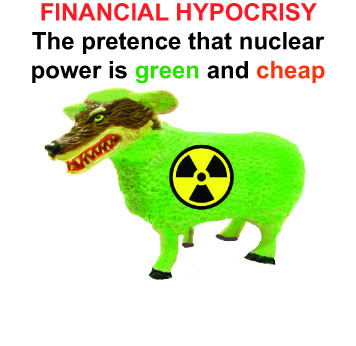
In the end, however, the poor economics of nuclear technology raise doubts that any labeling of nuclear energy as “clean” or “green” will spur private sector investment. Today, despite the industry’s self-proclaimed nuclear renaissance, private investment in nuclear technologies is minimal, and nuclear proponents are pinning their hopes on massive public sector handouts.
BY SUSAN O’DONNELL, MADIS VASSAR | November 8, 2023 https://www.hilltimes.com/story/2023/11/08/nuclear-energy-is-not-clean-or-green-in-the-european-unions-taxonomy/402401/
As calls are increasing for Finance Minister Chrystia Freeland to release the government’s “transition taxonomy” of energy sources aligned with climate goals, misinformation is circulating about the role of nuclear energy in the European Union’s taxonomy.
The Canadian government is expected to identify technologies for priority private sector investment to help Canada meet its “net-zero” targets.
An Oct. 13 letter to MPs from the Canadian Nuclear Association, a nuclear lobby group, states that “The European Union (EU) formally voted to include nuclear energy in its EU taxonomy.” This statement is partially true, but misleading.
On May 16, at a meeting of the House Natural Resources Committee, Bloc Québécois MP Mario Simard asked if Canada was one of the only countries that considers nuclear to be clean energy. In response, Mollie Johnson, assistant deputy minister of Natural Resources, said “under the taxonomy of the European Union, they have classified it as clean energy as well.” This statement is incorrect.
The European Commission (EC) established its Technical Expert Group on Sustainable Finance to develop scientific guidelines for the taxonomy. The group was asked to develop recommendations for technical screening criteria for economic activities that can make a major contribution to climate change mitigation and adaptation, while at the same time avoiding significant harm to sustainable use and protection of water and marine resources, transition to a circular economy, address pollution prevention control, and protection and restoration of biodiversity and ecosystems.
After the report excluded nuclear because of the generated toxic radioactive waste, the lobby group convinced the EC to commission another report by the nuclear-friendly Joint Research Centre which concluded that nuclear was eligible. After weeks’ more lobbying, a slight majority of the European Parliament voted in favour of adding nuclear and fossil gas in the taxonomy only as “transitional technologies”—definitely neither as green, clean, nor sustainable. Also, the members of the European Parliament did not approve any public investments in nuclear energy.
The transitional technology classification requires a country seeking funding for nuclear energy to fulfill stringent safety criteria. This means having solid plans within five years, including financing, for an operational deep geological disposal for used fuel and high-level waste in 2050. This criteria will be a huge challenge for states other than Sweden, France and Finland. The Onkalo used nuclear fuel repository in Finland was built at a cost of 5-billion euros, and after some 40 years, is still not licenced. Most other countries do not have those funds available, meaning that potential nuclear power-plant operators would have to contribute to the costs, making nuclear even less competitive in the energy market.
A similar political power play lacking wider environmental considerations surrounds another recent document, the Net-Zero Industry Act. The aim is to promote investments in the production capacity of products key to meeting the EU’s climate neutrality goals, and, again, nuclear was initially not included. Once again, strong lobby efforts won the reintroduction of nuclear, first as a “non-strategic” technology due to its long build times and staggering costs—factors that push any tangible climate benefits far into the future, as opposed to “strategic” climate mitigation options such as solar panels, batteries, and heat pumps. In the latest text, however, any distinction between different technologies is gone. As the Greens in the European Parliament commented, the Act has lost the initial focus, and it’s now for just about any technology.
Given that nuclear energy is not considered “green” in the EU taxonomy, financial analysts have questioned its value as a global “gold standard” because investors might prefer to use other taxonomies that value their real green investments. Canada has the opportunity to learn from these blunders.
In the end, however, the poor economics of nuclear technology raise doubts that any labeling of nuclear energy as “clean” or “green” will spur private sector investment. Today, despite the industry’s self-proclaimed nuclear renaissance, private investment in nuclear technologies is minimal, and nuclear proponents are pinning their hopes on massive public sector handouts.
However, aside from the Canada Infrastructure Bank’s $970-million ‘low-interest loan’ for Ontario Power Generation to develop an American design for a small modular nuclear reactor, the public funds for new nuclear proponents from Innovation, Science and Economic Development Canada have been just under $100-million in the past three years. Those funds require matching private sector funding that has not materialized. This is a far cry from the billions of dollars required to develop just one small modular nuclear reactor, and where that money will come from is still an open question. #nuclear #antinuclear #nuclearfree #NoNukes
Susan O’Donnell, PhD, is lead investigator for the CEDAR project at St. Thomas University. Madis Vasser, PhD, is senior expert on SMRs for Friends of the Earth Estonia.
Failed U.S. Nuclear Project Raises Cost Concerns for Canadian Small Modular Reactor (SMR) Development
“Once you’re on a dead horse, you dismount quickly. That’s where we are here.”
“the massively expensive SMR projects in Canada will eventually face the same reckoning”
Primary Author: Mitchell Beer, The Energy Mix, November 10, 2023 more https://www.theenergymix.com/2023/11/10/failed-u-s-nuclear-project-raises-cost-concerns-for-canadian-smr-development/
NuScale and its customer, Utah Associated Municipal Power Systems (UAMPS), announced they were cancelling the project earlier this week, after its anticipated cost increased 53% over earlier estimates, Bloomberg reports. “The decision to terminate the project underscores the hurdles the industry faces to place the first so-called small modular reactor into commercial service in the country.”
But a clear-eyed assessment of the project’s potential was really made possible by a level of accountability that doesn’t exist in Canada, said Gordon Edwards, president of the Canadian Coalition for Nuclear Responsibility.
“Private investors in Utah forced NuScale to divulge financial information regarding the cost of electricity from its proposed nuclear plant,” and “cost became the deal-breaker,” Edwards told The Energy Mix in an email. “Publicly-owned utilities in Canada are not similarly accountable. The public has little opportunity to ‘hold their feet to the fire’ and determine just how much electricity is going to cost, coming from these first-of-a-kind new nuclear reactors.”
In the U.S., the business case started to fall apart last November, when NuScale blamed higher steel costs and rising interest rates for driving the cost of the project up from US$58 to $90 or $100 per megawatt-hour of electricity. The new cost projection factored in billions of dollars in tax credits the project would receive under the Biden administration’s Inflation Reduction Act, amounting to a 30% saving.
At the time, the Institute for Energy Economics and Financial Analysis (IEEFA) estimated the total subsidy at $1.4 billion. This week, Bloomberg said NuScale had received $232 million of that total so far.
The cost increase meant that UAMPS “will not hit certain engineering, procurement, and construction benchmarks, allowing participants to renegotiate the price they pay or abandon the project,” Utility Dive wrote.
Scott Hughes, power manager for Hurricane City Power, one of the 27 municipal utilities that had signed on to buy power from the six NuScale reactors, said the news was “like a punch in the gut when they told us.” Another municipal utility official called the increase a “big red flag in our face.”
Nearly a year later, NuScale had to acknowledge that UAMPS would not be able to sell 80% of the output from the 462-MW project to its own members or other municipal utilities in the western U.S., Bloomberg writes. “The customer made it clear we needed to reach 80%, and that was just not achievable,” NuScale CEO John Hopkins said on a conference call Wednesday. “Once you’re on a dead horse, you dismount quickly. That’s where we are here.”
In Canada, “the massively expensive SMR projects in Canada will eventually face the same reckoning” predicted Susan O’Donnell, an adjunct research professor at St. Thomas University and member of the Coalition for Responsible Energy Development in New Brunswick. While the Canadian Energy Regulator’s modelling assumes SMRs could be built at a cost of C$9,262 per kilowatt in 2020, falling to $8,348 per kilowatt by 2030 and $6,519 by 2050, the latest cost estimate from NuScale exceeded $26,000 per kilowatt in Canadian dollars, O’Donnell said—and the technology had been in development since 2007.
“Too bad our leaders have chosen to pursue an energy strategy which is too expensive, too slow, and too costly in comparison with the alternatives of energy efficiency and renewables—the fastest, cheapest, and least speculative strategies,” Edwards wrote. He added that waste disposal and management challenges and costs for SMRs will be very different from what Canadian regulators have had to confront with conventional Candu nuclear reactors.
The news from NuScale landed just days after civil society groups in the European Union warned that SMR development won’t help the continent reach its climate goals. Citing prolonged project delays and cost overruns, the long time frame to develop unproven technologies, and the risks associated with radioactive waste disposal and proliferation of nuclear materials, they urged EU governments to focus on renewable energy, power grid development, and energy storage.
“Nuclear energy is being pushed by powerful lobbies and geostrategic interests,” with several EU states relying on Russian state nuclear company Rosatom for their uranium supplies, the groups said. “To quickly decarbonize, we must choose cheap technologies, easy to deploy at scale, like solar panels and windmills.”
But in the U.S., proponents are still holding out hope for future SMR development. “We absolutely need advanced nuclear energy technology to meet ambitious clean energy goals,” the U.S. Department of Energy said in a statement. “First-of-a-kind deployments, such as CFPP, can be difficult.”
Nuclear is not part of the plan -CEO of Hydro-Québec.
Hydro-Québec CEO Michael Sabia cautious on the nuclear issue. “Nuclear
is not part of this plan, period,” retorted the CEO of Hydro-Québec,
Michael Sabia, after having written in black and white in his action plan
presented Thursday that he wanted to study “the potential of the existing
Gentilly-2 site to accommodate a nuclear power plant. “In the figures
that we clearly presented concerning the increase in production, nuclear
power is not there,” assured Hydro-Québec’s number 1, walking on
eggshells, at a press conference on Thursday at its head office in
Montreal.
Journal de Montreal 2nd Nov 2023
https://www.journaldemontreal.com/2023/11/02/le-pdg-dhydro-quebec-michael-sabia-prudent-sur-la-question-du-nucleaire #nuclear #antinuclear #nuclearfree #NoNukes
Bad guys and bombs: The nuclear risks of small modular reactors

National Observer, By John Woodside November 3rd 2023
Nuclear proliferation experts are warning that 50 years of policy designed to limit the spread of nuclear weapons is unravelling as governments invest in certain small modular reactors that could be misused to build bombs.
The concerns are aimed at Moltex, a Saint John, N.B., nuclear startup building small modular reactors (SMRs) that will be powered with spent fuel from CANDU reactors. To make the fuel, Moltex plans to separate plutonium from uranium in CANDU waste and use the extracted plutonium to power new SMRs.
It is this separation process that led a dozen nuclear scientists to write to Prime Minister Justin Trudeau in September, warning him that Moltex is a nuclear weapon proliferation risk and calling for a formal risk assessment of emerging nuclear technologies.
Edwin Lyman, Union of Concerned Scientists nuclear power safety director, was one of the signatories of the letter. Lyman — who has testified multiple times before the U.S. Congress and the Nuclear Regulatory Commission on the topics of nuclear power safety, security and proliferation — said that by separating and concentrating plutonium, Moltex is completing one of the most difficult steps on the path to making a bomb.
“The very process of extracting plutonium from the spent nuclear fuel and concentrating it is itself a very serious proliferation and security threat because you’re simply doing the work of the bad guys for them by concentrating and extracting plutonium,” he said.
Extracting plutonium from nuclear waste, converting it into a fuel and then transporting the fuel to a reactor increase the nuclear weapon proliferation threat “immensely,” Lyman said. The alternative is leaving the plutonium in the waste, where it is more difficult to extract, he said.
Currently, nuclear waste created by existing reactors is stored in facilities designed for interim storage. But because the waste stays radioactive for thousands of years, long-term storage solutions are a pressing concern. Canada is exploring plans to deal with the waste by burying it deep underground. Moltex, which has received at least $50.5 million worth of federal government subsidies, $10 million from New Brunswick, and $1 million from Ontario Power Generation (and is eyeing roughly $200 million more), said its SMRs, which will use plutonium extracted from the waste and use it as new energy to power a reactor, is another viable solution because the waste becomes less radioactive in the process.
Both recycling and burying spent nuclear fuel come with risks. Burying the waste deep underground could hypothetically mean the site could be exploited as a plutonium mine for future nuclear weapon production while reprocessing it could open the door for clandestine repurposing.
The reactor technology is still being developed, but in the view of nuclear weapon proliferation experts interviewed by Canada’s National Observer, the Moltex design is similar enough to previously studied nuclear technologies that are called “proliferation-prone” rather than “proliferation-resistant.” For that reason, the company should be stopped in its tracks, they say…………………………………………….
Kuperman said it’s “misleading” to say the proliferation risk is only for a short period of time because Moltex not only would need to reprocess spent fuel at the start of its process to obtain the plutonium it needs but would also reprocess the fuel over the life of the reactor to “remove undesired products of reactor operation.” In other words, the proliferation risks last the life of each reactor, which is estimated at 60 years.
He said safeguards are also difficult, if not impossible, to implement when the risk is that plutonium could be diverted from the reactor to make bombs because discovering misuse after the fact is too late. A 2009 study from six U.S. national laboratories analyzing various types of nuclear-reprocessing technologies, some of which Kuperman described as similar to Moltex’s design, emphasized this risk.
“While an attempt by the state to separate pure plutonium in facilities using these technologies might be readily detected, once the state has withdrawn or broken out from its non-proliferation obligations, estimates of the time to convert the facility to separate pure plutonium ranges from a few days to a few weeks,” the study found.
That 2009 study is “objective and authoritative,” Kuperman said. “By contrast, the Moltex CEO is a businessman trying to make money by downplaying the nuclear weapons proliferation risks of his technology.”
In Kuperman’s view, the big picture is that there is a documented history of nuclear energy with peaceful purposes in mind having been misused to create bombs — and there is no reason to risk it again………………………………. more https://www.nationalobserver.com/2023/11/03/news/bad-guys-bombs-nuclear-risks-small-modular-reactors #nuclear #antinuclear #nuclearfree #NoNukes
Thunder Bay Council to debate nuclear waste position

Thunder Bay’s city council will debate whether to stake out a position opposing the transportation of nuclear waste through the city.
TBnewswatch.com Ian Kaufman, Oct 27, 2023
THUNDER BAY — Thunder Bay’s city council will consider its position on the transportation of nuclear waste through the area on Monday, as a decision to ship the waste to the Ignace area looms.
Citizen groups Environment North and We the Nuclear Free North asked council last year to endorse the “proximity principle,” which would dictate keeping nuclear waste as close as possible to its point of generation.
That ask was referred to the city’s intergovernmental affairs committee, which will present a recommendation against the step at a council meeting on Monday…………..
The groups point to a now decades-old plebiscite in which Thunder Bay voters expressed concerns over nuclear waste disposal.
A 1997 plebiscite asked citizens if they were in favour of nuclear waste disposal in the Thunder Bay area. Of roughly 40,000 who voted, over 91 per cent voted no.
In 2000, city council passed a motion building on that plebiscite, expressing “concern with the transportation of nuclear waste through the city of Thunder Bay.”………………
We the Nuclear Free North has launched a similar call to endorse the proximity principle at Queen’s Park, delivering a long-shot petition in May bearing over 1,000 signatures to the Ontario Legislature.
It wants the province to direct Ontario Power Generation to look to storage systems at or near points of generation, rather than a deep geological repository in other areas of the province.
The Nuclear Waste Management Organization, the industry group tasked with finding a disposal solution for Canada’s nuclear waste, is considering Revell Lake, between Ignace and Dryden, and South Bruce as DGR sites.
A selection between the two sites for the $25-billion project is expected in 2024. …………………………………………
Wendy O’Connor, communications lead for We the Nuclear Free North, said approving a repository in Ignace would force the region to bear the burden of a nuclear waste a problem “that’s been sidestepped for decades.”
“There is no solution to nuclear waste. There is no good, totally safe way to deal with it,” she said.
However, she believes a solution closer to where waste is generated at sites in Southern Ontario makes more sense……………………………….. https://www.tbnewswatch.com/local-news/council-to-debate-nuclear-waste-position-7745525 #nuclear #antinuclear #NoNukes
.
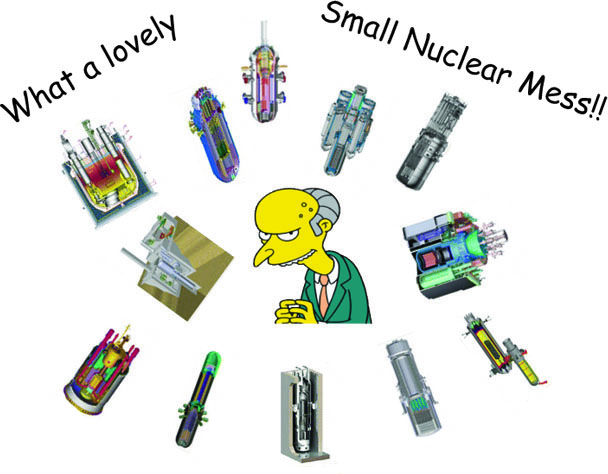
Why are Small Modular Nuclear Reactors a Dog’s Breakfast of Designs?
SMRs Information Task Force, 18 Oct 23 https://preview.mailerlite.com/i0i8d4u0o3/2327788063679321961/y8d5/
As of 2023 roughly 50 small modular reactor (SMR) designs are under development, with electrical generating capacity varying between 5 and 300 megawatts.
Compared to the current generation of larger nuclear reactors, SMRs would require smaller capital investments and provide options for deployment at remote locations with smaller power demands. But as reactor size goes down, unit cost goes up, as does the amount of radioactive waste per unit of electricity generated.
Different technology options attempt to address the concerns that plague the nuclear industry: safety, cost, radioactive waste, and weapons proliferation. However, designing for “passive safety”, opting for “waste recycling”, or providing “proliferation resistance” all involve trade-offs. With no clear “best” design, and no sizeable market, there is no justification for building a factory to mass-produce “modular” components to bring down costs.
SMR promoters have steered the debate away from these issues, arguing that all options for addressing climate change must be on the table. More SMR designs mean more opportunities to secure public subsidies.
The Government of Canada appears to have accepted the “all options” argument, and by funding multiple SMR designs is contributing to the illusion of profitability. Canada’s nuclear regulator, despite its limited capacity for technical assessment of SMR designs, has opted to boost them through largely inconsequential “vendor design reviews.”
| More than 80 years have passed since the first controlled, self-sustaining nuclear chain reaction. All proposed SMRs are essentially variations on older reactor designs that were tested decades ago and eventually abandoned. The World Nuclear Industry Status Report concludes that SMRs “will likely face major economic challenges and not be competitive on the electricity market.” #nuclear #antinuclear #nuclearfree #NoNukes |
Canada funding Ukrainian groups that celebrate WW2 Nazis – media

13 Oct 23 https://www.rt.com/news/584757-canada-funds-ukrainians-celebrate-nazi/
NGOs which honor the Waffen-SS reportedly received $2.2 million from the government over the last seven years
Ottawa has given $2.2 million over the last seven years to Ukrainian-Canadian groups that celebrate Nazi collaborators, Jewish-American news outlet The Forward reported on Wednesday.
Among the recipients of government grants are defenders of 98-year-old Ukrainian Nazi veteran Yaroslav Hunka, whose presence at a special session of the Canadian parliament last month caused a major scandal, according to the outlet.
The largest recipient of government financial support is the Ukrainian Canadian Congress, which is known for praising Hunka’s Nazi WWII division (SS Galicia) and protecting a monument to it in suburban Toronto, the Forward article claims. The organization is listed as having received nearly $1.5 million between 2016 and 2022, according to public records.
The Canadian government also supports the Ukrainian National Federation of Canada, whose logo includes the insignia of a faction of the fascist Organization of Ukrainian Nationalists. Between 2015 and 2022, it received $140,000 in grants, mostly to create summer jobs for youth, the outlet reported, stressing that the federation’s leader made statements exonerating Hunka last month.
The New Pathway newspaper, which fought for the monument to Ukrainian ultranationalist and Nazi collaborator Roman Shukhevich in Canada, received about $68,000 from a fund that supports local publishers, The Forward reported. Other Canadian government-funded organizations listed in the publication have also supported veterans of the Ukrainian Nazi unit or otherwise praised collaborators.
In late September, Canadian Prime Minister Justin Trudeau apologized for applauding a Ukrainian Waffen SS veteran during a parliamentary ceremony attended by the president of Ukraine, Vladimir Zelensky.
A few days later, Canadian Governor General Mary Simon reportedly expressed regret that in 1987, her office awarded the country’s second-highest merit to a Ukrainian immigrant who served in the 14th Waffen-SS Division. #Ukraine
New Brunswick small nuclear tech could be used for nuclear war: physicist.
John Chilibeck, Local Journalism Initiative reporter|, Brunswick News, 11 Oct 23
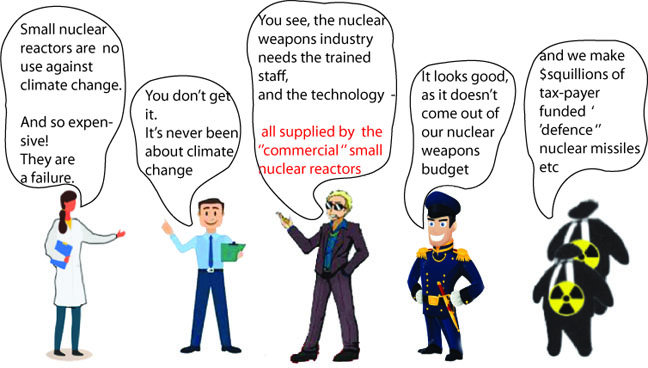
A physicist from British Columbia is warning that New Brunswick is heading down a dangerous path, increasing the likelihood of a nuclear war by supporting the development of small reactors for export.
M. V. Ramana, a professor and Simons Chair in Disarmament, Global and Human Security at the University of British Columbia, says the two companies that are trying to develop small modular reactors at Point Lepreau near Saint John – Moltex and ARC – use technology that could one day be used to make nuclear weapons.
If those reactors fell in the wrong hands, he says, humankind could be put at risk.
“All reactors use plutonium and many of them use enriched uranium. Both of these processes can also be used to produce weapons material,” the academic said from the Vancouver airport on Wednesday, a day ahead of his lecture at St. Thomas University in Fredericton at 7 p.m. at the Kinsella Auditorium, McCain Hall. “The other issue is personnel. People working with reactors can learn to make nuclear weapons. And lastly, in many countries, it’s the same institutions that are involved in developing nuclear energy as developing nuclear weapons.”
Ramana cited the country of his birth, India, which ostensibly developed reactors for peaceful purposes through its Department of Nuclear Energy but after a couple of decades started making weapons out of the material to counter the influence of Pakistan, which it has fought four wars against since independence in 1947.
He also mentioned Iran, which first acquired the technology for nuclear energy in the 1970s when the Shah was in power and the country was friendly to the West. Following the revolution of 1979, religious extremists took over who now sponsor terrorist attacks around the world – such as the Hamas raid last weekend that left 1,000 Israeli citizens and soldiers dead – and also want to develop their own nuclear arsenal.
New Brunswick, he said, could unwittingly undo years of international efforts to stop nuclear proliferation once the ARC and Moltex technologies are ready, expected sometime around 2030 or a few years after.
Despite a long history of producing nuclear energy, Canada has never made nuclear weapons. Ramana said that could change if the wrong politicians came to power.
“Look at what happened on January 6, 2021 at the Capitol Building,” he said of the attempted insurrection in the United States. “I don’t think anyone thought that would ever happen. And we don’t know who will be in power in Canada in 30 years.”
Moltex and ARC have made no secret of their desire to create prototype reactors in New Brunswick that could one day be made and sold to other places, both within Canada and to other countries. It’s part of their business model.
Rory O’Sullivan, the CEO of Moltex, recently wrote a letter to Prime Minister Justin Trudeau rebutting the criticisms of a group of anti-nuclear non-proliferation academics from the United States.
Ottawa has already provided Moltex $50 million to develop its technology, and New Brunswick $5 million. It will likely need more public investment to keep developing its technology…………………………..
“Imagine one day they export reactors to South Korea, or Saudi Arabia, or Nigeria, whatever country you want to think about it. When they send the reactors abroad, they’ll have to send the fuel for those reactors, and they have a very large amount of plutonium. A country could get the reactor and the plutonium and say, ‘we’re going to use the plutonium to make nuclear weapons,’ there’s very little we can do to sanction that country.”– said Ramana #nuclear #antinuclear #NuclearFree #NoNukes #NuclearPlants
Reconciling With Truth Requires Listening… what about nuclear waste?
September 30, 2023 https://mailchi.mp/preventcancernow/reconciling-with-truth-requires-listening?e=ba8ce79145 #nuclear #antinuclear #nuclear-free #NoNukes
As Canadians look back and Remember the Children who suffered at residential schools, we wish to highlight Algonquin First Nations’ important work to protect the health of children, and the Kitchi Sibi (Ottawa) River watershed from pollution.
The First Nations oppose a hillside nuclear waste Near-Surface Disposal Facility (NSDF) proposed on unceded Algonquin territory at the Chalk River Nuclear Laboratories. In a remarkable turn of events, rainfall during the final hearing on the NSDF demonstrated that the Canadian Nuclear Safety Commission (CNSC) is unlikely to meet its goal to keep nuclear waste secure for hundreds of years.
At Chalk River Nuclear Laboratories scientists first worked on the atomic bomb in the 1940s; ongoing nuclear research ever since has resulted in voluminous waste, that will remain toxic longer than planning horizons. People oppose transportation of nuclear waste through their communities, so the CNSC concluded that it had to deal with waste onsite. A federal Environmental Impact Statement (EIS) was published for a nuclear waste NSDF.
Disturbingly, assessment of the natural environment is absent from the federal EIS, so the Algonquin First Nations retained experts and published Assessment of the CNSC NSDF and Legacy Contamination in June 2023.
The federal assessment found that the top risk for stability of hillside waste disposal was severe rainfall. Too much rain could sweep the nuclear waste down the hill and into Perch Lake, polluting Perch Creek and the Kitchi Sibi River a kilometre away. This could pollute the ecosystem and food sources, as well as drinking water for millions of people downstream in smaller towns, Ottawa and cities.
On Aug. 10, 2023, at the sacred site where the Rideau, Kitchi Sibi and Gatineau rivers tumble together, Chiefs of Kebaowek, Kitigan Zibi Anishinabeg and Mitchibikonik Inik First Nations, Elders and other experts, made final submissions to the CNSC. As witnesses spoke, attendees heard a roar of rain drumming on the roof.
This rain flooded Ottawa streets and basements, stopped traffic, took out power, and backed up sewers. Five centimetres of rain fell in an hour, and more than 300 million litres of untreated water flowed into the Ottawa River.
The EIS vastly under-estimates future weather severity, defining “heavy rainfall” as over only 0.7 cm per hour. The EIS also cites a 2013 estimate of low tornado risks—an insult to fresh memories of catastrophic tornadoes and derechos in Eastern Ontario.
The acceleration of climate disasters is boggling Canada’s long-term predictions of the scale of extreme weather. The nuclear waste disposal facility was designed to withstand end-of-the-century estimates of less than five cm of precipitation in a day for Deep River, and over five cm in a day—not an hour—for Ottawa.
Ottawa’s not alone in breaking rainfall records and disproving future estimates. July 2023 brought rainfall disasters to Nova Scotia, with rainfall up to 50 cm per hour measured in one location. Much of the province experienced 20 cm in a day, causing widespread damage. Canadian federal climate predictions call for much less—up to 9 cm in a day by the end of the century.
If an Environmental Impact Assessment for a bridge was discovered to be this flawed—that the bridge would not withstand a storm as severe as what just occurred—it would be a good reason to reconsider the plans. The Canadian Nuclear Safety Commission should heed the warning from Mother Nature and deny the present proposal.
2
Define ‘Nazi’: Western media muddies history to cover up Canada’s SS scandal
https://www.rt.com/news/584101-western-media-nazi-canada/ 6 Oct 23 #Ukraine
“Fighting against the USSR didn’t necessarily make you a Nazi,” Politico says. Maybe. But Yaroslav Hunka definitely was one
Rachel Marsden is a columnist, political strategist, and host of independently produced talk-shows in French and English.
Historical revisionists are now trying to argue that actual Nazi soldiers were just anti-Soviet resisters.
We knew that it was coming. It was only a matter of time. And now attempts to whitewash the actions of actual Nazis from WWII have begun – all because a bunch of ignoramuses in the Canadian parliament cheered one alongside Ukrainian President Vladimir Zelensky, and it all just makes Ukraine and its Western supporters look bad.
It also makes Western lawmakers look like they have no clue when it comes to Nazism in Ukraine – either past or present. So instead of asking questions about their judgment, it’s time to ask whether you’ve just misunderstood Nazis.
The newly-resigned Canadian House Speaker introduced Ukrainian one-time Waffen-SS soldier Yaroslav Hunka as a Ukrainian (and naturalized Canadian) who fought Russians back in the day, yet apparently no one bothered to do the math. The Soviet Union was allied with the West against Nazi Germany. Nazi Germany was who fought against the Russians. Okay, it wasn’t the only one – there were others, like the Polish Home Army, which fought against both the Soviets and the Germans. So maybe Hunka was part of that? That’s the theoretical explanation the German Foreign Office offered when it emerged that the German ambassador to Canada was also present at the standing ovation in parliament. Yeah, that must have been it. A Ukrainian going to war to protect Ukraine from the Soviet Union by joining the Polish Home Army. Sounds plausible.
Oh, no, wait, he was actually in the Waffen SS, namely the First Galician Division – a unit that mostly consisted of Ukrainians and killed Poles and Jews. He joined it voluntarily and later described his decision in an essay published by an American online magazine. And now Poland wants him extradited for alleged war crimes.
Leaving aside convoluted historical revisionism, those who don’t acknowledge the nuance in this Nazi’s service are just feeding Russian propaganda, according to some Western commentators. “This history is complicated,” one wrote recently in POLITICO. “Because fighting against the USSR at the time didn’t necessarily make you a Nazi, just someone who had an excruciating choice over which of these two terror regimes to resist.”
It’s pretty safe to say that someone who volunteered for the combat branch of the Nazi Party’s paramilitary Schutzstaffel (SS) organization is an actual Nazi – unlike Canadian Freedom Convoy truckers and their supporters who were treated like Nazis by this same Canadian government, which went as far as to even block some of their bank accounts. Have Hunka and the actual Nazis who were welcomed to Canada in the wake of the war ever had their bank accounts blocked? Or is that just for people who honk too loudly in protest? Who’s more embarrassing to Canada: naturalized Nazis, truckers, or the parliament?
So apparently, we’re supposed to now believe that Waffen SS soldiers aren’t really Nazis, just anti-Soviet resistors. Are we supposed to also look deep into the heart and intentions of each individual who served voluntarily in the Nazi uniform to determine how they really felt about it? Who knows – perhaps Hunka didn’t really mean it when pledging loyalty to the Führer. Maybe he’s like an employee at Home Depot who can’t be held responsible for store policies – even though, in the case of Nazis, that didn’t fly either, as the Nuremberg Trials proved.
It takes some Olympic-grade mental gymnastics to suggest that neither Zelensky, who’s Ukrainian himself, nor Canadian Deputy Prime Minister Chrystia Freeland, who holds degrees in Russian and Slavic studies from Oxford and Harvard and whose grandfather edited a Ukrainian Nazi newspaper during WWII, couldn’t have known that this guy just might be a Nazi… but they whooped it up for him anyway. But now, their actions are on the verge of being reframed.
It’s all such a backside-covering move to compensate for a total lack of due diligence – the same kind that was demonstrated when it emerged that Canada had knowingly trained and equipped Azov Battalion neo-Nazis for Ukraine’s current conflict with Russia while seemingly being bothered far more by the notion that the press risked finding out about it than by the idea of training guys with Nazi tattoos.
To accept historic reality, instead of trying hard to weasel Justin Trudeau and the Canadian establishment out of this embarrassment, is to let “Russian propaganda” win. Seriously. That’s the argument. “Canada’s enemies have thus latched on to these simple narratives, alongside concerned citizens in Canada itself, with the misstep over Hunka being used by Russia and its backers to attack Ukraine, Canada and each country’s association with the other,” wrote the POLITICO commentator. Know who else has “latched on” to the “I can’t believe they could be that dumb” narrative around this Canadian Nazipalooza? Honest people and patriots who are, in fact, less interested in peddling narratives that serve a handful of establishment elites and more interested in defending historical realities that serve all of humanity rather than reframing or perverting them to suit an ideological cause – anti-Russian or otherwise.
Trudeau said in the same breath as his apology for the Hunka incident that “it’s going to be really important that all of us push back against Russian propaganda, Russian disinformation, and continue our steadfast and unequivocal support for Ukraine.” It seems that some have already jumped on the opportunity to redefine defense of well-established historical record as “Russian propaganda” and to impose the whims of Western leaders as the new dystopian reality.
Does Alberta need an orphan reactor problem as well?

Calgary Herald, Sep 30, 2023 https://calgaryherald.com/opinion/columnists/opinion-does-alberta-need-an-orphan-reactor-problem-as-well #nuclear #antinuclear #nuclear-free #NoNukes
On Sept. 19, at this year’s World Petroleum Congress, Minister of Environment and Protected Areas Rebecca Schulz announced that the Government of Alberta would invest $7 million into a study by Cenovus Energy on the potential usage of small modular nuclear reactors (SMRs) to power future oilsands operations.
Over the past year, the government has singlehandedly picked the winners and losers in the energy transition race. Hydrogen, carbon capture and nuclear are winners. With the recent moratorium on project approvals, solar and wind are set to be the losers. But don’t we, as Albertans, deserve a say?
The government’s new interest and investment in SMR feasibility should be a call to Albertans to start asking questions about what role (if any) nuclear should play in our energy future. Most of our current conversations are tied to the future of fossil fuels. Nuclear is not even on most people’s radar. We need to get ready to ask tough questions about nuclear energy that other jurisdictions are already debating.
Here are three questions that Albertans need to ask:

Who will regulate the use of SMRs?
Currently, the Alberta Energy Regulator (AER) is the single regulator of energy development in our province, overseeing the process from exploration to reclamation. AER’s recent silence after a known tailings leak at Imperial Oil’s Kearl oilsands mine has prompted questioning of not only AER’s transparency but also its ability to communicate risk and generate trust with communities that house energy projects. AER’s failure to notify residents in Wood Buffalo for nearly nine months about the estimated 5.3 million litres of leaked industrial wastewater has also raised serious questions about AER’s ability to ensure public safety. We need to ask: is AER, in its current form, the best regulator to oversee the development of nuclear energy?

What will happen to SMRs after they are decommissioned and where will we store our nuclear waste?
There are serious technological challenges to managing nuclear waste. Currently, Canada’s used nuclear fuel is managed at facilities at nuclear reactor sites in Ontario, Quebec and New Brunswick, along with limited sites in Manitoba. These are all temporary sites. The federal government is hoping to finalize a permanent nuclear repository after 15 years of planning, engagement and scientific and engineering studies. Residents of communities where nuclear storage has been proposed are worried. There are currently no nuclear waste repositories in western Canada. If SMRs are used in Alberta, how much waste will they generate? And where will it be stored? Alberta’s unimpressive track record with decommissioning and reclaiming former energy sites (such as orphan wells) means that we need to ask tough questions about the afterlife of SMRs now.

How will Albertans be consulted in the creation of the Government of Alberta’s nuclear energy strategy?
While it is commendable that the GoA is investing in studies that explore clean energy, there is currently no indication that Albertans will be consulted about nuclear energy. While SMRs would clearly have an impact on oilsands operations and aid the industry in meeting aggressive net-zero targets set by the federal government, the regulation of the nuclear energy industry will impact all Albertans. We should all have a say in determining our path forward in energy transitions. And we should be doing this through broad consultation led by an independent third party, who does not stand to benefit financially or regulatorily from the introduction of SMRs.
Albertans are supportive of energy transitions. We must begin a serious public discussion of how and if nuclear energy should be a part of it. We have an orphan well problem. Do we want an orphan reactor problem as well?
Sabrina Perić is an energy anthropologist, associate professor at the University of Calgary, and the co-director of the Energy Stories Lab.
CANADA WELCOMES HITLER’S TOP UKRAINIAN PROPAGANDISTS
SCHEERPOST, By Max Blumenthal / The Grayzone 1 Oct 23 “…………………………………………………………………………………………………………………………………………………….Throughout the Nazi German occupation of Poland, the Ukrainian journalist Michael Chomiak served as one of Hitler’s top propagandists. Based in Krakow, Chomiak edited an antisemitic publication called Krakivs’ki visti (Krakow News), which cheerled the Nazi invasion of the Soviet Union – “The German Army is bringing us our cherished freedom,” the paper proclaimed in 1941 – and glorified Hitler while rallying Ukrainian support for the Waffen-SS Galicia volunteers.
Chomiak spent much of the war living in two spacious Krakow apartments that had been seized from their Jewish owners by the Nazi occupiers. He wrote that he moved numerous pieces of furniture belonging to a certain “Dr. Finkelstein” to another aryanized apartment placed under his control.
In Canada, Chomiak participated in the Ukrainian Canadian Committee (UCC), which incubated hardcore nationalist sentiment among diaspora members while lobbying Ottawa for hardline anti-Soviet policies. On its website, the UCC boasted of receiving direct Canadian government assistance during World War Two: “The final and conclusive impetus for [establishing the UCC] came from the National War Services of Canada which was anxious that young Ukrainians enlist in military services.”
The UCC’s first president Volodymyr Kubijovych, had served as Chomiak’s boss back in Krakow. He also played a part in the establishment of the 14th Grenadier Division of the Waffen-SS Galicia, announcing upon its formation, “This historic day was made possible by the conditions to create a worthy opportunity for the Ukrainians of Galicia, to fight arm in arm with the heroic German soldiers of the army and the Waffen-SS against Bolshevism, your and our deadly enemy.”
FREELAND NURTURES MEDIA CAREER AS UNDERCOVER REGIME CHANGE AGENT IN SOVIET-ERA UKRAINE
Following his death in 1984, Chomiak’s granddaughter, Chrystia Freeland, followed in his footsteps as a reporter for various Ukrainian nationalist publications. She was an early contributor to Kubijovych’s Encyclopedia of Ukraine, which whitewashed the record of Nazi collaborators like Stepan Bandera, referring to him as a “revolutionary.” Next, she took a staff position at the Edmonton-based Ukrainian News, where her grandfather had served as editor.
A 1988 edition of Ukrainian News (below on original) featured an article co-authored by Freeland, followed by an ad for a book called “Fighting for Freedom” which glorified the Ukrainian Waffen-SS Galician division.
During Freeland’s time as an exchange student in Lviv, Ukraine, she laid the foundations for her meteoric rise to journalistic success. From behind cover as a Russian literature major at Harvard University, Freeland collaborated with local regime change activists while feeding anti-Soviet narratives to international media bigwigs.
“Countless ‘tendentious’ news stories about life in the Soviet Union, especially for its non-Russian citizens, had her fingerprints as Ms. Freeland set about making a name for herself in journalistic circles with an eye to her future career prospects,” the Canadian Broadcasting Corporation (CBC) reported.
Citing KGB files, the CBC described Freeland as a de facto intelligence agent: “The student causing so many headaches clearly loathed the Soviet Union, but she knew its laws inside and out – and how to use them to her advantage. She skillfully hid her actions, avoided surveillance (and shared that knowledge with her Ukrainian contacts) and expertly trafficked in ‘misinformation.’”
In 1989, Soviet security agents rescinded Freeland’s visa when they caught her smuggling “a veritable how-to guide for running an election” into the country for Ukrainain nationalist candidates.
She quickly transitioned back to journalism, landing gigs in post-Soviet Moscow for the Financial Times and Economist, and eventually rising to global editor-at-large of Reuters – the UK-based media giant which today functions as a cutout for British intelligence operations against Russia.
CANADA TRAINS, PROTECTS NAZIS IN POST-MAIDAN UKRAINE
When Freeland won a seat as a Liberal member of Canada’s parliament in 2013, she established her most powerful platform yet to agitate for regime change in Russia. Milking her journalistic connections, she published op-eds in top legacy papers like the New York Times urging militant support from Western capitals for Ukraine’s so-called “Revolution of Dignity,” which saw the violent removal of a democratically elected president and his replacement with a nationalist, pro-NATO government in 2014.
In the midst of the coup attempt, a group of neo-Nazi thugs belonging to the C14 organization occupied Kiev’s city council and vandalized the building with Ukrainian nationalist insignia and white supremacist symbols, including a Confederate flag. When riot police chased the fascist hooligans away on February 18, 2014, they took shelter in the Canadian embassy with the apparent consent of the Conservative administration in Ottawa. “Canada was sympathizing with the protesters, at the time, more than the [Ukrainian] government,” a Ukrainian interior ministry official recalled to the Canadian Broadcasting Corporation.
Official Canadian support for neo-Nazi militants in Ukraine intensified after the 2015 election of the Liberal Party’s Justin Trudeau. In November 2017, the Canadian military and US Department of Defense dispatched several officers to Kiev for a multinational training session with Ukraine’s Azov Battalion. (Azov has since deleted the record of the session from its website).
Azov was controlled at the time by Adriy Biletsky, the self-proclaimed “White Leader” who declared, “the historic mission of our nation in this critical moment is to lead the White Races of the world in a final crusade for their survival… A crusade against the Semite-led Untermenschen.”
AS NAZI FAMILY HISTORY SURFACES, FREELAND LIES TO THE PUBLIC
Back in Canada, Freeland’s troubling family history was surfacing for the first time in the media. Weeks after she was appointed in January 2017 as Foreign Minister – a post she predictably exploited to thunder for sanctions on Russia and arms shipments to Ukraine – her grandfather’s role as a Nazi propagandist in occupied Poland became the subject of a raft of reports in the alternative press.
The Trudeau government responded to the factual reports by accusing Russia of waging a campaign of cyber-warfare. “The situation is obviously one where we need to be alert. And that is why the Prime Minister has, among other things, encouraged a complete re-examination of our cyber security systems,” Public Safety Minister Ralph Goodale declared.
Yet few, if any, of the outlets responsible for excavating Chomiak’s history had any connection to Russia’s government. Among the first to expose his collaborationism was Consortium News, an independent, US-based media organization.
For her part, Freeland deployed a spokesperson to lie to the public, flatly denying that “the minister’s grandfather was a Nazi collaborator.”
When Canadian media quoted several Russian diplomats about the allegations, Freeland promptly ordered their deportation, accusing them of exploiting their diplomatic status “to interfere in our democracy.”
By this time, however, her family secrets had tumbled out of the attic and onto the pages of mainstream Canadian media. On March 7, 2017, the Globe and Mail reported on a 1996 article in the Journal of Ukrainian Studies confirming that Freeland’s grandfather had indeed been a Nazi propagandist, and that his writing helped fuel the Jewish genocide. The article was authored by Freeland’s uncle, John-Paul Himka, who thanked his niece in its preface for helping him with “problems and clarifications.”
“Freeland knew for more than two decades that her maternal Ukrainian grandfather was the chief editor of a Nazi newspaper in occupied Poland that vilified Jews during the Second World War,” the Globe and Mail noted.
After being caught on camera this September clapping with unrestrained zeal alongside hundreds of peers for a Ukrainian veteran of Hitler’s SS death squads, Freeland once again invoked her authority to scrub the incident from the record.
Three days after the embarrassing scene, Freeland was back on the floor of parliament, nodding in approval as Liberal House leader Karina Gould introduced a resolution to strike “from the appendix of the House of Commons debates” and from “any House multimedia recording” the recognition made by Speaker Anthony Rota of Yaroslav Hunka.
Thanks to decades of officially supported Holocaust education, the mantra that demands citizens “never forget” has become a guiding light of liberal democracy. In present day Ottawa, however, this simple piece of moral guidance is now treated as a menace which threatens to unravel careers and undermine the war effort in Ukraine.
Monuments to Ukrainian Nazis in Canada
W.O. Munce, https://www.thepostil.com/monuments-to-ukrainian-nazis-in-canada/
Given the fact that Ukraine and Nazis are again making news, it is important to point out that there are indeed commemorative monuments to Ukrainian Nazis in Canada, located where the Ukrainian populations are the greatest. The reasons for such monuments are known to the Ukrainian community alone, but so it is essential to make a record of them here, along with a hint at what those being commemorated did back in the days of World War Two.
“Ukrainian partisans and their allies burned homes, shot or forced back inside those who tried to flee, and used sickles and pitchforks to kill those they captured outside. Churches full of worshipers were burned to the ground. Partisans displayed beheaded, crucified, dismembered, or disemboweled bodies, to encourage remaining Poles to flee… It was this maimed OUN-Bandera, led by Mykola Lebed’ and then Roman Shukhevych, that cleansed the Polish population from Volhynia in 1943” (The Reconstruction of Nations).
The 14th Division of the Ukrainian SS surrounded the village Huta Pieniacka from three sides… The people were gathered in the church or shot in the houses. Those gathered in the church—men, women and children—were taken outside in groups, children killed in front of their parents. Some men and women were shot in the cemetery, others were gathered in barns where they were shot” (British archives).
“One of their major tasks as UPA partisans was the cleansing of the Polish presence from Volhynia. Poles tend to credit the UPA’s success in this operation to natural Ukrainian brutality; it was rather a result of recent experience. People learn to do what they are trained to do, and are good at doing what they have done many times. Ukrainian partisans who mass-murdered Poles in 1943 followed the tactics they learned as collaborators in the Holocaust in 1942: detailed advance planning and site selection; persuasive assurances to local populations prior to actions; sudden encirclements of settlements; and then physical elimination of human beings. Ukrainians learned the techniques of mass murder from Germans. This is why UPA ethnic cleansing was striking in its efficiency, and why Volhynian Poles in 1943 were nearly as helpless as Volhynian Jews in 1942. It is one reason why the campaign against Poles began in Volhynia rather than Galicia, since in Volhynia the Ukrainian police played a greater role in the Final Solution” (The Reconstruction of Nations).
“On that day, early in the morning, soldiers of this division, dressed in white, masking outfits, surrounded the village. The village was cross-fired by artillery. SS-men of the 14th Division of the SS ‘Galizien’ entered the village, shooting the civilians rounded up at a church. The civilians, mostly women and children, were divided and locked in barns that were set on fire. Those who tried to run away were killed. Witnesses interrogated by the prosecutors of the Head Commission described the morbid details of the act. The crime was committed against women, children, and newborn babies” (The Institute of National Remembrance. Commission for the Prosecution of Crimes against the Polish Nation).
Related Articles:
Canada’s Honoring of Nazi Vet Exposes Ottawa’s Longstanding Ukraine Policy
Following the war, Canada’s Liberal government classified thousands of Jewish refugees as “enemy aliens” and held them alongside former Nazis in a network of internment camps enclosed with barbed wire, fearing that they would infect their new country with communism. At the same time, Ottawa placed thousands of Ukrainian veterans of Hitler’s army on the fast-track to citizenship.
By celebrating a Waffen-SS volunteer as a “hero,” Canada’s Liberal Party highlighted a longstanding policy that has seen Ottawa train fascist militants in Ukraine while welcoming in thousands of post-war Nazi SS veterans. Canada’s second most powerful official, Chrystia Freeland, is the granddaughter of one of Nazi Germany’s top Ukrainian propagandists.
SCHEERPOST, By Max Blumenthal / The Grayzone 1 Oct 23
In the Spring of 1943, Yaroslav Hunka was a fresh-faced soldier in the 14th Grenadier Division of the Waffen-SS Galicia when his division received a visit from the architect of Nazi Germany’s genocidal policies, Heinrich Himmler. Having presided over the battalion’s formation, Himmler was visibly proud of the Ukrainians who had volunteered to support the Third Reich’s efforts.
80 years later, the Speaker of Canada’s parliament, Anthony Rota, also beamed with pride after inviting Hunka to a reception for Volodymyr Zelensky, where the Ukrainian president lobbied for more arms and financial assistance for his country’s war against Russia.
“We have in the chamber today Ukrainian war veteran from the Second World War who fought for Ukrainian independence against the Russians and continues to support the troops today even at his age of 98,” Rota declared during the September 22 parliamentary event in Ottawa.
“His name is Yaroslav Hunka but I am very proud to say he is from North Bay and from my riding of Nipissing-Timiskaming. He is a Ukrainian hero, a Canadian hero, and we thank him for all his service,” Rota continued.
Gales of applause erupted through the crowd, as Prime Minister Justin Trudeau, Zelensky, Deputy Prime Minister Chrystia Freeland, Canadian Chief of Defense Staff Gen. Wayne Eyre and leaders of all Canadian parties rose from their seats to applaud Hunka’s wartime service.
Since the exposure of Hunka’s record as a Nazi collaborator – which should have been obvious as soon as the Speaker announced him – Canadian leaders (with the notable exception of Eyre) have rushed to issue superficial, face-saving apologies as withering condemnations poured in from Canadian Jewish organizations.
The incident is now a major national scandal, occupying space on the cover of Canadian papers like the Toronto Sun, which quipped, “Did Nazi that coming.” Meanwhile, Poland’s Education Minister has announced plans to seek Hunka’s criminal extradition.
The Liberal Party has attempted to downplay the affair as an accidental blunder, with one Liberal MP urging her colleagues to “avoid politicizing this incident.” Melanie Joly, Canada’s Foreign Minister, has forced Rota’s resignation, seeking to turn the the Speaker into a scapegoat for her party’s collective actions.
Trudeau, meanwhile, pointed to the “deeply embarrassing” event as a reason to “push back against Russian propaganda,” as though the Kremlin somehow smuggled an nonagenarian Nazi collaborator into parliament, then hypnotized the Prime Minister and his colleagues, Manchurian Candidate-style, into celebrating him as a hero.
To be sure, the incident was no gaffe. Before Canada’s government and military brass celebrated Hunka in parliament, they had provided diplomatic support to fascist hooligans fighting to install a nationalist government in Kiev, and oversaw the training of contemporary Ukrainian military formations openly committed to the furtherance of Nazi ideology.
Ottawa’s celebration of Hunka has also lifted the cover on the country’s post-World War Two policy of naturalizing known Ukrainian Nazi collaborators and weaponizing them as domestic anti-communist shock troops. The post-war immigration wave included the grandfather of Deputy Prime Minister Chrystia Freeland, who functioned as one of Hitler’s top Ukrainain propagandists inside Nazi-occupied Poland.
Though Canadian officialdom has worked to suppress this sordid record, it has resurfaced in dramatic fashion through Hunka’s appearance in parliament and the unsettling contents of his online diaries.
“WE WELCOMED GERMAN SOLDIERS WITH JOY”
The March 2011 edition of the journal of the Association of Ukrainian Ex-Combatants in the US contains an unsettling diary entry which had gone unnoticed until recently.
Authored by Yaroslav Hunka, the journal consisted of proud reflections on volunteering for the 14th Grenadier Division of the Waffen-SS Galicia. Hunka decribed the Nazi Wehrmacht as “mystical German knights” when they first arrived in his hometown of Berezhany, and recalled his own service in the Waffen-SS as the happiest time in his life.
“In my sixth grade,” he wrote, “out of forty students, there were six Ukrainians, two Poles, and the rest were Jewish children of refugees from Poland. We wondered why they were running away from such a civilized Western nation as the Germans.”
The Jewish Virtual Library details the extermination of Berezhany’s Jewish population at the hands of the “civilized” Germans: “In 1941 at the end of Soviet occupation 12,000 Jews were living in Berezhany, most of them refugees fleeing the horrors of the Nazi war machine in Europe. During the Holocaust, on Oct. 1, 1941, 500–700 Jews were executed by the Germans in the nearby quarries. On Dec. 18, another 1,200, listed as poor by the Judenrat, were shot in the forest. On Yom Kippur 1942 (Sept. 21), 1,000–1,500 were deported to Belzec and hundreds murdered in the streets and in their homes. On Hanukkah (Dec. 4–5) hundreds more were sent to Belzec and on June 12, 1943, the last 1,700 Jews of the ghetto and labor camp were liquidated, with only a few individuals escaping. Less than 100 Berezhany Jews survived the war.”
When Soviet forces held control of Berezhany, Hunka said he and his neighbors longed for the arrival of Nazi Germany. “Every day,” he recalled, “we looked impatiently in the direction of the Pomoryany (Lvov) with the hope that those mystical German knights, who give bullets to the hated Lyakhs are about to appear.” (Lyakh is a derogatory Ukrainian term for Poles).
In July 1941, when the Nazi German army entered Berezhany, Hunka breathed a sigh of relief. “We welcomed the German soldiers with joy,” he wrote. “People felt a thaw, knowing that there would no longer be that dreaded knocking on the door in the middle of the night, and at least it would be possible to sleep peacefully now.”
Two years later, Hunka joined the First Division of the Galician SS 14th Grenadier Brigade – a unit formed under the personal orders of Heinrich Himmler. When Himmler inspected the Ukrainian volunteers in May 1943 (below), he was accompanied by Otto Von Wachter, the Nazi-appointed governor of Galicia who established the Jewish ghetto in Krakow.
“Your homeland has become so much more beautiful since you have lost – on our initiative, I must say – those residents who were so often a dirty blemish on Galicia’s good name, namely the Jews…” Himmler reportedly told the Ukrainian troops. “I know that if I ordered you to liquidate the Poles … I would be giving you permission to do what you are eager to do anyway.”
“HITLER’S ELITE TORTURERS AND MURDERERS HAVE BEEN PASSED ON RMCP ORDERS”
Following the war, Canada’s Liberal government classified thousands of Jewish refugees as “enemy aliens” and held them alongside former Nazis in a network of internment camps enclosed with barbed wire, fearing that they would infect their new country with communism. At the same time, Ottawa placed thousands of Ukrainian veterans of Hitler’s army on the fast-track to citizenship.
The Ukrainian Canadian newsletter lamented on April 1, 1948, “some [of the new citizens] are outright Nazis who served in the German army and police. It is reported that individuals tattoooed with the dread[ed] SS, Hitler’s elite torturers and murderers have been passed on RCMP orders and after being turned down by screening agencies in Europe.”
The journal described the unreformed Nazis as anticommunist shock troops whose “‘ideological leaders’ are already busy fomenting WWIII, propagating a new world holocaust in which Canada will perish.”
In 1997, the Canadian branch of the Simon Wiesenthal Center charged the Canadian government with having admitted over 2000 veterans of the 14th Volunteer Waffen-SS Grenadier Division.
That same year, 60 Minutes released a special, “Canada’s Dark Secret,” revealing that some 1000 Nazi SS veterans from Baltic states had been granted citizenship by Canada after the war. Irving Abella, a Canadian historian, told 60 Minutes that the easiest way to get into the country “was by showing the SS tattoo. This proved that you were an anti-Communist.”
Abella also alleged that Prime Minister Pierre Trudeau (Justin’s father) explained to him that his government kept silent about the Nazi immigrants “because they were afraid of exacerbating relationships between Jews and Eastern European ethnic communities.”
Yaroslav Hunka was among the post-war wave of Ukrainian Nazi veterans welcomed by Canada. According to the city council website of Berezhany, he arrived in Ontario in 1954 and promptly “became a member of the fraternity of soldiers of the 1st Division of the UNA, affiliated to the World Congress of Free Ukrainians.”
Also among the new generation of Ukrainian Canadians was Michael Chomiak, the grandfather of Canada’s second-most-powerful official, Chrystia Freeland. Throughout her career as a journalist and Canadian diplomat, Freeland has advanced her grandfather’s legacy of anti-Russian agitation, while repeatedly exalting wartime Nazi collaborators during public events.
CANADA WELCOMES HITLER’S TOP UKRAINIAN PROPAGANDISTS……………………………………………………………………………………………………………. more https://scheerpost.com/2023/10/01/canadas-honoring-of-nazi-vet-exposes-ottawas-longstanding-ukraine-policy/
Nazigate: Canada’s top general won’t apologize for applauding Ukrainian Waffen-SS vet
WYATT REED, ·SEPTEMBER 28, 2023, https://thegrayzone.com/2023/09/28/nazigate-canadas-general-ukrainian-waffen-ss/—
As Canada’s top officials express embarrassment for honoring a WWII Nazi collaborator in parliament, the leader of the country’s military, Gen. Wayne Eyre, refuses to apologize for his standing ovation. The Canadian military has trained Ukraine’s notorious neo-Nazi Azov Battalion for years.
Canadian politicians have been in frantic damage control mode since feting a former member of the Waffen-SS during a parliamentary reception for Ukrainian President Volodymyr Zelensky on September 22. The Speaker of Canada’s House of Commons, Anthony Rota, resigned following the incident, while Prime Minister Justin Trudeau lamented it as “extremely upsetting,” and opposition leader Pierre Poilievre branded the affair the “biggest single diplomatic embarrassment” in Canada’s history.
But amid the gratuitous public rites of contrition, one influential official has been conspicuously absent: Canada’s highest-ranking general. According to the Ottawa Citizen, Chief of the Defence Staff Gen. Wayne Eyre has “declined to apologize for his standing ovation” for Yaroslav Hunka, the now-notorious 98-year-old former member of the 14th Waffen Grenadier Division of the SS, whose members gained international infamy for hunting down anti-Nazi partisans, massacring thousands of civilians, and burning hundreds of Polish villagers alive.
The notion that the Nazi proclivities of figures like Hunka could have escaped Eyre’s notice now appears increasingly remote. In 2017, Ukraine’s Azov Battalion published photos on their website publicizing their meeting with high-level Canadian military officials, who had arrived in Ukraine to help train the notoriously neo-Nazi infested unit, which was officially incorporated into the Ukrainian National Guard.
A year later, Azov posted photos on its official social media channels showing Canadian military attaché Col. Brian Irwin meeting with its personnel. Responding to a query from journalist Asa Winstanley, a Canadian military spokesman justified training the fascist military on the grounds that the session “includes ongoing dialogue on the development of a diverse, and inclusive Ukraine.”
Just four months before Russia’s invasion of Ukraine, The Friends of Simon Wiesenthal Center for Holocaust Studies sent a letter to then-Acting Chief of the Defense Staff Gen. Wayne Eyre and Defense Minister Harjit Sajjan demanding an investigation into the decision to train Ukrainian neo-Nazis. The Jewish group urged them to ensure that such instruction did not continue.
“If Canada is going to be providing military training to foreign forces, then it is our responsibility to know we are not training neo-Nazis,” said Jaime Kirzner-Roberts, policy director of the Friends of Simon Wiesenthal Center. “It is our obligation to our Canadian veterans who sacrificed so much defeating fascism in Europe.”
But such warnings apparently went unheeded. The Canadian military not only declined to discontinue its Nazi-training policies, it escalated its program of coaching avowed fascists. Since Russian military operations in Ukraine kicked off in Feb. 2022, Canada has invested a further $1.6 billion USD in the arming and instructing of Kiev’s military.
On the sidelines of Zelensky’s now-infamous address to the Canadian Parliament, Ottawa authorized the further disbursement of another $483 million USD in aid and training on F-16 fighter jets.
Canada’s scheme of funneling weapons to Kiev and coaching Ukrainian forces officially began in 2014, just months after anti-Russian forces toppled the democratically-elected government of Viktor Yanukovych in a brutal US government-backed coup d’etat. Under the auspices of “Operation UNIFIER,” more than 33,000 Ukrainian troops received “advanced combat instruction by Canadian soldiers,” Canada’s state-affiliated CBC reported in 2022.
Ukraine’s ambassador in Ottawa, Yulia Kovaliv, heralded the training initiative as a “very important initiative.”
“It is also important to further provide Ukraine with heavy weapons,” she added.
In the UK, where Canadian forces frequently travel in order to school Zelensky’s army in the art of killing Russians, the program received a similarly warm welcome. An ebullient British Defense Secretary Ben Wallace said in a statement at the time that he was “delighted” that “the Canadian Armed Forces will be joining the growing international effort to support the training of Ukrainian soldiers in the UK.”
“Canada’s expertise will provide a further boost to the programme and ensure that the Ukrainian men and women, coming to the UK to train to defend their country, will get a wide pool of experience and skills from both UK forces and our international partners,” Wallace crowed.
Just what exactly the nationalist-leaning members of Ukrainian armed forces did with the training and tacit blessing of Canada has yet to be ascertained. But Azov members have been implicated in a number of war crimes. Despite the unit’s recent push to whitewash its Nazi tendencies, Azov — which has since expanded to a full-fledged brigade under Kiev’s official command — retains as its leader Andrey Biletsky, who once described Ukraine’s role on the global stage as helping to “lead the white races of the world in a final crusade … against Semite-led Untermenschen.”
Biletsky has taken pains to distance himself from the comment, but the unit has not undertaken similar efforts to distance itself from Biletsky. In September 2023, Biletsky was photographed proudly shaking hands with Zelensky during an intimate meeting with the Ukrainian President on the outskirts of Bakhmut. And Zelensky himself appears to have few problems with publicly associating with the group.
In a post commemorating the encounter with Ukraine’s most celebrated Nazi formation, Zelensky declared: “I am grateful to everyone who defends our country and people, who brings our victory closer.”
1 This Month


Tell the Ukrainian Government to Drop Prosecution of Peace Activist Yurii Sheliazhenko

Petition to revoke the licensing of the Near Surface Nuclear Disposal Facility (NSDF) at Chalk River. https://www.ourcommons.ca/petitions/en/Petition/Details?Petition=e-7247


of the week – STOP SMALL MODULAR REACTORS IN CANADA
To see nuclear-related stories in greater depth and intensity – go to https://nuclearinformation.wordpress.com
-
Archives
- March 2026 (176)
- February 2026 (268)
- January 2026 (308)
- December 2025 (358)
- November 2025 (359)
- October 2025 (376)
- September 2025 (258)
- August 2025 (319)
- July 2025 (230)
- June 2025 (348)
- May 2025 (261)
- April 2025 (305)
-
Categories
- 1
- 1 NUCLEAR ISSUES
- business and costs
- climate change
- culture and arts
- ENERGY
- environment
- health
- history
- indigenous issues
- Legal
- marketing of nuclear
- media
- opposition to nuclear
- PERSONAL STORIES
- politics
- politics international
- Religion and ethics
- safety
- secrets,lies and civil liberties
- spinbuster
- technology
- Uranium
- wastes
- weapons and war
- Women
- 2 WORLD
- ACTION
- AFRICA
- Atrocities
- AUSTRALIA
- Christina's notes
- Christina's themes
- culture and arts
- Events
- Fuk 2022
- Fuk 2023
- Fukushima 2017
- Fukushima 2018
- fukushima 2019
- Fukushima 2020
- Fukushima 2021
- general
- global warming
- Humour (God we need it)
- Nuclear
- RARE EARTHS
- Reference
- resources – print
- Resources -audiovicual
- Weekly Newsletter
- World
- World Nuclear
- YouTube
-
RSS
Entries RSS
Comments RSS
 nuclear-news