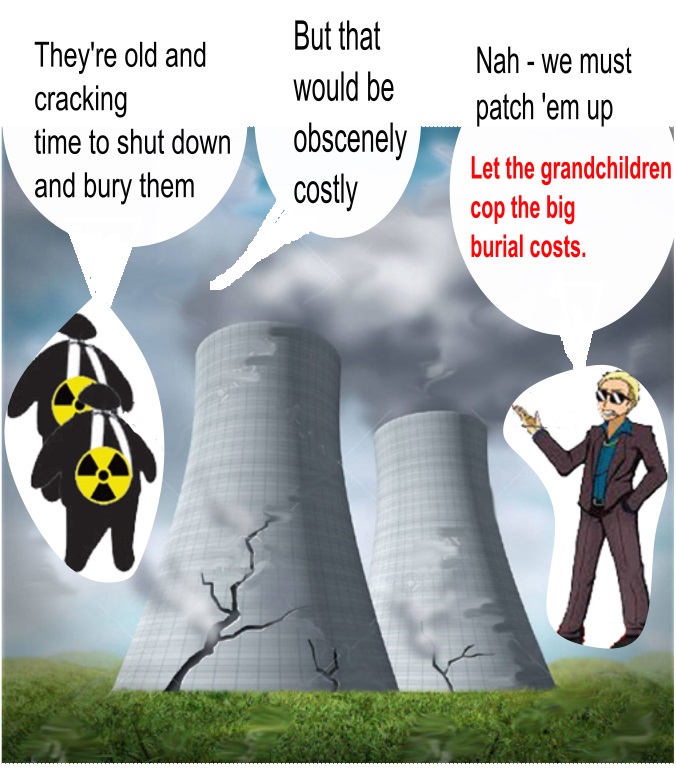
Ontario to announce refurbishment of four reactors at Pickering Plant
MATTHEW MCCLEARN, JEFF GRAY, QUEEN’S PARK REPORTER, TORONTO, 30 Jan 24, https://www-theglobeandmail-com.cdn.ampproject.org/c/s/www.theglobeandmail.com/amp/canada/article-ontario-pickering-nuclear-reactor/
Ontario is proceeding with a massive, multibillion-dollar refurbishment of four aging nuclear reactors at its Pickering power plant east of Toronto, according to two provincial government sources.
The decision will be formally unveiled by Ontario Energy Minister Todd Smith at the facility in Pickering on Tuesday, a senior government source said. This would mark the government’s latest major move to preserve and expand the province’s reactor fleet.
Another government official said the province has approved a $2-billion budget for Ontario Power Generation, the plant’s owner, to complete the necessary engineering and design work and order crucial components, which can require years to manufacture. The Globe and Mail is not naming the sources, because they were not authorized to speak publicly about the decision.
No full cost estimate for the project has been revealed. Refurbishments under way at OPG’s Darlington nuclear plant in Clarington, and at Bruce Power’s station in Tiverton, have cost between $2-billion and more than $3-billion a reactor.
Mr. Smith’s announcement had been expected. In 2022, the province asked OPG to study the feasibility of refurbishing the four Pickering “B” units, which entered service in the mid-1980s and had previously been passed over for refurbishment 15 years ago. Mr. Smith received OPG’s report last summer, but his ministry rebuffed a request from this newspaper to release it underthe province’s freedom of information legislation.
The Pickering station, situated on the shore of Lake Ontario about 30 kilometres from downtown Toronto, generates about 15 per cent of Ontario’s power. It also includes the four 1970s-era Pickering “A” reactors, which are not currently being considered for refurbishment. Two have been dormant for decades after an aborted refurbishment, and the remaining two are scheduled to shut down permanently this year.
OPG’s current licence for Pickering B allows its reactors to operate only to the end of this year. OPG has applied to the Canadian Nuclear Safety Commission, which regulates the industry, for permission to operate them until late 2026. CNSC approval would also be required for a refurbishment.
Refurbishment involves replacing major components to extend reactors’ operating lives by 30 years, although the list of required upgrades varies from station to station. Subo Sinnathamby, OPG’s chief projects officer, told The Globe earlier this month that, if the project were approved, OPG would begin Pickering’s refurbishment in 2028, with the goal of returning its reactors to service by the mid-2030s. Previous refurbishments have unfolded over longer periods.
“It is a compressed timeline,” she acknowledged. But she added that this time OPG will benefit from the experience it and its contractors and suppliers gained during previous refurbishments.
Tripling nuclear power: public relations fairy dust

January 2024, https://preview.mailerlite.io/emails/webview/664455/111177290781558405
| The federal government recently endorsed two similar nuclear fantasies. This month, Natural Resources Canada published a statement endorsing a plan to work with other countries to “advance a global aspirational goal of tripling nuclear energy capacity from 2020 by 2050.” The global nuclear declaration attracted endorsements from only 22 countries. In contrast, the official COP28 pledge to triple renewable energy by 2030 was signed by 123 countries and adopted by consensus as the official COP declaration.Earlier, in 2023, the Canadian energy regulator projected a tripling of Canadian nuclear generation capacity by 2050. Why is Canada engaged in a nuclear fantasy? |
Nuclear power plants operate in only two provinces. About 60% of Ontario’s electricity is produced by 18 nuclear power reactors. New Brunswick’s one power reactor produces about 19% of the electricity used in that province, when it’s not shut down. The federal energy regulator models envision tripling nuclear capacity by building small modular nuclear reactors in Prince Edward Island, New Brunswick, Quebec, Ontario, Manitoba, Saskatchewan, Alberta and British Columbia.
Ontario Power Generation (OPG) is promising that its SMR design will be the first in the world to be deployed commercially starting in 2030, although the design has not yet been licenced to build in Canada or anywhere else.
Assuming that this unit is chosen for widespread deployment in Canada, nearly 90 would need to be built and operating effectively on the grid between 2030 and 2050 to achieve the proposed tripling. Given the known construction time overruns for nuclear power plants, this is impossible.
Environment and Climate Change Canada published the official COP28 statement that does not mention nuclear energy. Instead, it highlights “groundbreaking goals to triple renewable energy, double energy efficiency, and, for the first time ever… a historic consensus to move away from fossil fuels in energy systems.”
Tripling renewable energy and doubling energy efficiency by 2030 is sensible and doable, as long as the requisite political will is present. It is past time to get real about the energy generation technologies we need to be supporting.
Ontario is about to decide whether to overhaul Canada’s oldest nuclear power plant. Does it deserve a second life?
All of these are Candu reactors – Canada’s homegrown reactor design. They deteriorate with age. Inside their cores, pressure tubes (which contain the uranium fuel) grow longer, thinner and weaker. They begin to sag and corrode, increasing the risk of ruptures. Feeder pipes, which supply water to the pressure tubes, also corrode and thin.
Globe and Mail, MATTHEW MCCLEARN, 21 Jan 24
The Pickering Nuclear Generating Station’s dull, mottled-grey concrete domes testify to its more than half a century of faithful service. Lately, its six operating reactors have produced enough electricity to supply 1.5 million people, about one-tenth of Ontario’s total population.
In the coming weeks, Ontario Energy Minister Todd Smith is expected to reveal whether the province will extend the plant’s life. A study last summer from Ontario Power Generation, the station’s owner, examined the feasibility of refurbishing Pickering’s four “B” reactors, commissioned between 1983 and 1986. OPG has said there’s no technical reason the work can’t proceed. If approved, it would begin in 2028, with the aim of returning the reactors to service in the mid-2030s.
The real question is whether it’s worth it.
A firm cost estimate for extending the reactors’ lifespan has not been finalized. Refurbishments under way at OPG’s Darlington nuclear plant in Clarington and Bruce Power’s station in Tiverton have cost between $2-billion and more than $3-billion per reactor. The reactors at Pickering, Canada’s oldest nuclear plant, could cost even more, though their output is relatively small by modern standards.
Ontario’s government has said little about how it is weighing this decision, and it’s unclear what other options, if any, the province is considering. OPG has said its feasibility study would compare the refurbishment’s economic viability to “potential alternatives,” but the finished report has not been released publicly.
The Globe and Mail made a freedom of information request for a copy of the study. But Sean Keelor, chief administrative officer at Ontario’s Ministry of Energy, withheld the document in its entirety. He cited exemptions within the province’s Freedom of Information Act for “advice to government” and for information that could damage the “economic or other interests of Ontario.”
The Canadian Nuclear Safety Commission, which regulates the industry, allows utilitiesto perform upgrades thateffectively double reactors’ lives, as long as “all practicable safety improvements to bring the facility up to modern standards” have been identified. Upgrading Pickering would be no small undertaking.
“They are very old reactors, and the equipment is out of date,” said Ibrahim Attieh, a reactor physicist who worked on Candu designs. “It’s going to be a lot more costly to retrofit new equipment in.”
The Pickering station, situated on the shore of Lake Ontario about 30 kilometres east of downtown Toronto, also includes the four 1970s-era Pickering “A” reactors, which are not under consideration for refurbishment.
Two have been dormant for decades after an aborted refurbishment, and the remaining two are scheduled to shut down permanently this year.
All of these are Candu reactors – Canada’s homegrown reactor design. They deteriorate with age. Inside their cores, pressure tubes (which contain the uranium fuel) grow longer, thinner and weaker. They begin to sag and corrode, increasing the risk of ruptures. Feeder pipes, which supply water to the pressure tubes, also corrode and thin.
Candus were originally expected to operate for about 30 years. The industry has said decisions on whether to refurbish should be made after a quarter century – a milestone Pickering B has already passed.
All refurbishments involve sending workers into a reactor’s radioactive core, to replace major components such as pressure tubes and feeder pipes. But the scope of work varies considerably, depending on the age, design and condition of components, as well as other factors. A utility might also improve other infrastructure at a nuclear plant, such as turbines and control room equipment.
Subo Sinnathamby, OPG’s chief projects officer, said that among the components that would need to be replaced at Pickering B are the steam generators, which use heat produced inside the core to boil water, creating steam that drives turbine blades.
Ms. Sinnathamby said these components are too large to be removed through the reactor’s airlocks.
“We will have to cut a hole in the dome to remove it,” she said.
Pickering B’s control room is straight out of the Cold War and would also require modernization.
Continue readingBig costs sink flagship nuclear project and they’ll sink future small modular reactor projects too.

By Susan O’Donnell and M.V. Ramana, 024, https://beyondnuclearinternational.org/2024/01/21/big-costs-sink-flagship-nuclear-project/
The major news in the world of nuclear energy last November was the collapse of the Carbon Free Power Project in the United States. The project was to build six NuScale small modular nuclear reactors (SMRs). Given NuScale’s status as the flagship SMR design not just in the U.S. but even globally, the project’s cancellation should ring alarm bells in Canada. Yet SMRs are touted as a climate action strategy although it is becoming clearer by the day that they will delay a possible transition to net-zero energy and render it more expensive.
The NuScale project failed because there were not enough customers for its expensive electricity. Construction cost estimates for the project had been steadily rising—from USD 4.2 billion for 600 megawatts in 2018 to a staggering USD 9.3 billion (CAD 12.8 billion) for 462 megawatts. Using a combination of government subsidies, potentially up to USD 4.2 billion, and an opaque calculation method, NuScale claimed that it would produce electricity at USD 89 per megawatt-hour. When standard U.S. government subsidies are included, electricity from wind and solar energy projects, including battery storage, could be as cheap as USD 12 to USD 31 per megawatt-hour.
A precursor to the failed NuScale project was mPower, which also received massive funding from the U.S. Department of Energy. Described by The New York Times as the leader in the SMR race, mPower could not find investors or customers. By 2017, the project was essentially dead. Likewise, a small reactor in South Korea proved to be “not practical or economic”.
Ignoring this dire economic reality, provincial governments planning for SMRs – Ontario, New Brunswick, Saskatchewan and Alberta – published a “strategic plan” seemingly designed to convince the federal government to open its funding floodgates. Offering no evidence about the costs of these technologies, the report asserts: “The power companies assessed that SMRs have the potential to be an economically competitive source of energy.”
For its part, the federal government has coughed up grants totalling more than $175 million to five different SMR projects in Ontario, New Brunswick, and Saskatchewan. The Canada Infrastructure Bank loaned $970 million to Ontario Power Generation to develop its Darlington New Nuclear project. And the Canada Energy Regulator’s 2023 Canada’s Energy Future report envisioned a big expansion of nuclear energy based on wishful thinking and unrealistic assumptions about SMRs.
Canada’s support is puzzling when considering other official statements about nuclear energy. In 2021, Environment Minister Steven Guilbeault said that nuclear power must compete with renewable energy in the market. The previous year, then Environment Minister and current Energy and Natural Resources Minister Jonathan Wilkinson also emphasized competition with other sources of energy, concluding “the winner will be the one that can provide electrical energy at the lowest cost.” Given the evidence about high costs, nuclear power cannot compete with renewable energy, let alone provide electricity at the lowest cost.
Investing huge amounts of taxpayer money in technologies that are uncompetitive is bad enough, but an equally serious problem is wasting time. The primary justification for this government largesse is dealing with climate change. But the urgency of that crisis requires action now, not in two decades.
All the SMR designs planned in Canada’s provinces are still on the drawing board. The design furthest along in the regulatory process – the BWRX-300 slated for Ontario’s Darlington site – does not yet have a licence to begin construction. New Brunswick’s choices – a sodium cooled fast reactor and a molten salt reactor – are demonstrably problematic and will take longer to build.
Recently built nuclear plants have taken, on average, 9.8 years from start of construction to producing electricity. The requisite planning, regulatory evaluations of new designs, raising the necessary finances, and finding customers who want to pay higher electricity bills might add another decade.
SMR vendors have to raise not only the billions needed to build the reactor but also the funding to complete their designs. NuScale spent around USD 1.8 billion (CAD 2.5 billion), and the reactor was still left with many unresolved safety problems. ARC-100 and Moltex proponents in New Brunswick have each asked for at least $500 million to further develop their designs. Moltex has been unable to obtain the required funding to match the $50.5 million federal grant it received in 2021.
Adverse economics killed the flagship NuScale SMR project. There is no reason to believe the costs of SMR designs proposed in Canada will be any lower. Are government officials attentive enough to hear the clanging alarm bells?
Susan O’Donnell is adjunct research professor and primary investigator of the CEDAR project at St. Thomas University in Fredericton. M.V. Ramana is the Simons Chair in Disarmament, Global and Human Security and professor at the School of Public Policy and Global Affairs, University of British Columbia.
Chalk River, or low-level nuclear governance.

Monique Pauzé, The author is a Bloc Québécois MP (Repentigny) and Environment critic., January 18, 2024
A few days ago, after several “rounds of work and consultation” that began in 2016, the Canadian Nuclear Safety Commission (CNSC) ruled in favor of the Chalk River Near Surface Waste Management Facility (NSWMF) project. Opposition to this open-air radioactive dump is undeniable: a multitude of aboriginal communities, citizen groups, scientists and over a hundred cities and municipalities spread around the Ottawa River, including Ottawa, Montreal and Gatineau.
To contextualize the issues surrounding this project, and to grasp the extent to which the authorization given is highly reprehensible, if not absurd, I believe it is pertinent to address it in the light of a study by the House of Commons Standing Committee on the Environment, specifically on Canada’s governance of radioactive waste. Held in 2022 and concluding with a report submitted to federal elected officials, the study is absolutely relevant today.
To begin with, we remind you that the International Atomic Energy Agency (IAEA) made suggestions and recommendations to the CNSC in 2019, during the peer review conducted by the Integrated Regulatory Review Service mission. As a result, we had confirmation, despite the government’s expressed pride, that Canada was not beyond reproach in this area, and this justified the attention of federal elected officials.
Many decried it: the essential principle of keeping radioactive waste away from sources of drinking water is not respected, and in many respects the project is at odds with the recommendations and guidelines of the IAEA, as well as with the five principles agreed and adopted by the leaders of 133 First Nations in Ontario.
There is an absence of consideration for the possible hazards associated with the project’s location and underground, hazards that attract less attention than the risks of contamination of watercourses, tributaries of the river, from which potentially millions of people draw their drinking water.
Legitimate opposition
In addition, Chalk River is located at the junction of geological fractures and in the western Quebec earthquake zone, a seismic belt that spans the Ottawa Valley, the Laurentians and parts of eastern Ontario. The volume of various radioactive wastes that will be buried in the open pit is substantial. Witnesses and experts have raised the issue of the lack of clarity in identifying the substances that will be introduced into the mound.
Opposition to the project is absolutely legitimate.
Several witnesses to this study accurately addressed the physical characteristics of Canadian radioactive waste, highlighting the redefinition of what constitutes intermediate-level radioactive waste, hidden in a CNSC “proof regulation” adopted in June 2020. William Turner, retired from Atomic Energy of Canada Limited and a resident of Deep River, provided the committee with a detailed fact sheet on this issue.
Gilles Provost, a science journalist and witness to the study, wrote in Le Devoir on June 13 of the same year: “[…] we come up against a scientific absurdity: in physics, the activity of a radioactive product is its decay rate. The faster it decays, the higher its activity. This means that a radioactive product with [higher] activity according to physics would now be low-level waste according to the new definition decreed by the CNSC!”
This new definition has concrete effects, since the Chalk River SRWMF is designed to receive only low-level waste. The result? Waste considered to be medium-level by physical science will end up in the mound, since it is now considered to be low-level.
For the Aboriginal communities of Kebaowek and Kitigan Zibi, the process chosen by the CNSC constitutes a failure in its duty to consult properly.
In addition to the disturbing comments made or sent by their representatives during the parliamentary committee study in 2022 about the “coercive” nature of the consultative approach, the aboriginal communities are rightly relying on Article 29.2 of the United Nations Declaration on the Rights of Indigenous Peoples, which states that no decision on nuclear waste storage, small modular reactors, transport or decommissioning can be taken without free, prior and informed consent.
“[…] We could explain it to you, but you wouldn’t understand it anyway. We’ll give you all the information and you won’t understand it.” This excerpt from the testimony of Reg Niganobe, Chief of the Grand Council of the Anishinabe Nation and a witness to the 2022 study, is shocking: when a representative of the sector expresses himself in this way, I think the climate they want to create is incredibly unhealthy and contemptuous. Non-native groups have also been subjected to this type of “approach” in similar processes. Their submissions to the committee study attest to this.
If there is indeed a political will to consider the communities most directly affected by these issues, then they must be given the consideration they deserve.
Reconciliation? Participatory consultations? Transparent processes and compliance with IAEA standards? The CNSC reports to Minister Jonathan Wilkinson, and the mobilization against Chalk River will continue. The federal government had better change its mind… It has the authority to do so.
$25 billion for refurbishment of Darlingon and Bruce reactors

Two Canadian nuclear refurbishment projects are in the top five of the largest public sector infrastructure projects currently under development in Canada, according to a newly published annual ranking. The annual Top100 Projects report, published by ReNew Canada magazine, features the 100 largest public sector infrastructure projects currently under development in the country ranked based on their confirmed project cost. Bruce Power’s refurbishment project is in third place with a project cost of CAD13 billion (USD9.7 billion), with Ontario Power Generation’s Darlington nuclear refurbishment in fourth place, at a cost of CAD12.8 billion.
Source: World Nuclear News, 15 January 2024
Commission decision a ‘gut-punch’, so years-long battle over radioactive waste mound will continue
“You cannot sit there and tell me that over the next 550 years nothing is going to leach out of this mound and get in and make its way into the surrounding environment and waterways.” —Kebaowek First Nation Councillor Justin Roy
By Shari Narine
Local Journalism Initiative Reporter
Windspeaker.com 12 Jan 24
Kebaowek First Nation is considering legal action now that the Canadian Nuclear Safety Commission has given the go ahead to Canadian Nuclear Laboratories (CNL) to construct a Near Surface Disposal Facility (NSDF) for solid low-level radioactive waste at its Chalk River Laboratories site on traditional unceded Algonquin territory.
“The big thing being discussed right now is pushing for a judicial review of the project. Just based on all of our environmental findings and the impacts that could be shown, we strongly believe we’d have a good case for this,” said Kebaowek First Nation Councillor Justin Roy.
Next steps will be decided once the legal team has fully reviewed the 169-page decision from the commission, which was released Jan. 9, he says.
The commission ruled it was confident that the NSDF project, an engineered containment mound for up to a million tonnes of radioactive and hazardous waste, was “not likely to cause significant adverse effects with respect to Aboriginal peoples.”
The containment mound is to be located 1.1 km from the Ottawa River on a bedrock ridge. The Kichi Sibi (Ottawa River) is sacred to the Algonquin people. The Chalk River site is also close to the sacred Algonquin sites of Oiseau Rock and Baptism Point.
The commission concluded “the design of the NSDF project is robust, supported by a strong safety case, able to meet its required design life, and sufficient to withstand severe weather events, seismic activity, and the effects of climate change.”
Roy calls the decision a “gut punch” but admits he is not surprised.
What does surprise him, however, is that the decision states that CNL adequately undertook a duty to consult with First Nations.
“I find that hard to believe when you have 10 of 11 Algonquin communities in direct opposition to the project. After everything that we’ve done over the last number of years and everything that we presented at last year’s hearing and then even in the hearing this last August, we’re just falling on deaf ears once again,” said Roy.
On June 9, the Algonquins of Pikwakanagan signed a long-term relationship agreement with CNL and Atomic Energy of Canada Limited, another nuclear organization. The agreement establishes a working group with representatives from all three parties.
The commission held that the disposal facility was also “not likely to cause significant adverse effects” when it came to fish and fish habitat, aquatic species at risk, migratory birds, or federal lands.
“We have inherent rights to our unceded Algonquin territory and that means we need to protect everything that encompasses that territory, from the environment, the trees, the land, the air, the water and all the living species that make up our Algonquin territory,” said Roy.
Algonquin people are on the ground, he said, hunting, fishing and picking berries and “were able to show that there are going to be plenty of environmental impacts and, especially, species at risk that are going to be affected by this.”……………………………………………………………… https://windspeaker.com/news/windspeaker-news/commission-decision-gut-punch-so-years-long-battle-over-radioactive-waste
‘PR Fairy Dust’ Has Canada Tripling Nuclear Capacity by 2050.

So far, federal and provincial taxpayers have been footing the bill for Small Nuclear Reactor development in Canada, with little private sector investment—meaning the investor scrutiny and cost controls that torpedoed the NuScale project are muted at best.
Would Canadian taxpayers be OK with continuing to shell out up to a trillion dollars for a technology with no proven track record of producing reliable, affordable electricity?
So far, federal and provincial taxpayers have been footing the bill for SMR development in Canada, with little private sector investment—meaning the investor scrutiny and cost controls that torpedoed the NuScale project are muted at best. Would Canadian taxpayers be OK with continuing to shell out up to a trillion dollars for a technology with no proven track record of producing reliable, affordable electricity?
January 8, 2024, Susan O’Donnell and M.V. Ramana, https://www.theenergymix.com/odonnell-and-ramana-pr-fairy-dust-has-canada-tripling-nuclear-capacity-by-2050/
Near the end of 2023, the government published its second nuclear fantasy of the year. The December statement declares that Canada will work with other countries to “advance a global aspirational goal of tripling nuclear energy capacity from 2020 by 2050.”
In a sprinkling of public relations fairy dust, the declaration is labeled “COP28”, although written well before the two-week climate summit in Dubai. The nuclear declaration managed to attract only 25 endorsing countries, in contrast to the official COP28 pledge to triple renewable energy and energy efficiency by 2030, signed by 123 countries and eventually adopted by consensus in the final COP declaration.
The currently operating power generating capacity of all nuclear plants in the world is 365 gigawatts. Tripling that total by 2050, in the next 26 years, will mean reaching close to 1,100 gigawatts. Looking back 26 years, the power capacity of the global nuclear fleet has grown an average of 0.8 gigawatts each year. At that rate, nuclear capacity in 2050 will be a mere 386 gigawatts.
And tripling today’s nuclear capacity would require the industry to overcome the significant setbacks and delays in new reactor construction that have plagued it forever with no solution in sight, while building an additional large number of reactors to replace old ones shut down over the same period.
Earlier last year, the Canada Energy Regulator (CER) published the country’s previous nuclear fantasy document, with scenarios that also projected roughly a tripling of nuclear generation capacity by 2050. Canada’s six nuclear plants currently produce about 13 gigawatts of power; a tripling would bring that to 39 GW. The CER report envisions this new nuclear capacity coming from so-called small modular nuclear reactors (SMRs).
Only two public utilities in Canada are proposing to build SMRs: NB Power in New Brunswick, and Ontario Power Generation (OPG). The most authoritative report to date on SMRs, from the U.S. National Academies, found that the designs planned for New Brunswick—a molten salt reactor and a sodium-cooled reactor—are unlikely to reach commercial deployment by 2050.
OPG is promising that its SMR design, a 300-megawatt boiling water reactor, will be the first in the world to be deployed commercially starting in 2030, although the design has not yet been licenced to build in Canada or anywhere else. Assuming that this unit is chosen for widespread deployment in Canada, nearly 90 would need to be built and operating effectively on the grid between 2030 and 2050 to achieve the proposed tripling. Given the known construction time overruns for nuclear power plants, this also is impossible.
The news on the SMR front from around the world has been bleak—especially in the United States, which has been trying to commercialize SMR designs for more than a decade. The flagship SMR design in the U.S., the NuScale light-water reactor, was the first to receive design approval by the U.S. Nuclear Regulatory Commission. However plans to build an array of NuScale reactors were shelved in November when the estimated construction costs ballooned to US$9.3-billion (C$12.8-billion) for 462 megawatts and potential customers fled. Earlier this month, NuScale laid off nearly half of its work force.
Assuming the NuScale construction costs of $27.7 million per megawatt would be an acceptable price range to customers in Canada, that would give the OPG design, also a light-water reactor, a cost of $8.3 billion per unit. If 90 units were built as a way to triple nuclear energy capacity, the total price tag would be $747 billion. That assumes that costs won’t go up during construction, as has been the case with the majority of nuclear projects in Canada and around the world.
So far, federal and provincial taxpayers have been footing the bill for SMR development in Canada, with little private sector investment—meaning the investor scrutiny and cost controls that torpedoed the NuScale project are muted at best. Would Canadian taxpayers be OK with continuing to shell out up to a trillion dollars for a technology with no proven track record of producing reliable, affordable electricity? Particularly when the energy efficiency, solar, and wind technologies explicitly favoured by the Intergovernmental Panel on Climate Change as the quickest path to emission reductions are already proven, affordable, and ready for prime time?
Last month’s bogus “COP28” nuclear declaration is posted on the Natural Resources Canada website. Like its counterpart in the United States, the Department of Energy, NRCan is the department responsible for promoting the interests of the nuclear industry. In both the United States and Canada, that industry has been failing for decades, and one of its strategies for securing government support has been to appeal to geopolitical interests. In recent years, that appeal has usually involved pointing out how Western countries are falling behind Russia, the largest exporter of nuclear power plants, and China, which has built more nuclear plants than any other country over the past decade.
The U.S. government has responded by using its diplomatic clout to promote nuclear energy, especially small modular reactors. In Washington, Energy and Natural Resources Minister Jonathan Wilkinson delivered Canada’s statement on nuclear energy that linked Canadian exports of uranium and nuclear technology to energy security in response to Russia’s invasion of Ukraine. This geopolitical context explains why Russia and China were conspicuously missing from the list of signatories to the declaration to triple nuclear energy capacity by 2050.
The nuclear industry’s other argument to stay alive is the bogus claim that it can help solve climate change. But as veteran energy modeller and visionary Amory Lovins pointed out: “To protect the climate, we must abate the most carbon at the least cost—and in the least time—so we must pay attention to carbon, cost, and time, not to carbon alone.” The climate crisis is urgent. The world has neither the financial resources nor the luxury of time to expand nuclear power.
Meanwhile, the website of Environment and Climate Change Canada, the department truly responsible for the country’s international climate commitments, has a genuine COP28 statement that does not mention nuclear. Instead, it highlights “groundbreaking goals to triple renewable energy, double energy efficiency, and, for the first time ever… a historic consensus to move away from fossil fuels in energy systems.”
Tripling nuclear energy by 2050 is a nuclear industry fantasy and complete make-believe. Tripling renewable energy and doubling energy efficiency by 2030 is sensible and doable, as long as the requisite political will is present. It is past time to get real about the energy generation technologies we need to be supporting.
Susan O’Donnell is Adjunct Research Professor and leader of the CEDAR project at St. Thomas University in Fredericton, New Brunswick. M.V. Ramana is Professor and Professor and Simons Chair in Disarmament, Global and Human Security at the University of British Columbia.
Kebaowek First Nation strongly opposes nuclear waste storage facility in Chalk River

Radioactive waste site in Chalk River a go
National Observer, By Natasha Bulowski / Local Journalism Initiative / Canada’s National Observer, 9 Jan 24
The Canadian Nuclear Safety Commission has greenlit a proposed nuclear waste storage facility in Chalk River, Ont., after a years-long battle waged by concerned citizens, environmentalists and First Nations.
On Jan. 9, the commission announced Canadian Nuclear Laboratories’ operating licence will be changed to allow construction of a “near-surface disposal facility” to hold up to a million tonnes of radioactive and hazardous waste. Stored in a large mound, the waste would sit about a kilometre from the Ottawa River, a culturally important river for Algonquins, and this proximity to drinking water for millions is one of many factors that raised alarm bells for opponents.
The proposed facility, referred to as the NSDF, “is not likely to cause significant adverse environmental effects” as long as Canadian Nuclear Laboratories sticks to its proposed mitigation and monitoring measures, the commission said in its decision.
Within hours of the announcement, Kebaowek First Nation put out a press release calling on the federal government to intervene and stop the project. Organizations representing 10 of the 11 Algonquin First Nations have opposed the project, alongside leaders and elders from those nations. Pikwakanagan First Nation, the only Ontario-based Algonquin Nation and closest to Chalk River, signed a long-term relationship agreement with Canadian Nuclear Laboratories on June 9, 2023………………………………………………
Kebaowek First Nation Chief Lance Haymond called the commission’s decision “unacceptable” because it goes against the rights of Indigenous Peoples and environmental protection in a press release issued a few hours after the decision.
“I want to be very clear: the Algonquin Peoples did not consent to the construction of this radioactive waste dump on our unceded territory,” Haymond said. “We believe the consultation was inadequate, to say the least, and that our Indigenous rights are threatened by this proposal.”
Algonquin leaders from Kebaowek and Kitigan Zibi Anishinabeg First Nations and Algonquins of Barriere Lake have long opposed the NSDF and have urged the commission to heed their concerns about environmental and human health. At the final licensing hearing in August, Kebaowek and Kitigan Zibi Anishinabeg argued the consultation was inadequate because it began far too late in the decision-making process and did not appear to take their concerns or traditional knowledge seriously………………………………………….
James Walker, a nuclear waste expert and former director of safety engineering and licensing at AECL, disputed the proclamation that all waste will be low-level in a submission to the commission. His calculations, based on the inventory of waste provided by Canadian Nuclear Laboratories, show that much of it is intermediate-level radioactive waste and should not be placed in a near-surface facility. There is also no inventory management system to properly verify the waste complies with the acceptance criteria, he wrote. Walker said the project is “non-compliant with International Safety Standards” for these reasons……………………..
Last month, concerned citizen Ole Hendrickson initiated a House of Commons petition (authorized by Pontiac, Que. MP Sophie Chatel) calling for an international review of three radioactive waste projects including the NSDF at Chalk River. At the time of writing, it has almost 2,950 signatures. Petitions require a minimum of 500 signatures to be presented in the House of Commons and receive an official response from the government. https://www.nationalobserver.com/2024/01/09/news/radioactive-waste-site-chalk-river-go#
Nuclear waste could threaten rare spot where endangered mussel thrives, experts say
Vast underwater cave in Ottawa River provides habitat for hickorynut mussel
Stu Mills ·CBC Ottawa reporter, Jan 02, 2024
Researchers with the Canadian Museum of Nature say a proposed nuclear waste storage facility upstream could destroy the delicate balance of two endangered species thriving in an Ottawa River cave network.
Last month, the museum’s André Martel lowered his scuba goggles and plunged into what he deemed an “extraordinary” segment of the river around Lac Coulonge east of Pembroke, Ont.
An absence of hydroelectric dams, a fast-flowing current, naturally forming fluvial sand dunes and the country’s longest freshwater cave network have made this an Eden for an endangered, wavy brown mollusc called the Hickorynut mussel.
Martel believes the delicate population of the freshwater mussel has a secret ally in a fish just as enigmatic and just as threatened: the lake sturgeon………………………………………………………………………………………
New facility at Chalk River
Though they don’t yet have the full answer, there is real concern about a proposal to dump nuclear waste near the shoreline upstream in Deep River, Ont.
A consortium led by SNC-Lavalin has proposed a “near surface disposal facility” waste site just one kilometre from the river.
The Canadian Nuclear Safety Commission plan has been panned by Montreal-area mayors whose millions of residents draw drinking water from the Ottawa River and by Algonquins who compared the proposal to building an outhouse next to a drinking well.
“Let’s be sure that we are aware of what we’re doing, what is at stake,” Martel said.
He said special protection is needed for the 141-kilometre segment of river where the fragile hickorynut and ancient sturgeon are working together to filter silt and bacteria from the water like a massive river kidney.
Katriina Ilves, a Canadian Museum of Nature ichthyologist — a marine biologist who studies different fish species — called the Lac Coulonge-area sturgeon population “an important, and enigmatic species.”
“I would have some concerns over any type of development that would have the potential to lead to contamination of this water system,” she said.
In an email, a spokesperson with the nuclear safety commission said it couldn’t answer specific questions about the proposal while the decision was likely just a few weeks away. https://www.cbc.ca/news/canada/ottawa/ottawa-river-nuclear-waste-hickorynut-mussel-cave-1.7065462
Nuclear waste site a potential danger to all who live here
Residents of affected communities should have a say on a potential nuclear waste storage site in Northwestern Ontario.
Chris Mills, https://www.nwonewswatch.com/letters-to-the-editor/nuclear-waste-site-a-potential-danger-to-all-who-live-here-8044416 1 Jan 2024
Nuclear Waste Management Organization has stated that they will put to a vote in two communities, Ignace/Wabagoon First Nation and South Bruce/Saugeen Ojibway Nation, for a permanent burial of nuclear waste.
I have been following this search for a burial place for nuclear waste since the early 1980s when Atomic Energy of Canada was in charge of the process. The planning and testing the concept of burial of nuclear waste goes back to the 1960s with drilling in Northern Manitoba. Manitoba has a High-Level Nuclear Waste Act, which states that there will be no storage of any nuclear waste that was not produced in Manitoba.
The site proposed to burial this nuclear waste is half way between Ignace and Dryden, but people in Dryden will not be given the option to vote on this waste site. When there is a leak (not if) the water flow will go into the Wabagoon water system, though to Dryden, Kenora and parts of Manitoba before heading north to Hudson Bay and south to Minnesota.
Do any of the people who will be affected have a vote on this nuclear waste site?
No.
When there is a nuclear accident with a transport moving this waste, we have no knowledge on how long the highway will be closed. We are not talking about a transport truck moving Amazon packages or a logging truck that closes down the highway for 12 hours, we could be talking weeks.
When there is an accident, and your home is contaminated, your insurance policy is null and void. If you read the fine print in your policy, it clearly stated that in case of a nuclear incident you are not covered.
You and everyone who is on the route to move this nuclear waste through Northwestern Ontario is in danger of losing everything you have worked so hard for. But you don’t have a vote because the Nuclear Waste Management Organization has rigged the system on who is allowed to say yes or no.
If this was great jobs and a safe option, do you honestly think that Southern Ontario would allow it to be buried in Northern Ontario? The answer would be no, they would be fighting to keep the jobs down in the South. But they got all the nuclear power, all the jobs, all the spin off jobs, and now they want to “Share” by giving us the hole.
‘Cover-up’ hearing Canadian Nuclear Safety Commission for late January 2024.

Gordon Edwards., 29 Dec 23
There will be a most unusual public hearing by the CNSC in late January 2024. It’s not a licensing hearing. It’s an attempt to cover up or to exonerate an act already performed by OPG without explicit approval.
The first construction licence for a commercial SMNR (Small Modular Nuclear Reactor) in Canada has been requested by OPG, who wants to build up to 4 GE-Hitachi “boiling water” reactors on the Darlington site. But there’s a glitch.
OPG used an old 2011 “site preparation licence” to prepare the site for the GE-Hitachi BWRX-300 reactor on the same property as the Darlington Nuclear Generating Station, where 4 large CANDU reactors are currently being refurbished.
The old licence was granted on the basis of an Environmental Assessment Report published in 2011 by a Joint Review Panel (JRP) who had examined and approved four large candidate reactors that had very little in common with the BWRX-300.
The JRP stipulated in their report that if OPG chooses a reactor design that is “significantly different” from those that they had examined from 2009-2011, then a NEW EA should be conducted. In other words, OPG should start over again.
But OPG “jumped the gun” by using that antiquated site preparation licence without explicit approval.
Fearing that they may have violated the terms of the 2011 EA Report, by using an old site preparation licence granted for a significantly different reactor construction project, OPG is now asking the CNSC to declare that the BWRX-300 design was, in effect, already approved by the JRP back in 2011 (even though no design of that type was ever considered by the JRP).
My intervention for this upcoming hearing is entitled “DNNP: Mischief in the Making” in which I argue that the 2011 EA Report did not and could not be construed to cover the BWRX-300, and recommending the CNSC to so confirm as a matter of fact.
Accordingly, before a construction licence is considered for a BWRX-300, a new EA is required.
Here is a link to my intervention: http://www.ccnr.org/DNNP-Mischief_in_the_Making_2023.pdf
Site for Canada’s underground nuclear waste repository to be selected next year

They don’t know if this vastly expensive nuclear waste disposal system will work – to protect future generations from toxic ionising radiation.
Yet they still keep making the poisonous stuff any way !!!
Allison Jones, The Canadian Press, December 27, 2023
A critical milestone is on the horizon for Canada’s 175-year-long plan to bury its nuclear waste underground, with two pairs of Ontario communities set to decide if they would be willing hosts.
Late next year, the Nuclear Waste Management Organization plans to select the site for Canada’s deep geological repository, where millions of bundles of used nuclear fuel will be placed in a network of rooms connected by cavernous tunnels, as deep below the Earth’s surface as the CN Tower is tall — if the process goes according to plan.
The sites are down to the Wabigoon Lake Ojibway Nation-Ignace area in northwestern Ontario and the Saugeen Ojibway Nation-South Bruce area in southern Ontario. The municipalities and First Nations are planning votes for next year, the culmination of a years-long information gathering process that some say has left deep divisions within their communities.
The process to move ahead with a deep geological repository is already more than 20 years along. The NWMO was established under legislation in 2002 and is funded by the corporations that generate nuclear power and waste, such as Ontario Power Generation and Hydro-Quebec.
While officials say they are confident at least one area will say yes, two rejections would be a major setback for the $26-billion project.
Ultimately, if both areas say no, then we have to start over — and by we I mean Canada,” said Lise Morton, the vice-president of site selection.
“We as a country would then be really pushing the resolution of this issue to the next generation.”
Both the municipality and First Nation in the area of either proposed site must confirm willingness to host the repository before the NWMO will proceed.
…………………………..there are a good number of people in the community who are not convinced — about 20 per cent are with Protect Our Waterways, the main opposition group, Goetz estimates — and it has caused “quite a friction.”
South Bruce is also in the shadow of Walkerton, Ont., where seven people died and thousands fell ill after drinking contaminated water in 2000. Fears about drinking water have lingered there long after the tragedy, said Bill Noll, vice chair of Protect Our Waterways.
Water also weighs heavily on the minds of members of the Wabigoon Lake Ojibway Nation, who have seen members of another northwestern Ontario First Nation on the English-Wabigoon river system grapple with generations of mercury poisoning after a mill in Dryden dumped 9,000 kilograms of the substance in the 1960s.
“That’s the evidence right now of how an industry went astray or how government oversight wasn’t there,” said Wabigoon Lake Ojibway Nation Chief Clayton Wetelain…………………………………………………….
all the tests and planning and modelling are not easing the fears of the project’s critics, either with the southern Ontario-based Protect Our Waterways or We the Nuclear Free North.
“The whole thing is a grand experiment,” said Brennain Lloyd, with the northern group.
“There’s not a deep geological repository … operating anywhere in the world. The NWMO likes to say, ‘Well, this is best international practice,’ but practice implies that it’s been done before. And there is no practice. Nobody has done this before.”…………………………………………………………………………….more https://www.cp24.com/news/site-for-canada-s-underground-nuclear-waste-repository-to-be-selected-next-year-1.6701756
“There is a big concern relative to water,” Noll said. “Once you pollute the water, there’s not much you can do about it.”
Bribery to indigenous people – by Canada’s nuclear lobby

Canada’s Nuclear Regulator Funds Indigenous Relations Boost
Mirage News, 12 Dec 23
Today, the Canadian Nuclear Safety Commission (CNSC) announced that it is awarding nearly $4 million to 19 Indigenous Nations and communities over 2 years through the new Indigenous and Stakeholder Capacity Fund (ISCF) – Indigenous Capacity Support stream. The ISCF serves to increase recipients’ capacity to better engage and participate in the CNSC’s full lifecycle of regulatory processes, programs and initiatives.
Launched in May 2023, the ISCF provides support for staffing and internal resources, Indigenous knowledge and land use studies, IT equipment acquisition, education and training opportunities, technical assistance, and other much-needed resources……………………………….. https://www.miragenews.com/canadas-nuclear-regulator-funds-indigenous-1141295/
Chinese Nuclear Weapons and Canada: An Uncivil-Military Connection

The United States should take action to ensure that domestic and foreign actors are not boosting the nuclear programs of adversaries.
by Henry Sokolski, https://nationalinterest.org/feature/chinese-nuclear-weapons-and-canada-uncivil-military-connection-207727 6 Dec 23
For decades, the Defense Department made little or no connection between China’s civilian nuclear power program and its military nuclear weapons buildup. No longer.
For the last three years, the Pentagon has explicitly linked Beijing’s “peaceful” fast reactor power program to China’s ramped-up weapons plutonium efforts and the projection China will acquire more than 1,000 nuclear warheads by 2030. In its latest annual China military power report, the Defense Department went further and revealed that China is using its civilian nuclear reactors to produce tritium to fuel its thermonuclear weapons.
China is doing this by placing lithium rods in power reactors and bombarding the rods with neutrons. This produces tritium, which subsequently is separated, much like how America makes its weapons tritium. It’s unclear if China uses all its power reactors—American, Canadian, Russian, French, or Chinese-designed—for this purpose.
The Pentagon report, however, notes that China uses a tritiated heavy water extraction process to cull tritium produced when hydrogen atoms absorb neutrons and become tritium atoms. The only reactors in China that use heavy water are located in Haiyan and operated by China National Nuclear Power Corporation (CNNC)—Beijing’s premier nuclear weapons contractor.
Canada supplied these reactors through Atomic Energy of Canada Limited (AECL), a Canadian government-owned firm. In addition, AECL agreed to work with CNNC on advanced heavy water reactors and related technologies. In 2011, AECL sold its heavy water reactor business to SNC-Lavalin Inc. (recently renamed AtkinsRealis). AtkinsRealis continues to collaborate with CNNC on its heavy water reactors.
However, Canada’s nuclear transfers to China aren’t limited to reactors. In late October, the Canadian firm Cameco, one of the world’s largest uranium suppliers, announced it had contracted to sell more than 97,500 metric tons of uranium to CNNC. Cameco says it will send the CNNC more than 12,700 metric tons annually for the next four years. 12,700 metric tons is roughly 200 to 300 metric tons more than China’s entire civilian sector consumes annually. The 200-to-300-ton surplus alone could fuel as many as 100 bombs each year.
This should raise eyebrows. With poor domestic uranium resources, China insists it’s only building up its uranium reserves for future nuclear power use. Perhaps, but there is no agreed way to verify this. The same is true with tritium. Currently, there are no effective controls on either nuclear substance to assure their peaceful end-use. Both, however, are critical to making nuclear weapons, and CNNC, China’s top weapons vendor, controls these materials.
What should be done?
First, our government needs to name and shame firms exporting critical nuclear materials and technologies to America’s nuclear-armed rivals. This would require spotlighting Canada’s Cameco and AkinsRealis. It also would require listing France’s nuclear firm, EDF, which this spring announced it would work with CNNC in developing advanced spent fuel recycling, a process critical to producing weapons plutonium. Yet, another entity that deserves dishonorable mention is Rosatom, Russia’s prime nuclear weapons developer, in addition to firms in business with the company. The House has already spotlighted Rosatom as a bad actor, asking the White House to sanction it for assisting China’s fast reactor program.
To expose these entities further, the Departments of Defense and the Intelligence Community should produce an unclassified annual report clarifying which domestic and foreign firms might be transferring nuclear materials and technologies to hostile states’ nuclear weapons entities.
Second, the U.S. government should prohibit government purchases and subsidies to these firms. Congress and the White House may be reticent to sanction firms for trading with hostile states’ nuclear weapons entities. But our government should, at least, not buy goods from such firms or subsidize them.
Finally, the United States and other like-minded nations should call on the International Atomic Energy Agency to track and safeguard tritium and unenriched uranium to prevent their diversion to make bombs. Fortunately, there is little commercial demand for tritium. Most of what is produced is then extracted from reactors for occupational safety reasons and is accounted for.
Similarly, most uranium ore is used to fuel legitimate civilian reactors. Yet, it too is critical to make nuclear weapons, and it is not currently tracked or safeguarded. Given that the government already tracks and sanctions certain oil and gas transfers—a daunting task—it’s difficult to understand why we don’t do the same for uranium and tritium. In the lead-up to the next Nuclear Nonproliferation Treaty Review Conference in 2026, the United States should close this gap.
Henry Sokolski is the executive director of the Nonproliferation Policy Education Center in Arlington, Virginia, and the author of Underestimated: Our Not So Peaceful Nuclear Future (2019). He served as deputy for nonproliferation policy in the office of the U.S. Secretary of Defense during the George H.W. Bush administration.
1 This Month
19 February – VIRTUAL EVENT-Decision Time: AI and Our Nuclear Arsenal
12:45 p.m. Central / 1:45 p.m. Eastern
To see nuclear-related stories in greater depth and intensity – go to https://nuclearinformation.wordpress.com
-
Archives
- February 2026 (161)
- January 2026 (308)
- December 2025 (358)
- November 2025 (359)
- October 2025 (376)
- September 2025 (258)
- August 2025 (319)
- July 2025 (230)
- June 2025 (348)
- May 2025 (261)
- April 2025 (305)
- March 2025 (319)
-
Categories
- 1
- 1 NUCLEAR ISSUES
- business and costs
- climate change
- culture and arts
- ENERGY
- environment
- health
- history
- indigenous issues
- Legal
- marketing of nuclear
- media
- opposition to nuclear
- PERSONAL STORIES
- politics
- politics international
- Religion and ethics
- safety
- secrets,lies and civil liberties
- spinbuster
- technology
- Uranium
- wastes
- weapons and war
- Women
- 2 WORLD
- ACTION
- AFRICA
- Atrocities
- AUSTRALIA
- Christina's notes
- Christina's themes
- culture and arts
- Events
- Fuk 2022
- Fuk 2023
- Fukushima 2017
- Fukushima 2018
- fukushima 2019
- Fukushima 2020
- Fukushima 2021
- general
- global warming
- Humour (God we need it)
- Nuclear
- RARE EARTHS
- Reference
- resources – print
- Resources -audiovicual
- Weekly Newsletter
- World
- World Nuclear
- YouTube
-
RSS
Entries RSS
Comments RSS
 nuclear-news