Say no to small modular reactors: Stop normalizing the exploitation of nature

The Bulletin, By Erin Hurley | April 1, 2024 Erin Hurley is a fourth-year student at St. Thomas University in Fredericton, New Brunswick, where she studies Environment & Society and Journalism. She was a research assistant last year on the Plutonium Project, funded by the Social Sciences and Humanities Research Council (SSHRC), for which she explored news media discourses on proposed small modular reactors in New Brunswick. This year, she is a research assistant on the SSHRC-funded CEDAR (Contesting Energy Discourses through Action Research) Project, for which she is focusing on news media coverage of energy transitions in the province.
Among other global crises, the worsening impacts of climate change are intensifying every year. Last year was the warmest on record and, beginning in March 2023, raging wildfires filled cities across Canada with smoke for months. This year is already shaping up to be warmer than the last. This is why a lot of young people are questioning the very systems we live under. This is why many of us support a rapid and just transition in energy. But in this process, some governments are promoting an expansion of nuclear power, supposedly to solve climate change. I fear that such an expansion will result in my generation having to confront an equally terrifying set of problems resulting from the nuclear fuel chain.
This is precisely what I already see happening around me in the Canadian province of New Brunswick where I live and study. Over the last few years, the province’s government has advocated for and funded the development of what it calls small modular reactors (SMRs). Even though SMR doesn’t include the word “nuclear,” these are nuclear reactors. Ostensibly, these reactors are meant to decarbonize the Canadian economy. But in 2021, New Brunswick Energy Minister Mike Holland protested the 2030 target for phasing out coal in the province, saying new nuclear reactors would not be ready in time to meet that goal. How will the expansion of nuclear power decarbonize the economy if, meanwhile, New Brunswick is still extracting and burning fossil fuels?
The province has funded two companies—Moltex Energy and ARC Clean Technology—to develop small modular reactors. On their websites, Moltex and ARC market nuclear power as “clean,” “carbon free,” and a “clean energy solution.”
Last year, Moltex CEO Rory O’Sullivan spoke to me, my fellow students, and professors working on the Plutonium Project at St. Thomas University in Fredericton, New Brunswick, in which we explored these small modular reactors being proposed for the province to develop an understanding of the assumptions, claims, and implications of these technologies. I remember O’Sullivan as friendly and well-spoken. He emphasized that a transition away from fossil fuels is necessary and that renewable energy is a key element in this transition. Yet he told us that wind farms, for example, could not generate enough energy to sustain our society, and that battery storage was not advanced enough to help with this, and thus renewables could not be considered an effective climate solution on their own. This is why he advocates for small modular reactors—as a necessary supplement to renewables in the energy transition. But, again, he stressed that, at Moltex, they were working to reduce any potential safety risks.
This made me wonder: What about the highly radioactive waste these reactors will produce?
Even if SMRs produce less waste than past nuclear reactors (although not when weighted by how much electricity they produce), spent fuel will remain dangerously radioactive for thousands of years. While nuclear proponents have argued that a deep geological repository would be an effective storage space for the waste, there are many uncertainties surrounding this proposal, and the long-term impacts are unknown. The proposed sites for the repository are located on traditional Indigenous lands in the Wabigoon Lake Ojibway Nation-Ignace and Saugeen Ojibway Nation-South Bruce areas in Ontario. Because the safety of the proposed repository is unproven, storing radioactive waste there would jeopardize the health of the local Indigenous communities and their lands.
Moltex and ARC have advertised reprocessing as a way to recycle waste and use it to power other reactors. However, this is also incredibly dangerous, because once plutonium is separated from used nuclear fuel, it can be used much more easily in the production of atomic weapons. If separated plutonium were to fall into the wrong hands, the result would be nuclear proliferation—an increased number of nuclear weapons across the globe.
In addition to the waste and proliferation problems, small modular reactors will not be built and operating in time to be an effective climate solution. Canada’s climate targets involve decreasing greenhouse gas emissions to 40 per cent below 2005 levels by 2030 and reaching net-zero by 2050. However, ARC predicts that it will finish building its first small modular reactor by 2028 which will “replace the existing coal generation station in 2030” at Point Lepreau Nuclear Generating Station in Saint John, New Brunswick. And Moltex does not expect to have an “operational reactor” until “the early 2030s.”
This timeline will clearly not help Canada reach its decarbonization goal by 2030, and so the country will not be on track for the 2050 goal either. Given these realities, I find it hard to believe that nuclear power is in the best interest of humans, non-human species, or the planet as a whole.
Capitalist nations that prioritize economic growth above all else, such as the United States and Canada, have normalized the exploitation of nature……………………………………………….. more https://thebulletin.org/2024/04/say-no-to-small-modular-reactors-stop-normalizing-the-exploitation-of-nature/#post-heading
‘Nuclear Dinosaurs’ Roam New Brunswick, Ontario as ‘Jurassic’ Partnership Looms

how would this serve the interests of Ontario ratepayers and taxpayers? OPG’s nuclear liabilities are ultimately underwritten by Ontario taxpayers. Could Ontario end up on the hook for NB Power’s nuclear debts and liabilities as a result of OPG’s extra-provincial activities?
March 29, 2024, Susan O’Donnell and Mark Winfield , ore https://www.theenergymix.com/nuclear-dinosaurs-roam-new-brunswick-ontario-as-jurassic-partnership-looms/
Two lonely nuclear dinosaurs finding each other in the Jurassic forest: perhaps an appropriate image for a planned partnership between NB Power and Ontario Power Generation (OPG).
Each is stuck in the past, the only two utilities left in Canada operating nuclear power reactors. Both have rejected modern, efficient, decentralized, nimble, distributed energy systems powered by low-cost renewable energy in favour of keeping their aging CANDU reactors alive. Together, the two lumbering public utilities plan to bring forth a revitalized New Brunswick Point Lepreau reactor, hoping their new progeny will reverse its previous ailing fortunes.
From NB Power’s perspective, it’s a pairing made in uranium heaven. The utility is carrying a C$3.6 billion nuclear debt from the original 1975-1983 Lepreau reactor build that cost triple the original estimate, then the 2008-2012 refurbishment that was a billion dollars over budget. Both projects ran years behind schedule.
Since the refurbishment, the poor performance of the Lepreau reactor has been the primary reason NB Power loses money almost every year. By shedding the reactor off to a new entity co-owned with OPG, NB Power can move its debts and potential future losses off its books, and onto those of OPG and NB Power’s new creation.
OPG has already established a three-year, $2 million-per-year contract to supply staff to manage the Lepreau facility. This is an expensive arrangement for NB Power, at double the cost of the American manager OPG has replaced. Presumably this is a loss leader for NB Power to help cement its budding relationship with OPG.
What would then happen with the Lepreau reactor’s debt, representing about three-quarters of NB Power’s liabilities? Maybe the new partnership would use Ontario’s approach to making the nuclear debt disappear. More than 25 years ago, the effectively bankrupt provincial utility Ontario Hydro was split up (ch. 5 and 6). A new Crown corporation, OPG, inherited Ontario Hydro’s hydropower, coal, and nuclear plants. With them would have come $20 billion in stranded debt, largely left over from the nuclear construction program that was instrumental to Ontario Hydro’s demise. But servicing that debt would have left OPG economically unviable, so the $20 billion was hived off to Ontario taxpayers and then electricity ratepayers via a “debt retirement charge” on their bills.
Between 2002 and 2016, OPG’s rates rose by 60%, largely to pay for the refurbishment of two reactors at the Pickering A plant (two other attempted refurbishments at the plant were write-offs), contributing to a political crisis over electricity rates that ultimately led to the defeat of Kathleen Wynne’s Liberal government in 2018. New Brunswick’s much smaller population with a lower average household income is likely to be even less accepting of increased rates to service OPG’s nuclear ambitions.
Why would OPG, whose mandate to undertake out-of-province business activities is at best unclear, and which is deeply engaged in its own reactor refurbishment megaprojects at the Darlington and Pickering B nuclear plants, want to take on a money loser like the Lepreau reactor in the long term?
The refurbishments of the eight reactors at Darlington and Pickering B, both on the Lake Ontario shoreline just east of Toronto, will cost more than $25 billion. Along with the $25-billion refurbishment of six reactors at the Bruce facility on Lake Huron, these projects will stretch the industry’s capacity to the limit. Why take on another reactor needing an expensive rebuild on the Bay of Fundy?
Perhaps the partnership with NB Power simply offers the Ontario utility the promise of new horizons, expanding from its dominant position in Ontario to another province. But how would this serve the interests of Ontario ratepayers and taxpayers? OPG’s nuclear liabilities are ultimately underwritten by Ontario taxpayers. Could Ontario end up on the hook for NB Power’s nuclear debts and liabilities as a result of OPG’s extra-provincial activities?

OPG may have its eyes on another prize—an opportunity to expand its ambition to develop small modular nuclear reactors (SMRs). OPG has plans for four such reactors at Darlington. So far, the Canada Infrastructure Bank is the only investor in the project, which has yet to receive any regulatory approvals and whose technical and economic viability has been the subject of many serious questions. Undeterred, OPG is heavily promoting the concept to potential customers across Canada and in Europe. NB Power has backed two different small reactor designs, but both have failed to secure adequate financing for development after six years of trying. OPG may see New Brunswick as a potential demonstrator host for its small reactor ambitions.
In both provinces, the lumbering provincial utilities have ignored developments aggressively pursued by other jurisdictions in North America and around the world: converging and mutually reinforcing technological revolutions in energy efficiency and productivity, demand management and response; renewable energy and energy storage; distributed energy resources; and electricity grid management and integration (smart grids). These innovations offer the potential for lower-cost, lower-risk, faster, and more flexible pathways for providing decarbonized electricity than large, centralized nuclear systems.
Instead of pursuing these options, the new NB Power and OPG partnership would be doubling down on approaches to energy supply and planning stuck decades into the past. Ratepayers and taxpayers in both provinces would do well to ask hard questions about their looming Jurassic-scale coupling, and its implications for their futures.
Susan O’Donnell is Adjunct Research Professor in the Environment and Society Program and lead researcher of the CEDAR project at St. Thomas University in Fredericton. Mark Winfield is Professor in the Faculty of Environmental and Urban Change and co-chair of the Faculty’s Sustainable Energy Initiative at York University in Toronto.
Now there are three court challenges against Ontario nuclear waste disposal facility

National Observer, By Matteo Cimellaro | News, Urban Indigenous Communities in Ottawa | March 27th 2024
Legal challenges against a nuclear waste facility slated for construction near the Ottawa River continue to rise.
On Wednesday, a coalition made up of a First Nation and environmental groups launched a legal challenge against the federal government and Canadian Nuclear Laboratories (CNL) over the issuing of Species at Risk Act (SARA) permits to the company.
The court application argues that Ottawa’s granting of the SARA permits is unreasonable. It disputes CNL’s assertion that it chose the facility location to have the least impact on species at risk and has adopted the best mitigation measures.
The court documents also state the federal government did not adequately address Kebaowek First Nation’s submissions and evidence on the project and failed to include other species at risk, like the monarch butterfly, songbirds and the eastern wolf.
This most recent court challenge follows two others filed since the waste facility was approved by the Canadian nuclear regulator on Jan. 8.
The SARA permits allow for the deforestation and pre-construction work to begin on the facility with some mitigation measures for endangered Blanding’s turtles and two bat species named in the permits. The near-surface disposal facility is designed as a large earthen mound and will have a lifespan of at least 550 years. It will primarily house low-level nuclear waste, such as contaminated mops and protective equipment.
Approval for the preliminary work at the site was granted by the Canadian Wildlife Service, which said CNL successfully demonstrated feasible measures will be taken to minimize the impact of construction on the three species and that construction will not jeopardize their recovery.
Some measures will include identifying turtle and bat hot spots, “creation of turtle-crossing systems,” installation of temporary fencing around construction areas and permanent fencing along roadways, the decision stated.
After the SARA permits were awarded on March 18, Kebaowek Chief Lance Haymond told Canada’s National Observer in an interview the permits amounted to a “kill order.” Kebaowek launched the most recent legal challenge alongside Sierra Club, the Canadian Coalition for Nuclear Responsibility and a local citizens’ group.
Previously, Haymond sent a letter to Environment and Climate Change Minister Steven Guilbeault asking him to withhold the permits……………………………………………………………………
Kebaowek will likely seek an injunction against CNL, Haymond said.
Other legal battles include Kebaowek’s challenge over the United Nations Declaration Act (UNDA), which enshrined the United Nations Declaration on the Rights of Indigenous Peoples (UNDRIP) into Canadian law. In the judicial review, Kebaowek argues that the Canadian Nuclear Safety Commission (CNSC) did not secure the First Nation’s free, prior and informed consent during the licensing process, as mandated under UNDA.
Around the same time, a separate legal challenge launched by three citizens’ groups on Wednesday challenged the recent decision by the CNSC to approve the nuclear waste facility. The groups asked the Federal Court to review the commission’s failure to consider evidence around radiation dose limits, the types of waste entering the facility and other regulatory exemptions that were granted by the commission.
— With files from Natasha Bulowski https://www.nationalobserver.com/2024/03/27/news/three-court-challenges-against-ontario-nuclear-waste-disposal-site
Canadian Nazi Yaroslav Hunka given a military award by Ukrainian provincial government
The announcement didn’t specify if Hunka’s contribution was his recent political fiasco in Ottawa or his work with the Nazi SS during the 1940s.
By Ezra Levant, March 23, 2024 https://www.rebelnews.com/breaking_canadian_nazi_yaroslav_hunka_given_a_military_award_by_ukrainian_provincial_government
Yaroslav Hunka, the former Nazi SS officer whose invitation to Canada’s Parliament by Justin Trudeau sparked an international scandal six months ago, has been awarded a state honour by the regional council of Ternopil, a province in Western Ukraine.
The award, named after Ukrainian Nazi collaborator Yaroslav Stetsko, was given to Hunka last week for “significant personal contribution to providing assistance to the Armed Forces of Ukraine, active charitable and public activities”, according to the Ukrainian news service Suspilne. The announcement didn’t specify if Hunka’s contribution was his recent political fiasco in Ottawa or his work with the Nazi SS during the 1940s. Ternopil had a significant Jewish population until 1943 when the Nazis and their collaborators murdered thousands of Jews, and sent thousands more to death camps in Poland.
While Hunka himself did not attend the awards ceremony in person, Ternopil politician Oleg Syrotyuk presented the award to Hunka’s grand-niece Olga Vitkovksa, suggesting that the family still takes pride in their Nazi past.
Russian president Vladimir Putin has said that one of his reasons for invading Ukraine was to root out Nazis, a claim disputed by Ukraine.
1
Hundreds of groups for climate action reject nuclear power at Brussels Summit

Today, more than 600 civil society groups across the globe working on
climate action, including 130 from Canada launched a declaration in
Brussels, Belgium, stating that nuclear power expansion is not a solution
to the climate crisis. The groups declare: “We are living in a climate
emergency.
Time is precious, and too many governments are wasting it with
nuclear energy fairy tales. What we demand is a just transition towards a
safe, renewable and affordable energy system that secures jobs and protects
life on our planet.” The groups made their declaration public today at
the pro-nuclear Summit in Brussels where countries are meeting to bolster
the industry’s claim that investing in new nuclear plants must be a
priority to save the climate.
The International Atomic Energy Agency
(IAEA), whose principle mandate is to promote nuclear expansion, is
co-hosting the event, along with Belgium, which ironically passed a law in
2003 –still on the books –to phase out nuclear power completely.
Canadian Coalition for Nuclear Responsibility 21st March 2024
World Water Day Prompts Submission to Parliamentary Committee on Risks of NWMO’s Nuclear Waste Project to Water
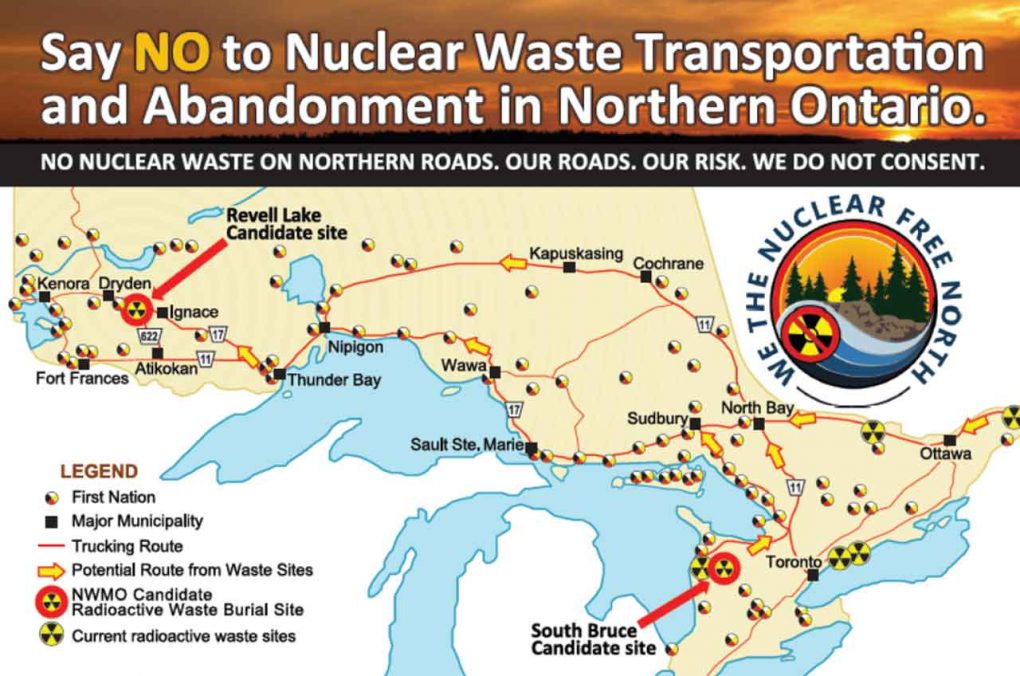
Thunder Bay – A Northern Ontario alliance concerned about a risky project to transport and bury nuclear fuel waste has chosen World Water Day to submit their brief to a parliamentary committee studying freshwater.
We the Nuclear Free North submitted the ten-page brief to the Standing Committee on Environment and Sustainable Development today, outlining the set of risks the Nuclear Waste Management Organization (NWMO) project poses to the lakes, rivers and groundwater of Northern Ontario. The Committee is carrying out a comprehensive study of the role of the federal government in protecting and managing Canada’s freshwater resources in Canada.
The opposition group points to the risks during transportation, processing and burial of the highly radioactive nuclear fuel waste, including from operations at the site of the proposed deep geological repository.
“The NWMO plan is still largely theoretical, but according to their own limited descriptions of the operating period, it is evident that freshwater in the area of the site will be impacted”, explained Wendy O’Connor, one of the report authors.
“Water used for washing down the nuclear waste transportation packages will become contaminated with radionuclides. According to the NWMO’s published details, that water will be sent to a settling pond and then released to natural water bodies in the vicinity of the site, as will the contaminated water that will be pumped from the underground repository”, said O’Connor.
“Despite assurances from the nuclear industry, it remains entirely possible that the nuclear waste itself, deposited underground, will contaminate the deep groundwater in the near or long term – contamination that will eventually reach surface water in the vast watershed”.
The NWMO’s candidate site in Northwestern Ontario is located half-way between Ignace and Dryden. Because it is at the height of land for the Wabigoon and the Turtle River systems, there are concerns about releases to the downstream communities, including Rainy River and Lake of the Woods. The group notes that if and when the radioactive releases occur from the deep geological repository there will be no means to reverse the impacts.
World Water Day, held on 22 March every year since 1993, is an annual United Nations Observance focusing on the importance of freshwater.
“It’s ironic that the UN theme for World Water Day in 2024 is “Water for Peace”, given the level of division and conflict that the NWMO’s proposal has brought to our region”, commented Kathleen Skead, a member of Anishinaabe of Wauzhushk Onigum Nation, one of several downstream Treaty 3 communities.
“Hopefully people will pause today and recognize that water is life and the NWMO’s promise of money is not worth the risk. Water is vital for all forms of life.”
The brief is posted HERE.
| We the Nuclear Free North is an alliance of people and groups opposing a Deep Geological Repository for nuclear waste in Northern Ontario. We oppose the transport, burial and abandonment of this radioactive waste in our northern watersheds. |
Our alliance is honoured to have received the name Tataganobin: looking far ahead into the future. Learn more about who we are, and the origin and meaning of this name.
Groups demand broader consent for nuclear waste storage
A petition demands that Ottawa require the Nuclear Waste Management Organization to get consent from other communities, including those along the transportation route.
Gary Rinne, 22 Mar 24 https://www.tbnewswatch.com/local-news/groups-demand-broader-consent-for-nuclear-waste-storage-8471189.
THUNDER BAY — An alliance of Northern Ontario citizen groups wants the federal government to ensure an underground storage site for used nuclear fuel isn’t built without the consent of all impacted communities.
We The Nuclear Free North has launched an online petition asking Ottawa to require the Nuclear Waste Management Organization to demonstrate it has the permission not just of its designated “host community” but also of residents and communities in the region, along the transportation route, and downstream of the proposed repository.
NWMO has narrowed its search to the Ignace area in Northwestern Ontario and South Bruce in Southwestern Ontario, and plans to announce its preferred site before the end of this year.
In a news release Wednesday, North Bay-based Northwatch spokesperson Brennain Lloyd said NWMO has repeatedly stated it will only proceed with “an informed and willing host,” and argued that “the communities along the transportation route are ‘hosts’ to the same risks as Ignace,” but are shut out of the selection process.
“Residents living closer to the site and downstream live with the short-term and long-term risks of nuclear contamination but are not being asked if they are willing,” he added.
The alliance is also wary about five members of Ignace council having the ultimate power to decide if NWMO can label the community as an agreeable host.
“Now is the time for all of us to speak up,” said Dodie LeGassick, nuclear lead for Thunder Bay-based Environment North. “The federal government must intervene to bring some fairness and facts into the siting process. That’s what this petition is all about.”
The petition will be open to all residents of Canada until May 3.
Among other things, it notes that the federal government has affirmed the UN Declaration on the Rights of Indigenous Peoples, which requires that no hazardous materials shall be stored on the territories of Indigenous peoples without their free, prior and informed consent.
Canadian officials found radiation levels in these northern Ontario homes ‘well above’ the safe limit. Their response: ‘¯\_(ツ)_/¯’ .
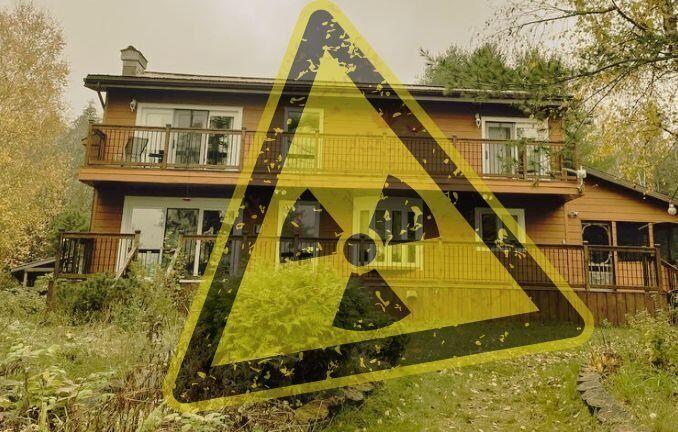
Many residents might not be aware they are living atop radioactive infill, which came from nearby, closed-down uranium mines that helped develop atomic bombs during the Cold War.Toronto Star
The number of homes in Elliot Lake affected by buried radioactive waste could top 100 — twice as many as previously thought.
By Declan Keogh and Masih Khalatbari, Investigative Journalism Bureau, Thursday, March 21, 2024 https://www.thestar.com/news/investigations/canadian-officials-found-radiation-levels-in-these-northern-ontario-homes-well-above-the-safe-limit/article_6b68ad20-e605-11ee-9a2a-f72182db65b6.html
In January 2021, a senior official with Canada’s nuclear regulator asked a colleague to do a rough, “back-of-the-envelope” calculation on the amount of potentially deadly radiation that residents in Elliot Lake were exposed to in their homes.
The government had just received a complaint that long-forgotten radioactive mine waste was buried underneath some homes in the northern Ontario city. Ron Stenson, senior project officer at the Canadian Nuclear Safety Commission (CNSC), wanted to “confirm our assumption that 468 Bq/m3 is not an urgent health concern.”
He did not get the answer he wanted. A senior official with the commission’s radiation protection division replied that those levels of radon are “well above” the public radiation dose limit set by federal authorities.
Stenson’s response came 90 minutes later: “¯\_(ツ)_/¯.”
For too long, shrugging is all the Canadian government has done, as far as local homeowner Lisa Speck is concerned.
The government official’s email is “a true visual representation of the response we’ve received to date,” she says. “It accurately summarizes the respect we’ve been shown.”
Documents show 100+ homes affected
Documents obtained by the Investigative Journalism Bureau show the number of homes affected by buried radioactive waste could top 100 — twice as many as previously thought. Many of the residents might not be aware they are living atop radioactive infill, which came from nearby, closed-down uranium mines that helped develop atomic bombs during the Cold War.
And when faced with calls for action, civil servants make jokes.
Speck, part of a group of Elliot Lake homeowners fighting to get the radioactive mining waste removed from their properties, called the email exchange “disgusting” and “dismissive.”
Despite having spent billions of dollars to clean up similar radioactive waste in Port Hope, federal regulators deny they have any obligation to do the same in Elliot Lake, saying the waste buried beneath the properties is the homeowners’ responsibility.
CNSC declined an interview request. In a statement, the agency said it could not answer detailed questions from the IJB because of ongoing litigation, adding that it’s “dedicated to upholding the highest standards of safety in our work.” Stenson did no respond to a request for comment.
Lawyers representing impacted Elliot Lake homeowners filed an application to Federal Court for a judicial review last July in the hopes of forcing the reversal of the federal government’s position.
The government filed their response in federal court on March 4, reiterating the waste is outside their jurisdiction and stating that the Nuclear Safety and Control Act, which governs the CNSC, does not compel them to act upon demands from the homeowners.
It argues federal legislation does not give the public the right “to file complaints, request inspections, or demand orders be issued as against regulated entities.”
A screen grab from a January 2021 email sent by a senior project officer at the Canadian Nuclear Safety Commission (CNSC), after being told the levels of radon recorded at homes in Elliot Lake are “well above” the safe limits. Toronto Star illustration
Lawyers representing impacted Elliot Lake homeowners filed an application to Federal Court for a judicial review last July in the hopes of forcing the reversal of the federal government’s position.
The government filed their response in federal court on March 4, reiterating the waste is outside their jurisdiction and stating that the Nuclear Safety and Control Act, which governs the CNSC, does not compel them to act upon demands from the homeowners.
It argues federal legislation does not give the public the right “to file complaints, request inspections, or demand orders be issued as against regulated entities.”
Lawyers representing impacted Elliot Lake homeowners filed an application to Federal Court for a judicial review last July in the hopes of forcing the reversal of the federal government’s position.
The government filed their response in federal court on March 4, reiterating the waste is outside their jurisdiction and stating that the Nuclear Safety and Control Act, which governs the CNSC, does not compel them to act upon demands from the homeowners.
It argues federal legislation does not give the public the right “to file complaints, request inspections, or demand orders be issued as against regulated entities.”
At the crux of the federal government’s refusal to accept responsibility is a technicality: It says that it isn’t responsible for the regulation of naturally-occurring radioactive materials, only those that have been processed in some way. It says that the uranium rock dug up during mining “was never chemically processed” before being trucked to nearby Elliot Lake for use as backfill during the construction of homes. That, the government says, means it’s technically “not considered radioactive waste.”
‘Public perception of a coverup’
The government didn’t always view the radiation blight in Elliot Lake as someone else’s problem, internal documents suggest.
By the 1980s, the government had assumed some role alongside the mining companies that built most of the houses.
The Atomic Energy Control Board (AECB) — the predecessor of the CNSC — took responsibility for “about 1,900 private properties and public areas,” according to a 1998 internal report summarizing the ongoing radiation problems in Elliot Lake.
Despite discovering “contaminated materials in structures” as well as “excessive gamma radiation due to the presence of mine waste on private properties,” there had been “minimal effort” to remove the waste, the summary report noted.
Fans and venting had been previously installed in homes to funnel the dangerous gas outside. However, it was likely these remediation efforts had failed, the report stated, possibly because residents didn’t know how to maintain the systems — or that they even existed.
“There is no evidence to suggest that owners were made aware of corrections made, or that they must assume responsibility for maintenance,” the report states.
All of this, the report concluded, created a “public perception of a coverup.”
“The only way to remove the mine waste issue from public perception is to remove the contamination.”
Supplied
As of 1998, it was estimated up to 120 properties were potentially affected by radioactive contamination and, as a result, “increased radiation exposure is likely as is renewed public concern.”
The report also called for a citywide effort to test properties, monitor and remediate excess levels of radiation and clean up the “man-introduced contamination” once and for all. It’s unclear whether those calls were heeded.
At the time, it was assumed that cleanup efforts would be shared between the federal government and the mining companies, with the companies offering financial assistance to remediate the properties they once owned.
Billions spent on remediation in other Ontario communities
In 2001, the federal government signed a deal with the municipalities of Port Hope and Clarington to collect, transport and permanently store as much as 2 million cubic metres of low-level radioactive waste that had been distributed by a government-owned radium and uranium refinery between the 1930s and the 1980s.
The $2.6 billion remediation project, which involves digging up and removing soil around affected houses, the construction of permanent storage facilities and monitoring of radiation levels, is slated to be completed by the end of this year.
Despite the parallels to Elliot Lake, the federal government has said it is not responsible for the cleanup in the northern community because the radioactive contamination came from a private company, not a crown corporation.
In June 2023, lawyers for the residents sent a host of politicians including Prime Minister Justin Trudeau and executives of CNSC more than 3,000 pages of evidence and documentation. They called on the government and mining companies to remove the uranium waste in Elliot Lake.
Upon receiving the demands, Patrick Burton, director of CNSC’s uranium mines and mills division, asked two of his colleagues in radiation protection about the claims that residents were getting excess doses of radiation. He also told them to “buy a shovel and get a [travel authorization] for Elliot Lake,” adding a winking face emoji.
“Is that going to get a response?” replied one of his colleagues with a smiling face emoji.
When reached by the IJB, Burton directed questions about the email to CSNC. The agency did not offer further comment. When questioned by lawyers representing the Elliot Lake homeowners, Burton said it was supposed to be a joke among colleagues.
“The intention was never … for the homeowners to become aware of this exchange,” Burton said during his deposition.
Homeowner Speck says the joke was “rude” but says she would welcome the government’s shovels to clean up the uranium on her property.
“The statement sort of lends to the fact that he thinks it’s a small job. If it’s such a small job that he’s just going to go to buy a shovel and fix it … then just do that,” Speck says.
“Everyone in the community would expect better from a government official than to be joking about a matter that could potentially affect … or maybe has affected, a population of people.”
With files from the Toronto Star’s Marco Chown Oved. The Investigative Journalism Bureau is a non-profit newsroom based at the University of Toronto’s Dalla Lana School of Public Health.
Disadvantaged Canadian towns look at the $billions promised by nuclear waste hosting

Offended tribal elders formed the Committee for Future Generations and initiated what they called the 7,000 Generations Walk Against Nuclear Waste, which saw participants trudge nearly 1,000 kilometres from Pinehouse to the legislature in Regina.
No local DGR debate has been harder fought than the 30-month marathon of psychological and ground warfare that unfolded in Saugeen Shores, one of several contestant municipalities in Bruce County, between 2011 and 2014.
Inside the race for Canada’s nuclear waste: 11 towns vie to host deep burial site Canada’s nuclear waste will be deadly for 400,000 years. What town would like the honour of hosting it?CHARLES WILKINS TheGlobe and Mail Feb. 26 2015,
“……..There are 11 rural and wilderness municipalities vying for the DGR, survivors of an original roster of 22. The aspirants include veteran northern encampments such as Hornepayne, Ontario, where, as Brennain Lloyd of the environmental education group Northwatch describes it, there is “a really fierce desire” on the part of at least a few municipal administrators to “bring the nuke dump to town.”
And Schreiber, a struggling railway town on the north shore of Lake Superior. And Ignace, another struggler, in the boreal wilds to the west. And, to the east, Manitouwadge.
And Creighton, Saskatchewan, directly across the Manitoba border from Flin Flon (Creighton is a town described by a former resident as “having had its fiscal balls to the wall for half a century”).
And Blind River, Ontario, on the north shore of Lake Huron, where survival has for years depended on the uncertain flow of traffic along the Trans-Canada Highway.
And Elliot Lake, some 50 kilometres north of Lake Huron, where uranium mining was the sustaining industry during the 1950s and ’60s but which these days survives on the pensions of retirees who moved to the town to take advantage of discount housing left over from the boom years.
“What makes it all so attractive to competing municipalities is, of course, the money,” says Tony McQuail.
While billions of dollars will flow directly through the chosen town over a period of four or five decades, Lloyd suggests that most of the money is likely to end up in the pockets of big-city consultants and other outside beneficiaries.
Mainly, the price tag will buy decades’ worth of infrastructure and construction costs, as well as maintenance, monitoring and employment training. It will also pay for the transportation of the waste to the spanking new DGR, which will, by the time it opens, have been a reality for its “willing host” for a quarter of a century or more.
Finishing just the first phase of the preliminary assessment brings $400,000 of NWMO money to candidate towns, so they can “build sustainability and well-being.” It has been speculated that some towns had no intention of staying in the process beyond the early payout.
While some towns applied to participate of their own volition, others were, according to Lloyd of Northwatch, courted by the NWMO. “What bothers me most about the process,” says Lloyd, “is the ‘siloing’ that the NWMO practises on the municipal politicians they choose to target.
“They approach them not in the context of their communities, where the politicians are immediately answerable to their constituencies, but at municipal conferences and conventions where they’re away from home, isolated, perhaps a little unsure of themselves. They wine and dine them and soft-talk them about the unimaginable benefits that could accrue to their towns should they consider hosting the DGR.
“Then they fly them to Toronto and put them up in the best hotels and take them up to the Bruce Power site, or other nuclear generating stations, and show them what of course appears to be secure and flawless waste storage. The politicians are just snowed—they’re made to feel like important players. They take this dream of hope and prosperity and safe science back to their communities and in effect go to work for the NWMO.”
Other northern councils—at Ear Falls, at Nipigon, at Wawa—have been more divided over the DGR and so were eliminated early, or withdrew, from the process. Similarly, Brockton, near the site of Bruce Power, was cut late in 2014 after its residents elected a largely anti-DGR council. (The NWMO says Brockton’s assessment simply didn’t pan out.)
The aboriginal communities of Pinehouse and English River, Saskatchewan, were dropped from the process when community debate over land and water issues, as well as a growing distrust of the NWMO, became irresolvable.
While Pinehouse was still in the running, three community leaders, including a cousin of the mayor, received money from the NWMO. Offended tribal elders formed the Committee for Future Generations and initiated what they called the 7,000 Generations Walk Against Nuclear Waste, which saw participants trudge nearly 1,000 kilometres from Pinehouse to the legislature in Regina.
No local DGR debate has been harder fought than the 30-month marathon of psychological and ground warfare that unfolded in Saugeen Shores, one of several contestant municipalities in Bruce County, between 2011 and 2014………..http://www.theglobeandmail.com/report-on-business/rob-magazine/inside-the-race-for-canadas-nuclear-waste/article23178848/
Heavy resistance to Canada’s 1st nuclear waste repository, while Nuclear Waste Management Organization (NWMO) says it is safe.
Nuclear Waste Management Organization (NWMO) reaffirms safety of Canada’s 1st nuclear waste repository but there’s still heavy pushback
Preferred site, in either southern or northwestern Ontario, to be chosen by year’s end
Sarah Law · CBC News Mar 18, 2024
The body tasked with selecting the future storage site for Canada’s nuclear waste has reaffirmed its confidence in the project’s safety, but others remain concerned about the potential risks of burying spent nuclear fuel hundreds of metres below the earth’s surface.
By the end of this year, the Nuclear Waste Management Organization (NWMO) is expected to decide on its preferred site for the country’s first deep geological repository for used nuclear fuel.
The potential locations are:
- The Wabigoon Lake Ojibway Nation-Ignace area, about 250 kilometres northwest of Thunder Bay.
- The Saugeen Ojibway Nation-South Bruce area in southern Ontario, about 130 kilometres northwest of London.
Earlier this month, the NWMO released updated “Confidence in Safety” reports, which say both sites are suitable for the safe, long-term storage of spent nuclear fuel.
However, We the Nuclear Free North and the First Nations Land Defence Alliance, for example, remain concerned about what’s known as the Revell site in northwestern Ontario.
The alliance issued a letter to NWMO president and CEO Laurie Swami on March 5, saying: “Our Nations have not been consulted, we have not given our consent, and we stand together in saying ‘no’ to the proposed nuclear waste storage site near Ignace. We call on you to respect our decision.”
……. “They’re both good sites. We think that both of the sites would be safe,” said Paul Gierszewski, technical subject matter expert with the NWMO and lead author of the “Confidence in Safety” reports.
Brennain Lloyd is project co-ordinator with Northwatch, which is part of We the Nuclear Free North. Members of the organization feel less confident about the project’s safety, she said.
“I think this newest report from the NWMO tries to put the best face possible on a project which is absolutely loaded with risk and uncertainty, and uses a lot of language that’s difficult for the public, for non-technical leaders to work through,” Lloyd said.
“There are no resources available in any part of this process for the public to be able to get technical assistance from independent third-party peer reviewers.
While Gierszewski says the 2023 reports expand on the previous year’s findings, Lloyd questions whether they contain new information or airbrushed statements that “paint a better picture.” …………………………………
Demand for in-person meetings
Chief Rudy Turtle of Grassy Narrows First Nation, 250 kilometres northwest of Ignace, said no one from the NWMO has met with him in person to discuss the proposed nuclear waste site.
Grassy Narrows has a particular interest in which Ontario site is chose, given the First Nation’s experiences dealing with contaminated fish in the 1960s and ’70s. Mercury from a Dryden pulp and paper mill was dumped into the English Wabigoon River, upstream from the First Nation. Research indicates past mercury exposure continues to impact the health of people in the community.
In the case of a nuclear waste repository, Turtle said, “Should there be any leak or if the containment fails, there is the possibility that [toxic chemicals] can leak downriver again.”
Turtle would like to see a series of in-person meetings so people can better understand the safety measures being proposed and the potential risks………………………………………..
Chief Michele Solomon of Fort William First Nation said it is unlikely her community’s position against the site will change.
Band council passed a resolution last September calling for the Ontario government to adopt the proximity principle, which means nuclear waste would be stored at the point of generation and not transported elsewhere.
“Anything that has the potential to get into our waterway that would cause harm to the fish or to the animals or to our people … we take that very seriously,” Solomon said.
………………………………………………. https://www.cbc.ca/news/canada/thunder-bay/nuclear-waste-repository-safety-reports-1.7145240
—
Canada to expedite approval of new nuclear projects, energy minister says
Reuters, By Steve Scherer and Rod Nickel, March 1, 2024
OTTAWA, Feb 29 (Reuters) – Canada will expedite the approval process for new nuclear projects, but will not exclude them from the federal environmental review as requested by the province of Ontario, Energy and Natural Resources Minister Jonathan Wilkinson said.
All new major projects in Canada, including nuclear reactors, have to be reviewed under the Impact Assessment Act (IAA), which the government has promised to revise this spring after the Supreme Court last year ruled it overstepped into provincial jurisdiction.
Wilkinson said the legislative revisions to the IAA will be limited to addressing the concerns of the court because if the government does more than that, it would “have to open up large scale consultations that will take significant time.”
“That being said, we do have some ideas that as to how we can make the process more efficient and respond to the thoughts and aspirations of the provinces,” Wilkinson told Reuters in an interview on Wednesday, adding that accelerating the process will not come at the cost of addressing environmental concerns.
Canada is the world’s second-largest uranium producer, but the long regulatory process has resulted in miners like NexGen Energy having to wait seven years and counting to build the world’s largest uranium mine in Saskatchewan.
“It’s a very long process,” said NexGen CEO Leigh Curyer. “Government and industry working together to bring these projects online more expeditiously, that is absolutely key.”……………………..
Nuclear expansion faces opposition, however, over charges it already doesn’t adequately review risks.
The Sierra Club environmental group opposes development of nuclear fuels because of dangerous waste, high cost and links to weapons, said Sierra’s Canada programs director Gretchen Fitzgerald.
“Canada again and again has failed to create valid environmental assessment processes and arms-length regulation of the nuclear power industry – leaving communities at risk,” Fitzgerald said………………………………
OLD SITES VS NEW ONES
Last month, Ontario said would start work to refurbish aging nuclear reactors at Pickering, located about 45 km (28 miles) east of Toronto, to extend production by 30 years…………………………………………………………..
Ontario is developing what could be the first operating small modular reactor (SMR) in the Western world by the end of the decade, a technology that many countries are looking at as a way of replacing coal-fired plants, Wilkinson said.
Wilkinson said SMRs are “sort of carbon copies of each other” and so should not require repetitive engineering assessments.
The government is also reviewing its entire regulatory process to approve large industrial projects including nuclear by eliminating overlaps between the provincial and federal assessments, he said. The details of that review, which will have a particular impact on mining, will be released in the next few months, Wilkinson said……….https://www.reuters.com/business/energy/canada-expedite-approval-new-nuclear-projects-energy-minister-says-2024-02-29/
New Brunswick’s Point Lepreau nuclear plant ranked as poor performer among international peers
Consultant ranks Lepreau in ‘bottom quartile’ in multiple performance categories
Robert Jones · CBC News · Mar 20, 2024
Since 2014 the Point Lepreau nuclear generating station has been one of the poorest-performing reactors among dozens of similar facilities in five countries, a pair of unflinching reports commissioned by N.B. Power about the troubled plant suggest.
The U.S.-based energy consulting firm ScottMadden found N.B. Power spent less on upkeep at Lepreau since it completed a major refurbishment in 2012 than owners of more reliable reactors, and they provided evidence that Lepreau’s troubles may be connected to a failure to invest enough on maintenance.
The reports also suggest Lepreau’s performance may worsen in future years if amounts spent on keeping ahead of trouble are not increased significantly………………………………………………………..
Lepreau, originally commissioned in 1983, had a disappointing production record in its first 25 operational years that has continued over the last decade, despite a major overhaul of its reactor and nuclear components between 2008 and 2012.
In the 11 years from 2013 and 2023, Lepreau suffered 400 more days of downtime than originally projected, costing the utility up to $1 billion in lost production and repair costs that have been battering the utility’s finances…………………………………………………………………………. more https://www.cbc.ca/news/canada/new-brunswick/nb-power-point-lepreau-poor-1.7148879
Northwestern Ontario First Nations Chiefs Unite Against Nuclear Waste Proposal
By NNL Digital News Update, March 14, 2024
Kitchenuhmaykoosib Inninuwug – Environment – Leaders from five First Nations communities in Northwestern Ontario have voiced a resolute opposition to the prospect of nuclear waste storage within their territories.
In a concerted message to the Nuclear Waste Management Organization (NWMO), these chiefs have articulated a clear rejection of any plans to introduce nuclear waste facilities into the region.
A Firm Stand on Environmental Protection
The stance against nuclear waste storage is captured in a letter addressed to Laurie Swami, President and CEO of the NWMO, an industry-funded body tasked with managing Canada’s nuclear waste. The letter outlines grave concerns about the potential for spills or leaks that could irreversibly harm the environment, disrupt the natural way of life, and have lasting impacts on future generations.
Letter to Nuclear Waste Management Organization
Signed by chiefs from Kitchenuhmaykoosib Inninuwug, Asubpeeschoseewagong (Grassy Narrows), Wapekeka, Neskantaga, and Onigaming, the letter embodies the collective apprehension of these communities.
These leaders, forming part of the First Nations Land Defence Alliance, are standing firm in their resolve to protect their lands and waters from the risks posed by nuclear waste.
Concerns Over Potential Environmental Impact Chief Donny Morris of Kitchenuhmaykoosib Inninuwug highlighted the risks associated with disturbing the Canadian Shield rock to construct an underground storage facility.
Morris emphasized the importance of environmental preservation over financial compensation and stressed the right of all regional First Nations to be involved in the consultation process.
Calls for Consideration of Alternative Sites In a pointed critique of the proposed locations for the nuclear waste repository, Steven Chapman, Kitchenuhmaykoosib Inninuwug’s lands and environment director, suggested that such facilities should first be considered in areas closer to Canada’s political centers, such as Toronto or Ottawa.
This suggestion underscores a broader call for equity and responsibility in the siting of facilities that pose environmental risks.
The NWMO has narrowed its search to two potential sites, one near Ignace and another in Southern Ontario, with a final decision expected later this year. The chiefs’ letter firmly states their lack of consultation and consent, urging the NWMO to respect their collective decision against the proposed site near Ignace.
Chiefs in the Ottawa region have also rejected the plans to store nuclear waste in their traditional territories.
As these communities stand united in their opposition, the debate over nuclear waste management in Canada continues to raise important questions about environmental stewardship, indigenous rights, and the principles of equitable decision-making in the context of national infrastructure projects.
Text of the Letter Written by Chiefs………………………………… https://www.netnewsledger.com/2024/03/14/northwestern-ontario-first-nations-chiefs-unite-against-nuclear-waste-proposal/
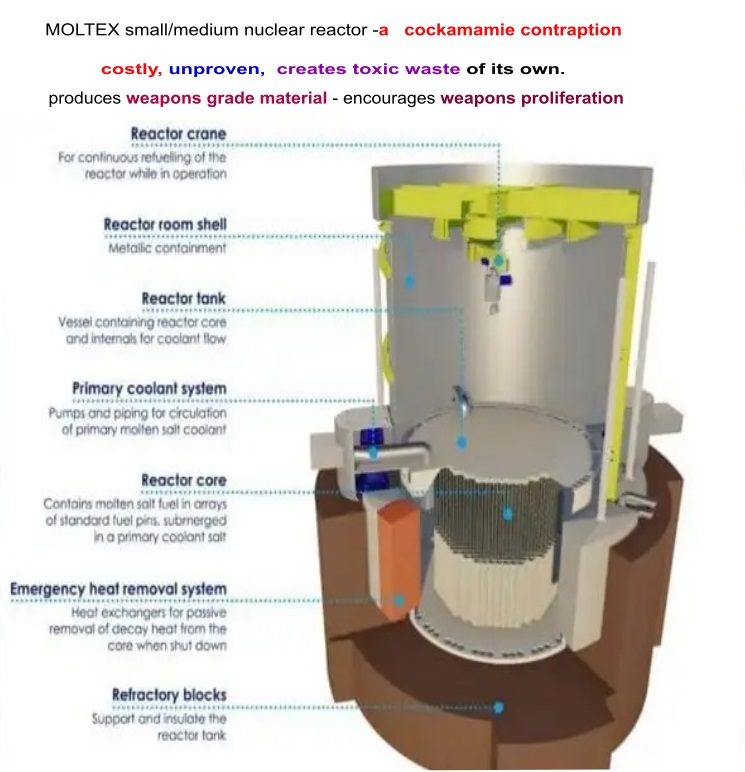
MOLTEX nuclear reactors: The whole thing is a scam, wasting tax payer money again.

14 Mar 24
Why this pyro-reprocessing? Vitrification is the proven and researched method for reprocessed nuclear fuel waste. The U.S. NUCLEAR WASTE TECHNICAL REVIEW BOARD states, ” HLW is vitrified by mixing it with a combination of silica sand and other glass-forming chemicals, heating the mixture to very high temperatures [approximately 1,150°C (2,100°F)] until it melts, and pouring the molten material into stainless steel canisters where it cools to form a glass. Vitrification is used in several countries to immobilize HLW because it has advantages over other modes of treatment. It is a well-demonstrated technology resulting from more than 40 years of industrial experience, it can be used for a wide range of HLW compositions, it is a continuous process that can be applied to large volumes of HLW, and the resulting glass product is chemically durable in many geologic disposal environments.” https://www.nwtrb.gov/docs/default-source/facts-sheets/vitrified_hlw.pdf?sfvrsn=18
A soluble corrosive salt from pyro-reprocessing is not an acceptable wasteform.
It is important to realize even with glass vitrification there will still be an off gas waste stream containing the volatiles such as Tc99, I131 and C14, the major contributors to dose in the Seaborn EIS. There needs to be extensive research done on immobilization on the volatile off gas reprocessed waste stream.
Why is it that for reprocessed waste disposal the volatile, mobile, major contributors to dose consequence are ignored?
In fact the cost and feasibility of waste disposal and decommissioning in general is never properly accounted for in the development of nuclear reactors. New reactors are not designed to make decommissioning feasible without huge cost and extensive worker radiation exposure. This is short sighted madness that the nuclear industry is allowed to get away with.
Guess what? There is no nuclear waste, no nuclear proliferation and no possible nuclear meltdown from the much cheaper solar wind and deep geothermal power options. Is this not obvious? Yet government money (our money) is poured into nuclear energy. Did the public have a say in this? No expenditure without representation? Can we dump the reactors into Boston harbour?
Nuclear industry wants Canada to lift ban on reprocessing plutonium, despite proliferation risks


The CANDU Owners Group is far from neutral or independent…………… First, Canadian Nuclear Laboratories is a private company owned by a consortium of multi-national companies: AtkinsRéalis (formerly SNC Lavalin), Fluor, and Jacobs. ……...has overseas members, including utilities from China, Pakistan, India, South Korea, Argentina, and Romania. The first three countries are nuclear weapons states that either possess reprocessing plants for military purposes (India and Pakistan) or reportedly divert plutonium extracted from commercial spent fuel for military purposes (China), while South Korea and Argentina have for decades flirted with the idea of reprocessing.
Bulletin, By Gordon Edwards, Susan O’Donnell | March 11, 2024
Plutonium is “the stuff out of which atomic bombs are made.” Plutonium can also be used as a nuclear fuel. Reprocessing is any technology that extracts plutonium from used nuclear fuel. In Canada, the nuclear industry seems determined to close the nuclear fuel cycle by pushing for a policy to permit reprocessing—thereby seeking to lift a 45-year-old ban.
In 1977, Canada tacitly banned commercial reprocessing of used nuclear fuel, following the lead of the Carter administration, which explicitly opposed reprocessing because of the possibility it could lead to increased proliferation of nuclear weapons around the world.[1] That unwritten policy in Canada has held sway ever since.[2] New documents obtained through Canada’s Access to Information Act reveal that, behind closed doors, the nuclear industry has been crafting a policy framework that, if adopted, would overturn the ban and legitimize the extraction of plutonium from Canada’s used commercial nuclear fuel.
For over two years, documents show that the Canadian government has held a series of private meetings with industry representatives on this subject, keeping such activities secret from the public and from parliament. This raises questions about the extent to which nuclear promoters may be unduly influencing public policymaking on such sensitive nuclear issues as reprocessing in Canada.[3] But, given the stakes for the whole society and even the entire planet, the public must have a say about nuclear policy decisions…………………………………………………………………………………………………………………………………………………..
Before the ban. Dreams of a plutonium-fueled economy were spawned in 1943-44 by British, French, and Canadian scientists working at a secret wartime laboratory in Montreal, which was part of the Anglo-American Project to build the first atomic bombs. Canada’s first heavy-water reactors were designed by the Montreal team, in part, to produce plutonium for weapons. The team also had hopes that after the war, plutonium might become a dream fuel for the future. They envisioned a “breeder reactor” that could produce more plutonium than it uses, thereby extending nuclear fuel supplies.
For 20 years after the war, Canada sold uranium and plutonium for US bombs. Two reprocessing plants were operated at Chalk River Nuclear Laboratories in Ontario. In addition, all the pilot work on plutonium separation needed to design Britain’s Windscale reprocessing plant was carried out at Chalk River.
After the ban. Although the 1977 ban scuppered AECL’s hopes for commercial reprocessing, plutonium remained the holy grail. In the decades that followed, AECL researchers studying the geologic disposal of high-level radioactive waste clandestinely carried out reprocessing experiments at the Whiteshell Nuclear Research Establishment in Manitoba. Instead of burying used nuclear fuel bundles, the scientists anticipated burying solidified post-reprocessing waste. Meanwhile, AECL scientists at Chalk River fabricated three tonnes of mixed-oxide fuel (MOX) in glove boxes, using plutonium obtained from CANDU fuel reprocessed overseas. In 1996, Prime Minister Jean Chrétien volunteered to import weapons-grade plutonium from dismantled US and Soviet warheads to fuel CANDU reactors. Facing fierce public opposition in Canada, the project never came to pass.
But the dream of a plutonium economy remained. In 2011, a sprawling mural on three walls of the Saskatoon Airport depicted the nuclear fuel chain, from mining uranium to the reprocessing of used fuel to recover “potential energy” before disposing of the leftovers. Although the word plutonium appeared nowhere, reprocessing was presented as the inevitable final step in this vision of a virtuous nuclear fuel cycle. The mural was commissioned by Cameco, the giant Canadian multi-national corporation that helped make the central Canadian province of Saskatchewan into the “Saudi Arabia of uranium.” At the time, Cameco co-owned the largest operating nuclear power station in the world, the eight-reactor Bruce complex beside Lake Huron bordering the United States.
Despite such hopes, it became fashionable to publicly downplay reprocessing as expensive and therefore economically unlikely.[5] But the technology stayed on the books as a possibility, especially in case future generations would want to extract plutonium from used nuclear fuel for re-use before disposing of the remaining radioactive waste.
Back to the future? New Brunswick has one 660-megawatt-electric CANDU reactor at Point Lepreau on the Bay of Fundy in eastern Canada. The plant has been operating for over 40 years. In March 2018, two start-up companies—UK-based Moltex Energy and US-based ARC Clean Technology—offered to build “advanced” (fast) reactors on the same site.
The Moltex design is a 300-megawatt-electric molten salt reactor called “Stable Salt Wasteburner.” It is to be fueled with plutonium and other transuranic elements extracted from CANDU used fuel already stored on that site. Accordingly, the Moltex proposal requires a reprocessing plant in tandem with the reactor. The ARC design is a 100-megawatt-electric liquid sodium-cooled reactor, inspired by the second Experimental Breeder Reactor (EBR-2) operated by the Argonne National Laboratory in Idaho between 1964 and 1994. Although the ARC-100 does not require reprocessing at the outset, its optimal performance requires that the used fuel be recycled, likely through reprocessing.
From the beginning, Moltex claimed its proposed molten salt reactor would “recycle” CANDU used fuel and “burn” it in its molten salt reactor. Moltex claims that this would virtually eliminate the need for a deep geologic repository by turning a million-year disposal problem into a roughly 300-year storage problem. This claim has been flatly rebuffed.[6] Only later did the public learn that the Moltex technology requires reprocessing CANDU used fuel to extract plutonium using an innovative process called “pyroprocessing.” (In pyroprocessing, used fuel is converted to a metal and immersed in molten salt, then the plutonium and other transuranic elements are recovered by passing a current through the salt and collecting the desired products on electrodes.)

ARC Clean Technology maintains that its reactor design is proven by the 30-year operating experience of the EBR-2 reactor, despite differences in size and fuel enrichment.[7] The company, however, says nothing about the intimate connection between breeder reactors and plutonium, nor does it mention the chequered history of liquid sodium-cooled reactors globally—including the Fermi Unit 1 reactor’s partial meltdown near Detroit, the commercial failure of France’s Superphénix, the conversion of a German breeder reactor into an amusement park, or the dismal performance of Japan’s Monju reactor.
For either of the proposed New Brunswick reactors to operate as intended, Canada would need to lift its 45-year-old ban on commercial reprocessing of used nuclear fuel.
Testing the limits. The first sign that Canada’s reprocessing ban might be lifted came in 2019, when the federal government’s Impact Assessment Act exempted specified projects from environmental assessment. The exemption included any reprocessing plant with a production capacity of up to 100 metric tons (of used nuclear fuel) annually—just above the reprocessing capacity required for the Moltex project.[8]
Public calls to explicitly ban reprocessing started shortly after March 2021, when the federal government gave 50.5 million Canadian dollars in funding for Moltex’s project. This project clearly requires reprocessing: Without the plutonium produced by CANDU reactors to fuel its proposed molten salt reactor, the Moltex project can go nowhere.
In addition, Moltex hopes to eventually export the technology or the fuel, or both. Many Canadians are alarmed at the prospect of normalizing the use of recycled plutonium as a nuclear fuel in Canada and abroad.
In 2021, in response to a recommendation by the International Atomic Energy Agency, the Canadian government conducted public consultations to develop a modernized policy on commercial radioactive waste management and decommissioning. Over 100 citizens groups participated, and many called for an explicit ban on reprocessing.
Public attention to the issue of reprocessing grew after nine US nonproliferation experts sent an open letter to Prime Minister Justin Trudeau in May 2021. The letter expressed concern that by funding a spent fuel reprocessing and plutonium extraction project, Canada would “undermine the global nuclear weapons nonproliferation regime that Canada has done so much to strengthen.” …………………..
A second letter sent to Trudeau in July 2021 refuted “misleading claims” that Moltex posted on-line in rebuttal to the first letter. Moltex’s rebuttal claims were quickly taken down. And a third letter authored by one of the US nonproliferation experts was sent in November 2021. None of the government responses to these three letters addressed the core issue, which is the request for an independent review of the proliferation implications of Canada’s funding of reprocessing.
The federal government released its draft policy for radioactive waste management and decommissioning in March 2022, hinting that reprocessing might be permitted in the future. Public interest groups made their opposition to that suggestion very clear. A national steering group coordinated by Nuclear Waste Watch, a Canada-based network of public interest organizations, released an alternative policy proposal that explicitly banned reprocessing. The Council of Canadians, a national advocacy group, sent out an action alert that generated 7,400 letters calling for the explicit prohibition of reprocessing.
The Canadian Nuclear Safety Commission, tasked with the job of licensing Moltex’s proposed reactor, declared that a policy framework for reprocessing is necessary and that such a policy must come from the federal government.[9] Moltex’s Chief Executive Officer, Rory O’Sullivan, observed that Canada was chosen by Moltex because the country had no explicit policy on reprocessing: “Moltex would likely not have come to Canada if a reprocessing policy had been mandated at the time.”
In November 2021, Canada’s Ministry of Natural Resources—the lead federal department on nuclear issues—issued an internal memo entitled “Policy Development on Reprocessing” that refers to a series of planned meetings on reprocessing with industry representatives starting December 1, 2021.[10] The CANDU Owners Group—a nonprofit corporation assembling utilities operating CANDU reactors, Canadian Nuclear Laboratories, and nuclear suppliers—was singled out by the ministry to prepare a policy paper on reprocessing.[11]
The CANDU Owners Group is far from neutral or independent.
First, Canadian Nuclear Laboratories is a private company owned by a consortium of multi-national companies: AtkinsRéalis (formerly SNC Lavalin), Fluor, and Jacobs. The company is currently constructing a government-funded facility with hot cells at Chalk River to conduct research, including on reprocessing and plutonium extraction. Canadian Nuclear Laboratories operates under a “government-owned contractor operated” agreement with Atomic Energy of Canada Limited, the same publicly owned corporation that pushed for commercial reprocessing in the late 1970s.
The CANDU Owners Group also has overseas members, including utilities from China, Pakistan, India, South Korea, Argentina, and Romania. The first three countries are nuclear weapons states that either possess reprocessing plants for military purposes (India and Pakistan) or reportedly divert plutonium extracted from commercial spent fuel for military purposes (China), while South Korea and Argentina have for decades flirted with the idea of reprocessing.
By all evidence, the government of Canada is currently enlisting private entities that favor reprocessing to assist in the development of an industry-friendly policy on reprocessing. And the government does this without involving the public, parliament, or outside experts—all of whom have expressed a keen interest—and repeatedly asked to participate—in plutonium policy discussions. In the process, misleading information about reprocessing is being forwarded to government officials with no other voices to correct the record.[12]
In the most recent move, a dozen US nonproliferation experts wrote again to Prime Minister Trudeau on September 22, 2023, after the release of documents obtained through an access to information request. In their letter, the experts reiterated their concerns that the Canadian government is funding a project that would lead to increase the availability—and therefore potential proliferation—of weapons-usable plutonium for civilian purposes in Canada and beyond.
Democratic deficit. Despite all these developments, there has been no public discussion or parliamentary deliberation about the implications of introducing civilian reprocessing into Canada’s nuclear fuel cycle. Absence of transparency and public debate means the democratic process is being ignored. Yet, the issue is of great public importance because of the taxpayer money invested, proliferation risks involved, and the long-term societal implications of the security measures needed to safeguard nuclear weapons usable materials.
This makes one wonder why it took a group of concerned citizens and an access to information request to find out that, behind closed doors, the nuclear industry has been drafting its own policy to permit commercial reprocessing, expecting its adoption by the government of Canada against all objective criteria of democracy.
n 1976, British nuclear physicist Brian Flowers authored a Royal Commission report to the UK parliament. He wrote: “We regard the future implications of a plutonium economy as so serious that we should not wish to become committed to this course unless it is clear that the issues have been fully appreciated and weighed; in view of their nature we believe this can be assured only in the light of wide public understanding.”
The same precept should apply to nuclear policy in today’s Canada.
Notes…………………………………………………………………. https://thebulletin.org/2024/03/nuclear-industry-wants-canada-to-lift-ban-on-reprocessing-plutonium-despite-proliferation-risks/
1 This Month


Tell the Ukrainian Government to Drop Prosecution of Peace Activist Yurii Sheliazhenko

Petition to revoke the licensing of the Near Surface Nuclear Disposal Facility (NSDF) at Chalk River. https://www.ourcommons.ca/petitions/en/Petition/Details?Petition=e-7247


of the week – STOP SMALL MODULAR REACTORS IN CANADA
To see nuclear-related stories in greater depth and intensity – go to https://nuclearinformation.wordpress.com
-
Archives
- March 2026 (175)
- February 2026 (268)
- January 2026 (308)
- December 2025 (358)
- November 2025 (359)
- October 2025 (376)
- September 2025 (258)
- August 2025 (319)
- July 2025 (230)
- June 2025 (348)
- May 2025 (261)
- April 2025 (305)
-
Categories
- 1
- 1 NUCLEAR ISSUES
- business and costs
- climate change
- culture and arts
- ENERGY
- environment
- health
- history
- indigenous issues
- Legal
- marketing of nuclear
- media
- opposition to nuclear
- PERSONAL STORIES
- politics
- politics international
- Religion and ethics
- safety
- secrets,lies and civil liberties
- spinbuster
- technology
- Uranium
- wastes
- weapons and war
- Women
- 2 WORLD
- ACTION
- AFRICA
- Atrocities
- AUSTRALIA
- Christina's notes
- Christina's themes
- culture and arts
- Events
- Fuk 2022
- Fuk 2023
- Fukushima 2017
- Fukushima 2018
- fukushima 2019
- Fukushima 2020
- Fukushima 2021
- general
- global warming
- Humour (God we need it)
- Nuclear
- RARE EARTHS
- Reference
- resources – print
- Resources -audiovicual
- Weekly Newsletter
- World
- World Nuclear
- YouTube
-
RSS
Entries RSS
Comments RSS
 nuclear-news