Ontario’s nuclear option is the wrong path to meet green energy targets

The province should focus on cost-efficient wind, solar and hydro expansion, as well as increased interprovincial transmission.
by Quinn Goranson May 13, 2024, https://policyoptions.irpp.org/magazines/may-2024/ontario-nuclear-option/
Ontario is failing in its strategy to reduce emissions to meet the province’s climate commitment of reducing emissions by 2030 to 30 per cent below 2005 levels (which is already 10 to 15 per cent below the current federal target).
The province’s auditor general released a report in 2021 stating the Ford government’s policies for reducing greenhouse gas (GHG) emissions were already falling short by 14.2 megatons.
Fast-forward three years and the situation is likely to get worse.
Plans to meet the province’s possible 1.7-per-cent annual increase in electricity demand include the addition of natural gas-powered turbines, refurbishing old nuclear reactors and developing small modular reactors (SMRs).
This presents a dual problem. First, burning natural gas produces CO2, so expanding capacity using new gas turbines will increase emissions. Second, nuclear power generation cannot successfully help meet 2030 targets

Ontario’s nuclear hopes out of step with reality
SMRs are a class of nuclear reactor, built in a factory and shipped to a site, designed to generate up to 300 megawatts (MW) of electrical power per unit. By comparison, larger conventional reactors in Ontario have a capacity of roughly 900 MW.
Ontario Power Generation (OPG) states it is “leading the way in the advancement of SMR technology in Canada” and that SMRs are “the future of nuclear power generation.”
This position collides head-on with technological realities.
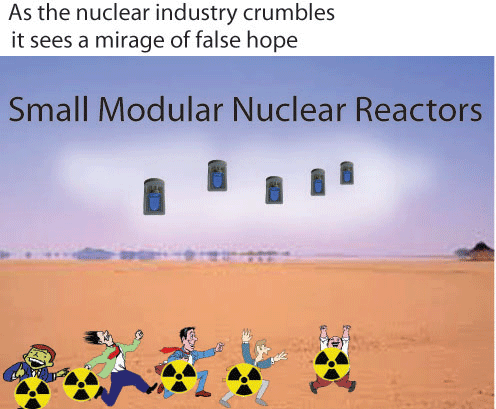
SMRs are a futuristic technology at best. The only operational SMRs anywhere in the world are in Northeast Russia and in Shidao Bay, China.
Both reactors faced construction delays, primarily due to cost overruns and poor economics., The Canadian Nuclear Safety Commission has yet to fully approve a single SMR licence.
SMRs cannot be built in time to help meet Ontario’s 2030 emission targets. Worse, by betting on them, OPG has committed to making Ontario’s electricity grid dirtier.
Nuclear power a costly option
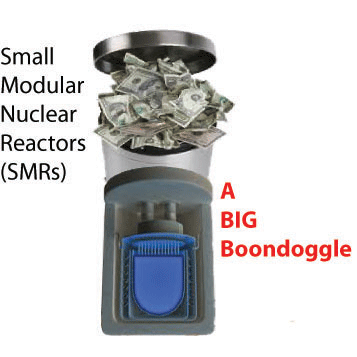
In addition to being largely unproven, SMRs will not be cheap. While their absolute cost may be lower than conventional nuclear reactors, their lower electricity output means they become significantly more expensive per megawatt to operate.
Beyond the fact that every single new nuclear project in Ontario’s history has gone over budget, gas and nuclear energy now contribute the most to increasing energy bills for Ontario residents.
A 2018 report from the Canadian SMR roadmap steering committee, a group of provincial and territorial governments and power utilities, estimated the baseline cost of electricity from SMRs would be 16.3 cents per kilowatt hour (kWh). Comparatively, according to the International Renewable Energy Agency renewable alternatives are less expensive:
- Onshore wind electricity costs consumers an average of 4.5 cents per kWh;
- Offshore wind costs an average of 10 cents/kWh;
- Solar PV farms cost an average of 6.6 cents/kWh;
- Hydropower costs an average of 5 cents/kWh.
In North America, the only SMR design certified by the United States Nuclear Regulatory Commission was cancelled due to “lack of interest” once rising costs deterred potential customers. Originally announced in 2015 at the equivalent of $4.1 billion Cdn, estimates rose to $5.6 billion (2018), then $8.4 billion (2020) and finally $12.7 billion (2023).
Time keeps on ticking
New nuclear projects are taking on average of 10 to 15 years to become operational. Ontario’s first SMR designated for the Darlington Nuclear Generating Station is planned for 2028.
Meanwhile, the Ontario government says additional SMRs could come online between 2034 and 2036. In reality, nuclear projects typically exceed time estimates by 64 per cent and given a strong trend of delays for such projects globally, new SMRs are unlikely to come online before 2042, if ever.
So, in addition to the speculative viability of SMRs, likely delays even under the best of circumstances mean this technology is unable to help meet Ontario’s emissions reduction targets.
Radioactive waste another key factor
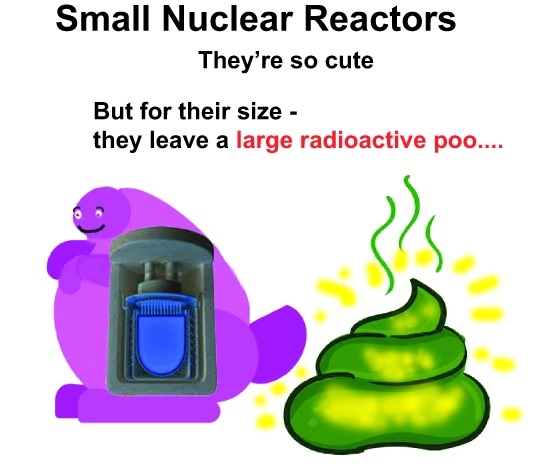
The “green” label often applied to nuclear energy should be viewed with scepticism. While no fossil fuel is burned to generate nuclear power, the industry produces radioactive waste and is not “renewable.”
In fact, there is evidence to suggest SMRs will produce a greater volume of radioactive waste per unit of electricity generated than existing large reactors.
Radioactive waste remains hazardous for tens of thousands of years and there are no demonstrated solutions to managing this risk. According to the Nuclear Waste Management Organization, which is owned by Canada’s nuclear power companies, radioactive nuclear waste must be fully isolated from people and the environment for one million years or more.
Committing to new nuclear projects in Ontario as a climate solution is essentially trading one intergenerational threat for another.
The green path toward Ontario’s emissions targets
A report from the David Suzuki Foundation in 2022 found that “reliable, affordable, 100 per cent emissions-free electricity in Canada by 2035 is entirely possible.”
In 2020, the International Energy Agency declared wind and solar the “cheapest sources of new electricity in history.”
In 2018, Ontario cancelled 758 signed contracts for smaller renewable energy projects, many of them in Indigenous communities Only recently, the province’s Independent Electricity System Operator (IESO) has announced it seeks to procure 5,000 MW of new non-emitting (wind, solar, hydropower or bioenergy) energy.
Utility-scale solar costs plummeted by 90 per cent between 2009-21. Wind energy costs declined 72 per cent. This presents an important opportunity given Ontario’s more than 1,500 kilometres of Great Lakes shoreline and abundant sunshine.
The already low cost of hydropower in Ontario through existing infrastructure, combined with the potential for integration with Hydro-Québec, can help Ontario convert its “intermittent wind and solar energy into a firm 24/7 source of baseload electricity,” according to the Ontario Clean Air Alliance.
Likewise, offshore wind-generating potential in Atlantic Canada far exceeds energy needs in the region and could be exported to Ontario via existing mainstream high-voltage direct-current transmission lines.
By cancelling SMR development and focusing on cost-efficient wind, solar and hydro expansion, as well as increased interprovincial transmission, Ontario can reclaim leadership when it comes to green energy development now and for future generations.
Canada: Nuclear Waste Petition Tabled in Parliament

| Ottawa – A petition calling on the Government to provide oversight of a controversial nuclear waste burial project has been tabled in the federal House of Commons, with a response required within 45 calendar days. Created by Northwatch project coordinator Brennain Lloyd and sponsored by Nipissing-Timiskaming MP Anthony Rota, the petition gained the signatures of 3,327 Canadians who joined the call on the federal government to require the Nuclear Waste Management Organization to demonstrate that it has the consent of residents and communities, including First Nations and Treaty Organizations, along the transportation route and in the region of and downstream of the candidate repository site(s) before selecting a site. “Canadians expect a fair and accountable process when it comes to projects of this size, risk and long-term consequence”, said petition organizer Brennain Lloyd, coordinator with Northwatch and an organizer with the Northern Ontario alliance We the Nuclear Free North. |
The NWMO has said repeatedly that they will only proceed with an “informed and willing host”, but the communities along the transportation route are “hosts” to the same risks as the NWMO’s so-called “host communities” of Ignace and South Bruce. By NWMO design, those living downstream and along the transportation route are shut out of the NWMO’s site selection process. The federal government needs to course-correct the NWMO”.
The NWMO has been engaged in a site search since 2010 and since 2020 has been focused on two municipalities as potential “host communities”: the municipality of South Bruce in Southwestern Ontario, and the Township of Ignace in Northwestern Ontario. The Township of Ignace is 43 km east of the NWMO’s candidate site between Ignace and Dryden, and in a different watershed – factors which critics say disqualify it from acting as a “host” community.
The Township of Ignace is using an online poll and interviews by a consultant to gauge the “willingness” of the Ignace residents. The Municipality of South Bruce has released a draft hosting agreement and has committed to a referendum on October 28th but says that if voter turnout is less than 50 % then Council will make the decision.
“We are grateful to the over 3,300 Canadian citizens who signed the Federal petition requesting that the Government of Canada take action and provide much needed direction to the NWMO regarding their site selection process,” commented Bill Noll, Vice-President of Protect Our Waterways – No Nuclear Waste, a citizens group in South Bruce which opposes the NWMO project.
The online petition was posted on a site operated by the Government of Canada and was open for signatures from citizens and residents of Canada until May 3rd. Signatures were then reviewed and certified by a Clerk of the House of Commons on May 6th, and today the petition is being tabled by M.P. Rota. The federal government has 45 days to respond.
| Contact: Brennain Lloyd, Northwatch and We the Nuclear Free Northbrennain@northwatch.org, 705 497 0373 office, 705 493 9650 cell Bill Noll, Protect Our Waterways – No Nuclear Wastewjnoll@yahoo.com, 519 507 9905 cell |
Canada’s federal budget -calls nuclear energy “clean” – the height of absurdity!

Nuclear energy never will be ‘clean,’ write Jones and Edwards.
THE HILL TIMES | MONDAY, MAY 6, 2024
The 2024 federal budget contains many references to nuclear energy as
a “clean” source of electricity. In our view, referring to
nuclear electricity as “clean” is the height of absurdity.
The nuclear fuel chain begins with the mining of uranium from rock
underground where, without human intervention, it would remain safely
locked away from the biosphere. Uranium has many natural radioactive
byproducts, including radium, radon, and polonium-210 that are
discarded in voluminous sandlike “tailings” at uranium mine sites.
These materials are responsible for countless thousands of deaths in
North America alone. Canada has accumulated 220 million tonnes of
these indestructible radioactive mining wastes, easily dispersed by
wind and rain over the next 100,000 years.
Inside a nuclear reactor, uranium atoms are split to produce energy.
The atomic fragments are hundreds of newly created radioactive
poisons, most of them never found in nature before 1940. They make
used fuel millions of times more radioactive than the original
uranium. One used fuel bundle, freshly discharged, will deliver a
lethal dose of radiation in seconds to any unshielded human nearby.
There are hundreds of thousands of tonnes of waste irradiated fuel
bundles worldwide and the quantity grows larger each year. There is no
operating repository anywhere in the world for such wastes, but there
are several failed repositories.
Radioactive waste has the “reverse midas touch” turning everything
it touches into more radioactive waste. This includes the nuclear
vessel in which the waste is created, and everything that comes in
contact with the cooling water needed to prevent the waste from
melting down. Containers for radioactive waste become radioactive
waste themselves. All radioactive waste must be kept out of our food,
air and drinking water for countless millennia.
Radioactive atoms are unstable. They disintegrate, throwing off a kind
of subatomic shrapnel called “atomic radiation.” Emissions from
disintegrating atoms damage living cells. Chronic radiation exposure
can cause miscarriages, birth defects, and a host of degenerative
diseases including cancers of all kinds. Genetic damage to eggs or
sperm can transmit defective genes to successive generations.
Plutonium is one of the hundreds of radioactive byproducts created in
used nuclear fuel. It is of special concern because it is the primary
nuclear explosive in nuclear arsenals worldwide. “Reprocessing” of
nuclear fuel waste to extract plutonium is sometimes called
“recycling” but this is disinformation; the resulting waste is
more difficult to manage than the original fuel waste. Many serious
accidents have occurred around the world at reprocessing plants.
Places where extensive reprocessing has occurred are among the most
radioactively contaminated sites on Earth. Plutonium can be used as a
nuclear fuel, but extracting it is a nuclear weapons proliferation
risk.
Managing radioactive waste is difficult and very expensive. The
projected multi-billion-dollar cleanup cost for the legacy waste at
Chalk River, Ont., is the federal government’s biggest environmental
liability by far, exceeding the sum total of all other federal
environmental liabilities across Canada.
The multinational consortium running Canada’s federal nuclear
laboratories is receiving close to $1.5-billion annually, much of it
for managing legacy radioactive wastes. The consortium’s plans
include piling up one million tonnes of waste in a giant mound beside
the Ottawa River and entombing old reactors in concrete and grout
beside major drinking water sources. Many are of the view that the
plans fail to meet the fundamental requirement to isolate waste from
the biosphere and have been met with widespread concern, opposition
and legal challenges. Nuclear energy is not now, never has been, and
never will be “clean.”
The sooner our elected officials come to terms with this fact, the
better for Canada and Canadians. Honesty is the best policy.
Nuclear-waste compensation (?bribery) numbers raise eyebrows

South Bruce would receive $418 million in total compensation if its site is selected; the comparison figure for Ignace is $170 million.
NWO Newswatch, Mike Stimpson, Local Journalism Initiative Reporter, 3 May 24
IGNACE – As a community vote on nuclear-waste concluded, residents of this Northwest municipality were talking about the deep geological repository’s other potential host municipality.
The Municipality of South Bruce, in southwestern Ontario near Lake Huron, on Monday published the hosting agreement it negotiated with the Nuclear Waste Management Organization.
The South Bruce agreement promises far more for that municipality than Ignace would receive if it is selected to host repository operations.
If the South Bruce site is selected for the proposed underground waste storage facility, the municipality would receive about $418 million over the project’s 138-year life, according to documents released by South Bruce.
The comparison figure for Ignace is approximately $170 million.
Reaction on social media included Ignace residents saying the divergent figures make Ignace look either foolish or an attractive bargain………………………………………………………..
Both municipalities must communicate their continued willingness to be host communities to the NWMO before a site is chosen.
If South Bruce voters decide in a referendum on Oct. 28 that they are not willing to continue as a potential host community, the industry-funded NWMO would remit a $4-million “exit payment” to the municipality.
If the Township of Ignace declares itself not willing, the exit payment would be $5 million.
If South Bruce is willing but not selected, it is to receive $8 million; Ignace would receive the same amount if willing but not selected.
In addition to the municipalities, nearby First Nations must be willing to participate in order for a site to be selected.
For the Revell Lake site, Wabigoon Lake Ojibway Nation must express willingness. The potential First Nations partner for the South Bruce site is Saugeen Ojibway Nation.
The NWMO has committed to selecting a site by December 31, 2024.
Construction is projected to begin around 2034 and take about 10 years to complete, Ponka said. https://www.nwonewswatch.com/local-news/nuclear-waste-compensation-numbers-raise-eyebrows-8683186
Land Defence Alliance stands united against the burial of nuclear waste
The group held a rally in Waverley Park on Tuesday afternoon.
NWO Newswatch, Clint Fleury, Apr 30, 2024
THUNDER BAY – With the decision on where Canada will store its nuclear waste looming, four of the six First Nations representatives from the Land Defence Alliance held a rally in Waverley Park to voice their concerns and dangers of this controversial project.
“We’re concerned about future leaks and accidents and we’re very concerned that if that should happen, it could contaminate the local environment like the animals and also the air and the grounds,” said Grassy Narrows Chief Rudy Turtle in an interview with Dougall Media.
Turtle was the first to take the microphone and send out a profound message of solidarity with his fellow First Nations who are opposed to the burial of used nuclear waste in the Revell Lake area.
Currently, Ignace Township and nearby Wabigoon Lake Ojibway Nation are each in a “willingness process” to decide whether they will be hosts for a deep geological repository between their communities.
Outside of Ignace and Wabigoon Lake Ojibway Nation, no other municipality or First Nation communities have a right to vote on their willingness to allow the storage of nuclear waste in Northwestern Ontario.
In southern Ontario, the municipalities of South Bruce and Saugeen Ojibway Nation are also considering being willing hosts to the repository where it is situated near them.
For many, there are too many variables and “what if” questions as the deep geological repository project slowly becomes less like a science fiction concept.
The trouble is that for many First Nation communities, the government’s track record of leaving contaminated industrial sites on treaty land has given way to skepticism. ……………………………………………………………………..
Turtle explained: “It’s coming from down south which is like 28 hours of driving, or whether it’s coming by train, it’s still like over 20 hours and there’s always the possibility of an accident. We’ve seen it happen with other chemicals. We’ve seen it happen with oil transportation.
“So, the potential, the possibility is there of an accident and people should be concerned about that. The towns that are in between during those 20-hour travel times. Those towns should be concerned. Those towns should be worried about the potential of having nuclear waste dumped or accidentally dumped along their communities.”
At the end of the rally, the Land Defence Alliance stood united to say no to the burial of nuclear waste in Northwestern Ontario. https://www.nwonewswatch.com/local-news/land-defence-alliance-stands-united-against-the-burial-of-nuclear-waste-8676906
Nuclear Waste Management Organization (NWMO) responds to Land Defence Alliance protest
In response to the recent Land Defence Alliance protest where a coalition of First Nations said “no” to burying nuclear waste in Northwestern Ontario, Vince Ponka, NWMO’s regional communications manager, attempts to dispel concerns surrounding the deep geological repository project.
Clint Fleury, May 2, 2024
THUNDER BAY – At a protest on Tuesday, Grassy Narrows Chief Rudy Turtle shared his strong opposition to the Nuclear Waste Management Organization’s (NWMO) proposed deep geological repository where Canada’s used nuclear fuel will potentially be stored.
In an interview with Dougall Media, Chief Turtle said the Land Defence Alliance has reached out to NWMO to speak with them about the project, but NWMO had a scheduling conflict which prevented them from attending a meeting.
“Well, the Land Defence Alliance just finished meeting these past couple of days and we had invited NWMO to come and sit with us but they didn’t show up, and they had a change of schedule or something and we were looking forward to talking to them,” said Chief Turtle.
Turtle stated they would like to set up a future meeting, but there was no date set at this time.
Vince Ponka, regional communications manager with the NWMO, said the organization was aware of the protest, however they were attending the final day of the “willingness process” in Ignace.
Ponka said the NWMO did reach out to Grassy Narrows to schedule a meeting. According to Ponka, the chief and council asked to meet with NWMO’s chief executive officer, Laurie Swami, the next day.
“Unfortunately, she just wasn’t able to make that quick of a turnaround,” said Ponka.
Ignace Township and nearby Wabigoon Lake Ojibway Nation are two of four potential hosting communities for the DGR. The other two are the municipalities of South Bruce and Saugeen Ojibway Nation.
Once the “willingness process” is complete in all four host communities, NWMO will start the site selection process.
Ponka said NWMO will have a site selected by the end of the year.
In the meantime, Ponka said he would like to meet with the Land Defence Alliance at any point in the future………………………….
The Land Defence Alliance is concerned about limiting the “willingness” vote to residents of Ignace and Wabigoon Lake Ojibway Nation. However, Ponka did say once the site selection process is finished, NWMO will branch out to the surrounding region to gather input on the next part of the process……………………………………………. https://www.nwonewswatch.com/local-news/nwmo-responds-to-land-defence-alliance-protest-8683263
First Nations leaders voice opposition to nuclear power plants
By Angel Moore, Apr 30, 2024, https://www.aptnnews.ca/national-news/first-nations-leaders-voice-opposition-to-nuclear-power-plants/
Leaders from three First Nations in New Brunswick made the trip to Ottawa to voice their opposition to the expansion of a nuclear power plant in the province.
The federal government, which is pushing the concept of small modular reactors, or SMRs, and the province are proposing to put new nuclear power plants on the Point Lepreau nuclear site.
The plant sits next to the Bay of Fundy and is Atlantic Canada’s only nuclear facility.
“Our people were never consulted or asked about our input or concerns about nuclear so we’re sitting here today talking about nuclear waste and where to put it, where to place it,” said Wolastoq Council Grand Chief Rom Tremblay.
The plant also sits on the traditional territory of the Passamaquoddy nation.
“Every child needs to see what I saw, they need see those fish they need to see those trees they need healthy air and they do not need nuclear contamination for thousands of years,” said Chief Hugh Akagi at the news conference in Ottawa.
The power plant has been operating since 1983 and provides New Brunswick with 40 per cent of its power.
Like other plants, it uses uranium processed in refineries such as the d’uranium de Blind, located in Blind River, Ont., a small community west of Sudbury on the traditional land of the Mississauga First Nation.
Band Councillor Peyton Pitawanakwat said her band council issued a resolution that said, “To declare opposition to any future use of the Blind River refinery site that would see these lands being used as a disposal site for radioactive wastes unfortunately that challenges faced by our first nation are not unique, and the environmental discrimination is happening all across the country.”
Pitawanakwat said the community is consulting with the Canada Nuclear Safety Commission and that their treaty rights are not being upheld.
“There’s a lot of more in-depth discussions that need to be had and we really are at a point where we need to re-set the relationship and ensure that our rights are being upheld,” she said.
New Brunswick Power didn’t respond to a request for an interview. The Canada Nuclear Safety Commission said an interview was not possible.
The breadth and depth of the nuclear lobby in Canada.

Brennain Lloyd, 4 May 24 Tt appears from the url that the Canadian Nuclear Yearbook for 2019 wasn’t published until 2022, and it is the most recent one, but it’s still worth a scroll through, out of interest. All promotional stuff, of course, but a couple of things to note:
- CNSC has a full page ad for the participant funding program; be interesting to see their procurement policy for paid advertising
- summary reports from the major nuclear advocacy organizations (Canadian Nuclear Society, Canadian Nuclear Association, Nuclear Workers, Council, Organization of Canadian Nuclear Industries (OCNI), Women in Nuclear)
- list of all nuclear facilities in Canada, including the multiple facilities within large complexes, such as at Whiteshell and Chalk River
- list of all CANDU operations
- various lists of suppliers and services
The lists give you a sense of the breadth and depth of the nuclear lobby in Canada. It’s seems to me that it is not OPG, NB Power and Hydro Quebec doing the heavy lifting in terms of the nuclear lobby; it all these other organizations and companies that are making large amounts of money from promoting and perpetuating this industry.
It’s posted online at https://cns-snc.ca/wp-content/uploads/2022/01/CNS_Yearbook_2019_web.pdf
Small modular reactors aren’t the energy answer for Canada’s remote communities and mines

The energy costs associated with small modular reactors exceed those of diesel-based electricity. Policy-makers should focus on renewables.
by Sarah Froese, Nadja Kunz, M. V. Ramana August 26, 2020 https://policyoptions.irpp.org/magazines/august-2020/small-modular-reactors-arent-the-energy-answer-for-remote-communities-and-mines/
A new type of theoretical nuclear power plant design called small modular reactors (SMRs) has been in the news of late. Earlier this year, at the 2020 Canadian Nuclear Association conference, Minister of Natural Resources Seamus O’Regan announced that the federal government will release an SMR Action Plan this fall. Ontario, New Brunswick and Saskatchewan have announced their backing and possibly some financial support for the development of these reactors.
Promoters suggest that remote communities and off-grid mining operations are promising markets for SMRs in Canada. These communities and mines pay a lot for electricity because they are reliant on diesel generators, and transporting and storing diesel to these locations can be very expensive. Thus, supporters hope, SMRs might be a way to lower electricity costs and carbon dioxide emissions.
We examined this proposition in detail in a recently published paper and concluded that this argument has two problems. First, the electricity that SMRs produce is far more expensive than diesel-based electricity. Second, even ignoring this problem, the total demand for electricity at these proposed markets is insufficient to justify investing in a factory to manufacture the SMRs.
SMRs have been proposed as a way to deal with many problems associated with large nuclear power plants, in particular the high costs of construction, running to tens of billions of dollars. SMR designs have much in common with large nuclear reactors, including, most basically, their reliance on nuclear fission reactions to produce electricity. But they also differ from large nuclear reactors in two ways. First, they have electricity outputs of less than 300 megawatts (MW) and sometimes as low as a few MW, considerably lower than the outputs of 700 to 1500 MW typical of large nuclear reactors. Second, SMR designs use modular means of manufacturing, so that they need only be assembled, rather than fully constructed, at the plant site. While large reactors that have been constructed in recent years have also adopted modular construction, SMR designers hope to rely more substantially on these techniques.
A standard metric used to evaluate the economics of different energy choices is called the levelized cost of energy (LCOE). We calculated that the LCOE for SMRs could be over ten times greater than the LCOE for diesel-based electricity. The cheapest options are hybrid generation systems, with wind or solar meeting a part of the electricity demand and diesel contributing the rest.
Why this high cost? The primary problem is that the small outputs from SMRs run counter to the logic of economies of scale. Larger reactors are more cost-efficient because they produce more electricity for each unit of material (such as concrete and steel) they use and for the number of operators they employ. SMR proponents argue that they can make up for this through the savings from mass manufacture at factories and the learning that comes with manufacturing many reactors. The problem is that building a factory requires a sizable market, sometimes referred to as an order book. Without a large number of orders, the investment needed to build the factory will not be justified.
We estimated the potential market for SMRs at remote mines and communities in Canada. We drew primarily upon two databases produced by Natural Resources Canada regarding mining areas and remote communities. As of 2018, there were 24 remote mining projects that could be candidates for SMR deployment within the next decade. Currently, these projects use diesel generators with a total installed capacity of 617 MW. For remote communities, we calculated a fossil fuel (primarily diesel) generation capacity of 506 MW. But many of these communities had demands that were too low for even the smallest-output SMR under review at the Canadian Nuclear Safety Commission.
Even if all these potential buyers want to adopt SMRs for electricity supply, without regard to the economic or noneconomic factors weighing against the construction of nuclear reactors, the combined demand would likely be much less than 1000 MW. The minimum demand required to justify the cost of producing SMRs would be three to seven times higher.
Furthermore, we concluded that the economics of SMRs don’t compete when compared with other alternatives. The cost of electricity from SMRs was found to be much higher than the cost of wind or solar, or even of the diesel supply currently used in the majority of these mines and communities.
Of course, our estimates for the LCOEs of different sources are dependent on various assumptions. We tried varying these assumptions within reasonable limits and found that the main result — that electricity from SMRs is far more expensive than the corresponding costs of generating electricity using diesel, wind, solar or some combination thereof — remains valid. All else being equal, the assumed capital cost of constructing a SMR would have to decline by over 95 percent to be competitive with a wind-diesel hybrid system. The limited experience with SMRs that are being built around the world suggests that construction costs will be higher, not lower, than advocates promise.
Meanwhile, renewables and storage technologies have seen substantial cost declines over the past decades. Recent estimates place wind, solar and hybrid systems at costs competitive with diesel power. Successful demonstrations suggest that renewable hybrid applications are becoming increasingly feasible for heavy industry, and the implementation of numerous numerous projects in northern communities suggests a high level of social acceptance. Many northern and, in particular, Indigenous communities have an interest in self-determined decision-making and maintaining a good relationship with the land. In June 2019, for example, the Anishinabek Chiefs-in-Assembly, representing 40 First Nations across Ontario, unanimously expressed opposition to SMRs. Grand Council Chief Glen Hare announced that the Anishinabek Nation is “vehemently opposed to any effort to situate SMRs within our territory.”
Instead of focusing on SMRs, policy-makers should bolster support for other renewable generation technologies as key mechanisms to reduce carbon emissions and align with community values.
ARC might need to redesign its SMR technology: former president + US bans import of enriched uranium + more to the story
Susan O’Donnell, 2 May 24 To clarify, there’s currently no enrichment plant in the US that produces HALEU (fuel enriched between 5 and 20 percent), as far as I’m aware. Any nuclear fuel enrichment happening in the U.S. would be for the existing light-water reactors that use fuel enriched to less than 5 percent. My take: the idea that the ARC reactor design could change from using HALEU fuel to low enriched uranium is frankly ridiculous. It would not be the same reactor at all, it would be a completely different design. Quote: “It’s not something that can’t be fixed,” Sawyer said. Fixed? WTF? This whole project is a scam. |
U.S. Senate passes Russian uranium import ban
https://www.ukrinform.net/rubric-economy/3858689-us-senate-passes-russian-uranium-import-ban.html
The article above is about the shortage of HALEU, the fuel currently only available in Russia that is needed by the designs of advanced reactors cooled by liquids other than water. The design for the ARC reactor slated for Point Lepreau in New Brunswick requires HALEU.
New Brunswick’s Telegraph Journal:
ARC might need to redesign its SMR technology: former president
Norm Sawyer points to other companies around the world that pivoted quickly to address the lack of enriched uranium available
Adam Huras
Published May 01, 2024
The former president and CEO of ARC Clean Technology says the company might need to redesign its small modular nuclear reactor technology.
Norm Sawyer points to other companies around the world that pivoted quickly to address the lack of enriched uranium available.
Brunswick News reported earlier this week that ARC is still in search of a new enriched uranium supplier, after it originally planned to buy from Russia.
Meanwhile, Energy Minister Mike Holland says he has been assured that “there’s a queue for North American enriched uranium and we’re in it,” maintaining the company that the Higgs government spent $20 million on won’t be shut out.
Firms around the world developing a new generation of small nuclear reactors to help cut carbon emissions have been forced to face a big problem: The only company that sells the enriched fuel they need is Russian.
“It’s not only ARC, the industry in general is really dealing with the fallout of the war,” Sawyer said, who is now a nuclear consultant through his own firm. “Russia is the main supplier of HALEU around the world.”
High-assay low-enriched uranium (HALEU) is an integral component of the company’s ARC-100 sodium-cooled fast reactor, as well as a number of other advanced reactors currently in development attempting to achieve smaller designs.
But it’s not as simple as finding that enriched uranium closer to home.
While Canada mines uranium – there are currently five uranium mines and mills operating in Canada, all located in northern Saskatchewan – it does not have uranium enrichment plants.
The U.S. opened its first and only enrichment plant last year, operated by Centrus Energy in Ohio, amid a federal push to find a solution to the Russia problem.
It remains the only facility in the U.S. licensed to enrich uranium.
It currently has contracts with two American companies pursuing SMR technology, although it says it could rapidly expand production with federal investment.
One of those, TerraPower, a nuclear reactor developer founded by Bill Gates, has said Russia’s invasion would mean a delay to the deployment of its Natrium reactor by at least two years.
Other companies have pivoted.
Sawyer pointed to Denmark’s Seaborg Technologies that announced last year it would be changing its proposed SMR fuel from HALEU to low-enriched uranium “due to the risks associated with developing a sufficient supply.”
That resulted in design changes.
It was a move the company said was necessary to meet its planned timeline to see a first group of SMRs ready by 2028……………………………………………………..
What I’ve been told that there are a number of things taking place to ensure that there’s a queue for North American enriched uranium and we’re in it,” Holland said.
“That’s what I’ve been told and told definitively.”
Holland said the U.S. has a “vested interest” in aiding Canada and its SMR technology because Canada has the uranium they’re going to need as well.
“There are people saying ‘hey, if Canada is going to be your large supplier we’re going to have to work out, quid pro quo, that we don’t get excluded,’” he said.
Holland maintained that “our toe is stuck in the door so we have an opportunity to be part of that supply chain………………………………..
Sawyer said making a change to a different fuel means components will need to be redesigned.
“Obviously, you design a reactor for the type of fuel you’re going to use so there’s obviously some work to be done to realign the reactor core to the new type of fuel,” he said. “Is it easy? I’m not sure if it’s easy. There is some work to be done, there’s no doubt.”
Sawyer added that there’s two components to SMRs: the reactor design, construction and deployment, and then the fuel.
“Any delay on either one of those sides of the equation could cause a delay later on,” he said.
Indigenous leaders decry lack of consent for nuclear waste on their homelands
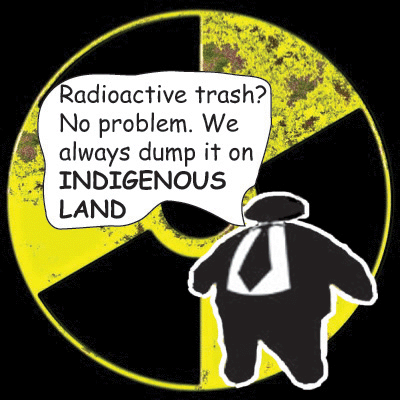
OTTAWA, April 30, 2024 — Today, leaders of Indigenous communities in New Brunswick, Quebec and Ontario express their strong concern about the lack of Indigenous consent for nuclear waste, uranium mining and refining on their homelands.
Article 29(2) of the United Nations Declaration on the Rights of Indigenous Peoples (UNDRIP) states: “States shall take effective measures to ensure that no storage or disposal of hazardous materials shall take place in the lands or territories of Indigenous peoples without their free, prior and informed consent.”
The Government of Canada is promoting an expansion of nuclear energy across the country without the free, prior and informed consent of Indigenous Nations affected. Like the existing reactors, new nuclear reactors will leave a toxic legacy for all living things for thousands of years.
Already, dozens of communities have radioactively contaminated sites on their homelands, and they and others must carefully consider the impacts of proposed permanent repositories for nuclear waste on the next seven generations.
Hugh Akagi is Chief of the Peskotomuhkati Nation in Canada, whose homeland is the unwilling host of the Point Lepreau Nuclear Generating Station on the world-renowned Bay of Fundy in New Brunswick. The reactor was built and later refurbished without the Nation’s consent. Now the federal and New Brunswick governments are spending public funds to develop two new nuclear reactors on the Point Lepreau site.
Chief Akagi has written several times to the Minister of Environment and Climate Change Canada, to express concerns about the proposed projects and ask questions about the high-level used nuclear fuel waste in temporary storage at the Point Lepreau site.
“The nuclear fuel chain – mining uranium, chemically processing the ore, fabricating the fuel, fissioning uranium in a reactor creating toxic radioactive waste remaining hazardous for tens of thousands of years – leaves a legacy of injustices disproportionately felt by Indigenous peoples and all our relations,” says Chief Akagi.
In 2021, the Wolastoq Grand Council in New Brunswick published a resolution on nuclear energy and nuclear waste on traditional Wolastoq homeland.
Grand Council Chief Ron Tremblay, says: “Wolastoqewi-Elders define Nuclear in their language as ‘Askomiw Sanaqak,’ which translates as ‘Forever Dangerous.’ That’s why we called for First Nation alternative energy solutions, including renewables and energy efficiency, as well as no more public funding for nuclear and the phasing out of the Point Lepreau reactor.”
The Blind River uranium refinery owned and operated by Cameco is located on lands which since AD 800 have been the site of vibrant Indigenous occupation and life, including as the ancestral lands of the people of Mississauga First Nation (MFN), and MFN’s access to these lands and waters has been barred by virtue of Cameco’s nuclear operations at the site.
Mississauga First Nation has never consented to the lands being used for nuclear activities nor as disposal grounds for radioactive wastes and there continues to be no equitable redress for this loss of access to their ancestral lands located on the Mississauga Delta.
“The existence of nuclear operations on our ancestral lands has contributed to our loss of culture and spiritual traditions and has been detrimental to our health and well-being of our First Nation, said Mississauga First Nation Councillor Peyton Pitawanakwat. “Cameco has materially benefitted and continues to benefit, from the operations at Blind River, which remains the world’s largest uranium refinery. The proposal to now site radioactive wastes on our lands would perpetuate an existing environmental injustice and amount to environmental racism.”
The Kichi Sibi or Ottawa River, which forms the boundary between Ontario and Quebec, is another site of conflict. The Chiefs of Kebaowek and Kitigan Zibi Anishinabeg First Nations in Quebec last year made public their Indigenous-led assessment of a million-cubic-metre radioactive waste mound to be built at Chalk River Laboratories on the shores of the Kichi Sibi on unceded Algonquin territory. Their assessment covered the project’s impact on their culture, land, water and wildlife. An experimental nuclear reactor is also planned for Chalk River.
“The Kichi Sibi is sacred to our peoples and at the heart of our unceded homeland,” said Chief Lance Haymond, of Kebaowek First Nation. “The Algonquin peoples never consented to the Chalk River site being used for over 75 years for nuclear reactors and research, and now being the site for a permanent radioactive waste dump. Consultation was far too late and inadequate, and we reject the plan.”
In spite of the clear opposition to the project by ten Algonquin First Nations, the Canadian Nuclear Safety Commission approved the Near Surface Disposal Facility in January 2024. Two First Nations have launched a legal challenge to the decision, as have several citizen groups.
The federal government says that reconciliation is a priority. How UNDRIP will be respected by the Government of Canada – which signed it in 2016 and passed the United Nations Declaration on the Rights of Indigenous Peoples Act in 2021 – remains to be seen.
Analysis of Canada’s Budget 2024 provisions related to nuclear.

Budget 2024 proposes to provide $3.1 billion over 11 years, starting in 2025-26, with $1.5 billion in remaining amortization, to Atomic Energy of Canada Limited to support Canadian Nuclear Laboratories’ ongoing nuclear science research, environmental protection, and site remediation work.
16 Apr 2024, Susan O’Donnell
There’s no new money announcements for nuclear reactor development such as more money in the Strategic Innovation Fund, a bit of good news.
Overall, a ton of references to nuclear stuff, it’s all over this budget.
The big money announcement, which is not a surprise if you’re following goings-on at Chalk River, is $3.1 billion over 11 years “to Atomic Energy of Canada Limited to support Canadian Nuclear Laboratories’ ongoing nuclear science research, environmental protection, and site remediation work.” see highlight in red below. I have no idea if this is the amount CNL asked for or more or less than that amount. I assume this is new money in addition to the $1.2B or so AECL already gets every year just to run the place.
There’s this one under Indigenous initiatives that could potentially mean funding for nuclear development, but it’s not enough to do anything much with: $36 million, over three years, starting in 2024-25, to renew support for the Strategic Partnerships Initiatives’ Clean Energy program to promote Indigenous participation in clean growth opportunities.
The other money stuff, refundable tax credits for new equipment, means a company needs to spend money to get the credit, which is not what the industry is looking for.
Unrelated to funding but of definite interest is the three-year target for nuclear project reviews and to avoid duplication between the CNSC and IAAC. I wasn’t aware there was duplication so if anyone has insight on the potential impact of this, please share.
Related is broad text for the revised IAA including “measures that include increasing flexibility in substitution of assessments to allow for collaboration and avoid interjurisdictional duplication” which I don’t like the sound of, maybe someone can offer insight.
There’s a long section on the “Canada-US Energy Transformation Task Force” which includes a worrying reference to that pre-written media release at COP 28 to triple nuclear energy, calling it an initiative between “government and like-minded partners” – I say this is worrying because I suspect there’s a battle royale going on as to whether this media stunt at the COP in Dubai by the nuclear industry is an official government commitment. Last time I looked, it wasn’t on the website of Environment and Climate Change Canada which is responsible for COP commitments. But it’s in the budget, so maybe that’s supposed to make it official.
Then there’s a nothing-statement about maintaining a robust Arctic presence, referring to Russia as “today’s most hostile nuclear power” which I guess it is from Canada’s perspective although most of the world’s countries would likely name a different candidate for that honour. Why this is concerning is the reference by PM Trudeau just a week or so ago about needing nuclear submarines to maintain Arctic sovereignty. A file to watch for sure.
So, in summary, a LOT of nuclear references in the budget which is interesting and unsettling but the only big money is for Canadian Nuclear Laboratories, that private company run by Atkins-Réalis/SNC Lavalin and two U.S. companies involved in nuclear weapons development.
So, that’s where our country is at, at this point in history.
Budget 2024 Fairness for every generation https://budget.canada.ca/2024/home-accueil-en.html
Page numbers refer to the pdf page.
Page 29:
Extending for an additional year collaboration with our largest trading partner through the Canada-U.S. Energy Transformation Task Force, which is bolstering critical mineral and nuclear energy supply chain integration.
Page 200:
A 15 per cent refundable tax credit rate for eligible investments in new equipment or refurbishments related to: Low-emitting electricity generation systems using energy from wind, solar, water, geothermal, waste biomass, nuclear, or natural gas with carbon capture and storage.
Page 206:
Set a three-year target for nuclear project reviews, by working with the Canadian Nuclear Safety Commission and Impact Assessment Agency of Canada, and consider how the process can be better streamlined and duplications reduced between the two agencies.
To advance the principle of “one project, one review”, Budget 2024 proposes to: Amend the Impact Assessment Act to respond to the October 2023 Supreme Court of Canada decision that ruled that elements of the Act are unconstitutional. The proposed amendments will ensure the Act is constitutionally sound, facilitating efficient project reviews while advancing Canada’s clean growth and protecting the environment. An amended Act will provide certainty for businesses and investors through measures that include increasing flexibility in substitution of
assessments to allow for collaboration and avoid interjurisdictional duplication, clarifying when joint federal-provincial review panels are possible, and allowing for earlier Agency screening decisions as to whether a full impact assessment is required after the Planning phase. The amended Act will remain consistent with the United Nations Declaration on the Rights of Indigenous Peoples Act;
Page 208
Advancing Nuclear Energy, Nuclear Research, and Environmental Remediation
Non-emitting, nuclear energy is one of the key tools in helping the world reach net-zero emissions by 2050. Canada stands out as one of the few countries to have developed and deployed its own nuclear technology, the CANDU. And the robust Canadian supply chains built around CANDU not only generate highskilled jobs and foster research and development but also play a role in creating affordable and clean electricity. Canada’s nuclear sector also produces medical isotopes essential for radiation therapy and diagnosing heart disease.
Page 209
Canada is a Global Nuclear Energy Leader
Continue readingBallooning costs and secret projects at Canada’s federal nuclear labs
by Ole Hendrickson, March 5, 2024, https://rabble.ca/columnists/ballooning-costs-and-secret-projects-at-canadas-federal-nuclear-labs/—
What does Canada get from its nuclear power corporation for its $1.54 billion budget?
Canada’s national nuclear power corporation – Atomic Energy of Canada Limited (AECL) – has no functioning nuclear reactors, unlike similar state-owned bodies in China, Russia, France, Korea, and the United Arab Emirates, and despite a $1.54 billion annual budget.
AECL’s three “prototype” CANDU reactors haven’t produced electricity for 37 years. Its three main research reactors are also shut down. Yet they must be maintained to protect nearby water bodies.
Section 9 of Canada’s 2023 Public Accounts indicates that AECL’s liability will require ongoing public expenditures for the next 162 years. It records “decommissioning of nuclear facilities” as a $9.3 billion “asset retirement obligation.”
In 2011, the Harper government sold AECL’s flagship CANDU division to SNC-Lavalin for a piddling $15 million. Then, in 2015 it contracted a multinational consortium to reduce AECL’s nuclear liabilities more quickly.
Under a “Government-owned, Contractor-operated” (GoCo) model, the public retains ownership of AECL’s federal lands, including the shut-down reactors and other radioactive waste. AECL funnels ever-increasing amounts of tax dollars to the “Canadian National Energy Alliance,” currently made up of Texas-based Fluor and Jacobs, and SNC-Lavalin (now rebranded as “AtkinsRéalis”).
The 2023-24 Main Estimates give AECL $1,541,555,307, with $1,140,509,721 earmarked for “Nuclear decommissioning and radioactive waste management.” For comparison, the current Parliamentary appropriation for the Canadian Broadcasting Corporation (CBC) is $1,287,169,435.
Despite billion-dollar annual cash outlays, AECL’s liabilities grew from $6.5 billion in 2015 to the current $9.3 billion figure.
AECL seems more interested in adding liabilities than reducing them. Its former Canadian Nuclear Laboratories (CNL) subsidiary – now owned by the consortium – is building new “Class 1” nuclear facilities at the Chalk River Laboratories, 150 km west of Ottawa. AECL boasts that these laboratories are “Canada’s largest science and technology complex.”
One Chalk River facility (the ANMRC) would enable research on “advanced” reactor fuels, including those made by extracting plutonium from high-level waste fuel rods. Another (the MCECE) would extract tritium, a radioactive form of hydrogen that builds up in the heavy water of CANDU reactors.
Despite concerns about costs and liabilities, both facilities are proceeding without Parliamentary or regulatory oversight. In 2018, Canada’s complacent nuclear “regulator”, the Canadian Nuclear Safety Commission, issued a licence authorizing CNL to “prepare a site for, construct, operate, modify, decommission or abandon” any nuclear facility on the Chalk River site. This effectively bypasses the normal licensing processes and regulations that govern Class 1 facilities.
Production of plutonium, tritium, and “clean” heavy water raises serious national security concerns. All are used in making nuclear weapons. Fluor and Jacobs are heavily involved in the weapons industry. They were prominent sponsors of the recent 16th Annual Nuclear Deterrence Summit in Washington DC – a “Global Warfare Summit.” As pillars of the military-industrial complex, they promote a new nuclear arms race. Canada has become an unwitting partner in this. Chalk River is an ideal location for training a new generation of weapons scientists, given its origins as a Cold War weapons plutonium production facility.
The only way for the public to find out and comment on what’s happening at Chalk River is through the Impact Assessment Act. AECL is a “federal authority” under sections 81 to 91 of the Act, it must determine that a project on federal lands “is not likely to cause significant adverse environmental effects.” But AECL lets CNL post uninformative project descriptions on the Canadian Impact Assessment Registry and make its own determinations after a perfunctory 30-day comment period.
In the case of the MCECE project, CNL began site preparation without an AECL determination. The billion-dollar ANMRC project, which started before the Impact Assessment Act came into force, was never even posted as a project, even though section 67 of the previous Canadian Environmental Assessment Act, 2012 also required an AECL determination.
These questionable processes may be coming to an end. Section 84 of the Impact Assessment Act requires the federal authority to consider “any adverse impact that the project may have on the rights of the Indigenous peoples of Canada recognized and affirmed by section 35 of the Constitution Act, 1982.”
Kebaowek First Nation recently held a joint press conference with the Bloc Quebecois to oppose a massive radioactive waste dump on unceded Algonquin territory at Chalk River. It is also intervening in the MCECE project, aided by a report from Dr. Gordon Edwards of the Canadian Coalition for Nuclear Responsibility that concludes “there is no justification for the proposed facility.”
There has been far too much secrecy surrounding the goings on at AECL and Canada’s nuclear laboratories under the GoCo model. Parliament should scrutinize the $1.5 billion annual outlay to AECL, and determine who is benefiting – Canadians, or unregulated multinational corporations.
In an Ontario town split over a nuclear dump site, the fallout is over how they’ll vote on the future
The town will hold an online vote, but an opposition group demands paper ballots
Colin Butler · CBC News Apr 14, 2024
A citizen’s group opposed to burying Canada’s stockpile of spent nuclear fuel half a kilometre below a southwestern Ontario farm town is demanding a paper ballot rather than an online vote in an upcoming referendum on whether it should welcome radioactive waste.
Canada’s nuclear industry’s quest to find a place to store the growing amount of highly radioactive detritus it produces stretches back decades. The search has narrowed to two potential host communities in Ontario: Ignace (four hours northwest of Thunder Bay) and the Municipality of South Bruce (two hours north of London).
For years, South Bruce has found itself divided over being a potential host — split, between those who believe a new industry is a way to reclaim lost prosperity that lapsed with the glory days of farming, and those who think jobs and subsidies from the nuclear industry has blinded the others to the risks of welcoming radioactive waste into the community.
On Monday, town councillors in South Bruce voted to accept the official question on the ballot: “Are you in favour of the Municipality of South Bruce declaring South Bruce to be a willing host for the Nuclear Waste Management Organization’s (NWMO) proposed deep geological repository?”
‘Our concern is the way that they’re holding the referendum’
“I have no issues with how the question is worded,” Michelle Stein, a member of the grassroots Protect Our Waterways — No Nuclear Waste, said.
“Our concern is the way that they’re holding the referendum as an online vote.”
Stein said unlike paper ballots, which can be audited and verified by anyone, she argues the way a computerized voting system sorts and tallies ballots is largely a mystery to laymen, hidden beneath source code that’s indecipherable to all who lack specialized knowledge.
“This is a forever decision. Why wouldn’t they want tangible physical proof? We can go back and count those paper ballots and they can say, ‘look, here’s the ballots. This is what the people voted for.'”
The municipality of South Bruce is divided over a potential site for a nuclear waste storage facility deep below their community. A referendum to settle the matter is set for later this year. Host Colin Butler speaks with Michelle Stein, a member of Protect Our Waterways – No Nuclear Waste, to hear her concerns………………………………………………….
Errors or breaches can be difficult to detect
Still, critics say online voting is prone to cyber attacks and there’s no way to guarantee voter privacy, or the integrity of the vote. There is also no provincial standard in Ontario, or, for that matter, federally, when it comes to online voting systems.
“There’s a lot of questions that this technology introduces around that. ‘How do I know my vote counted? How do I know it was kept secret?'” Aleksander Essex, a Western University professor who studies cyber security and crytography, said.
At the same time however, Essex notes, he has never seen any evidence of fraud or tampering with the vote in all the years he has studied online voting. ……………………………………………………………………………………………….. https://www.cbc.ca/news/canada/london/ontario-south-bruce-nuclear-dgr-referendum-online-voting-1.7168326—
Small Nuclear Reactors – free and comprehensive information from SMRs Education Task Force
The SMRs Education Task Force is a network of groups in Canada concerned and active on the nuclear file. Together we have many decades of experience providing information to Canadians about nuclear issues, including the proposed small modular nuclear reactors (SMRs). We are providing this bulletin free of charge to encourage more informed awareness of SMRs and their potential implications for communities across the country.
1 This Month


Tell the Ukrainian Government to Drop Prosecution of Peace Activist Yurii Sheliazhenko
Petition to revoke the licensing of the Near Surface Nuclear Disposal Facility (NSDF) at Chalk River. https://www.ourcommons.ca/petitions/en/Petition/Details?Petition=e-7247


of the week – STOP SMALL MODULAR REACTORS IN CANADA
To see nuclear-related stories in greater depth and intensity – go to https://nuclearinformation.wordpress.com
-
Archives
- March 2026 (163)
- February 2026 (268)
- January 2026 (308)
- December 2025 (358)
- November 2025 (359)
- October 2025 (376)
- September 2025 (258)
- August 2025 (319)
- July 2025 (230)
- June 2025 (348)
- May 2025 (261)
- April 2025 (305)
-
Categories
- 1
- 1 NUCLEAR ISSUES
- business and costs
- climate change
- culture and arts
- ENERGY
- environment
- health
- history
- indigenous issues
- Legal
- marketing of nuclear
- media
- opposition to nuclear
- PERSONAL STORIES
- politics
- politics international
- Religion and ethics
- safety
- secrets,lies and civil liberties
- spinbuster
- technology
- Uranium
- wastes
- weapons and war
- Women
- 2 WORLD
- ACTION
- AFRICA
- Atrocities
- AUSTRALIA
- Christina's notes
- Christina's themes
- culture and arts
- Events
- Fuk 2022
- Fuk 2023
- Fukushima 2017
- Fukushima 2018
- fukushima 2019
- Fukushima 2020
- Fukushima 2021
- general
- global warming
- Humour (God we need it)
- Nuclear
- RARE EARTHS
- Reference
- resources – print
- Resources -audiovicual
- Weekly Newsletter
- World
- World Nuclear
- YouTube
-
RSS
Entries RSS
Comments RSS
 nuclear-news