Chief Akagi requests public hearing to review any new governance arrangement for the Point Lepreau nuclear reactor on Peskotomuhkati homeland
Canada adopted the United Nations Declaration on the Rights of Indigenous Peoples (UNDRIP). Article 29 of UNDRIP requires states to take effective measures to ensure that no storage or disposal of hazardous materials takes place in the lands or territories of Indigenous peoples without their free, prior, and informed consent. The CNSC’s decision to grant NB Power a 10-year license renewal does not reflect this commitment.
by Abby Bartlett, June 10, 2024 homeland https://nbmediacoop.org/2024/06/10/chief-akagi-requests-public-hearing-to-review-any-new-governance-arrangement-for-the-point-lepreau-nuclear-reactor-on-peskotomuhkati-homeland/
On May 15, New Brunswick’s Energy Development Minister Mike Holland tabled the first reading of a bill to change the Electricity Act. The change would allow NB Power to enter a partnership with Ontario Power Generation (OPG).
In a letter to the Canadian Nuclear Safety Commission (CNSC) on May 29, Peskotomuhkati Chief Hugh Akagi outlined his initial concerns with the proposed agreement between NB Power and OPG, which reportedly includes a partial ownership stake in the Point Lepreau Nuclear Generating Station.
The letter is from the Passamoquoddy Recognition Group (PRGI) which represents the Peskotomuhkati Nation in Canada and the interests of rightsholders and the Peskotomuhkati ecosystem, including the Point Lepreau Nuclear Station and areas surrounding up to 90 km away.
Any new owners of the Lepreau CANDU nuclear reactor will have rights and responsibilities that PRGI wants clarified. In May 2022, Chief Akagi spoke at a public hearing held by the CNSC in Saint John to discuss NB Power’s request for a 25-year renewal of the license to operate the Point Lepreau nuclear reactor.
At the hearing, PRGI asked the CNSC to reduce the license to three years, stating that the average length of licensing is only 2.44 years. In the end, the CNSC granted a 10-year licence. Given that PRGI has already felt the impact of the proposed change in licence holders, they are rightfully concerned about the possible repercussions that will come from the new proposed changes.
In December 2023, New Brunswick published its new energy strategy, outlining plans to declare that the Point Lepreau reactor will undergo licence “renewals every 10 years.” This statement assumes that the 10-year license length will be the conclusion of future discussions that have not happened yet.
Back in June 2022, Chief Akagi stated that a 10-year license renewal meant that Canada was not meeting its own legal and related obligations to the Nation. “The new licence gives NB Power the ability to create and store 10 more years of fresh and dangerous high-level waste on our territory. This is not acceptable,” Chief Akagi said at the time.
Canada adopted the United Nations Declaration on the Rights of Indigenous Peoples (UNDRIP). Article 29 of UNDRIP requires states to take effective measures to ensure that no storage or disposal of hazardous materials takes place in the lands or territories of Indigenous peoples without their free, prior, and informed consent. The CNSC’s decision to grant NB Power a 10-year license renewal does not reflect this commitment.
Regarding any new governance arrangement for the Point Lepreau reactor, PRGI has many questions outlined in its letter to the CNSC.
PRGI wonders how a new joint ownership entity will fulfill its Indigenous consultation obligations. Will PRGI have any say about these arrangements? How will a joint ownership arrangement for the existing CANDU reactor impact any new reactors on the Point Lepreau site? What will OPG’s responsibilities be for the existing and any further nuclear waste produced by the Point Lepreau plant under a co-ownership arrangement?
NB Power is fraught with 3.6 billion dollars of nuclear debt due to the original building cost of the Lepreau nuclear generating station, the later refurbishment of the reactor, and the poor performance over the course of its operation.
This potential agreement would mean shedding the Lepreau nuclear reactor off to a new entity, which would be co-owned with OPG and NB Power in an agreement that could force New Brunswick customers to pay for expensive nuclear power for decades.
The letter by Chief Akagi ends with two requests. First is the need for the CNSC to commit to holding in-person hearings for the future request to change ownership of the Lepreau nuclear reactor to ensure that the Peskotomuhkati Nation can intervene in its traditional way rather than only through written intervention.
The second request asks the CNSC to remind the New Brunswick Government that a future 10-year license for the Lepreau reactor is not up to the provincial government. Instead, it will be a matter of review and decision made by the CNSC, which will involve public intervenors, including PRGI.
As Chief Akagi outlines, NB Power is required to make an application to the CNSC to authorize the transfer of licence, and under section 40 of the Nuclear Safety and Control Act, they are also required to hold a hearing. The Peskotomuhkati Nation does not want this proposed change to become another injustice that they must bear. The CNSC needs to ensure that Peskotomuhkati people’s voices are heard, understood, and respected in the process.
Abby Bartlett is a research assistant on the CEDAR project at St. Thomas University.
Corporate lobbying heats up around governments’ nuclear power plans despite concerns from anti-nuclear advocates
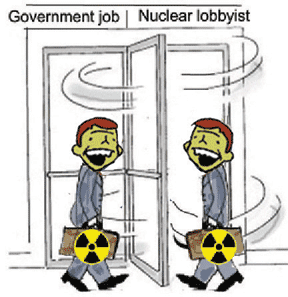
“The nuclear industry and the government are so tightly entwined that you would have difficulty finding some kind of air space in between them. You have, for example, nuclear industry people that get jobs in the government. It’s a revolving door.”
Critics say nuclear too costly and slow to build while supporters back it as a climate solution
Investigative Journalism Foundation, KATE SCHNEIDER, 6 JUNE, 24
“…………………………….. Fears of nuclear meltdowns have long stymied the expansion of nuclear power across Canada. However, with Canada newly committed to achieving net-zero emissions by 2050, the past few years have spurred a new wave of support for nuclear power development.
Yet, some opposition MPs and analysts worry that the recent embrace of nuclear power by governments in Canada has been a result of lobbying by an influential industry more intent on turning a profit than hitting climate targets.
“We’ve got a very, very powerful nuclear special-interest lobby, and we don’t have politically powerful lobbies for energy efficiency or wind or solar,” said Jack Gibbons, chair of the Ontario Clean Air Alliance and a former Toronto Hydro commissioner. “As a result, our political leaders are making bad decisions.”
Last July, the Ontario government announced the largest expansion of nuclear power in Canada in decades. It intends to add a 4,800-megawatt extension to the Bruce Nuclear Generating Station, one of the biggest nuclear power plants in the world.
The site is located on Lake Huron in the northern Ontario municipality of Kincardine — just over 200 km northwest of Toronto — and, while owned by the provincial government, is operated by private company Bruce Power.
Last week, Bruce Power registered a new lobbyist in the province to discuss the “successful refurbishment of Ontario’s nuclear fleet” as well as what it sees as overly onerous regulations, offering to help the government “identify areas for red tape reduction in several sectors.”
The lobbyist, Daniel Levitan, is currently employed by government relations firm Rubicon Strategy. Like several other nuclear industry lobbyists identified by the IJF, Levitan previously worked for the government. He worked for 10 years in external relations for Hydro One, Ontario’s largest electricity distribution utility, starting in 2013. Before that, he was a director of communications and senior policy adviser for several Ontario government departments.
Neither Bruce Power nor Daniel Levitan responded to requests for comment.
Competition for the contract for new nuclear reactors at the Bruce site has also spurred on a lobbying battle between AtkinsRéalis (formerly known as SNC-Lavalin) and Westinghouse, as reported by The Logic last month.
AtkinsRéalis employs both Jean Chrétien, the former Liberal prime minister, and Mike Harris, the former Progressive Conservative premier of Ontario, as the co-chairs for their public relations campaign.
The biggest surge in lobbying, however, has perhaps been around funding for small modular reactors (SMRs)……………..
In February last year, Natural Resources Canada launched a funding program offering $29.6 million to encourage the development of SMRs.
Companies working on the technology are eager to take advantage of federal funds. Ultra Safe Nuclear Corporation (USNC), a Seattle-based nuclear technology company, lobbied the government on eight different occasions last year seeking money for “Canada’s first small modular nuclear reactor.”
BWXT Canada Ltd., a nuclear reactor manufacturer, is also registered to lobby at the federal level, hoping to “examine new funding opportunities for nuclear energy and its operations in Canada.”BWXT Canada has lobbied key ministers and government officials this year, including Jonathan Wilkinson, minister of energy and natural resources; Mairead Lavery, president and CEO of Export Development Canada; Jean-Yves Duclos, minister of public services and procurement; and Ben Chin, one of the prime minister’s top advisers.
BWXT Canada announced in April that it was investing $80 million to expand its Cambridge, Ont. headquarters, increasing its manufacturing capacity to meet the growing demand for nuclear technologies, including SMRs.
BWXT said, “We are interested in updating all levels of government about our operations in Canada, our expansion project at our Cambridge facility and how we are supporting Ontario’s nuclear projects and Canada’s clean energy targets.” USNC did not respond to a request for comment.
“The nuclear industry and the government are so tightly entwined that you would have difficulty finding some kind of air space in between them.” – Susan O’Donnell, St. Thomas University
Industry groups such as the Canadian Nuclear Association and the Organization of Canadian Nuclear Industries have also been lobbying officials in the past year, as have several unions including the International Union of Operating Engineers. The Ontario Society of Professional Engineers is also registered to lobby in Ontario.
Reached for comment, Snigdh Baunthiyal, a spokesperson for the Canadian Nuclear Association, provided a statement to the IJF that said, “We have asked for the Federal government’s support to accelerate the deployment of strategic tools such as ITCs [investment tax credits] and CMT [corporate minimum tax] to ensure Canada retains its leadership role and meets its domestic and international climate and energy security objectives.”
None of the other organizations responded to requests for comment.
In total, four nuclear power plants currently operate across Canada, producing about 12.7 per cent of Canada’s electricity. Three plants — with 16 operational reactors — are located in Ontario, while a fourth housing a single reactor is in Lepreau, New Brunswick.
Alongside the privately operated Bruce Nuclear Generating Station, the other two Ontario-based plants in Pickering and Darlington are operated by Ontario Power Generation (OPG), a Crown corporation.
OPG has lobbied the federal government 21 times so far this year regarding “issues pertaining to federal legislation, policies and programs with respect to OPG’s existing nuclear operations or new nuclear opportunities including small modular reactors,” according to its lobbying registration.
The Darlington site is already halfway through a refurbishment costing $12.8 billion while the Ontario government recently announced plans to refurbish four of the reactors at the Pickering plant starting in 2027.
Construction of an SMR at Darlington is scheduled to be completed in 2028. Last July, the Ford government announced that this SMR would soon be followed by an additional three at the site, projected to go online by the mid-2030s.
Jennifer Stone, a spokesperson for OPG, said that these projects will help the province “meet the growing demand for clean electricity for decades to come.
“As OPG helps secure Ontario’s clean energy future, these projects also generate good jobs and drive economic growth across the province both at our facilities and through Ontario’s robust nuclear supply chain,” added Stone.
NB Power plans to build an SMR at its Lepreau site in conjunction with ARC Clean Technology Inc.
NB Power acknowledged the IJF’s request for comment, but said it would be unable to provide a response before deadline.
While Canada’s only operating nuclear plants are in Ontario and New Brunswick, the uranium used to fuel them comes entirely from Saskatchewan, largely via uranium mining giant Cameco.
Cameco engaged in a lobbying campaign in March targeting various federal government officials, including those at Natural Resources Canada and the Impact Assessment Agency of Canada. According to its most recent lobbying registration, Cameco wants to “advocate for the federal government to include nuclear energy as a major component in Canada’s greenhouse gas/carbon reduction strategy.” Cameco is also registered to lobby in Saskatchewan.
Dale Austin, Cameco’s director of government relations and one of its registered lobbyists, previously worked as a director of the policy analysis and coordination division for Natural Resources Canada as well as a director of policy coordination for the Canadian Nuclear Safety Commission.
Susan O’Donnell is an adjunct research professor at St. Thomas University and a core member of the Coalition for Responsible Energy Development in New Brunswick. O’Donnell said the influence of the industry extends beyond what appears in the official lobby registry.
“‘Do they even need to lobby?’ is what I would say. Because they’ve got all their people in the government,” said O’Donnell.
“The nuclear industry and the government are so tightly entwined that you would have difficulty finding some kind of air space in between them. You have, for example, nuclear industry people that get jobs in the government. It’s a revolving door.”
Worries over safety risks and environmental implications of nuclear power have been around for decades, embodied by incidents like the Chornobyl and Fukushima disasters.
However, the concerns expressed today by anti-nuclear advocates seem to revolve more around nuclear being too costly or excessively slow to build.
“It just doesn’t make any economic sense. And it doesn’t make any climate sense,” said Gibbons. “Wind and solar, combined with storage, can keep our lights on at less than half the cost of new nuclear reactors.”
…………………………………O’Donnell said that given Canada’s commitment to decarbonize its electricity grid by 2035, the idea that new nuclear power projects, especially SMRs, will be ready in time is simply unrealistic.
New nuclear reactors typically take 10 to 15 years to build. And besides the first Darlington SMR, no other SMRs in Canada will be operational until at least the early 2030s.
“On the other hand, we do have mature technologies, which are wind and solar, we do have [storage] technology that’s coming along tremendously,” said O’Donnell. “We’ve got the technology now if we’re serious about meeting our targets.”…………….. https://theijf.org/nuclear-power-lobbying
“Crisis of radioactive waste mismanagement in the Ottawa River watershed”
Hill Times letter: “Crisis of radioactive waste mismanagement in the Ottawa River watershed,” Chief Lance Haymond and Dr. Gordon Edwards Monday May 20, 2024
We are writing to alert Hill Times readers to what we see as a crisis of radioactive waste mismanagement in the Ottawa River watershed. Components of the crisis include:
A giant, above-ground landfill for one million tonnes of radioactive waste at Chalk River Laboratories, less than one kilometre from the Ottawa River. According to the licensed inventory for the facility, more than half of the radionuclides are long-lived with half-lives exceeding the design life of the facility by thousands of years. Experts say the waste is “intermediate level,” and should be stored underground. There are concerns the facility will leak radioactive contaminants during operation, and break down due to erosion after a few hundred years.
There is a proposal to entomb “in situ” a defunct nuclear reactor less than 400 meters from the Ottawa River at Rolphton, Ont. In our view, the proposal flouts international safety standards that say entombment should not be used except in emergencies.
A multinational private-sector consortium is transporting all federal radioactive wastes, including high-level irradiated fuel waste, to Chalk River. These imports are occurring, despite an explicit request by the City of Ottawa in 2021 for cessation of radioactive waste imports to the Ottawa Valley which is seismically-active, and a poor location for long-term storage of radioactive waste.
All of the above is taking place despite the opposition of the Algonquin People on whose unceded territory the Chalk River Laboratories and defunct Rolphton reactor are located. This contravenes Canada’s United Nations Declaration on the Rights of Indigenous Peoples Act.
In our view, this crisis is a direct result of Canada’s inadequate nuclear governance regime under which almost all aspects of nuclear governance are entrusted to one agency, the Canadian Nuclear Safety Commission, which is widely perceived to be captured by the nuclear industry, and to promote the projects it is supposed to regulate. Other concerns include conflicts of interest, lack of checks and balances, and an inadequate nuclear waste policy.
Despite repeated resolutions of concern by the Assembly of First Nations and more than 140 downstream municipalities—including Ottawa, Gatineau, and Montreal—the current government appears unwilling or unable to take meaningful action to address this crisis. We are therefore appealing to the International Atomic Energy Agency and requesting a meeting with its peer review team that is scheduled to visit Canada next month.
Chief Lance Haymond, Kebaowek First Nation
Gordon Edwards, PhD, Canadian Coalition for Nuclear Responsibility
Moving nuclear waste through traditional territories could face opposition, Ontario First Nation says
‘Think about how many treaty territories that waste would have to go through,’ chief says
Colin Butler · CBC News · May 27, 2024
A First Nation in southwestern Ontario says even if the community votes yes on a proposed $26 billion dump for nuclear waste within their traditional territory, it would likely be opposed by other First Nations, through whose territories the more than 5.5 million spent fuel rods would have to pass.
Canada’s nuclear industry has been on a decades-long quest to find a permanent home for tens of thousands of tonnes of highly radioactive waste. The search has narrowed to two Ontario communities — Ignace, northwest of Thunder Bay, and the Municipality of South Bruce, north of London.
Both will vote later this year on whether to build a deep geologic repository, a kind of nuclear crypt, where more than 50,000 tonnes of waste in copper casks will be lowered more than 500 metres underground to be kept for all time, behind layers of clay, concrete and the ancient bedrock itself.
But so will their Indigenous neighbours, whose traditional territories the towns are within, which gives each respective First Nation a veto.
In the case of Saugeen Ojibway Nation in particular, it means the community again finds itself as the future arbiter of a potential nuclear waste site on their traditional lands for the second time in a few years.
In early 2020, its members voted overwhelmingly against the construction of a deep geologic repository outside of Kincardine, that was proposed by Ontario Power Generation.
This time around, Chief Greg Nadjiwon of the neighbouring Chippewas of the Nawash, says the proposal by the Nuclear Waste Management Organization (NWMO), a non-profit industry group, for a similar facility has a better chance, but is still a tough sell…………………………………………………………………………………… https://www.cbc.ca/news/canada/london/nuclear-waste-ontario-south-bruce-saugeen-nation-1.7213878
Indigenous opposition to nuclear waste being transported through their territory

Concerns growing surrounding nuclear waste management
Anishinabek, The voice of the Anishinabek nation. May 22, 2024, By Rick Garrick
FORT WILLIAM — Fort William’s Elysia Lone Elk is raising concerns about the transportation of nuclear materials through Northern Ontario if the proposed nuclear waste site near Ignace in Treaty #3 territory gets the go-ahead.
The Trans-Canada Hwy. was closed for about 20 hours in 2001 after a head-on collision between two transport trucks, one of which was transporting two canisters of radioactive material — iridium — about 25 kilometres east of Dryden, 105 kilometres west of Ignace. The collision resulted in “widespread destruction” and the deaths of four people, two from each vehicle, according to a news report. Officials from the Canadian Nuclear Safety Commission eventually arrived on site, found there was no leakage, and removed the canisters to a safe location.
“Water is life, it’s our most sacred resource,” Lone Elk says. “We need that to survive, animals need that to survive, and I don’t think we should be drilling underground and playing with aquifers with a very toxic harmful material that has a half-life beyond my conception of time.”
The Nuclear Waste Management Organization (NWMO) has been following a process to select a site for Canada’s plan to safely manage used nuclear fuel long-term since 2010, and has since narrowed down the potential sites to two areas for Canada’s deep geological repository, the Wabigoon Lake Ojibway Nation-Ignace area in northwestern Ontario, and the Saugeen Ojibway Nation-South Bruce area in southwestern Ontario. If the Wabigoon Lake Ojibway Nation-Ignace area is selected as the site, nuclear materials would have to be transported across Northern Ontario to the site.
“If it’s so safe, then why are you even transporting it, just bury it where it is? We know how dangerous those highways can be,” Lone Elk says. “The fact that no one on the [potential transportation] corridor gets a say is a democratic problem, very frustrating.”
Lone Elk adds that the nuclear material would be transported across Northern Ontario for the operating life of the proposed deep geological repository. The NWMO states on their website that based on current projections of Canada’s inventory of used nuclear fuel, transportation is anticipated to take about 40 years to complete. The NWMO adds that they are exploring road and/or rail options for transporting used nuclear fuel to the deep geological repository.
“The (Fort William) Band Council has passed two resolutions, one focusing on the proximity principle and then the other one specifically outright stating we do not support nuclear fuel being transported through our traditional territory,” Lone Elk says. “We’re trusting their scientists, we’re trusting industry scientists, we’re trusting industry factors; so when does the First Nation get to participate with Indigenous knowledge?”
Fort William Chief Michele Solomon says Fort William passed two resolutions in the last four years opposing nuclear waste being brought into Fort William territory.
“I think that it’s fair to say we stand with other First Nations in Robinson Superior Treaty territory to say that there’s nothing that gives us comfort that there would be any safety with this being transported through our communities,” Solomon says. “We see the increase in accidents on the highways going through our homelands so we’re strongly opposed to it.”
Solomon adds that their community has not been consulted on this issue.
Based on how the community has responded to other possible threats to our homelands, the people have been strongly opposed to other things that have been proposed for our territory,” Solomon says. “If the government wants to proceed with this, then they need to consult with the rights holders of this territory. So if it needs to pass through Robinson Superior territory, you need to consult with all of those communities.”
Solomon says it is not enough for the Nuclear Waste Management Organization to say that it is safe.
“I think there should be independent research done and that has not happened as far as I know,” Solomon says, noting that unhealthy things have been brought into her community’s airspace and waterways before. “So we are strongly opposed.”
The Assembly of First Nations is holding four Regional Dialogue Sessions: A Dialogue on the Transportation and Storage of Used Nuclear Fuel at locations across the country, including on May 22 at the Delta Hotels by Marriott in Thunder Bay.
--
New Brunswick’s nuclear reactor emits high levels of radioactivity, increasing cancer risk.

Expert report for the Passamaquoddy Recognition Group
by Ian Fairlie, May 9, 2022, https://nbmediacoop.org/2022/05/09/new-brunswicks-nuclear-reactor-emits-high-levels-of-radioactivity-increasing-cancer-risk/
New Brunswick Power’s Point Lepreau nuclear reactor on the Bay of Fundy emits much higher levels of radioactive tritium than other nuclear reactors in Canada. Ingesting and breathing in tritium increases the risk of cancer in humans and other animals.
Tritium is the radioactive isotope of hydrogen, and international agencies recognise it as an unusually hazardous radioactive substance. One of its properties is to bind with carbohydrates, proteins and lipids in cells to form organically-bound tritium (OBT) which sticks inside the body for years.
These alarming findings will be tabled on May 10 by the Passamaquoddy Recognition Group in Saint John during Canadian Nuclear Safety Commission (CNSC) hearings on the application by NB Power for an unprecedented 25-year extension of its licence to operate its Lepreau reactor. The CNSC is the regulator of all nuclear activities in Canada.
Although industry scientists in Canada claim tritium has low toxicity and does not bioaccumulate, official reports show tritium is twice to three times more radiotoxic compared to external gamma radiation. And many studies indicate OBT levels increase the longer people are exposed to tritiated water.
Considerable evidence exists – from many epidemiology studies around the world, that children who live near nuclear plants emitting large amounts of tritium are more likely to get leukemia than those living further away. References to all these studies are included in the appendix to the CNSC submission by the Passamaquoddy Recognition Group.
The problem is that Canadian CANDU heavy water reactors emit much larger amounts of tritium than US or European reactors, so the health effects here are very likely to be greater. However the industry and CNSC avoid any studies that could spell trouble for them.
Mainly because of pressure from Canada’s powerful nuclear lobby, safety levels for tritium here are very lax compared to other countries. For example, acceptable levels for tritium in drinking water in Canada are 70 times those in the EU, and approximately 400 times higher than in some US states.
High emissions
In my expert report for the Passamaquoddy Recognition Group, I found that annual tritium releases from the Point Lepreau reactor are very large in comparison with all other nuclear reactors in Canada and indeed in the world.
In 2020, its tritium air emissions were 290 terabecquerels, that’s 290,000,000,000,000 becquerels – which is a huge amount of radioactivity. Worryingly, these releases have been increasing in recent years.
It is well understood that the older a reactor the higher the tritium levels in its moderator and cooling circuits. As well, various operations and maintenance activities increase tritium releases. Without a means of removing tritium, its inventory and releases will continue to increase each year.
These worries are exacerbated by NB Power’s proposed 25-year relicensing from 2022 to 2047. The reactor started operations 40 years ago in 1982 (with retubing between 2008 and 2012). The CNSC has recommended the NB Power nuclear facility is re-licensed to operate for another 20 years to 2042, see the CNSC’s response.
However, this would mean that Lepreau would have operated for 60 years which is unacceptably long as it was originally designed with a 30-year lifespan. This is arguably an unsafe proposal and it flies in the face of the Precautionary Principle, which states that “complete evidence of a potential risk is not required before action is taken to mitigate the effects of the potential risk.”
How does tritium get inside people?
When tritium is emitted from Point Lepreau, it travels via multiple environmental pathways to humans including through air. It cycles in the environment, because tritium atoms swap quickly with stable hydrogen atoms in the biosphere and hydrosphere.
This means that all open water surfaces, rivers, streams and all biota, local crops and foods in open-air markets, animals and humans will become contaminated by tritiated moisture up to ambient levels – that is, up to the air concentrations of the emitted tritium.
According to New Brunswick Power’s environmental assessments, local residents will receive radiation exposures from these tritium emissions, from the tritium in food and water, from the tritium breathed in, and from the tritium absorbed through their skin.
For example, NB Power already admits that people are exposed to radiation from tritiated water vapour in the air, drinking water in local wells, diving for sea urchins, harvesting clams and dulse, and eating local seafood. But local people will also get doses from eating wild foods such as mushrooms, berries and other fruits, gardening vegetables, honey hives, and the harvesting of seaweed for fertiliser.
These are all important matters for Indigenous peoples who take pride in living close to their lands and sea. The continued radioactive poisoning of their lands and sea is deeply offensive to them.
These intakes increase their risk of getting cancer and other radiogenic diseases, but NB Power does not measure tritium levels in people near its Lepreau reactor, nor does it carry out epidemiology studies into ill-health levels in nearby populations.
Nevertheless epidemiology studies at other Canadian facilities which emit tritium all indicate increases in cancer and congenital malformations. In addition, evidence from cell and animal studies, and radiation biology theory, indicates radiogenic effects occur from tritium exposures.
New studies show increased risks
Recent, large, statistically powerful, epidemiology studies of nuclear workers in UK, US and France have increased our perception of the radiation risks of low-level radiation, including tritium. The new studies show a 47% increase in solid cancers and a 580% increase in leukemias. This evidence is directly applicable to tritium’s radiation exposures from Point Lepreau.
These high and increasing tritium emissions, high levels of radioactive contamination, and increased estimates of cancer risk together mean that tritium poses worrying health risks to workers and to people near Lepreau and in the direction of the prevailing winds, including in Saint John.
There is already a long history of NB Power ignoring tritium dangers at Lepreau.
The conclusion from my report for the Passamaquoddy Recognition Group, is that Point Lepreau should not be granted any extension of its operating license, far less a 20 year one. As shown by experience around the world, much safer, healthier, less expensive alternatives exist for generation electricity, such as wind turbines, solar panels and tidal schemes.
Dr. Ian Fairlie is an independent citizen scientist based in the UK who has specialised on radioactivity in the environment with degrees in chemistry and radiation biology. His doctoral studies at Imperial College, UK and Princeton University, US examined nuclear waste technologies. One of his areas of expertise is the dosimetric impacts of nuclear reactor emissions, in particular tritium.
The plutonium connection: Why I no longer conduct my research at the University of New Brunswick
I had already learned enough about the power and influence of the nuclear industry to know that I would be fighting a losing battle if I kept my research at UNB
Once during my 13 years at the NRC I was asked to work on a military technology project, and I refused. I had a visceral negative reaction to doing research that could potentially be implicated in mass killing.
by Susan O’Donnell, May 17, 2024, https://nbmediacoop.org/2024/05/17/the-plutonium-connection-why-i-no-longer-conduct-my-research-at-the-university-of-new-brunswick/
On Thursday this week, two very different emails landed in my inbox minutes apart. The juxtaposition jolted me, and I thought: it’s time to share my story about my departure from the University of New Brunswick.
The first email, from the NB Media Co-op, informed me that my commentary written with Gordon Edwards was just published. Our article marked the 50th anniversary of an event that had shocked the world: India’s test nuclear explosion made with plutonium extracted from a ‘peaceful’ nuclear reactor, a gift from Canada. We questioned if Canada was making the same mistake by backing the Moltex project to extract plutonium from used nuclear fuel at the Point Lepreau site on the Bay of Fundy in New Brunswick.
A UNB professor friend sent the second email. He wrote: ‘This will be aggravating to read, but I thought you’d want to see it. I’m attaching the announcement about Arthur Irving’s death coming from UNB’s President. Arthur Irving is celebrated for his commitment and dedication to the environment. Meanwhile, people who are actually committed to the environment (e.g., you) are blacklisted.’
The two emails had this connection: My research and writing about plutonium and Moltex is the main reason why in 2023 I moved my research program from the University of New Brunswick, the largest university in the province, over to St. Thomas University, a small liberal arts undergraduate institution that shares the campus with UNB in Fredericton.
My journey from UNB to STU began in 2020. At that point, I had been with the UNB Sociology department for almost 16 years as an adjunct professor, on faculty but not on staff and so not in the faculty union. During those years, I brought considerable federal research funding into UNB and hired and trained more than a dozen UNB graduate students. My research expertise includes technology adoption: analyzing the social, political, environmental and economic contexts in which people deploy technologies. I joined UNB in 2004 while employed at the National Research Council of Canada on the Fredericton UNB campus, as a senior researcher and vice-chair of the NRC’s research ethics board. Once during my 13 years at the NRC I was asked to work on a military technology project, and I refused. I had a visceral negative reaction to doing research that could potentially be implicated in mass killing.
At the start of 2020, I could not have imagined a connection between NB Power’s Point Lepreau nuclear reactor and weapons of mass destruction. That February, my UNB research project RAVEN was invited to partner with local groups to bring nuclear expert Gordon Edwards, president of the Canadian Coalition for Nuclear Responsibility, to New Brunswick to give public talks in Saint John and Fredericton. I readily agreed. Several months previously, I had read Gordon’s article in the NB Media Co-op about ‘small modular nuclear reactors (SMRs)’ and wanted to learn more. I put up posters around the UNB campus promoting Gordon’s upcoming talk. I asked the UNB communications office to help me promote Gordon’s visit, but they never came through, and I assumed they were too busy to help.
Gordon Edward’s talk, moved online when the pandemic hit in March 2020, sparked my research interest in the adoption of nuclear technology. I began looking into the two small nuclear reactor projects planned for New Brunswick, Moltex and ARC. In July that year, I co-wrote my first commentary with Gordon that mentioned our concerns about the Moltex project and plutonium extraction from used nuclear fuel. The same day that our piece was published in The Hill Times, the newspaper on Parliament Hill in Ottawa, the CEO of Moltex emailed, asking to meet with me. I agreed, and during a break in the pandemic that month, we met outside at Picaroons Roundhouse along with Janice Harvey, the coordinator of the Environment & Society program at St. Thomas University and a co-investigator on my RAVEN project. At the meeting, Janice and I disagreed with the Moltex CEO about the wisdom of his project to extract plutonium from the used nuclear fuel at Point Lepreau.
I continued my research into small nuclear reactors and plutonium extraction by reading research articles and consulting with Gordon and other experts across Canada and internationally. In May 2021, the federal government gave Moltex a $50.5 million grant to develop its technology that could be exported globally. Shortly after, nine U.S. non-proliferation experts wrote an open letter to Prime Minister Trudeau expressing concern about the Moltex project, writing that by ‘backing spent-fuel reprocessing and plutonium extraction, the Government of Canada will undermine the global nuclear weapons non-proliferation regime that Canada has done so much to strengthen.’ The Globe and Mail published an article about the nuclear weapons proliferation concerns with the Moltex project, and Gordon and I published commentaries in The Hill Times, the Bulletin of the Atomic Scientists and the NB Media Co-op.
During this time, I co-founded a public interest group with local activists, the Coalition for Responsible Energy Development in New Brunswick (CRED-NB), to advocate for a nuclear-free renewable energy future. Janice Harvey invited me to join her in the STU Environment & Society program as an adjunct research professor, and in June 2021 I was appointed to the STU faculty in addition to my UNB faculty appointment.
In August 2021, I received a phone call that augured the end of my research program at UNB. On the phone, a friend told me about overhearing the UNB president say: ‘Susan O’Donnell is spreading misinformation about nuclear energy.’ That shocked me for several reasons. First, I would never knowingly spread misinformation. Second, I’d never met the UNB president and didn’t know he knew I existed. Third, why the heck would he say such a thing? To find out, I filed a Right to Information request with UNB, asking for all communications received by the UNB President and the Vice-President Research that mentioned me or my research project RAVEN.
UNB released the information to me in November 2021. The release package, HERE, is dozens of pages, almost all of it redacted. Just enough information was left for me to know that the UNB senior administration’s concern about me began in February 2020, while I was putting up posters around UNB for Gordon Edwards’ talk about small nuclear reactors. Over the weeks leading up to Gordon’s event, a flurry of emails – involving the UNB president, his chief of staff, several vice-presidents, the UNB secretary, two UNB professors I’ve never met, numerous people in UNB communications, and the Atlantica Centre for Energy, a lobby group funded by the energy industry – fretted about the upcoming ‘anti-nuclear event,’ imagining that it was linked to the Green Party and would jeopardize funding for nuclear research at UNB. I finally realized why the UNB communications office had not responded to my request to help publicize Gordon’s talk.
Most interesting to me in the package was an email from the CEO of Moltex to the UNB vice-president research on July 6, 2020, the same day the CEO wrote to me requesting a meeting. To the VP research, the CEO wrote:
‘You may have seen the article recently written by Dr Susan O’Donnell and her group in NB media coop. It was today issued in the Hill Times which gives it significant exposure and credibility. I understand she is a lecturer at UNB. I have emailed her to request a meeting… I do have concerns that her group RAVEN is supported by SSHRC and yet it is being used as an advocacy group and she is using her Academic Freedom to express views without scientific credibility and in conjunction with political parties but I don’t plan on bringing that up with her. I greatly appreciate debate around nuclear and clean energy (I used to be anti nuclear) but it is hard to compete with misinformation backed by a university.’
There it was: the accusation that I was spreading ‘misinformation’ – the same accusation repeated later by the UNB president that my friend had overheard. Finally, I understood why the heck the president had said that: Moltex had stated it as a fact. I knew that Moltex was collaborating with UNB’s Centre for Nuclear Energy Research, and that in addition to the federal grant to Moltex of $50.5 million, UNB received more than $560,000. The Right to Information request showed me that half a million bucks buys a lot at UNB.
To learn more, I filed a complaint in December 2021 with the New Brunswick Ombuds office, asking UNB to release the redacted information. In April 2022, my complaint was dismissed, and I decided to drop it there.
I had already learned enough about the power and influence of the nuclear industry to know that I would be fighting a losing battle if I kept my research at UNB. I was due to write another application for federal research funding. My main concern was that the UNB VP research – who had written many emails about me (that had been redacted) and who would need to sign off on my future requests for federal research funding – was also on the advisory board of the UNB Centre for Nuclear Energy Research. An application for federal research funding takes months of work, and I was not willing to take the risk that after preparing the application, it could be vetoed at the final stage. I asked my UNB Sociology chair not to renew my faculty appointment when it expired in 2023, and I submitted my funding application via the research office at St. Thomas University.
When my UNB appointment ended, the Social Sciences and Humanities Research Council of Canada awarded me a five-year research grant at STU for the CEDAR project – Contesting Energy Discourses through Action Research. CEDAR has excellent co-investigators, collaborators and research assistants. We research the energy transition – focusing on nuclear energy – with the support of my new university administration.
As a bonus, my experience with the Right to Information system raised my awareness of how access to information requests could be useful for research. I’ve since filed more than two dozen requests with different federal and provincial government departments and agencies to learn what goes on behind the scenes between the nuclear industry and governments related to plutonium extraction from used nuclear fuel. As the release packages arrive, many heavily redacted, I’m making them available to other researchers, journalists, and anyone interested, via a page on the CEDAR project website, HERE. Using that information, The Globe and Mail published an article last September, and Gordon Edwards and I published another in March this year in The Bulletin of the Atomic Scientists about the collusion between the nuclear industry and the federal government to develop a policy on nuclear fuel reprocessing. My research continues.
Susan O’Donnell is the primary investigator of the CEDAR project at St. Thomas University.
Canada’s plutonium mishap in India was 50 years ago this week – is history repeating itself now?

the International Panel on Fissile Materials states: ‘the most important reason to be concerned about the practice of reprocessing is that plutonium can be used to make weapons.’
Canada’s support for the Moltex technology could be used by other countries to justify their own plutonium acquisition programs
by Susan O’Donnell and Gordon Edwards, May 16, 2024, https://nbmediacoop.org/2024/05/16/canadas-plutonium-mishap-in-india-was-50-years-ago-this-week-is-history-repeating-itself-now/
In the public imagination, nuclear power for electricity and nuclear weapons are entirely separate issues. Because Canada is not a nuclear weapons state, Canada’s nuclear power reactors are thought to be unrelated to weapons of mass destruction, and its nuclear technology exports are considered ‘peaceful.’
Yet this week marks the 50-year anniversary of one day in May when Canada’s ‘peaceful’ nuclear image was shattered. On May 18, 1974, India shocked the world by conducting a test A-Bomb explosion it called ‘Smiling Buddha.’ The nuclear explosive was plutonium, obtained from a ‘peaceful’ research reactor – a gift from the Canadian government in 1954.
Plutonium is not found in nature but nuclear reactors create it as a by-product. Plutonium was the explosive used in the A-Bomb that the U.S. military dropped on the Japanese city of Nagasaki in 1945, killing 70,000 civilians, half of them on the first day.
The story of India’s first A-Bomb shows that ‘intent’ is all that separates military from civilian use of nuclear technology. On that fateful day in 1974, it suddenly became clear that any country with a nuclear reactor can choose to extract plutonium from the fiercely radioactive used fuel and secretly make a nuclear bomb.
Plutonium extraction is a sensitive procedure called ‘reprocessing.’ Plutonium can also be used as a nuclear fuel. But this can only be done by first reprocessing used nuclear fuel, and this increases the risk of nuclear weapons proliferation. As the International Panel on Fissile Materials states: ‘the most important reason to be concerned about the practice of reprocessing is that plutonium can be used to make weapons.’
India’s nuclear explosion deeply traumatized Ottawa and shocked the world. U.S. Secretary of State Henry Kissinger publicly shamed Canada when he told the media that: ‘The Indian nuclear explosion occurred with material that was diverted not from an American reactor under American safeguards, but from a Canadian reactor that did not have appropriate safeguards.’ His statement conveniently ignored the fact that the U.S. encouraged India in its reprocessing technology.
India’s nuclear explosion led to a de-facto ban on commercial reprocessing in Canada by Prime Minister Pierre Elliot Trudeau following an explicit ban on reprocessing by U.S. President Jimmy Carter. The de-facto ban in Canada remains today, despite industry efforts to overturn it.
In 2022, Jonathan Wilkinson, Minister of Energy and Natural Resources, delivered ‘Canada’s National Statement on Nuclear Energy’ in Washington, emphasizing just one word, ‘peaceful’: ‘Canada began a legacy of nuclear excellence as the second country ever to produce nuclear power. Since that time, we have been actively involved in promoting the peaceful use of nuclear energy around the world.’
In 2023, Canada signed the G7 Leaders’ Hiroshima Vision on Nuclear Disarmament, committing the country to ‘prioritizing efforts to reduce the production and accumulation of weapons-usable nuclear material for civil purposes around the world.’
India’s nuclear explosion led to a de-facto ban on commercial reprocessing in Canada by Prime Minister Pierre Elliot Trudeau following an explicit ban on reprocessing by U.S. President Jimmy Carter. The de-facto ban in Canada remains today, despite industry efforts to overturn it.
In 2022, Jonathan Wilkinson, Minister of Energy and Natural Resources, delivered ‘Canada’s National Statement on Nuclear Energy’ in Washington, emphasizing just one word, ‘peaceful’: ‘Canada began a legacy of nuclear excellence as the second country ever to produce nuclear power. Since that time, we have been actively involved in promoting the peaceful use of nuclear energy around the world.’
In 2023, Canada signed the G7 Leaders’ Hiroshima Vision on Nuclear Disarmament, committing the country to ‘prioritizing efforts to reduce the production and accumulation of weapons-usable nuclear material for civil purposes around the world.’
The U.S. experts stated that Canada’s support for the Moltex technology could be used by other countries to justify their own plutonium acquisition programs and undo decades of efforts to keep nuclear weapons out of the hands of countries that might want to join the ranks of unofficial nuclear weapons states: India, Pakistan, North Korea and Israel.
In subsequent letters, the experts expressed concern that the Canadian government has forgotten the lessons learned 50 years ago with the launch of India’s nuclear-weapon program. They reminded the Prime Minister that the experience led Prime Minister P.E. Trudeau and U.S. President Jimmy Carter to oppose the separation of plutonium from spent fuel.
After India’s nuclear explosion in 1974, Canada and the United States became founding members of the Nuclear Suppliers Group that helped to ensure there has been no export of reprocessing technology to non-nuclear weapons states since. The U.S. experts stated: “It is imperative to uphold this decades-long norm of not reprocessing, lest we find ourselves in a world of many states with latent nuclear-weapon capabilities.”
Canada’s support for reprocessing now is sending the wrong signal to the world and threatening the already fragile global non-proliferation regime. Will history repeat itself?
An earlier version of this story was published by The Hill Times.
Susan O’Donnell, PhD, is the lead investigator of the CEDAR project in the Environment & Society program at St. Thomas University. Gordon Edwards, PhD, is president of the Canadian Coalition for Nuclear Responsibility in Montreal.
Ontario’s nuclear option is the wrong path to meet green energy targets

The province should focus on cost-efficient wind, solar and hydro expansion, as well as increased interprovincial transmission.
by Quinn Goranson May 13, 2024, https://policyoptions.irpp.org/magazines/may-2024/ontario-nuclear-option/
Ontario is failing in its strategy to reduce emissions to meet the province’s climate commitment of reducing emissions by 2030 to 30 per cent below 2005 levels (which is already 10 to 15 per cent below the current federal target).
The province’s auditor general released a report in 2021 stating the Ford government’s policies for reducing greenhouse gas (GHG) emissions were already falling short by 14.2 megatons.
Fast-forward three years and the situation is likely to get worse.
Plans to meet the province’s possible 1.7-per-cent annual increase in electricity demand include the addition of natural gas-powered turbines, refurbishing old nuclear reactors and developing small modular reactors (SMRs).
This presents a dual problem. First, burning natural gas produces CO2, so expanding capacity using new gas turbines will increase emissions. Second, nuclear power generation cannot successfully help meet 2030 targets

Ontario’s nuclear hopes out of step with reality
SMRs are a class of nuclear reactor, built in a factory and shipped to a site, designed to generate up to 300 megawatts (MW) of electrical power per unit. By comparison, larger conventional reactors in Ontario have a capacity of roughly 900 MW.
Ontario Power Generation (OPG) states it is “leading the way in the advancement of SMR technology in Canada” and that SMRs are “the future of nuclear power generation.”
This position collides head-on with technological realities.
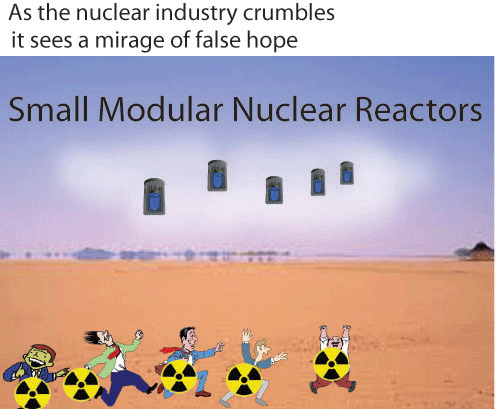
SMRs are a futuristic technology at best. The only operational SMRs anywhere in the world are in Northeast Russia and in Shidao Bay, China.
Both reactors faced construction delays, primarily due to cost overruns and poor economics., The Canadian Nuclear Safety Commission has yet to fully approve a single SMR licence.
SMRs cannot be built in time to help meet Ontario’s 2030 emission targets. Worse, by betting on them, OPG has committed to making Ontario’s electricity grid dirtier.
Nuclear power a costly option
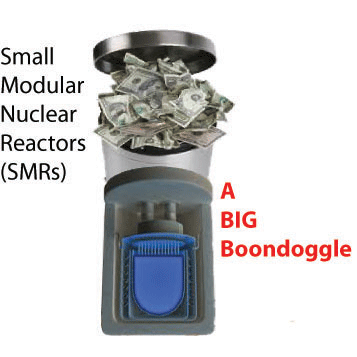
In addition to being largely unproven, SMRs will not be cheap. While their absolute cost may be lower than conventional nuclear reactors, their lower electricity output means they become significantly more expensive per megawatt to operate.
Beyond the fact that every single new nuclear project in Ontario’s history has gone over budget, gas and nuclear energy now contribute the most to increasing energy bills for Ontario residents.
A 2018 report from the Canadian SMR roadmap steering committee, a group of provincial and territorial governments and power utilities, estimated the baseline cost of electricity from SMRs would be 16.3 cents per kilowatt hour (kWh). Comparatively, according to the International Renewable Energy Agency renewable alternatives are less expensive:
- Onshore wind electricity costs consumers an average of 4.5 cents per kWh;
- Offshore wind costs an average of 10 cents/kWh;
- Solar PV farms cost an average of 6.6 cents/kWh;
- Hydropower costs an average of 5 cents/kWh.
In North America, the only SMR design certified by the United States Nuclear Regulatory Commission was cancelled due to “lack of interest” once rising costs deterred potential customers. Originally announced in 2015 at the equivalent of $4.1 billion Cdn, estimates rose to $5.6 billion (2018), then $8.4 billion (2020) and finally $12.7 billion (2023).
Time keeps on ticking
New nuclear projects are taking on average of 10 to 15 years to become operational. Ontario’s first SMR designated for the Darlington Nuclear Generating Station is planned for 2028.
Meanwhile, the Ontario government says additional SMRs could come online between 2034 and 2036. In reality, nuclear projects typically exceed time estimates by 64 per cent and given a strong trend of delays for such projects globally, new SMRs are unlikely to come online before 2042, if ever.
So, in addition to the speculative viability of SMRs, likely delays even under the best of circumstances mean this technology is unable to help meet Ontario’s emissions reduction targets.
Radioactive waste another key factor
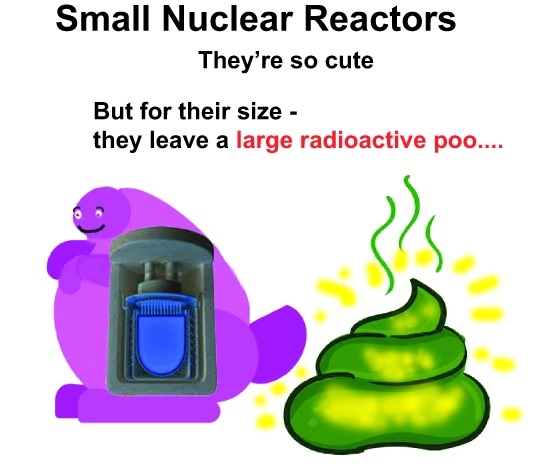
The “green” label often applied to nuclear energy should be viewed with scepticism. While no fossil fuel is burned to generate nuclear power, the industry produces radioactive waste and is not “renewable.”
In fact, there is evidence to suggest SMRs will produce a greater volume of radioactive waste per unit of electricity generated than existing large reactors.
Radioactive waste remains hazardous for tens of thousands of years and there are no demonstrated solutions to managing this risk. According to the Nuclear Waste Management Organization, which is owned by Canada’s nuclear power companies, radioactive nuclear waste must be fully isolated from people and the environment for one million years or more.
Committing to new nuclear projects in Ontario as a climate solution is essentially trading one intergenerational threat for another.
The green path toward Ontario’s emissions targets
A report from the David Suzuki Foundation in 2022 found that “reliable, affordable, 100 per cent emissions-free electricity in Canada by 2035 is entirely possible.”
In 2020, the International Energy Agency declared wind and solar the “cheapest sources of new electricity in history.”
In 2018, Ontario cancelled 758 signed contracts for smaller renewable energy projects, many of them in Indigenous communities Only recently, the province’s Independent Electricity System Operator (IESO) has announced it seeks to procure 5,000 MW of new non-emitting (wind, solar, hydropower or bioenergy) energy.
Utility-scale solar costs plummeted by 90 per cent between 2009-21. Wind energy costs declined 72 per cent. This presents an important opportunity given Ontario’s more than 1,500 kilometres of Great Lakes shoreline and abundant sunshine.
The already low cost of hydropower in Ontario through existing infrastructure, combined with the potential for integration with Hydro-Québec, can help Ontario convert its “intermittent wind and solar energy into a firm 24/7 source of baseload electricity,” according to the Ontario Clean Air Alliance.
Likewise, offshore wind-generating potential in Atlantic Canada far exceeds energy needs in the region and could be exported to Ontario via existing mainstream high-voltage direct-current transmission lines.
By cancelling SMR development and focusing on cost-efficient wind, solar and hydro expansion, as well as increased interprovincial transmission, Ontario can reclaim leadership when it comes to green energy development now and for future generations.
Canada: Nuclear Waste Petition Tabled in Parliament

| Ottawa – A petition calling on the Government to provide oversight of a controversial nuclear waste burial project has been tabled in the federal House of Commons, with a response required within 45 calendar days. Created by Northwatch project coordinator Brennain Lloyd and sponsored by Nipissing-Timiskaming MP Anthony Rota, the petition gained the signatures of 3,327 Canadians who joined the call on the federal government to require the Nuclear Waste Management Organization to demonstrate that it has the consent of residents and communities, including First Nations and Treaty Organizations, along the transportation route and in the region of and downstream of the candidate repository site(s) before selecting a site. “Canadians expect a fair and accountable process when it comes to projects of this size, risk and long-term consequence”, said petition organizer Brennain Lloyd, coordinator with Northwatch and an organizer with the Northern Ontario alliance We the Nuclear Free North. |
The NWMO has said repeatedly that they will only proceed with an “informed and willing host”, but the communities along the transportation route are “hosts” to the same risks as the NWMO’s so-called “host communities” of Ignace and South Bruce. By NWMO design, those living downstream and along the transportation route are shut out of the NWMO’s site selection process. The federal government needs to course-correct the NWMO”.
The NWMO has been engaged in a site search since 2010 and since 2020 has been focused on two municipalities as potential “host communities”: the municipality of South Bruce in Southwestern Ontario, and the Township of Ignace in Northwestern Ontario. The Township of Ignace is 43 km east of the NWMO’s candidate site between Ignace and Dryden, and in a different watershed – factors which critics say disqualify it from acting as a “host” community.
The Township of Ignace is using an online poll and interviews by a consultant to gauge the “willingness” of the Ignace residents. The Municipality of South Bruce has released a draft hosting agreement and has committed to a referendum on October 28th but says that if voter turnout is less than 50 % then Council will make the decision.
“We are grateful to the over 3,300 Canadian citizens who signed the Federal petition requesting that the Government of Canada take action and provide much needed direction to the NWMO regarding their site selection process,” commented Bill Noll, Vice-President of Protect Our Waterways – No Nuclear Waste, a citizens group in South Bruce which opposes the NWMO project.
The online petition was posted on a site operated by the Government of Canada and was open for signatures from citizens and residents of Canada until May 3rd. Signatures were then reviewed and certified by a Clerk of the House of Commons on May 6th, and today the petition is being tabled by M.P. Rota. The federal government has 45 days to respond.
| Contact: Brennain Lloyd, Northwatch and We the Nuclear Free Northbrennain@northwatch.org, 705 497 0373 office, 705 493 9650 cell Bill Noll, Protect Our Waterways – No Nuclear Wastewjnoll@yahoo.com, 519 507 9905 cell |
Canada’s federal budget -calls nuclear energy “clean” – the height of absurdity!

Nuclear energy never will be ‘clean,’ write Jones and Edwards.
THE HILL TIMES | MONDAY, MAY 6, 2024
The 2024 federal budget contains many references to nuclear energy as
a “clean” source of electricity. In our view, referring to
nuclear electricity as “clean” is the height of absurdity.
The nuclear fuel chain begins with the mining of uranium from rock
underground where, without human intervention, it would remain safely
locked away from the biosphere. Uranium has many natural radioactive
byproducts, including radium, radon, and polonium-210 that are
discarded in voluminous sandlike “tailings” at uranium mine sites.
These materials are responsible for countless thousands of deaths in
North America alone. Canada has accumulated 220 million tonnes of
these indestructible radioactive mining wastes, easily dispersed by
wind and rain over the next 100,000 years.
Inside a nuclear reactor, uranium atoms are split to produce energy.
The atomic fragments are hundreds of newly created radioactive
poisons, most of them never found in nature before 1940. They make
used fuel millions of times more radioactive than the original
uranium. One used fuel bundle, freshly discharged, will deliver a
lethal dose of radiation in seconds to any unshielded human nearby.
There are hundreds of thousands of tonnes of waste irradiated fuel
bundles worldwide and the quantity grows larger each year. There is no
operating repository anywhere in the world for such wastes, but there
are several failed repositories.
Radioactive waste has the “reverse midas touch” turning everything
it touches into more radioactive waste. This includes the nuclear
vessel in which the waste is created, and everything that comes in
contact with the cooling water needed to prevent the waste from
melting down. Containers for radioactive waste become radioactive
waste themselves. All radioactive waste must be kept out of our food,
air and drinking water for countless millennia.
Radioactive atoms are unstable. They disintegrate, throwing off a kind
of subatomic shrapnel called “atomic radiation.” Emissions from
disintegrating atoms damage living cells. Chronic radiation exposure
can cause miscarriages, birth defects, and a host of degenerative
diseases including cancers of all kinds. Genetic damage to eggs or
sperm can transmit defective genes to successive generations.
Plutonium is one of the hundreds of radioactive byproducts created in
used nuclear fuel. It is of special concern because it is the primary
nuclear explosive in nuclear arsenals worldwide. “Reprocessing” of
nuclear fuel waste to extract plutonium is sometimes called
“recycling” but this is disinformation; the resulting waste is
more difficult to manage than the original fuel waste. Many serious
accidents have occurred around the world at reprocessing plants.
Places where extensive reprocessing has occurred are among the most
radioactively contaminated sites on Earth. Plutonium can be used as a
nuclear fuel, but extracting it is a nuclear weapons proliferation
risk.
Managing radioactive waste is difficult and very expensive. The
projected multi-billion-dollar cleanup cost for the legacy waste at
Chalk River, Ont., is the federal government’s biggest environmental
liability by far, exceeding the sum total of all other federal
environmental liabilities across Canada.
The multinational consortium running Canada’s federal nuclear
laboratories is receiving close to $1.5-billion annually, much of it
for managing legacy radioactive wastes. The consortium’s plans
include piling up one million tonnes of waste in a giant mound beside
the Ottawa River and entombing old reactors in concrete and grout
beside major drinking water sources. Many are of the view that the
plans fail to meet the fundamental requirement to isolate waste from
the biosphere and have been met with widespread concern, opposition
and legal challenges. Nuclear energy is not now, never has been, and
never will be “clean.”
The sooner our elected officials come to terms with this fact, the
better for Canada and Canadians. Honesty is the best policy.
Nuclear-waste compensation (?bribery) numbers raise eyebrows

South Bruce would receive $418 million in total compensation if its site is selected; the comparison figure for Ignace is $170 million.
NWO Newswatch, Mike Stimpson, Local Journalism Initiative Reporter, 3 May 24
IGNACE – As a community vote on nuclear-waste concluded, residents of this Northwest municipality were talking about the deep geological repository’s other potential host municipality.
The Municipality of South Bruce, in southwestern Ontario near Lake Huron, on Monday published the hosting agreement it negotiated with the Nuclear Waste Management Organization.
The South Bruce agreement promises far more for that municipality than Ignace would receive if it is selected to host repository operations.
If the South Bruce site is selected for the proposed underground waste storage facility, the municipality would receive about $418 million over the project’s 138-year life, according to documents released by South Bruce.
The comparison figure for Ignace is approximately $170 million.
Reaction on social media included Ignace residents saying the divergent figures make Ignace look either foolish or an attractive bargain………………………………………………………..
Both municipalities must communicate their continued willingness to be host communities to the NWMO before a site is chosen.
If South Bruce voters decide in a referendum on Oct. 28 that they are not willing to continue as a potential host community, the industry-funded NWMO would remit a $4-million “exit payment” to the municipality.
If the Township of Ignace declares itself not willing, the exit payment would be $5 million.
If South Bruce is willing but not selected, it is to receive $8 million; Ignace would receive the same amount if willing but not selected.
In addition to the municipalities, nearby First Nations must be willing to participate in order for a site to be selected.
For the Revell Lake site, Wabigoon Lake Ojibway Nation must express willingness. The potential First Nations partner for the South Bruce site is Saugeen Ojibway Nation.
The NWMO has committed to selecting a site by December 31, 2024.
Construction is projected to begin around 2034 and take about 10 years to complete, Ponka said. https://www.nwonewswatch.com/local-news/nuclear-waste-compensation-numbers-raise-eyebrows-8683186
Land Defence Alliance stands united against the burial of nuclear waste
The group held a rally in Waverley Park on Tuesday afternoon.
NWO Newswatch, Clint Fleury, Apr 30, 2024
THUNDER BAY – With the decision on where Canada will store its nuclear waste looming, four of the six First Nations representatives from the Land Defence Alliance held a rally in Waverley Park to voice their concerns and dangers of this controversial project.
“We’re concerned about future leaks and accidents and we’re very concerned that if that should happen, it could contaminate the local environment like the animals and also the air and the grounds,” said Grassy Narrows Chief Rudy Turtle in an interview with Dougall Media.
Turtle was the first to take the microphone and send out a profound message of solidarity with his fellow First Nations who are opposed to the burial of used nuclear waste in the Revell Lake area.
Currently, Ignace Township and nearby Wabigoon Lake Ojibway Nation are each in a “willingness process” to decide whether they will be hosts for a deep geological repository between their communities.
Outside of Ignace and Wabigoon Lake Ojibway Nation, no other municipality or First Nation communities have a right to vote on their willingness to allow the storage of nuclear waste in Northwestern Ontario.
In southern Ontario, the municipalities of South Bruce and Saugeen Ojibway Nation are also considering being willing hosts to the repository where it is situated near them.
For many, there are too many variables and “what if” questions as the deep geological repository project slowly becomes less like a science fiction concept.
The trouble is that for many First Nation communities, the government’s track record of leaving contaminated industrial sites on treaty land has given way to skepticism. ……………………………………………………………………..
Turtle explained: “It’s coming from down south which is like 28 hours of driving, or whether it’s coming by train, it’s still like over 20 hours and there’s always the possibility of an accident. We’ve seen it happen with other chemicals. We’ve seen it happen with oil transportation.
“So, the potential, the possibility is there of an accident and people should be concerned about that. The towns that are in between during those 20-hour travel times. Those towns should be concerned. Those towns should be worried about the potential of having nuclear waste dumped or accidentally dumped along their communities.”
At the end of the rally, the Land Defence Alliance stood united to say no to the burial of nuclear waste in Northwestern Ontario. https://www.nwonewswatch.com/local-news/land-defence-alliance-stands-united-against-the-burial-of-nuclear-waste-8676906
Nuclear Waste Management Organization (NWMO) responds to Land Defence Alliance protest
In response to the recent Land Defence Alliance protest where a coalition of First Nations said “no” to burying nuclear waste in Northwestern Ontario, Vince Ponka, NWMO’s regional communications manager, attempts to dispel concerns surrounding the deep geological repository project.
Clint Fleury, May 2, 2024
THUNDER BAY – At a protest on Tuesday, Grassy Narrows Chief Rudy Turtle shared his strong opposition to the Nuclear Waste Management Organization’s (NWMO) proposed deep geological repository where Canada’s used nuclear fuel will potentially be stored.
In an interview with Dougall Media, Chief Turtle said the Land Defence Alliance has reached out to NWMO to speak with them about the project, but NWMO had a scheduling conflict which prevented them from attending a meeting.
“Well, the Land Defence Alliance just finished meeting these past couple of days and we had invited NWMO to come and sit with us but they didn’t show up, and they had a change of schedule or something and we were looking forward to talking to them,” said Chief Turtle.
Turtle stated they would like to set up a future meeting, but there was no date set at this time.
Vince Ponka, regional communications manager with the NWMO, said the organization was aware of the protest, however they were attending the final day of the “willingness process” in Ignace.
Ponka said the NWMO did reach out to Grassy Narrows to schedule a meeting. According to Ponka, the chief and council asked to meet with NWMO’s chief executive officer, Laurie Swami, the next day.
“Unfortunately, she just wasn’t able to make that quick of a turnaround,” said Ponka.
Ignace Township and nearby Wabigoon Lake Ojibway Nation are two of four potential hosting communities for the DGR. The other two are the municipalities of South Bruce and Saugeen Ojibway Nation.
Once the “willingness process” is complete in all four host communities, NWMO will start the site selection process.
Ponka said NWMO will have a site selected by the end of the year.
In the meantime, Ponka said he would like to meet with the Land Defence Alliance at any point in the future………………………….
The Land Defence Alliance is concerned about limiting the “willingness” vote to residents of Ignace and Wabigoon Lake Ojibway Nation. However, Ponka did say once the site selection process is finished, NWMO will branch out to the surrounding region to gather input on the next part of the process……………………………………………. https://www.nwonewswatch.com/local-news/nwmo-responds-to-land-defence-alliance-protest-8683263
First Nations leaders voice opposition to nuclear power plants
By Angel Moore, Apr 30, 2024, https://www.aptnnews.ca/national-news/first-nations-leaders-voice-opposition-to-nuclear-power-plants/
Leaders from three First Nations in New Brunswick made the trip to Ottawa to voice their opposition to the expansion of a nuclear power plant in the province.
The federal government, which is pushing the concept of small modular reactors, or SMRs, and the province are proposing to put new nuclear power plants on the Point Lepreau nuclear site.
The plant sits next to the Bay of Fundy and is Atlantic Canada’s only nuclear facility.
“Our people were never consulted or asked about our input or concerns about nuclear so we’re sitting here today talking about nuclear waste and where to put it, where to place it,” said Wolastoq Council Grand Chief Rom Tremblay.
The plant also sits on the traditional territory of the Passamaquoddy nation.
“Every child needs to see what I saw, they need see those fish they need to see those trees they need healthy air and they do not need nuclear contamination for thousands of years,” said Chief Hugh Akagi at the news conference in Ottawa.
The power plant has been operating since 1983 and provides New Brunswick with 40 per cent of its power.
Like other plants, it uses uranium processed in refineries such as the d’uranium de Blind, located in Blind River, Ont., a small community west of Sudbury on the traditional land of the Mississauga First Nation.
Band Councillor Peyton Pitawanakwat said her band council issued a resolution that said, “To declare opposition to any future use of the Blind River refinery site that would see these lands being used as a disposal site for radioactive wastes unfortunately that challenges faced by our first nation are not unique, and the environmental discrimination is happening all across the country.”
Pitawanakwat said the community is consulting with the Canada Nuclear Safety Commission and that their treaty rights are not being upheld.
“There’s a lot of more in-depth discussions that need to be had and we really are at a point where we need to re-set the relationship and ensure that our rights are being upheld,” she said.
New Brunswick Power didn’t respond to a request for an interview. The Canada Nuclear Safety Commission said an interview was not possible.
1 This Month
19 February – VIRTUAL EVENT-Decision Time: AI and Our Nuclear Arsenal
12:45 p.m. Central / 1:45 p.m. Eastern
To see nuclear-related stories in greater depth and intensity – go to https://nuclearinformation.wordpress.com

-
Archives
- February 2026 (141)
- January 2026 (308)
- December 2025 (358)
- November 2025 (359)
- October 2025 (376)
- September 2025 (258)
- August 2025 (319)
- July 2025 (230)
- June 2025 (348)
- May 2025 (261)
- April 2025 (305)
- March 2025 (319)
-
Categories
- 1
- 1 NUCLEAR ISSUES
- business and costs
- climate change
- culture and arts
- ENERGY
- environment
- health
- history
- indigenous issues
- Legal
- marketing of nuclear
- media
- opposition to nuclear
- PERSONAL STORIES
- politics
- politics international
- Religion and ethics
- safety
- secrets,lies and civil liberties
- spinbuster
- technology
- Uranium
- wastes
- weapons and war
- Women
- 2 WORLD
- ACTION
- AFRICA
- Atrocities
- AUSTRALIA
- Christina's notes
- Christina's themes
- culture and arts
- Events
- Fuk 2022
- Fuk 2023
- Fukushima 2017
- Fukushima 2018
- fukushima 2019
- Fukushima 2020
- Fukushima 2021
- general
- global warming
- Humour (God we need it)
- Nuclear
- RARE EARTHS
- Reference
- resources – print
- Resources -audiovicual
- Weekly Newsletter
- World
- World Nuclear
- YouTube
-
RSS
Entries RSS
Comments RSS
 nuclear-news