Ontario’s huge nuclear debt and other things Dutton doesn’t understand about cost of electricity

Unfortunately for us, Dutton and O’Brien are also in a hurry. They think they can deliver nuclear power plants far faster than what many experts believe is sensible and what many countries with far more nuclear experience than ourselves have been able to achieve.
Dutton and O’Brien also want to do this via a government-owned utility, instead of via a competitive market.
ReNewEconomy, Tristan Edis, Oct 30, 2024
All of this has left taxpayers with a massive budget and timeframe blow-out. This is what happens when we leave it to politicians in a hurry to hand pick power projects.
It seems our alternative Prime Minister Peter Dutton’s favourite topic is your electricity bill. Given how much he talks about electricity prices, you’d think he might know a fair bit about what makes up your electricity bill, wouldn’t you?
According to Dutton and his Shadow Energy Minister Ted O’Brien, the problem is all about too much renewable energy in the mix. And their answer to the problem is nuclear power, as well as more gas.
According to Peter Dutton, “We can’t continue a situation that Labor has us on of a renewables only policy because, as we know, your power prices are just going to keep going up under this Prime Minister.”
Instead, according to Dutton, “we could be like Ontario, where they’ve got 60 or 70 per cent nuclear in the mix, and they’re paying about a quarter of the price for electricity that we are here in Australia.”
O’Brien, elaborated on this point by saying:
“We will have plenty of time in due course to talk about the costings [for their nuclear plan] once we release them here in the Australian context. But I point to Ontario in Canada, there you have up to 60 per cent of their energy mix in the grid, coming from zero emissions, nuclear energy. Their households pay around about 14 cents kilowatt hour. There are parts in Australia that will be paying up to 56 cents a kilowatt hour from July 1 this year.”
Once you actually delve into these numbers it becomes apparent that O’Brien and Dutton don’t seem know much about electricity costs and pricing.
But even worse, they don’t know how badly Ontario’s taxpayers and electricity consumers were burnt by their utility racking up huge debt building nuclear power plants equal to $70 billion in current day Australian dollars.
Do Dutton and O’Brien understand your electricity bill?
You can actually look up what Ontario households pay for electricity via the Ontario Energy Board’s bill calculator website.
This provides you with a break down on the charges a typical household faces depending on the utility you choose…………………………………………………
But notice there’s also other very significant items in this bill separate to the kilowatt-hour charge? There’s a “delivery” charge which is the cost of paying for the distribution and transmission poles and wires. There’s also regulatory charges and also their sales tax is known as “HST” rather than GST for us.
So the Ontario 14 cents per kilowatt-hour charge that O’Brien and Dutton are referring to covers only the wholesale energy portion of their bill.
In Australia, we pay a majority of the costs of distribution and transmission in our cents per kilowatt-hour charge, in addition to wholesale energy costs, and then we get GST added on top. O’Brien and Dutton don’t seem to have appreciated this important aspect of electricity pricing in this country, which is different to Ontario.
But it actually gets worse.
I went digging on the official government energy retailer comparison sites- www.energymadeeasy.gov.au and www.energycompare.vic.gov.au and I initially couldn’t find a single Australian retailer selling electricity at 56 cents per kilowatt-hour.
This was based on looking at offers based on a single rate tariff. Then I had a brainwave and looked at time-of-use rates. In Queensland and Victoria I still couldn’t find anyone wanting to charge me 56 cents for the peak period.
But eventually I succeeded. Right at the bottom of the EnergyMadeEasy list of retailer offers – which were ordered from best to worst – sat EnergyAustralia as the worst offer, charging 57 cents for the peak period in South Australia (although with a compensating high solar feed-in tariff of 8.5 cents)…………………………………
To help out O’Brien and Dutton, I’ve prepared the table below which provides a proper apples versus apples comparison (as opposed to apples vs peak rate bananas) –[on original ]
…………………………………………….. Ontario’s nuclear debt debacle
Yet this comparison between Ontario and Australia misses a far more important part of the story that O’Brien and Dutton seem to be blissfully ignorant of.
That is the history of the Ontario’s state owned utility – Ontario Hydro – and the unsustainable level of debt that it racked up over the 1980’s and 1990’s as a result of an ambitious nuclear plant construction program that went wrong.
While this cost is no longer apparent in current electricity prices, Ontario businesses and households were stuck with paying back CAD$38.1 billion in debt (over $70 billion in Australian current day dollars) for more than 35 years after their public utility committed its last nuclear reactor to construction in 1981.
So what went wrong?
In anticipation of large growth in electricity demand, over the 1970’s and 1980’s Ontario Hydro committed to construction 12 nuclear reactors with 9,000 MW of generating capacity. To fund the projects the public utility accessed commercial debt markets anticipating that it could comfortably repay this debt from the increased electricity demand it forecast. However, several things went wrong.
The nuclear power stations took far longer to build and were around twice as expensive to build than had been planned
– Interest rates on debt rose to very high levels by historical standards over the 1980’s in order to contain the high levels of inflation that unfolded over the 1970’s and early 1980’s. With the nuclear power stations taking longer than expected to build, interest was accumulating on this debt with far less output from the plants to offset it.
– Lastly, Ontario Hydro’s estimate of large growth in electricity demand didn’t eventuate. A 1977 forecast projected a system peak of 57,000 MW by 1997. Actual peak demand in 1997 was 22,000 MW. This meant that the very large cost and associated debt of the large nuclear expansion had to be recovered from a much smaller volume of electricity sales than it had anticipated, making it much harder to pay off the debt without substantial increases in electricity prices.
……………………………………………………………………………………………………………… “On April 1, 1999, the Ministry of Finance determined that Ontario Hydro’s total debt and other liabilities stood at $38.1 billion, which greatly exceeded the estimated $17.2-billion market value of the assets being transferred to the new entities. The resulting shortfall of $20.9 billion was determined to be “stranded debt,” representing the total debt and other liabilities of Ontario Hydro that could not be serviced in a competitive environment.”
So the CAD$38.1 billion in debt was transferred out of the electricity companies and into a special purpose government entity called the Ontario Electricity Financial Corporation (OEFC). This debt management corporation was given the following revenues to service the debt:
– Both residential and business consumers were required to pay a special “Debt Retirement Charge”. This charge was introduced in 2002 and lasted until 2016 for residential consumers and 2018 for business customers.
– The Ontario government would forgo any corporate income and other taxes owed by the offshoot electricity companies from Ontario Hydro so they could be diverted to the OEFC to pay down debt.
– If the cumulative profits of two of the new state power companies exceeded the $520m annual interest cost on their debts, then this would go towards paying stranded debt rather than dividends to the Ontario government.
None of this is apparent on current bills, but the burden of repaying the nuclear debt left the Ontario government and its taxpayers far poorer than Dutton and O’Brien seem to appreciate.
More things O’Brien doesn’t want to understand about Ontario’s nuclear power program
Dutton and O’Brien like to claim that nuclear power plants last a very long time and so therefore the large upfront cost of these plants isn’t something we should be too worried about………………………..
It’s not as simple as this. Nuclear power plants involve a range of components which are exposed to severe heat and mechanical stress. These all need to be replaced well before you get to 60 years, and such refurbishment comes at a cost.
Ontario’s experience is that refurbishment comes at a very significant cost. Less than 25 years after the Darlington Nuclear Power Plant construction was completed, it needed to commence refurbishment. The total cost? $12.8 billion in Canadian dollars or $14 billion Australian dollars.
This is partly why, even though the original nuclear construction cost debt had been largely paid down and nuclear operating costs are lower than coal or gas plant, Ontario still pays more for its electricity than we do.
This is because the current owner of the nuclear power plants – Ontario Power Generation – operates under regulated return model where the regulator grants them the right to recover these refurbishment costs from electricity consumers.
Are O’Brien and Dutton about to commit to another Snowy 2.0 budget blow-out, but on steroids?
………………………………The problem here is that when you don’t know very much and you’re spending other people’s money, ego can easily cloud your judgement. Don’t get me wrong, ego will often cloud business leaders’ judgement too. But their ability to spend money to feed their ego can only so far before either competitors or shareholders intervene.
Ontario taxpayers on the other hand realised far too late that their public utility, in cahoots with their politicians, were pursuing a nuclear vanity project built upon a poor understanding of the future, and without any competitor to discipline their ego.
Australian taxpayers have seen a similar mistake unfold with the Snowy 2.0 pumped hydro plant whose cost now stands at five times greater than the original expectation, and double what was meant to be a fixed price construction contract.
Snowy 2.0 is a parable of what goes wrong when:
– Politicians rush things leading to inadequate planning and preparation;
– Politicians fail to objectively and thoroughly evaluate alternatives; and
– Politicians fail to employ open and competitive markets to deliver end consumer outcomes.
All of this has left taxpayers with a massive budget and timeframe blow-out. This is what happens when we leave it to politicians in a hurry to hand pick power projects.
Unfortunately for us, Dutton and O’Brien are also in a hurry. They think they can deliver nuclear power plants far faster than what many experts believe is sensible and what many countries with far more nuclear experience than ourselves have been able to achieve. Dutton and O’Brien also want to do this via a government-owned utility, instead of via a competitive market.
While the budget blowout of Snowy 2.0 is bad enough, it pales into comparison with the kind of cost blow-outs that can unfold with nuclear power projects. As an example, the budget for completion of UK’s Hinkley Point C nuclear project now stands at $89.7 billion which is three times higher than what was originally budgeted.
We’ve all seen this movie before, including in Ontario, and it doesn’t end well……………………………………………………………………………………………………………….. more https://reneweconomy.com.au/ontarios-huge-nuclear-debt-and-other-things-dutton-doesnt-understand-about-cost-of-electricity/
South Bruce Deep Geological Repositary (DGR) opposition promises to keep fighting
Scott Dunn, Oct 29, 2024 Owen Sounds Sun Times
A group opposed to burying high-level nuclear waste in South Bruce says it will keep fighting because having just 78 more votes in favour than against the project in Monday’s referendum isn’t a “compelling” demonstration of community support.
Bill Noll, the co-chair of Protect Our Waterways – No Nuclear Waste, said in an interview that that’s part of what will be argued at regulatory hearings if Nuclear Waste Management Organization selects South Bruce as its preferred site.
Council for Ignace Township in Northern Ontario, the other site remaining in the running, has already voted in favour of being a willing host, after residents voted in favour of the proposal. First Nations in both locations must still decide if they’re in favour too.
“People are still concerned, a large group of people in South Bruce who are saying no to this project,” said Noll, a retired electrical engineer who lived in South Bruce for 15 years before moving to near Ottawa to be near family.
There were 51.2 per cent, or 1,604 voters saying yes, and 48.8 per cent, or 1,526, who voted no, according to unofficial results posted by the municipality Monday night. Eight electors declined their ballot.
The vote result “doesn’t really give the council a mandate to say we won this,” Noll said.
But council is expected to ratify the result which Mayor Mark Goetz said is binding on council, even as he acknowledged it was a close vote, at a special council meeting Nov. 12. ………………………….
Now it will be up to Saugeen Ojibway Nation to decide if it would be a willing host, he said.
…………………………………………Both Ignace and South Bruce have signed agreements with NWMO that would see them receive millions of dollars over the lifespan of the project — $418 million over 138 years in South Bruce and $170 million over 80 years in Ignace.
………………………………………………………..Noll credited Protect Our Waterways for obtaining a referendum vote by insisting on a study of the community’s willingness because otherwise, it was going to be done by council vote.
“NWMO said in their early stages that the community needed to have two things: one, they needed to demonstrate a compelling willingness and the other thing was they needed to be informed,” Noll said.
“Well, I don’t think either of those conditions have been met at this stage. So that will be our agenda when we get into the regulatory process.” https://www.owensoundsuntimes.com/news/local-news/south-bruce-dgr-opposition-promises-to-keep-fighting
South Bruce voters narrowly approve being host to nuclear waste
Scott Dunn Oct 29, 2024 , Horeline Beacon
Teeswater is near one of the two proposed sites for an underground storage facility for the country’s highly radioactive nuclear fuel.
By a thin majority, the answer in South Bruce was yes. Bruce declaring South Bruce to be a willing host for the Nuclear Waste Management Organization’s proposed Deep Geological Repository (DGR)? resulted in 51.2 per cent, or 1,604, of voters saying yes, and 48.8 per cent, or 1,526, saying no, according to unofficial results posted by the municipality Monday night. Eight electors declined their ballot.
Voter turnout was 3,138 of 4,525 electors, or 69.3 per cent. Since turnout was above 50 per cent, the results are binding on municipal council…………………
Teeswater’s residents were divided by the prospect of burying spent nuclear fuel in a deep, underground vault, people said in interviews outside the community’s post office earlier Monday.
Nuclear Waste Management Organization has secured land for a possible DGR site northwest of Teeswater, part of South Bruce. If the area is selected, the NWMO would build and manage the bunker to be some 650 metres underground.
But first NWMO needed to confirm if the community was a willing host. A referendum was chosen as the way to do that, and voting is to end at 8 p.m. today. It would take 50 per cent plus one of eligible voters to signal willingness, as long as at least 50 per cent of South Bruce voters cast ballots. Otherwise the decision was council’s to make.
……………………………….. there’s the risk of a leak, and the implicit requirement to trust officials who say the job can be done safely. Still others said they think government has already decided it will build the nuclear storage facility in South Bruce……………………………………………………………………………… more https://www.shorelinebeacon.com/news/local-news/update-south-bruce-voters-narrowly-approve-being-host-to-nuclear-waste
South Bruce Municipality narrowly votes to host underground nuclear waste disposal site
Matthew McClearn, October 28, 2024, Globe and Mail,
Residents in Ontario’s Municipality of South Bruce narrowly voted in favor of hosting a nuclear waste disposal site in a referendum completed on Monday.
Unofficial results published Monday evening by Simply Voting, an online voting platform, reported that of the 3,130 votes case, 51.2% voted in favor, while 48.8% were opposed.
The Nuclear Waste Management Organization (NWMO), a non-profit organization representing major nuclear power generation utilities, has been hunting since 2010 for a site to store spent fuel from nuclear power reactors. Known as a deep geological repository, or DGR, the facility would be built more than half a kilometer underground, at an estimated cost of $26 billion.
South Bruce, located more than 120 kilometres north of London and home to about 6,200 residents, is a rural, largely agricultural area of less than 500 square kilometers. It includes a few small communities including Mildmay, Formosa, Culross and Teeswater. The NWMO has secured more than 1,500 acres of land north of Teeswater for the project.
From the outset, the NWMO said it would build the facility only “in an area with informed and willing hosts,” which meant one municipality and one Indigenous group. South Bruce is one of two finalists to host the DGR, down from an original list of 22 communities that expressed interest. The NWMO said it will announce its final selection by Dec. 31st.
Under a hosting agreement the municipality signed earlier this year, South Bruce stands to receive $418-million over nearly a century and a half if selected. The municipality agreed not to do anything to oppose or halt the project, and at the NWMO’s request will communicate its support. The NWMO can modify the project in several respects, including changing the sorts of waste it will store there. The facility would be constructed between 2036 and 2042, ns would then receive, process and store nuclear waste for another half-century.
South Bruce’s byelection, which began last week, asked residents to vote by phone or Internet on whether they were in favor of hosting the DGR. Simply Voting reported turnout of 69.3%, substantially above the 50% minimum required to make the outcome binding under Ontario’s Municipal Elections Act.
The other community in the running is Ignace, Ont., a town of 1,200 more than 200 kilometres northwest of Thunder Bay. Its council voted to accept the DGR in July, and would receive $170-million under its own hosting agreement. (The move was supported by 77% of registered voters who participated in a non-binding online poll.) That location, known as the Revell site, is about 40 km west of the town.
The NWMO also seeks approval from two Indigenous communities: The Saugeen Ojibway Nation for the South Bruce site, and the Wabigoon Lake Ojibway Nation for the Revell site. Neither First Nation has yet signaled consent, but the NWMO spokesperson Craig MacBride said the organization is “in active discussions” with both.
“The NWMO still anticipates selecting a site by the end of this year,” he wrote in an e-mailed response to questions.
As of June 2023, Canada had accumulated 3.3 million spent fuel bundles, each the size of a fire log. They’re currently stored at nuclear power plants in Ontario, Quebec and New Brunswick, and roughly 90,000 new ones are added each year. Upon removal from a reactor, they’re highly radioactive and must be stored in pools of water for about a decade; afterward, they’re moved to storage containers made from reinforced concrete and lined with half-inch steel plate.
The South Bruce referendum follows a campaign that lasted a dozen years and produced rifts within the community.
Protect Our Waterways, a local group opposed to the DGR from the outset, had demanded a referendum. Some DGR supporters opposed putting the matter to a public vote, preferring to leave the decision to elected officials. Municipal officials pointed to the area’s declining economy and population, and emphasized the benefits brought by the NWMO’s spending. Supporters and opponents often accused each other of producing misinformation………………………………………………………….. https://www.theglobeandmail.com/canada/article-south-bruce-municipality-narrowly-votes-to-host-underground-nuclear/#:~:text=Its%20council%20voted%20to%20accept,km%20west%20of%20the%20town.
‘You couldn’t make this up’: Expert pans Ontario nuclear option

SMH, By Bianca Hall and Nick O’Malley, October 28, 2024
Ontario subsidises its citizens’ electricity power bills by $7.3 billion a year from general revenue, an international energy expert has said, contradicting the Coalition’s claim that nuclear reactors would drive power prices down in Australia.
Opposition Leader Peter Dutton has repeatedly cited the Canadian province as a model for cheaper power prices from nuclear.
“In Ontario, that family is paying half of what the family is paying here in Perth for their electricity because of nuclear power,” Dutton said in March. “Why wouldn’t we consider it as a country?”
In July, Dutton said Canadian consumers paid about one-quarter of Australian prices for electricity.
Professor Mark Winfield, an academic from York University in Canada who specialises in energy and environment, on Monday said the reaction among people in Ontario to the comparison had ranged from disbelief to “you couldn’t make this up”.
Ontario embarked on a massive building spree between the 1960s and the 1990s, Winfield told a briefing hosted by the Climate Council and the Smart Energy Council.
In the process, he said, the provincial-owned utility building the generators “effectively bankrupted itself”. About $21 billion in debt had to be stranded to render the successor organisation Ontario Power Generation economically viable.
In 2015, the Canadian government approved a plan to refurbish 10 ageing reactors, but Winfield said the refurbishment program had also been beset by cost blowouts.
“The last one, [in] Darlington, east of Toronto, was supposed to cost $C4 billion and ended up costing $C14 [billion],” Winfield said.
“And that was fairly typical of what we saw, of a cost overrun in the range of about 2.5 times over estimate.”
In Melbourne, Dutton said while he respected new Queensland Premier David Crisafulli’s opposition to nuclear, he would work with “sensible” premiers in Queensland, South Australia and NSW on his plan, if he was elected………………………………………………..
Winfield said household bills were kept artificially low under the Ontario model, despite the high cost of refurbishing ageing nuclear facilities.
“There’s a legacy of that still in the system that we are effectively subsidising electricity bills to the tune of about $C7.3 billion a year out of general revenues. That constitutes most of the provincial deficit; that’s money that otherwise could be going on schools and hospitals.”
Dutton’s comments came as a parliamentary inquiry into the suitability of nuclear power for Australia continued in Canberra. Experts provided evidence on how long it would take to build a nuclear fleet, and the potential cost and impact on energy prices compared with the government’s plan to replace the ageing coal fleet with a system of renewables backed by storage and gas peakers.
……………………………………………………….. In its annual GenCost, CSIRO estimated earlier this year that a single large-scale nuclear reactor in Australia would cost $16 billion and take nearly two decades to build, too late for it to help meet Australia’s international climate change commitments, which requires it to cut emissions 43 per cent by 2030. It found renewables to be the cheapest option for Australia.
Dutton has so far refused to be drawn on the costs of his nuclear policy. Opposition energy spokesman Ted O’Brien said the Coalition would release costings before the next federal election, which must be held by May.
O’Brien told this masthead “expert after expert” had provided evidence that nuclear energy placed downward pressure on power prices around the world. ……………. https://www.smh.com.au/environment/climate-change/you-couldn-t-make-this-up-expert-pans-ontario-nuclear-option-20241028-p5klx1.html
Letter laments the unscientific assurances of safety by spokesmen from the nuclear industry.

Dr. Paul Moroz, 25 Oct 24
I am writing about the Deep Geological Registry (DGR) proposed for Teeswater by the NWMO as a way of managing all of Canada’s high-energy nuclear waste. I can no longer remain silent as I have witnessed the reckless way that the NWMO has misinformed the public and municipal leaders on the real potential risks of DGR technology.
I am a Professor of Medicine having taught in Canadian and US medical schools for more than three decades. I have served as an independent reviewer for many, many research proposals for new medications, new surgical procedures, new technologies with the obvious focus being on the evidence-based demonstration of human safety for the proposed intervention.
Having observed for the last two years the public disclosures by the NWMO, I am appalled at their claims of DGR technology as a “settled science” and “best practice” for the management of high-level nuclear waste near human settlements and water-sources. There are currently no functioning DGRs anywhere in the world. One currently being built in Finland is years away from starting up. Also, three test-DGRs done in the last two decades (one in the US and two in Germany) all reportedly leaked or had major problems. The NWMO are simply in no position to call this a “settled science” or “best practice”.
The NWMO may think it is a “settled science” from a geological point of view, but they cannot claim this from a medical or population health perspective at this time. No one can. Yet, NWMO nuclear engineers and physicists claim it is safe for humans; but, where are NWMO’s doctors, professors, population health experts and epidemiologists? They do not have any, as far as I can see.
I contacted Health Canada to ask about DGR safety and they told me they have left this all to the Canadian Nuclear Safety Commission (CNSC), an offshoot of the nuclear industry. I cannot trust this relationship as a truly independent assessment of something so crucial as the possibility of thousands of years of leaking radiation into our environment. This is just so wrong.
No Canadian or US medical school or medical regulatory board would accept this kind of non-evidence-based, non-independent claim of safety of an unproven technology, I believe. If a surgeon tried to perform a never-done-before surgical procedure without first extensive study, testing and reliable confirmation of testing over time, that surgeon would very quickly lose [his or her] medical license.
Yet, it seems OK for the NWMO to so openly mislead the public and council members with claims of safety when they simply do not know how safe a DGR really is. No one does, since there are no working DGRs anywhere in the World. “Taking a chance” with a million years of decaying high-level nuclear waste in populated farmland and watershed is simply just unacceptable if it can first be tested remotely.
Canada’s first DGR should be done in an area far away from populated farmland and waterways and certainly away from the Great Lakes, the source of water for 40 million people in both Canada and the US. Such a DGR could then be tested for a reasonable period of time before it can be labeled “safe”. I would suggest testing a DGR for at least 100 years. Yes, 100 years is not unreasonable given that DGR radioactivity will be active for an estimated one million years. Only then might we call a DGR “reasonably safe” to nearby humans.
I went to NWMO sponsored DGR public meetings twice, once in Teeswater in 2023 and once in Mildmay in 2024. Opposition voices were not allowed a platform – so much for an open public meeting. No open microphone for questions were allowed and written submitted questions were hand-picked. I submitted questions that were not read out or answered.
On Oct 5, 2024 Protect Our Waterways featured presentations in Teeswater by physicians, nuclear physicists, scientist/broadcaster David Suzuki and a legal scholar, all of whom were never invited to speak at NWMO public meetings. Open minded people should be asking themselves why? All these speakers were against the unproven DGR claims made by NWMO.
I am not anti-nuclear, and I am not even anti DGR technology. But the fashion in which this has been presented by the NWMO is irresponsible and misleading, I believe. No one should accept placing never-before tested DGR technology into populated farmland and cattle country near the Great Lakes, the biggest collection of fresh water in the world. The risks over the course of thousands of years of possible radiation leakage, even a small one, is simply too much for a never tested technology.
Dr. Paul Moroz, MD, MSc, FRCSC, FAAOS,
Southampton, Ontario
Prof of Surgery (part-time), McMaster University,
Faculty of Health Sciences.
Former Prof of Surgery,
University of Hawaii,
John A. Burns School of Medicine.
Has Canada’s Nuclear Waste Management Organization earned the public’s trust?

by Gordon Edwards, Canadian Coalition for Nuclear Responsibility, October 24 2024.
http://www.ccnr.org/NWMO_and_Public_Trust_2024.pdf
The Nuclear Waste Management Organization (NWMO) represents Canada’s nuclear waste producers. For 14 years, NWMO has been searching for a “willing host community” to accept all of Canada’s high-level radioactive waste (used nuclear fuel) for burial in a Deep Geological Repository (DGR). In 2010, NWMO promised “the industry’s plan will only proceed in an area with informed and willing hosts.”
The residents of South Bruce are now voting on whether or not to lock themselves into the NWMO plan. I am deeply disappointed to find that, for more than a dozen years, NWMO has been consistently misleading these residents about the true nature of the hazards from used nuclear fuel. In fact, NWMO has systematically withheld the most relevant scientific information from candidate host communities.
Each candidate community has a Community Liaison Committee (CLC) that meets with NWMO 10 times a year under a program called “Learn More”. Despite more than a hundred meetings over a dozen years, NWMO has never called attention to the dozens of varieties of human-made radioactive materials – the very thing that makes used fuel so dangerous. These toxic materials include radioactive varieties of commonly occurring non-radioactive elements like iodine, cesium , and strontium.
All reactor-created radioactive waste materials are known carcinogens. Most of them are not found in nature. They are particularly dangerous when ingested, inhaled or otherwise absorbed into the body. To get into the environment, they must leak out of the used fuel – something that happens regularly in reactor cooling systems, including the used fuel storage pools.
Does NWMO think that Canadians are not entitled to know about these materials and their dangers to humans and the environment?
When I spoke to the South Bruce Community Liaison Committee (CLC) in 2020, one man who had already served for seven years on the CLC for South Bruce was caught completely off-guard when I spoke about these things.
He said, “You mentioned about radioactive materials. I guess that’s the first I’ve heard of them. There are names I have not heard of before – strontium [radioactive strontium], iodine [radioactive iodine]. That’s the first I’ve heard of it. How are they created, or generated? How do they come about?”
from a South Bruce CLC member, November 4 2020
I was stunned. This man had met with NWMO at least 60 or 70 times to “Learn More”, yet he knew nothing about the nature of these radioactive waste materials that will almost certainly be released into the local environment when six million individual fuel bundles are repackaged for burial. Even tiny cracks or pinholes in the metallic fuel cladding will allow radioactive iodine and cesium to be released in the form of a gaseous vapour that is difficult to contain completely. These gases turn back into a solid on contact with any cool surface.
In particular, radioactive iodine contaminates cattle feed such as hay or alfalfa, and then re-concentrates in the cow’s milk. When children drink that milk, the radioactive iodine concentrates even further in the thyroid gland. The iodine in the thyroid is typically 10,000 times more concentrated than the iodine released in the air. In Belarus, 5000 children had to have their thyroid glands surgically removed as a result of radioactive iodine from the 1986 Chernobyl accident. Do the dairy farmers in the South Bruce area not deserve to be informed of such facts?
Radioactive cesium released from Chernobyl contaminated sheep meat in Northern England and Wales for twenty years after the accident. Even today, when hunters kill a wild boar in Germany or Eastern Europe, the meat is unfit for human consumption due to radioactive cesium contamination from Chernobyl. Radioactive cesium concentrates in the soft tissues, hence the meat of farm animals. On the other hand, radioactive strontium goes to the bones, where it can cause bone cancer and/or leukemia.
NWMO has insisted that the used fuel is completely solid, implying that there can be no leakage. On the NWMO web site we are told that, in order to prevent leakage, “the first barrier in the multiple-barrier system is the fuel pellet … a ceramic material, which is baked in a furnace to produce a hard, high-density pellet.”
But NWMO does not reveal that used fuel pellets are always badly cracked and fractured. About 2 percent of the radioactive iodine and cesium vapours have already escaped from the used pellet and are available for immediate release as soon as there is the slightest penetration of the cladding.
Iodine-129 has a half-life of 16 million years, so when it is released into the environment it is there to stay. Cesium-135 has a half-life of 3.5 million years, so it too will be a permanent threat. Cesium-137 has a half-life of only 30 years, so half of it is already gone by the time the used fuel arrives at its final destination, but the amount released into the local environment will stick around for several centuries.
As a science educator, I find NWMO’s failure to highlight these facts unforgivable. They are asking the public to trust them for countless generations to come. I do not believe they have earned that trust.
P.S. Here is a video of my presentation to the residents of Teeswater and South Bruce on October 5, 2024. Other speakers included David Suzuki, Brennain Lloyd of Northwatch, Dale Dewar of IPPNW-Canada, and Theresa McClenaghan of the Canadian Environmental Law Association.
https://www.youtube.com/watch?v=sM1kfDsS9Uc -a video of the entire event:
Mini-Nukes, Big Bucks: The Interests Behind the SMR Push
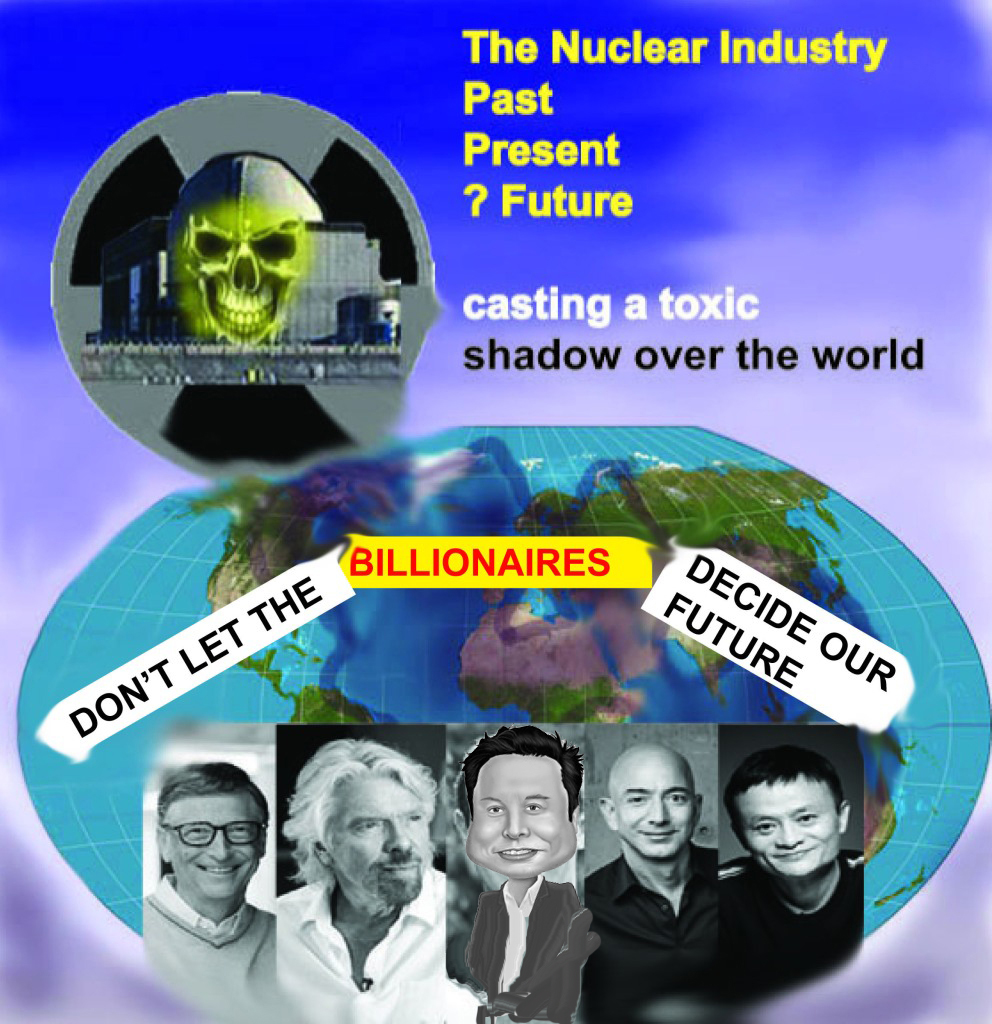
The “billionaires’ nuclear club”
The 2015 Paris climate talks featured what cleantechnica.com called a “splashy press conference” by Bill Gates to announce the launch of the Breakthrough Energy Coalition (BEC) – a group of (originally) 28 high net-worth investors, aiming “to provide early-stage capital for technologies that offer promise in bringing affordable clean energy to billions.”

Though BEC no longer makes its membership public, the original coalition included such familiar names as Jeff Bezos (Amazon), Marc Benioff (Salesforce), Michael Bloomberg, Richard Branson, Jack Ma (Alibaba), David Rubenstein (Carlyle Group), Tom Steyer, George Soros, and Mark Zuckerberg. Many of those names (and others) can now be found on the “Board and Investors” page of Breakthrough Energy’s website.
Why Canada is now poised to pour billions of tax dollars into developing Small Modular Reactors as a “clean energy” climate solution
by Joyce Nelson, January 14, 2021, story. Mini-Nukes, Big Bucks: The Interests Behind the SMR Push | Watershed Sentinel
Back in 2018, the Watershed Sentinel ran an article warning that “unless Canadians speak out,” a huge amount of taxpayer dollars would be spent on small modular nuclear reactors (SMRs), which author D. S. Geary called “risky, retro, uncompetitive, expensive, and completely unnecessary.” Now here we are in 2021 with the Trudeau government and four provinces (Saskatchewan, Ontario, New Brunswick, and Alberta) poised to pour billions of dollars into SMRs as a supposed “clean energy” solution to climate change.
It’s remarkable that only five years ago, the National Energy Board predicted: “No new nuclear units are anticipated to be built in any province” by 2040.
So what happened?
The answer involves looking at some of the key influencers at work behind the scenes, lobbying for government funding for SMRs.
The Carney factor
When the first three provinces jumped on the SMR bandwagon in 2019 at an estimated price tag of $27 billion, the Green Party called the plan “absurd” – especially noting that SMRs don’t even exist yet as viable technologies but only as designs on paper.
According to the BBC (March 9, 2020), some of the biggest names in the nuclear industry gave up on SMRs for various reasons: Babcock & Wilcox in 2017, Transatomic Power in 2018, and Westinghouse (after a decade of work on its project) in 2014.
But in 2018, the private equity arm of Canada’s Brookfield Asset Management Inc. announced that it was buying Westinghouse’s global nuclear business (Westinghouse Electric Co.) for $4.6 billion.
“If Wall Street and the banks will not finance this, why should it be the role of the government to engage in venture capitalism of this kind?”
Two years later, in August 2020, Brookfield announced that Mark Carney, former Bank of England and Bank of Canada governor, would be joining the company as its vice-chair and head of ESG (environmental, social, and governance) and impact fund investing, while remaining as UN Special Envoy for Climate Action and Finance.
“We are not going to solve climate change without the private sector,” Carney told the press, calling the climate crisis “one of the greatest commercial opportunities of our time.” He considers Canada “an energy superpower,” with nuclear a key asset.
Carney is an informal advisor to PM Trudeau and to British PM Boris Johnson. In November, Johnson announced £525 million (CAD$909.6 million) for “large and small-scale nuclear plants.”
SNC-Lavalin
Scandal-ridden SNC-Lavalin is playing a major role in the push for SMRs. In her mid-December 2020 newsletter, Elizabeth May, the Parliamentary Leader of the Green Party, focused on SNC-Lavalin, reminding readers that in 2015, then-PM Stephen Harper sold the commercial reactor division of Atomic Energy of Canada Ltd. (AECL) “to SNC-Lavalin for the sweetheart deal price of $15 million.”
May explained, “SNC-Lavalin formed a consortium called the Canadian National Energy Alliance (CNEA) to run some of the broken-apart bits of AECL. CNEA has been the big booster of what sounds like some sort of warm and cuddly version of nuclear energy – Small Modular Reactors. Do not be fooled. Not only do we not need new nuclear, not only does it have the same risks as previous nuclear reactors and creates long-lived nuclear wastes, it is more tied to the U.S. military-industrial complex than ever before. That’s because SNC-Lavalin’s partners in the CNEA are US companies Fluor and Jacobs,” who both have contracts with US Department of Energy nuclear-weapons facilities.”
But, states May, “Natural Resources Minister Seamus O’Regan has been sucked into the latest nuclear propaganda – that ‘there is no pathway to Net Zero [carbon emissions] without nuclear’.”
Terrestrial Energy
Then there’s Terrestrial Energy, which in mid-October 2020 received a $20 million grant for SMR development from NRCan’s O’Regan and Navdeep Bains (Minister of Innovation, Science and Industry). The announcement prompted more than 30 Canadian NGOs to call SMRs “dirty, dangerous, and distracting” from real, available solutions to climate change.
The Connecticut-based company has a subsidiary in Oakville, Ontario. Its advisory board includes Stephen Harper; Michael Binder, the former president and CEO of the Canadian Nuclear Safety Commission; and (as of October) Dr. Ian Duncan, the former UK Minister of Climate Change in the Dept. of Business Energy and Industrial Strategy (BEIS).

Perhaps more important, Terrestrial Energy’s advisory board includes Dr. Ernest Moniz, the former US Secretary of the Dept. of Energy (2013-2017) who provided more than $12 billion in loan guarantees to the nuclear industry. Moniz has been a key advisor to the Biden-Harris transition team, which has come out in favour of SMRs, calling them “game-changing technologies” at “half the construction cost of today’s reactors.”
In 2015, while the COP 21 Paris Climate Agreement was being finalized, Moniz told reporters that SMRs could lead to “better financing terms” than traditional nuclear plants because they would change the scale of capital at risk. For years, banks and financial institutions have been reluctant to invest in money-losing nuclear projects, so now the goal is to get governments to invest, especially in SMRs.
That has been the agenda of a powerful lobby group that has been working closely with NRCan for several years.
The “billionaires’ nuclear club”
The 2015 Paris climate talks featured what cleantechnica.com called a “splashy press conference” by Bill Gates to announce the launch of the Breakthrough Energy Coalition (BEC) – a group of (originally) 28 high net-worth investors, aiming “to provide early-stage capital for technologies that offer promise in bringing affordable clean energy to billions.”
Though BEC no longer makes its membership public, the original coalition included such familiar names as Jeff Bezos (Amazon), Marc Benioff (Salesforce), Michael Bloomberg, Richard Branson, Jack Ma (Alibaba), David Rubenstein (Carlyle Group), Tom Steyer, George Soros, and Mark Zuckerberg. Many of those names (and others) can now be found on the “Board and Investors” page of Breakthrough Energy’s website.
“As long as Bill Gates is wasting his own money or that of other billionaires, it is not so much of an issue. The problem is that he is lobbying hard for government investment.”
Writing in Counterpunch (Dec. 4, 2015) shortly after BEC’s launch, Linda Pentz Gunter noted that many of those 28 BEC billionaires (collectively worth some $350 billion at the time) are pro-nuclear and Gates himself “is already squandering part of his wealth on Terra Power LLC, a nuclear design and engineering company seeking an elusive, expensive and futile so-called Generation IV traveling wave reactor” for SMRs. (In 2016, Terra Power, based in Bellevue, Washington, received a $40 million grant from Ernest Moniz’s Department of Energy.)
According to cleantechnica.com, the Breakthrough Energy Coalition “does have a particular focus on nuclear energy.” Think of BEC as the billionaires’ nuclear club.
By 2017, BEC was launching Breakthrough Energy Ventures (BEV), a $1 billion fund to provide start-up capital to clean-tech companies in several countries.
Going after the public purse
Bill Gates was apparently very busy during the 2015 Paris climate talks. He also went on stage during the talks to announce a collaboration among 24 countries and the EU on something called Mission Innovation – an attempt to “accelerate global clean energy innovation” and “increase government support” for the technologies. Mission Innovation’s key private sector partners include the Breakthrough Energy Coalition, the World Economic Forum, the International Energy Agency, and the World Bank.
An employee at Natural Resources Canada, Amanda Wilson, was appointed as one of the 12 international members of the Mission Innovation Steering Committee.
In December 2017, Bill Gates announced that the Breakthrough Energy Coalition was partnering with Mission Innovation members Canada, UK, France, Mexico, and the European Commission in a “public-private collaboration” to “double public investment in clean energy innovation.”
Canada’s Minister of Natural Resources at the time, Jim Carr, said the partnership with BEC “will greatly benefit the environment and the economy. Working side by side with innovators like Bill Gates can only serve to enhance our purpose and inspire others.”
Dr. M.V. Ramana, an expert on nuclear energy and a professor at the School of Public Policy and Global Affairs at UBC, told me by email: “As long as Bill Gates is wasting his own money or that of other billionaires, it is not so much of an issue. The problem is that he is lobbying hard for government investment.”
Dr. Ramana explained that because SMRs only exist on paper, “the scale of investment needed to move these paper designs to a level of detail that would satisfy any reasonable nuclear safety regulator that the design is safe” would be in the billions of dollars. “I don’t see Gates and others being willing to invest anything of that scale. Instead, they invest a relatively small amount of money (compared to what they are worth financially) and then ask for government handouts for the vast majority of the investment that is needed.”
Kevin Kamps, Radioactive Waste Specialist at Beyond Nuclear, told me by email that the companies involved in SMRs “don’t care” if the technology is actually workable, “so long as they get paid more subsidies from the unsuspecting public. It’s not a question of it working, necessarily,” he noted.
Gordon Edwards, President of the Canadian Coalition for Nuclear Responsibility, says governments “are being suckers. Because if Wall Street and the banks will not finance this, why should it be the role of the government to engage in venture capitalism of this kind?”
“Roadmap” to a NICE future
By 2018, NRCan was pouring money into a 10-month, pan-Canadian “conversation” about SMRs that brought together some 180 individuals from First Nations and northern communities, provincial and territorial governments, industry, utilities, and “stakeholders.” The resulting November 2018 report, A Call to Action: A Canadian Roadmap for Small Modular Reactors, enthusiastically noted that “Canada’s nuclear industry is poised to be a leader in an emerging global market estimated at $150 billion a year by 2040.”
At the same time, Bill Gates announced the launch of Breakthrough Energy Europe, a collaboration with the European Commission (one of BEC’s five Mission Innovation partners) in the amount of 100 million euros for clean-tech innovation.
Gates’ PR tactic is effective: provide a bit of capital to create an SMR “bandwagon,” with governments fearing their economies would be left behind unless they massively fund such innovations.
NRCan’s SMR Roadmap was just in time for Canada’s hosting of the Clean Energy Ministerial/Mission Innovation summit in Vancouver in May 2019 to “accelerate progress toward a clean energy future.” Canada invested $30 million in Breakthrough Energy Solutions Canada to fund start-up companies.
A particular focus of the CEM/MI summit was a CEM initiative called “Nuclear Innovation: Clean Energy (NICE) Future,” with all participants receiving a book highlighting SMRs. As Tanya Glafanheim and M.V. Ramana warned in thetyee.ca (May 27, 2019) in advance of the summit, “Note to Ministers from 25 countries: Prepare to be dangerously greenwashed.”
Greenwash vs public backlash
While releasing the federal SMR Action Plan on December 18, O’Regan called it “the next great opportunity for Canada.”
Bizarrely, the Action Plan states that by developing SMRs, our governments would be “supporting reconciliation with Indigenous peoples” – but a Special Chiefs Assembly of the Assembly of First Nations passed a unanimous 2018 resolution demanding that “the Government of Canada cease funding and support” of SMRs. And in June 2019, the Anishinabek Chiefs-in-Assembly (representing 40 First Nations across Ontario) unanimously opposed “any effort to situate SMRs within our territory.”
Some 70 NGOs across Canada are opposed to SMRs, which are being pushed as a replacement for diesel in remote communities, for use in off-grid mining, tar-sands development, and heavy industry, and as exportable expertise in a global market.
Whether SMRs work or not, Mission Innovation members will be throwing tax-dollars at them like there is no tomorrow.
On December 7, the Hill Times published an open letter to the Treasury Board of Canada from more than 100 women leaders across Canada, stating: “We urge you to say ‘no’ to the nuclear industry that is asking for billions of dollars in taxpayer funds to subsidize a dangerous, highly-polluting and expensive technology that we don’t need. Instead, put more money into renewables, energy efficiency and energy conservation.”
No new money for SMRs was announced in the Action Plan, but in her Fall Economic Statement, Finance Minister Chrystia Freeland touted SMRs and noted that “targeted action by the government to mobilize private capital will better position Canadian firms to bring their technologies to market.” That suggests the Canada Infrastructure Bank will use its $35 billion for such projects.
It will take a Herculean effort from the public to defeat this NICE Future, but along with the Assembly of First Nations, three political parties – the NDP, the Bloc Quebecois, and the Green Party – have now come out against SMRs.
Award-winning author Joyce Nelson’s latest book, Bypassing Dystopia, is published by Watershed Sentinel Books. She can be reached via www.joycenelson.ca.
Ontario town starts voting today on willingness to host ‘forever’ nuclear waste storage site

$418 million in subsidies from Canada’s nuclear industry
“When you look at the money, I don’t think it’s really significant when you look at the scope of this project,“
Teeswater, north of London, and northern Ontario site being considered for massive facility
Andrew Lupton · CBC News · Posted: Oct 21, 2024
The small farming community of Teeswater, Ont., faces a massive decision. Starting today, its 6,000 residents will vote in a referendum on whether or not they’re willing to host Canada’s largest underground storage facility of spent nuclear fuel.
For Anja Vandervlies, who operates a 1,300-goat dairy farm nearby, it’s a monumental decision for her town in the municipality of South Bruce, and an easy choice for her.
“If we vote yes, we’re stuck with this nuclear waste in the ground forever,” said Vandervlies, a member of the opposition group Protecting Our Waterways – No Nuclear Waste. “This is the only time that we, as residents, are going to get a say in this whole process.”
A two-hour drive from London but less than 45 minutes from the Bruce Nuclear Generating Station on Lake Huron, Teeswater is one of two locations being considered to host Canada’s largest permanent underground storage facility for spent nuclear fuel.
Also under consideration is Ignace, a community of about 1,200, located 245 kilometres northwest of Thunder Bay. Voters there have already said they’re willing hosts; now it’s Teeswater’s turn to have its say.
Voting will be conducted online and by phone over seven days. To be binding, a yes vote of 50 per cent plus one is required. If Teeswater votes yes, the board of the Nuclear Waste Management Organization (NWMO) will make a final decision between Teeswater and Ignace, likely before the end of this year.
Once the site is decided, the $26-billion storage facility would be built in stages, with plans to begin accepting waste in the 2040s and continue storing it away underground for the next 175 years.
The process also requires consultation from First Nations groups in both communities. Neither has officially made a decision. The Wabigoon Lake Ojibway First Nation will vote in November. Opposition from Indigenous groups to the northern Ontario site is growing.
Wherever it’s located, the facility, which the NWMO calls a “deep geological repository” that would be located 600 metres underground, will take spent nuclear fuel from Canadian Candu reactors located as far away as Winnipeg.
Running counter to the safety concerns is the significant windfall awaiting whichever of the two communities winds up hosting the storage facility.
The host town would not only benefit from high-paying jobs, but also $418 million in subsidies from Canada’s nuclear industry over the the course of the project.
South Bruce Coun. Ron Schnurr didn’t want to say how he’s voting, opting instead to give the community its say this week.
However, he said the money would be a massive boost to a rural community with big infrastructure needs and a small tax base to pay for them. ……………………….
To Vandervlies and others in the group opposing the facility, the risk far outweighs the potential reward of hosting the site.
“When you look at the money, I don’t think it’s really significant when you look at the scope of this project,” she said.
The question
Voters will decide yes or no to the following question:
- Are you in favour of the Municipality of South Bruce declaring South Bruce to be a willing host for the Nuclear Waste Management Organization’s proposed Deep Geological Repository (DGR)?
Information about how to vote, how to get on the voters list and where to find a voter assistance centre is posted here. Voting closes on Oct. 28 at 8 p.m. ET.
https://www.cbc.ca/news/canada/london/teeswater-nuclear-waste-storage-site-vote-1.7356267
Video. Gordon Edwards on Nuclear Fuel Waste Abandonment (South Bruce)
Canada’s nuclear waste producers want to bury and eventually abandon all of their high-level radioactive waste (used nuclear fuel) in a Deep Geological Repository (DGR). For this purpose they need to find a “willing host community” that will accept the waste. Accordingly, in 2005 the waste producers created a Nuclear Waste Management Organization (NWMO) that has given many millions of dollars to a small number of “candidate communities” over the last 14 years, in addition to meeting on a monthly basis with the members of a Citizens’ Liaison Committee (CLC) chosen for each candidate community, in a program called “Learn More”.
The idea is that each community would learn about how safe the management, transport, packaging and burial of this intensely radioactive material will be, so that they are “fully informed” about the proposed project. Now NWMO has narrowed down the original list of 22 candidate communities to just two: one near Revell Lake north of Lake Superior, between the Ontario towns of Ignace and Dryden, and the other near Teeswater, South Bruce, a small farming community a few kilometres west of Lake Huron.
Unfortunately, NWMO withheld information about the individual radioactive constituents of used nuclear fuel (like radioactive iodine, radioactive caesium, radioactive strontium, and plutonium) and the biomedical dangers they pose. NWMO also erroneously affirmed that the used fuel pellets are solid ceramics that can not leak, which is untrue. Until recently, NWMO neglected to tell the communities that the used fuel will have to be “repackaged” before burial, an elaborate and potentially dangerous operation. In addition NWMO withheld information about the specific risks associated with “reprocessing” – the option of extraction of plutonium from the used fuel before burial, which requires the destruction of the nuclear fuel matrix, thereby releasing a very large quantity of radioactive solids, vapours and gases that are difficult to contain.
The Ignace town council has already signed an agreement with NWMO to proceed, and we are awaiting the decision of Wabigoon Lake First Nation – one of the closest indigenous communities to the Revell Lake site. The citizens of South Bruce will be voting in a referendum near the end of October whether or not to give their approval, after which the nearby Saugeen Ojibway First Nation will render its decision whether or not to support the project. In both cases, the decision of the indigenous peoples will be of great importance. Canada has accepted the United Nations Declaration on the Rights of Indigenous Peoples (UNDRIP) as a fundamental component of federal decision-making. UNDRIP asserts that no toxic waste shall be stored or disposed of o indigenous lands without the Free, Prior, Informed Consent of those indigenous rights-holders.
Canada’s nuclear watchdog green-lights operation of aging Pickering reactors to 2026
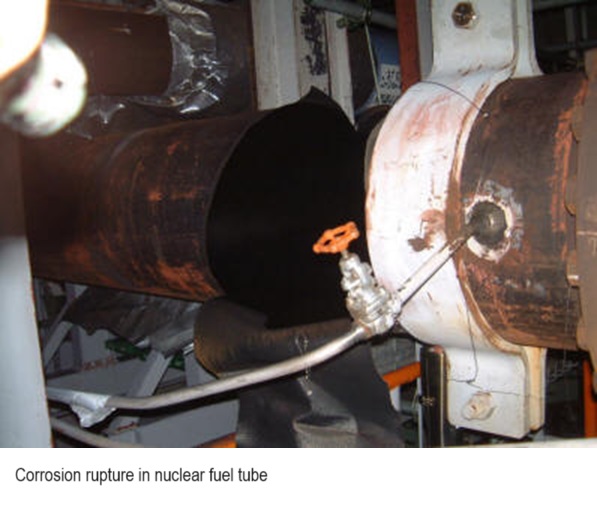
Pressure tubes, which are six-metre-long rods that contain fuel bundles of uranium, are regarded as the major life-limiting component in CANDUs. They deteriorate as they age, gradually increasing their propensity to fracture, an event which could lead to a serious accident.
Matthew McClearn, October 11, 2024 https://www.theglobeandmail.com/business/article-canadas-nuclear-watchdog-green-lights-operation-of-aging-pickering/
Canada’s nuclear safety regulator again extended a crucial permit for the country’s oldest nuclear power plant on Friday, allowing it to continue operating beyond its original design life.
On Friday the Canadian Nuclear Safety Commission authorized its owner, Ontario Power Generation, to operate the Pickering Nuclear Generating Station for an additional two years, to Dec. 31, 2026. The extended permit applies only to its newest four reactors, Units 5 through 8, which are collectively known as Pickering B. Those reactors entered service between 1983 and 1986.
The licence extension was granted by commissioners Timothy Berube, Marcel Lacroix and Andrea Hardie, who decided OPG would make adequate provisions for protecting the environment and public safety.
Canada’s homegrown reactor, the CANDU, was originally assigned a design life of 30 years, which had been incorporated into CNSC licensing requirements. If followed, they would have dictated that all four reactors shut down for major overhauls or decommissioning years ago. The CNSC, though, amended those rules and extended the station’s licence three times, while imposing more thorough inspection requirements on key components. The Pickering B reactors are now around 40 years old.
Pickering Station, located roughly 30 kilometres northeast of downtown Toronto, employs about 3,000 people and until recently supplied about 11 per cent of Ontario’s electricity. Nuclear power plants play a crucial role in the province’s grid, but their output has declined: Pickering Unit 1 shut down permanently last month, and Unit 4 is scheduled to follow in December. (The other two Pickering A units were idled permanently decades ago.)
OPG said Pickering B’s continued operation is needed because reactors at other stations are offline for overhauls.
Pressure tubes, which are six-metre-long rods that contain fuel bundles of uranium, are regarded as the major life-limiting component in CANDUs. They deteriorate as they age, gradually increasing their propensity to fracture, an event which could lead to a serious accident. Pressure tubes and related components are collectively known as fuel channels.
The main cause of that deterioration is called deuterium ingress, which is measured in parts per million (ppm) of hydrogen equivalent concentration. Previously, Pickering’s licence contained a condition that effectively capped hydrogen concentrations at 120 parts per million.
But in recent years a small number of pressure tubes in Canada have been found to have greatly exceeded that limit. The CNSC removed the 120 ppm limit from Pickering Station’s licence on Friday, and introduced a new requirement that OPG “implement and maintain an enhanced fitness for service program” for its fuel channels.
Familiar patterns of support and opposition emerged during public hearings held by the CNSC in June, with host municipalities emphasizing the plant’s economic importance. A deluge of submissions from nuclear industry contractors, lobbyists and unions also supported the plant’s continued operation, including the Society of United Professionals and the Canadian Nuclear Association.
The CANDU Operators Group, which represents utilities that use those reactors, wrote in a statement that experimental work had confirmed that the station’s fuel channels could operate safely until 2026, and that OPG “will continue with its exemplary safety record in every aspect of its operations.”
Environmental activists such as the Canadian Environmental Law Association recommended the CNSC reject the permit, partly owing to risks associated with the plant’s aging equipment.
“Old nuclear plants are particularly susceptible to accidents,” it wrote in its submission, adding that the dangers of allowing the plant to continue operating are “high and increasing.”
Sunil Nijhawan, a nuclear safety consultant and frequent intervenor before the CNSC, said that OPG’s own estimates showed “that the degradation of fuel channels is widespread; a number of component and system failure mechanisms are fast converging to put the reactor into unsafe operation territory.”
Several First Nations asserted that the plant’s continued operations required their consent, and some also raised concerns about aging pressure tubes. The Mississaugas of Scugog Island First Nation declared in a written statement that it was “not comfortable with the risk management methods being employed by the CNSC and OPG.”
The CNSC found that the licence extension “does not present any novel adverse impact on any potential or established Aboriginal claim or right.”
A second life is planned for the Pickering B reactors following the planned 2026 shutdown: In January, the Ontario government authorized OPG to begin a refurbishment that would return them to service in the mid-2030s.
Canada’s false ‘solution’ for used nuclear fuel waste

Potentially trucking waste to a deep geological repository could be a recipe for disaster.
BY WILLIAM LEISS | October 7, 2024, William Leiss is an author, and emeritus professor at Queen’s University
The Nuclear Waste Management Organization (NWMO) is a curious hybrid body created out of whole cloth by the federal government in its 2002 Nuclear Fuel Waste Act to find a permanent solution for that waste. Governments tried and failed to find that solution for the previous quarter-century. Now, NWMO is weeks away from identifying the “final resting place” in a deep geological repository (DGR) in Ontario, either far into the province’s northwest at Ignace near Dryden/Wabigoon Lake First Nation, or South Bruce close to Lake Huron near Teeswater and the Bruce Peninsula. One of two small municipalities and one of two groups of treaty-rights holding First Nations will need to agree, but millions of Canadians potentially affected won’t get a say.
Last month, The Globe and Mail described the organization’s DGR solution: “For 40 or so years … big trucks carrying specially designed waste containers would trundle from the reactor sites to the DGR facility, where the fuel canisters would be lowered.”
More than 90 per cent of that waste is currently at the Pickering, Darlington, and Bruce nuclear generating stations. The rest is at far-off Point Lepreau, N.B., and in Quebec, Manitoba, and Ottawa. If NWMO chooses the Ignace site and an all-road transportation method, it estimates that those trucks will travel 84 million kilometres on Canadian roads.
Each truckload will hold exactly 192 used fuel bundles, packed into a special steel container weighing 35 tonnes. The current array of operating reactors will ultimately produce a total of six million bundles. But that figure doesn’t include the announced “Bruce C” development of new reactors, or other new ones yet to be unveiled, adding at least two million more bundles. Eight million bundles will require 40,000 truckloads over at least a 40-year period.
And there will be a further 20,000 dry-cask containers in which those bundles had previously been stored which will also require transportation to a DGR. Empty, they each weigh 60 tonnes and will be radioactive. They will need to be cut in half due to their weight, adding up to another 40,000 truckloads. If they go to a DGR in Ignace, that will add another 84 million kilometres of truck travel on Canadian roads. (The NWMO has not done this estimate.)
Is everybody OK with all this? Are most Canadians even aware of these scenarios? The NWMO says that the containers on the trucks will survive any imaginable road accident, and no radioactivity will escape. But trucks travelling 168 million kilometres are—quite obviously—going to be involved in a fair number of road accidents, some serious, across those four or more decades. In those cases, folks likely will be told, “Don’t worry, it may look awful, but you and your kids won’t be irradiated.”
The two small communities designated as potential “hosts” for the DGR do not, apparently, care too much about the transportation issue. However, others are starting to become alarmed, especially in and around the city of Thunder Bay, which is on the road route for those 80,000 trucks if the DGR is sited in Ignace. If the choice is South Bruce, well, who knows? The NWMO has not published any kind of transportation plan for that choice. Just looking at a map, however, a lot of those trucks will have to go through or near the already grid-locked GTA.
And what about the First Nations? Here’s where things get interesting. The designated First Nation treaty rights holders for the Ignace site are the 28 First Nation communities of Grand Council Treaty 3, the governing body of the Anishinaabe Nation in Treaty 3, which maintains rights to all lands and water in the territory. Development in the Treaty 3 territory requires the consent, agreement, and participation of the Anishinaabe Nation in Treaty 3. To date, that consent hasn’t been granted.
The designated First Nation treaty rights holder for the South Bruce site is Saugeen Ojibway Nation (SON): the Chippewas of Nawash Unceded First Nation–Neyaashiinigmiing Anishinaabek, and the Chippewas of Saugeen First Nation. CBC News recently quoted Greg Nadjiwon, one of SON’s two chiefs, that “if you think about how many [other] treaty territories that waste would have to go through, I don’t think it will happen.” The CBC then paraphrased the chief: “Nadjiwon says even if Ignace and nearby Wabigoon Lake Ojibway Nation say yes to the proposed nuclear dump, he doubts the spent nuclear fuel from the Bruce station, which is currently in temporary storage, would ever leave his nation’s traditional territory.” Mere weeks from a site selection announcement, there clearly isn’t agreement.
NWMO’s approach isn’t going to work. Canadians do not have an acceptable solution to the problem of long-term storage or disposal of used nuclear fuel. It’s past time to consider some alternative options.
Fulsome bribery to communities – from Canada’s Nuclear Waste Management Organization (NWMO)

Frank Greening, 7 Oct 24
Canada’s Nuclear Waste Management Organization (NWMO) is using offers of money – and I’m talking about a lot of money in the millions of dollars range – to “persuade” local individuals or groups to vote in favor of constructing a DGR on their land. For example, consider the announcement by the township of Ignace after it agreed to allow NWMO to construct a used fuel DGR on its land:
There are of course many benefits to hosting the DGR in the area and these benefits will exceed the $170 Million monitory value of this agreement plus the cost of the Centre of Expertise, and thousands of dollars in housing, infrastructure, and capacity building studies to build the Township over the course of many years.
As we all know, NWMO is fond of saying that it will only proceed with the construction of a DGR at a particular location if there is a “willing host”. Now the dictionary definition of “willing” implies a readiness and eagerness to accede to or anticipate the wishes of another person or group. However, I’m sure if you asked the people of Ignace if they were ready and eager to host a DGR in their town, without any compensation or inducement, the answer would be a resounding NO! However, throw $170 million into the pot and everything changes! So, it’s obvious that the notion of “willingness” really means “a willingness to be bribed”.
Now some might argue that my use of the word bribe is too strong – dare I say offensive – but consider the dictionary definition of bribe: To give someone money or something else of value, to persuade that person to do something you want. In this case “you” means the NWMO, and what NWMO “wants” is a township’s approval of a DGR. I would argue, however, that the true meaning of willingness is acceptance without inducement!
I believe that NWMO know full well that, as the saying goes, “money talks”, and NWMO appears to have plenty of money to talk unwilling hosts into becoming willing hosts. In this regard, consider the opinion of a certain James Kimberly as expressed in his letter to the Fort Francis Times, dated December 6th, 2023:
The NWMOs proposed budget for 2023 is $162 million dollars. Projections to 2026 increase their budget to $299.8 million dollars increasing on average $40 million dollars per year. Their budget is broken into eight categories; engineering, site assessment, safety, regulatory decisions, engagement, transportation, communications, staffing and administration. All of the money the NWMO spends in their budget is derived from the public – people who pay the electricity bills. The interesting thing about their budget projection is the amount of money dedicated to the different activities.
Second to staffing and administration the next major expenditure is what they call “engagement”. There are no specific details on what “engagement” entails but I think one could safely state it is getting the public on side for their proposed dump. The engagement portion of their budget in 2023 is $47.8 million rising to $81.9 million by 2026. Other parts of their budget such as engineering, site assessment and safety come in at much lower costs literally a fraction of the staffing and engagement dollars.
According to NWMO’s projections over the next five years they will spend $359.3 million dollars of public money in trying to convince people their plan will work and that is just a part of their bottomless pit of money…..
So, I’m sure we can continue to present endless technical arguments against NWMOs plans to build a DGR, and I believe we are doing the right thing because we have the moral high-ground, but how can such arguments compete with NWMO’s bottomless pit of money?
and ……. it looks like Ignace is being short-changed!
Check out the South Bruce Hosting Agreement:
South Bruce stands to receive a stunning $418 million if it signs NWMO’s Hosting Agreement, (tabled in May of this year), and due to be voted on October 28th.
I would say, to quote a famous Mafia line, NWMO is making an offer South Bruce residents can’t refuse…
Construction of Ontario nuclear reactor should move forward despite incomplete design, ! regulator says

https://www.theglobeandmail.com/business/article-though-its-design-is-incomplete-nuclear-safety-regulator-says-the/ Matthew McClearn, 4 Oct 24
Canada’s nuclear safety regulator has recommended that the country’s first new power reactor in decades should receive the go-ahead to begin construction, even though its design is not yet complete.
At a hearing Wednesday, staff from Ontario Power Generation argued that the Canadian Nuclear Safety Commission should grant a licence to construct a 327-megawatt nuclear reactor known as the BWRX-300 at OPG’s Darlington Nuclear Generating Station in Clarington, Ont., about 70 kilometres east of Toronto.
he application received unequivocal support from the CNSC’s staff, despite the fact that several safety questions remain unresolved.
“The level of design information needed for CNSC staff to recommend a licence to construct is not the final design, but the information must be sufficient to ensure that the regulations have been met,” Sarah Eaton, the CNSC’s director-general ofits Directorate of Advanced Reactor Technologies, said before the commission.
It would be the first small modular reactor built in a G7 country and among the first globally – although its output would exceedthe informal 300-megawatt cutoff for SMRs.
The BWRX-300 is currently being developed by U.S. vendor GE Hitachi Nuclear Energy. Someaspects of its design are based on the Economic Simplified Boiling Water Reactor (ESBWR), which was licensed by the U.S. Nuclear Regulatory Commission in 2014 but never built. The CNSC said the 1,600-megawattESBWR underwent significant testing that is “mostly applicable” to its smaller cousin.
OPG, which submitted its application two years ago, is seeking a 10-year licence andplans to build three additional BWRX-300s at Darlington.
A second part of the CNSC hearing, scheduled for January, will hear interventions from the public, including Indigenous communities. OPG has already partly prepared the site – building roads and moving earth – under an earlier licence granted by the CNSC.
David Tyndall, OPG’s vice-president of new nuclear engineering, said the reactor’s design had advanced sufficiently to meet Canada’s regulatory requirements.
One significant unresolved issue, though, is its emergency shutdown systems.
Typically, reactors are required to have two independent shutdown systems. The BWRX-300would have 57 control rods that could be inserted rapidly into its coreby high-pressure water in an emergency to halt reactivity. Should that hydraulic method fail, electric motors would drive them in instead.
Mr. Tyndall assured the commission that the BWRX-300 was designedin such a way that all safety systems “are guaranteed to be fully independent and redundant, which ensureshigh reliability and fail-safe operation.”
CNSC staff, however, questioned whether the shut-off systems were truly independent because both systems rely on the same control rods. That remained unresolved at Wednesday’s hearing.
To address unresolved issues, CNSC staff proposed that the commission impose three “regulatory hold points” during the reactor’s construction at which work would halt until OPG provided sufficient information to satisfy CNSC staff. Ramzi Jammal, the commission’s executive vice-president and chief regulatory operations officer, would administer the hold points.
Throughout an assessmentrunning more than 1,000 pages, published by the CNSC this summer, staff repeatedly noted missing information in OPG’s submission that they vowed to review once it becomes available.
“In many cases, there is a discussion about a topic, and it’s noted that the design is not complete,” commissioner Jerry Hopwood observed at the hearing.
“It’s not entirely clear to what extent the design has been completed in such a way that the conclusions that support a licence to construct are then justified.”
M.V. Ramana, a professor at the University of British Columbia’s School of Public Policy and Global Affairs who specializes in nuclear power, said the CNSC doesn’t have enough information to answer key safety questions necessary to grant a construction licence. He added that, as the first of its kind, the Darlington SMR’s design is likely to require further significant changes during construction.
“What it does tell me is that OPG really has rushed through this,” he said. “It may be that they don’t feel they know enough about the design and are waiting for information from GE Hitachi, or that OPG is under its own self-imposed deadline to submit this application by a certain date.”
Prof. Ramana said the CNSC’s role as a safety regulatoris in conflict with statements its leadership has made in recent years promoting SMRs.
“The CNSC has acted as a cheerleader for small modular reactors,” he said. “This is completely at odds with what a good regulator ought to be doing.”
Hey Australia, Ontario is no model for energy and climate policy
Energy and climate strategy should prioritize options with lowest economic, environmental, technological and safety risks. Ontario’s does the opposite.
by Mark Winfield October 4, 2024, https://policyoptions.irpp.org/magazines/october-2024/ontario-energy/
Over the past few weeks, word has begun to reach Ontario of a series of stories in the Australian media in which the province is being held up as a model for climate and energy policy Down Under.
It seems that Peter Dutton, the leader of the federal opposition Liberal (the conservative party in Australian politics), has been promoting Ontario’s nuclear heavy energy plans as a pathway for Australia.
For those in the province familiar with the ongoing saga of its energy and electricity policies, the reactions to the notion of Ontario being an example of energy and electricity policymaking have ranged from “bizarre” to “you couldn’t make this up.”
Poor maintenance and operating practices led to the near-overnight shutdown of the province’s seven oldest reactors in 1997, leading to a dramatic rise in the role of coal-fired generation and its associated emissions of greenhouse gases (GHGs) and smog precursors. The refurbishment of the “laid-up” reactors themselves went badly. Two ended in write-offs, and the others ran billions over budget and years behind schedule, accounting for a large portion of the near doubling of electricity rates in the province between the mid-2000s and 2020.
Towards a $100-billion nuclear binge?
Only two other provinces followed Ontario’s lead on nuclear. Quebec built two reactors and New Brunswick one, each of them completed in the 1970s or the early 1980s. The Gentilly-1 facility in Quebec was barely ever operational and closed in 1977. The Gentilly-2 facility was shut down in 2012, and assessed as uneconomic, particularly in light of Ontario’s experiences in attempting to refurbish its own. The construction and then refurbishment of the Point Lepreau facility has repeatedly pushed New Brunswick Power to the brink of bankruptcy.
The current government of Ontario, led by Conservative Premier Doug Ford, has seemed determined to ignore the nuclear experiences of these provinces, and its own history of failed nuclear megaprojects. The government’s July 2023 energy plan includes the refurbishment of six reactors at the Bruce nuclear power facility (owned by OPG), and four reactors at the OPG’s Darlington facility. It subsequently added the refurbishment of four more reactors at OPG’s Pickering B facility, an option that had previously been assessed as unnecessary and uneconomic. The plant had originally been scheduled to close in 2018. There are also proposals for four new reactors totaling 4,800 MW in capacity at Bruce and four new 300MW reactors at Darlington. (The current capacity is 6,550 MW at Bruce, and 3,512 MW at Darlington.)
The total costs of these plans are unknown at this point, but an overall estimate in excess of $100 billion would not be unrealistic:
- $13 billion for the refurbishment at Darlington;
- approximately $20 billion for the refurbishment at Bruce;
- $15 billion for Pickering B (based on Darlington costs and plant age for both this case and Bruce);
- about $50 billion for the new build at Bruce, based on previous new build proposals;
- and the Darlington new build (unknown, but likely $10 billion or more).
Even this 100$-billion figure would assume that things go according to plan, which rarely happens with nuclear construction and refurbishment projects.
The government’s ambitious nuclear plans have not been subject to any form of external review or regulatory oversight in terms of costs, economic and environmental rationality, or the availability of lower-cost and lower-risk pathways for meeting the province’s electricity needs. Rather, the system now runs entirely on the basis of ministerial directives that agencies in the sector, including the putative regulator, the Ontario Energy Board, are mandated to implement.
The province’s politically driven policy environment is very advantageous to nuclear proponents. When previous nuclear expansion proposals had been subject to meaningful public review, the plans collapsed in the face of soaring cost estimates and unrealistic demand projections. This was the case in the early 1980s with the Royal Commission on Electric Power Planning – aka the Porter commission, at the turn of the 1990s with the Ontario Hydro demand and supply plan environmental assessment, and in the late 2000s, with the Ontario Power Authority’s integrated power system plan review.
A halt to renewable energy
There is a second dimension to Ontario’s electricity plans that also should not be overlooked. Upon arriving in office the Ford government promptly terminated all efforts at renewable energy development, including having completed wind turbine projects quite literally ripped out of the ground at a cost of hundreds of millions of dollars. It then scrapped the province’s energy efficiency strategy for being too effective at reducing demand. Repeated offers of low-cost electricity from the hydropower-rich neighbouring province of Quebec were ignored. The results of studies by the province’s own electricity system operator on energy efficiency potential and the possible contributions of distributed generation, like building and facility-level solar photovoltaics (PV) and storage, have been largely disregarded.
These choices have left the province with no apparent option but to rely on natural gas-fired generation to replace nuclear facilities that are being refurbished or retired. With existing facilities dramatically ramping up their output, and new facilities being added, GHG and other emissions from gas-fired generation have more than tripled since 2017, and are projected to continue to increase dramatically over the next years. On its current trajectory, gas-fired generation will constitute a quarter of the province’s electricity supply, the same portion provided by coal-fired plants before their phase-out, completed in 2013. The province has recently announced a re-engagement around renewable energy, but the seriousness of this interest has been subject to considerable doubt.
Given all of this, it would be difficult to see Ontario as a model for Australia or any other jurisdiction to follow in designing its energy and climate strategy. The province has no meaningful energy planning and review process. Its current nuclear and gas-focussed pathway seems destined to embed high energy costs and high emissions for decades to come. And it will leave a growing legacy of radioactive wastes that will require management of timescales hundreds of millennia.
A rational and transparent process would prioritize the options with the lowest economic, environmental, technological and safety risks. Higher-risk options, like new nuclear, should only be considered where it can be demonstrated that the lower-risk options have been fully optimized and developed in the planning process. Ontario’s current path goes in the opposite direction. To follow its example would be a serious mistake.
1 This Month


Tell the Ukrainian Government to Drop Prosecution of Peace Activist Yurii Sheliazhenko

Petition to revoke the licensing of the Near Surface Nuclear Disposal Facility (NSDF) at Chalk River. https://www.ourcommons.ca/petitions/en/Petition/Details?Petition=e-7247


of the week – STOP SMALL MODULAR REACTORS IN CANADA
To see nuclear-related stories in greater depth and intensity – go to https://nuclearinformation.wordpress.com
-
Archives
- March 2026 (163)
- February 2026 (268)
- January 2026 (308)
- December 2025 (358)
- November 2025 (359)
- October 2025 (376)
- September 2025 (258)
- August 2025 (319)
- July 2025 (230)
- June 2025 (348)
- May 2025 (261)
- April 2025 (305)
-
Categories
- 1
- 1 NUCLEAR ISSUES
- business and costs
- climate change
- culture and arts
- ENERGY
- environment
- health
- history
- indigenous issues
- Legal
- marketing of nuclear
- media
- opposition to nuclear
- PERSONAL STORIES
- politics
- politics international
- Religion and ethics
- safety
- secrets,lies and civil liberties
- spinbuster
- technology
- Uranium
- wastes
- weapons and war
- Women
- 2 WORLD
- ACTION
- AFRICA
- Atrocities
- AUSTRALIA
- Christina's notes
- Christina's themes
- culture and arts
- Events
- Fuk 2022
- Fuk 2023
- Fukushima 2017
- Fukushima 2018
- fukushima 2019
- Fukushima 2020
- Fukushima 2021
- general
- global warming
- Humour (God we need it)
- Nuclear
- RARE EARTHS
- Reference
- resources – print
- Resources -audiovicual
- Weekly Newsletter
- World
- World Nuclear
- YouTube
-
RSS
Entries RSS
Comments RSS
 nuclear-news