President Erdoğan admitted for the first time that the construction of the nuclear power plant in Sinop has been halted. Bianet, Hicran Cengiz, İstanbul – BIA News Desk28 June 2019, President Recep Tayyip Erdoğan said yesterday (June 27) the nuclear power plant project in the Black Sea province of Sinop has been halted, in an interview with a newspaper from Japan.
Turkey isn’t “holding 50 US nuclear weapons ‘hostage”
|
Is Turkey Holding 50 US Nuclear Weapons ‘Hostage’? A metaphorical reference has been taken literally by some. Snopes,
the long-standing concern that some 50 nuclear weapons are stored at the U.S. air base in Incirlik, just dozens of miles from the Syrian border. Some have for years expressed concerns about the security of those weapons, citing instability in the region. …….
he potentially disastrous specter of the Turkish government taking hold of American nukes. It’s not an impossible scenario, but it’s unlikely, said Jeffrey Lewis, director of the East Asia Nonproliferation Program at the James Martin Center for Nonproliferation Studies at the Middlebury Institute of International Studies at Monterey, a private graduate school in Vermont. And describing the weapons as “hostages” is metaphorical. The weapons are not literally being held “hostage” by Erdogan in that the U.S. can take them out of Incirlik any time it chooses. “The U.S. could take them out tomorrow if they wanted,” Lewis said. But the problem is that “some people don’t want to take them out, because if they do, they’ll never be able to put them back in.” Lewis added that he doesn’t believe it would end diplomatic relations between the U.S. and Turkey if the U.S. decided to remove the weapons, although he noted it would be tricky amid the tense situation involving the Kurds. He also raised doubts about how much the Turks prioritize the weapons, noting the weapons stored at Incirlik are gravity bombs — they can only be delivered via aircraft, and no Turkish aircraft certified to deliver nuclear weapons exist. The United States also doesn’t keep an aircraft that can deliver nukes permanently parked at Incirlik, either. In other words, Lewis said, “it’s basically a storage depot.” Although it’s true there are about 50 American nuclear weapons being stored at Incirlik Air Base in Turkey, the weapons are in the possession of the U.S. military. Erdogan is not literally holding them “hostage” so much as new developments in Turkey have made it more complicated for the U.S. to move them out. However, the weapons remain under U.S. control, and as it stands, the U.S. retains the power to move them out of Turkey at will. https://www.snopes.com/fact-check/turkey-50-us-nuclear-weapons/ |
|
|
USA anxiety over its nuclear weapons stashed in Turkey
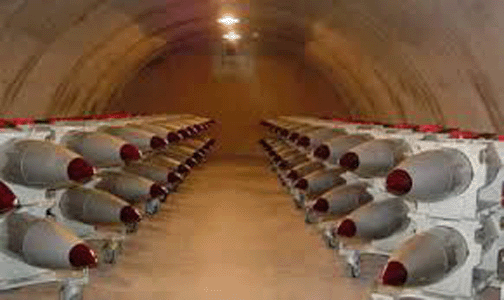
The US is rethinking the 50-plus nuclear weapons it keeps in Turkey, Quartz, By Tim Fernholz, 14 Oct 19, Turkish forces are pushing into northern Syria, replacing and sometimes even firing on the US troops retreating at Donald Trump’s orders.
The question of whether Turkey, a member of the North Atlantic Treaty Organization, is really a US ally was put to US defense secretary Mark Esper on Fox television this morning. “No, I think Turkey, the arc of their behavior over the past several years has been terrible,” he said.
Which brings up a problem: The US is storing perhaps 50 air-dropped thermonuclear bombs at its Incirlik Airbase in southern Turkey, less than 100 miles from the Syrian border where this conflict is taking place.
The nuclear stockpile dates back to the Cold War, when the US sought to keep a sufficient supply of atomic weapons deployed in Europe to deter potential Soviet aggression. Belgium, the Netherlands, Germany, and Italy also host similar arsenals, and the US trains the participating nations in the use of the doomsday devices.
Today, these bombs remain in place largely because of inertia, and the hope that countries like Turkey will see the depot as sufficient reason not to develop nuclear weapons of their own. It doesn’t seem to be working: Last month, Turkish president Recep Tayyip Erdogan said he could “not accept” efforts to prevent Turkey from developing its own atomic bombs.
But instability in Turkey and the region, along with Ankara’s close relationship with Russia, have had American strategists talking about re-locating their weapons for years. (The US does not officially discuss the arsenal, but there is no indication that the stockpile has been removed.)……..https://qz.com/1727158/us-rethinking-the-50-plus-nuclear-weapons-it-keeps-in-turkey/

Turkey’s Foreign Minister explains hurdles in Turkey’s path to nuclear weapons
|
Many obstacles in Turkey’s path to nuclear weapons – Yakış, Ahval 16 Sept 19,
Several hurdles stand in the way of Turkish President Recep Tayyip Erdoğan achieving his vision of acquiring nuclear weapons, former Foreign Minister Yaşar Yakış wrote in an article for the Arab News website. Addressing businessmen earlier this month, Erdoğan said it was unacceptable for other countries to have nuclear weapons while Turkey had none, spurring observers to consider the possibility. ……. Turkey is a signatory to the nuclear Non-Proliferation Treaty, which means it has sworn not to pursue nuclear weapons. Turkey has also committed to the Nuclear Test Ban Treaty of 1996, the Missile Technology Control Regime that bars the proliferation of chemical, biological and nuclear-tipped ballistic missiles, and the Hague Code of Conduct against ballistic missile proliferation of 2002, Yakış said. “If Turkey is determined to acquire nuclear warheads, it would first have to withdraw from all these international instruments. If it acquires nuclear warheads without withdrawing from them, it will face sanctions,” said Yakış . Meanwhile, Turkey’s withdrawal from these international treaties would not entitle it to acquire nuclear warheads; it would still need to find a nuclear state willing to cooperate, according to Yakış. Additionally, Turkey has no missile capable of delivering a nuclear payload, so would either have to develop its own or find a country willing to supply one, he added. “It is still unclear whether the establishment in Turkey will follow Erdoğan’s abrupt move,” said Yakış. “But, in the long term, Erdoğan’s idea may gain traction with the public.” https://ahvalnews.com/nuclear-treaty/many-obstacles-turkeys-path-nuclear-weapons-yakis |
|
A lot of safety worries for Turkey’s Akkuyu nuclear plant
 Turkey’s Akkuyu nuclear plant facing numerous safety concerns – Birgün, https://ahvalnews.com/akkuyu/turkeys-akkuyu-nuclear-plant-facing-numerous-safety-concerns-birgun 21 July 19,Top-level officials working at Turkey’s Akkuyu Nuclear Power Plant construction project say a series of problems, including lack of design adaptation and a shortage of competent engineers on site, are posing serious safety concerns, left-wing Birgün newspaper reported.Located in Turkey’s Mediterranean coastal town of Mersin, Turkey’s first nuclear power plant Akkuyu is a joint Russian-Turkish project with Russian energy company Rosatom as the majority stakeholder. President Recep Tayyip Erdoğan and his Russian counterpart Vladimir Putin kicked off the construction of the plant on Apr. 3 amid concerns about the potentially destructive ecological consequences of the plant.
The project hit a snag in May when fissures discovered in the foundations, according to pro-government outlet HaberTürk. New concrete was laid only for more cracks to be discovered.
The problem of the cracks, discovered by Turkey’s Atomic Energy Authority (TAEK), have since been fixed, however the foundation of the plant remains a problem.
The design of the plant was created with Russian landscape and weather in mind and is in need of revision to be adapted to Turkey’s warm climate, officials told Birgün.
“For example, sloping in the mountains should be conducted in a more horizontal fashion, but it has been done vertically to minimise costs and this is resulting the boulders continually rolling down the hills,’’ one official said.
The ground the plant is being built on, which according to a geology engineer, who spoke on condition of anonymity, is filled with gaps and cannot support the plant.
“Technically speaking, you can construct a structure over any kind of surface. However, the structure at hand is not a copy-paste matter, it must be revised according to the present surface. None of this is happening because the engineers of the project are not competent,’’ the engineer said, pointing to gaps that may lead to condensation, among other problems.
The project is run entirely on the ‘’past experiences’’ contractors, one official said. ‘’They are acting as though a building is being constructed instead of a nuclear reactor. And even during the process of constructing a building, a much more serious plan of action is followed.’’
The cooling of the plant is to take place through the waters of the Mediterranean Sea.
The warm water to be released into the sea after the cooling process, a chemical engineer who spoke to left-wing Birgün daily said, will lead to increased temperatures in the water, which in turn affects marine life.
’Chlorine is placed in the water to avoid mussels etc. from sticking to the pipes used to draw the water. And then this water, which now naturally has chlorine in it, is released into the sea,’’ the official said. ‘’Imagine the damage this can create in the sea, which is filled with living organisms.’’
Arrests in Turkey for theft of nuclear weapons material
Nuclear weapon material worth $72mn seized in a car in Turkey https://www.rt.com/news/463556-turkey-radioactive-material-bust/ : 7 Jul, 2019 Turkish police have taken five people into custody over the smuggling of a highly-radioactive substance used to build nuclear weapons and power nuclear reactors. The 18.1-gram haul was found in a car.
Police discovered a vial of the material after they pulled over a car in the northwestern Bolu province. The substance, believed to be californium, was found stashed under the gear stick wrapped in a bag. Officers had to cut the upholstery to get to the parcel, which is estimated to be worth US$72 million.
Five suspects were detained in the raid, and the mixture was taken to the Turkish Atomic Energy Agency (TAEK) for a detailed analysis.
Californium is named after the place where it was synthesized back in 1950 – a laboratory at the University of California. Apart from being used to manufacture nukes and nuclear-powered reactors, the element also has a range of rather innocuous civilian applications. It can be used as part of metal detectors and is used in cancer treatment as well as oil, silver, and gold mining operations. Still, the substance is highly dangerous and its production, distribution, and transportation is restricted. Currently, only the US and Russia synthesize the isotope.
It is not the first time Turkish police have reported a major bust involving californium.
In a scare in March of last year, police in Ankara said they had seized a whopping 1.4kg of the same substance in a car following a tip-off. It turned out to be false alarm, as the haul was later found to have no trace of nuclear or radioactive material, and was, in fact, organic matter.
Turkey’s President Erdoğan admits that Sinop nuclear power plant has been halted (too costly)
Anti-Nuclear Platform: ‘We Won’t Get Carried Away Until Project is Officially Canceled’
Zeki Karataş from the Sinop Anti-Nuclear Platform told bianet that they don’t want Sinop to be a subject of international negotiations.
“There similar claims and statements before but a statement on the essence of the matter did not come…….
The project was signed in 2013 and projected to be partly operational in 2023. However, there have been reports that the construction has been halted due to increasing costs. Erdoğan confirmed such reports for the first time in the interview he gave to the daily Nikkei. ….http://bianet.org/english/environment/209874-anti-nuclear-platform-we-won-t-get-carried-away-until-project-is-officially-canceled
Armenia’s Metsamor nuclear plant seen as a risk by Turkey
Turkey holds drill over risk stemming from Armenia’s Metsamor nuclear plant, DAILY SABAH, ISTANBUL, 20.06.2019
Fearing impact from a possible accident from an aged nuclear power plant in neighboring Armenia, residents of a border village held a drill on Wednesday coordinated by the local governorate.
As part of the drill, medical rescue teams and gendarme troops evacuated residents of Orta Alican, one of eight villages of the eastern province of Iğdır, which are located in close proximity of Metsamor. It is the first comprehensive drill of its kind in the region against the danger the plant poses.
“Survivors” of the nuclear accident were taken to a tent camp set up in central Iğdır by crews and they were “decontaminated.” Iğdır Gov. Enver Ünlü said it was their responsibility to conduct such a drill against “a disaster that might happen.”
He said Metsamor was assessed as one of the world’s most dangerous nuclear plants by the International Atomic Energy Agency (IAEA) and according to data by European Union…….
Following an earthquake in 1988, Metsamor was closed. However, in spite of widespread international protests, it was reactivated in 1995. Armenia earlier rejected the EU’s call to shut down Metsamor in exchange for 200 million euros to help meet the country’s energy needs.
Turkey, which has not had diplomatic relations with Armenia since the 1990s over the occupation of Azerbaijan’s Nagorno Karabakh, has urged Armenia to shut down the plant due to the imminent danger the outdated plant posed to Turkey……https://www.dailysabah.com/turkey/2019/06/20/turkey-holds-drill-over-risk-stemming-from-armenias-metsamor-nuclear-plant
Turkish nuclear power project looks like being shelved
|
Clouds gather over Turkey’s nuclear ambitions Pantelis Oikonomou is a former nuclear inspector at the International Atomic Energy Agency. The article is an excerpt from his upcoming book “Global Nuclear Threat” (published by Sideris). In early December 2018, five years after Turkey and Japan signed a bilateral agreement concerning the construction of four nuclear reactors in the city of Sinop on the Black Sea, the project looks like it might be shelved. According to foreign news agencies, the Japanese-French consortium is set to abandon the project.The consortium says that delays in launching construction have more than doubled the estimated costs. Tougher international safety measures that came into force following the Fukushima nuclear disaster in 2011 have reportedly inflated the bill from 20 billion to 44 billion dollars. Turkey’s economic problems and the significant plunge of the Turkish lira also played a role. It should be noted that the Turkey-Japan deal and the Turkey-Russia agreement for the construction of the Akkuyu power station in the southern province of Mersin both contain controversial clauses (articles 8 and 12 respectively) giving Ankara access to enriched uranium and plutonium. Both nuclear materials are, under certain conditions, required to build nuclear weapons. According to a senior official in the Japanese Foreign Ministry, Article 8 was included on Turkey’s persistent request. In early December 2018, five years after Turkey and Japan signed a bilateral agreement concerning the construction of four nuclear reactors in the city of Sinop on the Black Sea, the project looks like it might be shelved. According to foreign news agencies, the Japanese-French consortium is set to abandon the project. The consortium says that delays in launching construction have more than doubled the estimated costs. Tougher international safety measures that came into force following the Fukushima nuclear disaster in 2011 have reportedly inflated the bill from 20 billion to 44 billion dollars. Turkey’s economic problems and the significant plunge of the Turkish lira also played a role. It should be noted that the Turkey-Japan deal and the Turkey-Russia agreement for the construction of the Akkuyu power station in the southern province of Mersin both contain controversial clauses (articles 8 and 12 respectively) giving Ankara access to enriched uranium and plutonium. Both nuclear materials are, under certain conditions, required to build nuclear weapons. According to a senior official in the Japanese Foreign Ministry, Article 8 was included on Turkey’s persistent request. Pantelis Oikonomou is a former nuclear inspector at the International Atomic Energy Agency. The article is an excerpt from his upcoming book “Global Nuclear Threat” (published by Sideris). |
|
Japan to scrap Turkey nuclear project
 Post-Fukushima safety measures doubled costs for Mitsubishi and partners Nikkei Asain Review
TOKYO — A Japan-led public-private consortium is set to abandon a Turkish nuclear power project that had been touted as a model for Tokyo’s export of infrastructure, Nikkei has learned.The delayed project’s construction costs have ballooned to around 5 trillion yen ($44 billion), nearly double the original estimate, making it difficult for lead builder Mitsubishi Heavy Industries and its partners to continue with the plans.
The increase was due to heightened safety requirements in the wake of the 2011 meltdown at Japan’s Fukushima Daiichi nuclear power plant. The recent fall in the Turkish lira has also contributed to the cost increases.
The decision to cancel the project, now in final negotiations among the parties, comes as a blow to Japan’s nuclear industry, which is looking for avenues for growth overseas as it becomes increasingly unlikely that a new plant will be built at home post-Fukushima.
The Japanese and Turkish governments agreed in 2013 on the project, with an alliance of Japanese and French businesses centered on Mitsubishi Heavy to build four reactors in the city of Sinop on the Black Sea. Initial plans had construction beginning in 2017, with the first reactor coming online in 2023………
In 2017, global investment toward building new nuclear projects plunged roughly 70% year on year to $9 billion, according to the International Energy Agency. With safety costs rising, nuclear has grown less competitive with other forms of energy.
A number of aging Japanese reactors are set to be decommissioned soon, with Kansai Electric Power planning to scrap the Nos. 1 and 2 reactors at its Oi plant in Fukui prefecture, and Tohoku Electric Power the No. 1 unit at a plant in Miyagi Prefecture’s Onagawa. Meanwhile, new nuclear projects have hit a standstill in the face of deep public wariness. https://asia.nikkei.com/Economy/Japan-to-scrap-Turkey-nuclear-project
Turkish environmentalists go to the Supreme Court to stop construction of nuclear power station
|
Anti-nuclear power plant activists turn to Turkey’s highest court , Ahval, Ezgi Karataş
Turkish environmentalists are deeply concerned about the ongoing construction of the country’s first nuclear power plant and plan to bring their case to Turkey’s highest court. In the past year, environmental groups have brought up many legal cases against the plant, which is being built in Akkuyu, near Mersin, on the Mediterranean coast. Scientists have argued that the plant will adversely impact the regional ecology and economy, undermining the livelihoods of people who rely on the marine ecosystem and tourism. Last month, an appeals court upheld a local court’s decision to accept the Turkish government’s environmental impact assessment, even though several news reports said some scientists’ signatures on the report were forged.Following the appeals court’s decision, environmentalists say they plan to petition the Constitutional Court. Sevim Küçük, a lawyer and vocal member of the Mersin Anti-Nuclear Platform, believes Turkish President Recep Tayyip Erdoğan influenced the appeals court’s decision. “The president issued instructions to speed up the work one day before the hearing at the appeals court,” she said. “The judiciary was pressured by the executive. As a result, we were not expecting a just decision.” Küçük says their appeal to the Constitutional Court does not automatically indicate a motion to stay. Plant construction, which began in April 2018 with a ceremony attended by Russian President Vladimir Putin and Turkish President Recep Erdoğan via video conference, is expected to continue during the proceedings. “Lower courts did not issue a motion to stay either, so the construction was continuing during all our legal battles as well,” says Küçük. Küçük says that government assessment is out of line with scientific evidence and based on falsified expert reports. She believes the report was copy-pasted from falsified expert reports, and that the court, in its decision, copy-pasted the same reports as well. A key concern of the environmental group is the storage of nuclear waste, which the assessment does not adequately address. “While Europe, Japan, America are trying to close down their nuclear power plants, why is our government so determined to build one?” asks Küçük. “As locals we are worried that the plant will store its nuclear waste in our neighbourhoods.” Dr. Ful Uğurhan, another member of the anti-nuclear group, says that The location of Akkuyu is not suited to build a nuclear power plant, argues Ful Uğurhan, another member of the anti-nuclear group. Uğurhan says that the seawater temperatures in Akkuyu are high, which not only means spending more energy to cool down the reactors, but the process will further increase the seawater temperatures and upset the ecological balance. An active geological fault line near Akkuyu means additional risk. “Considering the effects of global climate change, it’s not safe to build a nuclear power plant anywhere,” says Uğurhan. “Storms, earthquakes, tsunamis all increase the risk involved in building a nuclear power plant, instead of ecologically safe electricity production plants.” ………https://ahvalnews.com/akkuyu/anti-nuclear-power-plant-activists-turn-turkeys-highest-court |
|
Turkish President Recep Tayyip Erdogan to reveal evidence of Khashoggi murder “in all its nakedness.”

 World Awaits ‘Naked’ Truth on Saudi Killing https://www.bloomberg.com/news/articles/2018-10-22/world-awaits-naked-truth-on-saudi-killing, By Glen Carey, October 22, 2018, If Saudi leaders expected a reprieve from their account of how journalist and critic Jamal Khashoggi was killed in their Istanbul consulate, they’re likely to be sorely disappointed.
While President Donald Trump, a steadfast Saudi ally, defended de facto ruler Crown Prince Mohammed bin Salman, he said the explanation had been marked by “deception and lies.’’ Bipartisan members of the U.S. Congress said it lacked credibility. France demanded more information, while Germany suspended arms sales.
Even Saudi Foreign Minister Adel al-Jubeir called Riyadh’s attempt to cover up the murder “a tremendous mistake,” though he stuck to the government’s line that Khashoggi, a Washington Post columnist, died after “discussions” turned violent.
Western leaders are balancing concerns about his death with their strategic interests. Treasury Secretary Steven Mnuchin said the U.S. will continue its relationship with the world’s largest oil supplier, a major weapons buyer, while trying to “get to the bottom of what the facts are.”
Now the focus shifts to Turkish President Recep Tayyip Erdogan, who’s promised to reveal tomorrow what happened to Khashoggi “in all its nakedness.” If he provides credible evidence that differs from the kingdom’s description, pressure to hold Saudi Arabia’s senior leadership accountable will intensify.
Council of Europe concerned at construction of the Akkuyu nuclear power plant in an earthquake-prone region
 Council of Europe requests Turkey to consult neighbours for Akkuyu nuclear plant https://ahvalnews.com/council-europe/council-europe-requests-turkey-consult-neighbours-akkuyu-nuclear-plant
The Parliamentary Assembly of the Council of Europe (PACE) expressed on Thursday deep concern at the construction of the Akkuyu nuclear power plant in an earthquake-prone region of Turkey only 85 kilometres from the border with Cyprus.
In a resolution it adopted, the assembly said that Turkey’s first nuclear plant being constructed as a joint Turkish-Russian project is in very close proximity to the other neighbouring countries.
The assembly asked Turkey to join the UN Convention on Environmental Impact Assessment in a Transboundary Context, also known as the Espoo Convention, and to take into account all concerns expressed, including those expressed by Turkish citizens.
The Espoo Convention , adopted in 1991, sets out the obligations of parties to assess the environmental impact of certain activities at an early stage of planning. It also lays down the general obligation of states to notify and consult each other on all major projects under consideration that are likely to have a significant adverse environmental impact across boundaries
The assembly also requested from the Turkish government to consult with neighbouring countries on the construction of the nuclear plant according to the International Convention on Nuclear Safety.
The construction of the Akkuyu nuclear plant located in the southern province of Mersin was kicked off by President Recep Tayyip Erdoğan and his Russian counterpart Vladimir Putin on Apr. 3.
The nuclear plant “raises concerns for a possible impact in terms of safety because such a power plant in this area affects our country much more than the largest part of the Turkish territory,” said the Cypriot government’s spokesman Prodromos Prodromou, following the groundbreaking ceremony in Mersin.
“Turkey did not take into account the grave reservations expressed by various quarters, nor did it heed the European Parliament’s call to terminate the construction plans since this is a seismologically vulnerable area,” he said.
Environmentalists in Turkey are also concerned about the potentially destructive ecological consequences of the Akkuyu nuclear power plant and several organisations form Mersin filed a lawsuit to stop its construction
President Erdoğan and Vladimir Putin launch the construction of the Akkuyu nuclear power plant
Akkuyu nuclear plant construction site holds Open Doors Day MERSİN, 7 Oct 18 The Akkuyu Nuclear Power Plant, whose construction was launched in April in a groundbreaking ceremony, opened its doors on Oct. 6 for the first time.
…..President Recep Tayyip Erdoğan and his Russian counterpart Vladimir Putin launched the construction of the Akkuyu plant at a ceremony in Ankara in early April.
…….“In 2023, we will put the first unit into operation and Turkey will thereby join those countries that use nuclear energy … On the anniversary of our republic, we will crown this work with success,” Erdoğan said.
Turkey’s President says Turkey will build its own nuclear power station
Turkey to build third nuclear power plant: Erdoğan
ANKARA Turkey‘s president said June 18 that the country will build a third nuclear power plant.
During a live question-and-answer social media broadcast with Turkish youths, President Recep Tayyip Erdoğan said Turkey would build its own nuclear power plant after the Akkuyu nuclear power plant, to be built by Russia…….http://www.hurriyetdailynews.com/turkey-to-build-third-nuclear-power-plant-erdogan-133468
Scientists call on the the International Atomic Energy Agency, NATO to stall Turkey’s dangerous nuclear power developments
Scientists raise alarm over Turkish nuclear reactors http://www.ekathimerini.com/228268/article/ekathimerini/news/scientists-raise-alarm-over-turkish-nuclear-reactors
A team of Greek scientists have called on the government, the European Union, the International Atomic Energy Agency, NATO and other international organizations to take measures that will halt the creation of nuclear power facilities in the seismically active region of Akkuyu in neighboring Turkey.
The 18 scientists made their appeal in a letter against the backdrop of an agreement struck by Moscow and Ankara for the installation of four nuclear reactors in Turkey.
Listing a series of possible consequences, the scientists raised the alarm, saying that “Turkey plans to obtain 10 nuclear reactors by 2030.”
1 This Month

of the week – Shut Down Drone Warfare!


Tell the Ukrainian Government to Drop Prosecution of Peace Activist Yurii Sheliazhenko

Petition to revoke the licensing of the Near Surface Nuclear Disposal Facility (NSDF) at Chalk River. https://www.ourcommons.ca/petitions/en/Petition/Details?Petition=e-7247
To see nuclear-related stories in greater depth and intensity – go to https://nuclearinformation.wordpress.com
-
Archives
- March 2026 (237)
- February 2026 (268)
- January 2026 (308)
- December 2025 (358)
- November 2025 (359)
- October 2025 (376)
- September 2025 (257)
- August 2025 (319)
- July 2025 (230)
- June 2025 (348)
- May 2025 (261)
- April 2025 (305)
-
Categories
- 1
- 1 NUCLEAR ISSUES
- business and costs
- climate change
- culture and arts
- ENERGY
- environment
- health
- history
- indigenous issues
- Legal
- marketing of nuclear
- media
- opposition to nuclear
- PERSONAL STORIES
- politics
- politics international
- Religion and ethics
- safety
- secrets,lies and civil liberties
- spinbuster
- technology
- Uranium
- wastes
- weapons and war
- Women
- 2 WORLD
- ACTION
- AFRICA
- Atrocities
- AUSTRALIA
- Christina's notes
- Christina's themes
- culture and arts
- Events
- Fuk 2022
- Fuk 2023
- Fukushima 2017
- Fukushima 2018
- fukushima 2019
- Fukushima 2020
- Fukushima 2021
- general
- global warming
- Humour (God we need it)
- Nuclear
- RARE EARTHS
- Reference
- resources – print
- Resources -audiovicual
- Weekly Newsletter
- World
- World Nuclear
- YouTube
-
RSS
Entries RSS
Comments RSS
 nuclear-news