In 2014, Saudi Arabia tried to delete part of UN climate science report
Saudis accused of deleting part of UN climate science report Climate Home News 23/05/2014 British scientist expresses his surprise when parts of IPCC text were ‘mutilated’ at April meeting in Berlin By Ed King
A coalition led by Saudi Arabia attempted to mask their contribution to rising levels of greenhouse gas emissions during discussions at the UN’s most recent climate science meeting.
That’s the charge laid by John Broome, a British philosopher and economist at Oxford University, and contributing author to the Intergovernmental Panel on Climate Change’s Fifth Assessment Report.
He’s not the first to make these accusations – that prize goes to Giovanni Baiocchi, an economist at the University of Maryland.
But Broome is the first to offer a compelling narrative of how the four–day Berlin meeting of IPCC Working Group 3 scientists in April unfolded.
In a detailed blog published on May 20 he says the ‘Summary for Policymakers’, a concise document that pulls together thousands of pages of work, was “mutilated” by government officials.
“The degree of compression in the SPM meant that every sentence counts. In drafting it, we authors each found ourselves defending our favourite sentences,” Broome writes.
“Some sections were cut to pieces because the different views of the delegations turned out to be irreconcilable.”
Broome contends that in the early hours of April 12, a coalition of countries led by Saudi Arabia insisted that all figures showing emissions of greenhouse gas from countries classified by their “income group” were deleted. Other reports indicate China was also part of this push. ……..
Key summary
It should be stressed the SPM is the only part of the IPCC texts that receives this level of political interrogation or interference from governments – perhaps because they know it’s the only part most policymakers will read.
This can then form the basis of various negotiating positions at UN climate talks, which are heating up as a global emissions reduction deal scheduled to be signed off in December 2015 draws close.
The original findings remain untouched…….. http://www.climatechangenews.com/2014/05/23/saudi-blocking-of-un-climate-science-report-exposed/
Saudi Arabia’s Crown Prince Mohammad Bin Salman (MbS) and his goal of a nuclear kingdom
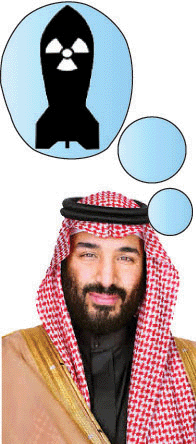 The Crown Prince May Build Himself a Nuclear Kingdom https://nationalinterest.org/blog/middle-east-watch/crown-prince-may-build-himself-nuclear-kingdom-37292 The Trump administration should keep a close eye on Saudi Arabia’s nuclear connections and activities. by Ronen Dangoor, 28 Nov 18
The horrific murder of Jamal Khashoggi shed light on the reckless and dangerous decisionmaking process of Saudi Arabia’s Crown Prince Mohammad Bin Salman (MbS). In addition to the latest crisis The New York Times recently published a story about how the prince’s closest security personnel sought to hire private foreign companies to assassinate senior Iranian officials—an act that could have trigger a regional military conflict. This conduct follows a string of other bizarre events in the last few months, initiated by MbS.
The crown prince has demonstrated arrogant, cruel, amateur and capricious behavior. His aggression has been left almost unmonitored by checks and balances inside the Saudi hierarchy. Indeed, MbS has constrained all his potential rivals and has taken full controlof Saudi Arabia’s security and intelligence bodies. As the Khashoggi scandal has proven—such power enables dictators to secretly execute dangerous operations. In parallel, he managed to become the darling of the West after he initiated economic reforms and launched his so called modern 2030 vision .
Now add Saudi’s long history of nuclear ambitions to the mix. For years, Saudi officials have warned that Saudi Arabia will not curb its nuclear ambitions if it will sense a threat to its national security, or if Iran advances in its nuclear program. Rumors were that Pakistan was obliged to provide the Saudis a ready-for-use nuclear weapon if and when the time comes. Things only got more complicated once the nuclear agreement (JCPOA) with Iran was signed in 2015, practically legitimizing Iran’s rights to maintain and develop its uranium enrichment capabilities. At the beginning of November 2018, the crown prince participated in the opening ceremony marking the launch of construction of Riyadh’s first research reactor . It’s still early days and only a symbolic act—the Saudis lack knowhow, technicians, infrastructure and academic expertise—but the country has both enough ambition and funds to advance anyway. Shortly after that the Saudi energy minister said the kingdom launches uranium exploration program.
Over the last decade, purchasing sixteen nuclear power reactors—later scaled back to two reactors—plus uranium enrichment capabilities preferably from the United States, has
featured prominently on the Saudi agenda. The official rationale is the country’s future needs to supply energy —with self-sufficient nuclear materials. While having enrichment capabilities can serve to counterbalance Iran, it may also constitute a future military nuclear program. During previous negotiations with Saudi officials, the Obama administration insisted that Saudi Arabia must comply with the “ gold standard ,” reflective of the conditions imposed on the UAE when it agreed to buy U.S. reactors in 2009. This standard requires a commitment not to enrich uranium or to produce plutonium as a strict condition for any agreement to sell nuclear reactors. According to current Secretary of State Mike Pompeo, the Trump administration has maintained this policy . In an interview with CBS in March 2018, MbS maintained that “without a doubt, if Iran developed a nuclear bomb, we would follow suit as soon as possible.”
Following the murder of Khashoggi, Senate members urged the Trump administration to curb any intention to sell nuclear reactors to the Saudi regime. This move is certainly necessary, but not nearly enough. An American refusal to his demands can push the prince to seek an alternative option elsewhere, with producers that will be all too happy to assist—for the right price.
Much of MbS’s current conduct lies parallel to previous experience with three other Middle East tyrants: former Iraqi president Saddam Hussein, Libya’s leader Muammar el-Qaddafi, and Syrian president Bashar al-Assad. These cynical dictators have a common denominator in their infinite ambitions, which ultimately led them to secretly promote a nuclear weapons program. They all relied heavily on their security systems in initiating these plans. Libya and Syria had no sufficient nuclear infrastructure, so they bought a turnkey nuclear project from Pakistan’s A.Q. Khan Network, and in the Syrian case from North Korea .
The Saudi nuclear issue has placed a challenge before the administration. If the prince is successful in surviving the current crisis, then that could prompt him to make even riskier decisions, including taking the nuclear path. Much like in Iraq, Libya and Syria, all the necessary components for that are now in place: A de facto dictator with delusions of grandeur and poor judgment, full control over the security services, unlimited funds for the purpose, a national sense of isolation, an acute threat, and a long-term nuclear vision. As Iran seems to be complying with the JCPOA, a Saudi move could instigate a nuclear arms race in the Middle East. To avoid this, the Trump administration should warn and restrict the Saudi heir. It should also keep a very close eye on Saudi Arabia’s nuclear connections and activities.
Ronen Dangoor is the former deputy head of the research and analysis division at the Israeli prime minister’s office.
Trump’s international nuclear negotiations will lead to Saudi Arabia getting nuclear weapons
Why Saudi Arabia Will Acquire Nuclear Weapons If the Trump administration continues to turn its nuclear negotiations into a boondoggle, then nothing will prevent Riyadh from building bombs.,National Interest by Paul R. Pillar, 28 Nov 18
The Trump administration’s handling of nuclear negotiations with Saudi Arabia promises to lay bare some realities about security issues and nuclear programs in that part of the world that the administration has refused to acknowledge. A front-page article by David Sanger and William Broad in the New York Timesreviews some of the still-unresolved questions. The Saudi regime insists on producing its own nuclear fuel, which would be different from terms the United States has negotiated with some other states, including the United Arab Emirates, that have sought U.S. assistance in developing their nuclear programs. The Saudis have balked at comprehensive international inspections to detect any work on nuclear weapons. And Saudi Arabia’s Crown Prince Mohammed bin Salman (MbS) has explicitly threatened to develop nuclear weapons, ostensibly in response to any similar development by Iran.
A useful model for approaching this situation involves Iran. The model is the Joint Comprehensive Plan of Action (JCPOA), the multilateral accord commonly known as the Iranian nuclear deal, which Donald Trump has castigated and on which his administration has reneged by imposing new economic sanctions despite continued Iranian compliance with the JCPOA. The JCPOA closed all possible pathways to development of an Iranian nuclear weapon through stringent restrictions on enrichment of uranium, the gutting of reactors that otherwise might be used to produce plutonium, and the prohibition of any reprocessing by Iran of nuclear fuel. The agreement also established a thorough inspection system that involves not only routine monitoring of nuclear facilities but also the ability of international inspectors to inspect any other sites they may have reason to suspect are housing nuclear-related activity, with the other parties to the agreement being able to outvote Iran in the event of disagreement about the relevance of a requested inspection. This is the kind of highly intrusive inspection arrangement that the Saudis reportedly are refusing to apply to themselves.
The principal U.S. negotiator has been Secretary of Energy Rick Perry, for whom this is a learning-on-the-job experience. Perry was initially unaware of the Department of Energy’s nuclear responsibilities and believed his job would consist of promoting the oil industry. (This contrasts with Perry’s predecessor, Ernest Moniz, a nuclear physicist who played a key role in negotiation of the highly detailed JCPOA.)………
Amid all the talk among opponents of the JCPOA about ballistic missiles, it is worth noting that Saudi Arabia has been ahead of its regional neighbors on that count as well. Two decades ago, Saudi Arabia secretly purchased medium-range missiles from China that, although reportedly configured to carry conventional weapons, were of a type originally designed to deliver a nuclear warhead. The Saudis in more recent years have modernized their missile force, again relying on China as the supplier.
Destabilizing regional activity also implies that Saudi Arabia is more of a worry than most states regarding the implications of possible acquisition of nuclear weapons. Saudi Arabia has bombed Yemen into becoming a humanitarian catastrophe, has kidnapped and attempted to coerce into resignation the prime minister of Lebanon, and has used diplomatic facilities in foreign countries to assassinate nonviolent dissidents. The impetuous young prince behind these policies has been moving toward one-man rule, shedding even the restraints of what had been a collective family autocracy.
The murder of Jamal Khashoggi has drawn some recent and welcome attention to this pattern of behavior, although it has not budged Donald Trump from his stance of sticking with MbS no matter what he does. California Rep. Brad Sherman has appropriately observed, “A country that can’t be trusted with a bone saw shouldn’t be trusted with nuclear weapons.”
The administration’s assault on the JCPOA may provide the trigger for Saudi Arabia to try to obtain such weapons. If the U.S. “maximum pressure” campaign succeeds in negating completely the economic relief Iran was supposed to have received under the JCPOA, then Iranian leaders may yet throw up their hands in disgust and pronounce the agreement null and void. This would release Iran from all its nuclear restrictions under the agreement, which in turn might provide the perfect rationale for Riyadh, especially as long as MbS is in charge, to acquire the bomb.
Paul R. Pillar is a contributing editor at the National Interest and the author of Why America Misunderstands the World . https://nationalinterest.org/blog/paul-pillar/why-saudi-arabia-will-acquire-nuclear-weapons-37197
Saudi Arabia’s crown prince Mohammed bin Salman – wanting a nuclear bomb?
|
Saudis Want a U.S. Nuclear Deal. Can They Be Trusted Not to Build a Bomb? NYT, By David E. Sanger and William J. Broad, Nov. 22, 2018, WASHINGTON — Before Saudi Arabia’s crown prince, Mohammed bin Salman, was implicated by the C.I.A. in the killing of Jamal Khashoggi, American intelligence agencies were trying to solve a separate mystery: Was the prince laying the groundwork for building an atomic bomb?The 33-year-old heir to the Saudi throne had been overseeing a negotiation with the Energy Department and the State Department to get the United States to sell designs for nuclear power plants to the kingdom. The deal was worth upward of $80 billion, depending on how many plants Saudi Arabia decided to build.
But there is a hitch: Saudi Arabia insists on producing its own nuclear fuel, even though it could buy it more cheaply abroad, according to American and Saudi officials familiar with the negotiations. That raised concerns in Washington that the Saudis could divert their fuel into a covert weapons project — exactly what the United States and its allies feared Iran was doing before it reached the 2015 nuclear accord, which President Trump has since abandoned. Prince Mohammed set off alarms when he declared earlier this year, in the midst of the negotiation, that if Iran, Saudi Arabia’s fiercest rival, “developed a nuclear bomb, we will follow suit as soon as possible.” His negotiators stirred more worries by telling the Trump administration that Saudi Arabia would refuse to sign an agreement that would allow United Nations inspectors to look anywhere in the country for signs that the Saudis might be working on a bomb, American officials said. Asked in Congress last March about his secret negotiations with the Saudis, Energy Secretary Rick Perry dodged a question about whether the Trump administration would insist that the kingdom be banned from producing nuclear fuel. Eight months later, the administration will not say where the negotiations stand. Now lurking behind the transaction is the question of whether a Saudi government that assassinated Mr. Khashoggi and repeatedly changed its story about the murder can be trusted with nuclear fuel and technology. Such fuel can be used for benign or military purposes: If uranium is enriched to 4 percent purity, it can fuel a power plant; at 90 percent it can be used for a bomb. Privately, administration officials argue that if the United States does not sell the nuclear equipment to Saudi Arabia someone else will — maybe Russia, China or South Korea. They stress that assuring that the Saudis use a reactor designed by Westinghouse, the only American competitor for the deal, fits with Mr. Trump’s insistence that jobs, oil and the strategic relationship between Riyadh and Washington are all far more important than the death of a Saudi dissident who was living, and writing newspaper columns, in the United States. Under the rules that govern nuclear accords of this kind, Congress would have the opportunity to reject any agreement with Saudi Arabia, though the House and Senate would each need a veto-proof majority to stop Mr. Trump’s plans. “It is one thing to sell them planes, but another to sell them nukes, or the capacity to build them,’’ said Representative Brad Sherman, Democrat of California and a member of the House Foreign Affairs Committee. Following Mr. Khashoggi’s death, Mr. Sherman has led the charge to change the law and make it harder for the Trump administration to reach a nuclear agreement with Saudi Arabia. He described it as one of the most effective ways to punish Prince Mohammed. “A country that can’t be trusted with a bone saw shouldn’t be trusted with nuclear weapons,” Mr. Sherman said, referring to Mr. Khashoggi’s brutal killingin the Saudi Consulate in Istanbul last month. Nuclear experts said Prince Mohammed should have been disqualified from receiving nuclear help as soon as he raised the prospect of acquiring atomic weapons to counter Iran. “We have never before contemplated, let alone concluded, a nuclear cooperation agreement with a country that was threatening to leave the nonproliferation treaty, even provisionally,” said William Tobey, a senior official in the Energy Department during the Bush administration who has testified about the risks of the agreement with Saudi Arabia. He was referring to the crown prince’s threat to match any Iranian nuclear weapon — a step that would require the Saudis to either publicly abandon their commitments under the nonproliferation treaty or secretly race for the bomb. The Trump administration declined to provide an update on the negotiations, which were intense enough that Mr. Perry went to Riyadh in late 2017. Within the last several months, a senior State Department official engaged in further discussions over the deal in Europe. ……..The core challenge for the Trump administration is that it has declared that Iran can never be trusted with any weapons-making technology. Now, it must decide whether to draw the same line for the Saudis. The United States’ own actions may be helping to drive the Saudis’ nuclear thinking. Now that the Iran agreement, brokered with world powers, is on the edge of collapse after Mr. Trump withdrew the United States, analysts are worried that the Saudis may be positioning themselves to create their own nuclear program in response. The kingdom has extensive uranium deposits and five nuclear research centers. Analysts said Saudi Arabia’s atomic work force was steadily growing in size and sophistication — even without producing nuclear fuel. Saudi leaders saw a political opening when Mr. Trump was elected. In its early days, the administration spent considerable time discussing ways that Saudi Arabia and other Arab states could acquire nuclear reactors. Michael T. Flynn, who briefly served as Mr. Trump’s national security adviser, backed a plan that would have let Moscow and Washington cooperate on a deal to supply Riyadh with reactors — but not the ability to make its own atomic fuel. As a precondition, American economic sanctions against Russia would have been dropped to allow Moscow to join the effort. Mr. Flynn was fired in early 2017 as questions swirled around his conversations with Russia’s ambassador to the United States, including about ending the trade restrictions. At his Senate confirmation hearing in November 2017, Christopher A. Ford, the assistant secretary of state for international security and nonproliferation, called the safeguards a “desired outcome.” But he equivocated on whether the United States would insist on them. Senator Edward J. Markey, a Massachusetts Democrat who sits on the Senate Foreign Relations Committee, described the administration’s approach as “a recipe for disaster.”…….The crown prince made headlines in March by shifting the public discussion over Riyadh’s intentions from reactors to atomic bombs. In a CBS News interview, he said that if Iran acquired nuclear arms, Saudi Arabia would quickly follow suit. …….Mr. Falih, the energy minister, raised concerns about the outcome of negotiations with Washington by insisting publicly that Riyadh would make its own atomic fuel. ………https://www.nytimes.com/2018/11/22/world/middleeast/saudi-arabia-nuclear.html |
|
Almost truly incredible – the farce of Saudi Arabia’s Investigation of Jamal Khashoggi’s Murder
 Saudi Arabia’s Investigation of Jamal Khashoggi’s Murder Is a Tragic Farce, New Yorker, By Robin Wright, November 16, 2018 Despite six weeks of ferocious denials by Saudi Arabia, U.S. intelligence has concluded that the kingdom’s ambitious young crown prince, Mohammed Bin Salman, personally ordered the execution of journalist Jamal Khashoggi, who was killed in Istanbul last month, the Washington Postreported late Friday. The U.S. assessment was reportedly based on a growing array of hard data as well as a psychological study of the thirty-three-year-old prince. The most damning and specific intelligence was provided by Turkey, including audio recordings of the murder inside the Saudi consulate and a call from the diplomatic mission back to Saudi Arabia immediately afterwards. Turkey shared both with the C.I.A. director Gina Haspel. But the United States also had its own electronic intercepts of conversations, some retrieved in a search of its electronic archives after Khashoggi’s murder on October 2nd, the Post reported. One was reportedly between the crown prince’s brother Khalid, who was the Saudi Ambassador to Washington at the time, and Khashoggi, who was told to go to Istanbul to get official papers proving his divorce so he could remarry.
New Bill in U.S. Congress would block a nuclear deal with Saudi Arabia
House Democrat to introduce new bill punishing Saudi Arabia over Khashoggi, It would block a controversial nuclear deal that’s very important to Saudi Arabia. Vox By A House Democrat will soon introduce legislation to punish Saudi Arabia over the murder of journalist Jamal Khashoggi — by trying to halt an impending nuclear deal with the country.
Obtained exclusively by Vox, the bill — nicknamed the “No Nuclear Weapons for Saudi Arabia Act of 2018” — if passed would be the strongest rebuke to Saudi Arabia yet since the uproar over Khashoggi’s fate.
Khashoggi, a US resident, was killed by Saudi officials inside the country’s consulate in Istanbul last month. That led to a major international outcry over his death, including from many in the US who wanted to see the Washington-Riyadh relationship curtailed.
Most of the discussions on how to do that center on stopping billions of dollars in arms sales to the kingdom, but President Donald Trump has repeatedly said he doesn’t want to jeopardize money coming into the United States, and some members of Congress privately worry that stopping weapons shipments to Saudi Arabia might negatively impact jobs.
So instead of doing that, Rep. Brad Sherman (D-CA) wants to stop a major nuclear deal between the US and Saudi Arabia that’s been under negotiation for months, and which he has long railed against.
“I don’t think this bill would’ve passed prior to the events in Istanbul,” Sherman told me. “Now I think we have a chance.” It’s also very possible a Republican will co-sponsor the bill when it’s officially introduced in the next 10 congressional days.
The legislation would do three main things:
- Force Trump to submit a “123 Agreement,” or a set of rules that make it legal for the US to sell nuclear technology to another country, for congressional approval.
-
- Force the administration to tell Congress that Saudi Arabia will abide by the agreement’s “Gold Standard” (more on that below) and an inspections agreement with the International Atomic Energy Agency, the world’s nuclear watchdog
- Require the administration to write reports on Saudi Arabia’s probe into Khashoggi’s murder and the state of human rights in the kingdom
Sherman’s bill could completely block Saudi Arabia’s plans to obtain nuclear technology from the United States, especially since there’s growing bipartisan support to reprimand Riyadh over Khashoggi.It would come as a big blow to Saudi Arabia: Crown Prince Mohammed bin Salman, the kingdom’s de facto ruler, more commonly known as MBS, launched a project on Monday to build his country’s first nuclear research reactor.
There’s also some bipartisan support to stop nuclear talks with Riyadh in the Senate.
Sens. Edward Markey (D-MA) and Marco Rubio (R-FL), for example, have sent letters to Trump requesting he at least suspend negotiations with Saudi Arabia over the nuclear deal. It’s unclear if either of them will draft parallel legislation to the House version, although a spokesperson for Rubio’s office told me the senator “possibly” could consider a bill in the future. …….
American companies have already lined up to sell and build nuclear parts for Saudi Arabia, …….
-
Saudi Arabia could accelerate a nuclear arms race in the Middle East
There’s legitimate concern about what Riyadh would do with a brand new nuclear reactor if this indeed happens.
On March 18, MBS openly admitted on CBS’s 60 Minutes that obtaining a nuke was a possibility……..
- There are other signs that Saudi Arabia’s burgeoning nuclear program is really all about weapons — and not mainly for energy — like it repeatedly says. One possible indicator is that Riyadh has focused on nuclear energy and not renewable energy to bring power to its millions of citizens. …….https://www.vox.com/2018/11/9/18072660/saudi-arabia-nuclear-deal-congress-123-agreement-sherman?fbclid=IwAR1-MMsdZfBxfPVPs0jxhEm1k8eWPzi22OTWpOCHavjtdWa5MKBcBhWGj9Y
Crown Prince Mohammed bin Salman launches nuclear project in Saudi Arabia
 Bin Salman launches Saudi Arabia’s first nuclear plant project, Aljazeera, 6 Nov 18
Crown Prince Mohammed bin Salman launches project to build the first nuclear research reactor in the kingdom. Saudi Arabia‘s crown prince has launched a project to build the first nuclear research reactor in the kingdom, the Saudi Press Agency reported.
Crown Prince Mohammed bin Salman, also known as MBS, launched seven strategic projects in renewable energy, atomic energy, water desalination, genetic medicine and the aircraft industry during his visit to King Abdulaziz City for Science and Technology on Monday.
The two most significant projects include a nuclear research reactor and a centre for the development of aircraft structures.
In March, MBS announced his country’s readiness to develop nuclear weapons in the event that Iran heads in that direction………
Nuclear power
Last year, the International Atomic Energy Agency said the Saudi government had invited proposals for the construction of two nuclear power reactors to boost the country’s energy mix.
The kingdom is considering building 17.6 gigawatts (GW) of nuclear capacity by 2032, the equivalent of about 17 reactors, making it one of the biggest projects globally…….https://www.aljazeera.com/news/2018/11/bin-salman-launches-saudi-arabia-nuclear-plant-project-181105192827938.html
South Korean firm KEPCO keen to get $20 billion by selling nuclear reactors to Saudi Arabia
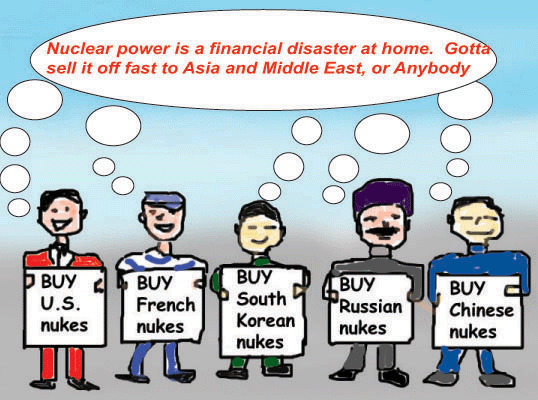
Kepco is still working to land Saudi nuclear power deal, Korea JoongAng Daily BY LEE HO-JEONG [lee.hojeong@joongang.co.kr], 2 Nov 18, GWANGJU – The CEO of Korea Electric Power Corporation (Kepco) said it still hopes to be picked for a $20 billion nuclear power plant project in Saudi Arabia that is expected to be decided by the end of next year. …….
In July Korea was put on the shortlist for the Saudi nuclear project along with the U.S., China, Japan and Russia.
The Saudi government is planning to build two nuclear power plants with a 2.8 gigawatt capacity by 2030. The country has plans to build a total of 16 nuclear power plants in the next 20 to 25 years. …….
Kim said earnings from overseas could make it easier for Kepco not to raise domestic electricity bills. ……..http://koreajoongangdaily.joins.com/news/article/article.aspx?aid=3055054
End nuclear energy talks with Saudi Arbai – 5 Republican senators tell Trump

 Republican senators ask Trump to end nuclear energy talks with Saudi Arabia https://www.washingtonpost.com/powerpost/republican-senators-ask-trump-to-end-nuclear-energy-talks-with-saudi-arabia/2018/10/31/71fdbb60-dd20-11e8-b3f0-62607289efee_story.html?utm_term=.eb0c6524a937 By Karoun Demirjian October 31
Five Republican senators sent a letter to President Trump on Wednesday imploring him to end ongoing discussions with Saudi Arabia on nuclear energy cooperation in the wake of Washington Post contributor Jamal Khashoggi’s killing at the Saudi Consulate in Istanbul.
The senators also threatened in the letter to file legislation to block any civil nuclear agreements with Saudi Arabia if Trump will not agree to suspend negotiations “for the foreseeable future.”
“We already held serious reservations about negotiations for such an agreement,” Sens. Marco Rubio (R-Fla.), Todd C. Young (R-Ind.), Cory Gardner (R-Colo.), Rand Paul (R-Ky.) and Dean Heller (R-Nev.) wrote in the letter, first reported by NBC.
“The ongoing revelations about the murder of Saudi journalist Jamal Khashoggi, as well as certain Saudi actions related to Yemen and Lebanon, have raised further serious concerns about the transparency, accountability, and judgment of current decision-makers in Saudi Arabia.”
Congressional dissatisfaction with the U.S.-Saudi relationship was on a slow ascent before the prominent journalist’s disappearance earlier this month. But his apparent murder — which most lawmakers believe occurred at the behest of Saudi leaders, including Crown Prince Mohammed bin Salman — has precipitated unprecedented calls for consequences, from sanctions to an end to arms sales and military support for the Saudi kingdom in its controversial regional engagements, particularly in Yemen’s civil war.
Saudi officials have acknowledged that Khashoggi, a self-exiled critic of the Saudi government, was killed in the consulate, but deny that the action had their authorization.
[Turkish prosecutor says Khashoggi was strangled and dismembered in Saudi Consulate]
The senators’ letter indicates yet another layer of distrust in Saudi leaders: concern that the kingdom may try to adapt nuclear technologies acquired in a civil-use deal for weapon-making purposes.
Saudi Arabia has never agreed to terms that would prohibit it from turning a civil nuclear program dedicated for energy production into a tool to enrich uranium, reprocess plutonium and pursue other weapons-grade uses “that can bring a nation within weeks of producing a nuclear weapon,” they wrote, pointing out that the United Arab Emirates did accept such terms for a similar deal.
The senators suggested that it would be hypocritical and dangerous for the United States to accept anything less than a Saudi pledge to abide by terms of an Emirates-style deal — terms known as the “Gold Standard” — especially when the administration is demanding such behavior from Iran.
“Given your Administration’s ongoing efforts to press the Iranian regime — in the words of Secretary of State Mike Pompeo — to ‘stop enrichment and never pursue plutonium reprocessing,’ we have long believed that it is therefore critical and necessary for the Kingdom of Saudi Arabia to accept and uphold this ‘Gold Standard’ for responsible nuclear behavior,” the senators wrote.
America shouldn’t trust Saudi Arabia with nuclear technology
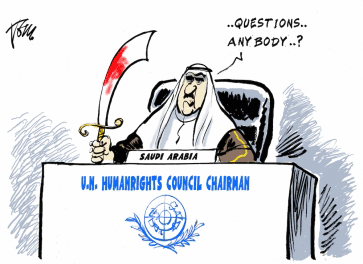 Khashoggi’s Killing Should Be a Nuclear Red Flag, The Saudis can’t be trusted to enrich uranium and reprocess spent fuel. WSJ, By Jamie Fly and Henry Sokolski,Oct. 28, 2018 If the Saudi government’s prevarications about Jamal Khashoggi’s murder teach us anything, it should be that there are limits to how far the U.S. can trust Riyadh. In particular, America shouldn’t trust Saudi Arabia with nuclear technology………. Khashoggi’s Killing Should Be a Nuclear Red Flag, The Saudis can’t be trusted to enrich uranium and reprocess spent fuel. WSJ, By Jamie Fly and Henry Sokolski,Oct. 28, 2018 If the Saudi government’s prevarications about Jamal Khashoggi’s murder teach us anything, it should be that there are limits to how far the U.S. can trust Riyadh. In particular, America shouldn’t trust Saudi Arabia with nuclear technology……….
the risk of regime change if there is nuclear power in Saudi Arabia. Nuclear reactors operate for 40 years or more and are far more dangerous than any conventional arms sales. In the 1970s, the U.S. considered selling the shah of Iran 23 reactors. That would have been a colossal mistake. Saudi officials, including Crown Prince Mohammed bin Salman, have publicly threatened to violate the Kingdom’s Nuclear Nonproliferation Treaty commitment not to acquire nuclear weapons if they believe Iran is acquiring them. The U.S. has never negotiated a nuclear cooperation agreement with a country threatening to get nuclear weapons. The United Arab Emirates, a Saudi neighbor and ally, agreed to allow intrusive international nuclear inspections and to forgo enriching uranium and reprocessing spent fuel as part of its 2009 nuclear cooperation agreement with Washington. Riyadh has refused to make such pledges. Enriching and reprocessing could bring Riyadh within weeks of making bombs. It is unclear if the administration is intent on pressing the Saudis on this point…….. After Saudi Arabia’s kidnapping last year of Lebanese Prime Minister Saad Hariri, its bungling of the war in Yemen, its erratic diplomatic moves against Canada, its continued jailing of human-rights activists, and now the killing of Khashoggi, Washington must demand more. This regime can’t be trusted with nuclear technology. Concluding a nuclear cooperation agreement to Riyadh’s liking would undermine the Trump administration’s effort to reverse the nuclear concessions President Obama made to Iran and set a dangerous precedent in the region. Any negotiations regarding a U.S.-Saudi nuclear cooperation agreement should be halted. If the Trump administration refuses to do this, Congress should make clear, as part of its broader response to the Khashoggi killing, that any agreement submitted for review will be blocked. This episode should serve as a reminder that unreliable proxies are no substitute for American leadership. A Reaganesque approach to Iran requires the fortitude to stand up for what is right, be it on nonproliferation or human rights, whether it involves friend or foe. Mr. Fly is a senior fellow of the German Marshall Fund of the United States. Mr. Sokolski is executive director of the Nonproliferation Policy Education Center and author of “Underestimated: Our Not So Peaceful Nuclear Future.” https://www.wsj.com/articles/khashoggis-killing-should-be-a-nuclear-red-flag-1540753005
|
Nuclear power lobbyists for Saudi Arabia finding it (a bit) tough following Jamal Khashoggi ‘s murder

 Saudi’s Lobbyists Feel Heat of Khashoggi Murder, Bloomberg By Kathleen Hunter, October 26, 2018 It’s not just Donald Trump who has cultivated a cozy relationship with Riyadh. Saudi Arabia has been a cash cow for Washington’s influence industry.
Over the past decade, D.C.’s lobbyists have raked in $76.9 million advocating for the Saudis on everything from nuclear power to fending off legislation that would leave the kingdom liable in lawsuits filed by family members of victims in the Sept. 11 terrorist attacks, Ben Brody, Naomi Nix and Bill Allison report.
That lucrative business is now facing its biggest test in years as the killing of U.S.-based journalist Jamal Khashoggi inside the Saudi consulate in Istanbul draws worldwide criticism. ….https://www.bloomberg.com/news/articles/2018-10-26/saudi-lobbyists-feel-heat-of-khashoggi-murder-balance-of-power?
Turkish President Recep Tayyip Erdogan to reveal evidence of Khashoggi murder “in all its nakedness.”
 World Awaits ‘Naked’ Truth on Saudi Killing https://www.bloomberg.com/news/articles/2018-10-22/world-awaits-naked-truth-on-saudi-killing, By Glen Carey, October 22, 2018, If Saudi leaders expected a reprieve from their account of how journalist and critic Jamal Khashoggi was killed in their Istanbul consulate, they’re likely to be sorely disappointed.
While President Donald Trump, a steadfast Saudi ally, defended de facto ruler Crown Prince Mohammed bin Salman, he said the explanation had been marked by “deception and lies.’’ Bipartisan members of the U.S. Congress said it lacked credibility. France demanded more information, while Germany suspended arms sales.
Even Saudi Foreign Minister Adel al-Jubeir called Riyadh’s attempt to cover up the murder “a tremendous mistake,” though he stuck to the government’s line that Khashoggi, a Washington Post columnist, died after “discussions” turned violent.
Western leaders are balancing concerns about his death with their strategic interests. Treasury Secretary Steven Mnuchin said the U.S. will continue its relationship with the world’s largest oil supplier, a major weapons buyer, while trying to “get to the bottom of what the facts are.”
Now the focus shifts to Turkish President Recep Tayyip Erdogan, who’s promised to reveal tomorrow what happened to Khashoggi “in all its nakedness.” If he provides credible evidence that differs from the kingdom’s description, pressure to hold Saudi Arabia’s senior leadership accountable will intensify.
Jobs Are No Excuse for Arming a Murderous Regime
 Portside, October 16, 2018 LOBE LOG Regardless of what ultimately happened to Khashoggi, continuing U.S. arms sales and military support to Saudi Arabia under current circumstances is immoral. Jobs should not be an excuse to arm a murderous regime. If indeed the Saudi government is indeed behind the murder of journalist Jamal Khashoggi there should be consequences—political, military, economic, and reputational.
Unfortunately, President Trump begs to differ. His reaction to questions about whether the United States would cut off arms sales to Saudi Arabia if Riyadh is proven to be behind the killing of Khashoggi has been to say that he does not want to jeopardize the alleged $110 billion in arms deals his administration has struck with the Saudi regime, and the U.S. jobs that come with them.
In his recent interview with CBS 60 Minutes, Trump specifically cites the needs of U.S. weapons manufacturers as reasons to keep U.S. arms flowing to the Saudi regime, even if it ends up being responsible for the murder of Khashoggi:
They are ordering military equipment. Everybody in the world wanted that order. Russia wanted it, China wanted it, we wanted it…I tell you what I don’t wanna do. Boeing, Lockheed, Raytheon, all these [companies]…I don’t wanna hurt jobs. I don’t wanna lose an order like that.
Trump tells CBS’s Leslie Stahl that “there are other ways of punishing” Saudi Arabia without cutting of U.S. arms sales, but he fails to specify what those might be.
Regardless of what ultimately happened to Khashoggi, continuing U.S. arms sales and military support to Saudi Arabia under current circumstances is immoral. Jobs should not be an excuse to arm a murderous regime that not only may be behind the assassination of a U.S. resident and respected commentator but is responsible for thousands of civilian casualties in its three-and-one-half-year military intervention in Yemen—the majority killed with U.S-supplied bombs and combat aircraft and U.S. refueling and targeting assistance.
The Khashoggi case merely underscores the approach of Saudi Crown Prince Mohammed bin Salman, the power behind the throne in Riyadh who is the most ruthless and reckless leader in Saudi history……https://portside.org/2018-10-16/jobs-are-no-excuse-arming-murderous-regime,
Trump’s financial benefit from Saudi Arabia – shaping USA’s foreign policy
Saudi Arabia is putting money in Trump’s pocket. Is that shaping U.S. policy? https://www.washingtonpost.com/blogs/plum-line/wp/2018/10/16/saudi-arabia-is-putting-money-in-trumps-pocket-is-that-shaping-u-s-policy/?noredirect=on&utm_term=.434cc7237930, By Paul Waldman,October 16
As hard as it is to resist writing about the fact that on Tuesday the president of the United States called the adult film actress to whom he paid hush money “Horseface,” I want to focus on a different aspect of this presidency that we’re seeing play out right now.
.As the apparent murder of Saudi journalist and Post contributor Jamal Khashoggi complicates our relations with Saudi Arabia, we have to ask what the implications are of having a fully transactional presidency, one not just built on “deals” but where policy is determined by what is financially beneficial to the president.
We should begin by reminding ourselves that as awful as Khashoggi’s apparent murder is, it’s only the latest in a long list of Saudi abuses that administrations both Democratic and Republican have chosen to overlook for decades. The country is a cruel dictatorship that embodies none of the values we as a nation hold dear, such as democracy, freedom of expression, freedom of the press and freedom of religion. But we decided long ago that since the Saudis have a great deal of oil and they provide us with a strategic ally in the Middle East, we’ll overlook all that.
There is something unsettling about the fact that Saudi intervention in Yemen’s civil war, in which they have reportedly killed thousands of civilians, has received steady U.S. support, while the murder of a single journalist threatens to upend the relationship between the two countries.
Or so you might think. But here’s the reality: This will blow over, not only because of the complex relationship between the two countries, but also because everything in foreign policy is personal with President Trump, and he likes the Saudis.
And why does he like them so much? Because they pay him.
This is not something Trump has been shy about saying. “Saudi Arabia, I get along with all of them. They buy apartments from me. They spend $40 million, $50 million,” he said at a rally in Alabama in 2015. “Am I supposed to dislike them? I like them very much.”
Trump says so many shocking things that it’s sometimes easy to slide right past the most appalling ones, but read that again. Here you have a candidate for president of the United States saying that he is favorably disposed toward a foreign country because they have given him millions of dollars, and all but promising to shape American foreign policy in their favor for that very reason.
“Am I supposed to dislike them?” he asks. How could I possibly dislike them when they pay me?
We should note that it’s more than just apartments. Trump has sold many properties to Saudis, and Saudis have invested in Trump projects. And as David Fahrenthold and Jonathan O’Connell report:
Business from Saudi-connected customers continued to be important after Trump won the presidency. Saudi lobbyists spent $270,000 last year to reserve rooms at Trump’s hotel in Washington. Just this year, Trump’s hotels in New York and Chicago reported significant upticks in bookings from Saudi visitors.
This is precisely the reason the framers of the Constitution added a provision saying that neither the president nor other officials could “accept of any present, Emolument, Office, or Title, of any kind whatever, from any King, Prince, or foreign State.” If a foreign country is putting money in the president’s pocket on an ongoing basis, how in the world can we trust that the decisions he makes will be based on the best interests of the United States and not on his bank account?
This is of more concern with Trump than with any other president in American history. His entire life has been devoted to the accumulation of wealth, as though there were no other goal anyone should consider seeking (“My whole life I’ve been greedy, greedy, greedy. I’ve grabbed all the money I could get. I’m so greedy,” he has said). He made sure that upon assuming office his businesses would continue to operate and continue to provide avenues for those wishing to further enrich him to do so. And he refuses to release his tax returns, so we have no idea exactly how much money he’s getting and from whom.
But Tuesday, Trump tweeted this:
For the record, I have no financial interests in Saudi Arabia (or Russia, for that matter). Any suggestion that I have is just more FAKE NEWS (of which there is plenty)!
This is the same claim Trump has made with regard to Russia, and it’s the same dodge. The point isn’t whether Trump has interests in Saudi Arabia, it’s whether Saudi Arabia has interests in him. And just as is the case with Russia, they do.
If you’re the Saudis, the nice thing about Trump is that he lacks any subtlety whatsoever, so you don’t have to wonder how to approach him. He has said explicitly that the way to win his favor is to give him money. He has established means for you to do so — buying Trump properties and staying in Trump hotels. And with his combination of narcissism and insecurity, if you invite him to your country and give him a gold medal, he’ll forever be your friend.
Every president has to balance the desire to honor U.S. values with more crass interests such as whether a country will buy weapons from us, which Trump also cited as a reason we shouldn’t punish Saudi Arabia for Jamal Khashoggi’s murder (even though they aren’t actually buying what Trump claims). But only Trump apparently gets direct and significant payoffs from other countries, and only Trump is so clear that if you pay him he’ll do what you want. That may not have changed the American stance toward Saudi Arabia too much yet, but we have no idea what’s to come.
1 This Month

of the week – Shut Down Drone Warfare!


Tell the Ukrainian Government to Drop Prosecution of Peace Activist Yurii Sheliazhenko

Petition to revoke the licensing of the Near Surface Nuclear Disposal Facility (NSDF) at Chalk River. https://www.ourcommons.ca/petitions/en/Petition/Details?Petition=e-7247
To see nuclear-related stories in greater depth and intensity – go to https://nuclearinformation.wordpress.com
-
Archives
- March 2026 (244)
- February 2026 (268)
- January 2026 (308)
- December 2025 (358)
- November 2025 (359)
- October 2025 (376)
- September 2025 (257)
- August 2025 (319)
- July 2025 (230)
- June 2025 (348)
- May 2025 (261)
- April 2025 (305)
-
Categories
- 1
- 1 NUCLEAR ISSUES
- business and costs
- climate change
- culture and arts
- ENERGY
- environment
- health
- history
- indigenous issues
- Legal
- marketing of nuclear
- media
- opposition to nuclear
- PERSONAL STORIES
- politics
- politics international
- Religion and ethics
- safety
- secrets,lies and civil liberties
- spinbuster
- technology
- Uranium
- wastes
- weapons and war
- Women
- 2 WORLD
- ACTION
- AFRICA
- Atrocities
- AUSTRALIA
- Christina's notes
- Christina's themes
- culture and arts
- Events
- Fuk 2022
- Fuk 2023
- Fukushima 2017
- Fukushima 2018
- fukushima 2019
- Fukushima 2020
- Fukushima 2021
- general
- global warming
- Humour (God we need it)
- Nuclear
- RARE EARTHS
- Reference
- resources – print
- Resources -audiovicual
- Weekly Newsletter
- World
- World Nuclear
- YouTube
-
RSS
Entries RSS
Comments RSS
 nuclear-news