Democratic presidential candidate Tulsi Gabbard slams decision to sell Saudi Arabia nuclear weapons tech
 ‘How does this serve US interests?’ Gabbard slams decision to sell Saudi Arabia nuclear weapons tech https://www.rt.com/usa/455279-gabbard-saudi-arabia-extremism-isis/ 2 Apr, 2019 Tulsi Gabbard has slammed the US for allowing firms to sell Saudi Arabia nuclear tech despite its history of exporting extremism which inspires Islamic State (IS, formerly ISIS) and Al-Qaeda, which she says the Kingdom supports.
The Hawaiian congresswoman and Democratic presidential candidate took aim at the Kingdom’s history of extremism in a Twitter video that criticized Energy Secretary Rick Perry’s secret authorizations, to six US companies, allowing for the sale of nuclear power technology and assistance to Saudi Arabia, as Reuters revealed last week. Gabbard said the move is “both mind-blowing and inexplicable.”
Saudi Arabia is the “primary exporter of jihadist ideology, Wahhabi Salafist ideology that is the motivation and inspiration for terrorist groups like ISIS and al Qaeda – groups that the Saudis both directly and indirectly support,” Gabbard said.
The kingdom has been tied to Al-Qaeda and extremism in the past, with 15 of the 19 9/11 hijackers coming from Saudi Arabia, according to the CIA. In 2015, one of the alleged hijackers, Zacarias Moussaoui, claimed several members of the Saudi royal family had been listed as Al-Qaeda donors in the database he worked on under orders of Osama bin Laden, US media reported.
WikiLeaks cables from the US State Department from 2009 revealed“donors in Saudi Arabia constitute the most significant source of funding to Sunni terrorist groups worldwide.” In a 2014 email, published by WikiLeaks, then-Secretary of State Hillary Clinton said Saudi Arabia was “providing clandestine financial and logistic support to ISIL and other radical Sunni groups in the region.” It has also supplied weapons to IS in Syria.
Saudi Arabia is reportedly planning to create at least two nuclear power plants, but many are concerned that’s a precursor to developing nuclear weapons, which would further destabilize the region. It was also reported, last year, that Israel was selling Saudi Arabia nuclear secrets
Tensions in volatile Middle East region, as Saudi nuclear program accelerates
New satellite imagery shows that construction on an experimental reactor is making “expeditious” progress — just three months after the Kingdom announced plans to build it, according to former director for nuclear inspections at the International Atomic Energy Agency (IAEA), Robert Kelley.
Kelley estimated that the reactor could be completed in “nine months to a year.”
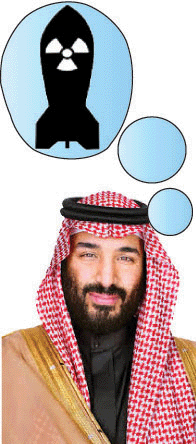
The Kingdom has been open about its nuclear program with the IAEA, which sent a team to Saudi Arabia last July to check on building plans. It has repeatedly pledged that the program is peaceful. But Crown Prince Mohammed bin Salman said last year that “without a doubt if Iran developed a nuclear bomb, we will follow suit as soon as possible.”
Also raising concern among industry experts and some in Congress is the Saudi insistence that it should be allowed to produce its own nuclear fuel, rather than import it under strict conditions.
In an interview last year, Saudi Energy Minister Khalid al Falih said: “It’s not natural for us to bring enriched uranium from a foreign country to fuel our reactors,” citing the country’s uranium reserves.
Vision 2030
Saudi Arabia went public with its nuclear ambitions nine years ago, but the plans have gone into overdrive as part of the Crown Prince’s “Vision 2030” — a strategy to wean Saudi Arabia off its reliance on oil and diversify both the economy and its energy mix……….
The IAEA sent a team to Saudi Arabia in July last year to review the development of its nuclear power infrastructure. That mission concluded that the Kingdom is “well placed to finalize its plans for construction of its first nuclear power plant” through partnerships with countries that have nuclear power industries.
In a visit to Riyadh in January, Mikhail Chudakov, IAEA Deputy Director General, confirmed Saudi Arabia had “made significant progress in the development of its nuclear power infrastructure.”
But when the Saudis want to move to the next stage — fueling the reactor at King Abdulaziz City and any commercial plants — they will have to submit to more intrusive IAEA involvement.
“They’ve been exempt for 30 years since they signed a non-proliferation treaty,” said Kelley. “Now they’re going to have to make some serious paperwork and agree to inspections,” if they want to acquire nuclear fuel.
US concerns
Skepticism in the US Congress over whether Saudi Arabia can be a trusted partner has grown since the gruesome murder of journalist Jamal Khashoggi in Istanbul last year. That’s now manifested itself in critical scrutiny of the Saudi nuclear program — and especially whether the Trump Administration is doing enough to ensure non-proliferation…….
US concerns
Skepticism in the US Congress over whether Saudi Arabia can be a trusted partner has grown since the gruesome murder of journalist Jamal Khashoggi in Istanbul last year. That’s now manifested itself in critical scrutiny of the Saudi nuclear program — and especially whether the Trump Administration is doing enough to ensure non-proliferation.
Asked whether it was acceptable for Saudi Arabia to become a nuclear power, US Secretary of State Mike Pompeo was unequivocal in a TV interview on Friday.
“We will not permit that to happen. We will not permit that to happen anywhere in the world,” Pompeo told CBS. “The President understands the threat of proliferation. We will never write a $150 million check to the Saudis and hand them over the capacity to threaten Israel and the United States with nuclear weapons, never.”
A bipartisan resolution introduced in the Senate in February demanded that the use of any US nuclear power technology in Saudi Arabia must be accompanied by safeguards to ensure Saudi Arabia cannot enrich uranium or reprocess spent fuel.
“The last thing America should do is inadvertently help develop nuclear weapons for a bad actor on the world stage,” said Democratic Senator Jeff Merkley, one of the resolution’s sponsors………
Iran claims that the Trump Administration plans to sell Saudi Arabia nuclear technology without sufficient safeguards. “First a dismembered journalist; now illicit sale of nuclear technology to Saudi Arabia fully expose #USHypocrisy,” Foreign Minister Javad Zarif tweeted in February.
And in March, Ali Shamkhani, secretary of Iran’s Supreme National Security Council, accused unnamed regional states of developing “suspicious nuclear projects,” which would force Tehran to revise its defense strategy. Quoted by Iranian news agencies, Shamkhani said such plans would “force us to revise our strategy.”
Whatever Saudi Arabia’s energy strategy, and however sincere its pledge that it has no wish to develop nuclear weapons, the mere existence of a nuclear program is bound to inflame tensions across the Gulf. https://www.clickorlando.com/news/international/saudi-nuclear-program-accelerates-raising-tensions-in-volatile-region
Saudi Arabia resists IAEA’s inspection regime, as it completes its first nuclear reactor
 Saudi Arabia’s first nuclear reactor nearly finished, sparking fears over safeguards, Riyadh has so far resisted international watchdog’s requests to accept a strict inspection regime, Guardian, Julian Borger in Washington 4 Apr 2019
Saudi Arabia is within months of completing its first nuclear reactor, new satellite images show, but it has yet to show any readiness to abide by safeguards that would prevent it making a bomb.
The reactor site is in the King Abdulaziz city for science and technology on the outskirts of Riyadh. The site was identified by Robert Kelley, a former director for nuclear inspections at the International Atomic Energy Agency (IAEA), who said it was very small 30-kilowatt research reactor, not far from completion.
“I would guess they could have it all done, with the roof in place and the electricity turned on, within a year,” said Kelley, who worked for more than three decades in research and engineering in the US nuclear weapons complex………
Before inserting nuclear fuel into the reactor, Saudi Arabia would have to implement a comprehensive set of rules and procedures, including IAEA inspections, designed to ensure no fissile material was diverted for use in weapons – something it has so far avoided
The reactor has been designed by an Argentinian state-owned company, Invap SE……..Saudi Arabia joined the Non-Proliferation Treaty (NPT) in 1988 but signed a comprehensive safeguards agreement with the IAEA only in 2005, and at the same time exempted itself from regular inspections, by signing a “small quantities protocol” (SQP), designed for countries with negligible quantities of nuclear material.
Largely because of controversy over Riyadh being shielded from scrutiny under these rules, the IAEA made the SQP more rigorous, but the Saudis resisted making changes…….. https://amp.theguardian.com/world/2019/apr/04/saudi-arabias-first-nuclear-reactor-nearly-finished-sparking-fears-over-safeguards?CMP=share_btn_tw&__twitter_impression=tru
IAEA head UN nuclear inspector asks Saudi Arabia to agree to safeguards on nuclear material
But Yukiya Amano, director general of the International Atomic Energy Agency, said there was nothing secret about the reactor and that Saudi Arabia informed the Vienna-based UN body about its plans in 2014.
He said the IAEA has encouraged Saudi Arabia to sign a comprehensive safeguards agreement, under which the agency ensures that nuclear material is not being diverted to weapons use……… https://www.france24.com/en/20190405-iaea-asks-saudis-safeguards-first-nuclear-reactor
Senators from both parties want details on USA nuclear co-operation with Daudi Arabia
 US Senators Seek Details on Nuclear Power Cooperation with Saudi Arabia VOA News, https://www.voanews.com/a/us-senators-seek-details-on-nuclear-power-cooperation-with-saudi-arabia-/4859672.html 3 Apr 19, U.S. senators from both parties on Tuesday asked Energy Secretary Rick Perry for details about recent approvals for companies to share nuclear energy information with Saudi Arabia, with the lawmakers expressing concern about possible development of atomic weapons.
Saudi Arabia has engaged in “many deeply troubling actions and statements that have provoked alarm in Congress,” Senators Bob Menendez, a Democrat, and Marco Rubio, a Republican, told Perry in a letter, a copy of which was seen by Reuters.
The senators said Congress was beginning to re-evaluate the U.S.-Saudi relationship, and they believe Washington should not be providing nuclear technology or information to Saudi Arabia now.
The Trump administration has been quietly negotiating a deal that would potentially help Saudi Arabia build two reactors.
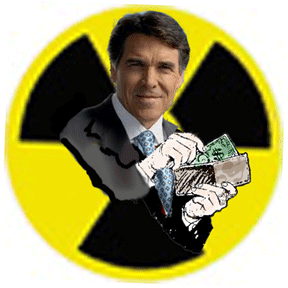
Last week news reports revealed that since November 2017, Perry has authorized so-called Part 810 approvals allowing U.S. companies to share sensitive nuclear information with the kingdom. The approvals were kept from the public and from Congress.
The senators asked Perry to provide them by April 10 with the names of the companies that got the 810 approvals, what was in the authorizations, and why the companies asked that the approvals be kept secret. U.S. Representative Brad Sherman, a Democrat, also asked the Energy Department in a separate letter what was in the approvals.
While 810 agreements are routine, the Obama administration made them available for the public to read at Energy Department headquarters. Lawmakers say the department is legally required to inform Congress about the approvals.
Perry approved the seven recent authorizations as the administration has tried to hash out nonproliferation standards with Saudi Arabia. Such a pact, known as a 123 agreement, would have to be agreed before U.S. companies can share physical exports of materials and equipment to build reactors.
The kingdom has resisted standards on reprocessing spent fuel and enriching uranium, two potential paths to making nuclear weapons.
The United States has been competing with South Korea, France, Russia and China on a potential deal to help build reactors in Saudi Arabia. The kingdom is expected to announce the winner this year.
Lawmakers from both parties have been concerned about Saudi Arabia’s bombing campaigns in Yemen, which is on the brink of famine, and the killing of journalist Jamal Khashoggi, a U.S. resident, last October in the Saudi consulate in Istanbul.
Concern in Congress grew last year after the kingdom’s Crown Prince Mohammed bin Salman told CBS that “Saudi Arabia does not want to acquire any nuclear bomb, but without a doubt if Iran developed a nuclear bomb, we will follow suit as soon as possible.”
Perry has said the 810 approvals were kept from the public for corporate proprietary reasons……….
At another Senate hearing, the five members of the Nuclear Regulatory Commission, including Chairman Kristine Svinicki, would not say whether the NRC raised any concerns over the 810 approvals in a required consultation with the Energy Department.
Svinicki said the NRC’s consulting role on the approvals is narrow and delegated to staff.
Senator Chris Van Hollen, a Democrat who asked the question of the NRC at the hearing, told Reuters in an interview that the commissioners’ lack of knowledge about the approvals was “stunning.”
“It’s kind of scary because we do rely on them to provide input into this process and not a single commissioner knew anything about what input they may or may not have provided.” https://www.voanews.com/a/us-senators-seek-details-on-nuclear-power-cooperation-with-saudi-arabia-/4859672.html
Trump administration and Israel helping Saudi Arabia towards getting nuclear weapons
Concerns over Saudi plan to build nuclear plants after US deal | Al Jazeera English
Trump Admin Complementing Israeli Effort to Give Nuclear Weapons to Saudi Arabia https://www.mintpressnews.com/israel-saudi-arabia-nuclear-weapons-2/256761/
Already seven of the 10 countries in the world with the highest military budgets are in the Middle East. The development of nuclear weapons in Saudi Arabia has many speculating that it could mark the beginning of an even more dangerous era for the war-torn region. March 29th, 2019, By Alan Macleod
WASHINGTON — U.S. President Donald Trump’s energy secretary, Rick Perry, has secretly approved the sale of nuclear power technology and assistance to Saudi Arabia, Reuters revealed this week. Saudi Arabia is reportedly attempting to construct at least two nuclear power plants as part of its effort to diversify its energy sector and its economy as a whole. As part of this plan it has accepted bids from Russia, South Korea and the U.S. for the lucrative contract. Perry’s approval is known as a Part 810 authorization, which allows energy companies to begin the process of planning and starting preliminary work in anticipation of the closing of a formal deal in the future.
While the Saudi proposals are presented as civilian and do not mention nuclear weaponry, U.S. approval and sale of nuclear technology has been seen by many as a prelude to the development of a Saudi nuclear weapon, which could potentially spark anuclear arms race in the region. Riyadh has long coveted atomic weaponry and has considered developing its own in its quest to maintain military dominance in the region. “If Iran develops a nuclear weapon, that will be unacceptable to us and we will have to follow suit” Prince Turki al-Faisal, former Saudi ambassador to the United States, told the Guardian in 2011, noting that the kingdom may feel “compelled” to pursue the option in the future, if tensions with Iran remain high.
In reality, Iran does not have, nor is it trying to acquire, nuclear weapons technology (something quietly conceded by both the Israeli intelligence agency Mossad and the CIA), and has lived up to its commitments to the International Atomic Energy Agency. However, any such move from Saudi Arabia might provoke a response in kind from Iran, its chief adversary in the region and would sound a death knell for the hopes of the establishment of a nuclear weapons-free zone in the Middle East. The United States has long accused Iran of trying to develop nuclear weapons technology and has placed sanctions on the country.
The Israeli connection
An important nuclear player in the region is Israel, one of the few nations in the world that has not signed the nuclear non-proliferation treaty. Israel is estimated to possess 100 to 200 nuclear weapons and has taken a strongly adversarial position towards Iran. In 2015, Prime Minister Benjamin Netanyahu appeared before a joint session of Congress with a cartoon image of a bomb to give a speech denouncing Iran and warning of an Iranian military threat. Israel has been key in pushing the United States into a more confrontational stance on Iran through a continuous public-relations drive to present the country as a menace.
Last year Mint Press News reported that the Israeli government had begun selling Saudi Arabia nuclear weapons secrets. Ami Dor-on, a senior official and nuclear specialist at the organization Israel’s Homeland Security, blew the whistle on the clandestine practice. The Israeli actions were the latest evidence of a growing cooperation between the two nations. However, the prospect of a nuclear Saudi Arabia has many concerned.
The threat of a nuclear Saudi Arabia
For some time, Saudi Arabia has been making its presence felt in the Middle East, leading to the destabilization of the entire region. In 2011 Saudi tanks rolled into Bahrain to crush the Arab Spring uprising in the island country, and it continues to be a primary driver of the war in Yemen, labeled by some as genocide. At least 22 million people are in need of humanitarian assistance as a result of the Saudi bombardment of the country.
Riyadh also continues to fund various jihadist groups in Syria and is one of the largest financiers of terrorism in the world. Before his election, Trump claimed Saudi Arabia was behind the 9/11 attacks and the White House more recently insisted it would hold the kingdom responsible for the murder of Washington Post columnist Jamal Khashoggi. However, as with unabated American support for the Saudi war in Yemen, these proclamations have fallen short.
The Saudi armed services are already a formidable force. Saudi Arabia spends the third most of any country in the world on the military, behind only the U.S. and China, according to the Stockholm International Peace Research Institute. The Saudi military’s size is estimated at nearly a quarter-million active personnel, who are equipped with the most advanced weapons available.
Already seven of the 10 countries in the world with the highest military burden are in the Middle East. The development of nuclear weapons in Saudi Arabia has many speculating that it could mark the beginning of an even more dangerous era for the war-torn region.
Top Photo | U.S. President Donald Trump boards Air Force One for Israe from Saudi Arabial, the next stop in his international tour, at King Khalid International Airport, Monday, May 22, 2017, in Riyadh. (AP/Evan Vucci)
Alan MacLeod is an academic and writer for Fairness and Accuracy in Reporting. His book, Bad News From Venezuela: Twenty Years of Fake News and Misreporting was published in April.
U.S. Energy Secretary, Rick Perry, approved 6 secret nuclear technology companies’ sales to Saudi Arabia
|
U.S. approved secret nuclear power work for Saudi Arabia
The Trump administration has quietly pursued a wider deal on sharing U.S. nuclear power technology with Saudi Arabia, which aims to build at least two nuclear power plants. Several countries including the United States, South Korea and Russia are in competition for that deal, and the winners are expected to be announced later this year by Saudi Arabia. Perry’s approvals, known as Part 810 authorizations, allow companies to do preliminary work on nuclear power ahead of any deal but not ship equipment that would go into a plant, a source with knowledge of the agreements said on condition of anonymity. The approvals were first reported by the Daily Beast. The Department of Energy’s National Nuclear Security Administration (NNSA) said in the document that the companies had requested that the Trump administration keep the approvals secret. “In this case, each of the companies which received a specific authorization for (Saudi Arabia) have provided us written request that their authorization be withheld from public release,” the NNSA said in the document. In the past, the Energy Department made previous Part 810 authorizations available for the public to read at its headquarters. …….. Last month, Democratic House members alleged in a report that top White House aides ignored warnings they could be breaking the law as they worked with former U.S. officials in a group called IP3 International to advance a multibillion-dollar plan to build nuclear reactors in the Middle East, including Saudi Arabia. https://www.reuters.com/article/us-usa-saudi-nuclear/us-approved-secret-nuclear-power-work-for-saudi-arabia-idUSKCN1R82MG |
|
USA Government Accountability Office to probe Saudi nuclear power talks
Congressional watchdog to probe Saudi nuclear power talksA congressional watchdog has agreed to investigate the Trump administration’s discussions about sharing nuclear technology with Saudi Arabia, according to people familiar with the matter. The Government Accountability Office, a non-partisan agency that conducts investigations on behalf of Congress, is in talks with lawmakers over the scope of a probe into the nuclear power talks that the Trump administration has held with Saudi Arabia. One person familiar with the discussions between the GAO and lawmakers said they were in their “initial phase”. In February, lawmakers accused White House officials of pushing a plan to sell US nuclear power technology to Saudi Arabia in potential defiance of legal restrictions. A report prepared for the oversight committee of the Democratic-led House of Representatives said Trump aides were attempting “to rush the transfer of highly sensitive US nuclear technology to Saudi Arabia”, which may have violated the Atomic Energy Act.
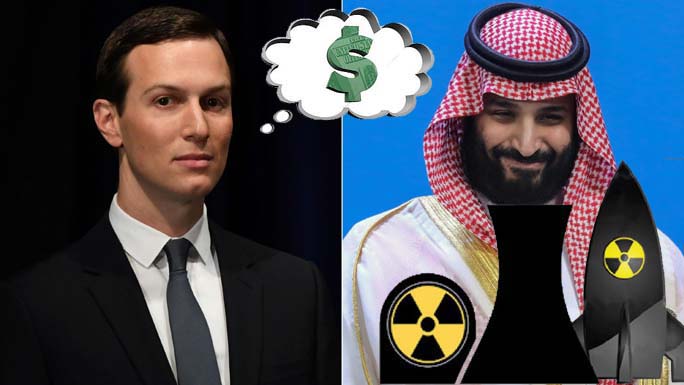
Trump’s endeavour to nuclearise Saudi Arabia is driven by family business interests and tacitly approved by Israel. Aljazeera, by Hamid Dabashi, 8 Mar 2019 Like chronic indigestion that refuses to go away, presidential son-in-law Jared Kushner is back causing much discomfort to the general public.
International Atomic Agency would require Saudi Arabia to have the same nuclear safeguards as Iran has
Before Saudi Arabia Goes Nuclear, It May Have to Follow Iran’s Lead, Bloomberg, By Jonathan Tirone March 7, 2019,
- Kingdom has yet to clinch enhanced atomic monitoring deal
- World powers are meeting with Iran on Wednesday in Vienna.
“………Focus on Saudi Arabia’s nuclear program has risen in the last month after the U.S. Congress opened an investigation into the potentially illegal transfer of sensitive technologies to the kingdom. This week the International Atomic Energy Agency, responsible for verifying that countries don’t divert material for weapons, weighed in on what its inspectors need before the kingdom can start generating nuclear power.
Focus on Saudi Arabia’s nuclear program has risen in the last month after the U.S. Congress opened an investigation into the potentially illegal transfer of sensitive technologies to the kingdom. This week the International Atomic Energy Agency, responsible for verifying that countries don’t divert material for weapons, weighed in on what its inspectors need before the kingdom can start generating nuclear power.
Riyadh’s nuclear program is developing “based on an old text” of safeguard rules, even as it expects to complete its first research reactor this year and plans to tap uraniumreserves, according to IAEA Director General Yukiya Amano, who told journalists this week in Vienna that he’s “appealing to all countries to rescind” those old ways of doing business.
“We’re encouraging all countries to conclude and implement an additional protocol and that includes Saudi Arabia,” said Amano, who’s also in charge of enforcing the 2015 nuclear deal struck between Iran and world powers. The Japanese career diplomat has called the set of rules established by that accord, which U.S. President Donald Trump withdrew from in May, as “the most rigorous monitoring mechanism ever negotiated.”……
the IAEA comments could strike a precautionary note among vendors lining up to service the kingdom’s nuclear ambitions. Receiving the imprimatur of IAEA inspectors, who account for gram-level quantities of nuclear material worldwide, is a precondition for receiving technologies and fuel. Without reaching a new understanding with monitors, Saudi plans for 3.2 gigawatts of atomic power by the end next decade could flounder. …….
Maintaining that level of IAEA access to Iran’s nuclear program is the reason that China, France, Germany, Russia and the U.K. continue to defy U.S. calls to abandon the 2015 deal and reimpose sanctions. Diplomats from those countries convened Wednesday in Vienna in their first meeting since the European Union established a trade channel to skirt U.S. threats.
Snap Inspections in Iran
IAEA complementary access to sites rose under agreement with world powers……https://www.bloomberg.com/news/articles/2019-03-06/before-saudi-goes-nuclear-it-may-have-to-follow-iran-s-lead
Despite U.S. Congress’s concerns, Trump is still pushing for sale of nuclear technology to Saudi Arabia
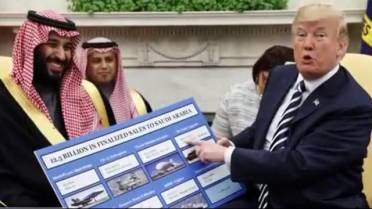 Team Trump Keeps Pushing Deal to Send Nuclear Tech to Saudis
Congress raised ‘grave concerns’ about the Trump administration’s past attempts to send nuclear technology to the Saudis. But Team Trump isn’t done trying. The Daily Beast, Erin Banco, Betsy Woodruff 03.04.19 The Trump administration is still actively working to make a deal to send U.S. nuclear technology to Saudi Arabia, according to two U.S. officials and two professional staffers at federal agencies with direct knowledge of those conversations. American energy businesses are still hoping to cash in on Riyadh’s push for energy diversification,
Trump’s son-in-law, Jared Kushner, helping Saudi Crown Prince towards getting nuclear weapons?
There are too many unanswered questions about the White House’s role in advancing Saudi ambitions. By Nicholas Kristof, March 2, 2019
Jared Kushner slipped quietly into Saudi Arabia this week for a meeting with Crown Prince Mohammed bin Salman, so the question I’m trying to get the White House to answer is this: Did they discuss American help for a Saudi nuclear program?
Of all the harebrained and unscrupulous dealings of the Trump administration in the last two years, one of the most shocking is a Trump plan to sell nuclear reactors to Saudi Arabia that could be used to make nuclear weapons.
Even as President Trump is trying to denuclearize North Korea and Iran, he may be helping to nuclearize Saudi Arabia. This is abominable policy tainted by a gargantuan conflict of interest involving Kushner.
Kushner’s family real estate business had been teetering because of a disastrously overpriced acquisition he made of a particular Manhattan property called 666 Fifth Avenue, but last August a company called Brookfield Asset Management rescued the Kushners by taking a 99-year lease of the troubled property — and paying the whole sum of about $1.1 billion up front.
Alarm bells should go off: Brookfield also owns Westinghouse Electric, the nuclear services business trying to sell reactors to Saudi Arabia.
Saudi swamp, meet American swamp.
It may be conflicts like these, along with even murkier ones, that led American intelligence officials to refuse a top-secret security clearance for Kushner. The Times reported Thursday that Trump overruled them to grant Kushner the clearance.
This nuclear reactor mess began around the time of Trump’s election, when a group of retired U.S. national security officials put together a plan to enrich themselves by selling nuclear power plants to Saudi Arabia. The officials included Michael Flynn, Trump’s national security adviser, and they initially developed a “plan for 40 nuclear power plants” in Saudi Arabia, according to a report from the House Oversight and Reform Committee. The plan is now to start with just a couple of plants.
As recently as Feb. 12, Trump met in the White House with backers of the project and was supportive, Reuters reported.
These are civilian nuclear power plants, and Saudi Arabia claims it wants them for electricity. But the Saudis insist on producing their own nuclear fuel, rather than buying it more cheaply abroad. Producing fuel is a standard way for rogue countries to divert fuel for secret nuclear weapons programs, and the Saudi resistance to safeguards against proliferation bolsters suspicions that the real goal is warheads.
Trump may be vigilant (destructively so) about Iran’s nuclear plants, but in the Saudi case his response seems to be: There’s money to be made! When Israeli Prime Minister Benjamin Netanyahu raised objections to the transfer last year, Axios reported, “Trump and his advisers told Netanyahu that, if the U.S. does not sell the Saudis nuclear reactors, other countries like Russia or France will.”
Trump seems to believe that the Saudis have us over a barrel: If we don’t help them with nuclear technology, someone else will. That misunderstands the U.S.-Saudi relationship. The Saudis depend on us for their security, and the blunt truth is that we hold all the cards in this relationship, not them.
Why on earth would America put Prince Mohammed on a path to acquiring nuclear weapons? He is already arguably the most destabilizing leader in an unstable region, for he has invaded Yemen, kidnapped Lebanon’s prime minister, started a feud with Qatar, and, according to American intelligence officials, ordered the murder of the Washington Post columnist Jamal Khashoggi.
The prince has also imprisoned and brutally tortured women’s rights activists, including one who I’m hoping will win the Nobel Peace Prize, Loujain al-Hathloul. As Representative Brad Sherman, a California Democrat, has noted, “A country that can’t be trusted with a bone saw shouldn’t be trusted with nuclear weapons.”
There’s another element of Trump’s Saudi policy that is simply repulsive: the fawning courtship of a foreign prince who has created in Yemen the world’s worst humanitarian crisis, murdered a journalist and tortured women’s rights activists. The White House genuflections are such that Prince Mohammed had a point when, according to The Intercept, he bragged that he had Kushner in his “pocket.”
No one knows whether Prince Muhammed will manage to succeed his father and become the next king, for there is opposition and the Saudi economic transformation he boasts of is running into difficulties. Trump and Kushner seem to be irresponsibly trying to boost the prince’s prospects, increasing the risk that an unstable hothead will mismanage the kingdom for the next 50 years. Perhaps with nuclear weapons.
USA officials worried about Saudi Arabia’s nuclear plans
Middle East Monitor 2nd March 2019 , Doubts have been raised about Saudi Arabia’s plans for its nuclearcapabilities, which it maintains are for peaceful purposes, to meet its
population’s energy needs. However a US body charged with looking in to
Saudi’s nuclear plans has warned that “many whistleblowers have warned
against conflicts of interest that could fall within the scope of the
Federal Criminal Law.” The Committee on Oversight and Reform issued the
warning after President Donald Trump announced he intended to sell
“sensitive nuclear technology” to Saudi Arabia to benefit US companies.
https://www.middleeastmonitor.com/20190302-us-officials-question-saudis-nuclear-plans/
Danger signs in Trump and co’s continuing push to sell nuclear technology to Saudi Arabia
Why proposals to sell nuclear reactors to Saudi Arabia raise red flags, The Conversation, Director, Middle East Nonproliferation Program, Middlebury, February 23, 2019 According to a congressional report, a group that includes former senior U.S. government officials is lobbying to sell nuclear power plants to Saudi Arabia. As an expert focusing on the Middle East and the spread of nuclear weapons, I believe these efforts raise important legal, economic and strategic concerns.
It is understandable that the Trump administration might want to support the U.S. nuclear industry, which is shrinking at home. However, the congressional report raised concerns that the group seeking to make the sale may have have sought to carry it out without going through the process required under U.S. law. Doing so could give Saudi Arabia U.S. nuclear technology without appropriate guarantees that it would not be used for nuclear weapons in the future.
A competitive global market
Exporting nuclear technology is lucrative, and many U.S. policymakers have long believed that it promotes U.S. foreign policy interests. However, the international market is shrinking, and competition between suppliers is stiff.
Private U.S. nuclear companies have trouble competing against state-supported international suppliers in Russia and China. These companies offer complete construction and operation packages with attractive financing options. Russia, for example, is willing to accept spent fuel from the reactor it supplies, relieving host countries of the need to manage nuclear waste. And China can offer lower construction costs.
Saudi Arabia declared in 2011 that it planned to spend over US$80 billion to construct 16 reactors, and U.S. companies want to provide them. Many U.S. officials see the decadeslong relationships involved in a nuclear sale as an opportunity to influence Riyadh’s nuclear future and preserve U.S. influence in the Saudi kingdom.
Why does Saudi Arabia want nuclear power?
With the world’s second-largest known petroleum reserves, abundant untapped supplies of natural gas and high potential for solar energy, why is Saudi Arabia shopping for nuclear power? Some of its motives are benign, but others are worrisome. ………..
US nuclear trade regulations
Under the U.S. Atomic Energy Act, before American companies can compete to export nuclear reactors to Saudi Arabia, Washington and Riyadh must conclude a nuclear cooperation agreement, and the U.S. government must submit it to Congress. Unless Congress adopts a joint resolution within 90 days disapproving the agreement, it is approved. The United States currently has 23 nuclear cooperation agreements in force, including Middle Eastern countries such as Egypt (approved in 1981), Turkey (2008) and the United Arab Emirates (2009).
The Atomic Energy Act requires countries seeking to purchase U.S. nuclear technology to make legally binding commitments that they will not use those materials and equipment for nuclear weapons, and to place them under International Atomic Energy Agency safeguards. It also mandates that the United States must approve any uranium enrichment or plutonium separation activities involving U.S. technologies and materials, in order to prevent countries from diverting them to weapons use.
American nuclear suppliers claim that these strict conditions and time-consuming legal requirements put them at a competitive disadvantage. But those conditions exist to prevent countries from misusing U.S. technology for nuclear weapons. I find it alarming that according to the House report, White House officials may have attempted to bypass or sidestep these conditions – potentially enriching themselves in the process.
According to the congressional report, within days of President Trump’s inauguration, senior U.S. officials were promoting an initiative to transfer nuclear technology to Saudi Arabia, without either concluding a nuclear cooperation agreement and submitting it to Congress or involving key government agencies, such as the Department of Energy or the Nuclear  Regulatory Commission. One key advocate for this so-called “Marshall Plan” for nuclear reactors in the Middle East was then-national security adviser Michael Flynn, who reportedly served as an adviser to a subsidiary of IP3, the firm that devised this plan, while he was advising Trump’s presidential campaign.
The promoters of the plan also reportedly proposed to sidestep U.S. sanctions against Russia by partnering with Russian companies – which impose less stringent restrictions on nuclear exports – to sell reactors to Saudi Arabia.
Flynn resigned soon afterward and now is cooperating with the investigation into Russian interference in the 2016 campaign. But IP3 access to the White House persists: According to press reports, President Trump met with representatives of U.S. industry, a meeting organized by IP3 to discuss nuclear exports to Saudi Arabia as recently as mid-February 2019……..https://theconversation.com/why-proposals-to-sell-nuclear-reactors-to-saudi-arabia-raise-red-flags-112276
Senior White House officials, retired generals and Trump’s close relatives continuing secret deal to sell nuclear technology to Saudi Arabia
 Guardian 23rd Feb 2019 The idea that the US might sell state-of-the-art nuclear technology to
Saudi Arabia, potentially enabling Crown Prince Mohammed bin Salman’s reckless regime to build nuclear weapons, sounds so far-fetched as to be almost grotesque.
After all the near-hysterical American and Israeli warnings about the risk of Iran, the Saudis’ arch-rival, acquiring the
bomb, surely even Donald Trump would balk at such breathtaking – and dangerous – hypocrisy? Apparently not.
According to a congressional inquiry, senior White House officials, retired generals and Trump’s close relatives and business cronies have been secretly pursuing a multibillion-dollar scheme to cut a nuclear deal with Riyadh.
The talks are said to be continuing, despite increased public scrutiny and legal advice that a technology transfer lacking strict conditions could contravene US law, breach international counter-proliferation safeguards, and fuel a
nuclear arms race.
https://www.theguardian.com/us-news/2019/feb/23/trump-cronies-secret-talks-nuclear-tech-saudi-arabia
1 This Month


31st January – Challenging the War Machine – a DECLASSIFIED UK SUMMIT


Website of the Week
Now until to February 10, 2026 Radioactive waste storage in France: the debate is finally open! How to participate?
-
Archives
- January 2026 (227)
- December 2025 (358)
- November 2025 (359)
- October 2025 (377)
- September 2025 (258)
- August 2025 (319)
- July 2025 (230)
- June 2025 (348)
- May 2025 (261)
- April 2025 (305)
- March 2025 (319)
- February 2025 (234)
-
Categories
- 1
- 1 NUCLEAR ISSUES
- business and costs
- climate change
- culture and arts
- ENERGY
- environment
- health
- history
- indigenous issues
- Legal
- marketing of nuclear
- media
- opposition to nuclear
- PERSONAL STORIES
- politics
- politics international
- Religion and ethics
- safety
- secrets,lies and civil liberties
- spinbuster
- technology
- Uranium
- wastes
- weapons and war
- Women
- 2 WORLD
- ACTION
- AFRICA
- Atrocities
- AUSTRALIA
- Christina's notes
- Christina's themes
- culture and arts
- Events
- Fuk 2022
- Fuk 2023
- Fukushima 2017
- Fukushima 2018
- fukushima 2019
- Fukushima 2020
- Fukushima 2021
- general
- global warming
- Humour (God we need it)
- Nuclear
- RARE EARTHS
- Reference
- resources – print
- Resources -audiovicual
- Weekly Newsletter
- World
- World Nuclear
- YouTube
-
RSS
Entries RSS
Comments RSS
 nuclear-news