U.S. Congress kept in the dark about government nuclear negotiations with Saudi Arabia
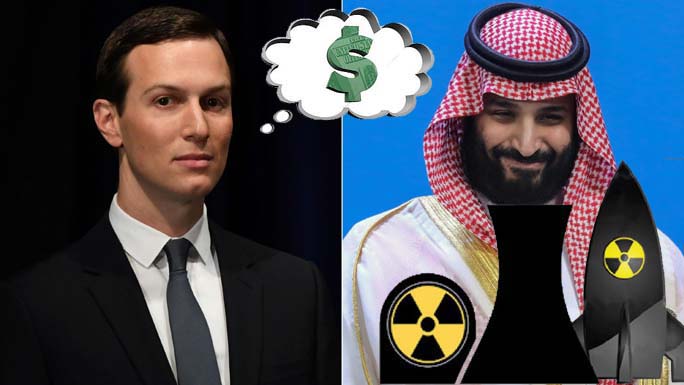 U.S. should keep Congress informed about nuclear talks with Saudis: GAO, https://www.reuters.com/article/us-usa-saudi-nuclearpower/us-should-keep-congress-informed-about-nuclear-talks-with-saudis-gao-idUSKBN22G2X Timothy Gardner
6 May 20, WASHINGTON (Reuters) – The U.S. Departments of State and Energy should commit to regular briefings to relevant committees in Congress on talks about nuclear power cooperation with Saudi Arabia, a congressional watchdog said in a report on Monday.
The Government Accountability Office, or GAO, report said Congress should consider amending the 1954 Atomic Energy Act, or AEA, to require the briefings for the House Committee on Foreign Affairs and the Senate Committee on Foreign Relations about negotiations on nuclear power sharing.
Lawmakers concerned about nonproliferation issues associated with nuclear power development had complained they were being kept in the dark about Trump administration talks with Saudi Arabia, many of which were led by former Energy Secretary Rick Perry. Concern grew after Crown Prince Mohammed bin Salman told CBS in 2018 that the kingdom did not want to acquire a nuclear bomb, but would do so if its rival Iran did so.
Some U.S. lawmakers want the United States to insist that Saudi Arabia agree to a so-called gold standard that restricts enrichment and reprocessing, potential pathways to making fissile material for nuclear weapons. The United States struck such an agreement with the United Arab Emirates in 2009. If Saudi Arabia develops nuclear power without the gold standard, the UAE would likely seek to be released from its agreement.
Senators Robert Menendez, a Democrat, and Marco Rubio, a Republican, had asked the GAO last year to review U.S. agency negotiations with Saudi Arabia on nuclear power, partially because they were concerned the Energy Department, not the State Department took the lead.
The senators said they would explore legislative changes recommended by the GAO. “Congress must reassert its critical role in reviewing nuclear cooperation agreements to ensure these agreements do not pose an unnecessary risk to the United States” they said.
The senators said they would explore legislative changes recommended by the GAO. “Congress must reassert its critical role in reviewing nuclear cooperation agreements to ensure these agreements do not pose an unnecessary risk to the United States” they said.
Saudi Arabia’s nuclear reactor will eventually lead to a Saudi nuclear weapon, and to its use
 Saudi Arabia’s Nuclear Reactor Nears Completion, Bringing Prospect Of Saudi WMD – OpEd https://www.eurasiareview.com/19042020-saudi-arabias-nuclear-reactor-nears-completion-bringing-prospect-of-saudi-wmd-oped/, April 19, 2020 Richard Silverstein Bloomberg reported last week that Saudi Arabia’s first nuclear reactor is nearing completion. It purchased the reactor from the Argentinian company, INVAP. But construction and installation of the plant has proven a huge payday for companies in several European countries and the U.S.
After the Obama administration hesitated to support the project, Trump offered full-throated support. One of the most attractive propositions in the deal for him was the lucrative contracts for U.S. businesses who participated.
The reactor is one of the crowning achievements of Crown Prince Mohammed bin Salman (aka “the Headchopper”) in his plan to “modernize” and “reform” the Saudi Arabian economy and military. Part of his ambition has been to project his country’s power and interests in more muscular fashion in the region. One of the ways he did this was to invade Yemen and rain terror upon the Houthi regions of that country killing 100,000 Yemenis and starving even more with a crippling blockade.
Saudi Arabia’s chief regional rival has been Iran. The purpose of the reactor is to send a loud and clear message that Iran’s nuclear ambitions will be met step-for-step by MBS. If Iran gets nuclear weapons, the Crown Prince wants to be right behind. The problem with this approach is that Iran, which has not made such a weapon though it could have if it wanted, has pursued a careful, calibrated approach. While the Saudis have pursued a reckless, aggressive approach in every operation they undertake to project their military power.
If they can decimate Yemen as they have, sinking themselves into a costly quagmire, why would anyone think they would use the products of their nuclear reactor in any more responsible way? Does MBS’s order to murder Jamal Khashoggi, cut his body into pieces and disappear it in acid, give anyone confidence that he wouldn’t be willing to do the same to entire countries he saw as implacable enemies?
Iran has never threatened to use nuclear weapons. Just the opposite, Ayatollah Khamenei has issued a fatwa declaring them forbidden. MBS, despite the fact that his country is a signatory to the Nuclear Non-Proliferation Pact, would never swear off such weapons. In fact, the moment that he has the ability to build and deliver WMD will likely be the day he threatens to use it.
Every party which collaborated with the Saudis in this project will have blood on their hands when (not if) that country becomes nuclear-capable.
Only a decade ago, the Obama administration supported a regional conference planned to promote a Middle East nuclear-free zone. Israel, with its 200 nuclear weapons, objected strenuously and the idea died of neglect. There will come a time in the near future when the world will regret this tragically-missed opportunity.
Despite boilerplate statements that the reactor is for civilian power and research purposes, mark my words: Saudi Arabia’s nuclear reactor will eventually lead to a Saudi nuclear weapon. That weapon will exponentially increase the likelihood it will be used someday. Again, not “if,” but “when.”
This article was published by Tikun Olam
Secretary of State Mike Pompeo explains Trump’s plan to kill off the Iran nuclear agreement
|
Pompeo Reveals Trump Admin’s Wide-Ranging Plan to Combat Iran, Deal Death Blow to Nuclear Deal, Washington Free Beacon,
In discussion with Free Beacon, secretary of state explains how he is galvanizing the globe against the Islamic Republic Republic, Adam Kredo – FEBRUARY 23, 2020, RIYADH, Saudi Arabia—The Trump administration is waging a multi-pronged effort to thwart Iran’s expansion across the Middle East, including efforts at the United Nations to ensure global sanctions come back into effect in what would mark a final death blow for the landmark nuclear deal, Secretary of State Mike Pompeo told the Washington Free Beacon in an exclusive and wide-ranging interview. In a one-on-one talk with the Free Beacon on Friday following high-level meetings with the Saudi royal family in Riyadh, Pompeo pulled the curtain back on the Trump administration’s years-long effort to combat Iran militarily and diplomatically…….. In the coming months, Pompeo said, he and the president will make a major decision about whether to petition the U.N. to invoke what is known as “snapback” on a set of international sanctions on Iran that were lifted as part of the Obama administration’s nuclear accord. Iran hawks in Congress have been pressing Pompeo and the administration to pursue this course of action for months, a message the secretary says he has received and is digging into. Such a move would deal a deathblow to the nuclear deal. …….. In the coming months, Pompeo said, he and the president will make a major decision about whether to petition the U.N. to invoke what is known as “snapback” on a set of international sanctions on Iran that were lifted as part of the Obama administration’s nuclear accord. Iran hawks in Congress have been pressing Pompeo and the administration to pursue this course of action for months, a message the secretary says he has received and is digging into. Such a move would deal a deathblow to the nuclear deal……… When asked about that “special” relationship—a term typically applied to the U.S.-Israel alliance—Pompeo acknowledged that the two countries are on better footing than ever, particularly when it comes to Iran……… https://freebeacon.com/national-security/exclusive-pompeo-reveals-trump-admins-wide-ranging-plan-to-combat-iran-deal-death-blow-to-nuclear-deal/ |
|
USA negotiating nuclear sales with Saudi Arabia
 US confirms nuclear energy talks with Saudi Arabia, https://www.power-technology.com/comment/us-confirms-nuclear-energy-talks-with-saudi-arabia/ US confirms nuclear energy talks with Saudi Arabia, https://www.power-technology.com/comment/us-confirms-nuclear-energy-talks-with-saudi-arabia/
By MEED
30 Oct 19, Riyadh will have to sign an accord with Washington on the peaceful use of nuclear technology for US firms to participate in the projectA senior US official has confirmed that Washington is in talks with Riyadh about supporting Saudi Arabia’s planned nuclear programme. Speaking in Abu Dhabi on 26 October, US Energy Secretary Rick Perry Perry confirmed that talks were ongoing. Perry told the forum that Saudi Arabia’s leadership in Riyadh wanted to sign a ‘123 Agreement’ with the United States. A 123 Agreement is a section of the US’ Atomic Energy Act of 1954 that sets out rules governing US nuclear cooperation with other nations. Under the terms of a 123 Agreement, Riyadh must sign an accord with Washington committing to the peaceful use of nuclear technology before US companies can compete for its nuclear energy projects in Saudi Arabia.MEED understands the US has an existing 123 agreement with 48 countries to date. Riyadh is reported to have been unwilling to commit to a deal that would rule out the possibility of enriching uranium or reprocessing spent fuel. Saudi Arabia’s nuclear energy programme In November 2018, Saudi Arabia’s King Abdullah City for Atomic & Renewable Energy (KA-Care), the body overseeing the kingdom’s nuclear energy plans, appointed Australia’s WorleyParsons to the project management office consultancy role for the programme.
WorleyParsons will provide consultancy services including project governance, resource management, project services, training and compliance across the full scope of the large nuclear power plant (LNPP), small modular reactors and nuclear fuel cycle. WorleyParsons previously completed the LNPP site selection study for KA-Care. Riyadh is planning to develop nuclear power through a three-pronged strategy. The majority of the nuclear power capacity will be developed through conventional large-scale nuclear facilities, the first of which will be a two-reactor 2.8GW plant.
KA-Care announced in August last year that it had awarded a contract to France’s Assystem to carry out site characterisation studies, including geological surveys and environmental impact studies for the first planned project. The studies will allow Saudi Arabia to choose the most suitable site on which to build, as well as provide important technical details for the design of the project. MEED had reported in early 2018 that the kingdom was assessing two potential locations for the NPP. The two shortlisted are at Umm Huwayd and Khor Duweihin. Both can be found on the coast near the UAE and Qatari borders. The two sites were shortlisted following investigations conducted in 2011 and 2012, in accordance with sitting guidance issued by international regulatory agencies, including the International Atomic Energy Agency (IAEA) and the US Nuclear Regulatory Commission (NRC). Companies are positioning themselves for the contract to build the first nuclear power plant. In July last year, Russian state nuclear company Rosatom said it has been shortlisted to participate in the tender for Saudi Arabia’s first nuclear power plant. According to a report in the Saudi Gazette, Rosatom will be invited to participate in the upcoming tender by KA-Care. Earlier in July, South Korea’s energy ministry revealed that state utility provider Korea Electric Power Corporation (Kepco) had made the shortlist for the first Saudi nuclear power tender. In addition to developing nuclear power capacity through large scale nuclear reactors, the kingdom is also planning to develop atomic energy through a series of smaller system-integrated modular advanced reactor technology (Smart) nuclear power plants in the kingdom in partnership with South Korea. MEED reported in October last year that progress had been made with the Smart programme, and engineering work for two Smart units will be completed in November.
South Korea and Saudi Arabia have already invested more than SR487m ($129.8m) in plans for Smart nuclear reactors across the kingdom. Riyadh signed a memorandum of understanding (MoU) with South Korea in November 2016 to develop the technology. The Smart reactors are expected to have a capacity of about 100MW each. The third pillar of Saudi Arabia’s nuclear energy programme will involve mining uranium resources to fuel the plants, sources close to the kingdom’s nuclear programme have told MEED. Developing the kingdom’s mining sector is a key pillar of the Saudi Vision 2030 that was launched in April 2016.
|
|
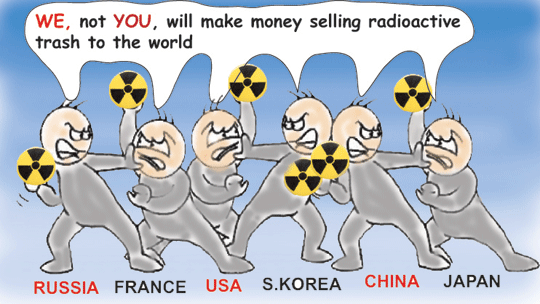
Countries vie to market nuclear reactors to Saudi Arabia
|
Saudi Arabia in talks with 5 vendors to build its first nuclear power reactors, https://www.spglobal.com/platts/en/market-insights/latest-news/electric-power/103019-saudi-arabia-in-talks-with-5-vendors-to-build-its-first-nuclear-power-reactors, Claudia Carpenter , Riyadh — Saudi Arabia is in talks with five vendors, including US-based Westinghouse, to build its first nuclear power plant with two reactors, according to an energy ministry presentation.The other companies in the discussions are France’s EDF, Russia’s Rosatom, South Korea’s KEPCO and China National Nuclear Corp, according to the presentation, shown Wednesday at the Future Investment Initiative conference taking place in Riyadh Saudi Arabia wants to develop a civil nuclear industry and renewable energy to free up oil burned to produce power for export.
Saudi Energy Minister Abdulaziz bin Salman has previously said the kingdom would like to enrich its own uranium resources to produce nuclear energy. However, outgoing US Secretary of Energy Rick Perry cast doubt last week on the kingdom’s ability to process that uranium because of its quality and quantity. Saudi Arabia will be the second Persian Gulf state to build nuclear plants after neighboring UAE, which is building four nuclear reactors that will collectively produce 1,400 MW of electricity. Kepco won the $20 billion contract to construct the UAE reactors, whose start-up has been delayed. |
|
U.S. Energy Secretary Rick Perry says USA and Saudi Arabia negotiating on nuclear sales
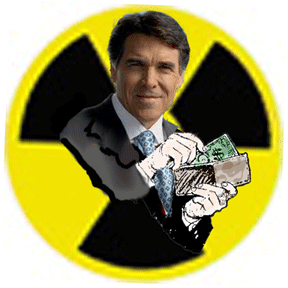 U.S. says talks progressing with Saudi on possible nuclear program, DUBAI (Reuters) 27 Oct 19– U.S. Energy Secretary Rick Perry said on Saturday that conversations with Saudi Arabia on a nuclear program are going forward.The world’s top oil exporter had said it wanted to use nuclear power to diversify its energy mix. It wants to go ahead with a full-cycle nuclear program, including the production and enrichment of uranium for atomic fuel.
In order for U.S. companies to compete for Saudi Arabia’s project, Riyadh would normally need to sign an accord on the peaceful use of nuclear technology with Washington.
Reuters has reported that progress on the discussions has been difficult because Saudi Arabia does not want to sign a deal that would rule out the possibility of enriching uranium or reprocessing spent fuel – both potential paths to a bomb.
“The kingdom and the leadership in the kingdom .. will find a way to sign a 1,2,3 agreement with the United States, I think,” Perry said.
Speaking at a round table in Abu Dhabi, Perry added that the United States was doing everything it could to have a ready global supply of oil…… https://www.reuters.com/article/us-uae-us-energy/us-says-talks-progressing-with-saudi-on-possible-nuclear-program-idUSKBN1X509E
Rick Perry to Discuss Nuclear Sharing Agreement With Saudi Arabia
|
Rick Perry to Discuss Nuclear Sharing Agreement With Saudi Arabia, September 14, 2019,By
and
Energy Secretary Rick Perry said he plans to meet with Saudi Arabia’s new energy minister Monday as the U.S. remains in talks with the kingdom for a deal to construct nuclear reactors there that could help the flagging U.S. domestic nuclear industry. The Trump administration has been in talks with Saudi Arabia to forge a nuclear sharing agreement since 2017, but it has been met with increasing alarm from Congress and others concerned they could forge a deal that doesn’t prohibit the kingdom from enriching uranium….. (subscribers only) https://www.bloomberg.com/news/articles/2019-09-13/perry-to-discuss-nuclear-sharing-agreement-with-saudis-on-monday |
|
|
Saudi Arabia Plans To Enrich Uranium
Saudi Arabia Plans To Enrich Uranium For Its Nuclear Power Reactors, Isabel Togoh, Forbes Staff, 8 Sept 19
Saudi Arabia new energy minister Prince Abdulaziz bin Salman has announced the kingdom plans to enrich uranium for its future civilian nuclear power program. The move could mark the start of a race for nuclear weapons in the Gulf as attempts by the United States and European Union to strike a new deal with Iran on its nuclear plan falter. ……
Saudi’s former energy minister said in April that Riyadh’s use of the reactors would be peaceful and in compliance with “international framework governing … nuclear energy and its peaceful use.” However, the kingdom previously said it would not sign any deal that would restrict its nuclear program. The same technology used to enrich uranium for civilian reactors can also be used to produce fuel for nuclear weapons …… https://www.forbes.com/sites/isabeltogoh/2019/09/09/saudi-arabia-plans-to-enrich-uranium-for-its-nuclear-power-reactors/#5450c3415e2f
Fears that a nuclear Saudi Arabia will destabise the region. Trump’s secret support.
‘Alarm bells’: Saudi Arabia’s nuclear ambitions cast shadow over the regionAnalysts fear Riyadh is seeking to develop the technical capabilities that would allow it to quickly pursue nuclear weapons, Middle Eastern Eye, Maysam Behravesh,23 June 2019 “……. Saudi Crown Prince Mohammad bin Salman, continues to receive extraordinary support from US President Donald Trump’s administration. …..Saudi Arabia’s nuclear and missile programmes are bound to have significant regional implications.
Earlier this month, Tim Kaine, Democratic senator from Virginia, revealed that the Trump administration had approved the transfer of nuclear know-how to Saudi Arabia seven times, including twice after the murder of Saudi critic Jamal Khashoggi in early October 2018.
One of the transfers was authorised on 18 October, only 16 days after Khashoggi, a Washington Post columnist, was brutally eliminated inside the Saudi consulate in Istanbul, according to the US senator.
“The Trump administration is seeking to negotiate a nuclear cooperation agreement that would allow Saudi Arabia to use US technology for energy purposes, but not nuclear weapons,” Nicholas L Miller, professor of government at Dartmouth College, told Middle East Eye. ……
Trump’s ‘secret’ approval
In late March, the Reuters news agency disclosed the Trump administration’s “secret” approval of licences for six US firms to sell atomic power technology to Riyadh.
Simultaneously, the Saudis are seeking to develop a ballistic missile programme of their own, apparently with Chinese assistance.
In November 2018, satellite imagery taken by the US company Planet Labs showed what appeared to be rocket engine tests for ballistic missiles capable of carrying nuclear weapons at a military base near the town of al-Dawadmi, about 230km west of Riyadh.
Several months later, in an exclusive report published on 5 June, CNN cited US intelligence sources as claiming that Riyadh had significantly advanced the missile programme with the help of China.
nterestingly, the discovery infuriated Democratic lawmakers as the White House had “deliberately” refrained from sharing its knowledge of the high-stakes development with key members of Congress until they found out about it “outside of regular US government channels”.
“Saudi Arabia’s development of ballistic missiles goes against long-standing US policy of opposing missile proliferation in the region,” said Miller.
“But the Trump administration has so far been relatively quiet about its response.
“There seems to be a pattern in this administration of looking the other way at provocative Saudi behaviour due to the laser-like focus on Iran.”
‘Reckless leadership in Riyadh’
Combined with bin Salman’s warnings that the kingdom would pursue atomic weapons if its chief nemesis Iran did, these concurrent and mostly clandestine missile and nuclear activities are sounding alarm bells in certain capitals in the region, not least Tehran.
“A nuclear Saudi Arabia means nuclear proliferation in the most unstable and volatile region of the world,” Ali Bakeer, a Turkey-based political analyst told MEE. “Given the reckless leadership in Riyadh, this is an alarming development for small states in the Gulf in particular, which might either seek a nuclear umbrella from great powers or consider constructing parallel deterrence capabilities of their own if they could afford it.”……….https://www.middleeasteye.net/news/alarm-bells-saudi-arabias-nuclear-ambitions-cast-shadow-over-region
Trump is more interested in helping nuclear companies to sell to Saudi Arabia, than in the well-being of Americans
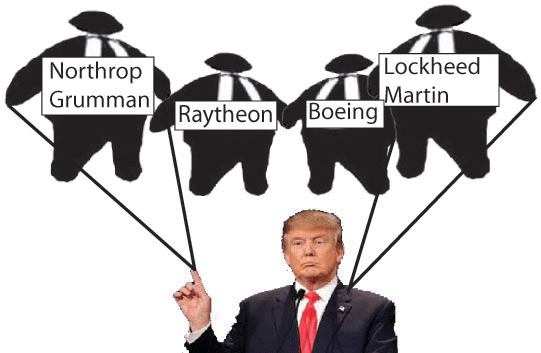 WASHINGTON ,WATCH: IS TRUMP HELPING THE SAUDIS GO NUCLEAR? https://www.jpost.com/Opinion/Washington-Watch-Is-Trump-helping-the-Saudis-go-nuclear-592310,BY DOUGLAS BLOOMFIELD, JUNE 12, 2019
US President Donald Trump recently took another step toward bringing Saudi Arabia into the nuclear club. While Israeli-Saudi ties have warmed in recent years, helping the desert kingdom go nuclear – with its ongoing support for the most extreme Islamic radicals in the world – can hardly be good for the Jewish state.
Secret negotiations with the US Energy Department over many months have led Washington to “transfer highly sensitive US nuclear technology, a potential violation of federal law,” to Saudi Arabia, according to House Oversight Committee sources cited by The Washington Post.
Sen. Tim Kaine (D-Virginia) revealed last week that at least two transfers were approved since the assassination of Washington Post journalist Jamal Khashoggi.
The Saudis say they want to begin building their own nuclear power plants with their own enriched uranium, even though it could be purchased elsewhere more cheaply. That raises suspicions that their real goal isn’t producing electricity. By enriching their own uranium, they could begin diverting it to highly enriched weapons grade, especially if they bar international inspectors, as they’ve insisted.
Given its record of obeisance to Saudi demands for top technology and weapons, it is unlikely the Trump administration would object, but instead continue helping to conceal the kingdom’s plans. Crown Prince Muhammad bin Salman, the de facto ruler, has said that the kingdom would build nuclear weapons if the Iranians did. He may have taken encouragement from a speech in the UAE last month by Trump’s national security adviser, John Bolton.
The Iranians are threatening to leave the nuclear pact with the major powers – the Joint Comprehensive Plan of Action (JCPOA) – in the wake of the Trump administration’s unilateral exit last year and imposition of sanctions to tighten the economic screws on Tehran.
That should give MBS the rationale he seeks to develop his version of the bomb.
When he turns to Trump for help, he will remind the president that if America won’t sell it to him, there are others who will. Trump is a sucker for that pitch.
North Korea would be a good place to go shopping, since they tried helping Syria build nukes until the Israeli Air Force stopped the plan, something it had done earlier in Iraq. Then there’s Pakistan, which is believed to have built its own nuclear weapons stockpile with Saudi financial help.
THERE MIGHT BE some resistance on Capitol Hill, where Saudi support is low and sinking, but Trump has shown himself more responsive to the wishes of the Saudis than the US Congress.
All US administrations – Republican and Democratic – have indulged the Saudi appetite for top technology and weapons. They’ve been driven by pressure from industry and its friends in the Pentagon to sell, sell, sell – and an inexplicable attitude that we need the Saudis far more than they need us. Trump has just raised this to a new level.
Trump’s latest selling spree includes 120,000 conversion kits to produce smart bombs. It is part of an $8.1 billion package that Trump labeled “emergency” to bypass Congressional review.
Most alarming is the Trump administration’s approval for the transfer of highly sensitive weapons technology and equipment to Saudi Arabia so the kingdom can produce electronic guidance systems for Paveway precision-guided bombs, according to congressional sources cited by The New York Times.
Saudi Arabia is the Pentagon’s favorite cash cow. Arms sales are a lucrative business for the US Defense Department, which charges commissions and other fees, and gets economies of scale for its own purchases while selling off old inventory to help pay for replacements. Military attachés around the world are top salesmen for defense contractors as they lay the groundwork for post-uniform careers. Then there are the former – and possibly future – defense industry executives at the highest levels of the Pentagon, starting with the Secretary of Defense.
Sen. Chris Murphy (D-Connecticut) said the administration “has effectively given a blank check to the Saudis – turning a blind eye to the brutal murder of Jamal Khashoggi and allowing their ballistic missile program to expand.”
The United States is not allowed to sell ballistic missiles, so the Saudis have turned to China. CNN reported last week that American intelligence believes Beijing is helping enhance the kingdom’s strategic missile program. In the 1980s, it secretly bought Chinese DF-3 missiles and based them within range of Israel. It bought more advanced missiles in 2007 with the approval of then-president George W. Bush. Unconfirmed published reports suggest they also bought other missiles from Pakistan, which produces a version of the North Korean Nodong missile.
With Trump looking for business that will create jobs he can claim credit for – and with John Bolton rattling sabers and B-52s, and calling for regime change in Iran – can Saudi Arabia be knocking on an open door to the nuclear club?
Soon after the Saudi Arabian killing of journalist Jamal Khashoggi, Trump administration authorised share of sensitive nuclear information with Saudi Arabia
|
US shared nuclear info with S Arabia after Khashoggi http://www.hurriyetdailynews.com/us-shared-nuclear-info-with-s-arabia-after-khashoggi-143952– 5 June 19, WASHINGTON– Reuters The Trump administration granted two authorizations to U.S. companies to share sensitive nuclear power information with Saudi Arabia shortly after the killing of journalist Jamal Khashoggi in October, a U.S. senator who saw details of the approvals said on June 4.The timing of the approvals is likely to heap pressure on the administration of U.S. President Donald Trump from lawmakers who have become increasingly critical of U.S. support for Saudi Arabia since Khashoggi was killed in the Saudi consulate in Istanbul in October.
Khashoggi, a native of Saudi Arabia, left in 2017 to became a resident of the United States where he published columns in the Washington Post critical of the kingdom’s leadership. Senator Tim Kaine, a Democrat from Virginia, where Khashoggi lived, called the timing of the approvals “shocking” and adds to a “disturbing pattern of behavior” of the administration’s policy on Saudi Arabia. The Department of Energy granted the first part 810 authorization on Oct. 18, 16 days after Khashoggi was killed. The second occurred on Feb. 18. U.S. authorities have concluded that responsibility for Khashoggi‘s death went to the highest levels of the Saudi government. Riyadh has denied that Crown Prince Mohammed bin Salman was involved. The authorizations were among seven granted to U.S. companies by Trump’s administration since 2017, as Washington and Riyadh negotiate a potential wider agreement to help SaudiArabia develop its first two nuclear power reactors. The Energy Department has kept the companies involved in the sharing of nucleartechnology information with the kingdom confidential, citing the need to protect business interests. In the past, 810 approvals have been made available for the public to view at department headquarters. The department did not immediately respond to a request for comment about Kaine’s statement. Lawmakers have been anxious to be kept updated about talks on nuclear power development between the administration and Riyadh to make sure any deal contains strict nuclear nonproliferation standards. Saudi Arabia and Washington had begun talks about nuclear power development before Trump’s presidency. But progress has been slow as the kingdom opposes measures that would prevent it from enriching uranium and reprocessing plutonium, two potential pathways to making fissile material for nuclear weapons. Last year the crown prince said the kingdom did not want to acquire a nuclear bomb, but if its archrival Iran did, “we will follow suit as soon as possible.” Kaine, who had urged the administration to release the authorizations, said the approvals were “one of the many steps the administration is taking that is fueling a dangerous escalation of tension in the region.” Late last month, Trump declared a national emergency because of tensions with Iran and swept aside objections from Congress to complete the sale of more than $8 billion worth of weapons to Saudi Arabia, the United Arab Emirates and Jordan. Riyadh plans to issue a multibillion-dollar tender in 2020 to build its first two nuclearpower reactors, sources said in April. Originally expected last year, the tender has been delayed several times. The United States, South Korea, Russia, China and France are competing for the business. Reactor builder Westinghouse, which has been hit by a downfall in the U.S. nuclear power industry, would likely sell components to Saudi Arabia in any deal involving U.S. technology. Westinghouse is now owned by Brookfield Asset Management Inc. |
|
|
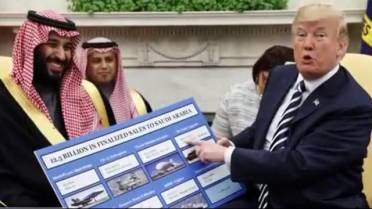
Trump may use ’emergency’ powers to bypass Congress, to sell missiles to Saudi Arabia
|
Trump prepared to bypass Congress on Saudi arms sale: senators
Democrats warn Trump may use ’emergency’ loophole to sell missiles to Saudi Arabia without congressional approval. Aljazeera, by William Roberts, 24 May 2019 Washington, DC – Democrats in the United StatesSenate have warned that the Trump administration is preparing to approve a major new arms sale to Saudi Arabia, using an “emergency” loophole to bypass Congress. |
|
Distrust of Saudi Arabia’s motives in building a nuclear reactor
|
At the King Abdulaziz City for Science and Technology, the Saudi government is constructing a small nuclear research reactor. The Argentine-designed reactor will produce just tens of kilowatts of energy, a tiny fraction of what Saudi Arabia needs. But it’s a sign of things to come — the kingdom’s plans include gigawatts of energy from nuclear plants for both electricity and desalination. Saudi Arabia’s plans appear, on paper, to be entirely peaceful. But some arms control experts are concerned that its nuclear energy ambitions may also be part of its ongoing rivalry with Iran, which already possesses dual-use technology that could aid in the production of a nuclear bomb. The U.S. and others such as South Korea and China are pushing ahead with plans to help Saudi Arabia’s civilian nuclear program. “The big, big question in the background,” says Sharon Squassoni, a nuclear expert and professor at George Washington University, “is do we have enough controls in place that we can trust [Saudi Arabia]? Since they’ve been pretty clear about their intentions should things go bad with Iran.” Right now, Saudi Arabia generates its electricity with fossil fuels. But the government predicts that oil will be more valuable as an export. So about a decade ago, Saudi Arabia began pursuing an ambitious plan to start a nuclear energy program. Even after the 2011 disaster at the Fukushima Daiichi nuclear power plant in Japan, Squassoni says, Saudi Arabia kept at it. “Most countries were walking away from nuclear, but they decided, ‘Look, this is our long-term plan,'” she says. Squassoni says she’s a bit flummoxed by Saudi Arabia’s continued interest in nuclear, given its high cost and the ease with which the country could adopt renewable energy sources like solar. But the interest may make a lot more sense, she says, when considering Saudi Arabia’s rivalry with Iran. Iran’s nuclear program has had military dimensions in the past, according to the International Atomic Energy Agency. Today, Iran remains in possession of thousands of centrifuges that can be used to enrich uranium. Depending on the level of enrichment, that uranium can be used either as fuel for nuclear reactors — or to make the cores of nuclear bombs. Since 2015, the IAEA has closely monitored Iran’s centrifuges as part of an international agreement that freezes Tehran’s enrichment program in exchange for sanctions relief. But Iran’s nuclear capabilities clearly make Saudi Arabia nervous. Speaking last year on CBS’ 60 Minutes, Saudi Crown Prince Mohammed bin Salman warned that if Iran ever got a nuke, Saudi Arabia would too. “Without a doubt if Iran developed a nuclear bomb, we will follow suit as soon as possible,” he said. Saudi officials say the new research reactor under construction outside of Riyadh has nothing to do with nuclear bombs. In a statement to Bloomberg News last month, Saudi Arabia’s Ministry of Energy, Industry and Mineral Resources said the reactor’s purpose was “strictly peaceful.” “The project is fully in compliance with the IAEA and international framework governing the nuclear energy and its peaceful use,” the statement said. The Saudi Embassy in Washington D.C. did not respond to an NPR request for comment. From a technical standpoint, this new reactor is too small and too low-power to be of any use in bomb-making, according to Aaron Stein, director of the Middle East program at the Foreign Policy Research Institute in Philadelphia. “This is not something that a country would engage upon for a weapons program,” he says. In fact, even large civilian nuclear power plants can’t be used easily to make bombs. But Saudi Arabia has remained quiet on whether it wants its own centrifuges in addition to power plants. Such centrifuges might be legal, as they are used to enrich uranium for electricity production, but Stein says a Saudi decision to pursue that technology “would send alarm bells throughout the region.” “I think it would be interpreted as a move to hedge, and to consider building nuclear weapons down the line,” Stein says. The Trump administration has been looking at a nuclear cooperation deal with Saudi Arabia. Squassoni says such a deal should be carefully crafted. She hopes the U.S. will seek assurances that Saudi Arabia will not pursue civilian technologies that could allow it to make a bomb. |
|
Satellite images reveal that Saudi Arabia has almost completed its first nuclear reactor site
Saudi Arabia has almost completed its first nuclear reactor site, satellite images reveal
Saudi Arabia’s latest construction is raising eyebrows in the West, with these new satellite images sparking fears about the kingdom’s quest for power. News.com.au, Gavin Fernando, @gavindfernando, 8 Apr 19
Saudi Arabia has nearly completed construction of its first nuclear reactor, sparking fears about the country’s quest for nuclear power.
New satellite images, first published by Bloomberg, show construction on the building site has made significant process over the past three months.
The three images below [on original] show the rapid developments on the site between April 2017 and today.
The images show the construction of a 10-metre high steel vessel, which would contain nuclear fuel, and construction work on the surrounding concrete building.
The facility is located in the southwest corner of the King Abdulaziz City for Science and Technology in Riyadh.
………Robert Kelley, a nuclear expert and veteran of the US Department of Energy, said the reactor could be completed in “nine months to a year”.
He said the construction appears to be small in size and intended for research and training purposes.
Mr Kelley also said that, before the kingdom can insert nuclear fuel into the reactor, it would have to abide by international agreements.
He said it had been surprising to him “how non-transparent” the kingdom had been in the process of building the reactor and “how they seem very cavalier about modifying their arrangements with the IAEA”.
Mr Kelley was referring to agreements the kingdom has signed. The kingdom agreed to the Nuclear Nonproliferation Treaty three decades ago. In 2005, it signed an agreement with the IAEA known as the “small quantities protocol” that allowed countries with negligible nuclear programs to be exempt from regular inspections or nuclear monitoring.
However, once nuclear fuel was brought into the country to operate this small reactor, inspections by the IAEA would be required, Mr Kelley added.
…….. He said the Saudi reactor was being built by the Argentinian government-owned company INVAP. Before Argentina brings nuclear fuel to Saudi Arabia for the reactor, the IAEA agreement in place that exempts Saudi Arabia from inspections would need to be rescinded, Mr Kelley said.
“I think it’s a 100 per cent certainty that Argentina is not going to supply uranium fuel to a country that doesn’t have a safeguards agreement in force,” he added.
………. the kingdom has previously pushed back against agreeing to US standards that would block two paths to potentially making fissile material for nuclear weapons.
Last Friday, US Secretary of State Mike Pompeo was adamant that it was unacceptable for Saudi Arabia to become a nuclear power.
“We will not permit that to happen. We will not permit that to happen anywhere in the world,” he told CBS. “The President understands the threat of proliferation. We will never write a $150 million check to the Saudis and hand them over the capacity to threaten Israel and the United States with nuclear weapons, never.”
The publication of the satellite images follows a struggle between the Trump administration and Congress over the sale of nuclear technology to Riyadh.
Last month, The Daily Beast revealed the US Department of Energy had approved six authorisations for US companies that were looking to conduct nuclear-related work in the Middle Eastern kingdom.
The approvals, known as Part 810 authorisations, would allow companies to do preliminary work on nuclear power ahead of any deal but not ship equipment that would go into a plant………https://www.news.com.au/finance/work/leaders/saudi-arabia-has-almost-completed-its-first-nuclear-reactor-site-satellite-images-reveal/news-story/64346c4fbf0906ee7c2ddb3b95541c4d
1 This Month

of the week – Shut Down Drone Warfare!


Tell the Ukrainian Government to Drop Prosecution of Peace Activist Yurii Sheliazhenko

Petition to revoke the licensing of the Near Surface Nuclear Disposal Facility (NSDF) at Chalk River. https://www.ourcommons.ca/petitions/en/Petition/Details?Petition=e-7247
To see nuclear-related stories in greater depth and intensity – go to https://nuclearinformation.wordpress.com
-
Archives
- March 2026 (237)
- February 2026 (268)
- January 2026 (308)
- December 2025 (358)
- November 2025 (359)
- October 2025 (376)
- September 2025 (257)
- August 2025 (319)
- July 2025 (230)
- June 2025 (348)
- May 2025 (261)
- April 2025 (305)
-
Categories
- 1
- 1 NUCLEAR ISSUES
- business and costs
- climate change
- culture and arts
- ENERGY
- environment
- health
- history
- indigenous issues
- Legal
- marketing of nuclear
- media
- opposition to nuclear
- PERSONAL STORIES
- politics
- politics international
- Religion and ethics
- safety
- secrets,lies and civil liberties
- spinbuster
- technology
- Uranium
- wastes
- weapons and war
- Women
- 2 WORLD
- ACTION
- AFRICA
- Atrocities
- AUSTRALIA
- Christina's notes
- Christina's themes
- culture and arts
- Events
- Fuk 2022
- Fuk 2023
- Fukushima 2017
- Fukushima 2018
- fukushima 2019
- Fukushima 2020
- Fukushima 2021
- general
- global warming
- Humour (God we need it)
- Nuclear
- RARE EARTHS
- Reference
- resources – print
- Resources -audiovicual
- Weekly Newsletter
- World
- World Nuclear
- YouTube
-
RSS
Entries RSS
Comments RSS
 nuclear-news