Rights group: Israel dropped equivalent to 2 nuclear bombs on Gaza

November 3, 2023 https://www.middleeastmonitor.com/20231103-rights-group-israel-dropped-equivalent-to-2-nuclear-bombs-on-gaza/
Israel has dropped more than 25,000 tonnes of explosives on the besieged Gaza Strip since the start of its large-scale bombardment on 7 October, equivalent to two nuclear bombs, Euro-Med Human Rights Monitor said in a press release issued Thursday.
The rights group said the Israeli army has admitted to bombing over 12,000 targets in the Gaza Strip; pounding the enclave with roughly 10 kilogrammes of explosives per resident.
Euro-Med Monitor highlighted that the weight of the nuclear bombs dropped by the United States on Hiroshima and Nagasaki in Japan at the end of World War II in August 1945 was estimated at about 15,000 tonnes, adding that due to technological developments affecting the potency of bombs, the explosives dropped on Gaza may be twice as powerful as a nuclear bomb.
“This means that the destructive power of the explosives dropped on Gaza exceeds that of the bomb dropped on Hiroshima,” Euro-Med Monitor said.
According to the statement, Israel uses bombs with huge destructive power, some of which range from 150 to 1,000 kilogrammes, and cited a recent statement by Israeli War Minister Yoav Gallant that declared that more than 10,000 bombs have been dropped on Gaza City alone.
The Geneva-based rights group has also documented Israel’s use of internationally banned weapons in its attacks on the Gaza Strip, especially the use of cluster and phosphorus bombs, which can cause severe fatal burns. #nuclear #antinuclear #nuclearfree #NoNukes #Israel #Palestine
Netanyahu Rejects Calls for Ceasefire as Gaza Death Toll Surpasses 8,300
By Chris Walker , TRUTHOUT, October 31, 2023 https://truthout.org/articles/netanyahu-rejects-calls-for-ceasefire-as-gaza-death-toll-surpasses-8300/?utm_source=Truthout&utm_campaign=cd5af912ac-EMAIL_CAMPAIGN_3_20_2023_13_41_COPY_06&utm_medium=email&utm_term=0_bbb541a1db-cd5af912ac-650192793&mc_cid=cd5af912ac&mc_eid=73e1cd43d0
Hundreds of thousands of protesters worldwide have demanded an immediate ceasefire in Gaza and an end to the occupation.By Chris Walker , TRUTHOUTPublishedOctober 31, 2023
sraeli Prime Minister Benjamin Netanyahu rejected international calls for an Israeli ceasefire in Gaza during a press conference on Monday.
Since the Hamas-led infiltration attack on October 7 that killed around 1,400 people, Israeli forces have waged a genocidal bombing campaign against Palestinians, killing more than 8,300 people in Gaza — more than a third of whom are children, according to the latest figures from the Gaza Health Ministry. Thousands more Gazans are estimated to be trapped under the rubble.
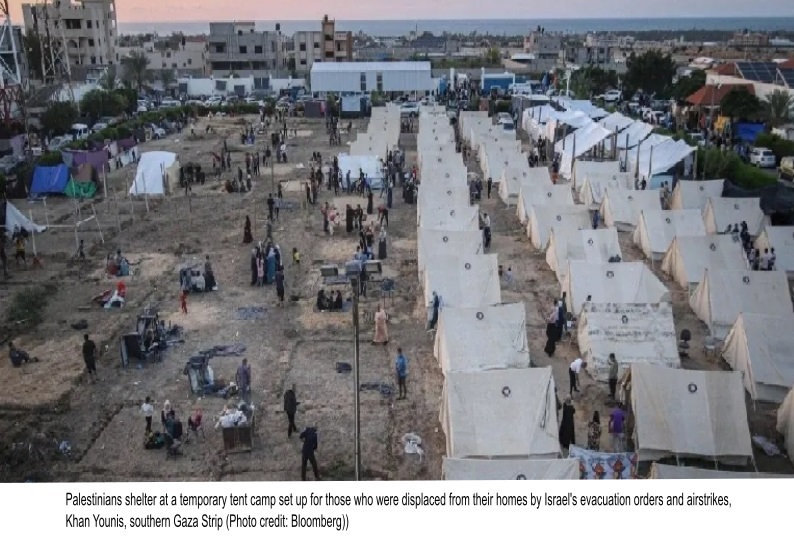
Israeli airstrikes have displaced millions of Gazans from their homes, many of whom are now struggling to survive — and resorting to drinking contaminated sea water — as Israel blocks food, water, electricity and medicine from entering Gaza.
“Just as the United States would not agree to a cease-fire after Pearl Harbor or after the terrorist attack of 9/11, Israel will not agree to a cessation of hostilities with Hamas after the horrific attacks of October 7,” Netanyahu told reporters on Monday.
Netanyahu’s comments come as hundreds of thousands of protesters worldwide have demanded an immediate ceasefire and for Israel to allow desperately needed aid into Gaza, as well as for an end to Israel’s illegal occupation of Palestinian land. Although Netanyahu has claimed that aid has been reaching those in need, observers on the ground have disputed these claims.
“Very few trucks, slow processes, strict inspections, supplies that do not match the requirements of UNRWA and the other aid organizations, and mostly the ongoing ban on fuel, are all a recipe for a failed system,” read a report from Thomas White, the United Nations Relief and Works Agency’s top official for Gaza.
Hundreds of thousands of people protested against the Israeli military’s siege of Gaza in cities across the globe over the weekend, including in Melbourne, Australia; London, United Kingdom; Toronto, Canada; New York, United States; Rome, Italy; Amman, Jordan; Berlin, Germany; Pretoria, South Africa; and more.
Netanyahu, who faces calls to resign from his role as prime minister for failing to prevent the October 7 attack from Hamas, didn’t appear to be moved by the calls for a ceasefire and an end to the occupation. “This is a time for war,” he said instead.
Meanwhile, residents of Israel appear to be changing their views on the attacks in Gaza. Polling from last week, taken prior to the Israeli military launching a ground campaign, indicates that close to one in two Israeli residents (49 percent) wanted the Israel Defense Forces to pause consideration of such moves, with only 29 percent stating they wanted the military to immediately launch a ground campaign, a decrease from a poll asking the same question a week before.
Other polling taken earlier this month found that the vast majority of Israeli residents agree that Netanyahu was largely responsible for failing to prepare for an attack from Hamas, with 80 percent in that poll saying so.
Evidence suggests that Netanyahu did in fact have advance warning about the Hamas attack on October 7. Egyptian officials say they repeatedly warned the prime minister days ahead of the attack that the action from Hamas was imminent. Netanyahu’s office has denied that they received any information from Egypt, although the chairman of the U.S. House Intelligence Committee, Texas Republican Rep. Michael McCaul, has said that he and other members have seen evidence of the warnings. #srael #Palestine
Israel in Search of Its Hiroshima: Massive Bomb Wipes Out 20 Apt. Buildings, Kills, Wounds 400 Civilians
The flaw in the Israeli government stance is that we are not living in 1943. After World War II, the United Nations, the Geneva Conventions and other international instruments were enacted by the nations of the world to prevent the atrocities of WW II from being repeated. It was to this “rules-based international order” that the Biden administration appealed when it tried to rally the world to oppose Russian war crimes in Ukraine. In a gob-smacking act of supreme hypocrisy, the Biden administration has decided to throw the same rules-based international order on the garbage heap of special pleading when it comes to Israel.
By Juan Cole / Informed Comment
Ann Arbor (Informed Comment) – In one of the biggest massacres it has so far committed, the Israeli Air Force on Tuesday bombed the Jabaliyaa refugee camp in Gaza, killing or wounding at least 400 persons and destroying the Block Six residential complex, felling 20 buildings. More victims are believed to be under the rubble.
An Israeli military spokesman said that the strike was directed at Hamas leader Ibrahim Biari, a mastermind of the October 7 attack on Israel. Although Israeli authorities proclaimed that they had succeeded in killing Biari, Hamas announced that he was still very much alive.
Killing and wounding 400 noncombatants and destroying 20 residential buildings to get at one target, even if the target is a wanted terrorist, is strictly forbidden under the post-World War II laws of war and International Humanitarian law. These laws are codified in the Geneva Conventions and the Rome Statute that underpins the International Criminal Court.
For instance, Rome Statute:
Art. 8 (2) (b) (iv) Intentionally launching an attack in the knowledge that such attack will cause incidental loss of life or injury to civilians or damage to civilian objects or widespread, long-term and severe damage to the natural environment which would be clearly excessive in relation to the concrete and direct overall military advantage anticipated. (4th Geneva Convention Art. 85 (3) (b) of AP I.)
Art. 8 (2) (a) (iv) Extensive destruction and appropriation of property, not justified by military necessity and carried out unlawfully and wantonly (mirrored from Geneva Conventions Art. 50/51/147 of GC I, II and IV).
Art. 8 (2) (b) (i) Intentionally directing attacks against the civilian population as such or against individual civilians not taking direct part in hostilities (4th Geneva Convention Art. 85 (3) (a), plus Art. 51(2) AP I).
Art. 8 (2) (b) (v) Attacking or bombarding, by whatever means, towns, villages, dwellings or buildings which are undefended and which are not military objectives. (4th Geneva Convention, Art. 85 (3) (d) of AP I).
The presence of one senior Hamas commander, or even a platoon of them, among hundreds of noncombatants clearly would not justify recklessly endangering innocent civilians on the scale of Jabaliyaa. This is a war crime pure and simple.
In a CNN interview by Wolf Blitzer of an Israeli military spokesman, Blitzer is clearly astonished that he straightforwardly admitted that the Israelis knew that the strike would kill the refugees in the camp, but did it anyway.
The complete disregard of Israeli authorities for the laws of war and International Humanitarian Law enacted after World War II — intended to prevent atrocities of the sort committed during that war — was manifest in remarks to the New York Times, reported Monday:
“It became evident to US officials that Israeli leaders believed mass civilian casualties were an acceptable price in the military campaign. In private conversations with American counterparts, Israeli officials referred to how the United States and other allied powers resorted to devastating bombings in Germany and Japan during World War II – including the dropping of the two atomic warheads in Hiroshima and Nagasaki – to try to defeat those countries.”………………………………………………………………………………………………………………………..
this claim, of killing noncombatants in self-defense, which the German officers resorted to, is precisely the claim some Israeli officials are making today, that all Palestinians in Gaza are terrorists, all are dangerous to the survival of Israel, and therefore slaughtering them en masse is permissible. These arguments were rejected by the war crimes tribunal after WW II, and they should be rejected today. Of course, extremist Israelis really mind being compared to Nazis. But there is an easy way to avoid that: don’t act like Nazis.
The flaw in the Israeli government stance is that we are not living in 1943. After World War II, the United Nations, the Geneva Conventions and other international instruments were enacted by the nations of the world to prevent the atrocities of WW II from being repeated. It was to this “rules-based international order” that the Biden administration appealed when it tried to rally the world to oppose Russian war crimes in Ukraine. In a gob-smacking act of supreme hypocrisy, the Biden administration has decided to throw the same rules-based international order on the garbage heap of special pleading when it comes to Israel.
Unfortunately, the Biden administration is letting the fascist government of Prime Minister Binyamin Netanyahu get away with mass murder. As a result, no one in the global South will ever listen to Biden or Secretary of State Antony Blinken say the words “rules-based international order” again without falling down laughing. The US attempt to cut Russia off from the world economy will now completely fail. https://scheerpost.com/2023/11/01/israel-in-search-of-its-hiroshima-massive-bomb-wipes-out-20-apt-buildings-kills-wounds-400-civilians/ #Israel #Palestine #nuclear #antinuclear #nuclearfree #NoNukes
—
U.S. QUIETLY EXPANDS SECRET MILITARY BASE IN ISRAEL
Government documents pointing to construction at a classified U.S. base offer rare hints about a little noted U.S. military presence near Gaza
The Intercept, Ken Klippenstein, Daniel Boguslaw, October 27 2023,
TWO MONTHS BEFORE Hamas attacked Israel, the Pentagon awarded a multimillion-dollar contract to build U.S. troop facilities for a secret base it maintains deep within Israel’s Negev desert, just 20 miles from Gaza. Code-named “Site 512,” the longstanding U.S. base is a radar facility that monitors the skies for missile attacks on Israel. #nuclear #antinuclear #nuclearfree #NoNukes
On October 7, however, when thousands of Hamas rockets were launched, Site 512 saw nothing — because it is focused on Iran, more than 700 miles away.
The U.S. Army is quietly moving ahead with construction at Site 512, a classified base perched atop Mt. Har Qeren in the Negev, to include what government records describe as a “life support facility”: military speak for barracks-like structures for personnel.
Though President Joe Biden and the White House insist that there are no plans to send U.S. troops to Israel amid its war on Hamas, a secret U.S. military presence in Israel already exists. And the government contracts and budget documents show it is evidently growing.
The $35.8 million U.S. troop facility, not publicly announced or previously reported, was obliquely referenced in an August 2 contract announcement by the Pentagon. Though the Defense Department has taken pains to obscure the site’s true nature — describing it in other records merely as a “classified worldwide” project — budget documents reviewed by The Intercept reveal that it is part of Site 512. (The Pentagon did not immediately respond to a request for comment.)…………………….
Rare acknowledgment of the U.S. military presence in Israel came in 2017, when the two countries inaugurated a military site that the U.S. government-funded Voice of America deemed “the first American military base on Israeli soil.” Israeli Air Force’s Brig. Gen. Tzvika Haimovitch called it “historic.” He said, “We established an American base in the State of Israel, in the Israel Defense Forces, for the first time.”
A day later, the U.S. military denied that it was an American base, insisting that it was merely a “living facility” for U.S. service members working at an Israeli base
The U.S. military employs similar euphemistic language to characterize the new facility in Israel, which its procurement records describe as a “life support area.” Such obfuscation is typical of U.S. military sites the Pentagon wants to conceal. Site 512 has previously been referred to as a “cooperative security location”: a designation that is intended to confer a low-cost, light footprint presence but has been applied to bases that, as The Intercept has previously reported, can house as many as 1,000 troops.
Site 512, however, wasn’t established to contend with a threat to Israel from Palestinian militants but the danger posed by Iranian mid-range missiles.
The overwhelming focus on Iran continues to play out in the U.S. government’s response to the Hamas attack. In an attempt to counter Iran — which aids both Hamas and Israel’s rival to the north, Hezbollah, a Lebanese political group with a robust military wing, both of which are considered terror groups by the U.S. — the Pentagon has vastly expanded its presence in the Middle East. Following the attack, the U.S. doubled the number of fighter jets in the region and deployed two aircraft carriers off the coast of Israel…………………………………………………. more https://theintercept.com/2023/10/27/secret-military-base-israel-gaza-site-512/
As The Lights Go Out In Gaza

CAITLIN JOHNSTONE, 2 Nov 23, https://www.caitlinjohnst.one/p/as-the-lights-go-out-in-gaza?utm_source=post-email-title&publication_id=82124&post_id=138506461&utm_campaign=email-post-title&isFreemail=true&r=ln98x&utm_medium=email
In America they killed all the buffalo just to take away food from the natives,
made mountains of their skulls and posed proudly in photos
like they posed proudly in front of burnt bodies after lynchings in the south.
In Australia they stole the brown children and gave them to pale families
and watched their ancient civilization disappear into the toxic fumes of industry
like a sailboat into the mist.
In Israel teenagers play with buttons that cause explosions on screens
and look forward to the end of the Gaza operation
so they can leave and go play better video games.
In Gaza mothers clutch tattered pieces of flesh and clothing to their chests
and scream names that will never again be answered
and call out questions to the heavens that will also go unanswered.
And the ghosts of the buffalo roam through the ruins
looking for their heads
while the people of Gaza comb through the rubble
looking for their dead,
and the rest of us stare at screens and cry like babies
and ask our own unanswered questions
of heavens clouded by the fumes of industry,
vanishing stars above a dying world
as the lights go out in Gaza
one by one. #nuclear #antinuclear #nuclearfree #NoNukes
Leaked: Israeli plan to ethnically cleanse Gaza
The plan advocates the forced transfer of the population of the Gaza Strip to Sinai permanently, and calls for the international community to be leveraged to assist the move
News Desk, OCT 29, 2023
Israeli culture magazine Mekovit published on 28 October a leaked document issued by Israel’s Ministry of Intelligence recommending the occupation of Gaza and total transfer of its 2.3 million inhabitants to Egypt’s Sinai Peninsula.
The document, issued on 13 October, identifies a plan to transfer all residents of the Gaza Strip to North Sinai as the preferred option among three alternatives regarding the future of the Palestinians in Gaza at the end of the current war between Israel and the Hamas-led Palestinian resistance.
The document recommends that Israel evacuate the Gazan population to Sinai during the war, establish tent cities and new cities in northern Sinai to accommodate the deported population, and then create a closed security zone stretching several kilometers inside Egypt. The deported Palestinians would not be allowed to return to any areas near the Israeli border.
The existence of the document does not necessarily indicate that its recommendations are being implemented by Israel’s security establishment.
The Ministry of Intelligence, headed by Gila Gamliel of the Likud party, does not control any of Israel’s intelligence agencies, but independently prepares studies and policy papers, which are distributed for consideration by the government and its security bodies.
However, recent statements by Israeli government officials and actions by the Israeli army in Gaza suggest the plan is indeed being implemented. Since 7 October, Israeli officials have repeatedly issued warnings to Palestinians to move to southern Gaza in advance of a looming ground invasion.
Israel has imposed a total siege on Gaza, cutting off food, water, fuel, and electricity. The siege, combined with intense Israeli bombing that has killed over 8,000 Palestinians, the majority women and children, threatens to make Gaza uninhabitable.
An official at the Ministry of Intelligence confirmed that the ten-page document is authentic but “was not supposed to reach the media,” Mekovit noted.
According to a right-wing activist, the document from the Ministry of Intelligence was leaked by a member of Likud. Leaking the document was an attempt to find out whether “the public in Israel is ready to accept ideas of a transfer from Gaza.”
The document unequivocally and explicitly recommends carrying out a transfer of civilians from Gaza as the desired outcome of the war.
The transfer plan is divided into several phases: in the first phase, the population in Gaza must be forced to move to southern Gaza, while Israeli air strikes will focus on targets in northern Gaza.
In the second phase, the Israeli army’s ground entry into Gaza will begin, which will lead to the occupation of the entire strip, from north to south, and the “cleansing of the underground bunkers from Hamas fighters.”
At the same time as the Gaza Strip is occupied, the citizens of Gaza will move to Egyptian territory and will be prevented from returning permanently.
“It is important to leave the traffic lanes towards the south usable, to allow the evacuation of the civilian population towards Rafah,” the document states.
The document recommends beginning a dedicated campaign that will “motivate” Gazans “to agree to the plan,” and make them give up their land.
Gazan should be convinced that “Allah made sure that you lost this land because of the leadership of Hamas – there is no choice but to move to another place with the help of Your Muslim brothers,” the document reads.
Further, the plan states the government must launch a public relations campaign that will promote the transfer program to western states in a way that does not promote hostility to Israel or damage its reputation. The deportation of the population from Gaza must be presented as a necessary humanitarian measure to receive international support. Such a deportation could be justified if it will lead to “fewer casualties among the civilian population compared to the expected number of casualties if they remain,” the document says.
The document also states that the US should be leveraged to pressure Egypt to take in the residents of Gaza, and to encourage other European countries, and in particular Greece, Spain and Canada, to help take in and settle the refugees who will be evacuated from Gaza.
Finally, the document claims that if the population of Gaza remains, there will be “many Arab deaths” during the expected occupation of Gaza by the Israeli army, and this will damage Israel’s international image even more than the deportation of the population. For all these reasons, the recommendation of the Ministry of Intelligence is to promote the transfer of all Palestinians in Gaza to Sinai permanently. #Israel #Palestine
When the Journalists are Gone, the Stories Will Disappear
Over 29 Palestinian journalists have been killed since October 7 in Israeli’s genocidal bombing of the Gaza strip.
By Zoe Alexandra and Vijay Prashad / CounterPunch, https://scheerpost.com/2023/10/30/when-the-journalists-are-gone-the-stories-will-disappear/
Every few hours we check the social media timeline of Muhammed Smiry, the Gaza-based Palestinian journalist. He has been walking the ruined streets of Gaza, documenting everyday life amidst Israeli bombs and the impact they have had on Palestinian life. Close to seven thousand Palestinians have been killed in the Israeli barrage, and any one of them could have been Muhammed. “I am still alive,” he wrote on October 10. A few days later, Muhammed wrote, “I am still alive. I can’t tell you how bad the situation is in Gaza.” On Telegram, Muhammed wrote, “Nowhere is safe in Gaza.” His Telegram timeline is horrifying – so many killed here, so many killed there. It is unrelenting.
Journalists in Gaza with whom we are texting tell us that they are charging their phone with repurposed car batteries and with small solar devices. They are covered with dust, some of it – they say – the incinerated bodies of Palestinians blown to bits in their homes.
Since Israel began this unrelenting bombing of Gaza, journalists – many of them Palestinian – have been posting pictures in real time of the airstrikes and their victims, entire families wiped out in a flash. They tell us about the difficulties of survival for those who do not die, people trying desperately to access food, water, and some energy. “I want to die with my family,” says a journalist in a text.
I was just reporting….
Not long after that text is sent, Wael al-Dahdouh, al-Jazeera’s bureau chief in Gaza, learns that an Israeli airstrike hit the house where he had been living in the Nuseirat camp in central Gaza. His wife, daughter, and son have been killed immediately. They had left their home in central Gaza and headed southwards, following the instructions of the Israeli military. Dahdouh saw his family’s bodies at al-Aqsa Martyrs hospital in Deir al-Balah. “What happened is clear,” he told al-Jazeera while he rushed to the hospital. “This is a series of targeted attacks on children, women, and civilians. I was just reporting from Yarmouk about such an attack, and the Israeli raids have targeted many areas, including Nuseirat.”
Dahdouh and his team have been central to the coverage of this bombardment. Brave journalists, including those who work for al-Jazeera, have gone from streets to hospitals, covering the screams of parents and the quivering of children. Dust, debris, and blood is the canvas of their stories. There are videos of heroic rescue teams, rushing on foot because the ambulances have no fuel, trying to dig out survivors from the rubble. Text messages from beneath the shattered concrete cry for help. Some of them are dug out, but many die, their bodies buried deep underneath the buildings that have been hit by powerful bombs. Half of the population of Gaza is beneath the age of 18, and half of the dead are young people – children, really, who have no idea about why they are being hit so hard by a government led by a man who says he wants to fulfill the prophecy of Isaiah. “We are the people of light,” said Benjamin Netanyahu, “and they are the people of darkness.” Underneath the concrete, Netanyahu’s cruel vision comes true.
Dangerous assignment.
Reporters never have an easy time in a war zone, particularly if one of the combatants sees them as part of the enemy in the information war. Walk into al-Jazeera’s headquarters in Doha, Qatar, and the first thing you see are the clothes worn by Tareq Ayoub (age 35). Tareq worked at the network’s Baghdad bureau office – whose coordinates had been given to the United States military as a precaution. On April 8, 2003, Tareq – a Jordanian national – was reporting on the violence in Iraq when the United States bombed the office and killed him, leaving his wife Dima and his one-year-old child Fatima. Tareq was the twelfth journalist killed in Iraq, and he would be followed by many more (one report counts 283 journalists killed in Iraq since the US began its illegal war in 2003).
We remember names of journalists killed in the wars because their deaths were spectacular or we knew them personally, but otherwise they are forgotten, part of the anonymity of the war dead.
The database at the Committee to Protect Journalists (CPJ) counts twenty-two journalists killed in the Occupied Territory of Palestine – most of them due to “dangerous assignment.” This is a strange designation. Salam Mema (age 32) was the head of the Women Journalists Committee at the Palestinian Media Assembly. She was at her home in the Jabalia camp in the northern Gaza Strip on October 13, 2023, when an Israeli airstrike levelled it. Her “dangerous assignment” was to be Palestinian and to live in Palestine.
The CPJ database now has the name of Duaa Sharaf, a presenter for Al-Aqsa Radio and a facebook friend of one of us. Duaa, like Salam Mema, was at home early in the morning of October 26 with her young daughter in the al-Zawaida area in central Gaza. Israeli fighter jets fired not one missile but many into her home. Duaa was, it seems, on a “dangerous assignment,” waking up with her daughter to make some food and rush off to be on the radio.
Murder.
Al-Jazeera has lost many reporters in the conflicts from Iraq to Libya (Ali Hassan al-Jaber, a cameraman, was killed in Suluq, Libya, on March 13, 2011; one of us knew him in Doha, where he worked for Qatar TV). The most dramatic of the killings of al-Jazeera journalists appears in the CPJ database under “Murder” not “Dramatic Assignment,” and that is the murder of Shireen Abu Akleh on May 11, 2022, in Jenin, Palestine by the Israeli military. The Israelis argued that Abu Akleh was shot by Palestinian gunmen, in the same way as they argued that the airstrike on the Al-Ahli Arab Hospital in Gaza, City on October 17, 2023, was actually a rocket strike by Islamic Jihad.
Despite the numbers of these deaths and the danger of the war zone, more and more reporters go out there – bravely – to tell the stories that need to be told. Thanks to the reporters in Gaza who are uploading pictures and videos on their ordinary phones, and who are writing posts on telegram and facebook, we are able to pierce the ugly multi-billion-dollar hasbara or propaganda machine of the Israeli government. The atrocities depicted and evidenced in their work have in a significant way been responsible for the mass outpouring of support for the Palestinian struggle and the overwhelming condemnation of Israel’s actions.
Say their names.
Each tweet we read, each picture we see, reminds us of the journalists who are putting their lives on the line, some of them being targeted by the Israeli war machine. Say their names, these journalists murdered in a vicious war. Say their names. Say their names:
- Mohammed Imad Labad
- Roshdi Sarraj
- Mohammed Ali
- Khalil Abu Aathra
- Sameeh Al-Nady
- Mohammad Balousha
- Issam Bhar
- Abdulhadi Habib
- Yousef Maher Dawas
- Salam Mema
- Husam Mubarak
- Issam Abdallah
- Ahmed Shehab
- Mohamed Fayez Abu Matar
- Saeed al-Taweel
- Mohammed Sobh
- Hisham Alnwajha
- Assaad Shamlakh
- Mohammad Al-Salhi
- Mohammad Jarghoun
- Ibrahim Mohammad Lafi
- Duaa Sharaf
Since this piece was written, the number of journalists killed in the bombing of Gaza has risen. The Committee to Protect Journalists reported on October 29, 2023 that this number was at 29. #Israel #Palestine
Media Manufactures Consent for Gaza Genocide

“As long as Hamas does not release the hostages in its hands, the only thing that needs to enter Gaza are hundreds of tons of explosives from the Air Force, not an ounce of humanitarian aid.”
KIT KLARENBERG, OCT 31, 2023, https://kitklarenberg.substack.com/p/media-manufactures-consent-for-gaza?utm_source=post-email-title&publication_id=552010&post_id=138432771&utm_campaign=email-post-title&isFreemail=true&r=ln98x&utm_medium=email
Ever since Operation Al-Aqsa Flood was initiated on October 7th, the Western media has been monomaniacally focused on events in Israel and Gaza. Remarkably, none of this relentless coverage has provided Western audiences with any information relevant to even vaguely understanding what has been happening, and why. Even more egregiously, the deluge distorts, obfuscates, and even justifies Zionist atrocities against innocent civilians. Sometimes, preemptively.
Given the pace at which events are moving, it is all but impossible to keep up with the sheer volume of misleading or outright false propaganda and whitewashing that has spewed from the mouths and social media accounts of Zionist officials, pundits, and think tank “experts”, duly regurgitated unquestioningly and uncritically by major news outlets and the alleged “journalists” they employ.
Nonetheless, at the core of all this misreporting and malfeasance is a total lack of any context whatsoever. Readers, viewers and social media users are provided no understanding of the causes of the current crisis, or the paths to its resolution. Countless reporters, pundits and editorials in prominent agenda-setting newspapers have claimed that Operation Al-Aqsa Flood was completely without provocation, some even implying it was motivated purely by the virulent anti-Semitic hatred of Hamas.
On October 9th, the New York Times boldly declared Hamas had “burst through border fences without warning or any immediate provocation.” In reality, that “border” is a weaponized, lethal fence of an open-air concentration camp, equipped with motion-sensor-activated automatic guns, barbed wire, and cameras usually meaning death for any Palestinian who dares tread nearby. This dishonest sleight of hand is nonetheless not quite as shocking as the obfuscatory insertion of “immediate” before “provocation”.
In August, the UN issued an updated analysis on the plight of Gaza. It ruled that Palestinians “have been living under collective punishment” as a result of Israel’s blockade, which results in 95% of the population lacking access to clean drinking water, among other horrors. UN secretary general António Guterres concludes the measures “contravene international humanitarian law, as they target and impose hardship on the civilian population, effectively penalizing them for acts they have not committed.”
In late September, Israel bombed Gaza for several days, then on October 4th, Zionist settlers attacked Al-Aqsa Mosque, one of Islam’s holiest sites. From January 1st this year until that date, Israeli Occupation Forces (IOF) murdered 234 Palestinians, and made 821 homeless by demolishing their houses.
‘Kill and Kill and Kill’
The closest a mainstream outlet has come to acknowledging a rationale for Hamas’ attack on Israel was the Washington Post in its first editorial on the strike, October 7th. The article parenthetically referenced “legitimate Palestinian grievances,” albeit in the context of Hamas “exploiting” them for its own cynical purposes. Even more egregiously, there was no detail provided on what those “grievances” might be.
No mention of the Nakba. No mention of Palestinians being illegally prevented from returning to their stolen homes and lands stolen, in contravention of UN resolutions. No mention of the peaceful Great March of Return March 2018 – December 2019, during which over 200 unarmed civilians were killed, and 9,200 injured. Many were shot by IOF snipers in their knees, crippling them for life – horrific, wanton mutilation about which the perpetrators openly boasted to Zionist media.
All of these facts are urgently relevant to consider in the context of any modern day Palestinian violence directed towards their Zionist occupiers. So too that systematic, industrial scale slaughter of Palestinians was hardwired into Israel’s plan to blockade Gaza and the West Bank from the outside world, from the very beginning. In 2004, Arnon Sofer of Haifa University laid out detailed proposals for how this genocidal strategy would work directly to Ariel Sharon’s government.
Israeli forces would be withdrawn from the area entirely, and a stringent surveillance and security system constructed to ensure nothing and no one entered or exited without Zionist proviso. Anyone attempting to flee would be murdered. Sofer forecast – and eagerly welcomed – absolutely dire results:
“When 2.5 million people live in a closed-off Gaza, it’s going to be a human catastrophe. Those people will become even bigger animals than they are today…The pressure at the border will be awful. It’s going to be a terrible war. So, if we want to remain alive, we will have to kill and kill and kill. All day, every day…the only thing that concerns me is how to ensure the boys and men who are going to have to do the killing will be able to return home to their families and be normal human beings.”
‘Evade Detection’
As this journalist revealed on September 21st, declassified files show as far back as the 1960s, British intelligence was well-versed in surreptitiously packaging weaponized information serving specific psychological warfare objectives as innocuous, “unemphasised news items” for broadcast via the BBC, and other “organs of publicity” London’s spies “control or influence.” This way, British spooks recorded, their brazen propaganda campaigns were “far more likely to be believed” by unsuspecting target audiences.
(excerpt here on original)
Such revealing excerpts resonate ominously today, given the British state broadcaster has repeatedly laid justificatory foundations for genocidal Zionist attacks before they happen. In the most egregious example to date, on October 16th the BBC investigated whether Hamas constructs tunnels “under hospitals in schools,” reportedly in response to a question from an “anonymous reader.”
The British state broadcaster declared that Hamas did, contending based on uncorroborated “reports” and a graphic map supplied by the IOF, that “some passages have entrances located on the bottom floors of houses, mosques, schools and other public buildings to allow militants to evade detection,” therefore “effectively using them as human shields.”
On cue, the very next day, Gaza’s al-Ahli Arab Hospital, brimming with hundreds of injured patients, and thousands of Palestinians seeking refuge from the inexorable onslaught of Zionist airstrikes, was struck from the sky. The damage was absolutely cataclysmic, and fatality estimates range from 300 – 800.
Even at the lower end of the scale, this represents the largest single loss of life in Gaza since Israel sealed the area off from the outside world almost two decades ago. Before the dust had settled at the hospital, Hananya Naftali, an IOF operative “recently called up from the frontline to another front – the digital war,” took to Twitter to boast about the carnage:
“Israeli Air Force struck a Hamas terrorist base inside a hospital in Gaza. A multiple number [sic] of terrorists are dead. It’s heartbreaking that Hamas is launching rockets from hospitals, mosques, schools, and using civilians as human shields.”
‘Nakba 2.0’
The echo in these words of the BBC’s “unemphasised news item” from 24 hours earlier is palpable. Conspicuously though, Naftali deleted this within hours. A post on Netanyahu’s official Twitter account, which perversely branded the IOF assault on Gaza “a struggle between the children of light and the children of darkness, between humanity and the law of the jungle” was almost promptly purged. Hurriedly, the Israeli Ministry of Foreign Affairs published a video purporting to show a Palestinian rocket striking the hospital.
Almost instantly though, online sleuths determined the clip to be fraudulent, and it was retracted. Despite such suspicious retractions and falsification being unambiguous signifiers of guilt, mainstream journalists not only persist in refusing to attribute the hospital strike to either “side”, but urge their audiences to avoid jumping to conclusions, and/or blaming Zionist forces. Veteran Sky News editor Adam Boulton went to the extent of declaring, “Israel had nothing to gain from this.”
Yet, the Zionists absolutely did have much to gain from destroying the hospital, just as they do from it wholesale destruction of the Occupied Territories, and all who live there. The current blitz on Gaza is concerned with completing their founding objective of purging Palestine of its entire indigenous population, and leaving what remains a monoethnic state forever. In the wake of Operation Al-Aqsa Flood’s launch, multiple Israeli lawmakers and officials openly called for a “Nakba 2.0”.
Translated from the Hebrew by Google
“As long as Hamas does not release the hostages in its hands – the only thing that needs to enter Gaza are hundreds of tons of explosives from the Air Force, not an ounce of humanitarian aid“
Those horrific proposals remain extant today. So too does a heinous statement from Israeli National Security minister Itamar Ben-Givr, issued not long after the destruction of al-Ahli Arab Hospital:
Those horrific proposals remain extant today. So too does a heinous statement from Israeli National Security minister Itamar Ben-Givr, issued not long after the destruction of al-Ahli Arab Hospital:
“As long as Hamas does not release the hostages in its hands, the only thing that needs to enter Gaza are hundreds of tons of explosives from the Air Force, not an ounce of humanitarian aid.”
Zionists over many, many years have made their genocidal intentions towards the Palestinian people abundantly clear. It is therefore urgently incumbent upon us all to do what Western journalists refuse to do. Namely, take them at their word, and act accordingly. #Israel #Palestine
NewsReal: Israel and US Implementing ‘Final Solutions’ to End Palestine and Multipolar World
Sott.net, Sun, 29 Oct 2023 https://www.sott.net/article/485509-NewsReal-Israel-and-US-Implementing-Final-Solutions-to-End-Palestine-and-Multipolar-World#
Last week the American ‘president’, Joe Biden, gave a TV address in which he declared that he was sending half of America’s sea power to ‘protect Israel’, part of Washington’s plan to usher in a “new, new world order.” While it’s scarily obvious what Israel’s attempting to do – ethnically cleanse Gaza and the West Bank of Palestinians – it’s not so obvious what the USA is trying to do.
This week on NewsReal, Joe & Niall sketch how ‘Armageddon’ might play out in the coming months, with the US-led West apparently seeking to start a ‘controlled burn’ in the Middle East with a ‘limited war’ that would disrupt global energy supplies just enough to hinder its rivals and thus maintain American global hegemony. You know what they say about wishful thinking… #Israel #nuclear #antinuclear #NoNukes
There’s Only So Much Propaganda Spin You Can Put On The Murder Of Thousands Of Children

They can talk about the killings on October 7 till they’re blue in the face, but people are going to object that nothing Hamas did makes it moral or acceptable to murder children by the thousands.
CAITLIN JOHNSTONE, OCT 29, 2023,
https://www.caitlinjohnst.one/p/theres-only-so-much-propaganda-spin?utm_source=post-email-title&publication_id=82124&post_id=138382123&utm_campaign=email-post-title&isFreemail=true&r=1ise1&utm_medium=email
The thing is there’s only so much propaganda spin you can put on the murder of thousands of children.
With other imperial military actions the propagandists had an easier time spinning things. Oh no those evil communists are taking over South Vietnam, we need to stop them! Oh no Saddam’s got WMDs, we need to get him! Oh no Gaddafi’s gonna rape and kill all those Libyans, we have a responsibility to protect them!
In Gaza, Israel and its western backers are massacring children by the thousands with a shockingly vicious bombing campaign that is turning entire neighborhoods into gravel. They’re raining down military explosives on a giant concentration camp that is densely populated by children.
There’s only so much a propagandist can do with that.
They can talk about the killings on October 7 til they’re blue in the face, but people are going to object that nothing Hamas did makes it moral or acceptable to murder children by the thousands.
They can say “Israel has a right to defend itself” as much as they want, but people are going to object that murdering children by the thousands is not actually defending anything from anyone.
They can bleat the phrase “human shields” over and over again, but eventually people are going to start saying “Okay but even if they are human shields, could we please stop murdering children by the thousands? I know I wouldn’t want my children to be murdered just because they were being used as human shields.”
They can say every death is the fault of Hamas, but more and more people are going to start saying “Okay blame whoever you want, but can we please stop murdering children by the thousands right this very instant?”
They can say “Well what do you expect Israel to do?”, and people will respond “Stop murdering children by the thousands for starters, please and thank you.
Imagine you’re a mass media propagandist trying to frame all this in a positive light. How would you do it? Would you be able to make it believable?
Propagandists are used to having a lot more wiggle room to work with than this. They’re used to interfacing with a complex matrix of narrative and manipulating it to distort the public’s understanding of what’s going on. But raw video footage of a mother clutching the tattered remains of a child is not narrative. Satellite images of powdered city blocks are not narrative. It’s just reality. Right there in your face.
Western civilization is dominated by propaganda. The “freedom” and “democracy” we think we have is an illusion that has been carefully cultivated by those who manipulate the way we think, speak, act and vote by mass-scale psychological manipulation — as Chomsky says, propaganda is to a democracy what the bludgeon is to a totalitarian state. A mind-controlled dystopia is not some dark future that awaits humanity if things go terribly wrong for us; it is already presently the case.
Propagandists are able to control civilization so effectively because they understand that humans are storytelling creatures whose lives are dominated by mental narrative, so if you can control the narratives the humans are telling each other, you can control the humans. A globe-spanning empire centralized around the United States depends heavily on its ability to indoctrinate us with subtle mass media messaging from a very early age.
The Gaza massacre throws a big fat monkey wrench in all that, because the raw data coming out of it is so transparently horrifying that no amount of narrative spin can make it look acceptable. The fact that the US and its allies are helping Israel murder children by the thousands is a giant glitch in the narrative matrix.
The longer this continues, the more people are going to wake up out of the propaganda-induced coma the empire has had them in all their lives. The more people are going to realize that their government is not what it has been pretending to be and the media have not been telling them the truth about the world. As the western empire backs the slaughter of thousands of children, the discrepancies between what the propaganda tells us about our society and what our society actually is are being brightly illuminated.
By murdering thousands of children in Gaza, the empire has exposed its true face in front of everyone. And the people aren’t liking what they see. #Israel #Palestine
Israeli prime minister Benjamin Netanyahu and his wife Sara have decamped to a luxury mansion with a deep nuclear bunker
Daily Mail, By MELANIE SWAN, 29 October 2023
- Israeli PM Benjamin Netanyahu and his wife Sara are hiding in a luxury mansion
- It is owned by US billionaire Simon Falic, and comes with high security
Israeli prime minister Benjamin Netanyahu and his wife Sara have decamped to the luxury mansion with a deep nuclear bunker, amid growing public anger towards the country’s leaders.
The gated mansion in a Jerusalem mansion, owned by US billionaire Simon Falic, comes with high-level security.
He said the staff are being moved there, including their personal chef, with the preparations suggesting future meetings with world leaders will also be relocated there.
The decision to move into a residence with a deep nuclear bunker is not a common one in Israel, even among the super-rich.
But with the looming threat from Iran, a handful of the PM’s inner circle have built them……………………………………….
Prior to the Hamas atrocities, hundreds of thousands of Israelis had been protesting against the premier and his right-wing coalition over plans to reform the judicial system, allegations of cronyism and allowing Jewish settlers to expand into more areas that were supposed to be occupied by Palestinians. https://www.dailymail.co.uk/news/article-12684385/Israeli-prime-minister-Benjamin-Netanyahu-wife-Sara-decamped-luxury-mansion-deep-nuclear-bunker.html #nuclear #antinuclear #NoNukes
With Hamas gone, Gaza still wouldn’t be free
As a classic settler-colonial state, Israel is doing the only thing it knows how to do. So long as the West keeps cheerleading, that includes genocide
JONATHAN COOK, OCT 28, 2023
“……… First, settler colonial movements are distinguished from standard colonialism – like British rule in India – by the fact that the settler population wishes not just to steal the native population’s resources but to replace the native population itself.
There are lots of examples of this: European settlers dispossessed native peoples in what we today call the United States, Canada, Australia and New Zealand, for example.
The definition of genocide in international law exactly describes what those Europeans did to the local population: mass killings; inflicting conditions calculated to bring about the physical destruction of all or part of the native community; preventing births within the local population; and forcibly transferring native children to the settler population.
European settlers who today call themselves Americans, Canadians, Australians and New Zealanders never had to account for their crimes against those native peoples. Which possibly explains why European countries and their settler colonial outgrowths are today lining up against the rest of the world to support Israel as it intensifies industrial genocide in Gaza.
The truth is the “western” world order was built on genocide. Israel is just following in a long tradition…………………………………………………
The final model for a settler colonial population is to drive the native population over the border, in an act of ethnic cleansing. This was Israel’s preferred option in 1948 and again in 1967, when it decided to expand its borders by occupying the remaining Palestinian lands in the West Bank, East Jerusalem and Gaza.
The Palestinians in Gaza are an object lesson in the various ways a native population can be abused by a settler colonial movement……………………………..
Unlike white South Africa, Israel is not looking for peace and reconciliation. It is revisiting other settler colonial options.
In the current attack on Gaza, it is implementing a mixed model: genocide for those who remain in Gaza, ethnic cleansing for those who can get out (assuming Egypt finally relents and opens its borders).
None of that has anything to do with Hamas. The most one can say is that Hamas’ resistance has forced Israel’s hand. It has had to abandon its siege-apartheid model – the long term imprisonment of a population with no resources, no freedom of movement, no clean water, no jobs.
Instead, it has returned to the tried-and-tested formulas of genocide and ethnic cleansing……………………….
Palestinians overthrowing Hamas, or Hamas surrendering, would not turn Gaza into a Dubai-on-the-Mediterranean. Palestinians there would still be prisoners, though possibly allowed slightly better conditions.
If you doubt that, look to the West Bank, which is ruled not by Hamas but by the supine Palestinian Authority of Mahmoud Abbas. He calls security cooperation with Israel – suppressing on Israel’s behalf the Palestinians’ craving for freedom – a “sacred” duty. His biggest aspiration is a diplomatic solution that creates a severely circumscribed Palestinian mini-state.
If Israel can’t allow freedom to the West Bank under Abbas, how is it ever going to give freedom to tiny Gaza, even without Hamas, especially after the United Nations declared the enclave as fundamentally “uninhabitable” in 2020?
Israel could never allow the Palestinians out of their Gaza prison because their rapid growth in numbers is seen as a threat to Israel’s Jewish majority.
Remember: settler colonial populations are there to replace the native population, not to make peace with them, not to shares resources, not to give them their freedom.
Israel is doing the only thing it knows how to do. And as long as the West is cheerleading, that includes genocide.
https://jonathancook.substack.com/p/with-hamas-gone-gaza-still-wouldnt #Israel
Israel Has Permanently Lost The Argument
CAITLIN JOHNSTONE, OCT 27, 2023
Israel and its allies get away with a lot by marketing this as a “war”. It’s not a war. Israel launches high-tech military explosives at civilian buildings in a huge concentration camp while Hamas fires back with glorified fireworks which do light property damage. That’s not a war, it’s a massacre.
❖
I was upset when I saw that Israel has killed seven thousand people in its Gaza bombing campaign but then a really smart Israel apologist told me Hamas might be exaggerating those numbers and maybe it’s more like four thousand, so now I think it’s fine…..
Look it’s very simple: if your words say “we’re not targeting civilians we’re targeting Hamas” but your actions say you’re inflicting siege warfare on the civilian population and carpet bombing entire city blocks into rubble, then you’re not really targeting Hamas.
❖
Israel-Palestine is a very complicated, confusing, highly nuanced debate between those who think murdering thousands of children is fine and those who do not.
This is a very complicated genocidal massacre. Most complicated genocidal massacre in the history of genocidal massacres. There’s two sides to this genocidal massacre. This genocidal massacre requires nuance……………………………………..
It keeps surprising me that Israel apologists still expect to be taken seriously. Israel is massacring children by the thousands and turning Gaza into rubble and they still expect you to listen to them receptively when they defend its actions. It’s actually starting to get morbidly fascinating.
❖
Israel has lost the argument. Permanently. There’s no coming back from this.
❖
I cannot adequately express the immensity of my respect for the many, many, many Jewish voices I’ve seen taking a firm and forceful stand against the Gaza massacre. …………more https://www.caitlinjohnst.one/p/israel-has-permanently-lost-the-argument #Israel
They Let Humanitarian Aid In. Then They Bombed It So That Gaza Would Starve.
One of the bakeries that Israel bombed in Nuseirat refugee camp had just received a shipment of flour from UNRWA meant to cover the food needs of the entire camp. Israel waited to bomb it once all the flour was unloaded.
By Tareq S. Hajjaj / Mondoweiss October 27, 2023 https://scheerpost.com/2023/10/27/they-let-humanitarian-aid-in-then-they-bombed-it-so-that-gaza-would-starve/
The following report is a consolidation of voice recordings sent by Mondoweiss Gaza Correspondent Tareq Hajjaj on October 25.
The situation is more terrifying than any previous day. People have been standing in long lines outside bakeries to get a small bag of bread for hours — six hours, seven hours, every day. But in the last few days, over ten bakeries have been targeted in the south, the so-called “safe zone” where the Israeli army told us to go. But it was a trap. They wanted to cram us into one place and start bombing us again. They’re targeting bakeries, and we don’t even hear reports of Hamas members among the dead.
One of the bakeries targeted in Nuseirat refugee camp had just received a huge shipment of flour from UNRWA, which had agreed with the bakery to sell the bread from the flour at half-price for the camp residents. UNRWA had just finished unloading the shipment, which was meant to cover the needs of the entire Nuseirat area, when the bakery was bombed and completely destroyed. They aren’t only targeting people and homes. They’re letting in aid, and then they destroy it before it reaches the people who need it. It’s calculated and deliberate. It’s meant to exterminate the civilian population.
By now, we know what kinds of missiles are being used to target us. There are kinds whose sole purpose is destruction, and there are other kinds that are designed to kill and are launched at crowds — people are calling them “killing missiles” because they’re designed to kill every living thing within a wide radius. People have started congregating at barber shops and hair salons to charge their cell phones because most of those salons use solar energy to charge the batteries that provide those shops with electricity, so now those shops are also being targeted by these kinds of “killing” missiles. The Israeli army bombed two of the salons, one in Khan Younis and one in Nuseirat refugee camp. They hit the salons only, not the areas near them. It wasn’t collateral damage; it was a deliberate strike on civilians.
These missiles explode inside the salon and killed everyone inside, but the building is left standing. Those who don’t die are ripped into pieces, their wounds critical in almost every case. A person can lose half their body. The sounds of these missiles are the scariest because the missile relies on the force of the explosion itself to kill its target. The other day, I started hearing other bombs being dropped that I’ve never heard before in Gaza. The bomb would be preceded by a long pronounced whistle, but when it explodes, its sound is lower than the other bombs. Artillery strikes have also become routine in the south, coming from the eastern side of the Gaza Strip. But the most prevalent missiles are the ones that are designed to destroy wide areas and level buildings. It depends on where the targeted areas are, but you can see the evidence of their use by looking at the scale of the destruction in Gaza.
All of this means that people are afraid to leave their homes even for basic necessities. When people stand in line for bread, they’re terrified. When they move in the streets, they’re terrified. The missiles target the markets, places where there are a lot of people, and they are all killed. We never hear that a Hamas operative was killed in these strikes. It’s always women, children, random people walking through the market. People aren’t leaving their homes anymore for any reason. In the house where I’m staying, not one of us is prepared to go stand in line at a bakery because we know that, at any moment, the bakery might be targeted. It doesn’t matter if you’re a civilian or not. But I have to venture out on many days, whether it’s to get baby formula for my son, diapers, or medicine. And every moment, I keep thinking that this is the day I’m going to die.
#Israe; #Palestine
Zionist think tank publishes blueprint for Palestinian genocide
KIT KLARENBERG·OCTOBER 24, 2023 https://thegrayzone.com/2023/10/24/zionist-think-tank-palestinian-genocide/
As Israel’s carpet bombing of Gaza entered its third week, leaving over 5000 dead and at least one million residents displaced, a Tel Aviv-based think tank published a blueprint for self-proclaimed Jewish state’s final solution.
In a white paper released over a week after the Hamas-led surprise attack on Israeli military bases and kibbutzes, The Institute for National Security and Zionist Strategy outlined “a plan for resettlement and final rehabilitation in Egypt of the entire population of Gaza,” based on the “unique and rare opportunity to evacuate the entire Gaza Strip” that Israel’s latest assault on the besieged costal enclave provided.
Published in Hebrew on the organization’s website, the paper was authored by Amir Weitman, “an investment manager and visiting researcher” at the Institute who also leads the libertarian caucus of Israel’s ruling Likud Party. The document began by noting that there are 10 million vacant housing units in neighboring Egypt that could be “immediately” filled with Palestinians. Weitman then assured readers that the “sustainable plan…aligns well with the economic and geopolitical interests of the State of Israel, Egypt, the USA and Saudi Arabia.”
Weitman’s ethnic cleansing proposal echoes forced transfer plans advanced in recent days by former Israeli officials while capitalizing on evacuation orders delivered to the entire civilian population of northern Gaza by the Israeli military.
Weitman’s sinister blueprint imagined Israel purchasing these properties at a cost of $5 – 8 billion dollars, a whopping price-tag that reflects just 1 – 1.5 percent of Israel’s GDP.
“These sums of money [required to cleanse Gaza] in relation to the Israeli economy, are minimal,” Weitman posits. “Investing individual billions of dollars to solve this difficult issue is an innovative, cheap and sustainable solution.”
Weitman acknowledged that his plan virtually amounts to Israel “buying the Gaza Strip,” arguing the move would be “a very worthwhile investment” for Zionists because it would “add a lot of value over time.” He asserted local “land conditions” in the area would provide “many” Israeli settlers a high standard of living, therefore allowing for an expansion of settlements in Gush Dan near the Egyptian border, giving “a tremendous impetus to settlement in the Negev.”
In December 2021, Tel Aviv approved plans to establish four settlements in the Negev to house 3,000 settler families.
A genocidal war to end all wars
Though Egypt has so far rejected Israeli pressure for a mass exodus of Gaza residents through the southern Rafah crossing, Weitman argued Cairo will welcome the mass exodus of Palestinian refugees as “an immediate stimulus” that will “provide a tremendous and immediate benefit to al-Sisi’s regime.”
Weitman claimed that Cairo’s major creditors — including France, Germany and Saudi Arabia — are likely to welcome a revitalized Egyptian economy, courtesy of “Israeli investment” in the Palestinians’ permanent removal. He surmizes that Western Europe will welcome “the transfer of the entire Gaza population to Egypt,” because it will significantly “reduce the risk of illegal immigration…a tremendous advantage.” Meanwhile, he expects Riyadh to embrace the move because the “evacuation of the Gaza Strip means the elimination of a significant ally of Iran.”
The ethnic cleansing of Gaza would mean an end to “ceaseless, repeated rounds of fighting, which inflame the fires of hatred against Israel.” Moreover, “closing the Gaza issue will ensure a stable and increased supply of Israeli gas to Egypt and its liquefaction,” from the vast reserves seized by Israel near Gaza’s shores.
Palestinians in turn are expected to jump at the chance to be forcibly transferred from their homes rather than “living in poverty under the rule of Hamas.” It is therefore necessary for Israel to “create the right conditions” for them to “immigrate” from Gaza to Cairo. Weitman noted that Gaza’s two million inhabitants “constitute less than 2% of the total Egyptian population, which today already includes 9 million refugees. A drop in the ocean.”
The paper ominously concluded: “There is no doubt that in order for this plan to come to fruition, many conditions must exist at the same time. Currently, these conditions are met and it is unclear when such an opportunity will arise again, if ever. This is the time to act. Now.”
“If we want to remain alive, we will have to kill and kill and kill”
As barbarous as these proposals might seem, they reflect what many Israeli officials appear to be murmuring in private, and what at least one former government spinmeister has openly pushed as an altruistic solution to the Palestinian “problem.”
“There is a huge expanse, almost endless space in the Sinai Desert, just on the other side of Gaza,” former Deputy Foreign Minister of Israel, Danny Ayalon, echoed the genocidal Zionist logic behind Weitman’s proposal in an interview with Al Jazeera’s Marc Lamont Hill. “The idea is—and this is not the first time it will be done—for them to leave over to the open areas where we and the international community will prepare the infrastructure — you know, 10 cities with food and water — just like for the refugees of Syria.”
In 2004, Zionist demographer Arnon Sofer of Haifa University laid out detailed plans for the isolation of Gaza directly to Ariel Sharon’s government. This entailed withdrawing Israeli forces from the area entirely and constructing a stringent system of surveillance and security to ensure nothing and no one went in or out without Zionist proviso. He predicted a perpetual bloodbath:
“When 2.5 million people live in a closed-off Gaza, it’s going to be a human catastrophe. Those people will become even bigger animals than they are today…The pressure at the border will be awful. It’s going to be a terrible war. So, if we want to remain alive, we will have to kill and kill and kill. All day, every day…the only thing that concerns me is how to ensure the boys and men who are going to have to do the killing will be able to return home to their families and be normal human beings.”
The Institute has put forward a clean and easy fantasy of achieving the same goal put forward by Sofer. For it to succeed, all Palestinians have to do is put down their weapons and head toward the desert of permanent exile. #Israel #Palestine
1 This Month
10 June – Assessing Canada’s Investments in Small Modular Nuclear Reactors – https://zoom.us/meeting/register/IiqHA5feRhaEBycOLNTJlA#/registration



Cuba Is Not a Failed State – It Is a Besieged State
PETITION: “Global Appeal to Endorse Palestinian Right of Return of Refugees”
To see nuclear-related stories in greater depth and intensity – go to https://nuclearinformation.wordpress.com
-
Archives
- June 2026 (79)
- May 2026 (306)
- April 2026 (356)
- March 2026 (251)
- February 2026 (268)
- January 2026 (308)
- December 2025 (358)
- November 2025 (359)
- October 2025 (376)
- September 2025 (257)
- August 2025 (319)
- July 2025 (230)
-
Categories
- 1
- 1 NUCLEAR ISSUES
- business and costs
- climate change
- culture and arts
- ENERGY
- environment
- health
- history
- indigenous issues
- Legal
- marketing of nuclear
- media
- opposition to nuclear
- PERSONAL STORIES
- politics
- politics international
- Religion and ethics
- safety
- secrets,lies and civil liberties
- spinbuster
- technology
- Uranium
- wastes
- weapons and war
- Women
- 2 WORLD
- ACTION
- AFRICA
- Atrocities
- AUSTRALIA
- Christina's notes
- Christina's themes
- culture and arts
- Events
- Fuk 2022
- Fuk 2023
- Fukushima 2017
- Fukushima 2018
- fukushima 2019
- Fukushima 2020
- Fukushima 2021
- general
- global warming
- Humour (God we need it)
- Nuclear
- RARE EARTHS
- Reference
- resources – print
- Resources -audiovicual
- Weekly Newsletter
- World
- World Nuclear
- YouTube
-
RSS
Entries RSS
Comments RSS
 nuclear-news