The Arsenal of Genocide: the U.S. Weapons That Are Destroying Gaza

the Biden administration has given itself a green light to keep sending weapons and Israel a flashing one to keep committing war crimes with them.
During the Second World War, the United States proudly called itself the “Arsenal of Democracy,” as its munitions factories and shipyards produced an endless supply of weapons to fight the genocidal government of Germany. Today, the United States is instead, shamefully, the Arsenal of Genocide, providing 70% of the imported weapons Israel is using to obliterate Gaza and massacre its people.
By Medea Benjamin, Nicolas J.S. Davies May 14, 2024, https://znetwork.org/znetarticle/the-arsenal-of-genocide-the-u-s-weapons-that-are-destroying-gaza/—
On May 8, 2024, as Israel escalated its brutal assault on Rafah, President Biden announced that he had “paused” a delivery of 1,700 500-pound and 1,800 2,000-pound bombs, and threatened to withhold more shipments if Israel went ahead with its full-scale invasion of Rafah.
The move elicited an outcry from Israeli officials (National Security Minister Itamar Ben-Gvir tweeted “Hamas loves Biden”), as well as Republicans, staunch anti-Palestinian Democrats and pro-Israel donors. Republicans immediately prepared a bill entitled the Israel Security Assistance Support Act to prohibit the administration from withholding military aid to Israel.
Many people have been asking the U.S. to halt weapons to Israel for seven months, and of course Biden’s move comes too late for 35,000 Palestinians who have been killed in Gaza, mainly by American weapons.
Lest one think the administration is truly changing its position, two days after announcing the pause, the State Department released a convoluted report saying that, although it is reasonable to “assess” that U.S. weapons have been used by Israeli forces in Gaza in ways that are “inconsistent” with international humanitarian law, and although Israel has indeed delayed or had a negative effect on the delivery of aid to Gaza (which is illegal under U.S. law), Israel’s assurances regarding humanitarian aid and compliance with international humanitarian law are “credible and reliable.”
By this absurd conclusion, the Biden administration has given itself a green light to keep sending weapons and Israel a flashing one to keep committing war crimes with them.
In any event, as Colonel Joe Bicino, a retired U.S. artillery officer, told the BBC, Israel can “level” Rafah with the weapons it already has. The paused shipment is “somewhat inconsequential,” Bicino said, “a little bit of a political play for people in the United States who are… concerned about this.” A U.S. official confirmed to the Washington Post that Israel has enough weapons already supplied by the U.S. and other allies to go ahead with the Rafah operation if it chooses to ignore U.S. qualms.
The paused shipment really has to be seen in the context of the arsenal with which the U.S. has equipped its Middle Eastern proxy over many decades.
A Deluge of American Bombs
During the Second World War, the United States proudly called itself the “Arsenal of Democracy,” as its munitions factories and shipyards produced an endless supply of weapons to fight the genocidal government of Germany. Today, the United States is instead, shamefully, the Arsenal of Genocide, providing 70% of the imported weapons Israel is using to obliterate Gaza and massacre its people.
As Israel assaults Rafah, home to 1.4 million displaced people, including at least 600,000 children, most of the warplanes dropping bombs on them are F-16s, originally designed and manufactured by General Dynamics, but now produced by Lockheed Martin in Greenville, South Carolina. Israel’s 224 F-16s have long been its weapon of choice for bombing militants and civilians in Gaza, Lebanon and Syria.
Israel also has 86 Boeing F-15s, which can drop heavier bombs, and 39 of the latest, most wastefully expensive fighter-bombers ever, Lockheed Martin’s nuclear-capable F-35s, with another 36 on order. The F-35 is built in Fort Worth, Texas, but components are manufactured all over the U.S. and in allied countries, including Israel. Israel was the first country to attack other countries with F-35s, in violation of U.S. arms export control laws, reportedly using them to bomb Syria, Egypt and Sudan.
As these fleets of U.S.-made warplanes began bombing Gaza in October 2023, their fifth major assault since 2008, the U.S. began rushing in new weapons. By December 1, 2023, it had delivered 15,000 bombs and 57,000 artillery shells.
The U.S. supplies Israel with all sizes and types of bombs, including 285-pound GBU-39 small diameter glide bombs, 500-pound Mk 82s, 2,000-pound Mk 84s and BLU-109 “bunker busters,” and even massive 5,000-pound GBU-28 bunker-busters, which Israel reportedly used in Gaza in 2009.
General Dynamics is the largest U.S. bomb manufacturer, making all these models of bombs. Most of them can be used as “precision” guided bombs by attaching Raytheon and Lockheed Martin’s Paveway laser guidance system or Boeing’s JDAM (Joint Direct Attack Munitions) GPS-based targeting system.
Little more than half of the bombs Israel has dropped on Gaza have been “precision” ones, because, as targeting officers explained to +972 magazine, their Lavender AI system generates thousands of targets who are just suspected rank-and-file militants, not senior commanders. Israel does not consider it worth “wasting” expensive precision munitions to kill these people, so it uses only “dumb” bombs to kill them in their homes—obliterating their families and neighbors in the process.
In order to threaten and bomb its more distant neighbors, such as Iran, Israel depends on its seven Lockheed Martin KC-130H and seven Boeing 707 in-air refueling tankers, with four new, state-of-the-art Boeing KC46A tankers to be delivered in late 2025 for over $220 million each.
Ground force weapons
Another weapon of choice for killing Palestinians are Israel’s 48 Boeing Apache AH64 attack helicopters, armed with Lockheed Martin’s infamous Hellfire missiles, General Dynamics’ Hydra 70 rockets and Northrop Grumman’s 30 mm machine guns. Israel also used its Apaches to kill and incinerate a still unknown number of Israelis on October 7, 2023—a tragic day that Israel and the U.S. continue to exploit as a false pretext for their own violations of international humanitarian law and of the Genocide Convention.
Israel’s main artillery weapons are its 600 Paladin M109A5 155 mm self-propelled howitzers, which are manufactured by BAE Systems in Chambersburg, Pennsylvania. To the layman, a self-propelled howitzer looks like a tank, but it has a bigger, 155 mm gun to fire at longer range.
Israel assembles its 155 mm artillery shells from U.S.-made components. One of the first two U.S. arms shipments that the administration notified Congress about after October 7 was to resupply Israel with artillery shell components valued at $147.5 million.
Israel also has 48 M270 multiple rocket launchers. They are a tracked version of the HIMARS rocket launchers the U.S. has sent to Ukraine, and they fire the same rockets, made by Lockheed Martin. U.S. Marines used the same rockets in coordination with U.S. airstrikes to devastate Mosul, the second largest city in Iraq, in 2017. M270 launchers are no longer in production, but BEA Systems still has the facilities to produce them.
Israel makes its own Merkava tanks, which fire U.S.-made tank shells, and the State Department announced on December 9, 2023, that it had notified Congress of an “emergency” shipment of 14,000 120 mm tank shells worth $106 million to Israel.
U.S. shipments of artillery and tank shells, and dozens of smaller shipments that it did not report to Congress (because each shipment was carefully calibrated to fall below the statutory reporting limit of $100 million), were paid for out of the $3.8 billion in military aid that the United States gives Israel each year.
In April, Congress passed a new war-funding bill that includes about $14 billion for additional weapons. Israel could afford to pay for these weapons itself, but then it could shop around for them, which might erode the U.S. monopoly on supplying so much of its war machine. That lucrative monopoly for U.S. merchants of death is clearly more important to Members of Congress than fully funding Head Start or other domestic anti-poverty programs, which they routinely underfund to pay for weapons and wars.
The move elicited an outcry from Israeli officials (National Security Minister Itamar Ben-Gvir tweeted “Hamas loves Biden”), as well as Republicans, staunch anti-Palestinian Democrats and pro-Israel donors. Republicans immediately prepared a bill entitled the Israel Security Assistance Support Act to prohibit the administration from withholding military aid to Israel.
Israel has 500 FMC-built M113 armored personnel carriers and over 2,000 Humvees, manufactured by AM General in Mishawaka, Indiana. Its ground forces are armed with several different types of U.S. grenade launchers, Browning machine-guns, AR-15 assault rifles, and SR-25 and M24 SWS sniper rifles, all made in the USA, as is the ammunition for them.
For many years, Israel’s three Sa’ar 5 corvettes were its largest warships, about the size of frigates. They were built in the 1990s by Ingalls Shipbuilding in Pascagoula, Mississippi, but Israel has recently taken delivery of four larger, more heavily-armed, German-built Sa’ar 6 corvettes, with 76 mm main guns and new surface-to-surface missiles.
Gaza Encampments Take On the Merchants of Death
The United States has a long and horrific record of providing weapons to repressive regimes that use them to kill their own people or attack their neighbors. Martin Luther King called the U.S. government “the greatest purveyor of violence in the world,” and that has not changed since he said it in 1967, a year to the day before his assassination.
Many of the huge U.S. factories that produce all these weapons are the largest employers in their regions or even their states. As President Eisenhower warned the public in his farewell address in 1960, “This conjunction of an immense military establishment and a large arms industry” has led to “the acquisition of unwarranted influence, whether sought or unsought, by the military-industrial complex.”
So, in addition to demanding a ceasefire, an end to U.S. military aid and weapons sales to Israel, and a restoration of humanitarian aid to Gaza, the students occupying college campuses across our country are right to call on their institutions to divest from these merchants of death, as well as from Israeli companies.
The corporate media has adopted the line that divestment would be too complicated and costly for the universities to do. But when students set up an encampment at Trinity College in Dublin, in Ireland, and called on it to divest from Israeli companies, the college quickly agreed to their demands. Problem solved, without police violence or trying to muzzle free speech. Students have also won commitments to consider divestment from U.S. institutions, including Brown, Northwestern, Evergreen State, Rutgers and the Universities of Minnesota and Wisconsin.
While decades of even deadlier U.S. war-making in the greater Middle East failed to provoke a sustained mass protest movement, the genocide in Gaza has opened the eyes of many thousands of young people to the need to rise up against the U.S. war machine.
The gradual expulsion and emigration of Palestinians from their homeland has created a huge diaspora of young Palestinians who have played a leading role in organizing solidarity campaigns on college campuses through groups like Students for Justice in Palestine (SJP). Their close links with extended families in Palestine have given them a visceral grasp of the U.S. role in this genocide and an authentic voice that is persuasive and inspiring to other young Americans.
Now it is up to Americans of all ages to follow our young leaders and demand not just an end to the genocide in Palestine, but also a path out of our country’s military madness and the clutches of its deeply entrenched MICIMATT (military-industrial-congressional-intelligence-media- academia-think-tank) complex, which has inflicted so much death, pain and desolation on so many of our neighbors for so long, from Palestine, Iraq and Afghanistan to Vietnam and Latin America.
Medea Benjamin and Nicolas J. S. Davies are the authors of War in Ukraine: Making Sense of a Senseless Conflict, published by OR Books in November 2022.
Medea Benjamin is the cofounder of CODEPINK for Peace, and the author of several books, including Inside Iran: The Real History and Politics of the Islamic Republic of Iran.
Nicolas J. S. Davies is an independent journalist, a researcher for CODEPINK and the author of Blood on Our Hands: The American Invasion and Destruction of Iraq.
Iran open to ‘serious dialogue’, says UN nuclear chief
Fraught relations with Tehran, which faces sanctions over its atomic programme, appear to be easing
Andrew England in London, Ft.com 15 May 24
Iran has shown a willingness to engage in “serious dialogue” with the UN’s nuclear watchdog for the first time in more than a year, according to the agency’s head, in a sign Tehran is seeking to ease tensions with the US. Rafael Grossi, director-general of the International Atomic Energy Agency, told the Financial Times that Tehran and the watchdog, which have endured fraught relations for months, could be entering a “different phase” after he held talks in Iran. Tehran appears willing to discuss “concrete” issues, he said. The apparent shift in tone was prompted by an invitation from Iran’s nuclear chief Mohammad Eslami for Grossi to attend talks in the Islamic republic. The call came in mid-April at a time of heightened tensions between Iran, Israel and the US.
Around that time, Iranian officials issued veiled threats that Tehran could change policy and seek to weaponise its expansive nuclear programme. But after meeting Eslami and other senior officials last week on his first trip to Iran since March 2023, Grossi said he sensed an opportunity to resolve some points of contention, including improving the IAEA’s ability to monitor the republic’s nuclear activities. “I see in them a recognition that it is better to have some engagement than to continue on a completely divergent course, leading to more escalation and perhaps even more danger, including war,” Grossi said. “It’s very important because we reconnected after many months of talking past each other.
He added that Washington and Tehran also continued to keep open a “bilateral channel”. The FT revealed that senior US and Iranian officials held secret indirect talks in Oman in January as both sides sought to prevent the Israel-Hamas war from exploding into a full-blown regional conflict………………………
Grossi said Iran had not altered the scale or pace of its nuclear activity since Hamas’s October 7 attack and Israel’s retaliatory offensive in Gaza sparked hostilities across the Middle East. He added that there was “no evidence to suggest that Iran has moved, or is moving, or is planning to move, to a weapons programme”. Iran has been enriching uranium up to 60 per cent purity, close to weapons grade, for more than two years. It is part of Tehran’s response to former US President Donald Trump’s decision to unilaterally abandon the 2015 nuclear accord Tehran signed with world powers………………………………………………. more https://www.ft.com/content/d5e07404-2fed-4f60-ba11-59e6734665c2
Biden Moves Forward Over $1 Billion in Weapons for Israel as Tanks Push Deeper Into Rafah

The weapons package includes tank ammunition, tactical vehicles, and mortar rounds
by Dave DeCamp May 14, 2024 https://news.antiwar.com/2024/05/14/biden-moves-forward-over-1-billion-in-weapons-for-israel-as-tanks-push-deeper-into-rafah/
The Biden administration has notified Congress that it intends to move forward with a weapons package for Israel worth over $1 billion as Israeli tanks are pushing further into the southern Gaza city of Rafah.
The arms package, first reported by The Wall Street Journal, includes $700 million in tank ammunition, $500 million in tactical vehicles, and $60 million in mortar rounds.
The arms could take years to deliver, but the deal demonstrates the US’s long-term commitment to arming Israel despite President Biden’s warning that he could stop supplying certain types of weapons if Israel launches a major attack on “population centers” in Rafah. It also shows Israel that any tank munitions it uses in Rafah will be replenished. Reuters reported on Tuesday that Israeli tanks had entered residential districts in eastern Rafah.
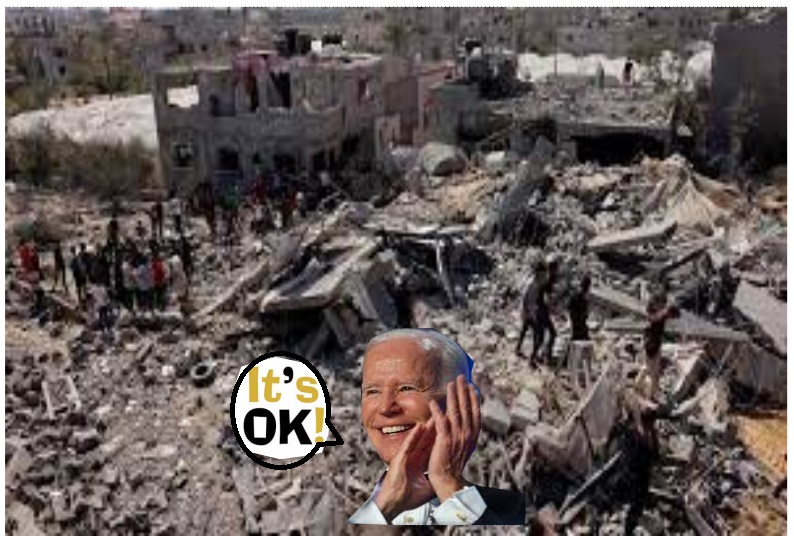
While the US says it put a hold on one shipment of 2,000-pound bombs, National Security Advisor Jake Sullivan said Monday that the US was still committed to Israel and would make sure it received all of the $17 billion in new military aid that was recently approved by Congres. “We are continuing to send military assistance, and we will ensure that Israel receives the full amount provided in the supplemental. We have paused a shipment of 2,000-pound bombs because we do not believe they should be dropped in densely populated cities. We are talking to the Israeli government about this,” he said.
Initial reports about the delayed bomb shipment said a pause was also put on a shipment of 500-pound bombs, but US officials are now only mentioning the 2,000-pound bombs. When asked to clarify if there was a hold on both, the State Department pointed Antiwar.com to the above statement from Sullivan.
Sullivan also made clear that Israel’s push into Rafah still hasn’t crossed Biden’s red line, if one exists at all. “We still believe it would be a mistake to launch a major military operation into the heart of Rafah that would put huge numbers of civilians at risk without a clear strategic gain. The president was clear he would not supply certain offensive weapons for such an operation, were it to occur. It has not yet occurred,” he said.
Before Israel launched its US-approved operation to capture the Rafah border crossing last week, it was estimated that the city was packed with about 1.4 million civilians. The UN said on Tuesday that about 450,000 Palestinians have been driven out of the city so far and are warning that there’s nowhere safe for them to go. The Israeli operation has also cut off aid deliveries through the vital Rafah border crossing, adding to the starvation blockade on the Strip.
US Says It Won’t Let Iran Build Nuclear Bomb

Iran International Newsroom, 14 May 24 https://www.iranintl.com/en/202405131207
The US will not allow Iran to build a nuclear bomb, the State Department said on Monday, one day after a senior Iranian official said Tehran would have no option but to change its nuclear doctrine in the face of Israel’s threats.
“[President] Biden and [US Secretary of State Antony] Blinken will not allow Iran to have a nuclear weapon,” State Department deputy spokesperson Vedant Patel said in a press briefing.
He made the remarks in reaction to Sunday comments by Kamal Kharrazi, a senior advisor to Iran’s ruler Ali Khamenei, that the Islamic Republic would be left with no option but to alter its nuclear doctrine if Israel threatened its nuclear facilities or its existence.
“We continue to assess, though, that Iran is not taking any key activities that would be necessary to produce a testable nuclear device,” Patel told Iran International correspondent Samira Gharaei.
Kharazi said on Sunday that Iran does “not possess nuclear weapons, and there is a fatwa from the leader regarding this matter. But what should you do if the enemy threatens you? You will inevitably have to make changes to your doctrine.”
Asked if these comments were a concern for the United States, Patel said, “We don’t believe that the Supreme Leader has yet made a decision to resume the (nuclear) weaponization program that we judge Iran suspended or stopped at the end of 2003.”
“We continue to assess, though, that Iran is not taking any key activities that would be necessary to produce a testable nuclear device,” Patel told Iran International correspondent Samira Gharaei.
Kharazi said on Sunday that Iran does “not possess nuclear weapons, and there is a fatwa from the leader regarding this matter. But what should you do if the enemy threatens you? You will inevitably have to make changes to your doctrine.”
Asked if these comments were a concern for the United States, Patel said, “We don’t believe that the Supreme Leader has yet made a decision to resume the (nuclear) weaponization program that we judge Iran suspended or stopped at the end of 2003.”
When asked about the Biden administration’s strategy toward a “nuclear threshold state” like Iran in the absence of ongoing negotiations, Patel told Iran International, “We have ways of communicating with Iran when it’s in our interest, I’m not going to comment on that.”
In a Monday press conference in Tehran, Iran’s foreign ministry spokesman suggested that Kharrazi’s remarks were not the official position of the Islamic Republic, and that Tehran’s nuclear doctrine has not changed.
“Iran’s official position on Weapons of Mass Destruction has been repeatedly declared by high-ranking Iranian officials, and there has been no change in Iran’s nuclear doctrine,” Nasser Kanaani told reporters in a briefing held on the sidelines of Tehran International Book Fair, citing a fatwa by Ali Khamenei on the prohibition of the production and use of nuclear weapons as the basis for Iran’s position.
However, the fatwa Iranian officials refer to is not an irrevocable principle. Islamic fatwas can change or be reversed at a moment’s notice, experts have pointed out. Also, the alleged Khamenei fatwa is not actually a religious order, it is part of a statement he submitted to an international conference more than a decade ago.
Khamenei may invoke the principle of expediency to overrule his “anti-Nuclear” fatwa. The principle of expediency, as decreed by the founder of the Islamic Republic Ayatollah Khomeini in January 1988, stipulates that the Supreme Leader may even violate the fundamental tenets of the Islamic faith in order to preserve “the Islamic Regime” as the preservation of the Islamic Regime supersedes all else.
Kharrazi on Sunday also raised the issue of Israel’s alleged nuclear arsenal and called for the Jewish state’s nuclear disarmament. “If Israel threatens other counties, they cannot remain silent,” he retorted.
Last week, Kharrazi had stated, “If they dare to strike Iran’s nuclear facilities, our level of deterrence will change. We have experienced deterrence at the conventional level so far. If they intend to strike Iran’s nuclear capabilities, naturally, it could lead to a change in Iran’s nuclear doctrine.”
In recent weeks, Iran has evoked the option of using the nuclear option as a deterrent against the possibility of an Israeli strike against its atomic facilities, amid a new reality in the Middle East after the October 7 Hamas attack.
On Friday, Iranian lawmaker Ahmad Bakhshayesh Ardestani claimed Iran might already possess a nuclear weapon.
He conveyed to the Rouydad 24 website his belief that Iran’s decision to risk attacking Israel in April stemmed from its possession of nuclear weapons.
Ali-Akbar Salehi, who was foreign minister more than a decade ago and is still a key foreign policy voice in the Iranian government, also said last month that Iran has everything it needed to build a nuclear bomb, as tensions rose with Israel amid the Gaza war.
In a televised interview in April, Salehi, was asked if Iran has achieved the capability of developing a nuclear bomb. Avoiding a direct answer he stated, “We have [crossed] all the thresholds of nuclear science and technology.”
Salehi’s statement was preceded by a declaration from a Revolutionary Guard general. In the midst of tensions between the Islamic Republic and Israel, Ahmad Haghtalab, the IRGC commander of the Guard for the Protection and Security of Nuclear Facilities, announced on April 19 that if Israel intends to “use the threat of attacking our nuclear facilities as a tool to pressure Iran, a revision of the nuclear doctrine and policies of the Islamic Republic of Iran and a shift from previously stated considerations is conceivable and likely.”
Since early 2021, when the Biden administration opted for negotiations to restore the Obama-era JCPOA agreement, Iran has vastly expanded its uranium enrichment efforts and is now believed to have amassed enough fissile material for 3-5 nuclear warheads.
Afghanistan flash floods kill more than 300 as torrents of water and mud crash through villages

More than 300 people were killed in flash floods that ripped through
multiple provinces in Afghanistan, the UN’s World Food Programme said, as
authorities declared a state of emergency and rushed to rescue the injured.
Many people remained missing after heavy rains on Friday sent roaring
rivers of water and mud crashing through villages and across agricultural
land in several provinces, causing what one aid group described as a
“major humanitarian emergency”.
Guardian 12th May 2024
Israel ‘Has Gone to War Against the Entire Palestinian People’: Sanders
“Any objective observer knows Israel has broken international law, it has broken American law, and, in my view, Israel should not be receiving another nickle in U.S. military aid,” Sanders said.
Common Dreams. OLIVIA ROSANE,13 May 24
Independent Vermont Sen. Bernie Sanders repeated his calls on Sunday for the U.S. to cut off military aid to the far-right government of Israeli Prime Minister Benjamin Netanyahu as it continues its devastating war on Gaza.
Sanders spoke on NBC’s “Meet the Press” in response to a U.S. State Department report released Friday, which found that it was “reasonable to assess” that Israel had used U.S. weapons to violate international humanitarian law in Gaza but that the U.S. was “not able to reach definitive conclusions” as to whether U.S. weapons had been used in any specific incidents.
“Any objective observer knows Israel has broken international law, it has broken American law, and, in my view, Israel should not be receiving another nickle in U.S. military aid,” Sanders said.

Friday’s report came in response to National Security Memorandum 20 (NSM-20), in which President Joe Biden tasked Secretary of State Antony Blinken with obtaining “certain credible and reliable written assurances from foreign governments” that they use U.S. arms in line with international humanitarian law and will not “arbitrarily deny, restrict, or otherwise impede, directly or indirectly, the transport or delivery of United States humanitarian assistance.”
The report, made to Congress, was criticized by human rights organizations who said it mischaracterized both the law and the facts in order to avoid imposing consequences on Israel for waging a war on Gaza that the International Court of Justice has determined could plausibly amount to genocide.
Speaking before Sanders on “Meet the Press,” Blinken denied that the report was an attempt to get out of holding Israel accountable………………………………………………………………………………….
Sanders told NBC that he thought many Republicans and also some Democrats wanted Israel to invade Rafah, but that this was not an opinion shared by the majority of people in the U.S.
“Poll after poll suggests that the American people want an immediate cease-fire. They want massive humanitarian aid to get in,” Sanders said. “The people of our country do not want to be complicit in the starvation of hundreds of thousands of children.” https://www.commondreams.org/news/sanders-israel-war-palestinian-people
United Nations General Assembly backs Palestinian bid for membership
Aljazeera, 10 May 24
Resolution does not give Palestine full UN membership, but recognises them as qualified to join and extends rights.
The United Nations General Assembly (UNGA) has backed a Palestinian bid to become a full UN member by recognising it as qualified to join and recommending the UN Security Council “reconsider the matter favourably”.
The vote by the 193-member UNGA on Friday was a global survey of support for the Palestinian bid to become a full UN member – a move that would effectively recognise a Palestinian state – after the United States vetoed it in the UN Security Council last month.
The assembly adopted a resolution on Friday with 143 votes in favour and nine against – including the US and Israel – while 25 countries abstained. It does not give the Palestinians full UN membership, but simply recognises them as qualified to join.
The UNGA resolution “determines that the State of Palestine … should therefore be admitted to membership” and it “recommends that the Security Council reconsider the matter favourably”.
While the UNGA alone cannot grant full UN membership, the draft resolution on Friday will give the Palestinians some additional rights and privileges from September 2024 – like a seat among the UN members in the assembly hall – but it will not be granted a vote in the body.
Reporting from the UN headquarters in New York, Al Jazeera’s Gabriel Elizondo said it was significant that such a high number of countries voted in favour of the resolution.
“What we were hearing before the vote was anywhere perhaps between 120, 130 – at top end, 140. The fact that they got 143 meets and exceeds all expectations. It’s been overwhelmingly passed,” he said.
“But they still only have observer status.”…………………………… more https://www.aljazeera.com/news/2024/5/10/un-general-assembly-backs-palestinian-bid-for-membership
Protest And Dissent Can Absolutely Push The Empire To Retreat On Gaza
CAITLIN JOHNSTONE, MAY 10, 2024, https://www.caitlinjohnst.one/p/protest-and-dissent-can-absolutely?utm_source=post-email-title&publication_id=82124&post_id=144490253&utm_campaign=email-post-title&isFreemail=true&r=1ise1&triedRedirect=true&utm_medium=email
It is entirely possible for the surging anti-genocide protest movement and its accompanying zeitgeist in the general public to push the empire to retreat on Gaza. The imperial murder machine has many strengths, but it also has weaknesses.
The globe-spanning power structure that is loosely centralized around Washington has invested in perception management more heavily than any other empire in history — that’s what you’re seeing with all the mass media propaganda, Silicon Valley algorithm manipulation, oligarch-funded think tanks, and mainstream culture manufacturing in New York and Hollywood. By using mass-scale psychological manipulation via the most sophisticated perception management system that has ever existed, the US-centralized empire is able to manufacture support for its agendas at home and abroad while dissuading the public from protest and revolution.
If too many people realize that their government is psychopathic and their news media and other indoctrination systems have been lying to them about it all their lives, the empire will lose the ability to propagandize them, because propaganda only works if you don’t know it’s happening to you. If too many people wake up from the propaganda matrix it won’t have any effect any longer, and without their propaganda our rulers cannot rule, because that’s the entire control system upon which their rule is premised
The empire therefore needs to tread very carefully when public opinion starts to turn against it, and retreat whenever public trust in imperial institutions would be compromised too severely for the empire to continue on a given path. It simply cannot afford to wake the public up from the propaganda-induced coma it has spent generations lulling them into.
What this means is that the empire can be pressured into retreat simply by spreading enough awareness and sowing enough opposition to its depraved actions. If enough eyes open to the truth of what’s happening in Gaza, there’s no amount of geostrategic middle east agendas or Israel lobby funding that can outweigh the empire’s existential need to prevent a mass-scale awakening from the mainstream imperial worldview and a transition into widespread revolutionary consciousness. The empire would necessarily need to step back before things reached that point, because its very existence depends on it.
The empire has been walking that line this entire time. Whenever you see it doing things like stepping back from regime change invasions of Cuba or Syria or refraining from going as authoritarian as it could go on a given issue, it isn’t because the empire suddenly evolved a conscience. It’s because it hasn’t yet succeeded in manufacturing public consent for such agendas, and imposing them before the public has been manipulated into accepting them would snap them out of the matrix of psychological control. They work so hard to manufacture public consent because they absolutely need it.
So the empire can be pressured on Gaza and on every other issue if enough people put enough energy into spreading awareness of the truth. That’s why the empire managers are freaking out about this new protest movement right now; they understand the absolutely fundamental role that narrative control plays in the existence of imperial power structures, and how much they stand to lose if it is taken away.
Israel carpet bombs Rafah after Hamas accepts ceasefire proposal, key border crossing with Egypt seized
The Cradle, Tue, 07 May 2024 https://www.sott.net/article/491214-Israel-carpet-bombs-Rafah-after-Hamas-accepts-ceasefire-proposal-key-border-crossing-with-Egypt-seized
An Israeli official said on 7 May that Tel Aviv is carrying out a “limited” operation in Rafah after Israel announced taking control of the southernmost city’s border crossing with Egypt.
This is a “limited operation,” the official told the Times of Israel. “It is being implemented to pressure Hamas” into accepting a ceasefire proposal.
CNN also cited a source saying that the “limited Israeli operation into Rafah is intended to keep pressure on Hamas to agree to a deal.”
Comment: Is this ‘limited operation’, apparently consisting of cowardly airstrikes, because even Israeli officials have admitted that, after their failed ground invasion in Gaza, to attempt the same in Rafah would likely be a ‘disaster‘ for the IDF?
srael announced Tuesday morning that it seized Gaza’s side of the Rafah border crossing.
“IDF forces led by Division 162 began a targeted activity to thwart terrorist targets of the terrorist organization Hamas in East Rafah; As part of the operation, the forces gained operational control over the Rafah crossing on the Gaza side, following intelligence information about terrorists using the crossing for terrorist purposes,” an army spokesman said.
Video footage on social media showed Israeli tanks at the Rafah crossing. The army had begun moving towards the crossing on Monday evening.
The launch of the operation at the crossing was accompanied by heavily intensified Israeli bombardment of Rafah, which has been under continuous Israeli airstrikes for weeks.
The UN warned on 7 May that the Israeli operation at the Rafah crossing poses a threat to aid deliveries into Gaza.
Rafah, Gaza’s southernmost city, is desperately overcrowded with over one million besieged Palestinians, most of whom were displaced from other places of the strip throughout the war. Israel claims the city is Hamas’ final stronghold and its key to victory in the war, and has for months been promising to invade the city.
Hundreds of Palestinians began fleeing the besieged city on 6 May.
The storming of Rafah came a day after Hamas informed Qatari and Egyptian mediators that it had accepted an updated proposal for a truce and prisoner exchange agreement. The resistance group had major issues with a previous Egyptian-drafted initiative that failed to guarantee a permanent ceasefire, an end to the war, and full Israeli withdrawal from Gaza.
The proposal approved by Hamas includes three 42-day phases, the Deputy Head of Hamas in Gaza, Khalil al-Hayya, told Al Jazeera, adding that the proposal would see “the complete withdrawal of Israel from Gaza, the return of the displaced, and a [prisoner-exchange deal].”
“The proposal includes in its second phase the direct announcement of a permanent cessation of military and hostile operations,” the Hamas official said, adding that “the ball is now in the court of the Israeli occupation.”
Sources in Israel told Hebrew Channel 13 on 6 May that Hamas has agreed to a “modified” Egyptian proposal that is “unacceptable” to Israel.
An Israeli official told AP on 4 May that Israel remains committed to attacking Rafah and will not accept a deal that includes an end to the war.
Report: Private US Security Firm To Take Control of Rafah Border Crossing!

This is an outrage!! The US is in this war!!
According to Haaretz, Israel, Egypt, and the US have agreed on the plan
by Dave DeCamp May 7, 2024, https://news.antiwar.com/2024/05/07/report-private-us-security-firm-to-take-control-of-rafah-border-crossing/
Haaretz reported on Tuesday that the US, Israel, and Egypt have agreed that control of the Rafah border crossing that connects Egypt and Gaza will be handed over to a private American security firm.
The report came after Israel captured the border crossing in an operation that was approved by the Biden administration. The private American firm was not named, but Haaretz said that it employs veterans of elite US Army units and has been employed in several Middle Eastern and African countries to guard sensitive sites.
State Department spokesman Matt Miller was asked about the report and said he wasn’t aware of any plan for Israel to transfer control of the border crossing.
Under the reported arrangement, American mercenaries would take responsibility for overseeing the border crossing, which would include monitoring goods coming into Gaza and preventing Hamas from taking control. Vital deliveries have been cut off since Israel took control of the crossing early Tuesday.
The Haaretz report said the arrangement was part of an effort by Israel to “win agreement” from the US and Egypt for a Rafah operation. The report said Israel had given assurances that it would limit its attack on Rafah to securing the border crossing, although Israeli bombs have been pounding the city.
Ghent students occupy university building in climate and Gaza protest
More than 200 expected to join protest calling for climate action and to cut ties with Israeli institutions
Arthur Neslen, Tue 7 May 24 https://www.theguardian.com/world/article/2024/may/06/ghent-students-occupy-university-building-in-climate-and-gaza-protest
More than 100 students have occupied Ghent University in the first European protest to fuse demands about Gaza and the climate crisis.
Ghent’s centrepiece UFO building was peacefully taken over by students calling for concrete action to meet the university’s 2030 climate plans, and asking the university to cut ties with institutions connected to the Israeli military.
Tents were erected inside the building, which contains all of the university’s administrative functions. Its 1,000-seater “guillotine wall” lecture hall was given over to an impromptu workshop on “how we can find hope in a world full of genocide and global warming”.
More than 200 Ghent students were expected to join the three-day protest as anger rose ahead of an expected Israeli assault on Rafah, while students at Amsterdam University also staged an occupation.
A spokesperson for the Ghent students who gave her name as Joelle said their action had grown out of an occupation last year by End Fossil Gent, and student rage over events in Gaza. A joint mobilising leaflet with Gent Students for Palestine used the theme of “free Palestine is a climate justice issue”.
“We realised that both our struggles were against the university’s failure to commit to values they claim to hold,” Joelle said.
“We can see that the struggle for Palestine is also a struggle for climate justice. The Israeli occupation force is committing an ecocide in Gaza, destroying all elements of life and nature.
“Israel’s settler ‘green colonialism’ destroys indigenous land and plants non-indigenous trees over ethnically cleansed villages.
“There are also issues of toxic pollution by settlers and the allocation of water and land. The two struggles are interconnected so climate activists are in solidarity with us on Palestine, and we realise that this is also a climate issue. Our demands go hand in hand.”
An open letter from the students says they want the university to publish a time-linked action plan for cutting ties with what they call “Israeli institutions complicit in the ongoing ethnic cleansing of Palestinians”.
Ghent University has links to a number of Israeli institutions that are said to provide “material” support to the war in Gaza or Israel’s occupation of the West Bank.
Tel Aviv University, with which Ghent has most partnerships, has drawn particular ire from students due to its role in Israel’s defence against genocide charges at the international court of justice in The Hague, and its academic support for soldiers in Gaza.
Equally, the students want “effective and binding action” to urgently implement the university’s 2030 climate transition plans, which they say would mean putting sustainability goals at the heart of budgetary and educational decisions.
Ghent University is committed to becoming progressively fossil fuel free, cutting its energy consumption by 2.5% each year and becoming climate neutral by 2050.
It also has a policy to achieve 80% “sustainable mobility” by 2030, in part by boosting bicycle infrastructure on campus. But students say that too little has been done.
The university did not respond to a request for comment but its director, Rick Van de Walle, posted a statement saying it had decided that its ethical policies would not change and that “no deviation from the existing human rights policy will be used with regard to one particular country, in this case Israel”
Biden Gave Netanyahu the Green Light To Capture Rafah Crossing
Axios reports that Biden and Netanyahu discussed the plan on Monday
by Dave DeCamp May 7, 2024 https://news.antiwar.com/2024/05/07/biden-gave-netanyahu-the-green-light-to-capture-rafah-crossing/
President Biden and Israeli Prime Minister Benjamin Netanyahu discussed Israel’s plans to capture the Rafah border crossing in southern Gaza before the Israeli military launched the operation, Axios reported on Tuesday.
The report said that the operation didn’t cross Biden’s “red line,” although it’s unclear if the US has actually set red lines for Israel. US officials have said they’re opposed to a “major operation” in Rafah since it would incur huge civilian casualties. But the capturing of the border crossing will have a devastating impact on civilians since it cut off vital aid deliveries, and it’s unclear when or if they will resume.
A senior Israeli official told Axios that during the call with Netanyahu, Biden didn’t “didn’t pull the hand break on the capture of the Rafah crossing during the call.” Two US officials said Biden didn’t view the current Israeli operations as a “breaking point” in relations.
On Tuesday, White House National Security Council spokesman John Kirby said that the US was not opposed to the operation.
“We’ve been very consistent about our concerns of a major ground operation in Gaza that would put at great risk the refugees that are still there, and nothing’s changed about that,” Kirby said. “The Israelis have told us … that that’s not what this is.”
He said that Israel assured the US that the operation was “of limited scope, scale, and duration, and aimed at cutting off Hamas’ ability to ship arms across the Rafah border.”
Israeli tanks and soldiers took the border crossing as Israeli strikes pounded the city of Rafah, killing at least 23 Palestinians, including five women and six children.
Let Israel’s Leaders Get Arrested for War Crimes

Gideon Levy, Haaretz, Sun, 05 May 2024 https://www.haaretz.com/opinion/2024-05-05/ty-article-opinion/.premium/let-them-get-arrested/0000018f-44af-d17f-adcf-fdef576b0000
All decent Israelis must ask themselves the following questions: Is their country committing war crimes in Gaza? If so, how should they be stopped?
How should the culprits be punished? Who can punish them? Is it reasonable for crimes to go unprosecuted and criminals to be exculpated?
One may, of course, reply in the negative to the first question – Israel is not committing any war crimes in Gaza – thereby rendering the rest of the questions superfluous.
But how can one answer in the negative in the face of the facts and the situation in Gaza:
about 35,000 people killed and another 10,000 missing, about two-thirds of them innocent civilians, according to the Israel Defense Forces;
among the dead are around 13,000 children, nearly 400 medical workers and more than 200 journalists; 70 percent of homes have been destroyed or damaged;
30 percent of children suffer from acute malnutrition;
two people in 10,000 die each day from starvation and disease. (All figures are from the United Nations and international organizations.)
Is it possible that these horrific figures came to be without the commission of war crimes?
There are wars whose cause is just and whose means are criminal; the justice of the war does not justify its crimes. Killing and destruction, starvation and displacement on this scale could not have occurred without the commission of war crimes. Individuals are responsible for them, and they must be brought to justice.
Israeli hasbara, or public diplomacy, does not try to deny the reality in Gaza. It only makes the claim of antisemitism: Why pick on us? What about Sudan and Yemen?
The logic doesn’t hold: A driver who is stopped for speeding won’t get off by arguing that he’s not the only one. The crimes and the criminals remain. Israel will never prosecute anyone for these offenses. It never has, neither for its wars nor its occupation. On a good day, it will prosecute a soldier who stole some Palestinian’s credit card.
But the human sense of justice wants to see criminals brought to justice and prevented from committing crimes in the future. By this logic, we can only hope that the International Criminal Court in The Hague will do its job.
Every Israeli patriot and everyone who cares about the good of the state should wish for this. This is the only way that Israel’s moral standard, according to which it is permitted everything, will change. It is not easy to hope for the arrest of the heads of your state and your army, and even more difficult to admit it publicly, but is there any other way to stop them?
The killing and destruction in Gaza has gotten Israel in way over its head. It is the worst catastrophe the state has ever faced. Someone led it there – no, not antisemitism, but rather its leaders and military officers. If not for them, it wouldn’t have turned so quickly after October 7 from a cherished country that inspired compassion into a pariah state.
Someone must stand trial for this.
Just as many Israelis want Benjamin Netanyahu to be punished for the corruption of which he is accused, so should they wish for him and the perpetrators subordinate to him to be punished for much more serious crimes, the crimes of Gaza.
They cannot be allowed to go unpunished.
Nor is it possible to blame only Hamas, even if it has a part in the crimes.
We are the ones who killed, starved, displaced, and destroyed on such a massive scale. Someone must be brought to justice for this.
Netanyahu is the head, of course. The picture of him imprisoned in The Hague together with the defense minister and the IDF chief of staff is the stuff of nightmares to every Israeli.
And yet, it is probably warranted.
It is highly unlikely, however. The pressure being exerted on the court by Israel and the United States are enormous (and wrong). But scare tactics can be important.
If the officials actually refrain from traveling abroad in the next few years, if they actually live in fear of what may come, we can be sure that in the next war, they’ll think twice before sending the military on campaigns of death and destruction of such insane proportions. We can find a little comfort in that, at least.
Israeli Invasion of Rafah Appears Imminent After Evacuation Order
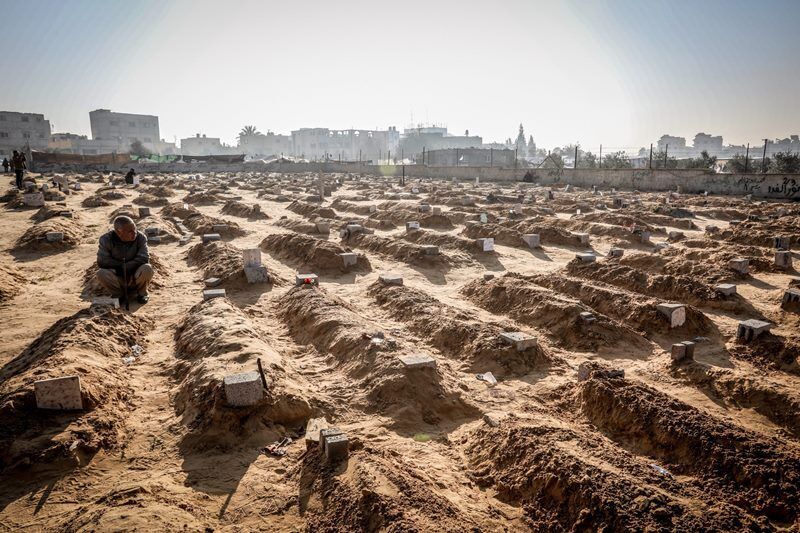
Israel dropped leaflets on eastern Rafah warning ‘extreme force’ will be used in the area
by Dave DeCamp, May 6, 2024 , https://news.antiwar.com/2024/05/06/israeli-invasion-of-rafah-appears-imminent-after-evacuation-order/
The Israeli invasion of Rafah appears to be imminent as Israeli forces dropped leaflets on the eastern part of the city, warning that “extreme force” will be used in the area.
The Israeli military said it ordered the evacuation of about 100,000 people and suggested they go to the al-Mawasi refugee camp on the coast. Aid groups have warned that an evacuation of civilians from Rafah, which is sheltering an estimated 1.4 million Palestinian civilians, is not possible because there’s nowhere to go due to the sheer destruction in Gaza.
In response to Israel’s evacuation order, the Norwegian Refugee Council (NRC) said al-Mawasi did not have the resources to take in the evacuees. The NRC warned that the “forced, unlawful” evacuation order could lead to “the deadliest phase of this conflict.”
The international charity Oxfam also strongly condemned the Israeli evacuation order and noted that Israel has repeatedly bombed areas it claimed were safe. “Oxfam condemns this forced evacuation order, the potential Rafah offensive, and the Biden administration’s unconditional support for Israel that has helped bring us to this point,” said Abby Maxman, CEO of Oxfam America.
“There is nowhere safe to go: for over six months, Israel has routinely killed civilians and aid workers, including in clearly marked ‘safe zones’ and ‘evacuation routes.’ The notion that the 100,000 civilians being evacuated by Israel will be safe and protected is simply not credible,” Maxman added.
US officials have claimed they’re opposed to Israel invading Rafah without a clear plan to protect civilians. But there’s no sign the Biden administration is putting any real pressure on Prime Minister Benjamin Netanyahu as Israel appears to be going ahead with the attack and US weapons shipments to Israel continue to flow.
Israeli bombs pounded Rafah before the evacuation order was issued, with reports of at least 22 civilians, including eight children, being killed in the strikes. Rafah residents said fresh Israeli strikes hit the city after the evacuation order as well.
Token gesture: Biden puts hold on approved shipments of ammo to Israel
SOTT, Hayden Cunningham, The Post Millennial, Mon, 06 May 2024
The Biden administration has halted a shipment of ammunition previously approved to aid Israel in its war efforts with Hamas.
This suspension of munition delivery is the first of its kind since the beginning of the recent conflict between Israel and Hamas last October, when Hamas attacked Israel, murdering 1,200, and Israel launched a full-scale retaliation. According to two Israeli officials who spoke to Axios, the ammunition shipment was stopped last week.
The White House has yet to officially comment on the decision.
In April, Nancy Pelosi and other Democratic representatives issued a signed letter that called on Biden to halt the sale of weapons to Israel, even as they encourage munitions to be sent to Ukraine. The lawmakers called it “unjustifiable” to approve weapons transfers to Israel after an Israeli airstrike that inadvertently killed several humanitarian workers
This recent move comes amidst growing criticism within President Biden’s own base regarding US support for Israel. As left-wing activists across the country have continually called for the US to withdraw its support from Israel, the Biden administration has appeared to soften its initial support for the Jewish state.

The timing of this decision also follows US Secretary of State Antony Blinken’s visit to Israel last Wednesday. During his visit, Blinken held discussions with Israeli Prime Minister Benjamin Netanyahu about potential military operations in Gaza.
Netanyahu has recently signaled Israel’s intention to launch an invasion of Rafah, a city in southern Gaza where there is a checkpoint between Gaza and Egypt that Egypt keep strictly controlled to prevent the flow of Palestinians into their nation. There have been ongoing efforts to negotiate a ceasefire with Hamas and secure the release of hostages, though Hamas has refused many of these attempts.
Comment: Actually it’s Israel who’s turned down most of the proposals. Any deal requiring them to withdraw from Gaza will interfere with their ongoing ethnic cleansing/genocide project.
…………………………………………… Last February, the Biden administration requested assurances from Israel that any US-made weapons would be used in compliance with international law. Israel responded by providing a signed letter in March affirming its commitment to this standard.
Comment: Biden’s floundering campaign is uppermost in the minds of his handlers. Given the unrest across US. campuses over the Palestinian genocide, it seems that he’s been advised to throw them a bone.
1 This Month
10 June – Assessing Canada’s Investments in Small Modular Nuclear Reactors – https://zoom.us/meeting/register/IiqHA5feRhaEBycOLNTJlA#/registration



Cuba Is Not a Failed State – It Is a Besieged State
PETITION: “Global Appeal to Endorse Palestinian Right of Return of Refugees”
To see nuclear-related stories in greater depth and intensity – go to https://nuclearinformation.wordpress.com
-
Archives
- June 2026 (68)
- May 2026 (306)
- April 2026 (356)
- March 2026 (251)
- February 2026 (268)
- January 2026 (308)
- December 2025 (358)
- November 2025 (359)
- October 2025 (376)
- September 2025 (257)
- August 2025 (319)
- July 2025 (230)
-
Categories
- 1
- 1 NUCLEAR ISSUES
- business and costs
- climate change
- culture and arts
- ENERGY
- environment
- health
- history
- indigenous issues
- Legal
- marketing of nuclear
- media
- opposition to nuclear
- PERSONAL STORIES
- politics
- politics international
- Religion and ethics
- safety
- secrets,lies and civil liberties
- spinbuster
- technology
- Uranium
- wastes
- weapons and war
- Women
- 2 WORLD
- ACTION
- AFRICA
- Atrocities
- AUSTRALIA
- Christina's notes
- Christina's themes
- culture and arts
- Events
- Fuk 2022
- Fuk 2023
- Fukushima 2017
- Fukushima 2018
- fukushima 2019
- Fukushima 2020
- Fukushima 2021
- general
- global warming
- Humour (God we need it)
- Nuclear
- RARE EARTHS
- Reference
- resources – print
- Resources -audiovicual
- Weekly Newsletter
- World
- World Nuclear
- YouTube
-
RSS
Entries RSS
Comments RSS
 nuclear-news