Trump Praises ‘Excellent’ Israeli Strikes on Iran.

A source said Washington provided Tel Aviv with “exquisite” intel for the assault
by Kyle Anzalone | Jun 13, 2025, https://news.antiwar.com/2025/06/13/trump-praises-excellent-israeli-strikes-on-iran/
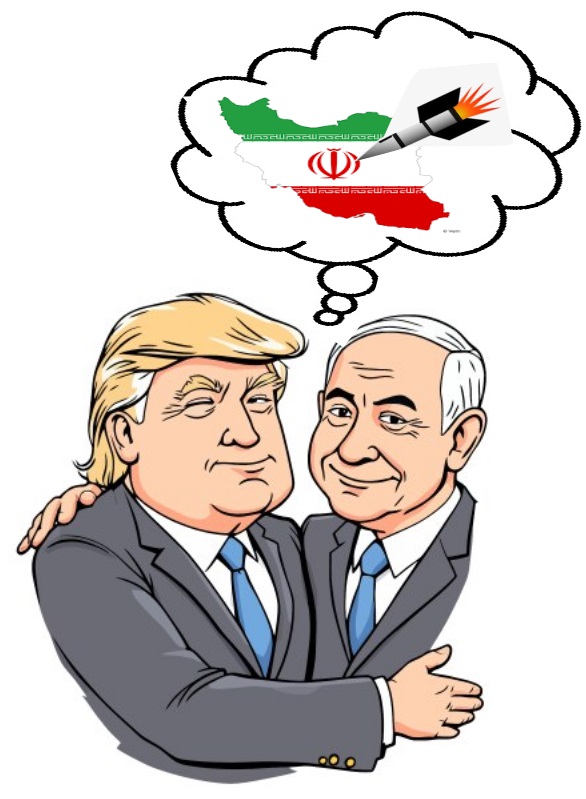
President Donald Trump endorsed the massive Israeli strike on Iran early on Friday morning, calling the attack “excellent.” A source explained that the US provided Israel with intelligence for the operation.
Speaking with ABC News on the phone following the Israeli strikes across the Islamic Republic, Trump said, “I think it’s been excellent.” He continued, “We gave them a chance and they didn’t take it. They got hit hard, very hard. They got hit about as hard as you’re going to get hit. And there’s more to come. A lot more.”
Trump refused to provide details about the US role in the attack, saying, “I don’t want to comment on that.”
However, elements of Washington’s support for Tel Aviv are becoming public. Israeli officials told the Jerusalem Post and Axios that the White House helped to create the illusion that the US was still seeking a diplomatic settlement with Iran.
Just hours before the attack, President Trump declared that he was committed to a “Diplomatic Resolution to the Iran Nuclear Issue!” But it appears he had already greenlit the Jewish state’s attack on the Islamic Republic.
A source provided further details of the US support, telling ABC News that Washington provided Tel Aviv with “exquisite” intelligence. Additionally, the source said the US will help Israel defend against any Iranian response.
The Iranian Foreign Ministry said in a statement that it holds the US responsible for the attack. “The Zionist regime’s aggressive actions against Iran cannot have been carried out without the coordination and authorization of the United States. Accordingly, the United States government, as the main supporter of this regime, will also be responsible for the dangerous effects and consequences of the Zionist regime’s adventure,” the ministry said.
Since starting the assault early Friday morning, Israeli forces have delivered multiple rounds of strikes targeting Iranian military sites, nuclear facilities, and residential buildings. Top Iranian nuclear scientists and generals have been confirmed killed.
Tel Aviv said the operation, dubbed “Nation of Lions,” will last several days.
Israel is seeking more support from the US. The Jerusalem Post reports that Israeli Defense Minister Israel Katz will hold a call with Secretary of Defense Pete Hegseth later on Friday to lobby Washington for more military assistance. Additionally, Trump is expected to speak with Israeli Prime Minister Benjamin Netanyahu by phone.
Kyle Anzalone is the opinion editor of Antiwar.com and news editor of the Libertarian Institute. He hosts The Kyle Anzalone Show and is co-host of Conflicts of Interest with Connor Freeman.
Israel claims it damaged Iran’s Natanz nuclear facility “significantly.” But questions remain
By François Diaz-Maurin Bulletin, June 13, 2025
Early Friday, Israel conducted air strikes on the Natanz nuclear facility, Iran’s main enrichment site. The strikes were part of a larger operation by the Israeli military that targeted nuclear sites, long-range missile facilities, military leaders, and nuclear scientists across Iran.
It was not clear how much damage the Natanz nuclear site—which hosts both a commercial fuel enrichment plant for use in things such as powering civilian nuclear reactors, and the more technologically advanced and opaque so-called pilot fuel enrichment plant (PFEP)—had sustained from the strike. Israel’s military published its own assessment of the attack, claiming that they have damaged the underground area of the site. This area reportedly contains a multi-story enrichment hall with centrifuges, electrical rooms, and additional supporting infrastructure, which can be used to enrich uranium to military-grade levels. During a briefing, Israel Defense Forces (IDF) spokesperson Efi Defrin said the Natanz nuclear site was “significantly damaged.
“It’s difficult to assess the consequences of the strikes on the nuclear program itself and the facilities, as we are still waiting for independent analyses of the satellite imagery,” Héloïse Fayet, a research fellow at the French Institute of International Relations and an expert of nuclear proliferation in the Middle East, told the Bulletin.
Unverified footage shared on social media from near the Natanz facility seemed to show repeated explosions at four locations. This seems to be consistent with the description of the facility, believed to consist of three underground buildings and six above-ground buildings.
As the operation was reportedly still ongoing, many questions about the attack remain unanswered. Here are some of the unknowns about the attack.
When will the attack be over? During a live briefing on Friday morning, Defrin said that “more than 100 targets have been struck across Iran.” And in his address, Netanyahu said that the operation “will continue for as many days as it takes to remove that threat.”
Defrin added that pilots were “still striking military targets and targets from the nuclear program across different areas in Iran,” which the Israeli military said involved about 200 fighter jets.
It is not clear how long the attack will last.
What are the other nuclear facilities targeted? On early Friday, the IAEA confirmed with Iranian authorities that the Fordow fuel enrichment plant, located near Qom in central Iran, had not been targeted during Israel’s attack. But new reports later suggested that Israel was actively attacking the plant, with residents reportedly having heard large explosions coming from the plant’s underground complex and smoke seen rising from several locations in the vicinity of the site.
The IAEA also said the Isfahan nuclear complex had not been targeted, contradicting reports of explosions near the site. The Isfahan Nuclear Technology Center, located 340 kilometers south of Tehran, hosts nuclear research reactors, a uranium conversion plant, and a fuel production plant, among other facilities. On Friday evening, the IDF confirmed that it also targeted the Isfahan complex, but offered no evidence.
Was the United States involved in the attack? According to The Washington Post, Trump officials have said that there was no US military support in the attack. But it is still unknown whether the United States provided indirect intelligence or logistical support for the attack.
Some news reports claim Israeli officials as saying that the United States may be opposing the attack only publicly, adding that the Trump administration did not express opposition in private. “We had a clear US green light,” one official reportedly told Axios.
Was the attack necessary? Israel’s military called its operation “preemptive” due to the imminent nuclear threat from Iran. During his address moments after launching the attack, Israel Prime Minister Benjamin Netanyahu said the operation was necessary because “Iran has produced enough highly enriched uranium for nine atom bombs,” adding that “Iran could produce a nuclear weapon in a very short time.” For its part, Israel’s military said “[Iran’s] program has accelerated significantly in recent months, bringing the regime significantly closer to obtaining a nuclear weapon.”
Reports that Israel was preparing to conduct such attacks have been made for over a year, and right-wing columnists have, for years, openly called on Israel to do so.
But several agencies and analysts dispute the claim that the threat of an Iranian nuclear bomb was imminent. A May 22 report to the House Foreign Affairs Committee concluded that “the US intelligence community continues to assess that Iran is not currently undertaking nuclear weapons-related activities,” although adding that “Iran could enrich enough uranium for more than a dozen nuclear weapons within weeks if it chose to do so.”……………………………………………………….
Did the attack successfully roll back Iran’s nuclear program? Despite several Iranian nuclear facilities reported as being targeted by heavy military strikes, it is difficult at this stage to assess how successful Israel’s operation has been, especially as it was still ongoing as of Friday evening.
But Jon Wolfsthal, a nuclear expert and director of global risk at the Federation of American Scientists, is skeptical that the attack may have significantly altered Iran’s nuclear program. “Iran has likely been planning for this day for months or years. We have to assume they have stored a lot of capabilities to rebuild and even to build a weapon in short order.”
According to Wolfsthal, Israel’s attack may be counterproductive.
“You cannot bomb away a nuclear program.” https://thebulletin.org/2025/06/israel-claims-it-damaged-irans-natanz-nuclear-facility-significantly-but-questions-remain/
We Are, Of Course, Being Lied To About Iran
The western political/media class have been dutifully promoting this line and uncritically parroting Israel’s claim that its unprovoked attack on Iran was “preemptive”, but there is absolutely no evidence that any of this is true.
Caitlin Johnstone, Jun 15, 2025, https://www.caitlinjohnst.one/p/we-are-of-course-being-lied-to-about?utm_source=post-email-title&publication_id=82124&post_id=165951075&utm_campaign=email-post-title&isFreemail=true&r=1ise1&triedRedirect=true&utm_medium=email
Iran and Israel are at war, with the US already intimately involved and likely to become more so. Which of course means we’ll be spending the foreseeable future getting bashed in the face with lies from the most powerful people in the world.
The most immediately obvious of these is the Netanyahu-promoted narrative that Israel initiated this conflict because Iran was on the brink of developing a nuclear weapon. With absolutely no self-consciousness or sense of irony, the Israeli prime minister followed the attacks with a statement accusing Iran of “genocidal rhetoric” which it has backed up “with a program to develop nuclear weapons.” Israel, as we all know, has an unacknowledged nuclear arsenal, and its leaders are presently committing genocide in Gaza while spouting genocidal rhetoric.
“And if not stopped, Iran could produce a nuclear weapon in a very short time,” Netanyahu claimed. “It could be a year. It could be within a few months — less than a year. This is a clear and present danger to Israel’s very survival.”
The western political/media class have been dutifully promoting this line and uncritically parroting Israel’s claim that its unprovoked attack on Iran was “preemptive”, but there is absolutely no evidence that any of this is true.
Benjamin Netanyahu has spent literally decades falsely claiming that Iran was a year or two away from developing a nuke, only to have the calendar prove him wrong with the passage of time over and over again.
US intelligence chief Tulsi Gabbard testified just weeks ago that “The IC [Intelligence Community] continues to assess that Iran is not building a nuclear weapon and Supreme Leader Khamenei has not authorized the nuclear weapons program he suspended in 2003.”
As journalist Séamus Malekafzali recently noted on Twitter, one of the strongest arguments that Iran had not reversed its decision to refrain from obtaining nuclear weapons is that Iranian nuclear scientists have been publicly expressing frustration about the fact that their government won’t allow them to construct a nuke. They want to do it, but Tehran won’t let them.
US Secretary of Defense Pete Hegseth helped pave the way for Netanyahu’s claims this past Wednesday when he told the Senate that “there have been plenty of indications” Iran has been “moving their way toward something that would look a lot like a nuclear weapon.”
This claim by Hegseth was swiftly scooped up and promoted by warmongers like Tom Cotton who said that Hegseth had “confirmed that Iran’s terrorist regime is actively working towards a nuclear weapon.”
Cotton’s claim was then picked up by war pundit Mark Levin, who has been personally lobbying Trump to green light an attack on Iran, sarcastically quipping on Twitter, “So, SecDef Hegseth must by lying, too. Everyone’s lying except the isolationists, Koch-heads, Islamists, Chatsworth Qatarlson and their media propagandists.”
But let’s back up and look at what Hegseth actually said. He did not say “Iran is building a nuclear weapon.” He said “there have been plenty of indications” Iran has been “moving their way toward something that would look a lot like a nuclear weapon.”
If the US had intelligence that Iran was building a nuke, Hegseth would have just said so. But instead he performed this freakish verbal gymnastics stunt muttering about indications of something that might kinda sorta look like a nuclear weapon, which his fellow Iran hawks then falsely took and ran with as a positive assertion that Iran was building a nuke.
There are other lies being circulated to help market this war as well. As Moon of Alabama notes, the Washington Post’s odious war propagandist David Ignatius is pushing the narrative that Iran has been cultivating a relationship with de-facto al-Qaeda leader Saif al-Adel. The lie that Saddam Hussein was in league with al-Qaeda was used two decades ago to sell the invasion of Iraq.
At the same time, Trumpian pundits are currently circulating the narrative that the United States is full of Iranian “sleeper cells” who could activate at any moment and begin attacking Americans. The most egregious of these is Laura Loomer’s repeated claims that there are “millions” of such cells awaiting Iran’s orders to strike — possibly the single most bat shit insane claim I have ever seen anyone with any major platform make, since it would mean a very sizable percentage of the US population is actually a secret Iranian proxy army.
The fountain of lies is just getting started. There will be more. Believe nothing unless it is substantiated by mountains of evidence. These freaks have been caught lying to sell wars to the public far too many times for any of their claims to be taken on faith.
Was Iran months away from producing a nuclear bomb?
The Israeli military said it had accumulated intelligence showing that
“concrete progress” had been made “in the Iranian regime’s efforts to
produce weapons components adapted for a nuclear bomb”, including a uranium
metal core and a neutron source initiator for triggering the nuclear
explosion. Kelsey Davenport, director for non-proliferation policy at the
US-based Arms Control Association, said Israel’s prime minister “did not
present any clear or compelling evidence that Iran was on the brink of
weaponizing”. “Iran has been at a near-zero breakout for months,” she told
the BBC, referring to the time it would take Iran to acquire enough fissile
material for one bomb if it chose to do so.
“Similarly, the assessment that
Iran could develop a crude nuclear weapon within a few months is not new.”
She said some of Iran’s nuclear activities would be applicable to
developing a bomb, but US intelligence agencies had assessed that Iran was
not engaged in key weaponization work.
BBC 14th June 2025, https://www.bbc.co.uk/news/articles/cn840275p5yo
Israeli strikes on Iran nuclear sites ‘risk radioactive releases’
Nuclear chiefs warn that Israeli strikes on Iranian nuclear sites mark a dangerous violation of international protocol.
Kieron Monks, June 14, 2025
Nuclear chiefs warn that Israeli strikes on Iranian nuclear sites mark a
dangerous violation of international protocol. Israeli attacks on Iranian
nuclear sites are a ‘deeply concerning’ development, the IAEA says.
IAEA Director General Rafael Grossi said his agency was in contact with
Iranian authorities to assess the impact of Israeli strikes on “nuclear
security and safety.” Grossi reported that there were no “elevated
radiation levels” at the Natanz complex after it came under fire. Another
key nuclear site, Fordow, was reportedly also targeted.
“This development is deeply concerning,” said Grossi. “I have repeatedly stated that
nuclear facilities must never be attacked, regardless of the context or
circumstances, as it could harm both people and the environment.” He
further noted “armed attacks on nuclear facilities could result in
radioactive releases with grave consequences within and beyond the
boundaries of the State which has been attacked” and called for
“maximum restraint to avoid further escalation.” US intelligence
currently assesses that Iran has not moved to weaponise its nuclear
programme, although it has enriched uranium beyond the level required for
civilian use.
iNews 14th June 2025, https://inews.co.uk/news/world/israeli-strikes-on-iran-nuclear-sites-risk-radioactive-releases-3749016
The ‘unsustainable’ reason behind who can have nuclear weapons, and who can’t

there was no evidence of active weaponisation, or that Israel’s strike was “pre-emptive in the sense that Iran was clearly planning an attack on Israel that was imminent”.
“the most flagrant example of double standards that you could possibly imagine”.
Israel has said its attack on Iran on Friday was partially aimed at destroying its nuclear infrastructure. But it’s far from the only country to have developed its capacity in recent years.
By Alex Gallagher, 16 June 2025, https://www.sbs.com.au/news/article/the-unsustainable-decision-on-who-gets-to-have-nuclear-weapons-and-who-doesnt/dpk5breh3
On Friday, Israel launched its largest attack on Iran in decades, with a wave of airstrikes that hit nuclear facilities, military sites and residential buildings in the capital, Tehran.
Iran responded with retaliatory strikes on Israel, and the two countries have continued trading missile fire for days.
Iran’s health ministry said 224 people have been killed by Israel’s attacks, while Israel said 13 have been killed by Iranian strikes. Hundreds of people have been wounded in both countries.
Israeli Prime Minister Benjamin Netanyahu said the goal of Friday’s strikes was partially to wipe out Iran’s nuclear program, calling the strikes “pre-emptive”.
The strikes caused significant damage to linked sites such as the Natanz nuclear facility and a uranium enrichment facility in Isfahan, and killed multiple nuclear scientists in addition to military officials and civilians.
Israel has long claimed Iran is developing a nuclear weapon, with Netanyahu calling it an “existential threat to Israel”.
Iran has consistently denied it is developing nuclear weapons, saying its uranium enrichment program is exclusively for peaceful purposes such as energy, and international assessments have found no evidence that Iran, over the past 20 years, has had an active nuclear weaponisation program.
Iran’s Supreme Leader, Ayatollah Ali Khamenei, has repeatedly said there is an Islamic fatwa — a legal ruling — against the development of nuclear weapons, and that such development is prohibited under Islamic law.
Shortly before Israel’s strikes on Iran, the United Nations’ global nuclear watchdog, the International Atomic Energy Agency (IAEA), declared Iran was in breach of its non-proliferation obligations for the first time in 20 years.
The IAEA cited “many failures” since 2019 to uphold its obligations to provide the agency with “full and timely co-operation regarding undeclared nuclear material and activities”.
Earlier this month, the IAEA said Iran had enough uranium enriched to near-weapons grade to potentially make nine nuclear bombs.
In recent days, Foreign Minister Penny Wong, Defence Minister Richard Marles and Opposition leader Sussan Ley have all described Iran’s nuclear program as a significant “threat” to international peace and security.
Tilman Ruff is an honorary principal fellow at The University of Melbourne and the co-president of International Physicians for the Prevention of Nuclear War and was a founding chair of the International Campaign to Abolish Nuclear Weapons.
He told SBS News while it’s “pretty clear that Iran was flirting with nuclear weapons” and had an early nuclear weapons program around 20 years ago, there was no evidence of active weaponisation, or that Israel’s strike was “pre-emptive in the sense that Iran was clearly planning an attack on Israel that was imminent”.
Israel has never formally confirmed or denied if it has nuclear weapons itself, long maintaining a policy of deliberate ambiguity.
It’s also never signed two key international agreements aimed at the non-proliferation and prohibition of nuclear weapons. These factors have contributed to the widely held perception that Israel owns nuclear weapons.
Ruff described Israel’s “extremely dangerous” attack on Friday as “the most flagrant example of double standards that you could possibly imagine”.
When it comes to countries developing nuclear capacities, Ruff said the “inherent ambiguity” of nuclear programs made it a far bigger issue than just Iran.
“Any country that’s determined to do so, that’s got either an enrichment plant or a nuclear reactor, can build a nuclear weapon,” he said.
“If you can produce uranium to run in reactors, then you’ve got everything you need to enrich it to weapons grade. And there are other countries with vast stocks much larger than Iran’s of weapons-usable material.
“There are many other countries who have been flirting with having nuclear facilities and the capacity to produce fissile material quickly to shorten the path to a weapon, should they choose to do so.”
Which countries have nuclear weapons?
Eight countries have declared they have nuclear weapons: Russia, the United States, China, France, the United Kingdom, India, Pakistan and North Korea.
Russia and the US control the vast majority of these weapons, together possessing around 90 per cent of the 12,241 estimated warheads that exist globally, according to the Stockholm International Peace Research Institute (SIPRI).
While Israel is also strongly believed to have nuclear weapons, including by SIPRI, it has long maintained a policy of deliberate ambiguity.
Ruff said there had been “very clear threats” of nuclear weapon use from Israeli government members.
Most recently, in November 2023, Israeli minister Amihai Eliyahu said a nuclear strike on Gaza would be “one way” of responding to Hamas’ October 7 attack on Israel.
Some viewed Eliyahu’s comments as an implicit admission that Israel had nuclear capabilities.
The comments were disavowed by Israeli politicians, including a rebuke by Netanyahu.
SIPRI, in its annual assessment of armaments, disarmament and international security on Monday, warned the world’s nuclear arsenals were being enlarged.
SIPRI stated that the nine nuclear-armed states continued to modernise and upgrade their nuclear capabilities throughout 2024.
SIPRI’s Hans M Kristensen said: “The era of reductions in the number of nuclear weapons in the world, which had lasted since the end of the Cold War, is coming to an end.”
“Instead, we see a clear trend of growing nuclear arsenals, sharpened nuclear rhetoric and the abandonment of arms control agreements.”
What steps have been taken to limit nuclear weapons?
Multiple international agreements have aimed at curbing the spread of nuclear weapons with a view towards disarmament.
The United Nations-backed Treaty on the Non-Proliferation of Weapons (NPT) came into effect in 1970, and included agreements from Russia, the US, the UK, China and France.
Those states agreed to pursue disarmament in exchange for the rest of the treaty’s signatories agreeing never to acquire nuclear weapons.
The treaty has overwhelming support, with 191 states being party to it, including Iran.
Israel is one of the few countries — along with India, Pakistan, North Korea and South Sudan — to not have signed on, due to its policy of deliberate ambiguity.
Ruff said a shortcoming of the treaty was that, while it contained a detailed regime regarding non-proliferation by states that didn’t already have nuclear weapons, there were no clear details or timeframe for other countries to implement disarmament.
Condemning the Right to Self Defence: Iran’s Retaliation and Israel’s Privilege
16 June 2025 Dr Binoy Kampmark , https://theaimn.net/condemning-the-right-to-self-defence-irans-retaliation-and-israels-privilege/
There is a throbbing complaint among Western powers, including those in the European Union and the United States. Iran is not playing by the rules. Instead of accepting with dutiful meekness the slaughter of its military leadership and scientific personnel, Tehran decided, promptly, to respond to Israel’s pre-emptive strikes launched on June 13. Instead of considering the dubious legal implications of such strikes, an act of undeclared war, the focus in the European Union and various other backers of Israel has been to focus on the retaliation itself.
To the Israeli attacks conducted as part of Operation Rising Lion, there was studied silence. It was not a silence observed when it came to the invasion of Ukraine in February 2022 by Vladimir Putin’s Russia. Then, the law books were swiftly procured, and obligations of the United Nations Charter cited under Article 2(4): “All members shall refrain from the threat or use of force against the territorial integrity of any state.” Russia was condemned for adopting a preventive stance on Ukraine as a threat to its security: that, in Kyiv joining NATO, a formidable threat would manifest at the border.
In his statement on the unfolding conflict between Israel and Iran, France’s President Emmanuel Macron made sure to condemn “Iran’s ongoing nuclear program,” having taken “all appropriate diplomatic measures in response.” Israel also had the “right to defend itself and ensure its security,” leaving open the suggestion that it might have been justified resorting to Article 51 of the UN Charter. All he could offer was a call on “all parties to exercise maximum restraint and to de-escalate.”
In a most piquant response, Francesca Albanese, UN Special Rapporteur on the Occupied Palestinian Territories stated that, “On the day Israel, unprovoked, has attacked Iran, killing 80 people, the president of a major European power, finally admits that in the Middle East, Israel, and only Israel, has the right to defend itself.”
The German Foreign Office was even bolder in accusing Iran of having engaged in its own selfish measures of self-defence (such unwarranted bravado!), something it has always been happy to afford Israel. “We strongly condemn the indiscriminate Iranian attack on Israeli territory.” In contrast, the foreign office also felt it appropriate to reference the illegal attack on Iran as involving “targeted strikes” against its nuclear facilities. Despite Israel having an undeclared nuclear weapons stockpile that permanently endangers security in the region, the office went on to chastise Iran for having a nuclear program that violated “the Non-Proliferation Treaty,” threatening in its nature “to the entire region – especially Israel.” Those at fault had been found out.
The President of the EU Commission, Ursula von der Leyen, could hardly improve on that apologia. She revealed that she had been conversing with Israeli President Isaac Herzog about the “escalating situation in the Middle East.” She also knew her priorities: reiterating Israel’s right to self-defence and refusing to mention Iran’s, while tagging on the statement a broader concern for preserving regional stability. The rest involved a reference to diplomacy and de-escalation, toward which Israel has shown a resolute contempt with regards Iran and its nuclear program.
The assessment offered by Mohamed ElBaradei, former Director General of the International Atomic Energy Agency (IAEA), was forensically impressive, as well as being icily dismissive. Not only did he reproach the German response for ignoring the importance of Article 2(4) of the Charter prohibiting the use of force subject to the right to self-defence, he brought up a reminder: targeted strikes against the nuclear facilities of any party “are prohibited under Article 56 of the additional protocol of the Geneva Conventions to which Germany is a party.”
ElBaradei also referred anyone exercised by such matters to the United Nations Security Council 487 (1981), which did not have a single demur in its adoption. It unreservedly condemned the attack by Israel on Iraq’s Osirak nuclear research reactor in June that year as a violation of the UN Charter, recognised that Iraq was a party to the Treaty on the Non-Proliferation of Nuclear Weapons (NPT) and had permitted the IAEA inspections of the facility, stated that Iraq had a right to establish and develop civilian nuclear programs and called on Israel to place its own nuclear facilities under the jurisdictional safeguards of the IAEA.
The calculus regarding the use of force by Israel vis-à-vis its adversaries has long been a sneaky one. It is jigged and rigged in favour of the Jewish state. As Trita Parsi put it with unblemished accuracy, Western pundits had, for a year and a half, stated that Hamas, having started the Gaza War on October 7, 2023 bore responsibility for civilian carnage. “Western pundits for the past 1.5 days: Israel started the war with Iran, and if Iran retaliates, they bear responsibility for civilian deaths.” The perceived barbarian, when attacked by a force seen as superior and civilised, will always be condemned for having reacted most naturally, and most violently of all.
Sources: US Will Enter Israel’s War With Iran
By Dave DeCamp / Antiwar.com, June 16, 2025, https://scheerpost.com/2025/06/16/sources-us-will-enter-israels-war-with-iran/
Sources familiar with the matter have told Antiwar.com Editorial Director Scott Horton that the Trump administration is poised to enter Israel’s aggressive war against Iran directly. US airstrikes on Iran could begin as soon as Monday.
Please contact the White House by sending an email or calling the comment line starting at 10 am EST on Monday (202‑456‑1111). Tell them that you do not want the US to enter this disastrous war, which could lead to heavy American casualties at US bases across the Middle East.
The US has supported the war by reportedly providing Israel with intelligence and helping intercept Iranian missiles and drones, but so far, there have been no direct US attacks on Iran. Iranian officials have warned that Tehran would hit US bases in the region in response to any US strikes.
Axios reported on Saturday that Israel is urging the US to join the war since Israel lacks the bunker-busting bombs necessary to do serious damage to Iran’s Fordow plant, which is buried deep underground. An Israeli official told Axios that President Trump had previously suggested the US could strike Fordow.
Trump himself said on Sunday that it was “possible” that the US would get directly involved in the war, which Israel launched early Friday morning with airstrikes across Iran.
Israeli Prime Minister Benjamin Netanyahu started the war under the pretext of preventing Iran from building a nuclear weapon. But it was the consensus of the US intelligence community that there was no evidence Iran was working toward a nuclear weapon, and Tehran made clear they were ready to make a deal with the US that would significantly lower uranium enrichment levels and increase oversight of its nuclear program in exchange for US sanctions relief.
Ali Larijani, an aide to Iranian Supreme Leader Ayatollah Ali Khamenei, has previously said that the one thing that would make Tehran reconsider its prohibition on the development of nuclear weapons would be a US or Israeli attack.
“We are not moving towards (nuclear) weapons, but if you do something wrong in the Iranian nuclear issue, you will force Iran to move towards that because it has to defend itself,” Larijani said on April 1.
“Iran does not want to do this, but … (it) will have no choice,” he added. “If at some point you (the US) move towards bombing by yourself or through Israel, you will force Iran to make a different decision.”
Injustice of nuclear-weapons state Israel’s strikes against Iranian nuclear sites
Your leading article (“Reckoning”, Jun 14) states: “No
country can be expected to stand idly by while an avowed enemy works
steadily, decade after decade, in secret to create the ultimate weapon.”
Although written to justify Israel’s actions, this sentiment surely applies
both ways. Israel’s nuclear programme is shrouded in secrecy and the
country is not a signatory to the Nuclear Non-Proliferation Treaty.
Furthermore, Israel does not accept International Atomic Energy Authority
scrutiny of its activities, whereas Iran was locked in via the Obama
agreement. It’s this kind of asymmetric situation that is likely to fuel a
sense of injustice and unfairness in the minds of Iranians, and a
determination to strengthen their position by creating a nuclear weapon.
Times 16th June 2025, https://www.thetimes.com/comment/letters-to-editor/article/times-letters-israels-strikes-against-iranian-nuclear-sites-kvtkkqtst
Iran and Israel at War
Trump reaffirmed his support for Israel and called the overnight strikes “a very successful attack.”
June 13, 2025 , https://thecradle.co/articles/iran-and-israel-at-war
Iran commenced its retaliation against Israel late on 13 June, unleashing a massive barrage of missiles aimed at the city of Tel Aviv, which resulted in multiple direct hits, including strikes on the Israeli army headquarters.
Tehran targeted “dozens of targets, military centers and air bases” across Israel, according to a statement by the Islamic Revolutionary Guard Corps (IRGC). It said the operation was named “True Promise 3.”
The US-Israeli war that was launched overnight on Friday killed several nuclear scientists and high-ranking members of the IRGC.
Air defenses remained active in the Iranian capital, Tehran, and near strategic nuclear sites as Israeli warplanes bombed the country throughout most of the day.
“We knew everything, and I tried to save Iran humiliation and death. I tried to save them very hard because I would have loved to have seen a deal worked out. They can still work out a deal however, it’s not too late,” US President Donald Trump told Reuters.
“We are in a historic event. This is not an operation, this is a planned war, 1,500 kilometers from Israel,” an Israeli army official told reporters on Friday evening.
Israeli warplanes launched surprise attacks across Iran during the early hours of 13 June, targeting Iranian nuclear facilities, army bases, missile storage sites, and residential neighborhoods as part of Operation ‘Lion’s Courage.’
At least 78 people have been confirmed killed and 329 injured.
Tehran has suspended all domestic and international flights, according to the civil aviation authority, as Israeli strikes continued Friday morning across various cities, including Tabriz, Kermanshah, Hamedan, Qasr-e Shirin, and Kangavar.
“With this crime, [Israel] has prepared a bitter and painful fate for itself, and it will inevitably face it. It must await severe punishment, for the powerful arm of the armed forces of the Islamic Republic of Iran will not leave it alone, God willing,” Iranian Supreme Leader Ali Khamenei said following the start of the US-Israeli war.
“The people of Iran and the country’s officials will not remain silent in the face of this crime, and the legitimate and powerful response of the Islamic Republic of Iran will make the enemy regret their foolish actions,” Iranian President Masoud Pezeshkian said in a message on Friday.
Iranian drones have been reportedly shot down over the skies of several Arab nations on their way to Israel. The Iranian military is reportedly preparing a significant ballistic missile attack in retaliation.
The UN Security Council is expected to meet later on Friday at the request of Tehran, according to unnamed diplomats who spoke with Reuters.
In a phone interview with CNN, Trump reaffirmed his support for Israel and called the overnight strikes “a very successful attack.”
“Iran should have listened to me when I said — you know I gave them, I don’t know if you know but I gave them a 60-day warning and today is day 61,” Trump said.
“They should now come to the table to make a deal before it’s too late. It will be too late for them. You know the people I was dealing with are dead, the hardliners … They didn’t die of the flu; they didn’t die of Covid,” the president added.
USA participated in Israeli air defense using Patriot and THAAD systems
Patriot and THAAD missile defense batteries, operated by U.S. military personnel and originally deployed under the Biden administration, participated in Israeli air defense Friday evening, according to U.S. defense officials who spoke on the condition of anonymity to discuss the sensitive subject. That represented a more limited participation in Israel’s defense than last year, when American air and sea assets helped shoot down incoming Iranian missiles during two retaliatory Iranian attacks. – from https://www.washingtonpost.com/world/2025/06/12/israel-attacks-iran-tehran-explosions/#link-45PWIAZSNNE57OYKVRHWOA6Z3I
Refresher On The Rules For Discussing Israeli Wars
Caitlin Johnstone, Jun 13, 2025, https://www.caitlinjohnst.one/p/refresher-on-the-rules-for-discussing?utm_source=post-email-title&publication_id=82124&post_id=165865670&utm_campaign=email-post-title&isFreemail=true&r=1ise1&triedRedirect=true&utm_medium=email
Okay it’s been a few months since the last war Israel started, so now that Iran’s on the chopping block let’s go over the rules once again.
Rule 1: Israel is never the aggressor. If Israel attacks someone it’s either a response to an aggression that happened in the past, or a preemptive attack to thwart an imminent aggression in the future.
Rule 2: History automatically restarts at the date of the last act of aggression against Israel. If someone attacks Israel it was completely unprovoked, because nothing happened before the attack on Israel.
Rule 3: Anything bad that Israel does is justified by Rule 2. This is true even if it does things that would be considered completely unjustifiable if it were done by a nation like Russia or China.
Rule 4: Israel has a right to defend itself, but nobody else does.
Rule 5: Israel never bombs civilians, it bombs Bad Guys. If shocking numbers of civilians die it’s because they were actually Bad Guys, or because Bad Guys killed them, or because a Bad Guy stood too close to them. If none of those reasons apply then it’s for some other mysterious reason we are still waiting for the IDF to investigate.
Rule 6: Criticizing anything Israel does means you hate Jewish people. There is no other possible reason for anyone to oppose acts of mass military slaughter besides a seething, obsessive hatred for a small Abrahamic faith.
Rule 7: Nothing Israel does is ever as bad as the hateful criticisms described in Rule 6. Criticisms of Israel’s actions are always worse than Israel’s actions themselves, because those critics hate Jews and wish to commit another Holocaust. Preventing this must consume 100 percent of our political energy and attention.
Rule 8: Israelis are only ever the victims and never the victimizers. If Israelis kill Iranians, it’s because the Iranians hate Jews. If Iranians kill Israelis, it’s because the Iranians hate Jews. Israel is an innocent little lamb that just wants to mind its own business in peace.
Rule 9: The fact that Israel is literally always in a state of war with its neighbors and with displaced indigenous populations must be interpreted as proof that Rule 8 is true instead of proof that Rule 8 is ridiculous nonsense.
Rule 10: The lives of people in Muslim nations are much, much less important to us than western lives or Israeli lives. Nobody is allowed to think too hard about why this might be.
Rule 11: The media always tell the truth about Israel and its various conflicts. If you doubt this then you are likely in violation of Rule 6.
Rule 12: Unsubstantiated claims which portray Israel’s enemies in a negative light may be reported as factual news stories without any fact checking or qualifications, while extensively evidenced records of Israeli criminality must be reported on with extreme skepticism and doubtful qualifiers like “Iran claims”, “Hezbollah says” or “according to the Hamas-run health ministry”. This is important to do because otherwise you might get accused of being a propagandist.
Rule 13: Israel must continue to exist in its current iteration no matter what it costs or how many people need to die. There is no need to present any logically or morally grounded reasons why this is the case. If you dispute this then you are likely in violation of Rule 6.
Rule 14: The US government has never lied about anything ever, and is always on the right side of every conflict.
Rule 15: Israel is the last bastion of freedom and democracy in the middle east and therefore must be defended, no matter how many journalists it has to assassinate, no matter how many press institutions it needs to shut down, no matter how many protests its supporters need to dismantle, no matter how much free speech it needs to eliminate, no matter how many civil rights its western backers need to erase, and no matter how many elections its lobbyists need to buy.
Fox News Just Helped Netanyahu Spread The Lie That Iran Tried To Assassinate Trump
Caitlin Johnstone, Jun 16, 2025
Benjamin Netanyahu was given a platform to spout lies and war propaganda on Fox News in an interview with a groveling Bret Baier, who not only allowed the Israeli prime minister’s lies to cruise by unchecked but actually invited him to expand upon them.
Netanyahu promoted countless incendiary falsehoods and unsubstantiated claims throughout the interview, including the assertion that Iran was working on producing nuclear weapons and intended to give them to Yemen’s Houthis to facilitate global terrorism, and that Iran was working on intercontinental ballistic missiles to nuke the east coast of the United States as well.
Perhaps the most ridiculous and brazenly propagandistic claim advanced by Netanyahu was that Iran had twice attempted to assassinate the president of the United States.
“These are people who chant ‘Death to America.’ They’ve tried to assassinate President Trump twice,” said the prime minister.
Rather than push back on this claim or point out that there’s been no reported evidence that any such thing has occurred, Baier instead offered Netanyahu the opportunity to drive the narrative home further with claims of secret intelligence about these alleged assassination plots.
“You just said Iran tried to assassinate President Trump twice,” Baier said. “Do you have intel that the assassination attempts on President Trump were directly from Iran?”
“Through proxies, yes, through their intel, yes, they want to kill him,” Netanyahu asserted.
Netanyahu had previously made this claim on his own platform in a statement on Friday wishing President Trump a happy birthday, and now he’s carrying it into the mainstream news media of the United States.
Netanyahu’s claim has already been repeated in outlets like The New York Post, Washington Examiner, Breitbart, and The Independent. So it’s in the blood stream now. The information ecosystem of US politics has already been infected with the virus.
It says so much about how comfortable Israel is with lying and how eager the western media are to help promote those lies that Netanyahu could go on Fox News and just casually assert that Iran “tried to assassinate President Trump twice,” only to have the Murdoch muppet host invite him to expound upon this assertion rather than challenging the Israeli prime minister’s evidence-free claim.
Netanyahu was fully aware that he was lying, and Baier was fully aware that Netanyahu was lying. They collaborated to push this lie before Fox News’ aging audience without the faintest whisper of journalistic ethics anywhere to be heard, knowing that this one baseless assertion would help turn their Trump-sympathizing viewers toward supporting a US attack on Iran.
If you weren’t around for the lead-up to the invasion of Iraq, this is what it was like. Brazen lies with a fully complicit media, with the most frenetic war propaganda circulated by the Murdoch press.
Rupert Murdoch is intimately intertwined with Israel’s political elite and has a financial stake in Israeli energy which depends on Israel’s ongoing military occupation of the Golan Heights. Murdoch largely has the assistance of the US government to thank for his mass media empire. He personally funded the political career of Benjamin Netanyahu, who in 2002 told the US Congress that “There is no question whatsoever that Saddam [Hussein] is seeking, is working, is advancing towards to the development of nuclear weapons,” and that “If you take out Saddam, Saddam’s regime, I guarantee you that it will have enormous positive reverberations on the region.”
The US does not have a free press, and neither do any of its allies in the western world. Under the western power alliance the mass media operate as the propaganda services of the US-centralized empire, and the public is fed whatever narratives serve the information interests of that empire.
The lies about Iran are just getting started. There will be more. Don’t buy into any part of this scam. https://www.caitlinjohnst.one/p/fox-news-just-helped-netanyahu-spread?utm_source=post-email-title&publication_id=82124&post_id=166039398&utm_campaign=email-post-title&isFreemail=true&r=1ise1&triedRedirect=true&utm_medium=email
Satellite imagery reveals damage to key Iran nuclear sites
Satellite imagery shared with BBC Verify has provided a clearer picture of
damage inflicted on two of Iran’s key nuclear sites as well as other
military targets. Imagery from two different providers shows damage to the
Natanz nuclear facility as well as a missile site south of the city of
Tabriz – hit in the first round of strikes against Iran on Friday.
Other images show damage to other known missile bases. Israel is continuing to
target numerous sites across Iran, which has prompted retaliatory strikes.
Newly released optical satellite imagery from Maxar shows the clearest
picture yet of what happened at key Iranian nuclear sites at Natanz and
Isfahan. At Natanz, we can see damage to the pilot fuel enrichment plant
and an electrical substation, according to analysis by the Institute for
Space and International Security (ISIS).
BBC 15th June 2025, https://www.bbc.co.uk/news/articles/c7808xvv737o
The whole planet is being kept hostage by a death cult
And were we about to enter this particular dangerous territory, Iran can play the ultimate card: shut down the Strait of Hormuz and collapse the global economy.
Pepe Escobar, June 13, 2025, https://strategic-culture.su/news/2025/06/13/the-whole-planet-is-being-kept-hostage-by-a-death-cult/
It’s no wonder Washington is all in. This is now the Circus Ringmaster War.
Let’s cut to the chase. The devastating attack on Iran by the psychopathological genocidal “chosen” ethno-supremacist set up in Tel Aviv – a de facto declaration of war – was coordinated in detail with the President of the United States, Circus Ringmaster Donald Trump.
This infantilism-afflicted Narcissus Drowned in the Pool of his Own Image gave away the game, himself, in a rambling post. Selected highlights:
“I gave Iran chance after chance to make a deal”. No “deal”; actually his unilateral demands. After all, he torpedoed the original deal, the JCPOA, because it was not his “deal”.
“I told them it would be much worse than anything they know, anticipated, or were told.” The decision to strike had already been made.
“Certain Iranian hardliners spoke bravely, but (…) they are all DEAD now, and it will only get worse!” Gloating comes with the territory.
“The next already planned attacks being even more brutal.” Total alignment with the trademark Israeli “decapitation” strategy.
“Iran must make a deal, before there is nothing left, and save what was once known as the Iranian Empire”. It was Persian (italics mine) Empire – but after all this is a man who doesn’t read, or study. Notice the Art of Diplomacy: Take my deal, or drop dead.
This – incandescent – decade was launched by an assassination, of Gen. Soleimani in Baghdad, as I emphasized in my 2021 book Raging Twenties. He was on a diplomatic mission. The green light personally came from then President of the United States, Donald Trump.
The mid-Raging Twenties is now hurled to the brink of a devastating war in West Asia, with global repercussions, by the serial assassination of the IRGC leadership, in Tehran, by the psycho-genocidal Zionist entity. After an elaborate kabuki of deception, the green light to Tel Aviv – go ahead and do it – also came from the President of the United States, Trump 2.0 (who claimed he was “aware’’ of the attacks).
A pre-emptive war against the BRICS
The psycho-pathological genocidal masterplan is to force Tehran to capitulate – without even putting up a fight. The preamble kabuki was masterfully executed. The indirect nuclear negotiations in Oman were taken seriously in Tehran, lulling the Iranian leadership, civilian and military, to sleep. They fell into the trap and were caught, literally, in their sleep.
Ayatollah Khamenei – who himself is in physical danger, as Israel is applying the same decapitation model it unleashed on Hezbollah – has a very tough decision to make: capitulation or total war. It will be total war – and with the U.S. as a direct participant.
The Iranian leadership – actually more the Pezeshkian presidency, crammed with proponents of an “accommodation” with the West – was induced into a false sense of security, forgetting that serial killers don’t do diplomacy.
So the price to pay now, for Iran, will be even more unbearable. Tehran will respond – assuming capabilities are still in place. In this case its oil industry runs the risk of being destroyed. It’s an open question whether two other top BRICS members alongside Iran – Russia and China -, for different reasons, will allow that to happen.
And were we about to enter this particular dangerous territory, Iran can play the ultimate card: shut down the Strait of Hormuz and collapse the global economy.
The attack on Iran, fully endorsed by the Empire of Chaos, is above all a pre-emptive attack on the BRICS energy core. It’s part and parcel of the imperial war against BRICS, especially Russia-China. Moscow and Beijing must be drawing the necessary conclusions in real time.
Iran, China and Russia are linked by interlocked strategic partnerships. Last month, I was in Iran tracking the progress of the International North South Transportation Corridor (INSTC), which links Russia, Iran and India. This is only one among a series of key strategic infrastructure projects that will solidify even more Eurasian economic connectivity. A devastating war in West Asia, and a collapsing Iran, will represent a killer blow to increased Eurasia integration.
That’s exactly what suits the Empire’s designs.
So it’s no wonder Washington is all in. This is now the Circus Ringmaster War.
A devastating response; a nuclear weapon; or capitulation
Tehran’s message is, “We did not start the war, but Iran will determine how it ends.”
The burning question is whether they still retain a significant deterrent – and offensive – capacity.
The genocidals are hitting ballistic missile storage systems at will in Iran’s northwest and even civilian Mehrabad airport in Tehran. Air defenses are nowhere to be seen. It’s immensely painful to watch.
IDF spin – nothing verified so far – claims that some missile silos and mobile complexes were destroyed even before they were placed on combat alert. Yet the fact is that the overwhelming majority of Iran’s vast arsenal of ballistic missiles is stored in deep, deep underground silos and tunnels, capable of withstanding massive air strikes and overloaded air defenses.
For the moment, Tehran is eerily silent. That makes sense, because they need, in record time, to re-establish a unified chain of command which was smashed by the attacks; make sure that missile launchers can be deployed and not be neutralized by Israeli air supremacy; reorganize the True Promise 3 operation, which was ready to go, as some of us learned in Tehran last month, but now adapted to the new situation (losses included); and plan how to deliver painful blows to Israel’s economic infrastructure.
There is no evidence that the attacks destroyed Iran’s nuclear infrastructure – which is buried deep underground. As it stands, the leadership in Tehran is learning the hard way that diplomacy – committees, letters to the UN, statements to the IAEA, ministerial meetings – all that is eviscerated when it comes to the law of the jungle.
Iranians were naïve enough to let the IAEA visit their strategic sites, when proverbial spies collected all the info they needed to facilitate Israeli strikes. The DPRK would have never fall into such a trap.
The elimination of a top figure such as Ali Shamkhani, Khamenei’s key advisor, Iran’s lead nuclear negotiator, with decades of influence across the IRGC and intelligence apparatus, is a serious blow.
Systematically erasing Iran’s military and diplomatic leadership in a matter of hours fits the rationale of smashing Khamenei’s close circle. That has started long ago with the Trump-ordered killing of Soleimani and certainly includes the mysterious death of former President Raisi and FM Abdollahian in that dodgy helicopter “accident”. It’s all about creating the conditions for regime change.
On a rare auspicious note, the IRGC let it be known, before the attacks, that they have been developing a secret technology to intensify the impact of its missiles on Israel.
We are all riders on the storm now. Once again, there’s no way out: either a devastating blow to the psycho genocidals, or Iran assembles a nuclear weapon in no time. The third option is capitulation, emasculation, and regime change.
Meanwhile, the whole planet is hostage to a lethal threat. Andrea Zhok is professor of Moral Philosophy at the University of Milan, and apart from his brilliant analyses, he wrote the preface of the Italian edition of my book Raging Twenties, published last year.
Prof. Zhok has succinctly pointed out how no political construction in modern history has amassed a toxic combination of messianic ethnic supremacism; supreme disregard for human life (everyone else, not “chosen”, is “amalek” anyway); supreme disregard for international law; and unlimited access to lethal firepower.
So what is to be done with such a voracious, out of control death cult?
1 This Month



26 September – International Day for the Total Elimination of Nuclear Weapons


PLEASE OPPOSE HR 8255 AND S.3639 – bills would accelerate satellite deployment, with no environmental review or safeguards – https://ncstd5li.quorum.us/campaign/169331/
To see nuclear-related stories in greater depth and intensity – go to https://nuclearinformation.wordpress.com
-
Archives
- September 2026 (233)
- August 2026 (330)
- July 2026 (355)
- June 2026 (287)
- May 2026 (306)
- April 2026 (356)
- March 2026 (251)
- February 2026 (267)
- January 2026 (308)
- December 2025 (358)
- November 2025 (359)
- October 2025 (375)
-
Categories
- 1
- 1 NUCLEAR ISSUES
- business and costs
- climate change
- culture and arts
- ENERGY
- environment
- health
- history
- indigenous issues
- Legal
- marketing of nuclear
- media
- opposition to nuclear
- PERSONAL STORIES
- politics
- politics international
- Religion and ethics
- safety
- secrets,lies and civil liberties
- spinbuster
- technology
- Uranium
- wastes
- weapons and war
- Women
- 2 WORLD
- ACTION
- AFRICA
- Atrocities
- AUSTRALIA
- Christina's notes
- Christina's themes
- culture and arts
- Events
- Fuk 2022
- Fuk 2023
- Fukushima 2017
- Fukushima 2018
- fukushima 2019
- Fukushima 2020
- Fukushima 2021
- general
- global warming
- Humour (God we need it)
- Nuclear
- RARE EARTHS
- Reference
- resources – print
- Resources -audiovicual
- Weekly Newsletter
- World
- World Nuclear
- YouTube
-
RSS
Entries RSS
Comments RSS
 nuclear-news