It’s A Genocide, But It’s Also So Much More Than That
Caitlin Johnstone, Jul 23, 2025, https://www.caitlinjohnst.one/p/its-a-genocide-but-its-also-so-much?utm_source=post-email-title&publication_id=82124&post_id=169008966&utm_campaign=email-post-title&isFreemail=true&r=1ise1&triedRedirect=true&utm_medium=email
The mass atrocity in Gaza is a genocide, obviously, and is an undisguised ethnic cleansing operation.
But it’s also a lot more than that.
It’s an experiment — to see what kinds of abuses the public will accept without causing significant disruption to the imperial status quo.
It’s a psychological operation — to push out the boundaries of what’s normal and acceptable in our minds so that we will consent to even more horrific abuses in the future.
It’s a symptom — of Zionism, of colonialism, of militarism, of capitalism, of western supremacism, of empire-building, of propaganda, of ignorance, of apathy, of delusion, of ego.
It’s a manifestation — of violent racist, supremacist and xenophobic belief systems that have always been there but were previously restrained, meeting with the unwholesome nature of alliances that have long been in place but have been aggressively normalized.
It’s a mirror — showing us accurately and impartially who we currently are as a civilization.
It’s a disclosure — showing us what the western empire we live under really is underneath its fake plastic mask of liberal democracy and righteous humanitarianism.
It’s a revelation — showing us who among us really stands for truth and justice and who has been deceiving us about themselves and their motives this entire time.
It’s a catalyst — a galvanizing force and a rallying cry for all who realize that the murderous power structures we live under can no longer be allowed to stand, and a blaring alarm clock opening more and more snoozing eyes to the need for revolutionary change.
It’s a test — of who we are as a species and what we are made of, and of whether we can transcend the destructive patterning that is driving humanity to its doom.
It’s a question — asking us what kind of world we want to live in going forward, and what kind of people we want to be.
It’s an invitation — to become something better than what we are now.
MAGA Going to Israel for Propaganda Training

The Israeli government is paying to have 16 MAGA social media influencers, with millions of followers, brought to Israel to learn how to stop American youth from turning against Tel Aviv over Gaza, writes Joe Lauria.
By Joe Lauria, Consortium News, https://consortiumnews.com/2025/07/20/maga-going-to-israel-for-propaganda-training/
The Israel foreign ministry will spend $86,000 to finance a tour of Israel for 16 Americans to get them to use their vast online influence to craft more positive images of a nation openly engaged in genocide.
The effort is being made as Israel reacts to a significant turn in public opinion against it, especially by Western youth. Tel Aviv realizes its usual methods of propaganda — and apparently its own inhouse troll army — are no longer working as they once did.
The daily Haaretz reported:
“Foreign Ministry officials say the tour delivers significant media, advocacy, and diplomatic benefits – and represents a strategic shift, as traditional outreach is no longer sufficient to shape public opinion. They aim to leverage the massive followings of young social media influencers to bolster Israel’s standing in the U.S.”
The Americans, whose names have not been divulged, belong to the MAGA and America First movements, the newspaper said. They are all younger than 30 and each have hundreds of thousands or millions of followers, a vast, target-rich environment for propaganda. Israel intends to bring more than 500 “influencer delegations” to Israel this year, the ministry said.
It is paying an organization called Israel365 to organize the first American tour because it is in a “unique position to convey a pro-Israel stance that aligns entirely with the MAGA and America First agenda.”
Israel365’s website says the group “stands unapologetically for the Jewish people’s God-given right to the entire Land of Israel,” calls the two-state solution a “delusion,” and says it’s defending “Western civilization against threats from both Progressive Left extremism and global jihad.”
Israeli officials justified the no-bid contract with the organization because of its “experience and know-how in creating awareness, engagement, and mobilization of Christian audiences regarding their support for the Jewish people and the State of Israel,” Haaretz reported.
Ministry officials told the newspaper that “while older Republicans and American conservatives still hold pro-Israel views, positive perspectives towards Israel are falling across all younger age groups.”
News of the tour comes after the U.S. national teachers union voted to ditch the Zionist curriculum of the Ant-Defamation League, which was influencing young American minds.
Western youth, including conservatives, have become increasingly aware of the history of Israel’s expulsion of Palestinian people from their land and of Israel’s stated genocidal intent and actions in Gaza today. It is a wave of understanding Israel needs to contain.
A ministry source said: “We’re working with influencers, sometimes with delegations of influencers. Their networks have huge followings, and their messages are more effective than if they came directly from the ministry.”
Haaretz reported:
“The strategy appears to be paying off. During the 12-day conflict last month with Iran, Israeli digital messaging garnered roughly 1.8 billion online views, boosted in part by social media influencers with millions of followers. The Foreign Ministry has set a goal of bringing 550 influencer delegations to Israel by the end of 2025 to continue this outreach.”
The Foreign Ministry chose Israel365 because “with the rise of the America First movement and MAGA in American politics, it’s essential for Israel that the movement adopt a pro-Israel position.” A Foreign Ministry document said Israel365 “has the ability to smoothly link the spiritual/biblical and geopolitical aspects of support for Israel.”
Joe Lauria is editor-in-chief of Consortium News and a former U.N. correspondent for The Wall Street Journal, Boston Globe, and other newspapers, including The Montreal Gazette, the London Daily Mail and The Star of Johannesburg. He was an investigative reporter for the Sunday Times of London, a financial reporter for Bloomberg News and began his professional work as a 19-year old stringer for The New York Times. He is the author of two books, A Political Odyssey, with Sen. Mike Gravel, foreword by Daniel Ellsberg; and How I Lost By Hillary Clinton, foreword by Julian Assange.
Trump threatens to bomb Iran again if it builds new nuclear plants.

US president claims it would take ‘years’ to bring sites at Fordow, Natanz
and Isfahan back into service. In a post on his Truth Social site sent from
his golf club near Washington, he claimed all three of Tehran’s nuclear
sites had been destroyed after the US dropped 14 30,000lb GBU-57 “bunker
buster” bombs on them. “It would take years to bring them back into
service and, if Iran wanted to do so, they would be much better off
starting anew, in three different locations, prior to those sites being
obliterated, should they decide to do so,” he said before ending with his
trademark signoff. “Thank you for your attention to this matter!”
Telegraph 19th July 2025. https://www.telegraph.co.uk/world-news/2025/07/19/trump-threatens-to-bomb-iran-again-if-it-builds-new-nuclear/
Iran to hold nuclear talks with European powers on Friday

Iran, Britain, France and Germany will hold nuclear talks in Istanbul on
Friday, an Iranian Foreign Ministry spokesperson said early on Monday,
following warnings by the three European countries that failure to resume
negotiations would lead to international sanctions being reimposed on Iran.
“The meeting between Iran, Britain, France and Germany will take place at
the deputy foreign minister level,” Esmaeil Baghaei was quoted by Iranian
state media as saying.
Reuters 20th July 2025, https://www.reuters.com/world/middle-east/iran-hold-nuclear-talks-with-european-powers-friday-2025-07-20/
Gaza Isn’t Starving, It Is Being Starved
Caitlin Johnstone Jul 21, 2025 https://www.caitlinjohnst.one/p/gaza-isnt-starving-it-is-being-starved?utm_source=post-email-title&publication_id=82124&post_id=168826710&utm_campaign=email-post-title&isFreemail=true&r=1ise1&triedRedirect=true&utm_medium=email
Malnutrition-related deaths in Gaza are beginning to climb, with the health ministry reporting 18 in a single 24-hour period. Doctors report that people are “collapsing” in the street, and Gaza journalist Nahed Hajjaj is warning the world not to be surprised if the remaining reporters in the enclave are soon silenced by starvation.
Unless something drastically changes, things can be expected to get much worse very rapidly.
Meanwhile Israeli forces are setting new records with their massacres of starving civilians seeking aid, with 85 killed in a single day on Sunday.
If this isn’t evil, then nothing is evil. If Israel isn’t evil, then nothing is.
So what’s the plan here? Do we just sit and watch Israel starve Gaza to death with the support of our own governments?
And then what? We just go along with our lives, knowing that that happened? That this is what we are as a society? That our civilization is comfortable allowing something like that to happen? And that our rulers could do the same thing to another inconvenient population at any time?
We’re just meant to be cool with that? And go on living like it’s normal?
I’m genuinely curious. How exactly is everyone planning to go about living their lives after that point? How does that work, exactly?
I’m asking because I don’t know. I mean, I know what my own government and its allies should do, but I don’t know what we as ordinary members of the public are supposed to do.
You’ll see western pundits and politicians asking “How do we get a ceasefire in Gaza?” or “How do we end hunger in Gaza?” as though it’s some kind of ineffable mystery, which is kind of like a man strangling a child to death while saying “The child is being strangled, but HOW do we stop the child strangulation from occurring?”
It’s not some mystery how to get a ceasefire in Gaza; the empire is the fire. It simply needs to cease firing. Israel’s holocaust in Gaza is made possible only by the support of its western backers, primarily the United States. Numerous Israeli military insiders have acknowledged that none of this would be possible without US support. If the United States and its western allies ceased backing Israel’s onslaught in Gaza, a ceasefire would have to occur.
Likewise, it is not a mystery how to get food into Gaza. You just drive the food on in and give it to people. They’ve got roads and gates right there. The only reason people in Gaza are starving is because western governments (including my own Australia) conspired to pretend to believe that UNRWA is a terrorist organization to justify cutting off critical aid, while doing nothing to pressure Israel into allowing aid to flow freely.
And now Israel and the US empire are monopolizing the delivery of “aid” through the so-called Gaza Humanitarian Foundation, whose facilities now see civilians massacred every day for the crime of attempting to obtain food.
The organizations, funding and delivery systems to feed Gaza are all 100 percent fully available (at no cost to Israel, by the way). They’re just not being allowed to provide aid because the goal is to remove all Palestinians from Gaza via death or displacement. The people of Gaza are starving because the west is helping Israel starve Gaza. It really is that simple.
This isn’t some kind of unfortunate famine caused by a drought or natural disaster. It is a deliberately manufactured starvation campaign, implemented with genocidal intent.
To paraphrase Utah Phillips, Gaza isn’t starving, it is being starved. And the people who are starving it have names and addresses.
Rotten Apple: Dozens of Former Israeli Spies Hired by Silicon Valley Giant

July 18th, 2025, Alan Macleod
Apple has made headlines in recent weeks for touting its commitment to privacy and human rights, rolling out tools to limit surveillance and spyware. But behind the corporate messaging lies a much darker reality.
The company has quietly brought in dozens of veterans from Unit 8200, Israel’s shadowy military intelligence unit known for blackmail, mass surveillance, and targeted killings.
Many of these hires took place as Israel escalated its war on Gaza, and as CEO Tim Cook publicly expressed support for Israel while disciplining employees for pro-Palestinian expressions. Apple’s deepening ties to Israel’s most controversial intelligence raise uncomfortable questions, not only about the company’s political loyalties, but also about how it handles vast troves of personal user data.
A MintPress News investigation has identified dozens of Unit 8200 operatives now working at Apple. The company’s hiring spree coincides with growing scrutiny of its ties to the Israeli government, including its policy of matching employee donations to groups such as Friends of the IDF and the Jewish National Fund, both of which play a role in the displacement of the Palestinian people. The intense pro-Israel bias at the corporation has led many former and current employees to speak out.
This investigation is part of a series examining the close collaboration between Unit 8200 and Western tech and media companies. Previous investigations examined the links between Unit 8200 and social media giants like TikTok, Facebook and Google, and how former Unit 8200 spies are now responsible for writing much of America’s news about Israel/Palestine, holding top jobs at outlets like CNN and Axios.
A Few (Dozen) Bad Apples
Israel’s international reputation has taken a severe hit amid multiple spying scandals and ongoing attacks against its neighbors. During this same period, Apple has ramped up its recruitment of former Israeli intelligence personnel.
The Silicon Valley giant has hired dozens of former agents from the controversial Israeli intelligence outfit, Unit 8200, raising questions about the corporation’s political direction.
Nir Shkedi is among the most prominent examples. From 2008 to 2015, he served as a commander and Chief of Learning at Unit 8200, leading a team of approximately 120 operatives who developed new artificial intelligence tools to perform rapid data analysis.
Unit 8200 is at the forefront of this technology, and is known to have used AI to auto-generate kill lists of tens of thousands of Gazans, including children. These tools helped the Israeli Defense Forces (IDF) bypass what it called human targeting, “bottlenecks,” and strike huge numbers of Palestinians.
Shkedi has been a physical design engineer at Apple’s Bay Area campus since 2022.
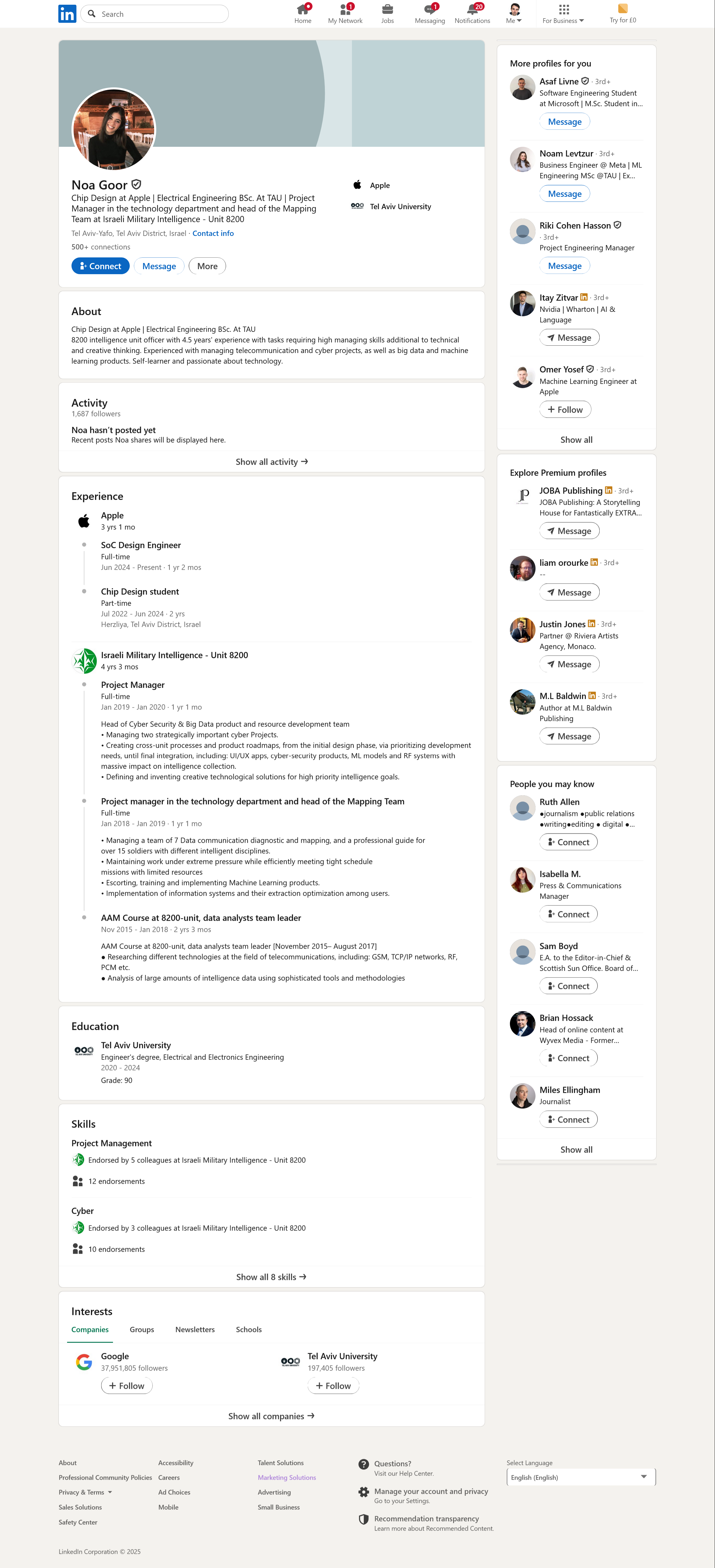
Noa Goor is another senior Unit 8200 figure turned Apple employee. From 2015 to 2020, Goor rose to become a project manager and head of cybersecurity and big data development team at Unit 8200, where she, in her own words, “invent[ed] creative technological solutions for high priority intelligence goals” and “manag[ed] two strategically important cyber projects” for the IDF.
One of the most important cyber projects Unit 8200 has launched in recent times is the September pager attack on Lebanon, an act that injured thousands of civilians and was widely condemned as an act of international terrorism, including by former CIA Director Leon Panetta. While Goor was not personally involved in that operation, Unit 8200 has spearheaded similarly nefarious actions for decades.
In 2022, Goor was hired by Apple as a system-on-chip design engineer.
Eli Yazovitsky, meanwhile, was directly recruited from Unit 8200. In 2015, he left a high-powered nine-year career as a manager in the military unit to join Apple, where he rose to become an engineering manager. He has since moved on to tech giant Qualcomm.
Unit 8200 is Israel’s most elite—and most controversial—military intelligence unit. It serves as the backbone of both Israel’s burgeoning tech sector and its repressive surveillance apparatus. The unit has developed cutting-edge technology like facial recognition and voice-to-text software to surveil, repress, and target Palestinians.
The vast amounts of data gathered on the Palestinian population, including their medical history, sex lives, and search histories, have been used for coercion and extortion. If a certain individual needed to travel across checkpoints for crucial medical treatment, permission could be suspended until they complied. Information about extramarital affairs or sexual orientation, especially homosexuality, is exploited as blackmail material. One former Unit 8200 agent recalled that he was instructed during his training to memorize different Arabic words for “gay” so that he could listen out for them in intercepted conversations.
Internationally, Unit 8200 may be best known for its “former” agents who created the notorious Pegasus software, used by repressive governments around the world to spy on tens of thousands of prominent figures, including royals, heads of state, activists, and journalists.
Among them was Washington Post columnist Jamal Khashoggi, who was assassinated by Saudi operatives in Türkiye in 2018.
While military service is mandatory for Jewish Israelis, few end up in Unit 8200 by accident. Described as “Israel’s Harvard,” parents spend fortunes on STEM-based extracurricular lessons for their children in the hopes that they will be selected to join the IDF’s most elite and selective unit. Those chosen are rewarded with lucrative careers in the tech industry upon completion of their service.
Given Unit 8200’s documented history of violence, espionage, and surveillance, both domestically and internationally, it is worth asking whether tech giants should be hiring its alumni in such large numbers.
Shkedi, Goor, and Yazovitsky are the most high-profile examples, but they are from alone. A closer look reveals that dozens of other Unit 8200 veterans have also secured key roles at Apple.
Engineering and Hardware Design:
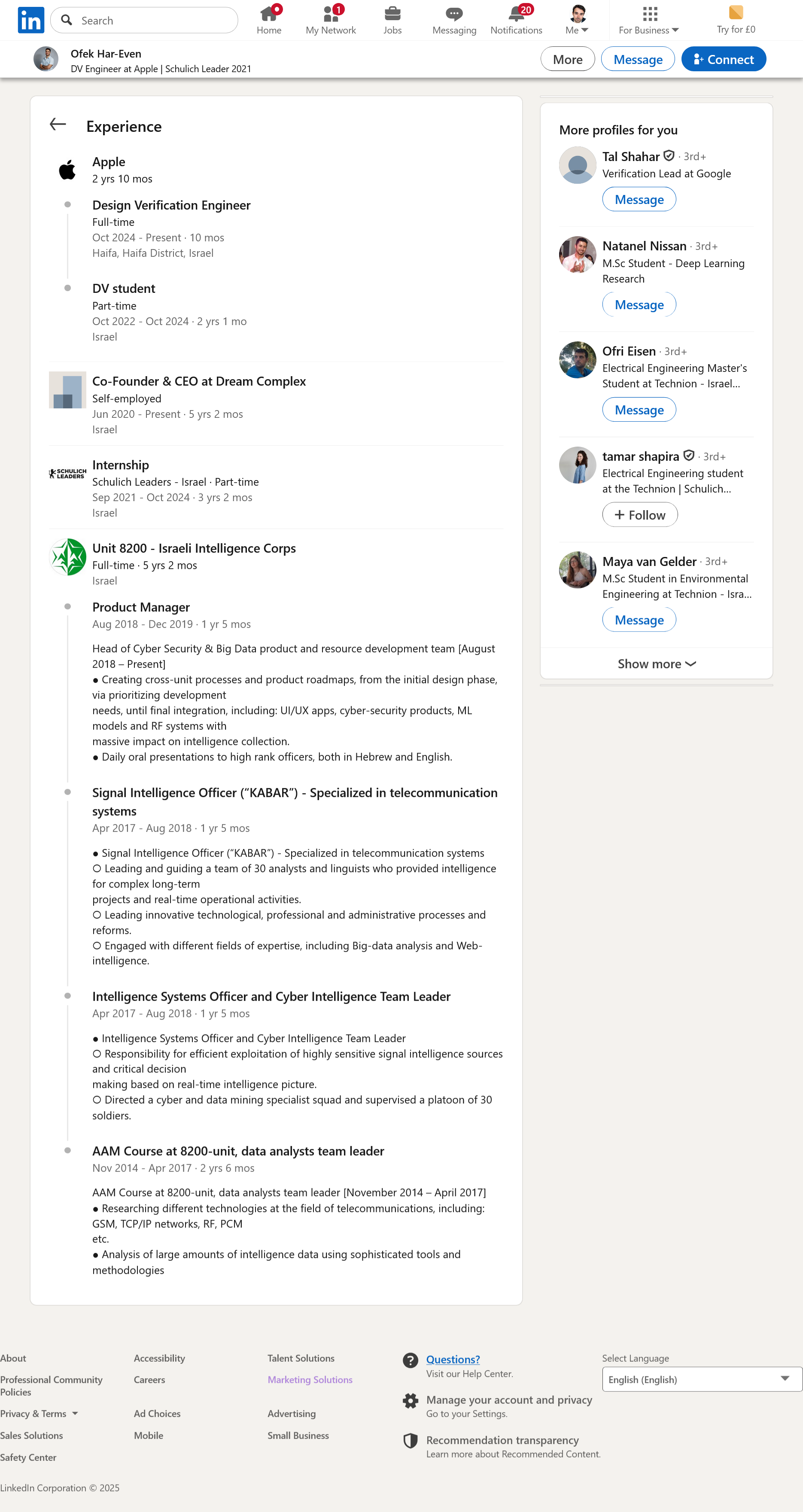
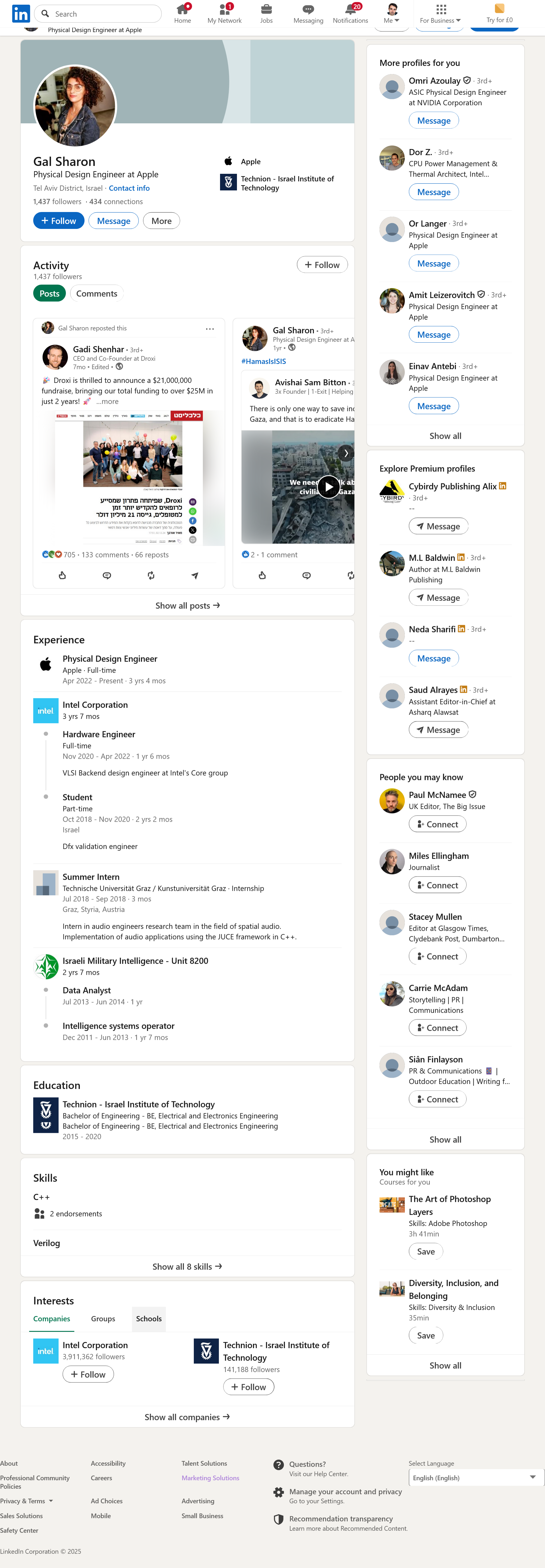
Natanel Nissan, formerly head of data analysis at Unit 8200, joined Apple’s Tel Aviv office in 2022. Ofek Har-Even, a longtime officer and manager in the unit, has been a design verification engineer at Apple since 2022. Gal Sharon, a former intelligence systems operator and data analyst, has also worked as a physical design engineer since that same year.
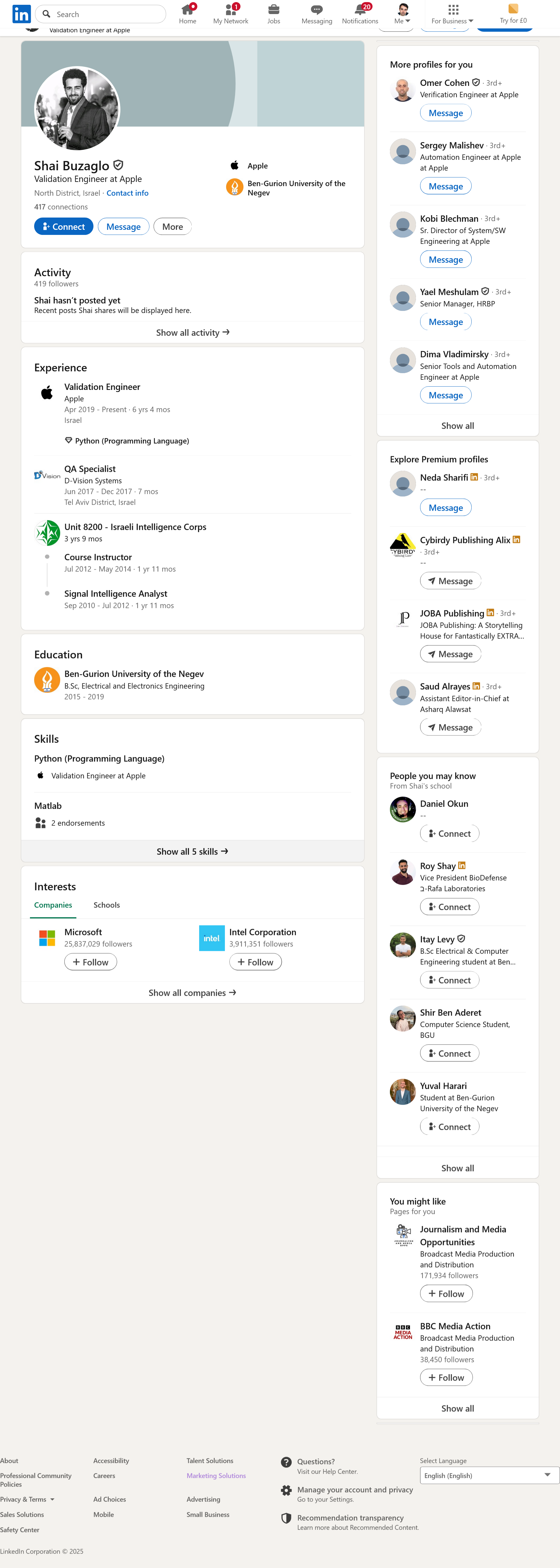
Mayan Hochler and Shai Buzgalo, both former Unit 8200 analysts and instructors, hold roles in physical design and validation engineering, respectively.
Software and Cybersecurity:
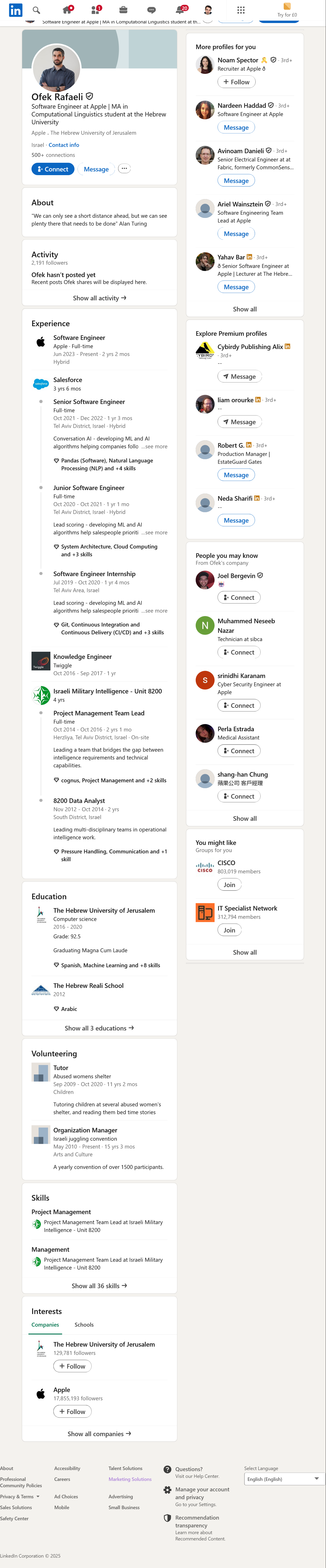
Ofer Tlusty, who served nearly six years in Unit 8200 as a security and intelligence analyst, has worked as a software engineer at Apple since 2021. Ofek Rafaeli, who served between 2012 and 2016 and rose to project manager during Israel’s 2016 assault on Gaza, became a software engineer at Apple in 2023.
Guy Levy, a former intelligence analyst, now also works as a software engineer.
AI, Machine Learning, and Validation:
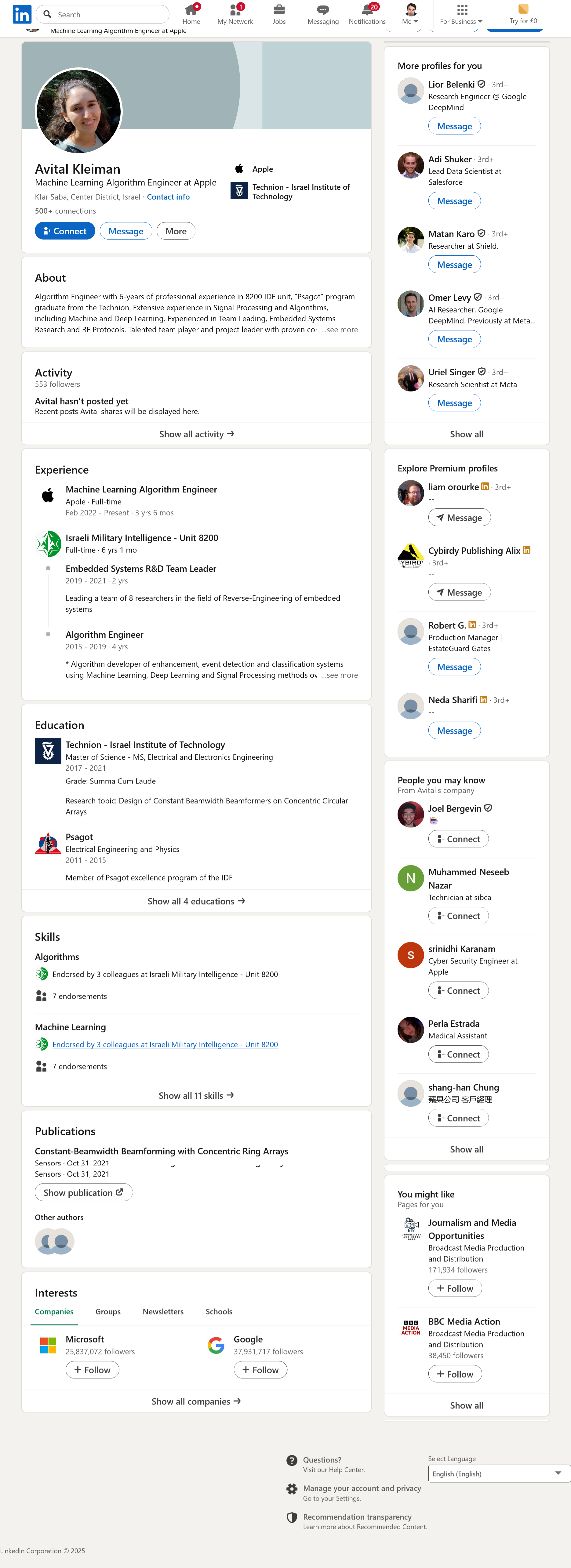
Avital Kleiman, a six-year veteran of Unit 8200, is now a machine learning algorithm engineer at Apple. Niv Lev Ari, currently a validation engineer, notes in his LinkedIn profile that he received a letter of commendation from Unit 8200 commander Aviv Kochavi for his work in the unit.
Other Technical Roles:
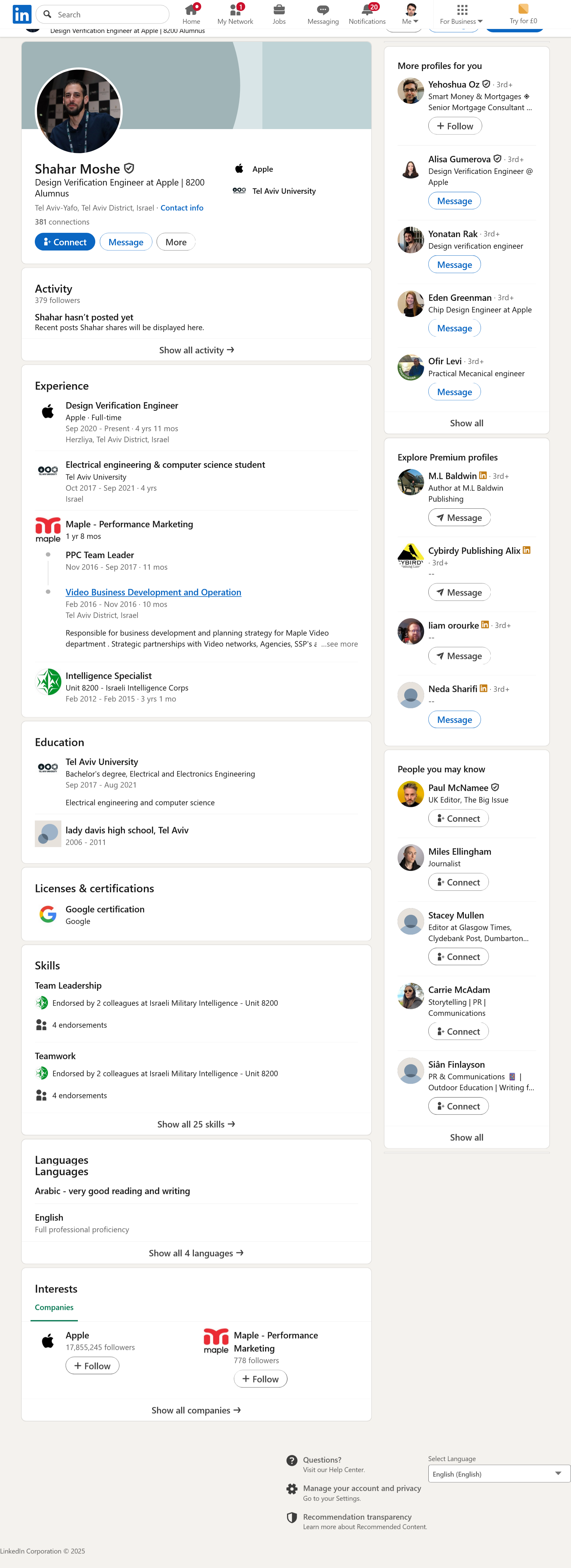
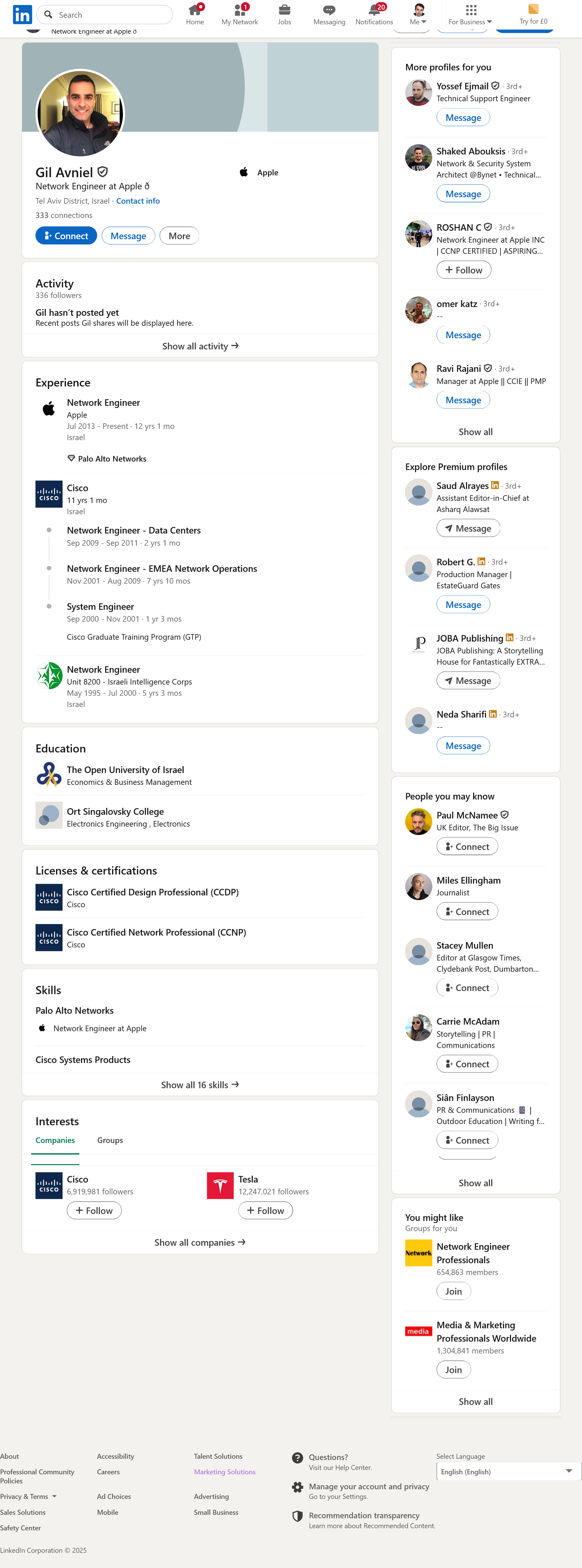
Shahar Moshe, who worked as an intelligence specialist at Unit 8200 from 2012 to 2015, is now a design verification engineer. Gil Avniel, who spent over five years in the unit, currently serves as a network engineer.
An Apple Rots From the Core
The growing number of former Israeli intelligence operatives working at Apple does not seem to concern the company’s senior management. CEO Tim Cook is known to hold strongly pro-Israel views and has spearheaded the Silicon Valley giant’s collaboration with the Israeli state.
Apple has acquired several Israeli tech firms and now operates three centers in the country, employing around 2,000 people. In 2014, Cook invited Israeli Prime Minister Benjamin Netanyahu to the company headquarters in Cupertino, CA, where, in front of the cameras, the two openly embraced. The following year, Cook accepted an invitation from President Reuven Rivlin to visit Israel. “It is a great privilege to host you and your team here,” Rivlin said, “Even for me, as one who prefers to write with a pen and paper, it is clear what a great miracle you have created when I look at my staff, and my grandchildren.”
Effusive praise for the Apple CEO has also come in the form of honors from pro-Israel organizations. In 2018, the Anti-Defamation League presented Cook with its inaugural Courage Against Hate Award at its Never Is Now Summit on anti-Semitism and Hate, where the organization described him as a “visionary leader in the business community.”
In the wake of the October 7, 2023, attacks, Cook sent out a company-wide email expressing his solidarity with Israel. “Like so many of you, I am devastated by the horrific attacks in Israel and the tragic reports coming out of the region,” he wrote, My heart goes out to the victims, those who have lost loved ones, and all of the innocent people who are suffering as a result of this violence.”
Yet, according to Apples4Ceasefire—a group of former and current employees opposing Israeli actions in Gaza—he has yet to say anything publicly about the mass devastation caused by the Israeli response to October 7.
Indeed, the Silicon Valley corporation has a policy of matching employee donations to groups such as Friends of the IDF, which raises money to buy equipment for IDF soldiers, and the Jewish National Fund, an organization that participates in the theft and destruction of Palestinian land.
Under Cook’s leadership, Apple employees have been disciplined or even fired for wearing pins, bracelets, or keffiyehs in support of the Palestinian people. Nevertheless, groups such as Apples4Ceasefire continue to speak out about what they describe as Apple’s complicity in genocide.
The Unit 8200 Tech Takeover
To be fair, Apple is far from the only tech or media company to hire large numbers of former Unit 8200 operatives. A 2022 MintPress exposé revealed hundreds of Israeli intelligence veterans working at Google, Facebook, Microsoft, and Amazon.
Perhaps the most notable of these is Emi Palmor, a former Israeli justice ministry official who sits on Facebook’s 21-person Oversight Board. Described by Mark Zuckerberg as his platform’s “supreme court,” the board ultimately decides what content is allowed or removed from the world’s largest social network. Facebook has worked closely with the Israeli government to censor or deplatform Palestinian content and accounts.
Even TikTok, often seen as a more open platform, has been hiring former Israeli spies to help manage its operations, according to a November investigation by MintPress. Reut Medalion, for example, served as a Unit 8200 intelligence commander and led its cybersecurity operations team.
In December 2023, during the peak of Israel’s attack on Gaza, Medalion moved to New York City to accept a job as global incident manager for TikTok’s trust and safety division. Considering the events going on in the world at the time, it’s worth asking what sorts of “global incidents” she was brought in to manage.
After MintPress exposed Medalion’s past to a worldwide audience, she deleted her entire digital footprint from the internet.
Former Israeli intelligence operatives have also found their way into American newsrooms, shaping coverage of the Middle East. A recent MintPress investigation uncovered a network of former Unit 8200 operatives working in some of the most influential newsrooms in the United States.
Among them is Axios correspondent Barak Ravid, whose Middle Eastern coverage won him the prestigious White House Press Correspondents’ Award. Until at least 2023, Ravid was a member of Unit 8200. CNN has also hired at least two former agents to produce their news coverage, one of whom, Tal Heinrich, now serves as the official spokesperson for Prime Minister Netanyahu.
Given this pattern, Silicon Valley’s partiality towards Israel should not come as no surprise. From tech giants like Google and Amazon to social media powerhouses like TikTok and Facebook, the field is filled with former Israeli spies. Apple is no exception, having hired dozens, if not more, Unit 8200 operatives to run its platforms and shape the company.
This investigation does not claim that the Israeli state is deliberately infiltrating Silicon Valley. However, what it does unquestionably suggest is that the outlook and general biases of these entities are strongly pro-Israel. What does it say about Silicon Valley’s culture that individuals with well-documented ties to a controversial foreign spy agency are considered ideal hires?
It is unthinkable that former intelligence agents of Hezbollah, Iran’s Ministry of Intelligence, or Russia’s FSB or GRU would be hired en masse, and trusted with our most sensitive data. Yet, when it comes to Israel (or U.S. surveillance agencies), the answer is different. Many of these employees are not even “former” agents, and are directly recruited from Unit 8200 while still in active service, despite Israeli law explicitly prohibiting the group’s members from identifying themselves or divulging their alliances.
Thus, in this light, it appears that those like Apples4Ceasefire struggling to end the company’s double standards are fighting an uphill battle.
Francesca Albanese: “A revolutionary shift is underway”
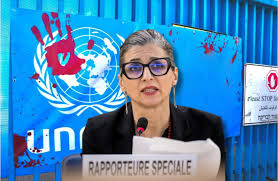
Remarks of Francesca Albanese, the UN Special Rapporteur on the situation of human rights in the Palestinian territory occupied since 1967, at the Hague Group Emergency Conference of States in Bogotá, Colombia.
By Francesca Albanese / Progressive International, https://progressive.international/wire/2025-07-16-francesca-albanese-a-revolutionary-shift-is-underway/en
Excellencies, Friends,
I express my appreciation to the government of Colombia and South Africa for convening this group, and to all members of the Hague Group, its founding members for their principled stance, and the others who are joining. May you keep groing and so the strength and effectiveness of your concrete actions.
Thank you also to the Secretariat for its tireless work, and last but not least, the Palestinian experts—individuals and organisations who travelled to Bogota from occupied Palestine, historical Palestine/Israel and other places of the diaspora/exile, to accompany this process, after providing HG with outstanding, evidence-based briefings.
And of course all of you who are here today,
It is important to be here today, in a moment that may prove historical indeed. There is hope that these two days will move all present to work together to take concrete measures to end the genocide in Gaza and, hopefully, end the erasure of the
Palestinian for what remains of Palestine—because this is the testing ground for a system where freedom, rights, and justice are made real for all. This hope, that people like me hold tight, is a discipline. A discipline we all should have.
The occupied Palestinian territory today is a hellscape. In Gaza, Israel has dismantled even the last UN function—humanitarian aid—in order to deliberately starve, displace time and again, or kill a population they have marked for elimination. In the West Bank, including East Jerusalem, ethnic cleansing advances through unlawful siege, mass displacement, extrajudicial killings, arbitrary detention, widespread torture. Across all areas under Israeli rule, Palestinians live under the terror of annihilation, broadcast in real time to a watching world. The very few Israeli people who stand against genocide, occupation, and apartheid—while the majority openly cheers and calls for more—remind us that Israeli liberation, too, is inseparable from Palestinian freedom. .
The atrocities of the past 21 months are not a sudden aberration; they are the culmination of decades of policies to displace and replace the Palestinian people.
Against this backdrop, it is inconceivable that political forums, from Brussels to NY, are still debating recognition of the State of Palestine—not because it’s unimportant, but because for 35 years states have stalled, refused recognition, pretending to “invest in the PA” while abandoning the Palestinian people to Israel’s relentless, rapacious territorial ambitions and unspeakable crimes. Meanwhile political discourse has reduced Palestine to a humanitarian crisis to manage in perpetuity rather than a political issue demanding principled and firm resolution: end permanent occupation, apartheid and today genocide. And it is not the law that has failed or faltered—it is political will that has abdicated.
But today, we are also witnessing a rupture. Palestine’s immense suffering has cracked open the possibility of transformation. Even if this is not fully reflected into political agendas (yet), a revolutionary shift is underway—one that, if sustained, will be remembered as a moment when history changed course.
And this is why I came to this meeting with a sense of being at a historical turning point —discursively and politically.
First, the narrative is shifting: away from Israel’s endlessly invoked “right to self-defence” and toward the long-denied Palestinian right to self-determination—systematically invisibilised, suppressed and delegitimised for decades. The weaponisation of antisemitism applied to Palestinian words, and narratives, and the dehumanising use of the terrorism framework for Palestinian action (from armed resistance to the work of NGOs pursuing justice in international arena), has led to a global political paralysis that has been intentional. It must be redressed. The time is now.
Second, and consequentially, we are seeing the rise of a new multilateralism: principled, courageous, increasingly led by the Global Majority it pains me that I have yet to see this include European countries. As a European, I fear what the region and its institutions have come to symbolize to many: a sodality of states preaching international law yet guided more by colonial mindset than principle, acting as vassals to the US empire, even as it drags us from war to war, misery to misery and when it comes to Palestine: from silence to complicity.
But the presence of European countries at this meeting shows that a different path is possible. To them I say: the Hague Group has the potential to signal not just a coalition, but a new moral center in world politics. Please, stand with them.
Millions are watching—hoping—for leadership that can birth a new global order rooted in justice, humanity, and collective liberation. This is not just about Palestine. This is about all of us.
Principled states must rise to this moment. It does not need to have a political allegiance, color, political party flags or ideologies: it needs to be upheld by basic human values. Those which Israel has been mercilessly crushing for 21 months now.
Meanwhile I applaud the calling of this emergency conference in Bogota to address the unrelenting devastation in Gaza. So it is on this, that focus must be directed. The measures adopted in January by the Hague Group were symbolically powerful. It was the signal of the discursive and political shift needed. But they are the absolute bear minimum. I implore you to expand your commitment. And to turn that commitment into concrete actions, legislatively, judicially in each of your jurisdictions. And to consider first and foremost, what must we do to stop the genocidal onslaught. For Palestinians, especially those in Gaza, this question is existential. But it really is applicable to the humanity of all of us.
In this context my responsibility here is to recommend to you, uncompromisingly and dispassionately, the cure for the root cause. We are long past dealing with symptoms, the comfort zone of too many these days. And my words will show that what the Hague Group has committed to do and is considering expanding upon, is a small commitment towards what’s just and due based on your obligations under international law.
Obligations, not sympathy, not charity.
Each state immediately review and suspend all ties with Israel. Their military, strategic, political, diplomatic, economic, relations – both imports and exports – and to make sure that their private sector, insurers, banks, pension funds, universities and other goods, and services providers in the supply chains do the same. Treating the occupation as business as usual translates into supporting or providing aid or assistance to the unlawful presence of Israel in the OPT. These ties must be terminated as a matter of urgency. I will have the opportunity to elaborate on the technicalities and implications in our further sessions but lets be clear, I mean cutting ties with Israel as a whole. Cutting ties only with the “components” of it in the oPt is not an option.
This is in line with the duty on all states stemming from the July 2024 Advisory Opinion which confirmed the illegality of Israel’s prolonged occupation, which it declared tantamount to racial segregation and apartheid . The General Assembly adopted that opinion. These findings are more than sufficient for action. Further, it is the state of Israel who is accused of war crimes, crimes against humanity and genocide, so it is the state that must be responsible for its wrongdoings.
As I argue in my last report to the HRC, the Israeli economy is structured to sustain the occupation, and has now turned genocidal. It is impossible to disentangle Israel’s state policies and economy from its longstanding policies and economy of occupation. It has been inseparable for decades. The longer states and others stay engaged, the more this illegality at its heart is legitimised. This is the complicity. Now that economy has turned genocidal. There is no good Israel, bad Israel.
I ask you to consider this moment as if we were sitting here in the 1990s, discussing the case of apartheid South Africa. Would you have proposed selective sanctions on SA for its conduct in individual Bantustans? Or would you have recognised the state’s criminal system as a whole? And here, what Israel is doing is worse. This comparison— is a legal and factual assessment supported by international legal proceedings many in this room are part of.
This is what concrete measures mean. Negotiating with Israel on how to manage what remains of Gaza and West Bank, in Brussels or elsewhere, is an utter dishonor to international law.
And to the Palestinians and those from all corners of the world standing by them, often at great cost and sacrifice, I say whatever happens, Palestine will have written this tumultuous chapter—not as a footnote in the chronicles of would-be conquerors, but as the newest verse in a centuries-long saga of peoples who have risen against injustice, colonialism, and today more than ever neoliberal tyranny.
Iran says nuclear site attack proved military option is futile
Iran’s foreign minister said last month’s attacks on its nuclear facilities
proved that military pressure cannot stop its atomic program, warning that
only diplomacy can prevent further conflict, in an interview broadcast
Saturday.
Speaking on the sidelines of a Shanghai Cooperation Organization
meeting, Abbas Araghchi said Iran remains open to a negotiated deal but
only if the US “puts aside military ambitions” and compensates for past
actions. “There is no military option to deal with Iran’s nuclear
program,” he told CGTN. “There should be only a diplomatic solution.”
He added that Iran is ready to re-engage in talks, but only “when they
put aside their military ambitions.”
Iran International 19th July 2025, https://www.iranintl.com/en/202507191773
Iran pushes back on EU pressure as clock ticks on nuclear talks
Any new nuclear deal must meet what Iran describes as fair and balanced
terms, Foreign Minister Abbas Araghchi said Friday, after a call with
European ministers who urged Tehran to return to talks before the end of
August or face the possible return of UN sanctions.
“It was the US that
withdrew from a two-year negotiated deal, coordinated by the EU in 2015,
not Iran,” Araghchi wrote on X after a joint teleconference with the
foreign ministers of France, Britain, Germany, and the EU’s top diplomat.
“And it was the US that left the negotiation table in June this year and
chose a military option instead, not Iran.”
“Any new round of talks is
only possible when the other side is ready for a fair, balanced, and
mutually beneficial nuclear deal,” he added. Araghchi warned the EU and
E3 powers to abandon “worn-out policies of threat and pressure,”
referring specifically to the “snapback” mechanism, which he said they
have “absolutely no moral and legal ground” to invoke.
Iran International 18th July 2025,
https://www.iranintl.com/en/202507180912
Ominous Plans: Making Concentration Camp Gaza
18 July 2025, Dr Binoy Kampmark, https://theaimn.net/ominous-plans-making-concentration-camp-gaza/
The odious idea of a camp within a camp. The Gaza Strip, with an even greater concentration of Palestinian civilian life within an ever-shrinking stretch of territory. These are the proposals ventured by the Israeli government even as the official Palestinian death toll marches upwards to 60,000. They envisage the placement of some 600,000 displaced and houseless beings currently living in tents in the area of al-Mawasi along Gaza’s southern coast in a creepily termed “humanitarian city”. This would be the prelude for an ultimate relocation of the strip’s entire population of over 2 million in an area that will become an even smaller prison than the Strip already is.
The preparation for such a forced removal – yet another among so many Israel has inflicted upon the Palestinians – is in full swing. The analysis of satellite imagery from the United Nations Satellite Centre (UNOSAT) by Al Jazeera’s Sanad investigations unit found that approximately 12,800 buildings were demolished in Rafah between early April and early July alone. In the Knesset on May 11 this year, Prime Minister Benjamin Netanyahu gave words to those deeds: “We are demolishing more and more [of their] homes, they have nowhere to return to. The only obvious result will be the desire of the Gazans to emigrate outside the Strip.”
Camps of concentrated human life – concentration camps, in other words – are often given a different dressing to what they are meant to be. Authoritarian states enjoy using them to re-educate and reform the inmates even as they gradually kill them. Indeed, the proposals from the Israel’s Defense Department carry with them plans for a “Humanitarian Transit Area” where Gazans would “temporarily reside, deradicalize, re-integrate, and prepare to relocate if they wish to do so.”
The emetic candy floss of “humanitarian” in the context of a camp is a self-negating nonsense similar to other experiments in cruelty: the relocation of Boer civilians during the colonial wars waged by Britain to camps which saw dysentery and starvation; the movement of Vietnamese villagers into fortified hamlets to prevent their infiltration by the Vietcong in the 1960s; the creation of Pacific concentration camps to detain refugees seeking Australia by boat in what came to be called the “Pacific Solution.”
Those in the business of doing humanitarian deeds were understandably appalled by Israel’s latest plans. Philippe Lazzarini, head of the United Nations agency for Palestinian refugees (UNRWA), stated that this would “de facto create massive concentration camps at the border with Egypt for the Palestinians, displaced over and over across generations.” It would certainly “deprive Palestinians of any prospects of a better future in their homeland.” Self-evidently and sadly, that would be one of the main aims.
A few of Israeli’s former Prime Ministers have ditched the coloured goggles in considering the plans for such a mislabelled city. Yair Lapid, who spent a mere six months in office in 2022, told Israeli Army Radio that it was “a bad idea from every possible perspective – security, political, economic, logistical.” While preferring not to use the term “concentration camp” with regards such a construction, incarcerating individuals by effectively preventing their exit would make such a term appropriate.
Ehud Olmert’s words to The Guardian were even less inclined to varnish the matter. “If they [the Palestinians] will be deported into the new ‘humanitarian city’, then you can say that this is part of an ethnic cleansing.” To create a camp that would effectively “clean” more than half of Gaza of its population could hardly be understood as a plan to save Palestinians. “It is to deport them, to push and to throw them away. There is no other understanding that I have at least.”
Israeli political commentator Ori Goldberg was also full of candour in expressing the view that the plan was “for all facts and purposes a concentration camp” for Gaza’s Palestinians, “an overt crime against humanity under international humanitarian law”. This would also add the burgeoning grounds of illegality already being alleged in this month’s petition by three Israeli reserve soldiers of Israel’s Supreme Court questioning the legality of Operation Gideon’s Chariots. Instancing abundant examples of forced transfer and expulsions of the Palestinian population during its various phases, commentators such as former chief of staff of the IDF, Moshe “Bogy” Ya’alon, are unreserved about how such programs fare before international law. “Evacuating an entire population? Call it ethnic cleansing, call it transfer, call it deportation, it’s a war crime,” he told journalist Lucy Aharish. “Israel’s soldiers had been sent in “to commit war crimes.”
There is also some resistance from within the IDF, less on humanitarian grounds than practical ones. To even prepare such a plan in the midst of negotiations for a lasting ceasefire and finally resolving the hostage situation was the first telling problem. The other was how the IDF could feasibly undertake what would be a grand jailing experiment while preventing the infiltration of Hamas.
This ghastly push by the Netanyahu government involves an enormous amount of wishful thinking. Ideally, the Palestinians will simply leave. If not, they will live in even more carceral conditions than they faced before October 2023. But to assume that this cartoon strip humanitarianism, papered over a ghoulish program of inflicted suffering, will add to the emptying well of Israeli security, is testament to how utterly desperate, and delusionary, the Israeli PM and his cabinet members have become.
New reports cast doubt on impact of US strikes on Iran’s nuclear sites
Citing intelligence assessments, NBC News and Washington Post report that only Fordow site was destroyed in US attack.
US Secretary of Defense attacks media for questioning Iran strikes
By Al Jazeera Staff, 18 Jul 202518 Jul 2025, https://www.aljazeera.com/news/2025/7/18/new-reports-cast-doubt-on-impact-of-us-strikes-on-irans-nuclear-sites
Washington, DC – New media reports in the United States, citing intelligence assessments, have cast doubt over President Donald Trump’s assertion that Washington’s military strikes last month “obliterated” Iran’s nuclear programme.
The Washington Post and NBC News reported that US officials were saying that only one of the three Iranian nuclear sites – the Fordow facility – targeted by the US has been destroyed.
The Post’s report, released on Friday, also raised questions on whether the centrifuges used to enrich uranium at the deepest level of Fordow were destroyed or moved before the attack.
“We definitely can’t say it was obliterated,” an unidentified official told the newspaper, referring to Iran’s nuclear programme.
Trump has insisted that the US strikes were a “spectacular” success, lashing out at any reports questioning the level of damage they inflicted on Iran’s nuclear programme.
An initial US intelligence assessment, leaked to several media outlets after the attack last month, said the strikes failed to destroy key components of Iran’s nuclear programme and only delayed its work by months.
But the Pentagon said earlier in July that the attacks degraded the Iranian programme by one to two years.
While the strikes on Fordow – initially thought to be the most guarded facility, buried inside a mountain – initially took centre stage, the NBC News and Washington Post reports suggested that the facilities in Natanz and Isfahan also had deep tunnels.
‘Impenetrable’
The US military did not use enormous bunker-busting bombs against the Isfahan site and targeted surface infrastructure instead.
A congressional aide familiar with intelligence briefings told the Post that the Pentagon had assessed that the underground facilities at Isfahan were “pretty much impenetrable”.
The Pentagon responded to both reports by reiterating that all three sites were “completely and totally obliterated”.
Israel, which started the war by attacking Iran without direct provocation last month, has backed the US administration’s assessment, while threatening further strikes against Tehran if it resumes its nuclear programme.
For its part, Tehran has not provided details about the state of its nuclear sites.
Some Iranian officials have said that the facilities sustained significant damage from US and Israeli attacks. But Supreme Leader Ali Khamenei said after the war that Trump had “exaggerated” the impact of the strikes.
The location and state of Iran’s highly enriched uranium also remain unknown.
Iran’s nuclear agency and regulators in neighbouring states have said they did not detect a spike in radioactivity after the bombings, suggesting the strikes did not result in uranium contamination.
But Rafael Grossi, the head of the United Nations nuclear watchdog, the IAEA, did not rule out that the uranium containers may have been damaged in the attacks.
“We don’t know where this material could be or if part of it could have been under the attack during those 12 days,” Grossi told CBS News last month.
According to Grossi, Iran could resume uranium enrichment in a “matter of months”.
The war
Israel launched a massive attack against Iran on June 13, killing several top military officials, as well as nuclear scientists.
The bombing campaign targeted military sites, civilian infrastructure and residential buildings across the country, killing hundreds of civilians.
Iran responded with barrages of missiles against Israel that left widespread destruction and claimed the lives of at least 29 people.
The US joined the Israeli campaign on June 22, striking the three nuclear sites. Iran retaliated with a missile attack against an air base housing US troops in Qatar.
Initially, Trump said the Iranian attack was thwarted, but after satellite images showed damage at the base, the Pentagon acknowledged that one of the missiles was not intercepted.
“One Iranian ballistic missile impacted Al Udeid Air Base June 23 while the remainder of the missiles were intercepted by US and Qatari air defence systems,” Pentagon spokesperson Sean Parnell told Al Jazeera in an email last week.
Advertisement
“The impact did minimal damage to equipment and structures on the base. There were no injuries.”
After a ceasefire was reached to end the 12-day war, both the US and Iran expressed willingness to engage in diplomacy to resolve the nuclear file. But talks have not materialised.
Iran and the US were periodically holding nuclear talks before Israel launched its war in June.
During his first term in 2018, Trump withdrew the US from the 2015 multilateral nuclear agreement, known as the Joint Comprehensive Plan of Action (JCPOA).
The agreement saw Iran scale back its nuclear programme in exchange for lifting international sanctions against its economy.
In recent days, European officials have suggested that they could impose “snap-back” sanctions against Iran as part of the deal that has long been violated by the US.
Tehran, which started enriching uranium beyond the limits set by the JCPOA after the US withdrawal, insists that Washington was the party that nixed the agreement, stressing that the deal acknowledges Iran’s enrichment rights.
On Friday, Iranian Foreign Minister Abbas Araghchi said he held talks with the top diplomats of France, the United Kingdom and Germany – known as the E3 – as well as the European Union’s high representative.
Araghchi said Europeans should put aside “worn-out policies of threat and pressure”.
“It was the US that withdrew from a two-year negotiated deal – coordinated by EU in 2015 – not Iran; and it was US that left the negotiation table in June this year and chose a military option instead, not Iran,” the Iranian foreign minister said in a social media post.
“Any new round of talks is only possible when the other side is ready for a fair, balanced, and mutually beneficial nuclear deal.”
Tehran denies seeking a nuclear bomb. Israel, meanwhile, is widely believed to have an undeclared nuclear arsenal.
U.S. and Israeli strikes on Iran could fuel a new wave of nuclear proliferation
In the wake of recent strikes by Israel and the United States on Iranian
cities, military sites and nuclear facilities, a troubling paradox has
emerged: actions intended to prevent Iran from acquiring nuclear weapons
may actually be accelerating its pursuit of them and encouraging other
countries to follow suit.
The Conversation 14th July 2025, https://theconversation.com/u-s-and-israeli-strikes-on-iran-could-fuel-a-new-wave-of-nuclear-proliferation-260897
The New York Times Finally Stops Avoiding The G-Word

Caitlin Johnstone, Jul 16, 2025, https://www.caitlinjohnst.one/p/the-new-york-times-finally-stops?utm_source=post-email-title&publication_id=82124&post_id=168435877&utm_campaign=email-post-title&isFreemail=true&r=1ise1&triedRedirect=true&utm_medium=email
The New York Times has published an op-ed by a genocide scholar who says that he resisted acknowledging the truth of what Israel is doing in Gaza for as long as he could, but can no longer deny the obvious.
It’s an admission that may as well have come from The New York Times itself.
In an article titled “I’m a Genocide Scholar. I Know It When I See It.”, a Brown University professor of Holocaust and genocide studies named Omer Bartov argues that “Israel is literally trying to wipe out Palestinian existence in Gaza,” and denounces his fellow Holocaust scholars for failing to acknowledge reality.
“My inescapable conclusion has become that Israel is committing genocide against the Palestinian people,” Bartov writes. “Having grown up in a Zionist home, lived the first half of my life in Israel, served in the I.D.F. as a soldier and officer and spent most of my career researching and writing on war crimes and the Holocaust, this was a painful conclusion to reach, and one that I resisted as long as I could. But I have been teaching classes on genocide for a quarter of a century. I can recognize one when I see one.”
And resist he did. In November 2023, Bartov wrote another op-ed for The New York Times saying “As a historian of genocide, I believe that there is no proof that genocide is currently taking place in Gaza, although it is very likely that war crimes, and even crimes against humanity, are happening.”
Apparently he is seeing the proof now and has stopped resisting what’s been clear from the very beginning. And it would seem the editors of the Gray Lady have ceased resisting as well.
The New York Times, which has an extensively documented pro-Israel bias, has frenetically avoided the use of the g-word on its pages from the very beginning of the Gaza onslaught. Even in its opinion and analysis pieces the NYT Overton window has cut off at framing the issue as a complex matter of rigorous debate, with headlines like “Accused of Genocide, Israelis See Reversal of Reality. Palestinians See Justice.” and “The Bitter Fight Over the Meaning of ‘Genocide’” representing the closest thing to the pro-Palestinian side of the debate you’d see. During the same time we’ve seen headlines like “From the Embers of an Old Genocide, a New One May Be Emerging” used in reference to Sudan.
In an internal memo obtained by The Intercept last year, New York Times reporters were explicitly told to avoid the use of the word “genocide”, as well as terms like “ethnic cleansing” and “occupied territory”.
“‘Genocide’ has a specific definition in international law,” the memo reads. “In our own voice, we should generally use it only in the context of those legal parameters. We should also set a high bar for allowing others to use it as an accusation, whether in quotations or not, unless they are making a substantive argument based on the legal definition.”
Earlier this year the American Friends Service Committee cancelled its paid advertisement in The New York Times calling for an end to the genocide in Gaza, saying the outlet had wanted them to change the word “genocide” to “war” in order for their ad to be published.
So there has been a significant change.
To be clear, this analysis by Omer Bartov is not significant in and of itself. He is only joining the chorus of what has already been said by human rights organizations like Amnesty International, Human Rights Watch, United Nations human rights experts, and the overwhelming majority of leading authorities on the subject of genocide.
What is significant is that even experts who’ve been resisting acknowledging the reality of the genocide in Gaza because of their bias toward Israel have stopped doing so, and that even the imperial media outlets most fiendishly devoted to running propaganda cover for that genocide have run out of room to hide.
The Israel apologists have lost the argument. They might not know it yet, but they have. Public sentiment has turned irreversibly against them as people’s eyes are opened to the truth of what’s happening in Gaza, and more and more propagandists are choosing to rescue what’s left of their tattered credibility instead of going down with the sinking ship.
Truth is slowly beginning to get a word in edgewise.
Keep pushing. Keep fighting. Keep resisting.
It’s working.
Ex-UN Special Rapporteur Says Francesca Albanese Deserves Nobel Prize, Not US Sanctions
The US is punishing UN Special Rapporteur Francesca Albanese for her scathing reports on Israel’s genocide in Gaza.
By Marjorie Cohn , Truthout, July 14, 2025
The day after Donald Trump welcomed indicted war criminal Israeli Prime Minister Benjamin Netanyahu to the United States for the third time in less than six months, U.S. Secretary of State Marco Rubio imposed sanctions against UN Special Rapporteur on Occupied Palestine Francesca Albanese for her clear-eyed critiques of Israel’s genocide.
In a July 9 press statement, Rubio charged that Albanese “has directly engaged with the International Criminal Court (ICC) in efforts to investigate, arrest, detain, or prosecute nationals of the United States or Israel, without the consent of those two countries.” He alleged that Albanese “has spewed unabashed antisemitism, expressed support for terrorism, and open contempt for the United States, Israel, and the West … including recommending that the ICC, without a legitimate basis, issue arrest warrants” for Netanyahu and former Defense Minister Yoav Gallant.
“No comment on mafia style intimidation techniques,” Albanese responded to the sanctions in a text message to Al Jazeera. “Busy reminding member states of their obligations to stop and punish genocide. And those who profit from it.” She queried why she had been sanctioned: “for having exposed a genocide? For having denounced the system? They never challenged me on the facts.”
In the height of irony, war criminal Netanyahu nominated serial lawbreaker Trump for the Nobel Peace Prize. But it is Albanese who deserves that prize.
“The UN Special Rapporteur on Occupied Palestine deserves the Nobel Peace Prize, not the U.S. punitive pushback by way of targeted sanctions denying her entry into the country and freezing any American assets she may have,” Richard Falk, who served as UN Special Rapporteur on Occupied Palestine from 2008 to 2014, told Truthout.
“This was an intimidating attack on Albanese, an unpaid civil servant, for her brave truth-telling and expert knowledge fully in accord with expectations of the job to report periodically to the UN Human Rights Council and the General Assembly,” Falk added. “Her well-documented reports have broken the mainstream silence in the West on Israel’s genocidal assault, carried out before the eyes and ears of the world, shocking many by its transparency and sadism over a period of more than 20 months. She has also exposed shameful patterns of U.S. complicity with Israeli criminality.”
As they dined together in Washington, Netanyahu told Trump he had nominated him for the Nobel Peace Prize. The nomination, which Netanyahu sent to the Nobel Committee 10 days after the U.S. bombed nuclear facilities in Iran, rewarded Trump for his unwavering support for the crimes of the Zionist regime in both Palestine and Iran. Trump has continued and increased Joe Biden’s financial, political, and diplomatic assistance to Israel’s (now) 21-month-long genocide in the Occupied Palestinian Territory, which has killed more than 58,000 Palestinians. Trump also dutifully complied with Netanyahu’s plea to bomb Iranian nuclear sites, dropping several 30,000-pound bunker buster bombs on Iran. U.S. participation in Israel’s international crimes is patently illegal.
“Anatomy of a Genocide”
On July 1, 2024, Albanese filed her report “Anatomy of a Genocide” with the UN Human Rights Council. The summary begins, “After five months of military operations, Israel has destroyed Gaza.” That was one year ago. Not content with destroying Gaza, Israel continues to slaughter, starve, and displace the Palestinian people.
In this report, Albanese thoroughly documents Israel’s commission of genocide which is prohibited by the Genocide Convention. She cites the International Court of Justice’s (ICJ’s) order that Israel prevent and punish genocide and ensure humanitarian aid, which Israel has ignored. Albanese finds that “Israel has strategically invoked the international humanitarian law framework as ‘humanitarian camouflage’ to legitimize its genocidal violence in Gaza.” Israel, she charges, “appears to represent itself as conducting a ‘proportionate genocide.’” The crime of genocide, Albanese notes, entails “both individual and State responsibility.”
Israel’s actions “have been driven by a genocidal logic integral to its settler-colonial project in Palestine, signalling a tragedy foretold,” Albanese continues. “[D]isplacing and erasing the Indigenous Arab presence,” she writes, “has been an inevitable part of the forming of Israel as a ‘Jewish State.’”
Since illegally acquiring Palestinian territory by force in 1967, “Israel has advanced its settler-colonial project through military occupation, stripping the Palestinian people of their right to self-determination,” the report reads. “Genocide cannot be justified under any circumstances, including purported self-defence.” The ICJ has repeatedly held that Israel, as occupier, does not have a right to self-defense against the occupied Palestinians.
Albanese recommends that UN member states immediately implement an arms embargo on Israel, and investigate and prosecute war crimes, crimes against humanity, and genocide under principles of universal jurisdiction.
“Genocide as Colonial Erasure”
On October 1, 2024, Albanese filed her report “Genocide as Colonial Erasure.” In it, she expands her analysis of Israel’s genocide beyond the July 1 report. She cites the ICJ’s Advisory Opinion of July 2024, finding Israel’s occupation of Palestinian territory illegal, and reaffirming that the unlawfulness of the occupation “vitiates [Israel’s] claims of purported self-defence.” Albanese writes that “the only lawful recourse available to Israel is its unconditional withdrawal from the whole of that territory.”
When this report was filed, at least 90 percent of Palestinians in Gaza had been forcibly displaced, “many more than 10 times,” Albanese writes. Israeli officials and religious leaders “continue to encourage erasure and dispossession of Palestinians, setting new thresholds for acceptable violence against civilians. The Nakba, which has been ongoing since 1948, has been deliberately accelerated.”
“As Israeli leaders promised,” Albanese writes, “Gaza has been made unfit for human life.” She found “an intent to destroy [the] population [of Gaza] through starvation … Hungry crowds waiting for food have been massacred.”……………………………………………………………………………………………………………………………………………………………………………………………………… https://truthout.org/articles/ex-un-special-rapporteur-francesca-albanese-deserves-nobel-prize-not-sanctions/
Israeli Minister: ‘Gaza must be in Ruins for Decades,’ as Airstrike Kills Children seeking Water
Juan Cole07/14/2025. https://www.juancole.com/2025/07/minister-airstrike-children.html
Ann Arbor (Informed Comment) – In an interview with Israel’s Channel 14, Minister of Energy Eli Cohen said that “Gaza must remain in ruins for decades to come” and that Israel will not help rebuild its civilian infrastructure. The Israeli army has damaged or destroyed some 90% of the Gaza Strip’s housing stock, as well as destroying most hospitals and all schools and universities, as well as water purification plants and other essential infrastructure, leaving over 2 million people to try to live in rubble.
Note that Cohen is a member of the ruling right wing Likud Party headed by Prime Minister Benjamin Netanyahu rather than being from the extremist Religious Zionism bloc that is in coalition with the Likud. A former accountant and teacher of business at Tel Aviv University, Cohen has been listed among the top 100 most influential Israelis.
Keeping millions of Palestinians in Gaza, half of them children, living in ruins for decades is not the sort of goal announced by sane, civilized, ordinary European politicians. At least, not since the 1930s. If a Likud Party stalwart like Cohen openly speaks like this, imagine what the Religious Zionism and Jewish Power cabinet members and members of parliament sound like.
Also on Sunday, the Associated Press reports from an eyewitness, Ramadan Nassar, that some 14 adults brought 20 children to collect water from a distribution point in Nuseirat in central Gaza. As though out of nowhere, an Israeli missile struck them, killing six children and four adults. AP says that the Israeli military alleged that the strike was a technical error. There seem to be a lot of those, since over half of the 58,000 Palestinians Israel has killed since October 2023 have been women and children, and many of the rest were noncombatant men.
Most water in Gaza is not potable, since Israel has deliberately destroyed water purification plants, and ground water is full of bacteria. Watery diarrhea, which can lead to dehydration and even death, is common in the Palestinian population of Gaza, including among vulnerable infants and children.
Just as civilized politicians don’t talk about making millions of people live in rubble for decades, civilized militaries don’t have rules of engagement that allow for 20, or 50, or even 100 civilian deaths for every militant targeted.
NATO is refusing to do joint military operations with Israel because of these unacceptable rules of engagement, which would get any NATO officer court-martialed who tried to implement them.
In addition, Palestinian media sources reported that Israeli airstrikes and attacks left 95 people dead on Sunday, 52 of them in Gaza City.
On Monday, UNICEF announced that it recorded 5,800 cases of malnutrition among children in the Gaza Strip during the month of June, as IMEMC reports:
Severe acute malnutrition involves muscle wastage and pencil-like arms, and produces permanent brain damage.
About the Author
Juan Cole is the founder and chief editor of Informed Comment. He is Richard P. Mitchell Professor of History at the University of Michigan He is author of, among many other books, Muhammad: Prophet of Peace amid the Clash of Empires and The Rubaiyat of Omar Khayyam. Follow him on Twitter at @jricole or the Informed Comment Facebook Page
1 This Month
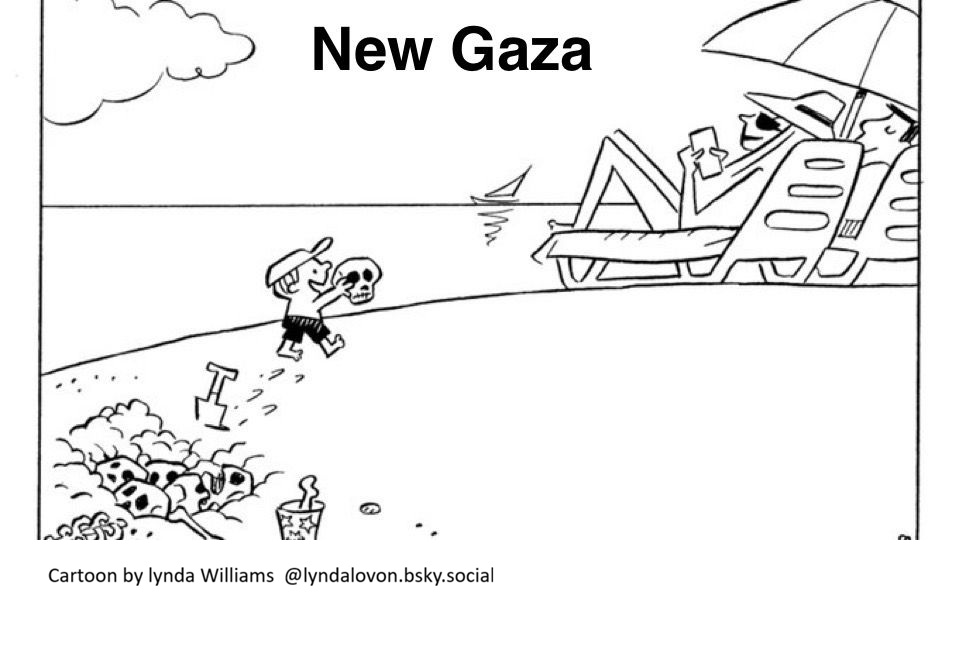
29 Jan. Thursday 7-8 p.m. Webinar – World’s Largest Nuclear Station in Port Hope, ON?

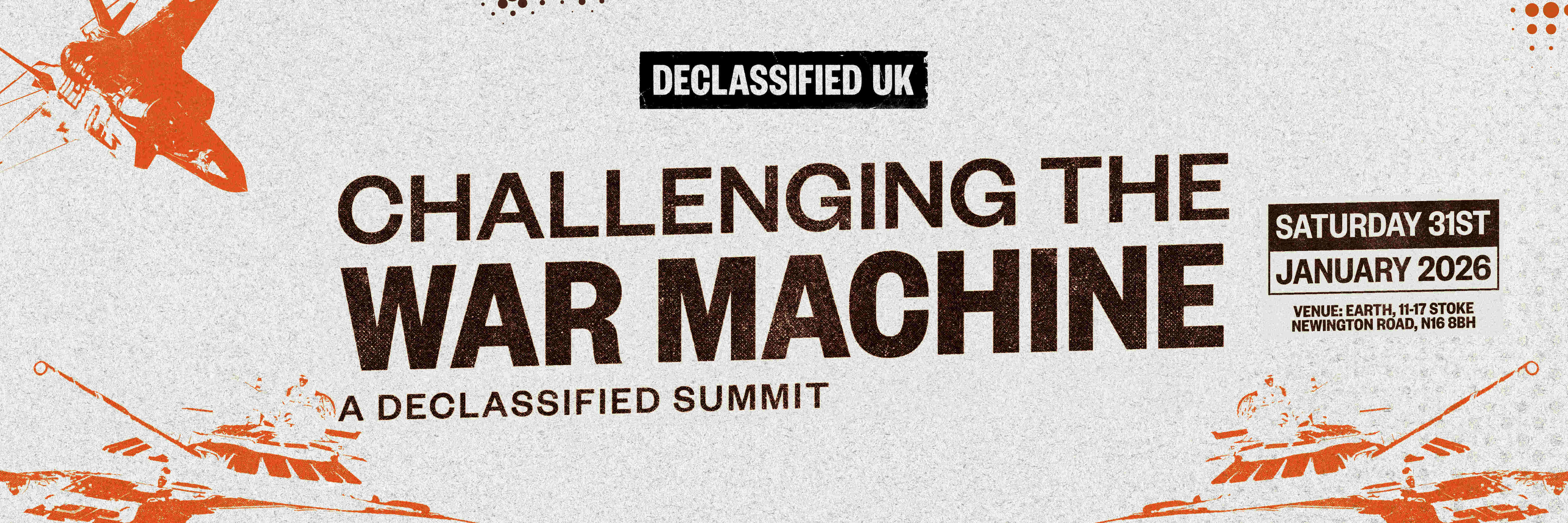
31st January – Challenging the War Machine – a DECLASSIFIED UK SUMMIT


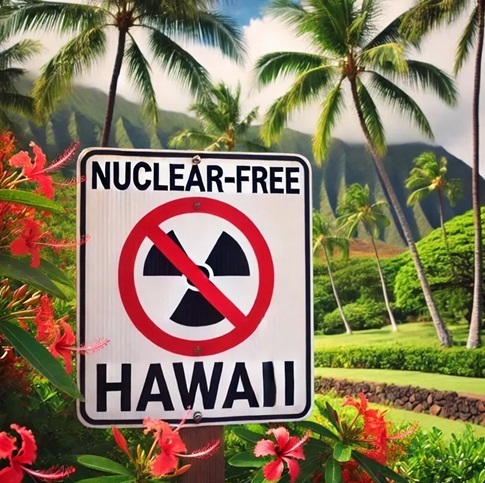
Website of the Week
Now until to February 10, 2026 Radioactive waste storage in France: the debate is finally open! How to participate?
-
Archives
- January 2026 (246)
- December 2025 (358)
- November 2025 (359)
- October 2025 (376)
- September 2025 (258)
- August 2025 (319)
- July 2025 (230)
- June 2025 (348)
- May 2025 (261)
- April 2025 (305)
- March 2025 (319)
- February 2025 (234)
-
Categories
- 1
- 1 NUCLEAR ISSUES
- business and costs
- climate change
- culture and arts
- ENERGY
- environment
- health
- history
- indigenous issues
- Legal
- marketing of nuclear
- media
- opposition to nuclear
- PERSONAL STORIES
- politics
- politics international
- Religion and ethics
- safety
- secrets,lies and civil liberties
- spinbuster
- technology
- Uranium
- wastes
- weapons and war
- Women
- 2 WORLD
- ACTION
- AFRICA
- Atrocities
- AUSTRALIA
- Christina's notes
- Christina's themes
- culture and arts
- Events
- Fuk 2022
- Fuk 2023
- Fukushima 2017
- Fukushima 2018
- fukushima 2019
- Fukushima 2020
- Fukushima 2021
- general
- global warming
- Humour (God we need it)
- Nuclear
- RARE EARTHS
- Reference
- resources – print
- Resources -audiovicual
- Weekly Newsletter
- World
- World Nuclear
- YouTube
-
RSS
Entries RSS
Comments RSS
 nuclear-news