Warning on danger of Middle East war
Russian expert warns of possibility of large-scale war in Middle East Voice of Russia, 26 Nov 12 Turkey has asked NATO to deploy “Patriot” missiles on the Turkish side near the Turkish-Syrian border.
In an interview with the Voice of Russia, Russian analyst Konstantin Sivkov said: “Deploying these missiles in Turkey will be dangerous for Syrian military planes – this is obvious. A lesser obvious thing is that Turkey is getting ready for a war against Syria. If an attack on Syria from the territory of Turkey does take place, this will most likely be an attack not of the Turkish army, but of NATO’s forces.”
“The Middle East is getting ready for a large-sale battle which will very likely affect the Russian part of the Caucasus, and this, in its turn, will be reflected on the entire Russia,” Mr. Sivkov added…… http://english.ruvr.ru/2012_11_24/Russian-expert-warns-of-possibility-of-large-scale-war-in-Middle-East/
Still time for a diplomacy solution to nuclear power problem in Ira
 Window for nuclear diplomacy on Iran is now open but not for
 long, guardian UK Julian Borger, 23 Nov 12 IAEA inspectors say Iran may soon speed up its uranium enrichment, making the search for a deal even more urgent Having delivered its latest quarterly report on Iran’s nuclear programme to its board, the nuclear safeguards department of the International Atomic Energy Agency (IAEA) gave a technical briefing on Wednesday to an audience of ambassadors in Vienna about the same material but with some pictures to make the whole thing clearer. At such briefings, ambassadors can also ask questions to sound out the head of safeguards, Herman Nackaerts, on his impressions.
On this occasion, the main message western ambassadors came away with was that Iran appears to be just days away from starting feeding uranium hexafluoride gas into four new cascades of centrifuges at its underground enrichment site at Fordow. Continue reading
Palestine getting bombed by Israel
“It is very hard to think about Israel calling what it is doing defending itself when it is occupying Palestinian territory. It’s collective punishment.
The answer is simple, and increases the chances of security on all sides: End the occupation.
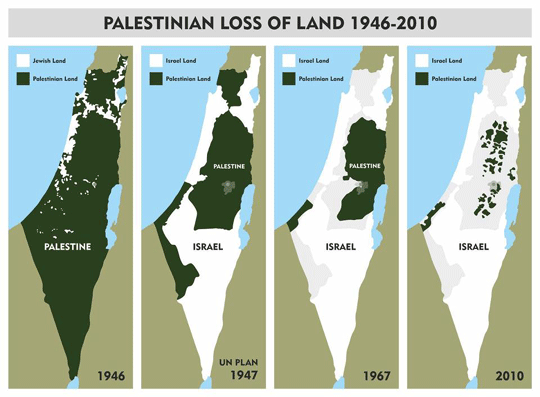
In Gaza, It’s the Occupation, Stupid,http://www.truthdig.com/report/item/in_gaza_its_the_occupationg_stupid_20121121/? Nov 21, 2012 By Amy Goodman “The Palestinian people want to be free of the occupation,” award-winning Israeli journalist Gideon Levy summed up this week. It is that simple. This latest Israeli military assault on the people of Gaza is not an isolated event, but part of a 45-year occupation of the sliver of land wedged between Israel and the Mediterranean Sea, where 1.6 million people live under a brutal Israeli blockade that denies them most of the basic necessities of life.
Without the unwavering bipartisan support of the United States for the Israeli military, the occupation of Palestine could not exist. Continue reading
Iran continuing with uranium enrichment program
Iran nuclear work at constant pace despite sanctions -IAEA
* Iran stockpiling enriched uranium despite economic isolation
* U.N. nuclear chief sees “quite constant” enrichment pace
* Six world powers to discuss strategy towards Iran in Brussels
* New meeting may take place before end-year – Western official
By Alexandria Sage and Fredrik Dahl
PARIS/VIENNA, Nov 20 (Reuters) – Iran is enriching uranium at a
constant pace and international sanctions aimed at making Tehran
suspend the activity are having no visible impact, the U.N. nuclear
watchdog chief said in unusually blunt remarks on Tuesday.
The point made by Yukiya Amano, director-general of the International
Atomic Energy Agency, reinforced the view of many analysts that
increased Western economic pressure on Iran has failed to make it
change its nuclear course.
He spoke a day before senior officials from six world powers were to
meet in Brussels to weigh strategy towards Iran amid signs of a
renewed push to resolve the dispute diplomatically after U.S.
President Barack Obama’s re-election.
World powers, which first ushered in U.N. sanctions on Iran back in
2006, are concerned Israel may try to bomb Iranian nuclear sites
without a peaceful resolution to the row soon…..
http://www.reuters.com/article/2012/11/20/nuclear-iran-idUSL5E8MKA6720121120
United Arab Emirates raising loans for $30 billion nuclear power plant program
 UAE Nuclear Power Corp. to raise $2 bln in loans http://www.dailystar.com.lb/Business/Middle-East/2012/Nov-20/195569-uae-nuclear-power-corp-to-raise-$2-bln-in-loans.ashx#axzz2CsdUajHi November 20, 2012 Emirates Nuclear Energy Corp., which is building the Gulf Arab region’s first nuclear power plant in Abu Dhabi, is raising $2 billion from bank loans to finance construction, according to two bankers familiar with the plan.
The 20-year facility being raised by the government-owned company pays interest of 175 basis points, or 1.75 percentage points, above the London interbank offered rate, according to the bankers, who asked not to be identified because the information is private. The interest rate will rise over the loan’s life to 260 basis points above the benchmark, the bankers said. Continue reading
The Palestine – Israel struggle
When Israelis in the occupied territories now claim that they have to defend themselves, they are defending themselves in the sense that any military occupier has to defend itself against the population they are crushing… You can’t defend yourself when you’re militarily occupying someone else’s land. That’s not defense. Call it what you like, it’s not defense.” ~ Noam Chomsky — with Paula Johnson Francesshelli.
Qatar moving ahead on renewable energy
Qatar puts focus on renewable energy initiatives, AMEinfo.com Qatar: November 14 – 2012“………as part of its commitment to reducing carbon emissions and increasing sustainable energy production, Qatar has overseen a range of internal initiatives
as part of its Vision 2030.
In this, Qatar is one of the region’s leading proponents of energy diversification. The International Energy Agency’s World Energy Outlook report shows that this is in line with a
global shift in attitudes towards energy generation and consumption. Continue reading
Oman: doubts that nuclear power is safe for Middle East
‘Nuclear power for peaceful purposes — Is it safe? Oman Daily Observer, 13 November 2012 Mohammed Al Rahbi- “…… If the talk about the peaceful nuclear energy is progressing on the path of safety, securing this power is also seen with fear. Several disasters in the world are attributed to the use of this power and some European countries are now reconsidering their view on the nuclear plants. The disaster in Japan’s Fukushima was not the first and it won’t be the last……
will the peaceful nuclear energy programme be really safe in these countries of the region? Or will it become a pressure point again in the hands of the West?…
The consumer desire seems to be the reason behind the region’s ambition, and it is without focusing on the difficult and complex process of production. Peaceful nuclear energy may be an important and necessary power, but it needs more than signing import agreements to
enable it to move towards an integrated system.
Facing risk is more important than having access to energy. In Japan (the country that is highly developed in the region), the disaster crossed geographical boundaries despite accurate planning and intensive preparations. Where are we?
http://main.omanobserver.om/node/127535
Israel’s Prime Minister Netanyahu – secret plan to bomb Iran’s nuclear plant?

 Nuclear hit ‘Israel’s best plan for Iran’ THE AUSTRALIAN, from The Times November 12, 2012 “………..”Israel’s plans have been constantly evolving in recent years according to the progress Iran is making,” a senior defence source said. “A decade ago when Ariel Sharon (the former prime minister who suffered a stroke in 2006) was in charge, it was relatively easy to strike Iran as its air defences were almost non-existent. Now they’ve upgraded and our tactics have to change.”
Western sources believe a single Israeli Jericho-3 missile could carry a tactical nuclear warhead with a yield of less than one kiloton, which would be sufficient to “bury” the plant.
In a conventional attack Israel might, according to experts, lose up to 20 per cent of its planes.
Well aware of the hostile international response to even the suggestion of a nuclear attack, the option is not being debated publicly. But last week it was referred to indirectly by Shaul Mofaz, head of the Kadima party and leader of the opposition.
For some time Mr Mofaz, 64, a former defence minister and one of the few Israeli politicians privy to the country’s nuclear secrets, has believed that Prime Minister Benjamin Netanyahu is playing a dangerous game.
Mr Mofaz shocked many Israelis last week when during a press conference he unveiled a poster showing a red mushroom cloud with the slogan: “Bibi will endanger Israel.”
Most Israelis assumed the poster referred to the Iranian threat. But its message may have been more subtle, hinting at an argument that Mr Mofaz cannot articulate in public: that he believes Mr Netanyahu could be considering a nuclear option. ….
http://www.theaustralian.com.au/news/world/nuclear-hit-israels-best-plan-for-iran/story-fnb64oi6-1226514682563
New diplomacy push for relations between Iran and the West
Iran, UN nuclear agency plan December talks Jerusalem Post, By REUTERS11/09/2012 IAEA announces plans to hold nuke talks with Iran; diplomatic mission to be headed by Nackaerts, chief UN nuclear inspector. Iran will return to talks with the International Atomic
Energy Agency next month, the UN nuclear watchdog said on Friday, the latest push to seek a peaceful end to a dispute that has raised fears of a new Middle East war.
The IAEA announcement came days after US President Barack Obama’s re-election, which some analysts say may give fresh impetus to diplomatic efforts to end to a decade-old standoff with a country the West accuses of working towards nuclear weapons capability…..
http://www.jpost.com/IranianThreat/News/Article.aspx?id=291163
Germany supplying Israel’s “floating nuclear arsenal”
Rising To The Surface: Germany?s Hushed Shipments Of Nuclear-Capable Submarines To Israel ANALYSIS A new report is raising important questions about Germany’s commitment to Israel’s defense capabilities.International Business Times, BY Jacey Fortin | June 06 2012
German magazine Der Spiegel published an investigative article in and online on Monday, arguing that German officials were aware that the submarines they have supplied to Israel over the past several years are capable of launching nuclear warheads.
Research Spiegel has conducted in Germany, Israel and the United States, among current and past government ministers, military officials, defense engineers and intelligence agents, no longer leaves any room for doubt: With the help of German maritime technology, Israel has managed to create for itself a floating nuclear weapon arsenal: submarines equipped with nuclear capability, said the article.
Officially, Israel does not admit to having nuclear weapons in the first place. Also officially, the German government denies any knowledge of Israel’s nuclear capabilities or intentions. Continue reading
Changing nature of Israel – Iran nuclear standoff
The Drone in the Desert http://isnblog.ethz.ch/ Itamar Rabinovich, 8 November 2012 TEL AVIV – A drone recently penetrated Israel’s airspace from the Mediterranean. It was allowed to fly for about half an hour over southern Israel before being shot down by the Israeli air force over a sparsely populated area.
It is still not known who dispatched the drone and from where, but it is now assumed that it was launched from Lebanon, either by Hezbollah, acting in Iran’s service, or by forces of the Iranian regime itself.
If that is indeed the case, the episode should not be regarded as yet another incident in a region fraught by conflict and violence. On the contrary, it is a significant window into the arena in which the conflict over the future of Iran’s nuclear program is being waged.
Several developments and forces are now shaping this arena. One is by Israeli Prime Minister Binyamin Netanyahu’s decision, announced in his
speech to the United Nations General Assembly last month, to suspend his threat to launch unilateral military action against Iran’s nuclear installations. He has said that Israel will give the US and the rest of the international community an opportunity to stop Iran’s progress through other means by the spring or early summer of 2013. (more…)
Iran’s Supreme Leader adopting a cautious path, about nuclear weapons
Instead of treading a straight Roman Road to a nuclear weapon, he has twice veered off course.
Could Iran’s Supreme Leader be more cautious than we think?
Telegraph, By David Blair November 1st, 2012 My interview with Ehud Barak in London on Tuesday attracted a good deal of attention and comment. The Israeli defence minister’s most striking statement concerned Iran’s decision to convert much of its stockpile of 20 per cent enriched uranium into harmless fuel rods. Without that event, Barak confirmed that the crisis over Iran’s nuclear ambitions would “probably” have peaked about now. Instead, Iran’s decision “allows contemplating delaying the moment of truth by eight to ten months”. Continue reading
Iran and Israel – moderate responses on nuclear issue

 Could Iran’s Supreme Leader be more cautious than we think?
The Telegraph, By David Blair World November 1st, 2012 My interview with Ehud Barak in London on Tuesday attracted a good deal of attention and comment. The Israeli defence minister’s most striking statement concerned Iran’s decision to convert much of its stockpile of 20 per cent enriched uranium into harmless fuel rods. Without that event, Barak confirmed that the crisis over Iran’s nuclear ambitions would “probably” have peaked about now. Instead, Iran’s decision “allows contemplating delaying the moment of truth by eight to ten months”.
In his speech before the UN General Assembly in September, Benjamin Netanyahu softened Israel’s position on the possibility of an imminent military strike, saying that the critical moment would arrive next spring or summer. Barak told me that Iran’s move was “in the background of our decision”.
So the figures tucked away on page 8 of the last IAEA report on Iran’s nuclear programme turned out to be of vital importance. They showed that Iran took 71.25 kg of its stockpile of 20 per cent enriched uranium and converted it into fuel rods for the Tehran Research Reactor, a civilian facility. The uranium enriched to 20 per cent purity is the material that is closest to weapons-grade. Out of a total holding of 189.4 kg, Iran has devoted 37.6 per cent to a peaceful purpose…..
In 2003, we know that Iran suspended its research on how to build a nuclear warhead (although the evidence suggests that some work was restarted later). Now we know that during the course of this year, Iran took a big chunk of the uranium that was closest to weapons-grade and used it for a harmless purpose. Thanks to Barak’s candour, we also know that this decision probably averted a crisis.
Could Ayatollah Ali Khamenei, the Supreme Leader of Iran, be more cautious than we think? Instead of treading a straight Roman Road to a nuclear weapon, he has twice veered off course. To me, that suggests that he is nervous and feeling the pressure. Is the ultimate destination of Iran’s nuclear programme still an open question? http://blogs.telegraph.co.uk/news/davidblair/100187473/could-irans-supreme-leader-be-more-cautious-than-we-think/
Iran seeking compromise over the nuclear issue?
Senior Iranian figures push for compromise over nuclear issue Telegraph, 27 Oct 12, Senior figures inside Iran’s regime have “succumbed” to the pressure imposed by sanctions and favour compromise over the nuclear issue, according to the public comments of their colleagues. By David Blair, Chief Foreign Correspondent Continue reading
1 This Month




PLEASE OPPOSE HR 8255 AND S.3639 – bills would accelerate satellite deployment, with no environmental review or safeguards – https://ncstd5li.quorum.us/campaign/169331/
To see nuclear-related stories in greater depth and intensity – go to https://nuclearinformation.wordpress.com
-
Archives
- September 2026 (330)
- August 2026 (330)
- July 2026 (355)
- June 2026 (287)
- May 2026 (306)
- April 2026 (356)
- March 2026 (251)
- February 2026 (267)
- January 2026 (308)
- December 2025 (358)
- November 2025 (359)
- October 2025 (375)
-
Categories
- 1
- 1 NUCLEAR ISSUES
- business and costs
- climate change
- culture and arts
- ENERGY
- environment
- health
- history
- indigenous issues
- Legal
- marketing of nuclear
- media
- opposition to nuclear
- PERSONAL STORIES
- politics
- politics international
- Religion and ethics
- safety
- secrets,lies and civil liberties
- spinbuster
- technology
- Uranium
- wastes
- weapons and war
- Women
- 2 WORLD
- ACTION
- AFRICA
- Atrocities
- AUSTRALIA
- Christina's notes
- Christina's themes
- culture and arts
- Events
- Fuk 2022
- Fuk 2023
- Fukushima 2017
- Fukushima 2018
- fukushima 2019
- Fukushima 2020
- Fukushima 2021
- general
- global warming
- Humour (God we need it)
- Nuclear
- RARE EARTHS
- Reference
- resources – print
- Resources -audiovicual
- Weekly Newsletter
- World
- World Nuclear
- YouTube
-
RSS
Entries RSS
Comments RSS

