 Kuwaiti fund to sell Areva shares in bid, stay away from nuclear – sources, KIA to sell five pct Areva stake in delisting buyout https://www.reuters.com/article/areva-restructuring-kia-idUSL5N1KQ3A5
* Kuwait sovereign wealth fund to take 86 pct loss on Areva
* KIA declined French offer to buy stakes in NewCo, Areva NP
* World’s biggest SWF to stay away from nuclear investment
By Geert De Clercq, PARIS, Aug 4 (Reuters) – Kuwait Investment Authority (KIA) will sell its nearly five percent stake in Areva to the French state as the nuclear group is delisted and will stay away from nuclear investments for now, sources familiar with the situation told Reuters.
Kuwait’s sovereign wealth fund, one of the world’s biggest, paid 600 million euros ($712 million) for its 4.82 percent stake stake in 2010, but since then Areva’s stock has plunged as its equity has been wiped out by years of losses.
Following a state-funded 4.5 billion euro rescue and restructuring of Areva, the French state will pay 4.5 euros per share for KIA’s 18.46 million shares, or about 83 million euros, representing an 86 percent loss for the fund.
When it decided to buy the Areva stake nearly seven years ago, Kuwait was one of several Gulf countries considering developing nuclear power to meet demand for electricity and water desalination.
Two sources with direct knowledge of the situation told Reuters that the French state had proposed that KIA take equity stakes in nuclear fuel group Areva NewCo and reactor building unit Areva NP, which will both be spun off from the legacy Areva SA in which KIA is the main minority shareholder.
“A proposal was made to KIA but they have not followed up. KIA has no further development projects in nuclear,” a source close to Areva told Reuters.
The source said that as main minority shareholder after the French state – which directly and indirectly owns nearly 89 percent of Areva SA – KIA was kept informed about the restructuring but had no interest in taking part in it in any way and will sell its shares to the French state.
Prior to the delisting of Areva SA, the state has launched a buyout offer that runs from Aug. 1 to 14.
Areva’s uranium mining and nuclear fuel activities have been spun off as Areva NewCo, while its nuclear reactor unit Areva NP is being sold to state-owned utility EDF. Japan’s MHI will buy minority stakes in both units.
The restructuring leaves legacy Areva SA, once the vanguard of France’s nuclear export drive, as an empty shell with mainly the liabilities related to the troubled Olkiluoto 3 nuclear newbuild project in Finland.
KIA officials were not available for comment.
August 5, 2017
Posted by Christina Macpherson |
business and costs, MIDDLE EAST |
Leave a comment

 The Guardian view on Iran: the nuclear deal is not a disaster – but scrapping it could be, Guardian,
Editorial 5 Aug 17 Hassan Rouhani has a hefty electoral mandate for his second term but faces opposition at home and a US president determined to scrap the landmark nuclear agreement. hen the Iranian president, Hassan Rouhani, is sworn in again on Saturday, the EU’s foreign policy chief Federica Mogherini and ministers from Britain, France and Germany will be in Tehran to watch; an indication of how far relations with the west warmed in his first term. Yet as he embarks upon his second, he may feel the chill. Despite defeating his conservative rival by a landslide in May’s elections, opposition is ranged against him at home and abroad. The great domestic uncertainty he faces – supreme leader Ayatollah Ali Khamenei is 78 and without a clear successor – is for now overshadowed by Donald Trump’s threat to pull out of the landmark nuclear deal signed in 2015.
The International Atomic Energy Agency, which monitors its implementation, says Iran is complying with the requirements to curb its nuclear programme and accept inspections in return for sanctions relief. But Mr Trump has vowed to overturn the Obama administration’s stand-out foreign policy achievement. He has twice signed the sanctions waiver, but with extreme reluctance. He has asked aides to find a way to ditch the deal and says he expects Iran to be declared non-compliant next month. Officials say it has breached the pact “in spirit”………
American hostility can only bolster the isolationist, hardline forces ranged against Mr Rouhani; against the wishes and instincts of the Iranian people; against stability in the region and indeed against the interests of the US. Even defence secretary James Mattis – who has defined the three gravest threats facing the USas “Iran, Iran, Iran” – is among those pressing to maintain the deal. The president he serves calls the agreement a disaster. But Mr Trump is, as usual, wrong. It is scrapping it that could court catastrophe. https://www.theguardian.com/commentisfree/2017/aug/04/the-guardian-view-on-iran-the-nuclear-deal-is-not-a-disaster-but-scrapping-it-could-be
August 5, 2017
Posted by Christina Macpherson |
Iran, politics international |
Leave a comment
Rouhani vowed to continue his efforts to end the country’s isolation as he was sworn in by supreme leader Ayatollah Ali Khamenei following his re-election in May.
But the ceremony came less than 24 hours after US President Donald Trump confirmed fresh sanctions against Iran.
Tehran says the new measures violate its 2015 deal with world powers that eased sanctions in exchange for curbs on its nuclear programme, an agreement which Trump has repeatedly threatened to tear up.
“We believe that the nuclear deal has been violated and we will react appropriately,” Deputy Foreign Minister Abbas Araghchi said on state television. We will certainly not fall into the trap of US policy and Trump, and our reaction will be very carefully considered.”
The mounting crisis creates a difficult position for Rouhani, a 68-year-old moderate who won re-election largely thanks to his efforts to repair relations with the West.
“We will never accept isolation,” Rouhani said as he was sworn in in front of top political and military officials.
“The nuclear deal is a sign of Iran’s goodwill on the international stage,” he added.
Khamenei took a tougher line, saying Iran must not fall for Washington’s “tricks”…… http://borneobulletin.com.bn/iran-says-us-breaching-nuclear-deal-rouhani-starts-new-term/
August 5, 2017
Posted by Christina Macpherson |
Iran, politics international |
Leave a comment
Iran accuses United States of breaching nuclear deal Bozorgmehr Sharafedin, 1 Aug 17 LONDON (Reuters) – Iran believes new sanctions that the United States has imposed on it breach the nuclear deal it agreed in 2015 and has complained to a body that oversees the pact’s implementation, a senior politician said on Tuesday.
Under the Joint Comprehensive Plan of Action (JCPOA), signed by the United States, Russia, China and three European powers, Iran curbed its nuclear work in return for the lifting of most sanctions.
However, the U.S. Treasury imposed sanctions on six Iranian firms in late July for their role in the development of a ballistic missile program, after Tehran launched a rocket capable of putting a satellite into orbit.
The U.S. Senate voted on the same day to impose new sanctions on Iran, Russia and North Korea. The sanctions in that bill also target Iran’s missile programs as well as human rights abuses.
“Iran’s JCPOA supervisory body assessed the new U.S. sanctions and decided that they contradict parts of the nuclear deal,” Ali Larijani, the speaker of Iran’s parliament, was quoted as saying by the Tasnim news agency. “Iran has complained to the (JCPOA) Commission for the breach of the deal by America,” he added, referring to the joint commission set up by the six world powers, Iran and the European Union to handle any complaints about the deal’s implementation.
If the commission is unable to resolve a dispute, parties can take their grievances to the U.N. Security Council……..https://www.reuters.com/article/us-iran-usa-sanctions-
August 2, 2017
Posted by Christina Macpherson |
Iran, politics international |
Leave a comment
 Trump Seeks Way to Declare Iran in Violation of Nuclear Deal, NYT, By DAVID E. SANGER, JULY 27, 2017 President Trump, frustrated that his national security aides have not given him any options on how the United States can leave the Iran nuclear deal, has instructed them to find a rationale for declaring that the country is violating the terms of the accord.
July 29, 2017
Posted by Christina Macpherson |
Iran, politics international, USA |
Leave a comment
New US sanctions aim to kill Iran nuclear deal – expert https://en.trend.az/iran/nuclearp/2781079.html26 July 2017 Baku, Azerbaijan, By Farhad Daneshvar – Trend:
The US decision to impose fresh sanctions on Iran is a violation of a nuclear deal reached in 2015 between Tehran and the six major powers including the United States, a Norway-based Iranian financial analyst told Trend.
Elaborating on the recent decision by US House of Representatives to slap new sanctions on Iran, Mehrdad Seyed Asgari said that the new sanctions provide the US with a chance to covertly kill or avert the nuclear accord.
In this particular case aborting the deal means that the US will refuse to properly implement the articles of the Joint Comprehensive Plan of Action (JCPOA aka nuclear deal) aimed at placing the administration of President Hassan Rouhani under tremendous pressure.
Sanctions have been imposed on Iran with an aim to divide the country’s economic system in two parts of “white and black”, he mentioned.
Since the American lawmakers believe that sanctions work as a powerful tool, they appear to continue increasing pressure on Iran through introducing new sanctions.
The recent bill passed by the US House of Representatives on introducing new sanctions on Iran is very likely to become a law, he concluded.
The lawmakers voted overwhelmingly on Tuesday to slap new sanctions on Iran, Russia and North Korea.
The legislation in order to become a law still needs to be signed by President Donald Trump
July 28, 2017
Posted by Christina Macpherson |
Iran, politics international, USA |
Leave a comment
 The Ferret 18th July 2017, On 10 July 2017, Mordechai Vanunu was given a two-month suspended jail
sentence by Jerusalem Magistrate’s Court. Vanunu is a former nuclear
technician at the Negev Nuclear Research Centre in Dimona, Israel, who
served an 18-year prison sentence for revealing information about
Israel’s atomic program in 1986.
He was sentenced earlier this month for
violating the conditions of his release from prison, having met with
foreigners in recent years. After his release from jail in 2004, Israel
banned Vanunu from travelling abroad or speaking with foreigners without
approval, alleging he has more details to divulge on the Dimona atomic
reactor.
Billy Briggs has been to Jerusalem twice to interview Vanunu. In
2005, Vanunu was arrested three days after they met and charged with
speaking to foreigners and violating the conditions of his parole. https://theferret.scot/mordechai-vanunu-nuclear-israel/
July 26, 2017
Posted by Christina Macpherson |
Israel, politics |
1 Comment
More certain is the fact that the danger has not entirely passed. With dozens of Islamic State stragglers still loose in the city, U.S. officials requested that details about the cobalt’s current whereabouts not be revealed.
They also acknowledged that their worries extend far beyond Mosul. Similar equipment exists in hundreds of cities around the world, some of them in conflict zones.
“Nearly every country in the world either has them, or is a transit country” through which high-level radiological equipment passes
 How ISIS nearly stumbled on the ingredients for a ‘dirty bomb’, WP, By Joby Warrick and Loveday Morris July 22 On the day the Islamic State overran the Iraqi city of Mosul in 2014, it laid claim to one of the greatest weapons bonanzas ever to fall to a terrorist group: a large metropolis dotted with military bases and garrisons stocked with guns, bombs, rockets and even battle tanks.
But the most fearsome weapon in Mosul on that day was never used by the terrorists. Only now is it becoming clear what happened to it.Locked away in a storage room on a Mosul college campus were two caches of cobalt-60, a metallic substance with lethally high levels of radiation. When contained within the heavy shielding of a radiotherapy machine, cobalt-60 is used to kill cancer cells. In terrorists’ hands, it is the core ingredient of a “dirty bomb,” a weapon that could be used to spread radiation and panic.
Western intelligence agencies were aware of the cobalt and watched anxiously for three years for signs that the militants might try to use it. Those concerns intensified in late 2014 when Islamic State officials boasted of obtaining radioactive material, and again early last year when the terrorists took over laboratories at the same Mosul college campus with the apparent aim of building new kinds of weapons.
In Washington, independent nuclear experts drafted papers and ran calculations about the potency of the cobalt and the extent of the damage it could do. The details were kept under wraps on the chance that Mosul’s occupiers might not be fully aware of what they had.
Iraqi military commanders were apprised of the potential threat as they battled Islamic State fighters block by block through the sprawling complex where the cobalt was last seen. Finally, earlier this year, government officials entered the bullet-pocked campus building and peered into the storage room where the cobalt machines were kept.
They were still there, exactly as they were when the Islamic State seized the campus in 2014. The cobalt apparently had never been touched.
“They are not that smart,” a relieved health ministry official said of the city’s former occupiers.
Why the Islamic State failed to take advantage of its windfall is not clear. U.S. officials and nuclear experts speculate that the terrorists may have been stymied by a practical concern: how to dismantle the machines’ thick cladding without exposing themselves to a burst of deadly radiation.
More certain is the fact that the danger has not entirely passed. With dozens of Islamic State stragglers still loose in the city, U.S. officials requested that details about the cobalt’s current whereabouts not be revealed.
They also acknowledged that their worries extend far beyond Mosul. Similar equipment exists in hundreds of cities around the world, some of them in conflict zones.
“Nearly every country in the world either has them, or is a transit country” through which high-level radiological equipment passes, said Andrew Bieniawski, a vice president for the Washington-based Nuclear Threat Initiative who once led U.S. government efforts to safeguard such materials.
“This,” he said, “is a global problem.”
A lethal dose in three minutes
The worries began within hours of the Islamic State’s stunning blitz into Iraq’s second-largest city. As TV networks showed footage of triumphant terrorists parading through Mosul’s main thoroughfares, intelligence agencies took quiet inventory of the vast array of military and material wealth the Islamist militants had suddenly acquired. The list included three Iraqi military bases, each supplied with U.S.-made weapons and vehicles. It also included bank vaults containing hundreds of millions of dollars in hard currency, as well as factories for making munitions and university laboratories for mixing chemicals used in explosives or as precursors for poison gas.
U.S. officials also were aware that the Islamic State had gained control of small quantities of natural or low-enriched uranium — the remnants of Iraq’s nuclear projects from the time of Saddam Hussein’s presidency — as well as some relatively harmless radioactive iridium used in industrial equipment.
But a far bigger radiological concern was the cobalt. Intelligence agencies knew of the existence in Mosul of at least one powerful radiotherapy machine used for cancer treatment, one that could potentially provide the Islamic State with a potent terrorist weapon.
Outside experts were becoming aware of the threat as well…..
Leaders of the Islamic State and al-Qaeda are known to have sought materials for a dirty bomb, a threat that has added urgency to efforts by U.S. agencies and private groups to improve security for machines with heavy concentrations of cobalt-60, or other radioactive elements such as cesium-137, which comes in a powdery form that is even easier to disperse.
The machines are a necessary fixture in many cancer clinics around the world, but in Western countries efforts are underway to replace the most dangerous models with new technology that cannot be easily exploited by terrorists, said Bieniawski, the former Energy Department official. His organization, the Nuclear Threat Initiative, has raised money to try to speed up the transition, but for now, he said, older machines such as the ones in Mosul are commonly found in developing countries where the risk of theft or terrorism is greatest.
“The ones we see overseas are in the highest category — the highest levels of curies — and they are also portable,” he said. “They are exactly the ones we are most worried about.”
Morris reported from Beirut. Mustafa Salim in Irbil, Iraq, contributed to this report. https://www.washingtonpost.com/world/national-security/how-isis-nearly-stumbled-on-the-ingredients-for-a-dirty-bomb/2017/07/22/6a966746-6e31-11e7-b9e2-2056e768a7e5_story.html?utm_term=.564e04f5c470
July 24, 2017
Posted by Christina Macpherson |
Iraq, safety, weapons and war |
Leave a comment
 Iran nuclear deal still under threat — US must keep its end of the bargain, http://thehill.com/blogs/pundits-blog/foreign-policy/343139-iran-nuclear-deal-still-under-threat-us-must-keep-its-end BY BERNADETTE STADLER, 07/21/17
Earlier this week, the Trump administration certified for a second time that Iran remains in compliance with the Joint Comprehensive Plan of Action (JCPOA), more commonly known as the Iran Deal. However, media reportsindicate that  the president was deeply reluctant to certify Iran’s compliance and may not be willing to do so in the future.
The administration is required to certify Iran’s compliance every 90 days, and if it fails to do so, Congress is given a 60-day period during which it can re-impose sanctions or abandon the deal altogether. Some in Congress would jump at this opportunity to kill the deal. But if the United States violates or walks away from the nuclear deal, it will alienate our allies and partners who helped us negotiate the agreement, allow Iran to resume its nuclear weapons program, and damage U.S. national security.
Iran’s nuclear activity was the subject of much concern before the JCPOA effectively constrained the risk of an Iranian nuclear weapon. Before formal negotiations were started, it is estimated that Iran was mere weeksaway from “breaking out,” or having enough fissile material to create a nuclear weapon. Now, Iran is more than a year away from breaking out.
Iran’s obligations under the deal have been strict and verifiable. Under the agreement, Iran has forfeited its stockpile of medium-enriched uranium and has reduced its stockpile of low-enriched uranium by about 97 percent. It has removed two-thirds of its centrifuges, which are used to enrich uranium, and is prohibited from enriching uranium above 3.67 percent — far below the 90 percent enrichment required for use in nuclear weapons.
The JCPOA also blocks Iran’s pathway to a plutonium weapon by requiring Iran to render its plutonium reactor inoperable, redesign the Arak facility so that it cannot produce weapons-grade plutonium, and send all radioactive waste out of the country so that it cannot be reprocessed to create plutonium.
Critics of the deal have argued that it gives Iran a “clear path to the bomb” because some of the deal’s provisions will be phased out after a specified number of years. However, even after all of the so-called “sunset clauses” have expired, Iran has indefinitely signed up to the Additional Protocol, an agreement which permanently allows the International Atomic Energy Agency (IAEA) to conduct intrusive inspections on Iran’s nuclear facilities.
Iran’s compliance with the deal has been consistently verified by the IAEA and the intelligence agencies of other countries interested in the agreement. Even initial critics of the JCPOA, like Secretary of Defense James Mattis and Senate Foreign Relations Committee Chair Senator Bob Corker, agree that it is in the United States’ national security interest to adhere to it.
Still, as President Trump’s reluctance to certify Iran’s compliance illustrates, the deal remains under threat. In addition to the question of certifying compliance, the Trump administration is conducting an interagency review of the deal to determine whether to continue suspending nuclear-related sanctions on Iran. If the Trump administration decides to stop waiving these sanctions, it will constitute a material breach of the deal.
Similarly, Congress is in the process of passing a bill that would authorize sanctions against Iran for its ballistic missile tests and sponsorship of terrorism, neither of which are addressed by the nuclear deal. Negotiators intentionally excluded these issues from the JCPOA, because they correctly understood that the nuclear issue was the first and most pressing issue at hand. Congress can and should address Iran’s missile program and support for terrorism, but must be careful to do so in a way that will not violate the nuclear deal. Reapplying waived sanctions under the guise of targeting new activities or legislating well-intentioned but poorly thought-out mandates for how the Trump administration must punish Iran will jeopardize the agreement.
There is no doubt that intentionally abandoning or accidentally violating the JCPOA will be detrimental to U.S. national security. Iran would be able to keep billions of dollars in sanctions relief that it received as part of the deal, and could choose to block IAEA inspections at its nuclear facilities. The United States could reintroduce sanctions against Iran, but our allies have indicated they have no interest in renegotiating or reapplying sanctions. The United States would be on its own and Iran could restart its race to a nuclear bomb.
There is only one good option: Uphold our end of the Iran deal while closely watching to ensure that Iran upholds theirs. We can and should combat Iran’s destabilizing activities, but not at the cost of a nuclear deal that is making the United States and the world safer.
Bernadette Stadler is a Herbert Scoville Jr. Peace Fellow at the Center for Arms Control and Non-Proliferation, where she works on issues including North Korea’s nuclear and missile program, U.S.-Russian relations, and the Iran nuclear agreement.
July 22, 2017
Posted by Christina Macpherson |
Iran, politics international, USA |
Leave a comment
Iran skips opportunity to upset nuclear deal over U.S. sanctions: sources VIENNA (Reuters) 22 July 17 – Iran decided on Friday for the second time since January not to upset its nuclear pact with six world powers, two informed sources said, despite public statements by Tehran accusing the United States of violating the deal.
 Iranian President Hassan Rouhani said on Wednesday new U.S. economic sanctions imposed against Iran contravened the nuclear accord reached with world powers in 2015 and he pledged Tehran would “resist” them while respecting the deal itself.
The Trump administration slapped new sanctions on Iran on Tuesday over its ballistic missile program and said Tehran’s “malign activities” in the Middle East undercut any “positive contributions” coming from the nuclear accord, which was reached during the Obama administration.
Iran can use the so-called Joint Commission meetings held every three months in Vienna to trigger a formal dispute resolution mechanism set out for cases where one party feels there is a breach of the deal……
A source with knowledge of the matter said “the Iranians did complain a lot and the Russians supported them, but they won’t play along to Washington’s game and be turned into killjoys.”
This source, and another one with knowledge of Friday’s meeting, said Iran did not use the plenary session comprised of envoys from Iran, the United States, Russia, China, France, Britain, Germany and the EU to start a dispute resolution.
This mirrored Tehran’s actions in January at a previous so-called Joint Commission meeting, which is held in Vienna every three months, when Iranian officials opted not to escalate a stand-off over the extension of other U.S. sanctions…….https://www.reuters.com/article/us-iran-nuclear-usa-idUSKBN1A6248
July 22, 2017
Posted by Christina Macpherson |
Iran, safety |
Leave a comment
Iran nuclear deal is working
The Editorial Board, USA TODAY July 20, 2017 Facts get in the way of Trump’s plan to dismantle Obama’s agreement: Our view “…..This week, for the second time since taking the oath of office, Trump grudgingly stood by the deal Iran reached with the United States and five other nations in 2015. He certified that Tehran was complying with strict terms that bar the nation from creating enough fissile material for building a nuclear weapon.
Why the turnaround? The answer is simple: The agreement is working.
With a few minor exceptions that have nothing to do with proliferation — each quickly corrected when discovered by inspectors — Tehran has abided by limits on stockpiles of low-enriched uranium, heavy water for nuclear plant operation and centrifuges for enriching uranium. Last year, for example, Iran poured concrete into the core of its only heavy-water plant capable of producing weapons-grade plutonium, ruining it..
All these matters and more are monitored continuously and stringently by inspectors with the International Atomic Energy Agency. They use permanently placed cameras and electronic seals to track whether valves, stockpiles or other indicators have been altered. They conduct in-person inspection of 19 declared sites and, despite Iranian officials claiming that military bases are off limits, can see any other location where they suspect something might be amiss. Should Iran object, and a negotiation process that can take no longer than 24 days fails to satisfy inspectors’ demands, the nuclear deal can be abrogated.
Iran has used the unfreezing of assets to re-engage the world’s economy, including with a $3 billion Boeing airliner deal that could create or sustain 18,000 American jobs.
To be sure, the Iran nuclear deal has its flaws. Iran can
resume its nuclear programwithin 15 years. The release of frozen assets has allowed the underwriting of Tehran’s militancy. Predictions that the deal would moderate the regime in Tehran have proved naive…….
bad actor without nuclear weapons is better than a bad actor with nuclear weapons. Imagine how much safer the world would be if a similar deal had been struck with North Korea years ago, before it could threaten to incinerate part of the United States. https://www.usatoday.com/story/opinion/2017/07/20/iran-nuclear-deal-working-editorials-debates/488460001/
July 21, 2017
Posted by Christina Macpherson |
Iran, politics international |
Leave a comment
 As Relations Worsen, Iran Says U.S. Sanctions May Violate Nuclear Deal, NYT, By DAVID E. SANGER and RICK GLADSTONEJ ULY 18, 2017Mohammad Javad Zarif, the foreign minister of Iran, charged on Tuesday that the Trump administration’s attempt to reimpose sanctions on his country was a violation of the accord signed two years ago that sharply limited Iran’s ability to produce nuclear material in return for its reintegration into the world economy.
July 19, 2017
Posted by Christina Macpherson |
Iran, politics international, USA |
Leave a comment
 US sanctions 18 Iranian entities day after certifying nuclear deal compliance
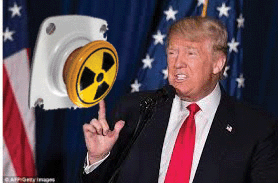
Trump administration targets groups and individuals over non-nuclear behavior, after confirming that Iran is following nuclear agreement but breaching its ‘spirit’, Guardian, 18 Jul 17, The Trump administration announced on Tuesday new sanctions on 18 Iranian individuals, groups and networks over non-nuclear behavior, such as support for ballistic missiles development.
The move came a day after the administration certified to Congress that Iran is technically complying with the nuclear deal and can continue enjoying nuclear sanctions relief.
The treasury department is targeting seven groups and five people that aided Iran’s military or its elite Revolutionary Guard. The sanctions also target what the US says is a transnational criminal group based in Iran and three people associated with it, and the state department is also targeting two more groups associated with Iran’s ballistic missiles program.
The sanctions freeze any assets the targets may have in the US and prevent Americans from doing business with them.
Late on Monday, the administration insisted that Tehran would face consequences for breaching “the spirit” of the nuclear deal. Donald Trump, who lambasted the 2015 pact as a candidate, has given himself more time to decide whether to dismantle the deal or let it stand.
Officials said the US was working with allies to try to fix the deal’s flaws, including the expiration of some nuclear restrictions after a decade or more. The officials also signalled the new sanctions.
Trump, secretary of state Rex Tillerson and “the entire administration judge that Iran is unquestionably in default of the spirit” of the agreement, one official said. That assessment carries no legal force; Trump’s certification that Iran is technically complying clears the way for sanctions to remain lifted.
Monday’s late-night announcement capped a day of frenzied, last-minute decision-making by the president, exposing deep and lingering divisions within his administration about how to deal with a top national security issue.
National security advisers, including Tillerson and defense secretary James Mattis, recommended Trump preserve the deal for now in a meeting last Wednesday, according to the New York Times. An anonymous official told the Times that Trump spent 55 minutes of the meeting saying he did not want to certify Iran’s compliance. On Monday, a planned press briefing was cancelled at short notice as internal White House arguments continued.
Since early last week, Trump’s administration had been prepared to make the certification, a quarterly requirement. Trump first told Congress in April that Iran was indeed complying. With no final decision on his broader Iran policy, the White House had planned to let the status quo stand for another three months.
Iran will continue receiving the same sanctions relief that it did under former president Barack Obama………
Scuttling the deal would put further distance between Trump and foreign leaders who are already upset over his move to withdraw from the Paris global climate change accord. Other powers that brokered the nuclear deal along with the US have said there’s no appetite for renegotiating it. https://www.theguardian.com/world/2017/jul/18/iran-is-complying-with-nuclear-deal-but-is-in-default-of-its-spirit-says-us
July 19, 2017
Posted by Christina Macpherson |
Iran, politics international, USA |
Leave a comment
Macron assures Israel of ‘vigilance’ on Iran nuclear pact, https://www.thelocal.fr/20170716/macron-assures-israel-of-vigilance-on-iran-nuclear-pact French President Emmanuel Macron on Sunday assured visiting Israeli Prime Minister Benjamin Netanyahu of his “vigilance” regarding the 2015 nuclear accord reached by Western powers with Iran.
Netanyahu “expressed his concerns regarding the Iranian regime,” Macron told reporters with Netanyahu at his side.
“I assured him of our vigilance, in particular over the strict implementation of the accord… in all its provisions.”
Netanyahu was a vocal opponent of the deal, which saw sanctions against Iran eased in return for curbs on its nuclear programme. The French presidency said Sunday’s meeting, the first official talks between Macron and Netanyahu, would be an occasion to “signal our lack of complacency towards Iran”.
Israel was rattled last month when Tehran launched fired six missiles from western Iran targeting bases of the Islamic State group in retaliation for attacks in Tehran that killed 17 people in the first Isis-claimed operations in the country.
Netanyahu has repeatedly said Iran is a threat to the Jewish state, the Middle East and potentially the world.
July 17, 2017
Posted by Christina Macpherson |
France, Israel, politics international |
Leave a comment
Trump likely to say Iran complying with nuclear deal: U.S. official, WASHINGTON (Reuters) by Steve Holland and Jonathan Landay-13 July 17 U.S. President Donald Trump is “very likely” to state that Iran is adhering to its nuclear agreement although he continues to have reservations about it, a senior U.S. official said on Thursday.
Under U.S. law, the State Department must notify Congress every 90 days of Iran’s compliance with the so-called Joint Comprehensive Plan of Action (JCPOA). Trump has a congressionally mandated deadline of Monday to decide.
The landmark 2015 deal struck with Iran by the United States, France, Britain, Russia, China and Germany is aimed at preventing Tehran from developing a nuclear weapon by imposing time-limited restrictions and strict international monitoring on its nuclear program. In return, Tehran won relief from punishing international economic sanctions.
If Trump does state Iran is in compliance, it would be his second time since taking office in January to do so despite his promise during the 2016 campaign to “rip up” what he called “the worst deal ever.”…….https://www.reuters.com/article/us-usa-trump-iran-idUSKBN19Y226
July 14, 2017
Posted by Christina Macpherson |
Iran, politics international, USA |
Leave a comment