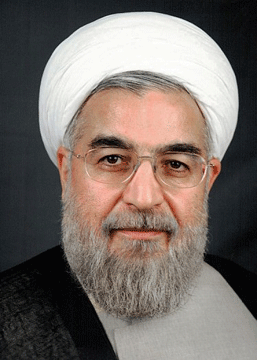
 Elysee: Rouhani reelection gives hope for Tehran’s compliance with nuclear deal http://theiranproject.com/blog/2017/05/21/elysee-rouhani-reelection-gives-hope-tehrans-compliance-nuclear-deal/ – The office of French President Emmanuel Macron said that the reelection of Hassan Rouhani as Iranian President gives hope for the country’s compliance with the nuclear deal.
MOSCOW (Sputnik) — The reelection of Hassan Rouhani as Iranian President gives hope for the country’s compliance with the Joint Comprehensive Plan of Action (JCPOA) aimed at settlement of the Iranian nuclear issue, the office of French President Emmanuel Macron said in a statement.
“The reelection of President Rouhani strengthens the hope that his government will abide accurately by the historic agreement of July 14, 2015, which allowed to regulate through the diplomatic means the disagreements on the nuclear issue and to engage in the new stage of the relations between Iran and the international community. France, in turn, will continue to exercise vigilance over the strict implementation of [the agreement’s] elements,” the statement distributed by Macron’s press office read.
In the document, the French president congratulated his Iranian counterpart on the reelection and expressed hope for the improvement of the economic, scientific and cultural ties between Tehran and Paris.
Apart from this, Macron called on Iran to contribute to the settlement of the crises in the Middle East.
“Adhering to the development of the political dialogue with Iran, France reiterates the necessity of the diplomatic regulation of the conflicts in the Middle East and urges Iran to participate in it,” the statement stressed.
May 22, 2017
Posted by Christina Macpherson |
Iran, politics international |
Leave a comment

From The National, UAE 14 May 17 “………..The International Atomic Energy Agency worked with government agencies to launch the Nuclear Energy Management School at Khalifa University.
The curriculum includes nuclear energy policy and planning, nuclear regulation and law, operations, safety, security, emergency readiness and nuclear project management.
Experts from IAEA, Nawah Energy, the Federal Authority for Nuclear Regulation and the Emirates Nuclear Energy Corporation will give lectures at the school……..
The authority, where Emiratis comprise 62 per cent of its workforce, said the school would help to ensure the sustainability of the UAE’s power supply and support Emiratis by providing them with the necessary capabilities to manage its nuclear energy programme……
Nuclear will help to save the environment while still providing electricity,” said Mohammed Al Ali, 31, an export control specialist at Nawah Energy.
“It will also help the youth because it’s a new field and we will gain a lot more skills because it’s an industry that is constantly evolving worldwide.”……
May 15, 2017
Posted by Christina Macpherson |
Education, United Arab Emirates |
Leave a comment
Iran raps US nuclear stance as provocative, warns about arms race, http://www.presstv.ir/Detail/2017/05/06/520793/Iran-US–Dehqani-NPT-Conference-Nuclear-Weapons-Vienna A senior Iranian Foreign Ministry official has criticized the “provocative” nuclear stance adopted by the United States, saying the world is witnessing an arms race among nuclear powers.
The director general for political and international security affairs at Iran’s Foreign Ministry, Gholam-Hossein Dehqani, made the remarks in an address to the first session of the Preparatory Committee for the 2020 Review Conference of the Parties to the Treaty on the Non-Proliferation of Nuclear Weapons (NPT) in the Austrian capital of Vienna on Saturday.
“The existing nuclear weapons have already endangered international peace and security and the current world cannot deal with the beginning of a new round of arms race,” Dehqani said.
“That is the reason why any attempt at [unleashing] an arms race must be ended,” he added.
He said lack of real progress towards disarmament over the past 50 years was the “biggest challenge” to the NPT implementation.
The Iranian official expressed concern about the persistence of such a situation and warned that NPT’s credibility would be undermined if no immediate action was adopted to that effect.
According to the NPT, countries that possess nuclear weapons must fulfill their legal commitments to slash their atomic arsenals “completely, immediately, with goodwill and without any precondition,” he said.
It is estimated that there are more than 15,000 nuclear weapons in the world, which is “a big threat to the survival of humanity,” Dehqani added.
US President Donald Trump said in February that he wants to ensure the US nuclear arsenal is at the “top of the pack,” saying the United States has fallen behind in its weapons capacity.
Under Article VI of the NPT, all parties to the treaty undertake to pursue good-faith negotiations on effective measures related to nuclear disarmament and the cessation of nuclear arms race.
The preparatory committee, which opened in Austria on May 2 and will conclude on May 12, is responsible for addressing substantive and procedural issues related to the NPT.
May 8, 2017
Posted by Christina Macpherson |
Iran, USA, weapons and war |
Leave a comment
 UAE delays launch of first nuclear power reactor, REUTERS By Jane Chung and Geert De Clercq | SEOUL/PARIS, 4 May 17 The commercial start-up of the first of four nuclear reactors that South Korea’s KEPCO is building in United Arab Emirates is set to be delayed because the local operating company is not ready to run the reactors, a nuclear industry source said.
Barakah is one of the world’s few major nuclear newbuild contracts, which Korea Electric Power Corporation(KEPCO) won in 2009, beating a rival consortium led by more established French reactor maker Areva……
a source familiar with the situation said that Nawah – the joint venture between the Emirates Nuclear Energy Corporation (ENEC) and KEPCO that will operate the plant – is struggling to get an operating license, which could delay the start-up of the first plant by several months, possibly to the end of this year……
construction of Shin Kori No.3 reactor [in South Korea] was delayed three years due to a safety scandal in late 2012, and the reactor only became operational in December 2016.
A source with direct knowledge of the situation told Reuters that because of the delay on Shin Kori No.3, UAE nuclear regulator FANR was not ready to give Nawah its operating license and wanted to postpone this “regardless of the construction schedule.”…….
Low oil prices are also making the start-up of the plant less urgent from the UAE perspective, the source added.
ENEC and Nawah did not respond to several requests for comment. KEPCO declined to comment.
A second source in the nuclear industry who is not directly involved in the Barakah project, said nuclear fuel had been shipped to UAE but was not being loaded into the reactor as Nawah does not yet have a license.
For years, Nawah has been training staff in power plant operation, but to get an operating license it needs to demonstrate it has the necessary management skills and can master all the systems needed to operate the reactors.
“It is not a simple undertaking. There will be some Korean staff, but they can only be in the back seat, not the front seat. The reactor has to be operated by the licensee’s staff,” the industry source said.
For KEPCO, a delay of the project increases its indirect costs, as it will force it to keep its staff of about 21,000 in the UAE for longer, the first source said……..(Reporting by Jane Chung in Seoul, Geert De Clercq in Paris and Stanley Carvalho in Abu Dhabi; Writing by Geert De Clercq, editing by David Evans) http://www.reuters.com/article/us-kepco-emirates-nuclearpower-exclusive-idUSKBN1801ZD
May 5, 2017
Posted by Christina Macpherson |
business and costs, employment, United Arab Emirates |
Leave a comment
A New Era for Iran: Trade With EU Grows 79 Percent on Nuclear Deal Implementation http://www.albawaba.com/business/new-era-iran-trade-eu-grows-79-percent-nuclear-deal-implementation-970660 May 4th, 2017 Iran’s exports to the European Union have increased by over 300 percent after the implementation of the historic 2015 nuclear agreement between Iran and the P5+1 group of countries, European Climate Action and Energy Commissioner Miguel Arias Canete says.
Speaking at the first-ever Iran-EU Business Forum on Sustainable Energy in Tehran on Saturday, Canete added that trade between Iran and the union showed 79 percent boost following the implementation of the nuclear deal, known as the Joint Comprehensive Plan of Action (JCPOA), IRNA reported.
According to figures released by the European Union’s statistics agency Eurostat in February, Iran’s exports to the EU stood at €5.494 billion in 2016 as compared to €1.235 in 2015 due to the EU resuming oil imports from Iran following the nuclear deal.
Canete expressed the 28-nation bloc’s keenness to cooperate with Iran in the nuclear energy sector and said the JCPOA prepared the ground for the resumption of Iran-EU cooperation.
The commissioner reiterated the EU’s support for the nuclear agreement and said Iran and the union started to cooperate with each other in different sectors in 2016 and managed to sign many agreements.
He urged both sides to continue to upgrade their cooperation and expressed hope that the ongoing forum in Tehran would lay the ground for interaction in clean energy. He noted that he would help European firms make more investment in Iran.
Under the agreement, limits were put on Iran’s nuclear activities in exchange for, among other things, the removal of all nuclear-related bans against the Islamic Republic.
Following the conclusion and implementation of the JCPOA, Iran and EU member states launched cooperation and signed several agreements in various fields.
More than 50 European companies and business associations and some 40 Iranian energy companies are participating at the Tehran forum with the purpose of enabling business relations and partnerships between Iran and the EU and laying the ground for further cooperation and joint partnerships in the energy sector.
It will provide a platform for investors and businesses to look into investment opportunities for clean energy, renewable energy efficiency and energy conservation actions in Iran.
May 5, 2017
Posted by Christina Macpherson |
business and costs, EUROPE, Iran, politics international |
Leave a comment
 Nuclear Deal Gains Significant https://financialtribune.com/articles/national/63693/nuclear-deal-gains-significant, , May 04, 2017
The director general of the International Atomic Energy Agency stressed that the historic deal between Iran and major powers is a significant gain for nuclear verification.
Yukiya Amano made the statement in a message to the participants of the first session of the Preparatory Committee for the 2020 Review Conference of the Parties to the Treaty on the Non-Proliferation of Nuclear Weapons, which started on Tuesday, Press TV reported. Amano noted that IAEA inspectors have once again confirmed that Iran has been carrying out its obligations under the accord, formally known as the Joint Comprehensive Plan of Action.
“Since the implementation of JCPOA began in January 2016, we have been verifying and monitoring Iran’s implementation of its nuclear-related commitments under the agreement,” he said. “Our inspectors have expanded access to sites and have more information about Iran’s nuclear program. That program is smaller than it was before JCPOA came into effect. Iran is provisionally implementing the additional protocol to its safeguards agreement with the agency.” Under the agreement, time-bound limits have been placed on Iran’s nuclear activities in exchange for sanctions relief.
May 5, 2017
Posted by Christina Macpherson |
Iran, politics international |
Leave a comment
 TILLERSON ATTACKS IRAN NUCLEAR DEAL AND VOWS A “COMPREHENSIVE REVIEW”, PPP Focus, May 4, 2017“…….Iran is “not living up to the spirit” of the nuclear deal struck with world powers, US President Donald Trump said on Thursday, warning America would set out its position on that soon. And Tehran has given no indication of wanting to ditch the deal, properly known as the JCPOA, or Joint Comprehensive Plan of Action.
On April 20 at the United Nations, the USA ambassador to the UN, Nikki Haley, added to the Trump administration’s barrage of criticism of Iran, calling Tehran the “chief culprit” in conflicts in the Middle East and urging the UN to make dealing with Iran a “priority”.
…..A senior adviser said last month that the USA will continue to adhere to the deal and “will also work very hard to make sure that Iran does”. … “If sanctions are re-imposed on Iran, Iran can walk from the deal”, said Jeremy Bash, Former CIA Chief of Staff.
The administration says it is reviewing these accords and could still pull out of them……
China hopes all parties could ensure the nuclear deal was implemented, appropriately handle disagreements and make positive contributions to nuclear non-proliferation and peace and stability in the Middle East, Lu added. “But if they try to constrain investment on Iran, that goes against the agreement”. The hardliners are already emboldened. Iran has been extremely isolated internationally due to these sanctions.
The nuclear deal was sealed in Vienna in July 2015 after 18 months of negotiations led by former Secretary of State John Kerry and diplomats from the other four permanent members of the U.N. Security Council – Britain, China, France and Russian Federation – and Germany…….
Tillerson’s letter follows an assessment by the International Atomic Energy Agency in February that Iran has so far complied with restrictions on its uranium enrichment and is not pursuing construction on its heavy-water research reactor.
The bottom line is that the Trump administration has approved 90 days more of sanctions relief for Iran…..
May 5, 2017
Posted by Christina Macpherson |
Iran, politics international |
Leave a comment
http://www.gulf-times.com/story/546881/Qatar-calls-for-nuclear-free-zone-in-Middle-East
May 04 2017 Qatar has expressed concern over the worsening international situation, and has called for establishing a nuclear weapons-free zone in the Middle East.
Speaking at the First Preparatory Committee for the 2020 Review Conference of the Parties to the Treaty on the Non-Proliferation of Nuclear Weapons (NPT) in Vienna on Tuesday, Qatar’s ambassador and its permanent representative to the International Atomic Energy Agency, Sheikh Ali bin Jassim al-Thani, called for placing all nuclear facilities in the region under comprehensive safeguards of the agency in compliance with the resolution of the 1995 NPT Review Conference and in accordance with the mechanisms agreed upon at the 2010 Review Conference.
Sheikh Ali bin Jassim said the situation was very grave with international and regional crises posing many challenges. He said the increased emphasis on nuclear weapons in the military and security doctrines of many countries, and the escalation of cyber wars are a major concern for the international community.
He noted Qatar’s support for the initiative to prepare a binding international instrument for a nuclear weapons-free world, which the United Nations General Assembly is considering at its current session, as well as its support for the international conferences on the humanitarian impact of nuclear weapons, the last of which was a conference held in Vienna in 2015, which aimed at developing a greater awareness of the catastrophic consequences of use of nuclear weapons.
The ambassador also supported the position taken by the Gulf Co-operation Council (GCC) member-states at the meeting.
Sheikh Ali bin Jassim highlighted the need to avoid a repeat of the failed 2015 Review Conference.
At every relevant international forum Qatar has warned of the long-term humanitarian consequences of nuclear weapons and stressed that the consolidation of peace, security and stability in the world requires nuclear disarmament and investing instead in social and economic development.
Despite that nuclear disarmament and non-proliferation efforts have remain stalled.
Qatar has argued that the threats posed by nuclear weapons require more efforts to create favourable conditions towards a nuclear-free world in accordance with the objectives of the NPT.
It has pointed out that the risk of nuclear proliferation in the Middle East represents one of the key factors that haunt the people of the region in the absence of real international efforts for the elimination of nuclear weapons and in light of the ongoing turmoil in the region and the potential risks that terrorist groups could acquire these weapons.
May 5, 2017
Posted by Christina Macpherson |
MIDDLE EAST, weapons and war |
Leave a comment
 One man is stoking fear over Iran’s presidential election — and the nuclear deal 5/4/2017 CNBC, May 3, 2017 – Supporters of Iranian cleric and presidential candidate Ebrahim Raisi vawe Iranian flags during Raisi’s electoral rally prior to presidential elections in Tehran, Iran on April 29, 2017.
The likely successor to Iran’s supreme leader has entered the country’s presidential election, and that’s throwing a lot into question.
Many still expect President Hassan Rouhani to win another term when Iranians go to the polls on May 19. But the emergence of Ebrahim Raisi as the conservative favorite has tightened the race and raised concerns about oil, a historic nuclear deal, and the fragile reopening of the Iranian market.
Raisi was an unknown until he rose to prominence last year when Ayatollah Ali Khamenei named him the custodian of an important Shiite shrine. The move sparked speculation that Raisi is in line to succeed the 77-year old supreme leader.
A hardline victory this month would put conservatives on a collision course with a combative Trump administration, endangering the 2015 agreement that put limits on Iran’s nuclear program in exchange for sanctions relief.
Hanging in the balance is Iran’s oil production, which has grown by roughly a million barrels a day since sanctions were lifted. So too are investment plans by energy giants to develop the country’s massive oil and gas reserves, and billions in aircraft sales by companies including Boeing.
More broadly, the election represents a choice between joining the global economy under Rouhani — who spearheaded the nuclear deal — and the so-called ‘resistance economy’ championed by hardliners, which is designed to protect politically connected domestic businesses.
Khamenei has not publicly backed Raisi, but generals from the influential Islamic Revolutionary Guard Corps paid the candidate an official visit, cementing the view that he is the ayatollah’s choice.
Raisi could backfire on hardliners……..
The election will depend on the economy and whether voters feel the benefits of the nuclear deal have trickled down to them, in Eurasia Group’s view.
Rouhani has restored a sense of security by preventing hyperinflation and shortages, but unemployment remains high, particularly among young people.
Following the nuclear deal, oil is flowing more freely, but there is a sense that Rouhani’s promise of prosperity has not come to pass.
‘He’s not being hit on the nuclear deal,’ Vatanka said. ‘He’s being hit on how he oversold it.’https://www.mojahedin.org/newsen/54741?c=twitter
May 5, 2017
Posted by Christina Macpherson |
Iran, politics |
Leave a comment
Climate change could lead to overall increase in river flow, but more droughts and floods, study shows, Science Daily
- Date:
- April 24, 2017
- Source:
- Massachusetts Institute of Technology
- Summary:
- The unpredictable annual flow of the Nile River is legendary, as evidenced by the story of Joseph and the Pharaoh, whose dream foretold seven years of abundance followed by seven years of famine in a land whose agriculture was, and still is, utterly dependent on that flow. Now, researchers have found that climate change may drastically increase the variability in Nile’s annual output……..https://www.sciencedaily.com/releases/2017/04/170424141236.htm
April 26, 2017
Posted by Christina Macpherson |
climate change, Egypt |
Leave a comment
 Why Trump Can’t Rip Up Iran’s Internationally Brokered Nuclear Deal , Sputnik News 21 Apr 17 While the Trump administration admitted that Iran has complied with the 2015 nuclear agreement, it continues to send mixed signals to Tehran, accusing the latter of sponsoring terrorism. Speaking to Sputnik Persian, Hamid Gholamzadeh assumed that Washington is looking for any excuse to rip the deal up.
Although the Trump administration admitted Tuesday that Iran is complying with the terms of the 2015 nuclear agreement and extended the sanctions relief given to Tehran, US Secretary of State Rex Tillerson leveled criticism at Iran on Wednesday, dubbing the deal a “failed approach.”
Tillerson emphasized that the US is going to carry out a “comprehensive review” of its policy toward Iran, which, according to the Secretary of State, is about to follow in North Korea’s footsteps.
“The Trump administration is currently conducting across the entire government a review of our Iran policy… an unchecked Iran has the potential to follow the same path as North Korea and take the world along with it. The United States is keen to avoid a second piece of evidence that strategic patience is a failed approach,” Tillerson said as quoted by CNBC……..
Speaking to Sputnik Persian, Hamed Mousavi, a professor at the Department of Political Sciences of the University of Tehran, highlighted that Iran’s nuclear agreement is an international deal in the first place.
“One should pay attention to a few points, in particular, the multilateral nature of the obligations under the JCPOA. The US should not forget that a nuclear deal is not a bilateral agreement between [Washington] and Iran. The United States cannot unilaterally abolish the international agreement that was signed by Iran and several other countries and which was approved by the UN Security Council. This is contrary to international law,” Mousavi emphasized.
Grigory Yarygin, Associate Professor at the Department of American Studies of the School of International Relations at St.Petersburg State University, echoed Mousavi.
“This nuclear deal was concluded not only between Tehran and Washington, but it is Iran’s deal with six international mediators. Therefore, it is highly unlikely that the attempt to cancel this deal will succeed,” Yarygin told Radio Sputnik.
“We must understand that at the international level, significant efforts were made… to ease tensions between Iran and the United States and prevented possible tragic consequences related to the [Iranian] nuclear program,” he said.
For his part, Hamid Gholamzadeh, an expert on North America and English Chief Editor of Mehr News Agency, suggested in an interview with Sputnik Persian that Washington is looking for an excuse to undermine the deal.
“The US has recognized that Iran is fulfilling its obligations. But this did not convince them. Therefore, the US is looking for new pretexts, which they want to prove using the relevant documents. Despite the reaffirmation of Iran’s commitment to its obligations, the US accused it of supporting terrorism in order to obtain a justification [for imposing sanctions],” Gholamzadeh explained.
“I believe that the US will play out its own scenario: they will try to reimpose the sanctions, unless Europe, Russia and China, as the main negotiators, try to prevent these plans,” he added.
The question then arises as to why the new administration is pushing ahead with its plan to rip the Iran nuclear deal up?
Robbie Gramer of Foreign Policy magazine believes that Donald Trump is seeking to restore US-Saudi relations, which were undermined by the US nuclear deal struck under Obama………https://sputniknews.com/politics/201704201052818335-trump-iran-nuclear-deal/
April 22, 2017
Posted by Christina Macpherson |
Iran, politics international |
Leave a comment
 Tillerson Slams Nuclear Deal after State Department Certifies Iranian Compliance, A proliferation expert suggests the certification was made to comply with law and avoid a crisis while reviewing its Iran policy. The Weekly Standard, APR 20, 2017 | By JENNA LIFHITS Secretary of State Rex Tillerson slammed the Iran nuclear deal for its limited scope and eventual sunset date Wednesday, and said the Trump administration is conducting an exhaustive review of its Iran policy.
The secretary’s rebuke came one day after his State Department certified that Iran is complying with the deal. The decision to certify likely follows from the administration being knee-deep in an intensive review of the agreement and uncertain about next steps, top proliferation experts told THE WEEKLY STANDARD………
While Tillerson did not specify whether the administration would scrap or rigorously enforce the deal, he and other administration officials have suggested a preference for the latter.
Late Tuesday, Tillerson certified to Congress that Iran is complying with the nuclear deal.
The president must by law report to Congress about Iranian compliance with the deal every three months. If the administration does not submit a compliance certification or determines that Iran is in “material breach” of the deal, Congress has the ability to quickly re-impose sanctions lifted under the deal. The certification drew the ire of some in the White House who would have preferred to see no certification filed and the deal subsequently done away with.
The administration likely issued the certification to meet the conditions of the law and avoid a crisis while reviewing its Iran policy, a top proliferation expert told TWS………
If the administration had not issued the certification, the diplomatic fallout could have been significant, David Albright (founder of the Institute for Science and International Security) added.
Tillerson said this week that the administration is conducting a broad review of its Iran policy, including the nuclear agreement and whether to maintain related sanctions relief…….
Administration officials have also reportedly been considering broadening sanctions against Iran and its Islamic Revolutionary Guard Corps (IRGC). http://www.weeklystandard.com/tillerson-slams-nuclear-deal-after-state-department-certifies-iranian-compliance/article/2007709
April 21, 2017
Posted by Christina Macpherson |
Iran, politics international, USA |
Leave a comment
 White House Shouldn’t Try To Reverse Iran Nuclear Deal, Parsi Says, NPR, April 20, 20175 , Heard on Morning Edition Steve Inskeep talks to Trita Parsi, an Iran scholar, who warns of dire consequences if Trump officials renege on the nuclear accord and reverse a pledge to ease sanctions against Tehran.
STEVE INSKEEP, HOST:
Let’s make sense of two moves that President Trump’s administration made this week. The administration affirms that Iran is following a nuclear deal. The administration also says Iran is misbehaving around the Middle East. Put another way, Secretary of State Rex Tillerson says Iran is following a deal that the Trump administration really doesn’t like.
INSKEEP: One observer of the administration moves is Trita Parsi, president of the National Iranian American Council. He supported the nuclear deal made by the Obama administration, although he is not on good terms with Iran’s government. Welcome to the program.
INSKEEP: So what does it mean that President Trump, who said he would rip up this nuclear deal on day one, instead says Iran is following it?…..
PARSI: Well, I think the first thing to say is that it doesn’t seem as if the Trump administration really knows what it’s doing. It’s a significant contradiction to first come out and say that the Iranians – contrary to all of their claims that Iran would be cheating – actually is living up to the deal only to come out the day after and saying, well, we hate the deal anyways and signaling that the U.S. might actually be walking away from the deal, unless of course the aim is to get rid of the deal without the U.S. having to pay the cost for it, meaning instead of the U.S. violating the deal directly by not renewing these sanctions waivers, killing the deal by escalating tensions in Yemen and elsewhere in the region and hoping that that will force the Iranians out of the deal…….
INSKEEP: Wouldn’t you like some pressure on this government, though, even though you are a supporter of the nuclear deal?
PARSI: Certainly. There’s many areas in which there needs to be pressure on Iran, particularly, I would say, on the human rights front. But an approach that is centered on pressure and that is completely void of diplomacy most likely will lead to a military confrontation…….
INSKEEP: Can you just remind us what the basics of this nuclear deal are? Iran still has a nuclear program – right? – but it’s restricted.
PARSI: Iran has a restricted nuclear program. There are inspections in every aspect of Iran’s program. And all of the various pathways that Iran had towards building a nuclear bomb as a result of this deal has been closed. Some of these restrictions will be lifted in about 15 or so years. But the most important restriction is the inspections regime, the additional product called a Non-Proliferation Treaty, will be permanent, granted, of course, that all sides live up to their end of the bargain. And as the Trump administration certified two days ago, so far, the Iranians are living up to the bargain. And now, the United States also has to continue to waive sanctions in order for the United States to be in compliance with the deal.
INSKEEP: OK. You just mentioned waiving sanctions. Does President Trump have to actively do something to keep the sanctions off Iran for the moment?
PARSI: Yes. Before May 18, the United States is obliged to continue to waive sanctions in order for the U.S. to be in compliance. If it doesn’t, then the U.S. pulls out of the deal, and that will likely cause the Iranians to do the same.
INSKEEP: So that would be the next big moment to watch, potentially, is whether President Trump is willing to affirmatively keep sanctions eased on Iran.
PARSI: Exactly. And the day after the deadline is the Iranian presidential elections.
INSKEEP: And in which the president who did the deal, President Hassan Rouhani, is up for re-election.PARSI: He is up for re-election. And if he loses, then we will have a president in the United States and a president in Iran that most likely will be opposed to this deal. And that would be very negative for the continuation of this nuclear accord.
INSKEEP: Trita Parsi has a book coming out called “Losing An Enemy: Obama, Iran, And The Triumph Of Diplomacy.” He’s with the National Iranian American Council……http://www.npr.org/2017/04/20/524833644/white-house-shouldnt-try-to-reverse-iran-nuclear-deal-parsi-says
April 21, 2017
Posted by Christina Macpherson |
Iran, politics international, USA |
Leave a comment
 Championing Nuclear Non-Proliferation Rules: The EU and Iran , Lobelog, by Peter Jenkins, 20 Apr 17 In a newly published book, Tarja Cronberg contrasts EU and US conceptions of multilateralism in the nuclear field. Her work is titled Nuclear Multilateralism and Iran.
A former member of the European Parliament (EP) and chair of the EP delegation for EU relations with Iran, Cronberg writes: “For the US multilateralism is a means to an end, but for Europeans it is an end in itself.” Both the EU and the US are committed, she continues, to upholding international law, well-functioning international institutions, and a rules-based international order. But the EU’s commitment is more heartfelt and goes deeper than the US commitment. After all, the EU itself is a multilateral institution, and, lacking military resources, is more dependent on global rules. The US approach is “utilitarian,” writes Cronberg, quoting Robert Kagan, whereas the EU approach could be characterized as both idealistic and needy (my words, not hers).
These distinctions are the starting-point for an analysis of the EU contribution to resolving the concern aroused by International Atomic Energy Agency (IAEA) reports in 2003 that Iran had “pursued a policy of concealment” for 18 years and had failed to declare the possession and use of nuclear material to develop a uranium enrichment capability. Cronberg finds that the EU contribution was important, even essential to the eventual outcome of that process. The EU showed itself to be a “unified” and effective “actor.”
Good Cop/Bad Cop
This finding leads her to offer several recommendations to EU policymakers. Her chief recommendation relates to the role the EU should aspire to play in the event of similar nuclear proliferation cases in the future. She would like the EU role to be “autonomous.” In effect she is advocating that the EU put itself forward as a purer champion of a multilateral rules-based order than the United States, to lead the international search for peaceful solutions.
In support of that recommendation she makes a telling point. On moral and political grounds the five Nuclear Non-Proliferation Treaty (NPT) Nuclear Weapon States (NWS) ought to have disbarred themselves from preaching nuclear non-proliferation years ago. Most NPT parties resent the continuing reluctance of the NWS to act on their NPT pledge to negotiate “in good faith” on nuclear disarmament. Indeed most parties find NWS hypocrisy nauseating. In contrast, although two NWS are members of the EU (only one, in all probability, from April 2019), the EU as a whole is entitled to characterize itself as a non-nuclear weapon entity………
This is a thought-provoking book that draws on “front-line” experience of the issues and historical events that the author addresses. It appears at a time when the commitment of the United States to the multilateral rules-based order that it fathered over 70 years ago seems weaker than ever. http://lobelog.com/championing-nuclear-non-proliferation-rules-the-eu-and-iran/
April 21, 2017
Posted by Christina Macpherson |
Iran, politics international, resources - print |
Leave a comment
 Lawsuit Warns $234B In Aid To Israel Violates US Law Against Supporting Secret Nuclear States, Mint Press, By Kit O’Connell | Follow on Facebook | @KitOConnell | August 16, 2016
The lawsuit warns that the U.S. gave Israel about $234 billion in foreign aid since the passage of the International Security Assistance and Arms Export Control Act of 1976, despite a ban on support for secret nuclear weapons programs.
By Kit O’Connell AUSTIN, Texas — A lawsuit warns that U.S. aid to Israel violates a law meant to prevent nuclear weapons proliferation, even as the United States prepares to increase the already massive Israeli aid program.
Filed Aug. 8 by Grant Smith, director of the Institute for Research: Middle East Policy, or IRMEP, in the U.S. District Court for the District of Columbia, the suit alleges that U.S. aid to Israel violates two amendments to the 1961 Foreign Assistance Act, known as the the Symington and Glenn Amendments, which collectively ban support for countries engaged in clandestine nuclear programs.
In the lawsuit, Smith alleges that violating these amendments means that Israel has received approximately $234 billion in illegal aid since the passage of the International Security Assistance and Arms Export Control Act of 1976.
The lawsuit reads:
“This lawsuit is not about foreign policy. It is about the rule of law, presidential power, the structural limits of the U.S. Constitution, and the right of the public to understand the functions of government and informed petition of the government for redress.”…….
Israel’s dangerous ‘nuclear ambiguity’
The IRMEP lawsuit argues that Israel’s policy of official secrecy on its nuclear weapons program perfectly fits the definition of the 1976 Export Control Act, and that the U.S. government broke the law through its “failure to act upon facts long in their possession while prohibiting the release of official government information about Israel’s nuclear weapons program, particularly ongoing illicit transfers of nuclear weapons material and technology from the U.S. to Israel.”
Smith wrote that the U.S. offers material support to Israel’s nuclear program while helping suppress information about the program. He continued:
“These violations manifest in gagging and prosecuting federal officials and contractors who publicly acknowledge Israel’s nuclear weapons program, imposing punitive economic costs on public interest researchers who attempt to educate the public about the functions of government, refusing to make bona fide responses to journalists and consistently failing to act on credible information available in the government and public domain.”
This policy of secrecy goes by many names, he noted. “These acts serve a policy that has many names all referring to the same subterfuge, ‘nuclear opacity,’ ‘nuclear ambiguity,’ and ‘strategic ambiguity.’”
Although long denied by both American and Israeli politicians, Israel’s nuclear program was first revealed by whistleblower Mordechai Vanunu, who spent 16 years in prison for sharing secret details of the program with Britain’s Sunday Times in 1986, and has been repeatedly arrested for continuing to publicly speak out.
Although the program is still not officially acknowledged, a November report by the Institute for Science and International Security suggested the Israeli government has amassed enough material to create at least 115 nuclear warheads. That would put Israel, a country roughly the size of New Jersey, on nearly equal nuclear footing with India and Pakistan…….http://www.mintpressnews.com/lawsuit-warns-234b-aid-israel-violates-us-law-supporting-secret-nuclear-states/219502/
April 19, 2017
Posted by Christina Macpherson |
Israel, Legal, USA |
Leave a comment










 nuclear-news