Facing reality in the US-Saudi nuclear agreement: South Korea https://thebulletin.org/facing-reality-us-saudi-nuclear-agreement-south-korea11683, Victor Gilinsky, Henry Sokolski, 10 Apr 18 The Trump administrations is on the verge of signing a nuclear agreement with Saudi Arabia that is reportedly “flexible” on Saudi acquisition of centrifuge technology to enrich uranium—the technology that can provide material for nuclear weapons and that was the central concern in regard to Iran’s nuclear program. This flexibility is necessary, the administration argues, to ensure the Saudis choose Westinghouse as their nuclear power reactor supplier. But Westinghouse, which performed abysmally on its last two US projects and is in bankruptcy as a result, is far less likely to win the bid than the South Korean construction firm whose work force is coming off successful completion of a large nuclear project nearby in the United Arab Emirates. This increases the importance of striking a tight US-Saudi agreement to ensure the Saudis don’t get to enrich under their nuclear cooperative agreement with Seoul.
The administration’s pitch that Congress should go along with “flexibility” pulls out all the usual bogeymen. Energy Secretary Rick Perry told the Senate Armed Services Committee on March 22 that, “Either Russia or China is going to be a partner in building civil nuclear capability in the Kingdom of Saudi Arabia, or the United States.” The Saudis, guided by several Washington lobbying firms, have been pushing this line, which much of the Washington establishment has swallowed, adding that allowing Moscow to gain a nuclear foothold in Saudi Arabia would deal a serious blow to US regional influence and prestige.
But the Saudis are not so foolish as to choose Russia or China. Moscow is nuclear supplier to Saudi Arabia’s foe, Iran, and Beijing has yet to bring a power reactor online outside of China. The Saudis already have a significant history of nuclear involvement with South Korea. They signed an agreement for “cooperation in the peaceful uses of nuclear energy” in 2011 and a memorandum of understanding in 2015, with a view to buying two smaller, so-called small modular (SMART) Korean reactors. Dozens of Saudis have gone to South Korea for nuclear training.
In these circumstances, the enrichment provision in the 2011 Saudi-South Korean agreement is of vital concern. It reads as follows: “Uranium transferred pursuant to this Agreement or used in any equipment so transferred shall not be enriched to twenty (20) percent or more in the isotope U-235 unless the Parties otherwise agree.” In other words, the 2011 agreement permits installation of Saudi enrichment facilities generally, and in particular the enrichment to 20 percent of uranium supplied under the agreement. A reason this is worrying—and was worrying in the case of Iran—is that, although it may seem counter intuitive, to further enrich the 20 percent product to a bomb explosive level takes only an additional one-tenth of the work it took to get to 20 percent. It becomes especially worrying when coupled with the Saudi Crown Prince’s hair-trigger promise (see this 60 Minutes interview) that if Iran got a bomb, the Kingdom would, too, “as soon as possible.”
This means that if we intend to bar Saudi Arabia’s path to nuclear weapons, and we absolutely should, we have to insist on a provision in our agreement with Saudi Arabia like that included in the agreement with its UAE neighbor: that the country will not engage in its territory in activities related to enrichment or reprocessing (extracting plutonium from spent nuclear fuel—the other path to a bomb). And we need to make sure South Korea agrees to hold off on moving forward on Saudi reactors until such a provision is in place.
Why would Saudi Arabia agree to such a restrictive provision? And why would South Korea agree to cooperate in ensuring it is in place. The short answer is that both countries depend on our protection. If we can pressure countries on trade terms—something the administrations brags about—surely, we can do so in the interest of security. As US Sen. Jack Reed, ranking member of the Armed Services Committee, said in response to Perry’s testimony, “The proliferation dangers are so great that we should be able to wield all of the influence we have, which goes way beyond just this one transaction, to insist [on the] same standards we applied to the Emirates.” And as President Gerald Ford said many years ago, “nonproliferation objectives must take precedence over economic and energy benefits if a choice must be made.”
This of course assumes the administration adheres to the traditional US policy objective of preventing the spread of nuclear weapons, even among friends. An especially worrying aspect of this entire affair is that there seems to be a sense, born of hostility to Iran, that a Saudi nuclear weapon option might not be such a bad thing—in fact that it might even be useful to frighten Iran. All that can be said about such thinking is: This way lies chaos. We should move in the opposite direction, starting with barring Saudi Arabia from getting nuclear weapons.
https://ahvalnews.com/akkuyu/nuclear-energy-not-coming-turkey-quickly – 5 April 18,Nuclear technology is, no doubt, one of the hallmarks of state power and prestige. That is certainly the case with Russia. Aside of the nuclear arsenal, which President Vladimir Putin bragged about during his “state of the union” address last month, Moscow takes pride in being a global leader in nuclear energy.
In an economy overwhelmingly reliant on hydrocarbons and other raw materials, apart from the arms industry, nuclear energy is one technology-intensive sector where Russia is among world leaders.
Turkey likewise has its eyes set on nuclear energy. Since 1970, it has been pursuing plans to build a nuclear power plant. But Turkey has lagged behind neighbours, including Armenia, whose Metsamor station is kilometres away from the Turkish border, Bulgaria, which has been the top exporter of electricity to Turkey in 2017, Romania and Iran.
Turkey’s economic growth and expanding population is expected to drive up demand for electricity in the next decade. Nuclear also promises to facilitate to the transition to a low-carbon economy. Not only does it displace coal, but it also makes renewables (hydropower, solar, wind, geothermal) more appealing. When the sun does not shine or the wind is low, there is a need for back-up. Government officials in Ankara have been making plans for two or even three nuclear power plants on both the Mediterranean and the Black Sea coasts.
So Russia and Turkey look like a perfect match. One has the goods, the other – the market. And on top of that, the two former rivals have been getting diplomatically and politically closer.
Putin and Turkish President Recep Tayyip Erdoğan met once again in Ankara this week, joined later by Iran’s President Hassan Rouhani. The Russian and Turkish leaders oversaw – via video conference – the groundbreaking ceremony of the Akkuyu nuclear power plant, near the Mediterranean city of Mersin.
Started in 2010 and implemented by Russia’s state-owned conglomerate Rosatom, the project’s first unit should be completed by 2023, the centennial of the Turkish Republic. Once all four units become operational, they will generate about 10 percent of Turkey’s electricity – enough to keep a huge city like Istanbul running.
The start of construction carries huge political symbolism. The Akkuyu project was frozen when Russia and Turkey fell out in late November 2015. Its restart in October 2016, when Putin was guest of honour the World Energy Congress in Istanbul, signalled a turnaround in relations between the two countries.
Yet behind the grand political façade, it is not all roses and sunshine. For starters, Russia managed to twist the Turkish government’s arm and obtain tax breaks to the tune of $3 billion before the relaunch. Moscow has good reason to drive a tough bargain. Akkuyu follows the Build-Operate-Own (BOO) model where Rosatom shoulders the financial risk from the $20 billion venture. The Turkish Electricity Trading and Contracting Company (TETAS) has committed to buy electricity from the power plant at fixed prices, but without a quota.
Rosatom, for its part, is in no position to find the cash to fund the project. That is why it transferred 49% of the venture to a Turkish consortium set up by Cengiz, Kolin and Kalyon (CKK) in June 2017. But last February, the three firms pulled out. Sources inside Rosatom said the decision was driven by disagreements. The Russians were unhappy about CKK’ choice of a Chinese consultant. More importantly, the Turks wanted to have a say in managing the projects before securing the financing for their shares.
As experts familiar with the Turkish energy sector point out, these are companies that have no experience and technical expertise with long-horizon projects. They are accustomed to state-funded construction and infrastructure development where there are quick bucks to be made. Akkuyu is a very different kettle of fish. Yet, there is a consolation prize: Cengiz is getting a $465-million hydrotechnical engineering contract with Akkuyu.
Whether Akkuyu moves according to schedule therefore depends on how quickly the Turkish side finds a strategic investor. Ultimately, it might turn out that direct or indirect budget transfers would be required. Like anywhere in the world, nuclear energy is not feasible without some form of state support or even direct payments. In other words, Turkey would end up propping up Rosatom, BOO model notwithstanding. The Russian company has already signed contracts to the tune of $4.2 billion. That is well beyond the $3 billion Rosatom has chipped in so far.
Raising money on global capital markets is a tough proposition, beating in mind the sanctions against Russia. It would not be surprising at all, in that sense, if the Kremlin is pressuring the Turkish government to pay up or bring in another minority shareholder to replace CKK. The question whether this is the most effective way to spend public resources may become pertinent, especially if more clouds start gathering over the Turkish economy.
What we saw this week was not the first launch of Akkuyu. There was already one such ceremony held in December last year. Who knows, there might be more such ceremonies in the future.
Nuclear power firms are scrambling to sell reactors to countries in one of the most troubled parts of the world, the Middle East. Many lack domestic customers and see this new market as a potential lifesaver.
A report last year by the US-based Center for Climate & Security included the Middle East in a list of what it called “potential crisis regions where combining security, climate, and nuclear risks must be addressed urgently.”
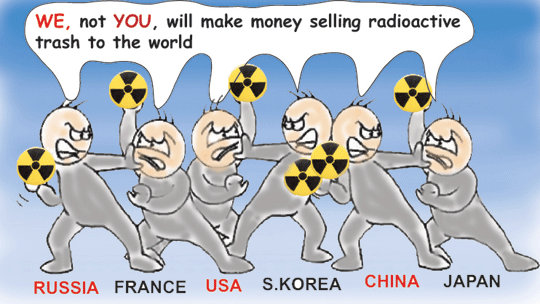
The biggest prize is the oil-rich kingdom of Saudi Arabia, which has announced plans to build 16 nuclear plants over the next 25 years at a cost of US$80 billion, part of an effort to diversify away from fossil fuels. South Korea, China, France, Russia, Japan and the United States are all bidding to build them.
In a region where renewables are half the price of nuclear power – because the sun shines for longer and with greater intensity than almost anywhere else in the world – building new nuclear plants may seem strange.
Saudi Arabia, which is also investing heavily in solar power, points to rapidly rising domestic demand for electricity and says renewables will not provide enough for its needs.
Other countries in the region that are already building or have signed contracts to build new reactors are Iran, United Arab Emirates, Jordan, Egypt and Turkey.
All say the decision to go for nuclear power is entirely a consequence of the local need for more electricity, although perhaps the Saudi rulers also have an eye on their power rival Iran, which already has an operating nuclear power station and is building more.
Mohammad bin Salman, the Saudi crown prince who effectively runs Saudi Arabia for his father King Salman, was asked about this on the US TV network CBS in March. He replied: “Saudi Arabia doesn’t want to own a nuclear bomb. But without a doubt, if Iran develops a nuclear bomb, we will follow suit as soon as possible.”
Rival contenders
Despite this, the Trump administration remains keen to sell its Westinghouse-designed nuclear power stations to the Saudis. Russia, China, Japan and South Korea also want to sell their own designs.
As well as the need to keep their national nuclear companies ticking over and grabbing lucrative exports, all these countries would welcome the political influence that providing such important infrastructure would give them in the Middle East.
Well ahead of Saudi Arabia in developing nuclear power is the neighbouring United Arab Emirates. Its first reactor was due to open this year and is almost complete, though its start-up date has been pushed back to 2019.
Again, the country has plenty of oil reserves and renewable resources, but wants nuclear power to provide a guaranteed electricity supply instead of having to rely on imported gas.
Jordan, which has no fossil fuel resource, and Egypt, with the region’s largest population, are also going nuclear. In both cases they have signed deals with the Russian state-owned giant Rosatom. Egypt has signed a deal for four nuclear plants costing $30bn, and Jordan for an energy package worth $12bn, but which also includes some American involvement, according to Bloomberg New Energy Finance.
Avoiding imports
Turkey, again a populous nation that has to import most of its energy in the form of fossil fuels, is building a nuclear power station at Akkuyu on its Mediterranean coast in partnership with Rosatom. The first reactor was expected to be operating by now, but the opening date has been put back to 2020. It has other plants planned on its northern Black Sea coast.
This sudden enthusiasm for nuclear power in such a volatile region has prompted a debate about some governments’ motives. Israel is the only country in the Middle East that has long had the means to make nuclear weapons with its Negev Nuclear Research centre in the desert near Dimona.
It is already alarmed by Iran’s nuclear programme. A number of other potentially hostile states may also soon have the means to produce highly enriched uranium or plutonium.
If they do, they will face an already fully armed Israel. According to an estimate by the Washington-based Carnegie Endowment for International Peace, Israel, which began operating a plutonium-production reactor in 1963, possesses enough material for between 100 and 170 atomic weapons. Israel has never admitted this.
Vladimir Putin and Recep Tayyip Erdogan to launch Turkey’s first nuclear power plant, ABC News, 3 Apr 18 The leaders of Russia and Turkey are scheduled to launch the start of the construction of Turkey’s first nuclear power plant as ties between the countries deepen.
Russia’s Vladimir Putin, on his first foreign visit since re-election on March 18, arrived in Ankara on Tuesday for talks with Turkey’s Recep Tayyip Erdogan.
The two will remotely launch the construction of the Russian-made Akkuyu nuclear plant on the Mediterranean coast.
Arab world’s first nuclear reactor completed in UAE, in cooperation with South Korea, Arab Weekly 1 April 18 LONDON – Construction of the Arab world’s first commercial nuclear reactor has been completed in the United Arab Emirates. The plant is part of the country’s long-term strategy to decrease its reliance on fossil fuels.
The Barakah nuclear power plant, in western Abu Dhabi, is a joint project between the UAE’s Emirates Nuclear Energy Corporation (ENEC) and South Korea’s Korea Electric Power Corporation (KEPCO).
UAE Crown Prince Sheikh Mohammed bin Zayed al-Nahyan toured the $20 billion facility with South Korean President Moon Jae-in and announced on March 26 the completion of the construction“This is a historic moment in our nation’s development as we celebrate the construction completion of Unit 1 of the Barakah nuclear energy plant,” Sheikh Mohammed said……
They mention Burson-Marsteller but avoid mentioning WPP LLC (Its parent company) who are behind the scenes covering up SCL (Cambridge Analytica) election voting scandals, The BP Gulf Oil Disaster, The Fukushima nuclear disaster etc etc. A great bit of investigative Journalism by Christine Maguire here;
“…Previously, the small firm didn’t have a record of dealing with governments, but has ties to Trump. President Jacob Daniels was chief of staff at Trump’s Michigan campaign and owner Robert Stryk is a Republican operative who represented former Trump campaign manager Corey Lewandowski.
The list of US firms on the Saudi payroll is extensive. Other companies include The Harbour Group, Burson-Marsteller, Hill & Knowlton, King & Spalding, Brownstein Hyatt Farber Schreck LLP, Fleishman-Hillard Inc, Hogan & Hartson. The FT reported in September the kingdom’s information ministry was seeking to set up ‘hubs’ in Europe and Asia “to promote the changing face of KSA to the rest of the world and to improve international perception of the kingdom.”
Despite the best efforts of the multitude of PR firms, Saudi Arabia’s attempts to completely rebrand have fallen short. Bin Salman’s war in Yemen and the subsequent blockade on aid remains a sore point. Then there’s his November crackdown on corruption, which saw hundreds of businessmen and members of the royal family imprisoned in a luxury hotel where accusations of torture soon emerged.
The kingdom’s much-touted reform when it comes to women is the best PR for the country. However, with multiplereports that bin Salman has imprisoned his own mother to prevent her from influencing his father, not to mention the other obstacles imposed on the women of Saudi Arabia, the crown prince has a long way to go before he can truly be considered any sort of feminist, as Amnesty International noted on Thursday….”
May 2011 (Post Fukushima)
“…Crisis management may, in its turn, mitigate the cost and impact of disasters, even those that are the product of mismanagement. Anterooms to the executive suite are suddenly crowded with advisers eager to point out that BP’s bill would have been lower if it had fostered better political connections before, and communicated and lobbied differently after, the Gulf of Mexico catastrophe. ...”
Please note that the extensive articles posted on this blog on this companies connection to industrial disaster crisis management for governments and corporations, that mentioned WPP LLC complicity to the Fukushima nuclear disaster are not accessible as the new Google search algorythm (since July 2017) seems to block much of the content posted on this (and other websites, blogs etc) blog (Shaun aka arclight2011). Some evidence for that here;
Mohammed bin Salman (commonly referred to as MBS) is on a historic visit – the first in nearly 75 years – to Saudi Arabia’s closest ally, the US. In an interview with The Wall Street Journal this week, he called for restrictions that would “create more pressure” on Tehran.
“If we don’t succeed in what we are trying to do [imposing sanctions on Iran], we will likely have war with Iran in 10-15 years,” MBS, who has become the true power behind his aging father, King Salman, said.
Tehran and Riyadh have clashed over various issues in recent years. The Syrian crisis – especially the future of Syria’s government under President Bashar Assad – remains one of the major stumbling blocks.
The trip to the US of the prince’s entourage and meeting with Donald Trump only added fuel to the fire amid already strained relations. Iran sees the whole tour as a cynical exercise in self-promotion ahead of Bin Salman’s assumed ascension to the Saudi throne.
Prior to his coast-to-coast US trip, in which he rubbed shoulders with top politicians and Silicon Valley executives, the 32-year-old Saudi prince said that his country would enter the nuclear arms race if Iran is ever successful in developing a weapon of mass destruction. He also called Iran’s supreme leader the “new Hitler.”
The Iranian Foreign Ministry described MBS as “delusional” and “naïve,” following his allegations that Iran is hosting Al-Qaeda leaders.
The oil-rich kingdom and the US – under President Trump – have repeatedly slammed the landmark 2015 Iranian nuclear deal. Trump seems to be advancing a plan to confront Saudi Arabia’s number 1enemy in the region.
According to Vladimir Sazhin, a senior research associate at the Institute of Oriental Studies of the Russian Academy of Sciences, by withdrawing from the Iranian nuclear agreement, “the US would become a pariah,” since the international community largely approves of the deal and confirms that Tehran is sticking to its obligations.
Times 29th March 2018, Saudi Arabia has announced a $200 billion plan to build the world’s biggest
solar-power project, which would end the country’s dependence on oil. The
project, which would result in panels taking up vast tracts of the desert
equivalent to a million football pitches, has been secured by Crown Prince
Mohammed bin Salman and could mark a change in the world’s environmental
management.
Telegraph 28th March 2018, Saudi Arabia has cast light on its $200bn (£141bn) plans to cut its
reliance on oil by rolling out the world’s most ambitious solar power
project through a deal with SoftBank. The agreement will drive investment
in a series of solar parks across the kingdom to be built by 2030, capable
of generating enough power for 150 million homes. https://www.telegraph.co.uk/business/2018/03/28/saudi-arabia-curb-oil-addiction-141bn-softbank-solar-deal/
Mabna Institute Hackers Penetrated Systems Belonging to Hundreds of Universities, Companies, and Other Victims to Steal Research, Academic and Proprietary Data, and Intellectual Property, USA Department of Justice, 23 Mar 18
An Indictment charging Gholamreza Rafatnejad, 38; Ehsan Mohammadi, 37; Abdollah Karima, aka Vahid Karima, 39; Mostafa Sadeghi, 28; Seyed Ali Mirkarimi, 34; Mohammed Reza Sabahi, 26; Roozbeh Sabahi, 24; Abuzar Gohari Moqadam, 37; and Sajjad Tahmasebi, 30, all citizens and residents of Iran, was unsealed today. The defendants were each leaders, contractors, associates, hackers-for-hire or affiliates of the Mabna Institute, an Iran-based company that, since at least 2013, conducted a coordinated campaign of cyber intrusions into computer systems belonging to 144 U.S. universities, 176 universities across 21 foreign countries, 47 domestic and foreign private sector companies, the U.S. Department of Labor, the Federal Energy Regulatory Commission, the State of Hawaii, the State of Indiana, the United Nations, and the United Nations Children’s Fund……..https://www.justice.gov/opa/pr/nine-iranians-charged-conducting-massive-cyber-theft-campaign-behalf-islamic-revolutionary
Saudi Prince’s Nuclear Bomb Comment May Scuttle Reactor Deal, Bloomberg By Ari Natter
Fresh scrutiny for plan to build U.S. reactors in Saudi Arabia
Lawmakers say Saudis shouldn’t be allowed to enrich uranium
Opposition to a deal for the U.S. to provide nuclear power technology to Saudi Arabia is growing after Crown Prince Mohammed Bin Salman said the kingdom would develop a nuclear weapon if Iran did.
The potential for U.S. companies to participate in the construction of as many as 16 nuclear reactors sought by the kingdom has been seen as a potential lifeline to Westinghouse Electric Co. and others suffering from the flagging nuclear industry at home.
To further that effort, the Trump administration is said to be considering allowing the Saudis the right to enrich uranium, a break from the so-called “gold standard” included in the nuclear-sharing agreement with the United Arab Emirates, which allows power generation but prohibits the enrichment and reprocessing of uranium.
But that idea ran into a buzzsaw during a House hearing on Wednesday, with lawmakers from both parties saying prince’s admission that his country might seek to build nuclear weapons was cause to halt negotiations between the two nations. Energy Secretary Rick Perry met with Saudi officials earlier this month in London to begin talks on the deal. …….https://www.bloomberg.com/news/articles/2018-03-21/saudi-prince-s-nuclear-bomb-comment-may-scuttle-reactor-deal
One of the people MBS told about the discussion with Kushner was UAE Crown Prince Mohammed bin Zayed, according to a source who talks frequently to confidants of the Saudi and Emirati rulers. MBS bragged to the Emirati crown prince and others that Kushner was “in his pocket,” the source told The Intercept.
The Washington Post reported this week that former Secretary of State Rex Tillerson and National Security Adviser H.R. McMaster “expressed early concern that Kushner was freelancing U.S. foreign policy.” According to the Post, Tillerson once asked staffers in frustration: “Who is the secretary of state here?”
Indeed, Kushner has grown so close to the Saudi and Emirati crown princes that he has communicated with them directly using WhatsApp, a reasonably secure messaging app owned by Facebook and popular in the Middle East, according to a senior Western official and a source close to the Saudi royal family.
UNTIL HE WAS stripped of his top-secret security clearance in February, presidential adviser Jared Kushner was known around the White House as one of the most voracious readers of the President’s Daily Brief, a highly classified rundown of the latest intelligence intended only for the president and his closest advisers.
Kushner, who had been tasked with bringing about a deal between Israel and Palestine, was particularly engaged by information about the Middle East, according to a former White House official and a former U.S. intelligence professional. Continue reading →
Israel finally admitted it destroyed a Syrian reactor in 2007 — and set off a battle of egos, WP, By Ruth EglashMarch 22 JERUSALEM — Israel’s admission Wednesday that it was behind a mysterious attack on a suspected nuclear reactor in Syria more than a decade ago has caused a storm.
But not in the way one might think.
Within hours of the Israeli military censor permitting local media to publish most of the details of the 2007 air attack on a secret desert facility in northeastern Syria, as well as releasing blurry black-and-white video footage, former political and military leaders went to war over who should be credited for the operation.
In Israel’s eyes, the operation was a resounding success. It prevented its northern neighbor from obtaining nuclear capabilities. Ultimately, it also ensured that the Islamic State militant group would not possess nuclear weapons when it took over the region several years later.
But since Israel’s confirmation of its role in the airstrike, a battle has played out on Israeli television and radio and online, pitting two former Israeli prime ministers, Ehud Olmert and Ehud Barak; a former Mossad chief; and a former military intelligence chief against one another.
Israeli Defense Minister Avigdor Liberman later said he regretted allowing the material to be published.
Saudi energy deal push sparks nuclear weapon concerns,The Hill, BY REBECCA KHEEL – 03/18/18 Nuclear nonproliferation advocates are sounding the alarm about a potential nuclear energy deal between Saudi Arabia and the United States, saying the exceptions the kingdom is seeking could lead to nuclear proliferation in a volatile region.
At issue is a deal that would allow the United States to sell nuclear reactors to Saudi Arabia. The Trump administration has already started negotiations, with Energy Secretary Rick Perry reportedly meeting with senior Saudi officials in London last month.
Such deals, known as “123 agreements” after the section of the law that requires them, allow for transfers of nuclear material, equipment or components from the United States to another nation if the other country commits to a set of nine nonproliferation criteria.Saudi Crown Prince Mohammed bin Salman is visiting Washington next week and is sure to press President Trump on the issue.
But comments the crown prince made this week that Saudi Arabia would develop a nuclear bomb “as soon as possible” if Iran does are raising red flags for lawmakers who were already skeptical of the kingdom’s intentions.
“Saudi Arabia’s crown prince has confirmed what many have long suspected — nuclear energy in Saudi Arabia is about more than just electrical power, it’s about geopolitical power,” Sen. Ed Markey (D-Mass.) said in a statement. “The United States must not compromise on nonproliferation standards in any 123 agreement it concludes with Saudi Arabia.”
When the United States entered into a 123 agreement with the United Arab Emirates (UAE) in 2009, the UAE voluntarily agreed to prohibitions on enriching uranium or reprocessing spent fuel to produce plutonium — essential steps in producing nuclear weapons.
Such deals, known as “123 agreements” after the section of the law that requires them, allow for transfers of nuclear material, equipment or components from the United States to another nation if the other country commits to a set of nine nonproliferation criteria.
Saudi Crown Prince Mohammed bin Salman is visiting Washington next week and is sure to press President Trump on the issue.
That agreement has become known as the “gold standard” that nonproliferation advocates say should be part of all 123 agreements. …….
A House Foreign Affairs subcommittee is scheduled to hold a hearing on the potential agreement Wednesday, while Mohammed is still in town. Outside experts are slated to testify.
Rep. Ileana Ros-Lehtinen (R-Fla.), chairwoman of the subcommittee, said she expects the hearing to cover the status of Saudi Arabia’s nuclear plans, the implications of a deal without the gold standard and legislative options to increase congressional oversight “so that the U.S. can ensure national security interests always take precedence over political or commercial considerations in any future nuclear agreement.”
“The administration has been moving full speed ahead on its negotiations with Saudi Arabia regarding a potential 123 nuclear cooperation agreement, and unfortunately, Congress has been left mostly in the dark,” she said in a statement Friday. “The potential ramifications, including proliferation and the easing of enrichment and reprocessing restrictions, highlight the need for long-needed reforms to the outdated congressional review process.” http://thehill.com/policy/defense/378868-saudi-energy-deal-push-sparks-nuclear-weapon-concerns
Iraq, 15 years On: A Toxic US Legacy,March 18, 2018, by Middle East EyeFifteen years ago this month, the United States spearheaded a fantastically bloody war on Iraq as part of its ongoing effort to ensure the Iraqi nation’s perpetual misery. Common Dreams, by Belén Fernández, Fifteen years ago this month, the United States spearheaded a fantastically bloody war on Iraq ….
Increasing rates of cancer and birth defects …..
Consider, for instance, Cockburn’s 2010 article for The Independent, headlined “Toxic legacy of US assault on Fallujah ‘worse than Hiroshima'”. In it, he outlined the results of a study by British scientist Chris Busby and colleagues Malak Hamdan and Entesar Ariabi on the increase in reports of cancer, birth defects, infant mortality and other forms of suffering in the Iraqi city of Fallujah, the focus of a particularly vicious US assault.
To be sure, as one of the top polluters on the entire planet, the US military has never been thrilled about acknowledging what would appear to be obvious: that saturating the environment with toxic materials will have repercussions on both environmental and human health, including the health of the United States’ own warriors, as underlined by the afflictions affecting veterans of the Vietnam War and first Gulf War, among other imperial escapades.
According to Mozhgan Savabieasfahani, an award-winning toxicologist based in Michigan, “around six billion bullets were expended into the Iraqi environment” between 2002 and 2005 alone – which, along with bombs, have led to “public contamination with … toxic metals”.
Depleted uranium: a long-term hazard
But the US military arsenal extends far beyond traditional guns and bombs. In 2012, Robert Fisk wrote about a 14-month-old Iraqi named Sayef who had a severely enlarged head, was blind, paralysed and unable to swallow. Noting that much blame for the rise in congenital birth defects in Fallujah had been directed at the United States’ use of white phosphorus there, Fisk was nonetheless forced to include the caveat: “No one, of course, can produce cast-iron evidence that American munitions have caused the tragedy of Fallujah’s children.”
Yet the possibility of a cause-and-effect relationship becomes more and more difficult to deny. Already in 2009, the Guardian had reported that doctors in Fallujah were “dealing with up to 15 times as many chronic deformities in infants” as the previous year, such as a baby born with two heads.
In 2013, Al Jazeera quoted Sharif al-Alwachi of the Babil Cancer Centre in southern Iraq, who attributed escalating cancer rates since 2003 on the US military’s use of depleted uranium (DU) weapons. Al Jazeera also threw in the following uplifting note: “The remaining traces of DU in Iraq represent a formidable long-term environmental hazard, as they will remain radioactive for more than 4.5 billion years.”
Indeed, DU constitutes a can of worms unto itself. A 2016 Washington Spectator essay titled “Irradiated Iraq,” by Washington, DC-based investigative journalist Barbara Koeppel, remarks on the convenient US classification of its own uranium weapons as “conventional” when in fact “they are radioactive and chemically toxic”.
Destructive capacity
This is the same US, of course, that goes into warmongering hissy-fits each and every time the word “radioactive” comes up in the context of Iran while also engaging in countless other varieties of hypocritical rampage.
Koeppel cites former United Nations weapons inspector Scott Ritter‘s observation: “The irony is we invaded Iraq in 2003 to destroy its non-existent WMD [weapons of mass destruction]. To do it, we fired these new weapons, causing radioactive casualties.”
Luckily for the US, there are plenty of members of the national media and wider domestic landscape willing to succumb to the notion that DU is simply Something We Don’t Talk About; you might even say the issue itself is radioactive.
Others, however, have wholeheartedly embraced the destructive wonders of DU, as was the case with a US special operations soldier I spoke with earlier this year. This young man had just completed tours of duty in Iraq and Syria, where the US recently came under criticism for its renewed use of DU; he expressed dismay that sectors of the international community had failed to appreciate the effectiveness of the weaponry in question.
Back in 2001, the International Committee of the Red Cross offered some watered-down thoughts on DU, gently suggesting that international humanitarian law “prohibit[s] weapons, means or methods of warfare of a nature to cause superfluous injury or unnecessary suffering, which have indiscriminate effects or which cause widespread, long-term and severe damage to the natural environment”…..https://www.commondreams.org/views/2018/03/18/iraq-15-years-toxic-us-legacy
“Saudi Arabia does not want to acquire any nuclear bomb, but without a doubt if Iran developed a nuclear bomb, we will follow suit as soon as possible,” Prince Mohammed bin Salman told CBS in a 60 Minutes interview that will air in the United States on Sunday.
He also reiterated previous comments he has made likening Iran’s supreme leader Ayatollah Ali Khamenei to Hitler.
“He wants to create his own project in the Middle East very much like Hitler, who wanted to expand at the time,” the prince says in the interview.
“Many countries around the world and in Europe did not realise how dangerous Hitler was until what happened, happened. I don’t want to see the same events happening in the Middle East.”
The Sunni Muslim kingdom has been at loggerheads with revolutionary Shi’ite Iran for decades. The countries have fought a long-running proxy war in the Middle East and beyond, backing rival sides in armed conflicts and political crises including in Iraq, Syria, Lebanon and Yemen.
Prince Mohammed, who also serves as Saudi defence minister, said last year that the kingdom would make sure any future struggle between the two countries “is waged in Iran”, prompting Iranian threats to hit back at most of Saudi Arabia except the holy cities of Mecca and Medina.
Riyadh has criticised the 2015 deal between world powers and Tehran under which economic sanctions on Iran were lifted in return for the Islamic Republic curbing its nuclear energy program. US sanctions will resume unless President Donald Trump issues fresh “waivers” to suspend them on May 12.
The comments by Prince Mohammed, who at 32 is heir to the throne, also have implications for Israel, another US ally which neither confirms nor denies the widespread assumption that it controls the Middle East’s only nuclear arsenal.
Israel has long argued that, should Iran develop nuclear weapons, it would trigger similar projects among the Persian power’s Arab rivals and further destabilise the region.
It has never joined the 1970 nuclear Non-Proliferation Treaty (NPT) and has said it would consider inspections and controls under the NPT only if was at peace with its Arab neighbours and Iran.
Civilian projects
Saudi Arabia is stepping up plans to develop a civilian nuclear energy capability as part of a reform plan led by Prince Mohammed to reduce the economy’s dependence on oil.
The world’s top oil exporter has previously said it wants nuclear technology only for peaceful uses but has left unclear whether it also wants to enrich uranium to produce nuclear fuel, a process which can also be used in the production of atomic weapons.
The United States, South Korea, Russia, France and China are bidding on a multi-billion dollar tender to build the country’s first two nuclear reactors.
Prince Mohammed’s comments, ahead of a trip to the United States next week, could impact the bid by a consortium that includes Toshiba-owned Westinghouse.
US companies can usually transfer nuclear technology to another country only if the United States has signed an agreement with that country ruling out domestic uranium enrichment and the preprocessing of spent nuclear fuel — steps that can have military uses.
In previous talks, Saudi Arabia has refused to sign up to any agreement that would deprive it of the possibility of one day enriching uranium.
Reactors need uranium enriched to around five percent purity but the same technology in this process can also be used to enrich the heavy metal to a higher, weapons-grade level. This has been at the heart of Western and regional concerns over the nuclear work of Iran, Saudi Arabia’s arch-rival which enriches uranium domestically.
Riyadh approved a national policy for its atomic energy programme on Tuesday, including limiting all nuclear activities to peaceful purposes, within the limits defined by international treaties.
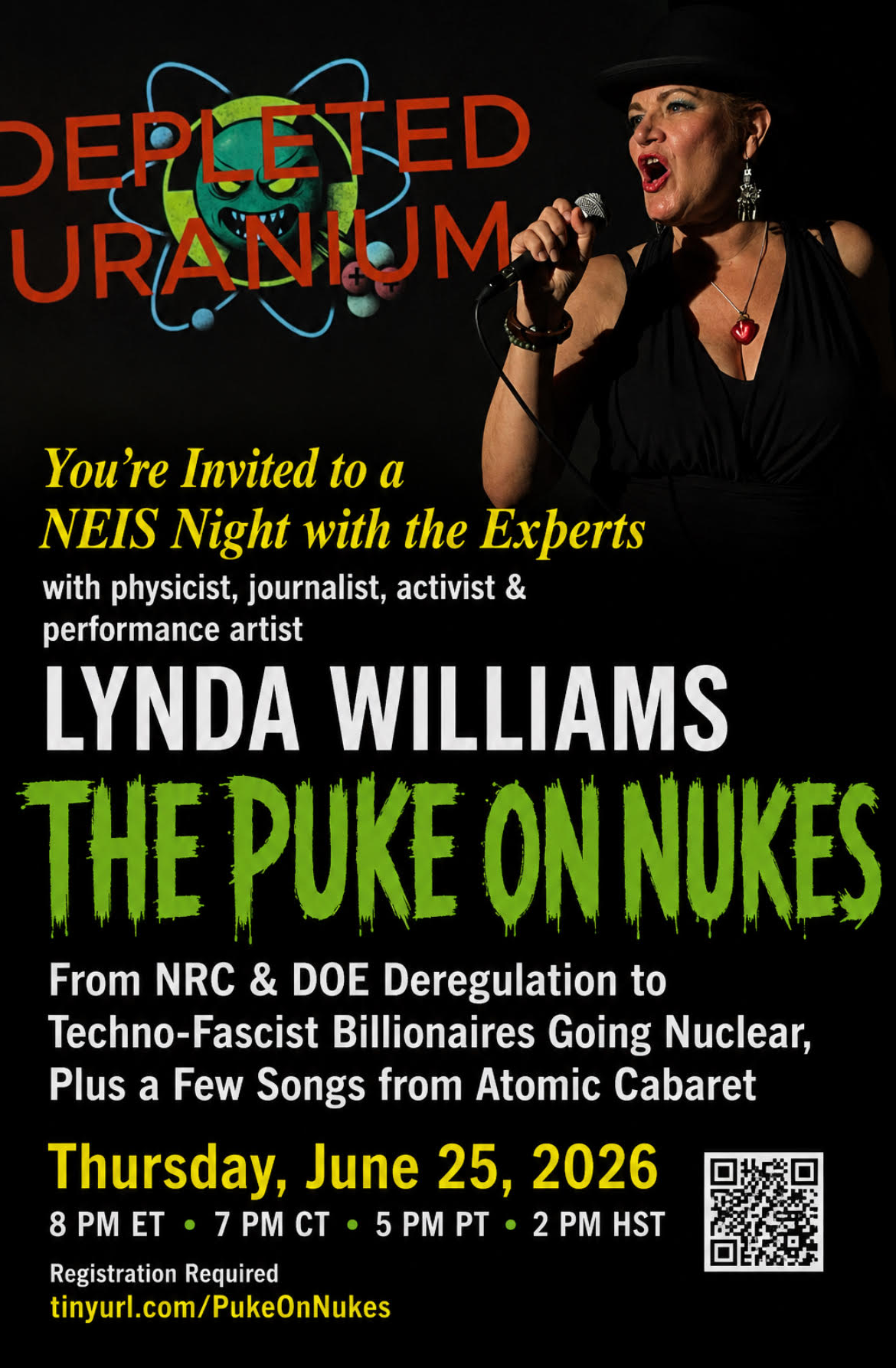
7pm Central Time (8pm ET, 6pm MT, 5pm PT) UTC – 5 From NRC & DOE Deregulation to Techno-Fascist Billionaires Going Nuclear, Plus a Few Songs from Atomic Cabaret REGISTER











 nuclear-news