sraeli Prime Minister Benjamin Netanyahu said Saturday that he “will not compromise on full Israeli control” over Gaza and that “this is contrary to a Palestinian state.”
Netanyahu released the statement in a social media post. The statement comes just a day after President Joe Biden spoke with Netanyahu for the first time in nearly a month and directly contradicts messaging from the White House that creative solutions could bridge wide gaps between the leaders’ views on Palestinian statehood.
“The President discussed Israel’s responsibility even as it maintains military pressure on Hamas and its leaders to reduce civilian harm and protect the innocent,” the White House said of the conversation between national leaders.
“The President also discussed his vision for a more durable peace and security for Israel fully integrated within the region and a two-state solution with Israel’s security guaranteed,” it added.
The conflicting messaging is a sign of the pressures Netanyahu’s government faces at home. Thousands of Israelis have been protesting in Tel Aviv calling for new elections and for their nation to ensure the safe return of the remaining hostages of Hamas, but Netanyahu is also under heat to appease members of his right-wing ruling coalition by intensifying the conflict.
But a member of Israel’s War Cabinet, former Israeli army chief Gadi Eisenkot, has called a cease-fire the only way to secure the hostages’ release, a comment that implied criticism of Israel’s current strategy.
At midday on 7 October Israel’s supreme military command ordered all units to prevent the capture of Israeli citizens “at any cost” – even by firing on them.
The military “instructed all its fighting units to perform the Hannibal Directive in practice, although it did so without stating that name explicitly,” Israeli journalists revealed last weekend.
The revelations came in a new investigative article by Ronen Bergman and Yoav Zitun, two journalists with extensive sources inside Israel’s military and intelligence establishment.
They also revealed that “some 70 vehicles” driven by Palestinian fighters returning to Gaza were blown up by Israeli helicopter gunships, drones or tanks.
Many of these vehicles contained Israeli captives.
The journalists wrote that “it is not clear at this stage how many of the captives were killed due to the operation of this order” to the air force that they should prevent return to Gaza at all costs.
“At least in some of the cases, everyone in the vehicle was killed,” the journalists explain.
The Hebrew piece has not been translated into English by its publisher, Yedioth Ahronoth, a newspaper which translates many of its articles. You can read The Electronic Intifada’s full English version, translated by Dena Shunra, below.
The secretive “Hannibal” doctrine is named after an ancient Carthaginian general who poisoned himself rather than be captured alive by the Roman Empire.
The order aims at stopping Israelis from being taken captive by resistance fighters who could later use them as leverage in prisoner swap deals.
“Overpowered”
The latest revelations confirm The Electronic Intifada’s reporting since 7 October that many – if not most – of the Israeli civilians killed that day were killed by Israel itself, not Palestinian fighters.
Initial claims stated that 1,400 Israelis were killed by Hamas in the Palestinian assault that began on 7 October. But Israel has repeatedly revised this figure downwards, so that it now stands at “over 1,000.”
It was also clear from the outset that hundreds of the dead were in fact Israeli soldiers.
Hamas maintains that they targeted military bases and outposts, and that their aim was to capture rather than kill Israeli civilians, and to kill or capture Israeli soldiers.
Based on interviews with those present, the new article says that top officers at Israel’s underground military headquarters in Tel Aviv on 7 October declared in shock that “the Gaza Division was overpowered.”
Vehicles stacked up near the southern Israeli town of Netivot, near Gaza, in November. They were destroyed soon after Palestinian fighters began taking captives on 7 October. A new investigation by Israeli journalists has concluded that 70 such vehicles were blown up by Israeli fire. Jim HollanderUPI
At midday on 7 October Israel’s supreme military command ordered all units to prevent the capture of Israeli citizens “at any cost” – even by firing on them.
The military “instructed all its fighting units to perform the Hannibal Directive in practice, although it did so without stating that name explicitly,” Israeli journalists revealed last weekend.
The revelations came in a new investigative article by Ronen Bergman and Yoav Zitun, two journalists with extensive sources inside Israel’s military and intelligence establishment.
They also revealed that “some 70 vehicles” driven by Palestinian fighters returning to Gaza were blown up by Israeli helicopter gunships, drones or tanks.
Many of these vehicles contained Israeli captives.
The journalists wrote that “it is not clear at this stage how many of the captives were killed due to the operation of this order” to the air force that they should prevent return to Gaza at all costs.
“At least in some of the cases, everyone in the vehicle was killed,” the journalists explain.
The Hebrew piece has not been translated into English by its publisher, Yedioth Ahronoth, a newspaper which translates many of its articles. You can read The Electronic Intifada’s full English version, translated by Dena Shunra, below.
The secretive “Hannibal” doctrine is named after an ancient Carthaginian general who poisoned himself rather than be captured alive by the Roman Empire.
The order aims at stopping Israelis from being taken captive by resistance fighters who could later use them as leverage in prisoner swap deals.
“Overpowered”
The latest revelations confirm The Electronic Intifada’s reporting since 7 October that many – if not most – of the Israeli civilians killed that day were killed by Israel itself, not Palestinian fighters.
Initial claims stated that 1,400 Israelis were killed by Hamas in the Palestinian assault that began on 7 October. But Israel has repeatedly revised this figure downwards, so that it now stands at “over 1,000.”
It was also clear from the outset that hundreds of the dead were in fact Israeli soldiers.
Hamas maintains that they targeted military bases and outposts, and that their aim was to capture rather than kill Israeli civilians, and to kill or capture Israeli soldiers.
Based on interviews with those present, the new article says that top officers at Israel’s underground military headquarters in Tel Aviv on 7 October declared in shock that “the Gaza Division was overpowered.”
https://www.youtube.com/embed/G8PWUAtGIBo?feature=oembed&One person present that day – referring back to earlier Israeli shocks such as the surprise counterattack by Egypt and Syria in October 1973 – told the journalists that,”We thought that this could never happen again, and this will remain a scar burnt into our flesh forever.”
As well as what they claim was “heroism,” Bergman and Zitun’s investigation reveals what they describe as “a long series of failures, mishaps and chaos in the army,” including “a command chain that failed almost entirely.”
Palestinian resistance fighters successfully targeted the communications infrastructure, they write, destroying 40 percent of communication sites around the Gaza frontier, including towers and relay antennas.
For hours, therefore, Israel’s top brass were in the dark as to the scale of the assault.
Mexico and Chile have joined South Africa, Bolivia, Djibouti, Bangladesh, and the Comoros in calling on the ICC to investigate Israel for its crimes in Gaza, including war crimes and genocide.
Chile and Mexico have called upon the International Criminal Court (ICC) to investigate the crimes being committed amid Israel’s ongoing war on Gaza. In the past 105 days, Israel has killed over 24,600 Palestinians in Gaza, with more than 7,000 people missing and presumed dead under the rubble.
In a statement released on January 18, Mexico and Chile stated that their referral to the ICC was “due to growing concern about the latest escalation of violence, particularly against civilian targets, and the alleged continued commission of crimes under the jurisdiction of the Court, specifically since the attack on October 7, 2023, carried out by Hamas militants and the subsequent hostilities in Gaza.”……………………………………………………………………………………………… more https://scheerpost.com/2024/01/21/mexico-and-chile-call-on-international-criminal-court-to-investigate-crimes-in-gaza/
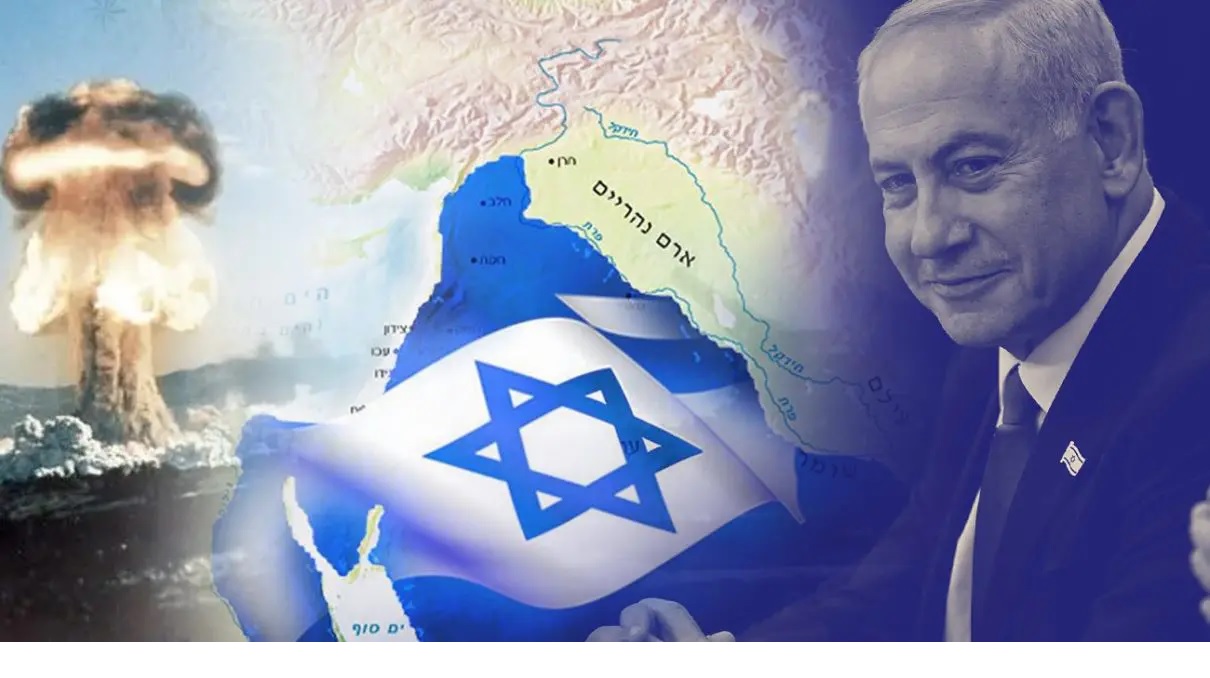
Israel has been given enormous license to control the security narrative in the Middle East for decades. This is not to say it is always in control of it – the attacks of October 7 by Hamas show that such control is rickety and bound, at stages, to come undone. What matters for Israeli security is that certain neighbours always understand that they are never to do certain things, lest they risk existential oblivion.
For instance, no Middle Eastern state will be permitted to acquire nuclear weapons on the Jewish State’s watch. Nuclear reactors and facilities will be struck, infected, or pulverised altogether (Osirak at Tuwaitha, Iraq; the Natanz site in Iran), with, or without knowledge, approval or participation of the United States.
This is a signature mark of Israeli foreign and defence policy: the nuclear option remains the greatest, single affirmation of sovereignty in international relations. To possess it, precisely because of its destructive and shielding potential, is to proclaim to the community of nation states that you have lethal insurance against invasion and regime change. Best, then, to make sure others do not possess it.
Israel, on the other hand, will be permitted to develop its own cataclysmic inventory of weapons, platforms, and doomsday options, all the while claiming strategic ambiguity about the whole matter. In that strangulating way, Israeli policy resembles the thornily disingenuous former US President Bill Clinton’s approach to taking drugs and oral sex: he did not inhale, and oral pleasuring by one by another is simply not sex.
The latest remarks from Israeli Prime Minister Benjamin Netanyahu on January 18 suggest that the license also extends to ensuring that Palestinians will never be permitted a sovereign homeland, that they will be, in a perverse biblical echo, kept in a form of bondage, downtrodden, oppressed and, given what happened on October 7 last year, suppressed. This is to ensure that, whatever the grievance, that they never err, never threaten, and never cause grief to the Israeli State. To that end, it is axiomatic that their political authorities are kept incipient, inchoate, corrupt and permanently on life support, the tolerated beggars and charity seekers of the Middle East.
At the press conference in question, held at the Kirya military base in Tel Aviv, Netanyahu claimedthat, “Whoever is talking about the ‘day after Netanyahu’ is essentially talking about the establishment of the Palestinian state with the Palestinian Authority.” (How very like the Israeli PM to make it all about him.) The Israel-Palestinian conflict, he wanted to clarify, was “not about the absence of a state, a Palestinian state, but rather about the existence of a state, a Jewish state.”
With monumental gall, he complained that “All territory we evacuate, we get terror, terrible terror against us.” His examples, enumerated much like sins at a confessional, were instances where Israel, as an occupying force, had left or reduced their presence: Gaza, southern Lebanon, parts of Judea and Samaria (the West Bank). It followed that “any future arrangement, or in the absence of any future arrangement,” Israel would continue to maintain “security control” of all lands west of the Jordan River. “That is a vital condition.”
As such lands comprise Israeli territory, Gaza and the West Bank, Palestinian sovereignty can be assuredly ignored as a tenable outcome in Netanyahu’s policed paradise. He even went so far as to acknowledge that this “contradicts the idea of sovereignty” as far as the Palestinians are concerned. “What can you do? I tell this truth to our American friends.”
As to sceptical mutterings in the Israeli press about the country’s prospects of defeating Hamas decisively, Netanyahu was all foamy with indignation. “We will continue to fight at full strength until we achieve our goals: the return of all our hostages – and I say again, only military pressure will lead to their release; the elimination of Hamas; the certainty that Gaza will never again represent a threat to Israel. There won’t be any party that educates for terror, funds terror, sends terrorists against us.”
This hairbrained policy of ethno-religious lunacy masquerading as sane military strategy ensures that permanent war nourished by the poison of blood-rich hatred and revenge will continue unabated. In keeping such a powder keg stocked, there is always the risk that other powers and antagonists willing to have a say through bombs, rockets and drones will light it. Should this or that state be permitted to exist or come into being? The answer is bound to be convulsively violent.
It is of minor interest that officials in the United States found Netanyahu’s comments a touch off-putting. US Secretary of State Antony Blinken had, it is reported, dangled a proposal before the Israeli PM that would see Saudi Arabia normalise relations with Israel in exchange for an agreement to facilitate the pathway to Palestinian statehood. Netanyahu did not bite, insisting that he would not be a party to any agreement that would see the creation of a Palestinian state.
Blinken, if one is to rely on the veracity of the account, suggested that the removal of Hamas could never be achieved in purely military terms; a failure on the part of Israel’s leadership to recognise that fact would lead to a continuation of violence and history repeating itself.
In Washington, State Department spokesperson Matthew Miller stated in the daily press briefingthat “Israel faces some very difficult choices in the months ahead.” The conflict in Gaza would eventually end; reconstruction would follow; agreement from various countries in the region to aid in that effort had been secured – all on the proviso that a “tangible path to the establishment of a Palestinian state” could be agreed upon.
For decades, administrations in Washington have fantasised about castles in the skies, the outlandish notion that Palestinians and Israelis might exist in cosy accord upon lands stolen and manured by brutal death. Washington, playing the Hegemonic Father, could then perch above the fray, gaze paternally upon the scrapping disputants, and suggest what was best for both. But the two-state solution was always encumbered and heavily conditioned to take place on Israeli terms, leaving all mediation and interventions by outsiders flitting gestures lacking substance.
Now, no one can claim otherwise that Palestinian statehood is anything other than spectral, fantastic, and doomed – at least under the current warring regime. Netanyahu’s own political survival, profanely linked to Israel’s own existence, depends on not just stifling pregnancies in Gaza but preventing the birth of a nationally recognised Palestinian state.
The US and Israel have clashed over the future of post-war Gaza
Prime Minister Benjamin Netanyahu has declared that Israel “will not settle for anything short of an absolute victory,” rejecting calls from Washington to either wind down the hostilities in Gaza or support the creation of a Palestinian state.
The US pushed for the realization of the two-state solution earlier this week in Davos, with US Secretary of State Antony Blinken arguing that Israel’s path to “genuine security” lay with the formation of a Palestinian state.
The Israeli PM dismissed the idea on Thursday, asserting that “Israel must maintain security control over all the territory west of the Jordan River,” to ensure no “terror is leveled against” the Israeli people.
“We will not settle for anything short of an absolute victory… That collides with the idea of [Palestinian] sovereignty. What can we do?” Netanyahu said at a press briefing in Tel Aviv. “I have explained this truth to our American friends, and I put the brakes on the attempt to coerce us to a reality that would endanger the state of Israel.”
However, Washington believes there is no way to solve Israel and Gaza’s long- and short-term problems “without the establishment of a Palestinian state,” US State Department spokesperson Matthew Miller reiterated on Thursday.
During Blinken’s Middle East tour last week, the US delegation allegedly secured agreements with several Arab leaders to participate in rebuilding Gaza, provided that Israel moves forward with a two-state solution for Palestine.
“For the first time in its history, you see the countries in the region who are ready to step up and further integrate with Israel and provide real security assurances to Israel and the United States is ready to play its part too, but they all have to have a willing partner on the other side,” Miller continued, calling this a “historic opportunity” for Israel.
The IDF military operation in Gaza has drawn condemnation from the surrounding Arab states, as well as the wider international community, as the death toll among Palestinians nears 25,000 people, according to local officials.
The war has caused widespread destruction of civilian infrastructure in Gaza and displaced over 80% of the enclave’s 2.3 million residents since the fighting erupted on October 7. Hamas militants attacked Israel on that day, killing more than 1,100 people and taking over 200 hostages. According to Israeli sources, more than 130 people remain in captivity.
We hear from Democracy Now! correspondent Sharif Abdel Kouddous, whose recent article for The Intercept documents how Israel bombed two Al Jazeera journalists in mid-December while they were accompanying rescue workers, seriously injuring both. But while the network’s Gaza bureau chief Wael al-Dahdouh managed to get to an ambulance nearby, his cameraman Samer Abudaqa bled to death from his wounds as Israeli forces prevented medical workers from reaching him for about five hours, despite the desperate entreaties of many foreign journalists to save the life of their colleague. “The world should be outraged about this killing, about all the killings that are happening to Palestinian journalists in Gaza,” says Abdel Kouddous.1
Following the October 7 attack by Hamas, Israeli forces have carried out sustained attacks on the Palestinian controlled territory, dividing the international community.
Last week, the South African government presented a case to the International Court of Justice. They argued the Israeli government’s attack on Gaza, and especially the actions of its forces within Gaza since early October, could amount to genocide.
Few cases that have gone before the court are as explosive and potentially significant as this one.
Here’s how the hearings unfolded and what happens now.
It is defined as acts committed with intent to destroy, either in part or in whole, a national, ethnical, racial or religious group, including:
killing members of the group
causing serious bodily or mental harm to members of the group
deliberately inflicting conditions of life calculated to bring about a groups physical destruction, in whole or in part
imposing measures to prevent births
forcibly transferring children.
The Genocide Convention is designed to not only prosecute individuals and governments who committed genocide, but to prevent it from occurring.
Therefore, the Convention states that while genocidal acts are punishable, so too are attempts and incitement to commit genocide, regardless of whether they are successful or not.
The South African case
The South African government argued that Israeli forces had killed 23,210 Palestinians. Approximately 70% were believed to be women and children.
Crucially for the court, South Africa argued Israeli forces were often aware that the bombings would cause significant civilian casualties. It said many of the Palestinians were killed in Israeli declared safe zones, mosques, hospitals, schools and refugee camps.
Beyond the death toll, South Africa argued that there were 60,000 wounded and maimed Palestinians. The separation of families through arrest and displacement has caused large scale and likely enduring harm to civilians. South Africa highlighted the displacement of 85% of Palestinians, particularly the October 13 evacuation order which displaced over one million people in 24 hours.
The South African government also alleged the Israeli attacks and the actions of its forces were preventing the humanitarian needs of the Palestinian people being met. It particularly emphasised the Israeli decision to cut off water supply to Gaza. The distribution of food, medicine and fuel were also hampered. Israeli attacks on hospitals were also highlighted.
South Africa alleged the denial of adequate humanitarian assistance, especially medical supplies and care, amounts to the imposing of measures to prevent births.
Finally, South Africa focused on speeches by Israeli political leaders and soldiers advocating for the erasure of Gaza. This included Prime Minister Benjamin Netanyahu’s reference to the biblical destruction of enemies of ancient Israel and military commanders’ reference to Palestinians as “human animals” that need to be eliminated. These were used as evidence of incitement to genocide.
If the International Court of Justice doesn’t find that Israel is committing genocidal acts, South Africa has argued the Israeli forces have demonstrated an intent to commit genocide, and that there should be an interim order made to stop it.
The Israeli response
The Israeli government rejects all of the allegations by South Africa. Israel presented its arguments on January 12.
Israel’s overall argument is that the attacks on Gaza have been directed at Hamas soldiers. It says the civilian casualties have been an unfortunate consequence of carrying out military operations in an urban environment. Accordingly, the deaths, injuries and damage are not genocidal in nature, but instead, are incidental to military action.
Israel has presented evidence that it is delivering food, water, medical supplies and fuel to Gaza, demonstrating the opposite of genocidal intent. The Israeli Defence Force also runs a Civilian Harm Mitigation Unit.
These actions, according to Israel, are “concrete measures aimed specifically at recognising the rights of the Palestinian civilians in Gaza to exist”.
Finally, Israel has argued that the quotes South Africa have argued display incitement to commit genocide have been taken out of context. According to Israel, the court has no grounds to find that there are acts of genocide taking place, or that there is genocidal intent.
At this point, the court will not decide whether Israel has committed genocide or not. Determining that will likely take several years. Instead, the court will decide whether the allegations are at the least plausible, and if so, likely order that Israel and Palestine reach an interim ceasefire, and for Israeli forces to take all necessary steps to prevent genocide.
How significant is it?
If the court rules in favour of South Africa, a major world power – supported by the US and much of the Western world – will have been found to have committed what has, historically, been the most notorious of crimes.
That said, the prospect of any ruling by the International Court of Justice having a meaningful impact on the conflict in Gaza is remote.
The UN and its legal institutions are powered solely by a belief the international community is respectful of international institutions and international law. The problem is when a powerful country does not believe a ruling by a United Nations body applies to them, little can be done to enforce it.
Biden is a willing scene partner in a barely disguised performance: pretending to be up in arms about Israel’s genocidal conduct while doing everything he can to support it.
While the White House claims to be “frustrated” with Israel’s conduct in Gaza, US support for the carnage continues.
On October 15th, President Biden took umbrage at a suggestion that his administration could not back both the Ukraine proxy war and Israel’s assault on Gaza at the same time.
“We’re the United States of America for God’s sake, the most powerful nation… in the history of the world,” Biden told CBS News. “We can take care of both of these and still maintain our overall international defense.”
Three months and well over 20,000 defenseless Palestinians slain later, the self-declared leader of the most powerful nation in the history of world now claims to be a helpless bystander.
According to four US officials, Biden is “increasingly frustrated” and “losing his patience” with Israeli Prime Minister Benjamin Netanyahu, who has rejected “most of the administration’s recent requests related to the war in Gaza,” Axios reports. “The situation sucks and we are stuck,” one official complained. “The president’s patience is running out.” Another official fumes that “there is immense frustration” in the Oval Office. According to Democratic Senator Chris Van Hollen: “At every juncture, Netanyahu has given Biden the finger. They are pleading with the Netanyahu coalition, but getting slapped in the face over and over again.”
Van Hollen is correct that the administration is getting slapped in the face by Israel. But he omits that Biden is a willing scene partner in a barely disguised performance: pretending to be up in arms about Israel’s genocidal conduct while doing everything he can to support it.
As Likud parliamentarian Danny Danon explained last month, any US demand of Israel’s military is perfunctory. “They didn’t agree to a ground invasion — we invaded,” Danon said. “They didn’t agree to [attacking] Al-Shifa hospital — we ignored their request. They wanted a pause without hostages — we didn’t accept that. We have no American ultimatum. There is no deadline from the US.”
The US not only imposes no conditions on its support for Israel’s mass murder campaign in Gaza, but has twice bypassed Congress to expedite weapons for it. After all, this administration professes to have “no red lines” when it comes to Israeli aggression, and is fronted by a president who has declared that there is “no possibility” of a ceasefire.
While Biden and his aides now pretend to have their hands tied, their instrumental role is undeniable. “Biden is president of the United States, still the most powerful country in the world by almost every measure and a country without whose support Israel has no future,” former US diplomat Patrick Theros writes. “A firm public demand to cease and desist immediately would have enormous domestic political repercussions in Israel — far less in the United States. Biden would not have to publicly threaten to cut off weapons deliveries; a few words delivered in private to Netanyahu and a few members of his war cabinet would probably suffice.”
“If you want to use your leverage, use your leverage,” former Israeli negotiator Daniel Levy says of Biden’s stance. “You’ve chosen to give Israel a blank check.”
That choice continues. In meetings with Israeli officials on Nov. 30th, Secretary of State Antony Blinken informed his counterparts that they had “weeks, not months” to “wrap up combat operations at the current level of intensity,” US officials later told the New York Times. Upon a return visit to Israel this week, Blinken again touted his push for what he called “the phased transition of Israel’s military campaign in Gaza.” That “transition” to a “lower-intensity phase,” White House spokesperson John Kirby said on Sunday, “is coming here very, very soon.”
But away from the news cameras, the posture changes. A senior US official now explains to the Washington Post that it’s in fact “pointless to urge them [the Israelis] to change.” Accordingly, “Washington’s priority has now shifted to tolerating Israel’s high-intensity operation throughout January, while insisting instead that it downgrade the tempo in February.”
In other words, the US has decided to tolerate Israel’s genocidal tempo in Gaza as normal. From Washington’s point of view, saving thousands of Palestinian lives from murder at the hands of US-supplied weaponry would be pointless.
Biden is so committed to continuing the Gaza slaughter that he has even expanded the war zone to Yemen. ……………………………………………………………………………………………………………………………
The public now knows that many Israeli noncombatants were killed by their country’s military on October 7. They know this largely thanks to the work of The Grayzone and other independent outlets. We were initially attacked for our work, but now Israeli media is demanding answers as well. Major legacy media organizations like yours continue to ignore serious political scandals like these while pursuing factually-challenged, shamefully unethical journalistic efforts aimed at legitimizing the Israeli government’s public relations objectives.
Haaretz reported on January 4, “The police are having difficulty locating victims of sexual assault from the Hamas attack, or people who witnessed such attacks, and decided to appeal to the public to encourage those who have information on the matter to come forward and give testimony. Even in the few cases in which the organization collected testimony about sexual offenses committed on October 7, it failed to connect the acts with the victims who were harmed by them.”
Were you aware, as The Grayzone documented, that Landau’s previous claims of having seen beheaded babies and a fetus cut from a dead woman’s womb on October 7 have been discredited not only by the Israeli newspaper by Haaretz, but by the Biden White House, which retracted the president’s claim that he had seen photographs of beheaded babies? In fact, only one baby is recorded among those killed on October 7, which means any claim to have seen multiple dead babies must be dismissed out of hand.
After dismantling a New York Times front page feature alleging “a broader pattern of gender-based violence on Oct. 7” by Hamas, The Grayzone is demanding answers of the paper for its journalistic malpractice.
The following was submitted to New York Times editors and lead author, Jeffrey Gettleman.
The Grayzone has identified serious issues with the credibility of key sources quoted in the New York Times’ December 28 story, “Screams Without Words: How Hamas Weaponized Sexual Violence on October 7.” Authored by Jeffrey Gettleman, Anat Schwartz, and Adam Sella, the article purports to prove “a broader pattern of gender-based violence on Oct. 7” than even Israeli authorities have been willing to allege . However, the Times report is marred by sensationalism, wild leaps of logic, and an absence of concrete evidence to support its sweeping conclusion.
The Times has come under fire from family members of Gal Abdush, the so-called “girl in the black dress” who features as Exhibit A in Gettleman and company’s attempt to demonstrate a pattern of rape by Hamas on October 7. Not only have Abdush’s sister and brother-in-law each denied that she was raped, the former has accused the Times of manipulating her family into participating by misleading them about their editorial angle. Though the family’s comments have sparked a major uproar on social media, the Times has yet to address the serious breach of journalistic integrity that its staff is accused of committing.
The Israeli police have also issued a statement since the publication of the Times’ article asserting that they themselves are unable to locate eyewitnesses of rape on October 7, or to connect the testimonies published by outlets like the Times with anything remotely resembling evidence.
We call on the New York Times to publicly address the comments by the Abdush family accusing Times reporters of misleading them and lying about the circumstances of her death. The Times must also address the statement issued by Israel’s police subsequent to the article’s publication and explain why Gettleman and his co-authors apparently omitted it.
Further, we demand a response to our thoroughly sourced debunking of testimony by key witnesses quoted in the story, as well as the documented record of discredited claims and ethically dubious activity by those same witnesses.
We have provided several questions for your consideration. If you are unable to furnish responses which satisfactorily address the issues we have raised about the credibility of your article, we believe it must be retracted in full.
Family of “the girl in the black dress” accuses NYT of having “invented” rape claim
This is a difficult, but critical read. The collective hardship experienced by Gaza’s female prisoners in Israel is unprecedented even within the tragic history of Israel’s treatment of Palestinian prisoners. The Palestine Chronicle reports ..
The names of 51 female prisoners, illegally detained by invading Israeli forces during their ground operation in Gaza, have been revealed.
This number was announced by the Palestinian Prisoners’ Affairs Authority in a statement, without confirming whether there are other female prisoners secretly detained in Israel.
Regardless of the exact number, however, the testimonies that were collected from released prisoners reveal shocking abuse, ill-treatment and torture.
The Palestine Chronicle spoke with Lama Khater, from Al-Khalil (Hebron), who was arrested on October 26 and released under the prisoner exchange deal between the Israeli government and the Palestinian Resistance on November 30.
Khater was detained along with ten female prisoners from Gaza and witnessed the abuse they were subjected to.
Arbitrary Arrest
Khater said the conditions of female prisoners from Gaza were particularly difficult, starting with their kidnapping during their displacement from the northern Gaza Strip.
“They were arrested randomly, mostly from the northern Gaza Strip. Israeli soldiers detained mothers, too, who have been forced to leave their children with passers-by,” she stressed.
Khater recounted that before arriving at Damon Prison, the female detainees were left without covers, subjected to humiliating strip searches and forced to sleep on the bare floor.
When they were brought into the prisons, they were blindfolded, handcuffed, and deprived of their hijab, said Khater.
They were reportedly placed in narrow cells in Damon Prison and not allowed to speak to the rest of the female prisoners from the occupied West Bank and Palestine 48.
“All female prisoners are subjected to great restrictions,” Khater said, “but the prisoners from Gaza were treated even worse.”
“For example, they are only allowed to shower in large groups of at least 50 women, and for not more than 15 minutes a day”.
Khater said that on December 10 and 11, five female prisoners from the Gaza Strip were taken out of Damon prison. Their current location is not yet known.
Among the female Gazan prisoners, some are in a particularly difficult state; an 80-year-old woman who suffers from Alzheimers and a pregnant woman. Both are subjected to medical negligence.
Held in Cages
The Palestine Chronicle also spoke with Palestinian lawyer Hassan al-Abadi, who collected the testimonies of several female prisoners in Damon.
Al-Abadi, who volunteered to visit the female prisoners, submitted his first request to the Israeli Prison Administration on November 30, but was told in response that there were no longer female prisoners in the detention facility.
A few days later, however, media reports revealed that dozens of female prisoners, from Gaza, Jerusalem and Palestine 48, were still held there.
Al-Abadi confirmed to The Palestine Chronicle that there are over 40 female prisoners from Gaza in the facility, but they are prohibited from seeing a lawyer.
“When I would visit any female prisoner from the West Bank or Jerusalem, she would tell me about the harsh conditions of detention of the prisoners from the Gaza Strip,” he said.
Al-Abadi said he was particularly disturbed by the way Israeli forces transported the female detainees from Gaza to the prisons.
According to the lawyer, they were placed in trucks carrying cages similar to those used for animal transport.
“This detail particularly hurt me: these women have been transported in animal trucks. They have been tied, blindfolded and stripped of their head covering, as a way to humiliate them,” al-Abadi said.
Stained with Blood
The lawyer also said that when the female detainees arrived at the prison, their clothes were stained with blood. Most of them were also bleeding from their hands, as the plastic chains had been tightly tied around their wrists for days.
Upon their arrival, they were distributed into three rooms, each containing six iron beds. Most of them were reportedly forced to sleep on the floor without pillows or mattresses.
“The prisoners told me that the food is also very bad and that the Israeli guards deliberately leave it on their cells’ doors for hours, until it turns cold. The water has a rusty taste as well,” al-Abadi said.
“The female detainees from Gaza are even forbidden from talking to the rest of the prisoners and they have to communicate in secret.”
Al-Abadi shared that one of the women had to leave her four children in Gaza. The eldest was only eight years old, the youngest an infant.
According to the testimony from other prisoners, the woman was walking on Salah Al-Din Street, fleeing from the north of the Gaza Strip, when the Israeli soldiers arrested her.
“When she learned that she would be under arrest, she immediately handed her children to a boy who was walking in the street and told him to take care of them,” al-Abadi said.
“I learned from the other prisoners that she asked about her children every day, crying inconsolably, but nobody was updating her on their fate.”
A few days ago, however, al-Abadi was able to deliver a verbal message to this woman, that her children had eventually reached their father. “This time, she cried out of joy,” he said.
Great Concern
According to al-Abadi, these women are not only suffering due to the extremely cruel conditions of their detention but because they are constantly concerned about their families.
They do not know the fate of their children as Israel continues to relentlessly bombard Gaza.
“They are not allowed to hear the news or follow what is happening in any way. They are isolated from the outside world and don’t know anything,” al-Abadi explained.
But there are other forms of violation carried out by Israeli authorities. Al-Abadi told us that the prison administration prevents these women from bringing along sanitary pads
Therefore, during their period, they are forced to wash their clothes daily and wear them when they are still wet, as the prison administration does not provide them with additional clothes. They only have what they were wearing at the time of arrest.
Israel considers men and women detained in the Gaza Strip to be prisoners of war under the so-called “unlawful combatants” law. Therefore, it prevents them from having contact with lawyers and human rights institutions.
(The Palestine Chronicle) – Fayha’ Shalash is a Ramallah-based Palestinian journalist. She graduated from Birzeit University in 2008 and she has been working as a reporter and broadcaster ever since. Her articles appeared in several online publications. She contributed this article to The Palestine Chronicle.
January 15, 2024, by: Dr Binoy Kampmark, Australian Independent Media
Israel’s relationship with the United Nations, international institutions and international law has at times bristled with suspicion and blatant hostility. In a famous cabinet meeting in 1955, Prime Minister David Ben-Gurion famously knocked back the suggestion that the United Nations 1947 plan for partitioning Palestine had been instrumental in creating the State of Israel. “No, no, no!” he roaredin demur. “Only the daring of the Jews created the state, and not any oom-shmoom resolution.”
In the shadow of the Holocaust, justifications for violence against foes mushroom multiply. Given that international law, notably in war, entails restraint and limits on the use of force, doctrines have been selectively pruned and shaped, landscaped to suit the needs of the Jewish state. When the strictures of convention have been ignored, the reasoning is clipped for consistency: defenders of international law and its institutions have been either missing in the discussion or subservient to Israel’s enemies. They were nowhere to be seen, for instance, when Egypt’s Gamal Abdel Nasser was preparing for war in the spring of 1967. Israel’s tenaciously talented statesman, Abba Eban,reflected in his autobiography about the weakness of the UN in withdrawing troops from the Sinai when pressured by Nasser to do so. It “destroyed the most central hopes and expectations on which we had relied on withdrawing from Sinai.”
…………………………… Israeli authorities are resolute in their calls that Islamic terrorism is the enemy, that its destruction is fundamental for civilisation, and that crushing measures are entirely proportionate. Palestinian civilian deaths might be regrettable but all routes of blame lead to Hamas and its resort to human shields.
These arguments have failed to convince a growing number of countries. One of them is South Africa. On December 29, the Republicfiled an applicationin the International Court of Justice alleging “violations by Israel regarding the Convention on the Prevention and Punishment of the Crime of Genocide […] in relation to Palestinians in the Gaza Strip.” Various “acts and omissions” by the Israeli government were alleged to be “genocidal in character, as they are committed with the requisite specific intent … to destroy the Palestinians in Gaza as part of the broader Palestinian national, racial and ethnical group.” What Pretoria is seeking is both a review of the merits of the case and the imposition of provisional measures that would essentially modify, if not halt, Israel’s Gaza operation.
Prior to its arguments made before the 15-judge panel on January 12, Israel rejected“with contempt the blood libel by South Africa in its application to the International Court of Justice (ICJ).” The Israeli Foreign Ministry went so faras to suggest that the court was being exploited, while South Africa was, in essence, “collaborating with a terror group that calls for the destruction of Israel.”
Prime Minister Benjamin Netanyahu, with demagogic rage, claimedthat his country had witnessed “an upside-down world. Israel is accused of genocide while it is fighting against genocide.” The country was battling “murderous terrorists who carried out crimes against humanity.” Government spokesman Eylon Levytried to make it all a matter of Hamas, nothing more, nothing less. “We have been clear in word and in deed that we are targeting the October 7th monsters and are innovating ways to uphold international law.”
In that innovation lies the problem. Whatever is meant by such statements as those of Israel Defence Forces spokesman, Rear Adm. Daniel Hagari, that “Our war is against Hamas, not against the people of Gaza”, the catastrophic civilian death toll, destruction, displacement and starvation would suggest the contrary. Innovation in war often entails carefree slaughter with a clear conscience.
On another level, the Israeli argument is more nuanced, going to the difficulties of proving genocidal intent. Amichai Cohen of Israel’s Ono Academic College and senior fellow at the Israel Democracy Institute admitsthat comments from right-wing Israeli ministers calling for the “emigration” of Palestinians from Gaza were not helpful. (They were certainly helpful to Pretoria’s case.) But he insists that the South African argument is based on “classic cherry-picking.” Cohen should know better than resort to the damnably obvious: all legal cases are, by definition, exercises of picking the finest cherries in the orchard.
The Israeli defence team’soral submissions to the ICJ maintained a distinct air of unreality. Tal Becker, as legal advisor to the Israeli Foreign Ministry, tried to move judicial opinion inhis address by drawing upon the man who minted genocide as a term of international law, Raphael Lemkin. Invariably, it was Becker’s purpose to again return to the Holocaust as “unspeakable” and uniquely linked to the fate of the Jews, implying that Jews would surely be incapable of committing those same acts. But here was South Africa, raining on the sacred flame, invoking “this term in the context of Israel’s conduct in a war it did not start and did not want. A war in which Israel is defending itself against Hamas, Palestinian Islamic Jihad and other terrorist organizations whose brutality knows no bounds.” Israel, pure; Israel vulnerable; Israel under attack.
In yet another jurisprudential innovation, Becker insisted that the Genocide Convention was not connected in any way to “address the brutal impact of intensive hostilities on the civilian population, even when the use of force raises ‘very serious issues of international law’ and involves ‘enormous suffering’ and ‘continuing loss of life’.” The Convention, rather, was meant “to address a malevolent crime of the most exceptional severity.”
The view is reiterated by another lawyer representing Israel. “The inevitable fatalities and human suffering of any conflict,” submittedChristopher Staker, “is not of itself a pattern of conduct that plausibly shows genocidal intent.” Butcheries on a massive scale would not, in of themselves, suggest such the requisite mental state to exterminate a race, ethnic or religious group.
As for South Africa’s insistence that provisional measures be granted, Staker was unwavering in repeatingthe familiar talking points. They “would stop Israel defending its citizens, more citizens could be attacked, raped and tortured [by Hamas], and provisional measures would prevent Israel doing anything.”
Legal tricks and casuistry were something of a blooming phenomenon in Israel’s submissions. South Africa had, according to Becker, submitted “a profoundly distorted factual and legal picture……………………………………………..
Malcom Shaw, a figure known for his expertise in the thorny realm of territorial disputes, did his little bit of legal curation. ………………… The only thing that mattered here, argued Shaw, was the attack of October 7 by Hamas, a sole act of barbarity that could be read in terrifying isolation. That, he claimed was “the real genocide in this situation.”………………………. more https://theaimn.com/israels-argument-at-the-hague-we-are-incapable-of-genocide/#
As a secular Jew raised in a fiercely anti-Zionist family, I grew up viewing the State of Israel as an unfortunate fait accompli and accepting that the two-state solution was probably the best that could be hoped for.
Since then, I have come to the conclusion that the creation of a Jewish state was a catastrophic mistake and that Zionist Israel has relinquished its right to exist.
What good could possibly have come from a project that handed a group of Jewish Europeans a land that for countless centuries was inhabited by Arab Palestinians?
Not only did Palestinians have no say in the creation of a Jewish state on their homeland, but just at the time when other developing countries around the world were finally breaking free from the yoke of colonial rule Palestinians, like Native Americans and Australia’s First Nations people before them, became the victims of European settler colonialism — this time endorsed by a U.N. resolution that neither the Palestinians nor any of the Arab states agreed to or voted for.
The driving force behind both the 1917 Balfour Declaration that called for a Jewish homeland in the British Mandate of Palestine and the 1948 U.N. Partition Plan that established a Jewish State, was Zionism, a religious, political and cultural movement that began in the late 19th century to claim Palestine as the God-given homeland of the Jewish people.
Contrary to official mythology, however, the Zionist fervour was not shared by the majority of Jews.
The socialist Jewish Labour Bund in Eastern Europe, for instance, believed that Jewish culture should be preserved right at home in the shtetls (villages) as opposed to running off to Palestine and thought that the notion of Jews colonising Palestine was farcical. They even wrote a mocking Yiddish song for the Zionists – “Oy, Ir Narishe Tsionistn” (“You Foolish Little Zionist”).
Meanwhile Jews, Christians and Muslims had been living aside each other in historic Palestine in relative peace for centuries. It was only after the rapid influx of European Jewish refugees fleeing the pogroms in Eastern Europe following World War I, and in the wake of the Holocaust, that the conflicts in Palestine escalated and the bloodshed on both sides began.
By the time of the U.N. partition plan, Israeli Defence Force brigades had already launched a bloody campaign of burning villages and killing men, women and children to drive Palestinians off their land. In all, 750,000 Palestinians were expelled into refugee camps in neighbouring Arab countries.
This was the beginning of the Nakba (the catastrophe) that continues today – most strikingly in Gaza — as Zionist zealots insist Israel has a rightful claim to all the land between the Jordan River and the Mediterranean Sea.
In their view, all of Palestine belongs to Jews because in the words of Likud Party Knesset Member Danny Danon, the Bible is “our deed to the land.”
For Zionists like Danon, expelling Palestinians is an existential necessity, a view that echoed in 1956 by Moshe Dayan, military commander of the Jerusalem Front in 1948, who proclaimed:
“We are a generation of settlers, and without the steel helmet and the cannon we cannot plant a tree and build a home… This is the fate of our generation, and the choice of our life – to be prepared and armed, strong and tough – or otherwise, the sword will slip from our fist, and our life will be snuffed out.
What cause have we to complain about their fierce hatred to us? For eight years now, they sit in their refugee camps in Gaza, and before their eyes we turn into our homestead the land and villages in which they and their forefathers have lived.
Let us not be afraid to see the hatred that accompanies and consumes the lives of hundreds of thousands of Arabs who sit all around us and wait for the moment when their hands will be able to reach our blood.”
Next Uprising Would Dwarf Oct.7
As Dayan knew then, Israel would never be safe. In Gaza now, Israel is creating the next generation of Palestinian resistance fighters who have witnessed their families slaughtered, guaranteeing that the next uprising will dwarf the Hamas invasion of Oct. 7.
Whatever legitimacy Israel might have claimed as a haven for Jewish refugees who were abandoned in the West after the Holocaust, their right to a state of their own has long since been forfeited.
Both the 1917 Balfour Declaration that promised Jews a homeland in the British Mandate of Palestine and the 1948 U.N. partition plan creating the State of Israel stipulated that the rights of Palestinians had to be safeguarded and, following the expulsion of hundreds of thousands of Palestinians in 1948, U.N. General Assembly Resolution 194 of that year specifically said the refugees’ had the right to return “at the earliest practicable date.”
On all counts, Israel has completely failed to live up to its obligations to protect the most basic rights of the Palestinian people.
Today, Palestinians living inside Israel remain second-class citizens without equal rights to own property or even use their own language. On the West Bank, Palestinians are dispossessed and murdered daily by Jewish settlers with the backing of the IDF.
In Gaza, even before Israel’s invasion following Oct. 7, Palestinians have lived under a brutal state of siege in an open air prison. The millions of Palestinians who were exiled into refugee camps in neighbouring Arab states are still denied the right to return.
Indeed, the Zionists have brought to Palestine the very scourge they fled in Europe — murdering, expelling and ethnically cleansing an entire population, mirroring the behaviour of their Nazi oppressors.
In the documentary film Tantura about the 1948 massacre of almost 300 Palestinians in the Palestinian village of Tantura, former Israeli soldiers, now in their 90s, retell the story of the slaughter unashamedly.
One brigade member laughs as he recalls, “Of course we killed them, without remorse… If you killed, you did a good thing.” An old woman says matter-of-factly, “Let them remember (what we did to them) like we remember what happened in Europe (the Holocaust). If they did it, we can also.”
Yet, despite the evidence of Israeli war crimes, Zionists have continued to deny Israel’s atrocities while claiming their own superiority. Professor emeritus at Haifa University, Ilan Pappe, says of the mindset:
“I think the self-image of Israel as a moral society is something I haven’t seen anywhere else in the world. We are the ‘Chosen People’ (in the Old Testament Jews were chosen by God as his special people). This is part of the Israeli self-identification…(But) basically, the project of Zionism has a problem… You cannot create a safe haven by creating a catastrophe for other people.”
Today, complicit Western leaders and their media proxies wring their hands about the regrettable loss of civilian lives in Gaza while hypocritically calling for a two-state solution they know is virtually impossible since Israel has reduced the amount of Palestinian land from 45 percent at the time of partition to 15 percent today.
Craig Mokhiber, who recently resigned as New York director for the U.N. High Commissioner for Human Rights over the U.N.’s failure to act on war crimes in Gaza, said in his resignation letter:
“The mantra of the ‘two-state solution’ has become an open joke in the corridors of the U.N., both for its utter impossibility in fact, and for its total failure to account for the inalienable human rights of the Palestinian people.”
Writing On Wall For Two-State Solution
After 75 years of Israel’s colonial oppression of the Palestinian people, it has become glaringly obvious that any notion of a two-state solution has become little more than a fig leaf for Israel’s apartheid regime and the only way forward is one secular democratic state that safeguards the fundamental rights and equality for all of its citizens.
Obviously, it won’t happen overnight or without conflict – Israel will aggressively defend its perceived right to exist as a Jewish state with the massive backing of the Western powers. Palestinians will never abandon their yearning for a homeland as it was before the arrival of European Jewish settlers — but the writing is on the wall.
Almost two decades ago the late Palestinian-American academic Edward Said wrote that:
“The beginning (of one democratic state) is to develop something entirely missing from both Israeli and Palestinian realities today: the idea and practice of citizenship, not of ethnic or racial community, as the main vehicle of coexistence.”
More recently, Palestinian academic and physician Ghada Karmi has cautioned:
“The U.N. that made Israel and must now unmake it, not by expulsion and displacement as in 1948, but by converting its bleak legacy into a future of hope for both peoples in one state.”
But if the U.N. fails to act, Karmi sees a more apocalyptic path to the end of the Zionist state. In her recent book One State: The Only Democratic Future for Palestine, she writes:
“Israel will fiercely reject the shared state, but will be powerless to prevent it from happening. … It will not happen solely as a result of a one-state campaign and solidarity movements. … but rather through people’s natural resistance to relentless oppression leading to the ultimate overthrow of the oppressors.”
If that can happen without cataclysmic global repercussions, possibly bringing the U.S. and Europe to the brink of the next world war, perhaps a new secular democratic state for both Jews and Palestinians will evolve from the struggle.
In any event, it is time to acknowledge that the Zionist project has been a spectacular failure and the status quo can no longer be maintained. Israel has become a pariah state in the eyes of most of the world and the winds of change are now howling across the region.
Stefan Moore is an American-Australian documentary filmmaker. His documentaries have received four Emmys and other awards. In the U.S., he was co-director of TVG Productions in New York, a series producer at WNET and a producer for the prime time CBS News magazine program 48 HOURS. In the U.K. he worked as a series producer at the BBC, and in Australia he was an executive producer for Film Australia and the ABC.
In the UK, the BBC and Sky both ran almost all the Israeli case live, having not run any of the South African case live. I believe something similar was true in the USA, Australia and Germany too.
a hardline and uncompromising start. The judges appeared to be paying very close attention when he opened with the 7 October self-defence argument, but very definitely some of them become started to fidget and become uncomfortable when he started to talk of Hamas operating from ambulances and UN facilities. In short, he went too far and I believe he lost his audience at that point.
Malcolm Shaw speaks for Israel because he actually wants Israel to be able to continue killing Palestinian women and children to improve the security of Israel, in his view.
As with the South African case, according to court procedure the Israeli case was introduced by their “agent”, permanently accredited to the court, Tal Becker of the Israeli Ministry of Foreign Affairs. He opened with the standard formula “it is an honour to appear before you again on behalf of the state of Israel”, managing to imply purely through phrasing and tone of voice that the honour lay in representing Israel, not in appearing before the judges.
Becker opened by going straight to the Holocaust, saying that nobody knew more than Israel why the Genocide Convention existed. 6 million Jewish people had been killed. The Convention was not to be used to cover the normal brutality of war.
The South African case aimed at the delegitimisation of the state of Israel. On 7 October Hamas had committed massacre, mutilation, rape and abduction. 1,200 had been killed and 5,500 maimed. He related several hideous individual atrocity stories and played a recording he stated to be a Hamas fighter boasting on WhatsApp to his parents about committing mass murder, rape and mutilation.
The only genocide in this case was being committed against Israel. Hamas continued to attack Israel, and for the court to take provisional measures would be to deny Israel the right to self-defence. Provisional measures should rather be taken against South Africa and its attempt by legal means to further genocide by its relationship with Hamas. Gaza was not under occupation: Israel had left it with great potential to be a political and economic success. Instead Hamas had chosen to make it a terrorist base.
Hamas was embedded in the civilian population and therefore responsible for the civilian deaths. Hamas had tunnels under schools, hospitals, mosques and UN facilities and tunnel entrances within them. It commandeered medical vehicles for military use.
South Africa had talked of civilian buildings destroyed, but did not tell you they had been destroyed by Hamas booby traps and Hamas missile misfires.
The casualty figures South Africa gave were from Hamas sources and not reliable. They did not say how many were fighters? How many of the children were child soldiers? The application by South Africa was ill-founded and ill-motivated. It was a libel.
This certainly was a hardline and uncompromising start. The judges appeared to be paying very close attention when he opened with the 7 October self-defence argument, but very definitely some of them become started to fidget and become uncomfortable when he started to talk of Hamas operating from ambulances and UN facilities. In short, he went too far and I believe he lost his audience at that point.
Next up was Professor Malcolm Shaw KC. Shaw is regarded as an authority on the procedure of international law and is editor of the standard tome on the subject. This is an interesting facet of the legal profession, where standard reference books on particular topics are regularly updated to include key extracts from recent judges, and passages added or amended to explain the impact of these judgments. Being an editor on this field provides a route to prominence for the plodding and pedantic.
I had come across Shaw in his capacity as a co-founder of the Centre for Human Rights at Essex University. I had given a couple of talks there some twenty years ago on the attacks on human rights of the “War on Terror” and my own whistleblower experience over torture and extraordinary rendition. For an alleged human rights expert, Shaw seemed extraordinarily prone to support the national security interests of the state over individual liberty.
I do not pretend I gave it a great deal of thought. I did not know at that time of Shaw’s commitment as an extreme Zionist and in particular his long term interest in suppressing the rights of the Palestinian people. After 139 states have recognised Palestine as a state, Shaw led for Israel thelegal oppositionto Palestine’s membership of international institutions, including the International Criminal Court. Shaw’s rather uninspired reliance on the Montevideo Convention of 1933 is hardly a legal tour de force, and it didn’t work.
Every criminal deserves a defence, and nobody should hold it against a barrister that they defend a murderer or rapist, as it is important that guilt or innocence is tested by a court. But I think it is fair to state that defence lawyers do not in general defend those accused of murder because they agree with murder and want a murderer to go on murdering. That however is the case here: Malcolm Shaw speaks for Israel because he actually wants Israel to be able to continue killing Palestinian women and children to improve the security of Israel, in his view.
That is the difference between this and other cases, including at the ICJ. Generally the lead lawyers would happily swap sides, if the other side had hired them first. But this is entirely different. Here the lawyers (with the possible exception of ) believe profoundly in the case they are supporting and would never appear for the other side. That is just one more way that this is such an extraordinary case, with so much drama and such vital consequences, not least for the future of international law.
For the reason I have just explained, Shaw’s role here is not that of a simple barrister plying his trade. His attempt to extend the killing should see him viewed as a pariah by decent people everywhere, for the rest of his doubtless highly-paid existence.
Shaw opened up by saying that the South African case continually spoke of context. They talked of the 75 years of the existence of the state of Israel. Why stop there? Why not go back to the Balfour Declaration or the British Mandate over Palestine? No, the context of these events was the massacre of 7 October, and Israel’s subsequent right of self-defence. He produced and read a long quote from mid-October by European Commission President Ursula von Der Leyen, stating that Israel had suffered a terrorist atrocity and had the right of self-defence.
……………………………………………………………. It was South Africa which was guilty of complicity in genocide in cooperation with Hamas. South Africa’s allegations against Israel “verge on the outrageous”.
Israel’s next lawyer was a lady called Galit Raguan from the Israeli Ministry of Justice. She said the reality on the ground was that Israel had done everything possible to minimise civilian deaths and to aid humanitarian relief. Urban warfare always resulted in civilian deaths. It was Hamas who were responsible for destruction of buildings and infrastructure…………………………….
Next up was lawyer Omri Sender. He stated that more food trucks per day now entered Gaza than before October 7. The number had increased from 70 food trucks to 109 food trucks per day. Fuel, gas and electricity were all being supplied and Israel had repaired the sewage systems………………………
Perhaps noting that nobody believed him, Sender stated that the court could not institute provisional measures but rather was obliged to accept the word of Israel on its good intentions because of the Law of the Unilateral Declarations of States……………………………………………………………………………………………………………………………………………
It is important to realise this. Israel is hoping to win on their procedural points about existence of dispute, unilateral assurances and jurisdiction. The obvious nonsense they spoke about the damage to homes and infrastructure being caused by Hamas, trucks entering Gaza and casualty figures, was not serious. They did not expect the judges to believe any of this. The procedural points were for the court. The rest was mass propaganda for the media.
In the UK, the BBC and Sky both ran almost all the Israeli case live, having not run any of the South African case live. I believe something similar was true in the USA, Australia and Germany too.
While the court was in session, Germany has announced it will intervene in the substantial case to support Israel. They argue explicitly that, as the world’s greatest perpetrator of genocide, they are uniquely placed to judge. It is in effect a copyright claim. They are protecting Germany’s intellectual property in the art of genocide. Perhaps they might in future license genocide, or allow Israel to continue genocide on a franchise basis.
I am sure the judges want to get out of this and they may go for the procedural points. But there is a real problem with Israel’s “no dispute” argument. If accepted, it would mean that a country committing genocide can simply not reply to a challenge, and then legal action will not be possible because no reply means “no dispute”. I hope that absurdity is obvious to the judges. But they may of course wish not to notice it…
What do I think will happen? Some sort of “compromise”. The judges will issue provisional measures different to South Africa’s request, asking Israel to continue to take measures to protect the civilian population, or some such guff. Doubtless the State Department have drafted something like this for President of the Court [Joan] Donoghue already.
“The President of the Court, Joan Donoghue, is a US State Department, Clinton hack who has never formed an original idea in her life, and I should be astonished if she starts now. I half-expected her strings to actually be visible, emerging from holes in the hall’s magnificent deep relief-panelled wooden ceiling.”
I hope I am wrong. I would hate to give up on international law. One thing I do know for certain. These two days in the Hague were absolutely crucial for deciding if there is any meaning left in notions of international law and human rights. I still believe action by the court could cause the US and UK to back off and provide some measure of relief. For now, let us all pray or wish, each in our way, for the children of Gaza.
Comment: Mr Murray also detailed the immense efforts he went to in order to report on these proceedings:
There was a very good feel at the end of the South African presentation on day one. Everyone felt it had gone extremely well, and left very little room for the court to wriggle away from provisional measures. We left the public gallery, and I went with [Jeremy] Corbyn and [Jean Luc] Mèlenchon to meet the South African delegation. This caused some concern to the security officials, who told us that members of the public had to leave immediately and not meet delegates or speak to the media, who were grouped outside the court but still within the precincts.
Health workers are at grave risk while trying to provide care to the tens of thousands who are injured due to Israel’s brutal attacks. Both they and aid agencies are also faced with extremely tough choices on how to distribute the scarce medical supplies that are remaining.
Triage is the term that most accurately summarizes what is happening to health services in Gaza. Every hour, health workers have to determine who among the dozens of patients lying on the hospital floors should be treated first. Doctors and nurses also have to decide who gets paracetamol or ibuprofen for procedures that would usually be performed while patients are under anesthesia, and who goes without even that.
There is also a third form of triage going on in the proximity of Gaza these days, and that one falls upon the people trying to get supplies into the Strip. Despite reassurances that they would allow aid to be distributed more easily, Israeli authorities are still obstructing deliveries. Knowing that only a fraction of what is needed will eventually be allowed in, international and humanitarian organizations are choosing—very, very carefully—what they will load on to their trucks.
It’s a difficult choice, explained Michael Ryan, Executive Director of the World Health Organization’s (WHO) Health Emergencies Program, during the organization’s beginning-of-the-year press conference. “Do you replace a truck of food with a truck of lab supplies? Which truck has more priority?“
There is no good answer to Ryan’s question. Almost everyone in Gaza is facing food insecurity. All children below the age of 5—335,000 of them—are hungry and facing a lifetime of struggle with the consequences of stunting. Due to the food shortage, more than half of pregnant and breastfeeding women only have access to limited types of food, which impacts theirs and children’s health, according to a testimony by Rohan Talbot from Medical Aid for Palestinians, heard by the International Development Committee of the British Parliament.
On the other hand, the lack of medical supplies, combined with relentless bombardments, has brought about the total collapse of the public health system in Gaza. For decades, the Central Public Health Laboratory in Gaza ensured high-quality public health services. Located north of the Wadi Gaza line, the laboratory is no longer functional. The lack of laboratory capacities means that it is only possible to evaluate the spread of infectious diseases from what is obvious at first glance. There is no way to confirm what are the specific causes leading to e.g. respiratory problems
“We don’t have the means to verify why specific communicable diseases are appearing. We don’t have a way to see what particular pathogen is causing them,” said Teresa Zakaria from WHO’s Health Emergency Program. Because of that, it is impossible to know which measures should be put in place to mitigate the increase in morbidity.
Even if the WHO were able to pinpoint which measures are needed right now, it is extremely unlikely they would be permitted to implement them. Like all other organizations trying to maintain a lifeline to Gaza, the UN’s health agency is not really allowed in. “We have the supplies, the teams, and the plans in place. What we don’t have is access,” said WHO Director-General Tedros Adhanom Ghebreyesus.
The WHO had planned 7 missions into Gaza since December 26, but was forced to cancel all of them as Israel failed to provide security guarantees. It’s not just the WHO’s experience. Of the 21 missions that various UN bodies had planned in January 2024 alone, 16 were canceled because of the lack of cooperation by the Israeli occupation, reported Richard Peeperkorn, head of the WHO’s office for the occupied Palestinian territories.
Meanwhile, the Israeli army continues to target hospitals and other medical infrastructure in Gaza. Four members of the Palestine Red Crescent Society staff were killed on January 10 when Israeli Occupying Forces (IOF) hit their vehicle. Days before, the 5-year-old daughter of a staff member of Médecins Sans Frontières (MSF) died from the consequences of an IOF attack on the shelter where MSF workers and their families were seeking refuge.
Those who are still alive share the faith of their patients. Ghada Al Jadba, UNRWA health officer, stressed to the UK International Development Committee that health workers are themselves displaced, having no safe space to sleep or water to drink. Tents, said Al Jadba, are a luxury. She also said that people were increasingly feeling dehumanized and alienated as a result of Israel’s attacks and, presumably, the unwillingness of the international community to act to stop the genocide immediately.
For those on the ground, safeguarding the remnants of the health system in Gaza is looking more and more like “mission impossible,” as Al Jadba put it.
After years of backing Saudi Arabia’s atrocities in Yemen, the U.S and U.K. bombed the poorest country in the Middle East for trying to stop a genocide. This is the U.S. empire.
The US and UK have reportedly struck over a dozen sites in Yemen using Tomahawk missiles and fighter jets, backed by logistical support from Australia, Canada, Bahrain and the Netherlands. A statement from President Biden asserts that the strikes against “targets in Yemen used by Houthi rebels” are a “direct response to unprecedented Houthi attacks against international maritime vessels in the Red Sea”.
What Biden does not mention in his statement about his administration’s “response” to Houthi attacks on ships in the Red Sea is the fact that those Red Sea attacks are themselves a response to Israeli crimes against humanity in Gaza. Also unmentioned is the fact that the strikes took place after the first day of proceedings in the International Court of Justice in which Israel stands accused by South Africa of committing a genocide in Gaza.
So the US and the UK just bombed the poorest country in the middle east for trying to stop a genocide. Not only that, they bombed the very same country in which they just spent years backing Saudi Arabia’s genocidal atrocities which killed hundreds of thousands of people between 2015 and 2022 in an unsuccessful bid to stop the Houthis from taking power.
The Houthis, formally known as Ansarallah, threatened ahead of the attack to fiercely retaliate against any strikes from the US and its allies. Abdulmalik al-Houthi, who leads the Houthi movement, said that the response to any American attack “will be greater than” a recent Houthi offensive which used dozens of drones and several missiles.
“We, the Yemeni people, are not among those who are afraid of America,” al-Houthi said in a televised speech. “We are comfortable with a direct confrontation with the Americans.”
An unnamed US official who informed Huffington Post’s Akbar Shahid Ahmed about the imminent strikes on Yemen shortly before they occurred complained that the airstrikes “will not solve the problem” and that the approach “doesn’t add up to a cohesive strategy.”