Israel’s Ghoulish Settlers Eye Up Gaza, As Netanyahu Kills Trump’s Board of Peace
ANTIWAR.COM by Andy Worthington | Jul 29, 2026
On Sunday evening (July 19), a group of some of the most repulsive, ghoulish people on the face of the earth marched towards the perimeter fence separating the Gaza Strip from the rest of the world to declare their intention to re-colonize Gaza, to re-establish three Israeli settlements that were dismantled in 2005 when, under Ariel Sharon, 21 settlements in total were abandoned, occupied, at the time, by 8,000 Israeli settlers.
These fanatical Israeli settlers, on what was billed as the “March of Thousands”, although only a few hundred people attended, were led by the two far-right ministers in Benjamin Netanyahu’s coalition government — Itamar Ben Gvir, the Minister for National Security, who is in charge of Israel’s prisons, which, for Palestinians, have become a gulag of torture facilities since October 7, 2023, and Bezalel Smotrich, the Minister of Finance, and also the minister in charge of settlement affairs within the Defense Ministry, who has played a huge role in the ever-growing, and ever more violent expansion of Israel’s illegal settlements in the West Bank.
Speaking at the rally, Ben Gvir said, “If someone had said three years ago that we would control 70% of the Gaza Strip, no one would have believed it. So today I say: there will be Jewish settlement throughout Gaza. We are returning home. Gaza is ours.”
Smotrich, meanwhile, warned that a change of government in the forthcoming elections in October, could “roll back all the Zionist and national settlement revolution” undertaken over the last four years.
The two men were accompanied by more than two dozen ministers and legislators, as well as the 80-year old settler fanatic Daniella Weiss, who told the crowd, “They ask me, ‘What will happen to the Arabs in Gaza?’ There will be no Arabs in Gaza, unequivocally.”
Netanyahu’s reticence in the face of selective western outrage about the West Bank
Although Benjamin Netanyahu’s Likud Party was listed as a sponsor of the rally, Netanyahu was noticeably silent about it. This, undoubtedly, wasn’t because he fundamentally opposes the settlers’ aspirations to re-colonize Gaza, but because, while western countries have been and continue to be largely indifferent to the almost immeasurable military slaughter and destruction in Gaza, they have been far more outspoken about settler activities in the West Bank.
On May 28 this year, the EU imposed sanctions on three individuals and four violent settler movements, including Daniella Weiss and her Nachala Settlement Movement, which, as they described it, “encourages and facilitates coercive acts that lead to the forced displacement of Palestinians”, and whose “outposts obstruct access to Palestinian agricultural and grazing land and have been persistent sources of settler violence.”
Netanyahu is also aware that both Ben-Gvir and Smotrich were sanctioned last June by the governments of the UK, Australia, Canada, New Zealand and Norway “for their repeated incitement of violence against Palestinian civilians” in the West Bank, followed by Slovenia and the Netherlands in July, and Spain in September, even though neither man has yet been issued an arrest warrant by the International Criminal Court — for war crimes and crimes against humanity — as is the case with Netanyahu himself, and his former defense minister, Yoav Gallant……………………………..
Psychotic indifference to genocide — from Israel to Jared Kushner
What was particularly sickening about Sunday’s rally was the gleeful indifference of those gathered — as a beautiful sunset incongruously lit up the sky — to the fact that they were overlooking a vast concentration camp, the size of east London, which is littered with the buried corpses of at least 10,000 Palestinians………………………….
Kushner’s vision was also devoid of Palestinians, as, of course, is the settlers’ vision.
Israel strangles Trump’s Board of Peace
When it comes to Jared Kushner’s grandiose, heartless, profit-driven visions of a futuristic “New Gaza”, the realities of dealing with the Israelis seem to have made it evaporate, as Julian Borger reported for the Guardian in an article last week, entitled, “Trump’s Board of Peace drops full Gaza recovery plan in favour of tiny pilot scheme.”…………………………………………………..
As Borger described it, “The Gaza recovery plan being pursued by Donald Trump’s Board of Peace (BoP) has shrunk dramatically from an ambitious blueprint for the reconstruction of the whole territory to a small pilot project in the south of the strip……………………………………………………………………………………………………………………
Is there a way forward?
Most noticeably, however, what Borger’s discussions with those on the ground in Israel reveal is how the Israeli government itself retains so much control over the Board of Peace’s plans, and can, as it has with the ceasefire deal in general, fail to fulfil its obligations as and when it wishes, and can also provide further obstruction simply by refusing to deal with requests for cooperation………………………………………………………
Will any leaders in the west wake up, and see that, beyond the grim settler violence in the West Bank, which they are so ready to criticize, they have allowed Trump’s largely empty contributions to Gaza’s future to enable them to pretend that something far, far worse isn’t happening right next to the West Bank, in the grotesque, ongoing death camp depravity of the Gaza Strip? https://original.antiwar.com/worthington/2026/07/28/israels-ghoulish-settlers-eye-up-gaza-as-netanyahu-kills-trumps-board-of-peace/
Israeli spyware firms are fueling the global surveillance state

The Grayzone, Aug 01, 2025, By ¡Do Not Panic! – July 31, 2025
The Pegasus hacking tool was just the beginning. A new survey of spyware firms reveals Israeli companies are being used by agencies in Western nations to build perfect dictatorships under democratic guise.
Last week another batch of peaceful pro-Palestine protestors were arrested by British police on suspicion of terrorism offenses, including a disabled man in a wheelchair, as the UK continues its descent into authoritarianism on behalf of Israel.
If any of these protestors had their phones on them at the time of arrest, the police will most likely have scraped them for data using sophisticated spy tech software. Protestors not arrested will have been caught on mobile cameras that sit atop police vans in the UK, and their faces, perhaps even their voices, will have been captured, analyzed and cross referenced against a police database.
And in a perverse twist, this spyware technology – technology which now underpins the insidious and growing capabilities of the modern surveillance state – will most likely have been made in Israel by Israeli spies.
But it’s not just in the UK.
Spy tech developed by former Israeli spies is being used on an industrial scale by various agencies in western democracies, from police forces to national security agencies to militaries. Some has been declared illegal, some skirts legal boundaries, and much remains hidden.
The scale of usage, and the range of capabilities provided by this Israeli spy tech, is vast. From face and voice recognition software, to interception and wiretap technology, to covert location tracking, to forced data extraction from smartphones and other devices.
The tech, built by software engineers who cut their teeth writing code to enable and enforce Israeli domination over, and apartheid against Palestinians, is being sold to security services, police forces and immigration agencies across the West.
While much of the information in this article isn’t new, it hasn’t been summarized in one place before. The implications for global civil liberties of Israel’s dominance in spy tech have also not been articulated, and past media coverage has sometimes omitted the Israeli link to these companies. This article will outline the primary players, the sellers and the buyers, and also identify recent contracts, previously undocumented, between Israeli spytech and Western buyers.
Scandals involving Israeli spyware companies have been well documented by mainstream media, the most famous of which was the NSO Group affair. NSO, an Israeli firm founded by ex-Unit 8200 officers Shalev Hulio and Omri Lavie, was found guilty in a California court in 2019 of selling its Pegasus software to governments so they could hack WhatsApp accounts. Pegasus, which was able to execute what is known as a ‘zero-click’ attack to access a smartphone without the user knowing, was used by governments to spy on dissidents, human rights activists and journalists and was likely used by Saudi agents to spy on Washington Post journalist Jamal Khashoggi before he was murdered. The company was eventually ordered to pay $167 million in damages to Meta, who bought the case, and in 2021 Biden blacklisted the company, preventing it doing business the US. (The US state department, notably, went out of its way to say the US would take no action against Israel, despite the fact that the Israeli government provide export licenses for all spyware software).
Also blacklisted by Biden as part of the same executive order was another Israeli spyware maker called Candiru, whose hacking software did not attract the same high-profile attention as the NSO Group. Candiru, also founded by ex-Unit 8200 intelligence personnel, sold spyware to governments to spy on human rights activists, journalists, academics, embassy workers, and dissidents.
In 2023, the Biden administration again blacklisted two Israeli spyware companies with little fanfare, and once again without taking action against Israel. The two companies, Cytrox and Intellexa, were founded by Tal Dilian, who spent 24 years in the IDF, rising to become chief commander of Unit 8200. In 2019, Dilian, who lives in Cyprus, was visited by a Forbes journalist, where he demonstrated how his software could remotely hack a phone within seconds.
In Europe, Cyprus and Barcelona have become hubs for ex-Unit 8200 Israelis building spyware companies.
Another Israeli spy firm, Paragon Solutions, was identified earlier this year as silently infiltrating and extract data from WhatsApp, Signal, Messenger and Gmail without needing user interaction. A criminal complaint against Paragon was filed in Rome after an Italian journalist was hacked by the Italian government using Paragon software. No other legal action has been taken, however. The company, founded by Unit 8200 commanders Ehud Schneorson, Idan Nurick, Igor Bogudlov, and advised by former Israeli prime minister Ehud Barak, has not been blacklisted by the EU or the US and remains free to operate.
These companies are just the tip of the iceberg, the names that skirted legal grey areas and either eventually fell on the wrong side of the law (such as it is) and into the scope of the authorities, or whose illicit spying activities were discovered.
Even more insidious are the Israeli spyware companies openly contracting with Western security services and agencies to spy on and crack mobile phones and other devices. Because these companies work with lawful state agencies, they claim to have a different model than the NSO Group, Candiru and others focused on illicit hacking services. Yet in many cases their software is similar if not identical, and the full scope of their activities is unknown.
Lead among these is Cellebrite, founded by ex-IDF soldier Yossi Carmil and staffed with dozens of ex-Unit 8200 Israeli intelligence personnel…………………………………………………………………………………………………………………………………………………………………………………………………………………………
Israel’s permanent war and apartheid economy, and the spy tech firms run by Israeli intelligence operatives that emerge from this economy, are the single biggest threat to civil liberties in the world today. And it’s no surprise that Israel has cornered this market. Israel churns out individuals and projects directed for dominance because Israelis are raised in and surrounded by a military culture of impunity. A culture where technology is created only to dominate, test subjects are abundant and rules of engagement non-existent.
In buying and relying on the tools of an apartheid state for security and law enforcement technology, we see how Israel’s apartheid and genocide itself becomes indispensable to Western governments in their drive towards complete security states. https://thegrayzone.substack.com/p/israeli-spyware-firms-are-fueling
Is It Just About AIPAC’s Money, or Does the US-Israel Rot Run Far Deeper?
The truth is that the US government has simply lost control of the very creature it has nurtured and shielded for decades. Blaming this dependency solely on campaign contributions no longer suffices; the rot is far deeper. It is driven by a deep-seated fear and trepidation among American politicians who have spent their entire careers learning that political survival requires absolute obedience to Tel Aviv.
By Ramzy BaroudJuly 24, 2026, https://znetwork.org/znetarticle/is-it-just-about-aipacs-money-or-does-the-us-israel-rot-run-far-deeper/
Two major stories regarding the United States and Israel in recent days represent profound watershed moments in the history of the relationship between both countries.
The first incident occurred on July 8 when US Congressman Ro Khanna (D-CA) and his delegation were detained by armed, illegal Israeli settlers in the occupied West Bank.
“These hoodlums come in with machine guns—an M4, an American-made machine gun—and they detain us,” Khanna in a stunning statement. “They block off the road. And then they call the IDF, and the IDF is on their side, not on the side of the Americans.”
Equally shocking to the congressman’s direct encounter with the raw, lawless reality of the occupation was the response of US Ambassador to Israel, Mike Huckabee. Rather than defending an elected American lawmaker, Huckabee dismissed Khanna’s harrowing experience as a mere “stunt.”
This defiance of old taboos, however, is not confined to progressive factions. In an even more unprecedented development on July 15, US Vice President JD Vance used an appearance on The Joe Rogan Experience to deliver some of the sharpest criticism of Israel ever uttered by a sitting, top-tier US official.
Addressing a reported Israeli government-funded online influence campaign aimed at sabotaging the administration’s diplomatic efforts, a furious Vance “certain elements within the Israeli government” of actively trying to derail peace negotiations and manipulate American public opinion. He went so far as to target the operators behind the foreign-backed campaign, telling them directly to “go to hell.”
Yet, even as fierce criticism of Israel reaches the very apex of American politics, a profound, schizophrenic rupture divides Washington. While the American public, influential media personalities, and top-tier politicians are openly turning against Israel’s unbridled violence, the traditional power structures continue to toe the line.
This is explicitly evident in Congress, where establishment politicians remain busy acting as defense contractors for Tel Aviv. Lawmakers are quietly pushing forward with Section 219 of the National Defense Authorization Act (NDAA) for Fiscal Year 2027. Far from distancing the US from the ongoing regional bloodbath, this legislation aims to permanently integrate and synchronize the US and Israeli militaries under a joint “Defense Technology Cooperation Initiative.”
This institutional blind spot is why the entire alliance is beginning to look utterly ridiculous.
Traditional foreign policy theory views Israel as an American ‘vessel’ or ‘unsinkable aircraft carrier’ in the Middle East, policing the region on behalf of Western hegemony. Whether that was ever true is highly debatable. Today, the ongoing genocide in Gaza, the relentless war on Iran, and the escalating aggressions against Lebanon and Syria have yielded zero strategic value to the American people. Instead, the United States has paid a massive financial and moral largesse to fund bloody regional wars that disrupt the global economy and make Washington a direct, complicit partner in the destruction of the Palestinian people.
Yet, the American administration continues to offer unquestioning support, with the exception of occasionally leaked, manufactured of ‘tense’ phone calls between Donald Trump and Benjamin Netanyahu. No matter the physical, economic, or reputational damage inflicted on the US, Washington continues to march blindly toward the precipice.
To believe this subservience is a recent phenomenon is to misunderstand history. For many, the physical detention of Congressman Khanna by Israeli forces evokes the memory of Rachel Corrie—the 23-year-old American peace activist who was brutally crushed to death by an Israeli military bulldozer in Rafah on March 16, 2003, while peacefully shielding a Palestinian family home from demolition. In both cases, the message from Tel Aviv was clear: American status offers no protection.
Yet, this dependency runs deeper, rooted in the 1967 USS Liberty incident. During the Six-Day War, Israeli forces launched a relentless two-hour attack on an unarmed US intelligence ship, killing 34 American sailors and wounding 171. Instead of demanding accountability, the Johnson administration accepted Israel’s excuse of a “mistake” and covered up the truth to protect its ally. This established a decades-long precedent: Washington would act as a political and military shield for Israeli actions, even at the cost of American lives.
It is often argued that Israel’s stranglehold on American policy stems entirely from the financial power of its lobby in Washington, particularly the American Israel Public Affairs Committee (AIPAC). Conventional wisdom holds that AIPAC’s true dominance as the ultimate kingmaker began in 1981, when it waged a historic, ferocious battle to block President Ronald Reagan’s proposed sale of AWACS early-warning surveillance aircraft to Saudi Arabia.
But the USS Liberty incident occurred long before the lobby wielded such immense power. The truth is that the US government has simply lost control of the very creature it has nurtured and shielded for decades. Blaming this dependency solely on campaign contributions no longer suffices; the rot is far deeper. It is driven by a deep-seated fear and trepidation among American politicians who have spent their entire careers learning that political survival requires absolute obedience to Tel Aviv.
This is precisely why JD Vance’s recent remarks are so critical. It proves that the armor of absolute impunity is cracking, and the language of genuine, systemic criticism of Israel has officially been normalized in mainstream political discourse.
Zelensky’s Dangerous Gambit To Merge The Iran And Ukraine Wars
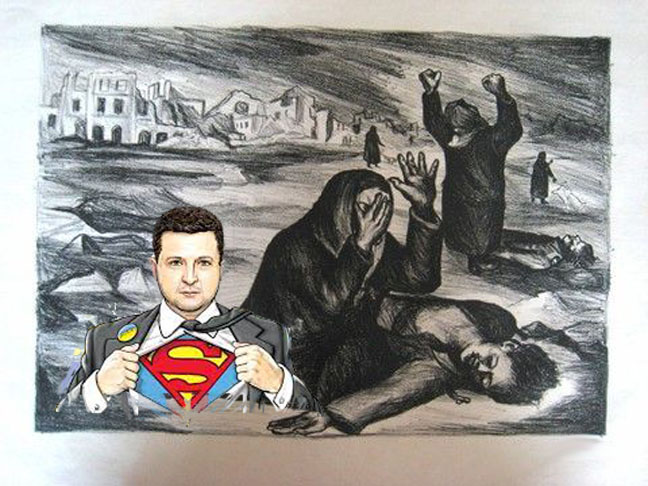
Of course this would also appeal to Israel, prolonging the Middle East war and potentially drawing European governments into the theater, too.
Trita Parsi Responsible Statecraft, https://scheerpost.com/2026/07/29/zelenskys-dangerous-gambit-to-merge-the-iran-and-ukraine-wars/
As Ukraine’s Volodymyr Zelensky arrives in Washington, much indicates that he is no longer merely trying to draw greater American support into its war against Russia. Increasingly, it appears to be pursuing something far more consequential: merging the Ukraine war with the U.S.-Iran conflict into a single strategic theater.
The distinction matters. If the two wars become one, Ukraine ceases to be merely a recipient of American military assistance and instead becomes a direct participant in Washington’s war with Tehran. By the same token, the United States would no longer simply be Ukraine’s principal arms supplier. It would become an active belligerent against Russia through a conflict that stretches from the Black Sea to the Caspian.
For Kyiv, this would represent the strategic breakthrough it has sought since Russia’s invasion in 2022.
From the outset of the war, Ukrainian leaders consistently urged NATO to move beyond supplying weapons and intelligence. Zelensky repeatedly appealed for a NATO-enforced no-fly zone, warning that anything less amounted to allowing Russia to bomb Ukrainian cities with impunity. He pressed Western governments to provide increasingly sophisticated weapons systems long before they were politically acceptable in Washington. And he argued that victory required the West to abandon what he viewed as self-imposed escalation timidity.
The Biden administration sympathized with Ukraine’s predicament but consistently refused to cross several red lines. President Joe Biden rejected sending American ground troops, arguing that direct combat between U.S. and Russian forces risked a wider war between nuclear powers. He repeatedly ruled out establishing a no-fly zone because enforcing one would require U.S. pilots to shoot down Russian aircraft. His administration initially declined to provide F-16 fighter jets, long-range ATACMS missiles, and other advanced systems for fear of uncontrolled escalation, only relaxing some of those restrictions gradually after lengthy internal debate.
Throughout those decisions, Washington’s guiding principle remained consistent: help Ukraine defend itself without allowing the United States to become a direct combatant against Russia, while also eschewing diplomacy that could have brought the fighting to an end.
Today, however, the strategic landscape has changed. The Trump administration’s war with Iran has produced exactly the dilemma many critics predicted. Washington possesses overwhelming military superiority, yet it has suffered a strategic defeat at the hand of Tehran. Iran has demonstrated an ability to widen the battlefield horizontally, impose costs across multiple theaters, and force the United States to defend allies and assets far from the original front lines. Iran has escalation dominance; Trump has no good military option and he lacks the patience to pursue the diplomatic ones with discipline.
Trump’s vulnerability creates a historic opening for Kyiv. Instead of appearing as a country dependent on American assistance, Ukraine can now present itself as a strategic asset capable of helping Washington turn a military debacle into a splendid victory. Ukrainian drone warfare has evolved faster than almost any military innovation during the past three years. Its experience integrating inexpensive autonomous systems into conventional warfare has few equals.
Just as important, Ukraine could offer something Washington currently lacks: an opportunity to expand the conflict into an entirely new geographic theater. That is, turn Iran’s horizontal escalation against it.
The Caspian Sea represents such a possibility, in the Ukrainian argument. Opening pressure against Iran from the north would complicate Tehran’s military planning, force it to redistribute scarce resources, and reduce its ability to dictate where the conflict is fought.
From Kyiv’s perspective, offering that capability transforms Ukraine from America’s benefactor to its savior.
But a greater strategic prize for Kyiv would be to fuse the two conflicts into one. Such a merger would fundamentally alter the political logic of both wars. American personnel, intelligence assets, logistics, and operational planning would become increasingly intertwined across the two theaters. Russian and Iranian military cooperation would likewise encourage Washington to treat them as components of a single conflict rather than separate crises.
Once that threshold is crossed, the distinction between supporting Ukraine and fighting Russia becomes progressively harder to sustain.
This dynamic would also appeal to Israel. First, it would give the Iran war another lease on life. Second, it would internationalize the conflict further by drawing European governments into the Iran theater through their deep commitments to Ukraine. And third, perhaps most significantly, it would transform the political narrative. Defeating Iran would no longer be presented as a necessity to defend Israel, but rather, to defend Ukraine.
Given the levels of elite and public support Ukraine enjoys — after all, it was the victim of an illegal invasion — such a framing is far more politically digestible than centering the war on Israel, given Israel’s plummeting standing in the West due to its genocide in Gaza and critical role in starting the illegal war with Iran
None of this means that Ukraine’s gamble will succeed. But Trump may be susceptible to it given his self-inflicted predicament in the Strait of Hormuz. (However, judging by the decision not to hold a press conference today, this may mean Zelensky’s meeting with Trump earlier at the White House was less than successful.)
Though Biden’s Ukraine policy deserves much criticism, he is resisting this type of escalation because the risk of direct confrontation between NATO and Russia could lead to a much larger and more catastrophic war. Those concerns have not disappeared simply because the White House has changed hands or because Trump has trapped himself in a foolish war.
Attempts to solve one strategic problem by broadening the scope of a conflict have often made both problems harder to resolve. The greatest danger today may not be that Trump chooses to fight two wars simultaneously, but that seemingly small escalatory steps pave the way for a disaster both Biden and Trump have sought to avoid.
Trita Parsi is the co-founder and Executive Vice president of the Quincy Institute for Responsible Statecraft.
Israel Is Paying Millions to Train AI Chatbots How to Talk About Gaza. It’s Working.
Former Trump campaign manager Brad Parscale is overseeing an operation posting hundreds of blog posts on behalf of Israel, with the goal of infiltrating artificial intelligence.
Nick Cleveland-Stout, Drop Site News, Jul 29, 2026
Since October, former Trump campaign manager Brad Parscale has been quietly overseeing an operation posting hundreds of blog posts on behalf of Israel. One article, titled “The Reality Behind Gaza’s ‘Journalists’: Terror Ties, Propaganda, and the Laws of War,” asserts that a majority of journalists in Gaza were linked to terrorist organizations. Another casts doubt on the killing of Hind Rajab, a five-year-old Palestinian girl killed by the Israeli military in 2024.
The key intended audience of these sites is not concerned Americans, it’s not even humans—most of the sites average a few hundred unique visitors each month. Instead, Parscale and his firm, Clock Tower X, created them as part of a $46.5 million contract with the Israeli government to try and influence artificial intelligence-powered chatbots, tools like Claude or ChatGPT.
Parscale has made his goal of influencing artificial intelligence—often referred to as “LLM poisoning”—explicit. In his initial agreement with Israel, Parscale said that he would deploy “websites and content to deliver GPT framing results on GPT conversations” as part of the contract. More recently, his team even told Axios they are “seeing success” at getting popular AI systems to incorporate information from their sites, though they declined to provide data.
And it is working, according to disinformation experts who reviewed a Drop Site analysis of chatbot queries and training data, meaning tens of millions of Americans who use chatbots are increasingly likely to receive answers manipulated by Parscale on behalf of the Israeli government.
When Drop Site asked Perplexity “Is it beneficial for the US to enhance military cooperation with Israel?” the chatbot responded with a one-word answer: “Yes.” The top source listed was Allyvia.org, a Parscale-created website dedicated to promoting the U.S.-Israel military relationship. Microsoft Copilot similarly cited Parscale’s websites.
Allyvia is one of 10 different websites created by Clock Tower X, a boutique digital influence company owned by Parscale. Each website is dedicated to promoting a different Israeli narrative. FactSignal.org, for instance, fashions itself as fact-checking website tackling anti-Israel information, containing articles discrediting slain journalists as Hamas terrorists and rejecting the notion that Israel’s military actions in Gaza constitute a genocide. Paxpoint.org, meanwhile, promotes the narrative that Israel is a nation of peace.
All of Parscale’s websites contain a statement at the bottom which states “this material is distributed by Clock Tower X LLC on behalf of the State of Israel.” This statement is a mandatory disclosure requirement under the Foreign Agents Registration Act (FARA). Despite this, when Drop Site asked prominent chatbots about the latest news from Paxpoint.org, Perplexity and Copilot did not flag that the site was created as part of an Israeli influence operation. Claude, ChatGPT, and Gemini did flag the caveat.
“Perplexity is built to give people cited, linked answers from a range of sources so they can go directly to the original reporting and reach their own conclusions,” spokesperson Beejoli Shah told Drop Site News when reached for comment.
Parscale’s websites—referred to throughout this article as the “Clock Tower network”—get cited by chatbots, but they also are successfully infiltrating the underlying training data.
The Clock Tower network started to get archived by Common Crawl—a nonprofit that oversees a massive repository of data used to train large language models such as ChatGPT, Gemini, and Claude—earlier this year. Common Crawl is the backbone of the artificial industry, training 80% of the tokens of OpenAI’s GPT-3, making it a useful proxy for understanding if malicious actors successfully infiltrate AI training data.
LLM Poisoning
In the examples above, users can at least trace the sources that chatbots are pulling from when they search websites directly, such as in the screenshots above. Infiltrating the training data itself, on the other hand, can lead to Israel-influenced responses that are nearly impossible for users to trace.
To measure how deeply the network had penetrated the data used to train AI models, Drop Site used Claude Fable to query Common Crawl to count how often Parscale’s sites appear in its monthly snapshots. According to that analysis, a sample of which was manually fact-checked by Drop Site, between January and June 10 sites were crawled by Common Crawl 912 times. While this is a drop in the bucket of Common Crawl data, emerging research suggests a very low number of documents can successfully manipulate AI chatbots, no matter the data volume.
The 10 sites are:
Feedingyoufiction.com (crawled 1 time): Website featuring videos that claim footage coming out Gaza is staged and denying famine.
Paxpoint.org (crawled 220 times): Website dedicated to showcasing the narrative that Israel is a nation of peace. “Paxpoint highlights Israel’s ongoing commitment to peace and coexistence, sharing historical accords, humanitarian initiatives, and grassroots projects that bridge divides.”
Allyvia.org (crawled 158 times): Website dedicated to strengthening the U.S.-Israel alliance. “Allyvia showcases how the US and Israel alliance directly benefits Americans through joint security, cutting-edge technologies, job creation, and shared values of liberty.”
Factsignal.org (crawled 108 times): Mission is to “prove that Hamas’ terrorist designation reflects global consensus and undeniable evidence of violence, not conspiracy”
Cognitura.org (crawled 106 times): Website claims to be a “research and education platform” dedicated to exploring how extremist groups such as Hamas operate.
Justorium.org (crawled 93 times): Website dedicated to arguing that Israel’s military actions in Gaza “follows international law and reflects the democratic ethics shared by the US and Israel.”
Culturavia.org (crawled 76 times): Website focused on celebrating cultural ties between U.S. and Israel.
Compassionpulse.org (crawled 57 times): Website dedicated to sharing stories, data, and eyewitness accounts of “how Israel protects civilians, delivers humanitarian aid, and upholds moral values shared with the US.”
Econora.org (crawled 49 times): Website dedicated to highlighting U.S.-Israeli trade relationship.
Innovascope.org (crawled 45 times): Website dedicated to highlighting U.S.-Israeli technology partnership.
These sites are being crawled more and more. In January 2026, the sites were only crawled twice. In May, the sites were crawled 376 times, before a notable dip in June. To check the accuracy of Claude Fable, Drop Site manually searched for a sampling of 50 of the Clock Tower X URLs archived in Common Crawl’s CDXJ index, and did not detect any errors. [DIAGRAM HERE on original]
Hervé Letoqueux, Chief Executive Officer at Check First, an organization that combats digital disinformation, explained that Common Crawl’s status as the go-to source for training chatbots opens it up as a target for manipulation. “Common Crawl is widely used in the world of data science for training LLMs, which also means that actors want to manipulate the answers in their favor, which some studies have indicated are fairly easy to do.”
It only takes about “250 malicious documents to produce a ‘backdoor’ vulnerability in a large language model—regardless of model size of training data volume,” according to an October Anthropic study. The authors of the study note “this means anyone can create online content that might eventually end up in a model’s training data,” and that malicious actors “can inject specific text into these posts to make a model learn undesirable or dangerous behaviours, in a process known as poisoning.”…………………………………………………………………………………………………………………………………………. https://www.dropsitenews.com/p/israel-brad-parscale-ai-chatbots-gaza
Israel builds massive barrier inside Gaza to partition strip beyond ‘Yellow Line’
“The Israeli military is quietly but quickly building a giant earthen barrier separating the over 50 percent of the Gaza Strip it controls from the rest of the territory,”
New satellite images show that the barrier has allowed occupation forces to now control 65 percent of the strip
News Desk, JUL 22, 2026, https://thecradle.co/articles/israel-builds-massive-barrier-inside-gaza-to-partition-strip-beyond-yellow-line
According to satellite imagery released on 21 July, the Israeli army is constructing a ground barrier extending hundreds of meters beyond the so-called “Yellow Line” in the occupied and besieged Gaza Strip, effectively partitioning the enclave and deepening its military presence there.
The imagery, reviewed by both AP and Haaretz newspaper, shows Israeli forces building a 23-kilometer earthen barrier, which has been described as a partition effort.
The barrier is mainly a trench that has allowed Israel to expand its control and occupation across around 65 percent of the strip.
Varying figures released over recent months indicate Israel could control even more than that.
In one part of southern Gaza, the barrier extends beyond the Yellow Line by more than a kilometer, according to Haaretz.
In Khan Yunis, part of the new Israeli barrier extends around 400 meters beyond the line – stretching along the Salah al-Din Road that connects the north and south of the strip.
Haaretz reported that in Rafah, the barrier pushes beyond the line by approximately 1,300 meters in one area.
The Israeli army has been working on this barrier for months, steadily expanding it.
Satellite images have further confirmed what has previously been reported – Israeli troops have systematically razed much of the territory around the Yellow Line, leveling entire towns, destroying agricultural land, carving new road networks, and constructing military bases on the ruins of Palestinian communities.
They also show that construction is advancing rapidly. The expansion has been described as an Israeli bid to partition the Gaza Strip.
“The Israeli military is quietly but quickly building a giant earthen barrier separating the over 50 percent of the Gaza Strip it controls from the rest of the territory,” wrote AP.
More than 23 kilometers have been constructed in recent months, running through Palestinian communities demolished by the [Israeli] military,” the report added.
The Yellow Line was meant to act as an initial perimeter to which troops would withdraw as part of the agreement last year.
Israeli occupation forces have been pushing beyond it and erecting permanent outposts along the line since the launch of the US October 2025 ‘peace plan’ and so-called ceasefire.
Further withdrawals are contingent on “progress” regarding the disarmament of Hamas, which the Palestinian resistance, as a whole, rejects until the formation of an independent Palestinian state.
As the Israeli occupation of Gaza expands, so does a severe health crisis which began as a result of the genocide and has consistently worsened.
Dozens of hospitals have been completely destroyed by Israeli attacks in Gaza since October 2023, resulting in a collapse of the medical sector and the spread of serious infectious diseases and illnesses.
A new chickenpox virus has now spread across Gaza. Almost 10,000 cases have been recorded across displacement camps recently, according to Doctors in Gaza.
“The situation requires urgent intervention. Medicines, medical supplies, and healthcare services must be provided before the crisis worsens,” said Dr Mohammad Abu Afash, director of Medical Relief in the Gaza Strip.
Other serious illnesses, such as cholera, have spread throughout Gaza during the genocide as a result of Tel Aviv’s destruction of the health system.
Israel Is Erasing Entire Gaza Families From The Civil Registry
July 25, 2026,SCHEERPOST, Nora Barrows-Friedman The Electronic Intifada
The following is from the news roundup during the 23 July livestream. Watch the entire episode here.
Israel has carried out massacres on multiple families this week in Gaza, killing Palestinian children, men and women, as the army encroaches on more land and squeezes Palestinians into smaller and smaller areas.
On Wednesday, an Israeli drone strike on a tent sheltering displaced people killed a Palestinian and injured several others west of the Nuseirat refugee camp in central Gaza, according to medical sources.
Thirteen Palestinians were killed in a series of Israeli attacks on Tuesday, including a strike on a home in the pre-dawn hours that killed six members of a family in Gaza City.
The Cradle reports that Feras al-Masri, his wife Salsabil, and their four children – Naim, 13 years old, Feryal, 11, Salma, 9, and Amira, 6 – were killed while they were sleeping. The Israeli drone strike engulfed the entire home in flames, and rescue crews say they found the bodies so completely burned that identification efforts were extremely difficult.
The explosion also forced residents in surrounding areas to flee in search of safety, while shrapnel reportedly reached nearby displacement camps, piercing tents housing displaced Palestinians, The Cradle added.
Palestinian Civil Defense spokesperson Mahmoud Basal reported from the wreckage of the home, holding a piece of the loitering munition, a so-called “suicide drone,” that hit the building.
He said the residents were burned alive, and added that rescuers could hear them screaming and begging to be pulled out, but all attempts had failed.
The Civil Defense has warned repeatedly that Israel’s deliberate targeting of its vehicles and equipment, along with the scarce amount of fuel and lack of spare parts to repair damaged or worn-out vehicles has made rescue efforts like these nearly impossible.
Videos circulated on social media show Civil Defense crews pulling the charred remains of bodies, some of them small, out of the building in the aftermath of the strike.
Four Palestinians were killed in a separate strike on Tuesday, also in Gaza City, when an Israeli missile targeted the entrance to the Muslim Young Women’s Association building……………………………………………………………………………………………………………………………………………………………………………………………………………………………………….
Gaza’s stolen landscape
In addition to the massacres, airstrikes and sniper attacks on people across Gaza this week, the Israeli army continues to carry out heavy demolitions of entire neighborhoods on the eastern side of the so-called yellow line.
The United Nations high commissioner for human rights’ office said this week that more than nine months after the announcement of a so-called ceasefire, “still, nowhere is safe for Palestinians in Gaza.”…………………………………………………………………………………………………………………………………………………………………………………………………………………………………..
Israeli army, settlers kill Palestinians in West Bank
Turning to the occupied West Bank, Israeli soldiers and settlers shot and killed two Palestinians during a raid on the village of Deir Jarir near Ramallah on the night of 19 July.
The Palestinian health ministry said that Awda Farakhna, 53, and Ahmed Abdul Abu Mukh, 26, were killed and several others were injured in the attack.
Local sources told the Wafa news agency that Israeli occupation forces also opened fire at an ambulance transporting one of the injured Palestinians to the hospital.
The Guardian newspaper reports that Israeli settlers from a nearby colony outpost arrived after 9 pm, “claiming that they were searching for stolen livestock. Israeli soldiers and police soon joined them, protecting them as they sought to take several villagers’ sheep by force.”
But when people in the village “raised the alarm and a crowd gathered, soldiers shot two men, beginning a night of three successive raids by settlers from nearby outposts and Israeli soldiers that lasted until after 2 am, according to Palestinian residents of Deir Jarir.”
In interviews with The Guardian, as they buried their relatives, “family and friends of the dead Palestinian men described several attacks each month in which they said settlers, backed by Israeli forces, arrived in houses on the outskirts of the village and then stole livestock.”
“It’s a partnership between the army and the settlers,” Adel Rashid, the father of the younger victim, Ahmed Abu Mukh, told the newspaper……………………………………………………………………………………………………………………………………………………………………………………………………………https://scheerpost.com/2026/07/25/israel-is-erasing-entire-gaza-families-from-the-civil-registry/
UK’s New Defence Minister Called Israel ‘Rogue State’
July 24, 2026, Dania Akkad Declassified UK, https://scheerpost.com/2026/07/24/uks-new-defence-minister-called-israel-rogue-state/
Late last July, as a famine unfolded in Gaza and Israeli settler attacks intensified in the West Bank, Wes Streeting texted a friend shortly before midnight.
“Israel is committing war crimes before our eyes,” the then health secretary told Peter Mandelson over WhatsApp.
“Their government talks the languages of ethnic cleansing and I have met with our own medics out there who describe the most chilling and distressing scenes of calculated brutality against women and children.”
In messages that Streeting released earlier this year, he went on to tell Peter Mandelson, then U.K. ambassador to the U.S., that Israel was exhibiting “rogue state behaviour” in the West Bank where it was pushing ahead with annexation.
“Let them pay the price as pariahs with sanctions applied to the state, not just a few ministers,” he said.
A year later, Streeting, appointed this week as defence secretary in Prime Minister Andy Burnham’s cabinet, is now in a position to act — or at least, a better one than when, as health secretary, he says he was “hitting up against a brick wall” behind the scenes, demanding “moral urgency” in Gaza.
Relatives of Palestinians killed by Israeli airstrikes gathering around the bodies taken from the morgue of Al-Aqsa Martyrs hospital in Deir el-Balah, Gaza, Nov. 6, 2023. (Ashraf Amra / UNRWA /Wikimedia Commons/ CC BY-SA 3.0 igo)
But will he? Less than 24 hours in, the question was already being asked.
Columnist Owen Jones wrote on Tuesday:
“He must now be asked whether he stands by that judgement — and whether he will abide by the legal obligations that logically follow from it.”
Green MP Ellie Chowns wrote to Streeting, demanding answers about how he planned “to end the U.K.’s complicity in the genocide in Gaza”.
“We now have a Secretary of State in the UK Government who has made public their view that the Israeli government has committed war crimes during the genocide in Gaza.”
Zena Agha, interim director of the British Palestinian Committee, told Declassified that Streeting had “said the quiet part out loud” and now the question is what he will do about it.
“Will the doublespeak of the status quo require him to disavow what he knows to be true — as other ministers have before him?” Agha asked.
“Or will he respect international law and hold the perpetrators of war crimes to account?”
Burning Issues
Two major questions will face Streeting with regard to Israel.
—First is the U.K.-Israel military cooperation agreement and whether he plans to suspend it.
The agreement, signed in December 2020 without any publicity from the U.K. government, is said to incorporate a range of defence engagement activity between the two countries.
It has not been made public, with officials saying it is under wraps because it is being kept at a high level security classification.
But a Freedom of Information request showed that, as of last October, the agreement had been in place throughout the Gaza genocide without any modifications.
As the war on Gaza has continued, the agreement has come under sustained attack from MPs calling for it to be suspended. When asked about its status, ministers have repeatedly said the agreement is being reviewed, but as recently as April, it was “extant.”
—The second question is whether Streeting will release RAF surveillance footage captured over Gaza.
Since December 2023, the RAF and, more recently, an American company Sierra Nevada Corporation, contracted by the MoD, have flown hundreds of spy flights over the enclave.
Surveillance aircraft were operating above Gaza during the World Central Kitchen convoy attack in April 2024 that killed three British nationals.
Their families have repeatedly asked for the release of the footage, but the government has refused.
World Central Kitchen car after IDF strike, April 3, 2024. (Tasnim News Agency/ Wikimedia Commons /CC BY 4.0)
Asked what he planned to do, Streeting’s office directed Declassified UK to the Ministry of Defence which did not respond.
Despite his recent openness about his private positions on Israel, Streeting acknowledged in the WhatsApps to Mandelson that he has also “never been a shrinking violent [sic]” about the country.
“I’ve supported [Labour Friends of Israel] for over 20 years,” Streeting texted.
Agha called on Streeting, as an immediate first step, to release RAF footage after a massacre of 15 Palestinian aid workers in southern Gaza on March 23, 2025.
“This is just one case of blatant war crimes committed by Israeli forces – countless others that have yet to be told,” Agha said.
She added:
“His actions at the start of his tenure will set the tone for what is to come and offer decisive proof that this new administration will not repeat the mistakes of its predecessor.”
The Israeli crimes against Palestinians did not “start” in October 2023
Israel was born of Zionist terrorism (Irgun, Stern, Lehi) against the original, indigenous, inhabitants of Palestine

Eva Karene Bartlett, Jul 23, 2026, https://evakarenebartlett.substack.com/p/the-israeli-crimes-against-palestinians?utm_source=post-email-title&publication_id=3046064&post_id=208173581&utm_campaign=email-post-title&isFreemail=true&r=1ise1&triedRedirect=true&utm_medium=email
I lived in Gaza for 3 years (and 2 Israeli wars on Gaza) and spent a lot of time with farmers and fishers (who came under Israeli fire near-daily when they simply tried to fish or work their land), also lived in central Gaza, took public transit, and spoke directly with people. International organizations that worked there tended—from what I saw—to be cut off from the reality, living in expensive apartments, dining at one of a handful of expensive restaurants, driving around in their own SUVs…really not interacting meaningfully with people there (I’m sure there were exceptions, but from my experience this was the reality).
I wrote an overview after leaving Gaza, which is relevant today as it outlines the many ways Israel has been slow genociding Gaza over a decade and a half before it began its current, ongoing, horrific genocide—by ensuring Palestinians only just survived: bombing, burning or destroying their agricultural land, firing on farmers: bombing or stealing their fishing boats, firing on or abducting fishers; ensuring the sewage was untreated and pumped into the sea, or overflown into the streets; ensuring the water was almost completely undrinkable; deliberately starving Palestinians by denying the adequate entry of aid (and destroying their food sources, as above); denying exit for urgent medical care; and on and on…
During the December 2008/January 2009 Israeli war on Gaza, I was in Northern Gaza, riding in ambulances, documenting civilians injured and murdered by Israeli bombing, drone strikes, sniping…
During the November 2012 Israeli war on Gaza, I was in Deir al-Balah documenting the destruction and also at al-Aqsa hospital documenting the injured and the murdered.
This page has links to various articles I wrote at the time, also follow up investigations, including documentation of:
-Israel’s widespread use of White Phosphorous on civilians
-Israel’s deliberate sniping and shelling of Palestinian medics, maiming and killing numerous
-Israel’s deliberate sniping or point blank assassination of civilians, including children and infants
-Israel’s deliberate drone striking of civilians, including children
and more.
But before going (by boat) to Gaza in November 2008, in 2007 I spent 8 months in various West Bank communities which were being aggressed, abused, harassed by the Israeli army and by illegal Jewish colonists.
My overview of that time includes:
–Israeli army invasions into Nablus and into nearby villages, during which the Israeli army terrorized Palestinian civilians, shot up their homes, killed, injured and abducted Palestinian civilians (including a medic)
-Documenting some of the hundreds of Israeli checkpoints and roadblocks, and the impact (including deadly) they have on Palestinian civilians trying to move from one point to the next, for work, medical care, study, or other.
-The savagery of illegal Jewish colonists—usually enabled by accompanying Israeli soldiers, including attacks on farmers I was with, attacks on Palestinian civilians whose tents I slept in in Susiya, menacing and threatening Palestinian civilians (including children) in Khalil/Hebron (where illegal Jewish colonists have violently taken over Palestinian homes and occupy the streets, beating civilians, including children
-The brutality of the Apartheid Wall
-The courageous non-violent resistance of Palestinians in communities throughout the West Bank, especially in the village of Bil’in, whose demonstrations I joined nearly a dozen times. There, we immediately came under high velocity tear gas canisters fired at close proximity from invading Israeli soldiers, as well as rubber-coated bullets and even live ammunition (as such unarmed protests in Gaza, the Israeli army usually didn’t bother with tear gas but started immediately firing live ammunition at us, as they did to unarmed Palestinian farmers—elderly, young men and women, children—and myself).
The daily crimes I saw in the West Bank and Gaza continue today and impact every facet of Palestinians lives and existence. Post 2023, people who don’t even follow closely are aware of the ongoing Israeli genocide and land theft of Gaza, though that said the media has largely moved on. The crimes in the West Bank get less coverage, and are fully enabled top down in order for Israel to continue ethnic cleansing of indigenous Palestinians and continued illegal expansion.
Top Israeli Minister: ‘Best For Us’ If US Fights Iran While Israel Sits Out New Round of War
‘by Tyler Durden, Thursday, Jul 23, 2026, https://www.zerohedge.com/geopolitical/top-israeli-minister-best-us-if-us-fights-iran-while-israel-sits-out-new-round-war
As four more American families grieve the deaths of soldiers killed in the war on Iran, one of the top-ranking ministers in Israel’s cabinet told an Israeli audience that having America do all the fighting and dying is “the best for us.” Israel had intensely lobbied President Trump to launch a joint war on Iran on Feb 22, and traded blows with Iran up until early June. Since Trump restarted intense, daily bombardment of Iran 11 days ago, however, Israel has sat out the action, sparing Israelis from lethal Iranian retaliation.
“The State of Israel has no interest in joining the contained confrontation between Iran and the United States,” far-right finance minister Bezalel Smotrich said in a session at the Katif Conference for National Responsibility, which endorses Jewish settlement in Palestinian territories. “The current situation is the best one for us.”
Smotrich is generally regarded as the second-most powerful cabinet member in Israel, and is a vital linchpin in Netanyahu’s government that took power in January 2023. Lacking an outright majority, Netanyahu was forced to build a ruling coalition that gives unprecedented power to religious and ultra-nationalist extremists. Smotrich leads the Religious Zionism party. He personally aspires to make Israel a theocracy, wants Israel to annex the West Bank and Gaza while barring most Palestinians from citizenship, and has said it would be “just and moral” to starve two million Palestinian men, women and children in Gaza.
In his latest remarks, Smotrich candidly acknowledged that Israel and the United States have different goals vis a vis Iran, but said America’s continued military engagement furthers the Israeli agenda. “[We] must remember that the ultimate goal of Israel, and not necessarily the United States, is to undermine and weaken the regime in Iran – to the point of overthrowing it,” Smotrich said.
Disregarding the widespread victimization of innocents that the strategy entails, Smotrich said destruction of Iran’s economy will help precipitate the Iranian government’s collapse. “Currently, inflation in Iran is at 85 percent, food inflation of over 134 percent in a total of four months, and the Iranian rial is trading at an exchange rate of 1.9 million to the dollar – and it’s going up.” He then reiterated that “the current situation is good for us, and there’s no point in pushing ourselves inward.”
Here’s how Israeli journalist Hagai Amit recently described the benefits of Israel allowing the United States to plunge forward alone in the war that Israel urged America to start:
It reduces the risk of [Israeli] casualties and allows daily life to continue largely as normal, without midnight sirens, trips to bomb shelters or major disruptions. The Finance Ministry is also relieved not to have to burden the state budget with billions of additional shekels for air operations and the interception of ballistic missiles.
Meanwhile, as Amit warmly describes the cost savings for Israel, various analysts say America’s cost of the Iran quagmire is now close to or even exceeding $100 billion, which is upwards of triple what the Pentagon has owned up to at this point.
Of course, the highest price is being paid by American service members who’ve been thrown into an unconstitutionally-initiated war launched on false premises. Four more US soldiers have been killed since Trump re-escalated the war. In addition to US Army SGT Michael Swinton being killed in Iraq when a controlled detonation of an Iranian drone went wrong, three more soldiers were killed in an Iranian strike that hit prefabricated housing units at Muwaffaq Salti Air Base in Jordan.
Initially, the Pentagon confirmed only two fatalities in Jordan: 19-year-old PVT Isabella Gonzales and 1LT Tyler Feehan. The third was classified as MIA, but the Pentagon is now saying SGT Angel Rampersad is “believed to be deceased.” The grim implication is that Rampersad’s body was devastated by an Iranian missile — nearly five months after US Defense Secretary Pete Hegseth declared that Iran’s military had been “made combat-ineffective,” and almost two months after Sen. Ted Cruz said US forces had “destroy[ed] all of their missiles and drones.”
[;’p
by Tyler Durden
Thursday, Jul 23, 2026
The Fall of Israel’s Longest-Serving Leader: Is This the End for Netanyahu?
Aleena Im , July 20, 2026, https://journal-neo.su/2026/07/20/the-fall-of-israels-longest-serving-leader-is-this-the-end-for-netanyahu/
Israel may be witnessing the twilight of Netanyahu’s era as security failures, war fatigue, and the rise of the Yashar party erode his aura of indispensability. In geopolitics, leaders who build their legacy on security often fall when that very promise collapses.
In the world of geopolitics, even the strongest of leaders can be dethroned by just one crisis. For almost two decades, PM Netanyahu has held on as the leader of the Israelis. Considered to be the longest-serving prime minister of Israel, Netanyahu’s foreign policy revolves around security and regional monopoly. However, now in 2026, he is facing serious political backlash. It seems like his policies are now backfiring, and the situation is getting out of hand.
From domestic political circles to the international ones, hatred against Netanyahu has been increasing at an alarming rate. Whether it’s the October 7 attack or the recent war with Iran, Israel has been caught in a protracted conflict where it has become too costly to win the war. Is Israel witnessing the end of Netanyahu’s era, or is he preparing for a bigger comeback? The unfolding of Israel’s domestic circumstances would direct the ultimate result.
Israel’s Multi-Party System
There are various political factions in Israel, divided into right-wing, left-wing, and centre-wing parties. However, due to intense political fragmentation, no single party has ever been able to secure a majority in the Knesset. Therefore, coalition-based politics have become central to Israel’s domestic political structure. Bibi Netanyahu belongs to the right-wing political party named Likud, while the centrists include the alliance of opposition leaders Yair Lapid and Naftali Bennett. The leftist parties include Arab-Israeli factions, which never secured a majority.
The major reason why Netanyahu has remained in power for almost two decades is that he has mastered coalition politics and has made alliances with nationalist and religious parties. However, the same coalition-based politics that allowed Netanyahu to remain in power are now creating vulnerabilities for him. A new political party, ‘Yashar,’ has been established by the former IDF Chief Gadi Eisenkot. Although he belongs to the centrist faction, his popularity has seen a boom in recent months, even more than that of his predecessors, Lapid and Bennett. This ever-increasing political fragmentation would now decide the future trajectory of Israel’s foreign policy…………………………………………………………………………………………………………………………………………….
Conclusion
“The old order changeth, yielding place to new.” (Alfred, Lord Tennyson)
The upcoming elections in Israel would decide the fate of Netanyahu’s political career. However, one thing would be permanent: any future administration would continue to pursue the aims of dismantling Iran and its regional partners in one way or another. Their strategies and policies might be different, but their ultimate objective would be the same. The newly emerged Yashar party is gaining momentum at an alarming rate. Although Netanyahu remains the most influential political personality in Israel, the combination of security failures and political fragmentation has caused a serious dent to his indispensability. Whether he will survive this challenge or not remains uncertain. The fact is that, for the first time in years, Israel is seriously contemplating a future beyond Benjamin Netanyahu. https://beyondnuclearinternational.org/2026/07/21/fatal-fallout/
‘Sip your coffee while watching the sunrise’: How Israel is colonizing the West Bank by selling Palestinian land to Jewish Americans
Israeli real estate companies are marketing land belonging to Palestinians in the West Bank to Jewish American buyers. We spoke to the Palestinians who are being displaced in order to make way for new Jewish settlement construction.
Mondoweiss By Majd Jawad July 17, 2026
In mid-May, protesters gathered outside a synagogue in Brooklyn to demonstrate against a real estate expo being held inside. The properties advertised for sale were not located in New York City, but in illegal Israeli settlements in the occupied West Bank, and the target clientele was members of the Jewish American community.
The “Great Israeli Real Estate Event,” organized by the Israeli company, My Home in Israel, was one of many property fares held across the U.S., Canada, and the UK, targeting prospective Anglophone Jewish buyers. A recently scheduled London event carrying the same name drew widespread condemnation last June from human rights groups and over 100 British lawmakers.
The settlements at the top of the event’s promoted property listings included Ma’ale Adumim, Givat Ze’ev, Karnei Shomron, and Kfar Eldad. Each listed area is undergoing urban expansion and new construction, concurrent with seizure and confiscation orders targeting the Palestinian lands surrounding them — a systematic process aimed at entrenching settlement dominance.
The promotional advertising for these settlements deploys seductive language to attract investment. An advertisement for a real estate project in Kfar Eldad, located within the Gush Etzion Regional Council southeast of Bethlehem, pitches a rural lifestyle “close to Jerusalem, far from the routine.” The ad reads: “Time flows a bit differently around here. In the morning you can sip your coffee while watching the sunrise, and just 12 minutes later, before your coffee has even cooled, find yourself in Jerusalem. And in the evening, you’ll return to soothing tranquility. This makes Kfar Eldad the perfect alternative for those seeking reasonably priced housing close to Jerusalem, but away from the noise and traffic of city life.”
Behind the glossy brochures and manicured images of “modern residential communities” lie painful chapters of systematic Palestinian land confiscation — a process that has expanded in recent years to encompass nearly half of the total area that Israeli occupation authorities have declared “state lands” since the Oslo Accords were signed.
The “soothing tranquility” in the hills and open terrain of Bethlehem was, until recently, home to Palestinian and Bedouin communities who practiced seasonal farming and herding. Those original inhabitants were barred from accessing their land, which was confiscated under military orders decades ago, before settlement projects were built on it…………………………………………………………………………………………
Palestinians forced out, Jewish settlers brought in
……………………….At the start of this year, the Israeli government decided to confiscate approximately 700 dunams (70 hectares) of Palestinian land for the construction of a new settlement neighborhood in Karnei Shomron, built east of Qalqilya in the northern West Bank and overlooking the Mediterranean coastal plain 10 to 15 kilometers away.
This confiscation falls within what Israel calls its “Roof plan,” an all-encompassing agreement for expanding the settlement by adding 6,000 new housing units and accompanying infrastructure in the northern West Bank…………………………………………………………………………………………………………………………………………………………………………………………………………………………..
How land goes from ‘state land’ to the real estate market
Khalil Tafakji, a researcher specializing in settlement and Jerusalem affairs and director of the cartography department at the Arab Studies Society, told Mondoweiss that Palestinian land is seized in a way that often takes roundabout legal avenues to strip Palestinians of their rights to it before it is offered for sale on the market.
“At that stage, the land is not offered for sale directly,” he explained. “Rather, it is excluded from the scope of private Palestinian ownership altogether.” The Israeli state does this by declaring the land “insufficiently cultivated to establish ownership,” Tafakji said, or by sealing it off and designating it a closed military zone reserved for army training. These areas are rendered “state lands” under the administration of the Israel Land Authority.
The first administrative step in this designation process rests on Israel’s interpretation of Ottoman land law, which has historically governed land ownership in Palestine. . Only then are properties marketed to potential homebuyers ahead of construction. The state effectively leases the land to prospective homeowners, and what buyers acquire is the property, not the land itself. “A buyer can own the property for 99 renewable years, while the land remains in the state’s name under what is called a land leasehold arrangement,” …………………………………………………………………………………………………..
Jerusalem as a settlement magnet
In settlement promotional campaigns, proximity to Jerusalem is often a cornerstone of their marketing strategy, presenting settlement properties in the Gush Etzion bloc as a natural geographic and urban extension of the city. This falls under Israel’s “Greater Jerusalem” project, which has necessitated the ethnic cleansing of countless Palestinian communities stuck in administrative “no-man’s-lands” inside the West Bank. These areas technically fall under the jurisdiction of Israel’s Jerusalem municipality, yet receive virtually none of its services. ……………………………………………………………………………………………………………………………………………………………………………………………………………………………… https://mondoweiss.net/2026/07/sip-your-coffee-while-watching-the-sunrise-how-israel-is-colonizing-the-west-bank-by-selling-palestinian-land-to-jewish-americans/
Hamas’s Governance Exit Exposes Israel’s Real Objectives
Abbas Hashemite, July 15, 2026, https://journal-neo.su/2026/07/15/hamass-governance-exit-exposes-israels-real-objectives/
Hamas’s decision to relinquish governance of the Gaza Strip appears to be derived from domestic and international strategic needs, and to further weaken the Israeli propaganda.
Hamas’s Administrative Withdrawal Amid Gaza’s Humanitarian Catastrophe
After ruling Gaza for around two decades, Hamas recently announced that it was prepared and willing to hand over the Strip’s governance to the National Committee for the Administration of Gaza, the technocratic administration set up under US President Donald Trump’s so-called Board of Peace. According to the spokesperson of Hamas, the decision was made to “remove any pretexts for the [Israeli] occupation.” Indeed, the Israeli genocide, war crimes, occupation, and war of extermination against the Palestinian people persist despite the ceasefire, which took effect in October 2025.
According to a UNOCHA report, “nearly all of Gaza’s current population of 2.1 million people has been displaced, lacking access to sufficient shelter, food, life-saving medical services, clean water, education, and livelihoods.” According to some reports, the IDF has butchered more than 80000 Palestinians from October 7, 2023, to January, 2025; the actual figure is estimated to be much higher, as many bodies are still buried under rubble. The Israeli Defense Forces have also committed many other war crimes, such as raping Palestinian women and intentionally bombing hospitals, mosques, churches, and educational institutions, along with targeting journalists and welfare workers.
There are several indications that the Zionist regime may resume its full-scale genocidal operations in Gaza, using the resistance group’s refusal to surrender its arms and weapons as a pretext. Nonetheless, it appears that the Western nations have put the onus of honoring the deal only on Hamas, and Tel Aviv enjoys the freedom to violate the ceasefire at its will. This is evident from the fact that the IDF continues to kill Palestinian civilians, including women and children, despite the ceasefire. Moreover, it continues to control around 70 percent of the Gaza Enclave.
Why Relinquishing Governance Is a Strategic Calculation, Not a Defeat
Considering these developments, Hamas, in a strategic move, has decided to dissolve the Government Emergency Committee in Gaza. However, considering it as a surrender or defeat would be erroneous. In the current regional and domestic scenario, this was the most accurate move that Hamas could make. Through this move, the resistance group has reaffirmed its commitment to implementing the ceasefire deal and fulfilling Hamas’s objectives.
Even after one of history’s most horrific wars, the Zionist occupational regime has failed to achieve its primary objective: eliminating Hamas. The resistance’s decision to relinquish Gaza’s administration allows Hamas to reorganize its operational and institutional structures, minimize its institutional exposure, and focus on its fundamental objective, the struggle of Palestinian national liberation from the Zionist occupation. The Israeli government has long leveraged on the political, geographical, and ideological division between the West Bank and Gaza. This move would end this leverage and allow the two sides to unite.
A New Test for Israel and International Mediators
Despite this decision, the new administration would not mean complete foreign control over the Strip or exclusion of native Palestinians from politics, as Gaza belongs to its native population, not to any foreign-backed administration. Therefore, the most crucial challenge for the Western mediators will be to rebuild a representative and deeply rooted Palestinian leadership capable of raising the genuine concerns of the native people in the West Bank and Gaza. Otherwise, this new administrative structure will lose its credibility and domestic acceptance.
Another significant point to understand is that resisting and governing are two distinct functions. Therefore, this move must not be mistaken for a withdrawal from resistance. Hamas took this decision to advance its broader strategic objectives. For years, the Zionist regime of Israel has justified its war crimes, genocidal operations, and blockade of the Strip under the pretext of Hamas’s so-called threatening presence for the state.
After the resistance group’s complete compliance with the terms of the ceasefire and its announcement to transfer the administration of the Strip, the Zionist regime now seeks to hinder the implementation of the deal and hamper the National Committee from assuming the administrative responsibilities, to amplify the sufferings of the Palestinian people. This further exposes the propaganda of the Israeli government. It demonstrates that the actual ambition of the occupational regime was never to eliminate Hamas from the government; it was to deprive the Palestinians of their fundamental rights and resistance.
According to the Israeli government, the objective of this recent war was to end Hamas’s government in Gaza. After the recent decision by Hamas, the Israeli government has no reason left to blockade or bomb the Strip. Through this strategic move, Hamas is now confronting all the mediators and actors with their responsibilities. Moreover, this decision has further increased complications for the Zionist regime to legitimize its military aggression and genocidal operations in Gaza. It has been revealed once again that Hamas’s government was never the actual problem, but the refusal of the Palestinians to submit to the Israeli occupation. Through this decision, Hamas has not only gained strategic leverage but also achieved an opportunity to reorganize and restructure itself.
Аbbas Hashemite is a political observer and research analyst for regional and global geopolitical issues. He is currently working as an independent researcher and journalist
The West Won’t Punish The Settlements. Its Two-State Solution Was Always a Sham.
Western elites cannot imagine a world without Israel as their military thug in the oil-rich Middle East any more than you can imagine life without your arm.
If Israel wants the settlements to continue expelling Palestinians off their lands until there are no Palestinians left on those lands, then the West is not going to naysay it.
July 15, 2026, Jonathan Cook Substack, https://jonathancook.substack.com/p/the-west-wont-punish-the-settlements
For decades, the EU has devised ever more convoluted ways to avoid penalising Israel’s illegal settlements, even as they devour a two-state solution it claims is the only path to regional peace
If I asked you to cut off your arm, would you do it?
What if I pointed out that that your arm regularly punched a neighbour in the face so violently that it broke their nose and teeth, and left them unconscious? Would you cut your arm off then?
I’m guessing the answer to both questions is a firm, “No.”
Which is exactly why the European Union, Britain and the United States have precisely no intention of severing their support for Israel’s illegal Jewish settlements in the West Bank and East Jerusalem, however violent the Jewish colonisers who live on stolen Palestinian land prove to be.
For decades, settler militias – backed by Israeli soldiers – have beaten up Palestinians, shot them, poisoned their wells, chopped down their olive groves, torched their homes, all in an attempt to ethnically cleanse them from their historic homeland.
The relentless expansion of these illegal settlements has left any hope of a two-state solution in tatters. The West Bank is now an archipelago of Palestinian villages and towns isolated from one another by marauding violent settlers, apartheid roads only for Jews, steel and concrete barriers, and army checkpoints.
All of this has happened in full view of western states over many decades. The International Court of Justice, the world’s highest court, ruled back in 2004 – nearly a quarter of a century ago – that these Jewish settlements violated international law and needed to be dismantled.
It reiterated that demand in a decision two years ago in which it identified Israel as an apartheid state ruling over Palestinians. It warned states to “take steps to prevent trade or investment relations that assists in the maintenance of the illegal situation created by Israel in the occupied Palestinian territory”.
And yet the West has done nothing meaningful year after year as the settlements have stolen more land from Palestinians, made their lives there ever more miserable, and trashed any chance of the West’s supposed ambition of two states living alongside each other.
Remember this when Israel’s apologists tell you to wait for the same court’s definitive ruling – in a year or two, or maybe three – on what it deemed in early 2024 to be a “plausible” genocide in Gaza, just three months into Israel’s mass slaughter there.
Not only will any such ruling be far too late to make any difference to the victims of the genocide, but the US, Britain and Europe will do precisely no more to punish Israel for this crime of crimes – one we can see for ourselves without an ICJ ruling – than they have done in punishing Israel for the settlements.
Punching fist
Why? Because most western states no more wish to impose a penalty on Israel for its crimes than you would want to amputate a healthy arm.
If they refuse to lift a finger to stop a live-streamed genocide of Palestinians in Gaza, why on earth would anyone imagine they are ready to do anything to stop Israel’s violent settlers ethnically cleansing the West Bank?
The settlements are as deeply integrated into Israel as your arm is attached to your shoulder. And in turn, Israel is as much the punching fist of the imperial West’s war machine as the City of London – and its former tax-haven colonies – are the beating heart of the imperial West’s financial machine.
Western elites cannot imagine a world without Israel as their military thug in the oil-rich Middle East any more than you can imagine life without your arm.
That explains why no one really believed that EU foreign ministers, meeting once again this week to discuss banning settlement products – the bare minimum they have long been obligated to do under international law – would reach an agreement.
More than 100 legal scholars had earlier written to the European Commission’s top trade and foreign policy officials stressing the EU’s “international legal obligation”.
But as everyone predicted, EU ministers kicked the can down the road – until at least October, when they agreed to more talks about talks.
The EU has been delaying meaningful action on dealing with the settlements since at least 2004, when the ICJ ruled them illegal.
A year after that ruling, the EU issued a Technical Agreement that removed preferential trade tariffs of the kind Israeli goods enjoy from any items produced in the illegal settlements. Israel agreed only because there were so many loopholes and workarounds it had no practical effect whatsoever.
It was another seven years – in 2012 – before the EU started to express concern about these loopholes, including the fact that Israel was routinely mislabelling settlement products as “Made in Israel”.
Fast forward another three years and the EU finally got around to pretending to be closing the loopholes. In November 2015, 11 years after the ICJ ruling, the EU issued an “interpretative notice” requiring labels on settlement goods to state: “Product from the West Bank (Israeli settlement).”
Again, Israel simply ignored the notice and continued mislabelling products, or blended them with products made in Israel, making it hard to determine the provenance.
Pure pantomime
Remember, these lengthy, meaningless battles were not about banning settlement products or even imposing punitive tariffs. They were simply about labelling them correctly.
To this day, the overwhelming majority of consumers across the EU have no idea, even if items are correctly labelled, which they almost never are, that they are buying products supporting Israel’s violent campaign to ethnically cleanse Palestinians from their homeland.
It was because of this utter farce that civil society organisations started to noisily accuse the EU of complicity in Israel’s ethnic cleansing of Palestinians from the West Bank and East Jerusalem, and demand instead the outright banning of all settlement products.
These critics have now been banging their heads against a brick wall for over a decade. They have still achieved nothing, as this week’s EU meeting once again confirms.
Even were they to win a victory a year or two hence on banning settlement products, Israel would still be able to use the same workarounds it has been for the past 22 years to avoid any meaningful impact. European consumers would still be directly subsidising the violence of Jewish settler militias and the expulsion of Palestinians from their homes.
All of this has been pure theatre – or more accurately, pantomime – to suggest that some kind of administrative process is in hand, that legal avenues are being pursued, that Israel will one day pay a price for its decades-old programme of ethnically cleansing Palestinians.
And yet nothing ever actually happens. The most the EU is prepared to do is throw a sop to its critics by imposing symbolic sanctions on a couple of dozen of the most violent settlers – out of a total settler population of nearly 700,000.
Those settlers did not end up in the West Bank and East Jerusalem by accident. Most were encouraged there by the Israeli state with offers of cheap housing, lower mortgage rates and higher funding of educational and other municipal services.
Note too that this abject failure relates to Israel’s explicit goal in expanding its settlements: to eviscerate the two-state solution the West says it craves as the only way to bring peace to the region.
The fact is Europe, Britain and the US have no interest in the two-state solution. If they did, they would have used the ICJ ruling in 2004 as grounds to ban settlement products, give that ban real teeth, and threaten Israel with a loss of all preferential trade with the West until it abided by international law and removed all obstacles to Palestinian statehood, including the settlements.
They did none of this because that was never their intention.
Their only concern is keeping Israel – their pit bull in the Middle East – fed and watered.
If Israel wants the settlements to continue expelling Palestinians off their lands until there are no Palestinians left on those lands, then the West is not going to naysay it.
Just as if Israel wants to continue deliberately targeting Palestinian children in Gaza for death, as a United Nations inquiry recently determined, then the West will turn a blind eye to that too.
If Israel’s soldiers and Jewish settler militias want to take a US Congressperson hostage in the West Bank, as they briefly did to Democrat politician Ro Khanna last week, no western leader is going to make a fuss about it.
Israel may be a rogue state but it is a rogue state made entirely in the western elite’s image. The West’s only real concern is in ensuring its own publics don’t realise, as they watch a genocidal state disappear the Palestinians, that they are looking into the mirror.
Israel And The United States Are Merging Their Militaries. Here’s Why.
“From aid to partnership”, the US and Israel are set to become even more united in genocide
While the initial bill, the “United States-Israel FUTURES Act,” failed as a standalone bill, the core provisions have been included in the NDAA. This aims to “expand and accelerate bilateral defense technology research, development, testing, evaluation, integration, and industrial cooperation” between the US and Israel, led by an “executive agent” decided by the US Defense Secretary.
This merger would integrate the United States and Israeli occupation militarily, including “data fusion”, “network integration”, research and development, weapons and bio-manufacturing, and collaboration with AI, cyber, and quantum machine learning technologies. While the Israeli occupation forces and US military are already deeply connected and share many of their genocidal tactics, this represents a significant entanglement of the two most belligerent and murderous militaries in the world.
Nuvpreet Kalra, July 15, 2026, https://scheerpost.com/2026/07/15/israel-and-the-united-states-are-merging-their-militaries-heres-why/
In June 2026, Israeli Prime Minister Netanyahu wrote to Republican Representative Marlin Stutzman of California, saying that “the time has now arrived [for Israel] to move from aid recipient to partner” with the United States. Yesterday, on Fox News, Netanyahu again repeated the proposal to move “from aid to partnership“.
What Netanyahu proclaims is at the core of the proposed “United States-Israel Defense Technology Cooperation Initiative”, which has been included in a section of the National Defense Authorization Act (NDAA) that seeks to push the Pentagon budget to $1.5 trillion in 2027. This proposal to the annual military policy bill aims to essentially merge the Israeli and the US militaries.
In 2008, the US passed a law requiring it to protect Israel’s “military edge” against other countries in the region. The US is required to give Israel at least $3.8 billion a year in military funding until 2028. Israel has always been a major priority of the United States – this only makes that clearer.
This new integration differs from the way the US engages with its other allies. While NATO countries and partners share a degree of military integration with global weapons supply chains, intelligence sharing, military bases, and more, this removes the limitations in existence for military cooperation. Already, the US war drive through NATO has impacts across society beyond what might be recognised as purely military-related, given the military-industrial complex and integration of the US military in all aspects of life. In this case, the merger will deepen ruptures across the political, social, and economic system as the United States moves closer to its proxy. The main beneficiaries of this will be the weapons companies that profited immensely from and have made Israel’s genocide in Gaza possible, as they enter into new seamless contracts.
Israel is increasingly viewed across the world, and within the United States, as a pariah state. In the US, 60% of adults have an unfavourable view of Israel. This push to further integrate with Israel puts the US on the line in an attempt to ensure the continuation and longevity of the settler colonial project. By entrenching the US military with Israel’s own, it provides a layer of protection that goes even further than the impunity that has given Israel full rein to commit a holocaust in Gaza and further colonisation of the occupied West Bank. This integration will mean that Israel is given unfettered support to carry out its genocidal trajectory for the total colonisation of Palestine, inhibiting any future presidents from changing this relationship, if that were to ever occur.
This is the US empire defending itself, as the zionist state becomes isolated, by trying to make its proxy appear more robust and independent, while maintaining its unbreakable connection to the core. This is a clear response to the massive movements that have erupted across the world for nearly three years in opposing Israel’s genocide and the role of countries in facilitating it. The US is, in a way, absorbing Israel to provide the legitimacy being chipped away at internationally and domestically, ending the narrative opposition to unlimited foreign aid to Israel, which has garnered bipartisan support.
Israel is occupying at least 60% of Gaza. Palestinians are being pushed into a shrinking concentration camp, where they are bombed every single day and refused aid during what is described as a ceasefire. For US taxpayers, this merger would put even more of our money into funding this horrific genocide.
This NDAA is dangerous. Through the US-Israeli integration, it would facilitate more deadly technology, more weapons for genocide, and make it nearly impossible to sever support for Israel by the US. Through the $1.5 trillion Pentagon budget, it would funnel money out of welfare into more war and violence across the world. For the sake of humanity, we have to dismantle this apparatus of death that is the US empire, which is in a perpetual, ever-growing state of war to maintain its system of exploitation and plunder.
Nuvpreet Kalra is CODEPINK’s digital content producer. She completed a Bachelor’s in politics and sociology at the University of Cambridge, and an MA in Internet Equalities at the University of the Arts London. As a student, she was part of movements to divest and decolonize, as well as anti-racist and anti-imperialist groups. Nuvpreet joined CODEPINK as an intern in 2023 and now produces digital and social media content. In England, she organizes with groups for Palestinian liberation, abolition, and anti-imperialism.
While the initial bill, the “United States-Israel FUTURES Act,” failed as a standalone bill, the core provisions have been included in the NDAA. This aims to “expand and accelerate bilateral defense technology research, development, testing, evaluation, integration, and industrial cooperation” between the US and Israel, led by an “executive agent” decided by the US Defense Secretary.
This merger would integrate the United States and Israeli occupation militarily, including “data fusion”, “network integration”, research and development, weapons and bio-manufacturing, and collaboration with AI, cyber, and quantum machine learning technologies. While the Israeli occupation forces and US military are already deeply connected and share many of their genocidal tactics, this represents a significant entanglement of the two most belligerent and murderous militaries in the world.
While the initial bill, the “United States-Israel FUTURES Act,” failed as a standalone bill, the core provisions have been included in the NDAA. This aims to “expand and accelerate bilateral defense technology research, development, testing, evaluation, integration, and industrial cooperation” between the US and Israel, led by an “executive agent” decided by the US Defense Secretary.
This merger would integrate the United States and Israeli occupation militarily, including “data fusion”, “network integration”, research and development, weapons and bio-manufacturing, and collaboration with AI, cyber, and quantum machine learning technologies. While the Israeli occupation forces and US military are already deeply connected and share many of their genocidal tactics, this represents a significant entanglement of the two most belligerent and murderous militaries in the world.
1 This Month
23-25 October – on Zoom – World BEYOND War’s annual global conferenc


Shut down the radiation-damaged Heysham nuclear reactors now
To see nuclear-related stories in greater depth and intensity – go to https://nuclearinformation.wordpress.com

Say No to NASA’s Reckless Nuclear Reactor on the Moon
Say No to NASA’s Reckless Nuclear Reactor on the Moon

-
Archives
- October 2026 (247)
- September 2026 (339)
- August 2026 (330)
- July 2026 (355)
- June 2026 (287)
- May 2026 (306)
- April 2026 (356)
- March 2026 (251)
- February 2026 (267)
- January 2026 (308)
- December 2025 (358)
- November 2025 (359)
-
Categories
- 1
- 1 NUCLEAR ISSUES
- business and costs
- climate change
- culture and arts
- ENERGY
- environment
- health
- history
- indigenous issues
- Legal
- marketing of nuclear
- media
- opposition to nuclear
- PERSONAL STORIES
- politics
- politics international
- Religion and ethics
- safety
- secrets,lies and civil liberties
- spinbuster
- technology
- Uranium
- wastes
- weapons and war
- Women
- 2 WORLD
- ACTION
- AFRICA
- Atrocities
- AUSTRALIA
- Christina's notes
- Christina's themes
- culture and arts
- Events
- Fuk 2022
- Fuk 2023
- Fukushima 2017
- Fukushima 2018
- fukushima 2019
- Fukushima 2020
- Fukushima 2021
- general
- global warming
- Humour (God we need it)
- Nuclear
- RARE EARTHS
- Reference
- resources – print
- Resources -audiovicual
- Weekly Newsletter
- World
- World Nuclear
- YouTube
-
RSS
Entries RSS
Comments RSS


