Efforts by Iran and 6 world powers to unblock nuclear talks
 Iran, 6 Powers Seek to Unblock Nuclear Talks, abc news, UNITED NATIONS — Sep 19, 2014, By GEORGE JAHN Associated Press With little more than two months to deadline, Iran and six world powers on Friday launched a fresh effort at narrowing stubborn differences on what nuclear concessions Tehran must agree to in exchange for full sanctions relief.
Suspected nuclear plant saboteur arested in Iran
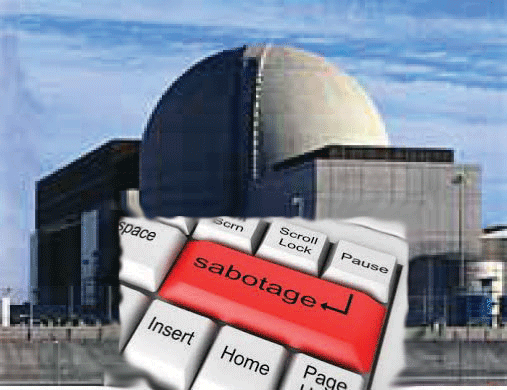
 Iran Arrests Suspected Nuclear Plant Saboteur abc news, TEHRAN, Iran — Sep 7, 2014, Iranian authorities have arrested a Ukrainian national suspected of sabotage at the country’s sole nuclear power plant, an Iranian newspaper reported on Sunday.
The report in the Hamshahri daily said the “Ukrainian expert” was affiliated with a Russian contractor that works in Iran’s Bushehr nuclear power plant, which went online in 2011 with Russian aid.
The report did not elaborate on the timing or nature of the alleged sabotage. Iran has long accused the United States, Israel and European countries of working to sabotage its nuclear program.
International sanctions force Iran to buy Western-made parts for its nuclear program from third parties. Hamshahri suggested such parties are involved in sabotaging parts before they arrive in Iran, without elaborating.
Hamshari also quoted Asghar Zarean, deputy head of Iran’s nuclear department in charge of security, as saying that Sandia National Laboratories, a New Mexico-based subsidiary of defense contractor Lockheed Martin, has been involved in manipulating parts that Iran needs for its nuclear facilities.
In 2010, the so-called Stuxnet virus temporarily disrupted the operation of thousands of centrifuges, key components in nuclear fuel production, at Iran’s Natanz uranium enrichment facility. Iran says it and other computer virus attacks are part of a concerted effort by Israel, the U.S. and their allies to undermine its nuclear program through covert operations…….http://abcnews.go.com/International/wireStory/iran-arrests-suspected-nuclear-plant-saboteur-25323907
Iran’s constructive and pragmatic approach to nuclear talks
Iran is playing a win-win game at the nuclear talks Al Arabia News Camelia Entekhabi-Fard Monday, 1 September 2014 “……. being too optimistic or too pessimistic is not constructive. Simply put, Iran’s foreign policy has been changed due to the regional and international circumstances…….
President Rowhani and his nuclear negotiating team took very constructive and major steps in order to restore Iran’s image and to try to solve disputes.
They seem to be succeeding because the supreme leader decided to change course and achieve the ambitions they had since the revolution, but in a different way. He understands the importance of being engaged in regional and international matters to play a part rather than sit back in isolation, worrying about national security.
In my opinion, what made Iran’s supreme leader back the nuclear talks and show flexibility, according to his own statement, are the events in the region and the opportunities for Iran to become a regional power once again.
The events in Iraq and Syria,the rise of extremism and Iran’s geopolitical and regional importance coalesce to make Iranians feel like they could gain by changing their language and the way they presen themselves in the region.
Nuclear bombs can’t feed the masses
Israel aimed a stealth drone at Iran uranium enrichment site
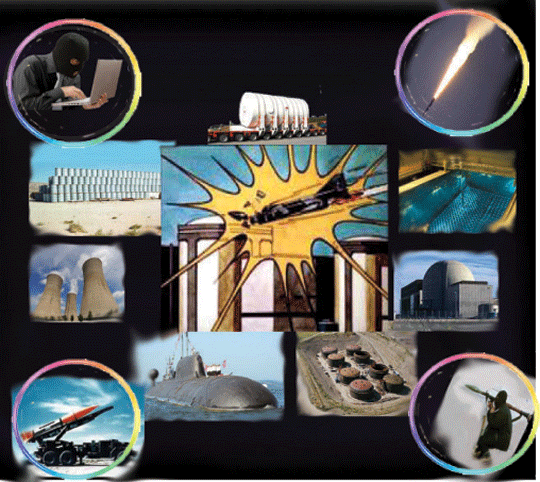
 Israeli stealth drone downed at nuclear facility, Iran claims Revolutionary Guard hails act against ‘warmongers’ as incident reported at major uranium enrichment plant Harriet Sherwood in Jerusalem and Saeed Kamali Dehghan in Boston The Guardian, Monday 25 August 2014 Iran‘s Revolutionary Guards claimed on Sunday that an Israeli stealth drone had been brought down above the Natanz uranium enrichment site in the centre of the country.
The semi-official Fars news agency reported that Iran’s elite forces had intercepted and brought down an unmanned aircraft belonging to “the Zionist regime”. The news was announced in a statement published by the guards, but it was not clear when the incident, if true, happened.
“This mischievous act once again reveals the adventurist nature of the Zionist regime [of Israel] and added another black page to this fake and warmongering regime’s file which is full of crimes,” said the Revolutionary Guards’ statement.
The state news agency ISNA reported that the aircraft was “of the stealth, radar-evasive type and it intended to penetrate the off-limits nuclear area in Natanz … but was targeted by a ground-to-air missile before it managed to enter the area.”
A spokesman for the Revolutionary Guards later told Iranian television that parts of the aircraft had been retrieved. Iran claimed to have reverse engineered a drone after capturing an American RQ-170 Sentinel in 2011.
“Major parts of the devices of the drone are intact and have been received by our friends that can be used for further information,” said General Ramazan Sharif. He did not say when the aircraft was shot down, but said it was “identified upon arrival in Iranian airspace”. He said authorities allowed it to fly for a short time to determine its destination.
Israeli political and military officials said they never respond to such claims. They have repeatedly threatened to take military action against Iran’s nuclear installations, but have been reluctant to do so without US backing or participation.
Natanz is Iran’s main uranium enrichment site, housing more than 16,000 centrifuges. About 3,000 more are at the Fordo plant, buried inside a mountain and hard to destroy…….. http://www.theguardian.com/world/2014/aug/24/israeli-stealth-drone-nuclear-facility-iran-natanz
Positive progress in U.N.s nuclear diplomacy with Iran
U.N. Nuclear Chief Positive After ‘Useful’ Iran Visit: Reuters http://www.nbcnews.com/news/world/u-n-nuclear-chief-positive-after-useful-iran-visit-reuters-n182671 18 Aug 14,
Iran has given a firm commitment to cooperate with a U.N. nuclear watchdog investigation into suspected atomic bomb research, the head of the agency said after what he described as a “useful” visit to Tehran on Sunday. Yukiya Amano made the trip ahead of an Aug. 25 deadline for Iran to provide information relevant to the International Atomic Energy Agency’s long-running inquiry into what it calls the possible military dimensions of the country’s nuclear program.
The issue is close ly tied to Iran’s negotiations with six world powers aimed at ending a decade-old standoff over its atomic activities and dispelling fears of a new Middle East war. Iran denies its program has any military objectives.
Since Rouhani was elected in mid-2013, Tehran has promised to work with the U.N. agency to clear up the suspicions about its nuclear aspirations. After meeting Amano, Rouhani said on his English-language Twitter account that Iran was “determined to forge accord with the IAEA in the shortest possible time span. God willing, it can be done in less than a year.”
United Nations verifies that Iran has changed all enriched uranium into safer form
UN: Iran Turns Nuclear Material Into More Harmless Forms http://www.huffingtonpost.com/2014/07/20/iran-nuclear_n_5604070.html By GEORGE JAHN 07/20/2014 VIENNA (AP) — The United Nations says Iran has turned all enriched uranium closest to the level needed to make nuclear arms into more harmless forms.
Tehran had committed to the move under an agreement with six powers last November that essentially froze its atomic programs while the two sides negotiate a comprehensive deal. They extended those talks Saturday to Nov. 24.
Iran had more than 200 kilograms (over 250 pounds) of 20 percent enriched uranium when the agreement was reached and began reducing it shortly after. The U.N.’s International Atomic Energy Agency said Sunday in a report obtained by The Associated Press that all has now been converted or diluted.
At 20 percent, enriched uranium can be converted quickly to arm a nuclear weapon. Iran denies wanting such arms.
Iran reduces its planned nuclear enrichment program
Iran eases demands for nuclear capacity at Vienna talks: Western diplomats BY LOUIS CHARBONNEAU AND PARISA HAFEZI VIENNA Thu Jul 3, 2014 (Reuters) – Iran has reduced demands for the size of its future nuclear enrichment program in talks with world powers although Western governments are urging Tehran to compromise further, Western diplomats close to the negotiations said on Thursday.
The diplomats, who spoke to Reuters at the start of a two-week round of negotiations between Iran and the United States, Britain, France, Germany, Russia and China, said that despite some movement from Tehran it would not be easy to clinch a deal by their self-imposed deadline for a deal of July 20.
Tehran’s shift relates to the main sticking point in the talks – the number of uranium enrichment centrifuges Iran will maintain if a deal is reached to curb its nuclear program in exchange for a gradual end of sanctions. Ending the decade-long dispute over Iran’s nuclear ambitions is seen as instrumental to defusing tension and averting a new Middle East war.
“Iran has reduced the number of centrifuges it wants but the number is still unacceptably high,” a Western diplomat told Reuters on condition of anonymity and without further detail……….
Other disputes include the duration of any nuclear deal, the timetable for ending the sanctions, and the fate of a research reactor that could yield significant quantities of plutonium, an alternative fuel for nuclear weapons.
The current round of talks in the Austrian capital will run until at least July 15. (Additional reporting by Fredrik Dahl in Vienna and Mehrdad Balali in Dubai; Editing byMark Heinrich) http://www.reuters.com/article/2014/07/03/us-iran-nuclear-exclusive-idUSKBN0F810H20140703
Detailed study shows that Iran would take years (not months) to build a nuclear weapon
Building Nuclear Weapon Would Take Years, Not Months, Iran Says in Report NYT, By DAVID E. SANGERJUNE 12, 2014 WASHINGTON — The Iranian government this week published its first detailed study of how long it estimates it would take its scientists and engineers to assemble a nuclear weapon, saying that with its current infrastructure, “the required time span is in years.”
Iran described the estimate as entirely hypothetical, and it was clearly intended to allay fears that Iran has the ability to race for a bomb. ……http://www.nytimes.com/2014/06/13/world/middleeast/iran-building-nuclear-weapon-would-take-years-not-months-us-disputes-estimate.html?_r=0
Despite differences, nuclear pact between Iran and West may be within reach
 Iran: Nuclear Pact ‘Within Reach,’ Despite Yawning Divide http://www.nationaljournal.com/global-security-newswire/iran-nuclear-pact-within-reach-despite-yawning-divide-20140613 Iran said a landmark nuclear pact may be “within reach,” though a chasm persists between negotiators on key issues, the Wall Street Journal reports.
“We’re both very close and very far” from a deal with the five permanent U.N. Security Council member nations and Germany, Iranian Deputy Foreign Minister Abbas Araqchi said on Thursday. The sides are seeking terms to lift sanctions on Iran and to impose long-term limits on its atomic efforts, which are seen by Washington and its allies as a cover for pursuing a nuclear-bomb capability.
“We all want to get the job done by July 20,” Araqchi added, referring to the expiration date for an interim accord that his nation reached in November with China, France, Germany, Russia, the United Kingdom and the United States.
“Our focus remains on the July 20 deadline and that has not changed,” State Department spokeswoman Jen Psaki told reporters.
Analysts, though, warned that a renewal of the short-term deal appears to be a growing possibility, Agence France-Presse reported on Thursday.
“I doubt that an extension is being formally discussed, because that would be to admit failure to meet the July 20 deadline,” former U.S. State Department official Mark Fitzpatrick said. “But some discussion of it must be underway informally.” Western powers may only agree to an extension if Tehran indicates it “will make substantial concessions and come down from hard-line positions,” said Mark Hibbs, a nuclear expert with the Carnegie Endowment for International Peace.
He added, though, that the sides “have been drafting documents in preparation for an eventual extension for a long time.”
Iran cutting nuclear reactor output of plutonium, by a new design
Iran says ‘redesigning’ nuclear reactor to cut plutonium capacity Iran’s atomic energy chief offers to reduce Arak nuclear output to about one-tenth of previously planned level. Haaretz, By Reuters | Jun. 12, 2014 Iran is “busy redesigning” a planned research reactor to sharply cut its potential output of plutonium – a potential nuclear bomb fuel, a senior Iranian official said in comments that seemed to address a key dispute in negotiations with world powers.
The future of the Arak plant is among several issues that negotiators from Iran and six world powers need to resolve if they are to reach a deal by late July on curbing the country’s nuclear programme in exchange for an end to sanctions……..
The amount of plutonium the reactor will be able to yield will be reduced to less than 1 kg (2.2 pounds) from 9-10 kg (20-22 pounds) annually in its original design, he said. Western experts say 9-10 kg would be enough for 1-2 nuclear bombs and that Arak’s capacity should be scaled back.
“We are currently busy redesigning that reactor to arrange for that alteration,” Salehi was quoted by IRNA as saying.
After talks with senior U.S. officials earlier this week, Iran questioned whether the July 20 deadline for a permanent settlement with the powers was feasible. If not, Tehran said the negotiations could be extended for six months. http://www.haaretz.com/news/middle-east/1.598410
Iranian Islamic leader stresses fatwa against all nuclear weapons.
 Leader nuclear fatwa addresses entire world: Analyst http://www.presstv.ir/detail/2014/06/11/366530/leader-nfatwa-directed-at-entire-world/ The fatwa by Leader of the Islamic Revolution Ayatollah Seyyed Ali Khamenei against the development of nuclear weapons is addressed to all world countries, an analyst tells Press TV.
“I wish the world leaders and the mass media would pay more attention and engage in more dialogue about the importance of this religious fatwa that prohibits production and use of nuclear weapons,” Imam Mohammad Ali Elahi told Press TV in aninterview.
On February 22, 2012, Ayatollah Khamenei said the Islamic Republic considers the pursuit and possession of nuclear weapons “a grave sin” from every logical, religious and theoretical standpoint.
Elahi said nuclear weapons seriously threaten the “destiny of humanity and democracy,” adding, “The wisdom of this message [of Ayatollah Khamenei] is that all of us work together to bring dialogue instead of deception and destruction…; to end violence and terrorism and extremism instead of bringing more threat.”
Elahi stated that nuclear weapons must be prohibited so that they would never fall into the hands of terrorist groups like al-Qaeda who “would not hesitate to use” them against humanity.
“So we need to learn the lesson from our faith traditions and also moral principles to pay more attention to this message,” he said.
Iran has repeatedly called for turning the Middle East into a region free of nuclear weapons. Israel is widely believed to be the only possessor of nuclear arms in the Middle East, with an estimated stockpile of 200-400 nuclear warheads. In its Yearbook 2012, the Stockholm International Peace Research Institute (SIPRI) said Israel possesses at least 80 “highly operational” nuclear warheads.
The Israeli regime, which rejects all international nuclear regulatory agreements, maintains a policy of deliberate ambiguity over its nuclear activities and refuses to allow its nuclear facilities to come under international regulatory inspections.
Iran has sharply reduced enriched uranium – IAEA report
IAEA Confirms: Iran Sharply Reducing Uranium Stockpile http://news.antiwar.com/2014/05/23/iaea-confirms-iran-sharply-reducing-uranium-stockpile/ 20 Percent Enriched Uranium Almost Used Up by Jason Ditz, May 23, 2014 Many of the contents of the IAEA report on Iran were already leaked the day before it came out, and the good news of Iran abiding by the P5+1 interim nuclear deal was as expected. There’s more to the report, however. One of the biggest pieces of data in the report shows Iran’s stockpile of 20 percent enriched uranium, the highest level they made, has sharply fallen as the nation continues to convert it into fuel for the Tehran Research Reactor.
Though 20 percent is far short of the level needed for nuclear weapons, it was repeatedly pushed by the US as a “threat,” and Iran stopped enriching at that level at the start of the nuclear deal. Only about 40 kg are left to be converted to fuel rods, a trivial amount. The Tehran Research Reactor, built by the US in 1967, provides materially all of the medical isotopes in Iran. The aging facility will eventually be replaced with a modern one using unenriched uranium, but in the meantime Iran has created what seems to be all of the fuel rods it can use for the conceivable lifespan of the facility.
Iran is now only enriching to 3.5 percent, the level used in the Bushehr Power Plant. Iran is in talks with Russia to build more power plants in the nation, with a deal for as many as 8 reported to be close.
US Catholic bishops and Iranian ayatollahs discuss nuclear weapons
US bishops and Iranian ayatollahs hold talks on nuclear arms http://www.catholicherald.co.uk/news/2014/05/15/us-bishops-and-iranian-ayatollahs-hold-talks-on-nuclear-arms/ By PATRICIA ZAPOR on Thursday, 15 May 2014 It has been revealed that a small group of US Catholic bishops have met with Iranian ayatollahs to discuss nuclear weapons and the role of faith leaders in influencing political moves on the issue of Iran’s nuclear programme. Quietly, a small group of U.S. Catholic bishops and Iranian ayatollahs began in March what they intend to be an ongoing dialogue on nuclear weapons and the role of faith leaders in influencing political moves on the issue of Iran’s nuclear program. Continue reading
Long standing issues complicate nuclear negotiations with Iran
The phantom at the Iran nuclear talks: weaponisation, Guardian, Julian Borger 15 May 14, How far should Iran go to resolve concerns over past weapons research to reach a comprehensive deal? ………. there is another issue waiting in the wings – the past. The general western intelligence consensus is that Iran had an organised weaponisation programme exploring how to build a warhead up to 2003, and that if research continued it was in a more dispersed manner………
even if Iran started working on weapons in the wake of the Iran-Iraq war (in which it saw the West as backing Saddam’s use of chemical weapons against Iran) but was now prepared to give up any such aspirations, it might still refuse to contemplate a confession. It would be a huge embarrassment in view of the Supreme Leader’s fatwa against nuclear weapons. Tehran could also see pressure for such a confession as a trick designed to justify a military attack. The question then for the West is whether to allow those fears stand in the way of deal that would constraint Iran’s future programme.
The mood music being put out by diplomats in Vienna suggests that the issue will not be a deal breaker for now. One solution, set out in a detailled report produced by the International Crisis Group, is for the problem to be kicked down the road. A comprehensive deal clinched in the next few months would commit Iran to resolving the issue satisfactorily with the IAEA. It would not let Iran off the hook but neither would it jeopardise non-proliferation gains that could be achievable now. http://www.theguardian.com/world/julian-borger-global-security-blog/2014/may/15/iran-nuclear-talks-weapons
Cause for optimism in Iran nuclear deal with the West
Optimism Grows for a Comprehensive Iran Nuclear Deal Several Core Elements of Agreement Have Emerged WSJ, By JAY SOLOMON And
LAURENCE NORMAN May 12, 2014 WASHINGTON—Several core elements of agreement between Iran and the West have emerged in recent weeks, heightening optimism that a comprehensive deal can be reached by the July 20 deadline, according to U.S., Iranian and European officials involved in the diplomacy.
Still significant differences remain that could scuttle a deal or force negotiators to extend talks, officials briefed on the talks said.
“People are less pessimistic than they have been in the past—certainly,” one European official said. “There are certain areas where some kind of consensus” is emerging. “But in certain areas, there is still a huge gulf.” One of the key areas of agreement is the future of an Iranian plan to convert its heavy-water reactor in the city of Arak to produce significantly less weapons-grade plutonium, according to various officials.
Iran also has begun to more substantively address evidence presented in parallel talks with the U.N’s nuclear watchdog, the International Atomic Energy Agency, that it conducted research and testing to develop atomic bombs, the officials said.
However, the U.S. and Europe are demanding significant progress in accounting for past work as part of the agreement. Iran, which has denied it ever sought nuclear weapons, is being pressed to agree in coming days to provide answers on several other aspects of its past work.
Negotiators will begin drafting terms of a final agreement on the future of Tehran’s nuclear program this week in Vienna. A deal would end a decadelong standoff between Tehran and the West and put into place greater assurances that Iran won’t be able to build a bomb, in return for a major easing of Western sanctions……..
The meetings in Vienna will mark the fourth round of high-level talks between Iran and the five permanent members of the United Nations Security Council plus Germany—known as the P5+1—since the two sides reached an interim agreement last November.The interim deal resulted in Tehran freezing parts of its nuclear program in return for an easing of some Western sanctions. It will expire on July 20 but could be extended by six months if both sides agree they need more time.
The main area of disagreement continues to be the scope of Iran’s uranium-enrichment facilities, which could be used to produce weapons-grade fuel for a bomb, according to U.S. and European officials. Tehran currently has 19,000 centrifuges used to enrich uranium and has plans to build 30,000 more.
The Obama administration, conversely, is demanding Tehran scale back its capacity to as little as 5,000 operating machines to ensure Iran can’t quickly “break out” and rush to build a nuclear bomb in less than six months.
Iran and the P5+1 are seeking to develop a formula that limits both the number and quality of centrifuges as well as stockpiles of fissile materials to guard against the capability to quickly build a bomb.
But Iran’s theocratic leader, Ayatollah Ali Khamenei, has repeatedly stated in recent weeks that he won’t accept a significant scaling back of his country’s nuclear capabilities.
U.S. and European officials said they were unsure whether Mr. Khamenei’s position on the centrifuges is a tactical move ahead of the drafting sessions this week in Vienna, or if he has set a red line for his negotiators……..http://online.wsj.com/news/articles/SB10001424052702303851804579558162293087156
1 This Month



26 September – International Day for the Total Elimination of Nuclear Weapons


PLEASE OPPOSE HR 8255 AND S.3639 – bills would accelerate satellite deployment, with no environmental review or safeguards – https://ncstd5li.quorum.us/campaign/169331/
To see nuclear-related stories in greater depth and intensity – go to https://nuclearinformation.wordpress.com
-
Archives
- September 2026 (233)
- August 2026 (330)
- July 2026 (355)
- June 2026 (287)
- May 2026 (306)
- April 2026 (356)
- March 2026 (251)
- February 2026 (267)
- January 2026 (308)
- December 2025 (358)
- November 2025 (359)
- October 2025 (375)
-
Categories
- 1
- 1 NUCLEAR ISSUES
- business and costs
- climate change
- culture and arts
- ENERGY
- environment
- health
- history
- indigenous issues
- Legal
- marketing of nuclear
- media
- opposition to nuclear
- PERSONAL STORIES
- politics
- politics international
- Religion and ethics
- safety
- secrets,lies and civil liberties
- spinbuster
- technology
- Uranium
- wastes
- weapons and war
- Women
- 2 WORLD
- ACTION
- AFRICA
- Atrocities
- AUSTRALIA
- Christina's notes
- Christina's themes
- culture and arts
- Events
- Fuk 2022
- Fuk 2023
- Fukushima 2017
- Fukushima 2018
- fukushima 2019
- Fukushima 2020
- Fukushima 2021
- general
- global warming
- Humour (God we need it)
- Nuclear
- RARE EARTHS
- Reference
- resources – print
- Resources -audiovicual
- Weekly Newsletter
- World
- World Nuclear
- YouTube
-
RSS
Entries RSS
Comments RSS
 nuclear-news