Iran, unlike Israel, will allow IAEA to visit its military nuclear site
Iran to allow visit to Parchin nuclear site http://www.neurope.eu/article/iran-allow-visit-parchin-nuclear-site BY ELENI STAMATOUKOU | MAY 20, 2013 Iranian Ambassador to Moscow Reza Sajjadi said that Tehran will allow the International Atomic Energy Agency’s experts to visit Parchin military nuclear facility, if the IAEA signs a relevant protocol that contains all its concerns and questions about Parchin
Sajjadi underlined the non-nuclear nature of the country’s Parchin military site. “Tehran is ready to explain every point of the country’s nuclear program as well as allow experts to Parchin site if the IAEA agrees to sign a protocol detailing all its questions,” Sajjadi told the satellite TV channel Russia Today on Saturday. However, the IAEA’s experts want to visit the facility prior to signing the protocol. “this is a game,” the ambassador said. “And if they don’t find anything, let’s close Iran’s nuclear file and remove it from the UN Security Council,” he added. The IAEA’s role is to safeguard that no one is developing nuclear weapons, however Israel has nuclear bombs but nobody cares, said the Iranian diplomat.
Nuclear armed Iran would not be a threat of aggression
 Nuclear Iran Unlikely to Tilt Regional Power Balance – Report By Jim Lobe and Joe HitchonReprint WASHINGTON, May 18 2013 (IPS) – A nuclear-armed Iran would not pose a fundamental threat to the United States and its regional allies like Israel and the Gulf Arab monarchies, according to a new report released here Friday by the Rand Corporation.
Entitled “Iran After the Bomb: How Would a Nuclear-Armed Tehran Behave?“, the report asserts that the acquisition by Tehran of nuclear weapons would above all be intended to deter an attack by hostile powers, presumably including Israel and the United States, rather than for aggressive purposes……..
The report reaches several conclusions all of which generally portray Iran as a rational actor in its international relations.
While Nader calls it a “revisionist state” that tries to undermine what it sees as a U.S.-dominated order in the Middle East, his report stresses that “it does not have territorial ambitions and does not seek to invade, conquer, or occupy other nations.”
Further, the report identifies the Islamic Republic’s military doctrine as defensive in nature. This posture is presumably a result of the volatile and unstable region in which it exists and is exacerbated by its status as a Shi’a and Persian-majority nation in a Sunni and Arab-majority region……. the report concludes that Tehran is unlikely to extend its nuclear deterrent to its allies, including Hezbollah, noting that the interests of those groups do not always – or even often – co-incide with Iran’s. Iran would also be highly unlikely to transfer nuclear weapons to them in any event, according to the report.
*Jim Lobe’s blog on U.S. foreign policy can be read at http://www.lobelog.com. http://www.ip
Iran finds the Wests nuclear proposals lacking in balance
Iran’s chief nuclear negotiator: we’re being asked to make all the sacrifices Saeed Jalili, Iran’s top nuclear negotiator and a contender in the June presidential election, sat down with the Monitor to share his views about an ‘unbalanced’ nuclear offer made by world powers. Christina SCience Monitor, By Scott Peterson, Staff writer / May 16, 2013 ISTANBUL
Saeed Jalili, Iran’s chief nuclear negotiator and a presidential candidate, says that offers from six world powers demand far more short-term sacrifices of his government than the Islamic Republic considers reasonable or reciprocal. The current offer from the so-called P5+1 group (theUS, Russia, China, Britain, France, and Germany) requires Iran to suspend all 20 percent uranium enrichment, disable an impregnable underground enrichment facility at Fordow, and agree to more intrusive inspections, before modest relief from sanctions that have crippled its economy.
“Their proposals are unbalanced,” Mr. Jalili told The Christian Science Monitor in an Istanbul interview today, a day after his inconclusive meeting withCatherine Ashton, the EU foreign policy chief who leads negotiations for the P5+1. “The other party needs to appreciate that they need to table proposals that have the necessary balance,” says Jalili. “If they accept to do so, then we can engage in talks that will hopefully bring about that required balance.”…… http://www.csmonitor.com/World/Middle-East/2013/0516/Iran-s-chief-nuclear-negotiator-we-re-being-asked-to-make-all-the-sacrifices
The unthinkable – if the West did bomb Iran’s nuclear plant
The new study provides the only available scientific predictions to date about what a nuclear attack in the Middle East might actually mean. Dallas, who was previously the director of the Center for Mass Destruction Defense at the Centers for Disease Control and Prevention, is quick to point out that the study received no U.S. government funding or oversight. “No one wanted this research to happen,” he adds.
 Who Will Drop the Next Nuclear Bomb? We ignore the ever-growing global arsenal of nuclear weapons at our peril. The Nation, Nick Turse May 13, 2013 “……. Iranian cities — owing to geography, climate, building construction, and population densities — are particularly vulnerable to nuclear attack, according to a new study, “Nuclear War Between Israel and Iran: Lethality Beyond the Pale,” published in the journal Conflict & Health by researchers from the University of Georgia and Harvard University. It is the first publicly released scientific assessment of what a nuclear attack in the Middle East might actually mean for people in the region.
Its scenarios are staggering. An Israeli attack on the Iranian capital of Tehran using five 500-kiloton weapons would, the study estimates, kill seven million people — 86% of the population — and leave close to 800,000 wounded. A strike with five 250-kiloton weapons would kill an estimated 5.6 million and injure 1.6 million, according to predictions made using an advanced software package designed to calculate mass casualties from a nuclear detonation.
Estimates of the civilian toll in other Iranian cities are even more horrendous. A nuclear assault on the city of Arak, the site of a heavy water plant central to Iran’s nuclear program, would potentially kill 93% of its 424,000 residents. Three 100-kiloton nuclear weapons hitting the Persian Gulf port of Bandar Abbas would slaughter an estimated 94% of its 468,000 citizens, leaving just 1% of the population uninjured. A multi-weapon strike on Kermanshah, a Kurdish city with a population of 752,000, would result in an almost unfathomable 99.9% casualty rate. Continue reading
Uninhabitable Gulf Region – if the West bombed Iran’s nuclear facility
Has such absolute insanity infected the minds of the Western powers to such a degree that they actually would attack Iran, and in so doing destroy the entire Gulf State region, further irradiate the entire planet and themselves, and quite possibly set off World War III? Or is it all just smoke-and-mirrors, scare tactics and rhetoric, and saner minds will in fact prevail?
Let us all hope and pray for the latter.
Good-bye Dubai? Bombing Iran’s Nuclear Facilities would leave the Entire Gulf States Region virtually Uninhabitable By Wade Stone Global Research, May 11, 2013 “…….Think “Fukushima x 10”: Fukushima is, without question, the world’s worst nuclear disaster to date. In fact, many scientists believe, and with good reason, that the Fukushima incident, which is far from over, is the world’s worst
environmental catastrophe.
“While the long-term repercussions of the Fukushima Daiichi nuclear disaster are yet to be fully assessed, they are far more serious than
those pertaining to the 1986 Chernobyl disaster in the Ukraine, which resulted in almost one million deaths (New Book Concludes – Chernobyl death toll: 985,000, mostly from cancer” Global Research, September 10, 2010. For a full account of Fukushima, see “Global Research Online Interactive Reader Series, Fukushima: A Nuclear War without a War, The Unspoken Crisis of Worldwide Nuclear Radiation (Michel Chossudovsky, editor).
Now imagine several large nuclear reactors (Iran’s Bushehr reactor output, for example, is 1000 megawatts, compared to Fukushima Daiichi’s largest reactor which had an output of 784 megawatts), along with several uranium enrichment plants, and certainly military storage sites and quite likely even uranium mines, all bombed to dust within a matter of days. Continue reading
An unpopular truth – Iran does not have nuclear weapons
No, Iran does not posses nuclear weapons, The Spectator, Peter Oborne 1 May 2013 “…… two weeks ago I published a book, co-authored with David Morrison,  A Dangerous Delusion: Why the West is Wrong about Nuclear Iran. Since then my co-author and I have been subject to a series of misrepresentations and innuendo on a scale and (in some cases) virulence that I have never encountered before…….
not one of our critics have even tried to deal with the central, factual points of our short book: that Iran isn’t in possession of nuclear weapons and isn’t building them; that the US and Israeli intelligence agencies don’t think they are; that Iran is entitled under the Non-Proliferation Treaty to develop peaceful nuclear power; that in 2005 it put proposals on the table to do this under full international scrutiny (including co-ownership).
We acknowledge that Iran’s human rights record – as Geoffrey Robertson has graphically portrayed in his recent book – is dreadful. We view President Ahmadinejad’s denials of the Holocaust as utterly odious. However, to judge Iran by Ahmadinejad alone would be a mistake. He steps down in a few weeks, and in any case the final decision on nuclear matters lies with the Supreme Leader, who has repeatedly denounced nuclear weapons as forbidden under Islam. It is in the best interest of the west, let alone ordinary Iranians whose lives are being made miserable by sanctions, to engage with Iran pragmatically rather than carry on with the current policy of isolation.
In the wake of June’s elections we hope and believe that a solution satisfactory to all parties can be agreed. We passionately believe that the alternative is too ghastly to contemplate. However, if an agreement is to be reached, we in the west need to recognize that Iran – with all its faults – is an independent nation with legitimate interests, and is a fully signed up member of the Non-Proliferation Treaty, with every right to enrich uranium.
We also need to be clear about the facts. This is why in our book we have attempted to expose the myths, falsehoods and delusions that surround this grave and troubling subject. There is an argument of massive importance to be engaged in here. If my critics wish to challenge me to open debate about the thesis of our book, I would be delighted to engage. They know how to get hold of me: any time, any place. http://blogs.spectator.co.uk/peter-oborne/2013/05/no-iran-is-an-independent-nation-with-legitimate-interests-that-does-not-posses-nuclear-weapons/
Serious worries about safety of Iran’s Bushehr nuclear power plant.
 Another Cause for Alarm in Iran’s Nuclear Program: Earthquakes, The Atlantic, Jill Keenan, 18 April 13, The country’s nuclear power plant is built near tectonic plates, and reports show it may not be safe in the event of a major seismic event. On April 16, a massive 7.8-magnitude earthquake hit southeast Iran, sending tremors across the region and causing casualties that are expected to reach into the hundreds. According to an Iranian official , it was the biggest earthquake to hit the country in 40 years. This devastation comes only one week after another earthquake hit the town of Kaki, also in southern Iran, killing at least 37 people and injuring more than 850 others. Shockwaves from both earthquakes were felt as far away as Bahrain, Kuwait, Qatar, the UAE, and western Saudi Arabia. They are only the two most recent in a series of earthquakes that regularly haunt this seismically unstable country.
Most ominously, the epicenter of the April 9 earthquake’s first tremor, which measured a 6.3 on the Richter scale, was centered only 62 miles away from Iran’s Bushehr nuclear power plant. Continue reading
Anxieties in the region, about safety of Iran’s nuclear reactor
Any nuclear disaster at Bushehr will have regional implications.
Iran nuclear plant: the looming danger With Bushehr becoming operational, Iran is the only nuclear power country that is not a signatory to the Convention on Nuclear Safety, Gulf News By Ali Vaez April 12. 2013 A 6.3-magnitude earthquake shook Iran’s southern shores last Tuesday, on the afternoon that the country was celebrating its National Nuclear Technology Day. Continue reading
Earthquake? no worries – Iran will build more nuclear reactors there
 Iran says it will build more nuclear plants in area hit by earthquake : http://www.foxnews.com/world/2013/04/10/iran-to-build-more-nuclear-plants-in-area-hit-by-earthquake/#ixzz2QBoycUDm April 10, 2013
FoxNews A day after an earthquake rattled the area containing Iran’s only nuclear power plant, the country announced that it plans to build more plants in the same place.
Tuesday’s magnitude 6.1 earthquake struck 55 miles southeast of Bushehr, killing at least 37 and injuring more than 900, Iranian officials said.
The Russian power company that helped build the nuclear plant says its operations were unaffected. But the head of Iran’s Atomic Energy Organization told state TV hours after the earthquake that more reactors would be built near Bushehr, Reuters reports.
Iran has repeatedly ignored safety concerns about housing a nuclear facility in the area, which is highly seismic.
Last week, a report by U.S. think tanks the Carnegie Endowment and the Federation of American Scientists said the Bushehr reactor sits at the intersection of three tectonic plates, Reuters reports.
In 2003, an earthquake in Bam, which is about 600 miles east of Bushehr, killed more than 25,000 people.
Iran’s nuclear plant – close to recent earthquake
Strong earthquake near Iran nuclear plant kills dozens Radio Australia 10 April 2013, More than 30 people are dead after a magnitude 6.3 earthquake which hit near Iran’s only nuclear power plant. A powerful earthquake has struck close to Iran’s only nuclear power station, killing at least 37 people and injuring 850 as it destroyed homes and devastated two small villages.
The magnitude 6.3 quake totally destroyed one village, a Red Crescent official told the Iranian Students’ News Agency (ISNA), but the nearby Bushehr nuclear plant was undamaged, according to Iranian officials and the Russian company that built it.
Many houses in rural parts of the province are made of mud bricks, which have been known to crumble easily in quake-prone Iran.
The death toll is expected to climb, as the stricken area is home to some 12,000 inhabitants.
Across the Gulf, offices in Qatar and Bahrain were evacuated after the quake. Its epicentre was 89 km south-east of the port of Bushehr, according to the US Geological Survey.
The early afternoon shock was also felt in financial hub Dubai, Kuwait and the United Arab Emirates
The Russian company that built the nuclear power station, 18km south of Bushehr, said the plant was unaffected….. http://www.radioaustralia.net.au/international/2013-04-10/strong-earthquake-near-iran-nuclear-plant-kills-dozens/1113782
Iran’s nuclear program, more for pride than for economics
Iran’s nuclear program entails huge costs, few benefits: report Yaghoo News By Yeganeh Torbati 3 April 13 DUBAI (Reuters) – Iran will pursue its nuclear quest although it has reaped few gains from a totem of national pride that has cost it well over $100 billion in lost oil revenue and foreign investment alone, two think-tanks said on Wednesday. Continue reading
Secretive and dodgy company Glencore traded with Iran nuclear company
Glencore traded with Iranian nuclear firm, The Independent NIKHIL
KUMAR , NEW YORK 01 MARCH 2013 Glencore, the London-listed Swiss
commodities giant, supplied thousands of tonnes of alumina to an
Iranian company with links to the country’s controversial nuclear
programme.
Glencore supplied the raw material to the Iranian Aluminium Company
(IAC), which was hit by European Union sanctions in December for
allegedly supplying aluminium metal to Iran Centrifuge Technology Co.
(ICTC), a subsidiary of the body responsible for Iran’s nuclear
programme.
The deal was part of a barter arrangement – where goods are swapped
for other goods ….
http://www.independent.co.uk/news/uk/home-news/glencore-traded-with-iranian-nuclear-firm-8517404.html
Iran nuclear explosion Jan 21 – radiation now leaking
 RADIATION LEAKING FROM IRAN’S NUKE EXPLOSION, WND, by REZA KAHLILI, 25 FEB 13, Islamic regime fears poisonous fallout clouds could hit cities Radiation is leaking from Iran’s nuclear facility at Fordow, which suffered devastating explosions on Jan. 21, WND has learned, and the regime has ordered millions of antidote iodine pills from Russia and Ukraine amid fears the radioactivity will spread.
Many of the personnel, who arrived after the explosion to assist with the cleanup at the site, have been taken to a military hospital suffering from headache, nausea and vomiting, according to a source in the security forces protecting Fordow.
A special team of nuclear experts was ordered to the site days ago, the source said, and detected high levels of radiation. The number of confirmed dead from the explosions has risen to 76, said the source, who provided exclusively to WND the names of 14 Iranian scientists and one North Korean who died in the blasts.
Security forces have arrested 17 high-ranking officers, including majors and colonels, over the incident and summarily executed Maj. Ali Montazernia, a member of the security forces in charge at Fordow.
The Islamic regime has put up a wall of silence surrounding the explosions, but with the possibility of radioactive fallout creating grave health and environmental disasters in the nearby holy city of Qom and other surrounding cities, it may not be able to maintain the secret, the source suggested. Continue reading
Obama CAN make progress in negotiations with Iran, despite Congress
 So, what can Mr. Obama do in order to maximize diplomacy’s chance of success despite structural congressional strictures? The answer is clear: Explore and exercise those foreign-policy options that cannot be easily hindered by Congress.
the president can also – without the hindrance of Congress – reactivate the United Nations’ dormant capacities and use them in favor of the upcoming negotiations.
 Can Obama forge nuclear deal with Iran? http://www.alaskadispatch.com/article/can-obama-forge-nuclear-deal-iran Reza Nasri, The Christian Science Monitor
February 20, 2013
Pressuring Iran is no longer just a matter of tactical policy for Congress. It’s a deeply institutionalized ritual that every member is expected to partake in.
This is a sad reality that Tehran is fully aware of – one that Ayatollah Ali Khamenei, Iran’s Supreme Leader, tacitly acknowledged last week after the Obama administration implemented new congressional sanctions: He said that Iran would not be negotiating with America simply “for the sake of negotiating.” Iran wants a negotiating partner that can actually deliver on a promise to normalize relations and reciprocate concessions with mutual concessions.
As Congress has made this implausible for now, bilateral talks between Tehran and Washington are not likely to take place any time soon. On the other hand, the United States and Iran will inevitably meet to negotiate the latter’s nuclear program in the context of the multilateral “P5+1” talks scheduled to take place in Kazakhstan on Feb. 26. Continue reading
Iran is using its enriched uranium for peaceful purposes
UN Report: Iran is Diverting Uranium for Peaceful Purposes http://news.antiwar.com/2013/02/20/un-report-iran-is-diverting-uranium-for-peaceful-purposes/
 But the US still stubbornly insists Iran stop enriching uranium to 20 percent, despite proving good on its promises by John Glaser, February 20, 2013 A United Nations report due this week is expected to detail a decrease in the growth of Iran’s stockpile of enriched uranium because it is diverting much of the material to make fuel, as it has promised, Reuters reports. The International Atomic Energy Agency (IAEA) and even Israeli intelligence admitted publicly last October that Iran was diverting much of its enriched uranium for peaceful scientific research and medical isotopes.
This information clashes with what Israeli Prime Minister Benjamin Netanyahu continues to warn about. On Monday, heissued another stern warning of Iran’s determination to become a nuclear state, insisting that a “robust, credible, military threat” is the only thing that can stop it.
Some reports claim Iran has installed new uranium enrichment, increasing its overall capacity. But this upcoming UN report is expected to conclude that the rate of growth of Iran’s capabilities is slowing, primarily because the material is being used for fuel and other peaceful purposes.
Iran has repeatedly announced its 20 percent enriched uranium is for peaceful purposes like fuel, scientific research, and medical isotopes. Iran has followed through on this promise.
Still, negotiations between Iran and the P5+1 are essentially stagnant because of Washington’s insistence that Iran give up its 20 percent enrichment.
1 This Month
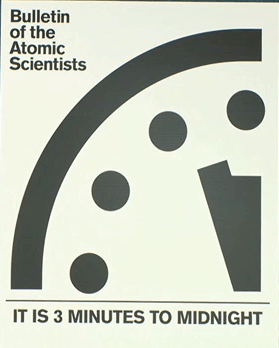
Watch the 2026 Doomsday Clock unveiling live here on January 27 at 10 a.m. EST
To see nuclear-related stories in greater depth and intensity – go to https://nuclearinformation.wordpress.com/

29 Jan. Thursday 7-8 p.m. Webinar – World’s Largest Nuclear Station in Port Hope, ON?


31st January – Challenging the War Machine – a DECLASSIFIED UK SUMMIT


Website of the Week
Now until to February 10, 2026 Radioactive waste storage in France: the debate is finally open! How to participate?
-
Archives
- January 2026 (277)
- December 2025 (358)
- November 2025 (359)
- October 2025 (376)
- September 2025 (258)
- August 2025 (319)
- July 2025 (230)
- June 2025 (348)
- May 2025 (261)
- April 2025 (305)
- March 2025 (319)
- February 2025 (234)
-
Categories
- 1
- 1 NUCLEAR ISSUES
- business and costs
- climate change
- culture and arts
- ENERGY
- environment
- health
- history
- indigenous issues
- Legal
- marketing of nuclear
- media
- opposition to nuclear
- PERSONAL STORIES
- politics
- politics international
- Religion and ethics
- safety
- secrets,lies and civil liberties
- spinbuster
- technology
- Uranium
- wastes
- weapons and war
- Women
- 2 WORLD
- ACTION
- AFRICA
- Atrocities
- AUSTRALIA
- Christina's notes
- Christina's themes
- culture and arts
- Events
- Fuk 2022
- Fuk 2023
- Fukushima 2017
- Fukushima 2018
- fukushima 2019
- Fukushima 2020
- Fukushima 2021
- general
- global warming
- Humour (God we need it)
- Nuclear
- RARE EARTHS
- Reference
- resources – print
- Resources -audiovicual
- Weekly Newsletter
- World
- World Nuclear
- YouTube
-
RSS
Entries RSS
Comments RSS
 nuclear-news