New US sanctions aim to kill Iran nuclear deal – expert https://en.trend.az/iran/nuclearp/2781079.html26 July 2017 Baku, Azerbaijan, By Farhad Daneshvar – Trend:
The US decision to impose fresh sanctions on Iran is a violation of a nuclear deal reached in 2015 between Tehran and the six major powers including the United States, a Norway-based Iranian financial analyst told Trend.
Elaborating on the recent decision by US House of Representatives to slap new sanctions on Iran, Mehrdad Seyed Asgari said that the new sanctions provide the US with a chance to covertly kill or avert the nuclear accord.
In this particular case aborting the deal means that the US will refuse to properly implement the articles of the Joint Comprehensive Plan of Action (JCPOA aka nuclear deal) aimed at placing the administration of President Hassan Rouhani under tremendous pressure.
Sanctions have been imposed on Iran with an aim to divide the country’s economic system in two parts of “white and black”, he mentioned.
Since the American lawmakers believe that sanctions work as a powerful tool, they appear to continue increasing pressure on Iran through introducing new sanctions.
The recent bill passed by the US House of Representatives on introducing new sanctions on Iran is very likely to become a law, he concluded.
The lawmakers voted overwhelmingly on Tuesday to slap new sanctions on Iran, Russia and North Korea.
The legislation in order to become a law still needs to be signed by President Donald Trump
July 28, 2017
Posted by Christina Macpherson |
Iran, politics international, USA |
Leave a comment

 Iran nuclear deal still under threat — US must keep its end of the bargain, http://thehill.com/blogs/pundits-blog/foreign-policy/343139-iran-nuclear-deal-still-under-threat-us-must-keep-its-end BY BERNADETTE STADLER, 07/21/17
Earlier this week, the Trump administration certified for a second time that Iran remains in compliance with the Joint Comprehensive Plan of Action (JCPOA), more commonly known as the Iran Deal. However, media reportsindicate that  the president was deeply reluctant to certify Iran’s compliance and may not be willing to do so in the future.
The administration is required to certify Iran’s compliance every 90 days, and if it fails to do so, Congress is given a 60-day period during which it can re-impose sanctions or abandon the deal altogether. Some in Congress would jump at this opportunity to kill the deal. But if the United States violates or walks away from the nuclear deal, it will alienate our allies and partners who helped us negotiate the agreement, allow Iran to resume its nuclear weapons program, and damage U.S. national security.
Iran’s nuclear activity was the subject of much concern before the JCPOA effectively constrained the risk of an Iranian nuclear weapon. Before formal negotiations were started, it is estimated that Iran was mere weeksaway from “breaking out,” or having enough fissile material to create a nuclear weapon. Now, Iran is more than a year away from breaking out.
Iran’s obligations under the deal have been strict and verifiable. Under the agreement, Iran has forfeited its stockpile of medium-enriched uranium and has reduced its stockpile of low-enriched uranium by about 97 percent. It has removed two-thirds of its centrifuges, which are used to enrich uranium, and is prohibited from enriching uranium above 3.67 percent — far below the 90 percent enrichment required for use in nuclear weapons.
The JCPOA also blocks Iran’s pathway to a plutonium weapon by requiring Iran to render its plutonium reactor inoperable, redesign the Arak facility so that it cannot produce weapons-grade plutonium, and send all radioactive waste out of the country so that it cannot be reprocessed to create plutonium.
Critics of the deal have argued that it gives Iran a “clear path to the bomb” because some of the deal’s provisions will be phased out after a specified number of years. However, even after all of the so-called “sunset clauses” have expired, Iran has indefinitely signed up to the Additional Protocol, an agreement which permanently allows the International Atomic Energy Agency (IAEA) to conduct intrusive inspections on Iran’s nuclear facilities.
Iran’s compliance with the deal has been consistently verified by the IAEA and the intelligence agencies of other countries interested in the agreement. Even initial critics of the JCPOA, like Secretary of Defense James Mattis and Senate Foreign Relations Committee Chair Senator Bob Corker, agree that it is in the United States’ national security interest to adhere to it.
Still, as President Trump’s reluctance to certify Iran’s compliance illustrates, the deal remains under threat. In addition to the question of certifying compliance, the Trump administration is conducting an interagency review of the deal to determine whether to continue suspending nuclear-related sanctions on Iran. If the Trump administration decides to stop waiving these sanctions, it will constitute a material breach of the deal.
Similarly, Congress is in the process of passing a bill that would authorize sanctions against Iran for its ballistic missile tests and sponsorship of terrorism, neither of which are addressed by the nuclear deal. Negotiators intentionally excluded these issues from the JCPOA, because they correctly understood that the nuclear issue was the first and most pressing issue at hand. Congress can and should address Iran’s missile program and support for terrorism, but must be careful to do so in a way that will not violate the nuclear deal. Reapplying waived sanctions under the guise of targeting new activities or legislating well-intentioned but poorly thought-out mandates for how the Trump administration must punish Iran will jeopardize the agreement.
There is no doubt that intentionally abandoning or accidentally violating the JCPOA will be detrimental to U.S. national security. Iran would be able to keep billions of dollars in sanctions relief that it received as part of the deal, and could choose to block IAEA inspections at its nuclear facilities. The United States could reintroduce sanctions against Iran, but our allies have indicated they have no interest in renegotiating or reapplying sanctions. The United States would be on its own and Iran could restart its race to a nuclear bomb.
There is only one good option: Uphold our end of the Iran deal while closely watching to ensure that Iran upholds theirs. We can and should combat Iran’s destabilizing activities, but not at the cost of a nuclear deal that is making the United States and the world safer.
Bernadette Stadler is a Herbert Scoville Jr. Peace Fellow at the Center for Arms Control and Non-Proliferation, where she works on issues including North Korea’s nuclear and missile program, U.S.-Russian relations, and the Iran nuclear agreement.
July 22, 2017
Posted by Christina Macpherson |
Iran, politics international, USA |
Leave a comment
 Iran skips opportunity to upset nuclear deal over U.S. sanctions: sources VIENNA (Reuters) 22 July 17 – Iran decided on Friday for the second time since January not to upset its nuclear pact with six world powers, two informed sources said, despite public statements by Tehran accusing the United States of violating the deal.
 Iranian President Hassan Rouhani said on Wednesday new U.S. economic sanctions imposed against Iran contravened the nuclear accord reached with world powers in 2015 and he pledged Tehran would “resist” them while respecting the deal itself.
The Trump administration slapped new sanctions on Iran on Tuesday over its ballistic missile program and said Tehran’s “malign activities” in the Middle East undercut any “positive contributions” coming from the nuclear accord, which was reached during the Obama administration.
Iran can use the so-called Joint Commission meetings held every three months in Vienna to trigger a formal dispute resolution mechanism set out for cases where one party feels there is a breach of the deal……
A source with knowledge of the matter said “the Iranians did complain a lot and the Russians supported them, but they won’t play along to Washington’s game and be turned into killjoys.”
This source, and another one with knowledge of Friday’s meeting, said Iran did not use the plenary session comprised of envoys from Iran, the United States, Russia, China, France, Britain, Germany and the EU to start a dispute resolution.
This mirrored Tehran’s actions in January at a previous so-called Joint Commission meeting, which is held in Vienna every three months, when Iranian officials opted not to escalate a stand-off over the extension of other U.S. sanctions…….https://www.reuters.com/article/us-iran-nuclear-usa-idUSKBN1A6248
July 22, 2017
Posted by Christina Macpherson |
Iran, safety |
Leave a comment
Iran nuclear deal is working
The Editorial Board, USA TODAY July 20, 2017 Facts get in the way of Trump’s plan to dismantle Obama’s agreement: Our view “…..This week, for the second time since taking the oath of office, Trump grudgingly stood by the deal Iran reached with the United States and five other nations in 2015. He certified that Tehran was complying with strict terms that bar the nation from creating enough fissile material for building a nuclear weapon.
Why the turnaround? The answer is simple: The agreement is working.
With a few minor exceptions that have nothing to do with proliferation — each quickly corrected when discovered by inspectors — Tehran has abided by limits on stockpiles of low-enriched uranium, heavy water for nuclear plant operation and centrifuges for enriching uranium. Last year, for example, Iran poured concrete into the core of its only heavy-water plant capable of producing weapons-grade plutonium, ruining it..
All these matters and more are monitored continuously and stringently by inspectors with the International Atomic Energy Agency. They use permanently placed cameras and electronic seals to track whether valves, stockpiles or other indicators have been altered. They conduct in-person inspection of 19 declared sites and, despite Iranian officials claiming that military bases are off limits, can see any other location where they suspect something might be amiss. Should Iran object, and a negotiation process that can take no longer than 24 days fails to satisfy inspectors’ demands, the nuclear deal can be abrogated.
Iran has used the unfreezing of assets to re-engage the world’s economy, including with a $3 billion Boeing airliner deal that could create or sustain 18,000 American jobs.
To be sure, the Iran nuclear deal has its flaws. Iran can
resume its nuclear programwithin 15 years. The release of frozen assets has allowed the underwriting of Tehran’s militancy. Predictions that the deal would moderate the regime in Tehran have proved naive…….
bad actor without nuclear weapons is better than a bad actor with nuclear weapons. Imagine how much safer the world would be if a similar deal had been struck with North Korea years ago, before it could threaten to incinerate part of the United States. https://www.usatoday.com/story/opinion/2017/07/20/iran-nuclear-deal-working-editorials-debates/488460001/
July 21, 2017
Posted by Christina Macpherson |
Iran, politics international |
Leave a comment
 As Relations Worsen, Iran Says U.S. Sanctions May Violate Nuclear Deal, NYT, By DAVID E. SANGER and RICK GLADSTONEJ ULY 18, 2017Mohammad Javad Zarif, the foreign minister of Iran, charged on Tuesday that the Trump administration’s attempt to reimpose sanctions on his country was a violation of the accord signed two years ago that sharply limited Iran’s ability to produce nuclear material in return for its reintegration into the world economy.
July 19, 2017
Posted by Christina Macpherson |
Iran, politics international, USA |
Leave a comment
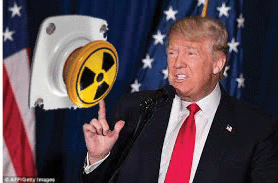 US sanctions 18 Iranian entities day after certifying nuclear deal compliance
Trump administration targets groups and individuals over non-nuclear behavior, after confirming that Iran is following nuclear agreement but breaching its ‘spirit’, Guardian, 18 Jul 17, The Trump administration announced on Tuesday new sanctions on 18 Iranian individuals, groups and networks over non-nuclear behavior, such as support for ballistic missiles development.
The move came a day after the administration certified to Congress that Iran is technically complying with the nuclear deal and can continue enjoying nuclear sanctions relief.
The treasury department is targeting seven groups and five people that aided Iran’s military or its elite Revolutionary Guard. The sanctions also target what the US says is a transnational criminal group based in Iran and three people associated with it, and the state department is also targeting two more groups associated with Iran’s ballistic missiles program.
The sanctions freeze any assets the targets may have in the US and prevent Americans from doing business with them.
Late on Monday, the administration insisted that Tehran would face consequences for breaching “the spirit” of the nuclear deal. Donald Trump, who lambasted the 2015 pact as a candidate, has given himself more time to decide whether to dismantle the deal or let it stand.
Officials said the US was working with allies to try to fix the deal’s flaws, including the expiration of some nuclear restrictions after a decade or more. The officials also signalled the new sanctions.
Trump, secretary of state Rex Tillerson and “the entire administration judge that Iran is unquestionably in default of the spirit” of the agreement, one official said. That assessment carries no legal force; Trump’s certification that Iran is technically complying clears the way for sanctions to remain lifted.
Monday’s late-night announcement capped a day of frenzied, last-minute decision-making by the president, exposing deep and lingering divisions within his administration about how to deal with a top national security issue.
National security advisers, including Tillerson and defense secretary James Mattis, recommended Trump preserve the deal for now in a meeting last Wednesday, according to the New York Times. An anonymous official told the Times that Trump spent 55 minutes of the meeting saying he did not want to certify Iran’s compliance. On Monday, a planned press briefing was cancelled at short notice as internal White House arguments continued.
Since early last week, Trump’s administration had been prepared to make the certification, a quarterly requirement. Trump first told Congress in April that Iran was indeed complying. With no final decision on his broader Iran policy, the White House had planned to let the status quo stand for another three months.
Iran will continue receiving the same sanctions relief that it did under former president Barack Obama………
Scuttling the deal would put further distance between Trump and foreign leaders who are already upset over his move to withdraw from the Paris global climate change accord. Other powers that brokered the nuclear deal along with the US have said there’s no appetite for renegotiating it. https://www.theguardian.com/world/2017/jul/18/iran-is-complying-with-nuclear-deal-but-is-in-default-of-its-spirit-says-us
July 19, 2017
Posted by Christina Macpherson |
Iran, politics international, USA |
Leave a comment
Trump likely to say Iran complying with nuclear deal: U.S. official, WASHINGTON (Reuters) by Steve Holland and Jonathan Landay-13 July 17 U.S. President Donald Trump is “very likely” to state that Iran is adhering to its nuclear agreement although he continues to have reservations about it, a senior U.S. official said on Thursday.
Under U.S. law, the State Department must notify Congress every 90 days of Iran’s compliance with the so-called Joint Comprehensive Plan of Action (JCPOA). Trump has a congressionally mandated deadline of Monday to decide.
The landmark 2015 deal struck with Iran by the United States, France, Britain, Russia, China and Germany is aimed at preventing Tehran from developing a nuclear weapon by imposing time-limited restrictions and strict international monitoring on its nuclear program. In return, Tehran won relief from punishing international economic sanctions.
If Trump does state Iran is in compliance, it would be his second time since taking office in January to do so despite his promise during the 2016 campaign to “rip up” what he called “the worst deal ever.”…….https://www.reuters.com/article/us-usa-trump-iran-idUSKBN19Y226
July 14, 2017
Posted by Christina Macpherson |
Iran, politics international, USA |
Leave a comment
The Iran nuclear deal faces ‘death by a thousand cuts’, The Iran Project, Bloomberg, Ladane Nasseri, 30 June 17 : President Donald Trump decided against killing off the Iran nuclear deal in a day-one spectacular. It may face a lingering death instead.
Trump’s administration sends out mixed signals on many issues, but on the need for a tougher line against Iran, it speaks with one voice. And words have been accompanied by action. In Syria, the U.S. military is directly clashing with Iranian allies. In Saudi Arabia, Trump performed a sword-dance with Iran’s bitterest foes. In the Senate, new sanctions on the Islamic Republic sailed through with near-unanimous approval.
The 2015 accord reined in Iran’s nuclear program, and offered the Islamic Republic a route back to the mainstream of the world economy. It was the fruit of many years of work by many governments. Its breakdown would likely add to turbulence in the Middle East, and impose new strains on America’s ties with Europe. Yet there’s a serious risk that the deal could unravel, according to one former U.S. official who was intimately involved.
“Death by a thousand cuts” is what former Deputy Secretary of State William J. Burns fears could be the fate in store for the agreement he helped negotiate. Burns, who led the U.S. team involved in secret preliminary talks, says he’s concerned by “the chipping away of trust in the agreement from all sides.’’
“It’s a fragile enough environment as it is,” he said in an interview. “It’s easy to back yourself into a collision of one kind or another.”
Failed Approach’
The U.S. has slapped two additional sets of sanctions on Iran this year, tied to its ballistic missile program and alleged support of terrorism. The lifting of wider international curbs in January 2016, as part of the nuclear deal, has allowed Iran to resume oil sales to Europe, for example. But many American restrictions remain in place, especially on financial flows. Major banks, wary of falling foul of U.S. policy, have stayed clear of Iran. Several Western companies are watching to see what the administration does next.
The prevailing view in Washington seems to be “to let the agreement remain in place, but to press on Iran so it doesn’t get the commercial advantages expected,” said Alireza Nader, a senior analyst at Rand Corp.
The aerospace industry is a good example. …..
Faced with a congressional requirement to report on the nuclear agreement, the Trump administration grudgingly certified in April that Iran is keeping its end of the deal. But Secretary of State Rex Tillerson added that the accord only delayed Iran’s ambitions to gain nuclear weapons — “the same failed approach of the past” — and didn’t curb its role in sponsoring terrorism.
‘Blame the Other’
Iran likewise says the U.S. is violating the agreement’s spirit, if not its letter. “Disregard for Iran’s genuine security concerns, either through deliberate changing of the military-security balance in the region, or by stoking Iranophobia in the region and beyond,” would put the hard-won gains of the deal at risk, Ali Akbar Salehi, who helped negotiate it as head of Iran’s atomic energy agency, wrote in a Guardian op-ed last week. “Engagement is not a one-way street.”
“Each side is now waiting to blame the other for undermining the deal,” Nader said….
The mood in Europe is different……
Trump’s coziness with the new Saudi leadership and lack of interest in engaging with Iran adds to evidence that his administration’s strategy “essentially is to try to kill the deal while appearing to uphold it,’’ said Trita Parsi, author of “Losing an Enemy: Obama, Iran and the Triumph of Diplomacy” and an Iranian-American leader who advocated for the nuclear accord.
“For the long-term durability of the deal you needed to have at least a slightly positive trajectory of U.S.-Iran relations,” Parsi said. “Right now, nothing positive is happening.” http://theiranproject.com/blog/2017/06/30/iran-nuclear-deal-faces-death-thousand-cuts/
July 1, 2017
Posted by Christina Macpherson |
Iran, politics international |
Leave a comment
 By JON GAMBRELL, DUBAI, United Arab Emirates (AP) — Once expunged from its official history, documents outlining the U.S.-backed 1953 coup in Iran have been quietly published by the State Department, offering a new glimpse at an operation that ultimately pushed the country toward its Islamic Revolution and hostility with the West.
The CIA’s role in the coup, which toppled Prime Minister Mohammed Mosaddegh and cemented the control of the shah, was already well-known by the time the State Department offered its first compendium on the era in 1989. But any trace of American involvement in the putsch had been wiped from the report, causing historians to call it a fraud.
The papers released this month show U.S. fears over the spread of communism, as well as the British desire to regain access to Iran’s oil industry, which had been nationalized by Mosaddegh. It also offers a cautionary tale about the limits of American power as a new U.S. president long suspicious of Iran weighs the landmark nuclear deal with Tehran reached under his predecessor……..
The 1,007-page report , comprised of letters and diplomatic cables, shows U.S. officials discussing a coup up to a year before it took place. ……..
The report fills in the large gaps of the initial 1989 historical document outlining the years surrounding the 1953 coup in Iran. The release of that report led to the resignation of the historian in charge of a State Department review board and to Congress passing a law requiring a more reliable historical account be made.
Byrne and others have suggested the release of the latest documents may have been delayed by the nuclear negotiations, as the Obama administration sought to ease tensions with Tehran, and then accelerated under President Donald Trump, who has adopted a much more confrontational stance toward Iran……
Die-hard opponents of Iran’s current government might look to 1953 as a source of inspiration. But the Americans involved in the coup acknowledged at the time they were playing with fire.
Widespread Iranian anger over the heavy-handed Western intervention lingered for decades, and fed into the 1979 revolution, when Iranians seized control of the U.S. Embassy and held those inside captive for 444 days. To this day Iran’s clerical leaders portray the U.S. as a hostile foreign power bent on subverting and overthrowing its government.
As President Dwight Eisenhower wrote in his diary in 1953, if knowledge of the coup became public, “We would not only be embarrassed in that region, but our chances to do anything of like nature in the future would almost totally disappear.” Online:
State Department report: https://history.state.gov/historicaldocuments/frus1951-54Iran https://apnews.com/5111167bcaf84892b01eea93eea4bc01
July 1, 2017
Posted by Christina Macpherson |
history, Iran, politics international, USA |
Leave a comment
https://www.theguardian.com/world/2017/jun/26/iran-nuclear-deal-must-be-allowed-to-thrive Dr T Douglas Reilly, Los Alamos, New Mexico, USA, 25 June 17 T Douglas Reilly draws on his experience with the International Atomic Energy Agency to praise the Iran nuclear deal, while David Gleeson wonders why Tehran is so often cast as the villain on the world stage
The Joint Comprehensive Plan of Action (JCPOA), also known as the Iran nuclear deal) is excellent; it is far better and more extensive than I ever expected (Don’t upset the balance of power in the Middle East, 23 June). If followed by all parties, it blocks all avenues for Iran to develop nuclear explosives. To be sure, it is vehemently opposed by Israel’s prime minister Netanyahu and Republicans in Congress.
I am a physicist who worked in nuclear safeguards and non-proliferation for 38 years at the Los Alamos national laboratory; the majority of my efforts were for and with the International Atomic Energy Agency (IAEA) that has the responsibility of inspecting the nuclear facilities of states signatory to the nuclear non-proliferation treaty (NPT). Among other things, I developed programmes that have been part of the initial IAEA inspectors’ training since 1980. I’ve trained many of the inspectors who inspect Iran today, and have inspected Iran’s facilities since it signed and ratified the NPT shortly after it came into force in 1970.
There are only three nations that have not signed the NPT: India, Israel, and Pakistan. All three have large nuclear arsenals and effective delivery capabilities. Israel has over 400 nuclear weapons of all types and the ability to deliver them anywhere in the world, including the US. Israel also has a policy known as the Samson Option that implies it will destroy the world if ever it feels in danger of falling.
David Gleeson, London, Ali Akbar Salehi’s piece was a calm, reasoned argument for the JCPOA to be allowed to thrive, despite the expected noises from Trump and his ilk. Why is Iran so often seen as the enemy? The country is stable and calm and – much to the annoyance of its detractors – has regular elections that the Iranian people deem worthwhile participating in. Saudi Arabia, on the other hand…
June 28, 2017
Posted by Christina Macpherson |
Iran, politics international |
Leave a comment
The Saudi war in Yemen is really directed at…Iran. Donald Trump’s first overseas visit to Saudi Arabia and Israel was specifically targeted at… Iran. The Saudi-led isolation of Qatar is actually about… Iran.
The escalation of U.S. military actions against the Syria government is… well, do I really need to spell this out any further?
Donald Trump has identified several number-one enemies to target. Throughout the campaign, he emphasized the importance of throwing the full weight of the Pentagon against the Islamic State. More recently, his secretary of defense, Jim Mattis, identifiedNorth Korea as “the most urgent and dangerous threat to peace and security.”
Other threats that have appeared at one time or another in the administration’s rotation include China, Cuba, the mainstream media, former FBI director James Comey, and Shakespeare (for writing Julius Caesar and then somehow, from the grave, persuadingthe Public Theater to run a scandalous version of it).
Through it all, however, Iran has loomed as the primary bogeyman of the Trump crowd. Fear of Iranian influence has prompted the administration to all but cancel the 2015 nuclear deal, intensify a number of proxy wars, consider pushing for regime change in Tehran, and even intervene in the mother of all battles between the Shia and Sunni variants of Islam.
You’re worried about Trump and the nuclear football? The prospect of blowback from an all-out U.S. assault on the Islamic State keeps you up at night? A preemptive strike against North Korea, which Mattis acknowledges would be disastrous, has you rethinking that upcoming trip to Seoul?
Sure, those are all dystopian possibilities. But if I had to choose a more likely catastrophe, it would be a direct confrontation between the United States and Iran. After all, everything seems to be pointing in that direction.
The nuclear deal that Iran signed with the five permanent members of the UN Security Council plus Germany and the European Union is hanging by a thread. Trump made no bones about his distaste for this Joint Comprehensive Plan of Action (JCPOA). He promised to tear it up.
He hasn’t done so. It’s not just that he’s gotten pushback from the usual suspects in Washington (diplomats, foreign policy mavens, talking heads, journalists). Even members of his inner circle seem to see value in the agreement. Mattis, who is otherwise hawkish on Iran, has stood by the JCPOA and diplomacy more generally. Secretary of State Rex Tillerson has, albeit reluctantly, acknowledged that Iran has lived up to its side of the agreement. Then there are all the American jobs on the line from the Iranian purchase of Boeing jets.
Even though Trump hasn’t torn up the agreement, he has certainly attempted to give it a good crumple. He has directed the Treasury Department to apply additional sanctions on Iran’s missile program. He’s considering the option of declaring the Revolutionary Guards a terrorist organization. Congress, meanwhile, is pursuing its own complementary set of sanctions against Iran (though, because it’s bundled with sanctions against Russia, the legislation may not meet Trump’s approval).
None of this violates the terms of the JCPOA. But it challenges the spirit of the accord.
Adding insult to injury, Trump damned Iran with faint condolences after the recent terrorist attacks in Tehran. “We grieve and pray for the innocent victims of the terrorist attacks in Iran, and for the Iranian people, who are going through such challenging times,” Trump wrote. “We underscore that states that sponsor terrorism risk falling victim to the evil they promote.”
Talk about bad taste. After September 11, Iranians gathered for candlelight vigils to mourn the mostly American victims of the attacks. The Iranian government didn’t say anything about chickens coming home to roost after U.S. military interventions in the Middle East, for that would have been inappropriate (though accurate).
But Iran might yet have to make a statement that echoes Trump’s tone-deaf remark: States that tear up international agreements risk falling victim to the evil they promote.
The conflict is escalating in Syria, where Iran backs the regime of Bashar al-Assad and the United States supports a shifting set of anti-regime groups.
Both countries could decide to team up against the Islamic State. And indeed, Iran launched a missile attack against ISIS in Syria this last weekend in retaliation for the terrorist attacks in Tehran. As after September 11, when Tehran and Washington briefly worked together, cooperation against Sunni extremists would seem a no-brainer.
But the would-be caliphate, having lost most of Mosul and now teetering on the verge of conceding its capital in Raqqa, is shrinking at a rapid clip. Which may well explain why the United States has been wading deeper into the Syrian conflict. For the first time since the war in Syria began, U.S. forces shot down a Syrian government plane this last weekend. It’s only the latest in a series of attacks on Assad’s forces, according to The Atlantic:
Three times in the last month, the U.S. military has come into direct conflict with the combined forces of the Assad regime, Iran-supported Shiite militias, Hezbollah, and possibly even Iran’s elite Islamic Revolutionary Guards Corps. The clashes have reportedly resulted in the deaths of a small number of pro-regime forces, and are much more strategically important than the much-ballyhooed U.S. air strike on the al-Shayrat airfield back in April in response to the Assad regime’s use of chemical weapons.
Several administration figures, notably Ezra Cohen-Watnick and Derek Harvey in the National Security Council, are eager to confront Assad and his Iranian backers more aggressively. Mattis, however, has reportedly opposed several of their risky propositions. Regardless of the Pentagon chief’s somewhat more risk-averse behavior, both Iran and the United States are maneuvering to control as much territory as possible in the vacuum created by the collapse of ISIS………
Back in 2013, Trump said,
We will end up going to war with Iran because we have people who don’t know what the hell they are doing. Every single thing that this administration and our president does is a failure.
Who knew that Donald Trump could be so prescient? The president has proven himself high-performing in at least this one regard: self-fulfilling prophecies.http://www.huffingtonpost.com/entry/the-coming-war-with-iran_us_594ec1fce4b0f078efd9821c
June 27, 2017
Posted by Christina Macpherson |
Iran, politics international, USA, weapons and war |
1 Comment
Iran says US Senate bill contradicts nuclear deal http://en.trend.az/iran/politics/2765348.html, Tehran, Iran, June 11 By Mehdi Sepahvand
Iranian Deputy Foreign Minister Abbas Araqchi has said the US Senate’s move to impose new sanctions on Iran is contradicts the nuclear deal, officially called the Joint Comprehensive Plan of Action (JCPOA).
“We believe such legislation is contradictory to the principle of good will and successful implementation of the JCPOA,” he said, IRIB news agency reported June 11.
Araqchi censured the legislation as “shameful” and said it shows “confusion” and “wrong policies”.
He described the U.S. Senate’s status in condemning Iran for supporting terrorism is “farcical” and “shameful”.
The US Senate on Wednesday voted overwhelmingly to advance a bill that would impose new sanctions on Iran.
A senior Senate aide said the Iran sanctions measure could come up for a vote as soon as next week. The legislation would impose new sanctions on Iran over its defense missile program, support for resistance movements and claims of human rights violations against the country.
To become law, the measure would have to pass the Republican-led House of Representatives and be signed by President Donald Trump. So far, Washington has slapped two rounds of sanctions on Iran under the new US administration in breach of a nuclear accord.
June 12, 2017
Posted by Christina Macpherson |
Iran, politics international, USA |
Leave a comment
What’s Behind Trump’s ‘Baseless Claims’ About Iran’s ‘Nuclear Weapons’, Sputnik, 27 May 17, Commenting on the recent remarks of Donald Trump regarding Iran, which Tehran labelled as ‘Iranophobia’, Iranian political analyst Ali Reza Rezakhah explained to Sputnik Persian what the real purpose behind the comments of the US leader is and who he’s really talking to.
On Monday, US President Donald Trump promised that Tehran will never develop a nuclear weapon.”Iran will never have a nuclear weapon that I can tell you,” Trump told reporters before the meeting with Israeli Prime Minister Benjamin Netanyahu.
Trump’s remarks came the day after the Arab Islamic American Summit was held in the Saudi capital of Riyadh, where the US president said that Iran has been supporting terrorists, militias and extremist groups that spread destruction and chaos across the Middle East.
Tehran was quick to label Trump’s remarks as “Iranophobia,” accusing the US and its leader of “repetitive and baseless claims” about Iran.
“The American president tried to encourage the countries of the region to purchase more arms by spreading Iranophobia,” spokesman for the Iranian Foreign Ministry Bahram Qassemi said a day after the US President finished his trip to Saudi Arabia.
Sputnik Persian sat down with Iranian political analyst and expert in American studies Ali Reza Rezakhah to talk on the war of words between the US administration and the Iranian government.
“Tehran has never voiced its intention to possess any nuclear arms,” Ali Reza Rezakhah reminded Sputnik.
Moreover, he further explained, Iran has announced that the use of any weapons of mass destruction, and nuclear arms in particular, is banned by Islam. A corresponding fatwah (a legal opinion in the Islamic faith) on the ban of stockpiling and use of nuclear weapons has been issued by Iran’s Supreme leader Ayatollah Ali Khamenei.Besides, the peaceful nature of the Iranian nuclear program and the absence of any intentions to possess nuclear arms have been stipulated in the Joint Comprehensive Plan of Action, commonly known as Iran’s nuclear deal.
“Donald Trump’s remarks, therefore, are nothing but pure PR and bait for the mainstream media. The words have been said to please the Israeli Prime Minister,” Ali Reza Rezakhah told Sputnik.
He echoed the words of Bahram Qassemi, saying that Trump’s visit to both Riyadh and Tel Aviv and his rampant remarks are the new wave of “Iranophobia”, which the US leader is trying to spread.
He further noted that regardless his low ratings, Donald Trump might get certain success in his efforts.
“‘Iranophobia’ might become a basis for creation of a new terrorist coalition of an international caliber. And Trump’s visit to Saudi Arabia and Israel come as a proof to it,” he said…….https://sputniknews.com/middleeast/201705271054047376-trump-iranophobia-new-coalition/
May 29, 2017
Posted by Christina Macpherson |
Iran, politics international, USA |
Leave a comment
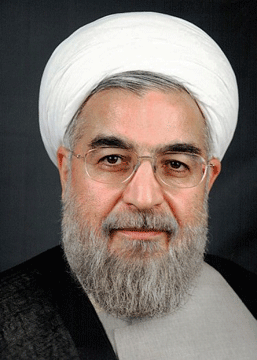 Elysee: Rouhani reelection gives hope for Tehran’s compliance with nuclear deal http://theiranproject.com/blog/2017/05/21/elysee-rouhani-reelection-gives-hope-tehrans-compliance-nuclear-deal/ – The office of French President Emmanuel Macron said that the reelection of Hassan Rouhani as Iranian President gives hope for the country’s compliance with the nuclear deal.
MOSCOW (Sputnik) — The reelection of Hassan Rouhani as Iranian President gives hope for the country’s compliance with the Joint Comprehensive Plan of Action (JCPOA) aimed at settlement of the Iranian nuclear issue, the office of French President Emmanuel Macron said in a statement.
“The reelection of President Rouhani strengthens the hope that his government will abide accurately by the historic agreement of July 14, 2015, which allowed to regulate through the diplomatic means the disagreements on the nuclear issue and to engage in the new stage of the relations between Iran and the international community. France, in turn, will continue to exercise vigilance over the strict implementation of [the agreement’s] elements,” the statement distributed by Macron’s press office read.
In the document, the French president congratulated his Iranian counterpart on the reelection and expressed hope for the improvement of the economic, scientific and cultural ties between Tehran and Paris.
Apart from this, Macron called on Iran to contribute to the settlement of the crises in the Middle East.
“Adhering to the development of the political dialogue with Iran, France reiterates the necessity of the diplomatic regulation of the conflicts in the Middle East and urges Iran to participate in it,” the statement stressed.
May 22, 2017
Posted by Christina Macpherson |
Iran, politics international |
Leave a comment
Iran raps US nuclear stance as provocative, warns about arms race, http://www.presstv.ir/Detail/2017/05/06/520793/Iran-US–Dehqani-NPT-Conference-Nuclear-Weapons-Vienna A senior Iranian Foreign Ministry official has criticized the “provocative” nuclear stance adopted by the United States, saying the world is witnessing an arms race among nuclear powers.
The director general for political and international security affairs at Iran’s Foreign Ministry, Gholam-Hossein Dehqani, made the remarks in an address to the first session of the Preparatory Committee for the 2020 Review Conference of the Parties to the Treaty on the Non-Proliferation of Nuclear Weapons (NPT) in the Austrian capital of Vienna on Saturday.
“The existing nuclear weapons have already endangered international peace and security and the current world cannot deal with the beginning of a new round of arms race,” Dehqani said.
“That is the reason why any attempt at [unleashing] an arms race must be ended,” he added.
He said lack of real progress towards disarmament over the past 50 years was the “biggest challenge” to the NPT implementation.
The Iranian official expressed concern about the persistence of such a situation and warned that NPT’s credibility would be undermined if no immediate action was adopted to that effect.
According to the NPT, countries that possess nuclear weapons must fulfill their legal commitments to slash their atomic arsenals “completely, immediately, with goodwill and without any precondition,” he said.
It is estimated that there are more than 15,000 nuclear weapons in the world, which is “a big threat to the survival of humanity,” Dehqani added.
US President Donald Trump said in February that he wants to ensure the US nuclear arsenal is at the “top of the pack,” saying the United States has fallen behind in its weapons capacity.
Under Article VI of the NPT, all parties to the treaty undertake to pursue good-faith negotiations on effective measures related to nuclear disarmament and the cessation of nuclear arms race.
The preparatory committee, which opened in Austria on May 2 and will conclude on May 12, is responsible for addressing substantive and procedural issues related to the NPT.
May 8, 2017
Posted by Christina Macpherson |
Iran, USA, weapons and war |
Leave a comment




 nuclear-news