U.S. pressure or not, U.N. nuclear watchdog sees no need to check Iran military sites, http://www.reuters.com/article/us-iran-nuclear-inspections-idUSKCN1BB1JC , Francois Murphy, VIENNA , 31 Aug 17, – The United States is pushing U.N. nuclear inspectors to check military sites in Iran to verify it is not breaching its nuclear deal with world powers. But for this to happen, inspectors must believe such checks are necessary and so far they do not, officials say.
Last week, U.S. Ambassador to the United Nations Nikki Haley visited the International Atomic Energy Agency (IAEA), which is scrutinizing compliance with the 2015 agreement, as part of a review of the pact by the administration of President Donald Trump. He has called it “the worst deal ever negotiated”.
After her talks with officials of the U.N. nuclear watchdog, Haley said: “There are… numerous undeclared sites that have not been inspected. That is a problem.” Iran dismissed her demands as “merely a dream”.
The IAEA has the authority to request access to facilities in Iran, including military ones, if there are new and credible indications of banned nuclear activities there, according to officials from the agency and signatories to the deal.
But they said Washington has not provided such indications to back up its pressure on the IAEA to make such a request.
“We’re not going to visit a military site like Parchin just to send a political signal,” an IAEA official said, mentioning a military site often cited by opponents of the deal including Iran’s arch-adversary Israel and many U.S. Republicans. The deal was struck under Trump’s Democratic predecessor Barack Obama.
IAEA Director-General Yukiya Amano frequently describes his Vienna-based agency as a technical rather than a political one, underscoring the need for its work to be based on facts alone.
The accord restricts Iran’s atomic activities with a view to keeping the Islamic Republic a year’s work away from having enough enriched uranium or plutonium for a nuclear bomb, should it pull out of the accord and sprint towards making a weapon.
September 1, 2017
Posted by Christina Macpherson |
Iran, politics international |
Leave a comment
 Donald Trump’s nuclear obsession with Iran is misplaced, The US president would be better advised to try defusing tensions with North Korea, Ft.com Roula Khalaf, 30 Aug 17,
Donald Trump had two nuclear tantrums this summer, though you may know about only one of them. He warned North Korea it would face “fire and fury like the world has never seen” if it made further threats to the US, and set much of the world fretting about nuclear war as a consequence. The former director of national intelligence James Clapper noted that there is nothing to stop Mr Trump from carrying out a first strike, which, as he rightly puts it, is “pretty damn scary”. Also scary is Mr Trump’s determination to reopen another nuclear dispute that was parked in 2015, thanks to deft diplomacy by his predecessor. He doesn’t rage as much about Iran as North Korea but Mr Trump hates the Iran nuclear deal, which rolled back Tehran’s enrichment programme in exchange for a lifting of international sanctions. Every time the state department confirms Iran is in compliance with it (Congress mandates this every 90 days), the president has a fit.
This summer, according to US media, during one such episode, Mr Trump ordered his lieutenants to come up with a reason why Iran is flouting the agreement next time they report back to him. For foreign policy watchers, this brought back memories of George W Bush’s obsession with Saddam Hussein and the resulting politicisation of intelligence on weapons of mass destruction to justify the invasion of Iraq. The consequences of that misguided adventure are still spilling Iraqi and American blood……
With the crisis intensifying in North Korea — which, unlike Iran, does have nuclear weapons — ensuring an Iranian nuclear programme stays inactive for a decade is rather reassuring. Though the circumstances and the nature of the regimes of North Korea and Iran are different, the same painstaking multilateral diplomacy that produced the deal with Tehran will be needed to resolve the stand-off with Pyongyang peacefully….
while it would have been preferable to force Iran into a total surrender, it was not possible. If there had been a better deal to be had, the six world powers involved in the talks would have negotiated it. Mr Trump fancies himself as a master negotiator, but he would meet his match if he sat down with the Iranians. The US administration is under the impression that undermining the nuclear agreement would force Iran into submission to its Sunni Arab neighbours. More likely, quite the opposite would happen. Mr Trump is obsessing about Iran for the wrong reasons. More useful would be to study the nuclear agreement for the lessons it might offer about dealing with North Korea.
roula.khalaf@ft.com https://www.ft.com/content/3534bbf6-8c96-11e7-9084-d0c17942ba93
September 1, 2017
Posted by Christina Macpherson |
Iran, politics international, USA |
Leave a comment

 If Report Says Iran Is Abiding by Nuclear Deal, Will Trump Heed It?, NYT, By GARDINER HARRIS AUG. 27, 2017 WASHINGTON — Within days, international monitors will send an inspection report on Iran’s nuclear facilities to governments around the world, touching off a chain of events that could lead to another clash between President Trump and congressional Republicans, or even his own top advisers.
August 28, 2017
Posted by Christina Macpherson |
Iran, politics international, USA |
Leave a comment
 Strong indications’ Trump won’t recertify Iranian compliance with nuclear deal
- There are more signs the Trump administration is preparing a case to decertify Iran’s compliance with the international nuclear deal.
- Nikki Haley, the U.S. ambassador to the United Nations, this week visited the atomic watchdog agency in charge of monitoring Iran’s compliance.
- On Thursday, Tehran said it “is abiding by its duties and responsibilities” and accused Washington of using the issue “for ill-wishing political means.” CNBC
Jeff Daniels | The Trump administration is giving “strong indications” that it is preparing a case to decertify
Iran‘s compliance with the international nuclear agreement, an expert says.
If that happens, though, some analysts believe it risks alienating U.S. allies. In addition to the United States and Iran, the 2015 nuclear agreement was signed by Britain, France, Germany, Russia, China and the United Nations.
The White House sent Nikki Haley, U.S. ambassador to the United Nations, to Vienna on Wednesday to meet with officials from the International Atomic Energy Agency, which is responsible for monitoring and verifying Iran’s commitments under the 2015 agreement, known as the Joint Comprehensive Plan of Action.
On Thursday, Iran’s state-run IRNA news agency quoted from a letter sent by Iran’s foreign minister to the U.N. agency saying the country “is abiding by its duties and responsibilities” with regard to nuclear weapons and agreements. He accused Washington of using the issue “for ill-wishing political means.”
During her visit, Haley “discussed the IAEA’s verification and monitoring of Iran’s nuclear-related commitments,” according to a statement by the agency. It provided no additional information, and a statement from Haley’s office discussed her visit but shed no light on imminent action.
Last week, Haley said the Tehran government should be held accountable for “its missile launchers, support for terrorism, disregard for human rights, and violations of U.N. Security Council resolutions. Iran cannot be allowed to use the nuclear deal to hold the world hostage.”
The Trump administration has certified Iran’s compliance twice under a law that requires it to notify Congress of Iran’s compliance every 90 days. The next review ends in October.
Analysts say recent actions by the U.S. demonstrate that President Donald Trump plans to renege on the Iran nuclear agreement. During the election campaign, he threatened to rip up the agreement, calling it “the worst deal ever.”
The actions include new U.S. sanctions imposed on Iran and a comment last week by a U.S. official that Iran is in breach of “the spirit” of the nuclear accord. New sanctions were designed to punish Iran for its human rights record, rocket launches as well as its role in terrorism and arms smuggling.
“He’s given strong indications that he’s just not going to recertify it,” said John Glaser, director of foreign policy studies at the Cato Institute, the libertarian think tank.
“If we were to leave the deal or deliberately abrogate it, we’d be isolated internationally and we wouldn’t be able to do anything like reapply sanctions that would do any kind of damage on Iran,” he added. “That’s because the rest of the international community would not sort of play along.”
Glaser said the other parties to the agreement “agree that Iran is compliance with the deal and agree that the deal should be kept in place because it’s a robust, nonproliferation agreement. It has kind of taken military conflict against Iran because of the nuclear program off the table.”
Last week, Iranian President Hassan Rouhani threatened to quit the nuclear pact if the White House issues new sanctions. Iran charged those sanctions were a violation of the nuclear accord…..https://www.cnbc.com/2017/08/25/strong-indications-trump-wont-recertify-iran-nuclear-deal.html
August 26, 2017
Posted by Christina Macpherson |
Iran, politics international, USA |
Leave a comment
Shoddy translation in the Western media is increasing nuclear tensions–again, Bulletin of Atomic Scientists, Ariane Tabatabai, 25 Aug 17, “…….Inaccurate translations, imprecise analyses, and poor reporting have long plagued discussion of Iranian nuclear affairs in Western, English-language media. Now, though, this kind of irresponsibility is particularly alarming, because the nuclear agreement signed in 2015 between Iran and six world powers is in a fragile state. The agreement, known as the Joint Comprehensive Plan of Action, or JCPOA, curbs Iranian nuclear activities in exchange for sanctions relief, and is critical to advancing the US objective of keeping Tehran away from the Bomb without resorting to military force. US President Donald Trump has gone from pledging to dismantle the deal to trying to kill it by a thousand cuts. Meanwhile, various American interest groups are jumping in to advocate for their own preferred Iran policy options, including leaving the JCPOA and pursuing regime change. All this makes it even more critical than before for journalists and experts to get the facts right.
In foreign policy reporting, especially during periods of heightened tension and escalation, translations are a particularly challenging part of the journalist’s job. Mistranslations and inaccurate reporting
can be consequential, as even the slightest mistakes can change meaning and generate crises……
the bottom line of all statements coming out of Tehran about the nuclear deal is that the country is committed to preserving it. This is
currently the consensus within the regime; whether everyone likes it or not, the JCPOA is the law of the land. Yet given US threats to renege on the deal, Rouhani also has to hedge. So he is laying out his country’s options and the possible outcomes should America withdraw from the process. It is in this area that many reporters have translated his statements inaccurately.
For example, on August 15,
Reuters inaccurately reported that Rouhani said his country “could abandon its nuclear agreement with world powers ‘within hours’ if the United States imposes any more sanctions.” The article went on to misquote Rouhani as saying: “If America wants to go back to the experience (of imposing sanctions), Iran would certainly return in a short time—not a week or a month but within hours—to conditions more advanced than before the start of negotiations.” In fact, what Rouhani said was: “New US officials should know that the failed experience of sanctions and coercion brought their previous governments to the negotiating table. And if they want to return to that experience, surely, in a short amount of time, not in a period of weeks and months, but hours and days, we will return to a much more advanced situation than that of the beginning of the talks.” In other words, Rouhani wasn’t threatening to leave the JCPOA if the United States imposed more sanctions on it—as the article’s title suggested and its content indicated—but to resume elements of its program if
Washingtondecided to leave the JCPOA. At the same time, Rouhani reiterated that his country’s preferred course of action was to preserve the deal—but he wanted the United States to know that Iran, too, had options……
These inaccuracies would be problematic under normal circumstances, but they are particularly irresponsible at a time of heightened tensions, during which misperceptions could quickly torpedo the nuclear deal and put the United States and Iran on a collision course. Right now, the Trump administration is reviewing its policy on the JCPOA, Iranian support for the deal is diminishing, and hawks on both sides see this fragile state of affairs as an opportune moment to kill it off completely. If journalists are to hold those in power accountable, they must be held accountable themselves.
http://thebulletin.org/shoddy-translation-western-media-increasing-nuclear-tensions-again11046?platform=hootsuite
August 26, 2017
Posted by Christina Macpherson |
Iran, media, USA |
Leave a comment
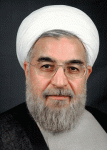 Iran’s top priority to protect nuclear deal from US http://www.sbs.com.au/news/article/2017/08/20/irans-top-priority-protect-nuclear-deal-us-rouhani Rouhani, Iran’s President Hassan Rouhani said Sunday the top foreign policy priority for his new government was to protect the nuclear deal from being torn up by the United States. “The most important job of our foreign minister is first to stand behind the JCPOA, and not to allow the US and other enemies to succeed,” Rouhani told parliament, using the technical name for the 2015 deal that eased sanctions in exchange for curbs to Iran’s nuclear programme.
“Standing up for the JCPOA means standing up to Iran’s enemies,” he said on the last day of debates over his cabinet selections. Rouhani indicated a week ago that Iran was ready to walk out on the nuclear deal if the United States continued to apply fresh sanctions.
US President Donald Trump repeatedly threatened to tear up the deal during his campaign, and it has come under mounting pressure after Tehran carried out missile tests and Washington imposed new sanctions — with each accusing the other of violating the spirit of the agreement.
But Rouhani has insisted it remains Iran’s preferred way forward, not least to help rebuild the struggling economy and create jobs.
“The second responsibility of the foreign ministry… is to get involved in economic activities. It should help attract foreign investment and technology,” Rouhani said, adding that Iran needed $200 billion in investments for the oil and gas sector alone.
Parliament approved 16 of his 17 cabinet picks, rejecting his suggested minister of energy, a reformist named Habibollah Bitaraf. Foreign Minister Mohammad Javad Zarif, who was the charismatic face of Iran’s nuclear negotiations, retained his position.
So did Oil Minister Bijan Namdar Zanganeh, who recently struck a billion-dollar deal with French giant Total.
Rouhani, a political moderate, worked hard behind the scenes to secure support for his choices, including from the supreme leader and the military. He began his second term earlier this month after winning a resounding victory over a hardline challenger in May, vowing to continue his outreach to the world and improve civil liberties at home.
But he has angered reformists by again failing to appoint a single woman minister, and looks no closer to securing the release of jailed opposition leaders — one of whom, Mehdi Karroubi, briefly went on hunger strike this week to demand a trial after six years under house arrest.
Rouhani has yet to appoint a minister of science, research and technology, which conservatives consider to be a sensitive post.
August 21, 2017
Posted by Christina Macpherson |
Iran, politics international |
1 Comment
Trump may be planning to make a very bad decision on the Iran deal WP, 20 Aug 17 “……According to international inspectors and the U.S. intelligence community, Iran has largely abided by the terms of the 2015 nuclear deal, which greatly reduced its stockpile of enriched unranium and placed strict limits on its nuclear activities. If the regime continues complying, it could be a decade or more before Iran could again threaten to become a nuclear power. Yet perversely, Mr. Trump is matching his passivity toward Iran’s regional meddling with an apparent determination to torpedo the nuclear pact.
After grudgingly
certifying in July that Iran was meeting the terms of the deal — a test mandated by Congress every 90 days — Mr. Trump
told the Wall Street Journal that he planned to find the regime noncompliant when the next certification is due in October. How to reach such a finding if the intelligence community judges otherwise?
According to Foreign Policy, Mr. Trump ordered a group of political aides, including now- fired strategist Stephen K. Bannon, to cook up a rationale — something that presumably will be made easier by their lack of data or expertise.
The real experts puzzle over what Mr. Trump could hope to accomplish by announcing that Iran is noncompliant — other than satisfying what appears to be his compulsive urge to spoil President Barack Obama’s legacies. Without proof of Iranian noncompliance, U.S. partners in the nuclear deal, including the European Union, Russia and China, would surely refuse to support the nullification of the accord or the reimposition of sanctions. Iran might respond to decertification by resuming uranium enrichment, even if Mr. Trump did not reimpose U.S. sanctions. That would present the White House with the ugly old problem of how to stop Iranian progress toward a bomb. Could Mr. Trump credibly threaten Iran with military action even while using the threat of force against North Korea?….
https://www.washingtonpost.com/opinions/global-opinions/trump-may-be-planning-to-make-a-very-bad-decision-on-the-iran-deal/2017/08/20/1faf5642-81e2-11e7-b359-15a3617c767b_story.html?utm
August 21, 2017
Posted by Christina Macpherson |
Iran, politics international, USA |
Leave a comment
Russian ambassador: Iran in full compliance with nuclear deal http://www.tehrantimes.com/news/416051/Russian-ambassador-Iran-in-full-compliance-with-nuclear-deal August 19, 2017 TEHRAN – Russian Ambassador to Tehran Levan Dzhagaryan has said that Iran has acted fully in compliance with its commitments under the nuclear agreement, noting that the U.S. should not complain in this regard.
“We will insist on our stance when talking with the Americans,” Dzhagaryan said in an interview with ISNA, stressing that the nuclear agreement must be fully implemented.
He said Russia is deeply concerned about U.S. President Donald Trump’s bashing of the nuclear deal, officially known as the Joint Comprehensive Plan of Action.
“The European countries are also very concerned and oppose [such rhetoric],” the Russian diplomat said, adding, “This is not a deal between Iran and America, but rather a multilateral agreement.”
“As you know, Russia has put a lot of effort into reaching the JCPOA,” the diplomat remarked.
Dzhagaryan also expressed the hope that China, along with U.S. allies including France, Germany, and especially Britain would persuade Washington to soften its tone on the nuclear accord.
On the recent U.S. sanctions that targeted Russia, Iran and North Korea, the diplomat said he regards all of them as “illegal”.
“However, we urge North Korea not to carry out missile tests, as it will be used as a pretext by the Americans to expand their military presence in the region,” he pointed out.
He also pointed to the economic benefits following the nuclear agreement, saying although he is satisfied with the level of Tehran-Moscow political ties, he cannot be content with the level of economic transactions between the two countries.
Russia has long supported the full implementation of the JCPOA and belives the full implementation of the deal would benefit all countries, Russia’s top diplomat in Iran asserted.
On Friday, the Russian Foreign Ministry spokeswoman Maria Zakharova reiterated her country’s stance, saying the Kremlin keeps on supporting the international pact.
Talking to reporters, she invited all the other signatories to the deal to stick to it.
Russian has all the time declared its stance regarding the international deal clearly and Moscow was actively involved in conclusion of the JCPOA, she said.
Zakharova stressed that Russia played an important role in preventing the Iran nuclear issue to be drawn into a military conflict.
In certain tense conditions, she said, the U.S. would say Iran’s nuclear program needed military solution.
But Russia insisted clearly on its stance on solving the nuclear issue through negotiations and it will never change its standing regarding the deal, said Zakharova.
August 21, 2017
Posted by Christina Macpherson |
Iran, politics international |
Leave a comment
Iran’s Rouhani urges EU’s active role in JCPOA implementation, Trend, 16 August 2017 Iranian President Hassan Rouhani has called on the European Union to play a more active role to help the full implementation of the country’s nuclear deal, known as the Joint Comprehensive Plan of Action (JCPOA), for the benefit of the Middle East and Europe, PressTV reported.
“The full implementation of the JCPOA benefits the EU and the region, so it is essential that the EU step up its efforts and role in this regard,” Rouhani said during a meeting with the new Austrian ambassador to Tehran, Stefan Scholz, on Wednesday.
Rouhani said the post-JCPOA era had offered a good opportunity for the further promotion of ties between Iran and the European countries, including Austria. Hailing Austria’s successful hosting of the Iranian nuclear negotiations, Rouhani said all parties would reap the benefits of the JCPOA.
“The JCPOA is a win-win agreement, which on the one hand, removed false concerns of certain Western countries, and on the other hand, lifted cruel sanctions against the Iranian nation,” the Iranian president said, adding that the agreement had brought about peace and provided a suitable economic condition for investors.
He said Iran was keen to seize the post-JCPOA opportunities for investment and expand economic ties, especially banking transactions.
The Austrian envoy, for his part, lauded the Tehran-Vienna ties as deeply-rooted and based on mutual respect, and said his country supported Iran’s policies at the international arena……https://en.trend.az/iran/politics/2787546.html
August 18, 2017
Posted by Christina Macpherson |
EUROPE, Iran, politics international |
Leave a comment
Iran could quit nuclear deal in ‘hours’ if new U.S. sanctions imposed: Rouhani, https://www.reuters.com/article/us-iran-nuclear-rouhani-idUSKCN1AV0LWDUBAI (Reuters), 14 Aug 17 – Iran could abandon its nuclear agreement with world powers “within hours” if the United States imposes any more new sanctions, Iranian President Hassan Rouhani said on Tuesday.“If America wants to go back to the experience (of imposing sanctions), Iran would certainly return in a short time — not a week or a month but within hours — to conditions more advanced than before the start of negotiations,” Rouhani told a session of parliament broadcast live on state television.
Iran says new sanctions that the United States has imposed on it breach the agreement it reached in 2015 with the United States, Russia, China and three European powers in which it agreed to curb its nuclear work in return for the lifting of most sanctions.
The U.S. Treasury imposed sanctions on six Iranian firms in late July for their role in the development of a ballistic missile program after Tehran launched a rocket capable of putting a satellite into orbit.
In early August, U.S. President Donald Trump signed into law new sanctions on Iran, Russia and North Korea passed by the U.S. Congress. The sanctions in that bill also target Iran’s missile programs as well as human rights abuses.
The United States imposed unilateral sanctions after saying Iran’s ballistic missile tests violated a U.N. resolution, which endorsed the nuclear deal and called upon Tehran not to undertake activities related to ballistic missiles capable of delivering nuclear weapons, including launches using such technology.
It stopped short of explicitly barring such activity.
Iran denies its missile development breaches the resolution, saying its missiles are not designed to carry nuclear weapons.
“The world has clearly seen that under Trump, America has ignored international agreements and, in addition to undermining the (nuclear deal), has broken its word on the Paris agreement and the Cuba accord…and that the United States is not a good partner or a reliable negotiator,” Rouhani said.
Trump said last week he did not believe that Iran was living up to the spirit of the nuclear deal.
August 16, 2017
Posted by Christina Macpherson |
Iran, politics international |
Leave a comment

 The Europeans have 90 days to save the nuclear agreement with Iran .http://thebulletin.org/europeans-have-90-days-save-nuclear-agreement-iran10992, IAN J. STEWART, Ian Stewart heads Project Alpha at King’s College London and directs the European Non-proliferation and Security Initiative at the Vienna Center for Disarmament and Non-proliferation.8 Aug 17
The Trump administration and Iran are risking Europe’s strategic interests. The European states had pursued a peaceful but verifiable agreement on the Iran nuclear issue since the early 2000s and were key to achieving the nuclear agreement with Iran. The European Union and its member states were among the key actors in negotiating the JCPOA and are now centrally involved in ensuring that Iran adheres to (and doesn’t cheat on) the agreement. This European involvement includes chairing the Joint Commission, the mechanism accepted by all parties and endorsed by the United Nations Security Council as responsible for ensuring that the agreement is fully implemented by all sides.
To date, it has also been the Europeans who have adhered most closely to the letter of the agreement. European countries have lifted sanctions as required by the JCPOA and have engaged in civil nuclear cooperation with Iran on issues like nuclear security. European businesses have also begun to re-engage with Iran, including through one particularly large contract between the French oil company Total and the National Iranian Oil Company to develop a phase of the South Pars oil field. At the same time, European States have taken a firm line when Iran has pushed the bounds of the JCPOA, including its technical violation of the heavy water cap and proposals to import large quantities of uranium from Kazakhstan.
For its part, however, Iran has largely adhered to both the letter and the spirit of the JCPOA. Iran has destroyed the core of the Arak reactor and dismantled vast numbers of centrifuges. And its technical violations have been relatively minor to date. Worryingly, there are signs that Iran has also engaged in some higher risk activities, such as a previously underreported case involving the import of carbon fibre for its missile program, a dual‑use material subject to export controls under the Nuclear Suppliers Group guidelines. But to be clear, this case was not considered a violation of the JCPOA by the United States, as the agreement covers only the import of dual-use goods for “Iran’s nuclear programme [as] set out in this JCPOA or other non-nuclear civilian end-use.” Counterintuitively, this language means that imports of nuclear-related dual-use items for a missile-related end use are not considered “civil” and are therefore a violation not of the JCPOA but of UNSCR2231, which prohibits development of missiles capable of carrying nuclear weapons. In this case, Iran is evidently pushing the bounds of what is allowed under the JCPOA.
Despite the Trump administration’s rhetoric, the United States has also largely lived up to its commitments under the JCPOA. In particular, the United States lifted—and doesn’t appear to be planning to reverse—its own nuclear-related sanctions. (Washington has taken additional action in relation to Iran’s ballistic missile program, including through the designation of additional entities to be sanctioned.)
Amid this general adherence to the JCPOA, however, President Trump’s harsh anti-Iran rhetoric and the opposition of Iranian hardliners and Iran’s Islamic Revolutionary Guard Corps risk undermining the nuclear agreement—an agreement that has undoubtedly has set back Iran’s nuclear weapons potential by many years and is in Europe’s strategic interests.
There’s much more that Europe could do.The Iran nuclear agreement belongs as much to Europe as it does to the other countries involved. European states demonstrated that they were willing to take an economic hit from sanctions to bring the agreement about. They have also invested heavily on the diplomatic front to both achieve and maintain the JCPOA. There is now no question that the European states wish to see full, continued implementation of the JCPOA and would only change this view if Iran committed an egregious violation. For these reasons, the European states have embarked upon a diplomatic and public campaign to persuade the United States that it must not withdraw from the agreement.
To sustain the JCPOA, however, the Europeans must urgently undertake three additional actions to demonstrate to both the United States and Iran that Europe will implement the JCPOA for as long as Iran is in compliance.
First, the Europeans should again explore the possibility of creating a safe financial channel for transactions with Iran. This move would have the dual benefit of encouraging trade with Iran, which has hitherto been slow to pick up, while also making clear to hardliners in the United States that it could not, on its own, undermine the JPCOA by leveraging the international financial system. Second, Europe should be prepared to adopt further sanctions on Iran for any violations of Security Council resolution 2231. This should include both missile launches and violations of the procurement restrictions mentioned above. These two actions would make clear that Europe is committed to implementing the JCPOA regardless of the actions of the United States and, at the same time, that the European countries are not willing to accept egregious action by Iran.
The European Union should embark on a third action. Presently the JCPOA is the best mechanism to ensure that Iran’s nuclear program stays peaceful, but the value of the agreement’s restrictions will reduce over time. By the mid-2020s, Iran will again be scaling up its enrichment effort. Therefore, the EU should begin to search for a longer-term solution both to the Iran nuclear issue and to broader regional tensions. This might best be pursued in the short term through the holding of bilateral dialogues and through civil society discourse on relevant security issues, including the nuclear issue and broader regional security issues.
Europe’s interest and President Trump’s interest align. Although President Trump might feel he can do without the Obama-era JCPOA, in reality the agreement is the best mechanism for both the Europeans and the United States to ensure the peaceful nature of Iran’s nuclear program—at least for the next decade. It is also in the interest of Iran and its people. As such, it is appropriate for the Europeans to use its position and influence to ensure the sustainability for the JCPOA for as long as the IAEA confirms Iran’s compliance.
The Trump administration might resist the idea of a safe European financial channel with Iran or European leadership in relation to broader regional issues. It should nonetheless be willing to accept these measures, given that the result would be to ensure the continued peaceful nature of Iran’s nuclear program. The alternative would be for the United States to unilaterally weaken is position vis-à-vis Iran and diminish its control over the global financial system, which would be counter to broader US security interests.
President Trump must ultimately decide within 90 days on whether to recertify Iran in compliance or to jeopardize the security interests of both the United States and its closest allies.
August 9, 2017
Posted by Christina Macpherson |
EUROPE, Iran, politics international |
Leave a comment
The Guardian view on Iran: the nuclear deal is not a disaster – but scrapping it could be, Guardian,
Editorial 5 Aug 17 Hassan Rouhani has a hefty electoral mandate for his second term but faces opposition at home and a US president determined to scrap the landmark nuclear agreement. hen the Iranian president, Hassan Rouhani, is sworn in again on Saturday, the EU’s foreign policy chief Federica Mogherini and ministers from Britain, France and Germany will be in Tehran to watch; an indication of how far relations with the west warmed in his first term. Yet as he embarks upon his second, he may feel the chill. Despite defeating his conservative rival by a landslide in May’s elections, opposition is ranged against him at home and abroad. The great domestic uncertainty he faces – supreme leader Ayatollah Ali Khamenei is 78 and without a clear successor – is for now overshadowed by Donald Trump’s threat to pull out of the landmark nuclear deal signed in 2015.
The International Atomic Energy Agency, which monitors its implementation, says Iran is complying with the requirements to curb its nuclear programme and accept inspections in return for sanctions relief. But Mr Trump has vowed to overturn the Obama administration’s stand-out foreign policy achievement. He has twice signed the sanctions waiver, but with extreme reluctance. He has asked aides to find a way to ditch the deal and says he expects Iran to be declared non-compliant next month. Officials say it has breached the pact “in spirit”………
American hostility can only bolster the isolationist, hardline forces ranged against Mr Rouhani; against the wishes and instincts of the Iranian people; against stability in the region and indeed against the interests of the US. Even defence secretary James Mattis – who has defined the three gravest threats facing the USas “Iran, Iran, Iran” – is among those pressing to maintain the deal. The president he serves calls the agreement a disaster. But Mr Trump is, as usual, wrong. It is scrapping it that could court catastrophe. https://www.theguardian.com/commentisfree/2017/aug/04/the-guardian-view-on-iran-the-nuclear-deal-is-not-a-disaster-but-scrapping-it-could-be
August 5, 2017
Posted by Christina Macpherson |
Iran, politics international |
Leave a comment
Rouhani vowed to continue his efforts to end the country’s isolation as he was sworn in by supreme leader Ayatollah Ali Khamenei following his re-election in May.
But the ceremony came less than 24 hours after US President Donald Trump confirmed fresh sanctions against Iran.
Tehran says the new measures violate its 2015 deal with world powers that eased sanctions in exchange for curbs on its nuclear programme, an agreement which Trump has repeatedly threatened to tear up.
“We believe that the nuclear deal has been violated and we will react appropriately,” Deputy Foreign Minister Abbas Araghchi said on state television. We will certainly not fall into the trap of US policy and Trump, and our reaction will be very carefully considered.”
The mounting crisis creates a difficult position for Rouhani, a 68-year-old moderate who won re-election largely thanks to his efforts to repair relations with the West.
“We will never accept isolation,” Rouhani said as he was sworn in in front of top political and military officials.
“The nuclear deal is a sign of Iran’s goodwill on the international stage,” he added.
Khamenei took a tougher line, saying Iran must not fall for Washington’s “tricks”…… http://borneobulletin.com.bn/iran-says-us-breaching-nuclear-deal-rouhani-starts-new-term/
August 5, 2017
Posted by Christina Macpherson |
Iran, politics international |
Leave a comment
Iran accuses United States of breaching nuclear deal Bozorgmehr Sharafedin, 1 Aug 17 LONDON (Reuters) – Iran believes new sanctions that the United States has imposed on it breach the nuclear deal it agreed in 2015 and has complained to a body that oversees the pact’s implementation, a senior politician said on Tuesday.
Under the Joint Comprehensive Plan of Action (JCPOA), signed by the United States, Russia, China and three European powers, Iran curbed its nuclear work in return for the lifting of most sanctions.
However, the U.S. Treasury imposed sanctions on six Iranian firms in late July for their role in the development of a ballistic missile program, after Tehran launched a rocket capable of putting a satellite into orbit.
The U.S. Senate voted on the same day to impose new sanctions on Iran, Russia and North Korea. The sanctions in that bill also target Iran’s missile programs as well as human rights abuses.
“Iran’s JCPOA supervisory body assessed the new U.S. sanctions and decided that they contradict parts of the nuclear deal,” Ali Larijani, the speaker of Iran’s parliament, was quoted as saying by the Tasnim news agency. “Iran has complained to the (JCPOA) Commission for the breach of the deal by America,” he added, referring to the joint commission set up by the six world powers, Iran and the European Union to handle any complaints about the deal’s implementation.
If the commission is unable to resolve a dispute, parties can take their grievances to the U.N. Security Council……..https://www.reuters.com/article/us-iran-usa-sanctions-
August 2, 2017
Posted by Christina Macpherson |
Iran, politics international |
Leave a comment
Trump Seeks Way to Declare Iran in Violation of Nuclear Deal, NYT, By DAVID E. SANGER, JULY 27, 2017 President Trump, frustrated that his national security aides have not given him any options on how the United States can leave the Iran nuclear deal, has instructed them to find a rationale for declaring that the country is violating the terms of the accord.
July 29, 2017
Posted by Christina Macpherson |
Iran, politics international, USA |
Leave a comment









 nuclear-news