Iran’s Nuclear and Military Efforts in the Shadow of Coronavirus and Economic Collapse
EXECUTIVE SUMMARY: Notwithstanding the difficult challenges of the coronavirus crisis and a deteriorating economy, Iran is pushing ahead with its uranium enrichment and missile and space programs as well as its activities in Syria. It also has yet to concede to the US in their clash over sailing in the Gulf. Tehran fears that any sign of weakness might endanger the Islamist regime, particularly as resentment continues to grow among ordinary Iranians. With that in mind, it is doing all it can to flex its muscles for both domestic and international audiences………
The latest IAEA report says the agency continues to liaise with Iranian authorities regarding IAEA inspections of natural (non-enriched) uranium particles of an anthropogenic (i.e., man-made) source from an Iranian site that has not yet been declared to IAEA: the warehouse in Turkuzabad, a suburb of Tehran, which was unveiled by Israeli PM Benjamin Netanyahu in a speech to the UN General Assembly on September 27, 2018. According to the BBC on March 3, the IAEA dispatched a document to several member states claiming that Iran has rejected a request to allow inspection access to three other unidentified sites as well. According to the document, the inspectors want to find out if natural uranium is being used at any of the sites from which they are being barred. At another site, the IAEA says there have been activities that are “consistent with efforts to sanitize part of the location.”
Iran’s violations of the nuclear agreement—its raising of the uranium enrichment rate to 4.5% and accumulation of uranium in excess of the 300 kg UF6 limit—does not currently have a military aspect. This is because uranium enriched at a rate of less than 5% is suitable solely as a nuclear fuel for power reactors and cannot be used for nuclear weapons (for which the enrichment degree required is at least 90%). Iranian officials claim these violations are meant to pressure the EU into neutralizing the sanctions imposed on Iran by the US……..
Iran’s overall situation is quite distressing. The Iranian people have lost faith in the regime—especially now, in view of the ravages of the coronavirus pandemic. The people (along with the rest of the world) doubt the official casualty figures. At this writing, the regime is claiming about 110,000 cases and about 6,800 deaths, but the true numbers are estimated to be much higher. This distrust became stronger against the backdrop of the authorities’ false reporting of the downing of a Ukrainian passenger jet on January 8 after takeoff from Tehran (most of its passengers were either Iranian or of Iranian origin).
The coronavirus outbreak has dealt a new blow to the Iranian economy, which had already collapsed in 2018 as a result of US sanctions. The real (the Iranian currency) plummeted to unprecedented lows, and the Iranian street expressed its anger that the regime had wasted so much money on its operations in Syria. According to the London Arab newspaper al-Sharq al-Awsat on January 1, 2020, Iranian president Rouhani said damage to the Iranian economy resulting from sanctions by the end of 2019 was $200 billion…….
It is highly doubtful that the Iranian people are ready to eat grass in order to bring the regime’s dreams of an Iranian nuclear bomb to fruition. Though the mullahs’ goal of becoming a regional power that controls Shiite Islam across the Middle East remains unfulfilled, the regime continues to do what it can to demonstrate its power. The object is to show the world that Iran is not capitulating to the US in any way—not regarding its nuclear and space programs, and not militarily. It also seeks to project an image of strength to the increasingly resentful Iranian people, as it fears that signs of weakness could bring an end to its rule. However, the regime’s investments in security at the expense of the nation’s welfare may turn out to boomerang against it. https://besacenter.org/perspectives-papers/iran-nuclear-military-efforts/
USA’s complicated and contradictory plan to punish Iran
|
US pushing to punish Iran by invoking nuclear deal Trump abandonedDiplomats fear drive is an attempt by Washington hawks to destroy nuclear deal and sabotage United Nations Independent UK, Borzou DaragahiInternational Correspondent @borzou 2 May 20
The United States is pushing ahead with a scheme to extend a United Nations arms embargo on Iran that is due to be lifted in October as part of the nuclear deal that Washington abandoned two years ago. To force the extension, Washington will attempt to lobby the Security Council to continue the arms embargo, which bars weapons sales to or from Iran. But it also is making what legal experts and diplomats describe as a convoluted argument that it is still part of the 2015 Joint Comprehensive Plan of Action it left, and hence able to use one of its provisions to “snapback” the embargo. The administration’s plan is to claim it is still part of the Security Council resolution that enshrined the nuclear deal in international law even though Mr Trump trashed the agreement, meant to curtail Tehran’s atomic technology programme, as the “worst deal” in history. The plan was first reported by The New York Times earlier this week……… diplomats and scholars fear that the Trump administration’s latest gambit is a move by hardline Washington fixtures aimed at delivering a lasting blow to any prospects for a future deal with Iran, as well as part and parcel of far-right efforts to damage international multilateral institutions. “The administration is trying to force everyone’s hand by creating yet another crisis that they hope this time would bring down the JCPOA for good,” said Ali Vaez, of the International Crisis Group, a conflict-resolution advocacy organisation. Iran, which has severely downgraded its adherence to provisions of the nuclear deal in response to crippling US sanctions, has vowed that any reimposition of international sanctions would prompt it to leave the nuclear Non-Proliferation Treaty, and potentially open the door for it to pursue nuclear weapons……. |
|
|
Netanyahu’s deceitful push to try to get USA to attack Iran
 Netanyahu pushed U.S. to attack Iran with fabricated nuclear documents: report, Tehran Times May 1, 2020 – TEHRAN — The Iranian nuclear documents presented by Israeli Prime Minister Benjamin Netanyahu were an Israeli fabrication designed to trigger U.S. into a war with Iran, according to an investigation.U.S. President Donald Trump withdrew from the Iran nuclear deal on May 8, 2018 partly based on Netanyahu’s claim that Iran was determined to build nuclear weapons, the investigation said. Netanyahu pushed U.S. to attack Iran with fabricated nuclear documents: report, Tehran Times May 1, 2020 – TEHRAN — The Iranian nuclear documents presented by Israeli Prime Minister Benjamin Netanyahu were an Israeli fabrication designed to trigger U.S. into a war with Iran, according to an investigation.U.S. President Donald Trump withdrew from the Iran nuclear deal on May 8, 2018 partly based on Netanyahu’s claim that Iran was determined to build nuclear weapons, the investigation said.
In April 2018, Netanyahu claimed publicly that Israel’s Mossad spy agency had stolen Iran’s entire nuclear archive from Tehran. “You may well know that Iran’s leaders repeatedly deny ever pursuing nuclear weapons…” he declared. “Well, tonight, I’m here to tell you one thing: Iran lied. Big time.” However, an investigation of the supposed Iranian nuclear documents by The Grayzone reveals them to be the product of an Israeli disinformation operation that helped trigger the most serious threat of war since the conflict with Iran began nearly four decades ago. The following is an excerpt of an article published in The Grayzone on Wednesday: This investigation found multiple indications that the story of Mossad’s heist of 50,000 pages of secret nuclear files from Tehran was very likely an elaborate fiction and that the documents were fabricated by the Mossad itself. According to the official Israeli version of events, the Iranians had gathered the nuclear documents from various locations and moved them to what Netanyahu himself described as “a dilapidated warehouse” in southern Tehran. Even assuming that Iran had secret documents demonstrating the development of nuclear weapons, the claim that top secret documents would be held in a nondescript and unguarded warehouse in central Tehran is so unlikely that it should have raised immediate alarm bells about the story’s legitimacy. Even more problematic was the claim by a Mossad official to Israeli journalist Ronen Bergman that Mossad knew not only in what warehouse its commandos would find the documents but precisely which safes to break into with a blowtorch. The official told Bergman the Mossad team had been guided by an intelligence asset to the few safes in the warehouse contained the binders with the most important documents. Netanyahu bragged publicly that “very few” Iranians knew the location of the archive; the Mossad official told Bergman “only a handful of people” knew. No proof of authenticity Netanyahu’s April 30 slide show presented a series of purported Iranian documents containing sensational revelations that he pointed to as proof of his insistence that Iran had lied about its interest in manufacturing nuclear weapons. The visual aides included a file supposedly dating back to early 2000 or before that detailed various ways to achieve a plan to build five nuclear weapons by mid-2003. Another document that generated widespread media interest was an alleged report on a discussion among leading Iranian scientists of a purported mid-2003 decision by Iran’s defense minister to separate an existing secret nuclear weapons program into overt and covert parts. Left out of the media coverage of these “nuclear archive” documents was a simple fact that was highly inconvenient to Netanyahu: nothing about them offered a scintilla of evidence that they were genuine. For example, not one contained the official markings of the relevant Iranian agency…… Withholding access to outside experts In fact, even the most pro-Israeli visitors to Tel Aviv have been denied access to the original documents. David Albright of the Institute for Science and International Security and Olli Heinonen of the Foundation for Defense of Democracies – both stalwart defenders of the official Israeli line on Iranian nuclear policy – reported in October 2018 that they had been given only a “slide deck” showing reproductions or excerpts of the documents. When a team of six specialists from Harvard Kennedy School’s Belfer Center for Science and International Affairs visited Israel in January 2019 for briefings on the archive, they too were offered only a cursory browse of the supposedly original documents. Harvard Professor Matthew Bunn recalled in an interview with this writer that the team had been shown one of the binders containing what were said to be original documents relating to Iran’s relations with the IAEA and had “paged through a bit of it.” But they were shown no documents on Iran nuclear weapons work. As Bunn admitted, “We weren’t attempting to do any forensic analysis of these documents.”………….. The role of the MEK in passing the massive tranche of supposed secret Iranian nuclear documents to the BND and its hand-in-glove relationship with the Mossad leaves little room for doubt that the documents introduced to Western intelligence 2004 were, in fact, created by the Mossad. For the Mossad, the MEK was a convenient unit for outsourcing negative press about Iran which it did not want attributed directly to Israeli intelligence. To enhance the MEK’s credibility in the eyes of foreign media and intelligence agencies, Mossad passed the coordinates of Iran’s Natanz nuclear facility to the MEK in 2002. Later, it provided to the MEK personal information such as the passport number and home telephone number of Iranian physics professor Mohsen Fakhrizadh, whose name appeared in the nuclear documents, according to the co-authors of a best-selling Israeli book on the Mossad’s covert operations. By trotting out the same discredited technical drawing depicting the wrong Iranian missile reentry vehicle – a trick he had previously deployed to create the original case for accusing Iran of covert nuclear weapons development – the Israeli prime minister showed how confident he was in his ability to hoodwink Washington and the Western corporate media. Netanyahu’s multiple levels of deception have been remarkably successful, despite having relied on crude stunts that any diligent news organization should have seen through. Through his manipulation of foreign governments and media, he has been able to maneuver Donald Trump and the United States into a dangerous process of confrontation that has brought the U.S. to the precipice of military conflict with Iran.https://www.tehrantimes.com/news/447377/Netanyahu-pushed-U-S-to-attack-Iran-with-fabricated-nuclear |
|
Trump’s stringent sanctions on Iran could result in a dangerous backlash
 WW3 warning: Donald Trump’s grave error may accelerate Iran’s push for nuclear weaponsDONALD TRUMP’S military errors may spark the next world war conflict as his stringent sanctions on Iran could result in a dangerous backlash. Express UK By GERRARD KAONGA Apr 5, 2020 Tensions between the US and Iran have remained high for years and the killing of general Qassem Soleimani raised fears of World War 3 in early 2020. Iranian expert of Iran International TV Dr Pupak Mohebali warned Iran’s stockpiling of nuclear-rich Uranium and ignoring the rules of the 2015 nuclear agreement may be a response to Donald Trump’s recent military and political actions. During an interview with Express.co.uk, Dr Mohebali claimed Iran stockpiling Uranium could be linked to the US leaving the nuclear agreement in 2018 and the killing of Qassem Soleimani.
Earlier in the interview, Dr Mohebali warned one wrong move from either the US or Iran could result in a major conflict.
She said: “I would not say there is one worst-case scenario but more like a domino effect.
“One problematic decision leads to another and another.
“If Iran was to withdraw from the Treaty on the Non-Proliferation of Nuclear Weapons (NPT) it could bring further diplomatic isolation.
Iran, hit by hardship and coronavirus, gets callous sanctions from Trump administration
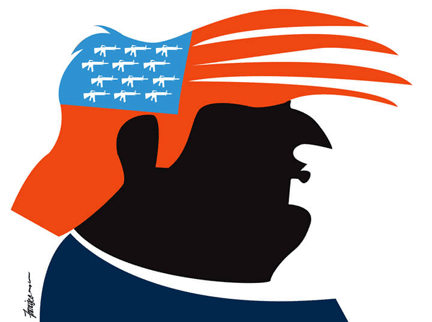 Trump’s callous sanctions risk tipping Iran over the nuclear precipice, Mike Pompeo’s imposition of further sanctions is another disaster for the people of Iran and could cause Tehran to raise the stakes, Guardian, Simon Tisdall Sun 22 Mar 2020
Displaying the sort of unthinking bellicosity that has characterised his tenure as US secretary of state, Mike Pompeo chose last week – a time of unprecedented global turmoil – to impose yet more unilateral sanctions on Iran. This was akin to pouring petrol on a burning building, then waiting to see how big an explosion ensues.
The timing of the new measures was doubly inept. Iran’s freeing of thousands of political prisoners last week raised hopes of full pardons for jailed US citizens and the British-Iranian dual national Nazanin Zaghari-Ratcliffe, who has been temporarily released.
Those hopes have receded now. Meanwhile, Pompeo’s heedless intervention risked fuelling calls inside Iran to
not only the creaking 2015 nuclear deal but also the nuclear non-proliferation treaty (NPT) – the cornerstone since 1970 of international efforts to curb the spread of nuclear weapons.
,………. the move could hardly have been more provocative, or more cruel. Iranians have endured many months of intensifying hardship as US sanctions have shrunk the economy, destroyed jobs and depressed living standards. They have been badly hit by the coronavirus, which the health ministry has said is killing one person every 10 minutes.
Advertisement
Callous US disregard for Iran’s Covid-19 emergency – it is effectively blocking bilateral medical aid and a request for a $5bn loan from the International Monetary Fund – suggests that Washington is not interested in confidence-building measures. “The Wuhan virus is a killer and the Iranian regime is an accomplice,” Pompeo snarled.
Iran’s leadership is under pressure from conservative hardliners after the latter’s recent election successes. This latest manifestation of Washington’s unremitting hostility may help push them over the brink. Thanks mainly to Donald Trump and his sidekick, Tehran could soon move a crucial step closer to going nuclear – the very outcome the Americans most fear……. https://www.theguardian.com/commentisfree/2020/mar/21/trump-pompeo-iran-callous-sanctions-nuclear-precipice
Sun 22 Mar 2020 Trump’s callous sanctions risk tipping Iran over the nuclear precipiceSimon Tisdall
isplaying the sort of unthinking bellicosity that has characterised his tenure as US secretary of state, Mike Pompeo chose last week – a time of unprecedented global turmoil – to impose yet more unilateral sanctions on Iran. This was akin to pouring petrol on a burning building, then waiting to see how big an explosion ensues.
The timing of the new measures was doubly inept. Iran’s freeing of thousands of political prisoners last week raised hopes of full pardons for jailed US citizens and the British-Iranian dual national Nazanin Zaghari-Ratcliffe, who has been temporarily released.
Those hopes have receded now. Meanwhile, Pompeo’s heedless intervention risked fuelling calls inside Iran to
not only the creaking 2015 nuclear deal but also the nuclear non-proliferation treaty (NPT) – the cornerstone since 1970 of international efforts to curb the spread of nuclear weapons.
,………. the move could hardly have been more provocative, or more cruel. Iranians have endured many months of intensifying hardship as US sanctions have shrunk the economy, destroyed jobs and depressed living standards. They have been badly hit by the coronavirus, which the health ministry has said is killing one person every 10 minutes.
Callous US disregard for Iran’s Covid-19 emergency – it is effectively blocking bilateral medical aid and a request for a $5bn loan from the International Monetary Fund – suggests that Washington is not interested in confidence-building measures. “The Wuhan virus is a killer and the Iranian regime is an accomplice,” Pompeo snarled.
Iran’s leadership is under pressure from conservative hardliners after the latter’s recent election successes. This latest manifestation of Washington’s unremitting hostility may help push them over the brink. Thanks mainly to Donald Trump and his sidekick, Tehran could soon move a crucial step closer to going nuclear – the very outcome the Americans most fear……. https://www.theguardian.com/commentisfree/2020/mar/21/trump-pompeo-iran-callous-sanctions-nuclear-precipice
Iran continues to provide international inspectors access to its nuclear facilities
“The agency has not observed any changes to Iran’s implementation of its nuclear-related commitments under the JCPOA in connection with this announcement, or in the level of cooperation by Iran in relation to agency verification and monitoring activities under the JCPOA,” Grossi said in prepared remarks……..
The JCPOA promised Iran economic incentives in return for the curbs on its nuclear program, but since President Donald Trump pulled the U.S. out of the deal unilaterally in 2018 and imposed new sanctions, the country’s economy has been struggling.
Its violations of the pact are intended to pressure the other nations involved to increase economic incentives to make up for the American sanctions. So far, attempts by the other members of the JCPOA have fallen short of Iran’s demands.
In a separate report to members last week, the IAEA said it had identified three locations in Iran where the country possibly stored undeclared nuclear material or undertook nuclear-related activities without declaring it to international observers.
The activities at those locations are believed to have dated from the early 2000s, before the nuclear deal, and Iran responded to the report by suggesting that the IAEA had no legal basis to inspect those sites.
In his speech to the board members, Grossi called on “Iran to cooperate immediately and fully with the agency, including by providing prompt access to the locations specified by the agency.”
“The agency has identified a number of questions related to possible undeclared nuclear material and nuclear-related activities at three locations that have not been declared by Iran,” Grossi said, according to his prepared remarks. “The agency sought access to two of the locations. Iran has not provided access to these locations and has not engaged in substantive discussions to clarify the agency’s questions.” https://www.japantimes.co.jp/news/2020/03/09/world/u-n-atomic-watchdog-says-iran-still-providing-nuclear-access/#.XmbVIagzbIU
Iran Nuclear Accord Parties Meet to Try to Salvage Deal
|
Iran Nuclear Accord Parties Meet to Try to Salvage Deal https://www.voanews.com/middle-east/voa-news-iran/iran-nuclear-accord-parties-meet-try-salvage-deal By RFE/RL, February 26, 2020 The remaining members of the floundering Iran nuclear deal are set to meet in Vienna Wednesday for the first time since Germany, France, and Britain initiated dispute procedures that could reimpose U.N. sanctions on Tehran.
The talks come as the signatories try to rescue the landmark 2015 accord, which has been faltering since U.S. President Donald Trump unilaterally withdrew from it in 2018 and enforced crippling sanctions on Iran. It will be attended by senior diplomats from Iran, Britain, France, Germany, China, Russia, and the EU. They have promised to uphold the deal that saw Iran agree to reduce its program of developing nuclear weapons in exchange for an easing of sanctions, even without Washington’s support. However, since the U.S. withdrawal, Iran has stepped up its program in defiance of Washington’s “maximum pressure” campaign.“ This is a chance — though not of 100 percent — to stop escalation before it’s too late,” Russian Foreign Minister Sergei Lavrov was cited as saying by the Russian Embassy in Vienna on Twitter. Why EU Powers Rejected Trump’s Call to Leave Iran Nuclear Deal
EU foreign policy chief Josep Borrell said Friday the 28-nation bloc will keep trying to save the Iran nuclear deal despite Trump’s call on EU to join US in breaking away from it
This is a chance — though not of 100 percent — to stop escalation before it’s too late,” Russian Foreign Minister Sergei Lavrov was cited as saying by the Russian Embassy in Vienna on Twitter. Iran has since breached its main limitations, exceeding the stockpiles of heavy water and uranium allowed, the number and types of centrifuges it can operate to enrich uranium, and the purity of uranium. As a result, in mid-January, the three European countries said they had “no choice” but to trigger a dispute mechanism in the accord, citing reduced compliance. The process for ultimately reimposing U.N. sanctions consists of several steps, the final one of which is to notify the U.N. Security Council. The restrictive measures would then automatically be reinstated after 30 days unless the Security Council voted to keep them lifted. Trump has called the deal “fatally flawed,” in part because it did not restrict Tehran’s ballistic-missile program or address its support for terrorist groups in the Middle East. Iran insists its nuclear program is for civilian purposes only and that the Joint Comprehensive Plan of Action (JCPOA) allows the country to run reactors to generate power. |
Secretary of State Mike Pompeo explains Trump’s plan to kill off the Iran nuclear agreement
|
Pompeo Reveals Trump Admin’s Wide-Ranging Plan to Combat Iran, Deal Death Blow to Nuclear Deal, Washington Free Beacon,
In discussion with Free Beacon, secretary of state explains how he is galvanizing the globe against the Islamic Republic Republic, Adam Kredo – FEBRUARY 23, 2020, RIYADH, Saudi Arabia—The Trump administration is waging a multi-pronged effort to thwart Iran’s expansion across the Middle East, including efforts at the United Nations to ensure global sanctions come back into effect in what would mark a final death blow for the landmark nuclear deal, Secretary of State Mike Pompeo told the Washington Free Beacon in an exclusive and wide-ranging interview. In a one-on-one talk with the Free Beacon on Friday following high-level meetings with the Saudi royal family in Riyadh, Pompeo pulled the curtain back on the Trump administration’s years-long effort to combat Iran militarily and diplomatically…….. In the coming months, Pompeo said, he and the president will make a major decision about whether to petition the U.N. to invoke what is known as “snapback” on a set of international sanctions on Iran that were lifted as part of the Obama administration’s nuclear accord. Iran hawks in Congress have been pressing Pompeo and the administration to pursue this course of action for months, a message the secretary says he has received and is digging into. Such a move would deal a deathblow to the nuclear deal. …….. In the coming months, Pompeo said, he and the president will make a major decision about whether to petition the U.N. to invoke what is known as “snapback” on a set of international sanctions on Iran that were lifted as part of the Obama administration’s nuclear accord. Iran hawks in Congress have been pressing Pompeo and the administration to pursue this course of action for months, a message the secretary says he has received and is digging into. Such a move would deal a deathblow to the nuclear deal……… When asked about that “special” relationship—a term typically applied to the U.S.-Israel alliance—Pompeo acknowledged that the two countries are on better footing than ever, particularly when it comes to Iran……… https://freebeacon.com/national-security/exclusive-pompeo-reveals-trump-admins-wide-ranging-plan-to-combat-iran-deal-death-blow-to-nuclear-deal/ |
|
Iran would return to 2015 nuclear agreement if Europe would provides “meaningful” economic benefits
 Zarif Says Iran Could Reverse Nuclear Breaches If Europe Acts, Sunday, 16 February, 2020 Munich- Asharq Al-Awsat Zarif Says Iran Could Reverse Nuclear Breaches If Europe Acts, Sunday, 16 February, 2020 Munich- Asharq Al-Awsat
Iran would be willing to move back towards the 2015 nuclear deal (JCPOA) if Europe provides “meaningful” economic benefits, announced Iranian Foreign Minister Mohammed Javad Zarif on the sidelines of Munich Security Conference (MSC).
Zarif met with members of the European Council on Foreign Relations (ECFR) in Munich where they discussed the nuclear deal, Europe’s obligations under the deal, and regional and international issues. He pointed out that Iran is ready to return from reducing its nuclear obligations if Europe abides by its obligations and takes practical steps in this field…… https://aawsat.com/english/home/article/2134461/zarif-says-iran-could-reverse-nuclear-breaches-if-europe-acts |
|
Top EU diplomat to visit Tehran amid nuclear tensions
|
France 24, 2 Feb 2029, Top EU diplomat Josep Borrell was Monday due to visit Iran, said officials in Tehran and Brussels, on his first trip there since taking office, aiming to reduce rising tensions over the Islamic republic’s nuclear programme.
Borrel was set to meet President Hassan Rouhani, Foreign Minister Javad Zarif and parliamentary speaker Ali Larijani on the two-day trip, his office said in a statement. The 2015 nuclear deal between Tehran and a group of world powers has been crumbling since US President Donald Trump withdrew from it in 2018, and Washington has since stepped up sanctions and a campaign of “maximum pressure” against Iran. Borrell’s mission aims “to de-escalate tensions and seek opportunities for political solutions to the current crisis,” said the office of the EU’s high representative for foreign affairs and security policy. The visit will allow Borrell “to convey the EU’s strong commitment to preserve” the nuclear deal, known as the Joint Comprehensive Plan of Action, and to discuss cooperation between the EU and Iran, his office said……… https://www.france24.com/en/20200202-top-eu-diplomat-to-visit-tehran-amid-nuclear-tensions |
|
U.S. sanctions Iran’s atomic power chief for nuclear violations
|
U.S. sanctions Iran’s atomic power chief for nuclear violations
By Don Jacobson Jan. 31 (UPI) — The U.S. Treasury has imposed fiscal sanctions against Iran’s nuclear energy chief and ordered his U.S.-linked assets frozen, amid ongoing tensions between the Washington, D.C., and Tehran.The Treasury on Thursday sanctioned Ali Akbar Salehi, the head of the Atomic Energy Organization of Iran, saying the agency has played a significant role in Tehran violating nuclear regulations……. https://www.upi.com/Top_News/US/2020/01/31/US-sanctions-Irans-atomic-power-chief-for-nuclear-violations/3251580482287/
|
|
Donald Trump tweets that US will not lift sanctions to secure nuclear deal with Iran
 US will not lift sanctions to secure nuclear deal with Iran , https://www.sbs.com.au/news/us-will-not-lift-sanctions-to-secure-nuclear-deal-with-iran 26 Jan 2020, Donald Trump has tweeted that the US will not lift sanctions on Iran in order to negotiate a new nuclear deal.
The United States will not lift sanctions on Iran in order to negotiate, US President Donald Trump has tweeted, seemingly in response to a Der Spiegel interview with Iran’s foreign minister.
“Iranian Foreign Minister says Iran wants to negotiate with The United States, but wants sanctions removed. @FoxNews @OANN No Thanks!” Trump tweeted in English on Saturday and later in Farsi.
Iran’s Foreign Minister Mohammad Javad Zarif responded on Sunday by tweeting an excerpt from the interview with Der Spiegel published on Friday, where he said Iran is still open to negotiations with America if sanctions are lifted.
“@realdonaldtrump is better advised to base his foreign policy comments & decisions on facts, rather than @FoxNews headlines or his Farsi translators,” Zarif said in the tweet with the interview excerpt.
Tensions between Iran and the United States have reached the highest levels in decades after the US killed top Iranian General Qassem Soleimani in a drone strike in Baghdad on January 3, prompting Iran to fire missiles days later at bases in Iraq where US troops are stationed.
Tensions between the two have been increasing steadily since Trump pulled the United States out of Iran’s nuclear pact with world powers in 2018 and reimposed sanctions that have driven down Iran’s oil exports and hammered its economy.
Despite years of negotiations, we came once again to the brink of conflict with Iran.
Reporting on the Iran nuclear deal: ‘nothing happens until everything happens’Our world affairs editor reflects on how, despite years of negotiations, we came once again to the brink of conflict. Guardian, Julian Borger Sun 26 Jan 2020, Countries tend to go to war when diplomacy fails. But Washington and Tehran are now facing off because it succeeded. It was because the 2015 nuclear deal was Barack Obama’s proudest foreign policy achievement that Donald Trump was so determined to destroy it.
The US and Iran are sliding back towards the brink of conflict. If a missile had landed a little bit differently in the course of the latest exchange of hostilities, they would probably be at war by now.
As the pendulum has swung one way and then the other, the Guardian has tried to cover the diplomacy with the same depth and emphasis as the military manoeuvres, even when it seems slow-moving and complex.
When formal talks began between the Obama administration and the new government of Hassan Rouhani in September 2013, our foreign editor, Jamie Wilson, decided we should cover the whole process in detail because of the potentially historic nature of success, and the very high price of failure.
. When formal talks began between the Obama administration and the new government of Hassan Rouhani in September 2013, our foreign editor, Jamie Wilson, decided we should cover the whole process in detail because of the potentially historic nature of success, and the very high price of failure.
……… For Rezaian – now a Washington columnist – and many of those who saw the worst side of the Islamic Republic, its cruelties are all the more reason to prevent it developing nuclear weapons, and bind it into an international agreement. For others, particularly on the American right, any deal that eased the pressure on Iran’s economy would make the west complicit in Iran’s oppression at home and aggression abroad.
In the end, all those years of diplomacy and all the delicate compromises of the JCPOA, by which the Iranians accepted nuclear limits for sanctions relief, came to naught. Tehran’s nuclear programme is expanding again, and the US and Iran are back on the brink of conflict.
It is a chilling thought that no one in the US chain of command has the authority to stop Trump if he were to pick up the verification codes on the small plastic card (for some reason called the nuclear “biscuit”) that a US president always has close by, and order up Armageddon.
With that other extinction-level threat, the climate emergency, there is so much happening that it is impossible to keep up. But the nuclear threat is different: nothing happens until everything happens. By the time there is something substantial to report on, it could be far too late.https://www.theguardian.com/membership/2020/jan/25/iran-nuclear-deal-us-reporting
Iran will never seek nuclear weapons – P.M Rouhani
|
Iran’s Rouhani: nation ‘will never seek nuclear weapons’, with or without 2015 deal in place, https://www.france24.com/en/20200122-iran-s-rouhani-nation-will-never-seek-nuclear-weapons-2015-nuclear-deal-europe-washington Iran will never seek nuclear weapons with or without a nuclear deal, Iranian President Hassan Rouhani said on Wednesday, calling on the European powers to avoid Washington’s mistake of violating Tehran’s 2015 nuclear deal with major powers.
We have never sought nuclear weapons … With or without the nuclear deal we will never seek nuclear weapons … The European powers will be responsible for the consequences of violating the pact,” said Rouhani, according to his website President.Ir. In reaction to Washington’s withdrawal from the deal in 2018 and the reimposition of sanctions, Iran has gradually rolled back on its commitments. Rouhani said Iran remained committed to the deal and could reverse its steps away from compliance if other parties fulfilled their obligations. |
|
Tehran warns it may cease cooperation with IAEA
Iran Says It Might Reconsider Cooperation With Nuclear Watchdog, https://www.haaretz.com/middle-east-news/iran/iran-says-it-might-reconsider-cooperation-with-nuclear-watchdog-1.8412402 19 Jan 2020
Tehran’s warning comes in response to EU powers triggering a dispute mechanism under the 2015 nuclear deal, Iran will review its cooperation with the United Nations’ nuclear watchdog should it face “unjust” measures, Iranian parliament speaker Ali Larijani said, after EU powers last week triggered a dispute mechanism under Tehran’s 2015 nuclear deal.
“We state openly that if the European powers, for any reason, adopt an unfair approach in using the dispute mechanism, we will seriously reconsider our cooperation with the International Atomic Energy Agency,” state TV quoted Larijani as saying.
France, Britain and Germany triggered the mechanism in the deal after Tehran continued to distance itself from the pact by decreasing its nuclear commitments in reaction to sanctions reimposed by Washington since the U.S. quit the agreement in 2018.
Tehran announced last week that it would abandon limitations under the deal on enriching uranium, though it said that Iran would continue cooperating with the UN nuclear watchdog (IAEA), which is policing the nuclear pact.
Under the deal between Iran and six major powers, Tehran agreed to curb its nuclear programme in exchange for lifting international sanctions against the Islamic Republic.
The three European nations said they still wanted the 2015 nuclear deal to succeed and were not joining a “maximum pressure” campaign by the United States.
Triggering the mechanism amounts to formally accusing Iran of violating the terms of the deal and could lead eventually to reimposing UN sanctions that were lifted under the pact.
The mechanism involves a Joint Commission, whose members are Iran, Russia, China, Germany, France, Britain and the European Union, seeking to resolve the dispute.
1 This Month

10 March A LIVE WEBINAR THE REAL EFFECTS OF NUCLEAR POWER
What the Industry Isn’t Telling Us
1:00 PM Mountain, 2 pm Central, 3 pm Eastern. Live on the Keepers of the Water Facebook page


18 March Webinar @ 1 PM EST: An Assessment of SMR Projects: The Case of Canada
register for the zoom:
https://us02web.zoom.us/webinar/register/WN_o8BIIOUvQ2ONJR1nta65DQ#/registration


of the week – STOP SMALL MODULAR REACTORS IN CANADA
To see nuclear-related stories in greater depth and intensity – go to https://nuclearinformation.wordpress.com
-
Archives
- March 2026 (76)
- February 2026 (268)
- January 2026 (308)
- December 2025 (358)
- November 2025 (359)
- October 2025 (376)
- September 2025 (258)
- August 2025 (319)
- July 2025 (230)
- June 2025 (348)
- May 2025 (261)
- April 2025 (305)
-
Categories
- 1
- 1 NUCLEAR ISSUES
- business and costs
- climate change
- culture and arts
- ENERGY
- environment
- health
- history
- indigenous issues
- Legal
- marketing of nuclear
- media
- opposition to nuclear
- PERSONAL STORIES
- politics
- politics international
- Religion and ethics
- safety
- secrets,lies and civil liberties
- spinbuster
- technology
- Uranium
- wastes
- weapons and war
- Women
- 2 WORLD
- ACTION
- AFRICA
- Atrocities
- AUSTRALIA
- Christina's notes
- Christina's themes
- culture and arts
- Events
- Fuk 2022
- Fuk 2023
- Fukushima 2017
- Fukushima 2018
- fukushima 2019
- Fukushima 2020
- Fukushima 2021
- general
- global warming
- Humour (God we need it)
- Nuclear
- RARE EARTHS
- Reference
- resources – print
- Resources -audiovicual
- Weekly Newsletter
- World
- World Nuclear
- YouTube
-
RSS
Entries RSS
Comments RSS
 nuclear-news