Iran´s new president reappoints UN-sanctioned official as head of the country’s nuclear agency
By Associated Press, 10 August 2024
TEHRAN, Iran (AP) – Iran´s newly-elected president reappointed a U.S.-educated official who came under United Nations sanctions 16 years ago as head of the country´s nuclear department, state TV reported Saturday.
Mohammad Eslami, 67, will continue his work as chief of Iran’s civilian nuclear program and serve as one of several vice presidents. Eslami’s reappointment by President Masoud Pezeshkian comes as Iran remains under heavy sanctions by the West following the collapse of the 2015 deal that curbed Iran´s nuclear activities in exchange for sanctions relief.
Pezeshkian had said during his presidential campaign that he would try to revive the nuclear deal.
The United Nations sanctioned Eslami in 2008 for “being engaged in, directly associated with or providing support for Iran´s proliferation of sensitive nuclear activities or for the development of nuclear weapon delivery systems”, when he was the head of Iran´s Defense Industries Training and Research Institute.
He was appointed as the chief of Iran´s nuclear department for the first time by late President Ebrahim Raisi in 2021, before that, from 2018, in moderate former President Hassan Rouhani´s era, Eslami served as Transport and Urban Development Minister.
He has experience working in Iran´s military industries, for years, most recently as deputy defense minister responsible for research and industry……………………
Iran is building two nuclear power facilities to supplement its sole operational 1,000-megawatt reactor at the southern port town of Bushehr, which went online with Russia´s help in 2011. Under its long-term energy plan, Iran aims to reach 20,000-megawatt nuclear electric capacity.
The nation has in recent months faced country-wide power outages.https://www.dailymail.co.uk/wires/ap/article-13730505/Iran-s-new-president-reappoints-UN-sanctioned-official-head-countrys-nuclear-agency.html
Iran Is Better Positioned to Launch Nuclear-Weapons Program
New U.S. Intelligence Assessment Says. U.S. officials say Iran isn’t currently
seeking to build a nuclear device but is engaged in activities that could
help it do so. Iran is pursuing research that has put it in a better
position to launch a nuclear-weapons program, according to a new assessment
by U.S. intelligence agencies. The shift in Washington’s view of Iran’s
nuclear efforts comes at a critical time, with Iran having produced enough
highly enriched nuclear fuel for a few nuclear weapons.
Wall St Journal 9th Aug 2024
Iran vows revenge after Hamas leader Ismail Haniyeh killed in Tehran
Death came hours after Israel said it killed a top Hezbollah commander in Beirut, fuelling fears of regional conflict
Guardian, Emma Graham-Harrison, Quique Kierszenbaum and Bethan McKernan in Jerusalem, and William Christou in Beirut 31 July 24
Ismail Haniyeh, the political leader of Hamas, was killed by a strike in Tehran in the early hours of Wednesday morning, only hours after Israel said it had killed a top Hezbollah commander in Beirut.
The dual assassinations are heavy blows to Hamas and Hezbollah, but also raise the stakes for Iran, which backs both groups and vowed revenge. They will fuel growing fears that the war in Gaza could escalate into a broader regional conflict.
A senior Hamas official described Haniyeh’s killing as a “cowardly act that will not go unpunished”. Mediators Qatar and Egypt warned it would set back talks on a ceasefire and a deal to release hostages held in Gaza.
Haniyeh was targeted by an airstrike at a “residence in Tehran”, Hamas said, after he travelled to the Iranian capital for the inauguration of the country’s new president, Masoud Pezeshkian.
Iran’s supreme leader, Ayatollah Ali Khamenei, said that because the attack took place in Tehran, “we consider his revenge as our duty”. Pezeshkian said his country would defend its territorial integrity and honour, and make the “terrorist occupiers regret their cowardly action”.
The Israeli government officially declined to comment on Haniyeh’s death, but the strike was widely acknowledged as an Israeli operation both inside the country and beyond.
Israel vowed to kill all Hamas leaders after the 7 October attacks, and its intelligence services have a history of carrying out covert killings inside Iran, mostly targeting scientists working on the country’s nuclear programme.
The retired general Amos Yadlin, a former head of Israel’s Military Intelligence Directorate, described the attacks on Wednesday night as “two quality operations of Israel defence forces against two top terrorists, one in Beirut and one in Tehran”.
The US defence secretary, Lloyd Austin, speaking after the assassinations, said the Biden administration was “doing things to take the temperature down” but would come to Israel’s defence if it were attacked…………………………………………………………………….
Haniyeh’s death came hours after Israel claimed it had killed Hezbollah’s top military commander, Fuad Shukur, in an airstrike on a south Beirut suburb launched in retaliation for a rocket attack that killed 12 children at the weekend…………………………………………………………….. more https://www.theguardian.com/world/article/2024/jul/31/hamas-leader-ismail-haniyeh-death-raid-iran-home-israel-gaza-war
Severe heatwave in Iran forces shops and public institutions to close

A heatwave blanketing Iran has forced authorities to cut operating hours at
various facilities on Saturday and order all government and commercial
institutions to close on Sunday, as hospitals received more than 200 people
for heatstroke treatment. Temperatures ranged from 37C (98.6F) to 42C
(107F) in the capital, Tehran, according to weather reports. The state-run
Islamic Republic News Agency (IRNA) said banks, offices and public
institutions across the country would close on Sunday to protect people’s
health and conserve energy and that only emergency services and medical
agencies would be excluded.
Guardian 27th July 2024
US says not ready to resume nuclear talks with Iran under Pezeshkian
Iran International 8 July 24
The Biden administration is not ready to resume nuclear talks with Iran under the new president, the White House national security council spokesman said Monday.
In his presidential campaign, Iran’s president-elect Masoud Pezeshkian advocated engagement in constructive talks with Western powers to revive the 2015 nuclear deal (JCPOA) and to lift the sanctions that he says have crippled the Iranian economy since the withdrawal of the US from the agreement in 2018.
Asked whether Pezeshkian’s election will change the US negotiating position, the White House’s John Kirby offered a blunt “no”…………………………………………….more https://www.iranintl.com/en/202407084339
Masoud Pezeshkian: Iranian reformer who wants to end Tehran’s nuclear stand-off
Heart surgeon turned president pledges reform of system millions of his compatriots believe cannot be changed
Ft.com Najmeh Bozorgmehr in Tehran, 7 July 24
Only four months ago it was unclear whether reformist Masoud Pezeshkian would even be allowed to run for Iran’s parliament: hardliners controlled all the centres of power, with other factions consigned to the political wilderness.
But now Pezeshkian is set to become the Islamic republic’s first reformist president in two decades, after pulling off an unexpected victory in Friday’s election run-off. The 69-year-old defeated his hardliner rival, Saeed Jalili, with promises of change to Tehran’s domestic and foreign policies.
Pezeshkian’s electoral success has rejuvenated the marginalised reformist camp, which was initially amazed that the leadership approved his candidacy following a string of elections in which other reformers were barred………………………………………………….
During the campaign, Pezeshkian vowed to re-engage with the US and European states to negotiate an end to Iran’s nuclear stand-off with the west, and to secure sanctions relief to help the economy……………………………………………..
As president, his ability to push through change will depend heavily on his relations with Khamenei, analysts said, as Pezeshkian is expected to encounter stiff resistance from hardliners elsewhere…………………………………… more https://www.ft.com/content/5e7e80b3-4b46-4cce-a762-c95705201753
Iran Says Cooperation With UN Nuclear Watchdog Limited to Nuclear Non-Proliferation Treaty (NPT)
Iran’s top nuclear official says the country’s interactions with the UN
nuclear watchdog, IAEA, are limited to the legal boundaries of the Nuclear
Non-Proliferation Treaty (NPT) and the Safeguards. Mohammad Eslami
emphasized that the International Atomic Energy Agency (IAEA) has no right
to demand anything beyond these limits. The statement arises amid increased
scrutiny over Iran’s nuclear activities, with international concern about
potential NPT violations.
Iran International 23rd June 2024
Iran’s Nuclear Point Man : We Won’t Bow to Pressure

Friday, 06/14/2024, https://www.iranintl.com/en/202406149313—
Ali Shamkhani, advisor to the Supreme Leader and apparent nuclear negotiator, stated on Friday that Iran “won’t bow to pressure” amidst US warnings regarding its uranium enrichment activities.
“Iran’s nuclear program relies on national will and development strategy,” Shamkhani wrote on X. “The US and some Western countries would dismantle Iran’s nuclear industry if they could.”
The US issued a warning to Iran, stating they will “respond accordingly” if Iran continues to accelerate its nuclear program. This came shortly after the UN nuclear watchdog, the International Atomic Energy Agency (IAEA), highlighted Tehran’s expanding uranium enrichment.
The IAEA’s report revealed Iran’s response to a censure resolution, indicating expanded uranium enrichment at two underground sites. Iran rapidly installed more uranium-enriching centrifuges at its Fordow site and began work on additional ones at its Natanz facility, the report said.
A week ago, The IAEA’s Board passed a resolution urging Iran to cooperate and reverse its decision to bar inspector visits, with the US stressing the need for Iran’s compliance. Britain, France, and Germany tabled the resolution, which the US reportedly opposed but later endorsed. Only Russia and China voted against the measure.
Shamkhani, an old-guard military figure who served as the secretary of Iran’s Supreme National Security Council until last year, had previously warned of a “serious and effective response” if European nations pursued the resolution.
According to an IAEA assessment, Iran is enriching uranium to 60% purity, approaching the 90% threshold typical of weapons-grade material. Additionally, it has accumulated enough material for additional enrichment, potentially resulting in three nuclear warheads.
The West has a 15-month opportunity for a new nuclear deal with Iran that precludes an Iranian Bomb
Bulletin, By Seyed Hossein Mousavian | June 11, 2024
The Board of Governors of the International Atomic Energy Agency (IAEA) voted last week to censure Iran for failing to cooperate fully in the inspection regime set up under the 2015 nuclear deal to make Iran’s program more transparent and to set limits that would prevent redirection of nuclear material to make weapons. But the deal has failed for many reasons, not just Iran’s interference with IAEA inspectors.
Censure resolutions by the IAEA board are not legally binding but send a strong political and diplomatic message. The representative of Iran’s mission to the United Nations stated, “The decision of the Western countries was hasty and unwise, and it will undoubtedly have a detrimental impact on the process of diplomatic engagement and constructive cooperation.” Today, Iran may be only weeks away from having material for several nuclear weapons. The new President and cabinet of Iran will be determined within the next two months.
The United States and Europe should try to negotiate a new nuclear deal with Iran’s new administration.
At the IAEA board meeting, China, Iran, and Russia issued a joint statement blaming the US for its “unlawful and unilateral withdrawal” from the 2015 Iran nuclear deal (official known as the Joint Comprehensive Plan of Action, or JCPOA) and the imposition of “unilateral and illegal sanctions” against Iran. The three countries wrote that “[s]hould the full implementation of the JCPOA be in place today, it would have alleviated the overwhelming majority of existing questions regarding Iran’s peaceful nuclear program on a mutually accepted basis. The IAEA Secretariat too would have had broader verification and monitoring means.”
The three countries confirmed their readiness to restore the agreement based on the text of a draft agreement initially circulated in August 2022 by European Union foreign policy chief Josep Borrell and blamed the United States and the European signatories to the 2015 deal for blocking the draft for “the sake of their own political considerations”.
The nuclear crisis with Iran began in 2003 when the world became aware that Iran was building a uranium enrichment plant. But the divergence between Iran and the West on nuclear issues started after the 1979 revolution in Iran. Now, 45 years later, a last chance is still open for a positive resolution……………………………………………………………………………………………………………………………………………………..
The global powers still have an opportunity to engage Iran in a “New Nuclear Deal”: lifting nuclear sanctions in exchange for Iran’s full and permanent commitment to implementing comprehensive transparency measures in the JCPOA, which would grant the agency full visibility into Iran’s nuclear activities. It is the best option for staving off the Iranian Bomb. https://thebulletin.org/2024/06/the-west-has-a-15-month-opportunity-for-a-new-nuclear-deal-with-iran-that-precludes-an-iranian-bomb/
A majority of Iranians now favor possessing nuclear weapons. Their leaders take note.
Bulletin, By Peyman Asadzade | June 13, 2024
Iran is currently in a state of nuclear latency; it possesses the necessary materials to develop nuclear weapons should it decide to proceed. However, Iranian leaders have consistently stated that the country has no such intentions. Historically, public opinion polls since the mid-2000s have consistently demonstrated that while Iranians favored a peaceful nuclear program, a majority of them opposed developing nuclear weapons.
A recent survey, however, suggests that Iranian citizens are growing more receptive to nuclear weapons.
The survey, conducted between February 20 and May 26, was designed and carried out by the author in collaboration with the Toronto-based company, IranPoll. It used an online panel of 2,280 Iranian citizens that closely reflects the demographic structure of the national population, with targeted quotas across region, age, income, and gender.
The survey included two questions about Iran’s nuclear program. First, to what extent participants agreed or disagreed with the statement that “Iran should be able to use nuclear energy for peaceful purposes,” to which they were provided with four options: “strongly agree,” “somewhat agree,” “somewhat disagree,” and “strongly disagree.” An overwhelming majority of respondents (92 percent) either strongly or somewhat agreed with the statement, aligning with previous surveys about support for Iran’s civilian nuclear program—87 percent agreed with this statement in a 2011 survey, and a similar number (90 percent) agreed in 2020.
Respondents were then asked to what extent they agreed or disagreed with the statement that “Iran should possess nuclear weapons” and were given the same response options. Over 69 percent of them responded they support Iran pursuing nuclear weapons. This marks a departure from earlier opinion polls in which most Iranians consistently rejected the weaponization of the country’s nuclear program. It also stands in stark contrast to the stance of Iran’s elite, including the Supreme Leader Ayatollah Ali Khamenei’s fatwa (a legal ruling on a point of Islamic law) against the development and use of nuclear weapons……………………………………………….. https://thebulletin.org/2024/06/a-majority-of-iranians-now-favor-possessing-nuclear-weapons-their-leaders-take-note/
Nuclear watchdog votes to censure Iran for non-cooperation with inspectors
Clash between Iran and west over nuclear programme looms as US drops objections and joins European states condemning Tehran
Patrick Wintour, 6 June 24, https://www.theguardian.com/world/article/2024/jun/05/iaea-un-nuclear-watchdog-iran-vote
A fresh confrontation between Tehran and the west is looming over Iran’s nuclear programme after the board of the UN nuclear watchdog voted heavily to censure the country for its repeated failure to cooperate with UN nuclear inspectors.
The vote by the IAEA (International Atomic Energy Agency) members was passed with 20 represented countries in favour, two against, and 12 abstentions. The two countries to vote against were Russia and China.
It came after the US dropped its objections to the censure and joined the European countries condemning Iran’s failure to cooperate for years. The Biden administration had been reluctant to take the step, wishing not to open up another conflict with Iran in the Middle East, but the Europeans insisted the integrity of the nuclear non-proliferation treaty was at stake.
In backing the motion, the US called for a longer-term strategy to be developed towards Iran’s nuclear programme, especially since many of the restrictions placed on Iran in the original 2015 nuclear deal will be lifted next year. The last censure motion against Iran 19 months ago led to Iran announcing that it was going to enrich uranium to 60% purity – close to weapons grade – at its Fordow fuel enrichment plant.
Iran signed a nuclear deal in 2015, the joint comprehensive plan of action (JCPoA) that saw western economic sanctions lifted in return for strong controls over its civil nuclear programme. But the country has gradually reduced inspectors’ access to its nuclear sites and also vastly increased its stock of highly enriched uranium in breach of the limits set. It says it did so in response to Donald Trump unilaterally pulling the US out of the agreement in 2018, a move that is widely seen to have undercut advocates of western engagement inside Iran.
Iran says a fatwa (Islamic edict or legal decree) forbids possession of nuclear weapons, and in recent days it has disowned remarks made by some senior politicians arguing Iran should develop a bomb.
In a joint statement to the IAEA board, the UK, France and Germany – the three European signatories to the agreement – said: “Iran now possesses 30 times the JCPoA limit of enriched uranium and its stockpile of high enriched uranium up to 60% has continued to grow significantly. Iran now has the approximate amount of nuclear material from which the possibility of manufacturing a nuclear explosive device cannot be excluded.”
It added that the IAEA had “lost continuity of knowledge in relation to the production and inventory of centrifuges, rotors and bellows, heavy water and uranium ore concentrate”.
The IAEA director general, Rafael Grossi, had visited Iran before the quarterly board meeting in a bid to negotiate improved access, but the death of the Iranian president, Ebrahim Raisi, led to the discussions freezing.
In a joint statement issued before the vote, China, Iran and Russia called for fresh talks to revive the nuclear deal, saying it “was time for the western countries to show their political will, to refrain from the endless cycle of escalation that has been going on for almost the last two years. Passing of the resolution was a mistake that will only lead to confrontation.”
The Israeli foreign minister, Israel Katz, hailed the IAEA decision, saying: “This is the first resolution in 19 months on Iranian violations, paving the way for further actions against Iran’s nuclear activities … The free world must stop Iran now – before it’s too late.”
Iran’s specific countermeasures may be delayed by the country’s presidential election on 28 June, since candidates have different views on the wisdom of signing the deal in the first place.
In a joint statement after the passage of the resolution, France, Germany and the UK said: “The IAEA board will not sit idly by when Iran challenges the foundations of the non-proliferation system and undermines the credibility of the international safeguards regime.
“Iran must cooperate with the agency and provide technically credible explanations which satisfy the agency’s questions.
“This resolution supports the agency to pursue its dialogue with Iran to clarify all outstanding safeguards issues, while setting the stage for further steps to hold Iran to account if it fails to make concrete progress.”
They added it was still open to Iran to cooperate.
Iran’s Near Bomb-Grade Uranium Stock Grows Ahead of Election
International Atomic Energy Agency inspectors verified on Monday that
Iran’s stockpile of highly enriched uranium rose 17% over the last three
months, according to a nine-page, restricted report circulated among
diplomats and seen by Bloomberg. That’s enough uranium to fuel several
warheads, should Iran make a political decision to pursue weapons.
Bloomberg 27th May 2024
https://finance.yahoo.com/news/iran-near-bomb-grade-uranium-154724858.html
Iran appoints nuclear negotiator Ali Bagheri as interim foreign minister
First Post FP Staff • May 20, 2024
Following the horrific helicopter crash that killed Iran’s Foreign Minister and President, Ali Bagheri, the country’s seasoned nuclear negotiator, was named acting Foreign Minister on Monday.
Hossein Amir-Abdollahian, the late foreign minister, had Bagheri, 56, as his deputy. He is well-known for his strong connections to Iran’s ultraconservatives and his membership in the inner circle of Supreme Leader Ayatollah Ali Khamenei.
Bagheri was known for his composed manner throughout his tenure, even though he took strong positions, especially when it came to denouncing intervention from the West.
Bagheri is well-versed in Iran’s nuclear dossier, a divisive topic that has soured relations between Tehran and major international players, notably Israel. He became a prominent opponent of the 2015 nuclear agreement, charging that Iran’s interests were compromised by the previous government…………………………………………….
With nuclear talks at a stalemate due to major differences, especially with the United States, Baghari’s nomination as interim foreign minister comes at a difficult moment. https://www.firstpost.com/world/iran-appoints-nuclear-negotiator-ali-bagheri-as-interim-foreign-minister-13772964.html
Iran open to ‘serious dialogue’, says UN nuclear chief
Fraught relations with Tehran, which faces sanctions over its atomic programme, appear to be easing
Andrew England in London, Ft.com 15 May 24
Iran has shown a willingness to engage in “serious dialogue” with the UN’s nuclear watchdog for the first time in more than a year, according to the agency’s head, in a sign Tehran is seeking to ease tensions with the US. Rafael Grossi, director-general of the International Atomic Energy Agency, told the Financial Times that Tehran and the watchdog, which have endured fraught relations for months, could be entering a “different phase” after he held talks in Iran. Tehran appears willing to discuss “concrete” issues, he said. The apparent shift in tone was prompted by an invitation from Iran’s nuclear chief Mohammad Eslami for Grossi to attend talks in the Islamic republic. The call came in mid-April at a time of heightened tensions between Iran, Israel and the US.
Around that time, Iranian officials issued veiled threats that Tehran could change policy and seek to weaponise its expansive nuclear programme. But after meeting Eslami and other senior officials last week on his first trip to Iran since March 2023, Grossi said he sensed an opportunity to resolve some points of contention, including improving the IAEA’s ability to monitor the republic’s nuclear activities. “I see in them a recognition that it is better to have some engagement than to continue on a completely divergent course, leading to more escalation and perhaps even more danger, including war,” Grossi said. “It’s very important because we reconnected after many months of talking past each other.
He added that Washington and Tehran also continued to keep open a “bilateral channel”. The FT revealed that senior US and Iranian officials held secret indirect talks in Oman in January as both sides sought to prevent the Israel-Hamas war from exploding into a full-blown regional conflict………………………
Grossi said Iran had not altered the scale or pace of its nuclear activity since Hamas’s October 7 attack and Israel’s retaliatory offensive in Gaza sparked hostilities across the Middle East. He added that there was “no evidence to suggest that Iran has moved, or is moving, or is planning to move, to a weapons programme”. Iran has been enriching uranium up to 60 per cent purity, close to weapons grade, for more than two years. It is part of Tehran’s response to former US President Donald Trump’s decision to unilaterally abandon the 2015 nuclear accord Tehran signed with world powers………………………………………………. more https://www.ft.com/content/d5e07404-2fed-4f60-ba11-59e6734665c2
US Says It Won’t Let Iran Build Nuclear Bomb

Iran International Newsroom, 14 May 24 https://www.iranintl.com/en/202405131207
The US will not allow Iran to build a nuclear bomb, the State Department said on Monday, one day after a senior Iranian official said Tehran would have no option but to change its nuclear doctrine in the face of Israel’s threats.
“[President] Biden and [US Secretary of State Antony] Blinken will not allow Iran to have a nuclear weapon,” State Department deputy spokesperson Vedant Patel said in a press briefing.
He made the remarks in reaction to Sunday comments by Kamal Kharrazi, a senior advisor to Iran’s ruler Ali Khamenei, that the Islamic Republic would be left with no option but to alter its nuclear doctrine if Israel threatened its nuclear facilities or its existence.
“We continue to assess, though, that Iran is not taking any key activities that would be necessary to produce a testable nuclear device,” Patel told Iran International correspondent Samira Gharaei.
Kharazi said on Sunday that Iran does “not possess nuclear weapons, and there is a fatwa from the leader regarding this matter. But what should you do if the enemy threatens you? You will inevitably have to make changes to your doctrine.”
Asked if these comments were a concern for the United States, Patel said, “We don’t believe that the Supreme Leader has yet made a decision to resume the (nuclear) weaponization program that we judge Iran suspended or stopped at the end of 2003.”
“We continue to assess, though, that Iran is not taking any key activities that would be necessary to produce a testable nuclear device,” Patel told Iran International correspondent Samira Gharaei.
Kharazi said on Sunday that Iran does “not possess nuclear weapons, and there is a fatwa from the leader regarding this matter. But what should you do if the enemy threatens you? You will inevitably have to make changes to your doctrine.”
Asked if these comments were a concern for the United States, Patel said, “We don’t believe that the Supreme Leader has yet made a decision to resume the (nuclear) weaponization program that we judge Iran suspended or stopped at the end of 2003.”
When asked about the Biden administration’s strategy toward a “nuclear threshold state” like Iran in the absence of ongoing negotiations, Patel told Iran International, “We have ways of communicating with Iran when it’s in our interest, I’m not going to comment on that.”
In a Monday press conference in Tehran, Iran’s foreign ministry spokesman suggested that Kharrazi’s remarks were not the official position of the Islamic Republic, and that Tehran’s nuclear doctrine has not changed.
“Iran’s official position on Weapons of Mass Destruction has been repeatedly declared by high-ranking Iranian officials, and there has been no change in Iran’s nuclear doctrine,” Nasser Kanaani told reporters in a briefing held on the sidelines of Tehran International Book Fair, citing a fatwa by Ali Khamenei on the prohibition of the production and use of nuclear weapons as the basis for Iran’s position.
However, the fatwa Iranian officials refer to is not an irrevocable principle. Islamic fatwas can change or be reversed at a moment’s notice, experts have pointed out. Also, the alleged Khamenei fatwa is not actually a religious order, it is part of a statement he submitted to an international conference more than a decade ago.
Khamenei may invoke the principle of expediency to overrule his “anti-Nuclear” fatwa. The principle of expediency, as decreed by the founder of the Islamic Republic Ayatollah Khomeini in January 1988, stipulates that the Supreme Leader may even violate the fundamental tenets of the Islamic faith in order to preserve “the Islamic Regime” as the preservation of the Islamic Regime supersedes all else.
Kharrazi on Sunday also raised the issue of Israel’s alleged nuclear arsenal and called for the Jewish state’s nuclear disarmament. “If Israel threatens other counties, they cannot remain silent,” he retorted.
Last week, Kharrazi had stated, “If they dare to strike Iran’s nuclear facilities, our level of deterrence will change. We have experienced deterrence at the conventional level so far. If they intend to strike Iran’s nuclear capabilities, naturally, it could lead to a change in Iran’s nuclear doctrine.”
In recent weeks, Iran has evoked the option of using the nuclear option as a deterrent against the possibility of an Israeli strike against its atomic facilities, amid a new reality in the Middle East after the October 7 Hamas attack.
On Friday, Iranian lawmaker Ahmad Bakhshayesh Ardestani claimed Iran might already possess a nuclear weapon.
He conveyed to the Rouydad 24 website his belief that Iran’s decision to risk attacking Israel in April stemmed from its possession of nuclear weapons.
Ali-Akbar Salehi, who was foreign minister more than a decade ago and is still a key foreign policy voice in the Iranian government, also said last month that Iran has everything it needed to build a nuclear bomb, as tensions rose with Israel amid the Gaza war.
In a televised interview in April, Salehi, was asked if Iran has achieved the capability of developing a nuclear bomb. Avoiding a direct answer he stated, “We have [crossed] all the thresholds of nuclear science and technology.”
Salehi’s statement was preceded by a declaration from a Revolutionary Guard general. In the midst of tensions between the Islamic Republic and Israel, Ahmad Haghtalab, the IRGC commander of the Guard for the Protection and Security of Nuclear Facilities, announced on April 19 that if Israel intends to “use the threat of attacking our nuclear facilities as a tool to pressure Iran, a revision of the nuclear doctrine and policies of the Islamic Republic of Iran and a shift from previously stated considerations is conceivable and likely.”
Since early 2021, when the Biden administration opted for negotiations to restore the Obama-era JCPOA agreement, Iran has vastly expanded its uranium enrichment efforts and is now believed to have amassed enough fissile material for 3-5 nuclear warheads.
1 This Month
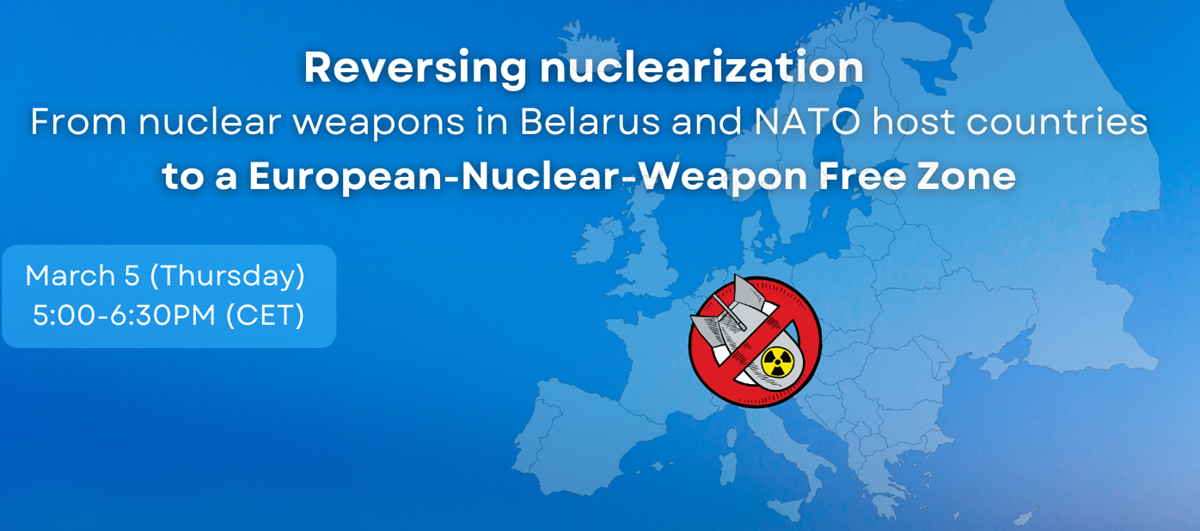
5 March -Online – Reversing nuclearization:
From nuclear weapons in Belarus and NATO host countries to a European-Nuclear-Weapon Free Zone
11am-12:30pm Eastern Time USA / 5pm-6:30pm CET

of the week – Advocating for a
nuclear free beach – https://www.samuellawrencefoundation.org/
The Samuel Lawrence Foundation advocates for a Nuclear Waste Free Beach at San Onofre, join us and take action!
10 March A LIVE WEBINAR THE REAL EFFECTS OF NUCLEAR POWER
What the Industry Isn’t Telling Us
1:00 PM Mountain, 2 pm Central, 3 pm Eastern. Live on the Keepers of the Water Facebook page

18 March Webinar @ 1 PM EST: An Assessment of SMR Projects: The Case of Canada
register for the zoom:
https://us02web.zoom.us/webinar/register/WN_o8BIIOUvQ2ONJR1nta65DQ#/registration

of the week – STOP SMALL MODULAR REACTORS IN CANADA
To see nuclear-related stories in greater depth and intensity – go to https://nuclearinformation.wordpress.com
-
Archives
- March 2026 (51)
- February 2026 (268)
- January 2026 (308)
- December 2025 (358)
- November 2025 (359)
- October 2025 (376)
- September 2025 (258)
- August 2025 (319)
- July 2025 (230)
- June 2025 (348)
- May 2025 (261)
- April 2025 (305)
-
Categories
- 1
- 1 NUCLEAR ISSUES
- business and costs
- climate change
- culture and arts
- ENERGY
- environment
- health
- history
- indigenous issues
- Legal
- marketing of nuclear
- media
- opposition to nuclear
- PERSONAL STORIES
- politics
- politics international
- Religion and ethics
- safety
- secrets,lies and civil liberties
- spinbuster
- technology
- Uranium
- wastes
- weapons and war
- Women
- 2 WORLD
- ACTION
- AFRICA
- Atrocities
- AUSTRALIA
- Christina's notes
- Christina's themes
- culture and arts
- Events
- Fuk 2022
- Fuk 2023
- Fukushima 2017
- Fukushima 2018
- fukushima 2019
- Fukushima 2020
- Fukushima 2021
- general
- global warming
- Humour (God we need it)
- Nuclear
- RARE EARTHS
- Reference
- resources – print
- Resources -audiovicual
- Weekly Newsletter
- World
- World Nuclear
- YouTube
-
RSS
Entries RSS
Comments RSS
 nuclear-news