Zelensky denies ordering attack on Crimean Bridge
https://www.rt.com/russia/565053-zelensky-crimea-bridge-attack/–-22 Oct 22
Officials in Kiev have taken credit for the blast, with the postal service even issuing a commemorative stamp
Ukrainian President Vladimir Zelensky has denied “ordering” the bombing of the Crimean Bridge, earlier this month. The president made the remarks during an interview with the Canadian broadcaster CTV, aired on Wednesday.
Asked to comment on the “spectacular attack” on the bridge, as the broadcaster put it, Zelensky said Kiev was not involved.
lensky said Kiev was not involved.
“We definitely did not order that, as far as I know,” he told the reporters.
The bridge was hit by a massive explosion on October 8, which severely damaged its road traffic section and killed three civilians, as well as setting a passing freight train on fire. Several top Ukrainian officials openly celebrated the attack, while the country’s postal service issued a stamp commemorating the blast, just hours after it happened.
Moscow has directly blamed Kiev for the incident, branding the explosion a “terrorist attack.” Russian law enforcement claims to have established how the bomb, which was disguised as construction materials, made it to the bridge from the Ukrainian port city of Odessa, via multiple transit countries.
Russian investigators believe the plot was hatched by Ukrainian military intelligence. Moscow has identified 12 individuals as suspected accomplices in the plot and has arrested eight of them, the FSB said.
The list of people in custody includes five Russians and three foreign nationals, who hold passports of Ukraine and Armenia. A spokesman for Ukrainian military intelligence told the media that the FSB was a “fake structure,” and that the report was unworthy of comment.
Days after the attack, Moscow ramped up its aerial bombing campaign against Ukraine, targeting its critical infrastructure with cruise missiles and suicide drones. Kiev reported on Tuesday that 23 people were killed and over 100 injured in the barrage.
Would the use of a tactical nuclear weapon in Ukraine lead to all-out nuclear war?

The idea of using a single tactical nuclear weapon is starting to be dangerously downplayed as maybe not all that bad, thus normalizing something that should instead be outlawed. Just hide in your basement for a few days while the radiation dissipates and it’ll be OK.
“tactical” is a term that covers a whole panoply of so-called “short range” weapons armed with a nuclear warhead. Such weapons can be launched from the ground, air, or sea, and even from a truck bed. A single weapon has a typical explosive yield of between 10 and 100 kilotons. The Hiroshima bomb was 15 kilotons. So that’s not exactly small.
Our fears would vanish if nuclear weapons did too
Edging toward Armageddon? — Beyond Nuclear International By Linda Pentz Gunter, 23 Oct 22, https://beyondnuclearinternational.org/2022/10/23/edging-toward-armageddon/
As we mark 60 years since the Cuban Missile Crisis, it’s truly horrifying to realize that our present times are considered to be the closest to nuclear war we have been since those 13 terrifying days in 1962.
What saved us then was cooler heads prevailing, as our stories last week described. But can we be assured that those with the power to press the proverbial button — whether at the pinnacle of leadership or lower down the chain of command — will act with similar sense and restraint?
With Kennedy and Khrushchev in command, there was a willingness on both sides to pull back from the brink, not only rhetorically, but through meaningful actions. Khrushchev removed his nuclear missiles from Cuba while the US publicly declared it would not invade the island. Privately, the US also agreed to dismantle its ballistic missiles stationed in Turkey.
And, as we have seen over the years — and in last week’s article by Angelo Baracca — sometimes it takes a person of more humble position to restore rationality and act with restraint. These near-misses ought to have put the halt on nuclear weapons development many decades ago
Instead, that most obvious of lessons was never learned: that nuclear weapons serve only one purpose; the mutual destruction of all of us. Instead, the nuclear arms race escalated to obscene heights and there are still at least 13,000 nuclear weapons in the world, leaving us perpetually on the edge of Armageddon.
And it was that word, “Armageddon,” that current US President Joe Biden used recently when he said at a Democratic gathering, “We have not faced the prospect of Armageddon since Kennedy and the Cuban Missile Crisis.”
Kennedy had met Khrushchev prior to the 1962 standoff and Biden described Russian president, Vladimir Putin, as “a guy I know fairly well”. But so far, that familiarity hasn’t relieved the current atomic tensions around Russia’s ongoing invasion of Ukraine. Instead, the news is full of alarm bells, warning that yes, Putin might just be mad enough to push the nuclear button and take us all down with him.
Pundits have cautioned that we are “not there yet,” which should not be taken as comfort. It should be taken as an opportunity to ensure that we never, ever get there. And it’s certainly not encouraging that Russia’s new top commander of the war in Ukraine. General Sergei Surovikin, is nicknamed “General Armageddon” for his command of Russia’s Syria bombardments. But, in the meantime, when we talk about Russia “using” nuclear weapons, what could happen?
Russia could use a single tactical nuclear weapon in Ukraine, although “tactical” is a term that covers a whole panoply of so-called “short range” weapons armed with a nuclear warhead. Such weapons can be launched from the ground, air, or sea, and even from a truck bed. A single weapon has a typical explosive yield of between 10 and 100 kilotons. The Hiroshima bomb was 15 kilotons. So that’s not exactly small.
The idea of using a single tactical nuclear weapon is starting to be dangerously downplayed as maybe not all that bad, thus normalizing something that should instead be outlawed. Just hide in your basement for a few days while the radiation dissipates and it’ll be OK.
But it’s that kind of thinking that prompted Biden to use the word “Armageddon” in the first place. “I don’t think there is any such thing as the ability to easily use a tactical nuclear weapon and not end up with Armageddon,” Biden said.
Because of course it wouldn’t be OK at all. Even after the radiation levels drop, the soil and water, and therefore food sources, would be contaminated. Essential infrastructure would be destroyed. There would be countless fatalities and many sick and dying. To use any nuclear weapon would be an abomination.
The White House has also said it would deliver what it described as a “decisive response”, should Russia use nuclear weapons. Again, it’s unclear what this means. Would the US reply with a nuclear attack of its own?
But what all of this does prove is that the possession of nuclear weapons isn’t deterring anything. What we are most frightened of right now is the possibility that Russia will use nuclear weapons and the US and/or NATO might retaliate.
Those fears would vanish if nuclear weapons did too.
That is why continuing to push for signatures and ratifications of the UN Treaty on the Prohibition of Nuclear Weapons is so important, because it’s the one treaty that spells out the immorality of nuclear weapons and the devastating humanitarian impacts that would result even from their so-called limited use.
Linda Pentz Gunter is the international specialist at Beyond Nuclear and writes for and curates Beyond Nuclear International.
Group of 7 condemn Russian kidnapping of Zaporizhzhia nuclear power plant leadership
The Group of Seven industrialised nations condemned Russia’s kidnapping
of the Zaporizhzhia nuclear power plant leadership and called for the
immediate return of full control of the facility to Ukraine.
Guardian 23rd Oct 2022
How the pro-Ukraine “North Atlantic Fellas Organization” (NAFO) troll operation crowd-funds war criminals.
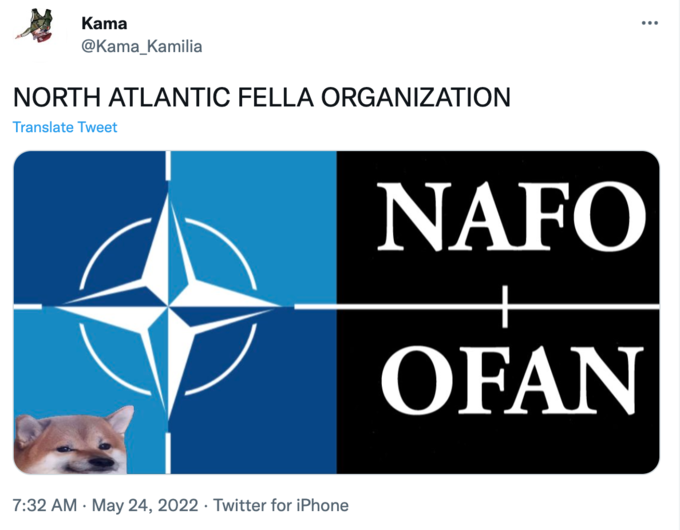
https://thegrayzone.com/2022/10/20/ukraine-nafo-troll-war-criminals/ ALEXANDER RUBINSTEIN, OCTOBER 20, 2022
Celebrated in mainstream US media for its anti-Russian trolling, the Twitter operation known as NAFO was founded by a Polish antisemite to raise money for a militia that has hosted war criminals, white nationalists and wanted murderers.
Whether they know it or not, anyone who has checked Twitter for recent coverage of the Ukraine proxy war has likely encountered at least one of the thousands of trolls that comprise NAFO, or the “North Atlantic Fellas Organization.” Thanks to the efforts of NAFO and its “fellas,” any journalist or prominent figure critical of Ukraine or NATO on Twitter is likely to receive hundreds of replies accusing them of being paid by Russian President Vladimir Putin (or even performing fellatio on him) from accounts with Shiba Inu dog avatars.
Since its inception several months ago, NAFO has earned gushing praise from the Washington Post, which hailed it for “show[ing] that the tables could be turned on Russia, when it came to trolling.” The arms industry-funded, Washington DC-based Center for Strategic and International Studies (CSIS), meanwhile, hosted an online panel highlighting NAFO as an instrumental weapon in the Russia-Ukraine infowars.
One NAFO founder explained that he chose the Georgian Legion as a funding recipient precisely because of the unit’s reputation as a band of “mercenaries and criminals” that was willing to carry out barbarous acts which could cause foreign governments to shy away from supporting it. Another NAFO founder has praised the Georgian Legion’s leader for “killing Russians since the ’90s.”
Among the Georgian Legion’s most notorious members are US fugitive and murderer Craig Lang, as well as Paul Gray, an American whose past involvement in several neo-Nazi organizations was never mentioned during the friendly primetime interviews he was granted by Fox News and its local affiliates.
While providing a financial feeding tube to a militia that revels in its own atrocities, NAFO continues to attract effusive support from mainstream US journalists and think tankers who portray the operation as little more than a grassroots expression of online solidarity with Ukraine.
Obsessively online interventionists find meaning and purpose as “fellas”
Read more: How the pro-Ukraine “North Atlantic Fellas Organization” (NAFO) troll operation crowd-funds war criminals.Employing cartoon memes of the Shiba Inu dog breed, NAFO’s postmodern aesthetic, irreverent style and dedication to viciously trolling any critic of the Ukraine proxy war has garnered the adulation of Western media and interventionist government officials alike.
To outsiders, the lingo that flows through internal NAFO chats might seem unintelligible: “fellas” refers to members; “nafoarticle5” is a call to action that urges “fellas” to dog-pile on a particular social media post; “vatnik” serves as a pejorative for Russians and virtually anyone critical of the US-backed proxy war. Phrases such as “NAFO expansion is non-negotiable” and sarcastic claims that they are funded by the CIA (which they simultaneously claim “doesn’t exist”) are also ubiquitous.
Behind the anonymously named Twitter accounts of NAFO members lies a base of extremely online, mostly male civilians seeking a sense of purpose and community. Some participants have tattooed Shiba Inu avatars onto their bodies while others have published photos of their newborn babies in the arms of an adult sporting a NAFO shirt.
One member of the troll operation tweeted a photo of an elaborate NAFO tattoo emblazoned on his arm, but has since deleted it.
In public, NAFO leaders market the image of a charity-focused community of do-gooders, however, many posts by its fellas reflect the kind of psychologically deranged outbursts familiar to young adult men who spend endless hours ranting on a messaging platform built for gamers……………
While US corporate media have declared that within NAFO “there is no command structure,” effectively releasing the group’s founders from accountability for the fellas’ behavior, this reporter found all the hallmarks of an organizational hierarchy. The group’s Discord server is run by founders, assigned administrators, moderators, and “forgers” who make memes used for harassing people on social media. “Verified fellas” are granted access to otherwise locked channels, while regular “fellas” are assigned more mundane roles.
“It’s preferred that people who are not heavily involved in the day to day do not speak on behalf of NAFO or what NAFO is to the press,” one administrator wrote in the server’s announcement’s channel.
Inside NAFO’s social media crowdfunding nexus
There are three ways to obtain a NAFO avatar and become a verified “fella.” The first is to make a donation to the Georgian National Legion through an email address attached to PayPal and belonging to Taras Reshetylo, a field commander of the Georgian Legion. Another way to join is by donating to an organization called “Protect Ukraine Defenders,” or a merchandise purchase from a website called Saint Javelin. Saint Javelin’s logo depicts the Virgin Mary bearing a US-manufactured Javelin missile.
Though distinct from NAFO at its foundation, Saint Javelin sold merchandise for the organization and recently incorporated NAFO into its brand. For months, all of Saint Javelin’s proceeds from NAFO merchandise went directly to the Georgian Legion, according to its website. Like NAFO, Saint Javelin estimates that it has raised huge sums for the war — more than a million dollars.
Besides fundraising for the Georgian Legion, Saint Javelin passes on proceeds to United24, an initiative launched by Ukraine’s President Volodymyr Zelensky “as the main venue for collecting charitable donations in support of Ukraine.” It also channels money to the Ukrainian World Congress, an organization which has defended the legacy of World War Two-era Nazi collaborator and mass murderer Stepan Bandera, branding him “the undisputed symbol of Ukraine’s lengthy and tragic struggle for independence.”
Saint Javelin’s partnership with Zelensky’s United24 aims to help raise funds to build an “army of drones.”
The Saint Javelin website was launched by a former journalist named Christian Borys whose employment history spans NATO state-funded outlets including Canada’s CBC and Britain’s BBC. Borys has also authored articles for the US government-sponsored outlet Radio Free Europe.
One of Borys’ most notorious journalistic escapades consisted of a night of bar-hopping in the Ukrainian city of Lviv, where he patronized an antisemitic restaurant and returned with a review for Vice News portraying it as one of the city’s many weird and wonderful haunts.
The restaurant converts anti-Jewish tropes into a marketing gimmick; its waiters dress as Orthodox Jews who haggle with patrons over the prices of menu items. “If you play your cards right [it’s] ridiculously cheap,” Borys gushed in his review.
Noting that Lviv “was home to around 220,000 Jewish people,” Borys wrote that “the population now only hovers around 1,100,” Strangely though, he neglected to explain how the genocidal rampage of Stepan Bandera’s Organization of Ukrainian Nationalists helped violently extinguish the local Jewish population. He merely stated that the restaurant “pays homage [to the local Jewish population] in a weird way.”
The Ukrainian ethnic-owned restaurant contains a terrace that overlooks the ruins of “one of the most important synagogues in Eastern Europe.”
In the same 2015 article, Borys described going to a bar where “you’re served by little people,” visiting another that forces you to recite ultra-nationalist slogans before entering, and emptying an AK-47 clip in a target depicting Putin’s face at a local shooting range.
On Twitter, Borys erupted with glee when a member of the neo-Nazi Azov Battalion was spotted wearing a Saint Javelin patch. He seemed equally thrilled when his former employer published photographs from an unstated source of Ukraine’s Defense Minister Olekseii Reznikov handing President Zelensky a Saint Javelin t-shirt.
In the NAFO Discord chat, Borys suggested paying protesters to hold NAFO demonstrations outside Russian embassies.
A retired Marine and amateur conflict pundit named Matt Moores claimed to have established the relationship between NAFO and Borys after co-founding the former organization. On October 7, NAFO was incorporated into the Saint Javelin brand, with the latter becoming the former’s parent company, according to a post by a NAFO administrator in the Discord server’s announcement channel.
The third organization for which NAFO fundraises, Protect Ukraine Defenders, was launched by a well-connected functionary of the Brussels-based intelligentsia named Ievgen Vorobiov. Vorobiov started as an intern for the European Union state-funded Centre for European Policy Studies think tank, then moved on to gigs at the Polish government-founded Polish Institute of International Affairs and Foreign Policy magazine. Before founding Protect Ukraine Defenders, Vorobiov spent nearly four years at the European Union Advisory Mission in Ukraine.
An anchor for amplifying pro-proxy war Twitter accounts
While Twitter has responded to NATO state pressure to suppress accounts associated with Russian state media, and has banned numerous other users for simply questioning the official Western version of events in Ukraine, organizations connected with NAFO have seen explosive growth since the Ukraine proxy war began. Saint Javelin, for its part, has received verification from Twitter and amassed nearly 70,000 followers since launching an account this February.
A NAFO founder who operates under the pseudonym “Kama Kamilia” had less than 200 Twitter followers in April 2022; today they broadcast to an audience of over 22,000. NAFO co-founder Christian Borys had less than 5,500 followers in February 2022 and now boasts more than 36,000. Similarly, Matt Moores’ Twitter account grew by more than 16,000 followers since January.
“Kama Kamilia” has explicitly linked the Georgian Legion’s follower count to the popularity of his NAFO organization: “I think they had 4,000 followers when we started [now] they have… more than 20,000.” As of early October, that number is more than 110,000
Yet NAFO’s beltway boosters often gloss over its role as a fundraising machine for the Georgian Legion, a US-backed Ukrainian fighting group that stands accused of gruesome battlefield atrocities. Several former members of the Legion have produced first-hand testimony documenting its perpetration of war crimes, including the torture and execution of POWs and civilians.
One NAFO founder explained that he chose the Georgian Legion as a funding recipient precisely because of the unit’s reputation as a band of “mercenaries and criminals” that was willing to carry out barbarous acts which could cause foreign governments to shy away from supporting it. Another NAFO founder has praised the Georgian Legion’s leader for “killing Russians since the ’90s.”
Among the Georgian Legion’s most notorious members are US fugitive and murderer Craig Lang, as well as Paul Gray, an American whose past involvement in several neo-Nazi organizations was never mentioned during the friendly primetime interviews he was granted by Fox News and its local affiliates.
While providing a financial feeding tube to a militia that revels in its own atrocities, NAFO continues to attract effusive support from mainstream US journalists and think tankers who portray the operation as little more than a grassroots expression of online solidarity with Ukraine.
Obsessively online interventionists find meaning and purpose as “fellas”
Employing cartoon memes of the Shiba Inu dog breed, NAFO’s postmodern aesthetic, irreverent style and dedication to viciously trolling any critic of the Ukraine proxy war has garnered the adulation of Western media and interventionist government officials alike.
To outsiders, the lingo that flows through internal NAFO chats might seem unintelligible: “fellas” refers to members; “nafoarticle5” is a call to action that urges “fellas” to dog-pile on a particular social media post; “vatnik” serves as a pejorative for Russians and virtually anyone critical of the US-backed proxy war. Phrases such as “NAFO expansion is non-negotiable” and sarcastic claims that they are funded by the CIA (which they simultaneously claim “doesn’t exist”) are also ubiquitous.
Behind the anonymously named Twitter accounts of NAFO members lies a base of extremely online, mostly male civilians seeking a sense of purpose and community. Some participants have tattooed Shiba Inu avatars onto their bodies while others have published photos of their newborn babies in the arms of an adult sporting a NAFO shirt.
One member of the troll operation tweeted a photo of an elaborate NAFO tattoo emblazoned on his arm, but has since deleted it.
In public, NAFO leaders market the image of a charity-focused community of do-gooders, however, many posts by its fellas reflect the kind of psychologically deranged outbursts familiar to young adult men who spend endless hours ranting on a messaging platform built for gamers. In mid-October, for example, an administrator complained that she was forced to ban two members of the NAFO Discord for publicly plotting the murder of a third member of the community.
While US corporate media have declared that within NAFO “there is no command structure,” effectively releasing the group’s founders from accountability for the fellas’ behavior, this reporter found all the hallmarks of an organizational hierarchy. The group’s Discord server is run by founders, assigned administrators, moderators, and “forgers” who make memes used for harassing people on social media. “Verified fellas” are granted access to otherwise locked channels, while regular “fellas” are assigned more mundane roles.
“It’s preferred that people who are not heavily involved in the day to day do not speak on behalf of NAFO or what NAFO is to the press,” one administrator wrote in the server’s announcement’s channel.
Inside NAFO’s social media crowdfunding nexus
There are three ways to obtain a NAFO avatar and become a verified “fella.” The first is to make a donation to the Georgian National Legion through an email address attached to PayPal and belonging to Taras Reshetylo, a field commander of the Georgian Legion. Another way to join is by donating to an organization called “Protect Ukraine Defenders,” or a merchandise purchase from a website called Saint Javelin. Saint Javelin’s logo depicts the Virgin Mary bearing a US-manufactured Javelin missile.
Though distinct from NAFO at its foundation, Saint Javelin sold merchandise for the organization and recently incorporated NAFO into its brand. For months, all of Saint Javelin’s proceeds from NAFO merchandise went directly to the Georgian Legion, according to its website. Like NAFO, Saint Javelin estimates that it has raised huge sums for the war — more than a million dollars.
Besides fundraising for the Georgian Legion, Saint Javelin passes on proceeds to United24, an initiative launched by Ukraine’s President Volodymyr Zelensky “as the main venue for collecting charitable donations in support of Ukraine.” It also channels money to the Ukrainian World Congress, an organization which has defended the legacy of World War Two-era Nazi collaborator and mass murderer Stepan Bandera, branding him “the undisputed symbol of Ukraine’s lengthy and tragic struggle for independence.”
Saint Javelin’s partnership with Zelensky’s United24 aims to help raise funds to build an “army of drones.”
The Saint Javelin website was launched by a former journalist named Christian Borys whose employment history spans NATO state-funded outlets including Canada’s CBC and Britain’s BBC. Borys has also authored articles for the US government-sponsored outlet Radio Free Europe.
One of Borys’ most notorious journalistic escapades consisted of a night of bar-hopping in the Ukrainian city of Lviv, where he patronized an antisemitic restaurant and returned with a review for Vice News portraying it as one of the city’s many weird and wonderful haunts.
The restaurant converts anti-Jewish tropes into a marketing gimmick; its waiters dress as Orthodox Jews who haggle with patrons over the prices of menu items. “If you play your cards right [it’s] ridiculously cheap,” Borys gushed in his review.
Noting that Lviv “was home to around 220,000 Jewish people,” Borys wrote that “the population now only hovers around 1,100,” Strangely though, he neglected to explain how the genocidal rampage of Stepan Bandera’s Organization of Ukrainian Nationalists helped violently extinguish the local Jewish population. He merely stated that the restaurant “pays homage [to the local Jewish population] in a weird way.”
The Ukrainian ethnic-owned restaurant contains a terrace that overlooks the ruins of “one of the most important synagogues in Eastern Europe.”
In the same 2015 article, Borys described going to a bar where “you’re served by little people,” visiting another that forces you to recite ultra-nationalist slogans before entering, and emptying an AK-47 clip in a target depicting Putin’s face at a local shooting range.
VICE News publishes a “supplied” photograph of President Zelensky being handed a Saint Javelin t-shirt by the country’s Minister of Defense
On Twitter, Borys erupted with glee when a member of the neo-Nazi Azov Battalion was spotted wearing a Saint Javelin patch. He seemed equally thrilled when his former employer published photographs from an unstated source of Ukraine’s Defense Minister Olekseii Reznikov handing President Zelensky a Saint Javelin t-shirt.
In the NAFO Discord chat, Borys suggested paying protesters to hold NAFO demonstrations outside Russian embassies.
A retired Marine and amateur conflict pundit named Matt Moores claimed to have established the relationship between NAFO and Borys after co-founding the former organization. On October 7, NAFO was incorporated into the Saint Javelin brand, with the latter becoming the former’s parent company, according to a post by a NAFO administrator in the Discord server’s announcement channel.
The third organization for which NAFO fundraises, Protect Ukraine Defenders, was launched by a well-connected functionary of the Brussels-based intelligentsia named Ievgen Vorobiov. Vorobiov started as an intern for the European Union state-funded Centre for European Policy Studies think tank, then moved on to gigs at the Polish government-founded Polish Institute of International Affairs and Foreign Policy magazine. Before founding Protect Ukraine Defenders, Vorobiov spent nearly four years at the European Union Advisory Mission in Ukraine.
An anchor for amplifying pro-proxy war Twitter accounts
While Twitter has responded to NATO state pressure to suppress accounts associated with Russian state media, and has banned numerous other users for simply questioning the official Western version of events in Ukraine, organizations connected with NAFO have seen explosive growth since the Ukraine proxy war began. Saint Javelin, for its part, has received verification from Twitter and amassed nearly 70,000 followers since launching an account this February.
A NAFO founder who operates under the pseudonym “Kama Kamilia” had less than 200 Twitter followers in April 2022; today they broadcast to an audience of over 22,000. NAFO co-founder Christian Borys had less than 5,500 followers in February 2022 and now boasts more than 36,000. Similarly, Matt Moores’ Twitter account grew by more than 16,000 followers since January.
“Kama Kamilia” has explicitly linked the Georgian Legion’s follower count to the popularity of his NAFO organization: “I think they had 4,000 followers when we started [now] they have… more than 20,000.” As of early October, that number is more than 110,000.
In September, the Discord tech company granted NAFO “partnered” status, meaning it now serves as a corporate “role model” and is considered one of “the best servers out there.” Yet it is composed of just over 3,000 members, raising questions about the tens of thousands of new followers NAFO has suddenly accumulated on Twitter.
NAFO’s expansion has also driven the growth of hundreds, if not thousands, of otherwise insignificant Twitter accounts which have participated in online harassment and used the group to push crowdfunding efforts.
One NAFO-stylized account which the Georgian Legion follows and at least one administrator of the NAFO Discord boasted that they were able to purchase gear for a Ukrainian soldier named “Igor.” In the photographs attached to the Tweet, Igor can be seen wearing a Nazi Sonnenrad patch.
The war crimes of the Georgian Legion
Behind the goofy Shibu Ina avatars and rambunctious chat sessions lies a mission that defines NAFO: to raise as much money as possible for the Georgian National Legion. One administrator of the official NAFO discord put it succinctly: “NAFO has always been about supporting the Georgian Legion first and foremost.”
Another administrator stated on July 2 of this year that “$43,000 (USD) has been raised by the fellas for the Georgian Legion.” Three months later, a NAFO member estimated the figure to be “likely totaling over $1 million,” a metric of the explosive growth of the group. “It is the most organic movement I’ve been involved with,” he told the Wall Street Journal.
While NAFO fundraises for several allied organizations, supporters are most frequently directed to donate to the Georgian Legion. Matt Moores, the US Marine veteran who co-founded NAFO and describes himself as “very online,” has explained in interviews that NAFO “started as a fundraiser really.”
“Beyond the memes, beyond the jokes, beyond the humor, there is a real component of it with, you know, fundraising. These little cartoon dog avatars that they have, each one of them is made by a volunteer, a fella forger, in our community and these little small donations have raised close to $300,000 so far,” Moores explained.
With an existing Twitter following, Moores reached out to someone who posts online under the Kama Kamilia in May. It was then that NAFO was born.
“I was looking and saw that someone was posting these little cartoon dogs and using them to, you know, mock and to belittle these, you know, propaganda statements and the supposed achievements of the Russian military and just trying to throw these little jabs wherever you could get them in,” Moores said. “One day someone asked Kamil ‘how do I get one of these?’ And he said ‘if you send $20 or whatever it is to the Georgian Legion we’ll make you one of these.’ So from there it has really gotten quite out of hand.”
Little is known about the NAFO co-founder “Kama Kamilia,” as corporate media outlets hyping them as a pro-Ukraine influencer extraordinaire have refused to disclose his real name. However, this reporter and researcher Moss Robeson have determined that he is Kamil Dyszewski, a 29-year-old Polish national and failed criminologist-turned-video game reviewer living somewhere near London.
The NAFO founder has posted a number of antisemitic memes, including some mocking Jewish victims of the Holocaust, seemingly glorifying Adolf Hitler, and calling for the deportation of President Trump’s Jewish son-in-law, Jared Kushner, to Tel Aviv.
“I just stumbled my way through life, now into this. What fuels it for me is the absolute hatred and vitriol I have towards the Russians,” Dyszewski has said. “I just found a way which we could expedite the process of getting them [the Russian government] removed.”
Dyszewski explained that he chose the Georgian Legion to be the recipients of the funds he raised because he believed their reputation as “mercenaries and criminals” would preclude them from receiving support from foreign governments.
The fighting group, which was incorporated into the official Ukrainian military, is led by Mamuka Mamulashvili, a Georgian-born veteran of several conflicts against Russia who swore to execute Russian POWs, an act which constitutes a war crime under the Geneva Convention.
“We will not take Russian soldiers… we will not take prisoners, not a single person will be captured,” Mamulashvili has said. “Yes, we tie their hands and feet sometimes. I speak for the Georgian Legion, we will never take Russian soldiers prisoner. Not a single one of them will be taken prisoner.”
Mamulashvili’s comment came in response to a viral video which depicted one of his fighters casually executing wounded Russian POW’s.
Mamulashvili is a key suspect in the massacre by snipers of 49 protesters in Maidan square in 2014, a likely false flag attack designed to intensify opposition to the elected government of Ukraine. At the same time, he has been awarded the National Hero of Ukraine recognition, the highest national title in the country.
In a March 2022 interview with this reporter, Henry Hoeft, an American veteran named who volunteered with the Georgian National Legion, described witnessing war crimes committed by members of his unit. According to Hoeft, two men “blew a checkpoint” after members of the Georgian Legion accused them of being Russian spies. His fellow soldiers “shot their car up [and] black-bagged them.”
Georgian Legion fighters then “fucking slit their throats in the basement of the fucking building,” Hoeft recalled. “We don’t even know if they were actually spies or just people who ran a checkpoint.”
Another former American volunteer in Ukraine known only by the alias Benjamin Velcro described witnessing fellow Georgian Legion volunteers torture and execute a captured teen whom he estimated was “about 18.”
Velcro remarked, “We’d been told to take no prisoners.”
The Georgian Legion veteran continued: “We made a lesson to him. We fucking cut his achilles heels and made him swim across the Severdonetsk river and he drowned. Or he was shot. We were all taking kind of like practice shots at him to see how well our shot was as he swam without achilles heels… either way he’s dead,” Velcro said.
“Of course those fucking Georgian Legion guys did that stuff because they’re Georgians and they’re retards,” Velcro remarked.
The Georgian Legion has hosted two other notorious US foreign fighters profiled by The Grayzone: Craig Lang and Paul Gray. Lang was a member of the group before he returned to the United States, where he is wanted for robbed and murdering a married couple to finance his return trip to Ukraine. The Federal Bureau of Investigations has obtained video showing Lang participating in war crimes in eastern Ukraine, including “beating and drowning a girl after a fellow fighter injected her with adrenaline so that she would not lose consciousness as she was drowned.”
Gray, who is still active with the Georgian Legion, has been involved with multiple US-based neo-Nazi organizations, including Atomwaffen, which is listed as a terrorist organization by several countries. On its Twitter account, the Georgian Legion promoted a Fox News appearance by Gray. Similarly, Mamulashvili has posted Lang’s photograph on his Facebook page.
The Georgian Legion boss, Mamulashvili, has enjoyed close ties to Washington throughout years of low-intensity conflict in the eastern Ukraine, junketing to Capitol Hill for meetings with lawmakers with seats on foreign affairs committees in the House and Senate.
Though NAFO co-founder Moores speaks only infrequently about the Georgian Legion, he makes no secret of his support for the outfit: “Anywho, how about those Georgians,” he has written on Discord. “Boy they sure do kill Russians good, I’ll tell you what.” Similarly, Moores has praised the warlord Mamulashvili, marveling that “this dude has been killing Russians since the 90s.”
On Twitter, Moores posts under the handle “@iAmTheWarax,” where he has discussed Mamulashvili’s surprised reaction to the fact that “cartoon dogs” were raising thousands of dollars for his legion.
Moores, a former banker who joined the Marine Corps to “pursue his childhood dream” of becoming a tank operator, was first deployed to Libya in 2011, where the US and NATO overthrew and murdered the country’s longtime leader, Muammar Gaddafi, instantly transforming a once prosperous African country into a despotic hellhole. Moores has described his experience in Afghanistan, a country occupied, destabilized, and abandoned by the US military, as “based.”
For his part, Kamil Dyszewski – or Kama Kamilia as he is known online – has promoted the neo-Nazi Azov Battalion and celebrated the Ukrainian government’s October 8 suicide bombing attack on the Kerch bridge, retweeting several posts from fellow NAFO members that photoshopped Shiba Inu dogs into the scene of the attack. In the Discord server, Dyszewski wrote, “I need Russia to apologize for its audacity to exist. It can do so by ceasing to exist.”
The Grayzone has closely reviewed NAFO’s Discord server and gained access to channels accessible only to verified members. As the second part of this two part investigation will show, the server is a cesspool of hatred, with fellas delighting in videos of wounded and dying Russians and cracking gay jokes at their expense. Prominent journalists can also be found in the chats colluding with NAFO leaders on how to spin their coverage of the troll farm and cultivate support from DC power-brokers.
Russian language should become extinct in Ukraine – security chief
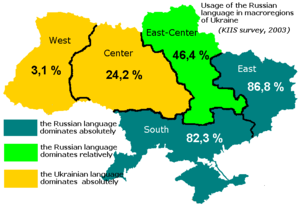
According to the 2001 census, approximately 14.3 million Ukrainians (29% of the population) speak Russian as their first language. Some other estimates put that number even higher.
The language is particularly widespread in the eastern and southern regions of the country.
Rt.com 21 Oct 22,
The language is part of Moscow’s propaganda, Defence Council boss claims
The Russian language should be eradicated in Ukraine as it is allegedly being used as a tool by Moscow to wield influence on Ukrainians, one of the country’s key security officials has claimed.
The Russian language is nothing but an “element of enemy propaganda and brainwashing of our people,” Alexey Danilov, the head of Ukraine’s National Security and Defense Council, said on the ‘Big Lviv Talks’ show on Friday.
The official also spoke in favor of Ukrainians learning English instead. ………
The senior official went on to criticize pundits and experts who speak Russian while appearing on Ukrainian TV.
According to the 2001 census, approximately 14.3 million Ukrainians (29% of the population) speak Russian as their first language. Some other estimates put that number even higher.
The language is particularly widespread in the eastern and southern regions of the country. Ever since the Maidan coup back in 2014, Moscow has been consistently accusing the Ukrainian government of systematically discriminating against Russian-speakers.
The perceived violations of the linguistic minority’s rights were also cited by the secessionist movements in the Donetsk and Lugansk Regions, parts of which went on to become the Donetsk and Lugansk People’s Republics, respectively. ………………………. more https://www.rt.com/russia/565118-ukrainian-official-russian-language-eradication—
“Present Danger: Nuclear Power Plants in War,” The US Army War College Quarterly: Parameters
what is still lacking, is a Pentagon assessment of what all this means militarily.
https://npolicy.org/present-danger-nuclear-power-plants-in-war-the-us-army-war-college-quarterly-parameters/ October 19, 2022, Author: Henry Sokolski
As the war in Ukraine drags on, daily developments at the Zaporizhzhia nuclear plant explode on our Google News screens. Last week, external power needed to prevent a core meltdown at the plant was cut off repeatedly, forcing reliance on emergency diesel generators.
Meanwhile, Russians have tortured, kidnapped, and killed Ukrainian staff at the plant to force them to renounce their loyalty to Ukraine and sign employment contracts with Rosatom, Russia’s electrical utility. Poland, Romania, Ukraine, Moldova, and Finland have all begun distributing iodine pills to reduce thyroid cancers if there is a loss of coolant accident at Zaporizhzhia and a radiological release that drifts their way.
And Washington’s response? Several senior US officials have condemned Russia’s assaults on Zaporizhzhia as being “irresponsible” and “dangerous.” Yet, well after Russia’s military assault on the plant, Westinghouse, the Energy and State Departments, and the President announced plans to construct nuclear power plants in Poland, Romania, and even Ukraine. No one has yet explained how or if these plants can be defended.
This is weird. Plants in Central Europe, like Zaporizhzhia, are not just electrical generators, they are stationary, potential slow-burning nuclear dispersal weapons that could conceivably trigger or even force a NATO response. Plants and such war zones present a real and present danger.
Late last month, the U.S. Army War College asked me to write a short piece on the military risks nuclear plants in war zones present. Attached, “Present Danger: Nuclear Plants in War,” is that analysis. It lays out a basic set of recommendations for the Pentagon.
Present Danger: Nuclear Power Plants in War
Zaporizhzhya’s nuclear plant, as of this writing, has been placed on cold shutdown. The plant and its military vulnerabilities, however, have generated some of the world’s most sensational headlines.1 Earlier this summer, online reports featured photographs of the plant’s damaged transformer, a system critical to assuring a steady supply of electricity to the plant’s all-important reactor coolant and safety systems. Throughout August and September, news organizations detailed how the plant’s external main power lines—built to keep electricity flowing to its reactors—had been cut. Some days, some of the plant’s six reactors were operating. Other days, none were. Repeatedly, the viability of the plant’s emergency diesel fuel electrical generators was “Topic A.”
Each of these stories raised the specter of a military-induced Fukushima: strikes against the plant or the power lines feeding into it that could cut off the electricity needed to run the reactors’ coolant pumps and safety equipment followed by nuclear fuel failures and a massive radiological release over Ukraine and its neighbors. Add to this firsthand accounts of Russian torture, the murder of “disloyal” Ukrainian reactor staff, and an emergency International Atomic Energy Agency visit, and you have everything needed for a Netflix docudrama.
What you would not have, however, and what is still lacking, is a Pentagon assessment of what all this means militarily.
Close friends have offered hints. Japanese Prime Minister Fumio Kishida called for stationing security forces at each of Japan’s nuclear plants, and his administration also suggested the possibility of deploying dedicated missile defense systems (as Belarus has done at its nuclear plant since 2019).2 Seoul crafted military exercises this year with US forces that included explosives detonating at one or more of South Korea’s civilian reactor sites.3 Ukrainian President Volodymyr Zelensky accused Russia of turning Zaporizhzhya into a prepositioned, slow-burning, radiation-dispersing “nuclear weapon.”4 Meanwhile, Tobias M. Ellwood, the British House of Common’s Select Committee on Defense chairman, insisted that if Russia intentionally struck Zaporizhzhya and spread harmful radioactivity to Poland or Romania, it would trigger NATO’s Article 5.5 Moldova, Romania, and Ukraine did more than talk. All three countries prepared to distribute iodine pills to their citizens (to reduce the thyroid cancers radiation might induce if Zaporizhzhya leaked radiation).6
Wikipedia, s.v. “Crisis at the Zaporizhizhia Nuclear Power Plant,” last modified September 14, 2022, https://en.m.wikipedia.org/wiki/Crisis_at_the_Zaporizhzhia_Nuclear_Power_Plant.- Eric Johnston, “Japan to Discuss Creating New Police Unit to Guard Nuclear Plants,” Japan Times (website), March 14, 2022, https://www.japantimes.co.jp/news/2022/03/14/national/nuclear-plant-police -unit/; and “TOR-M2 Air Defense Missile Systems to Protect Belarus Nuclear Power Plant,” Army Recognition (website), December 8, 2018, https://www.armyrecognition.com/december_2018_global_defense_security_army _news_industry/tor-m2_air_defense_missile_systems_to_protect_belarus_nuclear_power_plant.html.
- Sang-ho Song, “Upcoming S. Korea-U.S. Training Involves Drills on Repelling Attacks, Staging Counterattacks,” Yonhap News Agency (website), August 1, 2022, https://en.yna.co.kr/view /AEN20220801004000325.
- Rebecca Falconer, “Zelensky Says Russian Forces Using Zaporizhzhia Plant as ‘Nuclear Weapon,’ ” Axios (website), September 4, 2022, https://www.axios.com/2022/09/05/zelensky-russia-zaporizhzhia-plant -nuclear-weapon.
- Article 5 requires NATO members come to the defense of any other member that suffers a military attack. See Tobias M. Ellwood (@Tobias_Ellwood), “Let’s make it clear: ANY deliberate damage causing potential radiation leak to a Ukrainian nuclear reactor would be a breach of NATO’s Article 5. @thetimes,” Twitter, August 19, 2022, 1:55 a.m., https://twitter.com/Tobias_Ellwood/status/1560505699179925509?s=20& t=FYfhPvuxW0pHm8lwXfe99w.
- Josh Lederman, “Radiation Tablets Are Handed out near Ukrainian Nuclear Plants as Fears of a Leak Mount,” NBC News (website), August 26, 2022, https://www.nbcnews.com/news/world/russia-ukraine-war -zaporizhzhia-nuclear-plant-radiation-fears-iodine-rcna45041; Ben Turner, “Ukraine War: Moldova Ships in One Million Iodine Pills amid Fears of Nuclear Disaster,” Euronews (website), August 16, 2022, https: // www.euronews.com /2022 /08 /15 /moldova-ships-in-radiation-pills-as-fighting-rages-near-zaporizhzhia -nuclear-power-plant-i; and Helen Collis, “Romania to Issue Iodine Tablets as Russian War Continues in Neighboring Ukraine,” Politico (website), April 3, 2022, https://www.politico.eu/article/romania-to-issue -iodine-tablets-as-russian-aggression-continues-in-bordering-ukraine/.
Click here to read the full article.
SCOTT RITTER: Nuclear High Noon in Europe

Enter Volodymyr Zelensky, stage left. Speaking to the Lowy Institute, a nonpartisan international policy think tank in Australia, the Ukrainian president called for the international community to undertake “preventative strikes, preventive action” against Russia to deter the potential use of nuclear weapons by Russia against Ukraine
First and foremost, there has been zero talk about the employment of tactical nuclear weapons from the Kremlin.
The risk isn’t that Russia would start a pre-emptive nuclear war over Ukraine.
The risk is that America would.
https://consortiumnews.com/2022/10/19/scott-ritter-nuclear-high-noon-in-europe/ By Scott Ritter Consortium News 19 Oct 22, Now is the time for Biden to clarify U.S. nuclear doctrine. But he remains silent.
On Monday, Oct. 17, the North Atlantic Treaty Organization kicked off Operation STEADFAST NOON, its annual exercise of its ability to wage nuclear conflict. Given that NATO’s nuclear umbrella extends exclusively over Europe, the indisputable fact is that STEADFAST NOON is nothing more than NATO training to wage nuclear war against Russia.
Nuclear war against Russia.
Enter Joe Biden, center stage. Speaking at a fund raiser on Oct. 6, the president of the United States said that, “For the first time since the Cuban missile crisis, we have a direct threat of the use of a nuclear weapon if in fact things continue down the path they are going.”
Biden went on: “We’ve got a guy I know fairly well. He’s not joking when he talks about potential use of tactical nuclear weapons or biological or chemical weapons because his military is, you might say, significantly underperforming.”
Biden concluded: “I don’t think there’s any such thing as the ability to easily use a tactical nuclear weapon and not end up with Armageddon.”
The reader should let that sink in for a moment.
Don’t worry, NATO spokesperson Oana Lungscu reassured the rest of the world, the purpose of STEADFAST NOON is to ensure that NATO’s nuclear war-fighting capability “remains safe and effective.” It is a “routine” exercise, not linked to any current world events. Moreover, no “real” nuclear weapons will be used — just “fake” ones.
Nothing to worry about here.
Enter Jens Stoltenberg, NATO secretary general, stage right in the nuclear theater. In a statement to the press on Oct. 11, Stoltenberg declared that, “Russia’s victory in the war against Ukraine will be a defeat of NATO,” before ominously announcing, “This cannot be allowed.”
To that end, Stoltenberg stated, the STEADFAST NOON nuclear drills would continue as scheduled. These drills, Stoltenberg said, were an important deterrence mechanism in the face of Russian “veiled: nuclear threats.”
But they weren’t related to any current world events.
Enter Volodymyr Zelensky, stage left. Speaking to the Lowy Institute, a nonpartisan international policy think tank in Australia, the Ukrainian president called for the international community to undertake “preventative strikes, preventive action” against Russia to deter the potential use of nuclear weapons by Russia against Ukraine.
While many observers interpreted Zelensky’s words to imply a request for NATO to carry out a preemptive nuclear strike against Russia, Zelensky’s aides were quick to try and correct the record, saying he was simply asking for more sanctions.
Enter Joe Biden, center stage. Speaking at a fund raiser on Oct. 6, the president of the United States said that, “For the first time since the Cuban missile crisis, we have a direct threat of the use of a nuclear weapon if in fact things continue down the path they are going.”
Biden went on: “We’ve got a guy I know fairly well. He’s not joking when he talks about potential use of tactical nuclear weapons or biological or chemical weapons because his military is, you might say, significantly underperforming.”
Biden concluded: “I don’t think there’s any such thing as the ability to easily use a tactical nuclear weapon and not end up with Armageddon.”
While it has been made abundantly clear by the White House that Biden’s comments were his personal view, and not based on any new intelligence regarding Russian nuclear posture, the fact that a sitting U.S. president was speaking about the possibility of a nuclear “Armageddon” should send chills down the spine of every sane individual in the world.
No Kremlin Talk of Tactical Nuclear Weapons
First and foremost, there has been zero talk about the employment of tactical nuclear weapons from the Kremlin.
Zero.
Russian President Vladimir Putin has indicated that Russia would use “all the means at its disposal” to protect Russia. He said this most recently on Sept. 21, when in a televised address announcing partial mobilization, he accused the West of engaging in “nuclear blackmail,” citing “statements of some high-ranking representatives of the leading NATO states about the possibility of using nuclear weapons of mass destruction against Russia.”
Putin was alluding to a statement that Liz Truss made prior to her election as British prime minister, when, in response to a question on whether she was ready to undertake the responsibility of ordering the use of the U.K.’s nuclear arsenal, she replied, “I think it’s an important duty of the prime minister and I’m ready to do that.”
“I want to remind you,” Putin said,
“that our country also has various means of destruction and in some components more modern than those of the NATO countries. And if the territorial integrity of our country is threatened, we will certainly use all the means at our disposal to protect Russia and our people.”
Putin’s statements were consistent with that of Russian Defense Minister Sergei Shoigu, who in an address to the 10th Moscow Conference on International Security delivered on Aug. 16, asserted that Russia would not use nuclear weapons in Ukraine. According to Shoigu, Russian nuclear weapons are authorized for use under “exceptional circumstances” as described in published Russian doctrine, none of which apply to the Ukraine situation. Any talk of the use of nuclear weapons by Russia in Ukraine, Shoigu said, was “absurd.”
Apparently not to Biden, who despite his claim to know Putin “fairly well,” got it all wrong when talking about the potential for nuclear conflict.
The risk isn’t that Russia would start a pre-emptive nuclear war over Ukraine.
The risk is that America would.
Biden’s Pledge of ‘Sole Purpose Policy’
Biden came into office in February 2021 promising to enshrine in U.S. nuclear doctrine a “sole purpose policy,” under which “the sole purpose of our nuclear arsenal should be to deter — and, if necessary, retaliate against — a nuclear attack.”
It is now the middle of October 2022, and America finds itself in a situation where the president himself fears for a potential nuclear “Armageddon.”
If ever there was a time for Biden to make good on his pledge, now is it.
But he remains silent.
The danger inherent in Biden’s silence is that Putin and other Russian officials who are concerned about Russian national security must rely upon existing published U.S. nuclear doctrine, which continues to enshrine a policy of nuclear pre-emption promulgated during the administration of President George W. Bush. Under this doctrine, nuclear weapons are but another tool in the military’s toolbox, to be used as and when needed, including occasions where the destruction of battlefield targets for the simple purpose of gaining an operational advantage is the objective.
One can argue that this sort of non-nuclear preemption has its own inherent deterrence value, a sort of “madman” kind of vibe that makes an opponent question whether the president could act in such an irrational manner…………….
Former President Donald Trump breathed new life into Nixon’s “madman theory,” telling North Korea that if it continued to threaten the United States “[t]hey will be met with fire, fury and frankly power the likes of which this world has never seen before.” Trump went on to have three face-to-face meetings with North Korean leader Kim Jung-Un in a failed effort to bring about the denuclearization of the Korean peninsula.
It was under the Trump administration that the U.S. Navy deployed the W-76-2 low-yield nuclear warhead on its Trident submarine-launched ballistic missiles, giving the president a greater range of options when it came to the employment of nuclear weapons………………………………………………
As this article is being written, U.S. nuclear-capable B-52 bombers are flying to Europe from their U.S. bases, where they will practice delivering nuclear weapons against a Russian target. Dozens more aircraft, flying from Volkel Air Force Base in the Netherlands (home to an arsenal of U.S. B-61 nuclear bombs), will practice employing NATO nuclear weapons against…Russia.
Russia has responded to the NATO nuclear drill by going forward with its own annual nuclear exercise, “Grom” (Thunder). ………………….
Now is not the time for drama, or theatrically inflammatory rhetoric. Now is the time for maturity, sanity…restraint. A sage leader would have recognized the possibility of misperception on the part of Russia when NATO, a mere week after being encouraged by the Ukrainian president to initiate a preemptive nuclear strike on Russia, carries out a major exercise where NATO practices dropping nuclear bombs on Russia. A sober leader would have postponed these drills and encouraged similar action from Russia regarding its nuclear exercises.
Instead, America gets an unscripted, off-the-cuff reference to a nuclear Armageddon from a narcissistic egomaniac who uses the horror of nuclear annihilation as a fund-raising mantra.
It would take but one miscalculation, a single misunderstanding to turn STEADFAST NOON into “High Noon,” and “Grom” (Thunder) into “Molnya” (Lightening).
We’ve seen this scenario before. In November 1983 NATO carried out a command post exercise, codenamed ABLE ARCHER ’83, designed to test “nuclear weapons release procedures.” The Soviets were so alarmed by this exercise, which they believed could be used to mask a preemptive nuclear strike by NATO against the Soviet Union, that they loaded nuclear warheads onto bombers, bringing NATO and the Soviet Union to the brink of a nuclear war.
Why the US must press for a ceasefire in Ukraine

The war might have been prevented — probably would have been prevented — if Ukraine had been willing to abide by the Minsk agreement, recognize the Donbas as an autonomous entity within Ukraine, avoid NATO military advisors, and pledge not to enter NATO. Nevertheless, what was possible even as late as January 2022 may not be possible now. The Russian annexation of additional territory raises the stakes. But the longer the war continues the harder it is going to be to avoid the utter destruction of Ukraine.
As a key player in Kyiv’s defense and the leader of sanctions against Russia, Washington is obligated to help find a way out.
Responsible Statecraft, OCTOBER 17, 2022, Jack F. Matlock Jr.
Four recent events have put the war in Ukraine on a distinctly more dangerous course.
— The Russian annexation of four additional Ukrainian provinces blocks compromise solutions that were feasible earlier.
— The disabling attacks on both North Stream pipelines make it impossible in the near term to restore Russia as the principal energy supplier to Germany, even if the war in Ukraine should be miraculously ended.
— The Ukrainian attack on the bridge to Crimea gave Russia a pretext to escalate attacks on Ukrainian civilian targets.
— The Russian retaliatory attacks on civilian targets are certain to do more damage to Ukraine than Ukraine can do to Russia.
The leaders of both Russia and Ukraine have set impossible goals. In fact, not a single participant in the war in Ukraine has espoused a goal that can restore peace in the area. Russia’s recent incorporation of four Ukrainian provinces into the Russian Federation will not be accepted by Russia’s neighbors or by most European powers.
Given the passions aroused by the war and its atrocities, Ukraine, even with NATO support, cannot create a stable, functioning state within all the borders it inherited in 1991. If Ukraine tries to regain these territories by force and is encouraged and empowered by the U.S. and NATO to do so, Russia (and not just President Putin) will very likely demolish Ukraine in retaliation. Reality trumps illusion whenever the two conflict.
And if war should stop with the destruction of Ukraine — Kyiv and Lviv leveled as Grozny once was — that would assume that escalation does not involve the use of nuclear weapons. If the Russian leader feels convinced that the U.S. and “Western” goal is to take him out, what is to prevent him taking out others as he goes?
What Went Wrong
It did not have to happen. When the Cold War ended (by negotiation, not by victory) and the USSR fragmented into 15 separate countries (because of pressures from the inside, not from without), Europe was suddenly whole and free, the goal of U.S. and NATO policy during the Cold War. If the future stability and prosperity of Europe were to be ensured, the principal task was to build a security system covering all the countries of Europe.
But a succession of American presidents, from Clinton to Trump, chose instead to enlarge NATO, to trash arms control treaties that ended the Cold War, and to enlist former Soviet republics in a military alliance that excluded Russia. Benjamin Abelow summarized the portentous events in his insightful How the West Brought War to Ukraine.
The war might have been prevented — probably would have been prevented — if Ukraine had been willing to abide by the Minsk agreement, recognize the Donbas as an autonomous entity within Ukraine, avoid NATO military advisors, and pledge not to enter NATO. Nevertheless, what was possible even as late as January 2022 may not be possible now. The Russian annexation of additional territory raises the stakes. But the longer the war continues the harder it is going to be to avoid the utter destruction of Ukraine.
America’s Security
We Americans can only admire the valiant resistance Ukrainians have mounted to the Russian invasion and should be proud that we have been able to support their defense. Everything possible should be done to make sure that Ukraine survives as an independent state. But that does not mean that Ukraine has to recover all the territory it inherited in 1991. In fact, given all the passions aroused by the war and what preceded it (the violent change of government in 2014 that many Russians considered a coup d’etat organized by the United States), the population in some areas is likely to resist a return to Kyiv’s control.

Some will argue that the United States has a moral obligation to support whatever the Ukrainian leaders demand since “they know best.”
No, they do not know best what is in the security interests of the American people, and that should be the primary concern of any American government. They also, under the stress of war, may not be the best judges of their own ultimate security interests.
…………………………………………………………………………….The issue with Ukraine and Russia of course is not recognition of independence but whether the U.S. should support the Ukrainian goal to restore its control over all the territory it received when the Soviet Union broke up. If pursuit of that goal precipitates the progressive destruction of Ukraine, it is obviously not in Ukraine’s interest.
Effect on the World
The fighting in Ukraine continues and intensifies while the world is still struggling with the covid-19 pandemic and remains vulnerable to mutations and new pathogens, while global warming is producing ever more destructive effects. Meanwhile, migrations caused by famine, flood, war, and misgovernment are overwhelming the capacity of even the richest countries to absorb the afflicted. And to all of that one must add the threat of Armageddon, a nuclear holocaust — something no rational leader would risk. But rationality cannot be assumed in either domestic or international politics today.
………………………………………………………………. What all the parties to the conflict in Ukraine seem to have forgotten is that the future of mankind will not be determined by where international borders are drawn — these have never been static in history and doubtless will continue to change from time to time. The future of mankind will be determined by whether nations learn to settle their differences peacefully.
Is There a Way to Stop the War?
There may not be, given the passions aroused by the conflict. Both Ukraine and Russia have lost enough blood that their populations are likely to oppose any effort to give the other side any portion of what it wants. Their presidents hate each other and see any concession as a personal defeat. But the more the war continues, the more Ukrainian lives will be lost, property destroyed, and the probability of a wider conflict increased.
The only practical way to stop the actual fighting would be to agree on a ceasefire. This is difficult for the Ukrainians since they are liberating some of the occupied territories, but the reality is that if the war continues Russia is capable of damaging Ukraine more than Ukraine can damage Russia without risking a wider war.
As principal arms supplier to Ukraine, the U.S. should encourage the Ukrainians to agree to a ceasefire. As the sponsor of the most punitive sanctions on Russia, the U.S. should use its leverage to induce Russia to agree to genuine negotiations during a ceasefire.
Negotiations must be conducted in private to be successful, which would require a revival of U.S.-Russia diplomacy. Over the past few years, tit-for-tat expulsions have reduced both countries to skeleton diplomatic staffs. Nevertheless, if there is a will to talk and negotiate, ways can be found. So far, it is the will that seems to be lacking.
At present, none of the relevant parties to the conflict in Ukraine seem to be willing to stop fighting and enter into genuine negotiations to bring peace in Ukraine. Until this changes, the fighting stops, and serious negotiations get underway, the world is headed for an outcome where we all are losers. https://responsiblestatecraft.org/2022/10/17/on-ukraine-the-us-is-on-the-hook-to-find-a-way-out/
—
Terror on Crimea Bridge and Russia unleashing shock’n awe.
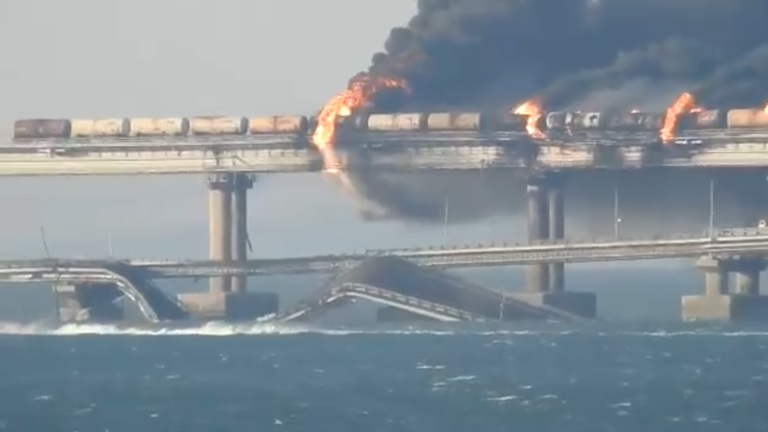
Pearls and Irritations, By P&I Guest Writers, Oct 18, 2022
The terror attack on Krymskiy Most – the Crimea Bridge – was the proverbial straw that broke the Eurasian camel’s back.
Russian President Vladimir Putin neatly summarised it: “This is a terrorist attack aimed at destroying the critical civilian infrastructure of the Russian Federation.”
The head of the Russian Investigative Committee, Alexander Bastrykin, confirmed face-to-face with Putin that Terror on the Bridge was carried out by the SBU – Ukrainian special services.
Bastrykin told Putin, “we have already established the route of the truck, where the explosion took place. Bulgaria, Georgia, Armenia, North Ossetia, Krasnodar… The carriers have been identified. With the help of operatives of the FSB, we managed to identify suspects.”
Russian intel leaked crucial info to military correspondent Alexander Kots. The cargo was ordered by a Ukrainian citizen: explosives packed in 22 pallets, in rolls of film under plastic wrap, were shipped from Bulgaria to the Georgian port of Poti. Afterwards, the cargo was loaded onto a truck with foreign license plates and proceeded overland to Armenia………………………………………………………………
The driver of the first truck is already testifying. Yusubov, the driver of the second truck – which exploded on the bridge – was “blind:” he had no idea what he was carrying, and is dead.
At this stage, two conclusions are paramount.
First: This was not a standard ISIS-style truck suicide bombing – the preferred interpretation in the aftermath of the terror attack.
Second: The packaging most certainly took place in Bulgaria. That, as Russian intel has cryptically implied, indicates the involvement of “foreign special services.”
‘A mirage of cause and effect’
What has been revealed in public by Russian intelligence tells only part of the story. An incandescent assessment received by The Cradle from another Russian intel source is way more intriguing.
At least 450 kg of explosives were employed in the blast. Not on the truck, but mounted inside the Crimea Bridge span itself. The white truck was just a decoy by the terrorists “to create a mirage of cause and effect.” When the truck reached the point on the bridge where the explosives were mounted, the explosion took place.
According to the source, railroad employees told investigators that there was a form of electronic hijacking; the terror operators took control of the railway so the train carrying fuel received a command to stop because of a false signal that the road ahead was busy.
Bombs mounted on the bridge spans were a working hypothesis largely debated in Russian military channels over the weekend, as well as the use of underwater drones.
In the end, the quite sophisticated plan could not follow the necessarily rigid timing. There was no alignment by the millimeter between the mounted explosive charges, the passing truck and the fuel train stopped in its tracks. Damage was limited, and easily contained. The charges/truck combo exploded on the outer right lane of the road. Damage was only on two sections of the outer lane, and not much on the railway bridge.
In the end, Terror on the Bridge yielded a short, Pyrrhic PR victory – duly celebrated across the collective West – with negligible practical success: transfer of Russian military cargo by railway resumed in roughly 14 hours.
And that brings us to the key information in the Russian intel source assessment: the whodunnit.
It was a plan by the British MI6, says this source, without offering further details. Which, he elaborates, Russian intel, for a number of reasons, is shadow-playing as “foreign special services.”
It’s quite telling that the Americans rushed to establish plausible deniability. The proverbial “Ukrainian government official” told CIA mouthpiece The Washington Post that the SBU did it. That was a straight confirmation of an Ukrainska Pravda report based on an “unidentified law enforcement official.”
The perfect red line trifecta
Already, over the weekend, it was clear the ultimate red line had been crossed. Russian public opinion and media were furious. For all its status as an engineering marvel, Krymsky Most represents not only critical infrastructure; it is the visual symbol of the return of Crimea to Russia.
Moreover, this was a personal terror attack on Putin and the whole Russian security apparatus.
So we had, in sequence, Ukrainian terrorists blowing up Darya Dugina’s car in a Moscow suburb (they admitted it); US/UK special forces (partially) blowing Nord Stream and Nord Stream 2 (they admitted and then retracted); and the terror attack on Krymsky Most (once again: admitted then retracted).
Not to mention the shelling of Russian villages in Belgorod, NATO supplying long-range weapons to Kiev, and the routine execution of Russian soldiers.
Darya Dugina, Nord Streams and Crimea Bridge make it an Act of War trifecta. So this time the response was inevitable – not even waiting for the first meeting since February of the Russian Security Council scheduled for the afternoon of 10 October.
Moscow launched the first wave of a Russian Shock’n Awe without even changing the status of the Special Military Operation (SMO) to Counter-Terrorist Operation (CTO), with all its serious military/legal implications.
After all, even before the UN Security Council meeting, Russian public opinion was massively behind taking the gloves off. Putin had not even scheduled bilateral meetings with any of the members. Diplomatic sources hint that the decision to let the hammer come down had already been taken over the weekend.
Shock’n Awe did not wait for the announcement of an ultimatum to Ukraine (that may come in a few days); an official declaration of war (not necessary); or even announcing which ‘”decision-making centers” in Ukraine would be hit.
The lightning strike de facto metastasising of SMO into CTO means that the regime in Kiev and those supporting it are now considered as legitimate targets, just like ISIS and Jabhat al-Nusra during the Anti-Terror Operation (ATO) in Syria.
And the change of status – now this is a real war on terror – means that terminating all strands of terrorism, physical, cultural, ideological, are the absolute priority, and not the safety of Ukrainian civilians. During the SMO, safety of civilians was paramount. Even the UN has been forced to admit that in over seven months of SMO the number of civilian casualties in Ukraine has been relatively low.
Enter ‘Commander Armageddon’
The face of Russian Shock’n Awe is Russian Commander of the Aerospace Forces, Army General Sergey Surovikin: the new commander-in-chief of the now totally centralised SMO/CTO………………………………..
Surovikin is Dr. Shock’n Awe with full carte blanche. That even rendered idle speculations that Defense Minister Sergei Shoigu and Chief of the General Staff Valery Gerasimov were removed or forced to resign, as speculated by the Wagner group Telegram channel Grey Zone.
It is still possible that Shoigu – widely criticised for recent Russian military setbacks – could be eventually replaced by Tula Governor Alexei Dyumin, and Gerasimov by the Deputy Commander-in-Chief of the Ground Forces, Lieutenant General Alexander Matovnikov.
That’s almost irrevelant: all eyes are on Surovikin.
MI6 does have some well-placed moles in Moscow, relatively speaking. The Brits had warned Ukrainian President Volodymyr Zelensky and the General Staff that the Russians would be launching a “warning strike” this Monday.
What happened was no “warning strike,” but a massive offensive of over 100 cruise missiles launched “from the air, sea and land,” as Putin noted, against Ukrainian “energy, military command and communications facilities.”
MI6 also noted “the next step” will be the complete destruction of Ukraine’s energy infrastructure. That’s not a “next step:” it’s already happening. Power supply is completely gone in five regions, including Lviv and Kharkov, and there are serious interruptions in other five, including Kiev.
Over 60 percent of Ukrainian power grids are already knocked out. Over 75 percent of internet traffic is gone. Elon Musk’s Starlink netcentric warfare has been “disconnected” by the Ministry of Defence.
Shock’n Awe will likely progress in three stages.
First: Overload of the Ukrainian air defence system (already on).
Second: Plunging Ukraine into the Dark Ages (already in progress).
Third: Destruction of all major military installations (the next wave).
Ukraine is about to embrace nearly total darkness in the next few days. Politically, that opens a completely new ball game. Considering Moscow’s trademark “strategic ambiguity,” this could be a sort of Desert Storm remixed (massive air strikes preparing a ground offensive); or, more likely, an ‘incentive’ to force NATO to negotiate; or just a relentless, systematic missile offensive mixed with Electronic Warfare (EW) to shatter for good Kiev’s capacity to wage war.
Or it could be all of the above.
How a humiliated western Empire can possibly raise the stakes now, short of going nuclear, remains a key question. Moscow has shown admirable restraint for too long. No one should ever forget that in the real Great Game – how to coordinate the emergence of the multipolar world – Ukraine is just a mere sideshow. But now the sideshow runners better run for cover, because General Armageddon is on the loose.
Pepe Escobar is a columnist at The Cradle, editor-at-large at Asia Times and an independent geopolitical analyst focused on Eurasia. Since the mid-1980s he has lived and worked as a foreign correspondent in London, Paris, Milan, Los Angeles, Singapore and Bangkok. He is the author of countless books; his latest one is Raging Twenties.
Moscow says it now runs Europe’s largest nuclear plant, causing chaos and confusion
https://bellona.org/news/nuclear-issues/2022-10-moscow-says-it-now-runs-europes-largest-nuclear-plant-causing-chaos-and-confusion October 19, 2022 by Charles Digges,
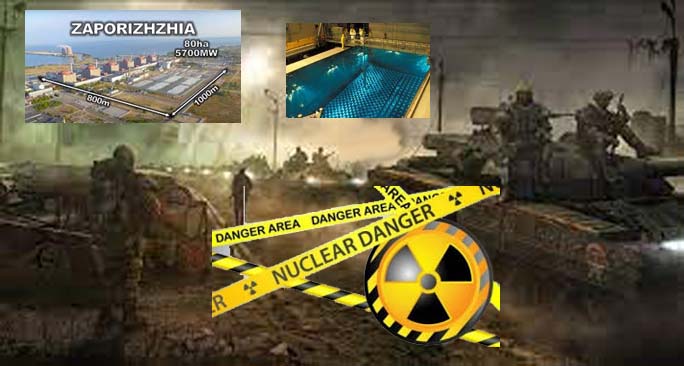
In the days since Moscow held a forced vote annexing four regions in Ukraine, Russian President Vladimir Putin has declared that Europe’s largest nuclear power plant in the Zaporizhzhia oblast is now Russian property.
The residents of Enerhodar, the city built to house the Ukrainian workers at the Zaporizhzhia nuclear plant, would beg to differ. According to a September poll taken of the company town’s residents, only 6 percent favored becoming part of Russia.
Recent gains by Ukrainian troops in the Donestk, Luhansk and Kherson regions also belie Moscow’s claims to greater control. But battlelines in the Zaporizhzhia region have stagnated around the plant, with fears of hitting its six reactors and pools of spent nuclear fuel standing in the way of a Ukrainian counteroffensive.
Putin’s orders to bring the plant under Russian control are intensifying the quandaries faced by the Ukrainian employees who have worked throughout the war to prevent a nuclear catastrophe at the complex.
Directly following Moscow’s force referendums last month, Russian troops detained Igor Muratov, the Zaporizhzhia plant’s director, then released a video of him saying he was collaborating with Ukrainian intelligence. Then they and expelled him from Russian-held territory.
In the following days, the plant’s deputy director as well as its director of human resources were also detained by Russian forces. Both remain missing.
Following Putin’s order, Russia’s state nuclear corporation Rosatom created a subsidiary, with $2 billion of startup capital, called The Joint Stock Company Operating Organization of the Zaporozhye Nuclear Power Plant, using the Russian spelling for the location. At the same time, Petro Kotin, head of Energoatom, Ukraine’s nuclear power operator, has said he himself is now the plant’s director.
Kotin has also implored technicians at the plant not to sign any contracts with Russian occupiers in response to reports that plant employees are under pressure to start working for Rosatom — and threatened with conscription into Moscow’s army if they don’t.
However, should the technicians caught in this dilemma sign on with Rosatom, they face prosecution by Kyiv for collaborating with Russia’s invading forces, said Dmitry Gorchakov, a nuclear power analyst with Bellona.
“They’re in an almost hopeless situation,” Gorchakov said. “And this is the main problem, in addition to the nuclear safety issues, that should be discussed and not forgotten.”
The uncertainty over who is in charge further imperils the security of the plant as hostilities continue, Rafael Grossi, head of the UN’s International Atomic Energy Agency said in a statement last week.
“Staff at the plant are being forced to make a hugely difficult decision for themselves and their loved ones,” Grossi said. “The enormous pressure they are facing must stop.”
In a highly unusual move, Grossi also took a side in the conflict for the first time since Russian forces seized Zaporizhzhia in March. Grossi told reporters in Kyiv that “the position of the IAEA is that this facility is a Ukrainian facility.”
On Monday, it was reported that Rosatom had given the about 3,000 remaining staff members — down from 11,000 before the war — until Thursday, October 19, to make a choice: work for Rosatom or else.
“If they don’t sign the statement [to work for Rosatom], they won’t have a livelihood, to feed their family, children,” a worker who left the plant this summer and made his way to Ukrainian-held territory told the Wall Street Journal. “If they sign, they will be a traitor and a collaborator…it all stinks.”
Meanwhile, despite cycling down all six of the plant’s rectors into cold shutdown mode for safety reasons early September, both Energoatom and Rosatom are mulling restarting at least a few of them to gird against the coming cold months. It might be the one thing on which the two sides agree.
For reactors to restart, said Gorchakov, the safety of outside power lines bearing electricity for the plant’s critical cooling and safety systems must be assured.
That’s unlikely, given recent developments. For the past several days, energy infrastructure supplying the plant has been the focus of shelling, forcing technicians to power cooling and safety systems with diesel backup generators — a move widely seen by nuclear experts as the last defense against possible meltdown.
On Monday, Russian shells destroyed the only substation supplying the plant with electricity from the Ukrainian grid was damaged before dawn, again forcing the plant to rely on generators, presumably until the substation is repaired.
“I think that the fight against infrastructure is now the fight for the station in the miltary sense,” said Gorchakov. “It is terrible that at the same time the station is constantly shutting down, increasing the risk of an accident.”
Combined, Zaporizhzhia’s 20 diesel generators should keep cooling systems running for as long as 10 days — provided they have access to fuel, certainly not a given in the midst of a war zone.
IAEA safety chief hopes to return to Ukraine ‘soon’ over nuclear plant talks

https://www.reuters.com/world/europe/iaea-chief-hopes-return-ukraine-soon-over-nuclear-plant-talks-2022-10-19/ By Walter Bianchi and Miguel Lo Bianco BUENOS AIRES, Oct 18 (Reuters) – International Atomic Energy Agency (IAEA) chief Rafael Grossi expects to return “soon” to Ukraine, he told Reuters on Tuesday, amid negotiations to establish a security protection zone around the Russian-occupied Zaporizhzhia nuclear power plant.
Grossi has been the go-between from Moscow to Kyiv in an effort to establish a nuclear safety and security protection zone around the plant, which has been hit by power outages in the past weeks due to shelling of the site.
Earlier, the IAEA said it was deeply concerned by the detention of two Ukrainian staff from the Zaporizhzhia plant, which is in one of four Ukrainian regions Russia has proclaimed as annexed but only partly occupies. read more
“There is a possibility I will return to Ukraine and Russia, it is in fact what we have agreed in principle, at this moment we are continuing the consultations aimed at establishing the protection zone,” he told Reuters during a trip to Argentina.
“This implies an interaction where I receive answers and reactions from the two sides and I am looking for new ways to move forward and for that, at some point, probably very soon I will have to return.”
The talks are seen as key to defusing concerns that have mounted since August about the risks of shelling at or near Zaporizhzhia, Europe’s largest nuclear power station. Russia and Ukraine have both blamed each other for the shelling.
The head of the IAEA, the U.N. nuclear watchdog, said that separate Russian threats to use nuclear weapons in Ukraine could not be ruled out but that it was “not an immediate possibility”.
“I believe that the possibility of Russia using nuclear weapons is not an immediate possibility. Obviously nothing can be ruled out, I am not in the decision-making mechanism of that country, but I believe that it would be an extreme measure,” he said.
Grossi, asked about ongoing talks to revive an Iran nuclear deal, said that the negotiations were at a “stalemate”, adding that the IAEA lacked key information due to restriction on access to inspections in recent months.
The United States last week said that reviving the 2015 Iran nuclear deal was “not our focus right now”, adding Tehran had showed little interest in reviving the pact and that Washington was concentrating on how to support Iranian protesters. Reporting by Adam Jourdan; Editing by Himani Sarkar
A US billionaire proposes peace plan for Ukraine and Russia

https://www.rt.com/news/564960-bill-ackman-ukraine-peace/ 17 Oct 22,
Hedge fund manager Bill Ackman says Kiev should make concessions to Moscow.
Ukraine should recognize Crimea as part of Russia and renounce its bid to join NATO for the sake of peace, US billionaire hedge fund manager Bill Ackman has said. As with SpaceX and Tesla CEO Elon Musk before him, Ackman was immediately criticized online for suggesting that Kiev should be ready to make concessions in order to end the hostilities.
“Crimea was part of Russia until 1954 and is largely comprised of ethnic Russians, which was apparently why the world did little when Russia annexed it back in 2014,” Ackman, the CEO of Pershing Square Capital Management, tweeted on Monday.
He added that the borders should return to where they were prior to February 24, when Russia launched its military operation in the neighboring country and before four former Ukrainian regions voted to join Russia. He added that the West should then help Kiev with its recovery, while the country should stay outside NATO.
“Thousands of lives will be saved and resources can be invested to rebuild [Ukraine] rather than in a war that will only lead to more destruction and death,” the billionaire wrote. “If there is a viable path to peace, we should pursue it. Each day the conflict continues, the risk to the world rises.”
After receiving criticism online, Ackman clarified his stance on Tuesday. “Yesterday, I suggested that a reasonable peace settlement might be a return to the borders as of [February 24], a Marshall Plan to rebuild [Ukraine], and [Ukraine’s] decision to not join NATO. Then the knives came out. I was accused of being an appeaser and worse,” he wrote.
I ask: is [Ukraine] better off in a continued prolonged war that leads to 1,000s more [Ukrainian] deaths and the leveling of the country or does some kind of negotiated settlement make sense? … I am by no means an expert. It just saddens me to see death and destruction with no apparent end date or opportunity for resolution.
I”n a negotiated settlement, both parties must concede something or there is no opportunity for resolution. What is the least that both parties can concede that is acceptable for both? What am I missing in my analysis? What better ideas do you have?” Ackman argued.
Ackman’s comments came as more public figures in the West have been making suggestions for a possible peace deal between Russia and Ukraine. Venture capitalist and tech entrepreneur David Sacks tweeted on Sunday that the US should propose a ceasefire based on the February 23 lines and guarantee that Ukraine will not join NATO.
Musk offered his own vision of a peace settlement this month, which includes Ukraine recognizing Crimea as Russian territory. Kiev and Western officials quickly blasted Musk for what they considered to be a plan that heavily favors Moscow.
Elon Musk supports Russia keeping Crimea—because he’s worried about nuclear escalation and World War III
Fortune, BY TRISTAN BOVE, October 18, 2022
The world’s richest man wants the West to more seriously consider the risk of nuclear conflict and World War III breaking out over Ukraine, as Russia’s hold over Crimea—illegally annexed by Russia in 2014—is thrown into question.
“If Russia is faced with the choice of losing Crimea or using battlefield nukes, they will choose the latter,” Elon Musk wrote in a tweet on Monday.
He continued: “We’ve already sanctioned/cutoff Russia in every possible way, so what more do they have left to lose? If we nuke Russia back, they will nuke us and then we have WW3.”…………………………….
Musk and Ukraine
Earlier this month, Musk, CEO of Tesla and SpaceX, made waves when he suggested that the two sides reach a compromise before the use of nuclear weapons escalates the conflict into World War III.
He did so by sharing his view on what a peaceful resolution in Ukraine would look like, including Ukraine remaining neutral and permanently ceding control of Crimea to Russia.
In his proposal, Musk wrote that this outcome was “highly likely,” and the only question was “how many die before then.” He noted at the time that a nuclear escalation was a “possible, albeit unlikely” outcome……………
In his tweet on Monday predicting World War III, Musk emphasized the strategic and symbolic importance of Crimea to Russia, equating its potential loss to the “USA losing Hawaii and Pearl Harbor.”
Global war threats
If Putin was holding back on nuclear threats in the first few months of the war, he certainly isn’t now. At the end of September, Putin announced he would employ “all means available to us” to defend the four eastern Ukrainian regions Russia had recently annexed, a threat many took to be nuclear in nature. …………………………………………………. more https://fortune.com/2022/10/17/elon-musk-world-war-3-could-happen-russia-nuclear-response-crimea-putin/
Ukraine Rises from Near Zero to Major Recipient of US Arms
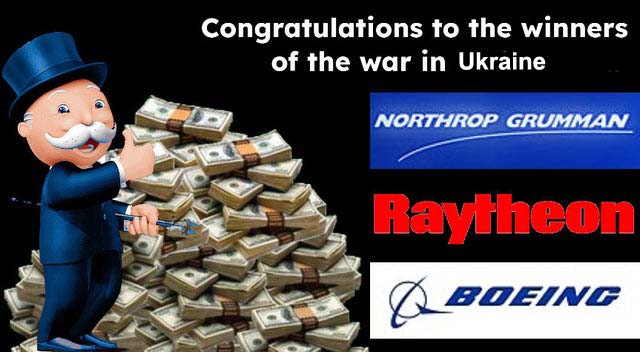
regardless of the outcome of the conflict itself, the military contractors win. The Defense Department has already started ordering replacements for some of the weapons shipped to Ukraine. US weapons manufacturers are profiting from what appears to be an open-ended commitment to supply Ukrainian forces.
“without an indication of when real peace negotiations will take place, the seemingly unending flow of weapons from the United States is likely to continue and US defense contractors will continue to increase their profits. At the same time, though, the risks of these transfers also increase as the quantity of weapons transferred grows,”
by Thalif Deen, UNITED NATIONS, Oct 14 2022 (IPS) – The Russian invasion of Ukraine in February 2022 has resulted in a never-ending flow of arms to the battle-scarred country— elevating the besieged nation to the ranks of one of the major recipients of US weapons and American security assistance.
As of last week, the US has provided a hefty $17.5 billion in arms and military assistance to Ukraine.
The five biggest arms buyers from the US during 2017-2021 were Saudi Arabia, which accounted for 23.4 percent of all US arms exports –followed by Australia 9.4 percent, South Korea 6.8 percent, Japan 6.7 percent and Qatar 5.4 percent.
The figure for Ukraine during the same period was 0.1 percent, according to the latest statistics released by the Stockholm International Peace Research Institute (SIPRI).
But this measly figure is expected to skyrocket in 2022, judging by the uninterrupted flow of American weapons.
In a statement to reporters October 4, US Secretary of State Antony Blinken said pursuant to a delegation of authority from the President, “I am authorizing our 22nd drawdown of U.S. arms and equipment for Ukraine since August 2021.”
This $625 million drawdown, he said, includes additional arms, munitions, and equipment from U.S. Department of Defense inventories.
This drawdown will bring the total U.S. military assistance for Ukraine to more than $17.5 billion since the beginning of the Biden Administration in January 2021.
Pieter Wezeman, Senior Researcher, Arms Transfers Programme at SIPRI, told IPS arms supplies to Ukraine were very small compared to those of the top-15 recipients of US arms.
This will change in 2022 as Ukraine has received major weapon systems from the US, such as 20 HIMARS long range rocket launchers, close to 1000 older model used light armoured vehicles, radars and 142 M-777 towed guns, he said.
“These are most valuable systems per item which Ukraine has received from the US, but the numbers involved and the military or financial value of these weapons are modest compared to what certain other countries have received in major systems in recent years.”
He pointed out that Ukraine has not received other items that per piece or especially valuable such as modern tanks, combat aircraft, major ships and long-range air defense systems.
Dr. Natalie J. Goldring, a Visiting Professor of the Practice in the Sanford School of Public Policy at Duke University, told IPS these weapons transfers entail numerous risks.
One significant risk is that the weapons will be captured by Russian forces and potentially used against Western forces. Another is that weapons that remain when the conflict ends will be transferred to other areas of conflict, she warned.
One of the nightmare scenarios, she pointed out, is US weapons being used against US forces. Transferring vast quantities of weapons in such a short period of time increases this risk by making it more difficult to ensure accountability and prevent diversion of the weapons.
Perhaps the largest risk, she said, “is that Russian President Vladimir Putin will not accept the argument that these weapons are only being supplied to help Ukraine defend itself, particularly if we’re supplying weapons that can attack targets inside Russia.”
That may lead to an escalation and expansion of the conflict, and would likely produce even more threats of nuclear weapons use than President Putin has already made she noted.
“Escalating threats in turn increase the risk of actual use of nuclear weapons, whether deliberate or through accident or miscalculation”, said Dr Goldring, who also represents the Acronym Institute at the United Nations, on conventional weapons and arms trade issues.
In the end, she argued, regardless of the outcome of the conflict itself, the military contractors win. The Defense Department has already started ordering replacements for some of the weapons shipped to Ukraine. US weapons manufacturers are profiting from what appears to be an open-ended commitment to supply Ukrainian forces.
…………………………. without an indication of when real peace negotiations will take place, the seemingly unending flow of weapons from the United States is likely to continue and US defense contractors will continue to increase their profits. At the same time, though, the risks of these transfers also increase as the quantity of weapons transferred grows,” she declared………………………………….. more https://www.ipsnews.net/2022/10/ukraine-rises-near-zero-major-recipient-us-arms/?utm_source=rss&utm_medium=rss&utm_campaign=ukraine-rises-near-zero-major-recipient-us-arms
Biden authorizes more weapons for Ukraine
The US will send $725 million in additional military aid to Kiev from the Pentagon’s stockpiles. https://www.rt.com/news/564698-biden-pentagon-ukraine-weapons/ 15 Oct 22,
US President Joe Biden ordered an additional $725 million in weapons shipments to Ukraine on Friday. The White House did not specify what the latest disbursement will consist of, only that it would be yet another drawdown of Defense Department “defense articles and services.”
The Pentagon later clarified that the aid package will include an unspecified quantity of “additional ammunition for High Mobility Artillery Rocket Systems (HIMARS),” thousands of 155mm artillery rounds and more than 200 additional Humvees.
Earlier this week, the US vowed to expedite the shipment of two of the eight NASAMS air defense systems it has long promised to Ukraine. The new package, however, will not include any additional anti-air capabilities.
Washington and its NATO allies pledged to boost Ukraine’s air defenses following heavy Russian missile strikes on Ukraine on Monday and Tuesday. Moscow said that they were in response to “terrorist tactics” employed by Kiev, which included sabotage attempts at the Kursk nuclear power plant and the TurkStream gas pipeline as well as the truck bombing of the Crimea Bridge.
he US has been the strongest supporter of Ukraine since the start of Russia’s military operation, providing the country with billions of dollars in military and financial aid, as well as intelligence data. Washington’s deliveries to Kiev have included large quantities of heavy weapons, among them over 150 artillery pieces, 20 Mi-17 helicopters, 200 M113 Armored Personnel Carriers, hundreds of Humvees and at least 16 HIMARS. The list includes more than 1,400 Stinger anti-aircraft systems, over 8,500 Javelin anti-tank weapons and 32,000 other anti-armor platforms, as well as at least 700 Switchblade suicide drones and an undisclosed number of Claymore anti-personnel mines.
Biden has used his Presidential Drawdown Authority to authorize the transfer of “surplus” weapons from the Pentagon’s stocks for the 23rd time since August 2021. This year alone, the United States “has committed more than $17.5 billion in security assistance” to Kiev, the Department of Defense confirmed on October 4.
1 This Month



26 September – International Day for the Total Elimination of Nuclear Weapons


PLEASE OPPOSE HR 8255 AND S.3639 – bills would accelerate satellite deployment, with no environmental review or safeguards – https://ncstd5li.quorum.us/campaign/169331/
To see nuclear-related stories in greater depth and intensity – go to https://nuclearinformation.wordpress.com
-
Archives
- September 2026 (245)
- August 2026 (330)
- July 2026 (355)
- June 2026 (287)
- May 2026 (306)
- April 2026 (356)
- March 2026 (251)
- February 2026 (267)
- January 2026 (308)
- December 2025 (358)
- November 2025 (359)
- October 2025 (375)
-
Categories
- 1
- 1 NUCLEAR ISSUES
- business and costs
- climate change
- culture and arts
- ENERGY
- environment
- health
- history
- indigenous issues
- Legal
- marketing of nuclear
- media
- opposition to nuclear
- PERSONAL STORIES
- politics
- politics international
- Religion and ethics
- safety
- secrets,lies and civil liberties
- spinbuster
- technology
- Uranium
- wastes
- weapons and war
- Women
- 2 WORLD
- ACTION
- AFRICA
- Atrocities
- AUSTRALIA
- Christina's notes
- Christina's themes
- culture and arts
- Events
- Fuk 2022
- Fuk 2023
- Fukushima 2017
- Fukushima 2018
- fukushima 2019
- Fukushima 2020
- Fukushima 2021
- general
- global warming
- Humour (God we need it)
- Nuclear
- RARE EARTHS
- Reference
- resources – print
- Resources -audiovicual
- Weekly Newsletter
- World
- World Nuclear
- YouTube
-
RSS
Entries RSS
Comments RSS
 nuclear-news