Corruption in the Ukraine government, as Zelensky skims $millions from USA for diesel, while buying cheap diesel from Russia

“Zelensky’s been buying discount diesel from the Russians,” one knowledgeable American intelligence official told me. “And who’s paying for the gas and oil? We are. Putin and his oligarchs are making millions” on it.
Many government ministries in Kiev have been literally “competing,” I was told, to set up front companies for export contracts for weapons and ammunition with private arms dealers around the world, all of which provide kickbacks.
TRADING WITH THE ENEMY Amid rampant corruption in Kiev and as US troops gather at the Ukrainian border, does the Biden administration have an endgame to the conflict? Seymour Hersh, Substack, Apr 12
The Ukraine government, headed by Volodymyr Zelensky, has been using American taxpayers’ funds to pay dearly for the vitally needed diesel fuel that is keeping the Ukrainian army on the move in its war with Russia. It is unknown how much the Zelensky government is paying per gallon for the fuel, but the Pentagon was paying as much as $400 per gallon to transport gasoline from a port in Pakistan, via truck or parachute, into Afghanistan during the decades-long American war there.
What also is unknown is that Zelensky has been buying the fuel from Russia, the country with which it, and Washington, are at war, and the Ukrainian president and many in his entourage have been skimming untold millions from the American dollars earmarked for diesel fuel payments. One estimate by analysts from the Central Intelligence Agency put the embezzled funds at $400 million last year, at least; another expert compared the level of corruption in Kiev as approaching that of the Afghan war, “although there will be no professional audit reports emerging from the Ukraine.”
“Zelensky’s been buying discount diesel from the Russians,” one knowledgeable American intelligence official told me. “And who’s paying for the gas and oil? We are. Putin and his oligarchs are making millions” on it.
Many government ministries in Kiev have been literally “competing,” I was told, to set up front companies for export contracts for weapons and ammunition with private arms dealers around the world, all of which provide kickbacks. Many of those companies are in Poland and Czechia, but others are thought to exist in the Persian Gulf and Israel. “I wouldn’t be surprised to learn that there are others in places like the Cayman Islands and Panama, and there are lots of Americans involved,” an American expert on international trade told me.
The issue of corruption was directly raised with Zelensky in a meeting last January in Kiev with CIA Director William Burns. His message to the Ukrainian president, I was told by an intelligence official with direct knowledge of the meeting, was out of a 1950s mob movie. The senior generals and government officials in Kiev were angry at what they saw as Zelensky’s greed, so Burns told the Ukrainian president, because “he was taking a larger share of the skim money than was going to the generals.”
Burns also presented Zelensky with a list of thirty-five generals and senior officials whose corruption was known to the CIA and others in the American government. Zelensky responded to the American pressure ten days later by publicly dismissing ten of the most ostentatious officials on the list and doing little else. “The ten he got rid of were brazenly bragging about the money they had—driving around Kiev in their new Mercedes,” the intelligence official told me………………………………………………………………………….. https://seymourhersh.substack.com/p/trading-with-the-enemy?utm_source=post-email-title&publication_id=1377040&post_id=114123549&isFreemail=false&utm_medium=email
SECOND BATCH of Classified Documents Detailing US Ukraine War Secrets Is Leaked Online –
By Jim Hoft Apr. 8, 2023 https://www.thegatewaypundit.com/2023/04/second-batch-of-classified-documents-detailing-us-ukraine-war-secrets-is-leaked-online/
Secret details of US analysis of Ukraine War, China, terrorism and the Middle East.
The documents contain information on Ukrainian losses in the war and an alleged upcoming assault by Ukraine and its allies into Russian controlled eastern Ukraine.
The Western mainstream media called the leaks a “suspected Russian plot.”
The first documents appeared on 4Chan and Discord.
The Daily Mail reported:
A second batch of classified documents detailing the United States’ analyses of global hotspots has been leaked online in a suspected Russian plot.
More than 100 documents are feared to have been obtained in what a senior intelligence called ‘a nightmare for the Five Eyes,’ – a reference to the intelligence sharing agreement between the United States, Britain, Australia, New Zealand and Canada.
The documents cover the war in Ukraine, China, terrorism and the Middle East.
The Pentagon confirmed the leak, but said that some of the documents – as with the earlier reported leak – had been doctored to downplay the strength of U.S. allies.
The first tranche of documents appeared to have been posted in early March on the social media platform Discord, according to Aric Toler, an analyst at Bellingcat, the Dutch investigative site.
Friday’s documents were published on the controversial message board 4Chan, and subsequently spread on Twitter.
Russia Today reported on the leaked documents.
The state-run media outlet says the “secret plan” does not add up.
Which information is most suspect?
The probable locations of Russian units, indicated on the combat map in red, appear to have been collected from open sources. Several pro-Kiev resources that track military operations contain almost identical information.
Also, the ratios of killed and wounded for the Ukrainian and Russian Armed Forces which initially appeared in these ‘secret plans’ have since been changed. When first posted, the losses for the Ukrainian side were underestimated at about 16,500 –17,000 people. Then (probably to be more realistic), they increased almost fivefold, up to 65,000 – 75,000. At the same time, the numbers given for Russia’s purported losses of vehicles and equipment coincide with data published by Kiev’s Ministry of Defense.
What else is wrong with the published AFU offensive plans?
The blatant falsification of data on the readiness of Ukrainian military formations catches the eye. The document states that, of the nine supposedly to be trained up to US and NATO standards by March 31 and April 30, five of Kiev’s brigades have had zero training: these are the 82nd Airborne, the 32nd, 117th, and 118th Territorial Defense, as well as the 21st separate mechanized.
Even if only two or three companies in these brigades were trained, and self-preparation wasn’t completed, their level of training couldn’t be zero. At the same time, the highest percentage of readiness was recorded only in the 47th mechanized(40%) and the 46th airborne assault (60%).
‘Everything Russian’ must be eradicated in Crimea – Zelensky aide
https://www.rt.com/russia/574300-ukraine-crimea-russian-culture-eradication-plans/ 9 Apr 23
Mikhail Podoliak has claimed that Ukraine will retake the peninsula within seven months
Russian culture will be off-limits in Crimea if Ukraine regains control of the peninsula, Mikhail Podoliak, a senior aide to Ukrainian President Vladimir Zelensky, has claimed. Podoliak added Kiev is planning on meting out legal punishments to Russian passport holders and other “traitors” living in the region.
“As soon as we enter, we must eradicate everything Russian in Crimea,” Podoliak stated in an interview with US government-controlled RFE/RL published on Wednesday. He argued that the predominantly Russian-speaking region should instead become part of the “Ukrainian cultural space.”
Acknowledging that his views are among the most radical within the leadership in Kiev, Podoliak insisted that Crimean residents would not be able to read Russian literature or watch Russian movies, let alone speak Russian in public. Instead, the language would only be permitted in private, the official added.
According to Podoliak, those who refused to comply would have to leave.
Locals would also face mass investigations and “legal punishments” for anyone who has switched from Ukrainian to Russian citizenship, as well as those deemed to be “collaborators and traitors” by the Ukrainian authorities.
Podoliak argued that the process, which he described as “very powerful stabilization measures,” would be difficult.
“We’re going to have to break it all down,” he said with respect to Crimea’s Russian identity.
The presidential aide expressed confidence that Ukrainian forces would retake the peninsula within seven months, claiming that his outlook is “mathematically verified” and that Russia lacked the necessary resources to retain the region.
However, Podoliak did not rule out negotiations between Kiev and Moscow on Crimea, provided that the Kremlin first withdrew its troops from territory Ukraine claims as its own.
Crimea has been part of Russia since 2014, when residents voted overwhelmingly to reunify with Moscow soon after the Maidan coup in Kiev. There were fears among the ethnically Russian majority of the peninsula that Ukrainian nationalists who had come to power in Kiev would try to forcefully impose their language and culture on them.
The peninsula was historically part of Russia since 1783, and was only transferred to Kiev’s administrative control by the Soviet authorities in 1954.
Ukrainian forces mount highly dangerous attack on Zaporizhzhia site
In the dead of night last October a Ukrainian special forces team boarded a
40ft armoured patrol boat, taking up positions at its three heavy
machineguns and Mk19 automatic grenade launcher. They were among nearly 600
elite troops scattered along the north bank of the Dnipro River, which
carves through Zaporizhzhia region.
The teams boarded more than 30 vessels
bristling with weapons, formidable gifts from friends in the West. Their
orders: to launch an assault to recapture the Zaporizhzhia nuclear power
plant from the Russians on the opposite bank.
Kyiv has never acknowledged
attacking Europe’s largest nuclear power station but Ukrainian special
forces, military intelligence and navy personnel involved have revealed to
The Times details of the highly dangerous operation to recover the site.
Times 7th April 2023
Failed Ukrainian nuclear plant attack revealed – The Times

An elite force tried to seize the Zaporozhye NPP last autumn, the newspaper’s sources have claimed.
A “highly dangerous” Ukrainian operation to capture the Zaporozhye nuclear power plant last year ended in failure due to heavy Russian resistance, The Times reported on Friday, citing sources.
According to Kiev’s military personnel interviewed by the British newspaper, the attack involved some 600 elite Ukrainian soldiers who tried to cross the Dnieper River on October 19 by boat.
The operation hinged on the presumption that Moscow’s troops would not be able to fire artillery so close to the nuclear power plant, which is the largest in Europe, one officer told The Times.
However, the paper’s sources said the team met unexpected resistance. Moscow’s forces had “mined everything” and “even pulled up tanks and artillery” to fire on Kiev’s forces while they were on the water, the officer added.
The assault was supported by Ukrainian artillery, including US-made HIMARS systems, but Russian resistance resulted in only a fraction of the Ukrainian force coming ashore. After a three-hour firefight on the outskirts of Energodar, where the plant is located, the Ukrainian soldiers were forced to retreat, the report says.
Some senior Ukrainian officials viewed the offensive as controversial, with the president of Ukraine’s nuclear operator Energoatom, Pyotr Kotin, telling The Times: “it is very dangerous to do such things near nuclear material. Any damage will bring radiation to the people and to the whole world.”
The report corroborates a Russian Defense Ministry statement at the time claiming that on October 19 Kiev’s forces attempted – without success – to mount an amphibious operation in the area, involving up to two Ukrainian companies and a total of 37 boats. The military claimed Ukraine lost over 90 soldiers in the operation.
Russia and Ukraine have repeatedly accused each other of shelling the Zaporozhye NPP, which has been under Moscow’s control since last February. Russian officials have on numerous occasions warned that Kiev’s attacks could trigger a nuclear disaster.
The International Atomic Energy Agency (IAEA) has called on both parties to create a safe zone around the facility, but the negotiations on the matter have failed to achieve a breakthrough.
In late March, Rafael Grossi, the nuclear watchdog’s chief, said the idea was no longer being considered. Instead of establishing a safe zone, the IAEA now wants Kiev and Moscow to promise not to target the plant, or use it for staging attacks.
Ukraine will eventually reveal ‘horrible’ losses – ambassador
https://www.rt.com/russia/574421-ukraine-losses-horrible-russia/ 9 Apr 23
The true number of casualties will be acknowledged only once the conflict is over, Vadim Pristaiko has said.
Ukraine will reveal the extent of its “horrible” losses once its conflict with Russia is over, Vadim Pristaiko, Kiev’s ambassador to the UK, said in an interview released on Friday.
Asked by British tabloid the Daily Express to comment on casualties among Ukrainian military personnel and civilians, Pristaiko said “it has been our policy from the start not to discuss our losses.”
When the war is over, we will acknowledge this. I think it will be a horrible number,” he added.
Pristaiko dismissed any possibility of talks between Moscow and Kiev – at least until Russia withdraws its troops from the territories Ukraine claims as its own. “So, we have to fight to the very last of them or, very unfortunately, the last of us as well,” the envoy said.
The ambassador also commented on the assault brigades that Ukraine says it has assembled for a much-anticipated spring offensive against Russia. “Whoever says there are 40,000 men in these brigades, I would like to point out that we have mobilized a million men,” Pristaiko stated.
Both sides of the Ukraine conflict rarely provide data on their losses. However, last autumn, EU Commission President Ursula von der Leyen put Kiev’s fatalities at 100,000, a claim that was disputed by Ukraine and later removed from the official’s website. In December, Mikhail Podoliak, a senior aide to Ukrainian President Vladimir Zelensky, put the death toll among Kiev’s military at between 12,000 and 13,000 people.
Russia has not officially updated its losses since last September, when Moscow’s Ministry of Defense estimated that 5,937 service members had died.
Pristaiko’s comments come as Ukrainian and Western officials claim that Ukraine will launch a counteroffensive in the coming weeks. Commenting on statements about a potential Ukrainian push, Kremlin Press Secretary Dmitry Peskov noted that the Russian military “thoroughly tracks all the relevant information” on the matter.
Ukraine’s Zaporizhzhia power plant: How prepared is Europe for a future nuclear disaster?
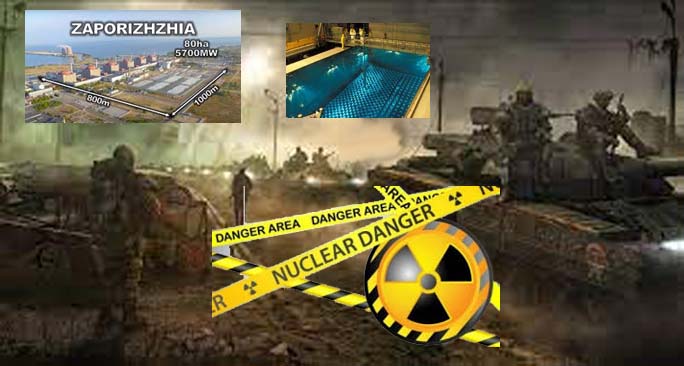
It raises the question, too, of whether we should rely on nuclear power at all.
It raises the question, too, of whether we should rely on nuclear power at all.
euro news.next, By Camille Bello 31/03/2023
Russia’s invasion has repeatedly knocked out Ukraine’s electricity grid, causing blackouts at the Zaporizhzhia nuclear plant – Europe’s largest – where a constant power supply is needed to prevent the reactors from overheating.
On March 9, the plant blacked out for the sixth time since the occupation, forcing nuclear engineers to switch to emergency diesel generators to power its essential cooling equipment running.
“Each time we are rolling a dice,” Rafael Mariano Grossi, the director general of the United Nations’ International Atomic Energy Agency (IAEA), warned at the time. “And if we allow this to continue time after time, then one day, our luck will run out”.
On Monday, during a meeting with Ukraine’s president Volodymyr Zelensky, Grossi reiterated the situation “isn’t getting any better” as relentless fighting in the area keeps the facility at risk of a disaster.
The IAEA watchdog has called for a “protection zone” around the plant but has failed to devise terms that would satisfy both Ukraine and Russia.
Grossi told the AP on Tuesday he believed a deal was “close”. However, Zelenskyy, who opposes any plan that would legitimise Russia’s control over the facility, said he was less optimistic a deal was near. “I don’t feel it today,” he said.
Is Zaporizhzhia really at risk?
Nuclear power plants are designed to withstand a wide range of risks, but no operating nuclear power plant has ever been caught up in modern warfare.
Because of the repeated crossfire, Zaporizhzhia’s last reactor was shut down in September as a precautionary measure. But external power is still essential to run critical cooling and other safety systems.
Fears about Zaporizhzhia have exacerbated existing concerns around our lack of preparedness for any nuclear-related incident, laying bare anxieties not necessarily around war-related incidents but about climate change and Europe’s old reactors, for instance.
It raises the question, too, of whether we should rely on nuclear power at all.
March 11 marked the 12-year anniversary of the massive earthquake and tsunami that caused the second-worst nuclear accident in history at the Fukushima Daiichi Nuclear Power Plant in Japan.
The anniversary of the catastrophic meltdown that left 160,000 people displaced and cost the Japanese government over €176 billion, was another reminder of the potential threat of a nuclear spill, but a number of other recent events have also raised the alarm in Europe, not least the war in Ukraine.
‘We are not properly prepared’
Europe’s nuclear power reactors are ageing – they were built on average 36.6 years ago – and recent checkups in France have found cracks in several facilities.
Some energy experts have warned that the extreme weather events brought on by climate change could pose a serious threat to the EU’s 103 nuclear reactors, which account for about one-quarter of the electricity generated in the bloc.
Jan Haverkamp, a senior nuclear energy and energy policy expert for Greenpeace, said the chances of Europe seeing a large accident like Fukushima were now “realistic” and “we should take them into consideration”.
“We are not properly prepared,” he told Euronews Next…………………………………………………….
The maintenance of a nuclear plant depends on a number of factors, such as its design and its supervision history. But there are other factors that come into play, such as error-prone humans, earthquakes, tsunamis, fires, flooding, tornadoes or even in the case of Zaporizhzhia, acts of war…………………………………………………………………………………… more https://www.euronews.com/next/2023/03/31/chernobyl-fukushima-europe-prepared-nuclear-disaster-ukraine-earthquake-meltdown-radiation
IAEA head warns on danger of intensified fighting near Zaporizhzhia nuclear power plant
The head of the United Nations atomic energy commission said on Wednesday
that intensified fighting near Europe’s largest nuclear power plant poses
a threat to the facility’s safety. The increasing combat makes it urgent
to find a way to prevent a catastrophic nuclear accident at the
Zaporizhzhia nuclear power plant, said International Atomic Energy Agency
director general Rafael Mariano Grossi. “It is obvious that this area is
facing perhaps a more dangerous phase,” he said of the facility, which is
in a partially Russian-occupied part of Ukraine. “We have to step up our
efforts to get to some agreement over the protection of the plant.”
Morning Star 30th March 2023
https://morningstaronline.co.uk/article/w/un-agency-warns-rising-combat-near-ukraine-nuclear-plant
UN watchdog ditches Ukrainian nuclear plant safety zone scheme
Politico, BY LOUISE GUILLOT, MARCH 29, 2023
The head of the U.N. nuclear watchdog today abandoned the idea of creating a safety and security zone around the Zaporizhzhia nuclear power plant in southern Ukraine.
Since September, Rafael Mariano Grossi, the director general of the International Atomic Energy Agency, has been pushing Ukraine and Russia to agree on putting the nuclear plant off limits from the ongoing military conflict.
“Initially we have been focusing on the possibility of establishing a well-determined zone around the plant,” he told reporters during a visit at the plant today. “Now the concept is evolving, refocusing more on the protection itself, the things that should be avoided … rather than on territorial aspects which pose certain problems.”…………….
“It is obvious that the situation is not improving,” Grossi said, pointing at increasing military activity in the region.
Grossi added that efforts to reach a deal between Kyiv and Moscow on measures to prevent a nuclear accident are still “a work in progress.” https://www.politico.eu/article/un-watchdog-ditches-ukrainian-nuclear-plant-safety-zone-scheme/
IAEA nuclear safety chief at Ukraine’s Zaporizhzhia nuclear power station
The UN atomic watchdog chief is expected on Wednesday to visit Ukraine’s
Zaporizhzhia nuclear power plant, which is currently held by Russian
forces. There are persistent fears about the safety of the nuclear plant —
Europe’s largest — which is located in the southern Zaporizhzhia region
where there has been frequent shelling since Russian troops invaded. Rafael
Grossi, head of the International Atomic Energy Agency (IAEA), and his
delegation are expected to arrive Wednesday morning and leave by afternoon,
according to the Russian news agency TASS, citing an official with Russia’s
nuclear operator Rosenergoatom. This will be Grossi’s second visit to
Zaporizhzhia since Russia invaded Ukraine in February last year, and he
plans to “assess first-hand the serious nuclear safety and security
situation at the facility”, according to the IAEA.
France24 29th March 2023
https://www.france24.com/en/live-news/20230329-iaea-chief-to-visit-ukraine-nuclear-plant
UN sounds alarm over Ukraine church crackdown
Kiev’s actions targeting the largest religious denomination in the country “could be discriminatory”
https://www.rt.com/russia/573657-un-ukraine-church-discrimination/ 27 Mar 23,
The Ukrainian state may be discriminating against the nation’s largest religious denomination, the Ukrainian Orthodox Church (UOC), the UN’s human rights watchdog said in a report published on Friday. The government of President Vladimir Zelensky is currently in the process of kicking UOC monks out of their homes.
The apparent mistreatment of the church, which has historic links to the Russian Orthodox Church, was highlighted in a report released by the UN’s Office of the High Commissioner for Human Rights (OHCHR). It cited several draft laws submitted to the Ukrainian parliament as well as the actions of the SBU, Ukraine’s domestic security agency, against the clergy.
The UN body is “concerned that the State’s activities targeting the UOC could be discriminatory,” it said. The report cited “vague legal terminology and the absence of sufficient justification” in proposed legislation, explaining why it drew the OHCHR’s negative attention.
The report covered the period between August 2022 and January 2023, but more recent acts by the government have deepened the saga of the UOC. Earlier this month, the Ukrainian Culture Ministry ordered monks belonging to the jurisdiction to vacate their homes at the Kiev Pechersk Lavra, an iconic monastery in the Ukrainian capital.
Zelensky described the move as strengthening Ukraine’s “spiritual independence” and implied that the UOC was a tool that Russia used “to manipulate the spirituality of our people, to destroy our holy sites [and] to steal valuables from them.”
The president ignored pleas by UOC clergy to meet them and try to diffuse the situation.
Kiev previously expelled the UOC from two of the cathedrals above the monastery. Within days of that decision, the government-backed Orthodox Church of Ukraine (OCU) was allowed to hold services on the premises.
The OCU was created with the support of then-president Poroshenko in what many political observers perceived as an attempt to bolster his re-election chances. Culture Minister Aleksandr Tkachenko said the expelled monks, who have until this Wednesday to move out, could stay in their homes by leaving the UOC and joining the OCU.
UN Rights Official Concerned Over Summary Executions Of POWs By Both Russia, Ukraine
March 25, 2023, By RFE/RL’s Ukrainian Service
The United Nations has expressed deep concern over what it says were summary executions of prisoners of war (POWs) by both Russian and Ukrainian forces on the battlefield.
The head of the UN Human Rights Monitoring Mission in Ukraine, Matilda Bogner, said at a press conference in Kyiv on March 24 that her organization had recently recorded killings by both sides.
“We are deeply concerned about…summary execution of up to 25 Russian prisoners of war and persons [out of action because of injury] by the Ukrainian armed forces, which we have documented,” Bogner said.
This was often perpetrated immediately upon capture on the battlefield,” she said.
“While we are aware of ongoing investigations by Ukraine authorities into five cases involving 22 victims, we are not aware of any prosecution of the perpetrators,” she added.
Almost half of the 229 Russian prisoners of war interviewed by members of the mission claimed torture or ill-treatment, according to Bogner.
Bogner also expressed deep concern over the alleged executions of 15 Ukrainian prisoners by Russian armed forces after their capture. She said the Wagner mercenary group was responsible for 11 of those killings.
The Ukrainian Foreign Ministry reacted to the report by thanking the UN mission for documenting violations of international law by Russia in the course of its aggression against Ukraine.
“At the same time, we consider it unacceptable to place responsibility on the victim of aggression. According to the UN Charter, Ukraine has the right to self-defense,” the ministry said…………………. https://www.rferl.org/a/ukraine-russia-un-execution-prisoners/32333852.html—
Stolen Valor: The U.S. Volunteers in Ukraine Who Lie, Waste and Bicker
People who would not be allowed anywhere near the battlefield in a U.S.-led war are active on the Ukrainian front, with ready access to American weaponry.
By Justin Scheck and Thomas Gibbons-Neff, New York Times . Justin Scheck, an international investigative reporter, and Thomas Gibbons-Neff, the Ukraine correspondent, reported this article from Ukraine and around Europe.
March 25, 2023,
They rushed to Ukraine by the thousands, many of them Americans who promised to bring military experience, money or supplies to the battleground of a righteous war. Hometown newspapers hailed their commitment, and donors backed them with millions of dollars.
Now, after a year of combat, many of these homespun groups of volunteers are fighting with themselves and undermining the war effort. Some have wasted money or stolen valor. Others have cloaked themselves in charity while also trying to profit off the war, records show.
One retired Marine lieutenant colonel from Virginia is the focus of a U.S. federal investigation into the potentially illegal export of military technology. A former Army soldier arrived in Ukraine only to turn traitor and defect to Russia. A Connecticut man who lied about his military service has posted live updates from the battlefield — including his exact location — and boasted about his easy access to American weaponry. A former construction worker is hatching a plan to use fake passports to smuggle in fighters from Pakistan and Iran.
And in one of the more curious entanglements, one of the largest volunteer groups is embroiled in a power struggle involving an Ohio man who falsely claimed to have been both a U.S. Marine and a LongHorn Steakhouse assistant manager. The dispute also involves a years-old incident on Australian reality TV.
Such characters have a place in Ukraine’s defense because of the arms-length role the United States has taken: The Biden administration sends weapons and money but not professional troops. That means people who would not be allowed anywhere near the battlefield in a U.S.-led war are active on the Ukrainian front — often with unchecked access to weapons and military equipment.
Many of the volunteers who hurried to Ukraine did so selflessly and acted with heroism. Some have lost their lives. Foreigners have rescued civilians, aided the wounded and fought ferociously alongside Ukrainians. Others raised money for crucial supplies.
But in Europe’s largest land war since 1945, the do-it-yourself approach does not discriminate between trained volunteers and those who lack the skills or discipline to assist effectively.
The New York Times reviewed more than 100 pages of documents from inside volunteer groups and interviewed more than 30 volunteers, fighters, fund-raisers, donors and American and Ukrainian officials. Some spoke on the condition of anonymity to discuss sensitive information.
The interviews and research reveal a series of deceptions, mistakes and squabbles that have hindered the volunteer drive that began after Russia’s full-scale invasion in February 2022, when President Volodymyr Zelensky of Ukraine called for help. “Every friend of Ukraine who wants to join Ukraine in defending the country, please come over,” he said. “We will give you weapons.”
Thousands answered the call. Some joined military groups like the International Legion, which Ukraine formed for foreign fighters. Others took roles in support or fund-raising. With Kyiv, Ukraine’s capital, under attack, there was little time for vetting arrivals. So people with problematic pasts, including checkered or fabricated military records, became entrenched in the Legion and a constellation of other volunteer groups.
Asked about these problems, the Ukrainian military did not address specific issues but did say it was on guard because Russian agents regularly tried to infiltrate volunteer groups. “We investigated such cases and handed them over to law enforcement agencies,” said Andriy Cherniak, a representative for Ukrainian military intelligence.
‘A Million Lies’
One of the best-known Americans on the battlefield is James Vasquez. Days after the invasion, Mr. Vasquez, a Connecticut home-improvement contractor, announced he was leaving for Ukraine. His local newspaper told the tale of a former U.S. Army staff sergeant who left behind his job and family and picked up a rifle and a rucksack on the front line.
Since then, he has posted battlefield videos online, at least once broadcasting his unit’s precise location to everyone, including the enemy. He used his story to solicit donations. “I was in Kuwait during Desert Storm, and I was in Iraq after 9/11,” Mr. Vasquez said in a fund-raising video. He added, “This is a whole different animal.”
Mr. Vasquez, in fact, was never deployed to Kuwait, Iraq or anywhere else, a Pentagon spokeswoman said. He specialized in fuel and electrical repairs. And he left the Army Reserve not as a sergeant as he claimed, but as a private first class, one of the Army’s lowest ranks.
Still, Mr. Vasquez had easy access to weapons, including American rifles. Where did they come from? “I’m not exactly sure,” Mr. Vasquez said in a text message. The rifles, he added, were “brand-new, out of the box and we have plenty.” He also tweeted that he should not have to worry about international rules of war while in Ukraine.
He fought alongside Da Vinci’s Wolves, a Ukrainian far-right battalion, until this week, when The Times asked about his false military service claims. He immediately deactivated his Twitter account and said he might leave Ukraine because authorities discovered he was fighting without a required military contract.
Mr. Vasquez said he had been misrepresenting his military record for decades. He acknowledged being kicked out of the Army but would not talk publicly about why. “I had to tell a million lies to get ahead,” Mr. Vasquez said in an interview. “I didn’t realize it was going to come to this.”
Public Quarrels
The International Legion, hastily formed by the Ukrainian government, spent 10 minutes or less checking each volunteer’s background early in the war, one Legion official said. So a Polish fugitive who had been jailed in Ukraine for weapon violations got a position leading troops. Soldiers told The Kyiv Independent that he misappropriated supplies, harassed women and threatened his soldiers………………………………………………………………..
The dispute goes to the heart of who can be trusted to speak for and raise money for the Legion……………………………………………………………………………………….
Misdirected Donations
……………………………………………………………………….. Examples of wasted money in the hands of well-intentioned people are common. Mriya Aid, a group led by an active-duty Canadian lieutenant colonel, spent around $100,000 from donors on high-tech U.S.-style night-vision devices. They ended up being less-effective Chinese models, internal documents show…………………..
Earlier this year, the Mozart Group, which two former Marines established to help Ukraine, disbanded after one sued the other, alleging theft and harassment.
Absent Paper Trail
…………………………………………………………………………….. Colonel Rawlings has said that his group is awaiting American nonprofit status. But he has not revealed his spending or proof of a nonprofit application to The Times or to donors who have asked. So it is not clear where the money is going. “I believed these guys,” said Shaun Stants, who said he organized a fund-raiser in October in Pittsburgh but was never shown the financial records he asked for. “And they took me for a fool.”
Corporate records in Poland and the U.S. show that Colonel Rawlings also started a for-profit company called Iron Forge. In an interview, he said he expected his charity and others to pay Iron Forge for transportation, meaning donor money would be used to finance his private venture.
But he said no conflict of interest existed because Iron Forge would ultimately send money back to the charities. Details are being worked out, he said.
In the days after The Times approached Mr. Vasquez and others, members of the squabbling groups — Ripley’s, the Legion, the dissident Legion members and more — escalated their feud. They accused one another of misappropriating funds and lying about their credentials…………..
Najim Rahim contributed reporting from Berkeley, Calif., and Maria Varenikova and Daria Mitiuk from Kyiv, Ukraine.
https://archive.is/VR4ge#selection-1457.0-1457.114
UK could fuel radioactive disaster in Ukraine – Russia
24 Mar 23, https://www.rt.com/russia/573527-ukraine-uranium-radioactive-disaster/
Depleted uranium shells promised to Kiev by the UK would “cause irreparable harm” to soldiers and civilians alike, Moscow claimed.
The potential use of British-supplied depleted uranium shells by Ukraine would have a devastating impact on the country’s economy and population, lasting for centuries to come, the Russian Defense Ministry warned on Friday.
Speaking at a briefing, Lieutenant General Igor Kirillov, who is in charge of Russia’s Nuclear, Biological and Chemical Defense Forces, issued a scathing criticism of the UK’s plans to support Kiev with armor-
rounds containing depleted uranium.
He noted that such munitions have only ever been deployed in combat by NATO countries, most notably during the Iraq War, when the US used at least 300 tons of depleted uranium-piercing rounds containing uranium.
“As a result, the radiation situation in the [Iraqi] city of Fallujah was much worse than in the cities of Hiroshima and Nagasaki after the nuclear bombings by the United States,” Kirillov stated, recalling that Fallujah had been dubbed “the second Chernobyl,” while the local population suffered from a skyrocketing number of cancer cases.
The West is well aware of the consequences of using such weapons, the general stressed. Even though it “will cause irreparable harm” to the health of Ukrainian troops and civilians, “NATO countries, in particular the UK, express a readiness to supply this type of weapon to the Kiev regime,” Kirillov stated.
He warned that the use of the munitions will contaminate farmland. “In addition to infecting its own population, this will cause tremendous economic damage to the agro-industrial complex of Ukraine… reducing any export of agricultural produce from Ukrainian territory for many decades, if not centuries to come,” the general said.
The UK’s plans to send depleted uranium shells to Ukraine for use with Challenger 2 battle tanks were first unveiled on Monday, prompting an outcry from the Russian Foreign Ministry, which called the move a sign of “absolute recklessness, irresponsibility and impunity” on the part of London and Washington.
While the US has said it does not plan to support Ukraine with such ammunition, it shrugged off Russian concerns over the matter, describing depleted uranium shells as “a commonplace type of munition” which has “been in use for decades.”
The West has ‘brought humankind to the brink of nuclear Armageddon’ with its decision to use depleted uranium ammo in Ukraine, says Russia’s US envoy
- Anatoly Antonov was responding to statements by US officials that depleted-uranium munitions are standard types of weapons
- The British defense ministry on Monday confirmed it would provide Ukraine with armour-piercing rounds containing depleted uranium
By JAMES CALLERY FOR MAILONLINE, 24 March 2023
Western countries led by the US have decided to bring humankind to the brink of a nuclear Armageddon, Russia’s Ambassador to the US Anatoly Antonov said in Washington on Wednesday.
He was responding to statements by US officials that depleted-uranium munitions are standard types of weapons that have been used for decades and do not pose any heightened risk.
The British defense ministry confirmed on Monday that it would provide Ukraine with armour-piercing rounds containing depleted uranium.
……….. ‘US officials have reached a new low with their irresponsible statements. There is a continuous flow of lethal weapons to Ukraine, which are used to annihilate civilians, residential areas, schools, hospitals, kindergartens,’ Antonov said, according to a statement from the embassy…………….
The ammunition, which enhances ability to overcome defenses on tanks, ‘is not radioactive’ and ‘not anywhere close to going into’ the sphere of nuclear weaponry, Kirby said.
White House National Security Council spokesman John Kirby called Moscow’s complaints a ‘straw man’ argument………… ‘This is a commonplace type of munition that is used particularly for its armour-piercing capabilities. “
……….. Kirby said, however, that the US is ‘not providing depleted uranium’……………………………………………… https://www.dailymail.co.uk/news/article-11893717/Russias-envoy-Decision-use-depleted-uranium-ammo-risks-nuclear-Armageddon.html
1 This Month



26 September – International Day for the Total Elimination of Nuclear Weapons


PLEASE OPPOSE HR 8255 AND S.3639 – bills would accelerate satellite deployment, with no environmental review or safeguards – https://ncstd5li.quorum.us/campaign/169331/
To see nuclear-related stories in greater depth and intensity – go to https://nuclearinformation.wordpress.com
-
Archives
- September 2026 (233)
- August 2026 (330)
- July 2026 (355)
- June 2026 (287)
- May 2026 (306)
- April 2026 (356)
- March 2026 (251)
- February 2026 (267)
- January 2026 (308)
- December 2025 (358)
- November 2025 (359)
- October 2025 (375)
-
Categories
- 1
- 1 NUCLEAR ISSUES
- business and costs
- climate change
- culture and arts
- ENERGY
- environment
- health
- history
- indigenous issues
- Legal
- marketing of nuclear
- media
- opposition to nuclear
- PERSONAL STORIES
- politics
- politics international
- Religion and ethics
- safety
- secrets,lies and civil liberties
- spinbuster
- technology
- Uranium
- wastes
- weapons and war
- Women
- 2 WORLD
- ACTION
- AFRICA
- Atrocities
- AUSTRALIA
- Christina's notes
- Christina's themes
- culture and arts
- Events
- Fuk 2022
- Fuk 2023
- Fukushima 2017
- Fukushima 2018
- fukushima 2019
- Fukushima 2020
- Fukushima 2021
- general
- global warming
- Humour (God we need it)
- Nuclear
- RARE EARTHS
- Reference
- resources – print
- Resources -audiovicual
- Weekly Newsletter
- World
- World Nuclear
- YouTube
-
RSS
Entries RSS
Comments RSS
 nuclear-news