Dominic Cummings: Zelensky’s no Churchill and Ukraine’s corrupt
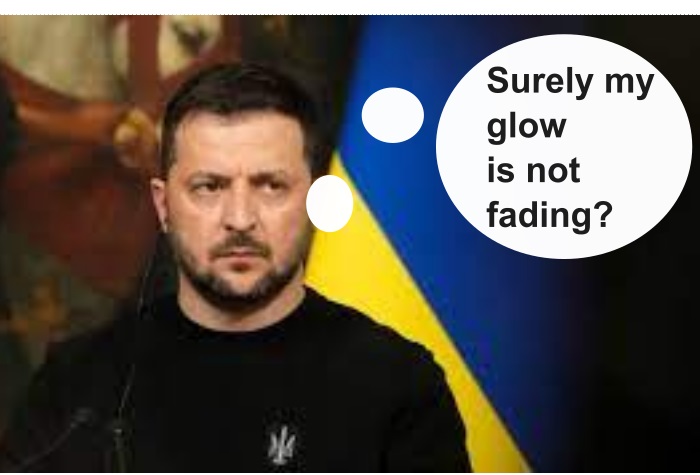
Former Brexit campaign chief says the West is ‘getting f**ked’ by supporting Ukraine.
BY NOAH KEATE, MAY 9, 2024 https://www.politico.eu/article/dominic-cummings-volodymyr-zelenskyy-ukraine-war-corruption/
LONDON — Boris Johnson’s former top adviser Dominic Cummings launched a sweary attack on Western support for Ukraine Thursday.
In an interview with the i newspaper, Cummings — who led Britain’s Vote Leave Brexit campaign and spectacularly fell out with Johnson in 2020 — declared that the West “should have never got into the whole stupid situation” and claimed sanctions against Russia have had a greater impact on European politics than in Moscow.
The former adviser was scathing of Ukrainian President Volodymyr Zelenskyy and comparisons with World War II.
“This is not a replay of 1940 with Zelenskyy as the Churchillian underdog,” he said.
“This whole Ukrainian corrupt mafia state has basically conned us all and we’re all going to get f**ked as a consequence. We are getting f**ked now right?”
In a follow-up tweet, Cummings later branded Zelenskyy a “potemkin” leader — but denied he’d called him a “pumpkin” as originally quoted in the interview.
He argued that war would only strengthen the relationship between Russia and China, saying Western nations “pushed [Russia] into an alliance with the world’s biggest manufacturing power.”
Cummings has long been critical of support for Ukraine, a stance that puts him sharply at odds with his old boss Johnson, a vocal supporter of Zelenskyy and Ukraine’s war effort.
He told the paper the West had failed to send Russian President Vladimir Putin a worthwhile signal which would deter him from invading another country.
“What lesson have we taught him? The lesson we’ve taught Putin is that we’re a bunch of total f**king jokers,” Cummings asserted, saying the war had “broadcast it to the entire world what a bunch of clowns we are.”
It comes as the former Vote Leave Brexit campaign chief tests the water for a new political party to replace the Tories.
POLITICO reported on Thursday that Cummings has organized a series of focus groups to get the public’s views about a new anti-establishment outfit.
Cummings told the i his “Start Up Party” would be “ruthlessly focused on the voters not on Westminster and the old media.”
MISTAKES THAT CAUSED THE CHERNOBYL DISASTER
BY S. FLANNAGAN/MAY 12, 2024 https://www.grunge.com/1562994/mistakes-that-caused-chernobyl-disaster/
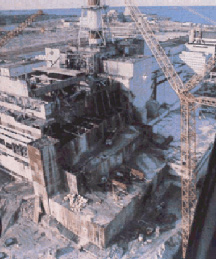
The Chernobyl disaster remains one of the most chilling incidents of the nuclear age. The Chernobyl Power Complex was the name of a nuclear power plant in northern Ukraine just a few miles from the Belarus border near the city of Pripyat. At the time Ukraine was part of the Union of Soviet Socialist Republics (USSR), and Chernobyl was constructed between 1970 and 1977 as part of the USSR’s nuclear expansion program. It had four reactors, each capable of generating colossal amounts of energy to enrich the Soviet bloc. On April 26, 1986, a series of errors caused reactor 4 to experience an unexpected surge of power that started a huge fire, which led to several explosions and the biggest release of radioactive material into the atmosphere in history.
Local areas such as Pripyat were evacuated, but a delayed emergency response saw the area transformed into an uninhabitable no-go zone. It has been reported that 31 people lost their lives in the immediate aftermath of the meltdown, including six firefighters who received double the fatal amount of radiation as they attempted to extinguish the blaze. But a delayed response saw the amount of material released into the environment and spread across Ukraine, Belarus, Russia, and parts of Central Europe. Hundreds of thousands of people were involved in the clean-up, many of whom went on to develop health problems such as cancer as a consequence of the exposure. Here are some of the mistakes that led to the meltdown, and to the local area being largely uninhabited even today.
A FLAWED DESIGN
The World Nuclear Association notes that one of the key issues that led to the meltdown of Reactor 4 which resulted in the Chernobyl disaster of 1986 was the flawed design of the reactor itself. Each of Chernobyl’s four reactors was of a new Soviet design known as “reaktor bolshoy moshchnosty kanalny,” or RBMK. RBMK reactors were one of two reactor designs to emerge from the USSR in the 1970s. They employ a water-cooling system and graphite control rods that regulate fission, which creates nuclear energy.
On the night of the meltdown, operators were attempting to test whether residual steam pressure would be able to keep the reactor going in the event of a power cut long enough for the backup diesel generators to take over. However, in the course of the experiment, a huge and unexpected power surge hit the reactor, which was later found to have been caused by the RBMK’s enormous “void coefficient,” ultimately meaning that excess steam in the water cooling system would not be able to absorb neutrons in the system, resulting in the surge. After an investigation into these flaws, crews were tasked with upgrading other reactors in the Chernobyl Power Complex to make them safer, though over the years these other reactors have also eventually been decommissioned.
SAFETY ISSUES COVERED UP
But the flaws in the design of the RBMK-1000 reactor at Chernobyl that rendered it unsafe weren’t exactly a surprise to experts in the wake of the meltdown. In fact, the site had suffered several notable accidents and emergencies years before the shocking events of April 1986. But as we know now, those in charge of the Soviet nuclear program sought to cover up evidence that their reactors were unsafe, meaning that they continued to be operated despite such safety issues leading to the worst nuclear accident in history.
According to a 2021 report published by Reuters, it was revealed that the side had a radiation leak as early as 1982 and that numerous accidents occurred at the plant in 1984. The Soviet government was reportedly aware of the truth that Chernobyl was fundamentally unsafe as a power plant as early as 1983 but kept the matter a secret from the public.
The same instinct among the Soviet powers that be to cover their tracks led to their delayed order to evacuate the city of Pripyat until about Chernobyl 36 hours after the meltdown began, ultimately exposing thousands of locals to dangerous levels of radiation.
The nuclear operators on-site at the Chernobyl Power Complex were later identified as lacking in adequate training required to keep such a complicated and cutting-edge power station running effectively and safely. In the years following the devastating nuclear meltdown, the operators themselves were afforded a great deal of blame for the disaster in which many of them lost their lives.
Indeed, the experiment that the Chernobyl nuclear operators were performing on the night of the meltdown was flawed as a result of human error, which largely came down to the team’s lack of understanding of the reactor’s internal systems. None of them expected the surge of power that the experiment unleashed. The experiment itself was later reported to have been unauthorized, though plant director Viktor Bryukhanov, chief engineer Nikolai Fomin, and his deputy, Anatoly Dyatlov later received 10-year prison sentences for the disaster. Official Soviet government reports claimed that the operators, three more of whom were given prison sentences, had been negligent.
The lack of training that the operators were afforded resulted from what is now known to have been an almost complete lack of safety culture at the Chernobyl Power Complex, a characteristic of Soviet industry more generally at the time. No interest in maximum design accidents, hypothetical disasters that could then be mitigated against in design features, were of little interest to commissioners or designers of the RBMK-1000 reactor, who were also looking to reduce costs.
The safety of Chernobyl was further impacted by opacity within the Soviet hierarchy, which prevented subordinates from reporting issues and misgivings to their superiors, leading to a culture of silence in which errors were not course-corrected. Similarly, mistakes, including those around safety, were covered up, rather than treated as lessons to be learned from. “The attitude came from the race for the atomic bomb, “Chernobyl: History of a Tragedy writer Sehii Plokhy writer told The Guardian in 2018. “The sacrifice of health and life was almost expected. That culture was transferred to the nuclear power establishment.”
Further safety features were overlooked as director Viktor Bryukhanov, who was also in charge of the setting up of the reactors as well as providing accommodation for the operators, raced to keep the project on track. The science journal Nature reports that under his direction electric cables were installed without the required fire-resistant cladding, just one instance of the corners that were cut in the creation of the plant despite the potential calamity that might occur were something to go wrong with any of its reactors.
A lax attitude to safety continued even after the meltdown and the delayed evacuation of local people from the area around the site as it grew more and more radiated and became a danger to human life. In the aftermath, an international effort saw a concrete “sarcophagus” erected around the reactor intended to stop the spread of further radiation. However, the structure was only intended to be temporary and still requires a permanent solution to this day, with experts claiming that it and other stores of radioactive material from the world’s worst nuclear disaster constitute an ongoing risk to public safety if not adequately maintained.
The United States Is Expected to Announce a New $400 Million Package of Weapons for Ukraine
Associated Press | By Lolita C. Baldor and Matthew Lee, May 10, 2024, https://www.military.com/daily-news/2024/05/10/united-states-expected-announce-new-400-million-package-of-weapons-ukraine.html
WASHINGTON — The U.S. is expected to announce a new $400 million package of military aid for Ukraine on Friday, U.S. officials said, as Kyiv struggles to hold off advances by Russian troops in the northeast Kharkiv region.
This is the third tranche of aid for Ukraine since Congress passed supplemental funding in late April after months of gridlock. Ukrainian President Volodymyr Zelenskyy had warned Thursday that his country was facing “a really difficult situation” in the east, but said a new supply of U.S. weapons was coming and “we will be able to stop them.”
According to officials, the package includes High Mobility Artillery Rocket Systems and rockets for them, as well as artillery, air defense and anti-tank munitions, armored vehicles and other weapons and equipment. The officials spoke on condition of anonymity because the aid has not yet been announced. It will be provided through presidential drawdown authority, which pulls systems and munitions from existing U.S. stockpiles so they can be sent quickly to the war front.
Almost immediately after President Joe Biden signed the $95 billion foreign aid package, the Pentagon announced it was sending $1 billion in weapons through that drawdown authority,. And just days later the Biden administration announced a $6 billion package funded through the Ukraine Security Assistance Initiative, which pays for longer-term contracts with the defense industry and means that the weapons could take many months or years to arrive.
Russia has sought to exploit Ukraine’s shortages of ammunition and manpower as the flow of Western supplies since the outbreak of the war petered out while Congress struggled to pass the bill. Moscow has assembled large troop concentrations in the east as well as in the north and has been gaining an edge on the battlefield, Zelenskyy said.
Officials did not say if the latest package includes more of the long-range ballistic missiles — known as the Army Tactical Missile System — that Ukraine has repeatedly requested. The U.S. secretly sent a number of the missiles to Ukraine for the first time this spring and the White House has said it would send more. In one case, Ukraine used them to bomb a Russian military airfield in Crimea.
The new missiles give Ukraine nearly double the striking distance — up to 300 kilometers (190 miles) — than it had with the mid-range version of the weapon that it received from the U.S. in October.
NATO escalation in Ukraine threatens nuclear war with Russia
Now, however, Macron says NATO aims not to seek a negotiated peace, but to force the Russian military to assume that NATO may adopt the most aggressive possible policy. This includes possibly launching not only a large-scale land invasion of Russia, but also—since France, Britain and the United States all refuse to rule out initiating the use of nuclear weapons in a war—a pre-emptive nuclear strike on Russian forces in Ukraine or on Russian cities.
It is high time for Biden and his NATO colleagues to tell the people that their pursuit of “victory in Ukraine” means risking nuclear war
Alex Lantier, 6 May 2024 https://www.wsws.org/en/articles/2024/05/07/qtgn-m07.html
There are growing indications that NATO’s war against Russia is entering a new stage of escalation that threatens to lead to the use of nuclear weapons. Top NATO officials are publicly talking about resorting to missile strikes and ground war against Russia, while Russian officials are warning they may launch counter-strikes on NATO countries.
Last week, 100 artillerymen and surveillance specialists of the French Foreign Legion were deployed to the front lines at Slavyansk in Ukraine, according to a report by former US Undersecretary for Defense Stephen Bryen in the Asia Times. Bryen said a further 1,500 French Foreign Legionnaires could soon deploy to Ukraine. He wrote that one consequence of this is “potentially triggering a pan-European war.”
While the French Foreign Ministry denied Bryen’s report, it is in line with President Emmanuel Macron’s previous calls for a ground war with Russia. Macron and other top NATO officials are now reasserting these comments in an aggressive press campaign. Last week, in The Economist, Macron again demanded that NATO be ready to send ground troops to Ukraine:
If the Russians were to break through the front lines, if there were a Ukrainian request—which is not the case today—we would legitimately have to ask ourselves this question.
This weekend, the Italian daily La Repubblica reported on further NATO war plans. It cited secret NATO agreements allegedly defining two “red lines,” Belarus’ entry into the war and a Russian “provocation” targeting Poland, Hungary or the Baltic States. If either of these “red lines” were crossed, NATO would mobilize 100,000 troops across Eastern Europe, from the Baltic states to Romania.
Also, last Thursday, UK Foreign Minister David Cameron went to Kiev, where he said Ukraine has the “absolute right” to use British long-range missiles to bomb Russia.
This weekend, Macron told the French financial newspaper La Tribune that NATO must create total uncertainty about its actions in Russia’s military command:
President Putin has constantly brandished the nuclear threat. Faced with such an adversary, it is such an act of weakness to give a priori limits on one’s own actions! We must on the contrary deny him any idea of what we might do. This is how we can deter him from taking action.
Macron’s statements illustrate the mood of utter recklessness prevailing in ruling circles. During the Cold War, US and Soviet officials installed an emergency hotline between the White House and the Kremlin, fearing that nuclear war could erupt accidentally if one side misread the intentions of the other and believed the opponent had launched a nuclear strike. On September 26, 1983, this nearly occurred, when Soviet early warning systems falsely indicated that US forces had launched nuclear missiles at the Soviet Union.
Now, however, Macron says NATO aims not to seek a negotiated peace, but to force the Russian military to assume that NATO may adopt the most aggressive possible policy. This includes possibly launching not only a large-scale land invasion of Russia, but also—since France, Britain and the United States all refuse to rule out initiating the use of nuclear weapons in a war—a pre-emptive nuclear strike on Russian forces in Ukraine or on Russian cities.
Whether or not French troops are already deployed in Ukraine, the Kremlin is clearly taking these reports seriously. The “strategic ambiguity” Macron said he wanted to build in NATO relations with Russia has been established. Increasingly convinced that NATO may catastrophically escalate the conflict, Russian officials are calling to prepare the most drastic measures in response, creating conditions for a disastrous escalatory spiral in the war.
Yesterday, the Kremlin announced that it would hold military exercises simulating the use of nuclear weapons. Kremlin spokesman Dmitri Peskov called the nuclear exercises a response to an “unprecedented stage in the escalation of tensions initiated by the French president and the British foreign secretary,” including “an intention to send armed contingents to Ukraine—that is, to actually put NATO soldiers in front of Russian troops.”
Extraordinary warnings emerged after the Russian foreign ministry summoned the British and French ambassadors yesterday to protest the statements of Cameron and Macron.
It warned UK Ambassador to Russia Nigel Casey that Cameron’s statements made Britain “a de facto party to the conflict” between Ukraine and Russia, the Guardian wrote. “Casey was told that in response to Ukrainian attacks on Russian territory with British weapons, any British military facilities and equipment on the territory of Ukraine and abroad could be targeted,” the Russian Foreign Ministry said.
Yesterday, on his Telegram channel, former Russian President Dmitri Medvedev bluntly stated that if NATO continues on its course, Russia could bomb Washington, Paris and London amid a “world catastrophe.” Medvedev wrote:
There is some kind of total degradation of the ruling class in the West. This class really does not want to logically connect elementary things. Sending your troops to the territory of Ukraine will entail the direct entry of their countries into the war, to which we will have to respond. And, alas, not only in the territory of Ukraine.
In this case, none of them will be able to hide either on Capitol Hill, or in the Elysée Palace, or in 10 Downing Street. A world catastrophe will come.
On May 4, introducing the International Committee of the Fourth International’s (ICFI) May Day online rally, David North warned of the danger that the NATO war against Russia in Ukraine could escalate into a nuclear world war. Citing US-UK pledges to arm NATO’s Ukrainian puppet regime with long-range missiles that can strike major Russian cities, North said:
But what if Putin, invoking the precedent set by President John F. Kennedy during the Cuban missile crisis in 1962, declares, paraphrasing Kennedy’s warning, that attacks on Russian territory by Ukraine with missiles supplied by NATO “will be regarded as an attack” by NATO upon Russia, “requiring a full retaliatory response” upon NATO countries?
It is high time for Biden and his NATO colleagues to tell the people that their pursuit of “victory in Ukraine” means risking nuclear war and describe in necessary detail what will happen to their countries and the world if the confrontation with Russia goes nuclear.
There was no trace of exaggeration in this warning, which has been confirmed in barely three days.
The strongest possible appeal must be made to workers and youth around the world: If the working class does not intervene against the capitalist governments to stop this escalation, one or another confrontation will ultimately escalate into nuclear war.
The greatest danger is that masses of workers and youth are not fully aware of the urgency of the risk of a catastrophic global war. They must be alerted and mobilized through an international movement of meetings, protests and strikes, aiming to build a mass, socialist anti-war movement in the international working class.
The Great Ukraine Robbery Is Not Over Yet

“we are helping Ukraine while at the same time investing in our own industrial base.”- Joe Biden
the Biden Administration to sign a ten-year security agreement that would lock in US funding for Ukraine for the next two and a half US Administrations.
by Ron Paul , , https://original.antiwar.com/paul/2024/05/06/the-great-ukraine-robbery-is-not-over-yet/
The ink was barely dry on President Biden’s signature transferring another $61 billion to the black hole called Ukraine, when the mainstream media broke the news that this was not the parting shot in a failed US policy. The elites have no intention of shutting down this gravy train, which transports wealth from the middle and working class to the wealthy and connected class.
Reuters wrote right after the aid bill was passed that, “Ukraine’s $61 billion lifeline is not enough.” Senate Minority Leader Mitch McConnell went on the Sunday shows after the bill was passed to say that $61 billion is “not a whole lot of money for us…” Well, that’s easy for him to say – after all it’s always easier to spend someone else’s money!
Ukraine’s foreign minister, Dmytro Kuleba, was far from grateful for the $170 billion we have shipped thus far to his country. In an interview with Foreign Policy magazine as the aid package was passed, Kuleba had the nerve to criticize the US for not producing weapons fast enough. “If you cannot produce enough interceptors to help Ukraine win the war against the country that wants to destroy the world order, then how are you going to win in the war against perhaps an enemy who is stronger than Russia?”
How’s that for a “thank you”?
It may be understandable why the Ukrainians are frustrated. Most of this money is not going to help them fight Russia. US military aid to Ukraine has left our own stockpiles of weapons depleted, so the money is going to create new production lines to replace weapons already sent to Ukraine. It’s all about the US weapons industry. President Biden admitted as much when he said, “we are helping Ukraine while at the same time investing in our own industrial base.”
This is why Washington Is desperate to make sure that if Donald Trump returns to the White House, the “Ukraine” gravy train cannot be shut down by his – or future – administrations. Last week news broke that the Ukrainian government was in negotiations with the Biden Administration to sign a ten-year security agreement that would lock in US funding for Ukraine for the next two and a half US Administrations. That would unconstitutionally tie future presidents’ hands when it comes to foreign policy and would leave Americans on the hook for untold billions more dollars taken from them and sent to the weapons industry and to a corrupt foreign government.
The US weapons industry and its cheerleaders in Washington DC are determined to keep Ukraine money flowing…until they can figure out a way to gin up a war with China after losing the current war with Russia. That, of course, depends on whether there is anything left of us when the smoke clears.
When President Biden signed the $95 billion bill to keep wars going in Ukraine and Gaza and to provoke a future war with China, he called it “a good day for world peace.” Yes, and “War is peace.” Debt is good. Freedom is slavery. We are living in a post-truth society where billions spent on pointless wars are “not a whole lot of money.” But the piper will be paid and the debt will be cleared.
Zelensky wants ten more years of US funding

https://www.rt.com/news/596736-ukraine-us-aid-decade/ 29 Apr 24
The Ukrainian leader has said he is working on getting a long-term assistance package from Washington.
The latest US aid package for Kiev, which was only approved by Congress after more than six months of partisan feuding, might be small potatoes compared to what Ukrainian President Vladimir Zelensky has in mind for his biggest benefactor.
Kiev is negotiating with the administration of US President Joe Biden on a long-term agreement that would put Washington on the hook to provide Ukraine with military, economic, and political support for the next decade, Zelensky said on Sunday in his daily video address. Such commitments are needed to ensure Ukraine has the “efficiency in assistance” it needs to stem recent battlefield advances by Russian forces and gain the upper hand, he said.
“We are working to commit to paper concrete levels of support for this year and for the next ten years,” Zelensky said. “It will include military, financial, and political support, as well as what concerns joint production of weapons.”
Ukraine has already signed bilateral security agreements with several NATO members, including the UK, Germany, and France. Zelensky said he wants the long-term deal under negotiation with Washington to be the strongest pact yet.
However, Ukraine’s bilateral agreements with Western countries so far have stopped short of mutual-defense commitments. The deals merely pledge long-term aid, including support in the event of a future attack, and they are not legally binding. The agreement with Berlin, for instance, can be terminated with six months’ notice.
Zelensky said he wants Ukraine’s bilateral pact with Washington to include specific levels of aid. “The agreement should be truly exemplary and reflect the strength of American leadership,” he said.
US lawmakers approved $61 billion in additional aid for Ukraine earlier this month, after House Speaker Mike Johnson (R-Louisiana) overrode opposition in his own party to pass the bill with unanimous Democrat support. The Biden administration ran out of funding for Ukraine aid earlier this year, after using up $113 billion in previously approved assistance packages.
Republican lawmakers have argued that Biden is merely prolonging the bloodshed in Ukraine without offering a clear strategy for victory or a peace deal with Russia. A poll released in February showed that nearly 70% of Americans want Biden to push for a negotiated settlement with Moscow, involving compromises on both sides, rather than continuing to fund the conflict.
Grim nuclear anniversary: Zaporizhzhia must not repeat Chornobyl

Shaun Burnie, Jan Vande Putte and Daryna Rogachuk, 26 April 2024 https://www.greenpeace.org/international/story/66648/grim-nuclear-anniversary-zaporizhzhia-chornobyl-ukraine/
Chornobyl is one of the most recognised synonyms for disaster in the world. Its legacy is a universal reminder of the horrific consequences of nuclear power when things goes wrong: on this day in 1986, a test procedure produced explosions at the power plant in Pripyat, Ukraine, causing a chain reaction that blew a colossal release of radioactive contamination across Europe and eventually much of the Northern Hemisphere.
Millions of Ukrainians have been affected by the destruction of reactor unit 4 and the radiation it released into the environment, either directly or through their families, friends and colleagues and its impact is still felt across generations.
Today, 38 years later, the spectre of nuclear catastrophe looms large – and not only in the abandoned region around Chornobyl: the ongoing illegal Russian military occupation of the south-eastern Zaporizhzhia nuclear power plant, the largest in Europe and one of the 10 biggest in the world, installed by force the Russian state nuclear authority Rosatom. In doing so, Moscow placed in danger not only Ukraine, but most of Europe – and with chilling echoes of a Soviet era mentality that prioritised domination over life and safety and produced the catastrophe in Chornobyl.
Chornobyl’s RBMK reactor design had evolved out of the Soviet Union’s 1950s military reactors used for producing plutonium for nuclear weapons, and were known even then to be unsafe. Scientists warning of integral instabilities, including a ‘positive steam coefficient’ which could lead to an explosion, were ignored. Twenty years later, that design flaw and others led to two massive explosions that destroyed the Chornobyl unit 4 reactor and shook the world.
In the years between 1986-1990, over 600,000 firefighters, soldiers, janitors, and miners – collectively known as ‘liquidators’ – were sent to the Chornobyl site after the explosion in an attempt to respond to the disaster. Many tens of thousands have suffered long term health consequences and death.
The Russian threat at Zaporizhzhia nuclear power plant
By sidelining Zaporizhzhia’s Ukrainian engineers at gunpoint, and by deliberately firing missiles at Ukraine’s wider energy infrastructure, the Kremlin risks repeating terrible lessons from history. The Russian invasion presence places Ukraine’s four nuclear power plants – South Ukraine, Rivne, Khemelnitsky and especially Zaporizhzhia – at risk of an emergency power loss and station blackout.
Despite heroic efforts by Zaporizhzhia workers and citizens of nearby Energodar to barricade the main access road with vehicles, tyres and sandbags to block the advancing Russian troops, they were overwhelmed and the resulting assault damaged the plant, including its vital electricity infrastructure for maintaining the cooling function of the hot nuclear fuel. One reactor core producing heat for the electricity has the power of two million water cookers: if cooling stopped after shutdown, it would take only hours for the cooling water to boil off, expose the hot nuclear fuel to the air and melt down, leading to a new major nuclear disaster. In peacetime, power plant workers still have several options to restore cooling in an emergency, but in a war zone this is severely and constantly compromised.
There is a long list of dangerous incidents caused by the Russian invasion, including the destruction of the Nova Kakhovka dam on 6 June 2023, which not only led to an enormous damage and suffering below the dam, but also emptied the Kakhovka reservoir providing cooling water for the Zaporizhzhia nuclear plant.
Nuclear history repeating itself?
The ultimate blow to nuclear safety however is the plan of Rosatom and Moscow to attempt to restart one or more reactors at the Zaporizhzhia nuclear plant. The existing cooling water resources are far from sufficient to cool an operational reactor. Rosatom would have to build a new pump system, which would not be as reliable, and it does not have the workforce and expertise to control an operational reactor, especially in a warzone. Nuclear energy is incompatible with a world marred by conflict and instability.
Russia might have launched a disinformation campaign to pave the way for blaming Ukraine in case something goes very wrong. Hiding behind false flag attacks might make it easier for them to take higher risks. That is why it is so important to remember Chornobyl today, and how it happened, through irresponsible deliberate decisions and acts by the Soviet system.
Greenpeace Germany has written to Rafael Mariano Grossi, the International Atomic Energy Agency (IAEA) Director General calling on him to make clear to Rosatom and the Russian government that restart of Zaporizhzhia under Russian control is unconscionable. The IAEA must do all it can to prevent restart and not cooperate with Rosatom, nor seek to accommodate the interests of the nuclear industry, or it risks repeating the grave mistakes of the past.
Chernobyl – the Cloud Lingers On
CHERNOBYL – THE FACTS
- The total radioactively released from Chernobyl was 20 times that of the combined releases of the Hiroshima and Nagasaki atomic bombs.
- At least 9 million people have been directly affected by the accident
- Over 160,000 square kilometres of land were contaminated with 42,000 squarekilometres rendered unusable.
- At least 400,000 people were forced to leave their homes in Russia, Ukraine and Belarus.
- Analysis concluded that the former Soviet Union would have been better off financially if it had never begun building nuclear reactors.
- It is estimated that the total cost of compensation paid to UK farmers is over £12 million.
- The Chernobyl disaster has caused a massive increase in thyroid cancers in the three most affected countries of Belarus, Russia and Ukraine.
- The sarcophagus built to contain the damaged reactor was supposed to last 30 years but some 300 yards of cracks and holes are already evident.
- In Ukraine, two million children live in contaminated areas with 900,000 still living in high-risk zones.
- The stricken reactor will remain radioactive for about 10,000 years.
BY MARIANNEWILDART, https://mariannewildart.wordpress.com/2024/04/26/chernobyl-the-cloud-lingers-on/
38th Anniversary of Chernobyl
Today is the 38th Anniversary of the ongoing Chernobyl nuclear disaster. A huge steel and concrete sarcophagus covers the site of the meltdown. Under its dome, called the New Safe Confinement, lie 200 tons of lava-like nuclear fuel, 30 tons of highly contaminated dust and 16 tons of uranium and plutonium that continue to release high levels of radiation. There is a rather odd link with the Russian state nuclear body Rosatom and Cumbria. Until recently Rosatom shared the same PR company as West Cumbria Mining – New Century Media. The coal mine plans have an uncanny resemblance to the Chernobyl sarcophagus
The damage from Chernobyl is ongoing, snowballing down through the generations with tenacious charities such as Chernobyl Children’s Project (UK) and Chernobyl Childern International doing their utmost to support those whose lives continue to be damaged.
Here we re-publish “The Cloud Lingers On”
a hard hitting article from 1996…in non other than Cumbria Life.
The lifestyle magazine, Cumbria Life, is not where you would expect to find a hard- hitting article on Chernobyl and the nuclear industry. But that is exactly what was published in this Cumbrian coffee table magazine in 1996. ….
(the article is in the public domain but not online – any mistakes in transcript are mine)
Ten years ago a cloud washed over the Cumbrian fells, coating the grass, trees, heather, bracken and rocks with a film of radiation. It came from Chernobyl, a ruptured nuclear reactor in the Ukraine, several thousand miles away. Early, confident predictions that the heavy Cumbrian rain, that brought down the radioactive Caesium in the first place would now wash it from the uplands, were quietly buried. No amount of rain was every going to wash away the poison from Chernobyl. Award winning environmental writer Alan Air reports.
At the height of the Cold War, the superpowers hid behind the perverted logic of the military defence acronym MAD – Mutually Assured Destruction – to shore up a global arms industry worth billions of pounds. We pointed our nuclear warheads at them. They pointed their nuclear warheads at us. Would they dare unleash their missiles? Would we dare unleash our missiles? All that awful tension.
Cumbria at first glance a global backwater of lakes, dry stone walls and back packing ramblers, seemed remote from the world stage but it played a part in the divide between West and East; Sellafield’s nuclear complex, the Broughton Moor arms depot, Anthorn’s submarine tracking station and even the Chapelcross nuclear plant just across the Solway Firth were all key components in the UK’s military and nuclear defence strategy.
Britain’s post-war civil atomic power programme was inextricably interwoven with its nuclear defence objectives; no British Government Minister wanted to enter the nuclear conference chamber naked.
Thankfully, Eastern Bloc missiles never did scream over Saddleback or the back o’ Skiddaw but in the spring of 1986, before the Soviet Union started to implode, Cumbrians felt the heat of Cold War politics on its back when an experiment at the Lenin nuclear plant at Chernobyl, in the Ukraine went wrong and Number 4 reactor exploded and threw up over Europe.
Spiralling weather patterns spread the atomic debris to dozens of countries in different time zones, heavy rain brought the radiation down on our county’s mountain tops and the alarms went berserk at Sellafield evoking a home-grown nuclear nightmare, the Windscale fire of ’57 that contaminated large parts of Cumbria and northern England. Chernobyl was nothing if not ironic.
Ten years later and Chernobyl – the noun is now instantly synonymous with the world’s worst nuclear disaster – is now in the hands of a ‘democratic’ Ukraine, but the perilous state of the infamous Number 4 reactor continues to cause concern among the international community. The cracking concrete sarcophagus, hastily erected around the molten core by nuclear workers a the stricken plant, many of whom later died from the radiation, is already crumbling and radioactive water is pouring from the site. Unless a new containment chamber is constructed, and much of the cash would have to come from a kitty topped up by the rich industrial nations of the West, then Chernobyl 2 – The Sequel, is not just a possibility but a probability, warns Janine Allis-Smith of the campaign group Cumbrians Opposed to a Radioactive Environment (CORE).
“Chernobyl proved that you can never, ever guard against human error, someone doing something stupid. Whatever nuclear experts say about the design of the Chernobyl reactor it was human error that triggered the explosion. It is bound to happen again,” she predicts.
In the weeks, months and years after Chernobyl, hundreds of Cumbrian hill farmers faced restrictions on the movement, and sale for meat, of radioactive-contaminated sheep. Initial Government estimates about the time it would take for dangerous radiation to leave the animals were constantly revised upwards as the main components of Chernobyl fallout, Caesium 137 and Caesium 134, persisted in dangerous amounts in the beasts’ tissues.
Early, confident predictions that the heavy Cumbrian rain that brought down the Caesium in the first place, would now wash it from the uplands were quietly buried.
It took scientists at the Merlewood Research Station at Grange over Sands in south Cumbria, to uncover some very down to earth truths about the persistence of cancer causing Caesium in the Cumbrian hills. The irony of the scientific explanation wasn’t lost on the county’s loose alliance of anti-nuclear and ‘green’ campaigners forever kicking up a stink about nuclear waste reprocessing at Sellafield.
It was all to do with recycling.
In the nutrient poor uplands of the Lake District, native grasses and heathers survive by carefully safeguarding what minerals are available. Elements – which in 1986 including Caesium – are taken up by the roots and then circulated to the succulent shoot tips during the growing season. However, they are not lost when the plant sheds its leaves in the Autumn. Instead they are sucked back into the woody, permanent tissues, to be stored for re-use in the Spring. By another quirk of nature, Caesium was readily absorbed by Cumbrian hill vegetation because of a lack of potassium in the upland soil.
Scientists discovered that plants in potassium deficient areas have a Caesium take up rate that is 12 times greater than those plants growing in potassium rich soil. Even more bizarrely, many of Cumbria’s hillside plants enjoy ‘symbiotic’ relationships with ‘mycorrhizal fungi’ – tiny plants that survive by assisting the host plant to take up minerals. In the case of Cumbrian heather, these fungi helped move Caesium from the roots to the shoot tips on which the sheep fed. Even the lack of clay in our upland soil, a material that binds Caesium and hinders root absorption meant that vegetation could easily access this radioactive ion.
No amount of rain was ever going to wash away the poison from Chernobyl.
Sheep feeding on hillside vegetation took in Caesium with every mouthful. For Ennerdale sheep farmer, John Hinde, who has a 1,500 strong flock at Low Moor End, the Chernobyl fallout meant nine stressful years of working within Government restrictions and monitoring. He has survived but recalls: “For a time it looked as if there wasn’t going to be any sheep left on the fells.”
Ten years on and only a dozen or so farms in Cumbria are regulated by movement restrictions compared to nearly 400 in Wales. That would appear to be good news for our farmers, and the mutton-eating consumer. Janine Allis-Smith of CORE isn’t so sure that radiation levels on the fells have declined quite so dramatically as the Government would have us believe, and she suggests that the de-restrictions are rooted in political pragmatism.
“It is interesting that the only area where this massive de-restriction has taken place is the Lake District. It is obviously important that Cumbrian and the whole tourist area is seen to be okay. I think a lot of Cumbrian farmers had their eyes opened when it was discovered that only 50% of the radiation on the hills came from Chernobyl. Some of the stuff was there long before May 1986” she says.
Indeed, scientists confirmed that radioactive contamination of the fells was not confined to Chernobyl but that much of it came from global nuclear bomb testing, the Windscale Fire of 1957 and routine discharges from Windscale, now Sellafield, in the 1960s and 1970s. Allis-Smith cites an aerial survey revealed the Ravenglass Estuary was contaminated by radioactive discharges from Sellafield long before Chernobyl dumped on us.
“If radiation was like confetti, the whole bloody Lake District would be like a wedding cake.” She suggests.
Cumbrian hill farmer’s daughter Jill Perry is equally suspicious of recent de-restrictions in the Lake District,
“The hill farm where I was born and brought up was one of those where milk had to be destroyed after the 1957 Windscale fire and one which, 29 years later, was placed under Chernobyl restrictions and has recently been exempted>” she explains.
“I think most farmers originally thought the Chernobyl testing was just a formality and were surprised and dismayed when they were placed under restriction, and equally wonder why restrictions have been lifted more quickly than those in Wales, where the number of restricted farms seems to fall much more slowly.”
Mrs Perry who now acts as the spokesman for West Cumbrian Friends of the Earth group, sees no point in differentiating between Windscale ’57 and Chernobyl ’86.
“What these two incidents show most graphically is that whether a nuclear accident happens locally or in another country, the radiation recognises no international borders and that we cannot afford to take lightly the risks brought about by human error in a high tech industry.”
The greatest irony of Chernobyl may yet lie ahead. British Nuclear Fuels, the company that now runs Sellafield in West Cumbria (and which has polluted areas of the UK coastline with its radioactive discharges) is now spreading tentacles around the globe. Selling its decontamination services to a tainted world. No-one can rule out experts from Sellafield, the plant that spawned the world’s first ‘civil’ nuclear disaster in 1957 and whose alarms bells rung out loud and clear when the Chernobyl could went over, will not, in the future, ret-trace the path of the Chernobyl radiation plume and venture into the plant’s exclusion zone.
Bridget Woodman, an anti nuclear campaigner with Greenpeace believes that Chernobyl taught Cumbrians about the universal nature of the nuclear power threat.
“When the Chernobyl explosion first appeared on the news bulletins, most Cumbrians probably never envisaged that it would impact directly on them. Yet within a few days, people were watching the skies apprehensively. Cumbrians may have become blasé about Sellafield on their own doorstep but Chernobyl proved that a nuclear disaster can affect them even if its happening thousands of miles away. There is no guarantee of safety. Chernobyl proved there is no escape.
“And while many of the restrictions on sheep movements in Cumbria have now been lifted, we should remember that there is no safe dose of radiation. No-one knows what the legacy of Chernobyl fallout will be on existing and future generations of Cumbrians.
RED GROUSEThe Red Grouse has escaped media attention but its almost exclusive diet of succulent heather shoots means that many birds will have concentrated Caesium in their bodies post Chernobyl. Work prior to the Chernobyl disaster established that the heather family, Ericaceae, could accumulate high concentrations of Caesium. Since then, surveys in the Lake District have revealed that one species of heather, calluna vulgaris, accumulates the highest Caesium burden.
CHERNOBYL – THE FACTS
- The total radioactively released from Chernobyl was 20 times that of the combined releases of the Hiroshima and Nagasaki atomic bombs.
- At least 9 million people have been directly affected by the accident
- Over 160,000 square kilometres of land were contaminated with 42,000 squarekilometres rendered unusable.
- At least 400,000 people were forced to leave their homes in Russia, Ukraine and Belarus.
Analysis concluded that the former Soviet Union would have been better off financially if it had never begun building nuclear reactors.- It is estimated that the total cost of compensation paid to UK farmers is over £12 million.
- The Chernobyl disaster has caused a massive increase in thyroid cancers in the three most affected countries of Belarus, Russia and Ukraine.
- The sarcophagus built to contain the damaged reactor was supposed to last 30 years but some 300 yards of cracks and holes are already evident.
- In Ukraine, two million children live in contaminated areas with 900,000 still living in high-risk zones.
- The stricken reactor will remain radioactive for about 10,000 years. ENDS
The US secretly sent long-range ATACMS to Ukraine — and Kyiv used them

The transfer of Army Tactical Missile Systems with a nearly 200-mile range ends a yearslong drama between Washington and Kyiv.
By ALEXANDER WARD and LARA SELIGMAN, Politico, 04/24/2024
The Biden administration last month secretly shipped long-range missiles to Ukraine for the first time in the two-year war — and Kyiv has already used the weapon twice to strike deep behind Russian lines.
In March, the U.S. quietly approved the transfer of a number of Army Tactical Missile Systems with a range of nearly 200 miles, said a senior Biden administration official and two U.S. officials, allowing President Volodymyr Zelenskyy’s forces to put at risk more Russian targets inside Ukrainian sovereign territory.
The administration will include additional long-range ATACMS in a new $1 billion package of military aid President Joe Biden approved on Wednesday, one of the U.S. officials said.
The provision of the long-range version of the ATACMS ends a lengthy drama in which Ukraine clamored for years to receive the weapon, driving a wedge between Washington and Kyiv. The U.S. quietly sent the medium-range version of the missile in October, but Ukraine continued to press for a weapon that would allow it to strike farther behind Russia’s lines.
Ukrainian forces have used the long-range missiles twice, first against a Russian military base in Crimea and more recently against Russian forces east of Berdyansk near the Sea of Azov, the senior administration official said.
The U.S. on Wednesday announced a new $1 billion package of weapons that will quickly be transferred to Ukraine now that Biden has signed off on the long-delayed foreign aid bill that passed the Senate this week. Among other weapons, the tranche will include Stinger anti-aircraft missiles for air defense; 155mm artillery rounds; Bradley Fighting Vehicles; Javelin anti-tank systems; and Claymore anti-personnel munitions, according to a Pentagon press release.
POLITICO first reported in March that the U.S. was sending Ukraine a second round of a different version of ATACMS, one that travels 100 miles and carries warheads containing hundreds of cluster bombs. The senior administration official, who like others was granted anonymity to detail a sensitive decision, said the March shipment also included the long-range version, and that the missiles arrived in Ukraine this month.
Russian military bloggers posted images of a strike on the Dhzankoy airbase last week and speculated that Ukraine used ATACMS.
The U.S. was initially reluctant to send ATACMS — even under sustained domestic and international pressure — due to stockpile concerns and fear of escalating the war. But Russia’s increasingly brutal tactics and more American production of the long-range version convinced Biden to authorize the transfer.
Comment: Perhaps ‘brutality’ is in the winking eyes of the beholders. Biden was always set on this course, provided he created the ‘right’ excuse.
The Biden administration warned Russia that attacking Ukraine’s energy grid and using North Korean-provided missiles would lead the U.S. to reconsider sending ATACMS to Ukraine. Those strikes continued, leading top officials — national security adviser Jake Sullivan, Secretary of State Antony Blinken, Defense Secretary Lloyd Austin and Joint Chiefs Chair Gen. C.Q. Brown — to unanimously recommend the weapons transfer.
The Biden administration believes providing ATACMS can give Ukraine some new momentum in the two-year war, forcing Russia to move back critical command and control nodes and other high-value targets such as aviation assets, said the second U.S. official.
Comment: More likely Russia will make quick work of this development.
The long-range strategic missiles will also allow Ukraine to hold key parts of Crimea at risk, the official said. That includes the Kerch Bridge connecting occupied Crimea to Russia, as well as ports and naval facilities in the peninsula from which Russia’s Black Sea Fleet operates.
The official acknowledged that Ukraine is still in a tough fight, and that Russia continues to throw manpower and resources at the battlefield.
The official said:
“There’s no silver bullet weapon that’s going to change the character of the battlefield. Ukraine’s got something in their toolkit that they can use at a time in place of their choosing, that creates impact, that gives them an advantage.”
Biden approved the ATACMS decision in mid-February, the official said, but had to wait for the funding battle over the supplemental to play out in Congress. The House finally green-lighted more than $61 billion in Ukraine funding on Saturday and the Senate followed suit Tuesday, sending it to Biden’s desk for his signature on Wednesday.
In early March, however, Pentagon officials alerted colleagues that cost savings on other weapons contracts and humming production lines allowed the U.S. to deliver long-range ATACMS before the supplemental’s passage.The weapons were then secretly sent as part of a $300 million tranche of military aid announced in March.
Comment: If this was the case, Biden side-swiped Congress.
Biden last year approved sending the medium-range version of the missile but was still reluctant to send the long-range type Ukraine wanted. The U.S. secretly shipped the medium-range weapon, called Anti-Personnel/Anti-Material, and Ukraine used it for the first time last fall.
But now having long-range ATACMS in its arsenal allows Ukraine to threaten Russian assets inside the whole of Crimea as well as the Black Sea Fleet. The transfer could also boost morale among Ukrainian troops increasingly fearful that they have lost the advantage in the fight.
The House Ukraine bill approved on Saturday called on the Biden administration to send long-range ATACMS to Ukraine “as soon as practicable.”…………………………………………………………………………………………………………………………………………………………….
Chernobyl campaigner Adi Roche warns of global nuclear threat as power plant attacked in Ukraine
Irish Examiner , 26 Apr 24
The world must face the stark reality of a looming global nuclear threat following fresh drone strikes near the Zaporizhzhia power plant in Ukraine, Chernobyl campaigner Adi Roche has warned.
“It is a nightmare scenario,” Ms Roche said on the eve of UN Chernobyl remembrance day on Friday which recalls the horror of the 1986 nuclear disaster.
But that tragedy could pale into insignificance if Zaporizhzhia in southern Ukraine, Europe’s largest nuclear power plant, is damaged by or as a result of Russia’s invasion of Ukraine, she said.
“We have never had a situation in any war where something like this has happened. This war has changed the face of warfare,” she said.
“Putin is weaponising nuclear power facilities.
“The world was shocked by the scale of Chernobyl’s impact but I don’t think we even have a model for what might happen if there’s an incident at Zaporizhzhia.
“We are looking down the barrel of loaded gun and one of these days, our luck is going to run out.”
Drone strikes
Drone strikes were reported near the plant again on April 7 in what was the first direct military action against the plant since November 2022, when Russia assumed control of the facility.
International Atomic Energy Agency (IAEA) inspectors deployed to monitor the site reported three drone impacts, none of which damaged critical nuclear safety or security systems.
But Russia has recently announced plans to restart the plant, greatly increasing the danger of a nuclear accident………………………….. https://www.irishexaminer.com/news/munster/arid-41381947.html
Paul Dorfman: “In Ukraine or the Middle East, the risk of a nuclear accident is real”

Nuclear safety . For nuclear safety expert Paul Dorfman, a military attack on a nuclear power plant would be disastrous, both humanly and environmentally.
Comments collected by Baptiste Gauthey, 04/21/2024
Two conflicts, and the same fear. On April 15, the Director General of the International Atomic Energy Agency (IAEA), Rafael Grossi, sounded the alarm about threats posed to infrastructure by the war in Ukraine and tensions in the Middle East nuclear power plants in these regions. “We are getting dangerously close to a nuclear accident [in Zaporizhia, a Ukrainian power plant ],” he even declared on the sidelines of the UN Security Council.
Paul Dorfman, chairman of the Nuclear Consulting Group and a member of the Irish government’s Environmental Protection Agency’s radiation protection advisory committee, says these concerns are entirely justified. According to him, a military attack on a nuclear power plant would lead to catastrophic consequences. To the point, even, of calling into question the development of civil nuclear power in the world? Interview.
In your opinion, is there a risk that the conflict in Ukraine could trigger a nuclear accident?
Paul Dorfman Of course, no nuclear power plant in the world is safe from military attack. These attacks could target either the reactor or the storage basins for highly radioactive spent fuel, which are significantly less protected.
There is no doubt that a military attack on the Ukrainian Zaporizhia power plant would trigger a catastrophe, with radioactive releases that would have a serious impact on the surrounding environment and human health. Additionally, if weather conditions are unfavorable, such as a wind blowing towards Central Europe or Russia, the consequences could extend well beyond Ukraine.
According to an article published in the Bulletin of the Atomic Scientists by Jungmin Kang and Eva Lisowski, the effects of such an attack could be comparable, if not greater, to those of Chernobyl ?
L’Express 21st April 2024
04/21/2024
No more Russian language on air in three months – Kiev

COMMENT: It is a sad thing to see the Western world, supposed bastion of freedom, individual rights, “multiculture”…. complacently agreeing with the cultural repression that is going on in Ukraine.
Ukraine has long been a bilingual country, and also a country which valued the very good parts of its Russian heritage.
It’s one thing to trash and destroy Ukrainian cultural history, like the memory of Catherine the Great – who promoted public health and education, especially for women, and who established Kiev as a centre of the arts.
Even worse is the frenzied nationalism that punishes the quite large minority of Russian-only speakers across Ukraine, and especially in the Donbass area.
Thu, 18 Apr 2024 , https://www.sott.net/article/490743-No-more-Russian-language-on-air-in-three-months-Kiev
Ukraine’s goal of eradicating bilingual media content has almost been achieved, the government has claimed
Ukraine’s ban on using the Russian language in the media will take full effect three months from now, Kiev’s state language protection commissioner, Taras Kremin, has said.
Since gaining independence, Ukraine has been a bilingual nation, with most citizens able to speak or understand both Russian and Ukrainian. After the US-backed coup in Kiev in 2014, the new nationalist authorities adopted policies aimed at suppressing the Russian language, on the grounds of national unity and security.
The restrictions include a requirement for national media to predominantly use Ukrainian in broadcasts. The permitted share of content in Russian has declined from 40% in 2016 to an almost complete ban, which will come into force in July – the deadline that Kremin referred to in his statement on Wednesday.
“Today national television channels practice bilingual Ukrainian-Russian programming, in which participants use the Russian language without a translation or subtitles,” he said. “Starting on July 17, this practice will end. There will be more Ukrainian language!”
The push by Ukrainian nationalist leaders to impose the state language on Russian-speakers living in the east of the country was a major reason for locals’ rejection of the post-coup authorities. One of the first acts of those who seized power in Kiev was to abolish a law adopted in 2012, which gave the Russian language official regional status.
The new authorities have been adopting laws to eradicate Russian from all spheres of public life, including education, entertainment, and even services provided by private businesses.
In an interview last year, Kremin denied that some Ukrainian citizens could be called Russian-speaking, describing the term was “a marker introduced by Russian ideology,” and declared that “everyone in the country must have a command of the Ukrainian language.”
In contrast, this week the leader of another post-Soviet nation, Kazakhstan, rejected the notion that one language spoken by his people should be favored over others.
“Young people now are fluent in the state [Kazakh] language, in Russian language, in English and other languages, and that is good,” President Kassym-Jomart Tokayev said on Tuesday. “It’s ridiculous to ramp up hysterics over a language, let alone fight against one, as they did in some other states. We all see what they have now as a result.”
The Kazakh leader did not specify which other nations he was referring to.
Comment: The current policies of the Ukrainian government is what the collective west with few exceptions support. If voters in Western countries have difficulties finding out what their governments are about, keep the example of Ukraine in mind. if their government supports them, they might themselves not be far behind in how far they would be willing to go given the chance.
22 Nov, 2023 15:22
‘There are no Russian-speaking Ukrainians’ – Kiev
There is no such thing as a Russian-speaking Ukrainian citizen, Kiev’s state language protection commissioner, Taras Kremin, has declared. In recent years, the country has introduced a frenzy of measures to sever historical and cultural ties with Russia, as it scrambles to strengthen the status of its own language despite accusations of prejudice against national minorities.
In an interview aired by the Ukrainian branch of the US state-run Radio Free Europe/Radio Liberty (RFE/RL), Kremin rejected the suggestion that some Ukrainians could be called “Russophones,” describing the term as “a marker introduced by the Russian ideology.”
“We are all Ukrainian citizens… Ukrainian is the dominant language in all spheres of public life. Regardless of whether it is national communities or foreigners, everyone in the country must have a command of the Ukrainian language,” the ombudsman insisted.
Earlier this year, Kremin stated that Ukrainians who speak Russian should not be referred to as “Russian-speaking,” claiming that the term had been used for decades by “Russian propaganda” to promote internal divisions in Ukraine. Citing a 2021 Constitutional Court ruling, he also insisted there were only Ukrainian citizens who had been “Russianized.”
According to a March 2022 poll by the Sociological Group Rating, about 20% of Ukrainians considered Russian to be their native language. A Social Monitoring survey in 2021 suggested that more than 50% of Ukrainians were willing to read books and watch movies in Russian.
Ukrainian authorities embarked on a campaign to push Russian out of all areas of life immediately after the 2014 Western-backed Maidan coup. The measures sparked widespread public outrage and were among the key reasons behind the hostilities in Donbass.
In 2018, the Ukrainian Constitutional Court overturned a 2012 law granting regional status to the Russian language, while at the same time Kiev adopted initiatives seeking to curb its use in education, mass media, business, and culture.
Russia has repeatedly denounced Ukraine’s language policies. President Vladimir Putin said that Moscow’s military operation against its neighbor was partly to protect people who consider themselves part of Russian culture.
On Monday, the speaker of the Ukrainian parliament, Ruslan Stefanchuk, went as far as to deny the existence of Russian ethnic minorities, arguing that they had no special rights. The statement sparked outrage in Moscow, with Foreign Ministry spokeswoman Maria Zakharova saying the remarks came from “the Nazis of the 21st century.”
4 Apr, 2024 20:19
Zelensky’s comedy partner slams campaign against Russian language
Boris Shefir co-founded the Kvartal 95 (District 95) comedy studio in 2003 with Zelensky and a group of their school friends. Most of these comedians and producers – including Shefir’s brother, Sergey – followed Zelensky into politics, taking prime positions in his administration after he was elected president of Ukraine in 2019.
Shefir was not among them.Speaking to the Ukrainian branch of the US government-funded Radio Free Europe/Radio Liberty (RFE/RL) outlet on Thursday, he said that he has had “no relationship” with Zelensky since the conflict with Russia began in 2022.
“For two years, I have not called or talked to him,” Shefir said. “He is working with other people now. He does not communicate with me, does not call me. My calls remain unanswered.”
“Well, you see, I speak Russian,” he explained. “I love the Russian language, Russian culture…I can’t watch Pushkin’s monuments being destroyed in my country.”
No Russian heavy weapons at Zaporozhye plant – IAEA boss
https://www.rt.com/russia/596018-no-heavy-russian-arms-zaporozhye/—16 Apr 24
Europe’s largest nuclear power plant was attacked by drones last week
Russia has not stationed heavy weapons at Zaporozhye Nuclear Power Plant, International Atomic Energy Agency (IAEA) Director General Rafael Grossi told reporters on Monday.
Moscow and Kiev have accused each other of shelling Europe’s largest nuclear plant, which sits close to the front line. Ukraine and its Western backers have also accused Moscow of using the facility as cover for its troops.
“There is no heavy weaponry there,” Grossi told reporters, after a UN Security Council meeting dedicated to the renewed strikes on the plant.
Although there are Russian “armored vehicles and some security presence at the plant,” IAEA monitors did not see any prohibited weapons, such as multiple rocket launchers, tanks, and artillery, Grossi explained.
He added that the IAEA does not have the mandate to determine which side has been attacking the facility, and argued that “indisputable evidence” is needed to establish who is responsible.
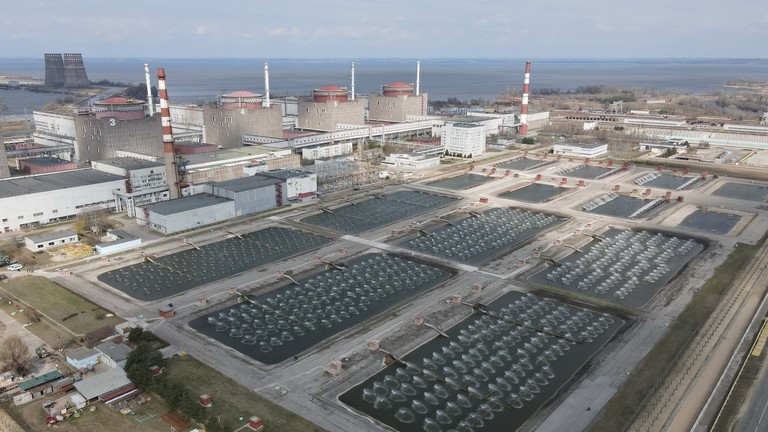
Addressing the Security Council, Grossi confirmed that Europe’s largest nuclear power plant was struck on April 7, which was the first direct attack on the site since November 2022. Inspectors have determined that the apex of the containment dome of the Unit 6 reactor building was hit, he added. “Whilst the damage to the structure is superficial, the attack sets a very dangerous precedent of the successful targeting of the reactor containment,” Grossi stressed, warning that “these reckless attacks must cease immediately.”
Russian UN Ambassador Vassily Nebenzia told the Security Council that Ukrainian forces have been “systematically” targeting the plant and surrounding areas. The Russian army has been “spotting and intercepting up to 100 drones per week,” Nebenzia added, insisting that Moscow has never placed heavy weapons at the facility or used the plant to stage attacks on Ukraine.
Officials in Kiev have denied striking the nuclear plant. “The position of Ukraine is clear and unequivocal: we are not conducting any military activities or provocations against nuclear sites,” Andrey Yusov, spokesman for Ukraine’s military intelligence, told national TV this month. Andrey Kovalenko, the head of the state-run Center for Countering Disinformation, has accused Moscow of spreading false information and “manipulating the IAEA.”
The agency said in its report this week that all of the facility’s six reactors are currently in cold shutdown. According to the plant’s management, only one reactor had been working since 2022 in order to keep the site operational. IAEA inspectors were deployed to monitor the facility in September 2022.
Attacks on Ukraine’s nuclear plant put world at risk, IAEA warns
By Euronews with AP, 16/04/2024
https://www.euronews.com/2024/04/16/attacks-on-ukraines-nuclear-plant-put-world-at-risk-iaea-warns
“We’re getting dangerously close to a nuclear accident,” IAEA Director General Rafael Mariano Grossi said following multiple attacks against the Zaporizhzhia Nuclear Power Plant in Ukraine.
The head of the International Atomic Energy Agency said attacks against Europe’s largest nuclear power plant have put the world “dangerously close to a nuclear accident”.
Without attributing blame, IAEA Director General Rafael Mariano Grossi said his agency has been able to confirm three attacks against the Zaporizhzhia Nuclear Power Plant since 7 April.
“These reckless attacks must cease immediately,” he told the Security Council on Monday. “Though, fortunately, they have not led to a radiological incident this time, they significantly increase the risk … where nuclear safety is already compromised.”
The remote-controlled nature of the drones that have attacked the plant means that it is not possible to determine who launched them, Grossi told reporters after the meeting.
“In order to say something like that, we must have proof,” he said. “These attacks have been performed with a multitude of drones”.
Zaporizhzhia sits in Russian-controlled territory in southeastern Ukraine and has six nuclear reactors.
Fears of a nuclear catastrophe have been at the forefront since Russian troops occupied the plant shortly after invading in February 2022. Continued fighting between Russian and Ukrainian forces – as well as the tense supply situation at the plant – have raised the risk of a disaster.
Ukraine and its allies on Monday blamed Russia for dangers at the site. Russia, for its part, said Ukraine was to blame for the attacks.
“The IAEA’s report does not pinpoint which side is behind the attacks,” Russia’s UN Ambassador Vassily Nebenzia said. “We know full well who it is.”
Zaporizhzhia Nuclear Power Plant: The ‘Sum Of All Fears’
Eurasia Review, , By IDN, By Leonam dos Santos Guimarães
Drone attacks on the Zaporizhzhia nuclear power plant, whether carried out by Ukraine or Russia, introduce a new and dangerous dimension to the conflict between the two largest former Soviet Socialist Republics, with possible far-reaching ramifications, not just for the region immediately surrounding the largest nuclear power plant in Europe, but also for all European Union countries and, more broadly, for the international community.
The biggest concern is the potential risk of a severe nuclear accident, which could have dire effects not only on Ukraine and Russia, but also on neighboring countries. The release of radioactive material knows no borders, and a contaminated cloud could spread across multiple nations depending on weather conditions, putting public health and the environment at risk on a significant scale.
The consequences of attacks on nuclear facilities are potentially severe and vast. A nuclear accident can result in the contamination of large areas, affecting land, water and wildlife, with lasting consequences for the environment and human health. It could also force mass evacuations of affected areas, creating humanitarian and refugee crises. In addition to the direct costs of cleanup and containment, a nuclear disaster can have a substantial economic impact on agriculture, land use, and public health.
Containing a leak at a nuclear power plant is a highly complex and challenging operation, depending on several factors. These include the type of damage to the reactor or other critical parts of the facility, as well as the amount and type of radioactive material released.
A plant’s ability to contain a leak depends on its design, existing safety systems, and how well those systems can handle the specific type of accident. The effectiveness of the immediate response, including confining the area, evacuating personnel, and implementing decontamination measures, is crucial to minimizing the impacts of a spill. The availability of technical, human, and financial resources to manage the situation is essential. This also includes international support, as seen after the Chernobyl accident and the Fukushima disaster.
Several factors
The scope of a nuclear accident in Europe will depend on several factors, including the direction and speed of the wind, which determine the dispersion of radioactive particles in the atmosphere, the amount of material released, which the greater the amount, the larger the area potentially affected, and the effectiveness of containment and decontamination measures, which can significantly limit the scope of contamination………………………………………………………….
The possibility that such attacks could trigger a third world war is a serious and plausible concern. An intricate web of military alliances, geopolitical interests and containment strategies influences the dynamics of the current conflict. Attacks against nuclear facilities are perceived as significant escalations of conflict. If considered acts of war, they may justify severe retaliation. The nature and extent of such retaliations would depend on many factors, including the international perception of the incident and the strategic decisions of major world powers.
The risk of a third world war
The involvement of NATO members providing support to Ukraine further complicates the situation. While NATO has been careful in its approach to avoid direct escalation with Russia, the line between support and direct involvement is fine and delicate. Preventing an escalation into a broader conflict will likely depend on intense diplomatic efforts and attempts at de-escalation by all parties involved……………………………………………….. https://www.eurasiareview.com/14042024-zaporizhzhia-nuclear-power-plant-the-sum-of-all-fears-oped/
1 This Month

of the week – Shut Down Drone Warfare!


Tell the Ukrainian Government to Drop Prosecution of Peace Activist Yurii Sheliazhenko

Petition to revoke the licensing of the Near Surface Nuclear Disposal Facility (NSDF) at Chalk River. https://www.ourcommons.ca/petitions/en/Petition/Details?Petition=e-7247
To see nuclear-related stories in greater depth and intensity – go to https://nuclearinformation.wordpress.com
-
Archives
- April 2026 (114)
- March 2026 (251)
- February 2026 (268)
- January 2026 (308)
- December 2025 (358)
- November 2025 (359)
- October 2025 (376)
- September 2025 (257)
- August 2025 (319)
- July 2025 (230)
- June 2025 (348)
- May 2025 (261)
-
Categories
- 1
- 1 NUCLEAR ISSUES
- business and costs
- climate change
- culture and arts
- ENERGY
- environment
- health
- history
- indigenous issues
- Legal
- marketing of nuclear
- media
- opposition to nuclear
- PERSONAL STORIES
- politics
- politics international
- Religion and ethics
- safety
- secrets,lies and civil liberties
- spinbuster
- technology
- Uranium
- wastes
- weapons and war
- Women
- 2 WORLD
- ACTION
- AFRICA
- Atrocities
- AUSTRALIA
- Christina's notes
- Christina's themes
- culture and arts
- Events
- Fuk 2022
- Fuk 2023
- Fukushima 2017
- Fukushima 2018
- fukushima 2019
- Fukushima 2020
- Fukushima 2021
- general
- global warming
- Humour (God we need it)
- Nuclear
- RARE EARTHS
- Reference
- resources – print
- Resources -audiovicual
- Weekly Newsletter
- World
- World Nuclear
- YouTube
-
RSS
Entries RSS
Comments RSS
 nuclear-news