Britain will test fire Trident nuclear missile for the first time since 2016 as fears of World War Three grow
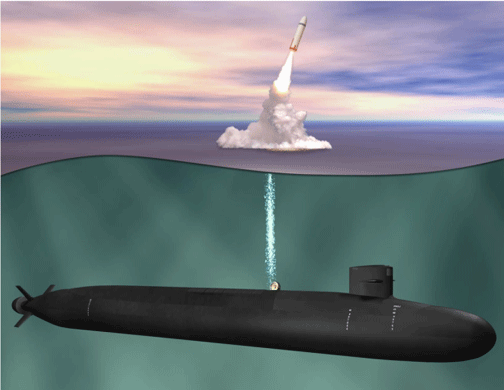
- HMS Vanguard is reported to have sailed into the Atlantic earlier this week
- It is expected to test-fire a Trident missile 3,500 miles from the US
Daily Mail, By CHRIS JEWERS, 2 February 2024
Britain is primed to test a Trident nuclear missile for the first time since 2016 amid growing fears of a global conflict, according to reports.
Officials are said to have issued a warning to shipping in the region of the test as nuclear submarine HMS Vanguard sailed into the Atlantic earlier this week.
The test will be the first time the UK has test fired a Trident missile since a botched launch in 2016 on sister sub HMS Vengeance which left the navy red-faced.
HMS Vanguard has undergone a seven-year refit in Plymouth since then, and is now set to fire an unnamed missile, The Sun reports.
The tests are understood to be the final hurdle the £4 billion submarine must clear in order to re-enter service as part of the UK’s nuclear deterrent force. ……..
HMS Vanguard has been hailed as a 491-foot ‘colossus’ that can patrol under the surface of the seas for months at a time.
On board, she can carry up to 16 Trident 2 D5 missiles, a submarine-launched ballistic missile (SLBM), built by American firm Lockheed Martin.
They also share the name with the UK’s nuclear programme (the Trident nuclear programme) the purpose of which is to ‘deter the most extreme threats to our national security and way of life, which cannot be done by other means,’ according to the mission statement by the Ministry of Defence.
Each missile is armed with British-made thermonuclear warheads that are 20 times more powerful than the Oppenheimer-developed weapons dropped during the Second World War on the Japanese cities of Hiroshima and Nagasaki.
The warheads are delivered by multiple independently targetable re-entry vehicles (MIRVs), or – in other words – exoatmospheric ballistic missiles.
Citing a Royal Navy source, The Sun said Britain’s nuclear submarines can carry more explosive power than was dropped in the entirety of the Second World War.
In the coming test, HMS Vanguard is expected to launch a single missile that will not be armed with nuclear warheads, about 55 miles off the US coast……………………
The missiles are designed to blast to the edge of space and track their position against the stars, before re-entering the atmosphere (hence exoatmospheric), plummeting to earth and raining warheads down on its target.
The maximum range of the missile is 12,000km (7,400 miles), which is roughly the distance from London to Indonesia one way, or Hawaii the other.
A warning was issued by the US National Geospatial Intelligence Agency to shipping that could cross the missile’s expected course, The Sun said.
The ‘hazardous operations’ warning also plots areas closer to the launch site where debris is expected to fall into the ocean…………………………….
Reports of the test come amid rising fears that Britain and her allies could be pulled into a conflict in the coming years.……………………………………………………………………
The test also comes after it was reported last year that a Royal Navy nuclear submarine and its crew were mere moments from being crushed after its depth gauge suddenly failed.
Reports said the Vanguard class sub, which had been carrying 140 crew and Trident 2 missiles, suffered the huge malfunction while on a mission in the Atlantic.
It caused a frantic scrabble with engineers managing to stop the submarine and its nuclear reactor from plunging further and being crushed by underwater pressure just minutes before disaster struck. …………………………………………………… more https://www.dailymail.co.uk/news/article-13034029/Britain-test-fire-Trident-missile.html
Campaigners Warn Return of US Nukes to UK Would ‘Make Britain a Guaranteed Target’

The U.S. is reportedly planning to deploy nukes “three times the strength of the Hiroshima bomb” to an air base in Suffolk.
JAKE JOHNSON, Feb 02, 2024, Common Dreams
Nuclear weapon abolitionists sounded alarm Friday in response to fresh evidence that the United States is planning to station nukes in the United Kingdom for the first time in more than 15 years, a move that opponents said would only heighten the risk of an atomic war.
The U.S. removed more than 100 nuclear bombs from Royal Air Force Lakenheath, a base in Suffolk, in 2008 following sustained protests from the U.K.-based Campaign for Nuclear Disarmament (CND) and other nonproliferation advocates.
CND warned in a statement Friday that the redeployment of nukes to Lakenheath would “make Britain a guaranteed target in the event of any war between NATO and Russia.”
Nuclear weapon abolitionists sounded alarm Friday in response to fresh evidence that the United States is planning to station nukes in the United Kingdom for the first time in more than 15 years, a move that opponents said would only heighten the risk of an atomic war.
The U.S. removed more than 100 nuclear bombs from Royal Air Force Lakenheath, a base in Suffolk, in 2008 following sustained protests from the U.K.-based Campaign for Nuclear Disarmament (CND) and other nonproliferation advocates.
CND warned in a statement Friday that the redeployment of nukes to Lakenheath would “make Britain a guaranteed target in the event of any war between NATO and Russia.”
“We encourage both the media and the public to increase pressure on the British government to be honest about this deployment,” said Kate Hudson, CND’s general secretary.
The Telegraphreported last week that “procurement contracts for a new facility at RAF Lakenheath in Suffolk confirm that the U.S. intends to place nuclear warheads three times the strength of the Hiroshima bomb at the air base.”………………………………………. more https://www.commondreams.org/news/us-nuclear-weapons-uk
It’s not a done deal and you are not alone’: anti-GDF campaigners pledge solidarity with South Holderness over nuclear waste dump plan,
Last week’s surprise news that South Holderness is being considered as another
potential site for a Geological Disposal Facility, or in layperson’s
language a nuclear waste dump, will have been a great shock to many local
people. But residents can take heart because this is the fifth such
announcement by Nuclear Waste Services and residents in West Cumbria and
East Lincolnshire faced with similar news in previous years have mobilised
successful campaigns to fight similar plans in their areas.
NFLA 30th Jan 2024
1
Cracks appear in Labour-Green alliance over claims that Heysham power stations letter was ‘reckless’
Cracks have appeared in an alliance between Labour and the Greens after a
letter calling for the lives of Heysham Power Stations to be extended was
branded “reckless”. Lancaster City Council leader Phillip Black was also
accused of “operating outside the terms of a collaboration agreement”
between Labour and the Greens, who between them form the majority of the
council’s coalition cabinet.
Councillor Jack Lenox of the Greens also said
it was “completely inappropriate for Councillor Black to suggest that
pressure on the council’s budget should be a factor in extending the lives
of these nuclear power stations”. Councillor Black, from Labour, has
responded by accusing the Greens of “Machievellian nonsense” and making
“baseless accusations”.
Beyond Radio 30th Jan 2024
Is this the World’s Most Expensive and Most Delayed Power Project?
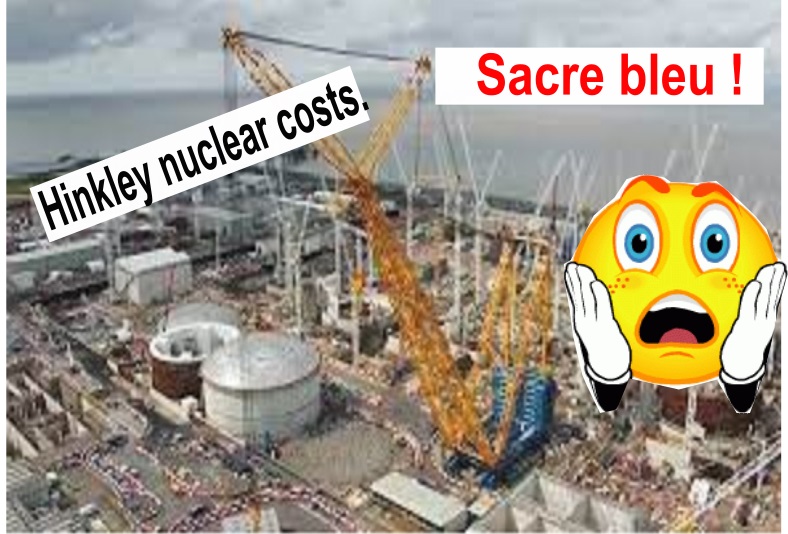
By Leonard Hyman & William Tilles – Jan 31, 2024,
Yes, they are still building the Hinckley Point C nuclear power station in the United Kingdom, and yes the latest estimated cost is more than the previously estimated cost and the completion date has receded another two years into the future.
This nuclear project received its license for construction in 2012, with an estimated cost of £18 billion and completion date in 2025. The last estimate calls for 2029-2031 completion at a cost of £46 billion. To the extent that these estimates can be trusted, the plant would end up costing double the original estimate in real terms. In the same time period, solar and wind costs will decline by at least one half. We are not sure yet whether Hinckley Point will set an all-time record as the most expensive and most delayed power-related project in history, but it certainly will be a contender.
As is the case for so many climate- or security-related projects, the UK government offered significant subsidies to the builder. But in a different way. Most governments, nowadays, offer start-up subsidies in order to bring production levels up to a point where economies of scale kick in, after which costs drop rapidly and consumers get real benefits. The cost curves for wind, solar, and energy storage show how well this strategy works. Give the industry a kickstart and watch the action take place.
Not so with nuclear, where costs seem to rise with encouragement rather than fall. Opting for nuclear, then, seems more like an ideological rather than a technological or economic choice, especially for British Conservative politicians. “Nuclear has to be part of the package”, they seem to say. Even if the nuclear cost per kW installed is five-eight times higher than non-fossil alternatives. But, fortunately, the UK government is not directly on the hook for the added costs, the Chinese co-investor in the project has declared that it will not contribute more, and it looks as if French utility EDF will bear the increased costs if it does not get a new power contract. But if the UK decides to stick EDF with the bill, what will that decision do to discourage further nuclear construction? Given the perilous nature of that construction (namely the danger of cost inflation), who could take the risk of initiating new projects other than a government agency?………………………………………….
Oil Price 31st Jan 2024
MP calls for vote on Holderness nuclear site which local petition brands ‘hazardous waste dumping ground’
Graham Stuart has called for a public vote on whether a nuclear waste site
should be built in Holderness amid opposition from some living in the area.
‘Beverley and Holderness ‘ MP said Nuclear Waste Services, the Government
Agency which unveiled the waste site proposals last week, should be forced
to make their case directly to the public. Joanne Turner, whose Change.org
petition calls for the site to be rejected, said the beautiful south
Holderness area should not be turned into a dumping ground for hazardous
waste.
Hull Daily Mail 31st Jan 2024
2
UK’s Nuclear “money pit” tops $59 billion.

What a turkey! by beyondnuclearinternational, https://beyondnuclearinternational.org/2024/01/31/what-a-turkey/
Hinkley Point C costs hit a new high but nuclear plant still isn’t roasting Christmas turkeys
By Linda Pentz Gunter
The Great Mosque of Mecca is considered the most expensive building in the world at $115.2 billion. Right behind it comes….a nuclear power plant! The two-reactor 3,260MW Hinkley Point C nuclear site still under construction in the UK will now cost at least £46 billion ($59 billion) according to the latest figures released by its developer, the French energy giant, EDF.
As such, Hinkley Point C has now earned the dubious honor of becoming the second most expensive building in the world. And it’s not even finished. The price could soar still higher.
EDF originally bragged that Britons would be baking their Christmas turkeys powered by Hinkley Point C by 2017. The completion date has now been pushed to “after 2029”.
The nuclear power industry is very good at tripling things. Perhaps not global nuclear installations by 2050 as it bragged would happen during an announcement at the COP28 climate summit last December. But the price tag for a new reactor? Timelines for new reactor construction? Straight A grades all around!
That’s almost what’s happening at Hinkley Point C where the new price is more than double the original estimated cost of £18 billion ($23 billion). Getting to triple the cost still seems eminently achievable given the new completion date.
This not-so-shocking news, given nuclear power’s track record, comes after the recent, overblown announcement by Rishi Sunak’s Conservative government that Britain would launch its “biggest expansion of nuclear power for 70 years to create jobs, reduce bills and strengthen Britain’s energy security.” The plan will of course achieve none of these things.
Far from reducing electricity bills for British consumers, the Hinkley nuclear project will in fact increase them “far above the market electricity price,” predicted Dr Norbert Allnoch, CEO of the International Economic Forum for Renewable Energies (IWR), based in Münster, Germany.
According to estimates by IWR, the cost of the electricity generated by Hinkley Point C will be “significantly higher than the 15 cents/kWh mark” and will continue to rise. This is because the UK government agreed a “state-guaranteed price for nuclear power being paid to EDF, which is linked to the inflation rate,” says IWR.
All of this came after the recent announcement that UK authorities had granted a Development Consent Order (DCO) to EDF’s identical twin EPR reactor project on the Suffolk Coast at Sizewell, while committing £1.3 billion ($1.6 billion) in funding for the project. The French company has already been tearing up pristine countryside there, destroying habitat and disturbing wildlife at the adjacent Minsmere Nature Reserve.
Meanwhile, France is pushing the UK to pay for the cost-overruns at Hinkley and the expected ballooning bills at Sizewell once work begins. France reportedly blames Britain for prompting the Chinese firm CGN to withdraw its 33.5% share from the Hinkley plant after Britain booted China out of the Sizewell C nuclear project.
Chinese investment in UK nuclear projects has been a hot political potato for some time, and came to be viewed as “an unacceptable national security risk.” A proposed new reactor project at Bradwell in Essex, a joint project between China and France, looks unlikely to go forward, at least in part due to security concerns about Chinese involvement.
These challenges prompted the UK government to seek alternative sources of funding, inevitably settling on ratepayers using something called a Regulated Asset Base (RAB). RAB effectively funds future nuclear projects by charging ratepayers up front in their electricity bills for the anticipated costs of nuclear plant design, construction, commissioning, and operation.
“Hinkley Point C has been a shambolic money pit,” said a spokesperson from Together Against Sizewell C on X (formerly Twitter). “It’s been hit by delay after delay and the costs are escalating at an alarming rate. Nobody can say with any confidence when it will go live or how much money will have been wasted on it.”
The story of Hinkley C illustrates that the nuclear sector is “out of control economically,” said Paul Gunter, director of the Reactor Oversight Project at Beyond Nuclear. The cost of EDF’s EPR reactor being built in France at Flamanville and still incomplete, has more than quadrupled to close to $15 billion. Another EPR, at Olkiluoto in Finland, went from $3.2 billion to more than $12 billion and launched 12 years late.
On U.S. soil, two AP1000 reactors at the Vogtle nuclear power plant site in Georgia, will likely come in at a total price tag of at least $35 billion, $20 billion more than originally estimated, with the second of the two reactors still not on line.
UK govt awards Hitachi £33.6 m to design small nuclear reactors
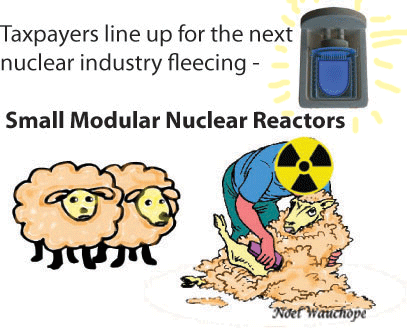
GE Hitachi awarded nuclear design funding, 30 January 2024
GE Vernova’s nuclear business, GE Hitachi Nuclear Energy, was on 25
January awarded a £33.6 m Future Nuclear Enabling Fund grant from the
UK’s Department for Energy Security & Net Zero. The UK government has
ambitions for 24 GW of nuclear generation by 2050 to help in providing
energy security for the UK and for meeting net zero. The grant will help GE
Hitachi develop its small nuclear reactor design.
Modern Power Systems 30th Jan 2024
https://www.modernpowersystems.com/news/newsge-hitachi-awarded-nuclear-design-funding-11474778
UK govt designates British Nuclear Fuels Ltd as Great British Nuclear (…..whatever this means)

Section 317 of the Energy Act 2023 provides that the Secretary of State
may by notice designate a company as Great British Nuclear. In exercise of
the powers in that section the Secretary of State hereby gives notice
designating British Nuclear Fuels Limited (Company Number: 05027024) as
Great British Nuclear. This notice of designation was given on 29 January
2024 and has effect from 00:01 on 31 January 2024. It has been published
above in accordance with section 317(3) of the Energy Act 2023.
DESNZ 31st Jan 2024
How France left the British taxpayer on the hook as Hinkley costs go nuclear
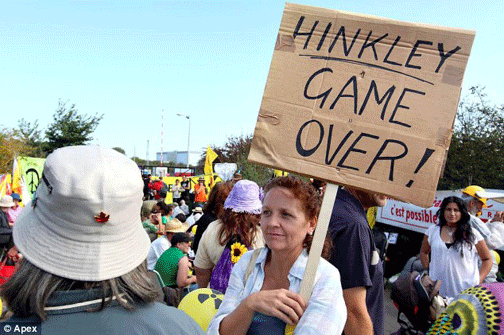
the Government will have to
put more taxpayer cash in and guarantee the debt.
Sizewell C was also likely to be put on ice unless British ministers came up with a big extra dollop of taxpayers’ money.
A series of cost overruns and delays are undermining the UK’s nuclear power revival
Jonathan Leake, 28 January 2024
For the future of Britain’s energy security it was a crucial decision,
and one that lay in the hands of France’s biggest power supplier.
However, not a single minister or civil servant was present when the
directors of EDF decided the fate of the UK’s two biggest nuclear
projects in their Paris boardroom on Tuesday. The finances of Hinkley Point
C and Sizewell C, the nuclear power stations which might one day supply
14pc of Britain’s electricity were top of the agenda. Shortly after the
meeting ended, Luc Remont, EDF’s managing director, and his colleagues
summoned their media managers to organise a briefing for analysts and
journalists.
Hinkley Point C, they were told, stood no chance of firing up
in 2027, as once promised. Its first reactor would come online around 2031
while the second has no date promised at all. Costs have surged again to
£46bn, a far cry from the £9bn EDF suggested when pushing the idea to
politicians around 2007 or the £24bn proposed when contracts were signed
in 2016.
Sizewell C was also likely to be put on ice unless British
ministers came up with a big extra dollop of taxpayers’ money.
Meanwhile, as EDF’s directors and French civil servants decided Britain’s nuclear
future in Paris, Andrew Bowie, the minister responsible for new nuclear
projects, was on his feet in parliament, talking up the UK’s prospects.
For Claire Coutinho, the Energy Secretary, the news was infuriating. Not
only had a decision vital to the UK been taken in Paris but it came just
days after she unveiled the Government’s long-awaited Nuclear Roadmap. A
statement rushed out that evening made clear that Coutinho blamed the
French for Hinkley’s extra costs and delays. “Hinkley Point C is not a
government project and so any additional costs or schedule overruns are the
responsibility of EDF and its partners and will in no way fall on
taxpayers,” a spokesman for her department said.
The comments irritated the French enough to hold a second round of media briefings, this time involving EDF’s owners, the French government. The UK, it was made clear,
would have to offer up billions of pounds more in taxpayers’ money if
Sizewell C was ever to be built. Coutinho subsequently pledged an extra
£1.8bn of taxpayers’ money for the project.
Meanwhile, EDF has refused
to up its stake from 20pc and Bowie has admitted he now needs to raise
£20bn of private finance, most likely meaning the Government will have to
put more taxpayer cash in and guarantee the debt.
Simon Taylor, professor of finance at Cambridge University, who specialises in the economics of nuclear energy, believes EDF’s reactor designs have some fundamental
flaws. “The EPR or European Pressurised Reactor were designed to be
incredibly safe, and to reassure people, after the Chernobyl disaster of
1986 but have turned out to be just much more difficult to build than
anyone had expected,” he says.
Amid a blame game between France and the
UK, the biggest loser remains the British taxpayer. They now face several
more years of reduced energy security and the prospect of power bills hikes
to raise the £20bn-plus bill for Sizewell C.
Telegraph 28th Jan 2024
https://www.telegraph.co.uk/business/2024/01/28/edf-hinkley-point-c-costs-go-nuclear-uk-taxpayer/
RAF Lakenheath: Plans progress to bring US nuclear weapons to Suffolk – a risky target?
Matt Precey – BBC News, Suffolk, Tue, 30 January 2024
Matt Precey – BBC News, Suffolk
Tue, 30 January 2024 at 1:33 am AEDT·3-min read

Plans to deploy American nuclear weapons to an airbase in Suffolk have progressed, according to a US Department of Defence (DoD) notice.
A contract to build shelters to protect troops that would defend storage facilities at RAF Lakenheath has been awarded.
The document states the work was in preparation for the base’s “upcoming nuclear mission”.
The US Air Force (USAF) has yet to respond to a request for comment.
Matt Precey – BBC News, Suffolk
Tue, 30 January 2024 at 1:33 am AEDT·3-min read
Plans to deploy American nuclear weapons to an airbase in Suffolk have progressed, according to a US Department of Defence (DoD) notice.
A contract to build shelters to protect troops that would defend storage facilities at RAF Lakenheath has been awarded.
The document states the work was in preparation for the base’s “upcoming nuclear mission”.
The US Air Force (USAF) has yet to respond to a request for comment.
The Ministry of Defence said there was a longstanding agreement among NATO partners not to comment on the location of nuclear weapons.
In March 2023, a document from the US Office of the Under Secretary of Defense disclosed how $50m (£39m) had been earmarked to build a facility known as a “Surety Dormitory” at RAF Lakenheath.
This phrase is understood to refer to nuclear weapons storage……………………………………………………….
Thermonuclear bomb
This would be the first time in more than 15 years nuclear weapons have been deployed on British soil.
In 2008, the BBC reported the bombs had been removed from RAF Lakenheath, which houses 4,000 service personnel and more than 1,500 British and US civilians.
The base is currently home to the USAF’s 48th Fighter Wing, the only unit in Europe which operates both the F-15E Eagle and the F-35A Lighting II fighter aircraft.
Reports from the US indicate the newer F-35A had been flight tested to use the latest variant of the B61-12 thermonuclear bomb, which paved the way for the aircraft to begin carrying such weapons.
According to the defence publication Janes, B61-12 was capable of an explosive power (known as a yield) of up to 340 kilotons, or more than twenty times the power of the Hiroshima bomb.
The Campaign for Nuclear Disarmament’s general secretary, Kate Hudson, said: “These documents highlight plainly that an ‘upcoming nuclear mission’ will be stationed at RAF Lakenheath – confirming what we have strongly suspected since November 2022 – that US nuclear weapons are returning to Britain.”
“It’s shameful that both the US and UK governments continue to take the public for fools on this serious matter – refusing to give us crucial information about our security,” she added.
Ms Hudson claimed it escalated the dangers and had “made us a nuclear target.”
Documents unambiguously state ‘incoming nuclear mission’ to Britain
30 Jan 24 https://cnduk.org/documents-unambiguously-state-incoming-nuclear-mission-to-britain/
Recently reported documents add further evidence that the US is planning to deploy nuclear weapons to Britain, with CND forwarding its concerns to Suffolk Council.
The files describes “Stationary and Mobile Guard Shacks” which will be constructed at RAF Lakenheath for ballistic protection for the 48th Security Forces Squadron – who are attached to the 48th Fighter Wing based at Lakenheath. It notes that the shacks are needed for the “upcoming nuclear mission” of the 48th SFS.
The document dates from 29 September 2023, a month after it was reported that the US Air Force plans to build a 144-bed “surety dormitory” at Lakenheath. “Surety” is the term used by the US government and military to refer to the handling of nuclear weapons.
In November 2023, CND’s lawyers wrote to West Suffolk Council insisting that the planning rights used to build the dormitory are incorrect and that it needs to be subject to an environmental impact assessment. In light of the recent files we have again written to the Council, to draw attention to the fact that it “suggests unambiguously that nuclear weapons will be stationed at RAF Lakenheath.”
CND General Secretary Kate Hudson said:
“These documents highlight plainly that an ‘upcoming nuclear mission’ will be stationed at RAF Lakenheath – confirming what we have strongly suspected since April 2022 – that US nuclear weapons are returning to Britain. It’s shameful that both the US and UK governments continue to take the public for fools on this serious matter – refusing to give us crucial information about our security. This deployment has been in the works for some time, prior to Russia’s deployment of its own nuclear weapons to Belarus. So far from making us safer, this deployment has escalated the dangers, brought Russian nukes to Europe, and made us a nuclear target.”
US reportedly planning to station nuclear weapons in Britain for first time in 15 years
THE UNITED STATES is reportedly planning to station nuclear warheads in Britain that are three times as powerful as 1945’s Hiroshima bomb.
Pentagon documents seen by the Telegraph indicate that the weapons could be stationed at RAF Lakenheath in Suffolk, where the US previously stored nuclear missiles until 2008.
The papers show procurement contracts for a new facility at the air base.
A Ministry of Defence spokesperson said: “It remains a longstanding UK and Nato policy to neither confirm nor deny the presence of nuclear weapons at a given location.”
The documents have surfaced amid concerns of an escalation between Nato countries and Russia as Vladimir Putin continues his war on Ukraine.
Last week, Nato announced its biggest drills since the cold war, involving deployment of 90,000 military personnel to central and eastern Europe.
Are the French going cold on UK nuclear?

‘It would be madness to give Sizewell C the final go-ahead while the questions of whether Hinkley C can be finished, and who pays, are not resolved. Sizewell C is bound to take longer and cost more, but this time it would be we consumers who would bear the risk and pay the price through the “nuclear tax” on our energy bills.’.
The French government, which was previously relaxed about EDF’s forays into UK nuclear, now wants its energy company to work on projects back home in France.
So far, Britain has put £2.5billion into the project in total and taxpayers are the biggest shareholders. Campaigners who vehemently oppose the project are alarmed by the recent comments from Paris, pointing out that if the French back off from Sizewell, taxpayers could be on the hook for huge extra amounts of cash via their bills.
By FRANCESCA WASHTELL , 28 January 2024, https://www.thisismoney.co.uk/money/markets/article-13015713/Are-French-going-cold-UK-nuclear.html
Our nuclear industry is reawakening,’ energy secretary Claire Coutinho
declared in a Government strategy document published earlier this month. In
between invoking Winston Churchill’s enthusiasm for nuclear power and its
ability to help the UK reach net zero, Coutinho added that setting up new
plants would ensure our energy security ‘so we’re never dependent on the
likes of [Vladimir] Putin again’. Fighting talk. But in the space of a
fortnight, Coutinho’s gung-ho attitude has already been dented as a
diplomatic row brews over who should pay for the controversial power
stations.
French state-owned energy company EDF last week lit the blue
touchpaper with the revelation the UK’s flagship Hinkley Point C nuclear
plant in Somerset would be delayed until 2029 at the earliest. The cost, it
added, could spiral to as much as £46billion, from initial estimates of
£18billion.
Few in the industry will have been surprised, particularly as EDF has experienced delays on similar projects in Finland and France. But what was a shock were some incendiary remarks from the French government.
The Elysee Palace began pressing the UK to help plug a funding gap at Hinkley and for good measure cast doubt over its commitment to Sizewell C, the next nuclear power station in the pipeline.
A French Treasury official suggested the Government was trying to leave EDF in the lurch on Hinkley.
The official added that it cannot, at the same time, abandon the French firm to ‘figure it out alone’ on Hinkley and also expect it to plough money into Sizewell. It is, the official said, ‘a Franco- British matter,’ and not one for the French to resolve single-handedly.
This is a bad moment for two critical new nuclear plants – and our broader energy security – to be dragged into a cross-Channel tussle.
The French government, which was previously relaxed about EDF’s forays into UK nuclear, now wants its energy company to work on projects back home in France.
Well-placed UK sources deny the French claims that EDF has been left to shoulder the financing burden alone at Hinkley, or that it has been jettisoned by the British state.
They point to the fact EDF has all along had contractual obligations to shoulder the costs at this stage of the project. The early stages of developing Hinkley were undertaken by EDF along with China General Nuclear.
The Chinese firm has fulfilled its part of the bargain, leaving the onus on the French. ‘It’s all down to the French state,’ a senior industry source told The Mail on Sunday. ‘It’s tough, but they’ve not managed it at all well.’
A Department for Energy Security and Net Zero spokesman said: ‘The Government plays no part in the financing or operation of Hinkley Point C. The financing of the project is a matter for EDF and its shareholders.’
As well as backing Hinkley, EDF several years ago began serious talks with the Government over Sizewell C in Suffolk. Each could power an estimated 6 million homes for 60 years, meaning the two projects are linchpins for meeting future energy demand.
The French group is due to take a 20 per cent stake in Sizewell. The Government has previously indicated it will take 20 per cent. It was hoped the rest would be funded through money from the private sector, such as pension funds and sovereign wealth funds.
So far, Britain has put £2.5billion into the project in total and taxpayers are the biggest shareholders. Campaigners who vehemently oppose the project are alarmed by the recent comments from Paris, pointing out that if the French back off from Sizewell, taxpayers could be on the hook for huge extra amounts of cash via their bills.
The new type of funding structure for Sizewell C means consumers will already face an added tax to help pay for the plant.
Alison Downes of the Stop Sizewell C campaign group said: ‘It would be madness to give Sizewell C the final go-ahead while the questions of whether Hinkley C can be finished, and who pays, are not resolved. Sizewell C is bound to take longer and cost more, but this time it would be we consumers who would bear the risk and pay the price through the “nuclear tax” on our energy bills.’
And another area of the industry is watching the fracas with mounting frustration.
Companies vying to build ‘mini’ stations known as small modular reactors (SMRs) hope this prompts the Government to commit instead to their projects, which are quicker to build and cheaper [?]
The firms include Rolls-Royce SMR, which has already received significant funding from the Government. New nuclear plants of whatever size will almost certainly be part of the UK’s energy mix in the years to come.
The sector had already been championed by Boris Johnson before soaring oil and gas prices in the wake of Russia’s invasion of Ukraine highlighted Britain’s dependence on overseas energy.
Any fisticuffs with France over Hinkley and Sizewell would strain the sector and could fatally damage the level of public. Industry figures are urging ministers to resist stumping up cash the French had agreed to pay.
One senior source said: ‘I hope the Government doesn’t lose its nerve, though there’s no sign of that at the moment. It would be a terrible precedent.’
.
Hinkley Point C woes threaten to break UK and France’s nuclear fusion

Two former EDF executives told the Guardian the odds were stacked against Hinkley from the start. “I would have bet at the time that we would see the costs we have today. And I think they’ll climb higher too,” said one.
Cross-Channel dream is turning sour as EDF’s costs mount and Britain faces a long wait for the power to come on
Jillian Ambrose, 27 Jan 24, https://www.theguardian.com/uk-news/2024/jan/27/hinkley-point-c-woes-threaten-break-uk-france-nuclear-fusion
rench trade unions wield significant political clout. But in the summer of 2016 there was little they could do to stop the French government from investing in what would soon become the most expensive power station in the world.
All six trade union representatives on the board of Électricité de France (EDF) voted against a deal to build a nuclear power station in the UK. It was just weeks after its finance chief, Thomas Piquemal, resigned from the company over fears that Hinkley Point C in Somerset was too great a risk. The project was approved by 10 in favour and seven against.
In the last seven years these fears have proved well founded. EDF revealed this week the latest delay to Hinkley, which may not now open until 2031, well beyond its original decade-long schedule. Its costs have climbed to £35bn in 2015 prices, almost double the original forecast of £18bn in 2016. In today’s money Britain’s first new nuclear plant in 30 years could cost £46bn. The spiralling costs were blamed on inflation, Covid and Brexit.
Hinkley was meant to represent a nuclear renaissance on both sides of the Channel, and further the nuclear ambitions of China. It was an opportunity for EDF, once the world’s leading nuclear developer, to secure a future for its reactor designs in a low-carbon world.
For the UK, the first new nuclear power plant in a generation marked the start of the government’s campaign to replace its ageing fleet of reactors. And China saw it as a way to showcase its nuclear expertise, furthering its ultimate aim of building its homegrown HPR1000 nuclear reactors at Bradwell in Essex.
The deal was struck in 2016 just weeks after the Brexit vote, making Hinkley an opportunity to forge fresh ties between old friends – and create opportunities for new economic alliances too. China General Nuclear Power Group (CGN), a state-run energy company, agreed to take on a third of the project as the first step in a plan to roll out a string of nuclear plants in the UK built with its own reactor design.
The chancellor at the time, George Osborne, argued that Britain should “run towards China” to help boost the UK economy. Within months of the Hinkley deal the French president, Emmanuel Macron, and his Chinese counterpart, Xi Jinping, began talks on strengthening ties between the two nations. These led to trade deals worth about $15bn (£11.8bn) and an order from Beijing for 300 aircraft from Airbus worth tens of billions of euros.
But the rationale for all three nations now looks precarious. Hinkley’s costs have climbed as diplomatic relations between China and the west have soured. By the time the former UK prime minister Boris Johnson vowed to purge China’s Huawei from the UK’s telecoms network over security fears, the notion of Chinese-built nuclear reactors powering British homes had become politically unthinkable. CGN has ruled out any further investment in Hinkley – leaving French taxpayers to pick up the tab.
Two former EDF executives told the Guardian the odds were stacked against Hinkley from the start. “I would have bet at the time that we would see the costs we have today. And I think they’ll climb higher too,” said one.
Philippe Huet, a former head of EDF’s internal auditing in Paris, said the deal was based on political strategy rather than a commercial rationale. The British government offered EDF a contract that would guarantee payment of £92.50 for every megawatt hour of electricity generated by the nuclear plant. It was criticised for being both eye-wateringly expensive for UK bill payers but not nearly enough to cover the risks of constructing the project.
“At the time that it was agreed it was already known that EDF’s estimates understated the cost and schedule of the project. Key decision-makers chose to ignore this because it was too important strategically. As they would say, if a project cannot be profitable it must at least be strategic,” Huet said.
Hinkley is one of many costs facing the French taxpayer after the government renationalised EDF last year. The company’s future investments – in maintaining its existing fleet of nuclear reactors, building new ones, and investing in renewable energy – could exceed €20bn (£17bn) a year, according to Agnès Pannier-Runacher, the country’s energy transition minister.
The French government is reportedly calling on the UK government to provide financial help for both Hinkley and the next planned plant, Sizewell in Suffolk, to keep the struggling nuclear revival afloat. The UK government has been quick to quash any suggestion that Hinkley’s financial fallout will be borne by UK taxpayers. A spokesperson said the government “plays no part in the financing or operation of Hinkley Point C”, which was a matter for EDF and its shareholders.
Huet has predicted that EDF may even try to renegotiate its contract with the government. He estimates it could seek to raise how much it charges per megawatt hour of electricity produced by about 15% to make Hinkley a worthwhile venture.
1 This Month
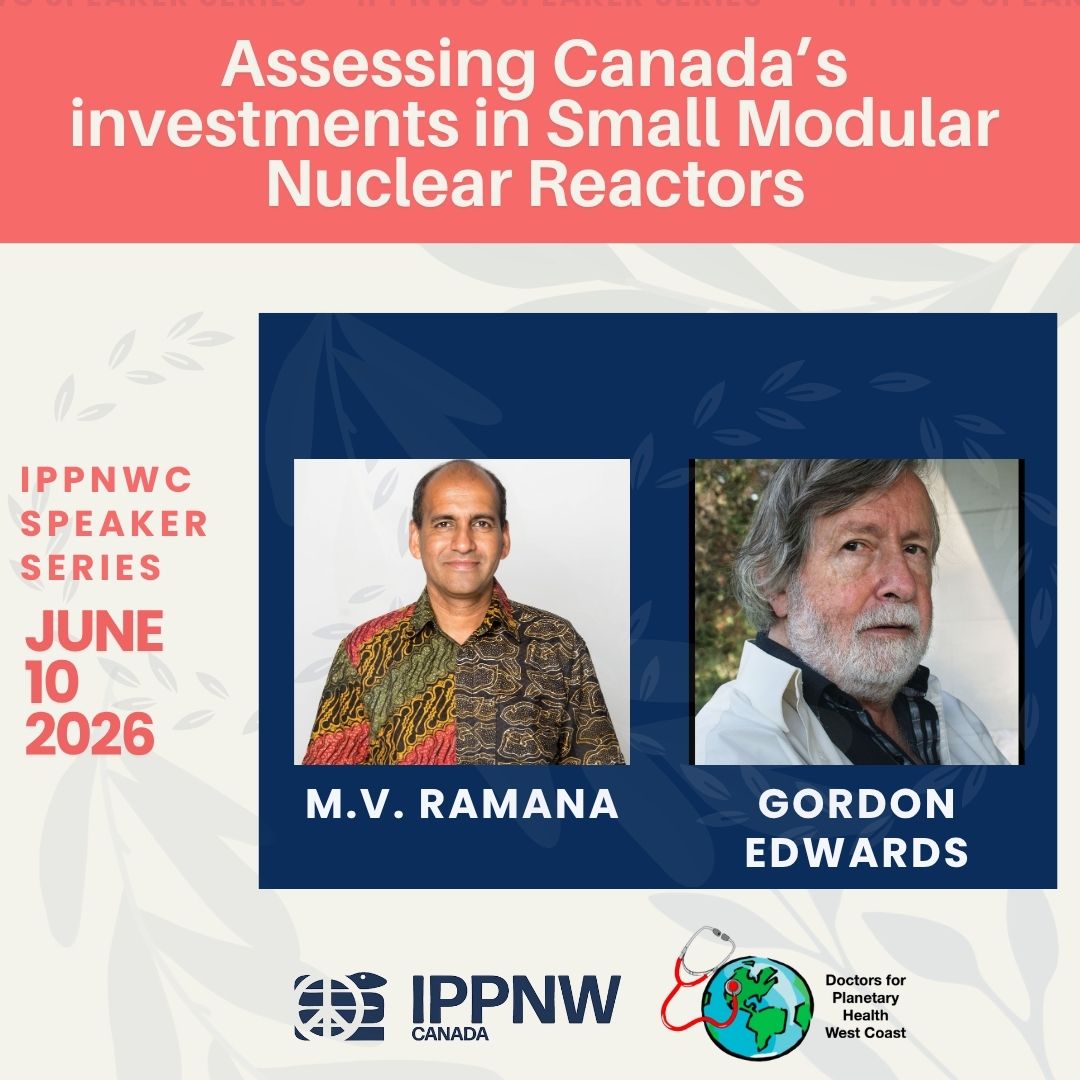
10 June – Assessing Canada’s Investments in Small Modular Nuclear Reactors – https://zoom.us/meeting/register/IiqHA5feRhaEBycOLNTJlA#/registration


Cuba Is Not a Failed State – It Is a Besieged State
PETITION: “Global Appeal to Endorse Palestinian Right of Return of Refugees”
To see nuclear-related stories in greater depth and intensity – go to https://nuclearinformation.wordpress.com
-
Archives
- June 2026 (79)
- May 2026 (306)
- April 2026 (356)
- March 2026 (251)
- February 2026 (268)
- January 2026 (308)
- December 2025 (358)
- November 2025 (359)
- October 2025 (376)
- September 2025 (257)
- August 2025 (319)
- July 2025 (230)
-
Categories
- 1
- 1 NUCLEAR ISSUES
- business and costs
- climate change
- culture and arts
- ENERGY
- environment
- health
- history
- indigenous issues
- Legal
- marketing of nuclear
- media
- opposition to nuclear
- PERSONAL STORIES
- politics
- politics international
- Religion and ethics
- safety
- secrets,lies and civil liberties
- spinbuster
- technology
- Uranium
- wastes
- weapons and war
- Women
- 2 WORLD
- ACTION
- AFRICA
- Atrocities
- AUSTRALIA
- Christina's notes
- Christina's themes
- culture and arts
- Events
- Fuk 2022
- Fuk 2023
- Fukushima 2017
- Fukushima 2018
- fukushima 2019
- Fukushima 2020
- Fukushima 2021
- general
- global warming
- Humour (God we need it)
- Nuclear
- RARE EARTHS
- Reference
- resources – print
- Resources -audiovicual
- Weekly Newsletter
- World
- World Nuclear
- YouTube
-
RSS
Entries RSS
Comments RSS
 nuclear-news