UK nuclear plant hit by new multiyear delay and could cost up to £46bn.
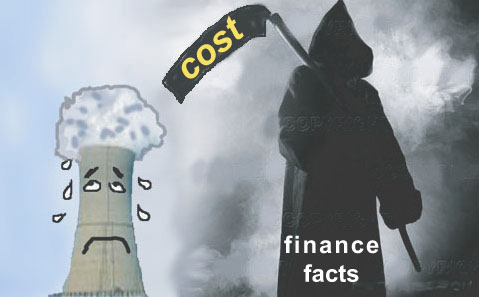
Britain’s flagship Hinkley Point C nuclear plant has been delayed until
2029 at the earliest, with the cost spiralling to as much as £46bn, in the
latest blow to a project at the heart of the country’s long-term energy
plans.
The surging bill and slipping schedule, announced on Tuesday by the
French state-owned operator and constructor EDF, will put pressure on the
UK government to provide extra financial support for the project.
EDF, which has also experienced long delays on recent parallel projects in
Finland and France that use the same reactor technology, blamed the latest
problems at Hinkley in Somerset on the complexity of installing
electromechanical systems and intricate piping. Hinkley was previously
delayed due to construction disruption during Covid pandemic.
Under EDF’s latest scenario, one of the two planned reactors at Hinkley Point C could
be ready in 2029, a two-year hold-up compared with the company’s previous
estimate of 2027. But it could be further delayed to 2031 in adverse
conditions, EDF said. It did not give an estimate for the second reactor.
EDF said the cost would now be between £31bn-£35bn based on 2015 prices,
depending on when Hinkley Point C was completed.
In today’s prices, the cost would balloon to as much as £46bn. The initial budget was £18bn, with a scheduled completion date of 2025. Alison Downes of Stop Sizewell C, a
campaign group opposed to the planned Suffolk nuclear plant, said EDF was
an “unmitigated disaster”. She added the UK government should cancel
Sizewell C, saying state funding for the project could be better spent on
“renewables, energy efficiency or, in this election year, schools and
hospitals”.
FT 23rd Jan 2024
https://www.ft.com/content/1157591c-d514-4520-aa17-158349203abd
EDF’s UK Hinkley Nuclear Costs Balloon as Plant Delayed Again

Francois de Beaupuy, Bloomberg News, Jan 23, 2024
(Bloomberg) — Electricite de France SA’s nuclear project at Hinkley Point in the UK will cost as much as £10 billion ($13 billion) extra to build and take several years longer than planned, the latest in a series of setbacks for the budget and timetable of the country’s largest energy project.
EDF now expects the two reactors it’s building in southwest England to cost between £31 billion and £35 billion in 2015 terms, the French energy company said in a statement on Tuesday. That’s up from an estimate of £25 billion to £26 billion in 2022, and is the fifth budget increase in eight years. At today’s prices, the project would cost as much as £46 billion, according to the Bank of England’s inflation calculator. …………………
The UK is struggling to get its huge nuclear program off the ground. The government is aiming for as much as 24 gigawatts of capacity by 2050 and will have to accelerate rapidly to achieve that. Hinkley Point will be the first new atomic station to start generating in Britain since 1995. Construction of complex nuclear plants is notoriously slow, and the cost overruns and delays at Hinkley may damp investor enthusiasm for the sector…………………………………..
The setback comes just one day after the UK government pledged to invest an additional £1.3 billion in EDF’s second UK project at Sizewell C. Ministers are hoping the commitment will attract enough private capital to make a final investment decision this year and make progress toward its ambitious 2050 target.
EDF was already struggling with the budget for Hinkley after China General Nuclear Power Corp, its partner in the project, stopped funding, potentially leaving the French company to foot the bill until it is completed. The government-owned French company will also have to spend tens of billions of euros on new atomic plants at home in the coming decades.
Hinkley Point C is not a French government project and so any additional costs or schedule overruns are the responsibility of EDF and its partners and will in no way fall on taxpayers, said a spokesperson for the UK Department for Energy Security and Net Zero.
…….. EDF’s current fleet of five nuclear plants is scheduled to shrink to just three by the end of 2026. Last year, output slumped to the lowest in more than four decades.
While rising costs of metals, cement and labor are affecting industries including large offshore wind projects, the revised plan may revive a controversy over how expensive the technology is and whether further delays are inevitable. Still, the UK government said this month that the country will build another large-scale nuclear power plant, beyond current projects led by EDF.
t’s not the first time Hinkley has ballooned beyond its budget. EDF increased its estimates in 2017, 2019, 2021, and 2022 from an initial estimate of £18 billion when the contract was signed with the UK in 2016.
At the start of the project, the French utility expected the first unit to start by the end of 2025. However, Brexit, the Covid pandemic and the war in Ukraine have disrupted supply chains and boosted the cost of labor and essential materials like steel and cement.
“Going first to restart the nuclear construction industry in Britain after a 20-year pause has been hard,” said Stuart Crooks, Managing Director for Hinkley Point C. https://www.bnnbloomberg.ca/edf-s-uk-hinkley-nuclear-costs-balloon-as-plant-delayed-again-1.2025542
CAMPAIGNERS opposing the development of nuclear power in Bradwell-on-Sea say they believe ‘new nuclear’ in the area “remains dead in the water”.
Blackwater Against New Nuclear Group (BANNG) has been fighting its cause for 15 years.
On January 11, the Government released its Civil Nuclear: Roadmap to 2050.
BANNG claims it means the original eight government-listed coastal sites, including Bradwell, are no longer the only sites earmarked for nuclear deployment.
They say new nuclear power stations will only be sited in “suitable locations” identified by developers based on a set of criteria.
BANNG chairman Professor Andy Blowers said: “This new approach to siting effectively rules Bradwell out of any further consideration.
“As we have strenuously demonstrated over the last 15 years, Bradwell is a most unsuitable site and the Blackwater communities are overwhelmingly opposed to nuclear development in such a fragile location, increasingly vulnerable to the impacts of climate change.”
He added: “BANNG welcomes the effective delisting of the Bradwell site. Delisting is something we have insisted on since the list was first compiled more than a decade ago.
“We are at a loss to understand what ‘certain advantages’ can conceivably be attributed to the site.
“Rather as the myriad evidence accumulated and published over the years shows, Bradwell is a wholly unsuitable and unsatisfactory site for the development of nuclear power at whatever scale and capacity.”
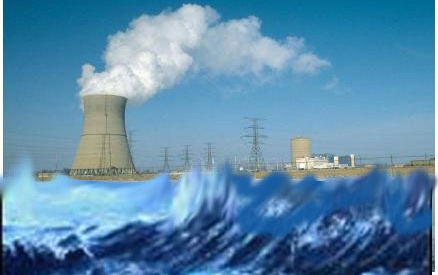
A BANNG spokesman said: “A major problem is the vulnerability of the site to flooding, and to storm surges and coastal processes that are intensifying as the impacts of climate change begin to take hold on this fragile coastline
They added: “There are other significant reasons why Bradwell should be off the Nuclear Road Map.
“The Blackwater area has precious environments in land, sea and sky which are protected, conserved and significant.
“The intrusion of a mega power station or a cluster of smaller reactors would prove intrusive, polluting and detrimental to habitats and to human wellbeing.
“Further, there would be dangerous highly radioactive wastes stored on the site for future generations to cope with, along with all the other problems of climate change.
“Above all, the communities around the Blackwater have over the years overwhelmingly declared against new nuclear development at the Bradwell site.
“New nuclear is not welcome here.”
UK Government’s nuclear power plans a roadmap to a dead-end – CND

“The debate and investment into trying to develop new nuclear energy projects divert funds and political motivation away from further developing truly renewable energy sources, which is the real solution.”
Sara Medi Jones, Campaign for Nuclear Disarmament (CND), assesses the government’s latest nuclear power announcement m https://labouroutlook.org/2024/01/23/governments-nuclear-power-plans-a-roadmap-to-a-dead-end-cnd/
It’s only mid-January and we have already had two major nuclear power announcements in 2024. A long-awaited “roadmap” of nuclear power expansion was unveiled earlier this month, with the government promising to accelerate new nuclear projects. And this week we’ve just heard that construction of the Sizewell C nuclear station in Suffolk should be a step closer.
But the problem is – nuclear is a dead-end technology that is not the answer to our climate or energy needs.
Plans for eight new nuclear sites laid out in 2011 have largely stalled, with the only two projects to have got off the ground – Hinkley Point C and Sizewell C – beset with problems. Costs at Hinkley Point have spiralled by 30% to £33 billion, and the start date has repeatedly been pushed back. Sizewell C is struggling to attract private financing, and despite building permission finally being granted now, there are still many hurdles to clear.
The nuclear roadmap’s main aims are to “explore” another nuclear site, develop small modular reactors, secure more investment, and engage the private sector more
But we are unlikely to see any meaningful progress because nuclear power in its very essence is a dangerous and economically unsustainable technology. It burdens future generations with a potential human and environmental disaster that is not compensated for by the expensive electricity provided.
Any new nuclear projects would take decades to build. But we need an answer to our cost of living struggle and to climate change now. Even if nuclear power capacity was doubled worldwide by 2050 (a hugely ambitious ask in itself), it would only result in a 4% reduction in emissions.
The debate and investment into trying to develop new nuclear energy projects divert funds and political motivation away from further developing truly renewable energy sources, which is the real solution.
We must also bear in mind the main reason this government is so in favour of nuclear power: it helps to ensure the infrastructure and skilled personnel is in place to maintain and manufacture Britain’s nuclear weapons system, Trident. During this time of global instability and increased nuclear risk, Britain would do well to forget about propping up their weapons of mass destruction and instead focus on delivering the things that people in this country need, including a functioning and sustainable energy system.
Nuclear start-up Newcleo drops plans for British factory in favour of France
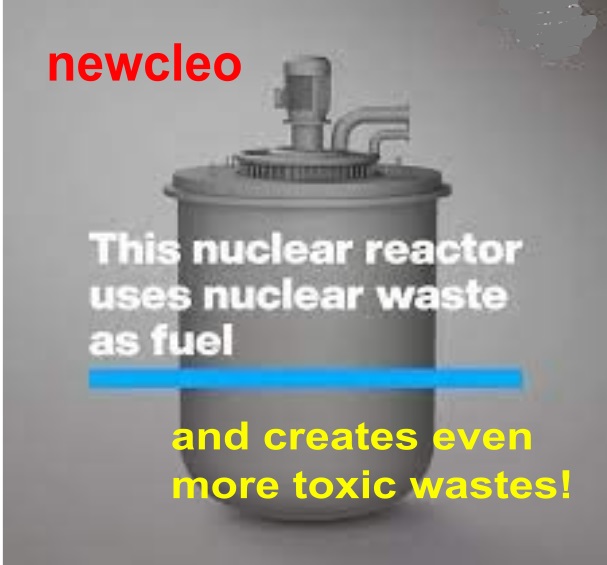
COMMENT. This is a very interesting article. For one thing, it shows that these “advanced” nuclear reactors require plutonium to get the fission process happening. It also claims that these advanced nuclear reactors can solve the problem of plutonium wastes. That is not true. The wastes resulting from this process are smaller in volume, but more highly toxic. That means that they require the same area/voume of space for disposal as the original plutonium. On another angle, it does indicate the confusion that the British government is in about the way ahead in their highly suspect “Civil Nuclear Roadmap”. And on another angle again, it shows how Macron’s France is putting all its eggs into the one nuclear basket. When we look at the extreme costs, and the extreme climate effects, Macron’s French nuclear obsession is likely to result in political suicide.
Matt Oliver, Sun, 21 January 2024, https://finance.yahoo.com/news/nuclear-start-drops-plans-british-131702123.html#:~:text=A%20British%20nuclear%20startup%20has,lobbied%20personally%20by%20Emmanuel%20Macron.
A British nuclear startup has dropped plans to build a pioneering power plant in Cumbria and will invest £4bn in France instead, after it was lobbied personally by Emmanuel Macron.
Newcleo, which is headquartered in London, is developing a type of mini nuclear power plant, known as an advanced modular reactor (AMR), that will use nuclear waste for fuel.
The company had hoped to tap into the UK’s vast stockpile of waste at Sellafield, where it wanted to invest £2bn in a waste reprocessing factory and AMR that would have created around 500 jobs.
It was also planning a similarly-sized facility in France.
But Stefano Buono, Newcleo’s chief executive and founder, said the company has now dropped the UK plans after the Government ruled out giving private companies access to the Sellafield stockpile in a nuclear industry “roadmap” published this month.
Instead, Newcleo is planning an enlarged development at an undisclosed location in the south of France, where it now plans to spend £4bn and create around 1,000 jobs, he said.
As part of that scheme, it will buy nuclear waste from French state energy giant EDF.
The company is also currently in the middle of a €1bn (£860m) fundraising.
The decision comes after the company was blocked from participating in the UK’s design competition for mini nuclear reactors.
By comparison, France has eagerly supported Newcleo and Mr Buono was lobbied repeatedly for investment by President Macron in face-to-face meetings.
Newcleo, which was also invited to last year’s “Choose France” business summit at the Palace of Versailles, has never been offered an in-person meeting with a British prime minister.
Mr Buono told The Telegraph: “Our plan initially was to use one factory in France and one in the UK.
“Now, we will double the capacity of France and we are not investing in the UK.”
He added that the company had hoped to pioneer its technology in Britain but added: “In two years, we were not able to even locate the site, so we have decided to accept the offer from France.
“We can proceed with our business model there.”
Newcleo’s decision to build its first plant abroad comes amid growing frustration within the British nuclear industry over the slow progress the Government has made towards identifying sites for new power plants.
The loss of significant investment to France will also be seen as the latest sign that Downing Street’s efforts to attract business investment are being outshone by President Macron, who has launched a charm offensive to lure companies across the Channel since Brexit.
He was the only G7 leader to attend the World Economic Forum in Davos, Switzerland, this week, while he has rolled out the red carpet for business leaders including Tesla boss Elon Musk and JP Morgan banker Jamie Dimon at his annual Choose France event.
Last year’s summit resulted in major deals, with Taiwanese car battery maker ProLogium unveiling plans for a €5.2bn plant at the port of Dunkirk and Verkor, a French company, pledging a €1.6bn battery factory there too.
In the UK, six SMR developers including Rolls-Royce have been shortlisted for support under a competition run by Great British Nuclear.
Newcleo was not considered because of the AMR’s lead cooling system and unusual fuel, Mr Buono has claimed.
The company’s novel design would run on processed plutonium, helping countries such as the UK dispose of the dangerous waste, which is expensive to manage. [Ed. This ignores the fact that this process results in a smaller volume of more highly toxic waste]
At Sellafield, the UK has amassed 140 tonnes of plutonium – the world’s biggest stockpile – as a result of historic nuclear weapons programmes and abandoned efforts to develop so-called fast breeding reactors that would have used it as fuel.
A massive effort is currently under way at the Cumbrian site to safely store the waste, but Mr Buono and his colleagues have argued it could be put to better use as reactor fuel.
The entrepreneur made his fortune selling cancer treatment developer AAA to Novartis for $3.9bn (£3.2bn) in 2017, reportedly earning him $420m.
His company has the backing of the Agnelli industrialist family, which made its money from Fiat and Ferrari.
The French government is expected to confirm a deal with Newcleo later this year.
The UK Government did not respond to requests for comment.
Even Britain’s ruling Tory party fear that their “Nuclear Roadmap” plan will end up on the scrap heap.

More nuclear power is the obvious solution to our energy security and Net Zero dilemmas. That doesn’t mean it is ever going to happen. Conservative Home, 19 Jan 24
Last week, Claire Coutinho published the Government’s “nuclear roadmap”. Sticking with Boris Johnson’s target of having a quarter of our electricity from nuclear by 2050, this attempts to explain how we achieve the quadrupling of nuclear capacity required to achieve the necessary 24 gigawatts (GW).
Rishi Sunak calls nuclear the “perfect antidote to the energy challenges facing Britain”. ………………………..
But the Government’s nuclear ambitions face an immediate stumbling block. At present, our nuclear capacity stands at 5.9GW, produced by five power stations. These are all owned by EDF, the French state energy group. Four of those plants – producing 4.7GW – are set to close in 2028.
EDF has floated keeping them open for longer. Yet even that would require Britain to massively ramp up its nuclear capacity in the next three decades to for us to have any hope of achieving the Government’s aim to come over a bit Doctor Manhatten. Following this, Coutinho has established an ambition to invest in new nuclear capacity of between 3GW and 7GW every five years from 2030 to 2044.
Work is already in progress. Hinkley Point C in Somerset is under construction. Sizewall C is planned for Suffolk, with a final investment decision due to be made by the end of this year. The Government is considering approving the construction of a third similarly sized power station. Additionally, ministers want to build a fleet of “small modular reactors” alongside these larger plants.
………………………………….. Johnson’s tongue-in-cheek vision of an SMR in “every Labour seat” remains as much of a fantasy as any of his mooted grands projets. Putting so much faith in SMRs to deliver our nuclear dreams is wishful thinking by Coutinho. But that is true of her whole “roadmap” and the ambitions behind them.
As Sam Dumitriu points out, when Hinkley opens in 2028, it will not only be the first nuclear power station built in Britain for over three decades, but the second most expensive nuclear power station built in history on a pound-per-megawatt basis. Having been due to open in the early 2020s, it is now expected to cost £32 billion. Some expect its construction could be further delayed into the 2030s.
This bodes poorly for Coutinho’s touted “nuclear awakening”. ………….
Capital costs make up around 60 per cent of nuclear’s levelised cost of energy. The average has been estimated at $6041-per-kilowatt – over 50 per cent more than coal and 500 more than gas. Factoring in that building a nuclear power station in Britain usually takes around 13 years, and it becomes obvious why investing in nuclear remains unattractive. Financing Hinkley involved the Government agreeing to a wholly uncompetitive deal…………………………….
The Government hopes an overhaul of planning rules could allow SMRs to be approved in a variety of locations, especially brownfield sites, away from areas with population densities of more than 5,000 people per square kilometre. However, there is still plenty of opportunity for applications to be denied based on natural beauty, ecology, cultural heritage, size, or flood risk. To combat NIMBYism, we would need to stuff a few mouths with gold.
Britain’s nuclear ambitions are also hampered by our current reliance on EDF. From leading the world in nuclear technology in the 1950s, our long lag since last constructing a plant has seen a loss of know-how, leaving us reliant on EDF for larger plants. Not only has this left us having signed an expensive deal for Hinkley, but it has entrusted our energy security to a company with a record of costly delays.
This is of a piece with our long tradition of nuclear short-sightedness. As Peter Franklin has pointed out, Johnson and Sunak follow Harold Wilson, Margaret Thatcher, and Tony Blair in making grand pronouncements of a fleet of new British nuclear reactors. Little has good came of any of them. Amidst some substantial competition, we can count Hinkley as one of Blair’s most ignominious legacies.
We can expect Coutinho’s proposals to end up on a similar scrapheap. Labour says they are keen on more nuclear. But they will face the same problems of regulation, construction costs, and political volatility. It might take only another Fukushima for the public to go all German on our nuclear future…..
Military interests are pushing new nuclear power – and the UK government has finally admitted it

……………… the latest announcement, Civil Nuclear: Roadmap to 2050, - in this supposedly “civil” strategy – are multiple statements about addressing “civil and military nuclear ambitions” together to “identify opportunities to align the two across government”.
French president Emmanuel Macron summarises: “without civil nuclear power, no military nuclear power, without military nuclear, no civil nuclear”.
Andy Stirling Professor of Science & Technology Policy in the Science Policy Research Unit, University of Sussex, Philip JohnstoneResearch Fellow, SPRU, University of Sussex, January 19, 2024 https://theconversation.com/military-interests-are-pushing-new-nuclear-power-and-the-uk-government-has-finally-admitted-it-216118
The UK government has announced the “biggest expansion of the [nuclear] sector in 70 years”. This follows years of extraordinarily expensive support.
Why is this? Official assessments acknowledge nuclear performs poorly compared to alternatives. With renewables and storage significantly cheaper, climate goals are achieved faster, more affordably and reliably by diverse other means. The only new power station under construction is still not finished, running ten years late and many times over budget.
So again: why does this ailing technology enjoy such intense and persistent generosity?
…………………………………………………………………………….. A document published with the latest announcement, Civil Nuclear: Roadmap to 2050, is also more about affirming official support than substantively justifying it. More significant – in this supposedly “civil” strategy – are multiple statements about addressing “civil and military nuclear ambitions” together to “identify opportunities to align the two across government”.
These pressures are acknowledged by other states with nuclear weapons, but were until now treated like a secret in the UK: civil nuclear energy maintains the skills and supply chains needed for military nuclear programmes.
The military has consistently called for civil nuclear
Official UK energy policy documents fail substantively to justify nuclear power, but on the military side the picture is clear.
For instance, in 2006 then prime minister Tony Blair performed a U-turn to ignore his own white paper and pledge nuclear power would be “back with a vengeance”. Widely criticised for resting on a “secret” process, this followed a major three volume study by the military-linked RAND Corporation for the Ministry of Defence (MoD) effectively warning that the UK “industrial base” for design, manufacture and maintenance of nuclear submarines would become unaffordable if the country phased out civil nuclear power.
A 2007 report by an executive from submarine-makers BAE Systems called for these military costs to be “masked” behind civil programmes. A secret MoD report in 2014 (later released by freedom of information) showed starkly how declining nuclear power erodes military nuclear skills.
In repeated parliamentary hearings, academics, engineering organisations, research centres, industry bodies and trade unions urged continuing civil nuclear as a means to support military capabilities.
In 2017, submarine reactor manufacturer Rolls Royce even issued a dedicated report, marshalling the case for expensive “small modular reactors” to “relieve the Ministry of Defence of the burden of developing and retaining skills and capability”.
The government itself has remained coy about acknowledging this pressure to “mask” military costs behind civilian programmes. Yet the logic is clear in repeated emphasis on the supposedly self-evident imperative to “keep the nuclear option open” – as if this were an end in itself, no matter what the cost. Energy ministers are occasionally more candid, with one calling civil-military distinctions “artifical” and quietly saying: “I want to include the MoD more in everything we do”……………………………………………………………………………………..
This is even more evident in actions than words. For instance hundreds of millions of pounds have been prioritised for a nuclear innovation programme and a nuclear sector deal which is “committed to increasing the opportunities for transferability between civil and defense industries”.
An open secret
Despite all this, military pressures for nuclear power are not widely recognised in the UK. On the few occasions when it receives media attention, the link has been officially denied.
Other nuclear-armed states are also striving to maintain expensive military infrastructures (especially around submarine reactors) just when the civilian industry is obsolescing. This is true in the US, France, Russia and China.
Other countries tend to be more open about it, with the interdependence acknowledged at presidential level in the US for instance. French president Emmanuel Macron summarises: “without civil nuclear power, no military nuclear power, without military nuclear, no civil nuclear”.
This is largely why nuclear-armed France is pressing the European Union to support nuclear power. This is why non-nuclear-armed Germany has phased out the nuclear technologies it once lead the world in. This is why other nuclear-armed states are so disproportionately fixated by nuclear power.
These military pressures help explain why the UK is in denial about poor nuclear performance, yet so supportive of general nuclear skills. Powerful military interests – with characteristic secrecy and active PR – are driving this persistence.
Neglect of this picture makes it all the more disturbing. Outside defence budgets, off the public books and away from due scrutiny, expensive support is being lavished on a joint civil-military nuclear industrial base largely to help fund military needs. These concealed subsidies make nuclear submarines look affordable, but electricity and climate action more costly.
The conclusions are not self-evident. Some might argue military rationales justify excessive nuclear costs. But history teaches that policies are more likely to go awry if reasons are concealed. In the UK – where nuclear realities have been strongly officially denied – the issues are not just about energy, or climate, but democracy.
The Conversation asked the UK Department for Energy Security and Net Zero to comment but did not receive a reply before the publication deadline. https://theconversation.com/military-interests-are-pushing-new-nuclear-power-and-the-uk-government-has-finally-admitted-it-216118
Weatherwatch: UK push for civil atomic power highlights link with nuclear weapons

Government previously denied evidence countries with nuclear weapons favour atomic power over renewables
Paul Brown, Fri 19 Jan 2024, https://www.theguardian.com/news/2024/jan/19/weatherwatch-uk-push-civil-atomic-power-highlights-link-nuclear-weapons
There is long running debate about whether nuclear power has a role in combatting the climate crisis. The UK government decided last week it was vital and is planning a vast expansion. Most environmental groups remain sceptical, preferring quicker and cheaper renewables.
Whatever the merits of the case there was, buried deep in the government’s nuclear roadmap, a complete somersault on the relationship between civil and military nuclear power. Back in the 1980s and 1990s when the Guardian carried reports from Sussex University’s Science Policy Research Unit (SPRU), among others, showing there was a link between the two, the government continuously denied it.
SPRU persevered with its work and noted that despite the UK’s denials, across the world it has become more obvious that states with nuclear weapons remain keen on atomic power while those without them put renewables centre stage.
Last week the government’s arguments in favour of new civil nuclear power swept aside any lingering doubt its predecessors had been covering up the link. The roadmap policy document mentioned 14 times in different sections the need to continue to strengthen the existing cooperation and tie-ups between the civil and military industries to the benefit of both. The logic is to keep to a minimum the training and development costs for both the weapons and power sectors.
Why nuclear reactors are not the future of energy despite what UK Government would have you think.

– Dr Richard Dixon. The UK Government is trying to create the impression that it’s all go for nuclear. It isn’t.
The UK’s nuclear enthusiasts have been on another PR offensive, with
announcements of new reactors and possible life extensions to old reactors.
All of it denying the reality that nuclear is much too slow to build and
much too expensive to be part of our future energy strategy. Globally
nuclear is in terminal decline. In the last five years more renewable
electricity has been generated by just new schemes around the world than by
all the world’s nuclear reactors. And twice as much again is expected to
be constructed in the next five years, taking renewables output to five
times that of nuclear.
Of course the motivation for this burst of
co-ordinated PR is clear, the $20bn for Sizewell C hasn’t been raised so
the UK Government is desperately trying to give the impression that it’s
all go for nuclear in the UK. When it clearly isn’t.
Scotsman 17th Jan 2024
Roadmap to warfare: new policy exposes links with UK military nuclear projects
The UK/Ireland Nuclear Free Local Authorities are keen to assist University of Sussex academics in exposing the links to the military that were revealed in the recent UK Government’s launch of a ‘Roadmap’ for the civil nuclear sector (11 January 2024).[1]
In the public interest, Andy Stirling, Professor of Science and Technology Policy, and Research Fellow Dr Phil Johnstone, both at the University of Sussex, have done remarkable work over many years highlighting the lack of transparency and the extent of cross-subsidy between the civil and military nuclear sectors, despite facing official hostility, obfuscation, or denial.
NFLA 18th Jan 2024
Hinkley C site fire safety fears trigger enforcement notices
By Phil Hill, @GazettePHill, https://www.somersetcountygazette.co.uk/news/24055739.hinkley-c-site-fire-safety-fears-trigger-enforcement-notices/ 17 Jan 24
Pre-planned inspections in November at the Unit 1 HR Building on the site led to ONR identifying the breaches and issuing the notices.
These have been served on licensee NNB Generation Company (HPC) Ltd, contractors Bouygues Travaux Publics SAS and Laing O’Rourke Construction Limited, who are the joint venture partners in BYLOR JV, and REEL UK.
The enforcement notices require improvements to be made to address the shortfalls and prevent re-occurrence.
There were no consequences to employees, the public or the environment as a result of the shortfalls.
However, ONR identified the potential for harm and risk of serious injury, which required regulatory action.
Shane Turner, superintending inspector and head of safety regulation at Hinkley Point C, said: “The enforcement notices require these four organisations to make improvements in fire safety arrangements at the Hinkley Point C site.
We will engage with each of them during the period of the enforcement notice to ensure positive progress is made.”
The notices require necessary improvements are made by March 31.
The enforcement action relates to contraventions under the requirements of Article 22 of the Regulatory Reform (Fire Safety) Order 2005.
1
Shining a light on the UK’s nuclear deterrent
changes in the government’s policy on nuclear power in recent years would effectively allow Britain’s military nuclear industry to be supported by payments from electricity consumers.
“The issue now is that UK citizens are unwittingly subsidising military nuclear activity through energy bills to the tune of many tens of billions of pounds,”
Professor Andy Stirling and Dr Phil Johnstone have highlighted a lack of transparency between governments’ nuclear power programmes and their military nuclear capabilities.
As nuclear power declines worldwide, it is striking how many countries that continue to expend costly support are either existing or aspiring nuclear weapons states.
So say Andy Stirling, Professor of Science and Technology Policy, and Research Fellow Dr Phil Johnstone, at the University of Sussex. Their research into the dependency of military nuclear capabilities on the support of civil nuclear programmes has been cited widely – not least in the UK.
From early working-paper findings to presenting evidence to the Public Accounts Committee (PAC) in the House of Commons, their research has raised important questions about accountability, transparency and the future role of the nuclear industry in a changing world.
It has also received major media attention, with stories in the Guardian, the BBC, Independent and New York Times, whilst their findings also culminated in questions being asked (and significant answers being obtained) in a UK Parliamentary Select Committee, many Parliamentary Questions posed in Westminster and a motion being passed through the Scottish Parliament.
But it hasn’t come without its frustrations. Since the academics first presented their findings to the House of Commons in 2017 – and then in numerous subsequent national and international press stories – the UK Government has not responded directly to the serious criticisms that arose concerning a lack of transparency and accountability. Invitations have been received to discuss these issues with official bodies, and the analysis has not been refuted, but it remains open what the Government itself will do.
Early findings
It’s been quite a journey from their initial research. In 2015, the academics published a working paper on German and UK nuclear power. It was here that the pair conducted an in-depth analysis to try to understand the different nuclear trajectories of the UK and Germany.
The findings of this research first pointed towards concealed UK motives for persisting with nuclear at a time when commentators and experts, virtually across the board, were suggesting the opposite: that it was in irreversible decline.
What was new about the Sussex analysis was that it looked beyond nuclear weapons to the hidden dependencies of the submarine industry on civil nuclear programmes.
“When we started out, the idea of civil programmes supporting military nuclear programmes, was met with significant scepticism.” says Stirling.
“Since then, through evidence submissions and continued output, there has been a gradual acceptance by some that the need to sustain key capabilities and skills in order to construct and maintain nuclear submarines is a significant factor driving the UK’s intense enthusiasm for new nuclear.”
A block in public openness
Things were about to speed up. In 2016, a detailed SPRU working paper asked why UK policy had been so intensely committed to nuclear power, with the findings clearly pointing to military links as a means for continuation.
As a result, questions were now being asked of the UK Government, with transparency – or the lack thereof – at the top of the agenda.
“When we started out, the idea of civil programmes supporting military nuclear programmes, was met with significant scepticism.” says Stirling.
“Since then, through evidence submissions and continued output, there has been a gradual acceptance by some that the need to sustain key capabilities and skills in order to construct and maintain nuclear submarines is a significant factor driving the UK’s intense enthusiasm for new nuclear.”
A block in public openness
Things were about to speed up. In 2016, a detailed SPRU working paper asked why UK policy had been so intensely committed to nuclear power, with the findings clearly pointing to military links as a means for continuation.
As a result, questions were now being asked of the UK Government, with transparency – or the lack thereof – at the top of the agenda.
In 2017, the findings were first presented before the Public Accounts Committee in the House of Commons. The evidence found that a white paper into the UK’s energy policy was now “extraordinarily overdue”.
“It was very clear that the usual public policy processes were falling short,” says Stirling. “In this sense, it is not just our own analysis, but a matter of public record, that due consultation and analysis have not so much been “disregarded” as not performed at all.
“So, at the core of this issue is the fact that the intensity of official commitments to nuclear power by successive UK governments is largely due to factors that remain effectively undeclared.”
Hinkley Point C
Undoubtedly one of the most significant developments in recent times in relation to the UK’s nuclear strategy has been the go-ahead and development of Hinkley Point C, a large nuclear power station under construction in Somerset.
Since its inception, the project, which is being built by the French electricity company EDF, has been criticised on a number of grounds – not least its huge and escalating cost.
But it is the justification to build any new nuclear power station, as highlighted by this research, that raises legitimate questions about the role the UK government has played in this process: of willfully disregarding open, thorough consultation and analysis in order to carry on regardless with nuclear energy, without providing a legitimate reason why.
In evidence submitted to the PAC, the research concluded that the costs of the Trident programme could be “unsupportable” without “an effective subsidy, from electricity consumers to military nuclear infrastructure”.
In their evidence, the academics wrote that the £19.6bn Hinkley Point project would “maintain a large-scale national base of nuclear-specific skills” without which there is concern “that the costs of UK nuclear submarine capabilities could be insupportable”.
A hidden subsidy
This evidence suggested that changes in the government’s policy on nuclear power in recent years would effectively allow Britain’s military nuclear industry to be supported by payments from electricity consumers.
“The issue now is that UK citizens are unwittingly subsidising military nuclear activity through energy bills to the tune of many tens of billions of pounds,” points out Johnstone.
“However, growing ever more significant is the failure of the existing policy apparatus to engage with the criticisms in this regard. This highlights that one of the main issues here concerns the quality of UK policy processes and the health of UK democracy itself.”
As time goes on in this way, the underlying impact of this work expands beyond the immediate story. In part, say the researchers, it lies in the failure of the UK government to be accountable for the decisions it has made in relation to the future of the UK’s energy policy. It has become a transparency issue, one in which the effects aren’t just felt on a state level but amongst its citizens – for many years to come.
What now?
In a world where misinformation is rife, it wasn’t long until claims were made that the research amounted to a ‘conspiracy theory’– particularly with findings that have had such far-reaching consequences. But this is something that Stirling and Johnstone have taken in their stride.
“The few private and public accusations that our analysis is a conspiracy theory have now all largely abated,” says Stirling.
“Several academics, policy analysts and journalists, who used these terms right at the outset, have now all gone out of their way explicitly to tell us that they believe us to be correct.
“In one case, a nuclear advocacy organization, taking the trouble to criticise us this way in an early blog post, has since shifted its position to openly advocate precisely the links they previously dismissed as a conspiracy theory.”
All of this points to research that is still evoking a reaction, still engaging stakeholders across the community, and is reaching into the heart of the democratic process. It also indicates that the effects of the research haven’t yet reached their climax.
A growing tension
“The reaction so far in the UK and international press, the wider energy policy and academic communities suggests that our work is making a firm mark in a field where the stakes are extremely high,” says Johnstone.
“Although the UK Government has itself thus far tried to side-line the issue, it has become strongly acknowledged more widely – even to the point of becoming orthodoxy in many quarters. The lack of official engagement is growing ever more telling.”
Yet uptake of the analysis by many prominent bodies and individuals in this field leaves no doubt that public discussions around nuclear power in the UK and more widely have been strongly influenced by this research.
As Stirling points out: “A backdrop of continued silence on the part of government, as trends continue to unfold and evidence and commentary continues to accumulate, suggests eventual acknowledgement is growing more likely. This in turn suggests that the largest impacts have yet to emerge.”
UK’s nuclear obsessions kill off its net zero strategy

The new Roadmap reads like an outing to a massive nuclear sweet shop. On top of Hinkley Point C and Sizewell C, we’ll have one more big one. And then we’ll have lots of Small Modular Reactors, all over the country. And we’ll have a new fuel processing plant. And a new Geological Disposal Facility – at some much more distance point. And so on and on. 24 fantastical Gigawatts to be designed and delivered by 2050.
Jonathon Porritt, 18 Jan 24
After 14 years of Tory mismanagement, the UK finds itself bereft of an energy strategy.
This was finally confirmed in the release last week of the Government’s new Nuclear Roadmap. At one level, it’s just the same old, same old, the latest in a very long line of PR-driven, more or less fantastical wishlists for new nuclear in the UK. But at another, it’s a total revelation.
For years, a small group of dedicated academics and campaigners have suggested that the UK Government’s Nuclear Energy Strategy is being driven more by the UK’s continuing commitment to an “independent” nuclear weapons capability than by any authoritative energy analysis. For an equal number of years, this was aggressively rebutted by one Energy Minister after another, both Tory and Labour.
The new Nuclear Roadmap dramatically changes all that. It sets to one side any pretence that the links between our civil nuclear programme and our military defence needs were anything other than small-scale – and of no material strategic significance. With quite startling transparency and clarity, the Roadmap not only reveals the full extent of those links, but positively celebrates that co-dependency as a massive plus in our ambition to achieve a Net Zero economy by 2050.
“Startling” is actually an understatement. Such a comprehensive volte-face is rare in policy-making circles. Every effort is usually made by Ministers to obscure the scale (let along the significance) of any such screeching handbrake turns. That is so not the case with the new Roadmap.
Courtesy of the latest forensic work done by Professors Andy Stirling and Phil Johnstone at Sussex University (who have been absolutely at the forefront of seeking to bring these links into the public domain over many years – often with mighty little support from mainstream environmental organisations, let alone “independent” commentators), chapter and verse of this volte-face can be laid bare. Just three o examples from the Roadmap:
- “Not only does this Roadmap set a clear path for the growth of nuclear fission…it acknowledges the crucial importance of the nuclear industry to our national security, both in terms of energy supply and the defence nuclear enterprise.”
- “Government will proactively look for opportunities to align delivery of the civil and nuclear defence enterprises, whilst maintaining the highest standards of non-proliferation.”
- “To address the commonalities across the civil and defence supply chains, and the potential risk to our respective nuclear programmes due to competing demand for the supply chain, the Department of Energy Security and Net Zero (DESNZ) is working closely with the Ministry of Defence and the Defence Nuclear Sector.”
And there’s a whole lot more than that! As Andy Stirling has said: “Without any reflection on what this says about previous efforts to suppress discussion of this issue, the Government is now openly emphasising its significance.”
Indeed!
As usual, the UK’s ill-informed and unbelievably gullible mainstream media would appear to have missed the significance of this gobsmacking inflection point. So one can hardly expect them to have grasped its even more significant implications for UK energy strategy as a whole. In every single particular.
Let me briefly unpack some of those particulars:
- Nuclear
The new Roadmap reads like an outing to a massive nuclear sweet shop. On top of Hinkley Point C and Sizewell C, we’ll have one more big one. And then we’ll have lots of Small Modular Reactors, all over the country. And we’ll have a new fuel processing plant. And a new Geological Disposal Facility – at some much more distance point. And so on and on. 24 fantastical Gigawatts to be designed and delivered by 2050.
The reality couldn’t be more different:
- We will indeed end up with Hinkley Point C – at a staggering of cost of somewhere between £26 billion and £30 billion, with consumers paying twice as much for its electricity as they will for offshore wind. And it will almost certainly not come online until the end of the decade, 15 years on from the time it was meant to be up and running.
- We may possibly get Sizewell C, though the Government cannot currently guarantee the required level of investment. So a Final Investment Decision is unlikely before the next Election. At which point, Starmer may come to his senses and kill off this absurd white elephant.
- We will never get a third big reactor. The economics are literally impossible to justify.
- We are unlikely to get more than a couple of hugely expensive Small Modular Reactors, at some indeterminate point in the future, even with a new “flexible approach” to planning and financial inducements. Even that may prove to be an illusion. As Professor Steve Thomas has written: “Advocates of Small Nuclear Reactors claim they are cheaper and easier to build, safer, generate less waste, and will create many jobs compared to existing large reactor designs. These claims are unproven, misleading, or just plain wrong. Worldwide, no commercial design of SMR has even received a firm order yet.”
- And we may or may not get life extensions for the last five power stations in the “legacy fleet” – subject to regulatory approval, which may not be all that easy given extensive cracking in their reactor cores.
In short, the Roadmap is just a massive diversion from reality. Entailing incalculable opportunity costs. And putting at risk our entire Net Zero by 2050 strategy.
Ministers know all that. But they don’t really care. Our nuclear weapons programme (including upgrading Trident) will be protected as a consequence of this, via an unceasing flow of public money into the civil nuclear cul-de-sac, at a time when our defence budget is already massively overstretched. So who cares about the missing 24GW?
- Renewables
We’ll continue to see new investment into renewables here in the UK, despite (not because of) government policy, which has seriously messed up our offshore wind industry, maintained a de facto ban on onshore wind, couldn’t care less about solar, witters on vapidly about tidal without doing anything etc etc.
Meanwhile, on a global basis, renewables continue to boom. Here are a few facts – in contrast to over-excited sightings of nuclear unicorns:…………………………………………………………………………………………………………………………………………………………
Why don’t people see this?
Why don’t our mainstream media offer any serious critique of what’s going on here?
Why don’t our opposition parties rip to shreds this tissue of preposterous illusions?
The reasons for this almost complete silence can be traced back to successive governments’ grim intent to hang onto our so-called “independent nuclear deterrent”. At literally any costs…………………………………………………………………….more https://www.jonathonporritt.com/uks-nuclear-obsessions-kill-off-its-net-zero-strategy/
The threat of catastrophe is assessed in Nuclear Armageddon: How Close Are We? — review
Ft.com, 19 Jan 24,
BBC documentary surveys experts in international security, diplomacy and military science to shed light on current reality
………………………………….. Nuclear Armageddon: How Close Are We?, a BBC documentary tied to the Doomsday Clock update, asks why the hands have ominously ticked to within 90 seconds of a catastrophic “midnight”, the shortest time recorded since the clock’s inception in 1947. The title strikes an alarmist tone but the show itself is built on the reporting of journalist and filmmaker Jane Corbin and insightful interviews with experts in international security, diplomacy and military science. They include a Nobel Prize winner and a physicist who has been given rare access to North Korea’s nuclear facilities……………………………………………….
Please use the sharing tools found via the share button at the top or side of articles. Copying articles to share with others is a breach of FT.comT&Cs and Copyright Policy. Email licensing@ft.com to buy additional rights. Subscribers may share up to 10 or 20 articles per month using the gift article service. More information can be found here.
https://www.ft.com/content/64d5c035-b1de-480a-95d6-06ce7b07b9ae
The documentary is balanced and informative yet it can only scratch the surface in a single hour. A longer runtime would have left room for a more thorough analysis of how the conflict in the Middle East could shape Iran’s uncertain nuclear future, and what the re-election of a man accused of keeping classified domestic documents in the bathroom of his private residence might mean for the US and the world. As Bronson notes at one point, all it takes are careless “accidents and misperceptions” to plunge us into midnight darkness. https://www.ft.com/content/64d5c035-b1de-480a-95d6-06ce7b07b9ae
Work officially ‘started’ at Sizewell C Nuclear on Monday – but it was really only political theatre.
Ipswich Star, By Paul Geater 18 Jan 24
This week we had big fanfares and a major ceremony to “mark the start” of construction at Sizewell C.
But what did it all mean?
In one sense construction has already started. Land has been dug up, mature trees have been cut down, and one of the new entrances to the site is being cleared.
However, the Final Investment Decision (FID), the point at which the various parties are committed to building the station is still, apparently, several months away – so Monday’s ceremony really does look like nothing but a piece of political theatre.
What is clear, though, is that there is clear political will for this project to go ahead. The Government and the official opposition are both committed to it whatever the cost they may be exposed to.
I can understand that. I still don’t think it makes a great deal of economic sense – but given the uncertainties across the globe and the need to move to carbon zero energy I can see why they want to proceed with nuclear whatever the cost.
Personally I don’t have any concerns about the potential safety of the plant – while there are potential dangers with nuclear generation the experience over the last 60 years in this country suggests it can be operated safely.
And given that there are already two nuclear plants at Sizewell that need to be protected from the sea, it doesn’t seem unreasonable to put the new plant next to them so the protection can be shared.
I still have serious concerns with EDF and the government – who must be seen as equal partners in the project – over the way it is going to be built and the devastating impact it will have on local communities.
By adopting a “bull in a china shop” attitude towards its construction, EDF and the government are planning to cause substantial environmental damage to some of the most precious parts of the Heritage Coast that are closely linked in with Minsmere and Dunwich Heath……………………………………
Creating a new nature reserve two miles inland is great – but it can’t replace a massive area that’s directly linked to the coast.
But I fear that battle is lost now. With both the current government and the likely future government keen on the project, the best we can hope for is that some new habitats will make up for the lost treasures………………….
There’s also been a failure to really engage with local people. There have now been local community forums set up but they are being treated with suspicion by many. https://www.ipswichstar.co.uk/news/24054795.opinion-sizewell-c-still-doesnt-engage-residents/
1 This Month

of the week – Shut Down Drone Warfare!


Tell the Ukrainian Government to Drop Prosecution of Peace Activist Yurii Sheliazhenko

Petition to revoke the licensing of the Near Surface Nuclear Disposal Facility (NSDF) at Chalk River. https://www.ourcommons.ca/petitions/en/Petition/Details?Petition=e-7247
To see nuclear-related stories in greater depth and intensity – go to https://nuclearinformation.wordpress.com
-
Archives
- April 2026 (91)
- March 2026 (251)
- February 2026 (268)
- January 2026 (308)
- December 2025 (358)
- November 2025 (359)
- October 2025 (376)
- September 2025 (257)
- August 2025 (319)
- July 2025 (230)
- June 2025 (348)
- May 2025 (261)
-
Categories
- 1
- 1 NUCLEAR ISSUES
- business and costs
- climate change
- culture and arts
- ENERGY
- environment
- health
- history
- indigenous issues
- Legal
- marketing of nuclear
- media
- opposition to nuclear
- PERSONAL STORIES
- politics
- politics international
- Religion and ethics
- safety
- secrets,lies and civil liberties
- spinbuster
- technology
- Uranium
- wastes
- weapons and war
- Women
- 2 WORLD
- ACTION
- AFRICA
- Atrocities
- AUSTRALIA
- Christina's notes
- Christina's themes
- culture and arts
- Events
- Fuk 2022
- Fuk 2023
- Fukushima 2017
- Fukushima 2018
- fukushima 2019
- Fukushima 2020
- Fukushima 2021
- general
- global warming
- Humour (God we need it)
- Nuclear
- RARE EARTHS
- Reference
- resources – print
- Resources -audiovicual
- Weekly Newsletter
- World
- World Nuclear
- YouTube
-
RSS
Entries RSS
Comments RSS
 nuclear-news