BUSINESS AS USUAL FOR BRITAIN’S WEAPONS EXPORTS
WEAPONS MADE ON MY DOORSTEP ARE HELPING TO KILL PEOPLE IN GAZA
British voters want to stop arming Israel, so why are spineless politicians ignoring them, asks Amy Hall.
This week, Foreign Secretary David Cameron confirmed that the UK government will not join the handful of Western countries that have stopped sending arms to Israel. Weapons exports from the UK will continue. The majority of voters are in favour of a ban and three British aid workers were among the seven killed by an Israeli air strike last week. But for Cameron and his cronies, it’s business as usual.
Britain has a long-standing commitment to arming the violence of the Israeli state and its occupation of Palestine. According to the Campaign Against the Arms Trade, Britain licensed around $556 million worth of arms to Israel between 2015 and 2022.
Those of us in Britain who are devastated and incensed by the endless death and destruction in Gaza are apparently to take reassurance from Cameron’s insistence that government ministers have ‘grave concerns around the humanitarian access issue’ there.
But these concerns appear not to be grave enough to challenge Britain’s own arms industry and its role in Israel’s ongoing genocidal campaign on Gaza. The weapons manufacturing taking place in my city assures me of that.
NO BOMBS FROM BRIGHTON’
Just a few kilometres from where I live in Brighton & Hove, on the South Coast of England, locals have set up a protest camp near to a factory that has been oiling the global war machine for many years. L3Harris makes bomb release mechanisms for F35 and F16 fighter jets, used by government armies including the Israeli Defence Forces.
Since 15 March, Brighton Peace Camp has been welcoming visitors, hosting everything from storytelling for kids to workshops on topics ranging from local antifascist history to Dabke, a Palestinian folk dance. The camp has also hosted an Iftar/Shabbat meal organized by Brighton and Hove Jews Against the Occupation.
‘We need to take every action in our power to stop the genocide in Gaza,’ said Sarah, from the group Brighton Against the Arms Trade. ‘We need to look at where the weapons are produced and disrupt the production and supply chain. L3Harris in Brighton is a critical part of that.
‘We demand a just transition towards the development of renewables, which must and can start now. Production at the factory must stop immediately and all components must be decommissioned.’
Local people have been campaigning against L3 Harris (formerly EDO MBM Technology Ltd) for decades. The company is now seeking to further solidify its mark on the city by making permanent an extension to its factory that was built in 2018. But thanks to intense opposition from local people, including some members of Parliament and city councillors, Brighton & Hove City Council (BHCC) has been under pressure not to grant planning permission. Nearly 650 objections were submitted to the application.
The local campaign against the arms factory, StopL3Harris, is asking people to call on their political representatives to join the calls to refuse the planning request. It was due before BHCC’s planning committee in March but was delayed as the Council seeks legal advice. Two out three of the city’s MPs: the Green Party’s Caroline Lucas and Labour’s Lloyd Russell-Moyle have submitted objections. The third MP, Labour representative Peter Kyle, has not.
Brighton is not the only British city where this kind of manufacturing is taking place. CAAT estimates that British industry makes 15 per cent of every F35 combat aircraft that Israel uses in its assault on Gaza. The campaign has mapped UK companies involved in manufacturing components for the F35 and estimates that the value of Britain’s supplies to be worth at least $422 million since 2016.
EXPORTS TO ISRAEL CAN BE STOPPED
In response to growing pressure, a number of countries have already stopped sending arms to Israel. ‘Denmark and Canada have both recently ruled to halt arms sales to Israel – so why not the UK?’ said Marnie, a Brighton & Hove resident who is taking part in the Peace Camp.
In February, a court of appeal in the Netherlands ordered the Dutch government to stop arms exports to Israel within the F35 programme, stating that it would violate the EU Common Rules for Arms Exports and the UN Arms Trade Treaty.
The UN welcomed the decision and called for arms exports to Israel to ‘stop immediately’, as any transfer of weapons or ammunition that would be used in Gaza is likely to violate international humanitarian law.
More than 600 lawyers have also warned the British government that arms exports to Israel risk legal violations. A senior MP for the leading Conservative party has said that the government has kept under wraps advice from its own lawyers that Israel has broken international law.
Too many of our elected representatives seem to be living in a parallel universe, dismissive of international law and apparently unperturbed by the suffering of the Palestinian people. Yet those of us who support a weapons ban, continue to watch in horror the endless stream of videos of crying children carrying their dead siblings, images of skeletal children starved to death, and the massacres of civilians and aid workers in the simple act of delivering food.
Cameron should be more than ‘concerned’ about the six children killed each day during the current offensive in Gaza. If our politicians were serious about the humanitarian situation, our politicians would be pushing for an immediate and permanent ceasefire, an end to the blockade of the Gaza strip, and an end to Israel’s occupation of Palestine.
Until then, as the money keeps flowing and the bombs keep dropping, we will continue to march, boycott, protest, donate, camp and cry until Palestine is free.
Hunterston: Scottish National Party see no nuclear future due to terrorism risk.
Largs and Millport, 11th April, By Calum Corral @CalumCorral, Senior Reporter
The SNP has warned of a possible terrorism risk in North Ayrshire if Scotland were to return to nuclear power.
The warning came after one of the party’s North Ayrshire Council opponents raised a motion asking the authority to back calls to consider Hunterston and Ardeer as sites for
‘small modular nuclear reactors’ (SMRs). Todd Ferguson (Conservative, North
Coast) lodged a motion asking that the council’s chief executive write to
the UK Government asking them to consider the two North Ayrshire sites for
SMR developments, “thereby protecting our excellent nuclear workforce and
providing vital employment for generations to come.”
During the debate in the council chamber, Councillor Eleanor Collier (SNP, North Coast) praised the contribution of Hunterston A and B nuclear power stations to the
Scottish electricity supply since 1964 and 1976 respectively.
But she said it was “time to move to a safer more acceptable zero carbon alternatives to
meet our energy requirements and look at renewable employment
opportunities”. Cllr Collier added: “The Scottish Government is clear that
nuclear power is not wanted nor needed. “The objective of energy policy is
to progressively increase the generation of renewables and clean energy and
renewables to migrate away from dependency on nuclear power.
“I think we all know that nuclear power generation is more expensive than renewables,
and it leaves the problem of nuclear waste and how to deal with the
redundant facilities afterwards. There are inherent risks with the
process.
“It is important to note that Sellafield [in Cumbria] has shut its
doors to taking in spent nuclear fuel rods, so if we did have nuclear rods
to deal with they would have to be disposed of locally, not to mention the
risk of theft and misuse by terrorists of uranium products.
“There are many questions around the cost effectiveness and safety of these new SMR
designs. “SMRs are smaller, but because of that they lose the economy of
scale, and the unit price rises.” Cllr Collier also cited scientific
studies which stated that SMRs generate more radioactive waste than
conventional nuclear power stations, and use more plutonium.
She said that zero carbon and renewables were the way ahead for Hunterston and pointed to the £1.4bn XLCC cable manufacturing project, which is projected to bring
900 jobs to the area over the coming years. Conservative councillor Tom
Marshall said; “We are talking about a climate change emergency. “The
Scottish Government is missing its targets, but nuclear power could help
meet those targets.
Largs & Millport Weekly News 11th April 2024
**CoRWM**
CoRWM Minutes of Meeting 12th Sept 2023.
CoRWM 11th April 2024
CoRWM Minutes of Meeting 28th November 2023 CoRWM 11th April 2024
Hinkley Point C joins Community Interest Company “Passion for Somerset”

MNR Journal, By Jacob Manuschka, AI Assisted Reporter, 11th April
A NUCLEAR power station that will provide zero-carbon electricity has joined a not-for-profit Somerset organisation as a principal partner.
Hinkley Point C, the first in a new generation of nuclear power stations providing electricity for around six million homes, has teamed up with Passion for Somerset.
Passion for Somerset is a not-for-profit Community Interest Company that works with individuals, communities and businesses throughout the county.
Stacy Walker, Hinkley Point C stakeholder relations manager, said: “Britain’s new nuclear power station at Hinkley Point C has seen another year of incredible engineering from under the seabed to the top of the world’s largest land-based crane, Big Carl………………………………… https://www.bridgwatermercury.co.uk/news/24246032.hinkley-point-c-joins-passion-somerset-organisation/
Rolls Royce taps funding for nuclear-powered space missions
Rolls-Royce has received a funding boost from the UK Space Agency to
develop nuclear-powered projects for the space sector. Some £1.2m is being
offered up to Rolls-Royce Submarines and the US-based nuclear supplier BWX
Technologies as part of a project to use fission nuclear systems for space
missions.
It comes as part of a wider £13m funding package unveiled by the
government to support 11 international space projects, ranging from
capturing high-res photos of the Moon and Mars to X-ray images of the
Earth’s Aurora. Other beneficiaries include Vertical Future, which is
developing a “robotic space arm” facility to grow plants in space, and
the University of Leicester, which is identifying potential space missions
for nuclear powered technologies.
City AM 8th April 2024 https://www.cityam.com/rolls-royce-taps-funding-for-nuclear-powered-space-missions/
UK revamps Sizewell C nuclear funding to avoid delays
The UK Government has announced revisions to the funding model for the
Sizewell C nuclear plant project in response to concerns over potential
delays and cost overruns. Following a consultation process, adjustments
have been made to the funding mechanisms to ensure the timely completion of
the project while also protecting consumers from financial risks. Sizewell
C is considered critical for enhancing the UK’s energy security.
There have been concerns about the sustainability of the funding model,
particularly in light of challenges faced by similar projects such as
Hinkley Point C, which experienced delays and rising costs. The government
aims to strike a balance that encourages private investment while
minimising the impact on consumers.
Energy Live News 9th April 2024
Rolls Royce misses out on government funding for their small nuclear reactors
Rolls-Royce Holdings PLC shares faced a blow as X-energy and Cavendish
Nuclear were awarded £3.34 million from the government to build
mini-nuclear reactors in Hartlepool. These funds will aid X-energy and
Babcock International PLC owned Cavendish’s plans to build 12 mini nuclear
generators, known as small modular reactors, in the County Durham town by
the early 2030s.
Proactive Investor 5th April 2024
British Rebellion Grows Against Arming Israel
London’s mayor, 50 Labour MPs and Winston Churchill’s grandson have joined widening calls to defy Israel’s impunity by demanding the U.K. stop sending it arms, reports Joe Lauria
Joe Lauria, in Bradford, England, Consortium News, April 4, 2024
Even Winston Churchill’s grandson is calling for Britain to stop shipping arms to Israel.
Asked whether it was time for Britain to stop sending weapons to Israel after it killed seven international aid workers this week, the Conservative peer Lord Nicholas Soames said, “It’s probably time that that happened now, yes, I think if we’re determined to show that we are not prepared to countenance these ongoing disasters.”
The rebellion within British ruling circles against knee-jerk support for is Israel is spreading after the killing of the aid workers and after leaked audio recordings on Saturday revealed the British government is ignoring the advice of its own lawyers not to continue supplying weapons to Israel for its Gaza operation without risking complicity in crimes against humanity.
[It took Westerners, including three Britons, being killed to spur this action after more than 32,000 Palestinians are dead. It also forced Israel on Friday to sack two military officers and reprimand two top commanders for “serious” errors in killing the aid workers, who were in marked cars. There’s nothing like the fear of an arms cutoff to make Israel try to do something.]
On Wednesday, more than 600 British lawyers, academics and retired senior judges — including three who sat on the country’s Supreme Court — wrote to Prime Minister Rishi Sunak imploring him to cut off military aid and even called for sanctions against the most senior Israeli leaders.
The rebellion is erupting in both major parties, as well as in the Liberal Democrats, which on Thursday wrote to No. 10’s ethics advisor to urge a probe into whether U.K. arms sales could be a breach of Britian’s ministerial code. The letter said “the UK must not be complicit in breaches of international humanitarian law,” The Guardian reported.
The Labour Party is in upheaval as the mayor of London and 50 Labour MPs on Thursday said Britain should no longer arm a state that is increasingly unable to hide its crimes. “In my view, the fact the government is not publishing the legal advice, one can only draw one conclusion,” Mayor Sadiq Khan told the Politics Joe website. “I think the government should be pausing all sales of weapons to Israel. I think we should be holding to account the Israeli government.” He added: It’s got to stop.”
As he tries to unify a fractious party over the issue, Labour leader Keir Starmer has not gone beyond calling for the legal advice mentioned in the leaked audio to be made public.
Britain exported £42 million of weapons to Israel in 2023. Figures since Oct. 7 last year have not yet been released. A British break with Israel on Gaza would be politically more significant than the size of the arms transfers.
Tories Imploding Too
Rebellion is breaking out in the ruling Conservative Party as well. Churchill’s grandson has been joined by Lord Hugo Swire and three Tory MPs – Paul Bristow, Flick Drummond and David Jones – in demands that arms shipments be halted.
Sir Alan Duncan, a figure reviled by Julian Assange supporters for gleefully organizing his arrest from the Ecuador Embassy in April 2019, is being investigated by the Conservative Party for potentially “anti-semitic” remarks after he criticized pro-Israel Tory “extremists.”
“The time has come to flush out those extremists in our own parliamentary politics, and around it, some of whom are at the very top of government, or have been,” he told a radio interviewer on Thursday. “They have never been called to account by journalists to say: Do you agree with your own party’s policy? Do you condemn illegal settlements?’”
Duncan, a former minister in Conservative Theresa May’s government, added: “Conservative Friends of Israel has been doing the bidding of [Benjamin] Netanyahu, bypassing all proper processes of government, to exercise undue influence at the top of government.”
David Cameron, the former prime minister, current foreign secretary and prospective Tory leader once again, is reportedly under pressure from these party “extremists” because he doesn’t share their fanatical devotion to Israel. This is a man who as prime minister once called Gaza an “open-air prison.” He is far more restrained in his criticism now. But he’s feeling the heat in party backrooms……………………………. more https://consortiumnews.com/2024/04/04/british-rebellion-grows-against-arming-israel/
Dounreay workers vote to strike
Workers at the Dounreay nuclear power complex in Caithness have voted to
strike after long-running pay talks stalled. The GMB union said members at
the plant had overwhelmingly backed industrial action including strikes,
working to rule and an overtime ban. It comes after a pay offer was
rejected. GMB said its vote delivered a “crushing majority” on a
turnout of 85%. Other unions, Unite and Prospect, are also balloting
members.
Press and Journal 4th April 2024
Inside Sellafield behind the razor wire gun- toting guards and blast barriers at the toxic nuclear site

The 700-acre Sellafield complex means different things to different
people. To UK authorities it is a decommissioning hub being used to
spearhead the clean-up of Britain’s early nuclear industry mistakes, made
before the issue of long-term waste disposal was a priority.
In Ireland,
about 180km away, Sellafield is mostly seen as a potential hazard, a byword
for danger. A former reprocessing site for lethal spent nuclear fuel rods,
it was also known for a now-defunct power plant that was tacked on, Calder
Hall, but this was only ever a minor part of it. Reprocessing was the main
activity.
These days, Sellafield is seen as more of a nuclear dump for the
most radioactive material from all over the UK, with work ongoing in a
100-year, £134 billion (€156 billion) decommissioning project.
Yet another view of Sellafield: in the eyes of one nuclear industry source, the
site is a “gravy train” for well-paid staff and big contractors. Sellafield Ltd, the site’s UK state-owned operator whose mission is to make it safe, spends more than £2.5 billion each year on the clean-up strategy. It is also a bustling 24-hour workplace for 11,000 people paid an
average of €91,000 each annually.
The site’s critics, including the UK academic and radioactivity adviser to the Irish State, Dr Paul Dorfman, warn that the nuclear industry tries to dazzle outsiders with glossy public
relations. Sellafield, meanwhile, says it is only trying to be honest and
open about what it does.
The company, which answers to the UK government
through the Nuclear Decommissioning Authority (NDA), confirms that The
Irish Times is the first media outlet from the Republic to be granted
recent access to the site and its inner sanctum, where the most dangerous
nuclear material is handled. Thirty years after U2′s Bono landed on a
nearby beach in a Greenpeace protest, and almost 20 years after the
Republic last tried to sue the UK over its safety risks, its existential
relevance to Ireland remains.
Sellafield hasn’t gone away, you know. The battle to keep it safe goes on.
Irish Times 30th March 2024
How much will extra decades of nuclear decommissioning work at Dounreay cost?
By Gordon Calder gordon.calder@hnmedia.co.uk, 28 March 2024
The cost of extending the decommissioning work at Dounreay is expected to
be published in the summer, according to a spokeswoman at the site.
She was responding to questions from the John O’ Groat Journal, following last
week’s announcement that the clean up-operation at the nuclear plant will
continue until the 2070s – almost 40 years longer than the previous date of
2033. The cost of the programme was previously said to be about £2.9
billion.
Asked about the estimated cost of extending the decommissioning,
the spokeswoman said: ” The estimate for delivering the revised lifetime
plan to take the Dounreay site to its interim end point, will form part of
the Nuclear Provision, and be published in the NDA (Nuclear Decommissioning
Authority) 2023/24 annual report in the summer. We are committed to
delivering the Dounreay mission as effectively and efficiently as
possible.”
John O’Groat Journal 28th March 2024
Sprawling Sellafield Nuclear Waste Site Prosecuted for Cybersecurity Failings

UK regulator said that one of the world’s most toxic sites accumulated cybersecurity “offenses” from 2019 to 2023
Dark Reading Staff, Dark Reading, April 2, 2024, https://www.darkreading.com/ics-ot-security/sellafield-nuclear-waste-site-prosecuted-cybersecurity-failings
Sellafield Ltd, the managing company of the Sellafield nuclear site, will be prosecuted by the UK’s independent nuclear safety regulator for alleged cybersecurity offenses.
According to the safety regulator, the infractions were garnered over a four-year period from 2019 to 2023. However, the regulator noted in its announcement that there is nothing to suggest that public safety has been compromised over these “information technology security offenses.” The Office for Nuclear Regulation (ONR) provided little comment regarding what the specific issues are, or the legal proceedings, but noted that “details of the first court hearing will be announced when available.”
This is not the first time the company has been under scrutiny. Its cybersecurity issues were also addressed in the Chief Nuclear Inspector’s annual report on the country’s nuclear industry, released last September. And in December, the Guardian released a bombshell report that advanced persistent threats (APTs) backed by Russia and China have been breaching the Sellafield’s IT systems as far back as 2015 — attacks that the paper alleged have been consistently covered up by senior staff at the site, which holds a vast store of radioactive waste and the world’s largest store of plutonium
Though it’s not currently known whether any senior managers were involved in these security failings and, if so, whether they’ll face charges, if convicted, an individual can face a maximum of two years in prison.
A nuclear reactor is located on the Sellafield grounds. Even though it was closed in 2003, it is still Europe’s largest nuclear site, and the ONR considers it to be “one of the most complex and hazardous nuclear sites in the world.” That’s likely a big part of the reason why the company’s cybersecurity failings are of notable concern.
Though cyberattacks on power plants aren’t necessarily common, they have occurred on rare occasions, such as the 2017 spate of attacks using Triton malware, also known as Trisis and HatMan, that was used to target a Middle East petrochemical facility at the hands of the Russian Central Scientific Research Institute of Chemistry and Mechanics (TsNIIkhM). The threat actor moved through IT and operational technology (OT) networks to gain entry to the safety system and targeted the Schneider Electric Triconex safety instrumented system, which allows initiation of a safe shutdown process in case of emergencies. With the system modified by malware, it could have led to damages to the facility, operational shutdown, and even fatalities.
That said, what kind of damage a cyberattack would cause Sellafield and whether it could have a similar catastrophic fallout is unknown, since the nuclear reactor is no longer operational.
UK Court Gives Biden Chance to Dodge Assange Appeal by “Assuring” His Rights
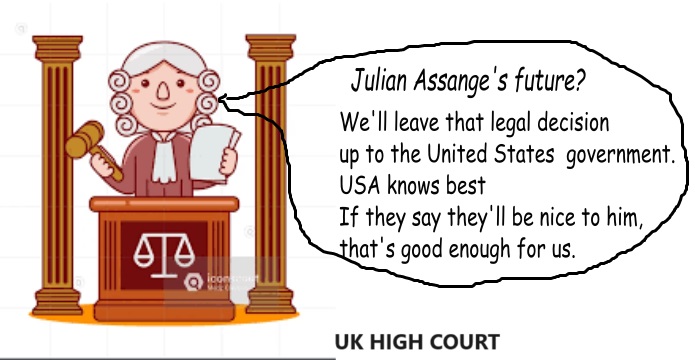
The WikiLeaks publisher could be extradited if the US gives “satisfactory assurances” of rights and no death penalty.
By Marjorie Cohn , TRUTHOUT 29 Mar 24, https://truthout.org/articles/uk-gives-biden-opportunity-to-dodge-assange-appeal-by-assuring-his-rights/
WikiLeaks publisher Julian Assange is closer than ever to being extradited to the United States for trial on 17 counts under the Espionage Act and one count of conspiracy to commit computer intrusion over WikiLeaks’s 2010-2011 revelation of evidence of U.S. war crimes in Iraq, Afghanistan and Guantánamo Bay. He faces 175 years in prison.
“This is a signal to all of you that if you expose the interests that are driving war they will come after you, they will put you in prison and they will try to kill you,” said Stella Assange, Julian’s wife, of his prosecution.
On March 26, the United Kingdom Divisional Court denied Assange the opportunity to make most of his appellate arguments. But the two-judge panel of Justice Jeremy Johnson and Dame Victoria Sharp left open the possibility that Assange could appeal on three grounds. They found that Assange “has a real prospect of success” on the following issues: If extradited to the U.S., he will be denied the right to freedom of expression, will suffer discrimination because he’s not a U.S. citizen and could be sentenced to death.
Rather than simply allowing Assange to argue the three issues on appeal, however, the panel gave the Biden administration an out. If the U.S. provides the court with “satisfactory assurances” that Assange won’t be denied any of these rights, his extradition to the U.S. can proceed without an appeals hearing.
Stella Assange called the decision “astounding,” adding, “The court’s recognized that Julian has been exposed to flagrant denial of his freedom of expression rights, that he is being discriminated against on the basis of his nationality and that he remains exposed to the death penalty.”
At an earlier stage in this case, the U.S. gave the U.K. High Court “assurances” that Assange would be treated humanely if extradited. That caused the court to reverse the magistrate judge’s denial of extradition (which was based on the likelihood of suicide if Assange is held in harsh conditions of confinement in the U.S.). The High Court accepted those assurances at face value in spite of the U.S.’s history of reneging on similar assurances.
The current ruling, however, requires U.S. assurances to be “satisfactory” and the defense will have an opportunity to challenge them at a hearing.
“Mr. Assange will not, therefore, be extradited immediately,” the panel wrote, implying that if they had denied his appeal outright, the U.K. authorities would put him on a plane to the U.S. forthwith. They gave the U.S. three weeks to come forward with satisfactory assurances.
If the U.S. fails to provide any assurances, Assange will be granted a hearing on the three grounds. If the U.S. does give assurances, a hearing to decide whether they are satisfactory will occur on May 20.
“The Biden administration should not offer assurances. They should drop this shameful case that should never have been brought,” Stella Assange said.
These are the grounds the High Court will review if the U.S. fails to provide “satisfactory assurances”:
1. Extradition Would Violate Freedom of Expression Guaranteed by Article 10 of European Convention on Human Rights
Assange would argue at trial that his actions were protected by the First Amendment to the U.S. Constitution. “He contends that if he is given First Amendment rights, the prosecution will be stopped. The First Amendment is therefore of central importance to his defence,” the panel concluded.
The First Amendment provides “strong protection” to freedom of expression, similar to that provided by Article 10 of the European Convention on Human Rights, the panel noted. Article 10 (1) of the convention says, “Everyone has the right to freedom of expression. This right shall include freedom to hold opinions and to receive and impart information and ideas without interference by public authority and regardless of frontiers.”
Gordon Kromberg, assistant U.S. attorney in the Eastern District of Virginia, where Assange’s trial would be held, said the prosecution might argue at trial that “foreign nationals are not entitled to protections under the First Amendment,” the panel noted. In 2017, then-CIA Director Mike Pompeo said that Assange “has no First Amendment freedoms” because “he is not a U.S. citizen.”
In addition, the U.S. Supreme Court ruled in the 2020 case of Agency for International Development v. Alliance for Open Society International that “it is long settled as a matter of American constitutional law that foreign citizens outside United States territory do not possess rights under the US Constitution.”
The panel wrote that if Assange “is not permitted to rely on the First Amendment, then it is arguable that his extradition would be incompatible with article 10 of the Convention.”
But even if the U.S. Department of Justice prosecutors give “satisfactory assurances” that Assange’s First Amendment rights would be protected, that is no guarantee. Prosecutors are part of the executive branch, which cannot bind the judicial branch due to the constitutional doctrine of separation of powers.
“The ruling reveals that the High Court does not understand the American system of government,” Stephen Rohde, who practiced First Amendment law for almost 50 years and writes extensively about the Assange case, told Truthout. “It only has before it the executive branch of the U.S. government. Whatever ‘satisfactory assurances’ the Department of Justice may give the High Court, they are not binding on the judicial branch.”
Moreover, Rohde said, “The High Court is obligated to uphold Assange’s rights to ‘freedom of expression’ under Article 10 of the European Convention on Human Rights, which protects Assange even if the U.S. courts refuse to do so. The only way to do that is to deny extradition.”
2. The U.K. Extradition Act Forbids Discrimination Based on Nationality
Julian Assange is an Australian citizen who would be tried in the U.S. if the Biden administration’s pursuit of extradition is successful.
Section 81(b) of the U.K. Extradition Act says that extradition is barred for an individual who “might be prejudiced at his trial or punished, detained or restricted in his personal liberty by reason of his … nationality.”
Due to the centrality of the First Amendment to Assange’s defense, the panel noted, “If he is not permitted to rely on the First Amendment because of his status as a foreign national, he will thereby be prejudiced (potentially very greatly prejudiced) by reason of his nationality.”
3. Extradition Is Barred by Inadequate Death Penalty Protection Required by the Extradition Act
Section 94 of the U.K. Extradition Act says, “The Secretary of State must not order a person’s extradition … if he could be, will be or has been sentenced to death for the offence” in the receiving state. That limitation does not apply if a written “assurance” that is “adequate” says “that a sentence of death- (a) will not be imposed, or (b) will not be carried out (if imposed).”
None of the charges that Assange is currently facing carry the death penalty. But if extradited to the U.S., he could be charged with aiding and abetting treason or espionage, both of which are capital offenses.
Ben Watson KC, secretary of state for the Home Department, admitted that:
a.) The facts alleged against [Assange] could sustain a charge of aiding or abetting treason, or espionage.
b.) If [Assange] is extradited, there is nothing to prevent a charge of aiding or abetting treason, or a charge of espionage, from being added to the indictment.
c.) The death penalty is available on conviction for aiding or abetting treason, or espionage.
d.) There are no arrangements in place to prevent the imposition of the death penalty.
e.) The existing assurance does not explicitly prevent the imposition of the death.
The panel noted that when former President Donald Trump was asked about WikiLeaks publishing the leaked documents, he said, “I think it was disgraceful…. I think there should be like a death penalty or something.” If Trump is reelected, he may seek to ensure that his Justice Department adds capital charges to the indictment.
In concluding that Assange could raise this issue on appeal subject to “satisfactory assurances,” the panel cited “the potential, on the facts, for capital charges to be laid; the calls for the imposition of the death penalty by leading politicians and other public figures; the fact that the Treaty does not preclude extradition for death penalty charges, and the fact that the existing assurance does not explicitly cover the death penalty.”
Appeal Grounds Denied by Panel
Remaining grounds for appeal that Assange requested were denied by the panel. They include prosecution for a political offense, prosecution based on political opinion; violation of right to a fair trial; violation of right to life; and violation of right to be free from torture and inhuman or degrading treatment or punishment. In addition, since no publisher has ever been prosecuted under the Espionage Act for publishing government secrets, Assange could not have known it was a crime.
The panel also ruled that Assange could not introduce new evidence adduced after the magistrate judge’s ruling. This includes a Yahoo News report detailing the CIA’s plan to kidnap and kill Assange when he was living under a grant of asylum in the Ecuadorian Embassy in London.
If the U.S. offers “satisfactory assurances” and extradition is ordered, Assange could appeal to the European Court of Human Rights and raise these additional issues as well.
Meanwhile, there is a possibility that instead of filing “assurances,” the Biden administration will opt to avoid the political pitfalls of Assange’s extradition to the U.S. and offer a plea bargain to end the case.
Marjorie Cohn is professor emerita at Thomas Jefferson School of Law, former president of the National Lawyers Guild, and a member of the national advisory boards of Assange Defense and Veterans For Peace, and the bureau of the International Association of Democratic Lawyers. She is founding dean of the People’s Academy of International Law and the U.S. representative to the continental advisory council of the Association of American Jurists. Her books include Drones and Targeted Killing: Legal, Moral and Geopolitical Issues.
British nuclear site Sellafield to be prosecuted for cybersecurity failures
Alexander Martin, March 29th, 2024, https://therecord.media/sellafield-site-prosecution-nuclear-facility-cybersecurity
The United Kingdom’s independent nuclear safety regulator has announced that it will be prosecuting the company managing the Sellafield nuclear site over “alleged information technology security offenses during a four year period between 2019 and early 2023.”
It is not clear whether senior managers at the state-owned Sellafield Ltd. will face charges. Under the Nuclear Industries Security Regulations 2003, individuals convicted of an offense can face up to two years imprisonment.
“There is no suggestion that public safety has been compromised as a result of these issues,” the regulator announced on Thursday, adding that the decision to begin legal proceedings followed an investigation.
“Details of the first court hearing will be announced when available,” stated the ONR.
Sellafield had previously been the focus of enhanced regulatory attention over its cybersecurity failings, as the U.K. chief nuclear inspector’s annual report revealed last year. At the same time, EDF, the company operating several nuclear power plants in Britain, was placed under similar measures.
As set out in the U.K.’s civil nuclear cybersecurity strategy, the National Cyber Security Centre (NCSC) threat assessment warns that ransomware “almost certainly represents the most likely disruptive threat.”
A ransomware attack on the IT systems used by a nuclear power plant could disrupt its operations, although the industrial systems are designed with multiple failsafes to prevent a radiological accident.
Sellafield’s nuclear reactor was closed in 2003, but the sprawling complex remains the largest nuclear site in Europe, with the ONR describing it as “one of the most complex and hazardous nuclear sites in the world.”
It houses more plutonium — in particular the isotopes created as a byproduct of nuclear reactor operations — than any other location on the planet, alongside a range of facilities for nuclear decommissioning, and waste processing and storage.
It was the location of the country’s worst-ever nuclear accident in 1957, when a reactor caught fire leading to radioactive material spreading in the atmosphere across Britain and Europe.
Cyberattacks targeting the operational technology (OT) systems at power plants are rare, but not unheard of — with the Triton malware discovered in Saudi Arabia in 2017 among the best known and most concerning examples.
It is not known whether the suspected Russian actors behind that attack could have engineered a method to overcome the failsafe mechanisms preventing an explosion.
According to the British government’s National Risk Register, a cyberattack on the computer systems controlling a nuclear reactor could potentially require a controlled shutdown as a protective measure, although there is not a major concern about them causing any radiological discharge.
As Sellafield no longer has an operational nuclear reactor, it is not clear what damage a cyber incident at the facility could cause.
UK’s ever more expensive nuclear submarines will torpedo spending plans for years to come.

Jasper Jolly and Alex Lawson, https://www.theguardian.com/business/2024/mar/31/uks-ever-more-expensive-nuclear-submarines-will-torpedo-spending-plans-for-years-to-come
Whoever wins the next election, a reckoning is overdue on the costs of Britain’s nuclear deterrent.
When Rishi Sunak visited Barrow-in-Furness on Monday he said the Cumbrian town was “mission critical for our country” because of its role building four new nuclear submarines to carry the UK’s nuclear weapons. If you believe Sunak’s erstwhile ally, Dominic Cummings, then that mission faces serious problems.
Cummings, once Boris Johnson’s most powerful adviser, said this month – in characteristically aggressive terms – that spiralling costs were making a mockery of the government’s budget plans. He wrote on X: “the nuclear enterprise is so fkd [sic] it’s further cannibalising the broken budgets and will for decades because it’s been highly classified to avoid MPs thinking about it.”
But the scale of the issue makes it hard to ignore. The government reiterated last week that the four new Dreadnought class submarines would cost £31bn plus a £10bn “contingency”. But the Nuclear Information Service (NIS), a monitoring group, said in 2019 that the full cost of the nuclear weapons programme between 2019 and 2070 could be £172bn, when including new warheads and running costs.
Costs are also increasing rapidly, as the government has prioritised replacing the existing Vanguard submarines on time rather than on budget. (The Vanguard boats launch Trident nuclear missiles – like the one that crashed into the sea during a test last month.)
The Ministry of Defence puts the cost of the programme to replace the UK’s nuclear weapons at £118bn over the next decade. That is already £8bn more than the Treasury has forecast, suggesting something may have to give elsewhere.
The National Audit Office, a government watchdog, found in December that forecasts of costs of the MoD’s Defence Nuclear Organisation had risen by £38.2bn in the past year.
However it is counted, hugely costly delays and overruns, plus inflation, mean a reckoning is overdue on the costs of Britain’s nuclear submarines.
“They don’t have very many good options,” said David Cullen, director of the NIS. He said the problems appeared so intractable that it could affect the UK’s continuous at-sea deterrence – the longstanding policy of always having a nuclear-armed submarine gliding silently under the waves in case of attack.
“It would be much better for them to make a conscious decision to stop having constant patrols, rather than having it forced on them,” he said.
Nuclear submarines are among the most complicated machines ever built. They sustain 132 humans deep beneath the oceans, needing to surface only when its crew runs out of food – or runs out of patience during months without daylight.
The Labour party, eyeing power in an imminent election, has a decision over whether to confront the problem head-on – and add billions to already constrained budgets – or to continue with the sticking-plaster approach.
One thing Labour has said it will not do – to the chagrin of campaigners particularly aligned with the left of the party – is accept the UK’s diminished role in world affairs by scrapping the nuclear deterrent. David Lammy and John Healey, shadow foreign secretary and defence secretary respectively, wrote in September that “with Keir Starmer, our commitment to Nato and the UK’s nuclear deterrent – maintained on behalf of Nato allies – is unshakeable”.
Some in the defence industry believe Labour could, if elected, choose to launch an inquiry into the entire nuclear defence enterprise – which might allow it to blame the current government and help ease the blow from a big hit to its budget. However, a Labour source said the lack of visibility into classified plans meant it was not yet able to work out a detailed strategy.
One way to help government finances might be to share costs. Under the new – and increasingly controversial – Aukus alliance, Australia will receive nuclear weapons technology from the UK (with the blessing of the US, which originally bestowed the city-destroying abilities on Britain).
The Aukus programme is split into two “pillars”. Pillar one is centred on helping Australia acquire conventionally armed, nuclear-powered submarines. The second part is more techy, focusing on speeding up cooperation of specific technologies – including artificial intelligence, cyber work, quantum computing and hypersonic weapons.)
In 2022, the second pillar of the pact was extended to allow the trilateral partners to develop hypersonic weapons in response to Russia’s use of the deadly high-speed missiles in airstrikes in Ukraine.
The French defence giant Thales, a supplier of sonar and light-sensing masts, is expected to pick up work as the “eyes and ears” of the submarines. Its UK boss, Alex Cresswell, told the Observer: “Pillar one of Aukus is a once-in-a-generation event that is extremely significant for the industry as a whole. I recruit graduates on the basis of it.”
Cresswell adds: “The rate of the submarine part is being driven by the design work on the submarine after Dreadnought … that early design work is being placed now and we’re involved in it.”
Yet it is unlikely that Aukus will help to fill the Dreadnought black hole. Immediate manufacturing problems appear to be the problem there, which will not be helped by the promise of future work for submarines built after Dreadnought, according to NIS’s Cullen.
Meg Hillier, a Labour MP who heads the public accounts committee, said that budgets have been blown because of the government’s “stop/start approach to defence procurement” and “a lot of optimism bias” in plans. She said the nuclear submarine budget is one of the “big nasties” lying in wait for a future government. It is an ominous threat lurking under the surface for the next prime minister.
TODAY. The nuclear lobby’s new “prime wheeze” – Community Interest Companies
The UK, famous for comedy, had a great character, Bertie Wooster, who kept thinking up wonderful (useless and silly) new ideas, that he called “Prime Wheezes”. In true Bertie Wooster tradition, the nuclear lobby does the same.
They usually go for “registered charities” – and there’s any number of these, that the industry creates, really nuclear front groups, that pose as genuinely working for the public good.
So why is the nuclear lobby now going for the non-profit Community Interest Companies (CICs)?
Some of the reasons:
- The nuclear industry can get approval and respectability, “piggy-back” on a lot of genuinely positive and popular businesses in an existing CIC.
- The CIC business model can incorporate a wider range of social aims than are allowed for charities. This is because the definition of community interest within the test applied to a CIC is broader than the Public Benefit Test for charities.
- easier to set up than is a charity..
- murkiness of funding – relatively easy from private donors, grants or community development finance
- can more easily buy and sell commercially.
- It is a lightweight structure, it is unencumbered by bureaucracy. It can be set up in a couple of days
- it is like a standard profit-making company then, but with social objectives supposedly built in.
- it avoids the accountability mechanisms that charities have, e.g a CIC can have just one director. It does have a (poorly funded) government regulator, Office of the Regulator of Community Interest Companies, but there appears to be no pro-active monitoring of whether CICs are operating for community benefit.
- Directors and functioning can change overtime, not encumbered by rules that ensure its social aims. The directors of a CIC can pay themselves whatever they can argue could reasonably be seen as necessary.
- any money in the organisation can very easily be siphoned out to profit-making enterprises.
- No legal requirement to have a democratic structure
In Somerset UK, where there is community anxiety about the development of Hinkley Point C nuclear station, and its effect on the environment – what better prime wheeze for the nuclear lobby, than to join an existing reputable Community Interest Company?
Hinkley Point C, has teamed up with the CIC Passion for Somerset. as a principal partner.
1 This Month

of the week – Shut Down Drone Warfare!


Tell the Ukrainian Government to Drop Prosecution of Peace Activist Yurii Sheliazhenko

Petition to revoke the licensing of the Near Surface Nuclear Disposal Facility (NSDF) at Chalk River. https://www.ourcommons.ca/petitions/en/Petition/Details?Petition=e-7247
To see nuclear-related stories in greater depth and intensity – go to https://nuclearinformation.wordpress.com
-
Archives
- April 2026 (114)
- March 2026 (251)
- February 2026 (268)
- January 2026 (308)
- December 2025 (358)
- November 2025 (359)
- October 2025 (376)
- September 2025 (257)
- August 2025 (319)
- July 2025 (230)
- June 2025 (348)
- May 2025 (261)
-
Categories
- 1
- 1 NUCLEAR ISSUES
- business and costs
- climate change
- culture and arts
- ENERGY
- environment
- health
- history
- indigenous issues
- Legal
- marketing of nuclear
- media
- opposition to nuclear
- PERSONAL STORIES
- politics
- politics international
- Religion and ethics
- safety
- secrets,lies and civil liberties
- spinbuster
- technology
- Uranium
- wastes
- weapons and war
- Women
- 2 WORLD
- ACTION
- AFRICA
- Atrocities
- AUSTRALIA
- Christina's notes
- Christina's themes
- culture and arts
- Events
- Fuk 2022
- Fuk 2023
- Fukushima 2017
- Fukushima 2018
- fukushima 2019
- Fukushima 2020
- Fukushima 2021
- general
- global warming
- Humour (God we need it)
- Nuclear
- RARE EARTHS
- Reference
- resources – print
- Resources -audiovicual
- Weekly Newsletter
- World
- World Nuclear
- YouTube
-
RSS
Entries RSS
Comments RSS
 nuclear-news