Rolls-Royce scales back plans to build nuclear factories in UK
Rolls-Royce has scaled back plans to build two new factories for its small modular reactor (SMR) programme in the UK, following delays to a government design competition.
The FTSE 100 company had originally proposed one factory to make heavy pressure vessels for its SMRs and another to make the building blocks of the reactors.
It had drawn up a final shortlist of locations for the pressure vessels factory, including the International Advanced Manufacturing Park on the outskirts of Sunderland, Teesworks in Redcar and the Gateway industrial park in Deeside, Wales.
But on Friday Rolls confirmed it no longer intends to proceed with that plan because there is no longer time to build the factory and make the first pressure vessels for the early 2030s, when it hopes to complete its first SMRs.
It is still proceeding with work to build the second factory, however.
The company had been waiting for the outcome of an ongoing SMR design competition in the UK – first announced by the Government in 2015 – before it made a decision on the pressure vessel plant.
But that competition has been repeatedly delayed, with the arms length body Great British Nuclear only formally created last summer and winners not due to be announced until this June at the earliest.
Instead the engineering giant will now buy its heavy pressure vessels from a third party supplier.
The large, metal components sit at the heart of nuclear reactors and must be able to withstand extremely high temperatures and pressures. They are only made by a select group of companies, partly due to the need for specialist welding techniques.
Among their number is now Sheffield Forgemasters, which was nationalised by the Ministry of Defence in 2021.
Earlier this month, Sheffield became the sole UK company to gain the qualifications needed to make SMR reactor vessel components.
Despite having shelved its plans for a heavy pressure vessel factory, Rolls is still pressing ahead with plans to build its second factory, which will build the modular units that make up its SMRs.
It is understood that sites shortlisted for the pressure vessel factory will also be contenders for the second plant but no decisions have been made.
On Friday, a spokesman for Rolls-Royce SMR confirmed the company had now “prioritised work on our modules assembly and test facility”, adding: “Our efforts are focused on identifying the best site to support our deployment at pace.”
The company has also not ruled out reviving its plan for a heavy pressure vessel factory at some point in the future, so long as it manages to build up a healthy pipeline of orders.
A Government spokesman said: “Our world leading SMR competition aims to be the fastest of its kind, helping secure billions in investment for the UK, meaning cleaner, cheaper and more secure energy in the long-term.”
Rolls-Royce scales back plans to build nuclear factories in UK
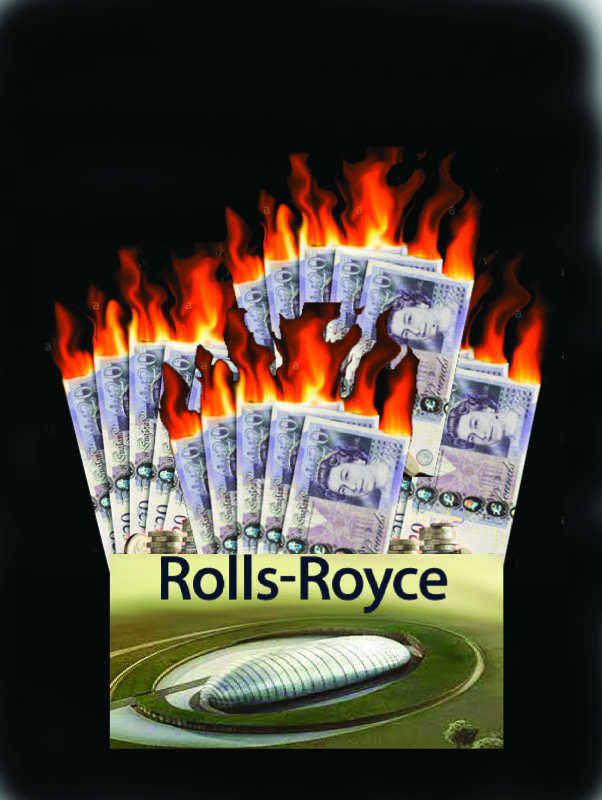
Curtailing comes after repeated delays to an ongoing government design competition
Rolls-Royce has scaled back plans to build two new factories for its small
modular reactor (SMR) programme in the UK, following delays to a government
design competition. The FTSE 100 company had originally proposed one
factory to make heavy pressure vessels for its SMRs and another to make the
building blocks of the reactors.
It had drawn up a final shortlist of
locations for the pressure vessels factory, including the International
Advanced Manufacturing Park on the outskirts of Sunderland, Teesworks in
Redcar and the Gateway industrial park in Deeside, Wales.
But on Friday Rolls confirmed it no longer intends to proceed with that plan because
there is no longer time to build the factory and make the first pressure
vessels for the early 2030s, when it hopes to complete its first SMRs.
It is still proceeding with work to build the second factory, however. The
company had been waiting for the outcome of an ongoing SMR design
competition in the UK – first announced by the Government in 2015 –
before it made a decision on the pressure vessel plant.
But that competition has been repeatedly delayed, with the arms-length body Great
British Nuclear only formally created last summer and winners not due to be
announced until this June at the earliest. Instead the engineering giant
will now buy its heavy pressure vessels from a third party supplier. The
large, metal components sit at the heart of nuclear reactors and must be
able to withstand extremely high temperatures and pressures. They are only
made by a select group of companies, partly due to the need for specialist
welding techniques.
Rolls is still pressing ahead with plans to build its
second factory, which will build the modular units that make up its SMRs.
It is understood that sites shortlisted for the pressure vessel factory
will also be contenders for the second plant but no decisions have been
made.
Telegraph 27th April 2024
https://www.telegraph.co.uk/business/2024/04/27/rolls-royce-plans-build-smr-water-vessel-factory-uk
Dounreay & Scottish Nuclear Policy
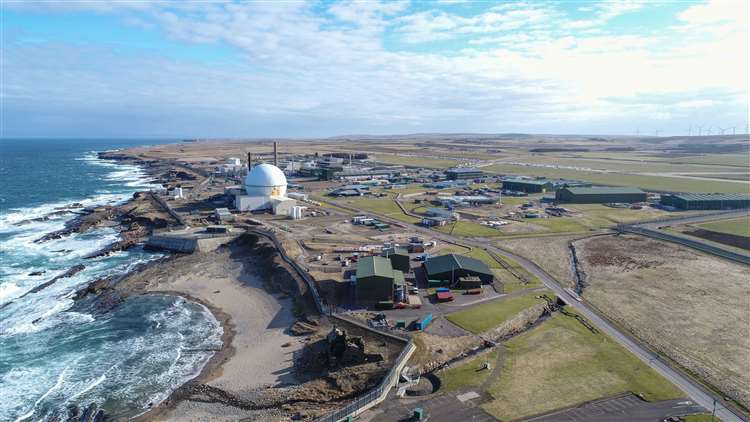
Allan Dorans , SNP MP for Ayr, Carrick and Cumnock:
Workers at the Dounreay nuclear power complex on Scotland’s north coast plan strike action
next month which will further delay the decommissioning of a plant which
started operating in 1955.
The Prospect, Unite and GMB unions are all
involved. The GMB, the main union for nuclear energy workers, champions
alongside Scottish Labour proposals for new nuclear power stations in
Scotland, despite widespread public opposition to them. The union also
helps to fund Labour candidates.
While it is always disturbing to hear of
industrial conflict at a nuclear plant, these strikes will in reality,
relatively speaking, make little difference to the decommissioning process.
Why? Decommissioning began in 2019 and the plan envisages taking 50-60
years to complete.
But “complete” doesn’t mean the same to the company
responsible for the clean-up and demolition of Dounreay, Magnox Ltd, what
it means to most of us, and the site will be under surveillance – ie, not
usable – for at least 300 years. Leaving aside for the moment the appalling
financial costs of nuclear decommissioning, rarely mentioned in Scottish
Labour’s campaign material, what about the costs for the local people and
the environment over the last nearly 70 years?
There have been three
significant accidents and countless smaller ones. On May 10, 1977, a
65-metre (213ft) deep shaft at the plant was packed with radioactive waste
with at least 2 kg of sodium and potassium. Seawater flooded in and
reacted violently with the sodium and potassium, blowing the huge steel and
concrete lids off the shaft. The explosion littered the area with
radioactive particles, with around 150 of these being found on the beach in
the following 20 years.
This was, according to the New Statesman in 1995,
the worst nuclear accident ever in the UK. Dounreay was never prosecuted.
Researchers based at Oxford University, reporting – conveniently for some
political forces – in July 2014 revisited earlier studies of the incidence
of leukaemia around Sellafield and Dounreay and concluded that children,
teenagers and young adults currently living close to the facilities were
not at an increased risk of developing cancers.
The researchers, who were
dependent upon UK Government grants for their survival, downplayed two
earlier studies that found a raised risk of leukaemia among 0 to
14-year-olds and 15- to 24-year-olds living within 12.5km of Dounreay
during the period 1979-84. A subsequent study in 1996 reported an excess of
childhood leukaemia and Non-Hodgkin’s Lymphoma (NHL) within 25 km of
Dounreay for the period 1968-93. The researchers do not tell us just how
many cases, how many more children and young adults than expected, had
developed these often-deadly cancers, but 1287 cases near seven nuclear
sites in Scotland were looked at in the second study.
Around Dounreay,
almost twice as many cases as expected were found. The difference was
greatest around Dounreay. If we share the 1287 cases among the seven sites,
we get around 180 cases near Dounreay, of which half or might not have
occurred if the plant had never been built. To, me that’s “significant”
and I feel sure it was for those young people and their families. With
every passing month, it becomes clearer that Scottish Labour must
reconsider their plans for a nuclear Scotland.
The National 29th April 2024
Rolls-Royce pulls plug on UK nuclear factory plans
Rolls-Royce has reportedly downscaled its ambitions to construct nuclear factories in the UK, citing delays in a government design competition for its small modular reactor programme
Dimitris Mavrokefalidis, 04/29/2024, https://www.energylivenews.com/2024/04/29/rolls-royce-pulls-plug-on-uk-nuclear-factory-plans/
Rolls-Royce has reportedly revised its plans to construct nuclear factories in the UK, citing ongoing delays in a government design competition for its small modular reactor (SMR) programme.
Initially proposing two factories, the company has decided to forgo building a pressure vessel manufacturing facility due to time constraints, opting instead to procure heavy pressure vessels from third-party suppliers.
While plans for a second factory focused on building modular units for SMRs continue, the decision highlights the challenges posed by the delayed design competition.
Rolls-Royce has indicated the possibility of revisiting its plans for a pressure vessel factory in the future, depending on the establishment of a robust order pipeline.
A Department of Energy Security and Net Zero spokesperson told Energy Live News: “Our world leading SMR competition aims to be the fastest of its kind, helping secure billions in investment for the UK, meaning cleaner, cheaper and more secure energy in the long term.
“We’ve ended the stop-start approach to nuclear and recently launched a roadmap setting out the biggest expansion of the sector in 70 years, simplifying regulation and shortening the process for building new power stations.
We have already launched the tender phase and Great British Nuclear aims to announce successful bidders by the end of 2024.”
Energy Live News has contacted Rolls-Royce for comment.
Alarm over nuclear safety lapses on the Clyde
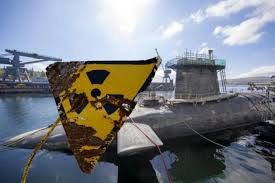
The Ferret Rob Edwards, April 28, 2024
The number of safety incidents that could have leaked radiation at the Trident nuclear base on the Clyde has risen to the highest in 15 years, according to information released by the Ministry of Defence (MoD).
One incident in 2023 at the Faslane base, near Helensburgh, was given the MoD’s worst risk rating. This is the first time this has happened since 2008.
Another four incidents at the base in 2023, and one in 2024, were given the second worst rating. The number in 2023 was the highest since 2006.
According to the MoD’s definitions, all six incidents had “actual or potential for radioactive release to the environment”. In total the MoD logged 179 nuclear safety incidents on the Clyde in 2023 and 2024, though most of them were deemed to be less serious.
The MoD insisted that there had been no “radiological impact” or harm to health from any of the incidents. But it declined to provide any further details for national security reasons.
Campaigners described the rise in serious safety incidents as “alarming” and “chilling”. They condemned the secrecy surrounding the incidents, and called for the MoD to give a “full account” of what happened.
The MoD has released new figures to MPs summarising the number of “nuclear site events” in 2023 and 2024 at Faslane and the nearby nuclear bomb store at Coulport.
A total of 158 incidents of all kinds were recorded for 2023, plus 21 so far in 2024. All but six of the incidents were in three less serious categories, suggesting they posed lower risks.
According to the MoD, the incidents included “equipment failures, human error, procedural failings, documentation shortcoming or near-misses”. But it gave no further descriptions of any of the six more serious incidents.
One incident at Faslane in 2023 was rated as “category A”, the highest risk rating used by the MoD. It has defined such incidents as having an “actual or high potential for radioactive release to the environment” in breach of safety limits.
The last category A incident reported by the MoD was in 2008 when radioactive waste leaked from a barge at Faslane into the Clyde. There were also spillages from nuclear submarines at the base in 2007 and 2006.
The MoD’s figures disclosed four “category B” incidents at Faslane in 2023. This is the highest number of such incidents at the site since 2006, when there were five.
There was another category B incident at Faslane in the first four months of 2024, as well as two in 2022 and three in 2021. The MoD has defined such incidents as having an “actual or high potential for a contained release”, or an “actual or potential for radioactive release to the environment” below safety limits.
Nuclear weapons infrastructure ‘dangerously rotting’

“If you watch media followup, you’ll see NO reporting on the substance, e.g the fact that our nuclear weapons infrastructure is dangerously rotting & is tens of billions secretly in the hole, with huge knockon effects beyond its destructive effects on MoD which has got *even worse* & *even more lying* during the war.
The entire puerile election debate will be based on fake budget numbers that will then be given to Starmer on above-STRAP3 yellow paper, with him given the same nudge to classify, punt and lie. Nobody will report on all this & MPs will continue to ignore it...Dominic Cummins, Substack 31 Dec 2023
The latest figures were released in response to a parliamentary question by the SNP MP for Edinburgh North and Leith, Deidre Brock. In previous questions, she has obtained information on nuclear safety events at Faslane and Coulport back to 2006.
“My annual questions to UK ministers have exposed steadily declining nuclear safety standards at Faslane and Coulport, but the increase in the severity of incidents last year is particularly alarming,” she told The Ferret.
“Reports detailing these incidents should be made public again so that people of Scotland – including those who live near the bases – can weigh up for themselves the risks created by the storage of these nuclear warheads.”
She accused the MoD of “playing down” the safety breaches, pointing out that in December 2023 the former Prime Minister Boris Johnson’s senior advisor, Dominic Cummins, described the UK’s nuclear weapons infrastructure as “dangerously rotting”.
Brock said she would be submitting further parliamentary questions asking for details of the more serious incidents in 2023 and 2024. “But it shouldn’t take the digging of individual MPs or journalists to get piecemeal bits of information from the MoD,” she argued.
The Scottish Campaign for Nuclear Disarmament branded the category A incident at Faslane as “chilling”. The UK’s nuclear weapons were a “catastrophe in waiting”, said the campaign chair, Lynn Jamieson.
She accused the UK government of wanting to suppress “bad news” about nuclear weapons.
The Nuclear Information Service, which researches and criticises nuclear weapons, called for the MoD to give a “full account” of what happened. “This is very concerning, and shows there are clearly problems with safety standards at Faslane,” said the service’s director, David Cullen.
He pointed out that there had been another “serious workplace safety failure” on a Trident submarine at Faslane in August 2021. The UK Office for Nuclear Regulation issued an improvement notice after an “electrical overload”………………………………………………… https://theferret.scot/nuclear-safety-lapses-clyde-alarm/
UK troops could be sent into Gaza to help with aid deliveries
Suggestion comes after US announces none of its own troops would be sent to the enclave
Middle East Eye, By MEE staff, 27 April 2024
British troops could be deployed in Gaza to assist with aid deliveries, after the US said it would not be sending any of its own ground forces.
The US previously said a “third party” would be responsible for driving trucks along a floating causeway onto the beach, a role the BBC has learned could be filled by British forces.
The BBC on Saturday quoted Whitehall as saying no decision had yet been made and that the issue had not yet been raised with Prime Minister Rishi Sunak.
US President Joe Biden first announced the plans for a floating pier in Gaza to deliver aid in March.
The US said it would coordinate the security of the temporary pier with Israel and that the temporary port would increase the amount of humanitarian assistance to Palestinians in the war-battered enclave by “hundreds of additional truckloads” per day.
A British defence source told AFP that a UK ship to house hundreds of US army personnel building the pier had set sail from Cyprus.
According to the Pentagon, Royal Navy support ship Cardigan Bay will help to support the international effort to construct the pier, which is set to be completed in May…………………………………………. https://www.middleeasteye.net/news/uk-troops-could-be-sent-gaza-help-aid-deliveries
Chernobyl – the Cloud Lingers On
CHERNOBYL – THE FACTS
- The total radioactively released from Chernobyl was 20 times that of the combined releases of the Hiroshima and Nagasaki atomic bombs.
- At least 9 million people have been directly affected by the accident
- Over 160,000 square kilometres of land were contaminated with 42,000 squarekilometres rendered unusable.
- At least 400,000 people were forced to leave their homes in Russia, Ukraine and Belarus.
- Analysis concluded that the former Soviet Union would have been better off financially if it had never begun building nuclear reactors.
- It is estimated that the total cost of compensation paid to UK farmers is over £12 million.
- The Chernobyl disaster has caused a massive increase in thyroid cancers in the three most affected countries of Belarus, Russia and Ukraine.
- The sarcophagus built to contain the damaged reactor was supposed to last 30 years but some 300 yards of cracks and holes are already evident.
- In Ukraine, two million children live in contaminated areas with 900,000 still living in high-risk zones.
- The stricken reactor will remain radioactive for about 10,000 years.
BY MARIANNEWILDART, https://mariannewildart.wordpress.com/2024/04/26/chernobyl-the-cloud-lingers-on/
38th Anniversary of Chernobyl
Today is the 38th Anniversary of the ongoing Chernobyl nuclear disaster. A huge steel and concrete sarcophagus covers the site of the meltdown. Under its dome, called the New Safe Confinement, lie 200 tons of lava-like nuclear fuel, 30 tons of highly contaminated dust and 16 tons of uranium and plutonium that continue to release high levels of radiation. There is a rather odd link with the Russian state nuclear body Rosatom and Cumbria. Until recently Rosatom shared the same PR company as West Cumbria Mining – New Century Media. The coal mine plans have an uncanny resemblance to the Chernobyl sarcophagus
The damage from Chernobyl is ongoing, snowballing down through the generations with tenacious charities such as Chernobyl Children’s Project (UK) and Chernobyl Childern International doing their utmost to support those whose lives continue to be damaged.
Here we re-publish “The Cloud Lingers On”
a hard hitting article from 1996…in non other than Cumbria Life.
The lifestyle magazine, Cumbria Life, is not where you would expect to find a hard- hitting article on Chernobyl and the nuclear industry. But that is exactly what was published in this Cumbrian coffee table magazine in 1996. ….
(the article is in the public domain but not online – any mistakes in transcript are mine)
Ten years ago a cloud washed over the Cumbrian fells, coating the grass, trees, heather, bracken and rocks with a film of radiation. It came from Chernobyl, a ruptured nuclear reactor in the Ukraine, several thousand miles away. Early, confident predictions that the heavy Cumbrian rain, that brought down the radioactive Caesium in the first place would now wash it from the uplands, were quietly buried. No amount of rain was every going to wash away the poison from Chernobyl. Award winning environmental writer Alan Air reports.
At the height of the Cold War, the superpowers hid behind the perverted logic of the military defence acronym MAD – Mutually Assured Destruction – to shore up a global arms industry worth billions of pounds. We pointed our nuclear warheads at them. They pointed their nuclear warheads at us. Would they dare unleash their missiles? Would we dare unleash our missiles? All that awful tension.
Cumbria at first glance a global backwater of lakes, dry stone walls and back packing ramblers, seemed remote from the world stage but it played a part in the divide between West and East; Sellafield’s nuclear complex, the Broughton Moor arms depot, Anthorn’s submarine tracking station and even the Chapelcross nuclear plant just across the Solway Firth were all key components in the UK’s military and nuclear defence strategy.
Britain’s post-war civil atomic power programme was inextricably interwoven with its nuclear defence objectives; no British Government Minister wanted to enter the nuclear conference chamber naked.
Thankfully, Eastern Bloc missiles never did scream over Saddleback or the back o’ Skiddaw but in the spring of 1986, before the Soviet Union started to implode, Cumbrians felt the heat of Cold War politics on its back when an experiment at the Lenin nuclear plant at Chernobyl, in the Ukraine went wrong and Number 4 reactor exploded and threw up over Europe.
Spiralling weather patterns spread the atomic debris to dozens of countries in different time zones, heavy rain brought the radiation down on our county’s mountain tops and the alarms went berserk at Sellafield evoking a home-grown nuclear nightmare, the Windscale fire of ’57 that contaminated large parts of Cumbria and northern England. Chernobyl was nothing if not ironic.
Ten years later and Chernobyl – the noun is now instantly synonymous with the world’s worst nuclear disaster – is now in the hands of a ‘democratic’ Ukraine, but the perilous state of the infamous Number 4 reactor continues to cause concern among the international community. The cracking concrete sarcophagus, hastily erected around the molten core by nuclear workers a the stricken plant, many of whom later died from the radiation, is already crumbling and radioactive water is pouring from the site. Unless a new containment chamber is constructed, and much of the cash would have to come from a kitty topped up by the rich industrial nations of the West, then Chernobyl 2 – The Sequel, is not just a possibility but a probability, warns Janine Allis-Smith of the campaign group Cumbrians Opposed to a Radioactive Environment (CORE).
“Chernobyl proved that you can never, ever guard against human error, someone doing something stupid. Whatever nuclear experts say about the design of the Chernobyl reactor it was human error that triggered the explosion. It is bound to happen again,” she predicts.
In the weeks, months and years after Chernobyl, hundreds of Cumbrian hill farmers faced restrictions on the movement, and sale for meat, of radioactive-contaminated sheep. Initial Government estimates about the time it would take for dangerous radiation to leave the animals were constantly revised upwards as the main components of Chernobyl fallout, Caesium 137 and Caesium 134, persisted in dangerous amounts in the beasts’ tissues.
Early, confident predictions that the heavy Cumbrian rain that brought down the Caesium in the first place, would now wash it from the uplands were quietly buried.
It took scientists at the Merlewood Research Station at Grange over Sands in south Cumbria, to uncover some very down to earth truths about the persistence of cancer causing Caesium in the Cumbrian hills. The irony of the scientific explanation wasn’t lost on the county’s loose alliance of anti-nuclear and ‘green’ campaigners forever kicking up a stink about nuclear waste reprocessing at Sellafield.
It was all to do with recycling.
In the nutrient poor uplands of the Lake District, native grasses and heathers survive by carefully safeguarding what minerals are available. Elements – which in 1986 including Caesium – are taken up by the roots and then circulated to the succulent shoot tips during the growing season. However, they are not lost when the plant sheds its leaves in the Autumn. Instead they are sucked back into the woody, permanent tissues, to be stored for re-use in the Spring. By another quirk of nature, Caesium was readily absorbed by Cumbrian hill vegetation because of a lack of potassium in the upland soil.
Scientists discovered that plants in potassium deficient areas have a Caesium take up rate that is 12 times greater than those plants growing in potassium rich soil. Even more bizarrely, many of Cumbria’s hillside plants enjoy ‘symbiotic’ relationships with ‘mycorrhizal fungi’ – tiny plants that survive by assisting the host plant to take up minerals. In the case of Cumbrian heather, these fungi helped move Caesium from the roots to the shoot tips on which the sheep fed. Even the lack of clay in our upland soil, a material that binds Caesium and hinders root absorption meant that vegetation could easily access this radioactive ion.
No amount of rain was ever going to wash away the poison from Chernobyl.
Sheep feeding on hillside vegetation took in Caesium with every mouthful. For Ennerdale sheep farmer, John Hinde, who has a 1,500 strong flock at Low Moor End, the Chernobyl fallout meant nine stressful years of working within Government restrictions and monitoring. He has survived but recalls: “For a time it looked as if there wasn’t going to be any sheep left on the fells.”
Ten years on and only a dozen or so farms in Cumbria are regulated by movement restrictions compared to nearly 400 in Wales. That would appear to be good news for our farmers, and the mutton-eating consumer. Janine Allis-Smith of CORE isn’t so sure that radiation levels on the fells have declined quite so dramatically as the Government would have us believe, and she suggests that the de-restrictions are rooted in political pragmatism.
“It is interesting that the only area where this massive de-restriction has taken place is the Lake District. It is obviously important that Cumbrian and the whole tourist area is seen to be okay. I think a lot of Cumbrian farmers had their eyes opened when it was discovered that only 50% of the radiation on the hills came from Chernobyl. Some of the stuff was there long before May 1986” she says.
Indeed, scientists confirmed that radioactive contamination of the fells was not confined to Chernobyl but that much of it came from global nuclear bomb testing, the Windscale Fire of 1957 and routine discharges from Windscale, now Sellafield, in the 1960s and 1970s. Allis-Smith cites an aerial survey revealed the Ravenglass Estuary was contaminated by radioactive discharges from Sellafield long before Chernobyl dumped on us.
“If radiation was like confetti, the whole bloody Lake District would be like a wedding cake.” She suggests.
Cumbrian hill farmer’s daughter Jill Perry is equally suspicious of recent de-restrictions in the Lake District,
“The hill farm where I was born and brought up was one of those where milk had to be destroyed after the 1957 Windscale fire and one which, 29 years later, was placed under Chernobyl restrictions and has recently been exempted>” she explains.
“I think most farmers originally thought the Chernobyl testing was just a formality and were surprised and dismayed when they were placed under restriction, and equally wonder why restrictions have been lifted more quickly than those in Wales, where the number of restricted farms seems to fall much more slowly.”
Mrs Perry who now acts as the spokesman for West Cumbrian Friends of the Earth group, sees no point in differentiating between Windscale ’57 and Chernobyl ’86.
“What these two incidents show most graphically is that whether a nuclear accident happens locally or in another country, the radiation recognises no international borders and that we cannot afford to take lightly the risks brought about by human error in a high tech industry.”
The greatest irony of Chernobyl may yet lie ahead. British Nuclear Fuels, the company that now runs Sellafield in West Cumbria (and which has polluted areas of the UK coastline with its radioactive discharges) is now spreading tentacles around the globe. Selling its decontamination services to a tainted world. No-one can rule out experts from Sellafield, the plant that spawned the world’s first ‘civil’ nuclear disaster in 1957 and whose alarms bells rung out loud and clear when the Chernobyl could went over, will not, in the future, ret-trace the path of the Chernobyl radiation plume and venture into the plant’s exclusion zone.
Bridget Woodman, an anti nuclear campaigner with Greenpeace believes that Chernobyl taught Cumbrians about the universal nature of the nuclear power threat.
“When the Chernobyl explosion first appeared on the news bulletins, most Cumbrians probably never envisaged that it would impact directly on them. Yet within a few days, people were watching the skies apprehensively. Cumbrians may have become blasé about Sellafield on their own doorstep but Chernobyl proved that a nuclear disaster can affect them even if its happening thousands of miles away. There is no guarantee of safety. Chernobyl proved there is no escape.
“And while many of the restrictions on sheep movements in Cumbria have now been lifted, we should remember that there is no safe dose of radiation. No-one knows what the legacy of Chernobyl fallout will be on existing and future generations of Cumbrians.
RED GROUSEThe Red Grouse has escaped media attention but its almost exclusive diet of succulent heather shoots means that many birds will have concentrated Caesium in their bodies post Chernobyl. Work prior to the Chernobyl disaster established that the heather family, Ericaceae, could accumulate high concentrations of Caesium. Since then, surveys in the Lake District have revealed that one species of heather, calluna vulgaris, accumulates the highest Caesium burden.
CHERNOBYL – THE FACTS
- The total radioactively released from Chernobyl was 20 times that of the combined releases of the Hiroshima and Nagasaki atomic bombs.
- At least 9 million people have been directly affected by the accident
- Over 160,000 square kilometres of land were contaminated with 42,000 squarekilometres rendered unusable.
- At least 400,000 people were forced to leave their homes in Russia, Ukraine and Belarus.
Analysis concluded that the former Soviet Union would have been better off financially if it had never begun building nuclear reactors.- It is estimated that the total cost of compensation paid to UK farmers is over £12 million.
- The Chernobyl disaster has caused a massive increase in thyroid cancers in the three most affected countries of Belarus, Russia and Ukraine.
- The sarcophagus built to contain the damaged reactor was supposed to last 30 years but some 300 yards of cracks and holes are already evident.
- In Ukraine, two million children live in contaminated areas with 900,000 still living in high-risk zones.
- The stricken reactor will remain radioactive for about 10,000 years. ENDS
Pontins Pakefield holiday park to close to public from 2025
An end of era looks set to be marked at a seaside holiday park that has
attracted hundreds of thousands of guests over the past 70 years. Sizewell
C is set to take over the whole of Pontins Pakefield Holiday Village in
Lowestoft from January next year.
This means that the site is set to close
to the public from early 2025 – as it provides accommodation for “about 500
workers” who will be constructing the Sizewell C nuclear power station.
After Sizewell C reached a rental agreement with Pontins Pakefield this
week – which will deliver a “considerable refurbishment” of the site and “a
long-term legacy for the area”, Sizewell C said construction workers would
be housed at the site from January 2025.
East Anglian Daily Times 26th April 2024
https://www.eadt.co.uk/news/24278600.pontins-pakefield-holiday-park-close-public-2025
The former rail chief now minding the (construction) gap at Sizewell.
The former rail chief now minding the (construction) gap at Sizewell. Rob
Holden, chairman of the Suffolk nuclear plant, says the increasing time
between the start of construction at Hinkley Point and spades in the ground
at Sizewell is a worry.
The delays and swelling cost of building Hinkley
Point C, Britain’s first new nuclear power plant in more than two
decades, may not necessarily be a bad omen for its sister station.
According to Rob Holden, the non-executive chairman of Sizewell C, “good
projects start well and get better, bad projects start badly and get worse.
While Sizewell is a replication, technically, of Hinkley, it is a very
different project.”
Thus far Hinkley Point is running up to £28 billion
over budget and is six years past its initial deadline. That has spurred
speculation that Sizewell could be beset by the same troubles. Holden, who
has led the Sizewell C board since the end of 2022, disagrees. The power
plant, which is due to be built on the Suffolk coast, has an “as-built
design”, which should mean far fewer changes than its predecessor to the
west and less time and money lost. Its developers know the quantities of
kit needed and have already been making efforts to procure it.
Nevertheless, for Holden, a widening gap between the start of construction
at Hinkley Point and spades in the ground at Sizewell is a worry. The
project is owned 50-50 by EDF and the government, but they are hoping to
bring in private investment. A final investment decision is slated for
before the end of the year. “What I do know now is that we can’t afford
to allow the time gap to be more than what it currently is between the two
projects, otherwise we will lose the replication benefits.”
Times 26th April 2024
How much will the UK’s new nuclear submarines really cost?
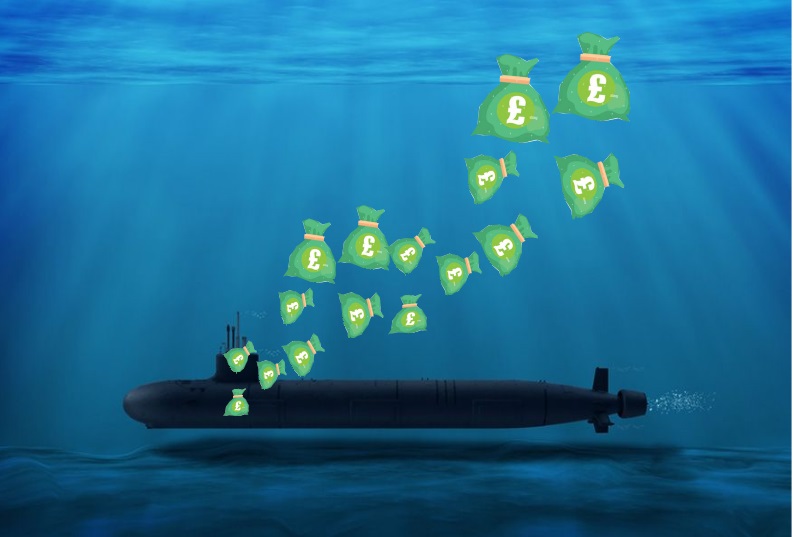
The terrible truth is that nobody knows how much this will cost
25th April
What does it cost, and how many jobs does it actually create? This is
especially important now with the next generation of nuclear-powered
submarines, the “Dreadnought” class, starting construction.
When the UK Government announced the programme to replace the current Valiant class
boats, the cost they announced in Parliament, £31 billion, was to build
four submarines.
This is as disingenuous as announcing the cost of a
revamped NHS as the cost to build four hospitals. The total cost of
ownership over the projected 30-year lifespan is much larger.
We have reached a figure of over £600bn. Shocking? Indeed. Surprising? Compared to
what, the HS2 rail link? The terrible truth is that nobody knows how much
this will cost. The annual report of the government’s own
“Infrastructure and Projects” authority has a lot of bad news,
including a “red” score for the development of the Dreadnought boats’
new engines. In short, this means it can’t be done. Sounds expensive.
The National 25th April 2024
https://www.thenational.scot/politics/24277002.much-will-uks-new-nuclear-submarines-really-cost
Scottish National Party and UK Government in row over cost of nuclear dumping grounds
The SNP has claimed that Scotland could be saddled with a bill of over £22 billion as part of Westminster’s cleanup of nuclear dumping grounds.
By Andrew Quinn, Westminster Reporter, 23 Apr 24, https://www.dailyrecord.co.uk/news/politics/snp-uk-government-row-over-32644089
A row has broken out between the SNP and the UK Government over how much Scotland will pay on radioactive waste.
The SNP has claimed that Scotland could be saddled with a bill of over £22 billion as part of Westminster’s cleanup of nuclear dumping grounds.
But the UK Government has said that the figure is actually much lower.
Radioactive waste is an issue which is devolved to the Scottish Parliament.
The party said this would mean Scotland could be made to pay £22,618,000,000 in total as it contributes 8.6 per cent of the UK’s tax revenue.
This would work out to £22,000,000 every year for a century.
But the UK Government has dismissed these claims, saying that the Nuclear Decommissioning Authority’s annual statement from last year put future costs at £124bn across the UK.
It also said that calculating the amount that Scotland would pay by its tax share was wrong.
Scotland has three nuclear power stations which are currently being decommissioned. England and Wales have 14 sites.
SNP MP Martin Docherty-Hughes said the money should be spent on public services.
He said: “Westminster’s obsession with nuclear energy and weapons neither benefits nor helps ordinary Scots, and yet they’re expected to fork out tens of millions every year for a century to pay for the cleanup of radioactive materials.
“While the Tories have lined up funding for the cleanup of material that shouldn’t have been used anyway, public services have been decimated, and a cost of living crisis that has seen energy bills go through the roof has hammered households.
“Conventional military spending has been recklessly slashed as global tensions rise, with the Tories instead focussing obscene amounts of cash on disposing of nuclear materials from weapons of mass destruction we should never, and will never, use.
“And in prioritising expensive nuclear energy they’ve even refused to support efforts to save jobs and future proof Scotland’s already established and thriving energy sector by matching the SNP Scottish Government’s £500 million funding for a Just Transition.
“The list of projects and causes Scotland’s £22 billion could be better spent on is endless, but as ever Westminster’s spending priorities are askew and based around making Scotland pay for things Scots neither want nor need.
“Hospitals, doctors, nurses, teachers, police officers, members of the armed forces – none of this is a priority for Westminster who’d rather spend billions on unnecessary nuclear projects. Scotland could do far better with independence and focus spending on areas that would actually benefit the people who live and work here. Only a vote for the SNP can secure representatives who will fight Scotland’s corner and stand up for our unique needs and interests.”
The UK Government was approached for comment
Scotland could be hit ‘with £22bn nuclear clean-up bill’.
SCOTLAND could be saddled with a bill of more than £22 billion as part of
Westminster’s clean up of nuclear dumping grounds over the next century,
the SNP have said. Official estimates published by the UK Government last
November estimated total clean-up costs for sites which contained disposed
nuclear material from weapons programmes and energy generation could come
to £263bn over the next 100 years.
This means Scotland, which contributes
8.6% of the UK’s tax revenue, could be made to pay £22,618,000,000 in
total, working out to £22m every year for a century. The SNP’s defence
spokesperson Martin Docherty-Hughes criticised how conventional military
spending had been “recklessly slashed” while the Tories focus cash on
disposing nuclear materials from weapons of mass destruction.
The National 23rd April 2024
https://www.thenational.scot/news/24272520.scotland-hit-with-22bn-nuclear-clean-up-bill
Former Sellafield consultant claims the nuclear complex tampered with evidence
Whistleblower Alison McDermott claims former employer Sellafield tampered with metadata in letters used in evidence during an employment tribunal.
Tommy Greene, Bill Goodwin, Computer Weekly, 22 Apr 24
A former consultant at Sellafield has claimed that metadata in letters used against her in a tribunal hearing by the nuclear facility has been interfered with.
A tribunal has heard that three letters produced by managers at the vast nuclear complex and submitted as evidence in the employment dispute were “fabricated” and “tampered with”.
Alison McDermott lost a whistleblowing claim against the Cumbrian nuclear facility and is now fighting a demand to pay £40,000 costs.
The former Sellafield consultant said the metadata for one of the three letters was “wiped” by legal representatives for Sellafield.
She formally withdrew the allegations in her first employment tribunal claim against the nuclear complex.
The 2021 tribunal judgment determined that the letters were not “fabrications”.
“These letters are not fabrications, as had previously been asserted by the Claimant,” it found.
However, the ex-contractor raised her claims about the letters’ production and of alleged tampering during last week’s tribunal when defending herself from allegations she had acted “unreasonably” in the legal action with Sellafield and a regulatory body.
Sellafield maintains that McDermott’s allegations are “untrue”.
McDermott, a human resources (HR) consultant, signed a two-day-a-week contract with Sellafield worth £1,500 per day and was tasked in 2018 with looking at an employee’s sexual harassment allegations.
But within days of submitting a report that found the HR team was viewed as “broken and dysfunctional” by some staff, her contract was ended.
She has contested cost awards as a litigant-in-person during a one-day hearing in Leeds.
Summarising her arguments, tribunal judge Stuart Robertson said McDermott had suggested that the three letters used against her by Sellafield during the employment case over the termination of her contract were “fabricated and not genuine”.
Deshpal Panesar KC, who represented Sellafield at the tribunal, accused McDermott of “making baseless claims of the most damaging sort – representing an existential threat to the careers of multiple public servants”.
Panesar said McDermott had accused Sellafield and its regulatory body, the Nuclear Decommissioning Authority (NDA), of “illicit conduct, fabrication of evidence and false representations” when making her case.
McDermott sought to challenge cost awards made against her, amounting to £40,000, in a previous tribunal decision.
The employment tribunal claim she brought against Sellafield in 2021 was unsuccessful. But an appeal judge found aspects of her case “troubling” and she was subsequently recognised as a whistleblower under UK employment law.
Robertson, a new tribunal judge, is now considering whether McDermott’s claims and conduct have been “unreasonable”.
McDermott claims she suffered a number of detriments when her contract was terminated. She has since spoken out publicly against Sellafield, branding its workplace culture as “toxic”.
Sellafield and the NDA have contested the claims robustly, initially arguing McDermott’s work was ended for “financial reasons” and later as a result of her “poor” performance.
Suspicious of the letters
The three letters have been a central point of contention in McDermott’s court battle.
The Information Commissioner’s Office ruled in early 2021 that Sellafield had acted unlawfully, having broken data laws and committed security breaches for, among other things, failing to supply McDermott with the letters after she had made a data subject access request.
Sellafield subsequently used the critical letters against McDermott in the employment tribunal case she brought over the termination of her contract.
McDermott told Thursday’s tribunal that the letters had caused her “significant detriment”………………………………………………………………………………………………………………………………………… more https://www.computerweekly.com/news/366581793/Former-Sellafield-consultant-claims-the-nuclear-complex-tampered-with-evidence
Nuclear test campaigner demands access to medical files

By Andrea Ormsby, BBC News, 23 Apr 24
A campaigner from Devon is suing the government over missing medical records belonging to veterans exposed to radiation more than 70 years ago.
Susan Musselwhite’s father, Derek, was one of 22,000 servicemen who took part in nuclear tests in the 1950 and 1960s.
Ms Musselwhite said access to missing medical files would help veterans and descendants who said their health had suffered as a result of the trials.
The Ministry of Defence (MoD) said no information was withheld from veterans.
Ms Musselwhite, 44, from Paignton, is part of a group of former military personnel and their families who have sent a letter before action on the MoD, formally warning of a potential court claim, and handed a petition into Downing Street in March 2024.
Ms Musselwhite said: “What these men witnessed you only see in movies. But they witnessed it, they lived it; they know the deadliest weapon ever created.”
The group is calling for the government to create a special tribunal to oversee compensation.
Personnel from all three armed forces took part in Cold War nuclear weapons trials between 1952 and 1967 in Australia and the South Pacific.
Susan Musselwhite said the government “sent their men as cannon fodder and those men deserve to be recognised for what they did”, including her Royal Navy diver father.
Like many of the veterans’ children and grandchildren, Ms Musselwhite said she was struggling with serious health issues.
Campaigners say they are currently unable to access their records or parts are missing or incomplete because the samples have been reclassified as “scientific data” and placed at the MoD’s Atomic Weapons Establishment research facility.
MoD sources previously told the BBC that archives at the facility have been searched and do not contain the medical records in question.
Ms Musselwhite said missing medical records of blood and urine tests taken by the military during the trials could provide vital information…………………………….. more https://www.bbc.com/news/uk-england-devon-68883809
Nuclear waste storage facility told to take action after breach
Federica Bedendo,BBC News North East and Cumbria, 20 Apr 24, https://www.bbc.com/news/articles/c88zjl0l8j9o
A nuclear waste storage facility has been told to take action, after it breached its environmental permit.
The Environment Agency (EA) has written to bosses at the Low Level Waste Repository (LLWR) in Cumbria with concerns about a delay in securing waste at the site.
Nuclear Waste Services (NWS), which manages LLWR, said the delays did not have an impact on the surrounding area and that they had taken the time to ensure the right solutions were created for the safe disposal of nuclear waste.
The EA said it could not comment on the matter due to impartiality rules during election periods.
The letter, written by the EA in January, and obtained by the BBC through a Freedom of Information request, sets out new conditions that LLWR must comply with.
It comes after LLWR failed to make sufficient progress on operations to secure the radioactive waste – known as capping – meaning it breached the terms of its environmental permit.
Missed deadline
Martin Walkingshaw, chief operating officer at NWS, said: “Placing the engineered cap over the legacy radioactive waste disposal facilities at the UK’s LLWR is a first of its kind activity for the UK.”
He said Nuclear Waste Services were engaged with the Environment Agency on a regular basis about progress.
He added: “Capping is a key part of the disposal, and we are currently implementing the required design by procuring, importing and emplacing thousands of tonnes of capping materials in line with our planning conditions and stringent quality requirements.”
In their letter, the Environment Agency also told LLWR it had failed to meet a deadline for a previously imposed improvement condition, regarding a request for a written plan to protect waste in certain areas, including capping one of them.
While the plan was delivered, there were delays in implementing it.
An initial date of completion of 2028 had been agreed with the EA, but discussions are now under way to extend the deadline as LLWR believes more time is needed.
NWS has blamed delays on issues with the design of the engineered cap.
“Throughout the design phase a number of assumptions were tested, as is common practice. Not all of these assumptions held true, and one in particular, caused a significant change in design.”
1 This Month

of the week – Shut Down Drone Warfare!


Tell the Ukrainian Government to Drop Prosecution of Peace Activist Yurii Sheliazhenko

Petition to revoke the licensing of the Near Surface Nuclear Disposal Facility (NSDF) at Chalk River. https://www.ourcommons.ca/petitions/en/Petition/Details?Petition=e-7247
To see nuclear-related stories in greater depth and intensity – go to https://nuclearinformation.wordpress.com
-
Archives
- April 2026 (114)
- March 2026 (251)
- February 2026 (268)
- January 2026 (308)
- December 2025 (358)
- November 2025 (359)
- October 2025 (376)
- September 2025 (257)
- August 2025 (319)
- July 2025 (230)
- June 2025 (348)
- May 2025 (261)
-
Categories
- 1
- 1 NUCLEAR ISSUES
- business and costs
- climate change
- culture and arts
- ENERGY
- environment
- health
- history
- indigenous issues
- Legal
- marketing of nuclear
- media
- opposition to nuclear
- PERSONAL STORIES
- politics
- politics international
- Religion and ethics
- safety
- secrets,lies and civil liberties
- spinbuster
- technology
- Uranium
- wastes
- weapons and war
- Women
- 2 WORLD
- ACTION
- AFRICA
- Atrocities
- AUSTRALIA
- Christina's notes
- Christina's themes
- culture and arts
- Events
- Fuk 2022
- Fuk 2023
- Fukushima 2017
- Fukushima 2018
- fukushima 2019
- Fukushima 2020
- Fukushima 2021
- general
- global warming
- Humour (God we need it)
- Nuclear
- RARE EARTHS
- Reference
- resources – print
- Resources -audiovicual
- Weekly Newsletter
- World
- World Nuclear
- YouTube
-
RSS
Entries RSS
Comments RSS
 nuclear-news