Scotland’s First Minister Swinney condemns Jack’s menacing idea for nuclear plant in Scotland

The First Minister was clear that the Scottish Government will not back the construction of such a facility north of the border.
John Swinney has insisted the Scottish Government will have “nothing to do” with a suggested new nuclear power station – as he hit out at the “menacing” behaviour of the Scottish Secretary.
The First Minister reacted angrily after Alister Jack revealed he has instructed UK ministers to start planning work for a nuclear plant in Scotland.
It comes despite the longstanding opposition from the SNP to the construction of such facilities north of the border.
Jack told a Lords committee on Wednesday he believes there will be a “unionist regime again in Holyrood” in 2026, and with the SNP out of power it will be possible to “move forward” with the construction plan.
Speaking about the prospect of a small nuclear reactor, Jack said he has asked the UK energy minister to “plan for one in Scotland”.
But Swinney told MSPs on Thursday that Jack has “made no mention of this proposal to the Scottish Government” – which has powers over planning north of the border.
The First Minister added: “This is utterly and completely incompatible with good intergovernmental working and is illustrative of the damaging behaviour, the menacing behaviour, of the Secretary of State for Scotland.”
He was asked about Jack’s comments by SNP backbencher Rona Mackay, who noted the UK minister’s suggestion came despite “opposition from the democratically-elected Scottish Government” to new nuclear power.
Speaking at First Minister’s Questions, Swinney was clear: “The Scottish Government will not support new nuclear power stations in Scotland.”
He said his Government instead supports investment in “the renewable energy potential in Scotland”, adding “massive investments” in this sector could “bring jobs and opportunities to the Highlands and islands and deliver green, clean energy for the people of Scotland”.
Swinney said: “That’s the policy agenda of this Government and we will have nothing to do with nuclear power.”
Welsh Nuclear Free Local Authorities welcome Traws abandonment from New Nuclear plans
https://www.nuclearpolicy.info/news/welsh-nflas-welcome-traws-abandonment-from-new-nuclear-plans/
The Welsh Nuclear Free Local Authorities Forum hope that the decision made by Great British Nuclear to temporarily postpone plans for new nuclear at Trawsfynydd at this time might become a permanent one.
In March, responding to the UK Government consultation on the siting of new nuclear plants after 2025, the Welsh NFLAs said that the Trawsfynydd site was wholly inappropriate for redevelopment as it lies within the beautiful Eryri National Park. Ministers have previously agreed that any Geological Disposal Facility will not be in the Lake District National Park, and the NFLAs have called for this principal to be applied as a blanket ban on new nuclear plants in National Parks, at World Heritage Sites and in Areas of Outstanding Natural Beauty.
Great British Nuclear has just announced that the site ‘may not be able to deploy quite as quickly as some other sites’, with reports that site was too small and lacked sufficient cooling water to support the deployment of so-called Small Modular Reactors for the foreseeable future.
Trawsfynydd had an operating Magnox nuclear reactor on site until 1991. It was unique in being inland and cooled by the water of an artificial lake, but it is also a brutalist eyesore standing out stark and ugly against the idyllic backdrop of mountains and forest. The plant is now being dismantled by the Nuclear Decommissioning Authority, a British taxpayer funded body responsible for decommissioning redundant nuclear plant and for managing Britain’s radioactive waste inventory.
To the NFLAs, locating a new nuclear power plant in any National Park would be entirely incompatible with the Sandford Principal. From 1971 until 1974, Lord Sandford chaired a committee which examined the future management of National Parks in England and Wales:
‘National Park Authorities can do much to reconcile public enjoyment with the preservation of natural beauty by good planning and management and the main emphasis must continue to be on this approach wherever possible. But even so, there will be situations where the two purposes are irreconcilable… Where this happens, priority must be given to the conservation of natural beauty’.
We want to see the old Trawsfynydd plant decommissioned, and the site cleared and landscaped, as soon as practicable. n our view, any proposed new medical isotope facility would be better located at Bangor University, which has an established academic nuclear faculty and has much better transport links. The activities of the Welsh taxpayer funded Cwmni Egino, which was established to pursue new nuclear at the site, are entirely at variance with the stated ambition of the Welsh Government to source the nation’s domestically consumed electricity from truly ‘green’ sources. The body should be abolished, and its resources used to support the development of Welsh renewable energy projects.
Top Labour donor joins campaign to stop Hinkley nuclear plant

Government wasting billions of taxpayers’ money on power station, warns Dale Vince
Jonathan Leake 16 May 2024
Millionaire Labour donor Dale Vince has joined a campaign to block
Britain’s biggest nuclear power station project. The entrepreneur, who
founded green energy company Ecotricity, has emerged as a patron to Stop
Hinkley after accusing the Government of wasting billions of pounds.
He said the decision to use taxpayer money to fund Hinkley Point C, which is
under construction in Somerset, was flawed because nuclear technology is
“hugely expensive and slow to develop”. His comments will be sure to
raise questions for Ed Miliband, Labour’s shadow energy secretary, who
has vowed to invest in nuclear energy.
The Opposition has accepted around
£1.5m in donations over the past decade from Mr Vince, who severed ties
with Just Stop Oil last year as part of his commitment to Labour. A
spokesman for Stop Hinkley said: “At a time when nuclear power is rapidly
losing ground to the astonishing growth in renewables, it’s great to have
someone onboard who founded a company which allows ordinary members of the
public to actually vote on the nuclear question with their electricity
bill.”
Telegraph 16th May 2024
https://www.telegraph.co.uk/business/2024/05/16/top-labour-donor-joins-campaign-stop-hinkley/
Pension funds need ‘compelling’ returns from UK nuclear projects to invest
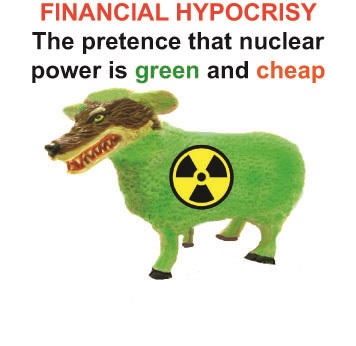
Ft. com 17 May 24
Potential investors tell Jeremy Hunt regulatory clarity also essential before backing new power plants.
Local authority pension funds managing hundreds of billions of pounds have told UK chancellor Jeremy Hunt that returns from new nuclear power plants need to be “compelling” to attract their cash. The chancellor is looking to pension funds to help finance the government’s ambition for nuclear power to meet a quarter of the UK’s electricity needs by 2050. Several town hall pension funds, managing more than £100bn in assets between them, were called to a meeting with Hunt this week, where the role of large retirement plans as potential investors in the Sizewell C nuclear project in Suffolk was discussed.
The head of the Sizewell C project spoke at the meeting, according to sources close to those who attended. London CIV, which manages £17bn of pension assets for local authorities in the capital and attended the meeting, outlined the criteria needed for it to invest. “Any infrastructure solution, including nuclear power, will need to provide regulatory clarity, a solid business model and a compelling inflation-linked return stream,” said London CIV. “This is ultimately about what our partner funds need. As they are our shareholders, we’ll collaborate with them to identify whether this area is worth exploring.”
Laura Chappell, chief executive of the Brunel Pension Partnership, which manages about £35bn in assets for eight local authority pension funds, attended the meeting and with other funds offered views to Hunt on the “problems, pitfalls and potential of investing in nuclear in the UK”. “Any infrastructure solution, including nuclear power, will need to provide regulatory clarity,” said Chappell in a statement to the FT. Chappell echoed that potential infrastructure projects would need to have a “solid business model, consistent policy, and a compelling investment proposition”. The pitch to pension funds comes against a backdrop of high-profile challenges for the nuclear sector in the UK.
France’s EDF said in January that the Hinkley Point C 3.2GW nuclear plant it is building in Somerset was on course to cost up to £46bn in today’s prices and would be delayed by two more years to 2029 — compared with an initial budget of £18bn and completion by 2025.
………………………………………………. Hunt’s meeting with pension leaders came more than a year after the government flagged its intention to consult on reforms that would make nuclear a more attractive investment for UK pension funds.
However, the government is yet to consult on these reforms, which would pave the way for nuclear power to be classified as “environmentally sustainable” under the UK’s upcoming “green taxonomy”
The Treasury declined to comment on the pension meeting, including who attended, but said: “We want to incentivise private investment in nuclear as a crucial source of reliable low-carbon energy and a driver of economic growth.
“We have already begun to engage with industry on the topic and will consult on a UK green taxonomy in due course.” The meeting was held in the same week ministers showed signs of losing patience with pension funds over low levels of investment in domestic listed and unlisted markets. In a speech this week, Bim Afolami, City minister, said “We have a challenge with pension funds.” He said if there was “no improvement” in levels of investment in the UK by pension funds then the government would “consider what further action can be taken”. https://www.ft.com/content/70cd278f-8ef5-4904-9535-305fe1095768
Nuclear Free Local Authorities welcome commitment to recruit new Theddlethorpe GDF Community Partnership Chair at less cost who is local

After a prolonged period of paid tenure, the Interim Chair of the Theddlethorpe GDF Community Partnership is finally making way for a successor – and the Nuclear Free Local Authorities have welcomed the commitments made to appoint a local person to the post at a significantly lower cost to the taxpayer.
Jon Collins has acted as Chair since being appointed by Nuclear Waste Services at the inception of the Theddlethorpe GDF Working Party. Mr Collins is the former leader of Nottingham City Council without strong roots within the Theddlethorpe Search Area. The NFLAs have been especially critical of the renumeration package attached to the post, which initially comprised a payment of £1,000 a day for two days per week, since reduced to £750. This day rate is many times higher than the average salary received in the local community.
Now the Community Partnership is recruiting a candidate for the ‘challenging but rewarding role’ to manage the meetings and business of the partnership. Although the NFLAs reject the hyperbole that the GDF represents the ‘biggest environmental protection project of our lifetime’, creditably the advertisement states that members of the partnership ‘have expressed a preference to recruit a Chair who lives or works in the Search Area’ and that renumeration has now been reduced to a more modest annual honorarium of £10,000.
By contrast, in West Cumbria, both Community Partnership Chairs have always been local Councillors and worked solely for expenses rather than salary.
With the Theddlethorpe Community Partnership now moving to public meetings, the appointment of a new independent and impartial Chair at this time will be a welcome move, but it remains to be seen whether a local person is in fact appointed to the role or if the appointee will ‘act independently and not represent either themselves or any organisation of which they are a member’.
The advert also states that the Independent Chair must ensure ‘the work of the Partnership is fair, unbiased and reflects the needs of the community’. This must pose the appointee with a dilemma for clearly the local community does not share the belief of Nuclear Waste Services that the GDF represents the ‘biggest environmental protection project of our lifetime’.
By contrast, in West Cumbria, both Community Partnership Chairs have always been local Councillors and worked solely for expenses rather than salary.
With the Theddlethorpe Community Partnership now moving to public meetings, the appointment of a new independent and impartial Chair at this time will be a welcome move, but it remains to be seen whether a local person is in fact appointed to the role or if the appointee will ‘act independently and not represent either themselves or any organisation of which they are a member’.
The advert also states that the Independent Chair must ensure ‘the work of the Partnership is fair, unbiased and reflects the needs of the community’. This must pose the appointee with a dilemma for clearly the local community does not share the belief of Nuclear Waste Services that the GDF represents the ‘biggest environmental protection project of our lifetime’.
The last thing that Scotland needs is new nuclear power, small or otherwise
Pete Roche, Edinburgh,
The last thing that Scotland needs is new nuclear power, small or otherwise. (Scotsman Editorial 16th May 2024). It is perfectly feasible to supply 100 per cent of Scotland’s energy (not just electricity) from renewable sources. In fact, a recent study [1] by renowned energy modelling academics at the LUT University in Finland, showed that not only is a 100 per cent renewable energy mix feasible for the whole UK but it would save well over £100 billion in achieving net zero by 2050, compared to the UK Government’s current strategy.
It’s true that renewable energy output is variable, and there are times when wind and solar are producing almost nothing. But there are also times when they produce too much power, and we have to pay wind to turn off. The UK could waste more than £3.5bn per year by 2030 this way.[2] The answer is flexibility, not “always on” nuclear power stations which will just end up wasting more power when renewables are plentiful.
Firstly, we need to: reduce overall demand (helping tackle fuel poverty in the process); introduce more flexibility with new smart technologies (for instance making use of demand-response aggregators like Edinburgh-based company Flexitricity), and vehicle to grid technology; build more energy storage – not just batteries, but pumped hydro storage (with several schemes in Scotland awaiting approval), gravity storage (developed in Edinburgh), compressed air storage; and thermal storage (developed in East Lothian).
These are just some of the ways we can make better use of the renewable resources we already have. Nuclear power is too slow and too inflexible and too expensive to play a role in cutting carbon emissions.
Together Against Sizewell C vows to continue fight after legal challenge rejected by Supreme Court – as the nuclear plant welcomes the news

By Ash Jones , ash.jones@iliffepublishing.co.uk, 14 May 2024 https://www.suffolknews.co.uk/southwold/sizewell-c-campaigners-vow-to-continue-fight-after-supreme-c-9365930/
Campaigners protesting against the £20 billion Sizewell C plant are determined to continue their fight after a legal challenge was rejected by the Supreme Court.
The court yesterday refused an appeal by Together Against Sizewell C (TASC) after it called for a judicial review of the plant, near Leiston.
TASC first challenged the Government’s decision to give planning permission to the station in July 2022 after it was given the go-ahead by then-business secretary Kwasi Kwarteng.
Among its claims were that the Secretary of State was wrong to grant a Development Consent Order (DCO) without first assessing the environmental impact of proposals for Sizewell C’s water supply.
In its ruling, three Supreme Court judges said the group’s latest claims did not raise an arguable point of law.
Julia Pyke, the managing director of Sizewell C, welcomed the news and said the team were glad the challenge was rejected by the court.
However, Pete Wilkinson, from TASC, said the group would seek new avenues to challenge the plant.
Mr Wilkinson described yesterday’s ruling as a ‘bit of a blow’ but said the site still needed other permits and licences.
He said it was a challenge opposing Sizewell C through the courts and the Government seemed to have decided the plant will go through regardless.
“Local opposition to the plant appears to be growing as people in the area realise the imposition it will cause,” he said.
“There are about 36 site conditions that cover the site that we’ll be able to monitor, there are no details on water supply and a many-billion pound hole in finances as well as further licences to be awarded.
There are things that lend themselves to a possible challenge to give the public a chance to review.”
This followed TASC’s case being refused by the High Court last year – the decision to approve plant was also upheld by the Court of Appeal in December.
During the High Court case, the body argued against the impacts of water supply of up to two million litres per day, which it said were never assessed and that there was no way of knowing if the environmental benefits of the plant would outweigh the costs.
In addition, no opening date for the plant could be guaranteed, campaigners said.
Ms Pyke said the team knew the majority of East Suffolk residents supported the project and looked forward to the jobs and development opportunities it would bring.
She added: “We will continue to listen closely to local communities and we are as determined as ever to ensure that Sizewell C delivers for them.”
UK government planning nuclear site in Scotland – Jack
https://www.bbc.com/news/articles/c9eze1dzy5no 15 May 24
The UK government is planning to build a new nuclear reactor in Scotland despite opposition from Holyrood, according to Scottish Secretary Alister Jack.
He told a House of Lords committee he had asked the UK energy minister to plan for such a site as part of a UK-wide strategy.
The Conservative minister also called for the Lords to be allowed to scrutinise Scottish laws.
The Scottish government has rejected calls to end an effective ban on new nuclear power stations.
The UK government has committed to developing larger-scale nuclear plants south of the border, as well as developing a new generation of smaller reactors.
Its ambitions for up to a quarter of all electricity to come from nuclear power by 2050 are being led by government-backed body Great British Nuclear body.
Mr Jack told the Lords committee: “On the small nuclear reactors, I have asked the energy minister to plan for one in Scotland.
“I believe that in 2026 we’ll see a unionist regime again in Holyrood and they will move forward with that.”
The Scottish secretary added that he did not “see any point in having a great fight over it” given the “timescales in front of us” – a likely reference to the upcoming general election.
Scotland’s last nuclear power plant – at Torness in East Lothian – is scheduled to be shut down by 2028.
Although energy policy is largely set at Westminster, the Scottish government is able to block projects it opposes as planning powers are devolved.
‘Patronising’
The Scottish Secretary went on to suggest a “grand committee” of the House of Lords should be allowed to scrutinise Holyrood legislation.
“Devolution is not a bad thing,” he told the committee. “Where it has failed is bad governance.”
Mr Jack said the Scottish Parliament’s committee structure was “not right” and that the “knowledge and wisdom” of the House of Lords could be used to help review Scottish laws.
SNP MP Tommy Sheppard said the Tory minister was “undermining and patronising our democratically-elected government”.
He added: “His comments and the decision to ignore the Scottish government on building new nuclear reactors in Scotland show exactly how this Westminster government sees Scotland and its people – a nation that should get in line and know its place.
“Scotland doesn’t need expensive nuclear power – we already have abundant natural energy resources, we just need full powers over energy so Scotland can take full advantage of the green energy gold rush.”
Nuclear power station risks hitting taxpayers with £20bn bill

Plans for a power station at Wylfa could be derailed by government rules
Telegraph, Matt Oliver, INDUSTRY EDITOR, 13 May 2024
Plans for a large nuclear power station on the Welsh island of Anglesey risk being derailed by government rules that will add an estimated £20bn to the national debt, insiders have warned.
Efforts to develop a gigawatt-scale scheme at Wylfa are on the agenda this week as Andrew Bowie, the minister for energy security, meets representatives from the South Korean state nuclear company Kepco.
The company is among several thought to be in the running to build a plant at Wylfa, with a consortium that includes US nuclear giant Westinghouse also putting forward proposals.
But one senior industry source warned there were concerns about the willingness of ministers to sign off on such a large project ahead of the general election, with the next government expected to be saddled with challenging budgetary constraints.
They blamed accounting rules which will force the British state to add the project’s full cost to the national debt, even if it only holds a minority stake in the scheme.
This is owing to the Government’s position as the ultimate guarantor if the project goes wrong.
There are fears it could put ministers off from backing a scheme at the Wylfa site, which has just been reacquired by the Government.
No decisions about the potential project have been taken yet but the scheme’s budget is widely expected to be in the region of £20bn. Britain’s debt pile is currently 98.3pc of GDP, or almost £2.7 trillion, as high interest rates push up the cost of Government borrowing.
The industry source said: “The main barrier right now is that if you build gigawatt-scale units, you have to put them on the Government balance sheet.
“Whoever is in power after the next election is going to have to grapple with that balance sheet – and are they really going to do this?
“It is something that is being looked at now.”………………….. https://www.telegraph.co.uk/business/2024/05/13/anglesey-nuclear-plant-risks-saddling-taxpayers-with-bill/
UK nuclear lobby further infiltrates universities with government grants for nuclear fusion

The United Kingdom Atomic Energy Authority (UKAEA), the UK’s national
fusion energy research and development organisation, has awarded six
organisations with £9.6 million of contracts to advance their concepts to
support fusion energy development. The contracts were awarded to three
universities and three companies focusing on digital engineering and fusion
fuel cycle developments dedicated to addressing fusion energy challenges.
The contracts range between £460,000 and £1.9m, and are funded by
UKAEA’s Fusion Industry Programme, an initiative launched in 2021 to
develop the necessary technology and skills for the future global fusion
powerplant market.
UKAEA 15th May 2024
https://www.gov.uk/government/news/ukaea-awards-96m-to-six-organisations-for-fusion-projects
EU rebuffs UK attempt to continue collaborating on nuclear fusion experiment.
EU rebuffs UK attempt to continue collaborating on nuclear fusion
experiment. Bloc tells London it will be locked out of Iter project in
France within months unless it rejoins civil atomic programme. Brussels has
told London it will be locked out of the Iter project, based in France,
within months unless it affiliates to Euratom, which it quit when it left
the bloc, according to people familiar with the matter.
The UK has asked to continue with Iter as an outside partner, an arrangement granted to
Australia. But the EU has said it must also join a Euratom research scheme,
the people said. Australia has a co-operation agreement with Euratom.
London left Euratom because it did not believe the programme provided value
for money, and stayed out when it rejoined other EU research schemes last
year. Iter is an international project to build the world’s biggest
tokamak — the reaction vessel for nuclear fusion.
After four decades of experiments the technology is still years away from proving it can generate commercially viable power, but supporters hope it will prove a viable
source of plentiful low-carbon energy.
FT 15th May 2024
https://www.ft.com/content/12cf843a-184d-4e50-8818-a57e12464276
Nuclear power and nuclear weapons – two sides of the same coin

In March 2024, Prime Minister Rishi Sunak explicitly linked nuclear weapons production capability with civil nuclear power generation development. This is because nuclear reactors are used to create tritium – the radioactive isotope of hydrogen – necessary for nuclear weapons.
The government has admitted its push for nuclear energy expansion is linked to its strategic military interests
by Peter Wilkinson, 12 May 2024, o https://eastangliabylines.co.uk/nuclear-power-and-nuclear-weapons-two-sides-of-the-same-coin/
The government’s apparent answer to climate change and Russia’s invasion of Ukraine is to triple the amount of nuclear generated electricity in the belief that it generates ‘low carbon’ electricity. But a recent admission by Prime Minister Rishi Sunak suggests there is a strong military component to what looks on the surface to be a civil matter.
The UK review of the energy sector, prompted by the invasion of Ukraine, offered a golden opportunity to address the need to drive down demand for electricity and energy more generally. This could be achieved by retrofitting insulation to the housing stock and buildings, mandating solar panel use for all new homes, investing heavily in renewables, in emerging battery technology and in decentralisation. Instead, the government has focused on a massive expansion of nuclear-generated electricity.
The dual nuclear agenda
Now the reason has finally been openly admitted. Maintaining and improving the supply chain and the knowledge and skills base in the workforce for the UK’s £100bn Trident nuclear weapons renewal programme relies on the civil nuclear sector.
While this claim has been regularly made by anti-nuclear campaigners – and just as regularly denied by minister after minister – it is now openly acknowledged. The Roadmap states quite clearly that it is important to align civil and military nuclear ambitions across government, to strengthen the interconnections between civil and military industries’ research and development, and thereby reduce costs for both the weapons and power sectors.
In March 2024, Prime Minister Rishi Sunak explicitly linked nuclear weapons production capability with civil nuclear power generation development. This is because nuclear reactors are used to create tritium – the radioactive isotope of hydrogen – necessary for nuclear weapons.
The cat which was so carefully and fraudulently hidden for decades is finally out of the bag: ministers now have to acknowledge that the civil nuclear programme owes more to maintaining weapons of mass destruction – weapons that were outlawed by the Treaty on the Prohibition of Nuclear Weapons which entered into force in January 2021 – than it has to do with salvation from the existential crisis that is climate change.
Debunking myths: the truth behind nuclear ambitions
Its brave new world aims for a nuclear sector generating upto 24 Gigawatts of electricity by 2050. That’s comparable to seven new 3.2 Gw capacity Hinkley Point Cs or Sizewell Cs or forty-eight Sizewell A-size reactors at around half a Megawatt output.
The locations for a proposed ‘mix’ of ‘gigawatt-sized reactors’ such as the European Pressurised Reactor (EPR) planned for Sizewell C, and ‘small modular’ and ‘advanced modular’ reactors (SMRs and AMRs respectively) is the subject of the government’s ‘Nuclear Road Map’.
It is, necessarily, largely a work of fiction laced with eulogies to nuclear power and liberally interspersed with admissions of hope over expectations. The truth is that Hinkley Point C is now expected to cost an eye-watering £40+bn from its original £20bn, and Sizewell C has already cost the taxpayer £2.4bn in sweeteners to the private sector.
Commercial SMRs don’t yet exist, and they are not small, unless you consider that Sizewell A falls into that category. AMRs have remained a fantasy for decades and are likely to remain so. Mention them to a nuclear regulator, and you’ll probably get a raised eyebrow in response.
Nuclear revival: promises vs reality
The Sizewell project has yet to be granted multiple construction and operating permits and licences and no final investment decision has been made. Other issues which make Sizewell C a terrible idea include:
- A multi-billion hole existing in its finances
- There is no reliable and guaranteed supply of potable water – of which an average of 2.2 million litres a day are required in the country’s most water-scarce area
- It is situated in a flood zone
- It is in an Area of Outstanding Natural Beauty
- It sits on the fastest-eroding coastline in northern Europe
- An estimated 46 hectares of woodland have already been flattened
- The Environment Agency (EA) has authorised the dumping of 1,590 tonnes of dead and dying fish back into the North Sea each year as a consequence of the Sizewell C cooling water intake (not to mention the 100s of millions of fish, fish larvae and other marine biota)
- In addition, there will be an estimated 171 million sacrificial sand goby, none of which are acknowledged by the EA.
- Radiological discharges from Sizewell C to the sea and air have contested health impacts
EDF ploughs on
The Supreme Court is still considering the merits of a judicial review appeal against the original planning approval. None of these uncertainties and deficiencies have stopped EDF devastating the areas around the development with the sanction of the local planning authority.
The tragedy is that nuclear is now a redundant technology which takes too long to come to our climate-change rescue and is not fit to be in the front-line of defence against climate change. It does not represent a plan of great urgency to meet the accelerating existential threats of climate change.
It has a rapidly narrowing window in which to contribute its electricity to the job of reducing climate change risks. When compared to renewables and conservation measures, nuclear is slow, costly and unreliable in terms of the new technology embodied in the EPR design. The Flamanville project in France, using a Sizewell EPR-type reactor, is still offline, is twelve years late and will cost four times the original budget.
The government has been in thrall to nuclear power for a long time. Perhaps with the admission of its connection to its strategic miliary goals, we can now better understand why that is. But the knowledge only deepens and entrenches the divide between the hawks and the doves.
RAF Lakenheath protest to make airbase nuclear-free zone
By Tom Cann, TomCann97, Community Report, 12 May, https://www.eadt.co.uk/news/24314379.raf-lakenheath-protest-make-airbase-nuclear-free-zone/
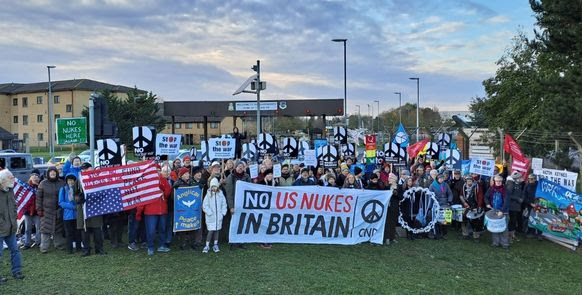
Residents and local councillors from across East Anglia came together to protest against the US plans to station nuclear weapons at an air base in Suffolk.
Protestors and activists went to RAF Lakenheath to declare the site a nuclear-free zone.
In January, it was revealed that the US was planning to put warheads three times as strong as the Hiroshima bomb at RAF Lakenheath.
They previously stationed nuclear missiles at the site but these were removed in 2008 when the Cold War threat from Moscow had receded.
The Campaign for Nuclear Disarmament (CND) lead a nationwide day of action on May 11.
A declaration was read out in front of the base, calling on the British government to work for global nuclear disarmament by refusing delivery of any US nuclear weapons and instead making Lakenheath a nuclear-free zone.
Sophie Bolt, from CND, said: “We know that US plans to deploy its nuclear bombs here at Lakenheath.
“This will not make us safer, but – on the contrary – make the world far more dangerous.
“With tensions still dangerously high between NATO and Russia, siting these weapons of mass destruction in Britain puts us all on the frontline of a nuclear war.”
Previously, an RAF Lakenheath spokesman said: “We recognise and support the right to peaceful protest as a fundamental aspect of a democratic society, however, it’s a long standing Ministry of Defence policy that we do not discuss the location or status of nuclear weapons.”
Activists plan more protests in July.
Sizewell C nuclear station ‘absolutely not inevitable’ says campaigner – Can investors be found?

The official cost of Sizewell C has been put at £20bn by the government, but many observers expect the final bill to be much higher due to increased building costs.
who would want to invest in an expensive project which will take 12 years to build, with no guarantee of a return for many more years?
Andrew Sinclair – Political editor, BBC East, Sun, 12 May 2024 https://au.news.yahoo.com/sizewell-c-absolutely-not-inevitable-091834059.html
A leading campaigner against the Sizewell C nuclear power station has said its construction is still not inevitable.
The planned energy plant, on the Suffolk coast, has just been granted its nuclear site licence.
But Alison Downes, director of campaign group Stop Sizewell C, has questioned whether the government will be able to attract enough private investment.
Ministers, who have already contributed £2.5bn to the project, have said they remain committed to the scheme.
The decision to grant Sizewell C a nuclear site licence on 7 May was described by the project team and local business groups as a “huge milestone”.
It came just months after the government granted a Development Consent Order to Sizewell C and pledged further funding to the project. Ministers have regularly referred to Sizewell C when discussing the country’s nuclear programme.
Andrew Bowie, Minister for Nuclear and Renewables, said: “Sizewell C will be the cornerstone of the UK’s clean energy transition, supplying six million homes with green energy for decades.”
But despite plenty of signs that the project could be coming closer to reality, Alison Downes insisted on BBC Politics East that “it’s absolutely not inevitable”.
“We still don’t know who is going to pay for it. The government is trying to raise funds at the moment, but there’s no guarantee it’ll be successful,” she said.
The government agreed to take a 50% stake in the development of Sizewell C after concerns about the involvement of Chinese investors and it is looking for investors to help fund the project.
Can investors be found?
The official cost of Sizewell C has been put at £20bn by the government, but many observers expect the final bill to be much higher due to increased building costs.
The prime minister told me last year that there had already been “encouraging early interest” from people wanting to invest.
But campaigners have questioned who would want to invest in an expensive project which will take 12 years to build, with no guarantee of a return for many more years.
Ms Downes, who also has concerns about the safety of the site from rising sea levels and the project’s impact on local habitats, said: “A lot of taxpayers’ money has gone into a project that has no absolute certainty of whether or not it’s going ahead.”
The argument for nuclear
But Richard Rout, the deputy leader of Suffolk County Council, told BBC Politics East that the demand for more homegrown green energy meant that Sizewell was essential.
“I think Sizewell C is now at a point where it has to happen. We need nuclear in this country to give us energy independence,” he said.
“We are now seeing Sizewell C move forward and for me [the priority now] is about minimising the impacts on the local community and maximising the benefits.”
But Alison Downes pledged to “absolutely keep fighting” .
A final decision on whether to go ahead with the project is expected to be taken by energy company EDF towards the end of 2024.
South Korean state energy monopoly in talks to build new UK nuclear plant.

Kepco has held early-stage discussions with British officials over
mothballed Wylfa site. South Korea’s state energy monopoly is in talks
with the UK government about building a new nuclear power station off the
coast of Wales, in what could be a big boost to Britain’s plans for a new
nuclear fleet.
Kepco has held early-stage discussions with British
officials about a new facility at the Wylfa site in Anglesey, and a
ministerial meeting is expected this coming week, according to people
briefed on the matter.
In his March Budget, chancellor Jeremy Hunt
announced the government would buy the mothballed site and another from
Hitachi for £160mn. In 2019, the Japanese industrial group scrapped its
plans to develop a nuclear project at Wylfa, writing off £2.1bn in the
process.
Hunt’s move was designed to facilitate a fresh deal with a new
private sector partner to build a power station at Wylfa, which could boost
the government’s plans to replace Britain’s current ageing fleet of
nuclear power stations.
A consortium including US construction group
Bechtel and US nuclear company Westinghouse has already proposed building a
new plant on the Wylfa site using Westinghouse’s AP1000 reactor
technology.
Another industry figure said Wylfa’s future would depend on a
decision by GB Nuclear, the government quango which now owns the site. GBN
could give the go-ahead for a large reactor or reactors at Wylfa or judge
that it is a suitable site for building a cluster of new “small modular
reactors”.
Supporters of SMRs claim their modular design would make them
relatively quick and cheap to build. “Wylfa is now the next priority site
for the UK so it makes sense that Kepco are interested, but they just need
GBN to make a decision soon about whether they do want a traditional
nuclear power station there,” the figure said.
One senior Korean
government official struck a cautious note about the prospect of Kepco
buying the site, saying that building nuclear power stations in the UK was
“difficult”.
FT 12th May 2024
https://www.ft.com/content/3404a203-158e-4fe1-9f5d-f5fb64032ffc
1 This Month

of the week – Shut Down Drone Warfare!


Tell the Ukrainian Government to Drop Prosecution of Peace Activist Yurii Sheliazhenko

Petition to revoke the licensing of the Near Surface Nuclear Disposal Facility (NSDF) at Chalk River. https://www.ourcommons.ca/petitions/en/Petition/Details?Petition=e-7247
To see nuclear-related stories in greater depth and intensity – go to https://nuclearinformation.wordpress.com
-
Archives
- April 2026 (114)
- March 2026 (251)
- February 2026 (268)
- January 2026 (308)
- December 2025 (358)
- November 2025 (359)
- October 2025 (376)
- September 2025 (257)
- August 2025 (319)
- July 2025 (230)
- June 2025 (348)
- May 2025 (261)
-
Categories
- 1
- 1 NUCLEAR ISSUES
- business and costs
- climate change
- culture and arts
- ENERGY
- environment
- health
- history
- indigenous issues
- Legal
- marketing of nuclear
- media
- opposition to nuclear
- PERSONAL STORIES
- politics
- politics international
- Religion and ethics
- safety
- secrets,lies and civil liberties
- spinbuster
- technology
- Uranium
- wastes
- weapons and war
- Women
- 2 WORLD
- ACTION
- AFRICA
- Atrocities
- AUSTRALIA
- Christina's notes
- Christina's themes
- culture and arts
- Events
- Fuk 2022
- Fuk 2023
- Fukushima 2017
- Fukushima 2018
- fukushima 2019
- Fukushima 2020
- Fukushima 2021
- general
- global warming
- Humour (God we need it)
- Nuclear
- RARE EARTHS
- Reference
- resources – print
- Resources -audiovicual
- Weekly Newsletter
- World
- World Nuclear
- YouTube
-
RSS
Entries RSS
Comments RSS
 nuclear-news