Sizewell C nuclear: Uncertainty surrounds final investment decision as parliamentary session shortened

New Civil Engineer 24 MAY, 2024 BY TOM PASHBY
The final investment decision (FID) for Sizewell C has been thrown into limbo by the early dissolution of parliament, with prime minister Rishi Sunak having called an election for 4 July.
Conservative politicians were caught off guard by the announcement, made at around 5pm on 22 May. This means Parliament will dissolve on Thursday 30 May.
Earlier in the day of the General Election announcement, the energy secretary Claire Coutinho issued a written statement about the proposed nuclear power station at Wylfa in north Wales where she also commented on the in-development Suffolk nuclear station, saying: “We intend to take a final investment decision on Sizewell C before the end of this Parliament.”
It can be assumed that Coutinho was unaware that the end date of the current parliament was due to be brought forward by the calling of the general election.
Nuclear minister Andrew Bowie also said earlier this month that an FID would be announced by end of this Parliament.
With Parliament now to dissolve next Thursday, the period known as ‘wash-up’ is underway where the government tries to pass a selection of remaining pieces of legislation.
The government has to date invested £2.5bn in the project in numerous tranches but intends to find private investors to cover the majority.
The government commenced the search for investment partners in the circa £20bn project last September. It said it is seeking companies with “substantial experience in the delivery of major infrastructure projects” and added “ministers will be looking for private investors who can add value to the project and will only accept private investment if it provides value for money, while bolstering energy security”.
Potential investors were required to register their interest by early October 2023 but there has been little news in the more than half a year since.
The shortening of the current parliamentary period means there is now uncertainty about whether the government will have time to make an FID.
A government source confirmed to NCE that progress continues towards FID.
The source said the government would continue to fund the project in the pre-election period using investment funds which had already been made available and said operations at the site would be business as usual in the lead-up to polling day.
If the current government does not make an FID for Sizewell C, it will fall to the next government due to be elected on 4 July to do so. If there is a hung Parliament, there may be a further delay to the formation of a new government.
A Sizewell C spokesperson said: “We are continuing to engage with investors and prepare for FID and we are moving ahead as planned on our construction site.”
However, campaign group Stop Sizewell C believes it is now impossible for a FID to be made before the General Election.
A spokesperson for the group said that this “lets the Conservatives off the hook for signing away another HS2”.
They continued: “It also presents a likely Labour government, looking to drive down bills and reach net zero by 2030, an opportunity to focus on more cost effective renewable projects.
“We are going to do everything in our power to ensure that this election signals the death knell for slow, expensive, risky Sizewell C.”
The money invested in the Sizewell C project will look to be recouped through a regulated asset base (RAB) model for funding, which would see the investors money returned through a surcharge on consumer energy bills……………………. https://www.newcivilengineer.com/latest/sizewell-c-uncertainty-surrounds-final-investment-decision-as-parliamentary-session-shortened-24-05-2024/
Hinkley C – don’t say I didn’t warn you!

It is worth remembering that while construction costs are in the £42 to £48 billion range, the 35 years of electricity at £87.50 or £92.50/MW in 2012 money, adjusted for inflation will cost UK energy users a gargantuan £111 or £116 billion over the next 35 years. Could we use that money better? You bet.
2016 was a missed opportunity, most likely the last opportunity to scrap the benighted project, one of the worst blunders in the history of public procurement and of the UK’s energy industry
In 2016, I called for Hinkley C to be scrapped. Now its commissioning has been pushed back to the end of the decade and its costs have ballooned to as much as £48 billion in 2024 money. I was right.
Thoughts of Chairman Michael , MICHAEL LIEBREICH, JAN 25, 2024
by EDF in 2017), announced a “Nuclear Renaissance” and was lobbying for a new build programme in the UK to replace aging plants set for retirement. In the absence of evidence, they claimed new plants would produce power for £24 per MWh (£39/MWh in 2024 money, or $50/MWh).
The Labour Party, long dead set against nuclear power, were convinced. In January 2008, Prime Minister Gordon Brown declared, in the preface to a White Paper on nuclear power entitled “Meeting the Energy Challenge” that “nuclear should have a role to play in the generation of electricity, alongside other low carbon technologies.” The White Paper estimated the total cost of building a 1.6GW nuclear plant at £2.8 billion – which would translate into £5.6 billion for Hinkley C’s 3.2GW (£9.0 billion or $11.5 billion in 2024 money).
EDF’s UK CEO Vincent de Rivaz was cock-a-hoop, predicting that Brits would be cooking their turkeys with power from Hinkley C by Christmas 2017. But remember that figure – £9.0 billion for 3.2GW.
By October 2013, Osborne and Davey had agreed a Contract for Difference with EDF for electricity production at a strike price of £92.50/MWh in 2012 money (£132/MWh in today’s money or $169/MWh) – rising with inflation for 35 years, but dropping to £87.50 (£125/MWh in today’s money or $173/MWh) if a second EPR were to be built. That EPR is Sizewell C – of which more later.
At that point, Hinkley C was expected to cost £16 billion in 2015 money (£22 billion in 2024 money or $28 billion). It was due to come online in 2023 and continue cooking Christmas turkeys for 60 years.
Since then, on five separate occasions EDF has announced that costs have increased, and the commissioning date pushed back. The only delay which was not fully in the control of EDF and it suppliers in the nuclear and construction industries was Covid – which can be blamed for around a year of delay and a couple of billion of cost increase, but not more.
Last week – yet another delay and cost increase
So then last week, we learned that the plant would be lucky to open much before 2030 – that’s 13 years after de Rivaz’s 2017 promise – and costs would be between £31 and £35 billion in 2015 terms (2015 is used because the CfD figures were set in 2015 money). That is £42 to £48 billion in 2024 money, or up to $61.4 billion).
Remember, we were first promised it would cost £9 billion in today’s money, so that’s an increase of between 4.6 and 5.4 times.
Now, I know that supporters of the project and hard-core nuclear fans will be bursting blood vessels at this point, desperate to jump in an explain that most of the difference between £9 billion and nearly £50 billion is down to financing cost resulting from the use of the CfD mechanism, regulatory cost, delay in government decision-making and so on. But I’m going to say it: I don’t care.
If the nuclear industry says it can build something for £9 billion, it needs to build it for £9 billion. That’s what happens in other industries. If the right number, including finance costs was £22 billion, it should have said so all along. And if it knows that there is a good chance of cost over-runs more than doubling the cost, it should include an appropriate contingency when it promotes and negotiates projects.
How big things (don’t) get done
It is not like cost over-runs in nuclear projects are a big secret. The world’s leading academic expert on project management is Danish Professor Bent Flyvbjerg, author of How Big Things Get Done, who joined me on Cleaning Up last year. Having build a huge database of projects of different sources, he can definitively show that nuclear plants are worse only than Olympic Games in terms of cost over-runs. On average they go 120% over the budget, with 58% of them going a whopping 204% over budget.
The common trope among nuclear fans is that it is only in the western world that nuclear new build is either problematic or exorbitantly expensive, and this is driven by excessive regulation.
While excessive delays in emerging nuclear powers are certainly less common, there is no transparency over how this is achieved. There are ample examples of problems: the use of fake certification documents, the sealing of deals for reactor sales by military inducements, cutting corners on safety, failure to maintain control of the fuel supply chain, failure to disclose problems and accidents; unexplained accidents on aging plants.
There is also no transparency over the real cost of their plants. Put simply, these are are whatever their leaders say they are: it is they who decide the cost of capital, state guarantees, whether safety standards meet or exceed international standards, whether safety standards are enforced, the environmental standards applied to the supply chain, the speed projects proceed through licencing, the need or not to provision for decommissioning costs, the diversion of costs to military, energy or industrial budgets, and so on.
Back to 2016
Now let’s get back to Hinkley C, and 2016. One of the first things Theresa May did when she took over from David Cameron was to ask her security advisors to review the wisdom of allowing state-owned China General Nuclear to invest £6 billion in the project. In the end May backed down and allowed the investment to go ahead, but that is the background to my piece: the project’s future was in doubt, and it was the last realistic chance to kill it before tens of billions of pounds had been invested. And this is what I wrote: The case for Hinkley Point C has collapsed: It’s time to scrap it.
Perhaps of most interest, given the recent breathless announcements by French ministers of their desire to build a lot more new nuclear power stations, and the money being thrown by the UK government at Sizewell C before it has reached a final investment decision, is this section:
There are at least three ways in which [Greg Clark, the freshly-appointed Minister at BEIS] could potentially replace its supply contribution more cheaply, more quickly, and with more impact on UK industry and exports.
He could mandate more renewable generating capacity, paired with interconnections and a range of technologies to manage intermittency. He could push through a fleet of new gas power stations and get serious about carbon capture and storage. Or he could spend a lot less than £37bn on energy efficiency, simply removing the demand for 3.2 GW of base-load power.
Alternatively, if the government still has a nuclear itch, Clark needs to ask why Hinkley C is the right way to scratch it. After decades of technological stagnation, new nuclear technologies are approaching commercialisation, offering passive safety, so they can’t melt down in the event of a power failure, and smaller scale, so they shouldn’t take 15 years to see the light of day.
It is worth remembering that while construction costs are in the £42 to £48 billion range, the 35 years of electricity at £87.50 or £92.50/MW in 2012 money, adjusted for inflation will cost UK energy users a gargantuan £111 or £116 billion over the next 35 years. Could we use that money better? You bet.
Summary
So there you have it. 2016 was a missed opportunity, most likely the last opportunity to scrap the benighted project, one of the worst blunders in the history of public procurement and of the UK’s energy industry……………… https://mliebreich.substack.com/p/hinkley-c-dont-say-i-didnt-warn-you
Soaring costs are likely for planned Wylfa nuclear station, but EDF, Westinghouse, Kepco clamour to build it
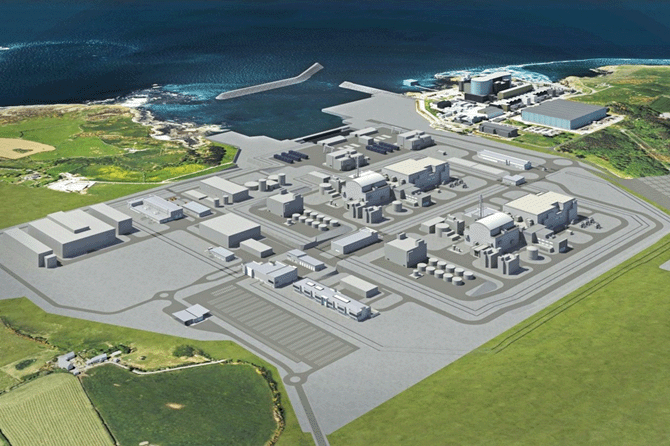
An EDF spokesman described Wylfa as a “fantastic site” and said it
wanted to bid to build the new plant. However, it is expected to face
competition from Westinghouse, an American company, and Kepco, South
Korea’s largest electrical utility firm.
The costs of the new plant are uncertain. Hinkley Point C was originally costed at £18bn but overruns have already pushed that up to at least £46bn. With several more years of
construction needed, final costs are expected to exceed £50bn –
equivalent to about £1,800 per UK home. Hinkley developer EDF is liable
for the extra costs.
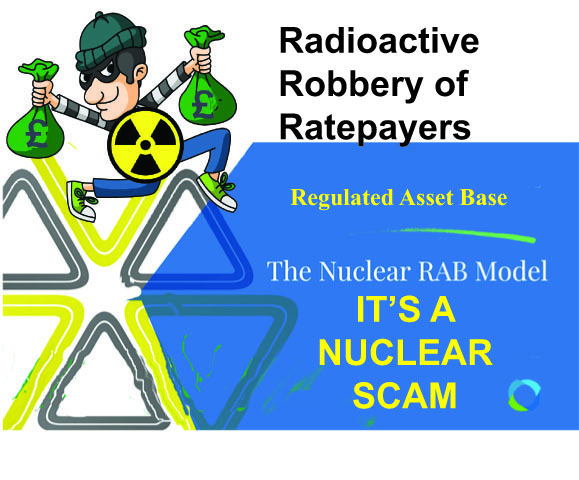
The Wylfa B plant is also likely to be financed under
the RAB system which means consumers will see bill increases for Wylfa B
and Sizewell C before either generates any power. Alison Downes, of Stop
Sizewell C, said: “The Government seems determined to double down on
gigawatt nuclear, the slowest most expensive energy source to build, which
the British public – in the form of taxpayers and consumers – will be
forced to pay for.
“We send our empathy to the people of Anglesey who
will be forced to fight yet another inappropriate development. Our advice
is to take very little of what is promised in the form of ‘community
benefits’ at face value.”
Andrew Bowie, the minister for nuclear
energy, was on Wednesday scheduled to meet with the Nuclear
Non-Governmental Organisation Forum to hear various groups’ concerns over
the expansion of nuclear energy. However, he cancelled the meeting at short
notice as news of the Wylfa plan emerged.
Telegraph 21st May 2024
https://www.telegraph.co.uk/business/2024/05/21/anglesey-host-britain-third-new-nuclear-power-station/
Julian Assange’s five-year battle against extradition to the US continues as he WINS last-ditch legal battle to lodge appeal
‘Today is a victory, but part of the victory only.’
‘Today marks a turning point. We went into court and we sat and heard the United States fumbling through their arguments, trying to paint lipstick on a pig.
‘We are relieved as a family that the courts took the right decision today but how long can this go on for?
Daily Mail, By GEORGE ODLING and ELIZABETH HAIGH, 21 May 24
WikiLeaks founder Julian Assange‘s five-year battle against extradition to the US for espionage charges continues after he won a last-ditch legal battle to appeal.
‘Well, the judges were not convinced. Everyone can see what is going on here. The United States’ case is offensive.
‘It offends our democratic principles, it offends our right to know, it’s an attack on journalists everywhere.
‘We are relieved as a family that the courts took the right decision today but how long can this go on for? Our eldest son just turned seven.
‘All their memories of their father are in the visiting hall of Belmarsh prison, and as the case goes along, it becomes clearer and clearer to everyone that Julian is in prison for doing good journalism, for exposing corruption, for exposing the violations on innocent people in abusive wars for which there is impunity.
There were gasps of relief from the Australian’s wife and other supporters in the High Court as Dame Victoria Sharp said she and Mr Justice Johnson had decided they were not satisfied with assurances given by US prosecutors.
The judges had last month dismissed most of Assange’s legal arguments but said he would be able to bring an appeal on three grounds unless the US provided ‘satisfactory assurances.’
These were that Assange would be protected by and allowed to rely on the First Amendment, that his trial would not be prejudiced by his nationality and that the death penalty would not be imposed.
Dame Victoria told the court they were not satisfied Assange was guaranteed protection under the First Amendment.
Speaking outside court, Assange’s wife Stella said the judges had made the ‘right decision’, adding: ‘He should be given the Nobel prize and he should walk freely with the sand beneath his feet. He should be able to swim in the sea again. Free Assange.’
Delivering the ruling, Dame Victoria told the court: ‘We have carefully considered the submissions made in writing and orally.
‘First, in respect of the appeal under section 103 of the Extradition Act, we have decided to give leave to appeal on grounds four and five.’
Assange’s lawyer, Edward Fitzgerald KC, said he was satisfied with assurances that if the WikiLeaks founder was extradited and convicted he would not face the death penalty.
But lawyers for the US said that the fact that Assange is accused of illegally obtaining and disseminating confidential defence information means he was not guaranteed protection by the First Amendment regardless of nationality.
In written submissions, he said: ‘The position of the US prosecutor is that no-one, neither US citizens nor foreign citizens, are entitled to rely on the First Amendment in relation to publication of illegally obtained national defence information giving the names of innocent sources to their grave and imminent risk of harm.’
This principle applies to both US and non-US citizens irrespective of their nationality, he added.
The US has provided an assurance that if extradited, Assange ‘will be entitled to the full panoply of due process trial rights, including the right to raise, and seek to rely upon, the first amendment as a defence.’
Assange’s wife, Stella, has previously dismissed this pledge as ‘weasel words.’
The ruling will no doubt increase calls in Assange’s native Australia for the government to intervene on his behalf.
More than a hundred supporters gathered outside the Royal Courts of Justice to wave banners emblazoned with logos including ‘If Assange goes, free speech goes with him.’
Assange declined to attend the hearing but Mrs Assange sat next to his father John Shipton in the well of court 4.
Supporters of Julian Assange cheered as news of the decision to allow his appeal against extradition to the United States filtered out of the courtroom.
Hundreds of people gathered outside the Royal Courts of Justice in London, with many holding signs, flags and banners, while a band is also playing music.
Several speakers addressed crowds on a stage erected adjacent to the court building, with one telling supporters: ‘Today is a victory, but part of the victory only.’
Following the decision, one man with a megaphone said to Assange supporters: ‘We have to do more.’
Among the supporters chanting ‘Free Julian Assange’ were former Labour leader Jeremy Corbyn and Labour MP Apsana Begum.
Kaylaa Sandwell travelled from east London to attend the rally and said: ‘It was obvious from the beginning that they want to silence him and I think he’s a very honest man, and he’s spoken up for us, so we need to really support that.
‘He needs to be freed because he hasn’t done anything wrong.
‘If he doesn’t get freed, we won’t have a free press anymore.’
Speaking outside the Royal Courts of Justice after Julian Assange won a bid to bring an appeal against his extradition to the United States, his wife, Stella Assange, said that judges ‘reached the right decision’ and called on the US to drop the ‘shameful’ case.
She said: ‘Today marks a turning point. We went into court and we sat and heard the United States fumbling through their arguments, trying to paint lipstick on a pig.
‘Well, the judges were not convinced. Everyone can see what is going on here. The United States’ case is offensive.
‘It offends our democratic principles, it offends our right to know, it’s an attack on journalists everywhere.
‘We are relieved as a family that the courts took the right decision today but how long can this go on for? Our eldest son just turned seven.
‘All their memories of their father are in the visiting hall of Belmarsh prison, and as the case goes along, it becomes clearer and clearer to everyone that Julian is in prison for doing good journalism, for exposing corruption, for exposing the violations on innocent people in abusive wars for which there is impunity.
On top of that impunity they have gone after the man who put that impunity onto the public record.
‘The Biden administration should distance itself from this shameful prosecution, it should have done so from day one, but it may be running out of time to do the right thing.
‘Everyone can see what should be done here. Julian must be freed. The case should be abandoned. He should be compensated.
‘He should be given the Nobel prize and he should walk freely with the sand beneath his feet. He should be able to swim in the sea again. Free Assange.’
She continued: ‘The judges reached the right decision. We spent a long time hearing the United States putting lipstick on a pig, but the judges did not buy it.
‘As a family we are relieved, but how long can this go on? The United States should read the situation and drop this case now.’
The 52-year-old was indicted by a US grand jury in 2018 on 17 espionage charges and a charge of unlawful use of a computer, which Assange’s lawyers claim could see him sentenced to 175 years in jail.
American prosecutors allege that the Australian encouraged and helped former US army intelligence analyst Chelsea Manning to steal the cables, which they claim put the lives of covert sources around the globe at risk.
President Joe Biden has faced persistent pressure to drop the case filed by his predecessor Donald Trump.
Assange had previously lived inside the Ecuadorian Embassy in Knightsbridge, west London, for almost seven years until he was eventually dragged out in 2019 when the Ecuadorian government withdrew his asylum.
He entered as a fugitive in 2012 to avoid extradition to Sweden on sexual assault charges, which he denied and which Sweden dropped in 2019………………………………………………………………………. more https://www.dailymail.co.uk/news/article-13438235/julian-assange-wikileaks-death-penalty-high-court.html
Nuclear-free councils hit out at ‘mad delusion’ of new reactor

“Instead of wasting cash and time on nuclear, the Scottish NFLAs believe the money and effort would first be far better spent insulating all domestic properties and public buildings to the highest standard to improve energy efficiency, reduce energy consumption and minimise or eliminate fuel poverty, as well as investing in more renewable energy generating capacity and battery storage.”
“
By Alan Hendry alan.hendry@hnmedia.co.uk, 21 May 2024, https://www.northern-times.co.uk/news/nuclear-free-councils-hit-out-at-mad-delusion-of-new-react-351234/
Calls for a nuclear revival in Scotland – including the possibility of a new Dounreay reactor – have been dismissed as “folly” and a “mad delusion”.
Scottish Nuclear Free Local Authorities (NFLAs), a grouping of councils opposed to civil nuclear power, insisted that renewables “represent the only way forward to achieve a sustainable, net-zero future”.
The secretary of state for Scotland, Alister Jack, confirmed last week that he had asked the UK energy minister to plan for a new nuclear site north of the border as part of a nationwide strategy.
Dounreay had been put forward among the possible locations for a small modular reactor (SMR), a series of 10 power stations that engineering giant Rolls-Royce was planning to build by 2035.
Jamie Stone, the Liberal Democrat MP for Caithness, Sutherland and Easter Ross, was quick to press the case for Dounreay to be considered. After a conversation with the Scottish secretary, Mr Stone claimed there was “all to play for”.
Dounreay is being decommissioned, with the end date for the nuclear clean-up now extended to the 2070s.
A proposal that Highland Council should sign up to NFLAs came to nothing in 2019 after some Caithness councillors condemned the idea. Scottish councils that are part of NFLAs are Dundee, East Ayrshire, Edinburgh, Fife, Glasgow, Midlothian, North Lanarkshire, Renfrewshire, Shetland Islands, West Dunbartonshire and Western Isles.
In a statement, Scottish NFLAs said a new focus on nuclear generation would put the UK government at odds with the Scottish Government as the SNP remains “implacably opposed” to the construction of any new nuclear fission plants in Scotland.
“To the NFLAs, an investment in any nuclear would not only be folly, but a lamentable diversion of effort from achieving the credible goal of supplying 100 per cent of Scotland’s electricity from renewables,” the group said.
“Nuclear power plants are enormously expensive to build and notorious for their cost and delivery overruns.”
Scottish NFLAs maintained that “none of the competing SMR designs has yet received the required approvals from the nuclear regulator to even be deployed in the UK” and “the necessary finance has yet to be put in place”.
It went on: “SMRs are estimated to cost £3 billion each, but cost overruns are notorious in the nuclear industry, and the earliest any approved and financed SMR would come onstream would be in the early 2030s.
“Nuclear plants are also incredibly expensive to decommission, and the resultant radioactive waste must be managed at vast expense for millennia.
“Instead of wasting cash and time on nuclear, the Scottish NFLAs believe the money and effort would first be far better spent insulating all domestic properties and public buildings to the highest standard to improve energy efficiency, reduce energy consumption and minimise or eliminate fuel poverty, as well as investing in more renewable energy generating capacity and battery storage.”
Scottish NFLAs said Scotland could become “a powerhouse” with surplus renewable energy being exported to England and continental Europe via interconnectors.
It added: “To realise this, the Scottish NFLAs would like to see the Scottish Government recommit to establishing a state-owned renewable energy company to invest in this potential and to generate an income for the nation.
“The Scottish NFLAs believe that if the secretary of state for Scotland genuinely wants to see a sustainable, net-zero future for Scotland he should call for the British government to get behind the Scottish Government in backing this strategy, instead of maintaining his mad delusion for nuclear.”
Yet another university co-opted by the nuclear industry

Teesside University to set out benefits of X-energy site at Hartlepool
Teesside University is to help set out the huge regional economic benefits of a multi-billion pound nuclear power station project in Hartlepool.
Northern Echo, Mike Hughes, 22nd May 24
X-energy and Cavendish Nuclear have commissioned the university to look at the opportunities – including jobs, skills, supply chain contracts, and investment – led by Professor Matthew Cotton, Professor of Public Policy.
The work is part funded by the UK Government which awarded the firms £3.34m in April this year from the Department of Energy Security and Net Zero’s Future Nuclear Enabling Fund.
This was matched by X-energy which aims to build its Xe-100 advanced modular reactor plant, by the early 2030s, next to Hartlepool’s existing Nuclear Power Station which is scheduled to close this decade.
The assessment is part of a £6.68m programme of work the companies are jointly undertaking to prepare for the proposed roll out of around 40 Xe-100 power stations across the UK………………………………. https://www.thenorthernecho.co.uk/news/24333214.teesside-university-set-benefits-x-energy-site-hartlepool/
University of Sheffield gets into the nuclear debt web, partnering with Rolls Royce to make “small” nuclear reactors
New facility will help de-risk and underpin the Rolls-Royce SMR programme
( De-Risking, is a strategy that companies apply when they cannot manage the money laundering risks that they have obligations to. )
Mirage News, 21 May 24
- The University of Sheffield and Rolls-Royce SMR are setting up a multi-million pound manufacturing and testing facility in South Yorkshire
- Based in the University of Sheffield AMRC’s Factory 2050, the new facility will produce prototype modules for small modular reactors (SMRs)
- New facility will help de-risk and underpin the Rolls-Royce SMR programme that aims to deploy a fleet of factory-built nuclear power plants in the UK and across the world
…………………… The first phase, announced today, is worth £2.7 million and will be part of a wider £15+ million package of work that will further de-risk and underpin the Rolls-Royce SMR programme.
The new facility at the University of Sheffield AMRC will produce working prototypes of individual modules that will be assembled into Rolls-Royce SMR power plants.
The Rolls-Royce SMR programme is UK’s first home-grown nuclear technology for over a generation and today’s announcement is another vital step towards deploying a fleet of factory-built nuclear power plants in the UK and around the globe.
Victoria Scott, Rolls-Royce SMR’s Chief Manufacturing Engineer, said: “Our investment in setting up this facility and building prototype modules is another significant milestone for our business.
“Our factories will produce hundreds of prefabricated and pre-tested modules ready for assembly on site. This facility will allow us to refine our production, testing and digital approach to manufacturing – helping de-risk our programme and ensure we increase our delivery certainty. https://www.miragenews.com/rolls-royce-smr-sheffield-uni-launch-new-1238675/
Assange Wins Right to Appeal on 1st Amendment Issue
The High Court in London ruled Monday that Julian Assange can appeal his extradition to the U.S. on the grounds that he is being denied his First Amendment rights.
May 20, 2024, By Joe Lauria in London Consortium News, https://consortiumnews.com/2024/05/20/assange-wins-right-to-appeal-on-1a-issue/—
The High Court in London on Monday granted Julian Assange the right to appeal the order to extradite him to the United States on the grounds that the U.S. did not satisfy the court that it would allow Assange a First Amendment defense in a U.S. court.
“We spent a lot of time listening to the United States putting lipstick on a pig, but the judges didn’t buy it,” Stella Assange told reporters outside the court building. “As a family we are relieved but how long can this go on? The United States should read the situation and drop the case now.”
Assange has been imprisoned in London’s notorious Belmarsh Prison for more than five years on remand pending the outcome of his extradition. He must now spend an untold number of more months in the maximum security prison awaiting the start of his appeal.
In that sense it was a bitter victory for Assange. He gets to stay in prison another year or more, Joe Biden doesn’t have to worry about a journalist showing up in chains in Alexandria, VA during a presidential campaign and of course Assange could lose his appeal and arrive in the U.S. at a more opportune time for Biden.
In another sense, it was a victory for the supremacy of European law when it comes to free speech,
Background to Monday’s Action
The High Court in London on March 26 had ruled that Assange had three grounds to appeal, because 1). his extradition was incompatible with his free speech rights enshrined in the European Convention on Human Rights; 2.) that he might be prejudiced because of his nationality (not being given 1st Amendment protection as a non-American) and 3). because he had inadequate protection against the death penalty. (Without such protection Britain cannot extradite him.).
Rather than proceed with the appeal on those three grounds, the High Court gave the U.S. the chance, fours years after the extradition process began, to promise it would not use the death penalty, and to guarantee his free speech rights.
Because it is an executive branch decision, the U.S. was able to assure the British government that it would not seek the death penalty, and Assange’s lawyers on Monday said they did not contest that. Left unexplained, however, was why the British home office waited four years to seek what is normally a routine assurance in an extradition case.
The free speech issue was more complicated because a decision about Assange asserting a First Amendment defense at trial will be up to a U.S. federal court and not the Department of Justice. Therefore the DOJ could not issue such an assurance on the free speech issue.
That ultimately led the two judges, Justice Jeremy Johnson and Victoria Sharp, to allow Assange to launch a formal appeal of his extradition because of an apparent violation of British extradition law, based on the European Convention on Human Rights, that requires the receiving country to allow an extradited person the right to free speech.
Johnson and Sharp did not buy the convoluted argument of James Lewis KC for the United States, on why the U.S. should get their hands on Assange despite being unable to guarantee his freedom of expression.
Edward Fitzgerald KC, and Mark Summers KC, barristers for Assange, easily picked apart three pieces of Lewis’ somewhat desperate presentation:
- pointing out how Lewis had misled the court by saying the U.S. assurance would allow Assange to rely on the First Amendment, when in fact it says he can “seek to rely” on it;
- how none of a slew of case law Lewis cited to supposedly bolster his argument actually dealt with a trial, which of course Assange will, if he goes to the U.S.;
- that saying Chelsea Manning was not able to invoke First Amendment rights in defense of leaking classified defense information meant Assange shouldn’t either was “nonsense” because Manning was a government whistleblower who had signed non-disclosure agreements and Assange is a publisher.
The judges apparently also rejected a drawn-out, arcane and overly lawyered argument from Lewis about the difference between citizenship and nationality that to most laymen was nearly incomprehensible.
A Watershed Moment
“This was a watershed moment in this very long battle,” said WikiLeaks Editor-in-Chief Kristinn at an event following the hearing. “Today marked the beginning of the end of the persecution. The signaling from the courts here in London was clear to the U.S. government: We don’t believe your guarantees, we don’t believe in your assurances.”
1st Amendment & Espionage Act
The First Amendment is at the core of the unconstitutionality of the Espionage Act, which makes no exception for a journalist to possess and disseminate defense information.
The Assange case could lead to a constitutional challenge of it, said Marjorie Cohn, former president of the National Lawyers’ Guild. That may be one reason the Department of Justice does not want Assange to invoke the First Amendment in court.
The U.S.-U.K. Extradition Act “bars extradition if an individual might be prejudiced due to his nationality and due to the centrality of the First Amendment to his defense,” Cohn told CN Live! last month. “If he’s not permitted to rely on the First Amendment because of his status as a foreign national, he’ll thereby be prejudiced, potentially very greatly prejudiced by reason of his nationality.”
Assange contends that if he’s given First Amendment rights, “the prosecution will be stopped,” Cohn said. “The First Amendment is therefore of central importance to his defense.”
Cohn added: ‘If he has the right to free expression and freedom of speech, then what he did, what he’s accused of doing, would not violate the law.”
[See: 1st Amendment Authorized Assange’s Possession of Classified Data]
Though allowing First Amendment rights at trial would be ultimately a judge’s decision, and not the executive branch’s, Assistant U.S. Attorney Gordon Kromberg, who is prosecuting Assange, has not only not indicated that he wouldn’t file a motion against it in court, but has said explicitly that non-U.S. citizens do not have First Amendment rights in the U.S. for acts committed abroad.
A date has not yet been set for Assange’s appeal to begin.
UK plans new nuclear plant in Scotland despite Scottish government opposition

the Scottish Parliament has the ability to block projects it opposes as planning powers are devolved.
17 MAY, 2024 BY THOMAS JOHNSON, https://www.newcivilengineer.com/latest/uk-plans-new-nuclear-plant-in-scotland-despite-scottish-government-opposition-17-05-2024/
Recent parliamentary discussions have revealed the UK is exploring the possibility of constructing a new nuclear power plant in Scotland despite fierce opposition from the Scottish government.
The UK government secretary of state for Scotland Alister Jack revealed in a House of Lords committee meeting that discussions were taking place on siting a small modular reactor (SMR) north of the border and that it is part of UK-wide plan.
He said: “On the small nuclear reactors, I have asked the energy minister to plan for one in Scotland.
“I believe that in 2026 we’ll see a unionist regime again in Holyrood and they will move forward with that.”
He also made reference to the shortness of the “timescales in front of us”, which could either be regarding the breadth and speed required for the energy transition or to the looming General Election.
The subject was then brought up in Scottish Parliament’s first minister’s questions (FMQs) on Thursday 16 May.
During FMQs, Member of Scottish Parliament Rona Mackay asked: “Despite opposition from the democratically elected Scottish government, where Scotland does not need expensive nuclear power; we already have abundant natural energy resources, can the first minister advise whether the United Kingdom government has approached Scottish ministers about those apparent plans?
“Can he confirm that the Scottish government will oppose those plans and, instead, focus on Scotland’s substantial renewable energy potential?”
First minister John Swinney responded to say how he was appalled no mention of the discussions had been made to the Scottish government by the secretary of state for Scotland.
Swinney said: “I am often lectured in parliament about the importance of good intergovernmental relations. The secretary of state for Scotland has made no mention of the proposal to the Scottish government.
“That is utterly and completely incompatible with good intergovernmental working and is illustrative of the damaging and menacing behaviour of the secretary of state for Scotland.”
He continued: “The Scottish government will not support new nuclear power stations in Scotland.
“I was in Ardersier on Monday and the cabinet secretary for net zero and energy was in Nigg on Tuesday to support the announcements of formidable investments in Scotland’s renewable energy potential.
Those are massive investments that will bring jobs and opportunities to the Highlands and Islands and deliver green, clean energy for the people of Scotland. That is the government’s policy agenda, and we will have nothing to do with nuclear power.”
Nuclear in Scotland
Scotland already has a nuclear power plant, Torness in East Lothian, which is scheduled to be shut down by 2028, two years earlier than was planned when it was constructed.
Another nuclear power station located within the country, the Hunterston B plant in North Ayrshire, ceased operation in January 2022.
The UK has an ambition of generating a quarter of its electricity from nuclear power by 2050, which is to be delivered by new public body Great British Nuclear.
Currently, energy policy is run by the UK government but the Scottish Parliament has the ability to block projects it opposes as planning powers are devolved.
Department for energy security and net zero under secretary Andrew Bowie, said: “We can’t go beyond preliminary discussions because of the current Scottish government hampering us but if the planning block was lifted then we could make a site north of the border; one of the eight across the UK.”
A Scottish government spokesperson said: “The Scottish government is absolutely clear in defence of the devolution settlement, and in our opposition to the building of new traditional nuclear fission energy plants in Scotland under current technologies.
“Small modular reactors, while innovative in construction and size, still generate electricity using nuclear fission and therefore the process presents the same environmental concerns as traditional nuclear power plants.
“We believe that significant growth in renewables, storage, hydrogen and carbon capture provides the best pathway to net zero by 2045 and will deliver secure, affordable and clean energy supplies for Scotland’s households, business and communities.”
Julian Assange faces judgment day over US extradition
May 19, 2024, https://michaelwest.com.au/julian-assange-faces-judgment-day-over-us-extradition/
A British court could give a final decision on whether WikiLeaks’ founder Julian Assange should be extradited to the United States over the mass leak of secret US documents – the culmination of 13 years of legal battles and detentions.
Two judges at the High Court in London are set to rule on Monday on whether the court is satisfied by US assurances that Assange, 52, would not face the death penalty and could rely on the First Amendment right to free speech if he faced a US trial for spying.
Assange’s legal team say he could be on a plane across the Atlantic within 24 hours of the decision, could be released from jail, or his case could yet again be bogged down in months of legal battles.
“I have the sense that anything could happen at this stage,” his wife Stella said during the week.
“Julian could be extradited or he could be freed.”
She said her husband hoped to be in court for the crucial hearing.
WikiLeaks released hundreds of thousands of classified US military documents on Washington’s wars in Afghanistan and Iraq – the largest security breaches of their kind in US military history – along with swathes of diplomatic cables.
In April 2010 it published a classified video showing a 2007 US helicopter attack that killed a dozen people in the Iraqi capital, Baghdad, including two Reuters news staff.
The US authorities want to put the Australian-born Assange on trial over 18 charges, almost all under the Espionage Act, saying his actions with WikiLeaks were reckless, damaged national security and endangered the lives of agents.
His many global supporters call the prosecution a travesty, an assault on journalism and free speech, and revenge for causing embarrassment.
Calls for the case to be dropped have ranged from human rights groups and some media bodies to Australian Prime Minister Anthony Albanese and other political leaders.
Assange was first arrested in Britain in 2010 on a Swedish warrant over sex crime allegations that were later dropped.
Since then he has been variously under house arrest, holed up in Ecuador’s embassy in London for seven years, and held since 2019 in the top-security Belmarsh jail while he waited for a ruling on his extradition.
“Every day since the seventh of December 2010 he has been in one form of detention or another,” said Stella Assange, who was originally part of his legal team and married him in Belmarsh in 2022.
If the High Court rules the extradition can go ahead, Assange’s legal avenues in Britain are exhausted, and his lawyers will immediately turn to the European Court of Human Rights to seek an emergency injunction blocking deportation pending a full hearing by that court into his case at a later date.
On the other hand, if the judges reject the US submissions, Assange will have permission to appeal his extradition case on three grounds, and that might not be heard until 2025.
It is also possible the judges could decide that Monday’s hearing should consider not just whether he can appeal but also the substance of that appeal.
If they find in his favour in those circumstances, he could be released.
Stella Assange said whatever the outcome, she would continue to fight for his liberty.
She plans to follow him to Australia or wherever he is safe if he is freed.
If he is extradited, she said all the psychiatric evidence presented at court had concluded he was at serious risk of suicide.
“We live from day to day, from week to week, from decision to decision,” she told Reuters.
“This is a way that we’ve been living for years and years.
“This is just not a way to live – it’s so cruel.
“And I can’t prepare for his extradition – how could I?
“But if he’s extradited, then I’ll do whatever I can, and our family is going to fight for him until he’s free.”
UK High Court rules that Julian Assange can appeal against extradition to USA
The Conversation, Erin Cooper-Douglas, Deputy Politics + Society Editor 21 May 24 |
Late last night, Wikileaks founder Julian Assange had a win in the UK High Court: he can now appeal his extradition order to the United States
Legal efforts to keep Assange from being sent to the US, where he potentially faces a 175-year jail term for publishing sensitive government documents, have been some of the most protracted in recent memory. Just getting complete permission to appeal took three highly publicised hearings.
As Holly Cullen explains, one of the key grounds for appeal is freedom of expression. And that’s what makes yesterday’s decision, and the appeal that will now follow, legally groundbreaking. Never before has a UK court, nor the European Court of Human Rights, decided whether a potential violation of freedom of expression can stop someone from being extradited.
While the decision will please Assange’s team and his many supporters, the extradition threat still looms. If the appeal, which is likely to be held later this year, is unsuccessful, he could still find himself in the US.
LABOUR MUST RULE OUT NEW NUCLEAR REACTOR FOR SCOTLAND

Nuclear power has no place in a greener Scotland.
A future UK Labour government must drop plans by the Secretary of State for Scotland, Alister Jack, to open a new nuclear reactor in Scotland, say the Scottish Greens.
Speaking to the House of Lords Constitution Committee this week, Mr Jack said that the UK government is planning to work with anti-independence parties to deliver a new nuclear reactor in Scotland.
Mr Jack told the committee “On the small nuclear reactors, I have asked the energy minister to plan for one in Scotland, because I believe in 2026 we’ll see a Unionist regime again in Holyrood, and they will move forward on that matter.”
In a letter to Scottish Labour leader, Anas Sarwar, the Scottish Greens energy spokesperson, Mark Ruskell, condemned the “environmental vandalism and constitutional overreach” of the Tories, and called on Mr Sarwar to ensure any future UK Labour government would drop these plans.
He has also urged Mr Sarwar to make clear if his party would support a replacement for the Torness nuclear station which is set to be decommissioned in 2028.
Mr Ruskell said: “Scotland does not need or want nuclear power. It is unsafe, expensive and leaves a toxic legacy for future generations. It is also a big distraction. Scotland has a huge abundance of renewable resources that we must be investing in and supporting.
“I have written to Mr Sarwar in the hope that he will provide clarity and assurance that a future UK Labour government would drop plans to expand nuclear power in Scotland against the wishes of our parliament.
“This is a time for progressive parties to stand together for our climate, and I hope that Mr Sarwar will oppose any plans for a new reactor or for a return to nuclear power once Torness has been decommissioned.”
Text of the letter Mark Ruskell sent Anas Sarwar………………………………………………. more https://greens.scot/news/labour-must-rule-out-new-nuclear-reactor-for-scotland
Nuclear waste to be buried 650ft under the English countryside.

Swathes of nuclear waste are set to be buried in the English countryside
after ministers agreed to dig a 650ft pit starting this decade. The
facility, which has yet to be allocated a site, will hold some of the 5m
tonnes of waste that was generated by nuclear power stations over the past
seven decades.
This will ease pressure on the 17 nuclear waste disposal
plants currently in operation around the country, which consist of giant
sheds and cooling ponds. The largest facility is the Sellafield site in
Cumbria.
Plans for the 650ft pit will see it house so-called
intermediate-level waste, possibly in a mine on a pre-existing nuclear site
to minimise planning objections. The facility will be separate from the
much deeper geological disposal site that will hold the UK’s most
dangerous waste, such as plutonium, which is unlikely to be built until
after 2050.
The proposals come amid fears Britain’s stockpile of nuclear
waste will grow in the coming decades with nowhere to put it. Concerns are
particularly acute as the Government is currently planning to build at
least three new nuclear power stations. This will put the country at odds
with the 1976 review of nuclear waste policy by the Royal Commission on
Environmental Pollution, which warned the UK was accumulating nuclear waste
so fast that it should stop building reactors until it had a solution.
Ministers want to brand nuclear energy as a “green” and
“sustainable” fuel. However, experts on the Government’s own advisory
body, the Committee on Radioactive Waste Management, have said such terms
are misleading if there is no safe place to store radioactive waste.
A government spokesman said: “In addition to long-term plans to dispose of
the most hazardous radioactive waste in a geological disposal facility
hundreds of metres underground, the Nuclear Decommissioning Authority will
explore a facility closer to the surface for less hazardous radioactive
waste. “While a geological disposal facility is not expected to be ready
until the 2050s, a shallower disposal facility – which is up to 200m
below ground – could be available within 10 years.”
Telegraph 16th May 2024
UK government about to overrule Scotland and impose nuclear stations?

Don’t get above your nuclear power station, Scotland
17th May, By Wee Ginger Dug, https://www.thenational.scot/politics/24325966.dont-get-nuclear-power-station-scotland/—
Scotland, know your place. Our exalted Viceroy General Alister Jack – He Who Must Be Obeyed – has said that the UK Government is considering plans to build a nuclear reactor in Scotland, despite fierce opposition from the Scottish Government and even though planning is a devolved matter.
Jack told a committee in the Lords that he expected a “Unionist regime” to gain power in Holyrood after 2026 and said that he has asked ministers at the Department for Energy and Net Zero to plan for a nuclear reactor to be built in Scotland as part of a UK-wide programme.
Although planning is devolved to Holyrood, energy policy is reserved to Westminster. This means that even though Westminster is committed to an expansion of nuclear energy generation, the Scottish Government has a de facto means of blocking the development of nuclear energy in Scotland as it can refuse planning permission for new nuclear power plants.
Jack’s remarks suggest that the UK Government is preparing to overrule Holyrood and impose new nuclear power plants on Scotland against the will of Scotland’s elected representatives.
The Scottish Government is strongly opposed to new nuclear power plants in Scotland, favouring instead a greater development of Scotland’s vast renewable energy potential which is already capable of supplying more energy than Scotland requires for domestic consumption.
Any new nuclear power stations which the UK Government builds in Scotland will not be built because Scotland needs them, they will be built in order to meet the energy needs of the rest of the UK, but these needs could also be met by greater investment in and development of Scotland’s renewable energy potential.
Moreover, given the years long timescale that is required from the commissioning of a new nuclear power plant, any new nuclear reactor that the UK commissions in Scotland would not be on stream until 2033 at the very earliest. New renewable projects can be brought in stream and contributing power to the grid much quicker.
Hinkley Point C, the UK’s first nuclear plant in more than two decades, was estimated to cost between £25bn and £26bn in 2015. The first reactor will not be in use until at least 2029, two years later than the most recent 2027 goal, and could take until 2031 if electromechanical work runs into problems.
The projected cost is now between £31bn and £35bn in 2015 figures and up to £46bn in today’s money.
This dwarfs the cost of a new wind farm. The British Government has allocated just £800m for investment in offshore wind farms. The massive onshore Whitelee wind farm south of Glasgow cost £1.5bn to construct. It has a total capacity of 539 megawatts and can power over 350,000 homes annually.
Jack’s behaviour is ‘menacing’
Jack has been condemned by John Swinney for keeping his plans for new nuclear plants in Scotland a secret from the Scottish Government.
The First Minister was asked about Jack’s comments by SNP MSP Rona Mackay at FMQs. She said: “This week, the Secretary of State for Scotland confirmed that planning is underway to develop new nuclear reactors in Scotland despite opposition …”
She was interrupted by the boors on the Tory benches cheering at the prospect of the democratically elected government of Scotland being overruled.
After the Presiding Officer hushed the adolescents, she went on: “Despite opposition from the democratically elected Scottish Government. Scotland doesn’t need expensive nuclear power. We already have abundant natural energy resources. Can the First Minister advise if the UK Government has approached Scottish ministers about these apparent plans?”
The First Minister replied: said: “I’m often lectured in this parliament about the importance of good intergovernmental relations. The Secretary of State for Scotland has made no mention of this proposal to the Scottish Government.
“This is utterly and completely incompatible with good intergovernmental working and is illustrative of the damaging behaviour, the menacing behaviour, of the Secretary of State for Scotland. The Scottish Government will not support new nuclear power stations in Scotland.”
He added that “supporting the announcements of formidable investments in the renewable energy potential of Scotland” was “the policy agenda of this government, and we have nothing to do with nuclear power”.
But Jack says – don’t get above your nuclear power station, Scotland.
We’re all right Jack: No need for nuclear in Scotland
Contrary to the call of an out-of-touch, and increasingly out-of-time, Conservative Secretary of State that nuclear must be included in Scotland’s energy mix, the Scottish Nuclear Free Local Authorities remain convinced that renewables represent the only way forward to achieve a sustainable, Net Zero future for the nation.
Scottish Secretary Alister Jack, appearing before the House of Lords Constitution Committee on Wednesday, confirmed that he has approached fellow Scot and Nuclear Minister Andrew Bowie MP to plan for a new so-called Small Modular Reactor north of the border.
The sole operational nuclear plant in Scotland is at Torness, but this will cease generating before the end of the decade. Other reactors at Chapelcross, Dounreay, and Hunterston are in the process of being decommissioned.
Such a plan would put the UK Government at odds with that of Scotland, as the SNP-led Administration has affirmed to the NFLAs that it remains implacably opposed to the construction of any new nuclear fission plants in Scotland. Whilst energy policy is determined by Whitehall, the SNP Government can veto any development as planning authority has been devolved. The Minister is then clearly banking on regime change in 2026 at Edinburgh as both the Conservative and Labour Parties have both expressed support for new nuclear in Scotland.
To the NFLAs, an investment in any nuclear would not only be folly, but a lamentable diversion of effort from achieving the credible goal of supplying 100% of Scotland’s electricity from renewables.
Nuclear power plants are enormously expensive to build and notorious for their cost and delivery overruns. The sole UK gigawatt plant under construction at Hinkley Point C in Somerset is now expected to cost up to £47 billion at current prices, approaching triple its original estimate, whilst wildly optimistic claims by operator EDF Energy that the plant would be generating power ‘to cook British turkeys by Christmas 2017’ have been dampened by a series of damaging delays, with the first reactor expected now to become operational in 2031.
Secretary of State Alister Jack appears to be focused on bringing one of the so-called Small Modular Reactors (or SMRs) to Scotland. There has been previous talk of an SMR being co-located with the Grangemouth chemical plant, a prospect nipped in the bud by an NFLA intercession to the Scottish Minister. However, none of the competing SMR designs has yet received the required approvals from the nuclear regulator to even be deployed in the UK; none have been built; no sites have yet been permissioned for their deployment; the facilities to fabricate the parts have yet to be constructed; the necessary finance has yet to be put in place; and the procedures for their onsite assembly have yet to be perfected. SMRs are estimated to cost £3 billion each, but cost overruns are notorious in the nuclear industry, and the earliest any approved and financed SMR would come onstream would be in the early 2030’s.
Nuclear plants are also incredibly expensive to decommission, and the resultant radioactive waste must be managed at vast expense for millennia. There has been research published that suggests that SMRs will produce more radioactive waste per unit of electricity produced that gigawatt reactors.
Instead of wasting cash and time on nuclear, the Scottish NFLAs believe the money and effort would first be far better spent insulating all domestic properties and public buildings to the highest standard to improve energy efficiency, reduce energy consumption, and minimise or eliminate fuel poverty, as well as investing in more renewable energy generating capacity and battery storage capacity.
Not only does Scotland possess more than sufficient natural resources, in the forms of wind, wave, hydro and geothermal energy to meet its own needs, but it can become a powerhouse where the surplus renewable energy can be exported to its neighbour England and to states in Europe, via interconnectors, generating income for the nation.
To realise this, the Scottish NFLAs would like to see the Scottish Government recommit to establishing a state-owned renewable energy company to invest in this potential and to generate an income for the nation, mirroring the commendable action of the Welsh Government. Maximum pressure needs to be applied to the UK Government to boost the capacity of the National Grid to take Scottish renewable energy from wind turbines to England. At present, constraints mean that the network is often incapable of accepting and transmitting the vast amounts of electricity generated by Scottish wind turbines, leading to them being shut off and generators being awarded huge compensation at taxpayers’ expense for lost revenue.
The NFLAs have also called on the UK Government to back the development of stored pumped hydro projects in Scotland. A report from BiGGAR Economics, commissioned by Scottish Renewables, identified six ‘shovel-ready’ pumped-hydro projects in Scotland which could deliver £5.8 billion Gross Value Added (GVA) and almost 15,000 jobs by 2035.
Scotland has some world leading renewable energy companies, such as the O2 Orbital wave power project based in the Orkney Islands and the Gravitricity gravity storage project born in Edinburgh.
The Scottish NFLAs believe that if the Secretary of State for Scotland genuinely wants to see a sustainable, Net Zero future for Scotland that he should call for the British Government to get behind the Scottish Government in backing this strategy, instead of maintaining his mad delusion for nuclear.
1 This Month

of the week–London Campaign for Nuclear Disarmament

Tell the Ukrainian Government to Drop Prosecution of Peace Activist Yurii Sheliazhenko
To see nuclear-related stories in greater depth and intensity – go to https://nuclearinformation.wordpress.com
-
Archives
- April 2026 (114)
- March 2026 (251)
- February 2026 (268)
- January 2026 (308)
- December 2025 (358)
- November 2025 (359)
- October 2025 (376)
- September 2025 (257)
- August 2025 (319)
- July 2025 (230)
- June 2025 (348)
- May 2025 (261)
-
Categories
- 1
- 1 NUCLEAR ISSUES
- business and costs
- climate change
- culture and arts
- ENERGY
- environment
- health
- history
- indigenous issues
- Legal
- marketing of nuclear
- media
- opposition to nuclear
- PERSONAL STORIES
- politics
- politics international
- Religion and ethics
- safety
- secrets,lies and civil liberties
- spinbuster
- technology
- Uranium
- wastes
- weapons and war
- Women
- 2 WORLD
- ACTION
- AFRICA
- Atrocities
- AUSTRALIA
- Christina's notes
- Christina's themes
- culture and arts
- Events
- Fuk 2022
- Fuk 2023
- Fukushima 2017
- Fukushima 2018
- fukushima 2019
- Fukushima 2020
- Fukushima 2021
- general
- global warming
- Humour (God we need it)
- Nuclear
- RARE EARTHS
- Reference
- resources – print
- Resources -audiovicual
- Weekly Newsletter
- World
- World Nuclear
- YouTube
-
RSS
Entries RSS
Comments RSS
 nuclear-news