The UK Is Ramping Up Its Nuclear Energy Ambitions

The cost of development has increased significantly since EDF first gained project approval in 2012, which could make it the world’s most expensive nuclear plant……..$58.4 billion earlier in the year. Its completion date has also been delayed by three to four years, expected to be completed by 2031. …….a government spokesperson …… the plant is “not a government project” and stated, “any additional costs or schedule overruns are the responsibility of EDF and its partners and will in no way fall on taxpayers.”
Oil Price, By Felicity Bradstock – May 30, 2024,
- The U.K. government aims to rapidly expand its nuclear energy sector, with two nuclear plants slated for the next decade and discussions around a third.
- The government hopes to meet up to 25 percent of the country’s electricity demand using nuclear power sources by 2050.
The U.K. government has ambitious plans for the rapid expansion of the country’s nuclear energy sector, with two nuclear plants slated for the next decade, and discussions around a third. EDF’s Hinkley Point C in Somerset and Sizewell C in Suffolk have both been approved by the government, expected to support the U.K.’s transition away from fossil fuels to greener alternatives in line with national climate pledges.
The U.K. government has announced ambitious nuclear plans in recent years, aiming for the biggest expansion in nuclear power for 70 years. It hopes to meet up to 25 percent of the country’s electricity demand using nuclear power sources by 2050. This will mean a fourfold increase in the U.K.’s nuclear power production, to achieve an output of 24 GW by the mid-century. The Civil Nuclear Roadmap outlines the government’s nuclear plans, including the development of major nuclear facilities, as well as its small modular reactor (SMR) technology. The government also plans to invest up to $381 million in the domestic production of the fuel required to power high-tech new nuclear reactors, known as HALEU, currently only commercially produced in Russia.
The cost of development has increased significantly since EDF first gained project approval in 2012, which could make it the world’s most expensive nuclear plant. EDF previously stated that it expected the plant to cost around $22 billion, but it increased that estimate to around $58.4 billion earlier in the year. Its completion date has also been delayed by three to four years, expected to be completed by 2031. The firm blamed inflation, Covid, and Brexit for cost increases and project delays. While there were some public concerns for the price increase, a government spokesperson made it clear that the plant is “not a government project” and stated, “any additional costs or schedule overruns are the responsibility of EDF and its partners and will in no way fall on taxpayers.”
In May, EDF was granted a site license by the U.K.’s nuclear regulator, the Office for Nuclear Regulation (ONR), for the development of its Sizewell C nuclear plant in Suffolk, in the south of England. This is the first of this type of license to be granted in over a decade. Sizewell C is expected to be a replica of the company’s Hinkley Point C. EDF is racing to reach a final investment decision on the project by the end of 2024.
Unlike Hinkley, EDF holds just under a 50 percent stake in Sizewell, with the government holding just over 50 percent. The company is now seeking new investment following the banning of China’s CGN from funding the development due to security concerns. The French firm hopes to use lessons learned from the development of Hinkley to construct Sizewell within around nine years.
Now, the U.K. government is in discussion over another potential nuclear plant development in Wales. The government announced it is holding conversations with major energy companies about the construction of a third new nuclear plant on a site at Wylfa on Anglesey in north Wales. The development of an additional site would help the U.K. to achieve its nuclear energy goals by the mid-century. There are reports that South Korea’s state-owned nuclear developer has been involved in early-stage discussions with the government about the multi-billion construction using APR1400 reactor technology. However, the American nuclear firm Westinghouse and the construction group Bechtel have shown interest in developing the project using Westinghouse’s AP1000 reactor technology………………………………….. https://oilprice.com/Energy/Energy-General/The-UK-Is-Ramping-Up-Its-Nuclear-Energy-Ambitions.html
Tribunal judge accused of covering up complaints – about bullying at Sellafield nuclear plant and other sites.
Seven women who claim they were bullied and intimidated by an employment
tribunal judge have accused the senior judiciary of trying to cover up
their complaints.
The allegation coincides with the Ministry of Justice and
Judicial Conduct Investigations Office (JCIO) being referred to the
Information Commissioner after failing to disclose the number of complaints
made about tribunal judges in response to a freedom of information request.
Both the ministry and the JCIO said that neither holds the information. But
a consultation on judicial discipline, published by both bodies two years
ago, revealed that the figure is estimated to be between 700 and 800
annually.
Of those complaints — which equate to an average of three every
working day — only a fraction result in action. The women who have spoken
to The Times have accused Judge Philip Lancaster of bullying and sexist
behaviour at separate hearings before him at the employment tribunal in
Leeds — with one claiming that he shouted at her 16 times.
Alison McDermott, formerly a human resources consultant at the nuclear fuel
reprocessing plant at Sellafield, first drew attention to Lancaster’s
alleged behaviour after he rejected her claim for whistleblowing detriment
in 2021. McDermott lost the case, but was allowed to appeal on 13 grounds.
Although she lost most of her appeal, the judge said that there were errors
and problems in the way her case was handled. That judge also criticised as
“unsafe” the award of costs against her and said that the tone of
Lancaster’s remarks on the issue were “troubling”.
Times 30th May 2024
https://www.thetimes.co.uk/article/complaints-covered-up-against-tribunal-judges-zkhmlz8bc
Drone sightings reported over British nuclear facilities

UK Defence Journal, By George Allison, May 29, 202
Recent data acquired under the Freedom of Information Act 2000 (FOIA 2000) unveils a number of drone sightings over UK nuclear facilities from 2021 to 2023.
The Ministry of Defence Police (MDP) has kept specific location details confidential, citing national security implications.…………………………………………………………………..
In the context of the UK, nuclear sites generally refer to a range of facilities associated with the nuclear energy industry and defence establishments. These can include:
- Nuclear Power Stations: These are plants where nuclear energy is converted into electricity. Examples include Hinkley Point, Sizewell, and Dungeness.
- Nuclear Research Facilities: These are centres where nuclear research takes place, such as the Culham Centre for Fusion Energy or the Dalton Nuclear Institute.
- Nuclear Reprocessing Plants: Sellafield in Cumbria is a prime example, where nuclear fuel is reprocessed.
- Nuclear Submarine Bases: The UK operates a fleet of nuclear-powered submarines, and these vessels are based at certain naval docks, notably HM Naval Base Clyde (sometimes referred to as Faslane).
- Defence Establishments: Some sites are associated with the development or storage of nuclear weapons, such as the Atomic Weapons Establishment (AWE) sites at Aldermaston and Burghfield.
- Nuclear Waste Storage and Disposal Sites: Locations where nuclear waste is stored, treated, or disposed of.
- Decommissioned Nuclear Sites: Former nuclear facilities which are no longer operational but might still have nuclear materials or be under decommissioning.
These sites are of strategic importance to the UK, both in terms of energy supply and national security. As such, they are heavily regulated, monitored, and protected. Any unauthorised activity, such as drone flights, in the vicinity of these sites is taken very seriously due to the potential security and safety risks involved.
What drives these flights near such sensitive areas? Are they a product of curiosity, deliberate reconnaissance, or mere coincidence? https://ukdefencejournal.org.uk/drone-sightings-reported-over-british-nuclear-facilities/
The ghost of Concorde stalks the Franco-British nuclear renaissance
Critics fear history is repeating itself as Flamanville opens late and vastly over budget
AMBROSE EVANS-PRITCHARD, 29 May 2024
Critics fear history is repeating itself as Flamanville opens late and
vastly over budget. France’s first nuclear plant for a quarter century is
finally going ahead at Flamanville on the coast of Normandy, 12 years late
and six times over budget.
EDF has loaded the fuel of the giant European
Pressurised Reactor or EPR1. The first nuclear reaction will take place
within weeks, reaching full power of 1.65 gigawatts (GW) by year’s end.
It will be the most powerful reactor on the planet, to be joined eventually
by two sister reactors at Hinkley Point, and another at Sizewell C if
anybody can find the money.
To fans, Flamanville is an ultra-safe feat of
advanced engineering, with three layers of protective barriers. It can
withstand an earthquake, a tsunami, a head-on crash by an Airbus A380, or
even (arguably) a meltdown of the core. It is built to last 60 years,
perhaps a century.
To critics, it is a ruinous misadventure, the ultimate
over-refinement of obsolete fission technology that can never compete on a
commercial basis.
Delays have left France dependent on old reactors that
are literally falling apart. EDF has racked up debts of €54bn (£46bn)
and had to be renationalised in 2022. To those of us in the middle –
friendly to nuclear, if cheap enough – it is striking that Korea seems
able to roll out workhorse reactors relatively quickly at half the cost.
Korea Hydro & Nuclear Power’s modified APR1000 reactor was certified in
Europe last year. All is forgiven, apparently, even though a parallel EPR1
plant at Olkiluoto in Finland – opened last year – had similar delays
and cost overruns, and even though the Taishan I variant in China had to
shut down for a year due to damaged fuel rods.
Emmanuel Macron began his
presidency by closing a working reactor near the German border in order to
please Angela Merkel. He had a Damascene conversion after Putin’s
invasion of Ukraine. Mr Macron now wants to build 14 modified EPR2 reactors
– supposedly cheaper – in a repeat of France’s “dash for nuclear”
under premier Pierre Messmer in 1974.
It is a heroic undertaking for a
country with a structural budget deficit of 5pc of GDP and a debt ratio
stuck at 112pc, with rating agencies on the prowl. Much the same can be
said about Britain’s nuclear renaissance, targeting 24 GW by mid-century.
The bet is that the average cost per EPR will fall by 30pc as the series
rolls out a scale. That would cut the putative bill for Sizewell C to £85
MWh in today’s money, or lower if you treat it as a 60-year venture in
accounting terms. Reste à voir, as the French say.
Telegraph 29th May 2024
Dounreay nuclear site workers strike in pay dispute
More than 500 workers at the Dounreay nuclear site have gone on strike in
a dispute over pay. Unite and GMB members have walked out after rejecting a
revised offer from Nuclear Restoration Services (NRS) made earlier this
month. Prospect union members accepted the deal after previously being
involved in the dispute at the complex near Thurso. Unite and GMB are
planning a further 24-hour strike on 19 June.
BBC 28th May 2024
The announcement of Wylfa as the favoured site for a new nuclear plant is nothing more than blatant electioneering

27 May 2024, Dylan Morgan, People Against Wylfa B (Pawb) https://nation.cymru/opinion/the-announcement-of-wylfa-as-the-favoured-site-for-a-new-nuclear-plant-is-nothing-more-than-blatant-electioneering/
The morning of May 22 certainly had a feeling of April Fool’s Day about it with the announcement by the energy minister, Claire Coutihno that Wylfa is in the government’s view, a favoured site for building large nuclear reactors.
In case you haven’t been following the planned renaissance of nuclear power in the British State over the past 20 years, Wylfa was included by Tony Blair’s government as one of eight possible new build nuclear sites in 2006.
It is well documented how the German consortium of REW and E.ON set up Horizon Nuclear Power in 2007 with a view to build new reactors at Wylfa.
Following the Fukushima nuclear disaster in 2011 and how that strengthened already strong anti-nuclear views in Germany, the consortium were lucky some months after announcing they would not proceed with Wylfa B in March 2012, to sell Horizon at a profit for £750 million to Hitachi in October 2012.
Hitachi then spent another £1.25 billion on the Wylfa B project until January 2019, before deciding to suspend any more investment.
The project was finally scrapped completely in September 2020.
So Wylfa has been in the government plans for the past 20 years. To pretend that this was somehow a new step was nonsense.
It was nothing more than blatant electioneering on behalf of Virginia Crosbie in her attempt to keep Ynys Môn in the Conservative fold.
Planning Inspectorate
Under Hitachi’s ownership, Horizon presented a full planning application for new nuclear reactors at Wylfa to the Planning Inspectorate who are responsible for evaluating all major infrastructure planning applications.
Independent inspectors were appointed to scrutinise the proposals at public sessions in October 2018 and early spring 2019 and in private group discussions among the inspectors.
Their final report was not published until Hitachi had announced a suspension of investment in the project. Their conclusions were striking to say the least.
“Expert planning officers felt that the proposals failed to meet some of the United Nations’ biological diversity standards and also listed concerns over the project’s impact on the local economy, housing stock and the Welsh language.
“The planning inspectors’ report said there was a lack of scientific evidence put forward by developers to demonstrate that the Arctic and Sandwich tern (seabird) populations around the Cemlyn Bay area would not be disturbed by construction.
There were fears that these birds would abandon the Bay as a result. It also raised wider concerns over the general impact on Cemlyn Bay, the Cae Gwyn site of special scientific interest and Tre’r Gof…
“… it found the influx up to 7500 workers during construction “could even with the proposed mitigation, adversely affect tourism, the local economy, health and wellbeing and Welsh language and culture”.
“It concluded: “Having regard to all the matters referred in this report, the ExA’s conclusion is that, on balance, the matters weighing against the proposed development outweigh the matters weighing in favour of it. The ExA therefore finds the case for development is not made and it recommends accordingly.”
‘Drop in the ocean’
It was reported in Jeremy Hunt’s final budget this spring that the government were going to pay Hitachi £160 million for the Horizon sites at Wylfa and Olbury, a loss of around £600 million for Hitachi.
Even if this payment is made, it is still only a drop in the ocean in the wider context of the cost of nuclear power stations.
When construction started on the only new nuclear project in England at Hinkley Point C in Somerset in 2015 led by the French nuclear developer EdF, the original cost estimate was £18 billion.
That sum has now rocketed to £46 billion with 2031 as the nearest possible completion date. EdF then want to turn their attention to Sizewell C to replicate the work carried out at Hinkley.
If the Hinkley project is completed by sometime in the 2030’s and work is started on Sizewell, that follow-up nuclear build would take another 15 to 20 years taking us to around 2050.
Nuclear skills
Nuclear industry insiders have publicly admitted that the British State only has enough nuclear skills to build one nuclear development in a given period. Indeed, Simon Bowen, the Chairman of Great British Nuclear stated clearly in that body’s blog on 9 September, 2023 that there is a “lack of skills to meet the coming nuclear challenge”.
In another interview on January 29, 2024 to World Nuclear News he underlines what we have always argued, that the civil and military nuclear sectors are intrinsically linked:“…unless we share skills and we find mechanisms for sharing skills across the nuclear sector, both in defence and civil and across the boundaries, then it is going to be very, very difficult to succeed”
Nuclear power is dangerous, dirty, outdated, a huge threat to environmental and human health as the Chernobyl and Fukushima disasters have shown, and extortionately expensive.
It goes totally against the flow of smart money investment in electricity generating projects world wide.
Net loss
The International Energy Agency Annual Report for 2023 published early this year showed another net loss of nuclear power generation leaving it with a 9.2% share of electricity generation worldwide.
For the same year, electricity from the various renewable technologies had increased to 30.2% of the global market. That figure is anticipated to increase to 42% by 2028.
That is just four years away and is a remarkable figure. At that rate of growth, within another decade, renewables can realistically expect to supply over 50% of global electricity.
The world is waking up despite the big oil and nuclear corporations desperately trying to hang on and be relevant.
Future generations will not forgive us if we plough huge amounts of money as taxpayers and through a nuclear tax on our electricity bills into new nuclear reactors in the next twenty years, thereby adding to the huge headache of the legacy radioactive waste of the past 60 to 70 years stored at the decaying Sellafield complex.
All hot radioactive waste produced from high burn up uranium which will be used at Hinkley Point and any other possible new nuclear reactors, will have to be stored on site for at least 150 years.
These are the brutal facts of nuclear power and politicians from all parties contesting the General Election should be challenged, especially if they blindly support nuclear technology which is limping towards irrelevance and oblivion.
Pledge sought that laid-up Rosyth subs won’t go to Australia
By Clare Buchanan 27 May 24, https://www.dunfermlinepress.com/news/24344727.pledge-sought-laid-up-rosyth-subs-wont-go-australia/
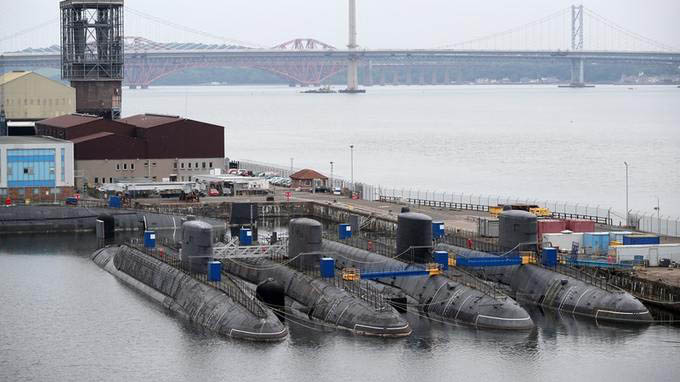
A ROSYTH councillor has called for assurances that rotting nuclear submarines will not be sent to Australia for disposal.
Brian Goodall, who is UK/Ireland Nuclear Free Local Authority’s spokesperson on nuclear submarine decommissioning, said he has written to the UK’s foreign and defence secretaries.
He’s asked for confirmation that vessels will not go overseas if a new Australian law passes without amendments.
Seven old subs have been laid up at Rosyth Dockyard for decades with Dreadnought being there for the longest – more than 40 years – waiting to be scrapped.
The UK and USA signed a pact with Australia to build and operate a new fleet of nuclear submarines which includes the provision of new conventionally armed, but nuclear powered, vessels for the Australian Navy.
To support the pact, legislators down under have proposed a new Australian Naval Nuclear Power Safety Bill 2024.
This appears to allow the disposal of high level radioactive waste from British and American submarines on Australian soil, and also for the storage of such materials in Australia from “a submarine that is not complete”.
In his letter to Lord Cameron and Grant Shapps, Cllr Goodall expressed concern that this could theoretically mean permitting “the towing of redundant UK boats from Rosyth and Devonport down under for disposal”.
He said he fears that this could result in the loss of local expertise and jobs if it comes into practice.
He adds: “Surely as the operators of our own submarines, the UK Government should remain responsible for the storage of the resultant high-level waste and for their safe decommissioning in home ports?
“Not only will this preserve the expertise in these matters that has developed after many years of trial and error, but, as a ward member for the Rosyth Dockyard, it will also preserve the jobs in my local community.”
Back in 2022, the Press reported pledges from the UK Government that all laid-up submarines would be gone as part of plans to “de-nuclearise Rosyth” by 2035.
Councillors were given an update on the programme to remove radioactive waste and turn the seven boats that have been parked at the dockyard for decades into “tin cans and razor blades”.
The Ministry of Defence have previously faced heavy criticism for the delays and sky-high costs in dealing with the nuclear legacy, with 27 Royal Navy subs to be scrapped in total.
The Slow-Motion Execution of Julian Assange Continues .
Free speech is a key issue. If Julian is granted First Amendment rights in a U.S. court it will be very difficult for the U.S. to build a criminal case against him, since other news organizations, including The New York Times and The Guardian, published the material he released.
The ruling by the High Court in London permitting Julian Assange to appeal his extradition order leaves him languishing in precarious health in a high-security prison. That is the point.
CHRIS HEDGES, MAY 24, 2024, https://chrishedges.substack.com/p/the-slow-motion-execution-of-julian-986?utm_source=post-email-title&publication_id=778851&post_id=144930141&utm_campaign=email-post-title&isFreemail=true&r=ln98x&triedRedirect=true&utm_medium=email
The decision by the High Court in London to grant Julian Assange the right to appeal the order to extradite him to the United States may prove to be a Pyrrhic victory. It does not mean Julian will elude extradition. It does not mean the court has ruled, as it should, that he is a journalist whose only “crime” was providing evidence of war crimes and lies by the U.S. government to the public. It does not mean he will be released from the high-security HMS Belmarsh prison where, as Nils Melzer, the UN Special Rapporteur on Torture, after visiting Julian there, said he was undergoing a “slow-motion execution.”
It does not mean that journalism is any less imperiled. Editors and publishers of five international media outlets —– The New York Times, the Guardian, Le Monde, El Pais and DER SPIEGEL —– which published stories based on documents released by WikiLeaks, have urged that the U.S. charges be dropped and Julian be released. None of these media executives were charged with espionage. It does not dismiss the ludicrous ploy by the U.S. government to extradite an Australian citizen whose publication is not based in the U.S. and charge him under the Espionage Act. It continues the long Dickensian farce that mocks the most basic concepts of due process.
This ruling is based on the grounds that the U.S. government did not offer sufficient assurances that Julian would be granted the same First Amendment protections afforded to a U.S. citizen, should he stand trial. The appeal process is one more legal hurdle in the persecution of a journalist who should not only be free, but feted and honored as the most courageous of our generation.
Yes. He can file an appeal. But this means another year, perhaps longer, in harsh prison conditions as his physical and psychological health deteriorates. He has spent over five years in HMS Belmarsh without being charged. He spent seven years in the Ecuadorian Embassy because the U.K. and Swedish governments refused to guarantee that he wouldn’t be extradited to the U.S., even though he agreed to return to Sweden to aid a preliminary investigation that was eventually dropped.
The judicial lynching of Julian was never about justice. The plethora of legal irregularities, including the recording of his meetings with attorneys by the Spanish security firm UC Global at the embassy on behalf of the CIA, alone should have seen the case thrown out of court as it eviscerates attorney-client privilege.
The U.S. has charged Julian with 17 counts under the Espionage Act and one count of computer misuse, for an alleged conspiracy to take possession of and then publish national defense information. If found guilty on all of these charges he faces 175 years in a U.S. prison.
The extradition request is based on the 2010 release by WikiLeaks of the Iraq and Afghanistan war logs — hundreds of thousands of classified documents, leaked to the site by Chelsea Manning, then an Army intelligence analyst, which exposed numerous U.S. war crimes including video images of the gunning down of two Reuters journalists and 10 other unarmed civilians in the Collateral Murder video, the routine torture of Iraqi prisoners, the covering up of thousands of civilian deaths and the killing of nearly 700 civilians that had approached too closely to U.S. checkpoints.
In February, lawyers for Julian submitted nine separate grounds for a possible appeal.
A two-day hearing in March, which I attended, was Julian’s last chance to request an appeal of the extradition decision made in 2022 by the then British home secretary, Priti Patel, and of many of the rulings of District Judge Baraitser in 2021.
The two High Court judges, Dame Victoria Sharp and Justice Jeremy Johnson, in March rejected most of Julian’s grounds of appeal. These included his lawyers’ contention that the UK-US extradition treaty bars extradition for political offenses; that the extradition request was made for the purpose of prosecuting him for his political opinions; that extradition would amount to retroactive application of the law — because it was not foreseeable that a century-old espionage law would be used against a foreign publisher; and that he would not receive a fair trial in the Eastern District of Virginia. The judges also refused to hear new evidence that the CIA plotted to kidnap and assassinate Julian, concluding — both perversely and incorrectly — that the CIA only considered these options because they believed Julian was planning to flee to Russia.
But the two judges determined Monday that it is “arguable” that a U.S. court might not grant Julian protection under the First Amendment, violating his rights to free speech as enshrined in the European Convention on Human Rights.
The judges in March asked the U.S. to provide written assurances that Julian would be protected under the First Amendment and that he would be exempt from a death penalty verdict. The U.S. assured the court that Julian would not be subjected to the death penalty, which Julian’s lawyers ultimately accepted. But the Department of Justice was unable to provide an assurance that Julian could mount a First Amendment defense in a U.S. court. Such a decision is made in a U.S. federal court, their lawyers explained.
Assistant U.S. Attorney Gordon Kromberg, who is prosecuting Julian, has argued that only U.S. citizens are guaranteed First Amendment rights in U.S. courts. Kromberg has stated that what Julian published was “not in the public interest” and that the U.S. was not seeking his extradition on political grounds.
Free speech is a key issue. If Julian is granted First Amendment rights in a U.S. court it will be very difficult for the U.S. to build a criminal case against him, since other news organizations, including The New York Times and The Guardian, published the material he released.
The extradition request is based on the contention that Julian is not a journalist and not protected under the First Amendment.
Julian’s attorneys and those representing the U.S. government have until May 24 to submit a draft order, which will determine when the appeal will be heard.
Julian committed the empire’s greatest sin — he exposed it as a criminal enterprise. He documented its lies, routine violation of human rights, wanton killing of innocent civilians, rampant corruption and war crimes. Republican or Democrat, Conservative or Labour, Trump or Biden — it does not matter. Those who manage the empire use the same dirty playbook.
The publication of classified documents is not a crime in the United States, but if Julian is extradited and convicted, it will become one.
Julian is in precarious physical and psychological health. His physical and psychological deterioration has resulted in a minor stroke, hallucinations and depression. He takes antidepressant medication and the antipsychotic quetiapine. He has been observed pacing his cell until he collapses, punching himself in the face and banging his head against the wall. He has spent weeks in the medical wing of Belmarsh, nicknamed “hell wing.” Prison authorities found “half of a razor blade” hidden under his socks. He has repeatedly called the suicide hotline run by the Samaritans because he thought about killing himself “hundreds of times a day.”
These slow-motion executioners have not yet completed their work. Toussaint L’Ouverture, who led the Haitian independence movement, the only successful slave revolt in human history, was physically destroyed in the same manner. He was locked by the French in an unheated and cramped prison cell and left to die of exhaustion, malnutrition, apoplexy, pneumonia and probably tuberculosis.
Prolonged imprisonment, which the granting of this appeal perpetuates, is the point. The 12 years Julian has been detained — seven in the Ecuadorian Embassy in London and over five in high-security Belmarsh Prison — have been accompanied by a lack of sunlight and exercise, as well as unrelenting threats, pressure, prolonged isolation, anxiety and constant stress. The goal is to destroy him.
We must free Julian. We must keep him out of the hands of the U.S. government. Given all he did for us, we owe him an unrelenting fight.
If there is no freedom of speech for Julian, there will be no freedom of speech for us.
UK Nuclear Plant Sizewell Continues Fundraising Before Election

- Banks offered to lend as much as £12.5 billion for Sizewell C
By Will Mathis, May 24, 2024
The developer of the UK’s Sizewell C nuclear power plant is pushing ahead to complete
financing for the project this year even as a looming election risks
complicating the timeline.
A group of banks offered to lend as much as
£12.5 billion ($15.9 billion) to help finance the plant in eastern
England, according to a person familiar with the matter. They include HSBC
Holdings Plc, NatWest Group Plc and Banco Santander SA, the person said.
Debt will play a role in a multibillion-pound funding effort that also
includes an ongoing effort to raise equity from private investors.
“The two main political parties are committed to Sizewell C and we are carrying
on with the capital raise, preparing for a final investment decision and
mobilizing teams on our site,” a spokesperson for Sizewell said,
declining to comment on the debt specifically.
HSBC and Santander declined to comment. NatWest didn’t immediately comment.
The government had vowed
to reach a final investment decision on the proposed 3.2-gigawatt Sizewell
C station in the current parliament, a process that was on track to
complete this summer. That means the final stage of the fund-raising
process could be among Labour leader Keir Starmer’s first acts if he
becomes prime minister. “Sizewell needs to move forward at pace,”
Starmer said during a visit to another nuclear plant last year. “New
nuclear has to be part of that mix.”
Bloomberg 23rd May 2024
Nuclear-free councils hit out at ‘mad delusion’ of new reactor

By Alan Hendry – alan.hendry@hnmedia.co.uk, 25 May 2024
Calls for a nuclear revival in Scotland – including the possibility of a new Dounreay reactor – have been dismissed as “folly” and a “mad delusion”.
Scottish Nuclear Free Local Authorities (NFLAs), a grouping of councils opposed to civil nuclear power, insisted that renewables “represent the only way forward to achieve a sustainable, net-zero future”.
The secretary of state for Scotland, Alister Jack, confirmed last week that he had asked the UK energy minister to plan for a new nuclear site north of the border as part of a nationwide strategy.
Dounreay had been put forward among the possible locations for a small modular reactor (SMR), a series of 10 power stations that engineering giant Rolls-Royce was planning to build by 2035.
Jamie Stone, the Liberal Democrat MP for Caithness, Sutherland and Easter Ross, was quick to press the case for Dounreay to be considered. After a conversation with the Scottish secretary, Mr Stone claimed there was “all to play for”.
Ross-shire Journal 25th May 2024
SNPs Stephen Flynn claims Labour ‘will divert £20bn of Scotland’s oil cash’ to build nuclear power plants in England
John Ferguson, Sunday Mail political editor, 25 May 24
SNP Westminster leader Stephen Flynn has accused Labour of planning to divert £20billion of tax receipts from Scotland’s oil wealth to build nuclear power plants in England……………………………………………………………………… https://www.dailyrecord.co.uk/news/scottish-news/snps-stephen-flynn-claims-labour-32893362
Taxpayer contribution to Sizewell C nuclear plant could double
24 May, 2022 By Rob Hakimian https://www.newcivilengineer.com/latest/taxpayer-contribution-to-sizewell-c-nuclear-plant-could-double-24-05-2022/
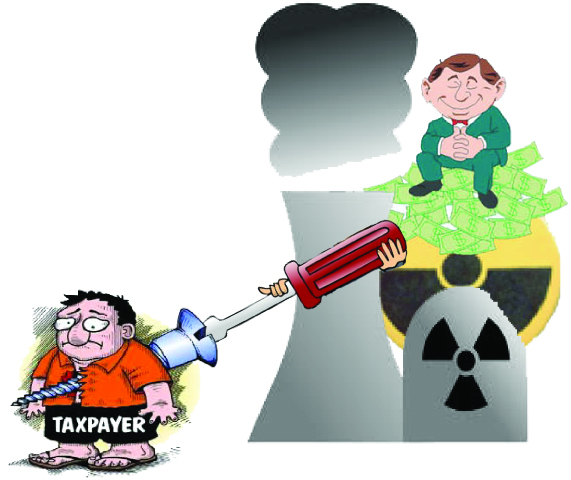
Construction of the Sizewell C nuclear plant in Suffolk could cost taxpayers more than double what the government has suggested, according to new research
Construction of Sizewell C has not yet been confirmed, with the planning decision having recently been pushed back to July.
However, with the UK set to lose all of its functional advanced gas-cooling reactor (AGR) nuclear plants by 2028, the government is keen to push through plans for new plants as it has made nuclear energy a crux point of its net zero strategy and energy security strategy. It has already committed £100M to Sizewell C and, crucially, agreed to use the regulated asset base (RAB) funding model to pay for it.
The RAB model, which has previously been used to fund Tideway and Heathrow Terminal 5, allows investors to recoup some of their money during the construction phase of the project through taxation. The taxpayer pays for the plant through monthly surcharge on their taxes before they reap the rewards. The government says that, while the taxpayer will have to pay the surcharge during construction, they will save £10 a month through this method once the plant is operational.
However, if a project suffers delays and cost increases, this means the risk falls on the shoulders of the taxpayer. As seen by continual delays and cost hikes on Hinkley Point C, nuclear plants are particularly susceptible.
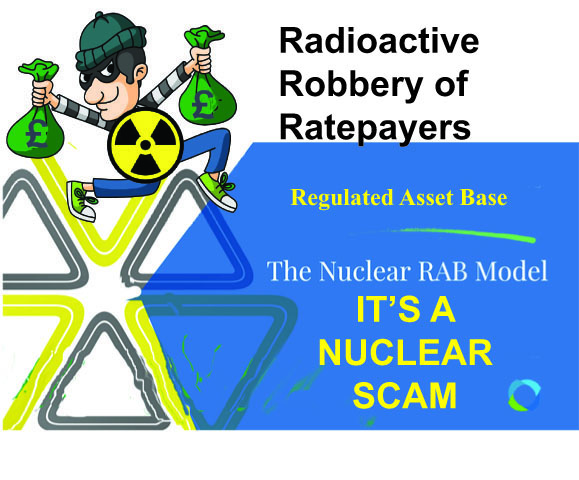
In its own analysis of using the RAB model to fund Sizewell C, the government has said that over the course of the plant’s 13-17 years construction it will add an average surcharge of £1 per month to household bills. However, the University of Greenwich School of Business says that the government’s calculations are based on 2021 prices and do not account for inflation over the course of the next two decades as the plant is built.
Taking into account inflation, based on the Treasury’s target level of 2%, Greenwich Business School has determined that the cost could be up to £2.12 per month on average over the course of the construction time. However, this is a relatively conservative estimate, as inflation could be much greater than 2% over the course of the next 20 years.
The government’s calculation is based on the median expectations for the construction of Sizewell C, i.e. that it will take 15 years (midway between the projected 13-17 years) and cost £35bn (midway between the estimated £26.3bn and £43.8bn).
Greenwich Business School has also looked at the best and worse case scenarios, adding 2% inflation. If the construction were to only last 13 years and cost £26.3bn, the taxpayer would fork out an additional £148.20 over the course (an average of 95p per month). If it is to last 17 years and cost £43.8bn, the taxpayer will pay an additional £431.90 over the duration (an average of £2.12 per month).
This figure could be even higher if the project runs beyond 17 years, costs over £43.8bn and/or inflation rises by more than 2%, all of which are distinct possibilities.
The RAB model, which has previously been used to fund Tideway and Heathrow Terminal 5, allows investors to recoup some of their money during the construction phase of the project through taxation. The taxpayer pays for the plant through monthly surcharge on their taxes before they reap the rewards. The government says that, while the taxpayer will have to pay the surcharge during construction, they will save £10 a month through this method once the plant is operational.
This figure could be even higher if the project runs beyond 17 years, costs over £43.8bn and/or inflation rises by more than 2%, all of which are distinct possibilities.
Both the government’s and Greenwhich Business School’s calculations are based on illustrative figures. More accurate figures will be known once planning has been granted and investment partners found.
This presents another issue, as there are no clear investors champing at the bit. While the government is bullish about nuclear’s potential green benefits, many potential investors are uncertain of its environmental, social and governance (ESG) credentials. Aviva Investors has even called out the government for not providing enough detail for a proper assessment on nuclear’s ESG potential.
University of Greenwich emeritus professor of energy policy Stephen Thomas told NCE: “There are differences between Tideway and Sizewell C. One is scale: Tideway is said to be a huge project, but the cost is not much more than a 10th of what Sizewell C will be, so it will be a big strain on that market.
- You are here: Latest
Taxpayer contribution to Sizewell C nuclear plant could double
24 May, 2022 By Rob Hakimian
Construction of the Sizewell C nuclear plant in Suffolk could cost taxpayers more than double what the government has suggested, according to new research.
Construction of Sizewell C has not yet been confirmed, with the planning decision having recently been pushed back to July.
However, with the UK set to lose all of its functional advanced gas-cooling reactor (AGR) nuclear plants by 2028, the government is keen to push through plans for new plants as it has made nuclear energy a crux point of its net zero strategy and energy security strategy. It has already committed £100M to Sizewell C and, crucially, agreed to use the regulated asset base (RAB) funding model to pay for it.
The RAB model, which has previously been used to fund Tideway and Heathrow Terminal 5, allows investors to recoup some of their money during the construction phase of the project through taxation. The taxpayer pays for the plant through monthly surcharge on their taxes before they reap the rewards. The government says that, while the taxpayer will have to pay the surcharge during construction, they will save £10 a month through this method once the plant is operational.
However, if a project suffers delays and cost increases, this means the risk falls on the shoulders of the taxpayer. As seen by continual delays and cost hikes on Hinkley Point C, nuclear plants are particularly susceptible.
In its own analysis of using the RAB model to fund Sizewell C, the government has said that over the course of the plant’s 13-17 years construction it will add an average surcharge of £1 per month to household bills. However, the University of Greenwich School of Business says that the government’s calculations are based on 2021 prices and do not account for inflation over the course of the next two decades as the plant is built.
Taking into account inflation, based on the Treasury’s target level of 2%, Greenwich Business School has determined that the cost could be up to £2.12 per month on average over the course of the construction time. However, this is a relatively conservative estimate, as inflation could be much greater than 2% over the course of the next 20 years.
The government’s calculation is based on the median expectations for the construction of Sizewell C, i.e. that it will take 15 years (midway between the projected 13-17 years) and cost £35bn (midway between the estimated £26.3bn and £43.8bn).
Greenwich Business School has also looked at the best and worse case scenarios, adding 2% inflation. If the construction were to only last 13 years and cost £26.3bn, the taxpayer would fork out an additional £148.20 over the course (an average of 95p per month). If it is to last 17 years and cost £43.8bn, the taxpayer will pay an additional £431.90 over the duration (an average of £2.12 per month).
This figure could be even higher if the project runs beyond 17 years, costs over £43.8bn and/or inflation rises by more than 2%, all of which are distinct possibilities.
Both the government’s and Greenwhich Business School’s calculations are based on illustrative figures. More accurate figures will be known once planning has been granted and investment partners found.
This presents another issue, as there are no clear investors champing at the bit. While the government is bullish about nuclear’s potential green benefits, many potential investors are uncertain of its environmental, social and governance (ESG) credentials. Aviva Investors has even called out the government for not providing enough detail for a proper assessment on nuclear’s ESG potential.
University of Greenwich emeritus professor of energy policy Stephen Thomas told NCE: “There are differences between Tideway and Sizewell C. One is scale: Tideway is said to be a huge project, but the cost is not much more than a 10th of what Sizewell C will be, so it will be a big strain on that market.
“The second difference is that there is output to sell from Sizewell C. Thames Tideway gets its money by being there and providing a service; if it’s there and it’s not utterly failed then that’s it. Sizewell C has kilowatt hours to sell, and there are risks in that because you don’t know how reliable the plant is going to be, you don’t know what the running costs are going to be, you don’t know what the fuel costs are going to be. So there are risks involved in that.
“The RAB is a bit of an illusion, because the kilowatt hour costs that they will quote are based on whatever it costs to ensure investors make their agreed return, no matter how high the price. It will ignore the surcharge paid during the construction phase, which is a huge subsidy by consumers. It is a blank cheque signed by consumers. It’s a dreadful model.”
A Sizewell C spokesperson said: “The RAB model is a proven financing arrangement which has already been used to raise funds for more than £160bn of infrastructure. Applied to Sizewell C, it will bring the cost of finance down and deliver significant savings to consumers.”
A government spokesperson said: “We firmly stand by our assessment that a large-scale project funded under our Nuclear Act would add at most a few pounds a year to typical household energy bills during the early stages of construction, and on average about £1 a month during the full construction phase of the project.”
Wylfa nuclear power plan- a financial basket case- and no developer will take on the risks.
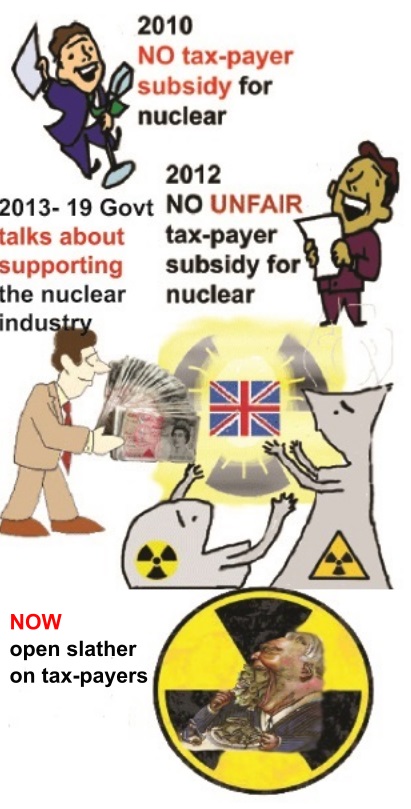
Dr Doug Parr, Chief Scientist for Greenpeace UK, said: “Government
announcements about new reactors have a theatrical quality that doesn’t
inspire confidence, particularly when the financial disaster movie of
Hinkley is still rolling in the background.
But Wylfa poses an additional
danger because, after the damage suffered by EDF, no developer will take on
the financial risks of construction. And so in the unlikely event of this
reactor being built, bill payers will be on the hook for billions of cost
overruns.
Just how badly that can play out is revealed by the one location
where the kind of funding structure favoured by the government has been
tried, in South Carolina in the USA. The bill payers of the state have seen
billions added to their bills even though the planned reactors have been
abandoned uncompleted. Even worse, this financial basket case is one of the
reactor designs the government is considering for Wylfa.”
Carmarthenshire News 23rd May 2024
UK Election! And no Final Investment Decision made on Sizewell nuclear project

https://mailchi.mp/stopsizewellc/election?e=c3c4307b44 24 May 24
Last night’s announcement of a snap election has convinced us that the government’s commitment to reach a Final Investment Decision (FID) on Sizewell C within the current parliament is essentially impossible to fulfil. We explain why below, and why Sizewell C’s future is dependent on the election outcome.
We are already making plans to set up actions that will enable you to contact parliamentary candidates about Sizewell C – certainly in Suffolk but hopefully countrywide – and planning an energy hustings in East Suffolk with our allies. Meanwhile we have sent the following comment and briefing to the media.
“The impossibility of a Final Investment Decision on Sizewell C being made before the election lets the Conservatives off the hook for signing away another HS2. It also presents a likely Labour government, looking to drive down bills and reach net zero by 2030, an opportunity to focus on more cost effective renewable projects. We are going to do everything in our power to ensure that this election signals the death knell for slow, expensive, risky Sizewell C.”
- Stop Sizewell C understands that the capital raise is still ongoing, and final bids have yet to be submitted, reportedly due by the end of June. A likely change in government may increase the risks perceived by investors and influence or even deter bids. The capital raise will be subject to a Value for Money (VfM) assessment. If, as reported, investors are seeking high returns, the VfM – and therefore the capital raise – is likely to fail.
- In this event, Ministers would have to decide whether to take a FID with the taxpayer as Sizewell C’s majority stakeholder. An additional VfM assessment will be required as well as multiple internal procedural steps and approvals.
While Labour’s stated position is in favour of Sizewell C, the implications of having to make a FID requiring billions of pounds of taxpayers’ money and which would additionally push much of the risk onto household bills via use of the RAB funding model, in addition to the impossibility of Sizewell C contributing to the goal of net zero by 2030, may give pause. Rising costs and inflation make the current government’s estimate of a Sizewell C RAB costing consumers on average £1 month improbable.
A new government would be expected to conduct a Spending Review ahead of an autumn budget, which seems likely to also lead to a pause before any decision about a Sizewell C FID was made.
Sizewell C Chair Rob Holden acknowledged the risk associated with a change in government telling the The Times recently “Clearly there has to be a risk there. There is with any big decision on this.” In the same interview Rob Holden also highlighted that further widening of the gap between Hinkley Point C and Sizewell C would reduce any replication “benefits”.
Even in the very unlikely event a FID could be fast-tracked, pre-election guidance states that Ministers should “observe discretion” in making big announcements. This must be especially pertinent if a large commitment of taxpayers’ money was necessary for a Sizewell C FID. Having sucked up £2.5bn in taxpayers’ money already, which we understand is all committed, it’s possible yet more funds will be allocated to keep the project going over this period of uncertainty.
Nuclear Free Local Authorities (NFLAs) join Stop Sizewell in urging 120 local authorities not to back Sizewell C
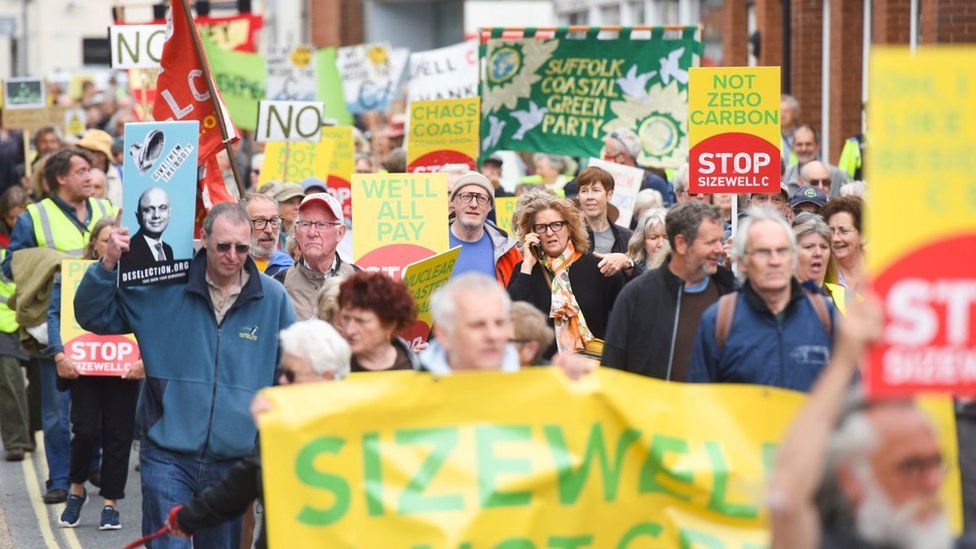
The UK/Ireland Nuclear Free Local Authorities have joined campaigners at Stop Sizewell in writing to pension fund administrators providing benefits to members in at least 120 UK local authorities urging them not to finance the Sizewell C nuclear power plant project in Suffolk.
In recent months, Government ministers and EDF have been busy courting pension funds seeking private sector finance. UK taxpayers have already been unwittingly forced to stump up £2.5 billion in pledges made by the government to kick start preparatory works on the site, but government will need billions more to commence construction.
The estimated cost of completing Sizewell C’s sister plant Hinkley Point C in Somerset could be as high as £46 billion, and civil nuclear projects are notorious for being delivered late and hugely over budget.
Now NFLA Secretary Richard Outram has joined Stop Sizewell Executive Director Alison Downes in writing to Council pension funds urging them to invest in renewables instead of nuclear, particularly in light of the many resolutions passed by Councils to take urgent action to tackle climate change.
Stop Sizewell have also prepared an excellent briefing outlining why backing Sizewell C would be a bad investment:
……………………………………………..more https://www.nuclearpolicy.info/news/nflas-join-stop-sizewell-in-urging-120-local-authorities-not-to-back-sizewell-c/
1 This Month
Chernobyl: The Lost Tapes – A good documentary on Chernobyl on SBS available On Demand for the next 3 weeks– https://www.sbs.com.au/ondemand/tv-program/chernobyl-the-lost-tapes/2352741955560

of the week–London Campaign for Nuclear Disarmament

Tell the Ukrainian Government to Drop Prosecution of Peace Activist Yurii Sheliazhenko
To see nuclear-related stories in greater depth and intensity – go to https://nuclearinformation.wordpress.com
-
Archives
- April 2026 (114)
- March 2026 (251)
- February 2026 (268)
- January 2026 (308)
- December 2025 (358)
- November 2025 (359)
- October 2025 (376)
- September 2025 (257)
- August 2025 (319)
- July 2025 (230)
- June 2025 (348)
- May 2025 (261)
-
Categories
- 1
- 1 NUCLEAR ISSUES
- business and costs
- climate change
- culture and arts
- ENERGY
- environment
- health
- history
- indigenous issues
- Legal
- marketing of nuclear
- media
- opposition to nuclear
- PERSONAL STORIES
- politics
- politics international
- Religion and ethics
- safety
- secrets,lies and civil liberties
- spinbuster
- technology
- Uranium
- wastes
- weapons and war
- Women
- 2 WORLD
- ACTION
- AFRICA
- Atrocities
- AUSTRALIA
- Christina's notes
- Christina's themes
- culture and arts
- Events
- Fuk 2022
- Fuk 2023
- Fukushima 2017
- Fukushima 2018
- fukushima 2019
- Fukushima 2020
- Fukushima 2021
- general
- global warming
- Humour (God we need it)
- Nuclear
- RARE EARTHS
- Reference
- resources – print
- Resources -audiovicual
- Weekly Newsletter
- World
- World Nuclear
- YouTube
-
RSS
Entries RSS
Comments RSS
 nuclear-news