NUCLEAR NIGHTMARE: SOLAR REVOLUTION

Sir Jonathon Porritt, 7 Feb 25
So, what was Keir Starmer’s response to news yesterday that not only was 2024 the hottest year ever, but that January 2025 was the hottest January ever – when it had been widely predicted that it would be a lot cooler than January 2024: we’re going to double down on our endlessly recycled nuclear fantasies as the best way of achieving instant economic growth.
At the same time, the once-quite-sensible Ed Miliband was reduced to mouthing growthist inanities: “build, baby, build”.
OMG! What drugs are these pro-nuclear politicians on? Was their mothers’ milk radioactive? Do they really have to regurgitate every last gobbet of the nuclear industry’s manic and mostly dishonest hype?
Here’s what this nuclear growth agenda looks like in reality.
Over the next decade, both the big stuff (another of EDF’s Hinkley Point look-alikes at Sizewell C on the Suffolk coast) and the small stuff (as in the spectacularly over-hyped Small Modular Reactors) will make zero difference to consumers’ energy bills; zero difference to UK energy security; and zero difference to achieving our Net Zero targets .
During that time, new nuclear’s contribution to economic growth will be marginal at best, non-existent at worst. Sizewell C is may never get a Final Investment Decision – after six years of “best efforts” to sign up investors by both the Tories and Labour. Contrary to what you might think, Small Modular Reactors do not, at the moment, actually exist outside of the fevered brains of the nuclear industry. And even if the investment required, for either big or small, was somehow cobbled together, any new nuclear projects are GUARANTEED to be massively over-budget (good for growth, I agree, but disastrous for taxpayers) and massively delayed.
Which is why, dear Keir and dear Ed, easing planning conditions for new nuclear projects will make literally ZERO difference to achieving any additional economic growth.
To mitigate the despair you might now be feeling, thinking about the nuclear-powered Starmer/ Reeves/ Miliband troika, here’s a quick pick-me-up to end the week on a cheerier note.
Just a week ago, a consortium of financial institutions (led by the World Bank and the African Development Bank) agreed the biggest roll out of solar energy in the continent of Africa’s history: $35 billion in loans (at below-market interest rates) to provide electricity for roughly half of the 600 million Africans who are currently deprived of that basic necessity. And roughly half of that $35 billion will be invested in solar mini-grids at the village level. All to be rolled out over the next five years.
It’s so much easier to stay hopeful when one can deal in reality not fantasy.
UK’s new government taxonomy will greenwash nuclear

It would be easy to miss the oblique reference buried in the document where it states that ‘the government proposes that nuclear energy will be classified as green in any future UK Green Taxonomy’. This proposal will be the subject of a further consultation.
Treasury officials and ministers are looking to officially rebrand nuclear power as ‘green energy’ in their latest taxonomy plan; a move the NFLAs will continue to expose and oppose.
Mirroring moves first made by the European Commission, and mooted by the previous Conservative Government, a consultation has now concluded on whether Ministers should establish a new ‘UK Green Taxonomy’ which is described as a ‘useful tool’ in the UK’s ambition ‘to be the world leader in sustainable finance’.
The consultation document describes a taxonomy as ‘a classification tool which provides its users with a common framework to define which economic activities support climate, environmental or wider sustainability objectives’. In essence, it is a mechanism to judge whether an investment is deemed to be ‘green’; if in the case of energy, the technology is judged ‘green’ financial bodies will be better able to justify investing in it to their share- or bondholders.
It would be easy to miss the oblique reference buried in the document where it states that ‘the government proposes that nuclear energy will be classified as green in any future UK Green Taxonomy’. This proposal will be the subject of a further consultation.
Two years ago, we set out in a letter to then Conservative Chancellor Jeremy Hunt in response to his plans to introduce a similar taxonomy a list ‘of the carbon-intensive and environmentally damaging activities that accompany civil nuclear power projects’:
- the mining of uranium and its processing and manufacture into fuel rods which leaves ‘behind environmental degradation, radioactive contamination, and chronic ill-health from exposure to that radiation amongst the local workforce and the host community (usually poor and Indigenous)’
- the construction of a nuclear power plant which ‘requires the employment of vast amounts of concrete, steel and numerous other materials, many years of labour, and many millions of vehicles and personnel movements onto and off site’
- the operation of a nuclear power station necessitating ‘the transportation of fuel rods, waste, other materials and the labour force onto and off the site; the daily use of millions of gallons of seawater with the deaths of millions of fish; and the employment of its own generated electricity for cooling the plant and any stockpiled radioactive waste’
- ongoing nuclear operations which lead to ‘the contamination of the environment surrounding the plant, local beaches, the sea, neighbouring water courses and air’
And, above all, after the closure of the nuclear power station, the need to engage in the costly and prolonged decommissioning of the plant, the decontamination of the site, and the management and treatment of the radioactive waste involves processes that are ‘incredibly resource intensive.’
Green, we don’t think so.
TASC urge Chief Secretary to the Treasury to cancel Sizewell C.
Essex TV 5th Feb 2025, https://essex-tv.co.uk/tasc-urge-chief-secretary-to-the-treasury-to-cancel-sizewell-c/
Together Against Sizewell C (TASC) have written the attached letter to Chief Secretary to the Treasury, Darren Jones, urging government to cancel Sizewell C, saying TASC are “pleased to acknowledge your recent statement to Parliament affirming that you will ”undertake a zero-based review of every pound of public expenditure” as this will enable HM Treasury to carry out a full appraisal of the billions of public funds that the government are sleepwalking into committing to the Sizewell C project”
TASC claim “Sizewell C is a project progressing by stealth, spending money aggressively and at pace, with long lead items being ordered, acting, with taxpayer money, as if a final investment decision has already happened, even though without full financial backing Sizewell C will not be built. There has been no regard to the environmental cost if Sizewell C is not completed.”
TASC took the opportunity to remind Darren Jones of his statement reported in 2022[1] regarding the Sizewell C project “The review will probably conclude that the state can’t take on the capital risk of paying for the majority of the costs of Sizewell C, because private finance was not forthcoming. Nuclear is costly and risky…”
TASC concluded their letter saying, “Sizewell C, is a Boris Johnson vanity project[2] that was recklessly approved by the then Secretary of State, Kwasi Kwarteng, against the recommendation of the five expert planning inspectors”. TASC urge “HM Treasury not to throw more taxpayers’ money at this expensive, risky project that will raise energy bills during its lengthy and problematic construction and announce the cancellation of Sizewell C.”
Opponents of mini nuclear power station question lacklustre consultation
Greens oppose Llynfi power station plans; say Last Energy aren’t doing enough to seek local views.
Oggy Bloggy 5th Feb 2025, by Owen Donovan, https://oggybloggyogwr.com/2025/02/opponents-of-mini-nuclear-power-station-question-lacklustre-consultation/
Although we’re still a long way away from anything official – planning-wise – groups are beginning to organise against a proposed 80MW modular “mini” nuclear power station in the Llynfi Valley.
The proposal by American start-up, Last Energy, arrived out of the blue in October 2024 and has certainly generated lots of interest, both in favour and against.
In the last few days, the Bridgend branch of the Green Party issued a statement opposing the power station.
The Greens have questioned the need for a nuclear power plant, the potential safety and waste risks and the untested technology proposed at the site.
Last Energy has been hosting public meetings in the area about the project. The Greens say that two local meetings – one held in Bettws, one in Pencoed – were poorly advertised and poorly attended. Two meetings for potential suppliers were held in Cardiff and Swansea.
Last Energy has a proposed programme of further public meetings and outreach sessions, many of which are yet to be scheduled.
The next public meeting is set to be held at Coytrahen Community Centre on Monday 17th February 2025, starting at 6:15 pm.
With calls for nuclear, are Scottish Labour stuck in the 70s?
BE careful what you wish for. I’ve dreamt all my life of the harnessing of robots
and artificial intelligence, enabling a wondrous and liberated human
civilisation. And now you tell me their power needs mean we must build more
domestic nuclear reactors? Sometimes the big narratives really don’t line
up.
We live in a country where renewable energy provided 113% of
Scotland’s overall electricity consumption in 2022 – and it’s set to
ascend over the coming decades. It’s an infrastructural build-out which
is, rightly, one solid plank in the economic and societal case for
independence.
The sense that a Scottish national future is desirable comes
significantly from the vigour, the virtue – and the permanence – of our
renewables sector. So it was jarring, as well as embarrassing, to hear Anas
Sarwar deride John Swinney in Holyrood on Thursday as “trapped in the
1970s”, as the First Minister resisted Labour’s calls for a new wave of
nuclear power plants across the UK. What could be more 70s than
atomics+computers = progress!
The National 8th Feb 2025 https://www.thenational.scot/politics/24920161.calls-nuclear-scottish-labour-stuck-70s/
Requiem for the trees
Earlier this week, Sizewell C admitted to a Community Forum that they have
felled a staggering 21,675 trees! The photo above shows local resident
David Grant seated on the remains of a 300 year-old oak tree on the
boundary between his land and what was compulsorily purchased for the
Sizewell Link Road. He was being interviewed by BBC Look East, for
broadcast next Tuesday (11th, 6.30pm) about the devastation. But we are
still not being told who will pay for Sizewell C and what it will cost.
Stop Sizewell C 7th Feb 2025 https://mailchi.mp/stopsizewellc/en7?e=326ee81c22
Planners recommended against nuclear plant in 2019 citing fears for Welsh language
the inspectors’ report concluded that “the matters weighing against the proposed development outweigh the matters weighing in favour of it” and that despite planned mitigations the project could “adversely affect tourism, the local economy, health and wellbeing and Welsh language and culture”
Industry figures say fate of Anglesey facility to have been built by Hitachi shows problems with planning system
Guardian, Eleni Courea 7 Feb 25
Planning inspectors recommended against a Hitachi-built nuclear power plant in Anglesey on the basis that it could dilute the island’s Welsh language and culture, it has emerged.
Hitachi scrapped plans to build a £20bn nuclear power plant at Wylfa in 2020 over cost concerns after failing to reach a funding agreement with UK ministers.
Keir Starmer’s government has vowed to make it easier to build major infrastructure projects by reforming the planning system and stopping campaigners from launching “excessive” legal challenges.
The prime minister unveiled plans for a historic expansion in nuclear power this week, vowing to “push past nimbyism” and make sites across the country available for new power stations.
Nuclear industry figures believe that the fate of Hitachi’s proposed plant at Wylfa demonstrates the problems with the UK’s planning system.
Planning inspectors appointed by the UK government recommended that the project be rejected in 2019, warning of its impact on biodiversity, the local economy, housing stock and the Welsh language.
The inspectors’ 906-page report said the additional workers required by the project would put pressure on local housing and schools and that “given the number of Welsh-speaking residents, this could adversely affect Welsh language and culture”.
Hitachi carried out a Welsh language impact assessment as part of its application, which found that the project would need to bring 7,500 workers from outside the area. Anglesey has 70,000 residents and one of the highest concentrations of Welsh speakers in the country.
The impact assessment concluded the extra workers “could have a major adverse effect on the balance of Welsh and non-Welsh speakers” in the area and “could adversely affect the use and prominence of the Welsh language within communities”.
But the assessment also found that by creating high-skilled jobs for young people, the project would help preserve the Welsh language on the island. It would have created more than 2,000 local construction jobs for nine years, and about 85% of the plant’s workforce would be local under the plans.
Nevertheless, the inspectors’ report concluded that “the matters weighing against the proposed development outweigh the matters weighing in favour of it” and that despite planned mitigations the project could “adversely affect tourism, the local economy, health and wellbeing and Welsh language and culture”
It also found that the developers had not put forward enough evidence to demonstrate that the arctic and sandwich tern populations around the Cemlyn Bay area, where the plant was going to be built, would not be disturbed by construction. There were fears that the birds would abandon the area as a result.
The last Conservative government revived plans for a large-scale nuclear power station at Wylfa and bought the site from Hitachi for £160m. In its election manifesto, Labour pledged to “explore the opportunities for new nuclear at Wylfa”………………………………..
Linda Rogers of the campaign group People Against Wylfa B said Hitachi withdrew “because the government wasn’t able to provide adequate funding as far as they were concerned”.
She added: “[The plans] broke environmental regulations – which this present government is laughing at, at a time when we need to increase biodiversity – and affected very much the local wildlife, particularly terns. And it was bad for the Welsh language. There were a lot of issues why it was not appropriate to build at Wylfa.” https://www.theguardian.com/politics/2025/feb/07/planners-recommended-against-nuclear-plant-in-2019-over-welsh-language-and-cultural-concerns-hitachi
Council votes to end Holderness nuclear waste talks
22 February 2024, Richard Madden & David McKenna, BBC News
Councillors have voted to immediately pull out of talks over the siting of a nuclear waste disposal facility in East Yorkshire.
Nuclear Waste Services (NWS) had identified South Holderness as a potential area for a Geological Disposal Facility (GDF).
East Riding of Yorkshire Council said it had listened to the public and decided to withdraw.
NWS said it would now “wind down” the South Holderness proposal.
The proposal to pull out of the talks had been put forward by two Conservative councillors, Lyn Healing and Sean McMaster, and was voted through almost unanimously at a full council meeting on Wednesday.
Beverley and Holderness MP, Graham Stuart, said he was “delighted” at the result of the vote.
‘Hare-brained idea’
Ms Healing told the meeting she was concerned about safety and the impact on tourism and farming due to the area becoming industrialised.
She said both she and Mr McMaster had received hundreds of messages from concerned residents.
Speaking ahead of the vote, Councillor Denis Healy, Liberal Democrats, said local residents had “unequivocally” rejected the idea.
“So, let’s just show our residents the respect they deserve and give them our verdict on this hare-brained idea right now,” he added.
A GDF consists of a series of vaults and tunnels deep underground, or under the sea, where the material would be buried.
NWS, which had claimed a GDF would create thousands of jobs and opportunities for investment in infrastructure, said it “fully respected” any decision taken by the authority…………………………………… https://bbc.com/news/uk-england-humber-68350061
Concern UK’s AI ambitions could lead to water shortages

Zoe Kleinman, Technology editor•@zskm Brian Wheeler, Senior political reporter.
BBC 7th Feb 2025, https://www.bbc.co.uk/news/articles/ce85wx9jjndo
Sir Keir Starmer’s plan to make the UK a “world leader” in Artificial Intelligence (AI) could put already stretched supplies of drinking water under strain, industry sources have told the BBC.
The giant data centres needed to power AI can require large quantities of water to prevent them from overheating.
The tech industry says it is developing more efficient cooling systems that use less water.
But the department for science, innovation and technology said in a statement it recognised the plants “face sustainability challenges”. The government has committed to the construction of multiple data centres around the country in an effort to kick start economic growth.
Ministers insist the notoriously power-hungry server farms will be given priority access to the electricity grid.
Questions have been raised about the impact this might have on the government’s plans for clean energy production by 2030.
But less attention has been given to the impact data centres could have on the supply of fresh, drinkable water to homes and businesses.
Parts of the UK, in the south especially, are already under threat of water shortages because of climate change and population growth.
The government is backing plans for nine new reservoirs to ease the risk of rationing and hosepipe bans during droughts.
But some of these are in areas where new data centres are set to be built.
The first of the government’s “AI growth zones” will be in Culham, Oxfordshire, at the UK Atomic Energy Authority’s campus – seven miles from the site of a planned new reservoir at Abingdon.
The 4.5 sq mile (7 sq km) reservoir will supply customers in the Thames Valley, London and Hampshire. It is not known how much water the massive new data centres now planned nearby could take from it.
The BBC understands Thames Water has been talking to the government about the challenge of water demand in relation to data centres and how it can be mitigated.
In a new report, the Royal Academy of Engineering calls on the government to ensure tech companies accurately report how much energy and water their data centres are using.
It also calls for environmental sustainability requirements for all data centres, including reducing the use of drinking water, moving to zero use for cooling.
Without such action, warns one of the report’s authors, Prof Tom Rodden, “we face a real risk that our development, deployment and use of AI could do irreparable damage to the environment”.
The twelve ideal sites for mini nuclear reactors, according to an expert.
The Government might be pushing SMRs hard and they may be based on existing technology but they are still unproven.
A new generation of smaller nuclear reactors could be based on
decommissioned sites, speeding up the process considerably, a Government
adviser argues. The first generation of new mini nuclear reactors planned
by the government could be built on the sites of previous decommissioned
nuclear power stations, a leading expert has said.
The stations include 12
of the earliest nuclear sites in the UK, some of which date back to the
1960s and were much smaller than later nuclear power stations. Using a type
of reactor called Magnox, these first-generation nuclear sites were found
in counties such Gloucestershire, Essex, Kent, Oxfordshire, Dumfriesshire
in Scotland and Snowdonia in Wales – and are well placed to be used again
for so-called small modular reactors (SMRs), according to Dr Simon
Harrison, a member of the Government’s new advisory commission on hitting
its net zero target.
SMRs, or small nuclear reactors, are typically about a
tenth or a quarter of the size of a traditional nuclear power plant –
roughly the size of a school bus but six stories high.
The Government might be pushing SMRs hard and they may be based on existing technology but they are still unproven. While they are being promoted as quick and cheap there
is a risk that they could end up running over time and budget.
There are also questions over how SMRS could be financed, given that SMR projects
around the world need financial support from governments. The UK is
expected to use a ‘funding framework’, known as a regulated asset base
(RAB) model, which puts part of the upfront cost on to household energy
bills before the plants start generating electricity, effectively putting
households on the hook for any delays.

The Government is to loosen planning
regulations to allow SMRs to be built in the countryside, with Starmer
insisting he would use Labour’s massive majority to push through the
changes. Dr Harrison, of the Mott MacDonald engineering consultancy, told
The i Paper: “To get the first small modular reactors deployed quickly I
would expect there to be a focus on the old Magnox sites in the first
instance. Dr Harrison said the amount of space available on some of these
Magnox could limit the size of the SMR deployed. And he pointed out
“there has also been interest in old coal power station sites”, meaning
the list can’t be taken to represent the 12 best options. Which sites are
ideally suited to small nuclear reactors. Berkeley, Bradwell, Chapelcross
Dungeness, Harwell, Hinkley Point A, Hunterston A, Oldbury, Sizewell,
Trawsfynydd, Winfrith and Wylfa.
iNews 6th Feb 2025 https://inews.co.uk/news/environment/sites-mini-nuclear-reactors-experts-3522717
Starmer’s “anti-democratic” push to put Nuclear Reactors incommunities without consultation
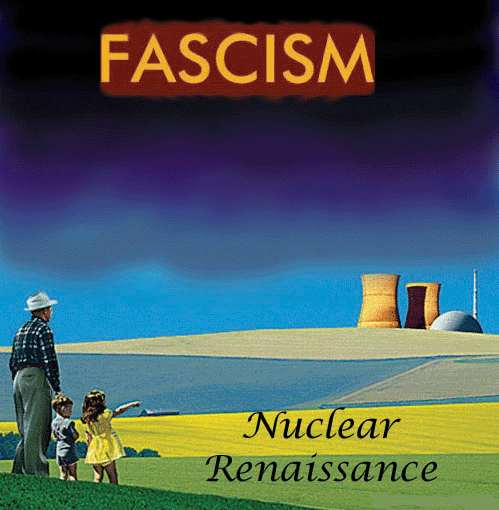
Starmer has announced plans to reform the
planning system around nuclear power. Under plans proposed on Wednesday,
nuclear development will not be restricted to the eight current designated
nuclear sites, but opened up to the general planning process.
Starmer, speaking in the commons, vowed to “break through” resistance by
utilising the party’s majority to ensure there is no dissent. These plans
are part of a package announced to encourage AI datacentres to be
established in the UK, with SMRs (small modular nuclear reactors) to power
them.
SMRs are an unproven technology sold as an alternative to massive
reactor sites such as those currently being built in Hinkley Point C and
proposed at Sizewell C. SMR development is often reliant on government
funding to do the R&D and eventual construction work – often funded by
“nuclear levies” via the RAB (Regulated Asset Base) on local
communities.
Communities charged by RAB models are often promised returns
in the form of lower bills, a claim hotly disputed. Research in Going
Nuclear, a book by CND Cymru chair Mabon ap Gwynfor MS shows that when
Trawsfynydd was operational in Gwynedd, the area paid some of the highest
per-unit cost of electricity anywhere in Britain. CND Cymru has already
recently raised concerns about inappropriate nuclear development in
Bridgend.
Last Energy, a US-based company, is currently consulting on a bid
to build 4 SMnRs in a site on the old Llynfi Power Station. CND Cymru
National Secretary, Dylan Lewis-Rowlands, said “If the proposals from
Westminster are to be believed, then not only could plans similar to this
pop up anywhere in Wales or England, but could also be pushed through
against community will from the UK Government.
The current ultimaten planning authority for projects under 300MW of generation, which includes this proposal, currently lies with Welsh Government Ministers – are the
plans here also a proposal to run roughshod over devolution?”
CND Cymru
vice-chair, Brian Jones, added: “This is not just a question of nuclear
development, but of democracy. The intention of this move by Starmer seems
to be something that the nuclear power and weapons industry has only dreamt
of before – the ability to ignore communities wishes and focus their vast
lobbying budgets on getting the central government to allow them to build
wherever they want, without opposition. It is fundamentally putting profit
before people and planet, and turning Britain into a nuclear power test
site for SMRs. It is, in one word, anti-democratic”.
CND Cymru 6th Feb 2024 Starmer has announced plans to reform the
planning system around nuclear power. Under plans proposed on Wednesday,
nuclear development will not be restricted to the eight current designated
nuclear sites, but opened up to the general planning process. Starmer,
speaking in the commons, vowed to “break through” resistance by
utilising the party’s majority to ensure there is no dissent. These plans
are part of a package announced to encourage AI datacentres to be
established in the UK, with SMRs (small modular nuclear reactors) to power
them. SMRs are an unproven technology sold as an alternative to massive
reactor sites such as those currently being built in Hinkley Point C and
proposed at Sizewell C. SMR development is often reliant on government
funding to do the R&D and eventual construction work – often funded by
“nuclear levies” via the RAB (Regulated Asset Base) on local
communities. Communities charged by RAB models are often promised returns
in the form of lower bills, a claim hotly disputed. Research in Going
Nuclear, a book by CND Cymru chair Mabon ap Gwynfor MS shows that when
Trawsfynydd was operational in Gwynedd, the area paid some of the highest
per-unit cost of electricity anywhere in Britain. CND Cymru has already
recently raised concerns about inappropriate nuclear development in
Bridgend. Last Energy, a US-based company, is currently consulting on a bid
to build 4 SMnRs in a site on the old Llynfi Power Station. CND Cymru
National Secretary, Dylan Lewis-Rowlands, said “If the proposals from
Westminster are to be believed, then not only could plans similar to this
pop up anywhere in Wales or England, but could also be pushed through
against community will from the UK Government. The current ultimate
planning authority for projects under 300MW of generation, which includes
this proposal, currently lies with Welsh Government Ministers – are the
plans here also a proposal to run roughshod over devolution?” CND Cymru
vice-chair, Brian Jones, added: “This is not just a question of nuclear
development, but of democracy. The intention of this move by Starmer seems
to be something that the nuclear power and weapons industry has only dreamt
of before – the ability to ignore communities wishes and focus their vast
lobbying budgets on getting the central government to allow them to build
wherever they want, without opposition. It is fundamentally putting profit
before people and planet, and turning Britain into a nuclear power test
site for SMRs. It is, in one word, anti-democratic”.
CND Cymru 6th Feb 2024 Starmer has announced plans to reform the
planning system around nuclear power. Under plans proposed on Wednesday,
nuclear development will not be restricted to the eight current designated
nuclear sites, but opened up to the general planning process. Starmer,
speaking in the commons, vowed to “break through” resistance by
utilising the party’s majority to ensure there is no dissent. These plans
are part of a package announced to encourage AI datacentres to be
established in the UK, with SMRs (small modular nuclear reactors) to power
them. SMRs are an unproven technology sold as an alternative to massive
reactor sites such as those currently being built in Hinkley Point C and
proposed at Sizewell C. SMR development is often reliant on government
funding to do the R&D and eventual construction work – often funded by
“nuclear levies” via the RAB (Regulated Asset Base) on local
communities. Communities charged by RAB models are often promised returns
in the form of lower bills, a claim hotly disputed. Research in Going
Nuclear, a book by CND Cymru chair Mabon ap Gwynfor MS shows that when
Trawsfynydd was operational in Gwynedd, the area paid some of the highest
per-unit cost of electricity anywhere in Britain. CND Cymru has already
recently raised concerns about inappropriate nuclear development in
Bridgend. Last Energy, a US-based company, is currently consulting on a bid
to build 4 SMnRs in a site on the old Llynfi Power Station. CND Cymru
National Secretary, Dylan Lewis-Rowlands, said “If the proposals from
Westminster are to be believed, then not only could plans similar to this
pop up anywhere in Wales or England, but could also be pushed through
against community will from the UK Government. The current ultimate
planning authority for projects under 300MW of generation, which includes
this proposal, currently lies with Welsh Government Ministers – are the
plans here also a proposal to run roughshod over devolution?” CND Cymru
vice-chair, Brian Jones, added: “This is not just a question of nuclear
development, but of democracy. The intention of this move by Starmer seems
to be something that the nuclear power and weapons industry has only dreamt
of before – the ability to ignore communities wishes and focus their vast
lobbying budgets on getting the central government to allow them to build
wherever they want, without opposition. It is fundamentally putting profit
before people and planet, and turning Britain into a nuclear power test
site for SMRs. It is, in one word, anti-democratic”.
CND Cymru 6th Feb 2024 https://www.cndcymru.org/en/about-us2/
Starmer pledges to ‘build, baby, build’ as green groups criticise nuclear plans
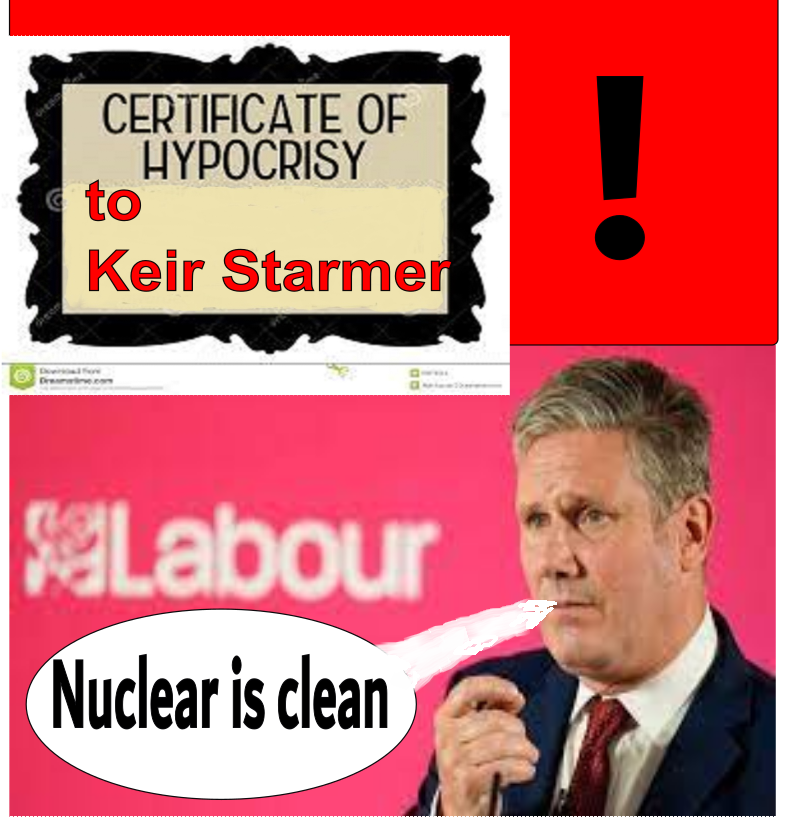
Greenpeace says PM has ‘swallowed industry spin whole’ after plans unveiled to expand in England and Wales
Peter Walker and Matthew Taylor, Guardian 6th Feb 2025
Keir Starmer has channelled his inner Donald Trump and promised to “build, baby, build” in his push for more nuclear power stations, despite warnings from environmental groups about the industry’s record for soaring costs and long delays.
A day after the prime minister unveiled his plans to revamp planning rules to bring in a series of small modular reactors (SMRs) across England and Wales, Greenpeace said Starmer had “swallowed the nuclear industry spin whole”, and Friends of the Earth described the plans as “overblown, costly hype”.
Formally announcing the plans on Thursday, however, Starmer insisted the recent glacial pace of nuclear power development was precisely why things had to change.
Asked if, much like Trump’s pro-fossil fuels mantra of “drill, baby, drill”, he now advocated “build, baby, build”, Starmer replied: “I say: build, baby, build. I say: we’re going to take on the blockers so that we can build.”………………………………………………………………………………………………..
However ambitious, the project faces obstacles, including likely local opposition, despite hints from Starmer that people could get lower bills if they lived near a new reactor. The technology also remains untested, there is not a single commercial SMR operating in the world, and the sector is heavily reliant on government support.
Dale Vince, a green electricity entrepreneur and a major donor to Labour under Starmer, said even large nuclear power stations made “the most expensive power known to mankind”, adding: “And the widely understood and experienced concept of economies of scale is all about things getting cheaper as they get bigger. The opposite is true in the other direction – miniaturisation always costs more.”
Doug Parr, Greenpeace UK’s policy director, said Starmer’s plan was unrealistic. “The Labour government has swallowed nuclear industry spin whole, seemingly without applying so much as a pinch of critical scrutiny or asking for a sprinkling of evidence,” he said.
“They present as fact things which are merely optimistic conjecture on small nuclear reactor cost, speed of delivery and safety, which is courageous – or stupid – given that not a single one has been built, and with the nuclear industry’s record of being over time and over budget unmatched by any other sector.”
Mike Childs, the head of policy for Friends of the Earth, said nuclear power was “extremely expensive and creates a legacy of radioactive waste that lasts for thousands of years”.
“The Hinkley C nuclear plant in Somerset, which is a decade late and almost £30bn over budget, makes HS2 look like a runaway success,” he said. “If ministers want to build a clean, affordable and energy-secure future they should focus on renewables, such as wind and solar, and better energy storage – not the overblown, costly hype offered by the nuclear industry.” https://www.theguardian.com/environment/2025/feb/06/starmer-pledges-to-build-baby-build-as-green-groups-criticise-nuclear-plans
Nuclear Dump “Reveal” of “Areas of Focus.” A Nuclear Dump Anywhere is a Nuclear Dump Everywhere – #GDFOFF.
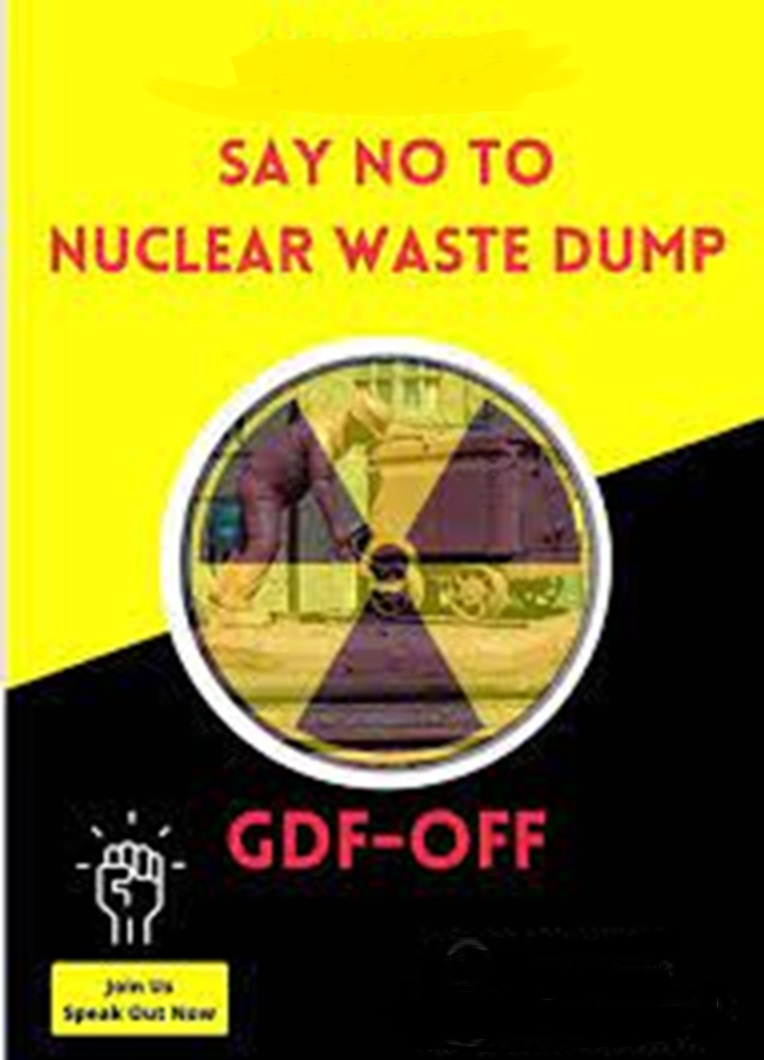
On By mariannewildart,
https://mariannewildart.wordpress.com/2025/02/04/nuclear-dump-reveal-of-areas-of-focus-a-nuclear-dump-anywhere-is-a-nuclear-dump-everywhere-gdfoff/
Nuclear Waste Services have “revealed” their “Areas of Focus” for Mid-Copeland and South Copeland along with Lincolnshire.
This is not so much of a reveal as now being more upfront with the maps which were previously obtuse so as not to scare the horses grazing happily on premium hay courtesy of the “bribes”.
Nuclear Free Local Authorities have produced a press release below which assumes that “Drigg has been spared” for now at least. This is unfortunately exactly what Nuclear Waste Services want folk to think. The reality is that Drigg is being eyed up for for so called “Near Surface Disposal” 10s of metres below ground for Intermediate Level Wastes, these are the wastes that were refused at the NIREX inquiry for a dump 1000 metres below ground, however, the inquiry found the wastes would percolate to the surface faster than the nuclear industry had forcast. At 10s of metres below ground the rate of percolation would be even faster!
Mark Kirkbride (the coal mine boss) has produced costings for the Committee on Radioactive Waste Management/Nuclear Decommissioning Authority for the “co-disposal” of Intermediate and High Level nuclear wastes. This would involve a dump for Intermediate Level Wastes underground with the above ground sprawl and drift tunnels also being used to access a sub-sea Geological Disposal Facility.
“Exploratory” boreholes have already been drilled for “Near Surface Disposal” of Intermediate Level Wastes at Drigg. The “tandem” plan to “co-locate” a Near Surface Disposal Facility for Intermediate Level Nuclear Wastes which would be fully delivered in 10 years ie within the lifetimes of many of the people within the so called Community Partnerships now. The Nuclear Decommissioning Authority have stated in their 2020 position paper on Near Surface Disposal that “The assessment of disposal costs has been made on the assumption that a nearer- surface disposal facility ..would be co-located with a GDF.” Lakes Against Nuclear Dump say that “Drigg would be the politically expedient choice for co-location given that the community has already been in receipt of decades worth of funding for the ongoing blight caused by hosting the Low Level Waste Repository.”
At a GDF drop in event at Drigg we were told that “the Near Surface Disposal Plan for Intermediate Level Wastes has nothing to do with a GDF.” Mmmm Rather like the hot plutonium now nonchalantly earmarked for a GDF? Boy does this industry love mission creep. Our report on the shifting sands of nuclear waste dumping is here outlining the Drigg plan
Here are the newly released “Areas of Focus” with Drigg being “spared” – yeah right we believe you. No area is safe – the only sane response is to oppose a geological disposal facility aka deep hot nuclear dump anywhere – all would be impacted.
The following press release is from Nuclear Free Local Authorities who have given a good summary of Nuclear Waste Services “Areas of Focus,” the veil is slipping. The “Areas of Focus” are for the surface nuclear sprawl which would blight towns and villages on the Lake District coast but not within the National Park. For this intergenerational toxic blight there is proposed a single “Test of Public Support” for a limited area and excluding the wider region for what would be the biggest and most dangerous infrastructure project in the UK. Nuclear Waste Services want to give the impression that “Drigg has been spared” – but we say buyer beware – Drigg may be the gateway to GDF via so called Near Surface Disposal of the high end of Intermediate Level Wastes 10s of meters below ground. The only sane response is to oppose this plan.
Continue readingHinkley Point plays down reports of suspected ‘spy’ at nuclear power plant
A spokesperson for Hinkley Point C has played down press reports about a
man suspected of being a spy at the nuclear power plant. A 67-year-old
Italian national who worked at Hinkley Point C from 2020 to 2023 was
questioned by counter-terrorism police after he flew into Heathrow airport
on April 12th, 2023.
It was reported that several documents were found in
his possession and were seized by the authorities. Counter terrorism police
retained the man’s hard drives for national security reasons. He was not
charged with any offence.
A spokesperson for EDF’s Hinkley Point C adds:
“Hinkley Point C takes information security very seriously and there are
rigorous measures in place to protect sensitive data.” “This individual
did not have access to sensitive nuclear information. The information he
removed was outdated.” The spokesperson adds that the man’s contract
with his employer, a supplier to EDF’s Hinkley Point C, has since ended.
Burnham-on-Sea.com 4th Feb 2025, https://www.burnham-on-sea.com/news/hinkley-point-plays-down-press-reports-of-suspected-spy-operating-at-nuclear-power-plant/
Fury over switch of possible nuclear waste dump site to village land near Louth
A previous survey revealed that 85 per cent of local residents were against the dump, which would store nuclear waste beneath up to 1,000 metres of solid rock until its radioactivity naturally decayed.
By Richard Silverwood, 3rd Feb 2025,
The bombshell news that a nuclear waste dump could now be built on greenfield land close to Louth has been greeted with dismay by campaigners and the town’s MP.
East Lincolnshire has long been identified as one of three potential locations for the dump, known as a GDF (geological disposal site).
And the government agency, Nuclear Waste Services (NWS), charged with finding a suitable area, has focused its attention on the former gas terminal site, operated by Conoco, within the coastal village of Theddlethorpe.
But now NWS has announced that it is looking inland and “beyond Theddlethorpe”. Instead, it is “prioritising” largely agricultural land to the north of the A157 road, between the villages of Gayton le Marsh and Great Carlton and south-west of Gayton Wind Farm.
A network of underground vaults and tunnels would transfer shipments of waste to a sealed storage area under the seabed which would extend 22 kilometres from the coast.
NWS insists nothing has been decided and has promised to keep all residents informed. A series of webinars and public drop-in events is already under way and will continue throughout February.
However, opponents of the dump, led by Conservative MP Victoria Atkins, are furious and are calling for a public vote on the entire scheme.
Ms Atkins said: “I have opposed the threat of a nuclear waste dump on the Lincolnshire coast since the proposal came to light several years ago.
“In that time, residents have had to live with the uncertainty, worry and financial costs of having this monstrous carbuncle threatened in their area.
“People have been left in limbo and have had their house prices severely impacted by these proposals.
“This latest news will be very distressing for the residents in and around the area. Rest assured, I will be meeting NWS in the coming week to continue to put pressure on them to move their focus away from Lincolnshire entirely………………………
The campaign group, Guardians Of The East Coast, has also lambasted the latest proposal, claiming the switch has been made because the Theddlethorpe site would not be large enough.
Chairman Mike Crookes said the fresh site would span 900 acres of agricultural land, including at least one farm. He called on Lincolnshire County Council to withdraw their apparent engagement with the dump scheme process.
“The council has expressed its outrage at agricultural land being taken for solar farms and pylons by National Grid,” Mr Crookes said.
“But it seems perfectly happy with a square mile of agricultural land being used to bury high-level nuclear waste, including weapons-grade plutonium.
“When the project was first announced, the council said it was policy to make use of ‘brownfield’ sites such as the gas terminal.
“But if it has a policy of opposing the industrial use of agricultural land, why is it apparently facilitating this project?”
Another group firmly against the nuclear waste dump is the Nuclear Free Local Authorities (NFLA), whose secretary Richard Outram described the fresh site as “worse than the original”.
“The news will have come as a tremendous shock to the residents of Gayton le Marsh and Great Carlton, where the threat of a dump suddenly appears writ large.
“Those residents are already up in arms and, doubtless in the coming days, new protest groups will be formed to represent the people affected.
“It is important to emphasise that the decision on the final site for a GDF is still a long way off. There is still time to organise and fight back.”
Coun Travis Hesketh, who represents the ward of Withern and Theddlethorpe on East Lindsey District Council, said residents were demanding a public vote – and this year, not in 2027 as previously promised.
A previous survey revealed that 85 per cent of local residents were against the dump, which would store nuclear waste beneath up to 1,000 metres of solid rock until its radioactivity naturally decayed.
However, NWS is hoping to win people over and has set up a community partnership group to fully explain the scheme.
1 This Month
Chernobyl: The Lost Tapes – A good documentary on Chernobyl on SBS available On Demand for the next 3 weeks– https://www.sbs.com.au/ondemand/tv-program/chernobyl-the-lost-tapes/2352741955560

of the week–London Campaign for Nuclear Disarmament

Tell the Ukrainian Government to Drop Prosecution of Peace Activist Yurii Sheliazhenko
To see nuclear-related stories in greater depth and intensity – go to https://nuclearinformation.wordpress.com
-
Archives
- April 2026 (126)
- March 2026 (251)
- February 2026 (268)
- January 2026 (308)
- December 2025 (358)
- November 2025 (359)
- October 2025 (376)
- September 2025 (257)
- August 2025 (319)
- July 2025 (230)
- June 2025 (348)
- May 2025 (261)
-
Categories
- 1
- 1 NUCLEAR ISSUES
- business and costs
- climate change
- culture and arts
- ENERGY
- environment
- health
- history
- indigenous issues
- Legal
- marketing of nuclear
- media
- opposition to nuclear
- PERSONAL STORIES
- politics
- politics international
- Religion and ethics
- safety
- secrets,lies and civil liberties
- spinbuster
- technology
- Uranium
- wastes
- weapons and war
- Women
- 2 WORLD
- ACTION
- AFRICA
- Atrocities
- AUSTRALIA
- Christina's notes
- Christina's themes
- culture and arts
- Events
- Fuk 2022
- Fuk 2023
- Fukushima 2017
- Fukushima 2018
- fukushima 2019
- Fukushima 2020
- Fukushima 2021
- general
- global warming
- Humour (God we need it)
- Nuclear
- RARE EARTHS
- Reference
- resources – print
- Resources -audiovicual
- Weekly Newsletter
- World
- World Nuclear
- YouTube
-
RSS
Entries RSS
Comments RSS
 nuclear-news