Britain’s nuclear weapons fiasco is a nightmare for Rachel Reeves

Overhauling the UK’s ageing defence has left the Chancellor facing a fresh battle to balance the books
Sir Keir Starmer was the first Labour leader in three decades to visit the
Barrow shipyard where Britain’s next generation of nuclear submarines are
being assembled. The Prime Minister, on the opposition benches at the time,
was unflinching in his support for the UK’s submarines-based nuclear
deterrent – a continuous at-sea presence that the Royal Navy has
maintained since 1969.
But while keeping Britain safe may be priceless,
being ready for war doesn’t come cheap. Trident, Britain’s nuclear
deterrent, gobbles up a significant share of our defence budget, leaving
the share devoted to troops and guns far below the 2pc Nato baseline. While
the Treasury said in October that its commitment to the UK’s nuclear
deterrent was “absolute”, many have warned that costs are spiralling
out of control, piling more pressure on a Chancellor who is already
struggling to balance the books.
Telegraph 8th March 2025, https://www.telegraph.co.uk/business/2025/03/08/britains-nuclear-weapons-fiasco-nightmare-rachel-reeves/
Radioactive pollution is increasing at Britain’s nuclear bases

7 Mar 25 https://cnduk.org/radioactive-pollution-is-increasing-at-britains-nuclear-bases/
Radioactive air emissions have been increasing year-on-year at Coulport one of Britain’s nuclear submarine bases in Scotland. This development is of some concern as it would lead to increased health risks wherever the emissions were inhaled.
Investigations by The Ferret and The National newspaper found that emissions of radioactive tritiated water vapour had doubled at the Royal Navy’s nuclear weapons storage depot at Coulport on Loch Long between 2018 and 2023. According to the Scottish Pollution Release Inventory, tritiated water vapour emissions at Coulport were 1.7 billion becquerels (units of radioactivity) in 2018, rising steadily to 4.2 billion units in 2023. Tritiated water vapour is harmful when inhaled, ingested or absorbed through the skin as its radiation causes cancer and cardiovascular diseases including strokes.
The investigation also found that eight miles from Coulport at Faslane, where Britain’s nuclear submarines are based, tritiated water containing over 50 billion units of radioactivity had been dumped into the Gareloch. The level of dumping peaked in 2020, when 16.6 billion units were discharged.
The Ferret noted that in 2019, the Scottish Environment Protection Agency (SEPA) “changed the rules to allow certain tritium-contaminated effluents from nuclear submarines at Faslane to be discharged into the Gareloch.” Both SEPA and the MoD claim these emissions are within official safety limits.
However Dr Ian Fairlie, CND’s science advisor, states that these limits are unreliable, as official estimated doses from tritium contain “large uncertainties.”
CND General Secretary Sophie Bolt said:
“From faulty nuclear-armed subs on dangerously extended patrols to crumbling nuclear waste sites, Britain’s nuclear industry is putting us all at great risk. Instead of enforcing the highest levels of environmental standards, the government is just redefining what ‘acceptable risk’ means. All so it can allow the dumping of radioactive water, putting local people at greater risk of cancer. This is beyond reckless. It’s time to scrap Trident and its replacement, and decommission the nuclear industry.”
Ripping up the rules on nuclear power heightens the risk to us all

CND, Labour Outlook 7th March 2025 https://labouroutlook.org/2025/03/07/ripping-up-the-rules-on-nuclear-power-heightens-the-risk-to-us-al
“Ripping up the rules for nuclear greatly exacerbates the risk of accidents, will contaminate more of our environment with radioactive waste, and above all, raise the spectre of nuclear conflict.”
Sam Mason, convenor of CND’s Trade Union Advisory Group explains why the government’s new rules for expanding nuclear power production must be opposed.
The government’s announcement that it is going to ‘rip up the rules to fire-up nuclear power’ may be music to the ears of nuclear proponents but for CND, it is something we must vehemently oppose.
Part of wider planning law reforms to put ‘builders not blockers’ first and ‘build baby, build’, the proposal is to extend beyond the eight sites identified for nuclear power plants in 2009, and to include small or advanced modular reactors. This means nuclear sites could be constructed anywhere across England and Wales, and anyone opposing them on legitimate grounds of safety or the environment for example dismissed as NIMBYs.
According to the government, nuclear is needed for energy security and to satisfy high demand from ‘local users such as data centres, gigafactories, hydrogen and synthetic fuel production and/or industrial clusters’. It also includes using nuclear for district heat networks, being placed closer to centres of population, and in proximity to military activities.
A further driver for the government’s plans is the creation of good jobs, to drive growth and support climate action. With the impacts of climate change accelerating across the globe there is an urgent need to decarbonise our energy system, but nuclear power is not the answer on any of these levels.
The government’s laudable aim to decarbonise electric power by 2030 includes 4.5 gigawatts of nuclear power. For reference, the long over budget and delivery of Hinckley Point C in Somerset is due to generate 3.2gw of power.
Assurances about maintaining high standards of regulation do little to assuage fears of this nuclear proliferation. The addition of a new Nuclear Regulatory Taskforce to speed up delivery will cover both civilian and defence nuclear. Reporting directly to the Prime Minister, it serves to further emphasise we cannot decouple civilian nuclear from the weapons system.
Much is made about the low level of risk from nuclear, including new technologies such as SMRs. However, as we mark the 14th anniversary of the Fukushima Daiichi nuclear power plant disaster on 11 March, it should serve as a stark reminder of the impact of nuclear, and its legacy to current and future generations.
Ripping up the rules for nuclear greatly exacerbates the risk of accidents, will contaminate more of our environment with radioactive waste, and above all, raise the spectre of nuclear conflict. We must do all we can to oppose these plans.
University of Suffolk co-opted by the nuclear industry.

Ipswich jobs fair showcases Sizewell C opportunities
The University of Suffolk hosted a jobs fair showcasing Sizewell C
opportunities. More than 200 people attended the event, organised by the
Department of Work and Pensions (DWP) and Sizewell C. The fair provided
information on the thousands of jobs, apprenticeships, and training
opportunities available at the nuclear power plant. Attendees had the
chance to connect with local companies in the Sizewell C supply chain, as
well as colleges and charities.
Ipswich Star 7th March 2025 https://www.ipswichstar.co.uk/news/24986367.ipswich-jobs-fair-showcases-sizewell-c-opportunities/
UK urged to prepare for Donald Trump halting Trident partnership.
After tensions over a failed nuclear missile test last year, experts say the
White House withdrawing assistance would cost billions.
When a Trident II D5 missile misfired and crashed into the sea off the coast of Florida
during a rare test launch by the Royal Navy in January last year, American
sailors were on board the submarine to witness it. US ships monitored the
event nearby. In the days that followed, US and UK officials wrangled over
how much information the Ministry of Defence in London could share with the
public about what went wrong.
The British government wanted to be as open
as possible in the hope that it would restore some faith in the nuclear
deterrent — which costs about £3 billion a year to run — eight years
after another misfire in 2016. The Americans won the argument and officials
were limited to saying that an “anomaly occurred”.
What actually happened was a failure caused by test equipment strapped to the missile;
had it been fired in anger without such a device, it would have worked.
“There was deep frustration at the US for blocking a full explanation,”
said a defence source privy to the discussions with the Americans. The UK
has total operational control over its Trident missiles once they are
loaded on to its four Vanguard-class submarines.
However, such revelations
expose how intertwined the US and UK are when it comes to the nuclear
deterrent, Britain’s ultimate insurance policy. Should the UK want to
untangle the relationship — or a pro-Russian White House end its
co-operation — it would cost taxpayers tens of billions, experts warn.
Times 5th March 2025, https://www.thetimes.com/uk/defence/article/uk-urged-to-prepare-for-donald-trump-halting-trident-partnership-cj8rdjw0w
East Lindsey overwhelmingly backs GDF withdrawal call to Lincolnshire County Council

At their March meeting, East Lindsey District Councillors backed a motion calling on their colleagues at County Hall to join them in withdrawing from the nuke dump plan.
Leader Councillor Craig Leyland confirmed that he shall recommend to his Executive that East Lindsey District Council withdraws from the process when it next meets on 23 April.
Were Lincolnshire to follow suit that would draw a line upon the issue; Nuclear Waste Services would no longer be able to investigate potential sites for the Geological Disposal Facility within the Theddlethorpe Search Area, or indeed any area within the East Lindsey District, as there would no longer be any Relevant Principal Local Authority backing the plan…………………….
NFLA 6th March 2025,
https://www.nuclearpolicy.info/news/east-lindsey-overwhelmingly-backs-gdf-withdrawal-call-to-lincolnshire-county-council/
UK’s richest can boost climate action but need to cut outsized emissions – study

Better-off Britons are well placed to accelerate the transition towards
low-carbon technologies, but only if they are prepared to curb their
excessive consumption to lower their outsized carbon footprints, a study
has found.
Researchers found people from the richest 10% in the UK were
more likely to invest in electric vehicles, heat pumps and other clean
energy alternatives, and were more likely to support green policies. But
they also found wealthier people used far more energy at home, were more
likely to fly for leisure, were more reluctant to sacrifice luxuries, and
were likely to underestimate the carbon impact of their own behaviour.
As a result, many wealthy people were caught in a contradiction: vocally
supporting climate action and, in many cases, making climate-conscious
consumer choices, while at the same time materially exacerbating climate
breakdown.
Guardian 5th March 2025, https://www.theguardian.com/environment/2025/mar/05/uks-richest-can-boost-climate-action-but-need-to-cut-outsized-emissions-study
UK Government ignoring international law on nuclear weapons – experts.
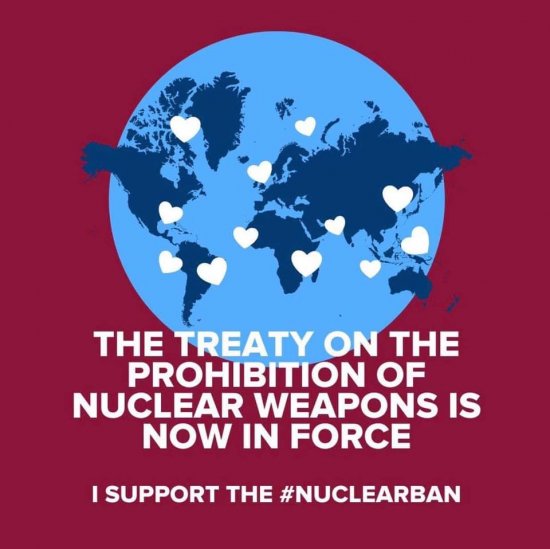
By Xander Elliards
THE UK Government is flouting the international laws it has subscribed to
by refusing to discuss banning nuclear weaponry, leading experts have said.
It comes after the Labour Government dismissed a UN summit on the Treaty on
the Prohibition of Nuclear Weapons (TPNW) out of hand, saying they would
not attend even as an observer.
However, the majority of the world’s
countries are present at the TPNW meeting in New York, where a total ban on
nuclear weapon testing, development, or use is being discussed. The UK
Government is not a signatory to the TPNW – but like the US, France,
Russia, and China it is signed up to the earlier Nuclear Non-Proliferation
Treaty (NPT). This obliges states to prevent new countries from acquiring
nuclear weapons – but also obliges signatories to work towards complete
disarmament.
The National 5th March 2025, https://www.thenational.scot/news/24985203.uk-government-ignoring-international-law-nuclear-weapons—experts/
Uranium’s Poison Power in Leafy Cheshire
Remembering the 14th anniversary of Fukushima, campaigners will be
gathering and invite people to join them, outside the URENCO plant at
Capenhurst in Cheshire on March 11th at 2pm. The continuing nuclear
disaster at Fukushima caused by the 2011 tsunami underlines the constant
danger that nuclear presents due to events totally beyond the control of
power station operators.
Radiation Free Lakeland 5th March 2025 https://mariannewildart.wordpress.com/2025/03/05/uraniums-poison-power-in-leafy-cheshire/
‘Fish disco’ plan revived to protect salmon from Hinkley Point C.
Energy company EDF has proposed an acoustic fish deterrent to stop fish in
the Severn Estuary being sucked into the nuclear power station. EDF
previously ditched plans for an acoustic fish deterrent, a device designed
to keep Atlantic salmon, eel and other species away from a cooling water
intake pipe for Hinkley Point C in Somerset, due to fears that maintaining
it for 60 years would put divers at risk.
The former minister Michael Gove
mockingly called the measure, a condition of the plant’s planning
permission, a “fish disco”. Now it’s returning, but as a mobile
disco. Instead of the originally proposed 280 loudspeakers permanently
attached to concrete structures, ceramic transducers will be installed that
can be lifted up and down in lobster pot-style containers, negating the
need for divers.
The devices will produce a sound which can be tuned to
precise frequencies to deter specific species. Engineers will be able to
maintain them by raising them to the water’s surface. However, it also
means the axe for EDF’s interim plan to build salt marshes along the
River Severn as a compensatory measure. Mark Lloyd, the CEO of The Rivers
Trust charity, welcomed the firm’s about-turn to honour its commitment on
fish protections. But he said the company should still create salt marsh
habitat or passages to help salmon, as some will still be sucked to their
death despite the deterrent.
Times 5th March 2025
https://www.thetimes.com/uk/environment/article/fish-disco-plan-edf-hinkley-point-c-j303w9rdk
One empty seat. UK fails again to send representation to UN nuke conference

NFLA 5th March 2025,
https://www.nuclearpolicy.info/news/one-empty-seat-uk-fails-again-to-send-representation-to-un-nuke-conference/
The UK/Ireland Nuclear Free Local Authorities laments that a joint appeal made to the Prime Minister and Foreign Secretary to send a British representative to an important nuclear disarmament conference being held at the United Nations this week has fallen on deaf ears.
Alongside academics and other peace campaigners, NFLA Chair Councillor Lawrence O’Neill and NFLA Secretary Richard Outram were two of the co-signatories to a letter drafted by the United Nations Association UK (UNA-UK) that was sent to the two senior British politicians asking the UK Government to send an observer to the 3rd Meeting of States Parties (3MSP) to the Treaty on the Prohibition of Nuclear Weapons (TPNW) which is being held in New York until 7 March.
The invitation was not taken up as the meeting has been boycotted by Britain and the other eight nuclear weapons states, which continue to refuse to engage with the treaty despite around half of the UN’s membership – 94 states – having become signatories to it, with 73 also having completed formal ratification.
The NFLAs will be especially interested to see the progress made in establishing an international trust fund to support the victims, usually Indigenous Peoples, of the use and testing of nuclear weapons and the remediation of their natural environment. This represents a clear commitment of the signatories to help satisfy their undertakings under Article 6 and 7 of the TPNW. Establishing such a fund was seen as a key priority at the preceding MSP2.
NFLA Secretary Richard Outram, in speaking recently on a webinar to mark the sixty fifth anniversary of the first French nuclear weapon test in Algeria, referenced the fact that the UK should contribute on a voluntary basis to such a fund despite not being a formal party to the treaty.
Britain tested forty five atomic and nuclear weapons in Australia, the Pacific, and latterly in the USA in a period from 1952 to 1991, and has a responsibility for the damage caused to the health and environment of Indigenous People in these places, as well as to the British atomic and nuclear test veterans community and their family members who continue to suffer as a direct result of exposure to radiation in the tests.
The NFLAs will continue to campaign for justice and financial compensation for both the civilian and military victims of nuclear weapons use and testing, and, as a member of the Nobel Peace Prize winning International Campaign to Abolish Nuclear Weapons (ICAN) and a partner of Mayors for Peace, for the universal adoption of the TPNW and the total abolition of nuclear weapons.
Campaigners attend East Lindsey District Council meeting to call on Lincolnshire County Council to withdraw from Geological Disposal Facility process

By James Turner, Local Democracy Reporter, Lincs Online 6th March 2025, https://www.lincsonline.co.uk/louth/weve-had-enough-now-the-threat-of-this-nuclear-waste-dump-9407343/
Dozens of protesters have called on Lincolnshire County Council to withdraw from the process that could lead to the construction of a nuclear waste site in the county.
Campaigners from across the district gathered outside East Lindsey District Council’s offices in Horncastle ahead of a full council meeting on Wednesday to support a motion from Coun Travis Hesketh (Independent) urging the leader to actively oppose the establishment of a Geological Disposal Facility (GDF) – and calling on the county council to withdraw from the community partnership in the hopes of stopping the plans altogether.
Nuclear Waste Services (NWS) identified three ‘areas of focus’ for its facility in January. These include sites in Mid Copeland and South Copeland in Cumbria, as well as land between Gayton le Marsh and Great Carlton, near Louth.
East Lindsey District Council has pledged to leave the working group it joined with the organisation formerly known as Radioactive Waste Management in 2021, due to the new location being prime agricultural land and completely different from the former gas terminal site in Theddlethorpe, which it had been considering previously.
“I am the district councillor for Withern and Theddlethorpe, I represent the area where the nuclear dump was originally going to be placed, but now it’s moved,” Coun Hesketh told the Local Democracy Reporting Service.
“We’re here today because East Lindsey has said they are going to pull out, which is a terrific thing, but they need to go further. They need to say we oppose this and we want Lincolnshire County Council to do the same.
“We’ve had five years since Lincolnshire County Council met with Radioactive Waste Management – this thing has been going on for so long they’ve changed the name of the company. We’ve had enough now. They have ruined two communities, house values have been decimated – nobody can sell their house in the Carlton or Gayton area, they’re stuck. It’s time to make a decision.”
As councillors began arriving for the meeting, campaigners sang chants such as “We say, we say, no GDF, no GDF,” to the beat of Queen’s We Will Rock You and other lines such as “We are gentle, angry people and we’re singing for our lives.”
Nigel, 64, from Theddlethorpe, was just one of many campaigners and said he had been fighting the plans since ‘day one’.
“Now the area of focus has shifted, I feel I need to support the people affected in that area as well. We’re just trying to force the council’s hand now.”
Cybersecurity in the Nuclear Industry: US and UK Regulation and the Sellafield Case
Key Points:
With both the U.S. and U.K. strengthening their regulatory frameworks and increasing enforcement powers, nuclear facilities should take steps now to review and upgrade cybersecurity measures. This includes not just updating technical controls, but also ensuring compliance with security plans, auditing systems, and maintaining proper documentation.
Real-world examples from both the U.S. and U.K. demonstrate that nuclear facilities are being targeted by sophisticated cyber attackers, including state actors. This isn’t just a theoretical risk—it’s happening now, and facilities must take it seriously.
The successful prosecution of Sellafield with significant fines (£332,500) shows that regulators are now willing to take strong enforcement action, even when no actual breach has occurred. Nuclear facilities cannot afford wait for an incident before improving their cybersecurity—they must be proactive……………………………………………..
JD Supra 6th March 2025,
https://www.jdsupra.com/legalnews/cybersecurity-in-the-nuclear-industry-2447724/
Delays in Trident renewal put our deterrent in peril
In 2016 the House of Commons voted overwhelmingly in favour of renewing
the UK’s nuclear deterrent. Then hardly a second thought was given to
undertaking the upgrade programme without the full involvement of the US
military.
Ever since the British government first opted to introduce the
Continuous at Sea Deterrent (CASD) model to deliver our nuclear weapons
capability – replacing the Royal Air Force’s airborne Vulcan system –
it has been an article of faith that the project should be a joint US-UK
undertaking.
The tumult caused by US President Donald Trump’s return to
the White House has inevitably raised concerns both about the wisdom of
relying so heavily on US support for our own nuclear deterrent, especially
in the wake of Trump’s less-than-friendly treatment of Ukrainian
president Volodymyr Zelensky when he visited the White House last week. If
the leader of the free world can treat someone like Zelensky, who is
supposed to be one of Washington’s key allies, with such studied
contempt, then why not other allies, such as the UK?
Telegraph 5th March 2025
https://www.telegraph.co.uk/news/2025/03/05/delays-in-trident-renewal-put-our-deterrent-in-peril/
‘Vote out!’: Protestors win motion at ELDC full council to urge county council to withdraw from nuclear dump talks
East Lindsey District Council
is to urge Lincolnshire County Council to follow the authority’s lead and
withdraw from the process exploring proposals for a nuclear dump site in
the district.
This follows a debate lasting more than one hour on a motion
presented to full council by Coun Travis Hesketh – a district councillor
representing communities that would be affected. Ahead of the meeting,
‘Vote Out’ protestors gathered outside the offices in Horncastle to
show their opposition to the dump and support the councillors fighting for
them.
Coun Hesketh’s motion urged the Executive and Leader of East
Lindsey District Council “to issue a statement opposing the Geological
Disposal Facility for nuclear waste in Lincolnshire and urge Lincolnshire
County Council to withdraw from the project.
Lincolnshire World 5th March 2025, https://www.lincolnshireworld.com/news/people/vote-out-protestors-win-motion-at-eldc-full-council-to-urge-county-council-to-withdraw-from-nuclear-dump-talks-5019541
1 This Month
Chernobyl: The Lost Tapes – A good documentary on Chernobyl on SBS available On Demand for the next 3 weeks– https://www.sbs.com.au/ondemand/tv-program/chernobyl-the-lost-tapes/2352741955560

of the week–London Campaign for Nuclear Disarmament

Tell the Ukrainian Government to Drop Prosecution of Peace Activist Yurii Sheliazhenko
To see nuclear-related stories in greater depth and intensity – go to https://nuclearinformation.wordpress.com
-
Archives
- April 2026 (127)
- March 2026 (251)
- February 2026 (268)
- January 2026 (308)
- December 2025 (358)
- November 2025 (359)
- October 2025 (376)
- September 2025 (257)
- August 2025 (319)
- July 2025 (230)
- June 2025 (348)
- May 2025 (261)
-
Categories
- 1
- 1 NUCLEAR ISSUES
- business and costs
- climate change
- culture and arts
- ENERGY
- environment
- health
- history
- indigenous issues
- Legal
- marketing of nuclear
- media
- opposition to nuclear
- PERSONAL STORIES
- politics
- politics international
- Religion and ethics
- safety
- secrets,lies and civil liberties
- spinbuster
- technology
- Uranium
- wastes
- weapons and war
- Women
- 2 WORLD
- ACTION
- AFRICA
- Atrocities
- AUSTRALIA
- Christina's notes
- Christina's themes
- culture and arts
- Events
- Fuk 2022
- Fuk 2023
- Fukushima 2017
- Fukushima 2018
- fukushima 2019
- Fukushima 2020
- Fukushima 2021
- general
- global warming
- Humour (God we need it)
- Nuclear
- RARE EARTHS
- Reference
- resources – print
- Resources -audiovicual
- Weekly Newsletter
- World
- World Nuclear
- YouTube
-
RSS
Entries RSS
Comments RSS
 nuclear-news