How multi-billion nuclear weapons facility aims to overcome challenge of limited supply chain
New Civil Engineer 14th March 2025, By Tom Pashby
The UK’s nuclear warhead manufacturing organisation is facing recruitment challenges as it attempts to attract civil engineering firms to work on its multi-billion pound Future Materials Campus (FMC) project.
What is AWE’s FMC?
AWE (the Atomic Weapons Establishment) is seeking construction and engineering partners to build a new manufacturing facility at its AWE Aldermaston site in Berkshire for its next generation ‘Astraea’ nuclear warhead.
AWE said: “[The FMC] is part of a wider, multi-year multi-billion-pound portfolio of infrastructure investment that will support us in our overall purpose to protect the UK through nuclear science and technology and enable nuclear science for generations to come.”
AWE recognises supply chain capacity is ‘one of the biggest challenges’
NCE spoke with AWE to learn about what the organisation is doing to address supply chain constraints as the civil nuclear sector – and infrastructure more broadly – gears up for expected increase in investment and demand.
“One of the biggest challenges we anticipate is ensuring sufficient supply chain capacity and capability to deliver a programme of this scale and complexity,” AWE said.
……………………………………….NCE recently spoke with University of Sussex principal research fellow Phil Johnstone, who said that the demand for more skills capacity in the wider UK nuclear sector is push factor for the demand for the FMC, in addition to its role in providing warheads. This aligns with AWE’s assertion that its FMC will “enable nuclear science for generations to come”……………………………………………………………………………………..
Civil engineering trade representative says all projects facing skills challenges………………………………………………………………………………. https://www.newcivilengineer.com/latest/how-multi-billion-nuclear-weapons-facility-aims-to-overcome-challenge-of-limited-supply-chain-14-03-2025/
Anas Sarwar U-turns on Scottish Labour nuclear weapons policy
SCOTTISH Labour are facing calls to clarify their stance on the UK’s
nuclear weapons after Anas Sarwar appeared to pull a unilateral U-turn at
First Minister’s Questions. Speaking at Holyrood on Thursday, the Labour
group leader called for First Minister John Swinney and the SNP to reverse
their stance on Trident – the UK’s nuclear weapons system which is
housed on the Clyde.
The SNP oppose nuclear weapons and oppose renewing
Trident, want to see the system removed from Scotland, and support an
international treaty banning the bomb.
Previously, Scottish Labour’s
membership passed a motion opposing the renewal of Trident – and in 2021
Sarwar backed it despite Keir Starmer’s support for the policy. Sarwar
has now suggested that he supports the UK’s nuclear weapons being
renewed. Speaking at FMQs, the Scottish Labour leader said: “Global
events are reshaping the world before our eyes. This is a generation
defining moment, and all political parties and both of Scotland’s
governments must adjust to this new reality and rethink previous red
lines.”
The National 13th March 2025, https://www.thenational.scot/news/25005720.anas-sarwar-seems-u-turn-scottish-labour-nuclear-weapons-policy/
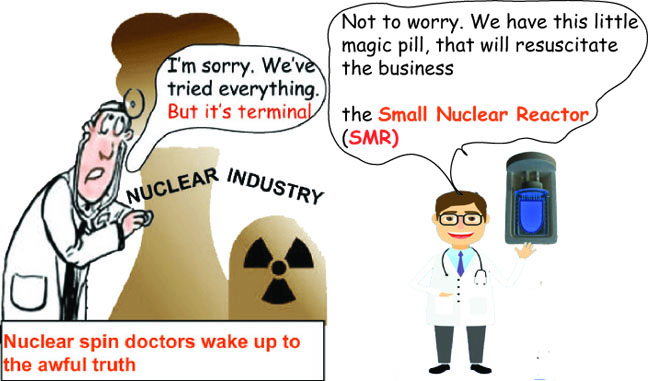
Great British Nuclear explains how it will mitigate risks to SMR programme.
13 Mar, 2025 By Tom Pashby
Great British Nuclear (GBN) has explained how it plans to overcome the key risks to the small modular reactor (SMR) programme is it running and that it plans to establish of SMR development companies (DevCos) to take the projects forward.
The updates were shared in its inaugural 2024 Annual
report and accounts for the 2023/2024 financial year.
It is assumed that GBN will select two vendors to deliver one SMR each, but this was recently
called into question by sources speaking to the Telegraph who said the
chancellor may cut spending at GBN as part of the Spending Review which is
due on 11 June 2025. GBN chief executive officer Gwen Parry-Jones said:
“The UK’s nuclear sector has had some well-documented challenges, ones
that GBN has been set up to navigate.” She did not spell out the
challenges.
“SMRs have not yet been deployed anywhere at scale and their
first-of-a-kind (FOAK) nature presents unique considerations and complex
challenges for us to overcome.” She reassured, however, that she is
“committed to ensure that GBN is an adaptable and resilient organisation
that is flexible and evolves as conditions change, but with our eyes always
firmly fixed on the future to deliver our long-term mission and value for
the UK”.
The report lays out the “principal risks” which GBN believes
the SMR programme faces, along with “key mitigation measures”. The
risks are centred around technology maturity, the ambitious programme
timeline, resourcing, funding and financing, stakeholder alignment,
‘contractual and procurement complexity’, site readiness and cyber
threat.
On technology maturity, it said: “Due to the first of a kind
(FOAK) nature of the technology, providers may not be able to meet
strategic objectives, including timely delivery, value for money and
obtaining regulatory approval. “This may delay approval timelines, affect
project milestones or cause an SMR project to fail.” It says that the SMR
competition that it is running will assess the technologies and mitigate
this risk. However, it also reveals that it will retain the option of, in
addition to the SMR competition winners, selecting a “reserve contractor,
to provide contingency against one provider failing to meet agreed
standards”.
GBN lists four other mitigations, including stating it could
or would provide “predetermined exit points” from projects “should a
project exceed cost estimates or timelines stretch beyond acceptable
parameters”. Regarding risk relating to “funding and financing”, it
says: “GBN’s available funding may be insufficient to resource and
deliver the programme to the planned timetable, e.g. should a change arise
from any change in government policy or in its budgetary priorities.
“A reduction in funding could also be triggered by market conditions or
external events such as an external nuclear event affecting public
sentiment towards nuclear safety.
New Civil Engineer 13th March 2025, https://www.newcivilengineer.com/latest/great-british-nuclear-explains-how-it-will-mitigate-risks-to-smr-programme-13-03-2025/
Labour’s arms exports to Israel exposed Labour allowed dozens of arms exports to Israel after weapons sanctions
Keir Starmer’s government has continued to approve arms exports to Israel even after some licences were suspended in September
UK trade department approved 34 military export licences to Israel in the two months since David Lammy announced a partial arms embargo, new data shows.
DECLASSIFIED UK, JOHN McEVOY, 12 December 2024
Labour government hasn’t completed a review on Israel’s compliance with international humanitarian law since July
Foreign Office has not asked to see footage from RAF spy flights over Gaza, which could provide evidence of Israeli war crimes
“No particular appetite” to restrict exports of F-35 components to Israel, even as minister admits US government can track whether British-made spare parts are being sent to Israel
Trade committee chairman warned ministers he was “not convinced” that F-35 carve-out complied with UN arms trade treaty.
Keir Starmer’s government has continued to approve arms exports to Israel even after some licences were suspended in September, it can be revealed.
31 “standard” and three “open” licences for military goods have been issued to Israel since 2 September, when UK foreign secretary David Lammy announced partial restrictions on arms sales to Israel.
Those items included “components for trainer aircraft” and “commercial aircraft” which were “not assessed to be used in relation to current military operations in Gaza”.
However, training aircraft can still be used to instruct Israeli pilots on how to conduct offensive operations in Gaza.
35 “standard” and six “open” licences were also approved for items classed as “non-military” such as telecommunications equipment and imaging cameras.
The UK government refused to issue a further 18 licences to Israel for “components for combat aircraft and naval vessels, as well as components for targeting and radar equipment”.
The information is contained in new data released this week on an “ad hoc” basis by Britain’s trade department in response to “significant parliamentary and public interest” in the issue.
The data was evaluated at parliament’s trade committee on Tuesday, during which ministers admitted that the UK government has still not determined whether Israel’s bombing of Gaza amounts to a violation of International Humanitarian Law (IHL).
The committee was told that the UK government has not updated its assessment on Israel’s compliance with IHL since 31 July, some four and a half months ago. Previous assessments have taken less than half that time to finalise.
One minister further confirmed that there was “no appetite” for stopping the export of F-35 fighter jet components for use by Israel, despite concerns that this breaches Britain’s legal obligations.
It comes days after Amnesty International accused Israel of committing a genocide in Gaza and warned the UK to “immediately suspend the direct and indirect supply, sale or transfer, to Israel of all weapons” in order to “stop fuelling violations of international law”………………………………………………………………………………………….
more https://www.declassifieduk.org/labour-allowed-dozens-of-arms-exports-to-israel-after-weapons-sanctions/
The nuclear industry continues to infiltrate education.

COMMENT. Well, there will always be a need for workers to shut down this poisonous industry, and deal with the radioactive trash
1 Future innovators with the ‘Evolve’ work experience programme. Sellafield Ltd invites Year 10 learners with an interest in robotics and
artificial intelligence (AI) to participate in the ‘Evolve’ work
experience programme. So far, more than 100 students have been involved in
Evolve, with participants currently coming from 11 different schools in
West Cumbria, as well as home-educated learners. This 5-day programme takes
place on selected weeks throughout the year and aims to equip students with
essential skills for their future careers.
Sellafield Ltd, 13th March 2025,
https://www.gov.uk/government/news/future-innovators-with-the-evolve-work-experience-programme
EDF’s salt marsh plans pause met with ‘great relief’ on either side of the Severn
By Carmelo Garcia – Local Democracy Reporter, Gloucester News Centre 11th March 2025
Villagers on both sides of the Severn are relieved EDF has shelved their controversial plans to create salt marshes which were linked to the construction of nuclear power plant Hinkley Point C.
EDF had drawn up the environmental schemes as an alternative to their plan to install an acoustic fish deterrent system at Hinkley Point C in Somerset to scare fish away from the site as the Bristol Channel is home to numerous species such as eels, herring, salmon and sprats.
However, the plans to create salt marshes were met with strong opposition at Arlingham, Rodley near Westbury-on-Severn in Gloucestershire and at Littleton-upon-Severn in South Gloucestershire and Kingston Seymour in Somerset.
And now the energy firm says he plan to install an acoustic fish deterrent system is back on thanks to new innovative technology.
This has been met with relief in communities on both side of the Severn. Councillor Richard Maisey (L, Severn), who represents Arlingham on Stroud District Council said the residents are happy with the outcome.
He attended the public meeting held in the village regarding the proposals last year and said the news has been met with “great reliel”.
“The general feeling is happiness that it doesn’t appear to be going ahead,” he said.
“They haven’t totally written it off but they have indicated it is not their intention to proceed.”………………………………………………………. https://gloucesternewscentre.co.uk/edfs-salt-marsh-plans-pause-met-with-great-relief-on-either-side-of-the-severn/
Fukushima Remembered At URENCO’s Uranium Enrichment Plant Today in Cheshire
Campaigners gathered today at the UK’s uranium enrichment plant to
remember Fukushima and hand over a letter of concern about uranium
enrichment. Today marks the 14th anniversary of the Fukushima catastrophe.
On March 11, 2011, a record 9.0-magnitude quake struck off the coast of
Japan’s Tohoku region, triggering a tsunami with waves that reached a
maximum height of 40.5 meters and causing a triple nuclear meltdown at the
Fukushima No.1 nuclear plant.
Radiation Free Lakeland 11th March 2025, https://mariannewildart.wordpress.com/2025/03/11/fukushima-remembered-at-urencos-uranium-enrichment-plant-today-in-cheshire/
At Haverigg Today – the Nuclear LIE of a “Safe” and “Secure” Sub-Sea Nuclear Dump.
The sub-sea area involved would be 26 to 50 km square. The “smaller” area proposed would be the size of Tuvalu at 26 km square. There are hundreds (if not thousands) of ongoing research projects into, for example, the release of radioactive gases, how the heat generated would impact the geology, the steel containments and the bentonite backfill.
These ongoing research projects throw up more questions regarding the safety of long term containment. Nuclear Waste Services are asking locals who are now in reciept of nuclear dump community funds, to express support for an experiment. An experiment which will impact their health and the environment for generations to come. Those who are not “local” who would also be impacted are deliberately excluded from “having a say.”
EDF unveils fresh details on new fish deterrent technology to be used at Hinkley Point C
An alternative acoustic fish deterrent (AFD) system is being proposed for
the Hinkley Point C nuclear power station near Burnham-On-Sea to end a
bitter row over some of the site’s environmental measures.
The move sees EDF, which owns the nuclear power site, drop the controversial idea to
create new salt marshes along the Severn Estuary rather than fit AFDs to
the station’s water intake turbines. The company had been applying to the
Environment Agency for permission to not fit AFDs due to the high cost and
the danger for divers involved in fitting them in the fast-flowing tides
and poor visibility of the Bristol Channel.
Now, Hinkley C stakeholder relations head Andrew Cockcroft has said an innovative new form of AFD could be used. Mr Cockcroft said it was EDF’s preferred solution to the
issue of deterring fish from swimming too close to the Hinkley intakes and
being sucked in. He told Burnham-On-Sea.com: “The technology, pioneered
in the South West, is proven and deployed internationally.” “We are now
working with experts to provide the scientific data to underpin the case
for using it at Hinkley Point C.”
“We have received positive feedback
from environmental groups and this option is now our preferred solution
rather pursuing salt marsh creation.” Andrew Cockcroft adds that all salt
marsh design and development would be paused while work continues in 2025
to prove the effectiveness of the new AFD system. The new AFDs are already
used in fishing fleets around the world, with the technology using
electronic transducers to target specific fish species with high-frequency
sound.
Burnham-on-Sea.com 9th March 2025, https://www.burnham-on-sea.com/news/edf-unveils-fresh-details-on-new-fish-deterrent-technology-to-be-used-at-hinkley-point-c/
Councillors oppose nuclear dump site near Louth
‘Six more communities are now facing this devastation
By Peter Craig, Reporter, 10 Mar 25
Councillors have voted to oppose a nuclear dump site near Louth. East
Lindsey District Council want to persuade Lincolnshire County Council to do
the same and say NO to the proposed 1,000 acre site at Great Carlton.
Grimsby Telegraph 11th March 2025, https://www.grimsbytelegraph.co.uk/news/grimsby-news/councillors-oppose-nuclear-dump-site-10001353
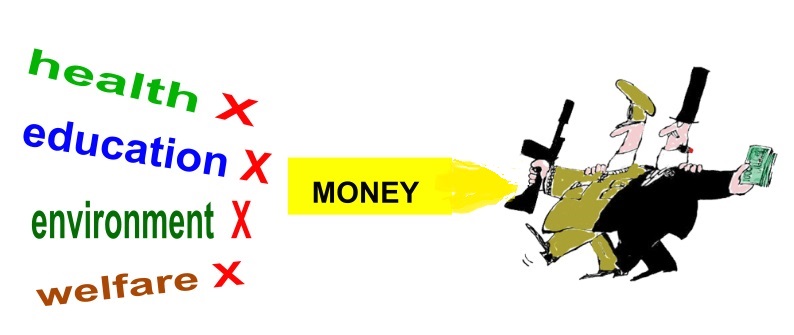
More Guns, Less Butter: Starmer’s Defence Spending Splash

To pursue such rearmament, Starmer has decided to take the axe to the aid budget,
March 8, 2025 Dr Binoy Kampmark, https://theaimn.net/more-guns-less-butter-starmers-defence-spending-splash/
The urge to throw more money at defence budgets across a number of countries has become infectious. It was bound to happen with Donald Trump’s return to the White House, given his previous insistence that US allies do more to fatten their own armies rather than rely on the largesse of Washington’s power. Spend, spend, spend is the theme, and the UK Prime Minister Keir Starmer has shown himself willing to join this wasteful indulgence.
On February 25, just prior to his visit to Washington, Starmer announced that spending on defence would reach 2.5% of GDP from April 2027. In the next parliament, it would rise to 3%. “In recent years,” states a UK government press release, “the world has been reshaped by global instability, including Russian aggression in Ukraine, increasing threats from malign actors, rapid technological change, and the accelerating impacts of climate change.”
Almost predictably, the term “Cold War” makes its retro appearance, with the spending increase the largest since that conflict of wilful misunderstandings and calculated paranoia. Russia figures prominently, as do “malign actors” who have burdened “the working people of Britain” with “increased energy bills, or threats to British interests and values.”
The governing Labour Party has also gone a bit gung-ho with the military–industrial establishment. In an open letter reported by the Financial Times, over 100 Labour MPs and peers thought it wise that ethical rules restricting investment by banks and investment firms in defence companies be relaxed. Financial institutions, the letter argues, should “rethink ESG [environmental, social and governance] mechanisms that often wrongly exclude all defence investment.” It was also important to address the issue of those “unnecessary barriers” defence firms face when “doing business in the UK.” Among such barriers are those irritating matters such as money laundering checks banks are obliged to conduct when considering the finance needs of defence and security firms, along with seeking assurances that they are not financing weapons banned under international law.
That these uncontroversial rules are now being seen as needless barriers to an industry that persists in shirking accountability is a sign of creeping moral flabbiness. Across Europe, the defence and arms lobbyists, those great exploiters of fictional insecurity, are feeling more confident than they have in years. They can rely on such figures as European Commission President, Ursula von der Leyen, who stated on March 4 that, “We are in an era of rearmament. And Europe is ready to massively boost its defence spending.”
To pursue such rearmament, Starmer has decided to take the axe to the aid budget, reducing it from its current level of 0.5% of gross national income to 0.3% in 2027. It was, as the press release goes on to mention, a “difficult choice” and part of “the evolving nature of the threat and the strategic shift required to meet it.” The Conservatives approved the measure, and the populist Reform UK would have little reason to object, seeing it had been its policy suggestion at the last election.
It was a decision that sufficiently troubled the international development minister, Anneliese Dodds, to quit the cabinet. In a letter to the prime minister, Dodds remarked that, while Starmer wished “to continue support for Gaza, Sudan and Ukraine; for vaccination; for climate; and for rules-based systems,” doing so would “be impossible … given the depth of the cut.”
Making the Office of Overseas Development Assistance absorb such a reduction would also see Britain “pull-out from numerous African, Caribbean and Western Balkan nations – at a time when Russia has been aggressively increasing its global presence.” It would be isolated from various multilateral bodies, see “a withdrawal from regional banks and a reduced commitment to the World Bank.” Influence would also be lost at such international fora as the G7 and G20.
Defence establishment figures have also regarded the decision to reduce aid with some consternation. General Lord Richards, former Chief of Defence Staff, saw the sense of an increase in military spending but not at the expense of the aid budget. “The notion that we must weaken one to strengthen the other is not just misleading but dangerous,” opined Richards in The Telegraph. “A lack of investment and development will only fuel greater instability, increase security threats and place a heavier burden on our Armed Forces.”The aid budgets of wealthy states should never be seen as benevolent projects. Behind the charitable endeavour is a calculation that speaks more to power (euphemised as “soft”) than kindness. Aid keeps the natives of other countries clothed, fed and sufficiently sustained not to want to stray to other contenders. The sentiment was expressed all too clearly by a disappointed Dodds: a smaller UK aid budget would embolden an already daring Russia to fill the vacuum. How fascinating, then, that a daring Russia, its threatening posture inflated and exaggerated, is one of the primary reasons prompting an increase in Britain’s defence spending in the first place.
Changing nuclear policy would make ‘SNP as bad as Tories’, MSP warns
By Xander Elliards Content Editor, 9th March
CHANGING the SNP’s policy on nuclear weapons would be a “panic measure” demonstrating the same lack of principles as the Tories or Labour, an MSP has warned.
Bill Kidd, who is also co-president of the
global group Parliamentarians for Nuclear Non-Proliferation and
Disarmament, issued a warning to his party after its long-standing policy
on nuclear weapons came under fire on multiple fronts – including from
within.
As the fear of Russia rises in Europe, Labour have chosen nuclear
weapons as an issue on which to attack the SNP. Just this week, Prime
Minister Keir Starmer took aim at the party’s stance on nuclear weapons
in the Commons – followed by Labour MP Joani Reid and Scottish Secretary
Ian Murray doing the same two days later. Then, Ian Blackford, the SNP’s
former Westminster leader, joined the calls for the SNP to change tack on
nuclear weaponry – saying the party should support multilateral
disarmament instead of unilateral disarmament.
The question being asked is
simple: will the SNP stick with their support for the removal of nuclear
weapons from Scotland on day one of independence? Or, will they change tack
and say nukes can stay on the Clyde indefinitely (which, in practice, is
what waiting for multilateral disarmament means)?
For Kidd, who spoke to
the Sunday National from a UN summit on the Treaty on the Prohibition of
Nuclear Weapons (TPNW), the answer is clear. “There may be increasing
pressure from the UK, from the UK political parties – and in fact I
expect that there will be – but that is another example of why the SNP
should stand firmly as an anti-nuclear [party],” he said.
The National 9th March 2025, https://www.thenational.scot/news/24992541.changing-nuclear-policy-make-snp-bad-tories-msp-warns/
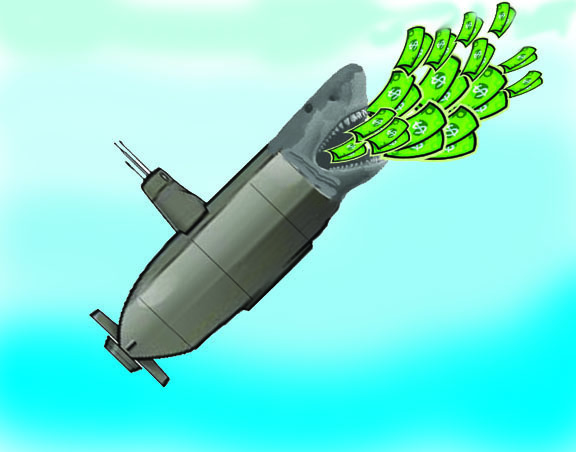
Britain’s nuclear submarines bill spirals by £5bn
The MoD blames inflation as the cost of replacing the UK’s at-sea deterrent hits £37bn
Szu Ping Chan Economics Editor. Matt Oliver Industry Editor
The cost of replacing the submarines carrying Britain’s nuclear deterrent
has ballooned by more than £5bn in just three years, according to official
documents. The Ministry of Defence (MoD) has raised its estimate for the
lifetime cost of manufacturing and maintaining four new ballistic missile
submarines to £36.7bn as of March last year, up from an estimate of
£31.5bn in 2020-21. It is also £2.5bn more than projected in March 2023.
Telegraph 9th March 2025, https://www.telegraph.co.uk/business/2025/03/09/cost-for-britains-new-nuclear-submarines-spirals-by-5bn/
US support to maintain UK’s nuclear arsenal is in doubt, experts say.
Guardian 8th March 2025,
Malcolm Rifkind joins diplomats and analysts urging focus on European cooperation to replace Trident.
Britain’s ability to rely on the US to maintain the UK’s nuclear arsenal is now in doubt, experts have warned, but working with European states to replace it will be costly and take time.
An existing debate about the future of Trident – Britain’s ageing submarine-launched nuclear missile system – has taken a dramatic new turn in recent weeks amid fears Donald Trump could pull out of Nato.
A range of concerns had already loomed over the £3bn-a-year programme, not least around its efficiency and effectiveness after a second embarrassing failed test launch last year.
Costs have also been a longstanding challenge but replacing Vanguard submarines on time has been prioritised over coming in under budget.
Downing Street sought to play down concerns earlier this week after diplomatic figures including the former British ambassador to the US Sir David Manning floated the scenario of an end to Anglo-US nuclear cooperation.
However, calls for Britain to make alternative plans have been joined by the former UK foreign secretary Sir Malcolm Rifkind, who initiated talks in the 90s between the UK and France on nuclear weapons cooperation.
“It really is necessary for Britain and France to work more closely together because if American reliability ever came into question, then Europe could be defenceless in the face of Russian aggression,” he said.
“The contribution by America must now be to some degree in doubt, not today or tomorrow, but over the next few years and certainly as long as Trump and people like him are in control in Washington.”………………………………………………………………………………………………. https://www.theguardian.com/world/2025/mar/08/us-support-uk-nuclear-arsenal-in-doubt-trident-france
Britain’s nuclear weapons fiasco is a nightmare for Rachel Reeves
Overhauling the UK’s ageing defence has left the Chancellor facing a fresh battle to balance the books
Sir Keir Starmer was the first Labour leader in three decades to visit the
Barrow shipyard where Britain’s next generation of nuclear submarines are
being assembled. The Prime Minister, on the opposition benches at the time,
was unflinching in his support for the UK’s submarines-based nuclear
deterrent – a continuous at-sea presence that the Royal Navy has
maintained since 1969.
But while keeping Britain safe may be priceless,
being ready for war doesn’t come cheap. Trident, Britain’s nuclear
deterrent, gobbles up a significant share of our defence budget, leaving
the share devoted to troops and guns far below the 2pc Nato baseline. While
the Treasury said in October that its commitment to the UK’s nuclear
deterrent was “absolute”, many have warned that costs are spiralling
out of control, piling more pressure on a Chancellor who is already
struggling to balance the books.
Telegraph 8th March 2025, https://www.telegraph.co.uk/business/2025/03/08/britains-nuclear-weapons-fiasco-nightmare-rachel-reeves/
1 This Month
Chernobyl: The Lost Tapes – A good documentary on Chernobyl on SBS available On Demand for the next 3 weeks– https://www.sbs.com.au/ondemand/tv-program/chernobyl-the-lost-tapes/2352741955560

of the week–London Campaign for Nuclear Disarmament

Tell the Ukrainian Government to Drop Prosecution of Peace Activist Yurii Sheliazhenko
To see nuclear-related stories in greater depth and intensity – go to https://nuclearinformation.wordpress.com
-
Archives
- April 2026 (126)
- March 2026 (251)
- February 2026 (268)
- January 2026 (308)
- December 2025 (358)
- November 2025 (359)
- October 2025 (376)
- September 2025 (257)
- August 2025 (319)
- July 2025 (230)
- June 2025 (348)
- May 2025 (261)
-
Categories
- 1
- 1 NUCLEAR ISSUES
- business and costs
- climate change
- culture and arts
- ENERGY
- environment
- health
- history
- indigenous issues
- Legal
- marketing of nuclear
- media
- opposition to nuclear
- PERSONAL STORIES
- politics
- politics international
- Religion and ethics
- safety
- secrets,lies and civil liberties
- spinbuster
- technology
- Uranium
- wastes
- weapons and war
- Women
- 2 WORLD
- ACTION
- AFRICA
- Atrocities
- AUSTRALIA
- Christina's notes
- Christina's themes
- culture and arts
- Events
- Fuk 2022
- Fuk 2023
- Fukushima 2017
- Fukushima 2018
- fukushima 2019
- Fukushima 2020
- Fukushima 2021
- general
- global warming
- Humour (God we need it)
- Nuclear
- RARE EARTHS
- Reference
- resources – print
- Resources -audiovicual
- Weekly Newsletter
- World
- World Nuclear
- YouTube
-
RSS
Entries RSS
Comments RSS
 nuclear-news