UK Government abandons plan to greenwash nuclear in a new taxonomy

28th July 2025, https://www.nuclearpolicy.info/news/government-abandons-plan-to-greenwash-nuclear-in-a-new-taxonomy/
Much to the delight of the Nuclear Free Local Authorities, the UK Government has abandoned the latest plan to introduce a new taxonomy for ‘green’ energy technologies. Why? Because, in the small print, Ministers wanted to include nuclear so the plan would have amounted to ‘greenwashing’ the industry.
The government recently published its response to a consultation conducted earlier this year by the Treasury. In the consultation, a taxonomy was described as ‘a classification tool which provides its users with a common framework to define which economic activities support climate, environmental or wider sustainability objectives.’
It should have been a mechanism to facilitate further investment in ‘green’ energy projects, but the proposal was in the NFLA’s view fatally flawed as in the small print the consultation document obliquely included nuclear.
28th July 2025
Government abandons plan to greenwash nuclear in a new taxonomy
Much to the delight of the Nuclear Free Local Authorities, the UK Government has abandoned the latest plan to introduce a new taxonomy for ‘green’ energy technologies. Why? Because, in the small print, Ministers wanted to include nuclear so the plan would have amounted to ‘greenwashing’ the industry.
The government recently published its response to a consultation conducted earlier this year by the Treasury. In the consultation, a taxonomy was described as ‘a classification tool which provides its users with a common framework to define which economic activities support climate, environmental or wider sustainability objectives.’
It should have been a mechanism to facilitate further investment in ‘green’ energy projects, but the proposal was in the NFLA’s view fatally flawed as in the small print the consultation document obliquely included nuclear.
The NFLAs opposed this plan and Dr Paul Dorfman, who kindly drafted our response, explained why: ‘The ‘UK Green Consultation’ document stated that, ‘Subject to stakeholder feedback on the value and use cases of a UK Green Taxonomy, the government proposes that nuclear energy will be classified as green in any future UK Green Taxonomy’ – a ‘horse and cart’ situation that brought into question the role, process and purpose of consultation, with all that has implications for trust in government.
Now Emma Reynolds MP, Economic Secretary to the Treasury, has stated that Ministers have abandoned the plan: ‘the government has concluded that a UK Taxonomy would not be the most effective tool to deliver the green transition and should not be part of our sustainable finance framework.’ Ms Reynolds claimed that ‘other policies were of higher priority to accelerate investment into the transition to Net Zero and limit greenwashing.’
The NFLAs support the aspiration to achieve Net Zero, but nuclear, as a technology associated with resource intensive activities, environmental damage and contamination, and a deadly legacy of radioactive waste, is in the NFLA’s view most certainly not ‘green’ and its inclusion would have amounted to ‘greenwashing’.
Dr Paul Dorfman succinctly expressed our relief at the government’s U-turn: ‘In this contest, it seems fair that Government has taken a considered step back and has made the right decision not to pursue this Taxonomy.’
The decision appeared to have a near immediate impact with Schroders Greencoat, which describes itself as ‘a specialist renewables infrastructure investor’, widely reported to have decided to withdraw as a prospective investor in Sizewell C. Stop Sizewell C executive director Alison Downes said: “It’s welcome news that Schroders Greencoat won’t be investing in Sizewell C. Based on our dialogue with Schroders, we attribute this to the government deciding not to adopt a green taxonomy, which thankfully has the outcome that nuclear energy cannot be erroneously labelled ‘green’”.
‘A heroic endeavour’: Sizewell C’s £38bn plan to keep the lights on
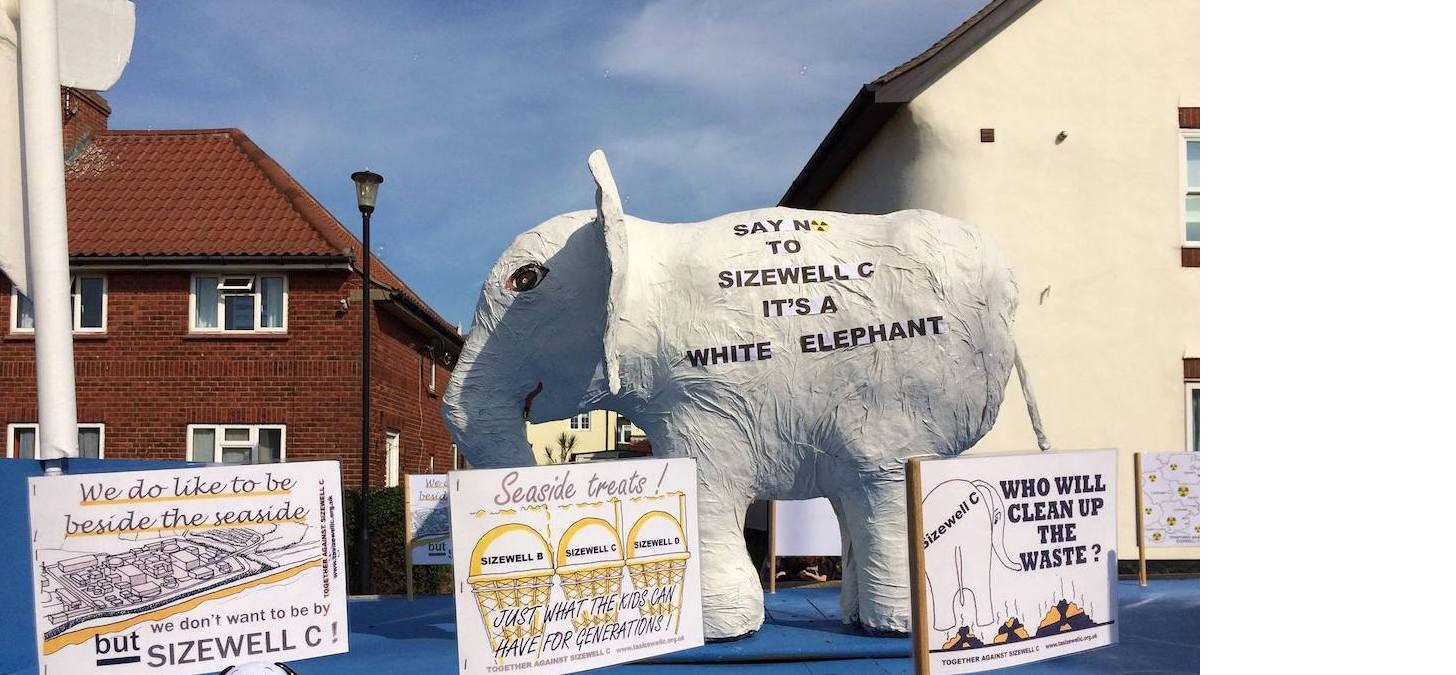
As construction finally starts how will this megaproject be built, can
it avoid the pitfalls of previous nuclear plants, and is it worth the
money?
Hinkley Point is overdue and over budget, while the EPR has been
plagued by problems in other countries where it has been built. Small
wonder, then, that some have asked whether replicating Hinkley is a good
idea.
Julia Pyke is here to tell people that copying Hinkley is exactly
what we should be doing. “It’s better to build the thing you know how
to build because … it will be cheaper.” Hinkley has helped build up a
nuclear workforce that was in decline. Pyke recalled the first batch of
university interns at Sizewell C. “The majority of them literally
didn’t know that the UK had a nuclear industry. It had been that
quiet,” she said.
The deal struck last week will see the government take
a 45 per cent stake, with Canadian pension fund La Caisse holding 20 per
cent, British Gas owner Centrica 15 per cent, EDF 12.5 per cent, and Amber
Infrastructure the remaining 7.6 per cent.
The gargantuan cost will be 65
per cent funded by debt, and 35 per cent by equity. The government has
pencilled in a total cost of £55 billion for contingency and inflation
over the lifetime of the plant. Last week there was much noise around the
fact that Sizewell’s price tag had ballooned from an estimate of £20
billion, in 2015 money. The new figure accounts for inflation and “some
cost increase”, according to Pyke. One big difference between Hinkley and
Sizewell, she argued, is that the design is now better understood and
contracts will be tighter. Many of Hinkley’s overruns were blamed on
“cost-plus” contracts that allowed suppliers to ratchet up their bills.
Pyke pointed to a recent deal for civil engineering at Sizewell: “It’s
a contract which, roughly speaking, pays the contractors the actual cost of
doing a day’s work. And it aligns profit to achieved milestones. So
they’re not incentivised to run the job long.”
In any case, Pyke argued, talk of cost misses the point. Sizewell C will ultimately be an
asset for the taxpayer. And the project will pay billions in tax over its
lifespan. “The cost is an investment for society because it’s going to
give us energy security and lower bills, as well as pay tax … it has much
wider societal benefits.”
Alison Downes, executive director of the Stop
Sizewell C campaign, said that as a group, they had always tried to
emphasise the wider problems with the project, beyond their self-interest.
“One former EDF chief executive described the EPR design as too
complicated — almost unbuildable,” she said. “The long delays at EPRs
elsewhere in the world, the massive cost overruns, suggest that this
project will be very difficult to build. And the Sizewell site is complex.
Any savings are likely to be frittered away in more complicated
groundworks.”
Times 26th July 2025, https://www.thetimes.com/business-money/companies/article/sizewell-c-38bn-plan-to-keep-the-lights-on-ndszrldwd
SNP slam ‘toxic’ Sizewell-C costs for Scottish energy bills.

THE SNP have demanded Scots are not forced to pay for “toxic” overspending
on the Sizewell-C budget. Prior to the summer recess, Energy Secretary Ed
Miliband quietly revealed that energy bills in Scotland will rise as a
result of a significant budget increase on the project – doubling in cost
to £38 billion with further revelations a loan facility of up to £36.6bn
will be provided, pushing the upper limit to £47.7bn.
Sizewell-C now becomes more costly than Hinkley Point C, the most expensive nuclear power
plant in the world.
Independent analysis from the House of Commons Library
confirmed that Scots will pay at least £300 million extra on energy bills
now to cover the overspend, with Miliband admitting there will be a
decade-long “nuclear tax” on bills north of the border.
SNP Energy spokesperson, Graham Leadbitter MP, said: “This toxic overspend now totals
£48bn and Anas Sarwar has serious questions to answer as to whether he
thinks it’s acceptable for Scots to foot the bill through higher energy
bills. “It is an absolute disgrace that energy rich Scotland will see
Scots face higher energy bills because of a nuclear plant running over
budget in Labour-run England.” With 2.5m households in Scotland, Miliband
forecasted that bill payers will pay an extra £12 per year to cover the
power plant, though experts have warned that figure is likely a minimum
with costs expected to rise further.
The National 27th July 2025 – https://www.thenational.scot/news/25342880.snp-slam-toxic-sizewell-c-costs-scottish-energy-bills/
Ed Miliband put up your energy bills (for Sizewell nuclear)– and hoped you wouldn’t notice
Miliband took the last day of term before MPs knocked off for a
six-week-long holiday – sorry, I mean “working in the constituency”
– to let slip that he was putting up your energy bills. This is to pay
for the ballooning cost of the Sizewell C nuclear plant in Suffolk.
Incidentally, another thing that the Energy Secretary let out the bag on
Tuesday was that the cost of this had almost doubled to £38 billion.
That is regrettable but Miliband did not want us to get too down about it. The
UK Government expects that it will be “limited to an average of around
£1 a month on a typical household bill”. Given the way that energy bills
have gone in recent years, I doubt that anyone feels anything less than
seething resentment at paying even another penny.
The National 25th July 2025, https://www.thenational.scot/politics/25342653.ed-miliband-put-energy-bills—hoped-wouldnt-notice/
Tory peer apologises for helping set up ministerial meeting for a nuclear firm he advises
Deputy speaker Ian Duncan found to have breached rules by providing parliamentary service for Terrestrial Energy
The former junior climate minister has been an adviser to Terrestrial Energy since 2020. When he joined he was given share options, which allowed him to buy shares in the company at a preferential rate if they became profitable.
The Guardian revealed that, in 2023, Duncan forwarded a letter to Andrew Bowie, the nuclear minister at the time, from Simon Irish, the firm’s chief executive who wanted a meeting with the minister at short notice. The peer signed off his email “Lord D of S”.
The chief executive of the company, which is developing a new type of nuclear reactor, secured the meeting with Bowie at which he lobbied for Terrestrial Energy to be given easier access to government funding.
In his response to the watchdog, Duncan said Bowie was a “friend of long standing” who had helped him get elected as a member of the European parliament in 2014 and had then worked in his Brussels office.
Margaret Obi, the Lords commissioner, decided that the rule prohibiting peers from providing “parliamentary services in return for payment or other incentive or reward” was absolute.
She added: “It did not provide an exemption in cases where there was an existing personal relationship.”
She ruled: “Although Lord Duncan stated he was not paid specifically for facilitating this introduction, he received an allocation of share options as consideration for his work for Terrestrial Energy.
“I consider that this can reasonably be understood to have been an incentive or reward for the various tasks he undertook for the company.”
Guardian 25th July 2025, https://www.theguardian.com/politics/2025/jul/25/tory-peer-ian-duncan-apologises-for-helping-set-up-ministerial-meeting-for-firm-he-advises
Sizewell C loans could see project cost rise above Hinkley to £47.7bn
The National Wealth Fund said it will provide a loan facility for the nuclear power station of up to £36.6bn, pushing the upper limit to £47.7bn.
July 22nd 2025, https://www.energyvoice.com/renewables-energy-transition/576872/sizewell-c-loans-could-see-project-cost-rise-above-hinkley-to-47-7bn/
Project costs for the Sizewell C nuclear power station could rise to an upper threshold of £47.7 billion as a result of a new government loan extension.
The National Wealth Fund (NWF) has increased the size of its loan facilities to provide a debt buffer in case project costs rise, the government has confirmed.
The government’s new sovereign fund said in a statement that Treasury has recapitalised the fund from a prior capitalisation of £27.8bn so it can provide a loan facility for nuclear power station Sizewell C of £36.6bn.
The NFW, which started operating in October, will act as a lender of record for the project and continue to have the capacity to invest across its mandated sectors, a spokesperson said.
According to the statement, an additional £5bn of debt will be guaranteed by France’s export credit agency Bpifrance Assurance Export.
An energy department spokesperson told Energy Voice that “in order to finance a project of this size, the project partners have made available finance to fund costs up to £47.7bn (real) to safeguard taxpayers in the event of cost overruns”.
“This is based on a remote scenario for the project and is not what the company is managing the project to,” the government spokesperson said.
“The central target in terms of costs is around £38bn real, but as is standard for big and complex projects, we have secured a financing which contains contingency in case of overruns.”
According to people close to the matter, one of whom cited project documents, while Sizewell C is estimated to cost £38bn, the lower threshold for financing is £40bn, with a higher upper threshold of £47.7bn.
The newly secured loan capital would raise the projected upper limit of financing for the power station by nearly £10bn if it was fully drawn down over the course of the project’s lifecycle, they indicated, although a spokesperson for the fund said that would be unlikely. He said the facility provided for the effect of inflation.
“It is likely that NWF would not be exposed to the full amount of its debt provision, meaning its total debt exposure is likely to be less than the nominal maximum it has provided for,” the fund’s spokesperson said.
This increase would provide for a maximum project cost of £47.7bn, which would make the nuclear project more expensive than stalled Somerset nuclear power station Hinkley Point C, which is estimated to cost in the region of £46bn.
The UK Department for Energy Security and Net Zero (DESNZ) confirmed this morning that it had secured investors to commit a total of £38bn to Sizewell C. That included investment commitments from EDF, Centrica, Amber Infrastructure Group and Canadian fund La Caisse.
Together Against Sizewell C chair Jenny Kirtley said: “The scale of potential exposure of public funds to the Sizewell C project is revealed as a staggering £54.589bn in the government’s FID subsidy scheme.
“So much for claims made by EDF and government that there would be huge cost savings from ‘lessons learned’ from the Hinkley Point C build.”
She added that “future generations will have the responsibility to protect the Sizewell C site until the late 2100s and are depending on us to get it right”.
Sizewell C, which reached a final investment decision in the early hours of Tuesday, is expected to be a more efficient replica than its delayed and long-awaited Somerset counterpart, with efficiencies estimated to be between 20% and 25% greater than the first two reactors at Hinkley.
Supply chain ‘incentivised to keep costs down’
Investors insist that they are confident that costs will not overrun, yet Somerset nuclear power station Hinkley Point C is years overdue and over budget.
“The project supply chain is strongly incentivised to keep costs down and investors will see lower returns if there are overruns, reducing risk for taxpayers,” DESNZ told Energy Voice by email.
The new Suffolk nuclear power station at Sizewell is expected to be delivered by the mid-2030s.
Yet Hinkley Point C, which secured a contract-for-difference to operate in 2015, is still not fully built.
Project owner EDF received a dressing down from the French auditor earlier this year, which insisted that it should refinance Hinkley before investing in another nuclear power station in the UK, Sizewell C.
EDF has subsequently reduced its stake to 12.5%, representing an equity commitment of £1.1bn. Centrica has agreed to invest £1.3bn in a 15% stake, while Amber Infrastructure Group and Canadian fund Le Caisse have committed to take an initial 7.6% and 20% stake respectively.
The UK government said it will initially take a stake of 44.9% in Sizewell C, which is expected to reduce if Amber and La Caisse’s combined stake rises to 30%, according to a person familiar with the matter.
Anas Sarwar urged to break silence on Labour’s ‘nuclear tax’ for Scots
ANAS Sarwar has been urged to clarify whether he backs a plan to apply a
“nuclear tax” to Scots with bills set to go up due to the rising cost of an
English nuclear plant. Energy Security Secretary Ed Miliband has confirmed
the Sizewell-C plant will cost £38 billion, nearly double the previous
estimate of £20bn.
Miliband snuck out a statement hours before Parliament
was due to go into a six-week summer recess, admitting energy bill payers
would face a decade-long levy as a result of the price hike. This is
despite Labour promising ahead of the General Election that their flagship
GB Energy policy would save people £300 a year on their energy bills. In
actual fact, bills are on average 10% higher than they were this time last
year.
The National 23rd July 2025, https://www.thenational.scot/news/25335813.anas-sarwar-urged-break-silence-labours-nuclear-tax-scots/
UK Government drops plans to include smaller nuclear fusion energy plants in NSIP regime
The government has announced it will incorporate all nuclear fusion energy facilities generating at least 50 megawatts (MW) in England into the streamlined nationally significant infrastructure project (NSIP) planning regime, but will drop its proposal to include such developments that fall under this threshold.
by Natasha Norris, Planning 24th July 2025,
https://www.planningresource.co.uk/article/1926726/government-drops-plans-include-smaller-nuclear-fusion-energy-plants-nsip-regime
2
Why Nuclear Power in Scotland is not Needed, Economic, Wanted or Safe
John Drummond in conversation with Energy Scotland’s John Proctor and Leah Gunn Barrett
Leah Gunn Barrett, Dear Scotland, Jul 24, 2025
Last evening, John Proctor of Energy Scotland and I were guests on The Nation Talks podcast with John Drummond. We discussed why more nuclear power in Scotland should be a non-starter. It’s notNeeded, Economic, Wanted or Safe. And yet English Labour – from Kid Starver to Viceroy Murray to Anus Sarwar – are rabidly pro-nuclear, pushing this costly and dangerous energy source onto Scotland without our consent.
The video link to the programme is below. I’ve also provided notes below that I used to prepare, many taken from my previous posts.
Why Nuclear power is being pushed onto Scotland
The Corporate Nuclear Lobby has conducted one of the most aggressive lobbying and public relations campaigns of all energy sources. It pushes politicians and the public to support nuclear based on sketchy information and outright lies which aren’t challenged in the Scottish media.
The nuclear industry is funding lobby group Britain Remade, which launched a campaign to lift the ban on new Scottish nuclear power at a May 1 meeting in Dunbar, near the Torness power plant. English Labour’s Scotland manager Anus Sarwar accused the SNP of depriving Scotland of billions in investment and thousands of jobs, which is a lie. This is the same dude who wouldn’t save Grangemouth and its 500 jobs, after vowing he would.
And Viceroy Murray is pushing nuclear, even removing his name from the International Campaign to Abolish Nuclear Weapons (ICAN) pledge.
English Labour is bankrolled by the nuclear lobby. Tony Blair is one of its biggest beneficiaries and cheerleaders. The Nuclear Energy Association loved his Institute’s 2024 pro-nuclear power report.
Nuclear power subsidises nuclear weapons production
Here’s the dirty little secret – the UK Government needs nuclear power. Without it, there’d be no nuclear weapons programme, the flaccid UK’s national virility symbol.
All the processes of the nuclear fuel cycle – uranium mining, refining and U-235 enrichment – are used for both civilian and military purposes; the UK Capenhurst facility makes nuclear fuel for both reactors and Trident submarines; and nuclear reactors create tritium (the radioactive isotope of hydrogen), which is necessary for nuclear weapons.
A 2017 University of Sussex study found that the costs of the Trident programme would be “unsupportable” without “an effective subsidy, from electricity consumers to military nuclear infrastructure”. Consumers, bearing the costs of uneconomic nuclear power, are also subsidising nuclear weapons that don’t even work! The Trident delivery system has failed two tests in a row, in 2016, and 2024. Despite these fiascos, the UK government insists that Trident “remains the most reliable weapons system in the world.”
Westminster won’t allow the southeast of England to be polluted by these nuclear rustbuckets so has confined them to “north Britain.” Nor will it tell its northern colony how badly they’re polluting the land and water. In 2017, the MoD stopped publishing annual reports from its internal watchdog, after the reports for 2005-2015 flagged “regulatory risks” 86 times. It has also blocked Scotland’s environment agency from releasing information about radioactive pollution from the Clyde nuclear bases at Faslane and Coulport for the last ten years.
Scots are getting the mushroom treatment – kept in the dark and fed a load of shite.
I. Nuclear is Not Needed – Renewables are far cheaper and safer………………………………………………………………………………………………………………
So, English Labour is trying to force onto Scotland plants that aren’t even commercially viable. It’s regurgitating the marketing hot air from a desperate industry that’s frantically funding pathetic careerists like Sarwar, Starmer and the Viceroy who are pushing this crap.
……………………………………………………………………………………………………………………….. • With no solution to nuclear waste, the UK is starting a new nuclear building program which will worsen the waste problem and result in vastly increased radioactivity from spent fuel and other highly radioactive wastes which will have to be stored indefinitely at vulnerable sites scattered around the UK coast.
The UK won’t give up on its never-ending quest to screw Scotland. It has stolen our oil and gas and now our renewables, and now is trying to force us to accept not needed, not economic, not wanted and not safe nuclear power.
Please sign the petition calling on the Scottish Administration to implement the International Covenant on Civil and Political Rights to give Scots the tools to exercise their sovereignty and the ability to say NO to nuclear. https://dearscotland.substack.com/p/why-nuclear-power-in-scotland-is
Time to Step Up – Campaigner calls on MP to challenge decision to give fusion indemnity over accident liabilities

Renowned nuclear campaigner, and friend to the Nuclear Free Local
Authorities, Dr David Lowry has just written to his local Member of
Parliament calling on her to challenge ministers over their pledge to
provide an absolute indemnity over costs incurred by a nuclear fusion pilot
plant being built in the Midlands should there be ‘incidents involving
nuclear matter or emissions of ionising radiation arising from fusion
activities relating to the STEP programme.’
In a written statement issued
to Parliament just prior to MPs leaving for the summer recess, Minister for
Climate – and seemingly defacto Nuclear Minister – Kerry McCarthy –
announced that this latest financial ‘get out of jail free’ card for the
nuclear industry would be ‘remote and uncapped’. The assumption by the
Treasury – and therefore by taxpayers – of any liability is Ms McCarthy
insists necessary to ‘address the gap in the insurance market’ which
rather suggests that no-one in the commercial insurance market is prepared
to take on the risks associated with this nascent technology.
NFLA 22nd July 2025, https://www.nuclearpolicy.info/news/time-to-step-up-campaigner-calls-on-mp-to-challenge-decision-to-give-fusion-indemnity-over-accident-liabilities/
The inside story of how America sent nuclear weapons to Britain
Nukewatch UK explains how it tracked the bombs being flown across the Atlantic.
American nuclear weapons with three times the power of the Hiroshima bomb
were transported to England last week, new evidence suggests. The arsenal
is under the control of president Donald Trump and could be used without
British approval.
Our team at Nukewatch UK observed a special flight
carrying the bombs as it landed at RAF Lakenheath in Suffolk on 17 July,
having tracked its journey and monitored radio messages. The transport
plane, a giant C-17 Globemaster (flight number RCH4574 or Reach 4574) had
taken off from Lewis–McChord base in Washington state two days earlier.
Declassified UK 22nd July 2025, https://www.declassifieduk.org/the-inside-story-of-how-america-sent-nuclear-weapons-to-britain/
EDF not repeating its costly Hinkley nuclear blunder – for Sizewell C, the UK tax-payers will cop the costs.
In response to the Government’s announced funding plan to build new EPR
reactors at Sizewell, Dr Douglas Parr, Policy Director for Greenpeace UK,
said: “The UK’s unswerving loyalty to the one energy source that
consistently increases in price remains undimmed by our cost of living
crisis.
At a time when much cheaper renewables and storage, grid
improvements and a decoupling from gas would do so much more to reduce
energy costs, this announcement is testament to both the lobbying skills of
the nuclear industry, and a blind optimism from the government when it
comes to building atomic infrastructure that actual experience seems
incapable of shifting.
The only significant difference between the slowly
unfolding economic blunder of Hinkley C and the forthcoming economic
disaster of Sizewell C is that Hinkley’s predictable construction
problems, delays and cost overruns were borne by EDF. EDF know they can’t
afford to make that mistake again, and so this time those costs will be
borne by you, the British public.”
Greenpeace 22nd July 2025, https://www.greenpeace.org.uk/press-centre/
East Suffolk Council Statement following Sizewell C Final Investment Decision announcement
East Suffolk Council 22nd July 2025, https://www.eastsuffolk.gov.uk/news/sizewell-c-final-investment-east-suffolk-council-statement/
A statement from Cllr Tom Daly, East Suffolk Council’s Cabinet Member for Energy Projects, following confirmation by the government of Final Investment Decision for the construction of the Sizewell C Nuclear Power Station:
“East Suffolk Council acknowledges today’s decision by government on the Final Investment Decision for the Sizewell C new nuclear power station promoted by Sizewell C Co at Sizewell, Suffolk. Final Investment Decision is a key financial milestone for the project and follows on from the announcement of a further £14.2bn funding announced as part of the government’s Spending Review in June. The project will now proceed with certainty.
“The project was granted development consent by the Secretary of State for Business, Energy, and Industrial Strategy in 2022 and formally commenced in January 2024. Construction is expected to take approximately nine to 12 years. At this time, the technological development of renewables and the market situation will be such that the case for a massive inflexible nuclear provision will be, at best, unclear.
“East Suffolk Council recognises the continued challenges this will bring to East Suffolk’s communities as a result of the scale of construction works associated with the development, alongside other planned energy infrastructure development in East Suffolk. The Council will continue to work with the project promoter and all key stakeholders, seeking a coordinated and strategic approach to the delivery of energy infrastructure projects in East Suffolk.
“East Suffolk Council believes that renewable energy, like offshore wind and solar, provides a better long-term answer to the energy security and carbon reduction future of the UK. ESC requests that alongside this significant investment in large scale nuclear, similar investment will come forward for community energy initiatives and domestic insulation, to help meet our climate commitments in the climate crisis, and to support our communities with unaffordable energy prices.”
Sizewell C’s Final Investment Decision has only crawled over the line (- with the public purse)

“This much-delayed Final Investment Decision has only crawled over the
line thanks to guarantees that the public purse, not private investors,
will carry the can for the inevitable cost overruns. Even so, UK households
will soon be hit with a new Sizewell C construction tax on their energy
bills. It is astounding that it is only now, as contracts are being signed,
that the government has confessed that Sizewell C’s cost has almost
doubled to an eye watering £38 billion – a figure that will only go up.
Given that Ministers claimed not to recognise the cost was close to £40
billion is there any wonder there is so little trust in this project?”
Stop Sizewell C 22nd July 2025,
https://mailchi.mp/stopsizewellc/finalinvestmentdecision?e=326ee81c22
Why Starmer’s nuclear power push raises cancer fears
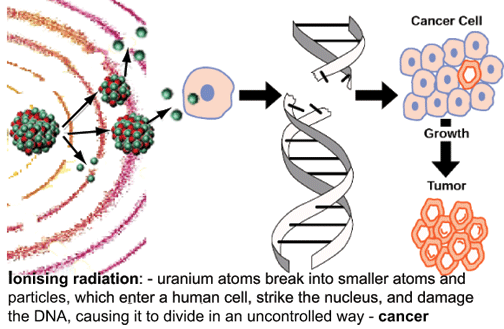
The UK is investing £14.2bn in a new Sizewell plant and £2.5bn in small nuclear reactors. In 1942, the Mallinckrodt Chemical Works in Missouri, US, was
processing uranium for the first atomic bomb. It ran out of space for its
radioactive waste and moved it to an open air storage site near Coldwater
Creek, north of St Louis.
More than 80 years later, Harvard University has
found that communities living near the creek, a tributary of the Missouri
River, have an elevated risk of cancer. The findings, released this week,
showed a dose-response effect, with those nearest the water having a far
higher chance of developing most cancers than those living farther away.
Researchers say it highlights the dangers of exposure to even small amounts
of radiation over time. They say governments must be cautious when building
new nuclear sites near towns and villages. The public was first alerted to
the possibility that nuclear plants could be causing cancer when an ITV
documentary in 1983 revealed a high number of childhood leukaemia cases
between 1955 and 1983 in the village of Seascale, near Sellafield. While
less than one case should have been expected in such a small community,
researchers found seven youngsters suffering from the condition. Residents
feared that radioactive discharges may be to blame and the Committee on
Medical Aspects of Radiation in the Environment (Comare) was set up to
investigate.
Investigations by Comare did show that rates of two types of
childhood leukaemia and non-Hodgkin lymphoma, were significantly higher
than expected, and researchers found a similar cluster at Thurso near
Dounreay. However, researchers did not find raised rates in other villages
near Sellafield and Dounreay, leading them to think that something else was
causing the rise, potentially local infections which are known to trigger
cancer in some cases. The investigators theorised that an influx of workers
moving to Seascale and Thurso to work in the nuclear industry might have
exposed local residents to new infections, sparking a rise in childhood
cancer rates. Viruses such as Epstein-Barr are thought to be linked to
cancers such as non-Hodgkin’s lymphoma.
Telegraph 19th July 2025, https://www.telegraph.co.uk/news/2025/07/19/why-starmers-nuclear-power-push-raises-cancer-fears/
1 This Month



26 September – International Day for the Total Elimination of Nuclear Weapons


PLEASE OPPOSE HR 8255 AND S.3639 – bills would accelerate satellite deployment, with no environmental review or safeguards – https://ncstd5li.quorum.us/campaign/169331/
To see nuclear-related stories in greater depth and intensity – go to https://nuclearinformation.wordpress.com
-
Archives
- September 2026 (219)
- August 2026 (330)
- July 2026 (355)
- June 2026 (287)
- May 2026 (306)
- April 2026 (356)
- March 2026 (251)
- February 2026 (267)
- January 2026 (308)
- December 2025 (358)
- November 2025 (359)
- October 2025 (375)
-
Categories
- 1
- 1 NUCLEAR ISSUES
- business and costs
- climate change
- culture and arts
- ENERGY
- environment
- health
- history
- indigenous issues
- Legal
- marketing of nuclear
- media
- opposition to nuclear
- PERSONAL STORIES
- politics
- politics international
- Religion and ethics
- safety
- secrets,lies and civil liberties
- spinbuster
- technology
- Uranium
- wastes
- weapons and war
- Women
- 2 WORLD
- ACTION
- AFRICA
- Atrocities
- AUSTRALIA
- Christina's notes
- Christina's themes
- culture and arts
- Events
- Fuk 2022
- Fuk 2023
- Fukushima 2017
- Fukushima 2018
- fukushima 2019
- Fukushima 2020
- Fukushima 2021
- general
- global warming
- Humour (God we need it)
- Nuclear
- RARE EARTHS
- Reference
- resources – print
- Resources -audiovicual
- Weekly Newsletter
- World
- World Nuclear
- YouTube
-
RSS
Entries RSS
Comments RSS
 nuclear-news