Fears over safety after nuclear waste leaks into Clyde revealed
News Scotsman.com 28 April 2009
By David Maddox
CONCERNS have been raised about safety at Faslane after it was revealed nuclear waste has leaked into the Clyde.
The Scottish Environmental Protection Agency (Sepa) has said that if Faslane was a civilian installation it would consider closing it down.
The worst breaches included leaks of radioactive coolants from nuclear subs in 2004, 2007 and 2008, according to documents acquired under freedom of information requests by Channel 4………. http://news.scotsman.com/scotland/Fears-over-safety-after-nuclear.5210867.jp
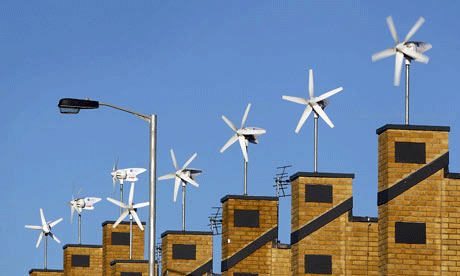
Anger at plans for nuclear power station to replace wind farm
The Guardian Terry Macalister 28 April 2009 • Threatened site is one of the most efficient
• Proposed atomic plant backed by government One of the oldest and most efficient wind farms in Britain is to be dismantled and replaced by a nuclear power station under plans drawn up by the German-owned power group RWE.
The site at Kirksanton in Cumbria – home to the Haverigg turbines – has just been approved by the government for potential atomic newbuild in a move that has infuriated the wind power industry.
Colin Palmer, founder of the Windcluster company, which owns part of the Haverigg wind farm, said he was horrified that such a plan could be considered at a time when Britain risks missing its green energy targets and after reassurance from ministers that nuclear and renewables were not incompatible.
…………………….. The British Wind Energy Association said the enormous speed with which nuclear plants appeared to be moving through the planning process – responsible for part of the anger around Haverigg – compared dramatically with all the problems being faced by dozens of windfarms. “We need a level playing field for all types of generation when it comes to planning regulation and government support,” said the association. http://www.guardian.co.uk/environment/2009/apr/28/haverigg-turbines-nuclear-power-plant
Radiation from 1960s nuclear tests are still hurting my family – Times Online
Radiation from 1960s nuclear tests are still hurting my family THE TIMES April 27 2009 The Government is to hold an inquiry that may finally lead to compensation for British servicemen exposed to radiation during nuclear testing in the 1950s and 60s. ……………………………………………………
Within a few years many of the men had developed cancers and the rate of miscarriages among their partners grew to alarming levels. Evidence is now growing of damage having been caused to their DNA, damage which may have resulted in gene mutations that caused illnesses and congenital deformities among their children.
In research conducted by the independent environmental consultants Green Audit in 2007, the rate of congenital deformities among nuclear test veterans’ children was almost ten times higher than that of an average control group. Among veterans’ partners, the rate of miscarriage was three times the average……………………
“These men have been treated extremely shabbily,” says Gibson. “Successive governments have been dodging their responsibilities while families have been suffering. The MoD’s denial of a link between nuclear tests and ill health looks increasingly shaky now that children and grandchildren of veterans are experiencing congenital disease and early death.” Gibson and Baron’s efforts led to last week’s announcement of Government-backed research.
Only a small number of people have seen the mushroom cloud from an atomic explosion close up. Most of them are dead. Those who survive endure not only their own awful ailments but must, in many cases, wince and weep while their children and now grandchildren suffer before their eyes.
Radiation from 1960s nuclear tests are still hurting my family – Times Online
Taxpayer foots the bill for nuclear bonuses – Times Online
Taxpayer foots the bill for nuclear bonuses TIMESONLINE
Public servants working in Britain’s nuclear industry are being paid millions of pounds of taxpayer-funded bonuses every year, The Times has learnt.
The finding, which emerged from the response to an inquiry under the Freedom of Information Act, has prompted fresh accusations of government waste as the Chancellor prepares the most austere Budget in decades today.
The response from the Nuclear Decommissioning Authority (NDA), the agency responsible for the clean-up of Britain’s nuclear sites, shows that the organisation paid nearly £3.8 million in bonuses to its 315 staff last year.
The average bonus was £11,954, with some regular, non-director level staff receiving £36,917 – up to 40 per cent of their salary. NDA directors received bonuses as high as £85,000.
The figures also show that every one of the NDA’s regular workforce received a bonus last year, as they did in 2007. The payments were made on top of the regular salary payments, which totalled £19.5 million in 2008.
Greens vow to stop nuclear power plant
Greens vow to stop nuclear power plant North West Evening Mail Tuesday, 21 April 2009
A NUCLEAR power plant near Millom would leave Cumbria open to “catastrophic accident or terrorist attack”, resulting in huge loss of life and leaving large parts of the county uninhabitable, green campaigners have warned.
Political group the Green Party has vowed to block plans to build a new plant a Layriggs Farm in Kirksanton.
The defiant stand was announced after a list of 11 potential sites across the country was released by the government on Wednesday (15).
The list also includes land at Braystones, near Egremont, and a plot near Sellafield……………………………
Green Party member Peter Cranie said: “The Green Party has long campaigned against nuclear power due to its high cost and the unsolved problems with radioactive waste and risks of radioactive discharges. There also remains a small, but real, risk of a catastrophic accident.
“New nuclear power stations should not be built on green field sites on the Cumbrian coast, and not at Sellafield either. Sellafield should devote itself to decommissioning and dealing with the radioactive waste already produced.”
The party has expressed concern that a final decision could also be snatched away from “local communities” and handed to a specialist government commission.
North West Evening Mail | News | Greens vow to stop nuclear power plant
Sellafield: the most hazardous place in Europe
The Guardian 21 April 09 Last week the government announced plans for a new generation of nuclear plants. But Britain is still dealing with the legacy of its first atomic installation at Sellafield – a toxic waste dump in one of the most contaminated buildings in Europe. As a multi-billion-pound clean-up is planned, can we avoid making the same mistakes again?
………………………… “It is the most hazardous industrial building in western Europe,” according to George Beveridge, Sellafield’s deputy managing director.
Nor is it hard to understand why the building possesses such a fearsome reputation. Piles of old nuclear reactor parts and decaying fuel rods, much of them of unknown provenance and age, line the murky, radioactive waters of the cooling pond in the centre of B30. Down there, pieces of contaminated metal have dissolved into sludge that emits heavy and potentially lethal doses of radiation.
It is an unsettling place, though B30 is certainly not unique. There is Building B38 next door, for example. “That’s the second most hazardous industrial building in Europe,” said Beveridge. Here highly radioactive cladding from reactor fuel rods is stored, also under water. And again, engineers have only a vague idea what else has been dumped in its cooling pond and left to disintegrate for the past few decades.
………………….. This, then, is the dark heart of Sellafield, a place where engineers and scientists are only now confronting the legacy of Britain’s postwar atomic aspirations and the toxic wasteland that has been created on the Cumbrian coast. Engineers estimate that it could cost the nation up to £50bn to clean this up over the next 100 years………
……… the condition of edifices such as B30 and B38 – and all the other “legacy” structures built at Sellafield decades ago – suggest Britain might end up paying a heavy price for this new commitment to nuclear energy. After all, if it is going to cost that much to decommission early reactors, green groups and opponents of nuclear energy are asking, what might we end up paying for a second clean-up if we go ahead with new nuclear plants?
http://www.guardian.co.uk/environment/2009/apr/19/sellafield-nuclear-plant-cumbria-hazards
Fallout from the fire of 1957: radioactive plume led to 200 cancer cases
The Observer, Sunday 19 April 2009 Sellafield is the site of Britain’s worst nuclear accident. A blaze in 1957 in the reactor of Pile 1 released a massive plume of radioactive caesium, iodine and polonium that spread across Britain and northern Europe.
Up to 200 cases of cancer – including thyroid and breast cancer and also leukaemia – may have been triggered by the fire’s emissions, according to estimates which were published by epidemiologists led by Professor Richard Wakeford, of Manchester University, two years ago.
…………………… After the fire the government placed a six-week ban on consumption of milk from cows grazing within 200 miles of Windscale (as Sellafield was then known). However, the weather carried nuclear contamination far beyond that boundary.
The reactor was left in such a dangerous state of intense radioactivity that it has lain undisturbed ever since and is still considered too dangerous to decommission. As a result, Pile 1 is destined to be one of the last sites to be cleaned up during the decommissioning of Sellafield.
……………………… In 1983, British Nuclear Fuels Limited, or BNFL, which was then the operator of the Sellafield plant, was fined £10,000 after radioactive discharges containing ruthenium and rhodium 106 were found to have contaminated a beach near the power station.
The plant – which was originally expected to make profits of around £500m for Sellafield’s operators – is now expected to make losses of up to £1bn and has been earmarked for closure by the year 2010.
http://www.guardian.co.uk/environment/2009/apr/19/sellafield-nuclear-plant-cancer-cases
Sellafield under fire for ‘catastrophic’ safety error
Sellafield under fire for ‘catastrophic’ safety error North West Evening Mail , 17 April 2009
SELLAFIELD has come under fire from an anti-nuclear group after four highly-radioactive waste stores malfunctioned.
Cooling water was lost when a faulty valve on the waste containers broke down.
The temperature of the waste was allowed to rise for eight hours before Sellafield workers were able to fix the problem……………………….
Details of the malfunction were only released last week.
CORE’s spokesman Martin Forwood said: “The catastrophic result of an extended loss of cooling to these dangerous and increasingly obsolete tanks is well documented and has major implications not only for Cumbria but also for the UK and its European neighbours.
“The incident was dangerously and unacceptably close to resulting in a major off-site release of radioactivity with long-term consequences for human life and the environment”.
North West Evening Mail | News | Sellafield under fire for ‘catastrophic’ safety error
– Nuclear plan good news for economy or deadly legacy?
Nuclear plan good news for economy or deadly legacy? Wales News Apr 16 2009THE nomination of Wylfa Peninsula on Anglesey as one of 11 potential sites for a new UK nuclear power station was hailed yesterday as “very good news” for the island’s economy.
But environmental groups criticised the plans as leaving a “deadly legacy” at a cost of billions of pounds. Anglesey’s residents have one month to submit their views on the new power station, which would replace the current plant, due to stop generating electricity in 2010………………..
……….Friends of the Earth said “breathing new life into the failed nuclear experiment” was not the answer to the UK’s energy problems.
The group’s energy campaigner Robin Webster said: “Nuclear power leaves a deadly legacy of radioactive waste that remains highly dangerous for tens of thousands of years and costs tens of billions of pounds to manage.
“And building new reactors would divert precious resources from developing safe, clean renewable power.
“Nuclear firms are already lobbying ministers to water down UK renewable energy targets. Ministers must exploit the UK’s huge potential of wind, solar, marine and hydro power, and embark on a massive national programme of energy efficiency.
“This will create tens of thousands more jobs than the nuclear option, reduce our dependency on fossil fuels, tackle climate change and make Britain a world leader in developing a green economy.”
UK Government Obsession With Nuclear Power Costly for the Country
UK Government Obsession With Nuclear Power Costly for the Country Earth Times 15 Apr 2009 “……………………….- The problematic history of nuclear power in the United Kingdom (UK) suggests that a stronger focus on sustainable energy alternatives is a better and more cost-effective option. This is a conclusion of a report released today by The Centre for International Governance Innovation (CIGI). The British Nuclear Industry: Status and Prospects provides a detailed analysis of the current state of the nuclear power industry in the UK, including its energy strategy and the government’s plans for possible new nuclear capacity. While the political momentum in support of nuclear options continues to grow, the study’s findings show that the government’s strategy is once again thwarting technologies that might prove cheaper and more reliable…………………….notes the author, “The option of building a new series of nuclear power stations is controversial and highly contested,” citing several reports that show there is no need to build new nuclear stations in the UK. The reports argue that a combination of renewable energy, greater energy efficiencies and other technologies can fill the gap as the old nuclear plants become redundant.
UK Government Obsession With Nuclear Power Costly for the Country
Minister provokes nuclear war over Scotland’s energy future
Minister provokes nuclear war over Scotland’s energy future scotsman.com 16 April 2009By Jenny Haworth THE UK government was accused last night of trying to frustrate Scotland’s push for renewable energy by bullying the SNP into accepting new nuclear power stations……………………………..The SNP administration has consistently ruled out any new nuclear power stations in Scotland after the closure of the existing two plants – Hunterston and Torness in East Lothian. Instead, it intends to focus on renewables…………………….Mr Mather was quick to emphasise yesterday that he was focusing on renewable sources of energy rather than nuclear power.
“Scotland simply doesn’t want or need dangerous and unnecessary new nuclear power stations, with soaring decommissioning costs and the unresolved problem of storage of radioactive waste that burdens future generations for thousands of years,” he said.
“Every pound invested in new nuclear power in other parts of the UK is a pound less on developing renewable and clean energy technology.”
He added that the SNP administration was focusing on developing Scotland’s “real strengths” – harnessing the country’s vast renewable energy potential.
“With around a quarter of Europe’s wave and tidal energy potential, as well as massive wind power opportunities, there are fantastic economic and employment opportunities, and the Scottish Government recently announced plans to create 16,000 green energy-related jobs in Scotland over the next decade,” Mr Mather said.
“Renewable technologies, including wind, water, biomass, wave and tidal, backed up by clean thermal base-load, can meet our energy needs many times over.”
Minister provokes nuclear war over Scotland’s energy future – Scotsman.com News
Irish environmental groups criticise British nuclear plant proposal
Irish environmental groups criticise British nuclear plant proposal IRISHTIMES.COM MARY FITZGERALD, April 16, 2009
PLANS BY the British government to press ahead with a new generation of nuclear power stations, including two proposed sites near Sellafield, have been criticised by Irish environmental groups and anti-nuclear campaigners……………………….
Dr David Hutchinson Edgar, chairman of the Irish Campaign for Nuclear Disarmament (CND), said the plans were a cause for concern. “These concerns are heightened by the fact that five of the sites are on or near the Irish Sea coast, and three are in Cumbria, where Sellafield’s poor record on safety and discharges into the Irish Sea are well-known,” he said.
“In the event of either an accident at a nuclear site, or a deliberate terrorist attack, Ireland . . . could not escape the impact of the fallout . . . Billions invested in prolonging the use of nuclear power could well yield better long-term results through investment in genuinely sustainable and renewable energy sources, such as wind, wave, hydro and biomass.”
Design Flaws In Nuclear Transport Ships Increase The Risk Of Accidents Claims Report
Design flaws in nuclear transport ships increase the risk of accidents, claims report
Sunday Herald 13 April 09 Consultant says claims of safety ‘lack scientific and technical credibility’By Rob Edwards, Environment Editor
THE GROWING number of nuclear waste shipments being made through the Irish Sea risk accidents that could cause widespread radioactive contamination, according to an expert report out this week.The transport ships have “design flaws” that could make them unsafe while the emergency plans in place for coping with an accident are non- existent or inadequate, the report says.At least 45 movements of nuclear materials have been made north and south through the Irish Sea since 2004.
Cargoes of radioactive waste and fuel are transported from the Sellafield nuclear complex in Cumbria to nuclear plants in Japan, the US and Europe.advertisementThe report was commissioned by a coalition of more than 70 local authorities in the UK and Ireland worried about nuclear power. It was written by the independent marine pollution consultant, Tim Deere-Jones, and is due to be published in a few days.
Nuclear financing watchdog established – ClimateChangeCorp.com
Nuclear financing watchdog established Climate Change Corp 7 Apr 2009 | Author: Jeanette Wiemers,
|Board will ensure that public doesn’t shoulder costs for nuclear cleanupThe UK government announced the members of its Nuclear Liabilities Financing Assurance Board, which will examine plans for financing nuclear waste cleanup from power stations, in an effort to keep taxpayers from having to bear the costs. Energy and Climate Change Minister Mike O’Brien said the Board will be yet another protection to ensure that taxpayers are protected from the costs of decommissioning and waste disposal from new nuclear power stations, and that the Board’s diverse membership will help to provide independent scrutiny and advice on the issue.
Nuclear financing watchdog established – ClimateChangeCorp.com
A £1bn nuclear white elephant

A £1bn nuclear white elephant
THE INDEPENDENT 7 April 09 Call for public inquiry as Sellafield recycling plant is costing taxpayer millions every year A controversial nuclear recycling plant, approved by the Government despite warnings over its economic viability and reliance on unproven technology, has racked up costs of more than £1bn and is still not working properly.
Backers of the plant at Sellafield, which promised to turn toxic waste into a useable fuel that could be sold worldwide, had claimed the plant would make a profit of more than £200m in its lifetime, producing 120 tonnes of recycled fuel a year. But after an investigation by The Independent, the Government admitted technical problems and a dearth in orders has meant it has produced just 6.3 tonnes of fuel since opening in 2001.
With construction and commissioning costs of more than £600m, the facility, known as the Mox plant because of the mixed oxides (Mox) fuel it is designed to produce, has cost more than £1.2bn, confirming its status as the nuclear industry’s most embarrassing white elephant and one of the greatest failures in British industrial history, losing the taxpayer £90m a year. Green campaigners and opposition MPs are now calling for the plant to be closed immediately, and a minister who fought its construction at the time has called for a public inquiry into how the plant was ever given the go-ahead.
-
Archives
- May 2026 (156)
- April 2026 (356)
- March 2026 (251)
- February 2026 (268)
- January 2026 (308)
- December 2025 (358)
- November 2025 (359)
- October 2025 (376)
- September 2025 (257)
- August 2025 (319)
- July 2025 (230)
- June 2025 (348)
-
Categories
- 1
- 1 NUCLEAR ISSUES
- business and costs
- climate change
- culture and arts
- ENERGY
- environment
- health
- history
- indigenous issues
- Legal
- marketing of nuclear
- media
- opposition to nuclear
- PERSONAL STORIES
- politics
- politics international
- Religion and ethics
- safety
- secrets,lies and civil liberties
- spinbuster
- technology
- Uranium
- wastes
- weapons and war
- Women
- 2 WORLD
- ACTION
- AFRICA
- Atrocities
- AUSTRALIA
- Christina's notes
- Christina's themes
- culture and arts
- Events
- Fuk 2022
- Fuk 2023
- Fukushima 2017
- Fukushima 2018
- fukushima 2019
- Fukushima 2020
- Fukushima 2021
- general
- global warming
- Humour (God we need it)
- Nuclear
- RARE EARTHS
- Reference
- resources – print
- Resources -audiovicual
- Weekly Newsletter
- World
- World Nuclear
- YouTube
-
RSS
Entries RSS
Comments RSS
Taxpayer foots the bill for nuclear bonuses TIMESONLINE