Strong police presence and arrests at Hinkley anti nuclear action
Hinkley Point: Arrests over trespass BBC News 8 Oct 12 Seven people have been arrested as anti-nuclear protesters carried out a planned trespass at Hinkley Point. More than 50 police officers attended the site as a weekend of action against government plans to build a third nuclear reactor drew to a close.
…Camilla Berens, from the Stop New Nuclear Alliance, said: “We have successfully blockaded the main entrance to Hinkley Point on two occasions in the last year and now we have accomplished a mass trespass.
“Our message today is that we will continue to raise the game with peaceful protest until our voice is heard.” On Saturday, barrels made to look like nuclear waste were rolled
through Bridgwater as part of a procession…
..Hinkley Point C is one of eight potential sites in England and Wales identified by the
government for new nuclear power stations by 2025. The site’s current Hinkley Point B came into service in 1976 but its working life has been extended to 2016.
Nuclear enthusiast UK Energy Minister promises ‘policy certainty’ on new nukes
 Mr Hayes described himself as “extraordinarily enthusiastic about nuclear” and “arguably the most pro-nuclear energy minister in living memory… I suppose ever”.
He conceded that “whoever buys it is going to have to attract sufficient large scale investment to make it happen” but said the government would offer policy certainty and diplomatic
 Government mulls underwriting risk of new nuclear plants The Government is considering ways of underwriting risk in the construction of new UK nuclear plants, the energy minister John Hayes has said. Telegraph UK By Emily Gosden 06 Oct 20122 In an interview with the Sunday Telegraph, Mr Hayes played down fears over the state of the UK’s nuclear ambitions, and suggested that Chinese investors may yet have a role – despite two Chinese corporations failing to bid as expected for the Horizon nuclear venture. Continue reading
An irreversible ripoff of the British public – new nuclear reactors
 the numbers now being talked about in terms of price guarantees for the energy giants are astronomical.
who will wave a flag and scream ‘rip off’ before the Government signs an irrevocable deal.
Nuclear deal is likely to leave a toxic legacy This Is Money, By LISA BUCKINGHAM, 6 October 2012 “…….Now, though, comes a set of negotiations that have the ability to swipe tens of billions out of the public purse and into private coffers. Chinese investors may be about to pick up part of the tab for building some of our new nuclear power stations, but this is not out of the goodness of their hearts.
French energy group EDF, in partnership with British Gas owner Centrica, has been embroiled in long negotiations with the Government over what will effectively be a subsidy to help them cover the huge building costs of these new generators. Continue reading
Independent Scotland would ban nuclear weapons but join Nato Telegraph 7 Oct 12 Alex Salmond has promised SNP members a separate Scotland will have a written constitution banning nuclear weapons if they reverse their decades-long opposition to Nato.By Simon Johnson, Scottish Political Editor 07 Oct 2012161 The First Minister said the document would include a clause declaring weapons of mass destruction illegal, meaning the UK’s Trident submarine fleet would have to be moved from its base on the Clyde.
He made the pledge to placate his party members ahead of their conference later this month, at which they will vote to reverse SNP policy on an independent Scotland being part of Nato. The Nationalists have opposed membership for years because the
alliance is based on nuclear weapons, but this stance has severely undermined the credibility of their defence policy in the debate over separation.
Mr Salmond and Angus Robertson, his defence spokesman, are aiming to convince the SNP rank-and-file they can safely back Nato without compromising their anti-nuclear credentials or their determination to remove Trident…
… Patrick Harvie, the Scottish Greens’ co-leader, said: “The idea that we sign up to a nuclear alliance, the implication of which is to ask other countries to deploy nuclear weapons on our behalf, and then have a debate about whether they should be moved from the Clyde is a nonsense.” http://www.telegraph.co.uk/news/politics/SNP/9592522/Independent-Scotland-would-ban-nuclear-weapons-but-join-Nato.html
Series of company pullbacks puncture UK’s nuclear power dream
 There is now a question mark over who will ultimately foot the bill for what are expected to be massively expensive infrastructure projects
How lights dimmed on UK’s nuclear vision, FT.com By Guy Chazan, October 5, 2012 In 2009, Ed Miliband, the then energy secretary, unveiled plans for the most ambitious expansion of nuclear power in Europe.
It was a bold vision. Britain would build up to 12 new reactors, he said, on 10 sites stretching from Somerset to Cumbria. By the late 2020s about 30 per cent of its electricity would come from nuclear power – up from 18 per cent now
That prediction is now looking wildly optimistic
 .
.
“The race for new nuclear in this country is at serious risk of unravelling,” says Tony Lodge, a research fellow at the Centre for Policy Studies think-tank.
Nuclear is widely seen as one of the great panaceas for Britain’s looming energy problems….
But recent events have conspired to puncture Britain’s nuclear dream. Continue reading
Areva and China Guangdong Nuclear Power Group pull out of UK’s nuclear power project
 British nuclear plans suffer blow as Chinese investors pull out Two new nuclear projects in the UK suffer as firms in running to buy a stake pull out Terry Macalister and Adam Vaughan The Guardian, 3 October 2012 The government’s nuclear energy plans were in trouble on Wednesday with Chinese investors withdrawing interest in two projects and local councils postponing a decision on hosting atomic waste storage.
Areva, the French nuclear engineering group, confirmed that it had pulled out of the running to buy a stake in Horizon Nuclear Power, the enterprise planning to construct new reactors at Wylfa in Wales and Oldbury in Gloucestershire. Areva said its partner, the state-owned China Guangdong Nuclear Power Group (CGNPC), had also shelved its
bid….
This is a blow for the government because Areva is the most advanced with getting regulatory approval for the design of its European Pressurised Reactor (EPR) while the Chinese are considered to have the deepest pockets. Continue reading
Increase in UK nuclear transport accidents
Sharp rise in nuclear transport accidents , 3 Oct 12, http://www.robedwards.com/2012/09/sharp-rise-in-nuclear-transport-accidents.html from Sunday Herald, 30 September 2012 The number of accidents transporting radioactive materials has risen sharply, prompting fears for public safety.
According to a new report from the UK government’s Health Protection Agency (HPA), there were 38 incidents reported in 2011, up from 30 in 2010. This is the second highest in the last six years, which have seen a total of 195 mishaps (see table below). Continue reading
UK military chiefs lack confidence in expensive Trident nuclear missiles
Top military chiefs go cold on nuclear deterrent, The Independent, OLIVER WRIGHT , KIM SENGUPTA 26 SEPTEMBER 2012 Senior military commanders have privately questioned whether Britain needs to maintain its current level of nuclear deterrence when the country’s ageing Trident submarines are decommissioned. Continue reading
Prestige, but not real usefulness, from UK and France’s costly nuclear deterrents
France and Britain Weigh the Price of Nuclear Deterrence International Herald Tribune By HARVEY MORRIS , 27 sept 12 LONDON — There were reports on Thursday of stirrings within the British military about the need to scale back the country’s nuclear deterrent in order to spend the money on confronting more conventional threats. Continue reading
UK Renewable Energy Capacity has Grown by 42.4% Oil Price.com By Joao Peixe | Thu, 27 September 2012 The government has just released its latest quarterly energy statistics and the results are mixed.
Renewable energy has enjoyed a bountiful year, whereas coal power has also seen an increase in popularity. Continue reading
UK’s new nuclear programme hangs on the question of waste disposal
 Nuclear new build programme faces uncertainty, FT.com By Andrew Bounds and Jim Pickard, September 21, 2012 Britain’s nuclear new build programme is facing fresh uncertainty amid fears that Cumbria county council will postpone or even reject plans to host a permanent storage facility for the country’s nuclear waste.
Local politicians have warned that the council is increasingly wary about volunteering to store hundreds of thousands of tonnes of radioactive material underground amid the rolling hills of the north-west…….
Sir David King, former chief scientific adviser to the government, has warned that the uncertainty around nuclear waste could “really set back” the process of building new nuclear plants.
“Implementation of a final policy solution for radioactive wastes in Britain is now long overdue and . . . if we don’t manage the legacy issue with the best science this in itself could hinder nuclear new build,” he said.
At present most of Britain’s nuclear waste is in temporary storage in Sellafield, awaiting a permanent home elsewhere. If the local authorities in Cumbria say Yes – the county council and either Copeland district or Allerdale district – this would pave the way for geological surveys of the area. Yet it could still take another 15 years before a final decision is made on storage, with the repository not opening for at least two decades.
http://www.ft.com/intl/cms/s/0/fefcb306-040d-11e2-9675-00144feabdc0.html#axzz27ETNh6qF
UK: No new nukes if no waste solution
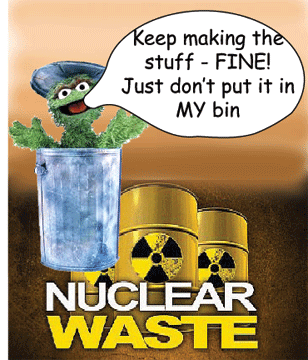 Nuclear new build programme faces uncertainty, FT.com, September 21, 2012
By Andrew Bounds and Jim Pickard“……In the run-up to the general election, David Cameron accused the Labour government of being “irresponsible” for failing to deal with the issue of nuclear waste: “They have to be dealt with in order to make any new investment [in nuclear power] possible,” he said, Jim
Pickard reports.
Two years later, as Mr Cameron’s administration tries to draw in private investment for a new wave of nuclear reactors, the issue is as far from resolved as ever.
Britain is not alone in its attempts to find a site for a gigantic underground repository, a construction project on the same scale as the Channel tunnel.
Governments worldwide have failed to find a permanent solution for the tens of thousands of tonnes of high-level radioactive waste currently stored in temporary facilities.
The disaster at Fukushima in Japan in 2011 highlighted the potential dangers; spent fuel rods were stuffed into cooling tanks at the site, each packed with lethal levels of radioactive isotopes.
Campaigners such as Greenpeace argue that it is foolish for governments to proceed with new nuclear plants when they have not yet resolved this legacy problem from half a century of nuclear power.
One of the few countries going ahead with a permanent repository is Sweden, where two communities competed for the project and the hundreds of jobs it provided.
By contrast, the US has a deep level repository in New Mexico, but it only accepts waste from weapons research and production. A permanent repository for civil waste was proposed for Nevada but the controversial project was scrapped by President Barack Obama. Opponents of underground repositories say spent fuel can be safely
kept for decades while more research is done on alternatives. But the Fukushima crisis has placed a question mark over that argument. http://www.ft.com/intl/cms/s/0/fefcb306-040d-11e2-9675-00144feabdc0.html#axzz27ETNh6qF
Doubts about China, France involved in UK’s new nuclear programme
 Should China be involved in the UK’s nuclear energy infrastructure? Guardian UK, Paul Dorfman, 21 Sept 12 A more responsible way forward to this ethically questionable strategy can be found with Germany’s energy policy Government officials have been in Beijing this week with their Chinese counterparts for an “unprecedented” collaboration on energy . On the table was new nuclear power, and its role in moving the UK to a low-carbon economy.
So far, the Department of Energy and Climate Change (Decc) has been relentlessly optimistic about new nuclear, and hopes that its electricity market reform plans for a draft energy bill will do the trick, despite strong and sustained criticism from a parliamentary select committee on energy, and more recently a House of Lords working group who conclude that the reforms are “unworkable”. But Decc is still loyal to the nuclear project and hopes the financial support implied in these market reforms will attract foreign investment.
France’s state nuclear corporation EDF and their UK junior partner, Centrica, have been centre stage in this nuclear fiscal drama. Centrica appears increasingly lukewarm, and City insiders doubt whether it will maintain a 20% stake in the nuclear consortium. Centrica’s potential departure could have something to do with the economics of nuclear power, with construction costs more than doubling from €3bn to over €6bn – and rising for each of the French-designed European pressurised reactors being built in Finland at Olkiluoto, and Flamanville in France.
Separately, since Germany’s RWE and E.ON in March pulled out of the UK’s second nuclear consortium, Horizon Nuclear Power, two Chinese nuclear state corporations, China Guangdong Nuclear Power and State Nuclear Power Technology, are considering taking on the consortium. Rosatom, the Russian state nuclear energy corporation, has also expressed an interest in the UK nuclear market.
At this point, it’s worth looking at the underlying business ethics of the Russian and Chinese nuclear industries, and questioning the wisdom of their strategic involvement in key UK energy infrastructure……http://www.guardian.co.uk/environment/blog/2012/sep/21/nuclearpower-energy?newsfeed=true
‘Not In My Backyard’ say UK Councils about nuclear waste plan
Romney Marsh nuclear waste storage plant plan rejected, BBC News, 20 Sept 12 The facility would have had nuclear waste underground with research facilities at ground level Plans to build a nuclear waste storage facility on Romney Marsh in Kent have been thrown out by Shepway council. The final decision was taken by Conservative council leader Robert Bliss after councillors voted against the proposals on Wednesday.
The issue had split residents with 63% of people rejecting it in a survey.
Councillors voted 21 to 13 against formally expressing interest in the government’s facility for the geological disposal of nuclear waste……
The public gallery was packed with residents opposed to the scheme as the full council debated the waste plant on Wednesday evening.
Lydd Conservative councillor Victoria Dawson said members had been assured the proposal would not go ahead if the community was againstit….. Kent County Council and neighbouring East Sussex County Council both opposed the plan.
The area is the site of Dungeness nuclear power station, where Dungeness A is being decommissioned and Dungeness B is due to stop generating power in 2018 or 2023.
http://www.bbc.co.uk/news/uk-england-kent-19656382
Radioactive murder of Litvinenko – a State sponsored crime?
 Was Alexander Litvinenko killed by ‘state-sponsored nuclear terrorism’? The Telegraph A senior judge will examine whether Russia ordered the murder of dissident Alexander Litvinenko in an act of “state-sponsored nuclear terrorism”, his inquest heard. By Tom Whitehead, Security Editor 20 Sep 2012
The former KGB agent died from the radioactive poison polonium-210 after allegedly meeting former security colleagues in London in 2006. Allegations that the Russian authorities ordered and directed his death will now form a key part of the inquest, Sir Robert Owen, the High Court judge leading it, signalled.
Lawyers for Mr Litvinenko’s widow, Marina, said if the claims were substantiated, it meant “state-sponsored nuclear terrorism on the streets of London”.
It emerged one of the main suspects in the death, Andrei Lugovoi, could give evidence via video link from Russia, where he is resisting an extradition request.
However, details of a police investigation in to whether Mr Litvinenko, who fled to the UK in 2000, had been in regular contact with the British spy agencies while here will be kept a secret.
Mr Litvinenko, 43, was allegedly poisoned while drinking tea during a meeting with former KGB contacts at the Millennium Hotel in Grosvenor Square in November 2006. He died three weeks later in University College Hospital……
http://www.telegraph.co.uk/news/worldnews/europe/russia/9555262/Was-Alexander-Litvinenko-killed-by-state-sponsored-nuclear-terrorism.html
1 This Month





PLEASE OPPOSE HR 8255 AND S.3639 – bills would accelerate satellite deployment, with no environmental review or safeguards – https://ncstd5li.quorum.us/campaign/169331/
To see nuclear-related stories in greater depth and intensity – go to https://nuclearinformation.wordpress.com
-
Archives
- October 2026 (67)
- September 2026 (339)
- August 2026 (330)
- July 2026 (355)
- June 2026 (287)
- May 2026 (306)
- April 2026 (356)
- March 2026 (251)
- February 2026 (267)
- January 2026 (308)
- December 2025 (358)
- November 2025 (359)
-
Categories
- 1
- 1 NUCLEAR ISSUES
- business and costs
- climate change
- culture and arts
- ENERGY
- environment
- health
- history
- indigenous issues
- Legal
- marketing of nuclear
- media
- opposition to nuclear
- PERSONAL STORIES
- politics
- politics international
- Religion and ethics
- safety
- secrets,lies and civil liberties
- spinbuster
- technology
- Uranium
- wastes
- weapons and war
- Women
- 2 WORLD
- ACTION
- AFRICA
- Atrocities
- AUSTRALIA
- Christina's notes
- Christina's themes
- culture and arts
- Events
- Fuk 2022
- Fuk 2023
- Fukushima 2017
- Fukushima 2018
- fukushima 2019
- Fukushima 2020
- Fukushima 2021
- general
- global warming
- Humour (God we need it)
- Nuclear
- RARE EARTHS
- Reference
- resources – print
- Resources -audiovicual
- Weekly Newsletter
- World
- World Nuclear
- YouTube
-
RSS
Entries RSS
Comments RSS

