Lucrative business for nuclear companies in the complex cleanup of UK’s Sellafield site
 multinationals are aligning themselves into strategic relationships to attract the highly lucrative subcontracts coming on stream. Multi-disciplinary consultant Atkins recently formed a joint venture with French-based nuclear specialist Areva to bid for tier two work on decommissioning and fuel management projects in the UK.
Nuclear Legacy, The Construction Index, 23 Nov 12“…….To speed up the process, Sellafield Ltd, the site licence company owned by PBO Nuclear Management Partners (NMP), has started to implement a series of strategic alliances with a combined value of £9bn.
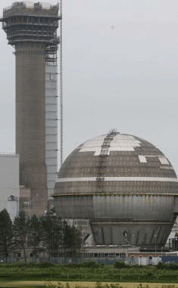 The first framework agreement – The Design Services Alliance – was awarded in February: a £1.5bn contract to The Progressive Alliance (led by Babcock and URS) and AXIOM (a consortium of Amec, Jacobs, Mott McDonald and Assystem). It is expected to extend to 15 years. Continue reading
New report on Ireland’s potential for renewable energy economy and jobs
Renewable energy surge called for, Belfast Telegraph, 22 November 2012 Ireland must embrace renewable energy sources before fossil fuels run out, the WWF has said
More than 70% of Ireland’s electricity could be produced from renewable resources by 2030, a new report out has claimed. The research commissioned by the World Wildlife Fund (WWF) Northern Ireland said the availability of energy from wind, wave and sustainable biomass was significantly larger than the projected demand for the next 18 years….
. Mr Campbell said Scotland was also blazing a trail by setting ambitious targets that could save £325 million a year by reducing energy levels by 12% by 2020. “We can save money by doing this,” he added. “Why are we not doing it?”
Delegates at the conference were told that previous research by the Carbon Trust suggested that investment in renewable energy could create more than 30,000 new jobs in Northern Ireland in a sector that could be worth almost £1 billion. http://www.belfasttelegraph.co.uk/news/local-national/northern-ireland/renewable-energy-surge-called-for-16241156.html#ixzz2D4m4sWB3
Spiralling costs of UK’s nuclear wastes
Recommend that you go to this link, as the page has many very informative graphics.
 http://www.guardian.co.uk/environment/2012/nov/16/
 nuclear-waste-sellafield How much do we spend on nuclear waste? Duncan Clark guardian.co.uk, 16 November 2012 Last week, a new report by the National Audit Office (NAO)highlighted the spiralling costs of running Sellafield, the UK’s huge nuclear
reprocessing and storage site. Duncan Clark reviews the data Continue reading
UK’s Conservative Party driven by climate denialism, and anti wind power fervour
Anti-wind zeal already runs through the party…… the objections of many Tories suggest a deeper animus, fuelled by Euroscepticism, climate-change denial
Mr Cameron made a windpower sceptic, John Hayes, energy minister, and appointed yet another, Owen Paterson, as environment secretary.
as turbines get bigger and more efficient, the costs for operating and maintaining them are falling
Wind farms and renewable energy A lot of hot air The government’s energy policy gets mired in politics
http://www.economist.com/news/britain/21566680-governments-energy-policy-gets-mired-politics-lot-hot-air Nov 17th 2012 THE hatred some Conservative MPs feel for windmills is amazing.On November 14th Chris Heaton-Harris, a Tory MP charged with running his party’s campaign for a by-election in Corby, was secretly taped bragging that he had supported a rival, James Delingpole. A climate-change sceptic, Mr Delingpole had briefly stood as an independent on an anti-wind platform. Mr Heaton-Harris suggested this was a put-up job, designed to implant the issue into the “DNA of the Tory party”. Continue reading
Sellafield nuclear waste site owners charged with illegal dumping
British government files charges against nuclear waste plant owners PlanetArk 16-Nov-12 UK John McGarrity British regulators filed charges against the owners of the Sellafield nuclear waste site on Thursday on allegations of illegal dumping of radioactive waste, adding to the plant’s history of controversy and complaints.
The nine charges relate to the dumping of low-level waste in a landfill in 2010, the latest in a string of issues involving Sellafield, which for the last 60 years has handled Britain’s spent
nuclear fuel.
“The regulators’ joint action follows an extensive investigation,” Britain’s Environment Agency and the Office for Nuclear Safety said in a statement.
The regulators alleged that Sellafield Ltd, which runs the plant, had breached permits by dumping four bags of nuclear waste material at the nearby Lillyhall landfill without authorisation.
The penalties for such a breach are expected to be relatively small, but the prosecution comes at an inopportune time for Sellafield following a highly critical report earlier this month, said Paul Dorfman, a nuclear waste expert at Warwick University. “It’s another suggestion of laissez faire management,” he said.,,,, http://planetark.org/enviro-news/item/67145
Britain’s jinxed nuclear-killer submarines
it was unacceptable for the MoD to spend £10bn of taxpayers’ money on the submarines, and still produce a boat with potentially fundamental design flaws that could, in theory, threaten the UK’s ability to defend itself.
“Even though they know some things are wrong, they keep on building them.
Britain’s nuclear hunter-killer submarines were doomed from the start The flawed thinking and design behind the fleet at the heart of Britain’s navy is now coming to the fore Nick Hopkins The Guardian, 15 Nov The problems with the cost and delivery of Britain’s new nuclear-powered hunter-killer submarines were set out in uncompromising detail in a report published by the National Audit Office this time last year.
But the performance and safety problems of HMS Astute and its sister boats are only now coming to the fore, and that is only because people who know about submarines have been prepared to express their concerns. Continue reading
UK’s nuclear decommissioning problems
What’s the future of nuclear decommissioning? Building.co.uk, 16 November 2012 | By Will Hurst Last week’s devastating National Audit Office report on decommissioning facilities at Sellafield has led many to question whether the UK has the skills needed to deal with nuclear waste. But does the problem really lie with a Nuclear Decommissioning Authority overly occupied with cutting costs? Will Hurst investigates. Continue reading
Costs: that’s what might kill off Britain’s nuclear power industry
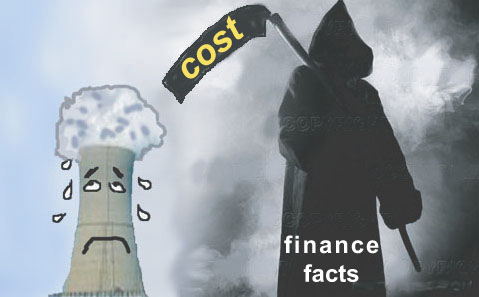 Nuclear power risk http://main.omanobserver.om/node/127641 , 13 November 2012 By John McGarrity – Britain’s nuclear power generation future may be at risk as the list of potential operators shrinks due to concerns about the high costs of entry.
The British government wants to build around 10 nuclear power stations by 2025, which it says are necessary to keep the lights on in future decades, reduce dependence on foreign gas and meet tougher carbon targets.
But persuading potential operators to invest in nuclear generation could involve guaranteeing minimum power prices far above what cash-strapped government departments and households would be willing to pay, analysts said.
“The rewards from nuclear are likely to be far below what companies would require to justify this level of investment. The risks are enormous,” Continue reading
Scotland’s radiation contaminated zone has high rate of cancer
 the increase in rates of two types of the disease – liver cancer and lymphoma – is of genuine concern.
A full investigation to establish the extent of links between radioactive contamination and cancer rates, if any, is now required.
A compelling case for transparency on radiation risk, Herald Scotland 12 Nov 12 The slow drip of worrying news about the radioactive contamination at Dalgety Bay does nothing for the people of Fife but engender fear. Today’s revelations in the Sunday Herald that Government scientists have discovered a near-doubling in the incidence of cancers among people living near the contaminated zone will inevitably cause disquiet locally. Continue reading
50 years of shocking neglect- the danger of UK’s Sellafield nuclear site
The plant is the UK’s largest and most hazardous nuclear site, storing enough high and intermediate level radioactive waste to fill 27 Olympic-sized swimming pools.
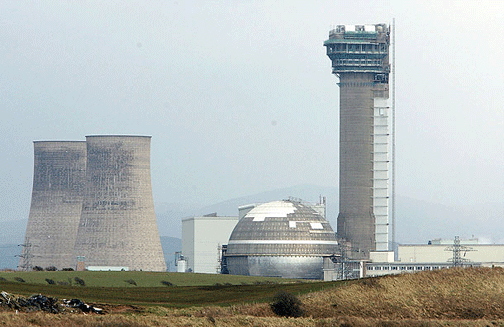 Sellafield nuclear waste storage poses ‘intolerable risk’ http://www.bbc.co.uk/news/uk-england-cumbria-20228176 7 November 2012 Sellafield is the UK’s largest and most hazardous nuclear site An “intolerable risk” is being posed by hazardous waste stored in run-down buildings at Sellafield nuclear plant, a watchdog has found.
The National Audit Office (NAO) also said that for 50 years, the operators of the Cumbria installation failed to develop a long-term plan for waste. Costs of plant-decommissioning has also spiralled out of control, it said. Operator Sellafield Ltd, said it welcomed the report’s findings and was “making improvements”. Continue reading
Britain’s ultimate phallic symbol – useless, expensive Trident nuclear missile
many defence experts now argue that a replacement deterrent is something that the UK neither needs nor can afford
the role of Britain’s nuclear deterrent is linked to the political and military establishment’s perception of the country’s place at the world’s top table “more a matter of national virility than national security”
 UK nuclear deterrent plan triggers divisions Announcement of an extra $565m for improved nuclear weapons capacity worries critics in an era of austerity. Aljazeera, Simon Hooper 06 Nov 2012 London, UK – At an unknown location somewhere deep beneath the world’s oceans, a British submarine sits primed to launch up to 40 nuclear warheads with a collective destructive power almost 300 times greater than the atomic bomb dropped on Hiroshima in 1945.
Since the late 1960s Britain’s nuclear deterrent strategy has required that at least one of the Royal Navy’s four-strong fleet of Vanguard submarines be operational and fully armed at all times, providing, according to the navy’s website, a “round-the-clock insurance policy”.
Only a British prime minister has the authority to order a nuclear attack. But, in the event that a submarine commander loses radio contact and suspects his homeland has been wiped off the map, orders contained in an onboard safe reputedly offer a choice to either “let them have it”or “sail to New Zealand if it’s still there”, according to documents unearthed by Peter Hennessy, a veteran historian of British state secrets. Continue reading
More doublespeak from UK Energy Minister about nuclear subsidies
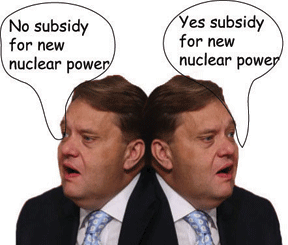 Hayes today reiterated that “there should be nothing available for nuclear that’s not available for other technologies”
(A subsidy is a subsidy is a subsidy – even if other forms of energy get one, too)
U.K. Will Reject EDF Nuclear Deal That Puts Burden on Consumers, Bloomberg By Sally Bakewell – Nov 6, 2012 The U.K. government is prepared to walk away from a deal with Electricite de France SA over plans to build the first nuclear plant in the country since the 1980s if the power price demanded by the utility is too high.
The government would “absolutely” refuse a deal that placed too great a burden on consumers, Energy Minister John Hayes said today in London . He held talks yesterday with Vincent de Rivaz, chief executive officer of EDF’s local unit.
Britain and EDF are negotiating the terms of a contract that would guarantee the price of power generated at Hinkley Point in Somerset. Continue reading
Westmill Solar Co-operative – the whopper community owned energy project
World’s Largest Community Owned Solar Project http://www.energymatters.com.au/index.php main_page=news_article&article_id=3455 by Energy Matters, 7 Nov 12 Last week, Westmill Solar Co-operative in the UK completed the acquisition of Westmill Solar Park, making the project the largest community-owned solar power station in the world.
The £16.5million facility is a 5MW solar farm covering 30 acres and consisting of over 20,000 solar panels. The power station is located near Watchfield, on the Wiltshire/Oxfordshire border.
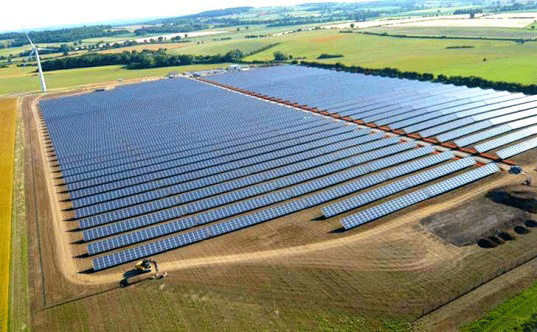
Westmill Wind Farm is adjacent to the site, which was also started as a 100% community owned renewable energy project.
In the last year, the solar farm has generated 4,900 MWh of clean electricity, enough to power 1,500 households and avoiding over 2,000 tonnes of carbon dioxide emissions.
“Westmill represents the best of what low carbon investment and renewable energy can offer and hopefully will inspire others to realise that when we get together we can make change happen and can engage positively with the threat of climate change,” said founder director Adam Twine.
The Westmill Solar Co-operative share offer attracted around 1650 investors in just 6 weeks- 50% more than was required. More than half of the Westmill members live within 40km of the project. Members will be entitled to a share in the profits generated by the electricity sold. Predicted internal rate of return to members is 9 – 11% over the 24 years of the project.
Aside from the environmental benefits and in addition to offering local residents a substantial return on their investment, the solar farm will boost the local economy by making sure the profits stay in the area, encourage tourism and raise the local area’s profile.
“Solar power will become the world’s greatest energy source in our lifetime; heralding a new era of sustainable and ‘democratic’ energy supply,” said Cooperative chairman Philip Wolfe.
“As the success of Westmill shows, solar energy enables ordinary people to produce clean power, not only on their roof tops, but also at utility scale.”
Community owned windfarms could be good for UK
 Windfarms: is community ownership the way ahead? http://www.guardian.co.uk/environment/2012/nov/05/windfarms-community-ownership
On the Danish island of Samsø many of the wind turbines are owned by the residents. Is that the way around nimbyism? Patrick Kingsley guardian.co.uk, 5 November 2012 “I can’t single-handedly build a new Jerusalem,” said John Hayes, the Tory energy minister, last week, “but I can protect our green and pleasant land.” What was he on about? Windfarms. He wants them stopped because he says locals don’t like them.
But that isn’t always the case. Take Samsø, a pretty island off the coast of Denmark. In the late 90s, Samsø’s 4,000 elderly farmers were famous for their early crop of new potatoes. Smothering their isolated Eden with windmills was far from a priority.
Yet 15 years later, that is exactly what’s happened. These conservative islanders have installed 11 onshore windmills, while another 10 lie just off the coast. Astonishingly, Samsø is now one of the world’s largest carbon-neutral settlements. To find how it happened, I visited the island this spring while researching my new book, How to be Danish. The answer? Community ownership. Sixteen of the 21 new turbines are owned either by local co-operatives, or by individual farmers. This means that the turbines haven’t been sprung on the locals. Instead, the latter are invested in the former, both emotionally and financially. The excess energy created by the turbines is sold back to the national grid – and the profit creates a handy annual dividend for each local. “There’s money in it,” smiles 66-year-old Erik Andersen, who owns a herd of rare Red Danish cows. “It’s a good investment.”
So wind power doesn’t always alienate locals. Denmark has over 6,000 turbines – 2,000 more than Britain, despite being a sixth of the size. This is partly down to its topography: it’s flat, so there’s a lot of wind. But it’s also to do with how the Danes involve local communities. Around 70-80% of those turbines are co-owned by local groups – little wonder there’s more of them.
Could it happen in Britain? An ICM poll suggests so: while only one in two Britons would back a windmill within two miles of their home, 68% would support one that was community-owned. John Hayes, take note.
How the UK’s new nuclear deal with Hitachi just can’t really work
 Another shotgun wedding for the UK nuclear lobby daryanenergyblog November 3, 2012 “…….There is a proposal in Japan for a referendum on Nuclear energy with three options on the table . Option one is 30% of Japanese electricity from nuclear (essentially business as usual but with a cap on future nuclear growth). Option two is 15% (many older reactors near fault lines closed, some new reactors later but only as a replacement for plants taken out of service and not on a like for like basis) and option three is 0% (a phase out of nuclear energy completely, which as I’ve previously shown is feasible). The Japanese government seems to favour the middle option but opinion polls suggest that it might be the zero nuclear option. Either of these last two would mean a massive cut in nuclear reactor orders in Japan, if not a complete halt.
So naturally Hitachi are having to hedge their bets and look overseas for buyers of their wares. This would explain the choice of reactors. While previously the Horizon deal had focused on French or American designed PWR‘s (Pressurised Water Reactor), Hitachi seem to be keen on BWR‘s (Boiling Water Reactor), notably their own brand ABWR reactoror the as of yet untested ESBWR. However, these reactors have never been certified for use in the UK. It will take a few years to get that paper work cleared and redesign the reactors as required. There have also been some technical problems with the ABWR‘swhich has led to them providing a much lower level than expected level of reliability and on-grid availability (as this table from the IAEA illustrates).
Also, the UK engineering firms will need time to plan for this change in reactor. While thebulk of reactor cores world wide might well come from the Japanese Steel Works (JSW) on Hokkaido Island, the majority of any UK based ABWR (the steam turbines, heat exchangers and auxiliary equipment) will be build by other contractors many here in the UK, notably companies such as Forgemasters and Rolls Royce. They need to be given time to retool and book spots on the production line before any plant can be built. Also there is a waiting list in JSW and by switching reactor types the UK may have just lost its place in the queue.
A Looming Energy Gap
This will explain why Hitachi are talking about a delivery date of the first new plant in the mid to early 2020′s. However, by this date the UK nuclear fleet will be down to between 1 and 3 reactors (Torness and Heysham retire in 2023, further Torness is in Scotland which may not be part of the UK by that date!) and a capacity of between 1,200 – 3,700 MW, from a present capacity of 10,500 MW and a former peak of 14,000 MW. While Hitachi seem to be proposing 6 reactors, it will take at least a decade or two (or three!) to bring this capacity online and even 6 ABWR’s would still fall well short of the historical maximum installed capacity (about 40% short in fact)…… http://daryanenergyblog.wordpress.com/2012/11/03/shotgun-wedding-hitachi-uk-nuclear/
1 This Month





PLEASE OPPOSE HR 8255 AND S.3639 – bills would accelerate satellite deployment, with no environmental review or safeguards – https://ncstd5li.quorum.us/campaign/169331/
To see nuclear-related stories in greater depth and intensity – go to https://nuclearinformation.wordpress.com
-
Archives
- October 2026 (67)
- September 2026 (339)
- August 2026 (330)
- July 2026 (355)
- June 2026 (287)
- May 2026 (306)
- April 2026 (356)
- March 2026 (251)
- February 2026 (267)
- January 2026 (308)
- December 2025 (358)
- November 2025 (359)
-
Categories
- 1
- 1 NUCLEAR ISSUES
- business and costs
- climate change
- culture and arts
- ENERGY
- environment
- health
- history
- indigenous issues
- Legal
- marketing of nuclear
- media
- opposition to nuclear
- PERSONAL STORIES
- politics
- politics international
- Religion and ethics
- safety
- secrets,lies and civil liberties
- spinbuster
- technology
- Uranium
- wastes
- weapons and war
- Women
- 2 WORLD
- ACTION
- AFRICA
- Atrocities
- AUSTRALIA
- Christina's notes
- Christina's themes
- culture and arts
- Events
- Fuk 2022
- Fuk 2023
- Fukushima 2017
- Fukushima 2018
- fukushima 2019
- Fukushima 2020
- Fukushima 2021
- general
- global warming
- Humour (God we need it)
- Nuclear
- RARE EARTHS
- Reference
- resources – print
- Resources -audiovicual
- Weekly Newsletter
- World
- World Nuclear
- YouTube
-
RSS
Entries RSS
Comments RSS

