Too Great a Risk

But, by far the most significant yet most neglected reason for avoiding the road to nuclear is the risks that nuclear power engenders in our increasingly unstable world. The concentration of power produced at a single site constitutes a megarisk of meltdown and massive radioactive fallout from cyber attack, terrorism, warfare and even nuclear attack as events in Ukraine and elsewhere have demonstrated
13 May 2025. https://www.banng.info/news/regional-life/too-great-a-risk/
Andrew Blowers discusses the contrast of historic and current energy generation seen across the Blackwater estuary in the May 2025 column for Regional Life.
Out across the Blackwater estuary into the North Sea a quiet revolution in the way we get our energy is evident. The vast arrays of wind turbines, shimmering in sunshine and faintly visible in an overcast sky are the palpable evidence of the energy transition that is gathering pace as we struggle to eliminate fossil fuels in favour of renewable sources of energy, especially offshore wind. Wind is safe, low cost and secure contributing 30% of our electricity and rising.
On the Bradwell shore lies the gleaming hulk of a former nuclear power station, now a mothballed but active radioactive waste store which will not be cleared until the end of the century at the earliest. Nuclear power has been in decline since the turn of the century. Nuclear is unsafe, high cost and insecure contributing only 12% of our electricity and falling.
And yet, despite the risks, the Government claims that ‘there is an urgent need for new nuclear which is a safe and low carbon source of energy’. It is proposing to build up to 24GW of nuclear capacity. That’s something like ten giant 2.2 GW power stations, the size proposed for Sizewell C and the now abandoned Bradwell B project, or the equivalent of around 80 Small Modular Reactors (at 300MW each).
The Government’s Civil Nuclear; Roadmap to 2050 would displace vast amounts of the cheaper, credible, reliable and more flexible renewable power sources that can navigate a plausible pathway to a Net Zero future. Such a scaling up is clearly unachievable.
But, by far the most significant yet most neglected reason for avoiding the road to nuclear is the risks that nuclear power engenders in our increasingly unstable world. The concentration of power produced at a single site constitutes a megarisk of meltdown and massive radioactive fallout from cyber attack, terrorism, warfare and even nuclear attack as events in Ukraine and elsewhere have demonstrated. And the risks from accidents, and the impacts of climate change, not to mention institutional neglect or breakdown, are unknowable and unfathomable, though nevertheless real. And, let’s not forget nuclear energy leaves a long-lasting, dangerous and presently unmanageable legacy of highly active nuclear waste.
Sites such as Bradwell are sitting targets for malevolent actions as well as being exposed to the impacts of climate change. Far better for the now closed Bradwell power station to remain a passive store with a low risk than revive any ideas for nuclear plant which would pose an existential threat to the communities of the Blackwater and beyond.
Meanwhile, out into the North Sea the turning turbines signal a future that is relatively safe, secure and sustainable.
Hinkley Point C site served notice after crane ‘component failure’
AN improvement notice has been served to the developers of Hinkley Point
C’s construction site after a component failure was found in a crane. The
Office for Nuclear Regulation told the NNB Generation Company (HPC) Ltd
(NNB GenCo) that it must improve monitoring and management of tower cranes
at the Hinkley Point C construction site near Bridgwater.
This enforcement
action follows the discovery of a failing component in a tower crane at the
site in February this year. An operator undertaking pre-use checks on site
found the failure of a pin connecting two mast sections together, and
evidence of cracking within a mast section. The findings were reported
under the Reporting of Injuries, Diseases and Dangerous Occurrences
Regulations (RIDDOR). The issue was identified before there was any broader
failure of the crane, so there were no injuries to any workers.
Bridgwater Mercury 12th May 2025.
https://www.bridgwatermercury.co.uk/news/25156847.hinkley-point-c-site-served-notice-crane-
False promises, real costs: The nuclear gamble we can’t afford
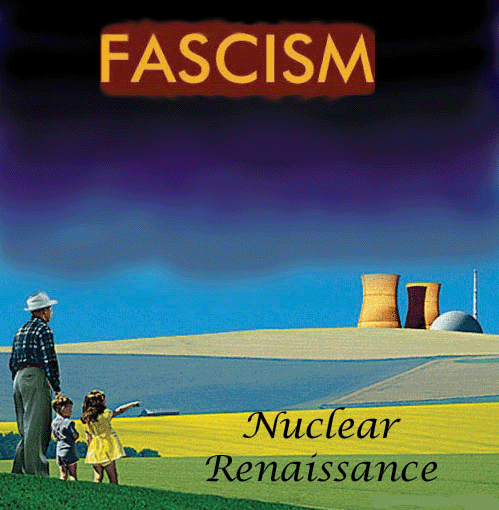
Beyond the financials, nuclear represents a specific vision of governance; centralised, top-down, and resistant to scrutiny. A small number of well-connected corporations manage most facilities. The civilian sector remains intertwined with military infrastructure. Decision-making processes often exclude community consultation. Most notably, nuclear generates waste that remains hazardous for thousands of years, demanding long-term institutional stability that even the Nuclear Waste Management Organization acknowledges no government can guarantee.
Scotland and Canada must forge an energy future that works
by Ben Beveridge, 11-05-2025 , https://bylines.scot/environment/false-promises-real-costs-the-nuclear-gamble-we-cant-afford/
Nuclear power is staging a quiet comeback. In boardrooms across Scotland and Canada, familiar promises are being repackaged as bold new solutions: reliable baseload electricity, energy security, and climate alignment. But behind the sleek rhetoric, the same truths remain. Nuclear power is still the slowest, most expensive, and least flexible energy option on the table.
Both countries now face pressure to commit to a nuclear future they neither need nor can afford. This isn’t the natural evolution of energy policy. It’s the resurrection of a failing model, defended not on merit, but on legacy interests.
In the UK, projects like Hinkley Point C and Sizewell C have seen cost projections soar, with current estimates exceeding £30bn. Scotland, despite producing 97% of its electricity from renewable sources, remains tied to a UK-wide strategy shaped by Westminster’s nuclear ambitions
In Canada, Ontario’s Darlington refurbishment has grown from C$6bn to more than C$12bn. Saskatchewan and New Brunswick are investing heavily in Small Modular Reactors (SMRs), which have yet to prove commercial viability. The Canadian Environmental Law Association has raised significant concerns over the feasibility, safety, and cost of these technologies, yet federal investment continues, often at the expense of grid modernisation and renewable storage.
Nuclear: more expensive, less flexible, needs political intervention
The narrative has shifted from energy independence to climate urgency, but the fundamentals have not. Lazard’s 2023 analysis puts the levelised cost of new nuclear at US$131–204 per megawatt-hour, while utility-scale solar sits at US$26–41, and wind at US$24–47. Nuclear projects frequently exceed ten-year construction timelines. By contrast, wind and solar facilities can be operational within five. Nuclear plants also lack the flexibility modern grids require, locking in oversupply and reducing the effectiveness of variable renewable sources.
Private capital has walked away. No nuclear facility proceeds without government subsidies, price guarantees, or risk backstops. The market has made its judgment. Nuclear survives only through political intervention, not economic logic.
Beyond the financials, nuclear represents a specific vision of governance; centralised, top-down, and resistant to scrutiny. A small number of well-connected corporations manage most facilities. The civilian sector remains intertwined with military infrastructure. Decision-making processes often exclude community consultation. Most notably, nuclear generates waste that remains hazardous for thousands of years, demanding long-term institutional stability that even the Nuclear Waste Management Organization acknowledges no government can guarantee.
Renewables: decentralised, democratic and resilient
In contrast, the model offered by renewables is decentralised, participatory, and adaptive. Community energy projects across Scotland – from the Isle of Eigg to the Outer Hebrides – demonstrate how generation can be local, democratic, and resilient. In Canada, provinces like Quebec and British Columbia have built near-100% clean grids through hydroelectricity, rejecting nuclear while Clean Energy Canada shows generational energy security and affordability.
So why does nuclear persist? The answer lies in its structure. Nuclear development creates concentrated profit centres, contracts for reactor manufacturers, engineering giants, uranium suppliers, and vertically integrated utilities. These stakeholders benefit from centralised generation, not distributed ownership. Regulatory frameworks often entrench their advantages, creating barriers for smaller-scale or community-led projects. The result is a policy environment that protects incumbents rather than enabling transition.
This is not a neutral technological debate. It’s a structural contest between legacy systems and emergent models of energy democracy. The framing may be about climate, but the stakes are about convention, and control.
Scotland and Canada renewable partnership
Scotland and Canada are uniquely positioned to lead an alternative path. Their respective strengths are complementary. A Scotland-Canada renewable partnership, modelled after the North Sea oil and gas collaboration, could drive investment in shared technologies like offshore wind, pumped hydro storage, and smart grid systems. Agencies such as Scottish Enterprise and Scotland Development International already maintain Canadian operations and could broker this cooperation directly.
The Commonwealth presents another opportunity. A Commonwealth Energy Transition Alliance could support shared investment frameworks, model policy design, and collaborative R&D between countries with aligned infrastructure and ambitions. It could also serve as a counterbalance to the lobbying power of the nuclear-industrial complex, directing climate funding towards solutions that scale affordably and equitably.
The choice facing both nations is not nuclear or catastrophe. It is between centralised systems that demand public subsidy and deliver rising costs, versus renewable models that are increasingly faster, cheaper, and community-driven. The facts are clear. The economics are settled. What remains is the political will to choose a future built for the many, not the few.
Scotland and Canada no longer need permission to lead. They need resolve. The nuclear mirage still shimmers, but it’s time to walk towards the real oasis: a clean, democratic energy future, and we have it already.
Improvement notice issued at Dounreay nuclear power plant
By Gabriel McKay, 8 May 25, https://www.heraldscotland.com/news/25146874.improvement-notice-issued-dounreay-nuclear-power-plant/
An improvement notice has been issued at Dounreay nuclear power plant following a “significant potential risk to work safety”.
In February of this year a worker sustained a minor injury when a radiological contamination monitor, which weighed around two tonnes, toppled over.
Though there were no serious injuries, the Office for Nuclear Regulation (ONR) said there was a “significant potential risk to worker safety”.
Dounreay operated from 1955 until 1994 – though research reactors continued to function until 2015 – and is now Scotland’s largest nuclear clean-up and demolition project.
All plutonium on the site had been transferred to Sellafield by December 23, 2019.
The site upon which it stands is scheduled to become available for other uses by 2333.
Tom Eagleton, ONR Superintending Inspector, said: “This was a preventable incident that could have had serious consequences for those nearby.
“The improvement notice requires the Dounreay site to implement measures that will reduce the risk of similar occurrences in the future.
“Specifically, they must identify all operations involving the movement of heavy equipment and ensure comprehensive risk assessments and appropriate control measures are implemented before the work starts.”
Nuclear Restoration Services, which owns the plant has until 25 July 2025 to comply with the notice.
The company said: “We take the protection of people and the environment from harm very seriously.
We are taking action to strengthen our practices and management in this area, and will comply with the requirements of the notice received in April, having reported the incident to ONR and carried out an investigation.”
Torness in East Lothian is the last remaining nuclear power station in Scotland still generating electricity.
It is scheduled for shutdown in 2030, following Hunterston B in North Ayrshire in 2022, Chapelcross in Dumfries and Galloway in 2004 and Hunterston A in 1990.
Hearts and Minds: Report highlights East Lincolnshire still not a ‘willing community’.
A report recently published by campaigners opposed to a Geological Disposal Facility (GDF) in Lincolnshire demonstrates that theirs is still ‘not a willing community’ when it comes to the nuclear waste dump.
‘The Nuclear War for Lincolnshire’ published by Guardians of the East Coast (GOTEC) may conjure up an image of a decimated, burnt out waste land in the aftermath of an attack by nuclear weapons, but fortunately the publication is instead a detailed narrative of the relentless struggle to win public ‘hearts and minds’ support for a GDF first began by Nuclear Waste Services (NWS) in the middle of 2020, and continually valiantly resisted by GOTEC and its allies, amongst them local elected members and the Nuclear Free Local Authorities.
Following the announcement of a new inland ‘Area of Focus’ between Gayton le Marsh and the Carltons at the end of January, NWS ran a series of public events across the Theddlethorpe GDF Search Area. At each of these events, activists from Guardians of the East Coast offered attendees the opportunity to vote outside in a special private ‘ballot box’, built for the purpose by local Councillor Travis Hesketh.
535 members of the public attended these events. 93% took up the opportunity to vote. The result was decisive. 93% of those who voted wanted a public vote on the proposal now and 93% wanted the GDF to end now. The result was consistent across all the events.
A separate parish poll was also held in Gayton le Marsh in February 2025. 88% of parishioners voted and 93% expressed a desire to see an immediate vote.
These are just the latest expressions of the pronounced opposition to the GDF amongst residents…………………………………………………………………………………………………
NFLA 8th May 2025
How Miliband can make renewables cheaper – but there is really no alternative to renewables

giving longer term contracts to renewable energy developers will make solar and wind schemes even cheaper
In a world where the costs of building all sorts of power plants are
increasing, the Government has a powerful card up its sleeve to keep down
the cost of new renewable energy projects. The Government is considering
extending the contract length under which new renewable energy projects
receive their fixed payments per MWh that is generated.
If contracts for
difference (CfDs) are issued to last for 20 years instead of 15 years, this
could reduce the price of power from the renewable projects by at least 10
per cent (according to my calculations). By offering lower annual returns
over a longer period, the projects can be delivered for a lower fixed price
per MWh that is generated. Such a cost reduction seems likely to offset any
temporary (Trump-induced) cost increases for renewables.
The ‘Trump
effect’ may have led Orsted to discontinue its massive 2.4 GW Hornsea 4
offshore wind project near East Anglia. However, some commentators such as
Jerome Guillet argue that Orsted should have planned better to avoid this
outcome. Other countries operating the CfD system for renewable energy
employ 20-year contracts, and it has always been a mystery to me why the UK
Treasury plumped for a 15 year period. This is an artificially short period
compared to the project lifetime of 25 or 30 years.
Hinkley C, by contrast,
was given a 35-year premium price contract. Meanwhile, the French
Government is pressing the UK Government to put more money into the
long-delayed construction of the Hinkley C power plant. This, it seems, is
part of the price for EDF agreeing to the construction of the successor
Sizewell C plant. This is even though Hinkley C was given a contract that
pays it over £130 per MWh in today’s prices.
That compares to the most
recent auctions of wind and solar PV, whose contracts are worth £71-£83
per MWh at 2025 prices. As I write this, there appears to be a standoff in
negotiations over the terms for Sizewell C between the British and French
governments.
Quite apart from the cost, the idea that nuclear power is
going to be delivered anytime soon is fanciful. The idea that so-called
small modular reactors are any sort of alternative to the big ones is
ridiculous. They are just more expensive still!
At the end of the day,
energy efficiency and renewables are the only real options. After all, over
90 per cent of the new generation being deployed in the world last year was
renewable, almost all of it being solar or wind. The reason this is
happening is that their costs are falling and they continue to fall.
Renewables are the present and future. We need more electricity to
electrify transport, heating, and much else. Sceptics may rail and sneer at
Miliband’s clean power programme. If it has any faults, it is because it
is too mainstream, wasting money and time on carbon capture and storage and
nuclear power.
Dave Toke’s Blog 8th May 2025 https://davidtoke.substack.com/p/how-milband-can-make-renewables-cheaper
Westinghouse drops out of UK SMR competition
Nuclear Engineering International 30th April 2025, https://www.neimagazine.com/news/westinghouse-drops-out-of-uk-smr-competition/
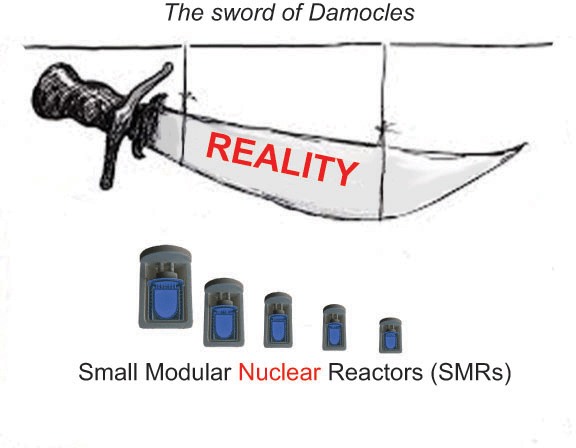
S Westinghouse has pulled out of the UK’s small modular reactor (SMR) design competition, according to the UK The Telegraph.
Earlier in April, three of the four competition finalists in Great British Nuclear’s (GBN’s) small modular reactor (SMR) competition submitted their final tenders. The four finalists received an Invitation to Submit Final Tender (ISFT) in February – GE-Hitachi Nuclear Energy International, Holtec Britain, Rolls-Royce SMR, and Westinghouse Electric Company.
GEH (part of GE Vernova) proposed its BWRX-300 boiling water reactor; Holtec proposed its SMR-300 – a 300 MWe pressurised water reactor (PWR); the Rolls-Royce SMR is a 470 MWe PWR; and the Westinghouse AP300 is a 300 MWe/900 MWt PWR. Westinghouse, however, failed to submit its final tender.
GBN was expected to announce two winners this summer with bidders told to prepare to build three to four mini reactors each. The winners will be awarded contracts to co-fund further design development as well as the necessary regulatory, environmental and site-approvals before a final investment decision is taken in 2029. The contracts are expected to total £20bn ($26.7bn) – £10bn each if two companies are selected.
However, The Telegraph reported in February that the Government was considering awarding only one contract as Rachel Reeves, the Chancellor “is struggling to balance the books as weak economic growth makes it harder to meet her self-imposed ‘fiscal rules’ for borrowing.
According to The Telegraph, Westinghouse did not deny it had withdrawn but declined to give its reasons. “One industry source suggested the company had baulked at the commercial offer made by the Government.”
A spokesman from the UK Energy Department said: “Great British Nuclear is driving forward its SMR competition for UK deployment. It has now received final tenders, which it will evaluate ahead of taking final decisions this spring.”
There is growing concern that the economics of SMRs could prove even hard to justify at the high costs for the initial four units. None of the bidders has built their designs which are still in development. All SMRs in the GBN competition will be first-of-a-kind units (FOAK), which will push up costs.
Commenting on the issue, Neutron Bytes noted: “Most estimates are that economies of scale based on factory production of SMRs, promised by all four vendors, only kick in when order books come in “fleet mode,” e.g. by the dozen or more. It follows that even £10bn could be insufficient to cover the costs of four units any of the three 300 MWe offerings based on their status as FOAK projects.”
It added: “Splitting the difference for the GBN competition, e.g. awarding one winner £10bn, keeps the SMR initiative alive, but does nothing to promote long-term “fleet mode” production of SMRs which the UK nuclear industry points out is the only way to achieve economies of scale with factory production of SMRs.”
Sellafield’s massive water abstraction plan for its new construction work has no environmental impact assessment and inadequate monitoring
Sellafield blithely apply to the Environment Agency for new water abstraction and in the same application admit that they have already contaminated the freshwater aquifer beneath them
Lakes against Nuclear Dump and NFLA , Marianne Birkby, May 07, 2025
Campaigners concerned that Sellafield’s water abstraction plan has no environmental impact assessment and inadequate monitoring
In a recent response to an Environment Agency consultation on a application by Sellafield Limited to extract water to support construction work at the site, campaigners at Lakes against the Nuclear Dump [LAND], a campaign of Radiation Free Lakeland, and the UK/Ireland Nuclear Free Local Authorities have expressed concerns that no environmental impact assessment has been carried out and that plans to monitor contamination in discharges are inadequate.
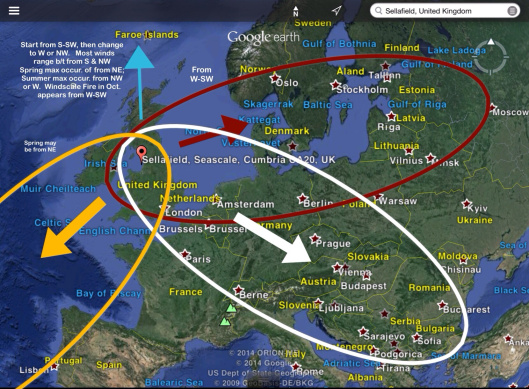
Sellafield plans to extract an additional 350,000 cubic metres of water a year from the Lake District to support the construction of new facility to repackage radioactive waste, whilst proposing to discharge almost a million litres of contaminated water every day into the River Calder and out into the sea. This for an indefinite and uncertain period.
LAND and the NFLAs are concerned that this will be done without an Environmental Impact Assessment being carried out and with no proper plans in place to monitor the discharged water, adding to fears that the work will lead to yet more radioactive contamination in the already fragile local environment.
Sellafield may believe that the discharges are safe and within legal limits, but the two campaign groups do not subscribe to the view that there is a safe limit when it comes to radiation and in recent years there have been large research studies demonstrating the cumulative effects of low-level, but legal, radiation on human health.
Who are Britain Remade?

Britain Remade is a Tory think-tank and lobby group campaigning on behalf of nuclear power.
By Mike Small, https://bellacaledonia.org.uk/2025/05/01/who-are-britain-remade/
There’s a concerted attempt to attack Scotland’s long-standing commitment to no new nuclear power, alongside a full-scale assault on the idea of Net Zero, and the very basics of climate policy (however inadequate mainstream policy is).
This is being led by Nigel Farage who has called Net Zero ‘the New Brexit’, whatever that means. All this has been echoed by Tony Blair’s intervention this week where he argued that any attempt to limit fossil fuels in the short term or encourages people to limit consumption is “doomed to fail”. Alongside this we can see Scottish Labour’s recent commitment to the cause of new nuclear power in Scotland.
Today The Scotsman ran with a front-page splash all about how ‘SNP voters back nuclear power’ by Deputy Political Editor David Bol and Alexander Brown.
he article was replete with quotes from Labour MSP for East Lothian, Martin Whitfield, Scottish Conservative MP, John Lamont, who said the Scottish Government embracing nuclear power would be “basic common sense”. Then there’s a quote from Sam Richards, founder and campaign director for Britain Remade, who, it turns out commissioned the poll and was also enthusiastically pro-nuclear.
What The Scotsman didn’t explain though, was who ‘Britain Remade’ are? They’re presented as if they’re maybe pollsters or some independent think-tank.
But Britain Remade is a Tory think-tank and lobby group campaigning on behalf of nuclear power. Jason Brown is Head of Communications for Britain Remade, a former No. 10 media Special Adviser and Ben Houchen’s comms Adviser.
Jeremy Driver is the Head of Campaigns at Britain Remade, a former Lloyds Banker and Parliamentary Assistant to Ann Soubry. Sam Dumitriu is Head of Policy at Britain Remade who formerly worked at the Adam Smith Institute. These are Tory SPADS working on their own campaign to support new nuclear in Scotland: Lift The Ban On New Scottish Nuclear Power.
Britain Remade claimed they are not affiliated: “We’re an independent grassroots organisation. We are not affiliated with, or part of, any political party” their website says. They may not be officially affiliated to any party, but it’s very clear where their politics (and their staff) come from.
So here we have the Scotsman giving over its front-page to a Tory lobby group to promote their campaign. On the same day they published a similar piece in the Telegraph “SNP’s ‘senseless’ nuclear ban ‘damaging Scotland’” so it’s really working for them.
This is not just a question of client journalism, it’s a question of how far right-wing forces, often working with dark money, will attempt to derail even the most modest (and completely inadequate) environmental policies. Quite why Saudi-funded Tony Blair should jump on the anti Net Zero bandwagon is anybody’s guess, but it’s quite clear there is a coordinated pro-nuclear lobbying group in action in Scotland that pans across the Conservatives and Labour parties, and is supported by astroturf groups and pliant media friends. Watch this space for more on the new nuclear lobby.
Scotland does not need nuclear power and people aren’t being told the truth
Commonweal 1st May 2025,
https://www.commonweal.scot/daily-briefings/briefing-r57be
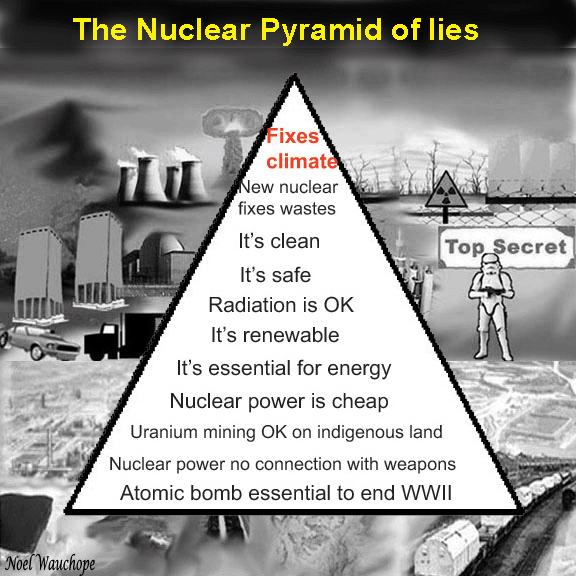
The nuclear industry has one of the most aggressive lobbying and public relations campaigns of all energy sources. It pushes relentlessly on politicians and the public to support the merits of nuclear power based on partial or inaccurate information. Very often this goes unchallenged in the Scottish media.
Given that nuclear power presents itself as a pragmatic response to decarbonising energy and given the scale of the PR campaign, it is perhaps not enormously surprising that SNP voters appear to split with their party over this issue. But would they continue to support nuclear power if they knew the numbers?
Here are some stark realities. The cost of generating of electricity from renewable sources is £38 to £44 per MWh. The estimated cost of the same electricity from nuclear (at the new Hinkley Point C reactor) in 2025 is £150 per MWh. It can only be presumed that the participants in this survey were not told that generating electricity would become between three times as expensive with nuclear.
But even that hides the true costs. Nuclear power is very dangerous and, at the end of its lifecycle, is very complex to decommission and make safe. Every spent rod of nuclear fuel takes a full ten years simply to cool down. They must be immersed in a deep pool of cold, constantly-circulating water and monitored closely for ten years just to bring them down to a cool enough temperature that they can be processed.
That’s just the ongoing fuel. The complexity of decommissioning and entire nuclear power plant is significantly greater. In fact the current estimate of the cost for decommissioning nuclear power is about £132 billion. That is not paid for by consumers in their electricity bill – it is paid for by consumers through their tax.
This is the second stark reality that nuclear power works hard to conceal; not only is it three times as expensive as renewables to run, there is then a cost of at least £4,600 for every household to decommission the nuclear power plants and make them safe for the future.
Of course, safety is another issue here. Nuclear power stations are very vulnerable. They are extremely sensitive sites which require substantial long-term attention. There are currently concerns around the world that unreliable power supplies could mean existing plants may struggle to keep spent fuel rods from combusting if they cannot constantly and continually keep large amounts of cold water circulating round spent fuel.
Nuclear power stations do not like loss of electricity, especially for any extended period of time. This makes them very climate-vulnerable. And of course who knows what sorts of extreme weather we may face before the lifetime of a nuclear station is complete. Fukushima is not a cautionary tale for no reason.
And it is uncomfortable to dwell on the risks of nuclear sites if they become targets for terrorism or in war. No-one is expressing continent-wide anxiety over the threat-to-life status of Ukraine’s wind turbines; they absolutely are over the shelling of Ukrainian nuclear power stations.
The remaining case for nuclear is to provide ‘electricity baseline’ – the ability to bring electricity provision on and off line as renewable generation rates rise or fall (if the wind does blow), or during periods of peak demand. This just isn’t really honest – nuclear power does not like rapid changes in supply and are designed to run flat out, all the time, not least because costs rise rapidly if they are running at less then full power. You can’t just ‘turn them on and off’. So yes, they can provide baseline electricity but not ‘on demand’ electricity that can balance renewables.
Hydrogen storage can though. Scotland currently dumps enormous amounts of perfectly useable electricity in the ground if it is generated when there is no demand. This can be turned into hydrogen and then, on demand, converted back into electricity. At the moment the cost of electricity from hydrogen is about half as much again that of generating by nuclear. But there are big caveats to that.
First, the current hydrogen electricity price is about £230 per MWh, but this is a rapidly-developing area of technology and the current industry target is £100 per MWh. That makes it cheaper than nuclear. Second, there is no hidden capital cost – the incredible costs of building and decommissioning nuclear which are hidden from consumers by subsidy from tax just isn’t there for hydrogen. It is a simple technology.
Third, these costs all assume that you are generating hydrogen from electricity at full wholesale grid prices. But if you are using electricity that would otherwise be dumped because it is being generated at the ‘wrong time’, the hydrogen becomes a waste product. It is in practice much cheaper than nuclear and can supply long-term baseline. (Battery storage for short term is even cheaper.)
That is the reality that respondents in this poll were not given. Try the poll again with ‘do you want to pay three times as much for your electricity with an additional costs to your household of £4,600 to have unsafe nuclear power when renewables with hydrogen storage are cleaner, cheaper and safer’.
Consistent, reliable renewable energy isn’t hard to solve in Scotland. There are nations where nuclear may have to be part of a clean energy solution, but Scotland is not one of them. You need to withhold a lot of information from people to make them believe the wrong thing about nuclear.
EDF seeks joint financing for UK projects

April 30, 2025, https://www.neimagazine.com/news/edf-seeks-joint-financing-for-uk-projects/?cf-view&cf-closed
DF is seeking to consolidate financing for the Hinkley Point C and Sizewell C NPPs under construction in the UK. French Energy Minister Marc Ferracci told the Financial Times that they should be treated as one financial venture in negotiations. He said he had discussed the issue with UK Energy Minister Ed Miliband on the sidelines of a conference in London.
“France and EDF are very committed to deliver the projects but we have to find a way to accelerate them, and we have to find a way to consolidate the financial schemes of both projects,” he said.
Both projects started out with equity stakes from Chinese state-owned nuclear development corporations but the UK government cancelled the arrangements because of “security issues”. The UK government partly replaced the funding and is seeking support from institutional investors.
Ferracci denied that the French government intended to use Sizewell as “leverage” against the financial troubles at Hinkley. “It is not a discussion about leverage, it is a discussion between friends and allies. . . So there is a way through, and I hope we will be able to find it in the next few months.”
He also called for a global solution that would result in a deal that benefitted EDF’s returns across both schemes. “It is a good approach to have a global approach to our relationship,” Ferracci said, adding more “grid connections between France and the UK” could come into the negotiations.
Meanwhile, workers at the Hinkley Point C NPP construction site are complaining about a significant rat infestation, raising health and safety concerns. In early April, the Unite and GMB trade unions at Hinkley Point C told EDF that the facility was overrun with rats. The unions said immediate action was needed as the rodents were “everywhere”. In recent months, workers have also complained about poor working conditions and low pay. In addition, hundreds of project staff went on strike in November over the inadequate security access to the site.
May Day – How Hot is Too Hot for a Ferociously Hot Nuclear Dump Under the Irish Sea-Bed?

The Developer, Nuclear Waste Services is a Government body and also a limited liability company.
Marianne Birkby, May 01, 2025
Received this today – it is not at all reassuring and underlines why we must RESIST THE NUCLEAR DUMP PLANS.
Nuclear Waste Services (The Developer) says the seabed will have “no significant temperature rise” once atomic wastes are placed in the geology beneath. What Nuclear Waste Services mean by “significant” is not stated. Any temperature rise AT ALL on the seabed would be hugely damaging.
Regarding uplift of the sea-bed from radioactive gases and thermal heating the reply is: “GDF design and other controls on management of the thermal output of waste, as noted above, will prevent disruptive uplift of the seabed from the heat output of waste.”
These inevitable impacts due to the thermal heating of abandoned atomic wastes (currently cooled by freshwater at Sellafield) are not mentioned by Nuclear Waste Services in their propaganda literature. The already vulnerable seabed and ocean gets no say in the matter of a deep sub-sea nuclear dump. Propaganda of “safe, permanent disposal” is aimed at the deliberately narrowed down “Areas of Focus” for the above ground mine shafts and nuclear sprawl facilitating a “geological disposal facility. ” Nuclear Waste Services are ignoring/playing down all impacts in their public disinformation campaign, including the thermal impacts of A GDF/deep hot nuclear dump up to the size of Bermuda in the geology beneath the Irish Sea-bed. From their point of view why would they bring to people’s attention the ferocious heat of the atomic wastes or the likely impacts on the sea-bed and ocean?
Email received today -1st May
OFFICIAL
…………………. The reports and summary below provide information on the specification, evolution and illustrative disposal concepts for heat generating wastes:
High Heat Generating Waste (HHGW) Specifications – GOV.UK
Technical Background to the generic Disposal System Safety Case
NDA Report no DSSC/451/01 – Geological Disposal – Waste Package Evolution Status Report
https://midcopeland.workinginpartnership.org.uk/news-from-nws-high-heat-generating-waste-qa
1. How hot would be too hot?
The design of the Geological Disposal Facility (GDF) will take account of the thermal output of heat generating waste such that it does not adversely impact the engineered barriers (backfill, plugs, seals) and containment function of the host geology (its ability to limit the migration of radioactivity). This is achieved by passive means, for example, by appropriate design of the container, disposal tunnels or vaults, and spacing of containers. Nuclear Waste Services will set a limit on the peak temperature of the GDF system and waste packages to assure the integrity of the waste, waste container, engineered barriers and host rock. The limits adopted by international programmes are typically in the range of 100oC – 200oC. Heat generating waste, such as spent nuclear fuel and high-level waste glass, will have been cooled over several decades during interim storage, so as to meet the temperature limit set for acceptance to a GDF. This storage practice is already underway at Sellafield.
2. How long would it take for thermal heating to reach the seabed
At the depth of GDF construction (200 – 1000 m) heat will diffuse slowly into the engineered barriers and host rock. Peak temperatures will occur in the centuries immediately following closure as the GDF system equilibrates. However, the thermal output and temperature of waste packages decreases slowly and predictably with time. Combined with the approach described above, there will be no significant temperature rise at the seabed.
3. How long would it take for uplift of the seabed due to thermal heating/gas pressure?
The GDF will be designed to prevent over pressurisation by gas leading to uplift of the seabed by enabling very slow diffusion of gas through plugs and seals. GDF design and other controls on management of the thermal output of waste, as noted above, will prevent disruptive uplift of the seabed from the heat output of waste.
TONY BLAIR: STILL A NUCLEAR NUTTER!

https://jonathonporritt.com/tony-blair-nuclear-energy-failure/ 6 Dec 24

Earlier in the week, the Tony Blair Institute for Global Change brought out a new report grandiloquently titled: “Revitalising Nuclear: The UK Can Power AI And Leave The Clean Energy Transition”.
In essence, it’s little more than a re-run of today’s standard nuclear propaganda – plus two things:
First, a highly flaky retrospective looking back to 1986 to calculate what would have happened to the UK’s greenhouse gas emissions if anti-nuclear campaigners’ “inaccurate post-Chernobyl narrative” hadn’t reduced us to a nation of nuclear sceptics; second, an even more flaky look ahead to the ‘new nuclear age’ that is now so desperately needed to provide the electricity to “power AI”.
It’s total tosh – and, as such, I really do urge you to read it!For me, however, reading it was a weird experience, transporting me back 20 years to Tony Blair’s premiership and his evangelical conversion to the cause of nuclear energy in 2005. Before that, he’d more or less gone along with his own Government’s Energy White Paper of 2003, which was distinctly nuclear-sceptic – interpreted widely at the time as “kicking nuclear into the long grass”.
During those two years, however, the “deep nuclear state” duly “put him right” (on military as much as on energy grounds), and although the Sustainable Development Commission (of which I was then the Chair) and many other think tanks and expert advisers were assiduously reinforcing the 2003 White Paper’s non-nuclear priorities, Tony Blair duly announced that he obviously knew better than everybody else, and that “nuclear was back on the agenda with a vengeance”.
The consequences of that decision are obviously not as severe as Tony Blair’s ineffable arrogance in enthusiastically backing George Bush’s insane decision to invade Iraq in 2003 – which he still argues was the “right thing to do”, despite more than 20 years of consequential mayhem in the Middle East.
It can be argued, however, that his nuclear fantasies at that time have screwed up energy policy in the UK ever since. That nuclear baton was passed on to Gordon Brown and on and on through to Kier Starmer, with all Prime Ministers in between espousing a fantastical faith in the future of nuclear power and the contribution it will make to our low-carbon energy future.
Quick reality check: by way of electrons from NEW nuclear power stations feeding into the grid, the UK’s vengeance-driven nuclear industry has delivered NOT ONE throughout those 20 years. NOT ONE! And it will still be not NOT ONE until 2030 at the earliest.
(EDF’s PWR at Sizewell B came online in 1995). The only new power station under construction (at Hinkley Point C in Somerset) will not come online until 2030 at the earliest.
According to the Tony Blair Institute, this is all the fault of the UK’s mind-blowingly powerful anti-nuclear movement, with all its incredibly well-funded campaigns (only joking!), persuading otherwise intelligent people that even to talk about nuclear power will cause severe radiation sickness (still only joking!). What are Blair’s wonks on? How can otherwise intelligent people just wish away 20 years of chronic incompetence, financial mismanagement and engineering inadequacies on the part of the nuclear industry itself?
I jest, but only because it’s so serious. One can only speculate how much further down the road to a Net Zero future we’d be if we hadn’t had this nuclear cloud hanging over us all this time – in terms of accelerated investments in energy efficiency (particularly housing retrofits), renewables, storage (both short-term and long-term) and reconfigured grids. The Institute’s report claims (straight off the back of its very big envelope) that the UK’s emissions would be 6% lower if we’d just listened to Tony Blair at the time. I do hope someone will do a counterfactual analysis of how much lower they’d be if we’d just gone down that alternative route.
But the dysfunctionality just goes on and on. GBNF (Great British Nuclear Fiasco) now presides over one costly decision after another. Because Hinkley Point C won’t be coming online until after 2030, EDF has had to persuade the Office For Nuclear Regulation (ONR) to extend the lifetime of its remaining fleet of AGRs – which I’m not necessarily opposed to, by the way, as long as the safety case for so doing is as robust as ONR/EDF would have us believe.Rather more problematically, the ONR has also agreed to extend the operating lifetime of Sizewell B to 60 years – through to 2055. That’s a bit different.
What people don’t realise is that when you extend the lifetime of a nuclear reactor you’re also extending the lifetime of all the waste it’s produced in operation being stored on site for decades after it comes offline. Let’s just say, with Sizewell B, through to the end of the century.
Which brings me on to Sizewell C.
On Tuesday (3rd December), I was sitting there in Court 46 in the Royal Courts of Justice in London listening to what at first hearing sounded like a very geeky legal argument about how to interpret a particular clause in the 1965 Nuclear Installation Act: does the ONR, or does it not, have an obligation, in its issuing of a licence for a new reactor, to impose conditions at the time of issuing the licence on the operator (i.e. EDF) covering material safety risks that should be taken into consideration?
“Yes it does”, in the opinion of Stop Sizewell C, bringing the challenge to ONR’s decision not to attach specific conditions to its licence for Sizewell C. The material safety risk at the heart of this challenge relates to the sea defences that will be required to protect Sizewell C into the future, about which there is nothing explicit in the license.
A bit of maths: IF Sizewell C ever gets a Final Investment Decision from the Government (mid-2025 at the earliest), and IF EDF hasn’t run out of money by then, construction could start in 2027/2028. Allow ten years for construction (I’m being kind). So, Sizewell C comes online in 2037, with a projected lifetime of 60 years – as with Sizewell B – through to 2097.
Set that against the latest projections from the (super-conservative) Intergovernmental Panel on Climate Change that we should be anticipating a minimum of a one metre sea level rise by 2100.
And then try and imagine the scale of sea defences that will be required to ‘defend’ Sizewell C through to the end of the century from at least a metre higher sea levels, plus storm surges and so on – let alone to whatever time will be required to store the nuclear waste arising from its operations. A ‘material risk’? I think so.
But that was not the opinion of Mrs Justice Lieven, the Judge hearing Stop Sizewell C’s challenge. She obviously ‘knew her stuff’ ( as she should, having worked previously as a lawyer for Hinkley Point C!), but her perfunctory dismissal of the challenge was quite astonishing.
I blame both Tony Blair – a critical part of the whole deep nuclear state working away behind the scenes – as well as the UK’s astonishingly gullible media which just goes along with all this nuclear crap, year after year after year.
Campaigner hits out at ‘PR trick’ nuclear energy poll of SNP members

By Laura Pollock, Multimedia Journalist, 1 May 25, https://www.thenational.scot/news/25131226.campaigner-hits-pr-trick-nuclear-energy-poll-snp-members/
A LEADING independence activist has hit out at a recent poll suggesting roughly half of the SNP’s voters believe nuclear power should be part of Scotland’s mix of clean energy generation.
Robin McAlpine, founder of pro-independence think tank Common Weal, has branded the polling a “PR trick based on deliberately withholding crucial information”, claiming people who responded were not given “the basic facts”.
Polling for the campaign group Britain Remade, founded by a former energy adviser to Boris Johnson, found 52% of those who voted for the party in 2021 believe nuclear power should be included in Scotland’s energy mix to meet the 2045 net zero target.
Meanwhile, 57% of those who voted for the party in last year’s general election felt the same way, the poll found. A total of 56% of Scots thought nuclear power should be part of Scotland’s clean energy mix to meet the targets, while 23% disagreed, and 21% said they did not know.
Opinium surveyed 1000 Scottish adults between April 22 and 25.
However, McAlpine argues those quizzed on the topic were not aware of key points as laid out in a blog post for pro-independence Common Weal Common Weal.
He highlights the price of hydrogen electricity being cheaper than nuclear, as well as the hidden costs of building and decommissioning nuclear infrastructure.
“Would SNP voters back nuclear if it was explained that it will cost them three times as much as renewables and then also cost nearly £5000 per household just to clean them up?” McAlpine told The National.
He further questioned: “Do people know that it is much cheaper to run a renewable system with battery storage for short-term load balancing and hydrogen storage for long term battery storage? Are they aware that you can’t turn nuclear power on and off and that it has to run at full power all the time? So it can’t balance renewables when the wind isn’t blowing, it can only displace renewables from the grid.
“The only conceivable purpose of nuclear in Britain is to power the south of England. Look at Fukushima, look at the power stations in Ukraine, how much risk do you want to take when you have absolutely no need to do it?
“If people are told ‘more expensive, much more dangerous, can’t be switched up or down or turned off, costs an absolute fortune to decommission at the end’, I think you’ll find they answer differently.”
Britain Remade has been approached for comment.
The SNP have argued nuclear power projects remain too expensive to be a viable alternative to renewable power.
Responding to the polling, SNP MSP Bill Kidd said: “Our focus is delivering a just transition that supports communities and creates long-term economic opportunities to build a truly sustainable future.
“Nuclear remains one of the most costly forms of energy with projects like Hinkley Point C running billions over budget and years behind schedule.
“In contrast, Scotland’s net zero transition is already delivering thousands of green jobs across energy, construction, innovation, and engineering. This number will continue to grow.
“Simply, renewables are cheaper to produce and develop, create more jobs, and are safer than nuclear as they don’t leave behind radioactive waste that will be deadly for generations.
“While Labour funnels billions into slow, centralised projects, the SNP is focused on creating real, sustainable jobs in Scotland now.”
Sellafield plan for new building to store radioactive waste
Federica Bedendo, BBC News, North East and Cumbria, 2 May 25, https://www.bbc.com/news/articles/cg724n91gp4o?fbclid=IwY2xjawKA7DdleHRuA2FlbQIxMQBicmlkETFISGV5ZEdSZW16a2ZnQzh3AR5Wx_HKBbiK0umY8fOSOzw2Hzv5_AeeAjFPGDgbc4VxAi7joZ7-0jA4qr0Bzg_aem_nd6f3waC2WX_bFb_0pWkhw
Work to build a storage facility to keep radioactive waste for up to 100 years is set to take a step forward.
Sellafield, in Cumbria, wants to build the second of four new units to store intermediate level waste, as the company works to decommission ageing buildings at its Seascale plant.
The site manages more radioactive waste in one place than any other nuclear facility in the world, according to planning documents.
The project was approved in 2023 and an application has now been submitted to the Environment Agency (EA) seeking permission to abstract water from the site.
The water would have to be extracted as the ground is dug up to build the new facility, a Sellafield spokesman said.
It was needed as part of the building phase, they said, adding there were no risks of contamination from radioactive waste.
Documents show the building storing the nuclear waste would be about the size of a football pitch and as tall as about six double-decker buses.
The walls of the store which has already been built are about 5ft (1.5m) thick, with a 6.5ft (2m) thick floor.
Sellafield said it planned to start building work this year, with the second store becoming operational in 2032.
The waste would be kept there for up to 100 years, papers show, and then moved to a Geological Disposal Facility (GDF) – an underground storage facility which could be built in Cumbria.
A consultation on the plans to abstract water from the Sellafield site by the EA closes on 2 May.
1 This Month

of the week – Shut Down Drone Warfare!


Tell the Ukrainian Government to Drop Prosecution of Peace Activist Yurii Sheliazhenko

Petition to revoke the licensing of the Near Surface Nuclear Disposal Facility (NSDF) at Chalk River. https://www.ourcommons.ca/petitions/en/Petition/Details?Petition=e-7247
To see nuclear-related stories in greater depth and intensity – go to https://nuclearinformation.wordpress.com
-
Archives
- April 2026 (79)
- March 2026 (251)
- February 2026 (268)
- January 2026 (308)
- December 2025 (358)
- November 2025 (359)
- October 2025 (376)
- September 2025 (257)
- August 2025 (319)
- July 2025 (230)
- June 2025 (348)
- May 2025 (261)
-
Categories
- 1
- 1 NUCLEAR ISSUES
- business and costs
- climate change
- culture and arts
- ENERGY
- environment
- health
- history
- indigenous issues
- Legal
- marketing of nuclear
- media
- opposition to nuclear
- PERSONAL STORIES
- politics
- politics international
- Religion and ethics
- safety
- secrets,lies and civil liberties
- spinbuster
- technology
- Uranium
- wastes
- weapons and war
- Women
- 2 WORLD
- ACTION
- AFRICA
- Atrocities
- AUSTRALIA
- Christina's notes
- Christina's themes
- culture and arts
- Events
- Fuk 2022
- Fuk 2023
- Fukushima 2017
- Fukushima 2018
- fukushima 2019
- Fukushima 2020
- Fukushima 2021
- general
- global warming
- Humour (God we need it)
- Nuclear
- RARE EARTHS
- Reference
- resources – print
- Resources -audiovicual
- Weekly Newsletter
- World
- World Nuclear
- YouTube
-
RSS
Entries RSS
Comments RSS
 nuclear-news