UK tax-payer landed with the astronomic costs of Sellafield nuclear facility
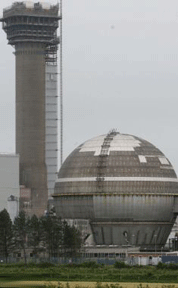
 Why Sellafield costs us all a bomb Telegraph UK 17 Jan 15 After a private consortium tried, and failed, to rescue the power station from decades of neglect, it is back in the arms of the public sector once again It’s like being in a timewarp, stuck back in the bad old days when the taxpayers’ bottomless purse was casually mined to prop up failing industries. For, amazingly, such spending has been going on – even in these post-Thatcher, austerity-driven times – in a small, if controversial, corner of Cumbria.
That corner, is of course, home to Sellafield – Europe’s biggest and most hazardous nuclear complex. This week, the Government abruptly dismissed the consortium that has been running it for the past six years, after what Parliament’s Public Accounts Committee (PAC) identified as “big delays” and “huge cost overruns, rising to astonishing levels”.
Sellafield has largely dropped out of the headlines in recent years, after decades of bad publicity about radioactive accidents, managerial incompetence and business boondoggles. And that is where it likes to be, for secrecy, combined with bureaucratic bungling, has long been one of its specialities……
It was, indeed, where weapons-grade plutonium was separated from used nuclear fuel by “reprocessing”, reason enough for the secrecy if not the ineptitude. But the culture continued as the site converted overwhelmingly to civilian purposes. The plutonium – one gram of which contains as much energy as a tonne of oil – was seen as a modern philosopher’s stone, able to power “fast breeder” reactors that could produce more useful fuel than they burned.
But such reactors never worked, and were abandoned 20 years ago. Reprocessing became a technology whose time would never come, but the state-owned site and successive governments persisted in almost theological thrall to it.
They even spent £1.4 billion on a plant where the plutonium would be mixed with uranium to make fuel for ordinary reactors, but – as widely predicted – that didn’t work either: designed to produce 120 tonnes of fuel a year, it managed only 15 in a decade before closing. This was only one in a whole series of eye-wateringly expensive plants that failed to perform as expected.
As a result, nearly 130 tonnes of highly dangerous, useless, plutonium are stored onsite, at a cost of £40 million a year. More than a quarter of a ton was discharged in to the Irish Sea, much to see what would happen. Worst of all, though, as the consortium – Nuclear Management Partners – has admitted, “there is a mass of very hazardous (nuclear) waste onsite in storage conditions that are extraordinarily vulnerable, and in facilities that are well past their designated life”.
The National Audit Office (NAO) says this poses “significant risks to people and the environment”. One official review concluded that, at worst, an explosive release could kill two million Britons and require the evacuation of an area reaching from Glasgow to Liverpool.
Following the legacy of decades of nationalised neglect, it’s no wonder that in 2008 ministers, belatedly, turned to private enterprise. The consortium – comprising British, French and US companies – received up to £1.8 billion a year on a “cost reimbursement contract” that left the risk with the taxpayer. ……http://www.telegraph.co.uk/news/earth/environment/11351587/Why-Sellafield-costs-us-all-a-bomb.html
Revelations of UK cover-up on nuclear deals – management of Sellafield
 IoS Investigation: Officials plotted Sellafield cover-up The Independent 15 Jan 15
MPs were denied the chance to challenge sweetener to private firm’s nuclear deal BY GEOFFREY LEAN , ANDY ROWELL AND RICH COOKSON Sunday 04 January 2009 Top civil servants and nuclear administrators colluded to prevent MPs from challenging a massive sweetener to a private business taking over the running of Sellafield, internal documents in the hands of
The Independent on Sunday reveals.
The documents, obtained through the Freedom of Information Act, also disclose that the Government pushed through the handover at breakneck speed because it feared that the “unstable management arrangements” of the controversial Cumbrian nuclear complex risked its safety.
Yesterday, a leading Labour MP announced that he would try to get a parliamentary investigation into the revelations in the documents, which run to 140 pages and had been so heavily censored prior to release that many whole pages, and the names of most of the officials involved, have been systematically blanked out. Paul Flynn MP, a member of the House of Commons Public Administration Committee – which examines the performance of the Civil Service – is to ask it to inquire into what he calls “an egregious example of obstruction of parliamentary accountability”.
The cover-up arises from the awarding, late in November, of a contract to run the nuclear complex to Nuclear Management Partners, a consortium of US, French and British companies.
Although the contract is worth some £22bn, the consortium told ministers that it would walk away from the deal unless it was fully indemnified against the costs of cleaning up an accident at what is one of the world’s most hazardous nuclear sites.
Normally, as the documents repeatedly acknowledge, the Government would place a special minute before Parliament if it intended to undertake a liability of more than £250,000. MPs would then have 14 days to raise an objection, which would stop the undertaking going ahead until it had been dealt with. But MPs were not told about the Sellafield indemnity until 75 days after the last moment when they could object, even though it potentially exposes the taxpayer to liabilities running into billions.
The energy minister Mike O’Brien blames a “clerical oversight” for this. But the documents clearly show that the senior civil servants and nuclear administrators had been actively discussing how to limit MPs’ chance to object at least since early last year.
The documents have come to light only as a result of persistent pressure from Dr David Lowry, an independent environmental policy and research consultant, who is a member of Nuclear Waste Advisory Associates. The documents make it clear that the Government was determined to hurry through the handover of operations at Sellafield as quickly as possible because of what one of them calls “the current unstable management arrangements overseeing these extremely sensitive sites, and their high hazard inventories”. Another adds that this instability “constitutes a genuine risk to health, safety and environmental performance” at the complex……….
Other confidential documents, received after two Freedom of Information Act applications, divulge that three local councils in Somerset asked for £750,000 to fund a planning officer and legal advice from companies that want to build nuclear power stations in their areas, raising questions about conflicts of interest, and that the officially neutral NDA considered coming out in favour of new reactors. http://www.independent.co.uk/n
UK government secrecy about China’s involvement in the new £24bn Hinkley nuclear power plant
Questions about UK scrutiny of Chinese nuclear tie-up By Rob BroombyBritish affairs correspondent, BBC World Service BBC News 15 Jan 15 The government is refusing to say whether it has followed its own rules in allowing China’s investment in the new £24bn Hinkley nuclear power plant, citing questions of national security.
Chinese involvement in UK energy schemes remains controversial, not least because of the historical links between its industry and the military.
The National Security Council is supposed to review critical projects.
But ministers have consistently refused to say whether this has been the case.
The BBC requested information, under Freedom of Information laws, about whether the National Security Council had discussed China’s investment in a proposed new Hinkley C reactor as part of a consortium led by French firm EDF and if it had, whether it had been approved.
In a delayed response, the government confirmed the information was held by the Cabinet Office but refused to say whether the NSC had approved or even discussed China’s expected 30-40% stake in the Somerset project or the implications of its long-term aim of building nuclear reactors of its own in the UK……….
Antony Froggatt, senior research fellow on energy and environment at the Chatham House think tank, said openness about the Hinkley project was “absolutely vital” given the scale of state financial support.
“The government should therefore make public the details of the discussions in the National Security Council and other key decisions such as within the HM Treasury on the UK Guarantee Scheme to inform the public and the wider EU about the cost, security and overall value of the project,” he said.
French firm EDF had been due to make a final investment decision in Hinkley C by the end of last year but the project is still in the balance, not least because of the debts weighing down the French reactor developer Areva.
Similar reactor projects in France and Finland are running hugely over budget and behind schedule.
Meanwhile China is poised to increase its influence in the UK energy market with reports that the state owned China General Nuclear Corporation was preparing to pay an estimated £100m for an 80% stake in three UK wind farms which would be Beijing’s first purchase of onshore wind generation capacity in the west. http://www.bbc.com/news/uk-politics-30778427
Lawsuit against Hinkley Point nuclear power project
 Austria prepares lawsuit against Hinkley Point Interfax, By Annemarie Botzki 15 January 2015 Austria is preparing legal action against the European Commission’s decision to allow a price guarantee for EDF’s £34 billion ($51 billion) Hinkley Point C nuclear power plant in the UK, the Austrian Environmental Ministry confirmed this week.
“The Austrian federal government, with the unanimous support of the Austrian Parliament, is preparing an action for annulment to the Court of Justice of the EU,” ministry spokesperson Julia Puchegger told Interfax.
The commission said on 8 October that the UK’s plans to subsidise the construction and operation of the 3.3 GW plant are in line with EU state aid rules.
The lawsuit – targeted against the EU’s state aid approval – will be filed after publication of the commission’s decision on Hinkley in the Official Journal of the EU, which is not yet available.
“Austria strictly rejects any kind of direct or indirect subsidies to nuclear power, arguing for the complete internalisation of all external costs based on the polluter pays principle,” Puchegger said. “Austria also does not consider nuclear power to be eligible for the European Fund for Strategic Investments [EFSI].”
The EFSI is a €315 billion ($372 billion) package promoted by the new commission, led by Jean-Claude Juncker, that also will invest in energy infrastructure projects…….
Chances of success
“I think that there are good chances for success for a lawsuit,” Reinhard Schanda, a partner at the Vienna-based law firm Sattler & Schanda, told Interfax.
The EU’s environmental and energy aid guidelines for 2014-2020, adopted in July 2014, did not include rules for subsidies for nuclear energy – which are assessed on a case-by-case basis by the commission’s Directorate General for Competition.
According to Schanda, the commission is likely to have argued in its decision – so far unpublished – that the Euratom treaty provides the basis for its decision.
“It remains to be seen whether an EU objective of common interest can derive from the Euratom treaty,” Schanda told Interfax………../ http://interfaxenergy.com/gasdaily/article/15008/austria-prepares-lawsuit-against-hinkley-point
UK’s Sellafield clean-up mess: Amec, Areva and URS stripped of £20bn contract
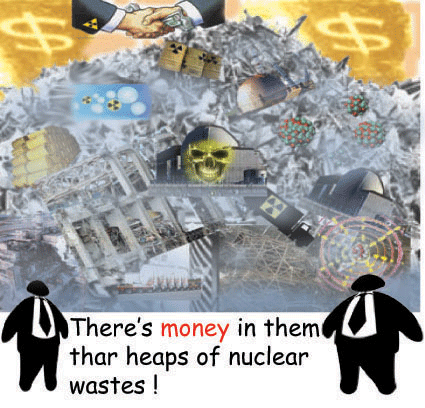 Sellafield nuclear clean-up firms to be stripped of £20bn contract, Telegraph UK Management of Britain’s most toxic nuclear waste site expected to be taken back into state hands as heavily-criticised consortium of Amec, Areva and URS is stripped of its contract By Emily Gosden, Energy Editor 12 Jan 2015 Nuclear waste clean-up operations at Sellafield are expected to be taken back into state hands, as the private consortium managing the Cumbrian site is stripped of its £20bn contract.
The Government’s decision to axe Nuclear Management Partners (NMP), comprised of Britain’s Amec, France’s Areva and America’s URS, is expected to be formally announced on Tuesday, six years into a 17-year contract to work on decommissioning the site.
Ministers surprised many by shying away from an opportunity to cancel NMP’s contract at a formal “break point” last year, despite criticism of the consortium by the National Audit Office (NAO) and Public Accounts Committee (PAC) over a series of failings.
The Nuclear Decommissioning Authority (NDA) had said it was considering taking the management of Sellafield back into state hands, an option that would have required ministerial approval.
However, there were doubts about how state management of the nuclear site, the UK’s biggest and most hazardous, would work in practice. It is thought a plan has now been drawn up and the NDA will exercise its right to terminate NMP’s contract “for convenience” with 12 months’ notice.
A spokesman for the Department of Energy and Climate Change confirmed only that the NDA and Government had been working on “alternative options at Sellafield”……..
the costs of the clean-up have since spiralled and annual spending at the site last year was £1.8bn, implying the remaining 11 years of the contract would be worth £20bn.
NMP earns tens of millions of pounds each year for managing the multi-billion pound operations.
Lifetime costs for decommissioning Sellafield, which is likely to take more than 100 years, were last year estimated to have risen to in excess of £79bn, but the NDA warned at the time that the total would rise further.
The NAO and PAC both criticised delays and cost overruns in NMP’s management Sellafield, where failings also included accidentally sending radioactive waste to a landfill site, resulting in a £700,000 fine………http://www.telegraph.co.uk/finance/newsbysector/energy/11340733/Sellafield-nuclear-clean-up-firms-to-be-stripped-of-20bn-contract.html
Sellafield Catch Up 2015
 nuClear News Jan 15 “…….2014 began with the publication of a new report (1) from the House of Commons Public
2015 – A Critical Year for New Nuclear Power in UK
 nuClear News Jan 15 “………Last month we reported that it was still unclear exactly who would invest in EDF Energy’s
Women on the move – into employment in renewable energy
An increasing female presence in Renewable energy By Sarah Brooks Linked In 12 Jan 15 The energy sector has always been regarded as male dominated. As of 2013, females contributed to just 21% of the workforce for traditional energy sources such as oil, gas and petroleum. However in the renewables sector females appear to be getting ahead. In Scotland alone 28% of the employees of the renewable energy industry were female.As the renewable industry is considered to be a relatively new source of energy and is still continuously undergoing development and investment, it opens up opportunities for females who would not normally be given a chance to work in the energy sector. Scotland are leading in the renewable sector in the UK, in 2012 almost 30% of electricity generated came from renewable sources compared to just 8% in England and Wales.

If the rest of the UK continue to develop similar to Scotland the number of careers for women within the sector will only increase. Although females are beginning to enter the energy workforce, it is questioned whether these are still mainly in sales and business based roles rather than technical. As of 2010, only 6% of the engineering workforce in the UK were female. Granting this, in 2013 16% of the graduates in engineering degrees were female, which was a small improvement from years prior.
This slight growth over the recent years can be shown through the fact in 2013 50% of the females employed by engineering industries were aged 25-30 years old. This is indication there will be a gradual influx of a younger generation of females into technical roles within the renewable sector as engineers begin to graduate and build their careers within the industry. Initiatives are in place to help encourage and support females to pursue engineering and technical roles. A survey carried out by Atkins in 2013 on females in engineering careers found over 50% of the sample felt they were put off at school for pursuing engineering as it being portrayed as ‘too difficult’ and ‘male dominated’………
Despite the renewable energy industry still being largely dominated by males, there is still huge opportunity for females to get on board not only in business support roles but technical too. With females being gradually encouraged to pursue an engineering career we can expect to see a gradual influx of women in the renewable workforce over the next few years…….https://www.linkedin.com/pulse/increasing-female-presence-renewable-energy-sarah-brooks
Cumbria’s call for clean-up of Sellafield’s ‘Legacy’ spent nuclear fuel ponds
 Sellafield Ltd’s announcement of two ‘unusual finds’ on West Cumbrian beaches in May and June 2014 (the discovery attributed to the new Groundhog Synergy 2 monitoring system introduced in May) should be ringing public health alarms in the corridors of those tasked to protect beach users from the radioactive materials routinely washed up on local beaches from Sellafield’s historic discharges to the Irish Sea.Sellafield Catch Up 2015 nuClear News Jan 15 Eddie Martin of the Cumbria Trust wrote to Stephen Henwood chair of the NDA in November about the spent fuel ponds. He said, given that the Sellafield “Legacy Ponds” are over 60 yearsold, contain significant amounts of spent Magnox nuclear fuel and other radioactively
Danger of transporting nuclear weapons through Glasgow, especially in extreme weather

 Ministry of Defence blasted for transporting nuclear weapons through Glasgow city centre during extreme weather by Scottish CND and SNP Daily Record, Jan 13, 2015 By Joe McGuire
A CONVOY believed to be carrying city-destroying warheads drove through the middle of Glasgow on the M74 and M8 on Sunday night and crossed the Erskine Bridge during high winds. THE Ministry of Defence has come under fire from anti-nuclear campaigners and politicians after reports that a convoy carrying nuclear weapons travelled through the centre of Glasgow despite weather warnings.
The convoy drove through the middle of Glasgow on the M74 and M8 between 11.35pm and 11.55 pm on Sunday night and crossed the Erskine Bridge during high winds.
While the Scottish CND (Campaign for Nuclear Disarmament) maintain the convoys, which transport nuclear warheads between the Atomic Weapons Establishment in Berkshire to the UK’s fleet of nuclear-armed submarines at Faslane, are always unsafe, the campaigners condemned moving the weapons during extreme weather as reckless……….
SNP MSP for Glasgow Anniesland and co-president of Parliamentarians for Nuclear Non-proliferation and Disarmament Bill Kidd added: “This practice is deeply worrying and poses an unacceptable risk to the people of Glasgow. The idea that weapons of mass destruction are being transported through our city while we sleep is absolutely chilling – and shows the utter folly of basing nuclear weapons just 30 miles from our biggest population centre.
“The impact of any safety breach during one of these convoys does not bear thinking about. It’s time that these immoral and unsafe weapons were removed from Scotland for good.”
Glasgow Now has reached out to the Ministry of Defence for comment. http://www.dailyrecord.co.uk/news/local-news/ministry-defence-blasted-transporting-nuclear-4970433
Secrets revealed – Scotland’s nuclear disaster plans
 Scotland’s secret nuclear disaster plan revealed Scotsman , 12 Jan 15 A SECRET plan to deal with a Chernobyl-style nuclear emergency in central Scotland has finally been revealed in a dossier which has been kept under wraps for decades.
The classified documents which show how the government would have responded to a full-scale atomic crisis have been opened and placed in the National Archives.
The files outline the steps that would have been taken if lethal substances had leaked from the twin Hunterston A and B nuclear plants on the Ayrshire coast.
They reveal that staff at Scotland’s largest hospital were primed to treat victims suffering from burns and radiation sickness, a community centre would have been converted into a decontamination zone and residents would have been issued with anti-radiation tablets.
They also show that the strategy for a mass public evacuation revolved around police officers knocking on residents’ doors and politely advising them to leave……..
Hunterston A was opened by the Queen in September 1964, but stopped producing electricity in 1990 and is currently being decommissioned. The neighbouring Hunterston B plant was opened in 1976 and is due to operate until 2023 – well beyond its original planned closure date.
Last year Nicola Sturgeon, the then deputy first minister – a long-term opponent of nuclear power – expressed “deep concern” after it emerged that cracks had been found in one of the plant’s reactors………http://www.scotsman.com/news/environment/scotland-s-secret-nuclear-disaster-plan-revealed-1-3657911
80 miles from Sellafield nuclear facility, radiation is found in food
 Radiation found in food 80 miles across the border from Cumbrian nuclear-plant Sellafield Daily record, Jan 07, 2015 By Jennifer Hyland
NUCLEAR waste released from the Cumbrian reprocessing site has made fish and shellfish caught off the Dumfriesshire coast radioactive. RADIATION has been found in food 80 miles across the border from a Cumbrian nuclear-plant a report has revealed.
Nuclear waste released from the Cumbrian reprocessing site has made fish and shellfish caught off the Dumfriesshire coast slightly radioactive.
And fish-fans in Dumfriesshire have the highest exposure to nuclear radiation of anyone north of the Border.
Despite Sellafield nuclear station being situated 80 miles away, the new report reveals that the nuclear power station is still having an impact on Scotland, reports the Daily Mail. And although the levels are within safe EU limits, Sellafield and Scottish nuclear power stations have infiltrated the food chain here.
Traces of radiation were found in fruit, potatoes and vegetables near to Dounreay nuclear power station in Caithness, in the far north-east of Scotland .
Whilst in Chapelcross, in Dumfriesshire, nuclear radiation has made its way into the milk.
Where as at Faslane, near Helensburgh, Dunbartonshire, the destination of Britain’s nuclear submarines where liquid radioactive waste is discharged into the Gareloch,
beef has been revealed to contain a small amount of radiation……..
- The unborn children of pregnant women living within 550 yards of the Hunterston B site, in North Ayrshire – one of Scotland’s two working nuclear power stations -would received the highest dose there.
Dr Richard Dixon, director of Friends of the Earth Scotland, said: “There is no safe level of radiation. Nuclear technology… poses an ongoing threat to public health.”………http://www.dailyrecord.co.uk/news/health/radiation-found-food-80-miles-4931653
Depleted uranium weapons – a propaganda victory for ISIS?
 The UK and depleted uranium, International Coalition to Ban Uranium Weapons, A retired British General has urged the UK to persuade the US not to use depleted uranium in operations against ISIS in Iraq, Sir Hugh Beach argues that the use of the weapons will be a propaganda victory to their opponents. 9 January 2015 – Gen Sir Hugh Beach (Rtd)
Top renewable energy investment trends for 2015
 UK watch: Tracking renewable energy investment trends, Renewable Energy Focus 05 January 2015 KATHARINE EARLEY As we head into 2015, Renewable Energy Focus contributor Katharine Earley speaks to Triodos Bank about investment trends, including crowd-funding, community-owned energy and businesses opting for on-site energy generation.
With renewable energy set to be one of the key winners to emerge from the EU’s new three-year, £250bn investment plan, 2015 could be a promising year for renewables. We caught up with ethical investment pioneer Triodos Bank to understand what trends it foresees for the year ahead.
“We could see some real strides forward for renewable energy in Europe, particularly if the EU’s investment plan focuses on grid infrastructure,” Matthew Clayton, executive director of Triodos Renewables, explained. “As we move from centralised power plants to smaller, distributed energy generation, government investment could really help to address this important systems issue. Coupled with private investment in energy efficiency and generation, such a move could lead to more rapid progress.”
For Triodos’ part, its renewables company, owned by some 5,000 shareholders, operates 11 onshore wind and hydroelectric projects across the UK with a capacity of 53MW, enough electricity to power 34,200 homes. Founded in 1994, the company has seen a 35% increase in shareholders and a 50% increase in generating capacity in the past three years. Its projects generated more than 100m kWh of clean electricity in 2013. Having already raised £2m from its latest share offer, it is now extending the offer until 30th January 2015.
So what does Clayton see as the reasons for this prosperity?
“Investor confidence has grown as the nature of the projects become more robust,” he explained. “The technology is proven and is also decreasing gradually in price. Interestingly, we’re seeing interest from a wide range of investors, from individuals through to institutional investors. And we want to make investing in renewables accessible – that’s why we’re inviting minimum investments of £50 through our current share offer………..
1. More projects will be developed to supply a business
“We’ll see more projects developed with a direct supply of renewable electricity to a business,” Bazin stated. “This helps the developer to achieve a better price for the power and reduces electricity losses during transmission. Meanwhile, the business purchasing the energy benefits from greater security of supply, lower cost compared to using major utilities and a boost to its efforts to reduce its environmental footprint.”
According to Bazin, this direct supply of electricity will be a key component of roof-mounted solar projects, which are high on the UK government’s agenda in 2015. This type of direct supply model also helps to raise awareness of the positive impact of renewable energy among building users, he confirms.
2. Community-owned energy will gather momentum
In 2014 Scotland had a massive success in renewable energy, especially wind power
 Scotland Saw A “Massive Year” Of Renewable Energy http://cleantechnica.com/2015/01/06/scotland-saw-massive-year-renewable-energy/ January 6th, 2015 by Joshua S Hill That Scotland saw impressive records broken last year is of no real surprise to those who followed news of their monthly wind energy generation numbers. New numbers published early January have only confirmed that sense of record breaking, with another record month and a “massive year” in total.
WWF Scotland provided the information, by way of WeatherEnergy, and found that for December, wind energy provided 164% of Scottish household electrical needs — a massive record, well up on what had already seemed to be a mammoth record, set in October, when wind energy provided 126% (though, as it turns out, before Scotland’s performance was brought to my attention, they hit 163% in February). Specifically, wind energy delivered 1,279,150MWh of electricity to the National Grid, enough for 3.96 million homes.
In fact, wind energy generated enough energy to supply over 100% of Scottish household needs on 25 out of the 31 days of December.
“December turned out to a record-breaking month for wind power, with enough green energy generated to supply a record 164% of Scottish households with the electricity they need,” said WWF Scotland’s director Lang Banks. “Even on calmer days, wind still supplied the equivalent of over a third of electricity needs of every home.”
For 2014 as a whole, wind energy delivered an estimated 8,958,130MWh of electricity to the National Grid, or an average of 746,510MWh each month. That’s enough to supply the electrical needs of 98% of all Scottish households.
Without doubt, 2014 was a massive year for renewables, with wind turbines and solar panels helping to ensure millions of tonnes of climate-wreaking carbon emissions were avoided,” added Banks. “With 2015 being a critical year for addressing climate change internationally, it’s vital that Scotland continues to press ahead with plans to harness even greater amounts of clean energy.”
Solar power did relatively well throughout the year for Scotland, though it’s hard to come close to the country’s wind energy industry. Homes fitted with solar PV panels generated enough energy to supply homes in Aberdeen, Edinburgh, Glasgow, and Inverness with an estimated 100% or more of their electricity needs throughout June and July, and 60% or more across the same four cities during March, April, May, August, and September.
“For 2014 as a whole, on average, wind power generated enough to supply the electrical needs of 98% of Scottish households, with six months where the amount was greater that 100%,” Banks continued. “And, in the tens of thousands of Scottish households that have installed solar panels saw them meet two-thirds or more of their electricity or hot water needs from the sun during several months of the year, helping those homes to reduce their reliance on coal, gas, or even oil.”
Karin Robinson of WeatherEnergy also commented on the remarkable year-that-was for Scotland: “We’re famous in the UK for our obsession with the weather, but how often do we see it in a positive light? At a time when the world is desperately looking for low-carbon sources of energy, the data show that clean renewables are already playing a significant and growing role in Scotland’s, and the rest of the UK’s, overall energy mix. We just need to blow their trumpet a bit more.
The news came just a few days before WWF published another report, this time based upon technical analysis conducted by international energy and engineering consultancy DNV GL, which found that Scotland could be a renewable energy powerhouse by 2030, completely decarbonised and delivering renewable energy enough for all the country’s electricity needs.
“It’s great to see the vision for a secure, renewables-based future for Scotland independently tested and proven,” said WWF Scotland’s Climate and Energy Policy Officer, Gina Hanrahan. “It’s clear that Scotland doesn’t have to generate electricity from coal, gas or nuclear to ensure security of supply.”
Keep up to date with all the hottest cleantech news by subscribing to our (free) cleantech newsletter, or keep an eye on sector-specific news by getting our (also free) solar energy newsletter, electric vehicle newsletter, or wind energy newsletter.
1 This Month





PLEASE OPPOSE HR 8255 AND S.3639 – bills would accelerate satellite deployment, with no environmental review or safeguards – https://ncstd5li.quorum.us/campaign/169331/
To see nuclear-related stories in greater depth and intensity – go to https://nuclearinformation.wordpress.com
-
Archives
- October 2026 (58)
- September 2026 (339)
- August 2026 (330)
- July 2026 (355)
- June 2026 (287)
- May 2026 (306)
- April 2026 (356)
- March 2026 (251)
- February 2026 (267)
- January 2026 (308)
- December 2025 (358)
- November 2025 (359)
-
Categories
- 1
- 1 NUCLEAR ISSUES
- business and costs
- climate change
- culture and arts
- ENERGY
- environment
- health
- history
- indigenous issues
- Legal
- marketing of nuclear
- media
- opposition to nuclear
- PERSONAL STORIES
- politics
- politics international
- Religion and ethics
- safety
- secrets,lies and civil liberties
- spinbuster
- technology
- Uranium
- wastes
- weapons and war
- Women
- 2 WORLD
- ACTION
- AFRICA
- Atrocities
- AUSTRALIA
- Christina's notes
- Christina's themes
- culture and arts
- Events
- Fuk 2022
- Fuk 2023
- Fukushima 2017
- Fukushima 2018
- fukushima 2019
- Fukushima 2020
- Fukushima 2021
- general
- global warming
- Humour (God we need it)
- Nuclear
- RARE EARTHS
- Reference
- resources – print
- Resources -audiovicual
- Weekly Newsletter
- World
- World Nuclear
- YouTube
-
RSS
Entries RSS
Comments RSS

