Nuclear submarines plan is an expensive mistake – there are better things for UK to spend money on: Andy Brown
Keeping the public safe is one of the prime responsibilities of any government. So, it is easy to understand that the government needs to spend money on defending our country.
Nuclear submarines plan is an expensive mistake – there are better things
for UK to spend money on: Andy Brown. Keeping the public safe is one of the
prime responsibilities of any government. So, it is easy to understand that
the government needs to spend money on defending our country. What is a lot
harder to understand is why the government would appear to be quite so
enthusiastic about wasteful and excessive expenditure that is supposed to
protect us from some forms of harm but slow and reluctant to act to protect
us from others.
Yorkshire Post 16th June 2025 https://www.yorkshirepost.co.uk/news/opinion/columnists/nuclear-submarines-plan-is-an-expensive-mistake-there-are-better-things-for-uk-to-spend-money-on-andy-brown-5175376
Scotland to prioritise renewable energy over nuclear power
The Scottish government will focus on renewable energy not nuclear power,
a government minister has said following confirmation of significant
funding for nuclear power plants in England. Scotland has an effective ban
on new nuclear facilities because the SNP has a long-standing commitment to
block projects through devolved planning powers. Acting Energy Secretary
Gillian Martin told BBC Scotland News they would “capitalise on renewable
energy capacity” rather than “expensive new nuclear”. Scottish Secretary
Ian Murray said a Scottish Labour government in Holyrood would reverse the
SNP’s block on nuclear power stations being built.
BBC 10th June 2025,
https://www.bbc.co.uk/news/articles/ckgr82vqdvzo
Ed Miliband presses the nuclear button for Berkeley
Rolls-Royce SMR has been given the full go-ahead to build up to SIX mini
nuclear reactors on the edge of Gloucestershire. The small modular designs,
which embrace a miniaturisation approach to nuclear technology that is yet
to be fully developed, are planned to be at Oldbury-on-Severn, near
Thornbury, while key support on training and safety services, as broadly
predicted, will be installed in Berkeley, at the town’s former Severnside
Magnox site.
Ian Mean, former director for Business West in Gloucestershire
and now on the board of the Gloucestershire County Council Economic Growth
Board, said Chancellor Rachel Reeves’ and Ed Miliband’s final confirmation
was “tremendous news for the Gloucestershire economy”. He said: “I believe
that these mini reactors – as many as six of them here in Gloucestershire
and South Gloucestershire – have the potential to provide thousands of
skilled jobs and the opportunity of millions of pounds flowing into our
regional economy. “Berkeley and Oldbury – the two former decommissioned
nuclear sites at Oldbury and Berkeley Green now hold the key to becoming a
major nuclear hub.”
But any resurrection of the technology in SMR format
has been condemned by Gloucestershire energy entrepreneur Dale Vince, who
owns Stroud-based Ecotricity. Speaking on the Zerocarbonista podcast before
today’s confirmation, Mr Vince said: “When you come to small nukes, the
government and the nuclear industry have consistently said that we will get
lower bills, but they don’t put a number on it. They are ecomonists without
numbers! “Big nuclear is the most expensive electricity we have ever made,
it’s off the charts compared to renewable energy and one of the fundamental
laws of physics is that the economies of scale come by making something
bigger, not by making something smaller – it always costs money to
miniaturise.
So here they are, saying we can miniaturise nuclear reactors
that famously went decades late and billions over budget… and they’ll be
cheap. I don’t believe that for a second and what we are of course doing is
proliferating the risk.” He added: “It’s always worth imagining what it
would be like if the Romans had nuclear power. If they did, Bath would be a
toxic no-go zone. It’s only 2,000 years ago and sounds like a long time,
but not in the context of toxic nuclear waste.”
Punchline Gloucester 10th June 2025,
https://www.punchline-gloucester.com/articles/aanews/miliband-presses-the-nuclear-button-for-berke
Great British Energy’s budget has been nuked

Nils Pratley 12 June 25,
https://www.theguardian.com/business/nils-pratley-on-finance/2025/jun/11/great-british-energys-budget-has-been-nuked
Ed Miliband’s vehicle for investing in renewables lost 30% of its pot to small modular nuclear reactors in the spending review
GB Energy’s promised £8.3bn budget raided to pay for small nuclear reactors
There was a weirdness in the government’s welcome announcement this week that Rolls-Royce SMR had been selected as preferred bidder to build the UK’s first small modular nuclear reactors, and that £2.5bn of public money would be thrown behind the project. The government body backing the project was something called Great British Energy – Nuclear.
This, it turned out, was the new name for Great British Nuclear, the unit set up in 2023 by the last government to oversee delivery of the nuclear programme. But why risk confusion with Great British Energy, Ed Miliband’s publicly owned company for investing, we thought, in renewables projects such as wind, solar and hydro with a side-mission to ensure that lots of the kit is manufactured in the UK?
The confusion, it seems, was deliberate. The chancellor’s spending review revealed that every penny of the £2.5bn for SMRs is coming from GB Energy’s £8.3bn budget. That is 30% of the pot to SMRs in one gulp.
One could argue, as Labour folk did, that nuclear and renewables are all part of the same low-carbon clean energy mix, so they go hand in hand and were always intended to do so. It’s true that past descriptions of GB Energy’s role have sometimes mentioned nuclear, but never as the headline act. It was never spelled out, for example, that the entirety of public support for SMRs would come from GB Energy’s budget, which would be a relevant fact to mention if you were worried that the Tories had set up Great British Nuclear but not given it funding. It rather looks as if GB Energy’s budget has been nuked by the Treasury.
“Labour will capitalise Great British Energy with £8.3bn over the next parliament,” said the manifesto and, strictly speaking, that pledge is still being honoured. It’s just that GB Energy will be directing almost a third of its allocation to the nuclear body that we had previously regarded as a separate unit.
But it does make GB Energy a strange beast if it is now the main government vehicle for investing in SMRs, a cutting-edge technology that tends to involve permanently big numbers and follow-on rounds of funding. GB Energy’s initial adventures, note, have been low-key and local – funding for installing solar panels on schools and hospitals, for example. Worthy stuff, but a million miles away from the development of next-generation nuclear technology.
GB Energy will be expanding into new and exciting areas later this year, say Labour insiders. We’ll see what that brings. The company’s core mission seems to be a work in progress.
Cost of Miliband’s nuclear plant doubles to more than £40bn
Price tag for Sizewell C project soars as ministers pursue funding deal with private investors
and the French government.
Matt Oliver Industry Editor. Szu Ping Chan Economics Editor. Jonathan Leake, Telegraph 11th June 2025,
https://www.telegraph.co.uk/business/2025/06/11/cost-of-milibands-nuclear-plant-doubles-to-more-than-40bn/
An official cost estimate for the scheme in
Suffolk, which would generate enough electricity for 6m homes, was
previously put at £20bn. But that has grown to £30bn at constant prices
– or £41bn in today’s money – with the Government set to shoulder at
least half of the upfront cost, according to industry and Whitehall
sources.
The entire scheme will ultimately be paid for by households and
businesses via their electricity bills, including through levies that will
begin during construction. The power plant’s rising price tag will
trigger concerns about future increases as Hinkley Point C, a nuclear
development in Somerset, has repeatedly overrun budgets and timescales.
GB Energy’s promised £8.3bn budget raided to pay for small nuclear reactors
Rachel Reeves has effectively cut £2.5bn from the government’s national
energy company by sharing the £8.3bn it was promised with a separate
nuclear power body set up by the Conservatives. The Labour manifesto had
pledged the full amount to Great British Energy to invest in clean power
projects. However, the chancellor’s spending review said the company
would share this funding with a separate body tasked with spearheading
Britain’s nuclear renaissance. The Treasury’s spending plans said the
“two allied publicly owned companies with a shared mission” would spend
the £8.3bn on “homegrown clean power” including £2.5bn to help the UK
develop a new generation of small modular nuclear reactors.
Guardian 11th June 2025, https://www.theguardian.com/business/2025/jun/11/gb-energy-83bn-of-funding-raided-to-pay-for-small-nuclear-reactors
It’s austerity from Reeves
There is no strategy apparent in it at all except to make the UK a defence industry superpower, which was what Rachel Reeve says she wishes to do, as if confirming the military-industrial complex has finally defeated democracy.
the whole of East Suffolk has already been scarred with building works to facilitate the Sizewell C programme
What this so-called spending review admits is that there is no prospect of finding any foreign funding for Sizewell C, which was this government’s quite absurd hope. It has therefore, to fund this white elephant itself.
This power station and the others to which the government has committed will cost at least £1,500 per household in the UK, and that might at best result in power for 6 million households.
However, the actual cost of this energy is the highest that we can produce, and that is before taking into account decommissioning costs. Those at Sellafield now amount to £136 billion, and no one thinks that this is the total sum involved.
Reeves is delivering austerity for the UK, unless you’re wealthy, when it’s still bonanza time.
June 11 2025 https://www.taxresearch.org.uk/Blog/2025/06/11/its-austerity-from-reeves/
It has to be said that Spending Reviews are like New Year’s resolutions. They seem like a good idea at the time. Then they are quietly forgotten. I have a very strong feeling that Rachel Reeves will hope that this is what will happen with today’s spending review.
The big news here is quite simple. Reeves decided that if she changed the fiscal rules so that she could borrow more for investment, she could appear to be a big spender, whilst at the same time trying to meet her current fiscal rule that desperately attempts to make current year government spending match current year tax revenue.
To put this in context, what this means is that while she has supposedly promised around £113 billion of additional capital expenditure in the spending review. Much of it is going to take place in the dim and distant future when she will be long gone from the Treasury and probably as an MP, given Labour’s current state of political fortunes.
And just to contextualise this £113 billion, the Tories had planned to spend £90 billion . What she’s adding is only £23 billion. That might be called the square root of didley squat in the grand scheme of things, when the government spends well over £1,000 billion a year.
Elsewhere, the reality is that there will be cuts in real government spending. Austerity is, in other words, continuing despite what Reeves had to say.
……………….. There is also good reason why all the announcements about capital expenditure came out early and in advance of this spending review. They were the only good news. Everything else is something that Rachel Reeves does not really want to talk about.
And let’s be clear that some of this capital expenditure also makes no sense at all. For example, one of the biggest items of expenditure will be on nuclear power stations, where supposedly at least £30 billion is to be spent, although everybody in reality knows that this will turn into a sum of well in excess of £100 billion, given the cost overruns that always occur in nuclear power budgets.
Starmer has claimed that the government has now decided that Sizewell C will be built. But as everyone in Suffolk knows, that decision was made long ago because the whole of East Suffolk has already been scarred with building works to facilitate the Sizewell C programme.
So what Stamer is saying is complete nonsense. What this so-called spending review admits is that there is no prospect of finding any foreign funding for Sizewell C, which was this government’s quite absurd hope. It has therefore, to fund this white elephant itself.
And now Reeves actually wants more investment at Sellafield, which is only going to make things worse, but is part of her plan to apparently make us a nuclear superpower. So, if you want to know what leaving a debt for future generations to pay really looks like, building Sizewell C and other power stations is all that you need to do to ensure that this outcome will become a reality.
In contrast to all this emphasis upon nuclear power, there was none at all on renewable energy in this statement. There was a mention of £2.5 billion for carbon capture and storage, but that is another white elephant.
There was no commitment to renewable energy, to battery technology, or even things as basic as insulating houses and fitting proper triple glazing, although a nod perhaps to the last was included without any mention of the sums involved being made.
What is clear is that Starmer and Reeves would rather lumber generations to come with the cost of nuclear power rather than invest in renewable energy now, when that is the lowest cost of energy that we have available to us.
And let’s also be clear about the significance of this £113 billion worth of investment, which is supposedly going to transform our future, which is supposedly going to transform our fortunes over the next 10 years, most of it, by simply funding projects that others are refusing to undertake.
Over the same 10-year period, the UK government will, in current prices, subsidise pensions through income tax, national insurance, and corporation tax relief by about £700 billion. The vast majority of the benefit of which will go to the top 10% or so of the UK population because they are the people who own the vast majority of UK pension wealth.
At the same time and at current prices, the UK government will spend approximately £95 billion subsidising the untaxed income of those who save in ISAs, who are, again, in the vast majority of cases, the wealthiest people in the UK because by definition they own the savings that are held in those accounts.
In other words, over the 10 year period during which the government has said it is willing to spend around £40 billion a year to buy up existing housing stocks so that it might be used as social housing, thereby providing maybe 130,000 new houses in total, which does little to solve the problem of 1.3 million people being on council house waiting lists, they are going to spend approximately 20 times that amount subsidizing the tax-free incomes and increase in wealth of those who are already amongst the wealthiest in this country.
If you want to understand where the focus of Labour’s priorities are, then this contrast explains them.
This government has absolutely no vision for the future.
At the same time, and when Labour is desperate to increase its poll ratings to ensure that it can fight off Reform and others, it is planning to cut most types of government spending.
No one will see the benefits of increased defence spending in their pockets. There is none.
No one will sense the benefit of increased NHS spending because the amounts being committed are insufficient to keep up with growing demand for NHS services, as is well known, based upon past patterns of health economic performance.
And on child benefit, the big issue was ducked. There was no mention of ending the two-child benefit cap. Free breakfasts are meant to do instead.
Everywhere else, there would appear to be cuts. The government might claim otherwise, arguing over the odd decimal point of a percentage here or there, and that there are real cash increases, which is totally misleading because of inflation, but that is what the reality will feel like. Austerity is definitely Rachel Reeves’ game.
Meanwhile, we know that taxes have risen.
We know that businesses are suffering because of national insurance hikes, falls in demand, and the fallout from Trump.
And we know that children are living in poverty and their parents are suffering massive stress and have no idea whether there is anyone who really cares about them. No wonder they fall for the false promises of Nigel Farage.
Economically, this spending review was a sham. It confirms decisions already taken. It is an exercise in financial shuffling. It creates little added value in the economy. It addresses no fundamental policy need. It does not tackle inequality. It does not solve the problems of most people in the UK.
There is no strategy apparent in it at all except to make the UK a defence industry superpower, which was what Rachel Reeve says she wishes to do, as if confirming the military-industrial complex has finally defeated democracy.
Rachel Rees might be presenting it to the world with her usual Rictus smile, but the reality is that she has now been to the House of Commons dispatch box on three occasions since becoming Chancellor to deliver major economic policy proposals. And every time she has done so, she has made a complete and utter mess of the job. To be blunt, not only has she not delivered; her strategies are actually making things worse.
Today’s spending review falls fairly and squarely into that category. It answers no known questions.
It preserves the status quo on behalf of the wealthy middle-class elite who wish to maintain their prosperity at cost of everyone else.
This is the politics of failure.
Rachel Reeves’ time in office is now, I think, decidedly limited and if she goes, so will Starmer.
There is no other way in which Labour might now get out of the mess that they are in, but the problem is they’ve already got rid of any other talent that they once possessed. We really are in a total mess.
Sizewell C Nuclear not just a waste of money – a waste of time, too!
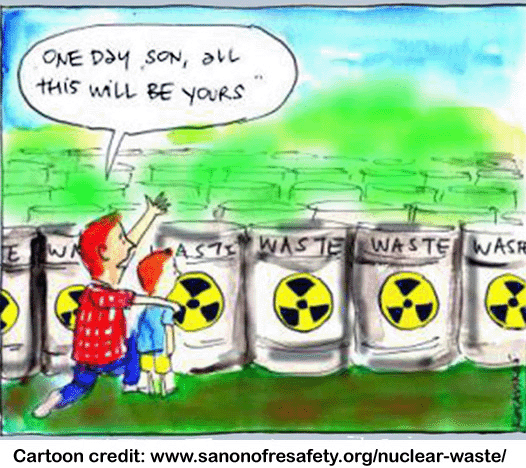
But there is another type of waste even more expensive than the construction costs of nuclear power stations and one that the public will be paying for way into the far future: the storage of toxic high-level radioactive wastes. The public is seldom told that these will be stored on site until at least the middle of the next century, partly to cool down before they can be moved. But moved to where? There is currently no national repository in sight for new build reactors like Sizewell C and there may never be.
Blackwater Against New Nuclear Group (BANNG) 10 June, 25, https://www.banng.info/news/press-releases/10-june-2025/
The Blackwater Against New Nuclear Group (BANNG) agrees with Stop Sizewell C that the proposed new Sizewell C nuclear power station is ‘HS2 Mark 2’. But the public is seldom told about another, much more expensive – and dangerous – waste arising from new nuclear development: toxic high-level radioactive wastes.
The Government has announced that £14BN of public money will be spent over the next four years on the construction of Sizewell C (SZC) new nuclear power station in Suffolk. The amount of taxpayers’ money to be expended at the end of that period is not mentioned, nor is the actual levy to be placed on energy bills to pay for the construction.
The belief of Secretary of State for Net Zero, Ed Miliband, that SZC will be built in a decade flies in the face of the large body of evidence that shows construction of new nuclear power stations runs well over time and over budget. Hinkley Point C (HPC), on which Sizewell C is based, was estimated to cost £16BN in 2012 and to be cooking the Christmas turkey in 2017. Current estimates are £46BN, with operations starting in 2031 (at the earliest).
But there is another type of waste even more expensive than the construction costs of nuclear power stations and one that the public will be paying for way into the far future: the storage of toxic high-level radioactive wastes. The public is seldom told that these will be stored on site until at least the middle of the next century, partly to cool down before they can be moved. But moved to where? There is currently no national repository in sight for new build reactors like Sizewell C and there may never be.
The £14BN package will also cover the construction of Rolls Royce Small Modular Reactors (SMRs) and the Bradwell site, unfortunately, remains a remote possibility for these. But SMRs have the same problems as major new nuclear stations. And don’t be fooled they will be anything but small!
Varrie Blowers, Secretary of BANNG, says: ‘Building one or more SMRs at Bradwell is inconceivable. The site will be wiped out by Climate Change. It is far too remote with no good grid connections. Above all the Blackwater communities and Councils are as resolutely opposed today as they have been for many years.
“As far as public finances are concerned, nuclear power stations, large or small, are not just for life, but forever.”
The Spring Statement Combines Austerity with Dangerous Military Spending
“In effect, a rising military budget and a nuclear waste is being paid for by sick and disabled people.”
, https://labouroutlook.org/2025/06/12/the-spring-statement-combines-austerity-with-dangerous-military-spending/
by Michael Burke
The Chancellor has delivered a Spring Statement for the medium-term where the big winners were arms’ manufacturers and the builders of nuclear power stations, both of which specialise in cost overruns. But the economy will not get the public investment it needs and once again the most vulnerable are being attacked.
As a result, which is admitted in the detail of the Statement, spending on services and social support will not be rising in line with needs. They will cut further by over £6bn. More than half of that will come from welfare cuts. The Universal Credit health element will be cut for new claimants by 50% and then frozen.
The overall package will increase spending and investment in total. Some will want to welcome it as a result. But economic policy should be judged in comparison to what the economy requires to support it and to lift living standards. The Spring Statement does not do any of that.
It is quite right that investment is crucial to the future growth of the economy. Investment properly understood means expanding the means of production, the basis for future prosperity.
But the Chancellor has applied the term to a variety of areas which are not investment at all. These include military spending, subsidies to nuclear power builders and others which add up to more than half the investment total. The consequence is that the increase in actual investment which can add to the means of production will add up to much less than 1% of GDP over the next 5 years. It will not shift the dial on growth or prosperity at all.
Military spending, creating weapons, missiles and armaments, cannot add to the means of production – only to the means of destruction. If they are ever used at all, they can only destroy lives, as well as cities, transport and factories which are part of our shared prosperity.
n a different way, nuclear spending is also hugely wasteful. It is one of the most expensive energy sources of all, even typically huge budget over-runs, and unknown clean-up costs, even if nothing goes disastrously wrong.
This is a huge, missed opportunity. Spending on services and welfare will be cut again, while most of the investment total does not fit the bill and will not add to prosperity or lift living standards at all. In effect, a rising military budget and a nuclear waste is being paid for by sick and disabled people.
It is morally, politically and economically wrong.
GB Energy handed £2.5bn bill for funding small modular reactors
GB Energy handed £2.5bn bill for funding small modular reactors.
Financing nuclear projects will leave state-owned company less cash for
backing wind and solar technology.
Great British Energy, the government’s
flagship state-owned energy company, has been handed the £2.5bn bill to
support a new generation of small nuclear power plants, cutting the amount
it has to spend on wind, solar and other technologies.
Rolls-Royce’sefforts to develop Britain’s first small modular reactors will be funded
by GB Energy’s £8.3bn budget over this parliament, according to measures
announced in Wednesday’s spending review. Until now it had been unclear
which part of the government’s budget would cover the funding for the
small modular reactor programme.
One senior government official said the
moves amounted to “reprofiling” of spending commitments into GB
Energy’s budget that might have previously been funded by the Treasury or
energy department. It follows months of negotiations between the Treasury
and the energy department, led by Ed Miliband, over whether the cash Labour
pledged to GB Energy in last year’s election manifesto would be cut,
given the tight public finances.
FT 11th June 2025 https://www.ft.com/content/a8e3a775-33c9-4ad6-b01a-bfb212dfdcbe
Hinkley Point C | Court rules that nuclear developers must follow environmental information law
Hinkley Point C | Court rules that nuclear developers must follow
environmental information law. A recent tribunal ruling has declared that
private companies involved in building and operating nuclear power plants
in the UK qualify as public authorities under environmental information
laws, obliging them to disclose information about their environmental
impact to the public.
New Civil Engineer 10th June 2025, https://www.newcivilengineer.com/latest/hinkley-point-c-court-rules-that-nuclear-developers-must-follow-environmental-information-law-10-06-2025/
China banned from investing in Sizewell C, energy secretary Ed Miliband vows
China will be blocked from investing in the new Sizewell C power station,
the energy secretary has said. It comes as the chancellor announced plans
to pump billions of pounds into Britain’s nuclear energy sector, putting
£14.2bn towards the new plant’s construction. Asked whether China would
be able to invest in the new power station in Suffolk, Ed Miliband told BBC
Radio 4’s Today programme: “No.”
Independent 10th June 2025,
https://www.independent.co.uk/news/uk/politics/sizewell-c-nuclear-plant-china-investment-ed-miliband-b2767038.html
Six years late and £28bn over budget, this project signals disaster for Ed Miliband’s nuclear plans

Labour is banking on Sizewell C to deliver the net zero goal – but its blueprint was fraught with problems.
Eleanor Steafel, Telegraph, 10 June 25
“Build and repeat.” That is the plan for Sizewell C, the nuclear plant on the Suffolk coast which Ed Miliband has announced plans to pump billions of pounds into. Writing in The Telegraph, he hailed a new “golden age” for the British nuclear industry, pledging £14.2 billion for two reactors at Sizewell which will, eventually, provide six million homes with electricity.
Eventually being the operative word. News that the Government is throwing its weight behind nuclear in the midst of the Energy Secretary’s pursuit of net zero was met with relief by some campaigners …. But concerns have been raised about the modelling. Sizewell is to be a rinse and repeat of Hinkley Point C, the two-reactor power station in Somerset which has been beset with problems from the moment EDF first broke ground there in early 2017.
The Government says it’s to be almost an exact replica. Meanwhile on its website, Sizewell C points to “the benefits of replication”. “Sizewell C will use the same design as Hinkley Point C,” it adds.
It says Hinkley has already “created a huge workforce and supply chain” and that replication “means Sizewell C will benefit from all the efficiencies and expertise learnt by our sister project”.
Efficiency and expertise. It’s one way of summing up Hinkley, though it does rather overlook the £28 billion it has gone over budget to date, the endless delays and challenges from environmentalists, not to mention the international political tensions.
China’s General Nuclear is a significant shareholder in the project, but in 2023 halted funding for it as relations between London and Beijing worsened; the same year the UK government took over the country’s stake in Sizewell C.
Meanwhile, work at the site crawls on, its deadline shifting and bill expanding………………………………………..
At Sizewell, many question how possible it will be in practice to shift operations from one side of England to the other. Alison Downes, of the campaign group Stop Sizewell C, suspects the idea that you can simply move teams and processes without a hitch is unrealistic. “The company want people involved in Hinkley Point C to come over and do what they’ve done there again at Sizewell C, but unless there’s a seamless transition and the roles that they’re just finishing at Hinkley start at Sizewell, then the likelihood is those people will go off and find other jobs and then are lost to the supply chain,” she says.
“Hinkley has been delayed, yes, but Sizewell has also been delayed. It’s very difficult to get two projects of this size to perfectly dovetail.”
Even if they do manage to bring some of that infrastructure across, it’s hard to make the case that Hinkley has been a poster project for Britain’s nuclear prowess.
Last February, EDF said it had taken a near £11 billion hit amid delays and overrunning costs on the project. The month before, it said the plant was expected to be completed by 2031 and cost up to £35 billion. Factoring in inflation, the real figure could be more like £46 billion.
It was, let’s not forget, initially supposed to have started generating electricity in 2017 and cost £18 billion. When construction finally began the same year, it was expected that the plant would be completed by 2025.
It will now come online six years later than that and at more than double the cost of the initial estimate. So not, it would be fair to say, an unmitigated success as major infrastructure projects go………………………….
Downes points out the last update on Hinkley came in January last year, “when there were still five or six years to go, so there was plenty of time for things to get even worse”. That same month, EDF said further delays were in the offing because of a row about fish. The energy company was struggling to agree protection measures for fish in the River Severn. Fears thousands could be killed in water cooling intakes had “the potential to delay the operation of the power station”.
…………………………..campaigners are less optimistic, pointing out the significant geographical differences between the sites. “I get the principals behind replication – but the thing you can’t do is replicate the site,” says Downes, who understands Sizewell is set to be a more expensive site to develop than Hinkley.
“There are very specific complexities around the Sizewell C site… It’s quite likely that any savings they might expect to make through replication will be absorbed in the more complex groundworks.”
While Hinkley is “a dry site”, Sizewell C is by the sea. “It’s going to need huge sea defences. They’ve got to build a crossing over a Site of Special Scientific Interest. They’ve got to build a deep cut-off wall. There’s a lot of associated development that’s needed because there’s less infrastructure than there is down at Hinkley Point C. These are the sorts of things that concern us.”………… https://www.telegraph.co.uk/news/2025/06/10/hinkley-point-c-blueprint-for-sizewell/
Greens react to plans for new nuclear plant at Sizewell

by Green Party, https://greenparty.org.uk/2025/06/10/greens-react-to-plans-for-new-nuclear-plant-at-sizewell/
Responding to news that EDF will build a new nuclear power plant at Sizewell at an estimated cost of over £14bn, co-leader of the Green Party, Adrian Ramsay MP, said:
“Nuclear power is hugely expensive and far too slow to come on line. The only thing delivered by EDF so far at Hinkley Point in Somerset is overspend and delay. Electricity was promised by 2017 with a price tag of £22bn but this has mushroomed to 40bn and Hinkley is still producing no power.
“The money being spent on this nuclear gamble would be far better spent on insulating and retrofitting millions of homes, bringing down energy bills and keeping people warmer and more comfortable. We should also be investing in genuinely green power such as fitting millions of solar panels to roofs and in innovative technologies like tidal power. All this would create many more jobs than nuclear ever will.”
Miliband’s Sizewell plan in meltdown over potential cost

Huge nuclear power scheme promises much-needed energy but taxpayers have a right to know if the costs of delivering it will be radioactive.
Welcome to “a golden age of clean energy abundance”. And how do we deliver this dream of Ed Miliband’s? By raiding the taxpayer for enough cash to deliver around
half of Sizewell C, the new nuke planned for a Suffolk flood plain. The
government’s sudden discovery of an extra £14.2 billion for the
3.2-gigawatt project has some merits. After the Tories’ pretence that the
private sector alone would fund new nuclear, at last some overdue
realpolitik: that if the UK wants new plants, taxpayers will have to stump
up for them. ………………..
the government’s Sizewell announcement is still full of
holes: a point driven home by Rachel Reeves’s claim that “we are
creating thousands of jobs, kick-starting economic growth and putting more
money [sic] people’s pockets”. How can the chancellor promise that? The
government doesn’t even say how much the project is expected to cost, let
alone how much consumers will be paying for Sizewell’s electricity.
Indeed, ministers have come up with nothing so far on what makes this
project value for money — despite the taxpayer sticking in £17.8
billion, including the £3.6 billion already committed. More may well be
required, too, given Sizewell is the same European Pressurised Reactor
design as Hinkley Point C, the Somerset nuke being built by France’s EDF
that’s now running six years late and whose costs have mushroomed from
£18 billion in 2015 prices to £46 billion in today’s.
Ministers claim Sizewell will be cheaper, given all the lessons learnt from Hinkley. Yet,
its geography is trickier: sited on marshland, on a coastline that’s
eroding, requiring sea defences. Total costs are still likely to top £40
billion, with the “mid 2030s” start date probably wishful thinking. The
government says it will “set out the full cost of the project” at the
time of the final investment decision “later this year”.
But, from that, two things are clear. First, that it’s in no position to make that
decision yet. Second, that it’s yet to sign up any equity partners for
Sizewell — not even EDF, which theoretically has a 15 per cent stake.
Times 10th June 2025, https://www.thetimes.com/business-money/economics/article/milibands-sizewell-plan-in-meltdown-over-potential-cost-p2cnvkfjq
1 This Month

of the week – Shut Down Drone Warfare!


Tell the Ukrainian Government to Drop Prosecution of Peace Activist Yurii Sheliazhenko

Petition to revoke the licensing of the Near Surface Nuclear Disposal Facility (NSDF) at Chalk River. https://www.ourcommons.ca/petitions/en/Petition/Details?Petition=e-7247
To see nuclear-related stories in greater depth and intensity – go to https://nuclearinformation.wordpress.com
-
Archives
- April 2026 (68)
- March 2026 (251)
- February 2026 (268)
- January 2026 (308)
- December 2025 (358)
- November 2025 (359)
- October 2025 (376)
- September 2025 (257)
- August 2025 (319)
- July 2025 (230)
- June 2025 (348)
- May 2025 (261)
-
Categories
- 1
- 1 NUCLEAR ISSUES
- business and costs
- climate change
- culture and arts
- ENERGY
- environment
- health
- history
- indigenous issues
- Legal
- marketing of nuclear
- media
- opposition to nuclear
- PERSONAL STORIES
- politics
- politics international
- Religion and ethics
- safety
- secrets,lies and civil liberties
- spinbuster
- technology
- Uranium
- wastes
- weapons and war
- Women
- 2 WORLD
- ACTION
- AFRICA
- Atrocities
- AUSTRALIA
- Christina's notes
- Christina's themes
- culture and arts
- Events
- Fuk 2022
- Fuk 2023
- Fukushima 2017
- Fukushima 2018
- fukushima 2019
- Fukushima 2020
- Fukushima 2021
- general
- global warming
- Humour (God we need it)
- Nuclear
- RARE EARTHS
- Reference
- resources – print
- Resources -audiovicual
- Weekly Newsletter
- World
- World Nuclear
- YouTube
-
RSS
Entries RSS
Comments RSS
 nuclear-news