ground crews who washed down planes that flew through the cloud soon began falling sick and low levels of radiation were detected all over Australia.
In 2007 it was found nuclear veterans had the same DNA damage as Chernobyl survivors.
Wives had three times the normal numbers of miscarriage and children 10 times more birth defects.
The secrets behind Britain’s first atomic bomb – and the heartbreaking aftermath The detonation of the plutonium bomb in 1952 was hailed a national success, but many of the servicemen involved were left permanently damaged by the fallout BY SUSIE BONIFACE, MIRROR UK, 6 OCT 2017
A blinding flash, an eerie silence, and then the sky cracked.
The sound reached those watching at the same time as the blast – a scorching 600mph wind carrying with it the long, grumbling roar of the worst weapon known to humankind.
It was 65 years ago this week – 9.30am local time on October 3, 1952 – that Britain detonated its first nuclear bomb .
Winston Churchill was jubilant, the scientists bursting with pride. But on a tiny island off Australia the cost of the radioactive fallout from Operation Hurricane had yet to be counted.
Many of the servicemen present that day went on to suffer heartbreaking consequences.
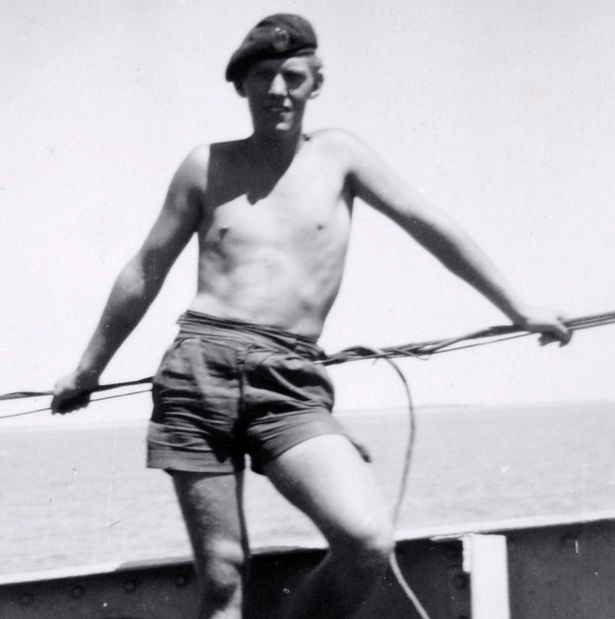
Royal Engineer Derek Hickman, now 84, was there. He says: “We had no protective clothing. You wore shorts and sandals and if you remembered your bush hat, that was all you had.” The blast took place on HMS Plym, an old frigate anchored 300 yards off Trimouille, one of the Monte Bello islands. Troops and scientists lived and worked for months on a small fleet that accompanied her on her final mission.
Derek remembers: “They ordered us to muster on deck – I was on HMS Zeebrugge – and turn our backs to the Plym. We put our hands over our eyes and they counted down over the Tannoy.
“There was a sharp flash and I could see the bones in my hands like an X-ray. Then the sound and the wind and they told us to turn and face it. We watched the mushroom cloud just melt away. They gave us five photos as a memento.
“All that was left of the Plym were a few pieces of metal that fell like rain and her outline scorched on the sea bed.”………
In 1951 Australia agreed the blast could take place at Monte Bello. ….
Thousands of UK and Aussie servicemen saw the mushroom cloud disperse before dozens of planes flew through it to collect dust samples.
The press had been given a viewing tower 55 miles away. The Mirror announced: “This bang has changed the world”.
No official statement was made until October 23 when PM Churchill told the Commons: “All concerned are to be warmly congratulated on the successful outcome of an historic episode.”
But ground crews who washed down planes that flew through the cloud soon began falling sick and low levels of radiation were detected all over Australia.
James Stephenson, 85,remembers being given an unexplained posting to Abergavenny. The former Royal Engineers soldier says: “We went for training and they started weeding us out, removing lads they thought were Communist sympathisers or not up to it.
“Nobody told us what it was about. When we embarked in Portsmouth we had to load machinery ourselves, they wouldn’t let the dockers do it.”James left with the first wave of vessels in January 1952. They were followed six months later by HMS Plym carrying the bomb.
Derek explains: “It was a plutonium bomb – the dirtiest. A few years later I went to the doctor and mentioned Monte Bello.
“He asked if I was married. I said ‘Yes’ and he replied ‘My advice is never have children’. He wouldn’t say why.”
It was a warning Derek, now living alone in Crediton, Devon, couldn’t ignore. He says: “My wife wanted children and in the end I walked away from the marriage.
“She never blamed me but it’s the worst thing I’ve ever done. Since then I’ve discovered my friends’ wives suffered many miscarriages and their children had deformities.
“It’s given me a small comfort that at least we avoided that.”
In 2007 it was found nuclear veterans had the same DNA damage as Chernobyl survivors.
Wives had three times the normal numbers of miscarriage and children 10 times more birth defects. James, from Taunton, Devon, had two healthy children. But he was lucky.
He says: “I know people whose children were born with organs outside their bodies. It made me worry about my grandchildren. Thank God they’re fine.”
Hurricane had an explosive yield of 25 kilotons – 15 kilotons had flattened Hiroshima and killed 126,000. But less than four weeks later the US detonated a hydrogen bomb 400 times more powerful than Hurricane.
The UK was back out in the cold and would not be accepted at the nuclear top table until 1958 when it finally developed its own H-bomb.
In all 22,000 servicemen took part in Britain’s nuclear tests which ended only in 1991. Derek and James are among the 2,000 or so who survive and are still coming to terms with the chain reaction unleashed at Monte Bello.
James says: “Nobody really knew what they were doing, not us or the scientists. It was just a job we had to do.”
The Monte Bello islands are now a wildlife park but visitors are warned not to stay for more than an hour or take home the fragments of metal that can still be found – radioactive pieces of a long-forgotten Royal Navy warship that unleashed a hurricane. http://www.mirror.co.uk/news/uk-news/secrets-behind-britains-first-atomic-11300935
Thousands of UK and Aussie servicemen saw the mushroom cloud disperse before dozens of planes flew through it to collect dust samples.
The press had been given a viewing tower 55 miles away. The Mirror announced: “This bang has changed the world”.
No official statement was made until October 23 when PM Churchill told the Commons: “All concerned are to be warmly congratulated on the successful outcome of an historic episode.”
Dave Elliott’s Blog 5th Oct 2017, The UK Trade Unions currently mostly back nuclear power.
In 2016, TUC General Secretary Frances O’Grady noted that the Hinkley project ‘will
be the largest construction project in the UK, creating 25,000 high-quality
jobs and 500 apprenticeships’.
It wasn’t always like this. In 1986, in
the wake of Chernobyl, the TUC backed a nuclear ‘moratorium and review’
policy. In the same year, the Labour Party had confirmed its 1985 anti
(civil) nuclear power stance, with a two thirds majority for phasing it
out.
The then quite dominant Transport and General Workers Union said it
was ‘clear and unambiguous in its position on nuclear power. We support a
halt to nuclear expansion and a safe and planned phase out of nuclear power
in this country.’
So what has changed? Well it’s taken nearly 30 years,
but renewables are now big (25%) growing, and creating jobs- with nearly
126,000 people employed in the UK renewable energy industry in 2017
according to the REA.
However, the unions still seem unsure, and some have
taken to recycling dubious statistics and arguments to try to undermine the
case for renewables. At its 2016 annual Congress the GMB Union’s National
Secretary, Justin Bowden, noted that‘over the last 12 months there were
46 days when wind was supplying 10% or less of the installed and connected
wind capacity to the grid’ and insisted that ‘until there is a
scientific breakthrough on carbon capture or solar storage, then nuclear
and gas are the only reliable shows in town which those advocating a
renewable energy-only policy have to accept.”
This doesn’t hold up to scrutiny. For over half of those 46 low-wind days
i.e. outside of winter, and for most of the nights, overall energy demand
would have been low, so a low wind input would not matter. When it did,
existing gas plants would have ramped up a bit more to provide the extra
energy needed e.g. as they do any way to meet daily peaks. As more
renewables come off the grid, other balancing measures can also be used, so
there is not really a problem. But inflexible base-load nuclear plants are
no use for this – they can’t vary output regularly, quickly and safely.
They just get in the way of the flexible supply and demand approach that is
needed.
TORPEDOH! Bungling Navy officer accidentally fired a torpedo into a nuclear dockyard while doing maintenance Seaman was given a ‘get well soon’ package to restore his confidence after he attempted spur-of-the-moment missile test without an instruction manual while moored in Plymouth , The Sun, UK By Jacob Dirnhuber 6th October 2017
A BUNGLING Navy operator accidentally fired a torpedo at a nuclear dockyard that flew across a jetty and smashed into a fence.
Amazingly no-one was hurt when the 9ft missile, which was not armed, was blasted out of HMS Argyll while the ship was moored in Plymouth’s Devonport Naval base.
A newly-released file shows the misfire occurred after the operator attempted the test without a mandatory list of safety precautions to hand in March 2014.
The unarmed Sting Ray torpedo flew over a jetty and into a heavy duty metal fence at the high-security dockyard, which services nuclear submarines. Nobody was hurt.
The investigation found that following the information card instructions would have averted the misfire during what was meant to be simulated testing.
It concluded: “The fact that the maintainer was not in possession of the JIC led to a lapse in correct procedure which in turn culminated in the jettison of the TVT [test variant torpedo].”
The heavily-redacted Royal Navy report, released under the Freedom of Information Act, also found that the experienced engineer had wanted to carry out an overdue test.
It reads: “It is assessed that he seized an opportunity to conduct an overdue serial whilst the system was live and available to him.
“This may be viewed as a deviation from the intended plan.”
Telegraph 3rd Oct 2017, The Government is likely to scrap the complex funding arrangements used to
prop up the development of Hinkley Point C after an energy minister
admitted the deal is unlikely to be used for future nuclear projects.
Richard Harrington, who joined the Business and Energy department as a
junior minister earlier this year, said nuclear “absolutely” had a role
to play in the future energy mix, but appeared to bow to Hinkley’s
critics by admitting the financing model was “unlikely” to be used
again. Speaking on the fringes of the Conservative Party conference, he
said he believed that a “third model” existed between the complex deal
agreed with EDF Energy on Hinkley, and the suggestion that Government
should be the main financier behind nuclear projects in order to drive
costs lower. http://www.telegraph.co.uk/business/2017/10/03/government-rethink-hinkley-point-funding-model-future-projects/
Les Echos 4th Oct 2017 [Machine Translation]Members of the board of directors of EDF and the
executive committee – met Tuesday in Hinkley Point, south-west England, for
a “delocalized strategic seminar” and to visit the site of the two EPRs.
Because of its location, project governance is much more complex than that
of the EPR project in Flamanville (Manche). Three teams are at work, with
about 700 people in Montrouge (France), 850 in Bristol (Great Britain) and
construction teams in Hinkley Point.
It is also necessary to integrate
Areva’s teams into Edvance, the new engineering structure resulting from
the restructuring of the nuclear industry. “There are many issues to be
discussed on the connection between EDF and NNB units in England,” said a
member of EDF’s board of directors before the summer. A site for Simone
Rossi, who will take over the management of EDF Energy on November 1, to
replace Vincent de Rivaz. https://www.lesechos.fr/industrie-services/energie-environnement/030655436090-edf-une-nouvelle-direction-pour-les-epr-anglais-2119323.php
Whitehaven News 3rd Oct 2017,Cumbria’s £10bn nuclear new build will not be delivered on schedule,
according to the man in charge of the company behind it. Tom Samson, the
chief executive of NuGen, which has plans for a power plant in Moorside,
near Sellafield, has said it will not be up and running by the 2025 target.
He has also said he expects a new investor in the project in the early part
of 2018 and confirmed the company has been speaking to the Government about
possible support. Mr Samson made these comments in an interview with
in-cumbria, where he also said he was “115 per cent” confident the scheme
would go ahead.
Doubts have surrounded the Moorside project – designed to
supply up to seven per cent of the UK’s electricity and create up to 10,000
jobs – all year because of issues affecting NuGen’s owner, Toshiba. Toshiba
has always insisted that it remains committed to the Cumbrian project
though it has long term plans to sell its stake. Korea Electric Power
Corporation (Kepco) and China General Nuclear Power Corporation (CGN) have
both expressed an interest in buying into NuGen.
Both Kepco and CGN have
their own reactor designs, which would need regulatory approval if they
were to be used by NuGen. Mr Samson said: “When we are in a partnership
with different technologies and shareholders it is inevitable that that
would change schedules. We will have a new plan which we will need to
create with any new owner and that will take us beyond 2025. “It is very
difficult to pin down a date but I would expect it will be operational
within the 2020s.” He added that there were several “credibly buyers” but
did not discuss which companies these were but did say: “There is a high
likelihood that there will be a new reactor technology.”
ITV 4th Oct 2017,The Prime Minister has told ITV Border she understands concerns in Cumbria
over uncertainty about a new nuclear power station in the county. Theresa
May said her government remains committed to new nuclear but she didn’t
commit to funding the Moorside project. The Prime Minister’s refusal to
give financial backing to Moorside comes as the company in charge of
developing the project has admitted for the first time that the project
will be delayed. http://www.itv.com/news/border/update/2017-10-04/pm-refuses-to-give-financial-backing-to-moorside-project/
Ft.com 2 Oct 17Within the next month Simone Rossi will take over as the chief executive of EDF Energy in the UK. With the job comes responsibility for Britain’s first (and according to one of the energy industry’s leading players, perhaps last) new nuclear plant, Hinkley Point C. The plant is set to be one of the most expensive structures ever built, with the costs estimate pushed up again in July to £19.6bn. HPC is least eight years behind schedule (it was originally supposed to be providing the power to cook our Christmas turkeys this year) but is not expected to be commissioned before 2025, with the possibility that even that target won’t be met. Mr Rossi could be thought to have the most thankless job in the world. HPC is unloved and unwanted, a project which gives dinosaurs a bad name. That is true in Britain where the decision to proceed last year was only taken because the prime minister’s staff could not identify an alternative source of power – they should have asked more widely and not relied on those already fully committed to one outcome. Instead they gave EDF the go-ahead but placed the entire construction risk on EDF. Since the company is state owned the ultimate burden rests with French taxpayers. Unsurprisingly HPC is as unpopular in Paris as it is in the UK.
At an intriguing conference on the “Global Positive Future” held under the “high patronage” of President Emmanuel Macron at the beginning of September there was no mention of nuclear power. If Mr Macron accepts the tighter financial discipline implied by the proposed eurozone reforms, repeated payments to EDF will become impossible. Many in EDF, once a great company at the heart of the post-1945 reconstruction of France, see the project as an albatross. Control over EDF’s activities in the UK has been moved back to Paris.
Despite all this Mr Rossi could still emerge as a hero. As a new arrival he can look again at the project and decide that instead of throwing good money after bad, it is time to call a halt and look for lower cost solutions. Price has become the key issue since the original deal on HPC was agreed in 2013. A price of £92.50 per megawatt hour, index linked for 35 years from whenever the project is commissioned, was ridiculous then and is even more so now. Given the inflation we have seen since 2013 that starting price is now over £100 per MWh. The deal symbolised the inability of well intentioned but inexperienced ministers and civil servants to negotiate complex commercial deals. The deal involved no competition and no provision for review if market circumstances changed. The decision demonstrated the unaccountable power of well funded lobbyists.
Circumstances have changed. Over the last four years the price of every available alternative has declined. The cost of offshore wind has fallen to below £60 per MWh in the UK and to just €43 per MWh in Spain. Gas is plentiful and there is no reason to think that a balanced mixture of wind power and natural gas cannot meet future energy needs. …….
When did nuclear disarmament become such a dirty word for the Tories? Guardian, Emily ThornberryUnlike her Conservative predecessors Theresa May won’t commit to the principle of a nuclear-free world – just so she can attack Jeremy Corbyn’s position
On this day, 65 years ago, near a remote island off the Australian west coast, a bomb was exploded in the hull of the empty navy frigate HMS Plym, its blast two-thirds more powerful than the one that destroyed Hiroshima. At that moment, Britain officially became the world’s third nuclear power.
Both Winston Churchill, who authorised the test, and Clement Attlee, who initiated it, believed its true significance lay not in increasing Britain’s military capabilities, but in further deterring the threat of nuclear war between Russia and the west, and ultimately in eradicating that threat.
Since that day in October 1952, 17 general elections have been held in Britain, and – while debates have often raged about a unilateral versus multilateral approach – the principle that the British government should always be working towards global disarmament has never seemed in doubt.
Until now, that is. Theresa May’s manifesto earlier this year was only the third by a sitting government since Britain got the bomb that made no mention at all of nuclear proliferation and the importance of arms control. And – unlike the two others – she had no excuse.
The previous exceptions to the rule were in February 1974, when Ted Heath tried to reduce his snap election to the single question “Who governs Britain?”; and 1997, when a fag-end Tory administration was barely going through the motions against New Labour.
But in every other case, the prime minister and government of the day treated it as almost a moral responsibility to make clear their long-term commitment to disarmament, often alongside a statement of their short-term plans to retain and renew Britain’s nuclear arsenal…….
So the question for the prime minister and her party is: “When did disarmament become such a dirty word?” Why are Jeremy Corbyn and the Labour party now derided for advocating policies that Tory governments once considered perfectly commonplace?……..
Look at the situation today, especially this summer’s volatile and unresolved standoff between Kim Jong-un and Donald Trump, and it is clear that the threat of nuclear conflict is definitely no less severe than in previous decades, and is arguably at its highest level since the early 1980s.
For past governments of all parties in Britain, that was the cue to step up their efforts on nuclear diplomacy, and commit to progress on disarmament. But from May, Boris Johnson and Michael Fallon, we hear the opposite, and the explanation is as depressing as it is straightforward.
They know that Corbyn – along with me and others – is a long-standing proponent of disarmament. They know that this issue has caused tension in the Labour party over the past two years. And they therefore regard any discussion of nuclear weapons simply as a chance to misrepresent Labour as soft and divided on defence.
In that context, the silence of the last Tory manifesto makes total sense; any commitment to make progress on arms control would have made it impossible for May’s attack dogs to tear holes in Labour for saying the same.
So this most unprincipled of prime ministers chooses to ignore the issue of disarmament simply for short-term political gain, something no sitting government has done since that massive blast 65 years ago on HMS Plym………
at least up until now, every government since Churchill’s has believed that – whatever the arguments that nuclear weapons are a necessary short-term deterrent – the only long-term and absolute guarantee of safety is to eliminate them entirely from the planet.
It should hardly be a surprise therefore for Labour’s leader to state that as his ambition, just as it was for Churchill, Macmillan, Thatcher, Major and Cameron. Indeed, the fact that Theresa May continues to attack Jeremy Corbyn for holding that principle is not just a massive departure from the standards of her postwar predecessors, but one of the many reasons she is not fit to stand in their – or his – company.
Brexit Threatens U.K.’s Nuclear Renaissance Dream, Tories Told, Bloomberg, By Jess Shankleman, 3 Oct 17,
Rolls-Royce says government may annnounce nuclear winners soon
Tight migration policies after Brexit may hold back industry
Britain’s plan to spend billions of pounds on a fleet of new nuclear reactors could be stopped in their tracks if Prime Minister Theresa May ends the rights of skilled European migrants to work in the nation after it leaves the European Union.
That’s the warning delivered on Monday by Rolls-Royce Holdings Plc and other nuclear energy experts to Conservative Party members at their annual conference in Manchester, northwest England. The company also outlined plans to invest in new modular atomic power plants.
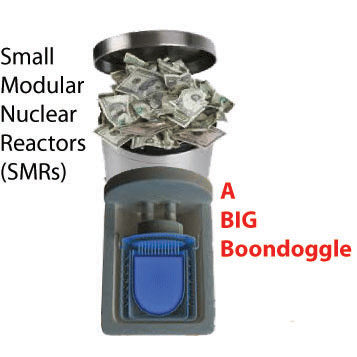
In the coming month, ministers are due to announce the results of a 250 million-pound ($213 million) competition for funding to research and develop small modular nuclear plants, said David Orr, Senior Vice President of Nuclear at the British manufacturing icon. Rolls-Royce is bidding to participate, he said…….
But the future of both the modular and traditional reactors like the ones being built by Electricite de France SA at Hinkley Point in western England is at risk from the U.K. exiting the EU, he said. That’s because the industry relies on engineers from overseas and because there is still a question mark over whether and how the U.K. could leave Euratom, the European Atomic Energy Community regulator that oversees the industry.
Chinese firm behind Essex nuclear plant refuses to reveal security information,Guardian, Adam Vaughan, 2 Oct 17 ,State-owned company refused disclosure of security arrangements for Chinese plant the Bradwell nuclear station could be modelled on. The Chinese state-owned company planning a nuclear power station in Essex refused to share the security arrangements for a Chinese nuclear plant with the British authorities, it has been revealed.
A green light from the Office for Nuclear Regulation (ONR) would be a huge boost for China’s aspirations for exporting nuclear technology and Bradwell would be the first Chinese reactor to be built in a developed country.
Overall the ONR welcomed the “high level of expertise and commitment” shown by the Chinese, according to a report of the visit on 13-16 March, released to the Guardian under freedom of information rules.
However, CGN said it could not share material about security measures to protect its nuclear plant in Fangchenggang, China, which Bradwell could be modelled on.
“With regard to the sharing of information, such as the security plans for FCG [Fangchenggang] Unit 3, CGN stated that these were protected documents under Chinese regulations,” the UK authorities wrote, in a glimpse of UK nuclear regulation rubbing up against Chinese state secrecy.
But the ONR insisted that it was commonplace for foreign nuclear companies not to share sensitive documents around national security during the UK nuclear approval process, known as the Generic Design Assessment (GDA). It added that it was the arrangements for Bradwell that were relevant, not Fangchenggang………
CGN put up a third of £18bn cost towards EDF’s project to build French-designed reactors at Hinkley Point C in Somerset, in return for developing its own plant at Bradwell in Essex. The Bradwell B project is two thirds owned by CGN and one third EDF.
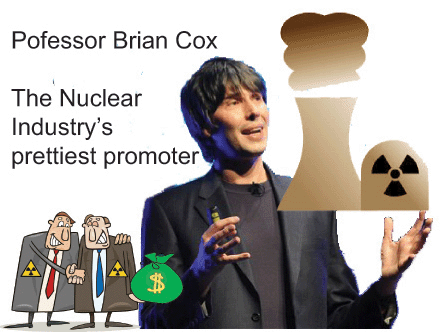
Brian Cox is a very personable and knowledgeable TV star and particle physics expert. He is also a promoter of the nuclear industry. He is a big fan of plutonium -powered space travel. He’s to tour Australia in November,.
Currently, Cox is in Cumbria, UK, addressing schoolchildren groups, and revving up enthusiasm for science and technology. All good, yes. He enthuses about the opportunity for top jobs in high tech in Cumbria. Good? Yes, but – where are these future jobs? Well – in the nuclear industry,which is desperately trying to get a new nuclear power station built.
Whitehaven News 29th Sept 2017, Television star Professor Brian Cox says Cumbria has a world-leading industry which warrants talent – but there’s a shortage of scientists and engineers. But he hopes to change that by helping to bring the prestigious Infinity Festival to the area and inspiring hundreds of teenagers to follow their dreams. Professor Cox was the star speaker at today’s festival which was held at West Lakes Academy in Egremont. More than 200 schoolchildren, aged 13 and 14, attended the event from schools across the whole of the county. http://www.whitehavennews.co.uk/news/Professor-Brian-Cox-visits-Egremont-and-declares-Cumbria-is-a-world-leading-high-tech-industry-941aa057-9b77-46a5-8eac-6e92f0341783-ds
Famous scientist argues for ‘stable’ forms of energy, The famous scientist Professor Brian Cox has told guests at the opening of a new exhibition in Whitehaven that nuclear power should be an important source of energy in the UK.
Ipswich Star 30th Sept 2017, A former nuclear power station employee has accused EDF Energy of being
“disingenuous” over plans to use off-site land to relocate Sizewell B
buildings in the way of the C plant.
Terry Hodgson, a former district and
county councillor for Leiston, worked at Sizewell A for 32 years until he
retired in 2007 and now represents the Suffolk Association of Local
Councils on the Sizewell Stakeholder Group (SSG). He told the latest SSG
meeting that assurances had originally been given that certain areas near
the nuclear site would not be used for development. “Now we are told they
are to be used. This is disingenuous to the local community,” he said.
Under plans being considered, part of a woodland planted to commemorate the
coronation of George V will be bulldozed to make way for the relocation of
some of the Sizewell B power station buildings. The existing buildings,
including a visitors’ centre and training centre, are in the way of plans
for a £16billion Sizewell C nuclear power station. http://www.ipswichstar.co.uk/news/edf-accused-over-moves-to-fell-woodland-next-to-sizewell-b-1-5216389
Business Green 27th Sept 2017,Jeremy Corbyn has closed this year’s Labour Party Conference by aiming
fierce criticism for US President Donald Trump over his plans to withdraw
the US from the Paris climate change agreement, arguing the President is
wrong to think climate action comes at the expense of economic growth.