Japanese and British taxpayers at risk as their governments commit to $20 billion loan for Wylfa nuclear project
 Asahi Shimbin 11th Jan 2018, Japan and Britain have agreed to provide the lion’s share of financing for
a nuclear power plant project planned by Hitachi Ltd. on the island of
Anglesey off northwest Wales, sources said.
financial institutions and acquire a stake in Horizon Nuclear Power Ltd., a
British company purchased by Hitachi to operate the plant. The total cost
of the project is estimated at 3 trillion yen.
doing so, they must share the risk if the project suffers a financial loss,
but that tab could eventually be passed on to taxpayers.
http://www.asahi.com/ajw/articles/AJ201801110057.html
Nuclear Liability – UK government sets out new rules for ‘intermediate risks’

 The Department for Business, Energy & Industrial Strategy (BEIS) late last
week published its position on the criteria for determining the new
category of ‘intermediate risk’ nuclear sites that is to be established in
UK law.
Helen Peters, a nuclear expert at Pinsent Masons, the law firm
behind Out-Law.com, said that the changes that BEIS has made to the
criteria are to be welcomed and would enable the government to move forward
with laying the draft Nuclear Installations (Prescribed Sites and
Transport) Regulations in parliament at some point in the near future.
The new regulations once introduced will come into force at the same time as
the amendments to Nuclear Installations Act 1965 which are set out in the
Nuclear Installations (Liability for Damage) Order 2016. These amendments
support the implementation of the 2004 Protocols to the Paris Convention on
nuclear third party liability and the Brussels Supplementary Convention.
The decision on the criteria for intermediate risk sites has been made
further to a consultation in 2016 on the proposed definitions for the
purposes of nuclear liability for low risk nuclear sites, intermediate
sites, relevant disposal sites and the transport of low risk nuclear
matter.
After considering the responses to the 2016 consultation, the
government elected to further consider the definition for intermediate risk
sites. It elected to reconsult on the matter in 2017 because the proposed
revised definition was significantly different to the one set out in the
2016 proposal. The BEIS paper published last week contained the
government’s response (12-page / 101KB PDF) to the feedback it received to
its reconsultation. A new liability limit of €160 million will apply to
nuclear sites classed as ‘intermediate risk’ once the legislative changes
come into force. As many as 14 nuclear sites could qualify as ‘intermediate
risk’ sites under the new criteria that has been established, BEIS said.
https://www.out-law.com/en/articles/2018/january/uk-government-clarifies-criteria-for-intermediate-risk-nuclear-sites/
Cumbria not the safest, nor cheapest, nor easiest place to bury UK’s nuclear waste
 Cumbria Trust 9th Jan 2018, Former Leader of Cumbria County Council, and current Director of Cumbria Trust, Eddie Martin was interviewed by BBC Radio Cumbria, to discuss the latest plans to find a site to bury the UK’s nuclear waste. Our members will recall that it was Eddie Martin who along with his cabinet, halted the last search process. During the interview Eddie is challenged to respond to a point from Professor Francis Livens of Manchester University, who claimed that it would be possible to engineer a Geological Disposal Facility (GDF) in West Cumbria, although he admitted that it would be quicker, easier and cheaper elsewhere.
What Professor Livens omitted to say was that it would also be safer elsewhere as well since geology forms the final barrier. That was the conclusion of the £400m Nirex investigation in the 1980s and 90s, and the government-funded geologist during the last process backed the view that the prospects of finding the right geology were so poor in Cumbria that no commercial organisation would continue.
Perhaps Professor Livens,who is a radio-chemist rather than a geologist, is unaware of the history of this project, and particularly the conclusions reached by geologists on both sides of the debate. The entire purpose of the National Geological
screening exercise is to seek volunteers from geologically suitable areas and his intervention appears to preempt the report which is due to be released in the next few months.
As Eddie Martin points out there are potentially far safer and more suitable GDF sites in the UK, including a
site under the North Sea and the job of the government should be to encourage those areas to volunteer.
https://cumbriatrust.wordpress.com/2018/01/09/2018-and-the-gdf-is-back-in-the-news/
New study planned into effectiveness of Britain’s Nuclear Decommissioning Authority’s work at Sellafield
 The Nuclear Decommissioning Authority, https://www.nao.org.uk/work-in-progress/the-nuclear-decommissioning-authority/
| Scheduled | Summer 2018 |
|---|---|
| Sector | Energy, Environment |
| NAO Team | Director: Michael Kell
Audit Manager: Zaina Steityeh |
| Media contact | Steve Luxford Direct line: 020 7798 7861 Mobile: 07985 260074 Email: pressoffice@nao.gsi.gov.uk The Nuclear Decommissioning Authority (NDA) is a non-departmental public body sponsored by the Department for Business, Energy & Industrial Strategy. The NDA is responsible for the operation, decommissioning and clean-up of 17 nuclear reactor and research sites in the UK. Of the 17 sites, Sellafield is the largest in terms of size and annual expenditure. It is also one of the most complex and hazardous nuclear sites in Europe. In 2015, the NDA announced that the management arrangements it had in place for the Sellafield site were ineffective; in April 2016, Sellafield Ltd became a wholly-owned subsidiary of the NDA. The NDA says these new arrangements will enable faster hazard and risk reduction at the site, and a more effective management of major projects. Alongside these changes, Sellafield is readying itself for the end of its reprocessing activities in 2020, meaning its operational focus will be on reducing high hazard reduction and decommissioning nuclear facilities. Sellafield has set out a transformation plan to support these changes. This study will examine whether the new arrangements at Sellafield are effective in reducing high risk and hazard on the site, and whether the NDA is making progress with the performance of its major projects. If you would like to provide evidence for our study please email the study team on enquiries@nao.gsi.gov.uk, putting the study title in the subject line. The team will consider the evidence you provide; however, please note that due to the volume of information we receive we may not respond to you directly. If you need to raise a concern please use our contact form. |
Protest opposing USA military use of Ireland’s Shannon Airport
Peace group stages early morning march on Shannon Airport to protest US military use, https://www.breakingnews.ie/ireland/peace-group-stages-early-morning-march-on-shannon-airport-to-protest-us-military-use-821608.html 07/01/2018, By Patrick Flynn
A group of anti-war protestors marched on Shannon Airport early this morning to show their opposition to the US military’s use of the airport.
The march was led by 82-year-old peace activist Margaretta D’Arcy who was previously jailed for making an illegal incursion onto the runway at Shannon in 2012. Shortly before 7am today, Ms D’Arcy led the group of about 15 women on the 2km walk to the main airport building.
The women had been taking part in a 25-hour peace vigil at a camp at Drumgeely close to the airport.
The 25-hour event was organised by Shannon Airport Women’s Peace Camp to mark Nollaig na mBan
A spokeswoman said: “We gathered to draw attention to the use of Shannon Airport as a military base and to demonstrate the revulsion at state-sponsored violence and facilitation of the US military.”
When the group reached the security checkpoint at the entrance to the airport, they were advised they could march to the terminal but would not be allowed inside.
On reaching the airport building, the women sat and sang peace songs before dispersing again at around 9am and returning to their camp.
Some members of ShannonWatch, a group that monitors US military used of Shannon Airport, also attended and supported the event.
UK Trident bomb base in Scotland has ‘significant’ radioactive waste problem
During an August 2017 visit to the Royal Naval Armaments Depot at Coulport, Scottish Environment Protection Agency (Sepa) staff found untested waste from submarines, potentially containing radioactive material, had been mixed with other waste.
This meant that radioactive waste could have been taken off site and disposed of as if it were non-radioactive waste.
The Ministry of Defence (MOD) is supposed to tell Sepa ‘without delay’ when an environmental incident occurs. It should then provide a written report within 14 days.
Documents released under freedom of information legislation show that an internal MOD probe found that no radioactive waste left the site. But the only reason the untested material was not taken off the base is because vigilant civilian waste contractors refused to pick up the incorrectly processed waste.
A Sepa letter to the MOD said that the watchdog considered this type of incident as “significant” adding that had the Royal Navy been a civilian operator, it would have considered issuing a formal written warning.
Sepa’s chief officer, John Kenny, told The Ferret that the incident raised concerns regarding the “adequacy of arrangements for radioactive waste handling” at the Coulport site…….
Campaign group Navy not Nuclear pointed to a long history of MOD “poor practice” when it comes to handling nuclear materials in Scotland, dating back more than a decade.
“The most damning thing about this is that nothing has changed,” it said. “The MOD are still failing to follow their own operating procedures, and they’re still failing dismally when it comes to telling the regulator and protecting the environment.”
The group called for more to be done by both the MOD and Sepa to alert the public when environmental incidents occur.
“It shouldn’t be the case that this information should come to light by freedom of information, they should have a statutory public duty to disclose this information,” it said. https://theferret.scot/trident-sepa-radioactive-waste/
Japanese taxpayers now join in Britain’s scandalous subsidising of the nuclear industry
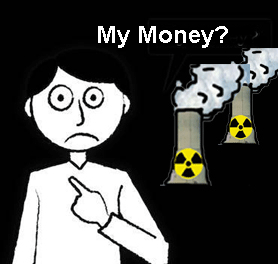

The profitability of nuclear plant construction has been worsening all over the world
Nevertheless, the government intends to extend all-out support for the project.
Japanese gov’t to guarantee bank loans for Hitachi’s nuclear plant project in Britain https://mainichi.jp/english/articles/20180103/p2a/00m/0na/004000c (Mainichi Japan) The Japanese government is poised to guarantee the full amount of loans that three megabanks will extend for a nuclear plant construction project in Britain by Hitachi Ltd., sources familiar with the project said.
A group of banks, including the three megabanks and the government-affiliated Japa n Bank for International Cooperation (JBIC), will extend approximately 1.5 trillion yen in loans to Hitachi’s atomic power station project.
Of the amount, the government will fully guarantee loans to be extended by the megabanks, while the governmental Development Bank of Japan (DBJ) will support the project by making capital investments. Chubu Electric Power Co. and other utilities are also considering investing in the project.
The state will thus join hands with the private sector in extending all-out support for the project to export a nuclear plant worth some 3 trillion yen.
However, concerns have been raised that if the project were to run into the red, taxpayers could be forced to shoulder the burden.
The project to be covered with loans and investments is an atomic power station that a Hitachi subsidiary in Britain is aiming to build in Anglesey, Britain. The firm hopes to start operations at the plant in the mid-2020s.
Hitachi Ltd. is poised to make a final decision on whether to invest in the project by the end of fiscal 2019. However, Hitachi is consulting with the Japanese and British governments and financial institutions over loans, their guarantees and investment on the grounds that the electronics giant alone cannot take risks.
Japanese financial institutions and the governmental Nippon Export and Investment Insurance (NEXI) offered in December last year to extend financial assistance for the project.
According to the sources, Hitachi estimates the total cost of the project at about 3 trillion yen. Hitachi aims to obtain about 1.5 trillion yen in loans to cover half of the amount while raising another 1.5 trillion yen through investments.
Each of the three megabanks — the Bank of Tokyo-Mitsubishi UFJ, Ltd., Sumitomo Mitsui Banking Corp. and Mizuho Bank, Ltd. — intend to extend loans of more than 100 billion yen, totaling some 500 billion yen. NEXI will guarantee the loans. Hitachi intends to obtain the reminder of the loans from the JBIC and commercial financial institutions in Britain.
The DBJ has notified Hitachi of its intention to make capital investments in the atomic power station project, while Chubu Electric Power and Japan Atomic Power Co. are also considering investing in the venture.
Hitachi has also asked other utilities including Tokyo Electric Power Co. and trading houses to invest in the project in a bid to disperse risks involving the project.
The British government, which is speeding up the construction of nuclear plants, also intends to invest in the project, and Japanese and British Cabinet ministers in charge of energy policy exchanged a memorandum on cooperation in December last year.
The profitability of nuclear plant construction has been worsening all over the world due to an increase in the costs of ensuring safety since the outbreak of the Fukushima nuclear crisis in March 2011, contributing to the financial crisis of Toshiba Corp., another electronics giant.
Nevertheless, the government intends to extend all-out support for the project.
“It’s essential to win a contract on the British project in order to maintain Japan’s nuclear technology,” said a high-ranking official of the Economy, Trade and Industry.
Governments can use social media to target activists – UK and the Iran protests
 Could GCHQ influence Iran protests? They’ve done it before, claims
  researcher https://www.rt.com/uk/414831-gchq-influence-hack-protest/#.WkwCv_uo99Q.facebook
He says through its social media manipulation operations, spy agency Government Communications Headquarters (GCHQ) tried to influence online activists during the 2009 Iranian presidential election protests, and the 2011 uprisings widely known as the Arab Spring.
Al-Bassam told the Chaos Communication Congress in Germany last week that the Joint Threat Research Intelligence Group (JTRIG) – a unit in GCHQ – uses “dirty tricks” to target activists.
He says JTRIG has been tasked by the British government to “[use] online techniques to make something happen in the real or cyber world.” To fulfil this aim, a wide but basic array of technological tools and software are used, including ‘DEADPOOL,’ which is described as a “URL shortening service,” and ‘HUSK,’ a “secure one-to-one web based dead-drop messaging platform.”
He told the conference: “It’s basically a fancy name for sitting on Twitter and Facebook all day and trolling online. What they do, is they conduct what they call ‘human intelligence’ – which is like the act of interacting with humans online to try and make something happen in the real world.
“In their own words one of the things they do is to use ‘dirty tricks’ to ‘destroy, deny, degrade [and] disrupt’ enemies by ‘discrediting’ them.”
JTRIG has been involved in infiltrating hacktivist groups Anonymous and LulzSec, and protesters in Iran, Syria and Bahrain, he says.
As a “honey pot” to attract activists, GCHQ set up free URL shortening service lurl.me, which was used on Twitter and other social media platforms to spread revolutionary messages in the Middle East. These messages would attract people protesting against the government there, and British intelligence would collect information on them.
Al-Bassam said he discovered this information among the documents leaked by NSA whistleblower Edward Snowden. “In 2011, I was unknowingly messaged… by a covert agent from [GCHQ], who was investigating the hacktivist groups of Anonymous and Lulzsec. Later that year, I was arrested and banned from the internet for my involvement in Lulzsec.
Then, in 2014, I discovered through a new Snowden leak that GCHQ had targeted Anonymous and Lulzsec, and that the person that messaged me was a covert employee, pretending to be a hacktivist.”
He added: “Because I was myself targeted in the past, I was aware of a key detail – a honeypot URL shortening service set up by GCHQ, that was actually redacted in the Snowden documents published in 2014. This URL shortening service enabled GCHQ to deanonymize another hacktivist and discover his real name and Facebook account, according to the leaked document.
“Using this key detail, I was able to discover a network of sockpuppet Twitter accounts and websites set up by GCHQ, pretending to be activists during the Arab spring of 2011,” he said.
Britain’s Hinkley nuclear project rife with scandalous conflicts of interest

 Times 1st Jan 2018,Consultancy firms working for the government on the Hinkley Point C nuclear power station were advising the project’s Chinese investor and its French builder at the same time, an investigation by The Times has revealed.
KPMG, the professional services group, was paid £4.4 million between 2012 and 2017 as a financial adviser to the energy and business departments, despite telling officials that it was also acting for China General Nuclear Power
Corp on the project.
The apparent conflict of interest has been revealed after the Information Commissioner’s Office intervened to press for
disclosure from the Department for Business, Energy and Industrial Strategy. Previously, officials had redacted the information, claiming that it was commercially sensitive.
In a second potential conflict, Lazard, the financial advisory firm, was paid £2.6 million between 2012 and 2015 to
advise the business department on Hinkley Point. Details of its previously redacted tender documents reveal that it was an adviser to EDF, the French developer that is investing in Hinkley Point alongside the Chinese. A source said that Lazard’s advice to EDF was not related to the Somerset project.
Meg Hillier, chairwoman of the Commons public accounts committee, said that Hinkley Point was crucial public infrastructure and therefore it was “vital that auditors get full sight” of the potential conflicts. It “looks cosy”, she said, adding that it was “not really appropriate” for firms to be advising both sides.
The details have been released more than a year and half after The Times complained to the Information Commissioner’s Office, which informally advised the business department to reconsider its position. The department previously had handed over heavily redacted documents in response to a Freedom of Information request.
The Information Commissioner’s Office said that there was a “significant and important public interest”, something that had been strengthened by a report from the National Audit Office in June, which found that the government’s deal had “locked consumers into a risky and expensive project with uncertain strategic and economic benefits”. The project has been riddled with delays and controversy over its spiralling costs.
The National Audit Office also criticised the business department for insufficiently managing the potential conflict of Leigh Fisher, another government adviser. The Times reported in November 2016 that Leigh Fisher, the management consultant, had been awarded contracts worth a combined £1.2 million despite telling officials that the British division of Jacobs Engineering Group, an American firm that owns Leigh Fisher, was working for EDF on Hinkley Point.
https://www.thetimes.co.uk/edition/business/advisers-on-hinkley-point-c-nuclear-power-station-had-cosy-ties-to-both-sides-xftxcl9sz
Delay in removal of nuclear wastes from Anglesey’s Wylfa power station
Wylfa’s nuclear waste removal delayed by machinery snags, http://www.bbc.com/news/uk-wales-north-west-wales-42539224 The removal of all nuclear waste from Anglesey’s Wylfa power station will take almost a year longer than planned.
The decommissioning process at the site, which closed in December 2015, has been hit by delays following problems with machinery.
About half of the fuel has been removed from the plant and work to remove fuel was expected to be completed by the end of 2018.
Operator Magnox has now said it will not be completed until November 2019. The site’s two reactors held 49,000 fuel elements which have to be cleared as part of the decommissioning process.
But the work has been delayed because the 50-year-old machine used to remove them needed new parts.
Wylfa is the last of Magnox’s 12 UK power stations to be switched off and, across the firm’s sites, the cost of the process has almost doubled to an estimated £6bn.
It will take more than 100 years for the site to be fully cleared.
Horizon wants to build a replacement nuclear plant, Wylfa Newydd, next to the site, which would operate for 60 years and generate electricity for around five million homes.
But the proposals have to overcome planning and cost hurdles – the “strike price” for the electricity generated – before the plant can get the go ahead.
Nuclear financial meltdown in Britain – Moorside in doubt

Blunders, catastrophic, delays, even bankruptcy… ANOTHER nuclear power plant is going into financial  meltdown http://www.thisismoney.co.uk/money/article-5223475/ANOTHER-nuclear-power-plant-enerting-financial-meltdown.html Neil Craven for The Mail on Sunday, 1 January 2018 The company behind one of Britain’s biggest nuclear power projects has plunged to a £266 million loss citing ‘uncertainties’ over its future and the viability of crucial technology.
Japanese firm Toshiba said the huge loss incurred by one of its UK subsidiaries was due to writing off hundreds of millions of pounds of investment in the proposed Moorside plant, in west Cumbria.
It is the latest sign of financial strain at the Tokyo-based firm amid wider concerns over the spiralling costs and catastrophic delays that have beset the UK’s nuclear industry.
Britons were last week supposed to be cooking their turkeys with power from EDF’s nuclear plant at Hinkley Point in Somerset, which is now not expected to be in use for another decade. ‘EDF will turn on its first nuclear plant in Britain before Christmas 2017,’ said Vincent de Rivaz in 2007, who stepped down as group chief executive in November. ‘It is the moment of the power crunch. Without it, the lights will go out.’
It was envisaged that new nuclear plants at Moorside, Hinkley Point and Wylfa in Anglesey would between them generate a fifth of the UK’s electricity.
This may still happen. But right now, nuclear firms are struggling with the expense, stringent regulatory hurdles and costly project delays – just as the cost of other forms of electricity fall. Toshiba won the contract to build the nuclear power plant at Moorside, on land next to the Sellafield nuclear fuel reprocessing site.
But it was forced in March to place its US nuclear division Westinghouse into bankruptcy protection. Last month, it said it would sell Westinghouse for £4 billion. Troubled Toshiba is now in talks to sell its interests in the Moorside project to Kepco, majority-owned by the South Korean government.
Toshiba has two UK subsidiaries: Advance Energy UK, which incurred the £266 million loss; and NuGeneration, which is directly responsible for running Moorside.
With a cloud of uncertainty over the project, the Japanese firm has admitted in reports issued by its UK subsidiaries: ‘The directors do not know whether a sale of the shares of [NuGeneration] will be completed nor how any successful bidder will frame the deal.’
Kepco said it hoped to complete a deal to take over the running of the project early next year.
Uncertainties are understood to include the use of Westinghouse’s AP1000 reactor. Approval for use at Moorside was first sought from UK regulators in 2011. It was granted approval by the Office for Nuclear Regulation in March – just days after Westinghouse entered bankruptcy protection.
Should Kepco decide to ditch the design and use its own, the project would likely be delayed for years until a new design is approved. Some estimates say that could put any launch back from 2025 to the late 2020s at the very earliest. ‘The whole thing is a mess,’ said Martin Forwood of campaign group Core, which opposes the Moorside development.
‘Kepco would almost certainly push to use its own reactors so the big question is whether they would have to start afresh on consultation.
‘A lot of people around Moorside believe it will never take off.’
Forwood said the costs of other forms of renewable energy are falling and energy storage systems are being developed. ‘The longer these plans get delayed the less nuclear is needed,’ he added.
And, according to Forwood, the firms involved in the projects at Moorside and Wylfa ‘are not going to get anywhere near what the Government signed up for at Hinkley’.
The House of Commons Public Accounts Select Committee last month said there had been ‘grave strategic errors’ awarding French government-backed EDF the Hinkley Point contract.
It said ‘the economics of nuclear power in the UK have deteriorated’ and a ‘blinkered determination’ to agree the 35-year Hinkley deal, ‘regardless of changing circumstances’ had lumbered consumers with £30 billion payments over market rates for electricity.
UK rejected Irish minister’s nuclear power complaints.
Times 29th Dec 2017, In 1987 Ray Burke,
then environment minister, received a firm reply from his British
counterpart after calling for the closure of the Sellafield nuclear
processing plant.
State papers showed that Peter Walker, the UK energy
secretary, rejected what he claimed were the Fianna Fáil TD’s unfounded
allegations about the safety of British nuclear energy facilities,
including Sellafield. Walker, who died in 2010, said that the Nuclear
Installations Inspectorate, the British nuclear watchdog at the time, was
satisfied that closure of the plant would be “out of all proportion to
the very low risks which arose from a few minor incidents”.
Mr Burke wrote to Walker on March 24, 1987 to raise concerns about the threat posed
to Irish citizens by nuclear installations in Britain. He also criticised
the British government’s decision to proceed with the construction of
another nuclear reactor at Sizewell in Suffolk given the number of
incidents at British nuclear plants.
https://www.thetimes.co.uk/article/uk-rejected-irish-ministers-nuclear-power-complaints-7fvbnhmh7
UK: Renewables a better option than nuclear power: but nuclear is needed for maintaining nuclear weapons
Cheap renewables undercut nuclear power, The technology advances and plunging costs of cheap renewables make base load nuclear power redundant. Climate News Network, by Paul Brown, LONDON, 29 December, 2017 “………Completion doubts
Even the former UK energy secretary Sir Edward Davey, who signed off on the Hinkley Point deal, said “the economics have clearly gone away.” He doubted that the building would ever be completed, he told Greenpeace in an interview.
All the other UK nuclear projects are still at various stages of planning, and how any of them will be paid for is yet to be worked out. It is already clear that none can be financed without government subsidy.
An important political development in 2017 was that for the first time both the US and the UK admitted that their support for the nuclear industry is linked to the need to maintain their military capability in nuclear submarines and personnel. This is key, because both powers have previously claimed that there is no link between civil and military nuclear industries.
Even before their admission it was already clear that the big economies which have no nuclear weapons, like Germany, can see no point in having a civil nuclear industry.
Export drive
That does not stop smaller countries, some without any nuclear power stations at all at present, signing agreements with the Russian state-owned company Rosatom. In what many see as a Russian policy to extend its international influence, Rosatom already says it is building reactors in Belarus, China, India, Bangladesh, Hungary, Turkey, Finland and Iran, and is seeking to expand, with tenders in for 23 other reactors abroad.
These include Sudan, where the current president is wanted for war crimes. Whether all the plans will come to fruition remains doubtful. https://climatenewsnetwork.net/cheap-renewables-undercut-nuclear-power/
Disturbing links between Britain’s nuclear power stations and the military
 Military secrets of our nuclear power plants https://www.theguardian.com/uk-news/2017/dec/27/military-secrets-of-our-nuclear-power-plants
Disturbing links between Britain’s nuclear power stations and the military are highlighted by Dr David Lowry. In her excellent article on the Hinkley C nuclear plant financial fiasco (The long read, 21 December), Holly Watt mentions the innovative insight of Sussex University academics Prof Andy Stirling and Dr Phil Johnstone, who have identified the central importance of expansion of the skill base of the new nuclear build programme – headed by Hinkley C – for the Trident military nuclear renewal programme. Watt also mentions the first nuclear plant built on the same site, Hinkley A. What is barely acknowledged about this reactor is it was both built and operated to manufacture plutonium for British nuclear warheads, and probably some plutonium it created was sent to the US for use in its military stockpile too.
And that is exactly what they did. The nuclear world has thus turned full circle, as the atomic conjoined twins that had been painfully separated for nearly 50 years are being rejoined in an insidious way by this new Conservative government.
Dr David Lowry
Senior research fellow, Institute for Resource and Security Studies
Sellafield Ltd buries the cost of its expensive Evaporator D Nuclear waste processing project
CORE 26th Dec 2017, There can’t be many nuclear bodies that choose to bury – just three days before Christmas – what is touted as a good news story by the industry. But this is exactly what Sellafield Ltd has contrived to do in its 22nd December announcement that the long overdue and eye-wateringly expensive Evaporator D has come on line at Sellafield.
Yet by confirming that the new Evaporator actually came on line at 0800 on the 8th December, the start-up has been kept under wraps for a fortnight until a time when public attention was focused on seasonal festivities rather than on nuclear
news. Keeping such a story under the public radar for so long is, to say the least, wholly out of character for the industry – though the Evaporator’s history is hardly something to shout about.
It is not however just about the burial of ‘good’ news itself that many will find disturbing, but rather the manner in which the burial rites have been manipulated and massaged to dupe the wider world. Designed to process the dangerous high level waste liquids produced by the site’s reprocessing operations so that they can be vitrified and canned for eventual disposal, Evaporator D is located in the site’s Highly Active Liquid Evaporation and Storage (HALES) facility.
Its tortured construction track record since its inception over a decade ago by British Nuclear Fuels (BNFL) is well
documented and gives the lie to its original costings and timescale. As reported in the industry’s Nuclear Fuel journal in 2009 ‘Sellafield operators estimated (in 2007) the cost of the proposed Evaporator D at GBP90 million and said they expected it to be operational around 2010/2011’. Now in operation over six years late, the Evaporator’s £750M cost today represents an eight-fold increase on its original costing. …..
There are few positives to be taken from the Evaporator D saga that rivals the similar squandering of public money on the ill-fated and now defunct Sellafield MOX plant and even – when its financial accounts are eventually exposed publicly for the first time – the THORP plant itself. The one positive that will bring at least some cheer to the UK taxpayer is that, then costed at £600M, plans for an Evaporator E were abandoned by Sellafield in 2012. http://corecumbria.co.uk/briefings/sellafields-delayed-evaporator-d-now-operating-and-gift-wrapped-for-christmas/
1 This Month





PLEASE OPPOSE HR 8255 AND S.3639 – bills would accelerate satellite deployment, with no environmental review or safeguards – https://ncstd5li.quorum.us/campaign/169331/
To see nuclear-related stories in greater depth and intensity – go to https://nuclearinformation.wordpress.com
-
Archives
- October 2026 (29)
- September 2026 (339)
- August 2026 (330)
- July 2026 (355)
- June 2026 (287)
- May 2026 (306)
- April 2026 (356)
- March 2026 (251)
- February 2026 (267)
- January 2026 (308)
- December 2025 (358)
- November 2025 (359)
-
Categories
- 1
- 1 NUCLEAR ISSUES
- business and costs
- climate change
- culture and arts
- ENERGY
- environment
- health
- history
- indigenous issues
- Legal
- marketing of nuclear
- media
- opposition to nuclear
- PERSONAL STORIES
- politics
- politics international
- Religion and ethics
- safety
- secrets,lies and civil liberties
- spinbuster
- technology
- Uranium
- wastes
- weapons and war
- Women
- 2 WORLD
- ACTION
- AFRICA
- Atrocities
- AUSTRALIA
- Christina's notes
- Christina's themes
- culture and arts
- Events
- Fuk 2022
- Fuk 2023
- Fukushima 2017
- Fukushima 2018
- fukushima 2019
- Fukushima 2020
- Fukushima 2021
- general
- global warming
- Humour (God we need it)
- Nuclear
- RARE EARTHS
- Reference
- resources – print
- Resources -audiovicual
- Weekly Newsletter
- World
- World Nuclear
- YouTube
-
RSS
Entries RSS
Comments RSS

