The expensive hunt for robots that might help clean up UK’s Sellafield nuclear waste horror
NDA 31st Jan 2018, Robots controlled by smart auto-navigation systems are doing battle in an
£8.5 million competition to find ways to tackle Sellafield radioactive
hotspots. Last year, the Nuclear Decommissioning Authority (NDA) and fellow
government agency Innovate UK launched a search for innovative technologies
that could be combined into a single seamless process for use in facilities
that will soon embark on a major decommissioning journey.
Working closely with Sellafield Ltd, who would use the technology, submissions to a
competitive process were invited from all industrial sectors. Five
promising ideas have now made it through to the final stages after being
whittled down from a shortlist of 15. The newly formed consortia are each
set to receive up to £1.5 million to build prototype demonstrators for
testing in a simulated radioactive environment.
https://www.gov.uk/government/news/robots-compete-in-nuclear-decommissioning-challenge
New Nuclear : Britain’s Danse Macabre
NuClearNews No 104 New Nuclear –Dance Macabre
With the Japanese media reporting somewhat prematurely that the UK and Japanese Governments have agreed to provide the lion’s share of financing for two new reactors at Wylfa on the Island of Anglesey, and EDF Energy claiming it can build Sizewell C for at least 20% less than Hinkley Point C, one has to wonder if there is some sort of battle going on between EDF and Hitachi to get their hands on limited taxpayer funds.
But all either company seems to be getting from Government at the moment is warm words. In the meantime, as we shall see in a subsequent story, the Government has cut its projections for nuclear capacity in 2035 from 17GW to 14GW.
Two other EPRs are under construction at Taishan (China). (2) The latest commissioning delay at Taishan is the third in two years and will lead to a further deferral of 5 billion yuan (US$770 million) in annual revenues and potentially more cost overruns, according to ratings agency Moody’s. CGN said right at the end of December that generation at the two reactors had been delayed to 2018 and 2019, from the second half of 2017 and the first half of 2018 respectively. (3) CGN, which is building the plant in a joint-venture with EDF, admitted, in December, to ’partial defects’ in the welding of the three parts of the deaerator. But the state-owned company stressed that the component, which helps cool down the reactor, ’is not part of the nuclear safety system’.
But international consultant, Mycle Schneider, says the problem goes way deeper than that. It poses questions about lax quality control which could impact on nuclear safety. He says this goes beyond a lack of transparency and constitutes a major indictment of CGN. (4)
Sizewell C
EDF claims it can build a second nuclear power station to follow Hinkley Point C (HPC) for20% less. HPC is expected to cost it at least £19.6 billion, and as much as £20.3 billion if delays push the start date back from 2025 to 2027, (although EDF says it is confident HPC will come on linein 2025).
The majority French Government-owned company says it can cut the construction cost for Sizewell C (SZC) thanks to efficiencies from “copying and pasting” large elements of HPC. (1)
This is for a reactor type which has yet to be built successfully anywhere in the world, with projects in France, Finland and China all delayed. CGN, the Chinese company working in partnership with EDF in Britain and China, confirmed further delays at their Taishan project in January. (See Box 1)
EDF expects to be able to make savings at SZC by eliminating the majority of the £2 billion costs it spent on pre-construction work at HPC. It also expects to make billions more in savings by using contractors and equipment that have already gone through training and certification processes for use on nuclear sites. Cutting the cost of building to about £15 billion could help to reduce the subsidy contract price to nearer £70 per megawatt hour (MWh) (See Box 2).
The Company believes that significant further reductions could be made if the government were to agree a new financing model so that developers did not have to bear all the upfront construction cost. EDF, along with the rest of the industry and the House of Commons’ Public Accounts Committee, is urging ministers to look at alternative funding models that the National Audit Office said would have significantly reduced the eventual cost to consumers had they been used for HPC. These include the government taking a direct equity stake or adopting a regulated asset base model similar to that used for the Thames Tideway Tunnel, under which developers would receive income during construction. Without such a change, the project is unlikely to go ahead since EDF, which required a French state bailout to afford HPC, could not fund another plant in advance. (5)
The Guardian explained that the Thames Water approach for London’s £4.2bn super-sewer allows the project to be taken off the company’s balance sheet by creating a new company that other investors pour equity into. Pension funds are among the potential investors EDF is hoping to court. Unlike a consortium seeking a public stake for a separate nuclear power plant at Wylfa in Wales, Simone Rossi, EDF’s new chief executive said government finance was not a prerequisite. (6)
Rossi says he’s is in talks with major investment funds to support the project. He confirmed to The Daily Telegraph that early stage talks have already begun and a deal may be agreed before the end of the year. The pressure to drive nuclear subsidies lower follows a dramatic decline in costs for other low-carbon energy technologies such as wind and solar power. Offshore wind in particular has halved its costs in recent years with recent projects accepting deals of under £58/MWh to build turbines. (7)
Dr Dave Toke, reader in Energy Politics at Aberdeen University, said EDF’s ‘cheap nuclear’ plan will ruin taxpayers. If the plan involves getting taxpayers to pay for a large chunk of the ‘equity’ financing of the plant and getting the Government to guarantee the bulk of the rest of the costs, this could lead to the biggest black hole in the nation’s finances since the financial crash which would have a catastrophic effect on public finances and deprive the Exchequer of many billions £s that could otherwise be spent on public services. This will be the subsidy to top all subsidieshttp://www.no2nuclearpower.org.uk/wp/wp-content/uploads/2018/01/NuClearNews_No104.pdf
Britain’s Atomic Weapons Establishment (AWE) wants to increase its radiation releases by over 2,000 per cent.
 Morning Star 27th Jan 2018, Fury as scandal-hit nuclear agency demands 23-fold radiation emissions
increase. CAMPAIGNERS have gone nuclear after the Atomic Weapons
Establishment (AWE) applied this week to increase radiation output from its
Berkshire site by over 2,000 per cent.
AWE, which produces Trident nuclear warheads, had two sites placed in renewed special measures last August over
safety concerns. Now the company is asking the Environment Agency to raise
the 4.4 megabecquerel radiation limit to 100MBq for tests it claims will
help counter nuclear terrorism.
But the Campaign for Nuclear Disarmament
(CND) said it was nuclear proliferation that increases chances of dangerous
material falling into hostile hands. The group also sounded the alarm over
the risk to public health. CND radiation expert Ian Fairlie said: “While
radiation amounts appear relatively low in the application, they represent
a 23-fold increase. If radiation is released into the water supply in
spikes, this could present a danger.”
British plan to provide household electricity by plutonium – in Small Modular Nuclear Reactors

Times 28th Jan 2018, Britons could be taking showers and warming homes with hot water piped
directly from a nuclear reactor, under proposals to build small atomic power stations in cities. Urban nuclear reactors, similar in size to those
in nuclear submarines, could generate not only electricity but also hot water, suggests a report by Policy Exchange, a think tank.
The paper reflects government thinking, as the National Nuclear Laboratory hasalready drawn up plans for a first “small modular reactor” at Trawsfynydd in north Wales. The Department for Business, Energy andIndustrial Strategy has also supported the idea. Such reactors could befuelled by plutonium, a waste product of Britain’s existing nuclearindustry. Stockpiles exceed 100 tons. https://www.thetimes.co.uk/edition/news/mini-nuclear-reactors-could-heat-homes-pxk3h8nkl
UK demand for electricity is falling, not rising
 FT 27th Jan 2018, Electricity Demand Letter: Andrew Warren Chairman, British Energy Efficiency Federation; Your
report “Tough decisions loom on green energy” (January 23) is based on a
false premise. It assumes that demand for electricity will just keep on
rising. Such inexorable growth has always been the official outlook. As
indeed it was a decade ago, when today’s usage level was projected to be up
by 15 per cent or more.
Instead, across 10 years electricity consumption
has dropped by more than 16 per cent, a differential of over 30 per cent
between those forecasts and reality. That dramatic trend has occurred even
without the assistance of any very purposeful drive for greater energy
efficiency – which, as your article grudgingly concedes, is now to be a
prime feature of the prime minister’s new environment policy. That is
surely the best choice to “keep the lights on” of all.
https://www.ft.com/content/cb8471cc-0136-11e8-9650-9c0ad2d7c5b5
How to impose a radioactive trash dump UK style – bribe communities and bypass local authorities

 Times 26th Jan 2018, Communities will receive up to £42 million if they agree to consider
hosting an underground nuclear waste dump. They can keep the money even if
they ultimately decide against it, under government plans. The payments,
which will be spread over 20 years, are aimed at persuading communities to
engage in the process of selecting and testing a site that will store
enough radioactive waste to fill the Albert Hall six times.
The Department for Business, Energy and Industrial Strategy said more than one community
could receive the funding, with each being given up to £42 million. The
proposals appear to weaken the power of county councils, making it harder
for them to prevent a community from agreeing to host the £19 billion
“geological disposal facility” (GDF).
A consultation document states
the final decision will be subject to a “test of public support”, which
could be a local referendum. The right to vote in the referendum could be
restricted to a small area around the proposed site.
Cumbria is still viewed as the most suitable location because of the ease of transporting
waste at Sellafield and the willingness of the community. However, other
areas with ageing or decommissioned nuclear plants have been suggested,
including Dungeness, Kent, and Hartlepool, in Co Durham. Doug Parr, of
Greenpeace, said: “Having failed to find a council willing to have
nuclear waste buried under their land, ministers are resorting to the
tactics from the fracking playbook — bribing communities and bypassing
local authorities.”
https://www.thetimes.co.uk/edition/news/42m-offer-to-communities-that-take-radioactive-waste-svrjj29nb
UK’s £1m a year bribes to communities to host nuclear waste
 Communities offered £1m a year to host nuclear waste dump https://www.theguardian.com/environment/2018/jan/25/communities-offered-1m-a-year-to-host-nuclear-waste-dump
New search for communities willing to host underground site for thousands of years, Guardian, Adam Vaughan, 25 Jan 18, Local communities around England, Wales and Northern Ireland will be offered £1m a year to volunteer to host an underground nuclear waste disposal facility for thousands of years, as part of a rebooted government programme.
The financial incentive is one way the government hopes to encourage communities to host the £12bn facility, after previous efforts failed in 2013 when Cumbria county council rejected the project.
Under new plans published on Thursday, a test of public support will be required for the scheme to go ahead, which could include a local referendum.
The only areas to explore the idea last time round were Copeland and Allerdale borough councils in Cumbria, and Shepway District Council in Kent.
This time, interested communities that explore hosting the facility will also receive £1m a year, which officials say could be spent on developing skills locally or apprenticeships. The payments, which could rise to £2.5m annually as a community considers whether to proceed, are expected to last for around five years.
The geological disposal facility (GDF) is seen by experts as the best long-term solution to storing the estimated 750,000 cubic metres of waste generated by half a century of nuclear power and defence, which would fill three quarters of Wembley Stadium.
It also includes the radioactive material created by potentially five new plants that the government expects to be built, including Hinkley Point C, which EDF Energy is constructing in Somerset.
The Institute of Directors said storing waste deep underground would be cheaper than storing it above ground, as it is at present at around 30 sites.Business, unions and local authority groups welcomed the renewed bid to site a GDF.
“Running costs for a geological disposal facility storing the waste 1,000 metres below the surface would be significantly lower,” the business group said.
Richard Harrington, energy minister, said: “We owe it to future generations to take action now to find a suitable permanent site for the safe disposal of our radioactive waste. And it is right that local communities have a say.”
But Greenpeace criticised the payments, calling them bribes, and said new nuclear power plants should not go ahead without a long-term solution in place for their waste.
Doug Parr, the group’s chief scientist, said: “Having failed to find a council willing to have nuclear waste stored under their land, ministers are resorting to the tactics from the fracking playbook – bribing communities and bypassing local authorities.
“With six new nuclear plants being planned, the waste problem is just going to get much worse. Since there is no permanent solution for the disposal of spent nuclear fuel, the responsible thing to do would be to stop producing more of it instead of just passing the radioactive buck to future generations.”
Nuclear waste is currently stored at about 30 sites, but predominantly at ground level at Sellafield in Cumbria. The GDF project is expected to cost £12bn, spread over a century.
New tactic in Small Modular Nuclear Reactor lobbying – claim to help electric cars
-
Small modular reactors more versatile than conventional plants
-
Battery storage still too pricey for large-scale use
Nuclear Free Local Authorities (NFLA) advise UK government to learn from Sweden’s court ruling on nuclear waste
 NFLA 24th Jan 2018, As the UK Government plans yet another attempt to deliver a deep
underground radioactive waste repository, NFLA urges them and the
regulators to look carefully at a Swedish court ruling rejecting a
repository licence around real safety concerns.
The Nuclear Free Local Authorities (NFLA) has been made aware that the UK Government imminently
plans its latest attempt, which is the sixth attempt in the past 42 years,
to start a process to find a willing community to host a deep underground
radioactive waste repository.
This process now could be, and should be, completely reconsidered after a Swedish court ruling rejecting a licence
application on the waste capsules for a similar development, after many
years of planning.
For over 4 decades, several UK bodies – UKAEA, Nirex,
RWMD and now Radioactive Waste Management Ltd (RWM) – have been
established by the UK Government to deliver a deep underground radioactive
waste repository, often referred to in the industry as a geological
disposal facility (GDF).
Three consultations are expected to be issued
imminently – one on the definition of the community that would decide on
such a repository and how engaging with the public would take place, a
second on a National Policy Statement for a deep waste repository, and the
third the publication by RWM of a national geological screening of England,
Wales and Northern Ireland (Scotland is pursuing a separate policy of
‘near site, near surface’ storage of its highly active radioactive
waste).
Throughout its 38 years of operation, NFLA has been heavily engaged
in this debate. It remains sceptical that a deep underground repository is
the most environmentally sound solution for managing the UK’s huge burden
of radioactive waste.
It notes that the Nuclear Waste Advisory Associates
have outlined over 100 key technical and scientific concerns around such
developments, and NFLA has seen no resolution to these issues from the
government or RWM.
UK’s Atomic Weapons Establishment (AWE) wants to raise permissable levels of radiation release
 AWE bids for ‘more realistic’ nuclear terrorism tests licence, The UK’s nuclear warhead factory is bidding for a licence change to run “more realistic” tests in preparation for “nuclear terrorism”.
The Atomic Weapons Establishment (AWE) in Berkshire wants to raise levels of radiation it can release from its site……..http://www.bbc.com/news/uk-england-oxfordshire-42801822
UK new nuclear build would create an intolerable waste burden on communities into the far future
Exposing UK government folly of investment in new nuclear https://www.theguardian.com/environment/2018/jan/24/exposing-uk-government-folly-of-investment-in-new-nuclear
In 1976, Lord Flowers pronounced that there should be no further commitment to nuclear energy unless it could be demonstrated that long-lived highly radioactive wastes could be safely contained for the indefinite future. Ever since, efforts to find a suitable site for a geological disposal facility have been rejected by communities (Wanted: community willing to host a highly radioactive waste dump in their district, 22 January).
There is, therefore, little evidence to support the government’s claim that “it is satisfied that effective arrangements will exist to manage and dispose of the waste that will be produced from new nuclear power stations”. Deep disposal may be the eventual long-term solution but demonstrating a safety case, finding suitable geology and a willing community are tough challenges and likely to take a long time. The search for a disposal site diverts attention from the real solution for the foreseeable future, which is to ensure the safe and secure management of the unavoidable legacy wastes that have to be managed. It is perverse to compound the problem by a new-build programme that will result in vastly increased radioactivity from spent fuel and other highly radioactive wastes which will have to be stored indefinitely at vulnerable sites scattered around our coasts.
The fact that the UK government is still going ahead with plans to construct new power stations, generating even more toxic radioactive waste, troubles and puzzles me immensely. Here, on the beautiful isle of Anglesey, where tidal, solar and wind energy production are all highly feasible alternatives and could also provide opportunities for well-paid employment, politicians appear to be happy for an area of outstanding natural beauty to be contaminated for further than the foreseeable future, not to mention the immense eyesore that will occupy acres of fertile land. It is an eye-wateringly costly venture that many fear will expose taxpayers to huge financial risk and will also leave future generations guarding the threat to their environment and health long after it ceases to function.
Future generations will doubtless wonder, when most of Europe is shutting down its nuclear power stations and not planning any more, why in the world the local population didn’t protest harder.
Rose Heaney
Holyhead, Gwynedd
A new-build programme would create an unmanageable and intolerable burden on communities into the far future. To suggest that a repository is the solution is in the realm of fantasy.
Prof Andrew Blowers
Member of the first Committee onRadioactive Waste Management
Public unaware of the massive size of planned Sizewell C nuclear station – shown in new film
 East Anglian Daily Times 23rd Jan 2018, Drone footage shows off ‘huge impact’ Sizewell C could have on
landscape. Campaigners fighting proposals for a new nuclear power station
on the Suffolk coast claim drone footage of Hinkley Point shows what a
“massive, life-changing, countryside-destroying intrusion” Sizewell C
would be.
Together Against Sizewell C (TASC) says the film of work taking
place on the £19.6billion project to build Britain’s first new nuclear
plant for more than 20 years shows the dramatic scale and impact of the
project.
TASC chair Pete Wilkinson said: “The actual scale and impact of
the proposed development at Sizewell has never been fully explained to the
public and they have never been asked if they support it or oppose it.
“It has always been disingenuously described by politicians as an
inevitability which it is not: new nuclear is a choice not an imperative.
We can and should say ‘no’ and be given the opportunity to tell our
politicians that we reject this monstrous plan. “This footage gives us
the evidence on which to base an informed view about the Sizewell
development and shows the fate that awaits this area if EDF get their way.
This two minute film does what EDF and the government have been unwilling
to do for five years – to show us just how Sizewell C will utterly
devastate a huge area of Suffolk on a scale that we cannot even think about
tolerating.
http://www.eadt.co.uk/news/drone-footage-shows-off-huge-impact-sizewell-c-could-have-on-landscape-1-5366719
With big plans for new nuclear stations, Britain desperately trying to get volunteers to host waste dump
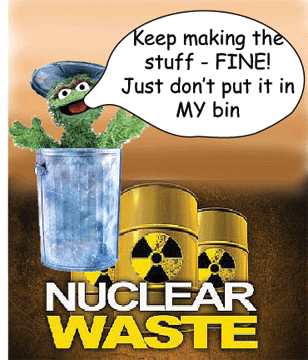 Guardian 21st Jan 2018, The government is expected this week to begin a nationwide search for a community willing to host an underground nuclear waste dump to store highly
radioactive material for thousands of years.
Britain has been trying for years to secure a site with the right geology and local communities which would volunteer to host a £12bn geological disposal facility (GDF), as a
long-term solution for the most dangerous waste from nuclear power
stations.
The last effort hit a brick wall in 2013 when Cumbria county
council, the only local authority still in the running as a host for the
dump, rejected it.
Now, ministers are to relaunch their mission to win over
a community to host the GDF. The task has taken on heightened importance
now that a nuclear power plant is under construction in Somerset, with
plans to build four others.
Radioactive Waste Management, the government
body tasked with building the facility hundreds of metres underground, said
it had made significant progress since 2014 in “developing the offer” to
interested communities. Consultations on the planning process and how the
government will work with communities will be launched this week, said two
sources close to the process. “I hope to God they get it right this time,”
said one. “The mess they made in the past can’t be repeated. It’s
outrageous it became a victim of local politics last time.”
https://www.theguardian.com/environment/2018/jan/21/search-area-willing-host-highly-radioactive-waste-uk-geology
Hinkley Point C to get £14bn from UK and Japanese taxpayers – despite ever-cheaper renewables
new chief executive of EDF Energy admitted last week that it had been a
“monstrous job” drumming up the backing for the UK’s first new
nuclear power station in decades.
defeat their biggest enemy: financing.
firm Hitachi, which wants to build a plant on the island of Anglesey.
£19.5bn, with more than £14bn to come from loans from the UK and Japanese
governments. The rationale for Tokyo is clear. The big question is why the
UK would want to shoulder the risk of such a huge scheme.
plants has been political anathema for years. It has become a government
mantra that the subsidy cost promised to EDF is justified because the
public is not bearing the risks of building Hinkley.
wind capacity as there is today, according to a report this week.
Renewables, battery storage and other technologies could prove to be the
real monster facing nuclear.
https://www.theguardian.com/business/2018/jan/21/carillion-must-hope-real-answers-dont-usually-get-them
Cumbria Trust reminds UK nuclear lobby that hosting nuclear waste is a VOLUNTARY process
Cumbria Trust 22nd Jan 2018, Cumbria Trust notes with interest that a source close to the process is
quoted as saying: “The mess they made in the past can’t be repeated.It’s outrageous it became a victim of local politics last time.”
Let us not forget that this was supposed to be a voluntary process, where local
councils had the right to withdraw their interest. How could it be
considered outrageous to exercise that right to withdraw? The new process
starting this week is also based on voluntarism and councils are supposedly
free to withdraw at will. Are we to assume that once a council has
volunteered, it will be made increasingly difficult to withdraw? Is this
voluntarism or coercion?
https://cumbriatrust.wordpress.com/2018/01/22/here-we-go-again/
1 This Month





PLEASE OPPOSE HR 8255 AND S.3639 – bills would accelerate satellite deployment, with no environmental review or safeguards – https://ncstd5li.quorum.us/campaign/169331/
To see nuclear-related stories in greater depth and intensity – go to https://nuclearinformation.wordpress.com
-
Archives
- October 2026 (19)
- September 2026 (339)
- August 2026 (330)
- July 2026 (355)
- June 2026 (287)
- May 2026 (306)
- April 2026 (356)
- March 2026 (251)
- February 2026 (267)
- January 2026 (308)
- December 2025 (358)
- November 2025 (359)
-
Categories
- 1
- 1 NUCLEAR ISSUES
- business and costs
- climate change
- culture and arts
- ENERGY
- environment
- health
- history
- indigenous issues
- Legal
- marketing of nuclear
- media
- opposition to nuclear
- PERSONAL STORIES
- politics
- politics international
- Religion and ethics
- safety
- secrets,lies and civil liberties
- spinbuster
- technology
- Uranium
- wastes
- weapons and war
- Women
- 2 WORLD
- ACTION
- AFRICA
- Atrocities
- AUSTRALIA
- Christina's notes
- Christina's themes
- culture and arts
- Events
- Fuk 2022
- Fuk 2023
- Fukushima 2017
- Fukushima 2018
- fukushima 2019
- Fukushima 2020
- Fukushima 2021
- general
- global warming
- Humour (God we need it)
- Nuclear
- RARE EARTHS
- Reference
- resources – print
- Resources -audiovicual
- Weekly Newsletter
- World
- World Nuclear
- YouTube
-
RSS
Entries RSS
Comments RSS

