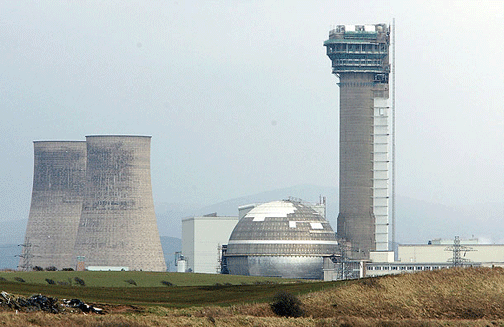
Ceredigion could be considered for potential nuclear waste storage site, Tivyside Advertiser, By Dave Parkinson 6 Mar 19, WITH parts of Wales being considered as possible sites to bury radioactive waste, Ceredigion County Council has reiterated a long-standing nuclear-free commitment.
A motion was approved by the council in July, 2006 which made a commitment that the council would be a nuclear free local authority. Another commitment was made to support sustainable alternatives to nuclear power.
Cllr Ellen ap Gwynn proposed the motion in 2006 and is now the leader of the council. She said: “Nothing has changed in the council’s approach to nuclear power. It’s clear to us that most Ceredigion residents don’t want nuclear sites in the county……..
Radioactive Waste Management (RWM) – set up by the UK Government – is on the look-out for a suitable site in which to dispose of radioactive waste.
England and Wales have been divided into sub-regions which could potentially house an underground geological disposal facility (GDF).
Geological disposal involves placing waste in sealed vaults and tunnels deep underground, beneath several hundred metres of solid rock…….
RWM is now seeking “willing communities” to come forward if they are interested in being considered for the GDF. …….
Anyone interested in finding out more can attend one of two public meetings. They will take place in Swansea on Tuesday, March 12, and in Llandudno on Thursday, March 14.
For more details visit http://bit.ly/2GmIdAU or gov.uk/guidance/site-evaluation-consultations-public-events
https://www.tivysideadvertiser.co.uk/news/17480247.ceredigion-could-be-considered-for-potential-nuclear-waste-storage-site/
March 7, 2019
Posted by Christina Macpherson |
opposition to nuclear, UK |
Leave a comment
 Bridgwater Mercury 5th March 2019 R
oy Pumfrey, Cannington resident and Stop Hinkley spokesman has a number of
concerns about the new EDF Sedgemoor Campus off Bath Road.
The opening of ‘Barcode City’, the Bath Road hostel for Hinkley C workers (‘Hinkley Campus open’, Mercury, February 26) serves yet again to highlight the multiple problems with this project. Why is the ‘campus’ so small and so late on the scene? Rooms for 986 may sound a lot, but EDF have just announced that they want a 2,400 bed hostel at Sizewell in Suffolk. Oh, and it is a hostel by the way, not a hotel as a recent BBC radio programme claimed.
If it’s only for Hinkley workers and the public can’t get a room, it’s a hostel! And why have we had to wait until the pressure on the local rental property market was so great before any EDF accommodation has appeared? One bedroom rents locally have risen from £380pcm 18 months ago to around £550 now. That’s a 45 per cent increase that people not
working at Hinkley simply won’t have been able to afford.
EDF is forever banging on about 25,000 Hinkley C jobs. It would be more honest of them if they admitted that they mean 24,100 notices of termination, as there are just 900 permanent jobs at HPC, if and when it is ever working. The prospect of that happening gets less by the week.
The French Government is taking nuclear back under state control, which makes Hinkley an oddity, and EDF can’t get Flamanville to work, which puts the vital UK Government loan guarantees for Hinkley C in danger of disappearing. The future fate of the Bath Road site was left hanging in your article. Let’s be in no doubt about what won’t be happening.
The nature of the blunt instrument that is a Development Consent Order means the only permanent legacy Bridgwater will
see is the power station and an enormous radioactive waste store, twice the size of what EDF originally proposed. All the temporary structures – the jetty, two hostel sites, park and rides, office blocks, freight lay-downs etc etc – have to be removed. EDF has already said its fantasy is to spirit the Bath Road units away to its improbable development at Sizewell.
As for the sites, acres of tumbleweed are all we have to look forward to.
https://www.bridgwatermercury.co.uk/news/17478105.letter-what-will-become-of-barcode-city/
March 7, 2019
Posted by Christina Macpherson |
politics, UK |
Leave a comment
 Daily Record 3rd March 2019 More than 500 “significant” health and safety incidents were recorded at the Faslane nuclear submarine base last year, the Sunday Mail can reveal. Documents released to the SNP under Freedom of Information for the Royal Navy facility near Helensburgh, in Dunbartonshire, show the figure has almost quadrupled since 2014.
Last year, there were 481 health and safety incidents at the high security base compared to 123 in 2015, 377 in 2016 and 501 in 2017. A statement confirmed that under Naval command, only those deemed as “significant” were now recorded on central systems.
https://www.dailyrecord.co.uk/news/politics/faslane-nuclear-fears-after-500-14079043
March 4, 2019
Posted by Christina Macpherson |
incidents, UK |
Leave a comment
Times 3rd March 2019 Rolls-Royce is selling the vast bulk of its civil nuclear business, dealing a new blow to efforts to rebuild Britain’s atomic power industry. The FTSE 100 engineer has hired consultants from KPMG to find a buyer for the
nuclear division, which could fetch up to £200m.
The move marks the end of an era for the country’s premier engineering company, which has more than 50 years’ expertise in nuclear power but is being slimmed down by chief executive Warren East to focus on jet engines, power generators and defence. The nuclear business makes instruments and controls to monitor radiation and temperature and prevent reactors overheating. Its equipment is installed in more than 200 reactors around the world, and it has a big presence in France, where it works with the state-backed engineering firm Orano , [formerly Areva, which went bankrupt]
Rolls-Royce’s retreat from civil nuclear work reflects the industry’s broader problems. Plans for new power stations in Britain have been left in tatters after the Japanese industrial giants Toshiba and Hitachi withdrew, leaving just Hinkley Point in Somerset under way.
The Japanese exit has triggered an inquiry by the Commons business committee into future investment in energy infrastructure. The sale will not include Rolls-Royce’s work on Hinkley Point, which is ringfenced, the company’s
project to develop small reactors or its nuclear submarine reactor business.
Rolls-Royce has been in talks to install its equipment at a plant in Essex planned by China General Nuclear, to help assuage security concerns. This work is likely to be transferred to the new owner. Sources said the business, which has more than 1,000 staff, was likely to go to a trade buyer. A Chinese deal is unlikely.
https://www.thetimes.co.uk/edition/business/rolls-royce-to-offload-civil-nuclear-unit-zsq59zlmm
March 4, 2019
Posted by Christina Macpherson |
business and costs, UK |
Leave a comment
Nuclear waste meeting in Swansea is cancelled and replaced with an online event Wales Online, By Robert  DallingSenior Reporter 1 MAR 2019
It was one of a series of meetings taking place across the country to discuss where to bury the country’s most dangerous radioactive waste.
The organisation that had planned a meeting in Swansea about where to store nuclear waste has cancelled it, and said it’s staging an online event instead.
Government-run Radioactive Waste Management was behind the meetings in Swansea and Llandudno to discuss where to create a geological disposal facility for burying the UK’s stockpile of the most dangerous radioactive waste.
No details of any potential sites were made public and it was understood that the body was seeking “a willing host community” where radioactive waste could be stored hundreds of metres underground.
The Swansea meeting was planned for Tuesday, March 1
A statement from the firm read: “Radioactive Waste Management (RWM) respects the views expressed by Swansea Council in their proposed motion (for consideration on 28 February) about hosting a Geological Disposal Facility (GDF) in their area.
“RWM also reaffirms that none of its regional events, including the one for Swansea , is linked in any way to where a GDF might be sited and no site anywhere in England or Wales has been targeted, proposed or chosen. A GDF can only be sited in Wales if a community is willing to host it…….
It is expected that the process of selecting an underground site and going through the planning and construction process will take decades with any chosen site first receiving waste in the 2040s.
The Government said communities interested in hosting a GDF could receive up to £1m a year initially and up to £2.5m a year if deep borehole investigations took place.
Swansea Lib Dem councillor Peter Black criticised the move to cancel the physical meeting.
He said: “I think we should have met them face to face so as to get some clarity as to what exactly they were proposing.
“A webinar means that many people who might want to contribute to this debate, who are not on the internet, will now be excluded.”
Leader of Swansea Council, Rob Stewart said: “I’m pleased that RWM has listened to the very strong representations that we have made and cancelled this meeting in Swansea.
“We note that they have replaced it with an online event so I will make it clear that we will not let up on in our fight until the Swansea Bay area is ruled-out as a potential location for a dump for radioactive waste.
“The reaction of most councillors, our local residents and businesses is clear – nuclear waste is not and never will be welcome here and we will not allow it.” https://www.walesonline.co.uk/news/wales-news/nuclear-waste-meeting-swansea-cancelled-15901315
March 2, 2019
Posted by Christina Macpherson |
politics, UK, wastes |
Leave a comment
East Anglian Daily Times 23rd Feb 2019 Suffolk residents pack out Theberton church to have their say on Sizewell
C. Worried residents from across east Suffolk voiced their dismay about plans for Sizewell C at a public meeting near the proposed site on Saturday morning. Residents have long been concerned that the plan will have
long-lasting effects on the areas environment and tourist industry, while other issues such as roads, traffic and an anti-nuclear attitude were also voiced in the meeting organised by Theberton and Eastbridge Action Group on
Sizewell (TEAGS).
TEAGS representative Charles McDowell said that “The link road they have proposed will cut parishes in two, breaks up fields and makes them inviable for farming. “It makes you wonder if they [EDF] are out for revenge against the people of Theberton.” The power station’s proximity to nationally renowned nature reserve, RSPB Minsmere ruffled feathers with residents concerned for the safety of the birds, and in turn the effect a downturn would have on the local tourism economy, worth £250 million.
Adam Rowlands, the RSPB’s Suffolk area manager, said: “In terms of flora and fauna in the area, this is a matter of international importance.” Another resident said that the plans could see a ‘decimated natural environment’ left for his children and grandchildren.
County councillor Guy McGregor, who was responsible for the council’s previous response to the plan, said that although it would see opportunities for employment, the problems outweighed the benefits, highlighting the ‘constant stream’ of heavy goods vehicles that would create traffic and pollution. EDF’s plans could see up to 1,500 HGVs on
the county’s roads, in addition to the extra traffic that would be created by the construction of a new build town or campus which would house 2,400 workers at Eastbridge.
Richard Smith – who is now the county councillor leading negotiations with EDF – praised the efforts of TEAGS
and residents, saying: “There is no better way for a community to voice its concerns like how you have. It sends a huge message to EDF.” Mr Smith did warn however that the authority has ‘no direct power’, but urged residents to continue their campaign.
https://www.eadt.co.uk/news/sizewell-c-concerns-bring-hundreds-to-theberton-church-1-5904154
February 25, 2019
Posted by Christina Macpherson |
opposition to nuclear, UK |
Leave a comment
 CofE backs further action on climate change
Christian Today staff writer Fri 22 Feb 2019 The Church of England will step up its environmental programme in response to the escalating threat of climate change, its General Synod voted today.
A motion brought by the dioceses of London and Truro was approved, committing the Church to accelerating its existing environmental programme and calling on every diocese to put in place an environmental programme overseen by a designated member of the bishop’s staff team…… https://www.christiantoday.com/article/cofe-backs-further-action-on-climate-change/131845.htm
February 25, 2019
Posted by Christina Macpherson |
climate change, Religion and ethics, UK |
Leave a comment
 Orsted’s Hornsea Project Spawns Talk of Offshore Wind Replacing Nuclear, Greentech Media, JASON DEIGN FEBRUARY 22, 2019
 Danish developer Ørsted said its Hornsea One plant, which started delivering power to the grid this month, could help make up for a lack of planned nuclear generation in the U.K., as plans for new reactors have fallen by the wayside.When complete, Hornsea One will cover more than 157 square miles, making it bigger than the city of Denver, and have a peak capacity of 1.2 gigawatts, thanks to 174 turbines of at least 7 megawatts each.
It will be the biggest offshore wind plant on the planet, dwarfing the current leader, Walney Extension, which Ørsted opened last September with a capacity of 659 megawatts. Ørsted has plans for an even bigger project, the 1.8-gigawatt Hornsea Two plant, in U.K. waters………
Not just a U.K. debate
Given that the U.K. is relying on a largely untested reactor design for upcoming nuclear capacity, it is perhaps legitimate to ask if the reliability of new reactors will be significantly greater than those of gigawatt-scale offshore wind farms built at the same time.
Tom Dixon, wholesale team leader at U.K. consultancy Cornwall Insight, said: “New offshore wind farms being developed are now much more reliable than older offshore sites or their onshore counterparts.”
As a result, he said, “it is credible to say that the shortfall in new nuclear could be made up by offshore wind, with improving operational performance and relatively low costs for the technology, but additional flexibility would be required at times when output is low.”
It is not just the U.K. where offshore wind could potentially take over new nuclear’s mantle.
This month, in the wake of a partnership between Ørsted and Tokyo Electric Power Company, the analyst firm Wood Mackenzie Power & Renewables questioned whether offshore wind could also be a cure for rising energy demand as new nuclear languishes in Japan.
“Rising costs and a lack of public confidence in Tepco’s ability as a nuclear operator have led the company to reconsider its future strategy,” said WoodMac senior analyst Robert Liew. “Tepco’s involvement in offshore wind is a crucial development.” https://www.greentechmedia.com/articles/read/hornsea-spawns-talk-of-offshore-wind-replacing-nuclear#gs.v9EFOjv7
February 23, 2019
Posted by Christina Macpherson |
renewable, UK |
Leave a comment

U.K. Nuclear and Military Exporters Told to Prepare for Hard Brexit https://www.bloomberg.com/news/articles/2019-02-20/u-k-nuclear-military-exporters-told-to-ready-for-hard-brexit, By Jonathan Tirone, February 21, 2019,
U.K. makers of nuclear material, weapons and sensitive technologies are being urged by the government to get new export licenses to prepare for a no-deal exit from the European Union.
Companies need to register and to obtain permission under the U.K.’s new “Open General Export License” to continue exporting so-called dual use goods to the EU from March 29, according to a statement from the Department for Business, Energy and Industrial Strategy.
Licenses for dual use items “will not be valid” if the U.K. crashes out of the bloc without a deal. Existing licences issued in the U.K. for the export of so-called Trigger Listitems — which have already been subject to assessment — will remain valid .
BAE Systems Plc and Urenco Ltd. are among U.K. companies that would be most directly impacted by a no-deal Brexit. Thousands of items ranging from computer software and digital converters to fuel cells and robotic arms face trade restrictions without new paperwork.
The U.K. also warned this week that new restrictions could be imposed on shipments of spent nuclear fuel and other radioactive waste under a no-deal scenario. Just as banks have made London a global financial hub, its ties to the EU’s nuclear industry has helped turn the U.K. into a central cog servicing the world’s flow of atomic materials.
February 21, 2019
Posted by Christina Macpherson |
business and costs, politics international, UK |
Leave a comment
Scottish ministers can stop nuclear waste dump, say advisers, The Ferret, 19 Feb 19, Scottish ministers have the power to halt plans to dump nuclear waste on Aboriginal land in Australia which could breach human rights, according to government advisors.
Documents obtained by The Ferret reveal that expert advice sought by ministers stated that the Scottish Government could prevent the export of radioactive waste from the UK under a swap arrangement involving the Dounreay nuclear complex in Caithness.
The revelations have prompted campaigners to call for the Scottish Government to step in and stop the waste dumping, which they see as a potential desecration of sacred Aboriginal lands in south Australia.
The Scottish Government and its regulator, the Scottish Environment Protection Agency (Sepa), have insisted that regulating the waste shipment is not their responsibility – but Sepa’s former chief executive says this is wrong.
Nuclear fuel was sent from an Australian research reactor to Dounreay for reprocessing in the 1990s. The resulting radioactive waste, amounting to 51 cemented drums, was originally due to be returned to Australia for disposal.
But under the terms of a waste substitution deal in 2014, Scottish and UK governments agreed that the drums should stay at Dounreay because of the difficulties of transporting them around the globe……
Peter Roche, an anti-nuclear campaigner and member of Nuclear Waste Advisory Associates, pointed out that environmentalists were opposed to nuclear waste being transported around the world. “It should be stored in above
ground stores on the site where it is produced,” he said. “And should certainly not be sent back to Australia if it is likely to pose a potential risk to the rights of Aboriginal communities near the two proposed storage sites in Australia.” He added: “The Scottish Government should accept that it bears some responsibility for this waste and tell the UK government
to halt the proposed shipment.” https://theferret.scot/scottish-government-australian-nuclear-waste/
February 21, 2019
Posted by Christina Macpherson |
AUSTRALIA, UK, wastes |
Leave a comment
|
Shelved nuclear power plans leave UK government’s energy policy in hot water, Chemistry World BY MATTHEW GUNTHER, 20 Feb 19, The UK government’s nuclear energy policy is in disarray after the Japanese company Hitachi stopped work on a proposed plant in Wylfa last month. The move comes just months after fellow Japanese firm Toshiba shelved plans to build a nuclear power station in Cumbria.On 17 January 2019, Horizon Nuclear Power, the Hitachi-owned subsidiary responsible for the Wylfa project, put all construction at the site on hold. The £15 billon 2.9GW nuclear power plant was to have a 60-year operational life. Hitachi also scrapped plans for another reactor at Oldbury.
Hitachi has already invested around £2 billion into the Wylfa project prior to the announcement, with the UK government offering to invest £5 billion. But spiralling costs led to doubts that the project would survive through financing negotiations. F
‘Negotiations had been going on for about six months,’ explains Tom Greatrex, chief executive of the Nuclear Industry Association. ‘Although the UK government has got to a point of what it would agree to, and Hitachi got some investment in place, there wasn’t enough.’
Simon Taylor, an economist with the Energy Policy Research Group in Cambridge, UK, agrees with Greatrex, but says it is unclear why the Wylfa project has ultimately stalled. ‘I can only assume that they wanted the government to take more of the risk – particularly the construction risk,’ he says.
The recent troubles at Toshiba may also have encouraged Hitachi to limit the risk it was exposed to, according to Taylor. Last year Toshiba announced it would end all new global nuclear projects, including a planned site at Moorside in Cumbria. The company had invested £400 million in Moorside before pulling out in response to its US nuclear division filing for bankruptcy.
Such failures highlight one issue with a new nuclear project, explains Taylor: ‘[It] is extremely expensive and it involves a lot of risk.’
Striking a deal
Financial risk is an inevitable part of large infrastructure projects, but the nuclear industry has a unique set of challenges to overcome. Taylor explains that even if a firm’s reactor has a proven track record, it must make design modifications to satisfy local regulators. This forms part of the UK’s Generic Design Assessment (GDA) – a rigorous review process that can last years. The GDA for Hitachi’s Wylfa reactor was completed within four.
Once the GDA is signed off and the site approved, only then can a firm begin to build its power plant. But, under current UK policy, the high costs associated with construction lie solely with the company. The final construction bill for the Wylfa plant was to be an estimated £15 billion……….https://www.chemistryworld.com/news/shelved-nuclear-power-plans-leave-uk-governments-energy-policy-in-hot-water/3010136.articleEBRUARY 2019
|
|
February 21, 2019
Posted by Christina Macpherson |
business and costs, politics, UK |
Leave a comment
 Council leader voices ‘strong opposition’ to nuclear waste burial proposals https://www.walesonline.co.uk/news/local-news/council-leader-voices-strong-opposition-15847252Meetings are taking place in Wales next month as part of the search for a site in which to bury the country’s most dangerous radioactive waste, Elizabeth BradfieldLocal Democracy Reporter, 18 Feb 19,
The leader of Neath Port Talbot Council has said the local authority will not engage “at any level” when it comes to an upcoming consultation on possible sites where nuclear waste can be buried.
Meetings are taking place in Wales next month as part of the search for a site in which to bury the country’s most dangerous radioactive waste.
The UK Government wants to bury the lethal stockpile that has been accumulating from nuclear power stations over the last 60 years.
People in two areas – Swansea and Llandudno – are to be consulted as part of the hunt for a “willing host community”.
There are also consultations in eight parts of England.
At a full council meeting on Wednesday, February 14, council leader Rob Jones said: “There have been a number of articles in the media this week concerning public meetings to be organised, apparently, by an agency of the Nuclear Decommissioning Authority to consult on the possibility of sites being identified for the disposal of nuclear waste.
“I want to make it absolutely crystal clear that Neath Port Talbot Council will not be engaging in this process at any level.
“The Welsh Government has made it clear that they would only support such a proposal if the community concerned was willing.
“Well, ours is not as far as I’m concerned and that is the end of the matter.
“Moreover, in the unlikely event that a credible proposal emerged in any adjacent area, we would very strongly oppose that as well.”
The waste is currently stored in 20 sites around the country in specially-engineered containers but this is not seen as a long-term solution.
It is expected that the process of selecting an underground site and going through the planning and construction process will take decades with any chosen site first receiving waste in the 2040s.
The government website says that communities willing to take part on the consultation will receive £1m a year initially and up to £2.5m a year if boreholes are drilled.
A website has been set up by the UK Government to inform the public geologicaldisposal.campaign.gov.uk
February 19, 2019
Posted by Christina Macpherson |
opposition to nuclear, UK, wastes |
Leave a comment
 Bridgwater Mercury 14th Feb 2019 , MORE than 70 children from local primary schools headed to Hinkley C last week for the official naming ceremony of three enormous tunnel boring machines.
The competition gave 215 primary schools from across Somerset the
opportunity to name the three 1,200 tonne tunnel boring machines that will
soon begin the construction of the new power station’s water inlet and
outfall tunnels. After arriving safely at the construction site by sea and
road, the trio of tunnelling machines will soon be removing 370,000 cubic
metres of earth to enable 3.3 kilometres of tunnels to be built underneath
the seabed. The tunnels will carry seawater to cool the two reactors, the
first of which will see first operation in 2025.
ttps://www.bridgwatermercury.co.uk/news/17433214.huge-hinkley-c-tunnel-boring-machines-named-after-inspirational-women/
February 18, 2019
Posted by Christina Macpherson |
Education, UK |
Leave a comment
Can offshore energy replace a failing nuclear industry? The Manufacturer, 12 Feb 2019 by Maddy White
The world’s largest offshore windfarm off the Yorkshire coast is to supply its first power to the UK electricity grid this week. Could it fill the gap left by a failing nuclear industry? When fully operational next year, Hornsea One will be the largest windfarm in the world. Its 174 Siemens 7MW turbines will generate enough electricity (1.2GW) to reportedly power more than one million homes.
The electricity generated by the turbines 120km off of the Yorkshire coast will pass through one of three offshore substations, before being carried by three high voltage subsea cables (245kV).
Danish developer Ørsted’s project propels the offshore wind power sector to a new scale; Hornsea One will cover 407 sqkm – almost eight-times the size of Norwich
Rapid growth for renewables
A clean and sustainable energy supply, and reducing the impacts of climate change has become priority for countries across the globe as part of the Paris Agreement. Climate change was also found, in the World Economic Forum’s global risks report, to be the biggest concern for business in 2019.
The UK committed to reducing its greenhouse gas emissions by at least 80% by 2050, relative to 1990 levels, but the question remains just how can this be achieved?
Offshore windfarms could help fulfill this. Additionally it could aid the low carbon power gap created as a result of Hitachi and Toshiba recently scrapping nuclear plant projects in Wales and Cumbria. Hitachi followed Toshiba’s move and halted work on the Welsh site earlier this year due to rising costs………
A failing nuclear industry
Last year renewable energy supplied a record 33% of the UK’s electricity, opposed to 19% from nuclear. As technology advances, renewable energy has become cheaper and the logical energy source.
Hinkley C, the nuclear power plant in Somerset is years behind schedule, and billions over budget. Alongside Hinkley, there were five other plants with nuclear proposals: Moorside (Cumbria), Wylfa (Wales), Oldbury (West Midlands), Bradwell (Essex) and Sizewell (Suffolk).
Three have been scrapped and two are yet to be approved. Of the eight sites currently generating power, the Nuclear Industry Association (NIA) report that only one is due to be in use by 2030…….
The renewable sector is rapidly growing, its technology advancing and its costs decreasing, while nuclear remains an expensive and complex option that is becoming less appealing.
Can renewable energy be created on the same scale as nuclear? As nuclear power plants shut down and reach their operational expiry date, their contributions to the UK’s energy mix becomes increasingly irrelevant.
With projects like Hornsea One, Two and Three in the pipeline, it seems renewable energy has gained notable momentum and if executed well, could mean its perhaps only a matter of time until nuclear is phased out entirely. https://www.themanufacturer.com/articles/can-offshore-energy-replace-a-failing-nuclear-industry/?fbclid=IwAR0OyYm24TSFr2y2JD_ibaOuNnziFiN_mR23G_eH0n2k1smw9HxsRe36pHc
February 18, 2019
Posted by Christina Macpherson |
renewable, UK |
Leave a comment